Perpetua quædam justitia: Casati's Eight Books on Mechanics
Paolo Casati, a Piacenza-born Jesuit who taught mathematics at the Collegio Romano and later governed the Province of Parma, spent decades reducing every machine — lever, pulley, wheel, wedge, and screw alike — to a single principle: what you gain in weight you pay for exactly in velocity, a bargain he called a perpetua quædam justitia. His Mechanicorum libri octo, printed at Lyon in 1684 under royal privilege, is the mature distillation of those lecture courses, a mixed-mathematical textbook that couples Archimedean geometry with an unabashedly scholastic physics of impetus — a force whose persistence in a moving body he defended by analogy with how the Eucharistic accidents endure apart from their substance. It matters because it shows a first-rate Jesuit mathematician accepting Galileo's results on free fall while refusing his explanations, holding open a physical vocabulary that modern historians still cannot agree to call either a genuine alternative or a scholastic relic.
ExLatinis
July 28, 2026
Contents
Paolo Casati, a Piacenza-born Jesuit who taught mathematics at the Collegio Romano and later governed the Province of Parma, spent decades reducing every machine — lever, pulley, wheel, wedge, and screw alike — to a single principle: what you gain in weight you pay for exactly in velocity, a bargain he called a perpetua quædam justitia. His Mechanicorum libri octo, printed at Lyon in 1684 under royal privilege, is the mature distillation of those lecture courses, a mixed-mathematical textbook that couples Archimedean geometry with an unabashedly scholastic physics of impetus — a force whose persistence in a moving body he defended by analogy with how the Eucharistic accidents endure apart from their substance. It matters because it shows a first-rate Jesuit mathematician accepting Galileo's results on free fall while refusing his explanations, holding open a physical vocabulary that modern historians still cannot agree to call either a genuine alternative or a scholastic relic.
Among the mathematical treatises produced within the Society of Jesus in the second half of the seventeenth century, the Mechanicorum libri octo of Paolo Casati — a Piacenza-born Jesuit (1617–1707) who taught mathematics at the Collegio Romano from the early 1650s and rose to be Provincial Superior of Parma — occupies a singular place. Printed at Lyon in 1684 by the Anisson–Posuel–Rigaud partnership under royal privilege, it is a systematic didactic work in the mixed-mathematical tradition: eight books that promise, on their title page, to explain the forces of machines physically and to demonstrate them geometrically, all under one and the same principle, that of the lever. A first-time reader should know at the outset that this is a textbook in the fullest early modern sense — the mature distillation of decades of lecture courses — but a textbook with a thesis, and one whose Latin (with its occasional Greek lemmas) carries a distinctive conceptual freight.
The central intellectual problem the treatise confronts is deceptively simple: how do machines multiply human power without themselves contributing any force? Casati's recurring answer is a reduction — every mechanical device, the balance, the lever, the wheel and axle, the pulley, the wedge, and the screw alike, is brought under a single dynamical principle whereby advantage gained in weight is paid for exactly in velocity. What is bought in one currency is spent in another, and between the power, the weight, the spaces traversed, and the times elapsed there is preserved what he calls a perpetua quædam justitia, a certain perpetual justice. The machine, on this account, adds nothing interior to the moving power; its efficacy resides in figure and arrangement alone. Around this core Casati builds a deliberately two-fold method, expository rather than axiomatic — chapters, not theorems — that interleaves geometric and trigonometric demonstration with a physical account of motion cast in the inherited vocabulary of impetus.
The stakes of this project are both disciplinary and confessional. Casati writes in the wake of Galileo, and he does not refuse Galilean results: he accepts that the spaces of free fall are as the squares of the times, and he reports his own observations from the tower of Bologna. Yet he declines the Galilean and Cartesian explanations of those results, retaining impetus as the proximate efficient cause of local motion and defending, against the Aristotelian mainstream, a positive levity — lightness as a real quality rather than a mere privation of weight. What makes the treatise genuinely distinctive is that this physical vocabulary is bound up with a theological commitment: the persistence of an impressed force in a body after separation from its mover is licensed, for Casati, by the same divine power that the Eucharistic mysteries reveal, whereby accidents may persist apart from their subject. The doctrine of impetus is thus, in his hands, at once a principle of mechanics and a piece of Jesuit natural philosophy. Whether that vocabulary represents a substantive theoretical alternative to Galilean–Cartesian mechanics or a scholastic survival awaiting elimination remains a live question among modern interpreters, and the evidence sustains both readings.
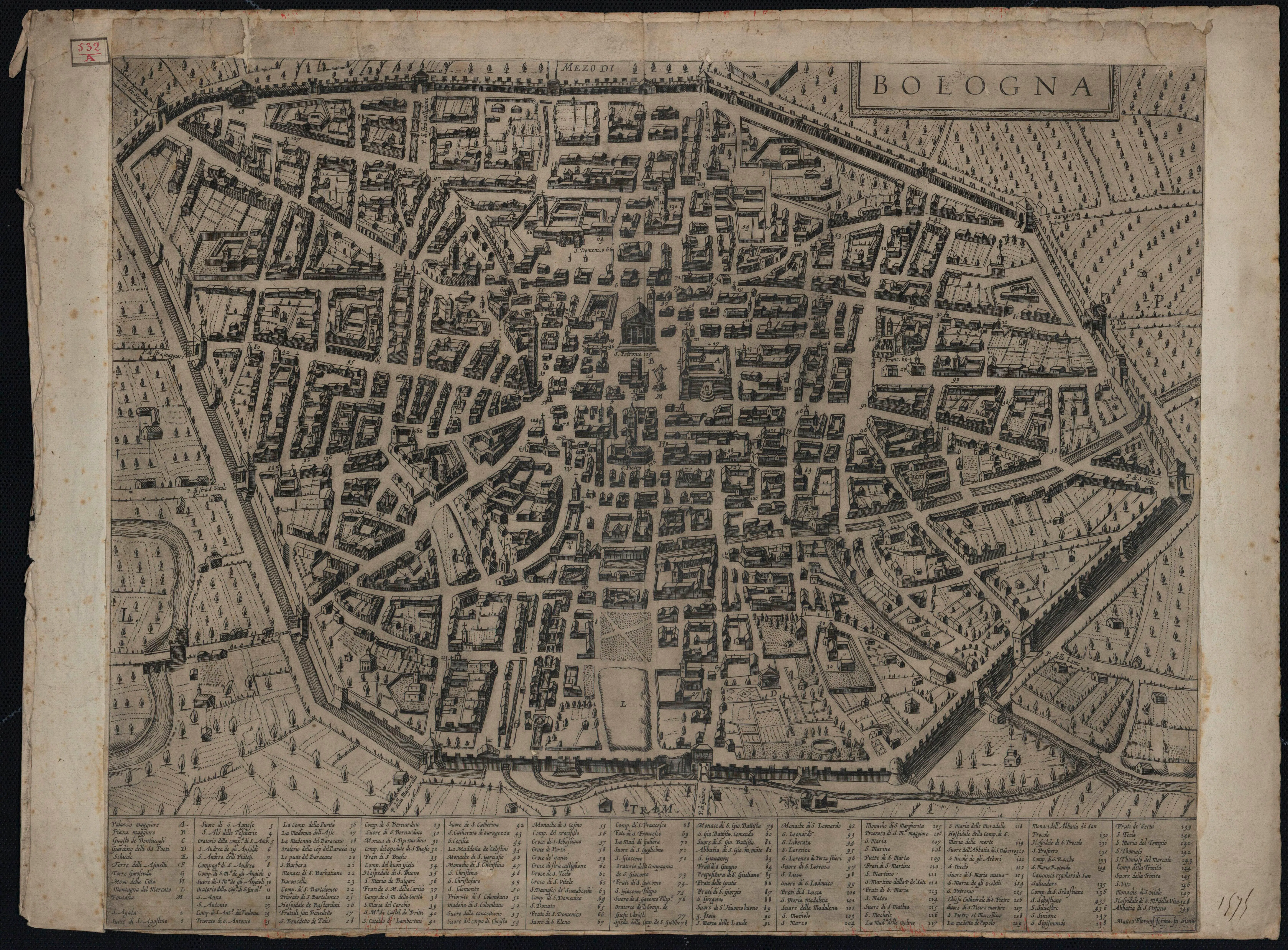
Matteo Florimi’s period plan of Bologna evokes the city not as a generic scholarly backdrop but as the empirical setting in which Casati linked Jesuit natural philosophy to post-Galilean mechanics through tower-based observations of falling bodies. Its dense urban fabric and prominent vertical structures make visible the kind of civic space in which measurement, correspondence, and collaboration with Bolognese figures such as Riccioli and Grimaldi could converge. Source ↗.
Several particulars will strike the reader as memorable. Casati systematically refutes two received reductions — the circle-reduction of mechanical powers descending from the pseudo-Aristotelian Quaestiones Mechanicae, and the reduction of the screw to an inclined plane — and, having cleared the ground, judges the screw the most efficacious of all the faculties. He tempers the ancient boast of Antipho that art conquers nature, insisting that machines are an aid to human weakness rather than a mastery over the world; and he vindicates the Archimedean promise to move any weight, even the earth, as free of all arrogance once the trade of velocity for weight is understood. His erudition ranges from the trigonometry of helices and pendulum arcs to the rivers and boats of China as reported in Martini's Atlas Sinicus, which he treats with a sceptic's caution. Throughout, the reader encounters a mind at once systematizing and physical, geometrical and confessional.
The account that follows traces these threads: the philological weight of Casati's three governing terms, the shape and ambition of the treatise as a whole, its place within Jesuit mathematical culture and the historiographical debates it has provoked, and the material and biographical circumstances of its single Lyon edition of 1684.
Read the full text and English translation on Leo
This text was transcribed and translated as part of the ExLatinis project, an effort by Leo to make free English translations of every text published in Latin in early modern Europe (1450–1750) available online. The complete transcription and English translation of this work can be read free of charge:
→ Read the original Latin text and full English translation on Leo
You can save a copy of this document into your Leo account to run deep text searches, conduct further analysis, or cross-reference it with your own research.
Assigning an English Title and Unpacking Casati's Governing Terms
Editorial English Title (supplied for convenience; no established English title exists in the scholarly literature)
Eight Books on Mechanics, in which, by one and the same principle of the lever, the forces of machines are physically explained and geometrically demonstrated, and a method of composing machines of every kind is set forth (after the Mechanicorum libri octo of 1684)
Philological Framing
Three terms bear the conceptual weight of Casati's treatise and each demands separate philological unpacking because the meanings they carry within the Mechanicorum diverge from both their inherited scholastic senses and from the Galilean–Cartesian vocabulary that was becoming standard in the later seventeenth century.
The first is impetus. Casatus adopts the technical sense current among Jesuit natural philosophers at Bologna and Rome in the mid-seventeenth century, in which impetus is the proximate efficient cause of local motion, an impressed force lodged in a moving body after separation from the original mover. This is the impetus innatus of high-scholastic lineage (Buridan, Albert of Saxony, the via moderna), transmitted to the Collegio Romano circle through Riccioli's commentaries and through Biancani's Aristotelian scholarship; it is emphatically not the Cartesian quantitas motus conserved in straight lines, nor the Galilean reduction of accelerated motion to the accumulation of a uniform quality of motion in equal instants. The treatise states the causal priority in its own terms, declaring that in the first moment of time it was not motion that produced impetus, but impetus that most immediately produced motion, and that the innate power of moving begot the impetus, Igitur & priore illo temporis momento non motus impetum; sed impetus motum proximè effecit; impetum autem procreavit innata movendi vis. Within the Mechanicorum, impetus is invoked most pointedly in the treatment of percussion (Liber VII, De Cuneo & Percussionibus), where a striking body's impetus is conceived as a transient, self-expending power that can be transmitted to the parts of a compound machine and that, precisely because it is transient, must be renewed at every instant of natural accelerated descent. The split between impetus innatus and impetus acquisitus allows Casatus to subscribe to the Galilean double-distance rule of free fall while resisting the Galilean explanation of it: he concedes that spaces are as the squares of times, but he explains the doubling by a fresh impetus acquisitus added at each instant, not by a uniformly accelerated quality inhering in the body. The philological interest of the term in this treatise therefore lies in its dual function as a term of physical explanation and as a term of theological caution: the impetus doctrine had been a Jesuit instrument since Suárez for articulating how accidents (the Eucharist's sensible qualities) can inhere in a subject without a substance, and Casatus's continued deployment of the term keeps that theological–physical analogy alive in mechanical philosophy.
The second is momentum. The word had a strictly defined technical sense within the Jesuit tradition of mechanics that Casatus inherits: momentum is the commensurate quantity obtained by compounding weight against velocity, by which two heterogeneous magnitudes are rendered comparable for the lever and its derivatives. The Latin momentum derives from momentum ponderis—a weight's "movement" in the oblique direction of a balance arm—preserved by medieval theorists of the Quaestiones Mechanicae and rendered mathematically tractable by the Tertiae Personae axiom of Archimedean equilibrium (that two bodies are in equilibrium on a straight lever when their distances are inversely as their weights). In Casatus the term is restricted to this mixed-mathematical sense: it is the quantity by which a small weight traverses a large arc and raises a great weight through a small one. He states the commensuration as an exact equality of resistance, since as much as greater velocity adds to a smaller weight, so much does a greater weight add to a smaller velocity, est enim omnino par resistentia; quia quantum addit major velocitas minori ponderi, tantumdem addit majus pondus minori velocitati. He explicitly refuses to extend the term to the Cartesian or Leibnizian sense of vis motrix conserved in collision, and he resists any identification of momentum with what Newton would later call quantity of motion (the product of mass and velocity in a single direction). For Casatus, momentum is, precisely, a scalar commensuration between weight and the velocity of a point on the lever arm, and the unification of the mechanical powers under one principle of momentum—announced on the title page and carried out across the eight books—depends on this restricted sense. This is the principle he casts as a perpetua quædam justitia, declaring that there is preserved a certain perpetual justice among the powers of the potency, the gravity of the weight, the spaces of the motions, and the times, Servatur itaque perpetua quædam justitia inter potentiæ vires, oneris gravitatem, spatia motuum, ac tempora. The philological stake here is the discipline's nominalist inheritance: by retaining momentum as a quantity defined only at the lever and only as the commensuration of two qualitatively distinct magnitudes, Casatus keeps the mixed-mathematical status of mechanics intact and refuses to assimilate it to a universal natural philosophy of motion.
The third pair is gravitas and levitas positiva. Casatus distinguishes gravitas absoluta from gravitas secundum speciem: a body may be heavier in kind than another without being heavier absolutely, because gravitas is determined not only by the quantity of matter but by the position of the body's centrum gravitatis in relation to the centre of the world-sphere. The opening of Book I signals that gravity cannot be passed over in an inquiry into the powers of machines, since, about to explore the powers of machines by which we resist the innate propensity of bodies to motion or rest, he cannot pass over gravity itself, MACHINARUM vires, quibus innatæ corporum in motum aut quietem propensioni obsistimus, exploraturus, præterire non possum gravitatem ipsam. From this definition he derives the defence of levitas positiva: lightness is not, as in the conventional Aristotelian analysis, a mere privatio gravitatis—a denial of weight—but a positive quality inhering in certain bodies and accounting, for example, for why an inflated vesicle submerged in water rises, why flame rises in air, and why, in the experiments cited from the Accademia del Cimento, a cold body can fall more swiftly through a dense medium than through a rarer one. He puts the choice starkly, holding that if either gravity or levity must be removed from the middle, it is better to leave levity, Quod si vel gravitas de medio tollenda sit, vel levitas, satius est levitatem relinquere. The defence of levitas positiva is the point at which the Mechanicorum touches the experimental programme of the Cimento most directly, and it is also the point at which the impetus-vocabulary does its heaviest theological work: because levitas is a positive quality, it can be communicated as a transient impetus of ascent in exactly the way gravitas is communicated as a transient impetus of descent. The philological consequence is that Casatus can describe the upward motion of light bodies in the same mechanical language as the downward motion of heavy ones, without collapsing them into a single principle of inertia. In this respect the Mechanicorum diverges both from Aristotelian orthodoxy (which would treat levitas as a privatio) and from Galilean–Newtonian orthodoxy (which would treat positive levity as a category error); the divergence is held open by the careful distinction between gravitas absoluta and gravitas secundum speciem and by the parallel insistence on levitas as a realis qualitas.
Taken together, the three clusters frame the treatise's project: impetus supplies the language of efficient causation; momentum supplies the language of commensuration; and the gravitas/levitas positiva pair supplies the ontology of bodies that allows the two languages to be deployed together without committing the treatise to either the scholastic denial of positive levity or to a Cartesian assimilation of all motion to a single conserved quantity.
What the Mechanicorum libri octo Argues and How It Was Printed
The Mechanicorum libri octo is a systematic didactic treatise in the mixed-mathematical tradition, written in Latin (with occasional Greek lemmas) by the Italian Jesuit Paolo Casati (Piacenza 1617 – Parma 1707) and printed at Lyon in 1684 by the partnership of Jean Anisson, Jean Posuel, and Claude Rigaud under royal privilege, the imprint line reading LUGDUNI, Apud ANISSONIOS, IOAN. POSUEL & CLAUDIUM RIGAUD. M. DC. LXXXIV. CUM PRIVILEGIO REGIS. Its driving thesis is the reduction of the entire doctrine of the simple machines—the lever, the pulley, the wheel on an axle, the wedge, and the screw—to one and the same principle, that of the lever, understood as the commensuration of weight against velocity, such that every mechanical power is at once physically explicable and geometrically demonstrable. Casati states that in this the whole artifice of mechanics consists, namely that it so dispose its instruments and so place the potency and the weight in fitting positions that the potency's motion be swifter than the weight's motion, In eo igitur totum Mechanices artificium consistit, ut sua instrumenta ita disponat, locisque congruis ita Potentiam, & Onus collocet, ut Potentiæ motus velocior sit præ motu Oneris.
The work is a textbook of mixed mathematics: it belongs to the genre of post-Galilean systematic Jesuit mechanics and combines geometric demonstrations in the Archimedean tradition with physical accounts of natural and forced motion cast in the language of impetus. Casati insists that his chief care was to investigate the physical cause of the wondrous motions produced by machines, Hoc videlicet mihi potissimum curæ fuit, ut Physicam admirandorum per Machinas motuum causam investigarem, and he forestalls objection to his expository organization, asking that the method not be blamed because he has not arranged the whole matter into theorems and propositions but distributed it into chapters, Methodum ne culpes, quòd non in Theoremata & Propositiones rem totam digesserim, sed in Capita distribuerim. Casati taught mathematics at the Collegio Romano from the early 1650s; the Mechanicorum is the mature reworking of those lecture courses and appears nearly three decades after his inaugural cosmological dialogue Terra machinis mota (1658). No complete translation into a modern language is recorded in the standard reference works; the treatise survives in its 1684 Latin imprint and is read today primarily in that original form.
Placing Casati within Jesuit Mathematical Culture and the Modern Debate
The Place of the Mechanicorum in Jesuit Mathematical Culture. The treatise holds an exceptional position in the Latin-language Jesuit mathematical literature of the later seventeenth century. It is the most ambitious Jesuit treatise on mechanics published between Honoré Fabri's Physica, id est scientia rerum corporearum (Lyon, 1666–1671) and Francesco Eschinardi's Roman-College contributions of the 1680s, and is the only post-Galilean Jesuit treatise to propose a unified reduction of the five simple machines to a single principle. That unifying principle is the trade of velocity for weight already surfaced above, and its force lies precisely in the claim that the machine imparts no interior virtue of its own: from a machine as machine the powers of the moving potency are not increased, Casati holds it certain, for no interior virtue is imparted to it, A machinâ quâ machina est, potentiæ moventis vires non augeri certum est; nihil enim illi interioris virtutis impertitur. The historiographical consensus treats the work as the mature expression of the Roman College mathematical programme founded by Giuseppe Biancani and inherited through Riccioli, Grimaldi, and Kircher, and disseminated through the Jesuit international correspondence network.
The Historiographical Traditions. Three principal modern scholarly traditions frame the treatise. First, the Italian tradition led by Veronica Gavagna (Florence), whose 1999 article in the Bollettino di storia delle scienze matematiche, her 2002 chapter on Casati and the Jesuit vacuum controversy, and her 2011 chapter on Casati and the Galilean school reconstruct Casati within the Roman College tradition descending from Biancani through Riccioli and Grimaldi. Second, the Tel Aviv school of Rivka Feldhay, with Ayelet Even-Ezra (on heaviness, lightness, and impetus) and Michael Elazar (on Fabri, Casati, and Eschinardi) interpreting the work as a physicalisation of mathematical mechanics through the fusion of Archimedean statics and Aristotelian impetus theory, situating the Mechanicorum in dialogue with the Cimento's experiments on positive lightness. Third, the Anglo-American tradition of Jesuit science represented by Ugo Baldini, Michael John Gorman, and Mordechai Feingold's edited volumes on Jesuit mathematical culture provides the institutional context of Roman College teaching and correspondence.
Major Historiographical Disputes. The principal modern dispute is whether Casati belongs to the category of conservative Jesuit anti-Galileanism or to that of selective assimilation of Galilean results. The older reading, exemplified in popular and polemical accounts, places Casati among the conservative opponents of Galilean science. The Feldhay–Even-Ezra and Elazar–Feldhay chapters revise this reading, arguing that Casati selectively assimilates Galilean experimental results (the double-distance rule, the inclined-plane analysis) while preserving the impetus framework as a genuine theoretical alternative rather than as a scholastic residue awaiting erasure. That the assimilation of Galilean results is genuine and first-hand is confirmed by his own report of the tower experiment: from the very high tower of Bologna he observed unequal weights dropped, at first descending almost equally, so that sometimes the greater weight reached the earth when the lesser was still distant by forty feet, Et ex altissimâ turri Bononiensi dimissa pondera inæqualia observavi initio quasi æqualiter descendere... aliquando gravitas major terram attigerit, quando minor adhuc aberat intervallo pedum quadraginta. Gavagna's 2011 chapter occupies an intermediate position, framing Casati as part of a Galilean school pursued within the Jesuit system. The dispute turns less on whether Casati admits Galilean experimental data (both sides concede he does) than on whether the impetus vocabulary represents a substantive theoretical alternative to Galilean–Cartesian mechanics or a scholastic survival destined for eventual elimination.
Position among Contemporaries. Casati's position within the Jesuit scientific community is best understood against four contemporary reference points: (1) Giovanni Battista Riccioli and Francesco Maria Grimaldi at Bologna, whose Almagestum novum (1651) provides the immediate observational and theoretical backdrop; (2) Honoré Fabri, whose Physica offers a parallel Jesuit impetus theory in dialogue with Descartes and Galileo; (3) Giovanni Battista Hodierna and the Italian observational school; and (4) Francesco Eschinardi, whose later Roman-College contributions inherit Casati's impetus framework. Casati's treatise is unique among these in the ambition of its unifying claim for the lever as the single principle of all mechanics, a claim he presses through an explicit and sustained refutation of the pseudo-Aristotelian circle-reduction: it is manifest, he concludes, that the principle of mechanical motions is sought in vain from the circle, but that it is the one indicated by him, Manifestum est igitur frustrà ex circulo peti Mechanicarum motionum principium; sed illud esse, quod à nobis indicatum est.
The Theological-Philosophical Context. The treatise's persistence in the language of impetus is also legible as a quiet theological commitment. Within the Jesuit tradition following Suárez, the impetus doctrine had been deployed to explain how sensible accidents (the Eucharistic species) can inhere in a subject without their substance, by analogy with how an impressed force can inhere in a moving body after separation from the original mover. Casati registers the standard scholastic objection that accidents do not pass from subject to subject, which the very walls of the schools cry out, Accidentia autem ex subjecto in subjectum non transire, ipsi scholarum parietes clamant, and he answers it precisely from the Eucharist, teaching that by divine power we learn from the Eucharistic mysteries that accidents torn from their subject can persist, though without any efficient cause they can in no way subsist, Divinâ siquidem vi accidentia à Subjecto avulsa permanere posse docemur ex Mysteriis Eucharisticis; at sinè ullâ causâ effectrice consistere nullatenus possunt. Casati's retention of the impetus vocabulary in the Mechanicorum therefore also carries a theological weight, and the work's polemical target is not only the circle-reduction tradition but also the mechanist programmes of Gassendi and Descartes that would, in Jesuit eyes, dissolve the accidents-in-without-substance structure into bare mechanism.
The 1684 Lyon Edition: Printing, Privilege, and Provenance
Production and Transmission. The Mechanicorum libri octo is known in a single early edition, that of Lyon, 1684. It was printed in quarto format, measuring 225 × 161 mm, by the Anisson–Posuel–Rigaud partnership operating under royal privilege (cum privilegio regis). The work is recorded in Carlo Sommervogel's Bibliothèque de la Compagnie de Jésus (II, cols. 799–803) and in the Catalogus bibliothecae of the Jesuits as part of Casati's output; the imprint line on the title page reads Lugduni, apud Anissonios, Ioan. Posuel & Claudium Rigaud. The collation recorded in trade catalogues corresponds to a substantial octavo or quarto volume of roughly [16] preliminary leaves and approximately 799 pages of text, with woodcut or engraved diagrams integrated into the text block; the exact distribution of gathering signatures has not been confirmed against a printed exemplar and is flagged as not publicly verified.
The Lyon Printing House. The Anisson–Posuel–Rigaud partnership was a Lyon-based publishing consortium active in the late seventeenth century. Jean Anisson (1642–1721), son of Laurent Anisson and brother of Jacques I Anisson, was later elevated to directeur de l'Imprimerie royale du Louvre (1691–1707) and imprimeur ordinaire du Roi (1699–1707); Jean Posuel and Claude Rigaud are documented in the Marques d'impressors register of the Universitat de Barcelona (entry 105852862890a) as active from at least 1675, with surviving Lyon imprints for both religious and learned works attested in the Bibliothèque nationale de France. The partnership thus brought together two strands of Lyon printing: the Anisson family's ascent toward royal-imprimeur status, and a book-trade infrastructure oriented toward scholarly and devotional works.
Royal Privilege and Jesuit Internal Licensing. The title page bears the legend cum privilegio regis, signalling that the imprint enjoyed the protection of the French royal printing privilege. Casati's institutional standing at the moment of publication was high: he had served as Provincial Superior of the Jesuit Province of Parma from 1684 to 1688, a position that carried the authority to license Jesuit publications. The standard Jesuit internal apparatus is to be expected in the front matter — formal approbations by named Jesuit fathers and the Roman or Lyon permittitur of the order's censor — though the exact wording and signatories of these notices have not been independently verified in the catalogues consulted and are recorded here as not publicly verified.
Holding Institutions. The work is held by several major research libraries. The ETH-Bibliothek Zürich holds the digital exemplar used in this report (DOI 10.3931/e-rara-11641), and its presence in Zürich reflects the Swiss acquisition of Jesuit-library holdings in the eighteenth century. The Universidad Complutense de Madrid holds the copy digitised by Google Books. The Göttingen Digitisation Centre (GDZ) holds a copy under PPN 616532725. HathiTrust holds a digital exemplar drawn from the Université de Lyon collection and preserves a record under system number 009302566. The Bibliothèque nationale de France holds the exemplar cited in its catalogue under the provenance stamp of Jean-Baptiste Vulpin, with shelfmark consultation required for direct verification. Casati's writings are catalogued by the Italian national authority (SBN) under the authority record UFIV073337.
Dedicatory and Patronage Field. The principal dedicatee has not been conclusively identified in the sources surveyed. The Christie's catalogue description for the New York copy (lot 9, October 2023) records that the work was bound in eighteenth-century half-vellum over blue paper boards, with a manuscript title on the top edge and a shelf label on the spine, and bears a 1755 inscription of provenance from the Monastery of the Discalced Carmelites. The dedicatory epistle has not been independently confirmed in this research window and is marked as not publicly verified; further work in a printed exemplar is needed.
Interlocutors and Opponents. Casati's Mechanicorum sits at the centre of an identifiable Jesuit intellectual network at the Collegio Romano and the Jesuit college at Parma. Named interlocutors include Giovanni Battista Riccioli and Francesco Maria Grimaldi at Bologna, Athanasius Kircher and his circle in Rome, Honoré Fabri in Lyon and Rome, Giovanni Paolo Oliva as Superior General of the Society, Marin Mersenne and the Minim-Mersennian correspondence network, Kaspar Schott in Würzburg, and Martino Martini and the Jesuit cartographic mission in China. Casati's engagement with the Martini material is that of a cautious critic of testimony rather than an uncritical compiler: confronted with the report of a single Chinese rower equal to six or eight European sailors, he complains that it seems said so magnificently but expounded so meagrely that he does not easily allow words to be given him, Postremum hoc de uno remige sex aut octo nostraribus nautis æquivalente, adeò magnificè dictum videtur, sed & adeò jejunè expositum, ut verba mihi dari non facilè patiar. The named or implied opponents of the treatise are the Quaestiones Mechanicae tradition descending from the pseudo-Aristotelian Mechanical Problems, with its circle-reduction of mechanical powers, and the Galilean inclined-plane reduction of the screw; on this last point Casati is explicit that the opinion of those who refer the powers of the screw to an inclined plane, represented by the spiral line itself, does not please him, Hinc est mihi non arridere eorum sententiam, qui cochleæ vires referunt ad planum inclinatum, quod ab ipsâ lineâ spirali repræsentetur, having judged the screw, other things being equal, the most efficacious of all the faculties, si cum cæteris Facultatibus comparetur, omnium efficacissima censenda erit, cæteris paribus.
Position Within Casati's Oeuvre. Within Casati's oeuvre the Mechanicorum stands between the cosmological dialogue Terra machinis mota dissertationes geometricae, mechanicae, physicae, hydrostaticae (Rome, Ignazio de Lazaro, 1658) and the natural-philosophical De igne dissertationes physicae (Venice, Nicolò Pezzana, 1686). The Terra machinis mota is an early rhetorical-didactic dialogue; the De igne is a later treatment of combustion. The Mechanicorum occupies the middle position as the systematic mathematical-philosophical treatise and constitutes the author's most ambitious technical work. Consonant with the throughline that machines aid rather than transcend human limitation, Casati concedes plainly that machines are employed as an aid to weakness, fatendum est apertè, adhiberi machinas in subsidium infirmitatis, even as he vindicates against every charge of arrogance the magnificent propositions of the mechanicians, by which they promise they will move whatever weight however immense, indeed the earth itself, if a place were given suitable for setting the machine, adeò ut omni arrogantiæ notâ vacent magnificæ illæ Mechanicorum propositiones, quibus se quodcumque etiam immane pondus moturos spondent, immò tellurem ipsam, si locus daretur statuendæ machinæ idoneus. The episode of Casati's mission to Stockholm in 1651 to gauge Queen Christina's intention to convert, a well-known biographical event, is unrelated to the contents of the Mechanicorum but is the most widely cited episode in his career.
No Earlier Edition, No Translation, No Vernacular Reprint. No earlier edition or contemporary reissue has been located. No complete translation into a modern European language has been recorded in standard bibliographies. The single 1698 Amazon listing recorded in the source material is a re-print entry of unclear standing and has not been confirmed against an independent catalogue record; it is treated here as provisional.
Tracing the Argument through the Eight Books
The Front Matter and the Declaration of Method
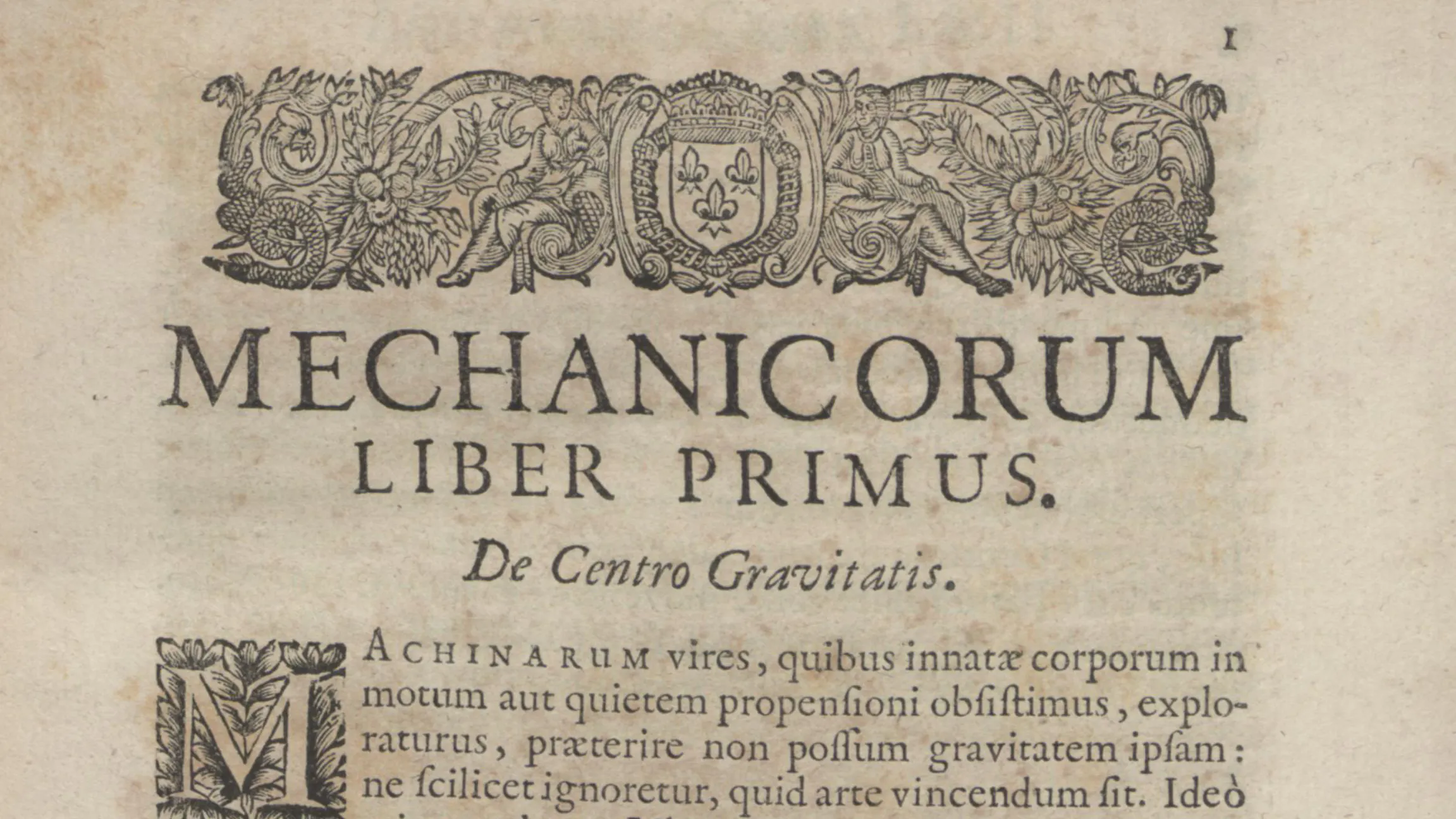
The treatise announces itself on its title leaf with the imprint that fixes its place, printers, date, and legal standing, the cum privilegio regis signalling the French royal protection under which the Anisson–Posuel–Rigaud partnership issued the work — the same imprint line already noted above. The front matter that follows performs the customary rhetorical labour of a Jesuit presentation volume, and its most conspicuous gesture is the dedication to Louis XIV, in which Casati stages his own smallness before the throne, laying himself and his mechanical labour at the king's feet as an unknown man of scarcely credible confidence, me, meamque hanc de rebus Mechanicis lucubrationem, ignotus homo, vix fortasse credibili confidentiâ. The posture of ignotus homo is a topos of humility, but it is also a calculated alignment: a treatise on the multiplication of human power by machines is offered to a monarch who works marvels in war and in peace, so that the book's central conceit — that machines accomplish more than unaided strength — quietly flatters the sovereign whose reach the dedication celebrates.
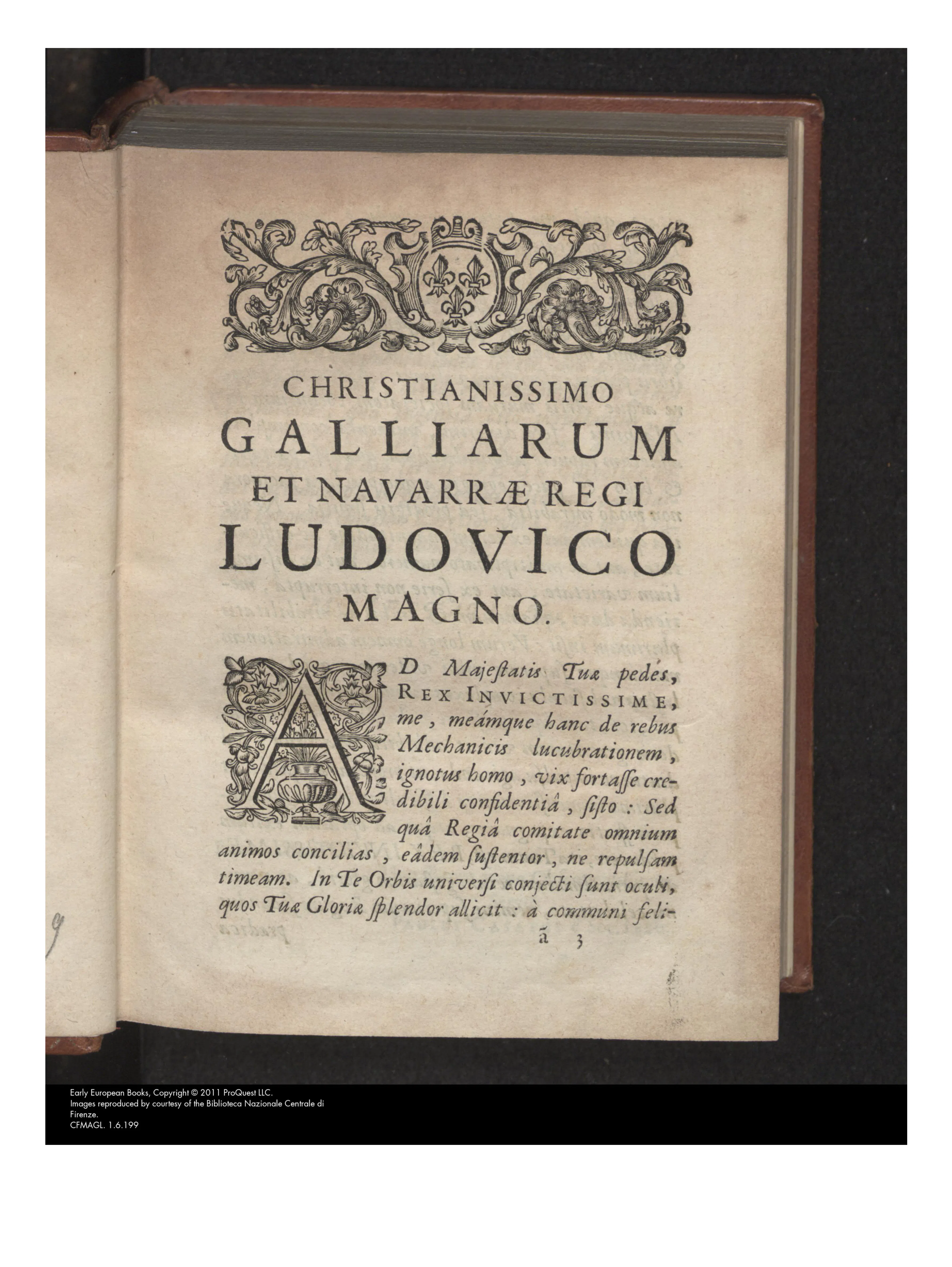
The opening recto of Casati’s dedication to Louis XIV turns royal address into typographic spectacle: graduated capitals name the “Christianissimus” king beneath a crowned fleur-de-lis headpiece, and the epistle begins in italic with a large woodcut initial. Here the humility formula of the “ignotus homo” is materially staged as courtly strategy, offering a work on mechanical power to a monarch whose authority is magnified in turn. Source ↗.
Before the substance opens, Casati sets out the method that governs the whole, and here the preface is unusually candid about the work's departures from the axiomatic norm of the mixed-mathematical tradition. He asks the reader not to fault the arrangement, that he has not disposed the entire matter into theorems and propositions but distributed it into chapters — the plea against blaming his method, already cited above. The pre-emptive defence is telling: to abandon the Euclidean scaffolding of theorem and proposition in a treatise that will nonetheless deploy Euclidean and Archimedean demonstration throughout is to court exactly the objection he anticipates, and the choice of Capita over Theoremata is bound up with the second, more substantive methodological commitment. His chief care, he declares, was to investigate the physical cause of the wondrous motions produced by machines — the profession of physical aim likewise given above. The two declarations are a single decision seen from two sides: the chapter form is the vehicle for interleaving physical explanation with geometrical demonstration, a coupling the rigid proposition-by-proposition format would resist. The admiranda, the wondrous effects of machines, are to be given a physica causa, and it is this insistence on efficient causation, rather than on demonstrated ratio alone, that stamps the treatise as something other than a purely Archimedean exercise.
Book I: Gravity, Positive Levity, and the Centre of Gravity
Book I opens by binding the study of machines to the study of gravity in a single breath. Setting out to explore the powers of machines, by which we resist the innate propensity of bodies toward motion or rest, Casati holds that he cannot pass over gravity itself — the opening declaration of Book I already registered above. The logic is that machines are instruments deployed against a prior tendency in bodies — the innata propensio — so that the whole doctrine of mechanical advantage rests on first understanding what it is that the machine works against. This grounds the treatise's ontology of bodies in the tendencies of gravity and levity, defined by their relation to the world's center: if bodies approach the center they are said to gravitate, if they recede, to levitate, Et quidem si ad centrum accedant, gravitare dicuntur, si verò recedant, levitare. The symmetry of the definition — gravitation and levitation as approach and recession from one and the same center — is not innocent, for it prepares the ground for the treatise's most philosophically loaded early commitment.
That commitment is the defence of positive levity, which Casati refuses to reduce to a mere privation or comparative lack of weight. Faced with the choice of which tendency to eliminate from the physics of bodies, he judges that it is better to leave levity — the forced disjunction already quoted above. The formulation exposes the stakes with unusual clarity: the alternatives are posed as a forced disjunction — one or the other must go — and Casati chooses to retain levity as a real quality rather than surrender it to the Aristotelian analysis that would make it a bare privatio gravitatis. The choice is buttressed by the experimental vocabulary the book repeatedly marks, from the hermetically sealed glass globe to the heated aeolipile whose interior air, rarefied by the force of heat, renders it lighter. The insistence on levitas positiva is precisely what permits the treatise to describe upward motion in the same causal register as downward motion, and it is the point at which the physics of Book I most directly touches the experimental programme it draws upon, without collapsing the two tendencies into a single principle.
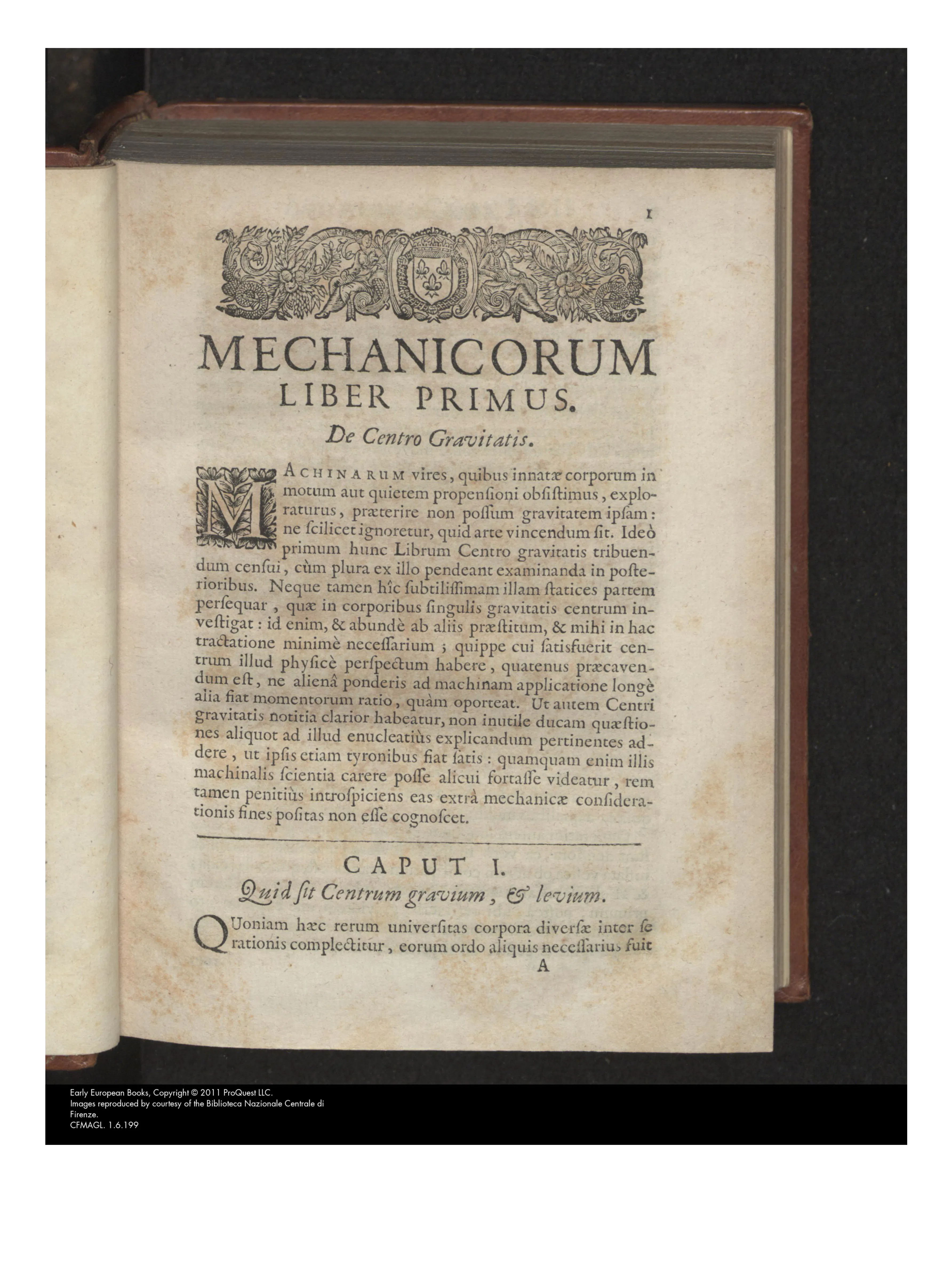
The first page of Liber Primus places Casati’s mechanics under the sign of gravity and levity before any treatment of machines: after the royal-armorial headpiece and the title “De Centro Gravitatis,” the opening paragraph insists that the powers of machines cannot be examined without first confronting the innate tendencies of bodies. Its first chapter, “Quid sit Centrum gravium, et levium,” begins the groundwork for treating levity as a positive principle rather than a mere absence of weight. Source ↗.
The centre of gravity itself, the organizing concept of the entire first book, receives a definition at once geometrical and dynamic, identified as that point in any heavy body which in motion always describes a line straight toward the earth's center, Illud itaquè punctum in quocumque corpore gravi, quod semper in motu describit lineam rectà in terræ centrum, from which follows the correlative definition of the line of direction as that which joins the center of gravity to the earth's center, & linea, quæ centrum gravitatis conjungit cum terræ centro, Linea directionis dicitur. This pair of definitions is the load-bearing apparatus for the stability analyses that follow, since the whole question of whether a body stands or falls is reduced to whether its linea directionis falls within or beyond its base.
Nowhere is that apparatus displayed to better effect than in the celebrated analysis of the leaning towers, where Casati converts an apparent marvel into a corollary of the line of direction. He treats the Pisan campanile with a historian's attention to its record, noting that it began to be built in the year 1173 by a certain German architect, whom he finds called by some William, by others John of Innsbruck, Ædificari coepit anno 1173 Germano quodam architecto, quem ab aliis Guillelemum, ab aliis Ioannem OEnipontanum dici reperio, the philological care over the architect's disputed name marking the same critical temper he brings to physical testimony. The mechanical conclusion is that from such an inclination no more ruin need be feared than if the tower were exactly perpendicular, ex hujusmodi inclinatione non magis esse de ruinâ timendum, quàm si exactè perpendicularis esset. The leaning tower is thus not an anomaly poised on the edge of collapse but a body whose linea directionis still falls within its foundation, and stability follows as securely as for an upright structure. What lends the passage its methodological weight is that Casati does not rest on his own inspection: for the Bolognese data he reports having asked, by letters sent to Father Francesco Maria Grimaldi, that he investigate those measurements accurately, litteris ad P. Franciscum Mariam Grimaldum datis rogavi, ut... accuratè mensuras illas inquireret. The appeal to Grimaldi, and the printed logarithmic calculation table accompanying the tower analysis, show the treatise's physical claims resting on solicited, corrected measurement rather than on received report — a discipline of testimony that recurs across the book.
That same discipline governs the cosmological excursus, where Casati weighs and rejects the notion that the earth might be turned by winds, concluding that no wind is so violent that it could impress an impetus on so great a mass, nullus igitur adeò vehemens est ventus, qui tantæ moli impetum imprimere valeat. The formulation is worth pausing over, for the verb imprimere and the noun impetus already deploy the causal vocabulary that Book II will elevate into a full theory of motion: the argument against the wind-driven earth is conducted in the very terms of impressed force that structure the treatise's dynamics. Into the same cosmological discussion Casati folds a striking historical illustration, the celebrated loss of a day as reported to have happened to the ship named Victoria in the Magellanic expedition, ut contigisse fertur navi cui à Victoria nomen inditum est, in expeditione Magellanicâ, the guarded fertur preserving the sceptical reserve he maintains toward secondhand testimony even where it serves his argument.
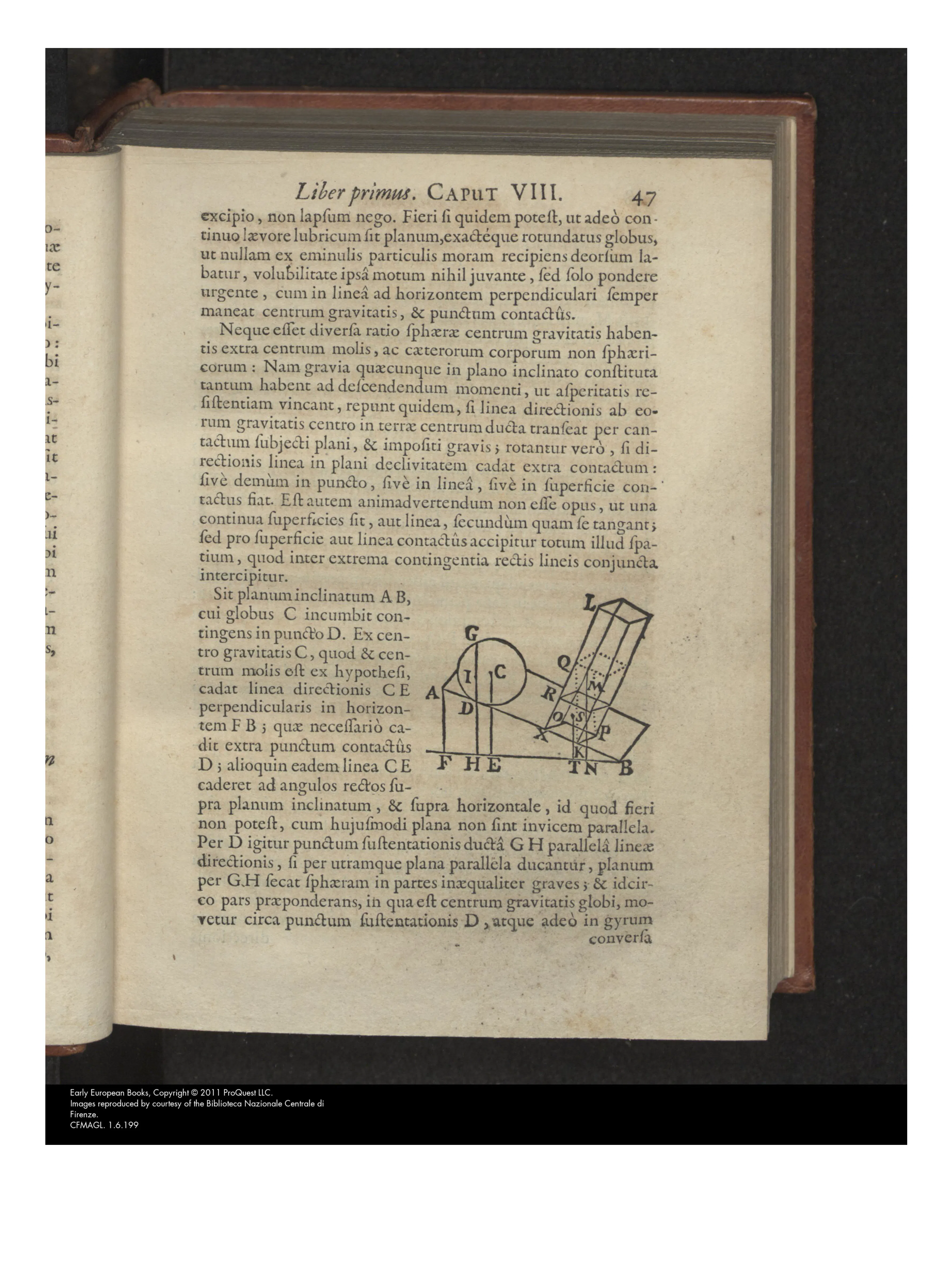
On this page Casati turns the linea directionis into a working test of stability: the woodcut sphere on an inclined plane maps where the line of direction falls relative to the contact point, while the adjacent tower section applies the same geometry to an architectural body. The movement from diagrammatic mechanics to measured leaning towers anticipates the disciplined treatment of evidence that governs his cosmological and historical examples. Source ↗.
The mathematical spine of the book's later chapters emerges in the trigonometric treatment of the inclined plane, where the qualitative doctrine of gravitation gives way to exact ratio. Casati establishes that gravitation on the inclined plane stands to gravitation on the perpendicular as the radius to the secant of the angle of inclination, gravitationem in plano inclinato ad gravitationem in perpendiculari esse, ut est Radius ad secantem anguli inclinationis. Here the physical account of tendencies toward the center is rendered fully commensurable through the trigonometric functions, and the interleaving of physics and geometry that the preface promised is realized in a single proportion.
Book II: The Physics of Impetus and the General Theory of Machines
Book II opens by fixing the disciplinary status of the whole enterprise, defining mechanics as subordinate to geometry precisely because it does not, as geometry does, consider the pure quantity and extension of bodies abstractly, but as bound to gravity or levity, Hæc Geometriæ subjicitur; neque enim, ut illa, puram corporum quantitatem molisque extensionem abstractè considerat, sed quatenus gravitati illigatam aut levitati. This is the mixed-mathematical self-understanding stated with precision: mechanics is not pure geometry, because its bodies come illigata, bound up, with the very tendencies of gravity and levity that Book I has established; nor is it pure natural philosophy, because it borrows geometry's demonstrative form. Against this backdrop Casati raises and then tempers the ancient boast of the mechanical art, citing in Greek the verse of Antipho that by art we conquer where by nature we are overcome, πεχην πρατοῦμεν, ὑν φύσει νικώμεθα.
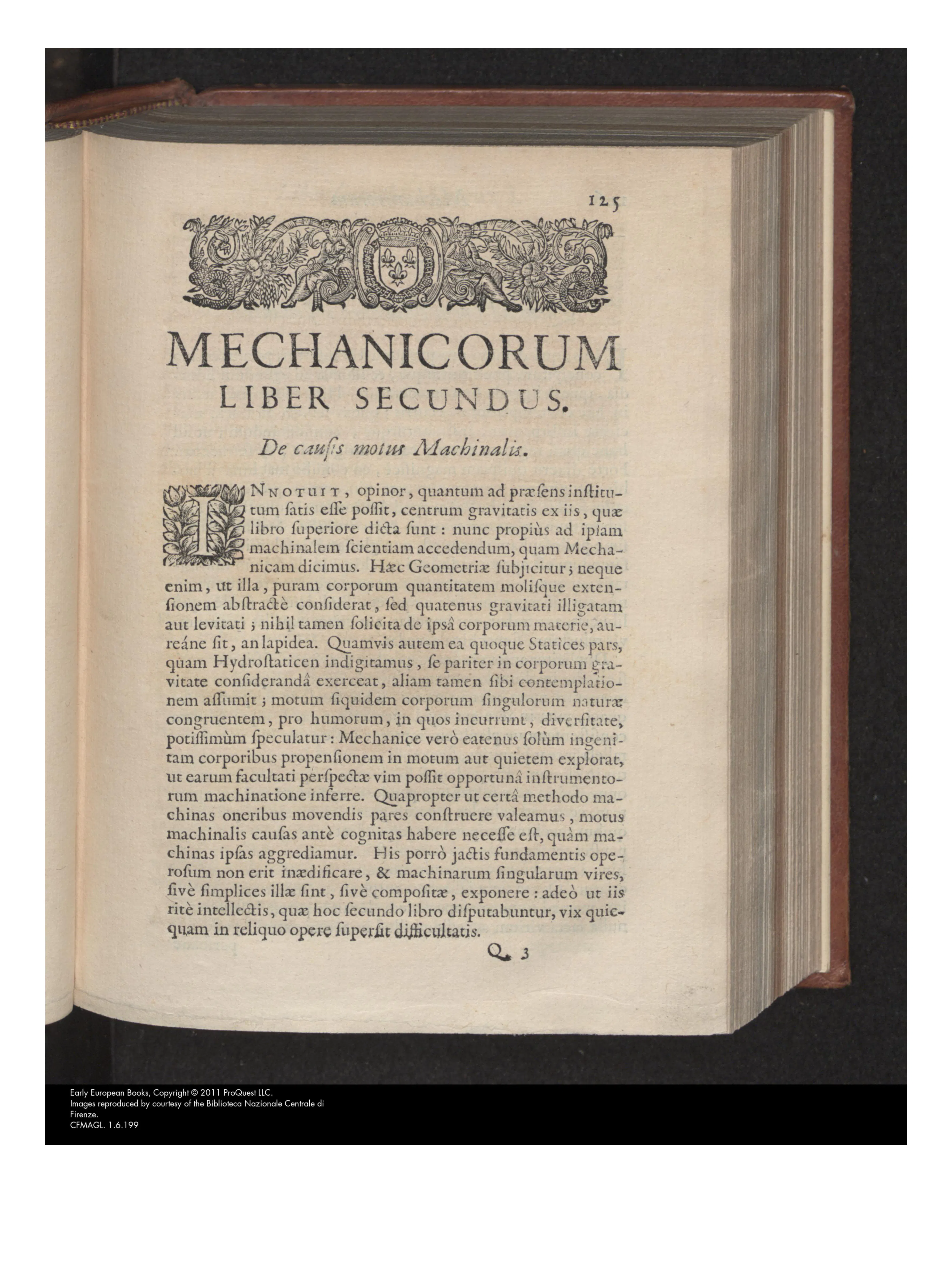
The opening of Book II, “Mechanicorum liber secundus,” gives Casati’s mechanics its programmatic footing: beneath a royal-armorial woodcut and a large historiated initial, the printed argument defines the discipline as geometrical in method yet concerned with bodies as bound to gravity and levity. The fleurs-de-lis in the headpiece make the page’s intellectual claim inseparable from its material setting under French royal privilege. Source ↗.
The Greek lemma, transmitted through the pseudo-Aristotelian Mechanica, is immediately deflated by his open admission that machines are employed as an aid to weakness — the concession already quoted above. The revision is consequential, recasting the machine not as an instrument by which art masters nature but as a subsidium infirmitatis, a support to human frailty — a sober redefinition that governs the treatise's understanding of what mechanical advantage is and is not.
From this threshold the physical program declared in the preface receives the vocabulary in which it will be carried out, as Casati names impetus the proximate cause of motion, holding that whatever things are moved have an impetus by which they are carried, to which, by a sufficiently probable conjecture, the proximate power of effecting motion is to be attributed, Quæcumque igitur moventur, impetum habent, quo feruntur; cui satis probabili conjecturâ, proxima vis motum efficiendi tribuenda videtur. The epistemic hedge of satis probabili conjecturâ is characteristic: impetus is advanced not as demonstrated certainty but as the most probable candidate for the proximate efficient cause, an impressed force lodged in the moving body. The book then fixes the direction of causation between motion and impetus with the claim, already registered above, that in the first moment of time it was impetus that most immediately produced motion and the innate power of moving that begot the impetus. The priority asserted here is not a matter of temporal sequence alone but of dependence: motion is the derivative, the visible effect, while impetus is the lodged cause. Casati grounds this abstract ordering in an observable fact of projectile behaviour, arguing that impetus is not increased by motion as such, as is sufficiently shown by missiles whose velocity, while they are moved, gradually grows faint, contrà verò motu, quâ motus est, impetum non augeri satis indicant missilia, quorum velocitas, dum moventur, sensum elanguescit. The observation that a hurled body slows even as it continues to move is enlisted as decisive: were motion itself the generator of impetus, sustained motion would sustain or amplify the impetus, whereas the perceptible languishing (elanguescit) proves the quality to be a diminishing deposit that motion spends rather than replenishes. The verb chosen — a body's speed growing faint — casts impetus in the register of a vital force that ebbs, and it is precisely this transience that will later require the doctrine of a fresh impetus renewed at each instant of natural descent.
That renewal receives its technical name in the treatment of how impetus perishes. Distinguishing the innate from the acquired species, Casati defines the latter through the case of a suspended body left to itself, which so strives toward its own place that the natural force, always equally applied to acting and unimpeded, acquires at each moment a new impetus, which is therefore called Acquired, Quòd si suspensum corpus sibi relinquatur, ita suum in locum contendit, ut vis naturalis æquè semper ad agendum applicata, nec impedita, momentis singulis novum impetum acquirat, qui proptere Acquisitus. The mechanism is instant-by-instant accretion: because the natural force is æquè semper applicata — applied always equally and without impediment — it lays down a new increment of impetus at every moment (momentis singulis). This is the conceptual device by which Casati can concede the observed acceleration of free fall while declining to explain it as a uniformly intensifying quality inhering in the body; the acceleration is instead the summation of discrete, freshly-begotten impetuses. The word contendit, the body straining toward its natural place, keeps the account within a teleological physics of proper place even as it delivers a quantitative rule for descent.
The bridge from this dynamics to the mechanics proper is a methodological thesis about resistance. Casati argues that a body's resistance to being moved by force cannot be defined absolutely from nature alone and the inborn principle that resists motion, since we cannot separate motion from every measure of speed or slowness, Ex his præterea manifestum est corporis per vim dimovendi resistentiam ex solâ naturâ, & principio insito, quod motui repugnat, absolutè definiri non posse; motum si quidem ab omni prorsùs celeritatis aut tarditatis mensurâ sejungere non possumus. The claim is that resistance is irreducibly a compound quantity: it cannot be read off from the sola natura of a body, its intrinsic reluctance to move, because no motion is ever given without some measure of quickness or slowness attached to it. Resistance is therefore always resistance-at-a-velocity, and this inseparability of speed from any real motion is exactly what licenses the machine-calculus that follows, in which weight and velocity are traded against one another as commensurable currencies. Here the vocabulary of momentum as commensuration receives its physical warrant: because velocity can never be abstracted away, it is legitimate — indeed unavoidable — to compound it with gravity.
With resistance so defined, Casati can state the formal cause of mechanical advantage in its starkest form, the thesis already cited above that from a machine as machine no interior virtue is imparted. The scholastic locution quâ machina est — the machine considered precisely as machine, abstracted from its own gravity — isolates the point: efficacy is not an added quantum of force but a matter of arrangement. The machine contributes nihil interioris virtutis, nothing of interior virtue, and this negative thesis is the pivot on which the entire reductive programme turns, since if machines added force they could not all be brought under one principle. Casati draws out the positive corollary immediately: the machine neither augments the powers of the potency nor diminishes the gravity of the weight, but accommodates the weight's resistance to the potency's virtue, Neque enim Machina aut Potentiæ vires auget, aut oneris gravitatem minuit, sed Ponderis resistentiam ad Potentiæ virtutem accommodat. The verb accommodat does the conceptual work: the machine adjusts, fits, or mediates between two fixed terms — the potency's virtue and the weight's resistance — altering neither but rendering them proportionate. It follows that the whole art of mechanics reduces to a single operation of disposition — the requirement, already quoted above, that the potency's motion be swifter than the weight's. The entire discipline is compressed into that requirement; advantage in force is purchased strictly by a surplus of velocity on the moving side.
This trade Casati elevates into a governing principle with a memorable formulation — the perpetua quædam justitia among power, weight, spaces, and times already given above. The choice of justitia is not ornamental. Justice, in its classical definition, renders to each its due, and Casati's four-term relation — forces, gravity, spaces, times — is imagined as a distributive equity in which no term can gain without another yielding in exact measure. What is taken in weight is repaid in space and time traversed; the ledger always balances. The moral figure is more than metaphor, for it frames the mechanical order as a lawful, incorruptible proportion, and it prepares the ground for the third book, where the balance will be presented under the same rubric of justice.
The negative complement of this constructive doctrine is Casati's sustained polemic against the pseudo-Aristotelian reduction of all mechanics to the circle. Having demonstrated by non-circular cases that a lesser power can move a greater weight, he concludes — in the passage already cited above — that the principle of mechanical motions is sought in vain from the circle, and that it is instead the one he himself has indicated. The adverb frustrà — in vain — dismisses the entire Quaestiones Mechanicae strategy of tracing every device back to the marvellous properties of the circle, and the emphatic à nobis indicatum substitutes Casati's own velocity-for-weight principle as the true and universal ground. The polemic is essential to the reductive ambition: only if the circle is displaced can the single lever-principle claim to underlie the balance, pulley, wheel, wedge, and screw alike.
Book III: The Balance
The doctrine then descends into the concrete science of the balance that opens the third book, and there the language of justice announced in the abstract returns in a patristic key. Casati frames the whole treatment of the libra with St. Basil's dictum that in each of us there is a certain balance prepared by the Creator of all things, through which one may rightly discern the nature of things, Cuilibet nostrûm intus statera quædam est à Conditore omnium apparata, per quam rerum naturam possis probè dignoscere. The interior statera, the inward steelyard implanted by the Creator, converts the mechanical instrument into a figure of the rational faculty of judgement, so that the study of the physical balance is presented as continuous with a moral and theological anthropology; the reader is invited to see in the equipoise of arms an emblem of right discernment. This framing is characteristic of the treatise's confessional coloration, whereby a mixed-mathematical inquiry is set within a providential order.
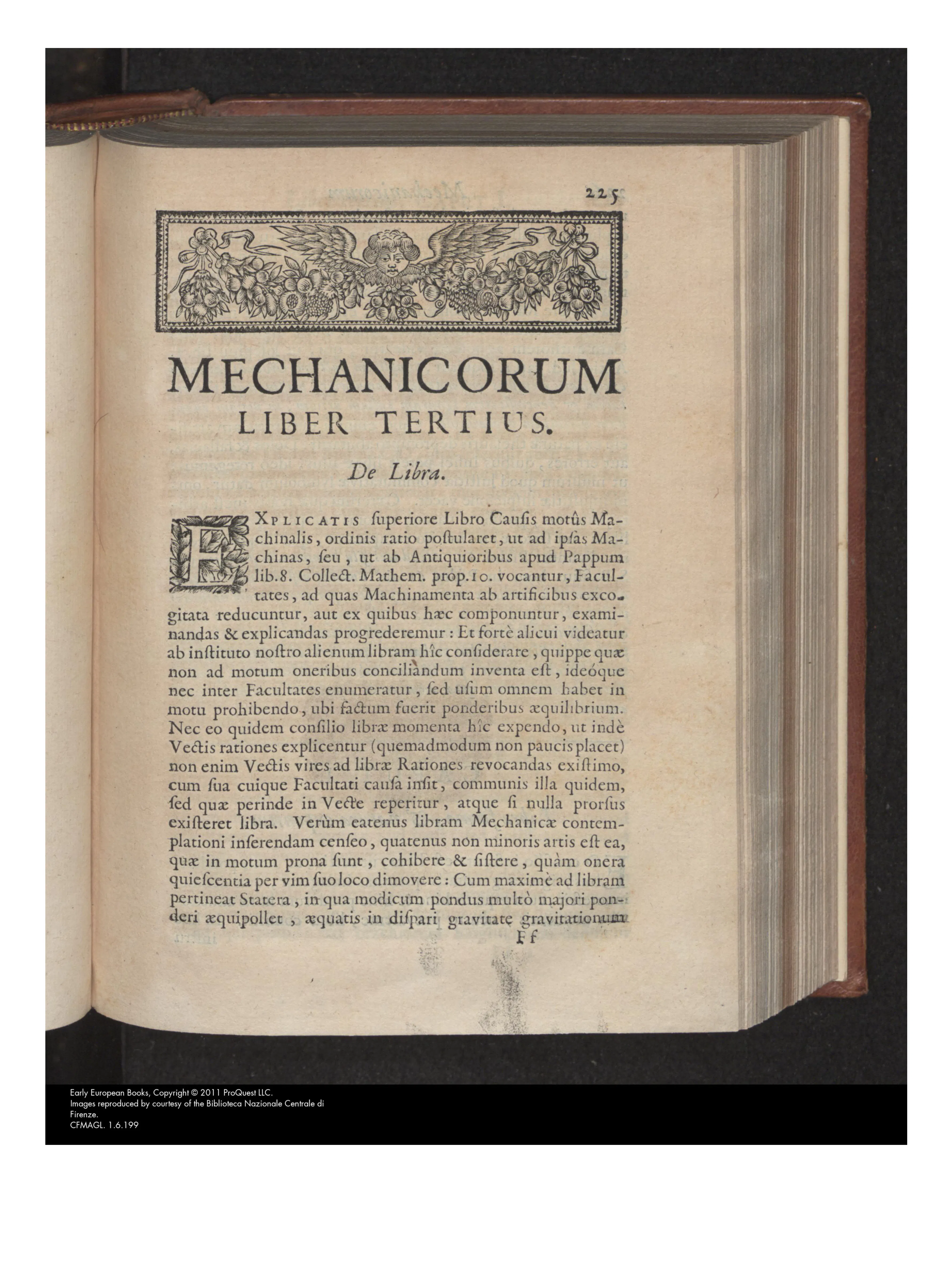
The opening page of Book III, “De Libra,” announces a major turn with its elaborate woodcut headpiece, display title, and decorated initial, giving the science of balance the ceremonial status of a new faculty within Casati’s mechanics. Its printed opening frames equilibrium not merely as a problem of weights but as a discipline of judgment, preparing the patristic and moral reading of the inner statera that makes the balance an emblem of right discernment. Source ↗.
The technical results of the balance-book, however, are austere and geometrical. Defining the equal-armed instrument, Casati specifies that with a balance so constituted an all-round equality intervenes both of the arms, by which motion is defined, and of the gravities, which resist one another equally, Cum itaque in librâ sic constitutâ intercedat omnimoda æqualitas & brachiorum, quibus definitur motus, & gravitatum. Equilibrium is analysed as the coincidence of two equalities — of the arms, which measure the spaces of motion, and of the gravities, which are the resisting weights — so that the balance is the limiting case in which the perpetual justice reduces to perfect symmetry. From this he moves to the unequal-armed case and its principal theorem, that the moments of the arms are to one another as the squares of the lengths of those same arms, Hinc sit momenta brachiorum esse inter se ut Quadrata longitudinum eorumdem brachiorum. The result that the moments vary as the squares of the arm-lengths follows from compounding the ratio of gravities with the ratio of velocities of the arm's extremities, both of which scale with length; it is a striking demonstration of how the commensuration of weight against velocity yields a quantitative law that goes beyond the simple reciprocal proportion of the Archimedean lever.
The book does not settle every question by fiat but stages genuine controversy, and Casati marks the stakes with Kepler's forceful claim, reporting that Kepler asserts that whoever denies the equal-armed balance will return to the horizontal equilibrium declares war not only on antiquity, but on the nature of things, on the utility of the human race, asserit eum, qui negat libram brachiorum æqualium ad horizontis æquilibrium redituram, non antiquitati tantùm, sed rerum naturæ, sed utilitati generis humani bellum indicere. The escalating tricolon — war on antiquity, on nature, on the utility of the human race — registers how much was felt to hang on whether a displaced equal-armed balance returns to the horizontal, a question Casati adjudicates against the naive position. Finally, in re-examining why larger balances are the more exact, he sets out the inherited explanation critically, noting that Aristotle thinks the cause is to be derived from this, that the pivot is the center, and the arms as it were lines going out from the center, Causam autem ex eo desumendam putat, quòd spartum sit centrum, brachia verò quasi lineæ à centro exeuntes. By attributing the received geometrical account to Aristotle and marking it as what putat — what he thinks — Casati signals that he will subject even this venerable explanation to his own analysis, consistent with the method that has governed the whole discussion: every authority, the pseudo-Aristotelian circle-reduction most of all, is measured against the single principle whereby advantage in weight is bought precisely with velocity.
Book IV: The Lever and Its Applications
Across the concluding chapters of Book IV and the whole of Book V, Casati works out the consequences of his single governing principle — that every mechanical faculty reduces to the lever and its commensuration of weight against velocity — by applying it to a dense catalogue of concrete devices, and it is precisely in the application that the interpretive interest lies. The reduction is not a formula recited over inert examples but a discriminating instrument that Casati wields to sort genuine levers from apparent ones, active powers from passive supports, and sound instruments from ingenious frauds.
The chapters on shared burdens establish the quantitative law that the rest of the discussion presupposes. When two bearers carry a load slung on a pole, Casati derives that the pressures they sustain stand in inverse ratio to their distances from the load, so that A is pressed as CB and B as CA, holding that the pressures are reciprocal to the bearers' distances from the load, Quare reciproca sunt pressiones distantiis gestatorum ab onere, & A premitur ut CB aut DB, B autem premitur ut C A aut D A. This is the momentum relation — weight compounded against distance — transposed from the balance to the shoulders of laborers, and it lets the treatise treat the porter's pole as a lever in disguise. But the same chapter carries a subtler conceptual freight, one that the treatise's whole vocabulary of Potentia depends upon. Casati insists that a fixed support is not a power at all: were the load held by two immovable props set at the ends, these, opposing the load's gravity by no exertion, would exercise only formal resistance by their solidity, At si onus palangæ connexum sustineretur à duobus fulcris in extremitate positis, hæc utique cùm oneris gravitati nullo conatu adversarentur, solam resistentiam Formalem suâ soliditate exercerent. The distinction between a resistentia formalis, offered passively by mere solidity, and an active conatus that earns the name of power is a genuinely philosophical discrimination smuggled into a chapter of practical carrying: what makes something a Potentia is not that it holds up a weight but that it strives against it. This is the same discrimination that, elsewhere in the treatise, keeps the machine from being credited with any interior virtue — a support contributes nothing but its rigidity, exactly as a machine as machine contributes nothing but figure and arrangement.
The chapter on elastic force shows the philological method carrying the analytic weight. Casati arrives at his definition by way of the Greek and the Italian vernacular before fixing the Latin term, naming as elastic force that faculty by which bent blades restore themselves to their proper figure and position, & facultatem illam, qua sibi congruentem figuram atque positionem hæ laminæ reparant, Vim Elasticam appellamus. The move is characteristic: an unfamiliar power is first named, then referred back to the lever — here to a lever of the third kind, with the fixed portion of the blade serving as fulcrum — so that even the spring of a bow or a clock is subsumed under the single principle rather than admitted as an independent species of force.
The nautical chapters are where the reduction becomes genuinely discriminating, because there Casati corrects Aristotle on the very ground of what counts as a fulcrum. In analyzing the oar he denies that the water struck is the weight moved; rather the ship is the weight, and the water furnishes the pivot, so that it is manifest that the ship, not the water, is the weight to be moved by the lever, and the water takes the place of the fulcrum, whence the oar is to be reckoned a lever of the second kind whose extremities the power and the fulcrum occupy, Manifestum est igitur pondus vecte promovendum navim esse, non aquam, ac propterea hypomochlij vices aquam subire, adeóque remum censendum esse vectem secundi generis, cujus extremitates potentia & fulcrum occupant. The correction is precise: by relocating the fulcrum to the resistant water and identifying the true load as the vessel, Casati preserves the lever schema while overturning the received placement of its parts. The same critical acuity produces a negative result in the case of the mast. Here the analogy fails outright, and Casati refuses it, concluding that the mast is not to be said to have the ratio of a lever in the motion by which the ship advances, Non igitur malus in motu, quo navis progreditur, Rationem vectis habere dicendus est. The reasoning is that fulcrum, weight, and power all move together with the ship, and where nothing stands still there can be no lever. What is striking is that Casati does not force the phenomenon into his master principle; when the lever schema does not fit, he says so and reaches instead for a purely physical cause. Confronting the observation that ships sail faster when the yard is set higher, he explains it not mechanically but by the quality of the wind aloft, showing without any ratio of a lever why, with the same sails and the same wind, ships are carried more swiftly when the yard is higher, namely because the sail raised higher receives both more wind and stronger wind, Ecce igitur citra omnem vectis rationem, Car quando antenna sublimior fuerit, iisdem velis, & vento eodem, celeriùs feruntur navigia: quia scilicet velum altiùs sublatum & plus venti, & validiorem ventum recipit. The distinction between speed (celeritas) and mechanical facility (facilitas) that governs this passage marks the boundary of the lever doctrine's competence: not every advantage a machine confers is a lever effect, and Casati is careful to keep the two orders of explanation — the geometric and the physical — apart even as he deploys both.
The scepticism that runs through the treatise's handling of reported marvels surfaces sharply where Casati weighs the testimony of the Atlas Sinicus on Chinese rowing, refusing to credit the claim that a single sculler equals six or eight European sailors — the complaint that the report is too meagrely expounded for him to allow words to be given him, already cited above. The idiom verba mihi dari — to be deceived, to have mere words palmed off in place of substance — registers a demand for demonstrable mechanical account rather than mere report of a wonder; the marvel is not denied outright but held in suspension pending an exposition adequate to the magnitude claimed.
Book V: The Axle-in-Wheel and the Vindication of the Archimedean Boast
Book V opens by justifying the introduction of a new faculty on the ground that the simple lever, however powerful in principle, is beset by practical inconveniences — chiefly that its arm cannot be indefinitely extended nor its motion continued. The axle-in-wheel supplies the remedy as a lever that renews itself perpetually, another faculty devised which, as many hold, is a certain perpetual lever, free from the inconveniences which occur in the simple lever, Hinc alia Facultas excogitata est, quæ, ut pluribus placet, vectis quidam sit perpetuus, citra incommoda, quæ in simplici Vecte, ut innuebam, occurrunt. The phrase vectis perpetuus is the hinge on which the whole reduction turns: the new machine is not a new principle but the old lever made continuous, its efficacy still resting on the commensuration of weight against velocity.
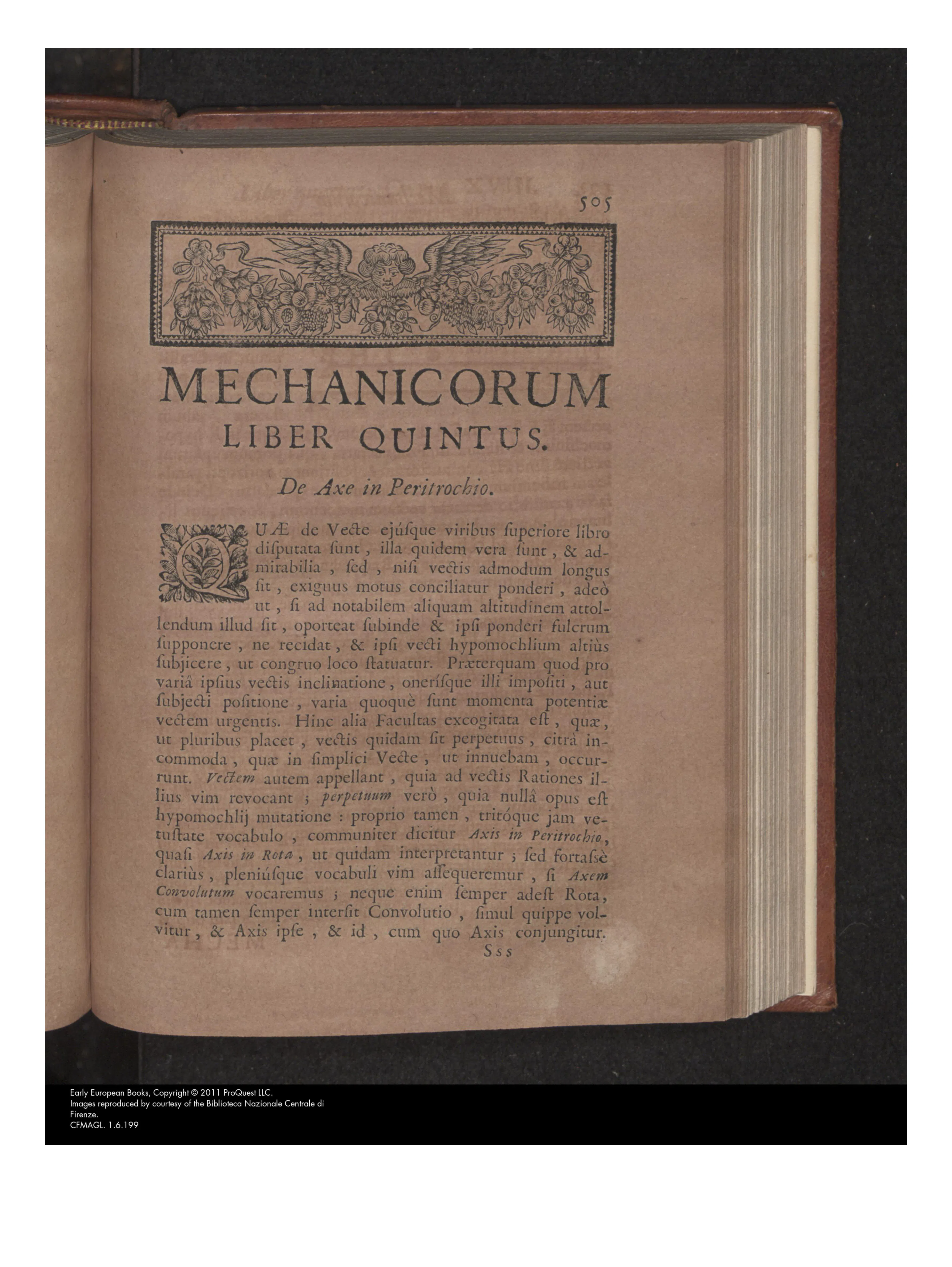
With its elaborate headpiece and decorated initial, the opening of Book V gives formal weight to Casati’s shift from the simple lever to the wheel-and-axle, introduced here as a “vectis perpetuus”—a lever made continuous rather than a distinct mechanical principle. The same page’s preference for “Axem Convolutum” over the conventional “Axis in Peritrochio” captures his insistence that terminology name the operative feature, convolution, rather than the incidental presence of a wheel. Source ↗.
Even here Casati cannot let a received name stand unexamined. He proposes to sharpen the terminology, judging that we would grasp the force of the word more clearly and fully if we should call it the Convolved Axle, for a wheel is not always present, though a convolution is always involved, sed fortassè clariùs, pleniúsque vocabuli vim assequeremur, si Axem Convolutum vocaremus; neque enim semper adest Rota, cum tamen semper intersit Convolutio. The intervention is telling: the name should track what is essential to the mechanism — the winding or convolution that carries the cord — rather than the accidental wheel that may or may not be present. This is the same nominalist discipline that governs his restriction of momentum to the lever; a term must denote the operative quantity or feature, not an incidental appearance.
The theory of compound gearing brings the treatise to its most ambitious claim, the vindication of the ancient boast. Once one axle-in-wheel is compounded with another and the multiplication of force is understood, the Archimedean promise loses its arrogance — the assurance, already quoted above, that the magnificent propositions of the mechanicians lack all note of arrogance, promising to move any weight, indeed the earth itself, if a suitable place were given. Yet the vindication is immediately qualified, and the qualification is the deep truth of the whole treatise. What is gained in weight must be paid in time, and Casati states the trade-off as an unanswerable question, asking how it could happen that the resistance of gravity be diminished by slowness of motion without much time being needed to move the weight, quî enim fieri possit, ut gravitatis resistentia ex motûs tarditate minuatur, quin multo tempore opus sit ad pondus movendum?. The boast is redeemed and disarmed in the same breath: the earth can indeed be moved, but only across a span of time so vast — the calculation that follows reckons it in tens of days for a comparatively small displacement — that the promise contains no threat to nature's economy. The advantage is never a gift; it is a purchase, weight bought with slowness, exactly the perpetual justice among power, weight, spaces, and times that governs the treatise's core.
Two final chapters display Casati's evaluative severity toward instruments. Prefacing his odometer he sets out his methodological creed, that it has always pleased him to enter by the plainest way, by which he judges one may arrive at what is wished, Mihi planissimâ inire viam semper placuit, qua putaverim ad id, quod volumus, perveniri posse — a preference for directness over the antiquarian ingenuity of a Vitruvian mechanism. And confronting the copying device that would reproduce a figure at altered scale, he condemns it on strictly geometric grounds, judging that the described figure, not preserving the ratios of the object, is to be reckoned a false-drawing, Quapropter descriptum schema non servans objecti Rationes, censendum est pseudographum. The verdict pseudographum is the counterpart, in the domain of instruments, to his refusal of the oar's misplaced fulcrum and the mast's false lever: an appealing device that fails to preserve the proportions it claims is no more to be admitted than a marvel too meagrely expounded. Throughout this stretch the reduction to the lever functions less as a doctrine to be defended than as a criterion to be applied — one that identifies the genuine fulcrum, exposes the spurious analogy, prices the promised advantage, and refuses the instrument that does not keep faith with its ratios.
Book VI: The Pulley
Casati's exposition of the pulley opens not with geometry but with a rationale drawn from the practical embarrassments of construction: scaffolding to raise weights aloft is often impossible without great expense, sæpè autem id fieri non posset sine magna impensa, and it is this economic and material constraint that motivates the invention of a distinct Facultas. Before any demonstration begins, however, he pauses over words. The pulley carries a freight of inherited nomenclature — the Vitruvian synonym Rechamum, the Greek gradations Monospatos, Dispastos, Trispastos keyed to the number of sheaves — and rather than adjudicate these usages Casati simply legislates his own, insisting that in matters of vocabulary one need not get stuck, and declaring that he calls a single housing with its wheels a Trochlea, Cæterùm in vocabulis non est hærendum: Ego Trochleam voco loculamentum unum cum suis orbiculis; & quando opus est duplici loculamento uti, duplicem Trochleam dico. The gesture is characteristic of his rationalizing method: the philological inheritance is acknowledged, then subordinated to a stipulative clarity that will keep the demonstrations unambiguous. Terminology here is instrumental, not antiquarian; the ancient authorities are honoured but not permitted to govern.
The conceptual core of the treatment of the pulley is the reduction of its efficacy to the same commensuration of weight and velocity that governs the whole treatise. When the housing is fixed to the weight so as to move with it, the power's moments are doubled, and Casati is precise about why: the motions of power and weight are not equal, but the former moves twice as fast, si tamen loculamentum ipsum adnectatur ponderi, quod cum illo moveatur, geminantur Potentiæ momenta, non enim æqualis est Potentiæ & Ponderis motus, sed illa duplo velociùs movetur. The doubling of momentum is thus grounded not in any hidden virtue of the wheel but in a kinematic disparity — the movable block traverses twice the space in the same time. This is the point at which the momentum of the philological framing does its work as a scalar commensuration defined at the point of application, and Casati raises it to a general law of reciprocal exchange in the passage — already quoted above — that as much as greater velocity adds to a smaller weight, so much does a greater weight add to smaller velocity. The formulation is symmetrical and exact: the advantage bought in weight is paid for, without remainder, in velocity, and the machine contributes nothing beyond the geometry of its arrangement. This is the perpetual justice of the treatise stated in its purest local form, and it is the premise from which the polemics of the following chapters proceed.
Those polemics are directed at the rival programme that would dissolve every mechanical faculty into the lever. Casati refuses the reduction with unusual vehemence, and — significantly — he grounds the refusal in a thought-experiment rather than a citation: he could never acquiesce in that kind of reasoning, for it is plain to him that even if the sheave were not rotatable but wholly fixed in its housing, the power would still raise the weight more easily, Verùm hujusmodi ratiocinationi nunquam aquiescere potui; mihi enim perspectum est, si orbiculus non fuerit versatilis, sed omnino fixus in suo loculamento, adhuc potentiam V faciliùs attollere pondus. The immobilized wheel is the decisive case: if the gain survives the abolition of rotation, then no rotating-lever analysis can be its true cause, and the advantage must lie where Casati locates all mechanical advantage, in the doubling of velocity. He reinforces the argument empirically with the rolled cylinder, appealing to most certain experiment that a cylinder of this kind is far more easily rolled by ropes than by the direct pushing of powers applied close to it, Certissimo constat experimento longè faciliùs cylindrum hujusmodi funibus convolvi, quàm impulsion potentiarum illi proximè applicitarum. The experiment functions as a controlled isolation of the variable: with the lever geometry held constant, only the manner of application changes, and the observed ease of rolling confirms that velocity, not any fulcrum-ratio, carries the gain.
The refutation becomes explicitly agonistic when Casati names his interlocutor. Against Schott's subtriple-power argument he objects that the addition of a power at the middle, where the weight is, does not entirely remove the pressure by which the fulcrum is urged by the weight, ex hoc siquidem quod addatur potentia in medio, ubi est pondus, non tollitur omnino pressio, quâ hypomochlium à pondere urgetur. The technical heart of the dispute is whether the hypomochlium can be treated as inert; Casati insists it bears part of the load, so that the lever-accounting of the pulley's forces is defective at its foundation. What lends this passage particular weight within the biography of the treatise is that the argument is Casati's own long-held teaching: the reasoning which he formerly, twenty-five years ago, imparted to his auditors in the Roman College, Schott tried to evade, Argumentum hoc, quod olim ante annos vigintiquinque in Collegio Romano meis Auditoribus insinuavi, conatus est P. Schott ubi supra cap.3. eludere. Here the Mechanicorum shows its genesis openly as the sediment of decades of lecture courses, and the dispute with a fellow Jesuit mathematician is staged not as abstract controversy but as the continuation of a classroom argument first advanced around 1659. The treatise's rationalizing ambition — one principle, the lever understood as velocity-commensuration, sovereign over all the faculties — is thus defended precisely by narrowing what the lever may be allowed to explain.
When Casati turns to the ancient question of wheel-size, he engages Aristotle directly, translating the ninth Mechanical Problem — why things lifted and drawn by larger circles move more easily and quickly, as with larger pulleys than smaller ones, Cur ea, quæ per majores circulos tolluntur, & trahuntur, faciliùs & citiùs moveri contingit, veluti majoribus trochleis, quam minoribus? — and answering it by relocating the true cause in the reduction of friction at the axle rather than in any circle-ratio. The move is consistent with his general demolition of the circle-reduction: the appearance that the large wheel embodies a favourable lever is dissolved into a geometrical account of the ratio between axle-circumference and wheel-circumference, and the practical corollary follows that gigantic wheels are not worth their bulk and cost. Yet Casati is no mere theorist of ratios; he grounds the compounding of faculties in engineering fact, reporting that by experiment we have learned that with two-sheave pulleys and a capstan a weight of not less than thirty thousand pounds is raised by two horses, experimento didicimus trochleis binorum orbiculorum, & Ergatâ attolli à duobus equis pondus librarum non minùs quàm triginta millium. The quantitative claim, embedded amid Vitruvian machine-descriptions of the Capra and the Artemon and colossicotera loads, exemplifies the treatise's double register: the mixed-mathematical demonstration is everywhere tethered to observed performance.
Book VII: The Wedge and Percussion
The opening of the seventh book on the wedge extends the same reductive strategy to a fourth faculty while introducing a genuine conceptual novelty. Casati coins the "perpetual wedge," and takes care to disarm any suspicion of the impossible: he calls a wedge perpetual not one that drives a body ever farther by a perpetual — that is, ever greater — impulse, but insofar as a power once applied can perpetuate the begun motion along the same direction, C Uneum Perpetuum voco non eum, qui perpetuâ, hoc est majore semper atque majore impulsionem corpus propellat longiùs atque longiùs... sed eatenus dico Perpetuum, quatenus potentia illi semel applicata institutum motum juxta eandem directionem perpetuare potest. The careful stipulation forecloses the reading of a self-augmenting force, keeping the device firmly within the economy of exchange rather than allowing it to promise something for nothing.
It is in the treatment of percussion, however, that the physical vocabulary of the treatise comes fully into play, and here the inherited language of impetus and the assimilation of Galilean results are held together in visible tension. Casati translates the nineteenth Mechanical Problem — whether, because all things happen with motion, the heavy thing itself assumes more of gravity while it moves than while it rests, An quia omnia cum motu fiunt, & grave ipsum gravitatis magis assumit motum, dum movetur, quàm dum quiescit? — and reinterprets the Aristotelian intuition in terms of acquired impetus, the impressed force added to the innate propensity. This is the impetus acquisitus of the philological framing functioning as the proximate cause of percussive force.
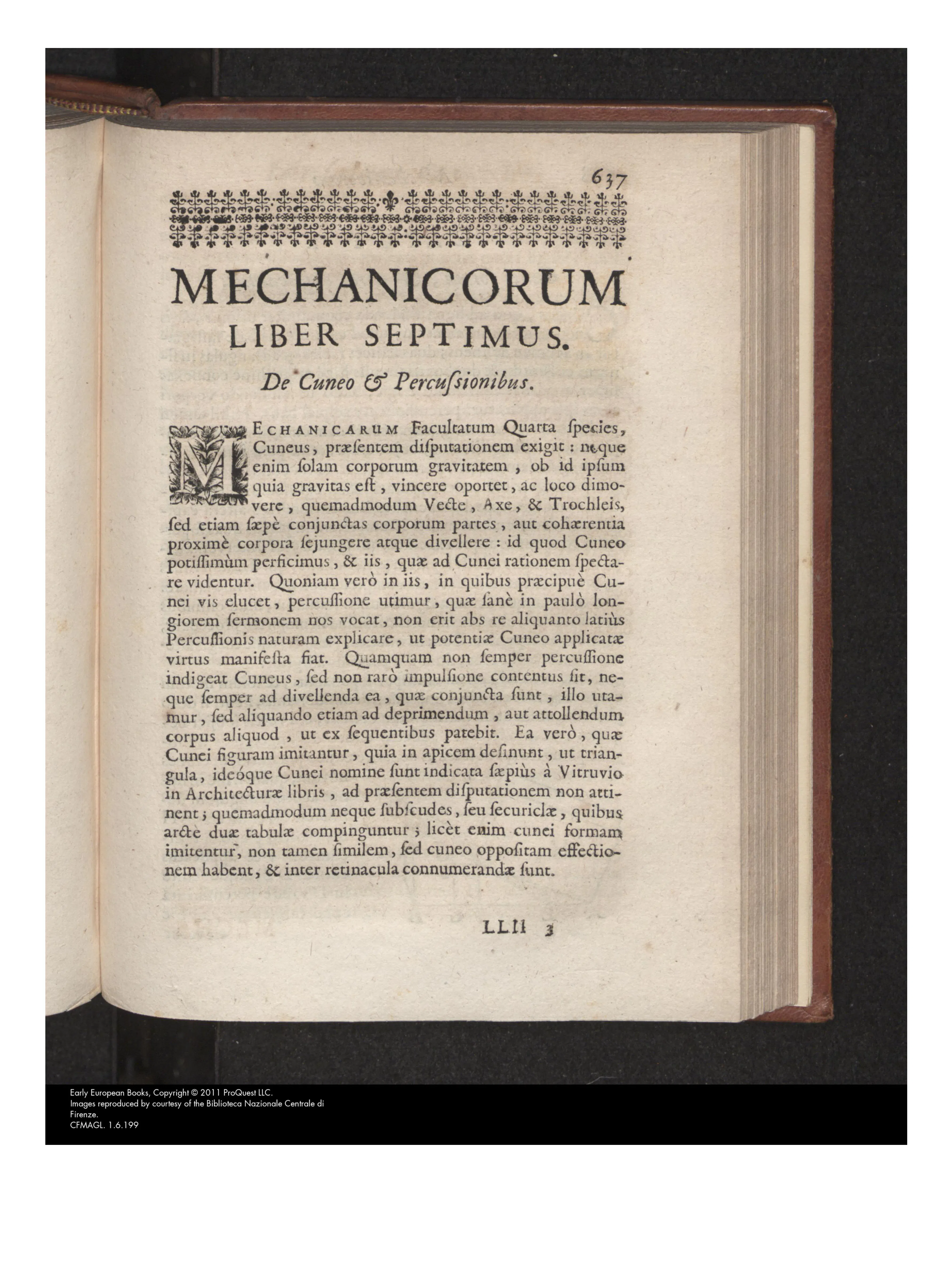
The ornamented opening of Casati’s Liber VII, “De Cuneo & Percussionibus,” frames the wedge not as a simple extension of earlier machines but as the point at which mechanics must confront cohesion, impact, and acquired force. Its decorated initial begins the section where percussion becomes the vehicle for holding Aristotelian impetus and Galilean motion in productive tension. Source ↗.
When he engages the free-fall debate, he does so as a first-hand observer who declines the doctrine of equal velocities: if one drops unequal bodies from a very high tower, the heavier strikes the earth sooner, but with so brief a difference of moments, Si enim ex valdè editâ turri inæqualia corpora... dimittas, illud, quod gravius est, terram citiùs attingere observabis, sed tam brevi momentorum discrimine. The observation is localized and specific, resting on the tower experiment at Bologna already reported above, in which the greater weight reached the earth while the lesser was still forty feet distant. The report situates Casati within the observational milieu of Riccioli and Grimaldi and confirms that his engagement with the Galilean programme is empirical and genuine, even as the impetus framework governs his explanation of the phenomenon rather than any uniformly accelerated quality inhering in the body.
The percussion chapters culminate in a synthesis that renders percussive force intelligible in the treatise's own commensurating terms: the forces of percussion are composed of the mass and of the velocity of the striking body, Ex his habetur percussionis vires componi ex mole & ex velocitate corporis percutientis. The compounding of moles with velocitas is the dynamical analogue of the static commensuration of weight against velocity that opened the book on the pulley, and it allows Casati to introduce a geometry of percussion parallel to the doctrine of the centre of gravity. His method for locating the Centrum Percussionis proceeds through pendulum isochronism: one may pronounce, not rashly, that the sought Centre of Moments of Impetus of the club is distant from the point of suspension by as much as is the length of the pendulum, pronunciabis quæsitum Centrum momentorum Impetûs clavæ tanto intervallo abesse à puncto suspensionis, quanta est perpendiculi longitudo. The reasoning binds the distribution of impetus across an extended striking body to the measurable period of an equivalent simple pendulum, so that a quantity of physical dynamics is captured by a geometrical construction — the treatise's twofold method, physical explanation and geometrical demonstration, working in concert precisely where the vocabulary of impetus might have seemed least tractable to measure.
Casati concludes the analysis of percussion by refusing to locate resistance in the struck body alone. The same bodily constitution, he insists, referring to the complexion of the component particles, must be weighed equally in the striker as in the struck, Hæc eadem corporis habitudo, quæ particularum componentium complexionem respicit, æquè in percutiente, ac in percusso attendenda est. This is more than a procedural note. It converts percussion from a one-sided action into a relation of reciprocal constitution, in which hardness, softness, and the capacity to bend or shatter belong to both terms of the encounter — a symmetry that will prove essential when he comes to ask how impetus passes between them. The physical care he had claimed as his chief concern throughout the treatise is here brought to bear on the microstructure of bodies rather than on the ratios of arms and weights.
That physical care is characteristically evidential, and Casati reaches beyond the mechanician's workshop to the missionary geography of the Jesuit order. From Martini's Atlas Sinicus he adduces the practice at the Chinese rapids, where, lest the ships incur the danger of breaking upon falling with the water, boatmen cleverly send ahead some bundles of straw against which the ship may strike more gently, and pass, scitè præmittunt aliquot straminis fasces, ad quos navis levius impingat, ac transeat. The interposed soft body blunting a violent impact is offered as corroboration drawn from the far edge of the known world, and it sits alongside the more martial illustration that mechanical constitution governs contemporary armor: so that the blows of balls fired from muskets may be harmlessly received, it is expedient that the iron be soft, so that being bruised it may bend, nunc verò ut innoxiè excipientur ictus globorum à Sclopis emissorum, ferrum molle esse expedit, ut contusum flectatur. The counter-intuitive prescription — that yielding iron defends better than rigid iron against the firearm — follows directly from the doctrine that resistance depends on the difficulty of receding, and that a body which bends absorbs an impetus that a brittle one would transmit to fracture. The examples are neither ornamental nor stray: they extend the reciprocal analysis of striker and struck across scales, from a boat at a cataract to a soldier's breastplate.
The anecdote of the Modena swordsman performs a related demonstration in the register of skill. At Modena, Casati reports, a man used to throw a sword into the air with such dexterity that it fell back perpendicularly with its point turned downward, which as it fell he caught harmlessly on the bare palm of his hand, Mutinæ ensem eâ dexteritate in altum projiciebat, ut perpendicularis recideret mucrone deorsum converso, quem cadentem nuda manûs vola innoxiè excipiebat. The point of the recollection is that the palm, by descending in concert with the falling blade, reduces the relative velocity at contact to near nothing and so nullifies the impetus that would otherwise wound; resistance, once again, is a matter of relative motion rather than of the striker's power taken absolutely. The dating of such episodes to ante aliquot annos marks them as the author's own remembered testimony, of a piece with the first-hand observational habit that the framing sections locate in his tower experiments.
From percussion Casati derives the law of reflection, and the derivation shows the geometrical language operating at full strength. Reasoning that no cause favors one reflected direction over another, he concludes that it remains that the angle of reflection be equal to the angle of incidence, reliquum est, ut angulo incidentiæ æqualis sit angulus reflexionis. What in an optical treatise would be a datum of experience is here made a consequence of the dynamics of the struck body, so that reflection becomes a special case of percussion determined geometrically. The physical illustrations that accompany it draw once more on lived observation, and at the point where he treats spin the Latin gives way to craft vernacular: when one plays with rackets, the racket is moved in an inclined plane, in what, he says, we Italians call to cut, or to slice a ball, nos Itali dicimus Tagliare, è Trinciare una palla. The explicit nos Itali is a rare authorial self-placement, and the intrusion of Italian craft terms into the demonstrative Latin registers the mixed-mathematical conviction that the technical account must answer to what practitioners actually observe on the court.
The philosophical centre of these chapters is the question of how impetus is communicated in the blow, and here the treatise's physical vocabulary reaches its most exposed formulation. Having rejected both the striker's self-moving power and its own impetus as adequate causes, Casati advances his positive thesis in a phrase weighted with epistemic modesty: nothing offers itself to him nearer the truth than to say that impetus migrates from the striker into the struck body, either wholly or in part, according as the body which resists the striker's motion is capable of some motion, nihil se mihi offert vero propius, quàm si dicamus ex percutiente in corpus percussum migrare impetum, aut totum, aut ex parte, prout alicujus motûs capax fuerit corpus. The verb migrare is doing heavy conceptual labor: impetus is treated as a real, transferable quantity of power that leaves one body and lodges in another, its partition governed by the receiving body's capacity for motion — precisely the reciprocal constitution established at the outset of the resistance analysis. This is impetus in the technical sense the treatise everywhere maintains, an impressed and transmissible force rather than a Cartesian quantity of motion or a Galilean accumulated quality.
Casati knows that the migration thesis collides head-on with a fundamental Scholastic axiom, and he voices the objection in its most resonant rhetorical form — that accidents do not pass from subject to subject, as the very walls of the schools cry out, the objection already cited above. The personification of the schoolroom walls dramatizes the weight of orthodoxy he must overcome: the ontological rule that an accident is individuated by its subject and cannot detach from it stands squarely against any doctrine of a wandering impetus. His answer is the treatise's most striking speculative move, drawing not on natural philosophy but on revealed theology — the appeal, likewise given above, to the Eucharistic mysteries as proof that accidents torn from their subject can persist though they cannot subsist without an efficient cause. The logic is one of precedent: if the mysteries of the altar establish that accidents can persist apart from the subject in which they inhered, then the migration of impetus from striker to struck violates no absolute metaphysical impossibility. The qualification is exact and characteristic — persistence is licensed, but subsistence without any efficient cause is not, so the transferred impetus still requires a cause to sustain it. In this move the physical doctrine of the blow is underwritten by the confessional commitments of the order, and the impetus vocabulary reveals its double life as at once a term of mechanics and a piece of Jesuit natural philosophy.
The abstract claim is then secured experimentally, in an instrument tuned for the purpose. Bend the steel bow of a crossbow with the string drawn, Casati proposes, and often, with no ball or dart added to be discharged, release it by removing the catch: will it be permitted to use this idle game for long, balistæ arcum chalybeum intento nervo inflecte, ac sæpiùs, nullo adjecto globo aut telo, quod explodat & ejiciat, submoto nervi adducti retinaculo dimitte: an diutiùs inani hoc ludo uti licebit?. The rhetorical question anticipates the answer: with no projectile to receive the impetus, the force remains in and damages the bow itself, which soon fails under repetition. The experiment converts the migration thesis into a testable consequence — impetus deprived of a recipient does not simply vanish but must expend itself somewhere, and the ruined crossbow is the visible proof.
Book VIII: The Screw, the Most Efficacious Faculty
Book VIII elevates the screw to the summit of the mechanical faculties, and does so with a thesis stated at the threshold — the judgement, already cited above, that compared with the other faculties it must be reckoned the most efficacious of all, other things being equal. That the device treated last should be judged first in power is deliberate, and it obliges Casati to distinguish his own analysis from the received reduction of the screw to an inclined plane, the sentence — likewise given above — in which he declares that the opinion referring the screw's powers to an inclined plane represented by the spiral line does not please him. The refusal is principled: the moving power travels along the base of the generating triangle, not up its hypotenuse, so the screw's efficacy cannot be captured by treating the helix as a wrapped incline. This is the same reductive analogy he elsewhere accepts for oblique impact and here declines for the screw, the discrimination between the two cases turning on where the potency actually moves. Consistent with the treatise's insistence that advantage in weight is bought with velocity, the screw's supremacy is quantified in the compound of endless screws, where by what effort one would move ten pounds, by the machine of three endless screws one will move one million three hundred fifty thousand pounds, hac trium cochlearum infinitarum complexione movebit millies mille trecentas quinquaginta libras. The staggering ratio is the numerical vindication of the whole reductive programme: the enormous multiplication of weight is bought at a proportionate cost in the slowness and length of the power's traverse, and the perpetual justice between force, weight, space, and time is preserved even at the extremity of mechanical advantage, before the text closes at its FINIS.
Frequently Asked Questions
What is Paolo Casati's Mechanicorum libri octo?
The Mechanicorum libri octo is a systematic Latin textbook on mechanics in eight books, printed at Lyon in 1684 under royal privilege by the Anisson–Posuel–Rigaud partnership. Written in the mixed-mathematical tradition, it reduces every simple machine — the lever, pulley, wheel and axle, wedge, and screw — to a single principle of the lever, whereby advantage gained in weight is paid for exactly in velocity. It couples Archimedean geometric demonstration with a physical account of motion cast in the scholastic vocabulary of impetus, distilling decades of Casati's lecture courses at the Collegio Romano.
Who was Paolo Casati?
Paolo Casati (Piacenza 1617 – Parma 1707) was an Italian Jesuit mathematician who taught at the Collegio Romano from the early 1650s and later served as Provincial Superior of the Jesuit Province of Parma from 1684 to 1688. His most widely cited biographical episode is his 1651 mission to Stockholm to gauge Queen Christina's intention to convert, though this is unrelated to his mechanical work. His writings include the cosmological dialogue Terra machinis mota (1658), the Mechanicorum libri octo (1684), and De igne dissertationes physicae (1686).
What did Casati mean by a perpetua quædam justitia?
Casati used the phrase perpetua quædam justitia — a certain perpetual justice — to name the exact proportion he believed governs every machine. Among the powers of the moving potency, the gravity of the weight, the spaces traversed, and the times elapsed, a lawful balance is preserved: whatever is gained in weight is repaid precisely in velocity, space, and time. The machine adds nothing interior of its own; its efficacy lies in figure and arrangement alone. Casati chose justitia deliberately, casting the mechanical order as a distributive equity in which no term can gain without another yielding in exact measure.
Why did Casati defend a positive levity, and how did he link impetus to the Eucharist?
Casati held that lightness is a real, positive quality inhering in certain bodies, not merely a privation of weight as the Aristotelian mainstream taught; faced with eliminating either gravity or levity, he judged it better to retain levity. This let him describe upward motion in the same causal language as downward. His retention of impetus — an impressed force persisting in a body after separation from its mover — carried theological weight: against the scholastic axiom that accidents cannot pass from subject to subject, he argued from the Eucharistic mysteries that divine power permits accidents to persist apart from their subject.
Is there an English translation of the Mechanicorum libri octo?
No complete translation into any modern language has been identified in the standard reference works; the treatise has been read chiefly in its original 1684 Latin imprint. A separate, freely available edition is offered by Leo, part of an effort to publish online, at no cost, English translations of every text printed in Latin in early modern Europe between 1450 and 1750. This edition presents the full Latin transcription together with a complete English translation for the first time. That translation is generated by AI, and every rendering should be verified against the original.
This report was generated by an advanced AI assistant that conducted deep research alongside an extensive interpretation of the transcribed original text. Every effort has been made to preserve fidelity to the source and to guard against inaccuracy, but corruption in the text recognition process and model hallucination may nonetheless have entered the text. Treat every claim, quotation, translation, and citation as provisional, and verify each against the original source before relying on or citing it.
Bibliography
- De Ferrari, Augusto, "Casati, Paolo," Dizionario Biografico degli Italiani: The authoritative Italian biographical entry, summarising Casati's Roman College, Stockholm, and Parma appointments and supplying the canonical list of his works. Read it beside Sommervogel's Bibliothèque de la Compagnie de Jésus (II, cols. 799–803) for the bibliographic spine of any serious study, and treat it as the corrective to the popular accounts that reduce Casati to the man sent to sound out Queen Christina.
- Christie's, Mechanicorum libri octo, Paolo Casati, 1684: The auction record for the New York copy (lot 9, October 2023), which is the source for the treatise's physical particulars used in this report — quarto, 225 × 161 mm, the Sommervogel reference, and the 1755 Discalced Carmelite provenance. Consult it for material and binding evidence a library catalogue rarely troubles to record, though remember that a saleroom description is written to sell and not to collate.
- Elazar, Michael, and Rivka Feldhay, "Jesuit Conceptions of Impetus After Galileo: Honoré Fabri, Paolo Casati, and Francesco Eschinardi," The Emergence and Expansion of Preclassical Mechanics: This essay places the Mechanicorum between Fabri's Physica and Eschinardi's later Roman-College work, and reads Book VII on the wedge and percussion as the technical core of the Jesuit theory of the blow. It is the indispensable statement of the case that Casati's impetus is a considered theoretical position rather than scholastic driftwood awaiting removal.
- Feldhay, Rivka, and Ayelet Even-Ezra, "Heaviness, Lightness and Impetus in the Seventeenth Century: A Jesuit Perspective," The Emergence and Expansion of Preclassical Mechanics: This chapter treats the treatise as the principal Jesuit fusion of Archimedean statics with Aristotelian impetus, and frames Casati's levitas positiva as a direct engagement with the Cimento experiments on positive lightness. Essential for grasping why a treatise on machines opens with a defence of real, non-privative lightness that the Galilean–Newtonian settlement would soon rule a category error.
- Gavagna, Veronica, Paolo Casati e la scuola galileiana: The standard Italian-language reconstruction of Casati's formation within the Roman College tradition descending from Biancani through Riccioli and Grimaldi, attentive to the 1657 Riccioli correspondence. It stakes out the intermediate historiographical position — Casati as a Galilean pursued inside the Jesuit system — against which the sharper Tel Aviv readings should be measured.
- Institute and Museum of the History of Science (IMSS), Horror Vacui? — Paolo Casati (1617–1707): A Florentine museum page tracing Casati's entry into the Society in 1634 and his passage through mathematical and theological studies, framed by the seventeenth-century vacuum controversy. A convenient orientation to the natural-philosophical disputes surrounding the man, useful precisely because it situates the mechanician within the physics quarrels the Mechanicorum keeps in view.
- Laird, W. Roy, "The Scope of Renaissance Mechanics," Osiris: Not Jesuit-specific, but the essay that maps the pseudo-Aristotelian Quaestiones Mechanicae and its circle-based reduction of the mechanical powers — precisely the tradition Casati sets out to demolish. Read it first to understand what the frustrà ex circulo polemic is actually aimed at, and why displacing the circle was the precondition for the single lever-principle.
- Technische Universität Ilmenau, Casati, Paolo (1617–1707), DMG-Lib: The Digital Mechanism and Gear Library's biographical record, identifying Casati as an Italian Jesuit mathematician of a Milanese family born at Piacenza. A compact reference keyed to the history of machines specifically, handy for cross-checking dates against the fuller Dizionario Biografico notice.
- Wikipedia contributors, Paolo Casati: The Italian-language encyclopedia entry, giving the Latinized name Paulus Casatus and the bare frame of mathematician, astronomer, and theologian with the Piacenza 1617 – Parma 1707 dates. Serviceable as a first pointer to primary dates and titles, but every claim should be run back through De Ferrari and Sommervogel before it is trusted, let alone cited.