The Rose from Its Ashes: Jean-Chrysostôme Magnen's Democritus Revived, or On Atoms
In 1646, a Burgundian physician teaching at Pavia set out to do something bolder than recover a lost philosophy: in Democritus reviviscens sive de atomis he proposed to bring ancient atomism back to life as a working science of nature, geometrically demonstrable and safe for Catholic natural theology. Jean-Chrysostôme Magnen redeemed the atom and the void—reinterpreting the void as air, keeping the substantial forms, and installing a creating God where the ancients had left blind chance—while marshaling a Euclidean scaffold of proofs, a free-fall experiment, and the revival of a rose from its own ashes. The result is one of the most revealing intermediate positions in the whole seventeenth-century argument over what matter is made of.
ExLatinis
28 July 2026

Contents
In 1646, a Burgundian physician teaching at Pavia set out to do something bolder than recover a lost philosophy: in Democritus reviviscens sive de atomis he proposed to bring ancient atomism back to life as a working science of nature, geometrically demonstrable and safe for Catholic natural theology. Jean-Chrysostôme Magnen redeemed the atom and the void—reinterpreting the void as air, keeping the substantial forms, and installing a creating God where the ancients had left blind chance—while marshaling a Euclidean scaffold of proofs, a free-fall experiment, and the revival of a rose from its own ashes. The result is one of the most revealing intermediate positions in the whole seventeenth-century argument over what matter is made of.
In 1646, in the university town of Pavia in the Duchy of Milan, a Burgundian physician named Jean-Chrysostôme Magnen published a treatise with an arresting title: Democritus reviviscens—Democritus revived. The claim embedded in that participle is bolder than it may first appear. Magnen did not propose merely to recover the doctrine of the ancient atomist as an object of antiquarian curiosity; he proposed to bring it back to life as a working philosophy of nature, a live contender against the entrenched Peripatetic orthodoxy of the schools. The atom and the void, long tainted by charges of impiety and of a cosmos assembled by blind chance, were to be redeemed and re-founded. Atomism appeared to Magnen, in his own words, as the great prize-winning work of human minds, atomorumq; opinionem veluti grande palmariumq; mentium humanarum opus produxit in medium, reliquitq; me in hac atomorum cogitatione defixum —a doctrine, he confessed, in which he found his own thought fixed and held fast.
The central problem the work confronts is at once physical and theological: whether matter is ultimately composed of physically indivisible atoms moving in void, and how such a doctrine can be made both rigorously demonstrable and acceptable to Catholic natural theology. Magnen's recurring move in answer is twofold, and it gives the treatise its distinctive character. On one side he works as a philologist and historian of philosophy, reconstructing Democritean doctrine from the fragments transmitted through Galen, cataloguing the atomist's lost works, and laying the blame for their disappearance at Aristotle's door. On the other he works as a geometer and experimentalist, re-founding atomism on a Euclidean scaffold of definitions, axioms, postulates, and propositions, and reinforcing it with observation—the equal free-fall of unequal weights, the chymical corroboration of a three-element theory, and the startling palingenetic revival of a rose from its own ashes. Binding the whole together is a theological commitment that distinguishes Magnen sharply from the ancient Epicurean tradition: the atoms are not self-organizing and the cosmos is no product of fortuitous concourse but the work of a creating God, captured in the maxim he repeatedly invokes, opus naturæ opus intelligentiæ, the work of nature is the work of an intellect.
The stakes of this project were considerable. In the mid-seventeenth century the corpuscular hypothesis was being reformulated on several fronts—by Gassendi's rehabilitation of Epicurus, by the Cartesian mechanists, and, shortly after, by the Boylean chymists—yet each of these programs carried its own liabilities, whether the theological scandal of the void, the geometrizing of physics, or the abandonment of substantial forms. Magnen's treatise stakes out an intermediate position: it accepts the corpuscular architecture of matter and the mechanical explanation of qualities while rejecting the strict Democritean void, reinterpreting it as air, and retaining the Peripatetic substantial forms. The result illustrates, more vividly than the more famous programs, just how elastic and negotiable atomism remained in the confessional and institutional setting of a Catholic university under Habsburg patronage.
What a first-time reader will find most striking about the work is the range of registers it moves through without apparent strain. Magnen defines the atom as the material and physical root and beginning of extension—physically indivisible yet mathematically divisible without limit, and expressly distinct from the geometric point. He denies that any body is properly heavy or light, substituting a single motive impetus for gravity and levity, and he presses an experiment in which a wooden and an iron globe, dropped together, strike the ground at the same instant, a result he takes to favor Democritus and to embarrass the Peripatetics. He cites Galileo on the odd-number law of fall. He argues that colour is an internal light of bodies diffused by fiery atoms. He reduces the four elements to three—Terra, Aqua, Ignis—and corroborates the reduction by appeal to the chymists' tria prima of sulphur, mercury, and salt. And he insists throughout that mathematics is indispensable to the philosopher while maintaining, against the Cartesians, that physical actions are not to be judged by geometric rules. The treatise is dedicated to the Senate of Milan, the body whose patronage secured Magnen's chair, and its methodological temper is caught in a phrase he borrows and sharpens: Amicus Plato, amicus Aristoteles, magis amica Veritas—Plato is a friend, Aristotle is a friend, but Truth is a greater friend.
This is not a major work in the sense that Gassendi's or Boyle's writings are major, and the historiography has consistently treated Magnen as a significant but secondary figure. Its interest lies precisely in its intermediacy and its texture: a work that binds humanist philology to geometric demonstration, chymical evidence to physico-theological argument, and the recovered doctrine of an ancient Greek to the auspices of a seventeenth-century Habsburg senate. The unifying thread runs from the polysemy of its central terms—atomus, inane, impetus—through the circumstances of its production under senatorial patronage and ecclesiastical licence, to the internal movement of an argument that recovers, demonstrates, and Christianizes atomism in a single sustained gesture. Much about Magnen's life and the finer details of the work's reception remains thinly documented, and several attributions in the historiography await firmer confirmation; where the evidence is slender, what follows says so.
Read the full text and English translation on Leo
This text was transcribed and translated as part of the ExLatinis project, an effort by Leo to make free English translations of every text published in Latin in early modern Europe (1450–1750) available online. The complete transcription and English translation of this work can be read free of charge:
→ Read the original Latin text and full English translation on Leo
You can save a copy of this document into your Leo account to run deep text searches, conduct further analysis, or cross-reference it with your own research.
Assigning an English Title and Framing Magnen's Key Terms
Democritus Revived, or On Atoms (an editorial English title supplied for Anglophone convenience, not inherited from the historiography). A more descriptive cataloguing rendering would be Democritus Revived; or, On Atoms, Addressed to the Most Excellent Senate of Milan, with the Life of Democritus and Necessary Indices.
The Latinate compound reviviscens in Magnen's chosen title is not a Renaissance metaphor of philological recovery but a metaphysical thesis: the resurrection of Democritus's doctrine as a live philosophical option in the mid-seventeenth century. The program announced by the title is therefore not antiquarian but constructive, and the philological framing of the work is grounded in three terminological commitments that require careful exposition. Magnen himself frames the enterprise as the rescue of a doctrine he regards as the crowning achievement of human thought, describing how atomism, atomorumq; opinionem veluti grande palmariumq; mentium humanarum opus produxit in medium, reliquitq; me in hac atomorum cogitatione defixum, came before him as the great prize-winning work of human minds and left him fixed in the contemplation of atoms.
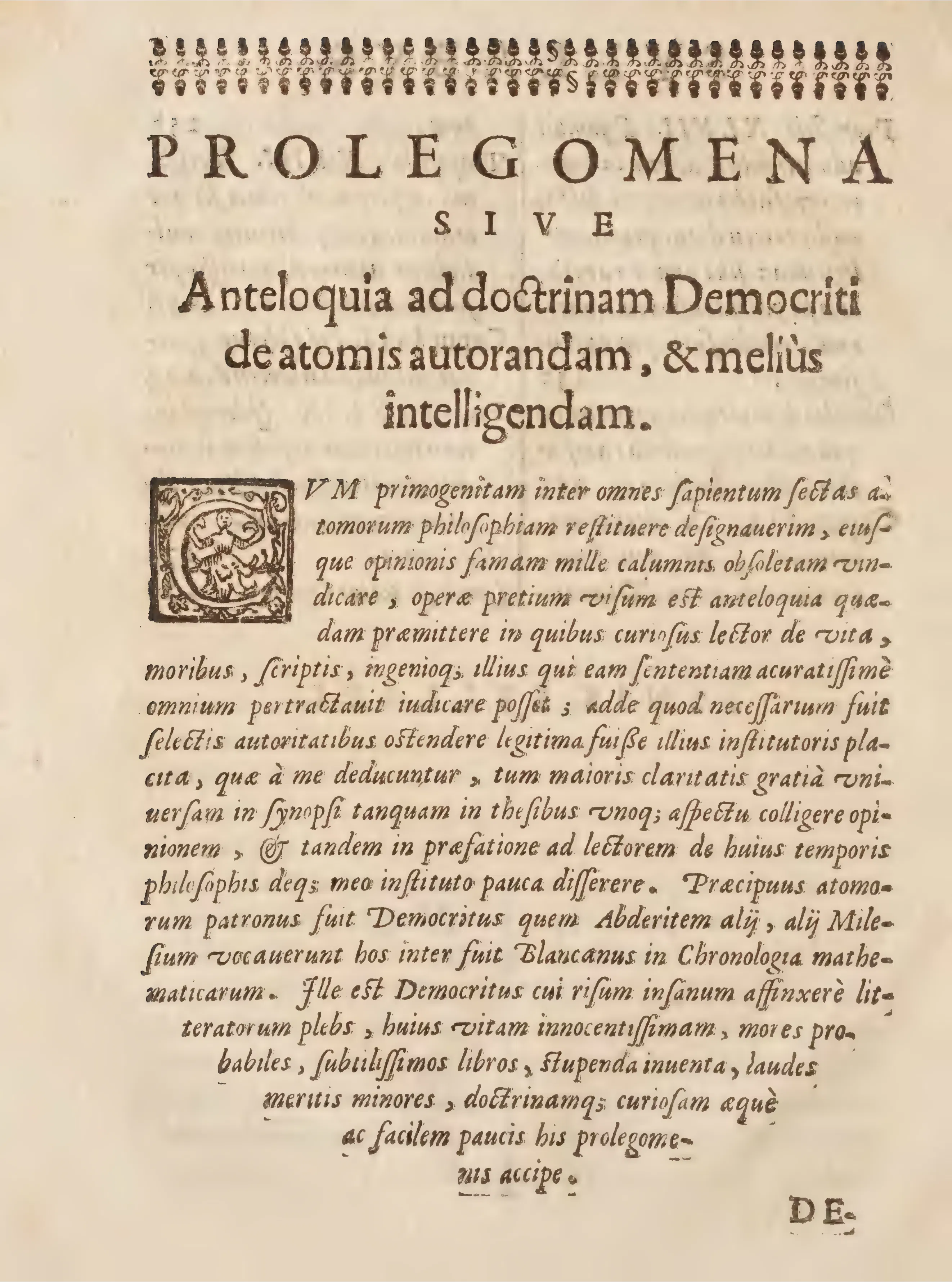
The ornamental headpiece and historiated initial mark the Prolegomena as a major threshold in Magnen's project, where the printed program casts atomism as the “primogenitam inter omnes sapientum sectas” and prepares a rehabilitation of Democritus rather than a merely antiquarian notice. By promising biography, vindication, synopsis, and an address to contemporary philosophers, the page stages the reviviscence of atomism as both historical recovery and constructive intervention. Source ↗.
The first is atomus. Magnen defines the atom not as a metaphysical point but as a physically indivisible corpuscle that is nevertheless mathematically divisible without limit—the radix et origo extensionis, the root and origin of extension. He states the definition in his own terms, holding that the atom can be defined as the material and physical root and beginning of extension, Atomus definiri potest, Materialis physicæq[ue] extensionis radix, & initium. The atom is for him neither the Democritean minimum with figure, order, and position alone, nor the Aristotelian minimum that always remains further divisible because of an underlying matter; it is a minimum physico-m mathematicum, a real, extended, indivisible magnitude. The construction is a deliberate reply to two rival vocabularies. Against the Aristotelian tradition, Magnen insists that the atom resists division not because division is conceptually incoherent but because the configuration of minima on which the body's macroscopic qualities depend is destroyed when the body is broken past a certain point: the action follows the being (operari sequitur esse). Against the Galilean tradition, which tended to assimilate indivisibles to mathematical points, Magnen holds that the atom, unlike the punctum geometricum, possesses magnitude however small. The atom is therefore a third term, neither pure mathematical indivisibility nor pure material continuum, and the terminology encodes a polemical position between Peripatetic minima and Cartesian-or-Galilean point-indivisibles. Magnen resolves the apparent paradox by distinguishing two aspects that must be conceived in any atom—its indivisible physical substance and its infinitely divisible mathematical figure and space—insisting that two things must be conceived in any atom, Duo itaq; in atomo quauis concipienda sunt, primò eius atomi substantia physica, quę vt sic est indiuisibilis, secundò eius respectus extrinsecus, siuè figura, & spatium extensione mathematica penes quam atomus quæuis diuisibilis est in infinitum, namely first the physical substance of the atom, indivisible as such, and second its extrinsic respect, its figure and space in mathematical extension, divisible to infinity.
The second commitment is to the Democritean inane or vacuum, which Magnen reinterprets as aer (air). Magnen makes the identification explicit, reporting that Democritus held there to be absolutely only two things, atom and void, and glossing the latter as air, Voluit autem duo tantum esse absolutè Democritus, atomum & vacuum quo nomine intelligit aerem. The identification diverges sharply from the orthodox Epicurean-Lucretian physics in which the void is required as an absolute emptiness without which motion is impossible. For Magnen, by contrast, the void is the elastic ambient air of Aristotelian-Peripatetic meteorology, not pure nothingness. The move is doctrinally consequential: it preserves the explanatory apparatus of Democritus—motion, mixture, porosity, the recombination of minima—while neutralizing the most controversial implication of classical atomism, namely the denial of any horror vacui or natural place. By reframing the void as a material medium, Magnen domesticates atomism for an audience trained on scholastic physics and Catholic theology, where the existence of an absolute vacuum had been the principal ground on which atomism had been condemned.
The third commitment is the maxim opus naturae opus intelligentiae—the work of nature is the work of an intellect. The phrase belongs to a long patristic and medieval tradition stretching from the De mundo attributed to Aristotle through Aquinas's use of it in the Summa theologiae and into the seventeenth-century physico-theological literature; Gassendi himself employs analogous formulae. Magnen deploys the maxim to argue that the regularity and purposiveness of atomist generation disclose a divine designer; the atoms are not self-organizing but are guided, so that the mechanistic explanation of natural phenomena does not collapse into materialism or chance. The maxim thus functions as a theological capstone that reconciles atomist cosmology with creation by an intelligent God, enjoining that in these works of nature one must always recall that truest maxim, as Magnen puts it, In istis verò naturæ operibus oportet semper recordari versissimi illius pronuntiati, opus naturæ opus intelligentiæ.
These terminological commitments diverge from inherited usage at precisely the points where Magnen is most exposed to objection. The identification of the void with air sets Magnen against both the strict Democritean and the Epicurean traditions, in which the void is absolute emptiness; the insistence that the atom is neither a point nor a Peripatetic minimum puts him at odds with both the Galilean and the Aristotelian schools. And the maxim that the work of nature is the work of an intellect, while consonant with Catholic natural theology, makes the work of nature intelligible only as the work of a designer, so that Magnen's mechanism is in service of a physico-theological argument. Magnen articulates these divergences in his prefatory letter, where he insists that actiones physicae regulis geometricis non sunt expendendae: the actions of physics are not to be weighed by the rules of geometry. He states the same principle propositionally within the treatise, that physical actions are not to be assessed by geometric rules, Non sunt expendendæ actiones physicæ regulis geometricis. The phrase signals that Magnen's mechanism operates on physical, not mathematical, principles, and that the atom, although mathematically divisible, is physically indivisible—a position that distinguishes him from Cartesian mechanism, where the rules of geometry govern physics directly.
What the Treatise Argues: An Executive Summary
Genre. A demonstrative natural-philosophical treatise in the Euclidean manner: definitions, axioms, postulates, propositions, and demonstrations, addressed formally to the Senate of Milan and organized so that the atomist case can be presented as both mathematically evident and theologically unobjectionable. Magnen announces the method explicitly, describing how he attempted to carry over Euclid's most noble practice for the sake of greater clarity by prefixing definitions, axioms, and postulates to his propositions, tentau nobilissimam Euclidis consuetudinem, maioris claritatis causa, à geometrico puluere in lycaum inuehere, definitiones axiomata, & postulata præstruens propositionibus.
Author. Jean-Chrysostôme Magnen (Latin Ioannes Chrysostomus Magnenus; Italian Giovanni Crisostomo Magneni), born at Luxeuil in the County of Burgundy (Franche-Comté), physician and university teacher; appointed in 1646 to the chair of medicine at the University of Pavia under the patronage of the Senate of Milan, and subsequently also to a chair of philosophy.
Date and place of composition and production. Pavia, 1646; printed apud Io. Andream Magrium (Giovanni Andrea Magri), an active Pavia printer.
Core thesis. The rehabilitation of Democritus's atomistic doctrine of matter as a respectable component of seventeenth-century natural philosophy; the reduction of the elements from four to three (Terra, Aqua, Ignis); the geometric vindication of atomism through the divisibility of extension; the experimental demonstration of matter theory through observation and measurement; and the reconciliation of atomist cosmology with divine creation. Magnen sets out the twofold architecture of the work at the outset, judging that prime matter must first be investigated and then contending that it consists of atoms, Primùm itaq[ue] inuestigandam mihi esse duxi materiam primam, quam deinde atomis constare contendo, sicq[ue] duæ sunt primæ huius libri partes prima de materia prima, altera de atomis, so that the two first parts of the book are one on prime matter, the other on atoms.
Language. Latin, with embedded Greek lemmata drawn from the Democritean fragments (notably for the nomos and epimologie doctrines) as transmitted through Galen's commentaries on Hippocrates.
Translation status. No modern English translation is known to exist. A French partial paraphrase circulates in unpublished dissertation form but no published translation appears in standard library catalogues.
Placing Magnen in the Historiography of Early Modern Atomism
The Democritus reviviscens holds a recognized but secondary position within the secondary literature on early modern atomism. Its significance is threefold.
First, the work constitutes the most prominent Catholic-Protestant intermediate position between the Gassendist rehabilitation of Epicurean atomism and the Boylean corpuscular programme. Magnen accepts the corpuscular architecture of matter, the role of figure in determining sensible qualities, the mechanical explanation of weight and lightness by impact rather than by inherent tendency, and the mechanical account of mixture by atomist recombination. He rejects, however, the strict Democritean void and retains the Peripatetic doctrine of substantial forms. The work thereby illustrates the confessional elasticity of mid-seventeenth-century atomism in a way that contrasts with both the more aggressive Boylean formulation and the more thoroughgoing Gassendist project. The confessional accommodation is nowhere clearer than in Magnen's declaration that the more probable doctrine is to hold that God composed all things from atoms, that if we say God most great composed all things from atoms we shall follow the more probable doctrine, Sed si dicamus Deum opt. maximum atomis omnia composuisse verisimiliorem doctrinam sectabimur, a move that redeems the atom and the void while discarding the fortuitous cosmogony to which the ancient system was chained.
Second, the work is regularly cited in the historiography of atomism as evidence for the diffusion of the corpuscular hypothesis through a teaching chair (Pavia) under the patronage of a Habsburg senate; the dedicatory apparatus situates the work within an institutional matrix (the Senate of Milan) and within a learned community (the Pavia medical faculty) in ways that the Gassendist and Cartesian writings do not.
Third, the work supplies the canonical estimate, first cited in modern historiography by A. Stückelberger and reused by K. Figala and others, that a pea-sized lump of incense contains ~10^18 atoms; this estimate, often attributed to Magnen (1646) and used by Loschmidt (1865) and subsequent nineteenth-century theorists, secures Magnen a small but persistent place in the history of atomic estimates.
The standard scholarly reference is Magnenus, Joannes Chrysostomus, in Charles Coulston Gillispie, ed., Dictionary of Scientific Biography (New York: Scribner's, 1970s), IX, 26–27. Subsequent treatments in Christoph Lüthy, John Murdoch, and William R. Newman's historiography of matter theory situate the work within the lineage of corpuscular alternatives to scholastic and Cartesian natural philosophy. Magnenus appears in alphabetical and thematic indexes of every comprehensive history of atomism after 1970 (Pyle, Westfall, Banchetti-Robischong).
Major debates and frictions engaged:
- The anti-Peripatetic assault on the doctrine of gravity and levity and on proper rarefaction and condensation. Magnen substitutes a single impetus for natural heaviness and lightness and explains condensation and rarefaction by mechanical impact rather than by qualitative transformation, in a manner comparable to Galileo but without Galileo's geometric commitment. He states the positive thesis that impetus is the single motive force in the second part of the relevant proposition, Secunda pars propositionis impetum esse vnicam vim motricem, and grounds the denial of gravity and levity in the argument that heaviness is only a downward motive virtue and lightness only an upward one, but since no body naturally lacks other motions, no body is properly heavy or light, grauitas est virtus motrix deorsum tâtùm, leuitas virtus motrix sursum tantùm, sed nullu[m] est corpus quod naturaliter non habeat alias lationes ergo nullum corpus graue est vel leue propriè loquendo. His denial of proper rarefaction and condensation rests on the claim that whatever exists has determinate limits of extension, quidquid existit determinatos habet extesionis limites vltra quos non potest porrigi, infra quos non potest adigi, ergo non datur rarefactio neque condensatio propriè dicta, beyond which it cannot be stretched nor below which forced, so that no proper rarefaction or condensation is given—a difficulty he resolves by the doctrine that the atom, its mass and quantity wholly unchanged, can occupy now a greater, now a smaller place through intrinsic and extrinsic virtualities, Atomus quidem est substantia simplicissima absq[ue] compositione, sine vlla vnione, virtualitates tamen habet intrinsecas, & extrinsecas, secundu[m] quas eàdem omnino mole, & quantitate permanente potest occupare modo maiorem, modo minorem locum extrinsecum.
- The reduction of the four elements to three (Terra, Aqua, Ignis), with air denied elemental status. This move aligns the work with the chymical tria prima of salt, sulphur, and mercury (Paracelsus and Sennert) rather than with the Aristotelian quadriga; Magnen makes the alignment explicit, holding that only three are found, as is manifest to the chymists, who find sulphur, mercury, and salt in all mixed bodies, tria tantum reperiuntur, vt Chymicis est manifestum qui sulphur, mercurium, & salem in omnibus mixtis reperiunt. The elemental scheme is further specified by the geometry of the atoms themselves, fire-atoms being originally spherical and lovers of that figure, taking others only accidentally, while earth-atoms are originally cubic and never change figure, Sunt itaq; atomi igneę originaliter sphericę illiusq; figurę amantes, per accidens autem quamlibet aliam induunt in gratiam formarum substantialium, & naturę commoda. Atomi terreę sunt originaliter cubicæ neq; figuram mutant.
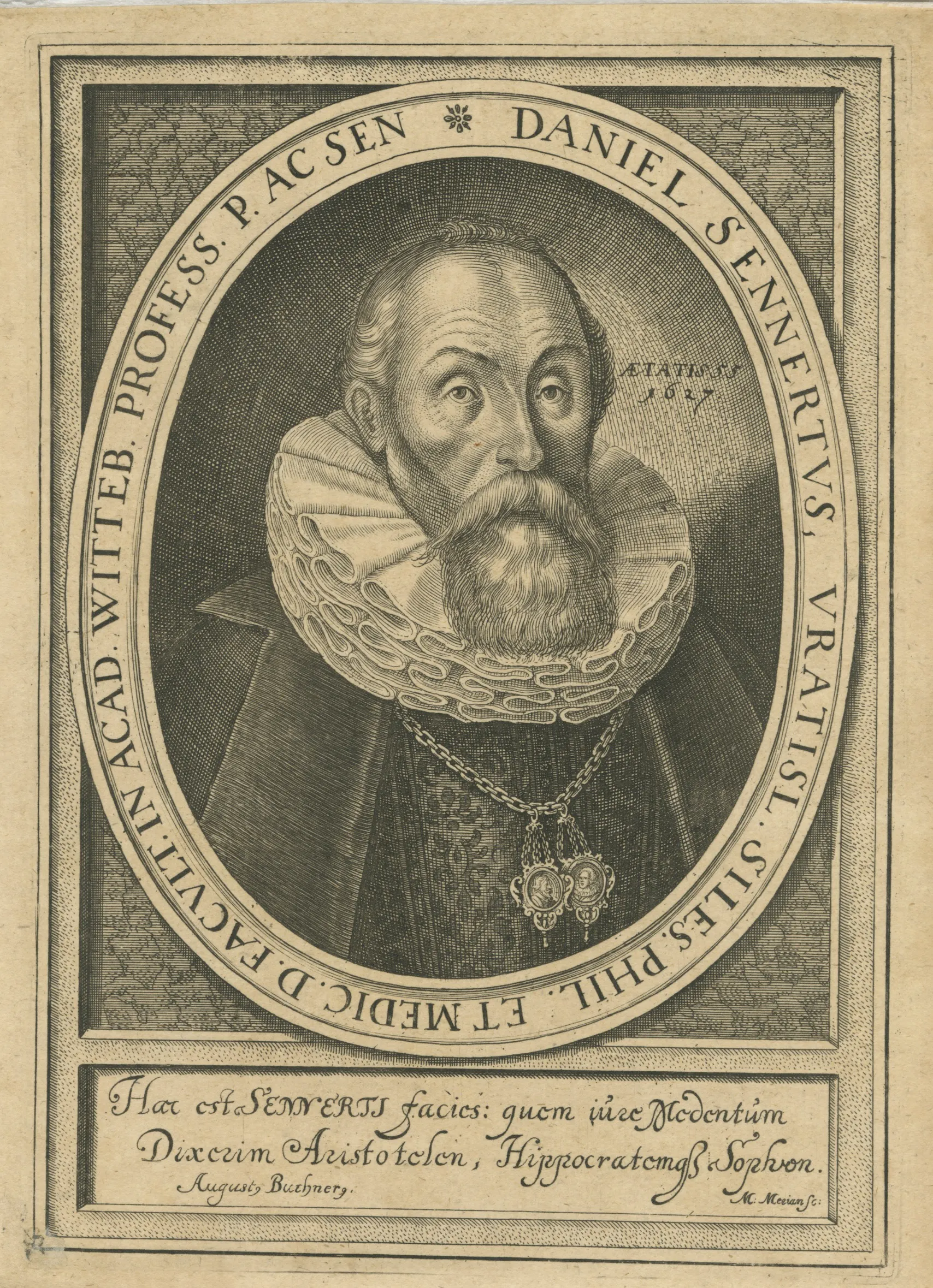
Merian's engraved portrait of Daniel Sennert, a key predecessor who helped transmit the Paracelsian triad of salt, sulphur, and mercury into learned natural philosophy. Magnen's three-element atomism draws on that lineage while pointedly moving beyond Sennert's “physical minima” toward a stronger claim about true atoms and their geometries. Source ↗.

- The reception of Galileo's odd-number law of fall (the square-law / odd-number rule for distances in equal successive times) and the free-fall experiment with wood and iron globes. Magnen cites Galileo as an authority for atomist kinematics, reporting the law that if any mobile descends from its point of rest, the spaces traversed in equal times keep the ratio of the odd numbers following from unity, Si aliquod mobile descendat, à puto quietis suæ, spatia in temporibus æqualibus peracta, eam inter se retinent rationem quam habent numeri impares ab unitate consequentes. The empirical companion to this is the free-fall experiment in which he let a wooden and an iron globe fall at the same instant from the same height, lignum, & ferreum globum eodem momento ex eade[m] horizontali linea pari altitudine demisi, & vtrumq; pari velocitate ad terram delatum est, and both reached the ground with equal speed—a result he presses hard against the schools, since the Peripatetics must deny it against sense-experience if they wish their doctrine to stand, peripateticis omnibus contra sensum est neganda si suam stare velint doctrinam, cæteroquin mirum quantum Democriti sententiæ fauet, while otherwise it wondrously favors Democritus's view.
- The theological problem of reconciling atomist cosmogony with divine creation, addressed through the maxim opus naturae opus intelligentiae and through the insistence that the atoms are created, not self-organizing. Magnen concedes that Democritus erred amid the gross darkness of the gentiles when he pronounced innumerable worlds coalesced by a fortuitous concourse of atoms, N[on] Vlli dubium est quin Democritus in crassis gentilium tenebris errauerit dum fortuito atomorum concursu mundos coaluisse innumeros pronuntiauit, and it is precisely this fortuitous cosmogony, rather than the atom and the void themselves, that his physico-theology is designed to discard.
- The natural-magic complex of sympathia (magnetism, the weapon-salve, sympathetic nose-transplant à la Tagliacozzi, the palingenesia of the rose), which Magnen treats as legitimate natural philosophy rather than as superstition. The palingenetic revival of the rose serves as a sensible proof of atomist recombination under divine ordering, Magnen reporting that little by little those corpuscles coalesced into a most perfect rose, lacking neither order in its petals, nor color, nor its saffron center, paulatim in rosam perfectissimam corpuscula illa coaluerunt, cui neq; in folijs ordo, neq; color, neq; meditullium croceum deessè videbatur.
The secondary literature directly addressing Magnen is thin. Major treatments are: the DSB entry; the work of William R. Newman on chymical atomism; the work of Christoph Lüthy on varieties of Aristotelian atomism; and the dissertation by Anne-Lise Rey on Magnen's atomism in seventeenth-century France. No full critical edition or monograph-length study of Magnen exists. The historiographical consensus treats Magnen as a significant but not major figure, important for the diffusion of atomist ideas through academic institutions and for the persistence of substantial forms within an otherwise mechanistic framework.
Textual History, Materiality, and the Object Biography of the 1646 Pavia Edition
Authorship Context. Jean-Chrysostôme Magnen (c. 1590 – c. 1679) was born at Luxeuil in the County of Burgundy (Franche-Comté, then within the Holy Roman Empire, transferred to France in 1678), obtained his doctorate in medicine at Dole, traveled in Italy, acquired a reputation as a physician, and in 1646 was appointed to the chair of medicine at the University of Pavia (Ticinum), under the patronage of the Senate of Milan. He was later promoted also to a chair of philosophy. The University of Pavia archives, partly edited by Alessandro Tadini and subsequently by Aldo Ferrario, contain Magnen's faculty rolls (Rotuli) from 1646, confirming the appointment. He is documented as holding the royal professorship of medicine with an annual stipend of 600 lire, an unusually high figure that reflects the patronage of the Senate of Milan and the strategic importance of medical teaching in the duchy.
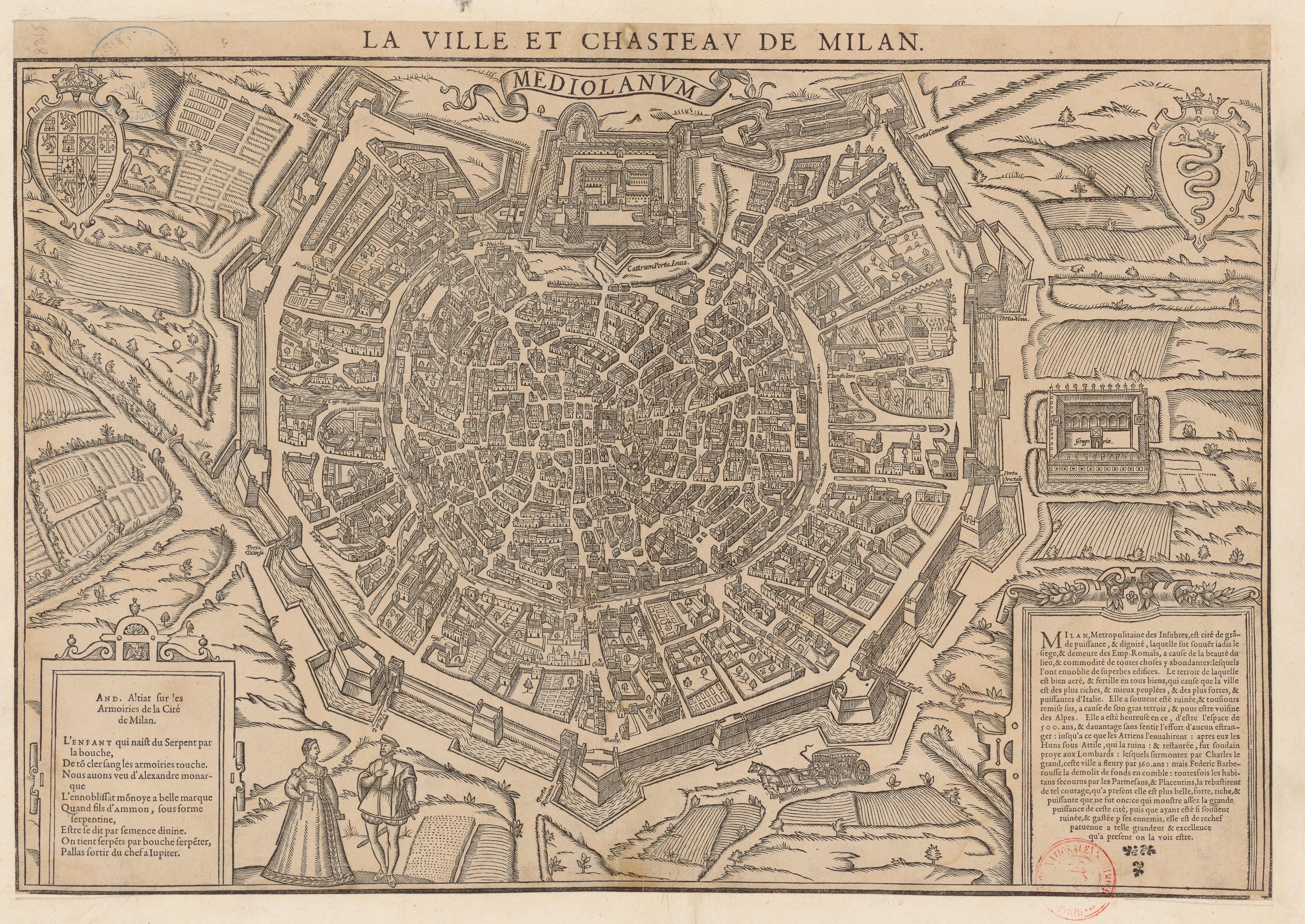
Braun and Hogenberg's early modern plan of Milan, with the fortified city and castle set within the Lombard landscape, evokes the governing center whose Senate stood behind Magnen's 1646 appointment at Pavia. Rather than illustrating the treatise itself, the print situates his academic career within the institutions and political geography of Habsburg Milan. Source ↗.

First Edition (1646, Pavia). Io. Chrysostomi Magneni Burgundi ... Democritus reviviscens sive de atomis ad excellentissimum Senatum Mediolanensem. Addita est Democriti vita cum indicibus necessariis. Papiae [Pavia]: apud Io. Andream Magrium [Giovanni Andrea Magri], 1646. 4° (quarto). [XII] + 416 [i.e. 424] pp., with engraved additional title and diagrams. The imprint is confirmed by copies at the Bayerische Staatsbibliothek (digital surrogate available) and other repositories. The printer Giovanni Andrea Magri was an active Pavia printer whose shop produced a number of medical and natural-philosophical works in the 1640s and 1650s.
Material and Typographical Features. The 1646 Pavia edition is a quarto with the conventional apparatus of a Jesuit-style scholastic natural-philosophical treatise: engraved additional title with author portrait, full-page engraved title with architectural frame (variously identified in the secondary literature as the work of an anonymous engraver associated with the Magri workshop), woodcut diagrams of elemental geometry and atomic configurations, and a final alphabetical index (indices necessarii). The dedicatory apparatus is unusually elaborate for a medical-natural-philosophical treatise and is intended to advertise the Senate of Milan's patronage of medical learning at Pavia. The patronage relation is inscribed in the very texture of the work: in the Conclusio Magnen instructs the reader that where anything polished and accurate occurs, the urbane reader should venerate the auspices of the most excellent Senate of Milan, vbi autem aliquid elimati acuratiq[ue] occurret, Urbanelector, EXCELLENTISSIMI SENATVS MEDIOLANENSIS auspicia venerare.
Dedicatory Epistle and Named Senators. The dedicatory epistle enumerates twelve senators of Milan to whom the work is dedicated: Octavianus Picenardus Cremonensis; Aloysius Belcredius Ticinensis; Joannes Baptista Bonettus Cremonensis; Petrus Petracinus Laudensis; Joannes Arias Maldonado Hispanus; Otho Camulus Mediolanensis; Andreas Alipherus Mediolanensis; Matthaeus Binius Mediolanensis; Joannes Baptista Cantonus Alexandrinensis (of Alessandria); Alphonsus Delrio Norlega Hispanus; Fabius Franciscus Dugnanus; Guido Bonus Cavalchinus; Carolus Patellanus; Augustinus Navarro Burgensis Hispanus. The Senate's jurisdiction over the University of Pavia is the immediate context of the dedication.
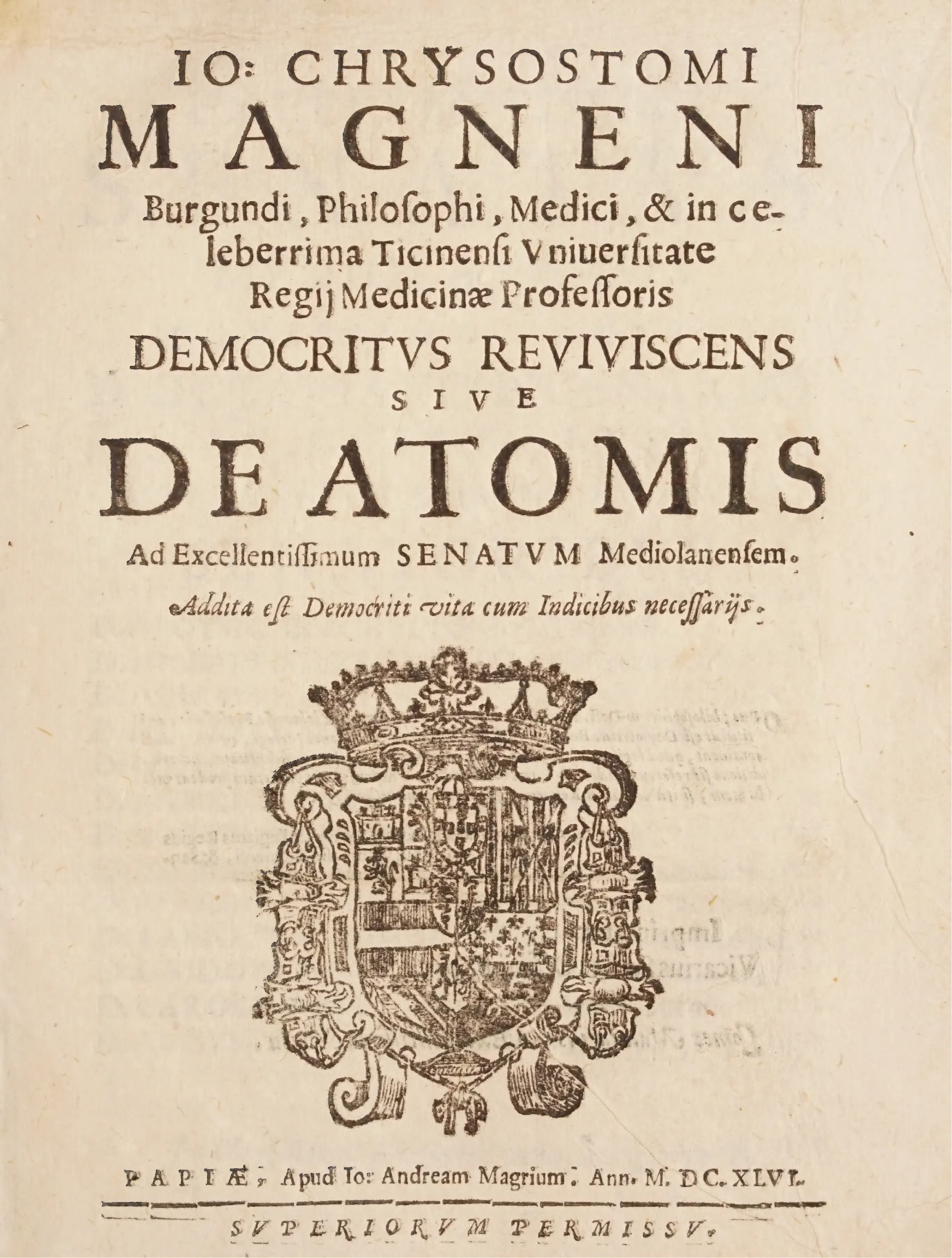
The 1646 Pavia title page of Magnen's Democritus reviviscens sive de atomis makes its patronage legible at a glance: the printed dedication to the Senate of Milan is reinforced by a large crowned heraldic woodcut occupying the lower half of the page. Set beneath Magnen's university credentials and the imprint of Giovanni Andrea Magri, the device anchors the work in the senatorial authority that governed the University of Pavia and framed the dedicatory epistle to its named Milanese patrons. Source ↗.
Reprints and Reissues.
- 1648 (Leiden, Hackius): Often cited as the first continental reprint. The imprint reads Lugduni Batavorum, ex officina Hackiana, 1648. This reissue preserves the original Pavia pagination in some copies, indicating that the sheets were reissued with a new title page. The Leiden reprint is itself rare and is the principal vehicle by which the work entered the Dutch book trade.
- 1658 (London and The Hague): Democritus reviviscens, sive vita et philosophia Democriti. The imprint is variously given as London and The Hague. This edition incorporates the corrected text of the 1646 Pavia edition and adds a new preface to the reader by a different editor. It is the edition most often cited in modern historiography of atomism because it is the edition reproduced in microform in the Landmarks of Science series and is widely held in research libraries.
The 1658 London/The Hague imprint is also the edition most frequently cited in modern scholarship as the "1658 edition" because of its wider availability in digitized form. The bibliography of Magnen in Maggs Bros., Bibliotheca Magensiaca (London: Maggs Bros., 1923), itemizes copies of both reissues.
Later Reception. Magnen's atomistic theses were taken up by Robert Boyle in his "atomicall" essays, although the extent of Boyle's direct dependence on Magnen is debated. Kenelm Digby and Walter Charleton also engaged the corpuscular hypotheses of Magnen in the 1650s and 1660s, though they do not always cite him by name. By the early eighteenth century, Magnen was cited primarily as a representative of the atomist school rather than as a primary source.
Repositories Holding Physical Copies.
- Bayerische Staatsbibliothek, Munich (digital surrogate).
- Biblioteca Ambrosiana, Milan.
- British Library, London.
- Bibliothèque nationale de France, Paris.
- Universiteitsbibliotheek Leiden.
- Newberry Library, Chicago.
- Burndy Library (now at the Huntington), San Marino.
- Wellcome Library, London.
- Yale University, Beinecke Library.
- Several Italian libraries including the Biblioteca Nazionale Universitaria di Torino.
The Bayerische Staatsbibliothek (BSB) holds a digital surrogate under shelfmark Res/4 Phys. 27. The Google Books scan (Google-id l_UcbNLjmZoC) is derived from the BSB digital surrogate.
Privilege, Censorship, Suppression. The work bears an imprimatur of the Vicariate of the Holy Office at Pavia (Vicarius Sancti Officii Papiae), which constitutes the documentary evidence of ecclesiastical licensing in Milanese territories. No documentary evidence of condemnation, expurgation, or inclusion on the Index has been located; the work is not listed in the Index Librorum Prohibitorum through the 1948 edition. Conversely, the absence of a suppression record is consistent with the work's general conformity to the doctrine of creatio ex nihilo and to the doctrine of substantial forms. The methodological posture that keeps the work within confessional bounds is also, notably, one that subordinates the authority of the schools to demonstration: Magnen insists that authorities are to be weighed rather than counted, that we weigh votes, we do not count them, suffragia enim ponderamus, non numeramus, and pledges his allegiance to truth above the sects in the formula that Plato is a friend, Aristotle is a friend, but Truth is a greater friend, Amicus Plato, amicus Aristoteles, magis amica Veritas.
Position Among Magnen's Other Works. The Democritus reviviscens belongs to a small corpus of works by Magnen that includes the Exercitationes de tabaco (on tobacco, 1648/1658/1669) and the De manna tract. These works share the atomist commitments and the Euclidean expository form of the Democritus. They constitute, collectively, the documentary basis for any assessment of Magnen's natural-philosophical program.
Tracing the Argument: Structure and Textual Evidence in Democritus reviviscens
The Front Matter: Fixation, Method, and the Recovery of Democritus
Magnen's treatise announces its animating conviction in the dedicatory epistle to the Senate of Milan, where atomism is presented not as a curiosity fit for the antiquary but as the recovered summit of human intellection. Consecrating what he calls the first fruits of his philosophy, Magnen stages the encounter of an older and a younger philosophy in the Boethian manner, from which the atomist doctrine emerges as the great, prize-winning work of human minds that leaves him fixed in its contemplation—the same avowal of thought held fast that opens the report as a whole. The verb defixum—held fast, transfixed—registers the personal and confessional stakes of the enterprise: the recovered doctrine does not merely interest Magnen, it holds him, and the treatise that follows is the labor of releasing that fixation into a demonstrable and licit form. Already in the same epistle he takes care to differentiate his atoms from the rival vocabulary of his most immediate modern predecessor, conceding that Sennert had proved not atoms at all but physical minima to be given, atomos nequaquam, sed minima physica dari probauit; the concession is also a claim of priority, marking the space in which Magnen's own contribution—the true atom, as against the Sennertian minimum—will be made to stand.
The method by which that contribution is to be secured is declared with equal explicitness at the head of the argumentative core. Magnen presents the treatise as an importation of geometry into the schools, attempting to carry Euclid's most noble practice out of the geometer's dust and into the Lyceum for the sake of greater clarity by prefixing definitions, axioms, and postulates to his propositions, tentau nobilissimam Euclidis consuetudinem, maioris claritatis causa, à geometrico puluere in lycaum inuehere, definitiones axiomata, & postulata præstruens propositionibus. The image of transporting demonstration à geometrico puluere in lycaum is not idle ornament: it figures the whole polemical ambition of the work, which is to subject the doctrines of the philosophical schools to the evidentiary discipline of the geometers. In the same programmatic passage Magnen lays out the twofold architecture that governs the opening disputations, judging that prime matter must first be investigated and then contending that it consists of atoms, so that the first two parts of the book are one on prime matter and the other on atoms, Primùm itaq[ue] inuestigandam mihi esse duxi materiam primam, quam deinde atomis constare contendo, sicq[ue] duæ sunt primæ huius libri partes prima de materia prima, altera de atomis. The sequence is not merely expository but demonstrative in intent: prime matter is to be run down to its constituents, and those constituents are to prove atomic. To that end Magnen insists that geometry is not an optional accessory to the physicist but a precondition of the inquiry, holding that one will accomplish nothing great in philosophy who is ignorant of mathematics, and will by no means grasp the most subtle science of atoms, nihil enim magni in philosophia faciet, qui mathesim ignorat, atomorum certè subtilissimam scientiam nullo modo percipiet. The claim that the subtilissima scientia of atoms is inaccessible without mathematics ties the physical thesis to the geometric apparatus at the root, even as the treatise elsewhere reserves the ultimate adjudication of physical action to physical rather than geometric rules—a tension internal to the program rather than a lapse within it.
The epistemological temper that authorizes this reordering of the schools is captured in two mottoes that Magnen places at the threshold of his method. Against the sheer accumulation of authorities he sets a principle of assessment over enumeration, insisting that we weigh votes and do not count them—the suffragia ponderamus formula noted earlier in connection with the work's methodological posture—a formula that converts the appeal to consensus into an appeal to demonstrative weight, and so licenses the elevation of a single ancient voice, Democritus, over the massed testimony of the Peripatetic tradition. The companion motto, deployed in the classification of philosophers into their three genera, pledges allegiance to truth above every school in the sharpened proverb that Plato is a friend, Aristotle is a friend, but Truth is a greater friend, the Amicus Plato proverb already met in the account of his method. In placing himself among the restorers of ancient doctrine rather than among the dogmatic followers of a sect or the radical innovators, Magnen uses the motto to define a middle posture: not the abandonment of the ancients but the recovery of the right ancient, adjudicated by weighed truth rather than by the count of adherents. That posture governs the whole recuperative gesture of the front matter, in which the loss of Democritus's works is laid squarely at Aristotle's door. The charge is grave and materially precise: Magnen accuses the Peripatetic tradition of a literarij peculatus, an embezzlement of letters, and reports that in a single conflagration were consumed so many riches of wisdom heaped up across thirty-six ages, vnoq[ue] incendio congesta triginta sex seculis tot sapientiæ diuitias absumpsit. The rhetoric of catastrophe—one fire destroying the accumulated wisdom of thirty-six ages—supplies the retrospective justification for the entire enterprise: what Aristotle destroyed, Magnen undertakes to raise again, and the demonstrative apparatus is the instrument of that resurrection.
The First Disputation: Prime Matter, the Three Elements, and the Free-Fall Trial
The two disputations transmitted here enact the program on its two chosen fronts. In the treatment of prime matter the decisive and most exposed move is the reduction of the four Aristotelian elements to three by the demotion of air. Magnen argues that a natural and proper medium between agent and patient must partake of neither, and that air is precisely such a medium, so that it partakes of the qualities of no agent or patient, Medium naturale, & proprium inter agens, & patiens de neutro participare debet, sed aer est huiusmodi, ergo de nullius agentis patientisue qualitatibus participat. Because air, on this account, lacks primary qualities of its own and cannot therefore enter into mixture as an element, it is expelled from the elemental quadriga; and the residual scheme is confirmed not by Peripatetic authority but by the testimony of the chymists, so that only three are found, as is manifest to the chymists who find sulphur, mercury, and salt in all mixed bodies, tria tantum reperiuntur, vt Chymicis est manifestum qui sulphur, mercurium, & salem in omnibus mixtis reperiunt. The alignment of the three surviving elements—Terra, Aqua, Ignis—with the chymical tria prima draws the demonstrative and the experimental registers together: the reduction is proposed as a conclusion and corroborated as a finding, and the corroborating witness is the laboratory tradition of Paracelsus and Sennert rather than the schools.
The demotion of air has a further, systematic payoff, for it supplies Magnen with the resource by which he neutralizes the most scandalous element of classical atomism. Reading Democritus through the surviving fragments, he reports that the Abderite held there to be absolutely only two things, atom and void, and that by the name of void he understands air, Voluit autem duo tantum esse absolutè Democritus, atomum & vacuum quo nomine intelligit aerem. The identification of the inane with the elastic ambient air preserves the whole explanatory machinery of atomist motion and porosity while dissolving the absolute emptiness that had been the principal ground of atomism's condemnation. It is an exegetical decision doing doctrinal work: the void becomes a material medium, and the horror vacui of the schools is left with nothing to abhor.
The most striking convergence of demonstration and observation in these disputations is the free-fall experiment, offered in proof that air possesses neither gravity nor levity and, more broadly, that weight does not govern the speed of descent. Magnen reports a personally conducted trial, that he let a wooden and an iron globe fall at the same instant from the same horizontal line at equal height, and that each was carried to the ground with equal speed, lignum, & ferreum globum eodem momento ex eade[m] horizontali linea pari altitudine demisi, & vtrumq; pari velocitate ad terram delatum est. The report is framed in the first person and as a repeatable procedure from high towers with varied bodies, and Magnen presses its polemical force without hesitation: the result must be denied against sense-experience by all the Peripatetics if they wish their doctrine to stand, whereas otherwise it wondrously favors Democritus's view, peripateticis omnibus contra sensum est neganda si suam stare velint doctrinam, cæteroquin mirum quantum Democriti sententiæ fauet. The rhetorical structure of the passage sets sensus against doctrina: to save the Aristotelian teaching one must deny what the senses report, and the burden of impiety toward experience is thereby transferred from the atomist to the Peripatetic. Sense-experience is enlisted as the arbiter that the weighed-not-counted maxim had promised.
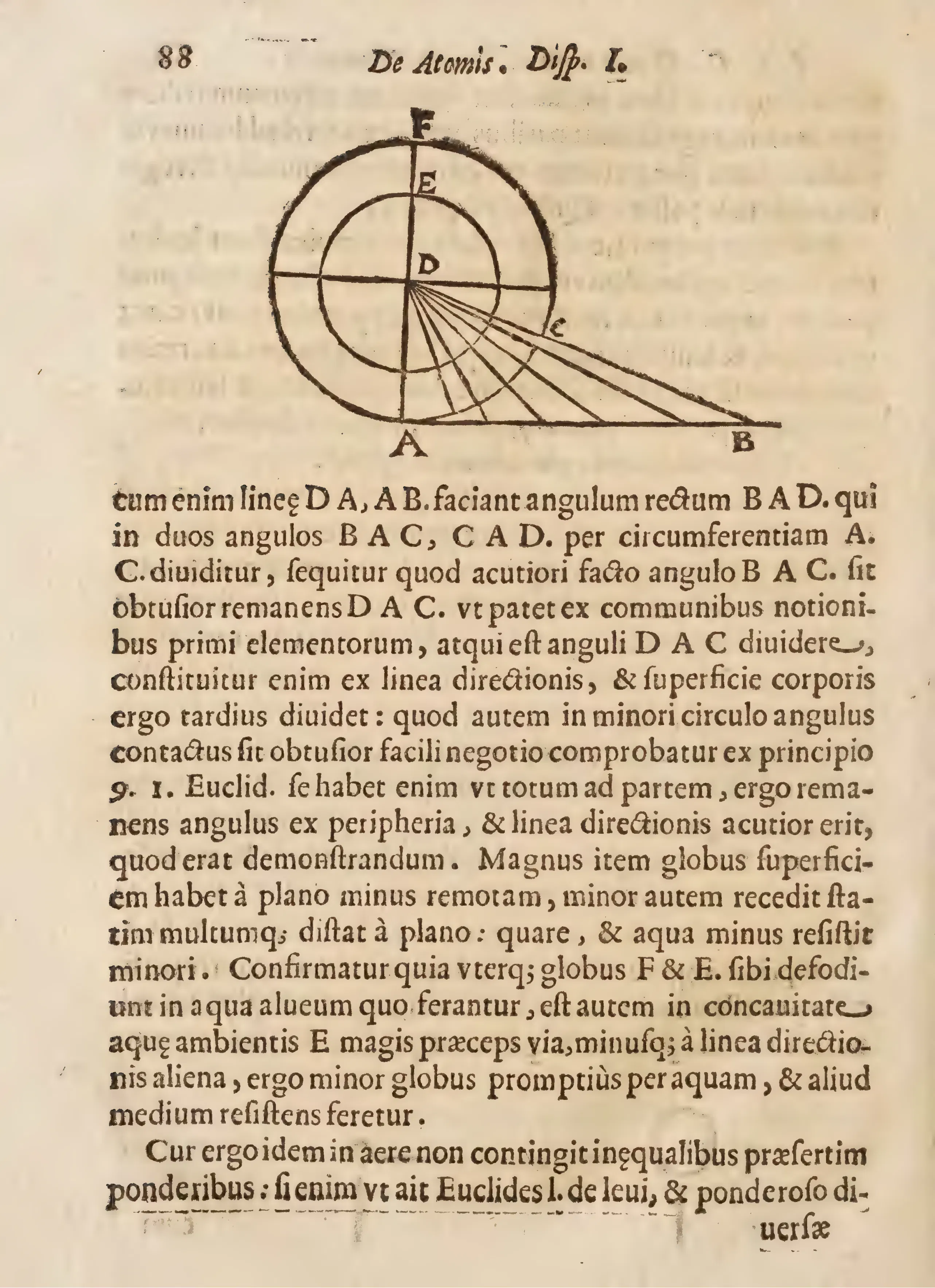
On this page of “De Atomis,” Magnen's woodcut of concentric circles, baseline AB, and rays from A turns the passage of globes through water into a Euclidean problem of angles of contact. That geometric lemma prepares the question that follows—why unequal weights do not behave differently in air—setting up the wood-and-iron globe trial in which sense-experience is made to favor Democritean atomism over Peripatetic doctrine. Source ↗.
The Second Disputation: Defining the Atom, Its Christianization, and the Palingenetic Proof
The second disputation carries the argument down to the atom itself, and here the definitional work is calibrated against a rival that the geometry threatens to collapse it into. Magnen defines the atom as a little body of such smallness and such a nature that it can in no way be divided, and expressly distinguishes it from the mathematical point, corpusculum tantæ paruitatis eiusq[ue]; genij vt nullatenus diuidi possit, differtq[ue]; à puncto mathematico. The insistence on the difference from the punctum mathematicum is the crux of his position: the atom is physically indivisible yet possesses magnitude, however small, and so is neither the dimensionless point of the geometers nor the endlessly divisible minimum of the Peripatetics. He fixes the definition in the compact formula that the atom can be defined as the material and physical root and beginning of extension, the radix et initium extensionis introduced at the outset of the report's philological framing. Naming the atom the root and beginning of extension holds the physical and the mathematical together at exactly the point where they threaten to come apart, for extension is the mathematical property and the atom is its physical root.
Two further passages disclose the theological and experimental extremities within which Magnen bounds his atomism. The first is the Christianizing move that renders the doctrine confessionally licit by severing the atom from the fortuitous cosmogony of the ancients: if we say that God the greatest and best composed all things from atoms, we shall follow the more probable doctrine, as already remarked in connection with the work's confessional accommodation. The atom and the recombination of minima are retained; the blind chance to which classical atomism had chained them is discarded, and a creating God is installed as the composer, so that the mechanism operates within, not against, Catholic natural theology. The second extremity is the palingenetic revival of a rose from its own ashes, offered as a sensible proof of atomist recomposition under divine ordering: little by little those corpuscles coalesced into a most perfect rose, in which neither order in its petals, nor color, nor its saffron center seemed to be wanting, as noted earlier among the phenomena of sympathia. The reassembly of the flower down to the meditullium croceum stages, at the visible scale, the very doctrine the disputations argue at the invisible one: dispersed corpuscles recombining into an ordered whole. That the demonstration is at once a wonder of natural magic and a token of resurrection is precisely the point, for it binds the recovered doctrine of the Abderite to a physico-theology in which the recomposition of matter is legible as the work of an ordering intellect rather than of chance.
The Geometry of the Elemental Atoms and the Problem of Place
Magnen's exposition in the ensuing stretch of the treatise moves from the geometry of the several elemental atoms into the cosmological and theological problem their motion raises, and the sequence of that movement is itself argumentatively load-bearing. It opens on the fixed figures proper to the atoms of each element, and the formulation Magnen chooses is telling in its accommodation of atomism to scholastic metaphysics. Fire-atoms, he holds, are originally spherical and enamored of that shape, assuming any other only accidentally for the sake of the substantial forms and nature's convenience, while earth-atoms are originally cubic and never change figure at all, as already recorded in the account of the three surviving elements. The clause in gratiam formarum substantialium is the decisive tell: the atoms are made to serve the substantial forms rather than to abolish them, so that Magnen's corpuscular architecture is fitted, from its foundational geometry upward, into a Peripatetic ontology it might otherwise seem designed to displace. The vocabulary of atoms "loving" their proper figure—illiusq; figurę amantes—is not merely ornamental; it introduces a teleological cast into the very shapes of the minima, preparing the ground for the physico-theological argument that will govern the whole cosmogonical section.
That geometry does real explanatory work, and Magnen presses it immediately into the service of his most delicate physical problem: how a body can occupy more or less space without any change in its matter. His answer is that the atom, though a most simple substance without composition or union, nonetheless possesses intrinsic and extrinsic virtualities by which, with its mass and quantity wholly unchanged, it can occupy now a greater, now a smaller extrinsic place, the doctrine of intrinsic and extrinsic virtualities set out earlier in the report's survey of rarefaction and condensation. The phrase eàdem omnino mole is the crux: mass and quantity are held rigorously constant while only the extrinsic termini vary. This is a maneuver of considerable ingenuity, for it lets Magnen retain the indivisible, unchanging corpuscle of Democritus while denying that rarefaction and condensation require any real addition or subtraction of matter. He is explicit that the whole apparatus rests on a mathematical foundation, confessing that this entire doctrine of his leans upon the propositions concerning isoperimetric figures, tota hæc mea doctrina in isoperimetrarum figurarum propositionibus innititur. The admission is significant precisely because it reveals how Magnen imports a theorem of pure geometry—that figures of equal perimeter may enclose unequal areas—and converts it into a physical principle governing the occupation of place. The tension latent here, between a mathematics that abstracts from matter and a physics that must not be judged by geometric rules, is one he will have to manage carefully, and it becomes the organizing problem of his solution to the continuum.
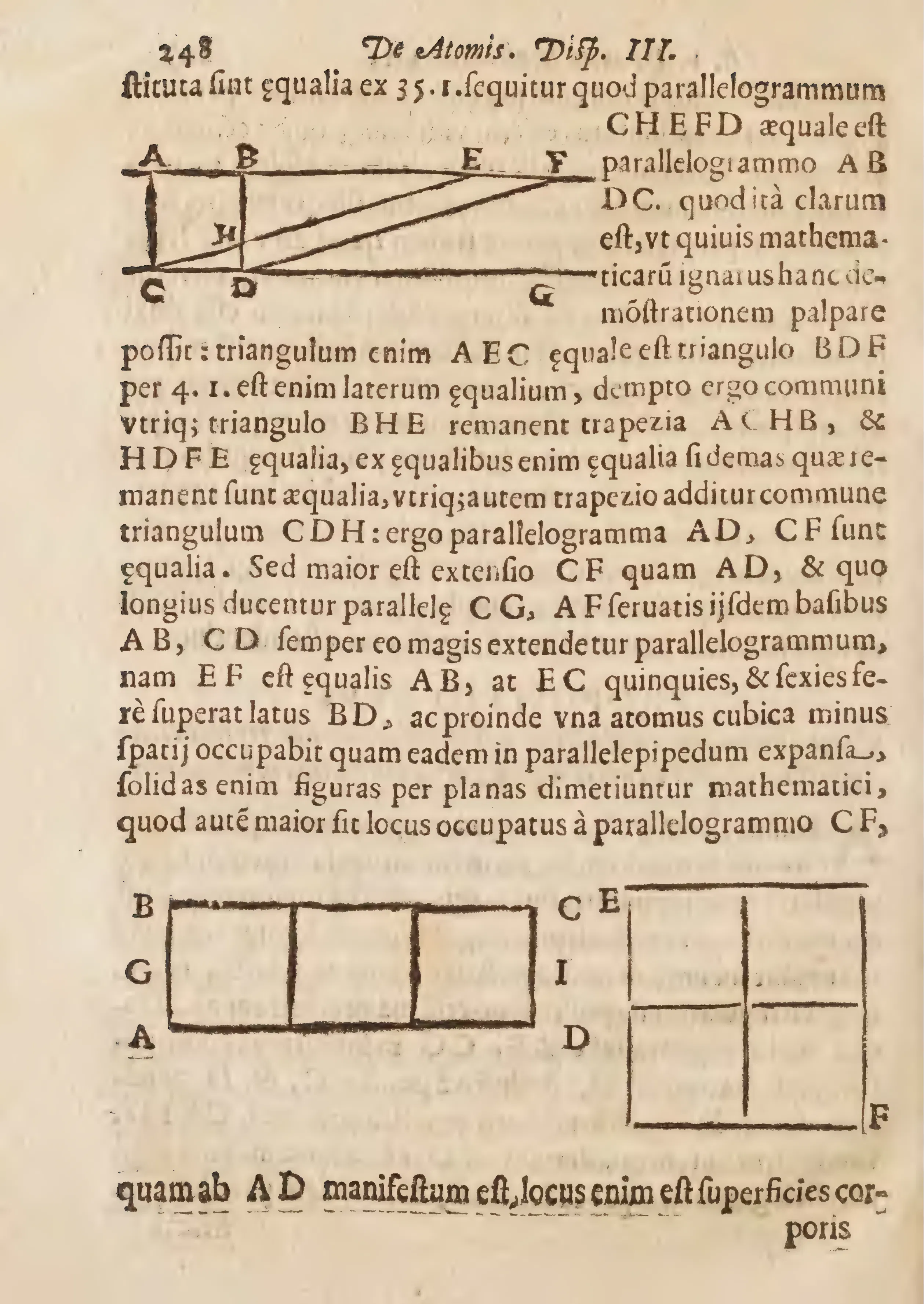
On this page of Disputation III, Magnen turns the isoperimetric theorem into a physics of place: the paired parallelogram and rectilinear diagrams visualize how equal quantities or perimeters can yield unequal extensions. The figures make concrete his claim that an unchanged atom may occupy a greater or lesser extrinsic place, allowing rarefaction and condensation to be explained without adding or subtracting matter. Source ↗.
Cosmogony and the Maxim of Ordering Intellect
Before reaching that solution, however, the argument turns to cosmogony, and it is here that the theological stakes of the enterprise surface most sharply. Magnen does not disguise the peril of his Democritean sources. He concedes without qualification that Democritus erred amid the gross darkness of the gentiles when he pronounced that innumerable worlds had coalesced by a fortuitous concourse of atoms, a concession already registered in the discussion of atomist cosmogony. The rhetorical structure of the concession is worth marking: the error is localized precisely and only in the fortuito atomorum concursu, the fortuitous concourse, and in the plurality of worlds it generates, not in the atom or the void as such. By isolating the offending doctrine so surgically, Magnen performs the central apologetic operation of the whole treatise—he salvages the physical apparatus of atomism by amputating its cosmological impiety. The atoms themselves are innocent; it is only their supposed self-organization by chance that consigns Democritus to the crassis gentilium tenebris. This is the discrimination on which the admissibility of the entire project depends, and Magnen states it here with a candor that leaves no room for ambiguity about where the line between recoverable physics and condemnable theology is to be drawn.
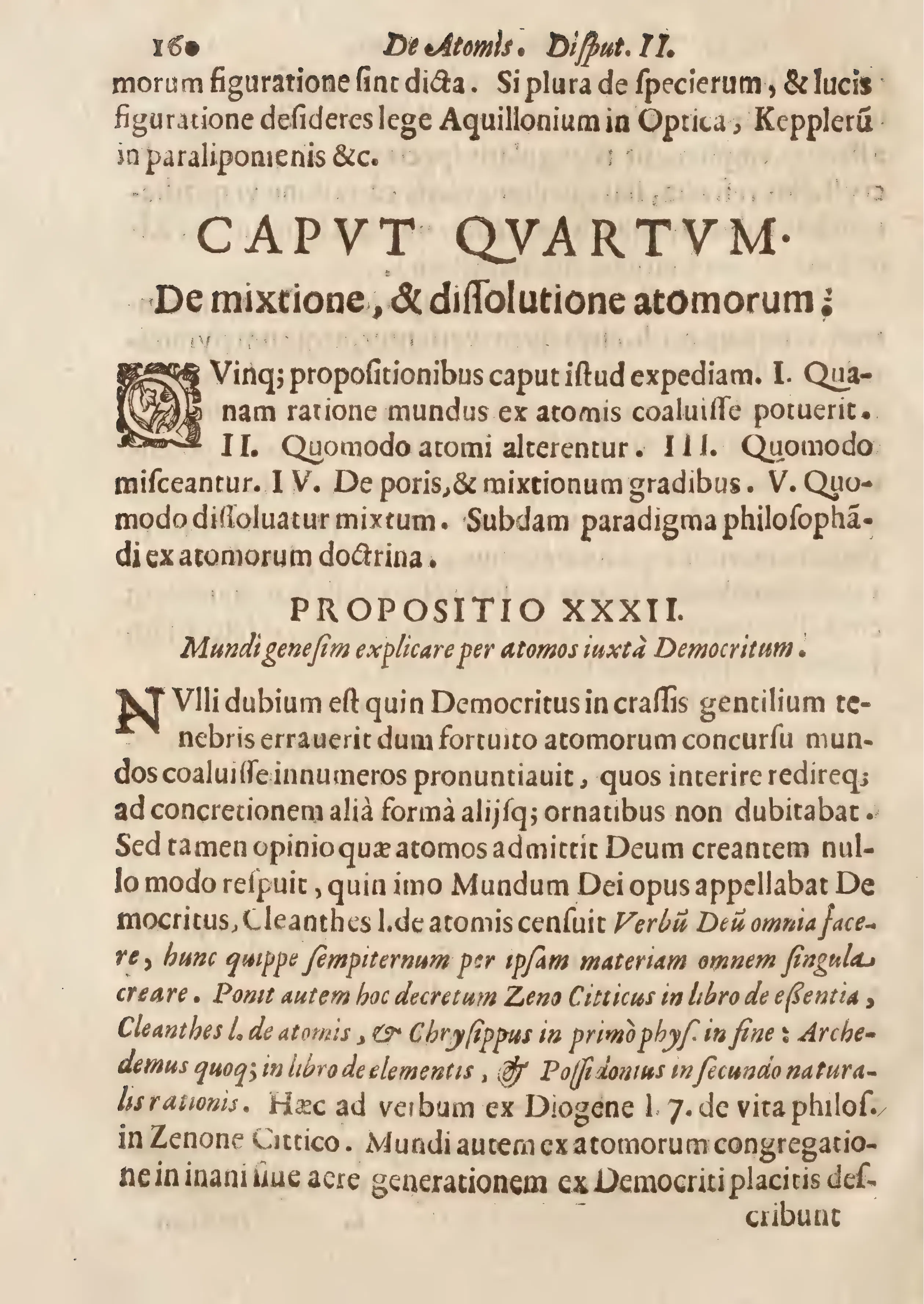
The chapter opening to “De mixtione, & dissolutione atomorum,” marked by a large ornamental initial, frames atomic mixture and dissolution as a major divisional problem rather than a marginal curiosity. In Propositio XXXII, Magnen turns Democritean cosmogony into a test case for Christianized atomism: atoms may serve natural explanation, but the fortuitous concourse of worlds is displaced by the governing intelligence his physics insists must never be forgotten. Source ↗.
The positive counterpart to that concession is the maxim Magnen erects as the methodological touchstone of the natural order, enjoining that in these works of nature one must always recall that truest of pronouncements, that the work of nature is the work of intelligence, the opus naturæ opus intelligentiæ maxim that gives the report its recurring refrain. The maxim functions as the exact inverse of the fortuitous concourse it is meant to displace: where Democritus's chance left the order of the cosmos unexplained, the appeal to intelligence guarantees that the regularity of atomic generation discloses a designing mind. The superlative versissimi invests the formula with the weight of settled truth rather than mere probable opinion, and its imperative mood—oportet semper recordari—makes it a standing methodological obligation binding every subsequent physical explanation. The atoms may recombine mechanically, but they do so under an intelligence that is never to be forgotten; the mechanism is thus perpetually chaperoned by design, and Magnen's naturalism is kept from collapsing into the materialism that the fortuitous concourse would otherwise entail.
The Master Lemma and the Two Aspects of the Atom
With the theological frame secured, Magnen can turn to the mathematical objections against indivisibles, and the resolution he offers is the conceptual pivot of the whole atomist defense. The master lemma—that physical actions are not to be assessed by geometric rules, the principle noticed in the report's philological framing—is the key he repeatedly turns to dissolve the arsenal of continuum paradoxes: the incommensurability of the diagonal, the squaring of the circle, the contact of sphere and plane, all refused their purchase by his refusal to let the geometer's infinite divisibility dictate the physicist's account of matter. Its complement is the distinction of two aspects that must be conceived in any atom—first the physical substance, indivisible as such, and second its extrinsic respect, its figure and space, divisible to infinity—the bifurcation already introduced in the report's account of the atom's definition. This bifurcation is what permits atomism to survive geometric refutation intact: the mathematician's infinite divisibility is granted in full, but confined to the respectus extrinsecus, the atom's figure and the space it occupies, while the substantia physica remains stubbornly indivisible. It is a strikingly elegant division of labor, and it exposes at the same time the concession Magnen must make—that mathematics genuinely governs the atom's extension even as it is forbidden any purchase on its substance. The isoperimetric doctrine invoked earlier now stands revealed as an application of precisely this permitted mathematical divisibility of the extrinsic figure.
The Third Disputation: Local Motion, the Denial of Gravity, and the Odd-Number Law
The third Disputatio carries these principles into the theory of local motion, and Magnen opens it by reworking the Aristotelian definition to his own ends, holding that local motion is the act of a being in potency, insofar as it is in potency, in order to place or space, Motus localis est actus entis in potentia prout in potentia in ordine ad locum, vel spatium. The retention of the Aristotelian formula, with its actus entis in potentia, is itself a demonstration of Magnen's method: the scholastic vocabulary is preserved but redirected toward the atomist framework by the addition of locum, vel spatium as the terminus of motion. From this definition he launches his boldest kinematic thesis, the denial of natural heaviness and lightness, resting on the argument, already cited in the report's account of his anti-Peripatetic assault, that gravity is a motive virtue only downward and levity a motive virtue only upward, but that no body naturally lacks other motions, and therefore no body is heavy or light properly speaking. The force of the argument lies in the minor premise, that every body naturally has alias lationes, other motions than the single upward or downward tendency the Peripatetics would assign it; the conclusion, qualified carefully as holding only propriè loquendo, dismantles the whole Aristotelian doctrine of natural place in favor of the single impetus that will serve as the unique motive virtue.
It is precisely at this juncture that Magnen enlists the newest mechanics, adducing the odd-number law of fall reported in the report's survey of his reception of Galileo—that the spaces traversed in equal times keep among themselves the ratio of the odd numbers following from unity. The incorporation of that law into an atomist account of impetus shows Magnen assimilating contemporary kinematics to a doctrine he presents as a recovery of the ancient Democritus, folding the mathematical description of accelerated fall into the mechanical framework that has already denied gravity any status as a proper quality. The same logic governs his treatment of rarefaction, where he denies any proper stretching or compression of matter on an a priori ground: whatever exists has determinate limits of extension beyond which it cannot be stretched and below which it cannot be forced, and therefore neither proper rarefaction nor condensation is given, the determinatos limites argument set out earlier in the report. The argument grounds physical extension in the essential mode of being of the thing itself, so that the determinate limits of any existent forbid the real expansion or contraction of its matter; what passes for rarefaction must instead be reinterpreted, consistently with the earlier isoperimetric doctrine, as the mere reconfiguration of atoms occupying variable extrinsic place.
Color, the Democritean Epistemology, and the Dedicatory Seal
The final chapter of the Disputatio turns to color, and here Magnen unites his optics with his mixture-theory in a single definition, holding that color is the internal light of bodies, diffused by fiery atoms and refracted through other atoms, Color est lumen internum corporum ab atomis igneis diffusum, & per allas atomos refractum. The definition draws directly on the elemental geometry with which this stretch of the treatise began—the fiery atoms, originally spherical, are now the diffusers of the internal light, and the refraction through allas atomos makes color a function of corpuscular arrangement rather than a real quality inhering in bodies. This account is anchored philologically in the Democritean epistemology transmitted through Galen, and Magnen quotes the locus classicus with its Greek intact: by convention, Democritus said, is color, by convention bitter, by convention sweet, but atom and void truly are, Lege enim (dicebat Democritus) color est, lege amarum, lege dulce; atomus verò, & vacuum verè est, ipse ET ELS dixit. The citation performs a double function characteristic of the whole treatise: it establishes Magnen's philological credentials as a recoverer of authentic Democritean doctrine, and it supplies the ancient warrant for the modern thesis that sensible qualities are not real forms but products of the disposition of atoms and void, the only two things that verè est.
The exposition closes on the dedicatory formula that binds the entire atomist enterprise to its institutional patron, the instruction, already noticed in the report's account of the work's materiality, that wherever anything polished and accurate occurs the urbane reader should venerate the auspices of the most excellent Senate of Milan. The formula subordinates whatever is elimati acuratiq[ue]—polished and accurate—in the work to the auspicia of the senatorial patrons, so that the recovered doctrine of the ancient atomist is offered up, in its closing gesture, under the protection of the seventeenth-century Habsburg magistracy whose favor secured the chair from which it issued. The imperative venerare casts the reader's proper response to the work's excellences as an act of veneration owed not to the author but to the patronage that made the enterprise possible, sealing the treatise's argument within the institutional matrix that its title-page and dedication had announced.
Frequently Asked Questions
What is Democritus reviviscens sive de atomis by Jean-Chrysostôme Magnen?
Democritus reviviscens sive de atomis (Democritus Revived, or On Atoms) is a natural-philosophical treatise printed at Pavia in 1646 and dedicated to the Senate of Milan. Its aim was not antiquarian recovery but the revival of ancient atomism as a working, demonstrable science of nature, made acceptable to Catholic theology. Written in the Euclidean manner with definitions, axioms, postulates, and propositions, it argues that matter is composed of physically indivisible atoms, reduces the four elements to three, and installs a creating God where the ancients had left blind chance.
Who was Jean-Chrysostôme Magnen?
Jean-Chrysostôme Magnen (c. 1590 – c. 1679) was a Burgundian physician born at Luxeuil in the County of Burgundy (Franche-Comté). He earned his medical doctorate at Dole, traveled in Italy, and in 1646 was appointed to the chair of medicine at the University of Pavia under the patronage of the Senate of Milan, later gaining a chair of philosophy as well. Faculty rolls from 1646 record him holding the royal professorship of medicine with an annual stipend of 600 lire. Much about his life remains thinly documented, and several attributions await firmer confirmation.
Why did Magnen reinterpret Democritus's void as air?
Magnen glossed the Democritean inane (void) as aer, air, reading the fragments to say that Democritus held there to be only two things, atom and void, understanding the latter as air. This diverges sharply from Epicurean-Lucretian physics, where the void is absolute emptiness required for motion. By recasting the void as elastic ambient air, Magnen preserved atomist motion, mixture, and porosity while removing the denial of a horror vacui that had been the principal ground for atomism's condemnation. The move made atomism defensible before an audience trained in scholastic physics and Catholic theology.
What was the free-fall experiment Magnen used against the Peripatetics?
Magnen reports personally dropping a wooden globe and an iron globe together, from the same horizontal line at equal height, and finding that both struck the ground with equal speed. He framed the trial as a repeatable procedure from high towers with varied bodies, and pressed its polemical force hard: the Peripatetics must deny the result against sense-experience if their doctrine of gravity and lightness is to stand, whereas otherwise it wondrously favors Democritus. He also cited Galileo's odd-number law of fall, folding contemporary kinematics into his atomist account of a single motive impetus.
Is there an English translation of Democritus reviviscens sive de atomis?
No modern English translation has been identified; a French partial paraphrase circulates in unpublished dissertation form, but no published translation appears in standard library catalogues. Separately, the Leo edition presents the full Latin transcription together with a complete English translation, generated by artificial intelligence and made available online free of charge. It forms part of an effort to publish English translations of every text printed in Latin in early modern Europe between 1450 and 1750. As with any machine translation, its renderings should be checked against the original before being relied upon.
This report was generated by an advanced AI assistant that conducted deep research alongside an extensive interpretation of the transcribed original text. Every effort has been made to preserve fidelity to the source and to guard against inaccuracy, but corruption in the text recognition process and model hallucination may nonetheless have entered the text. Treat every claim, quotation, translation, and citation as provisional, and verify each against the original source before relying on or citing it.
Bibliography
- Jean Chrysostôme Magnen, Democritus reviviscens sive de atomis (digital surrogate, Bayerische Staatsbibliothek): The Munich digital surrogate of the primary text itself (shelfmark A.gr.b. 1135), and the practical starting point for anyone who wishes to check a page token against the object rather than trust a transcription. Not a critical edition in the modern sense, but the closest thing available: consult it before citing any Latin passage discussed above, since the argument here rests page by page on this witness.
- Internet Archive, Io. Chrysostomi Magneni ... Democritus reuiuiscens siue de atomis: A freely downloadable scan of the 1646 edition derived from the same Google Books/BSB lineage, browsable in-page and searchable in a rough OCR layer. Useful for readers without institutional access who want to follow the free-fall trial, the three-element reduction, or the palingenetic rose in Magnen's own words, though its OCR should never be trusted over the images.
- Ursula Klein and Wolfgang Lefèvre, Materials in Eighteenth-Century Science: A Historical Ontology: A study of how chemical substances were classified and reasoned about, useful here for situating Magnen's tria prima borrowing within the longer chymical genealogy that runs from Paracelsus and Sennert toward the eighteenth century. Read it to see what became of the substance-ontology Magnen grafted onto his atoms once the substantial forms were gone.
- Christoph Lüthy, "The Variety of Aristotelian Atomisms," Late Medieval and Early Modern Corpuscular Matter Theories: The essay that best explains why "Aristotelian atomism" is not the oxymoron it sounds, mapping exactly the hybrid space Magnen occupies between Peripatetic minima and true indivisibles. Indispensable for grasping how Magnen could keep the substantial forms while smuggling in the atom.
- William R. Newman, Atoms and Alchemy: Chymistry, Atomism, and Newton's "Theory of Matter": The authoritative account of how laboratory chymistry, not armchair metaphysics, supplied the empirical spine of early modern corpuscularianism. It supplies the framework against which Magnen's appeal to sulphur, mercury, and salt should be read, and clarifies why his intermediate position matters to the Sennert-to-Boyle lineage.
- Anne-Lise Rey, Les Rêveries d'un malade: Magnen et l'atomisme en France au XVIIe siècle: The one sustained modern study devoted to Magnen himself, an unpublished dissertation that remains the fullest treatment of his atomism and its French afterlife. Track it down for the biographical detail and reception history that the thin secondary literature otherwise leaves conjectural.
- Robert S. Westfall, The Construction of Modern Science: Mechanism and Mechanics: A compact synthesis of the mechanical philosophy's rise, still serviceable for placing Magnen's denial of gravity and his single impetus within the wider seventeenth-century quarrel over motion. Use it to gauge the distance between Magnen's mechanism and the fully geometrized physics he pointedly refused.