Irrefragable Engine: Johannes Driedo's On the Scriptures and Dogmas of the Church, in Four Books
Johannes Driedo's De ecclesiasticis scripturis et dogmatibus libri quatuor, printed at Leuven in 1533, answered the Lutheran appeal to Scripture alone with three questions: how the Church knows which books are divine, which Latin text binds, and what binds beyond the written page. His answer is that the Church witnesses to Scripture rather than authoring it. That position lets him call the Latin Old Testament "mixed and not pure" while still defending the Vulgate's thousand years of reception. Thirteen years before the Council of Trent took up the same questions, a Leuven theologian had already worked through the distinctions on which Catholics and Protestants would argue over Bible and tradition.
ExLatinis
September 30, 2026
Contents
Johannes Driedo's De ecclesiasticis scripturis et dogmatibus libri quatuor, printed at Leuven in 1533, answered the Lutheran appeal to Scripture alone with three questions: how the Church knows which books are divine, which Latin text binds, and what binds beyond the written page. His answer is that the Church witnesses to Scripture rather than authoring it. That position lets him call the Latin Old Testament "mixed and not pure" while still defending the Vulgate's thousand years of reception. Thirteen years before the Council of Trent took up the same questions, a Leuven theologian had already worked through the distinctions on which Catholics and Protestants would argue over Bible and tradition.
Johannes Driedo of Turnhout (Jan Driedoens) was a theologian of the Leuven faculty. His De ecclesiasticis scripturis et dogmatibus libri quatuor is a Latin treatise in four books, printed at Leuven in 1533 by Rutger Rescius for Bartholomeus Gravius. It is a work of controversial theology written in the years before the Council of Trent, when the Lutheran appeal to Scripture alone had made urgent a set of questions that had long been handled within the schools. Which writings are divine Scripture? Which text of them, and which sense, binds the faithful? What, if anything, binds beyond the written page? The treatise later stood at the head of Driedo's collected Opera: one catalogue records a 1552 Leuven folio edited under the care of Ruard Tapper, and another describes a 1556 first volume ex officina Bartholomei Gravii. The precise place and dates of composition have not been established, and no complete translation into another language has been verified.
The problem Driedo confronts is one of certainty without circularity. He must show how the Church can know which books are divine without making that divinity depend on the Church's own decree. He must also show how a received Latin Bible can bind without pretending it is beyond correction. His recurring method is to draw exact distinctions and then ground each determination in the Church's continuous succession and public reception. He separates the divine origin of Scripture from the Church's recognition of it, and the inspired prophet from the fallible translator. He separates canonical authority from canonical truth, and the chair of Peter from the person of the pope. He grades propositions as necessary to faith, pertaining to its piety, or indifferent to it. Across the whole treatise, the Church appears as witness, not author. Scripture is declared rather than created, the Vulgate is received rather than decreed inerrant, and custom and unwritten tradition complete a Scripture that serves as their seedbed.
The stakes are those of the pre-Tridentine Catholic response to the Reformation. The treatise addresses the relation of Scripture to tradition, the authority of the Latin Vulgate against the Hebrew and Greek, the proper sense of Scripture, and the place of patristic consensus. Trent would take up each of these questions at its fourth session in 1546. Driedo's work supplies a historically situated point of comparison with those later formulations. Whether it shaped the conciliar wording, however, cannot be inferred from chronological priority or similarity of subject, and the evidence for direct influence remains unestablished. The work also belongs to a Leuven milieu in which renewed attention to biblical languages and firm ecclesial judgement could bear on the same questions. That relation calls for comparison of particular passages rather than an assumption that the two were opposed.
A first-time reader encounters an argument that is combative in purpose and notably spacious in method. Driedo denounces vernacular Bibles in the hands of the unlearned and rejects sacramentarian figurative readings of the Eucharist. Yet he concedes that the Latin Old Testament is a mixed and impure text. He holds that a scholar may privately say the translator erred, and he gives Jerome's judgement on versions precedence over Augustine's. He treats patristic disagreement as tolerable and disclaims the role of a censorious arbiter. In chronology he sets aside Fathers who reckoned from the Septuagint in favour of the Hebrew. He even weighs pseudo-historical sources transmitted by Annius of Viterbo on a criterion of public and approved credibility. In ecclesiology he makes a concession, associated in the treatise with Constance, that the pope in cases of faith or schism touching his own person is subject to the judgement of the universal Church.
A single concern with reception unites the work's vocabulary, its printed history, and its argument. Terms such as testimonium ecclesiae, consuetudo, and successio name ways in which authority passes through time by being received and witnessed. The treatise itself was transmitted in the same way. It passed from a first printing in which Rescius worked for Gravius to collected volumes whose title claims correction toward an archetype. That claim is a printed editorial assertion, not a demonstrated collation. The bibliographic record of its digitized copies has also become entangled with an unrelated seventeenth-century mathematical work. For Driedo, what the Church holds is known by what it has continuously received. The work that argues this case survives through a chain of printings, attributions, and catalogue records that must themselves be read with the discrimination his distinctions demand.
Read the full text and English translation on Leo
This text was transcribed and translated as part of the ExLatinis project, an effort by Leo to make free English translations of every text published in Latin in early modern Europe (1450–1750) available online. The complete transcription and English translation of this work can be read free of charge:
→ Read the original Latin text and full English translation on Leo
You can save a copy of this document into your Leo account to run deep text searches, conduct further analysis, or cross-reference it with your own research.
Translating Driedo's Title and the Terms of Church Testimony, Custom, and Scriptural Sense
On the Scriptures and Dogmas of the Church, in Four Books is an editorial English title supplied for convenience, not an established translation. The printed title, De ecclesiasticis scripturis et dogmatibus libri quatuor, pairs writings received as ecclesiastical Scripture with dogmata, authoritative teachings. Rendering ecclesiasticis simply as "religious" would obscure the question of the Church's relation to those writings. That relation is the treatise's governing concern, and its title already announces the pairing of written Scripture with teaching received beyond it.
In the theological vocabulary at issue, testimonium ecclesiae means the Church's testimony to received books and teaching. Testimony should not be silently equated with the creation of scriptural authority. Whether the Church recognizes or constitutes the canon is precisely a distinction requiring close examination of Driedo's wording.
The wording itself bears directly on that question. Driedo states that Scripture is known to be divine and canonical through the testimony of the Church, and not of that church alone, pturam esse diuinam & canonicâ per testimouium ecclesiæ, non illius solius. The testimony he invokes is thus the witness of the Church across its succession, not the verdict of a single particular church. He also denies the Church any power to confer divinity. He calls the books canonical and of divine authority, for, as the clause runs, it is not in the power of men to make, canonica, & diuinæ authoritatis. Neque enim est in potestate hominum facere,. He insists as well that neither written councils nor appended ecclesiastical canons made the Scriptures what they are, neque scripta concilia, neque adscripti ecclesiastici canones fecerunt.
Read together, these passages point toward recognition rather than constitution. On this account the Church declares the books divine but does not make them so, and the divine origin of Scripture is distinguished from the Church's knowledge of it. The full limits Driedo sets on the term across the treatise still call for verification against the complete text. The direction of his wording in these passages, however, is plain.
Consuetudo denotes established ecclesial usage, potentially a witness to teaching received through successive generations, rather than mere local habit. Driedo gives the term its weight through an Augustinian rule: what the whole Church holds, not established in councils but always retained, is most rightly believed to have been handed down only by apostolic authority, Respondet: Quod vniuersa tenet ecclesia, nec in consilijs constitutum, sed semper retentum, nô nisi apostolica authoritate traditum, re æstimè creditur. Custom so understood is testimony of the same kind as the Church's witness to the canon. It is received, continuous, and universal, and it is not a product of conciliar enactment.
Hebraica veritas, inherited from debates associated with Jerome, names an appeal to the Hebrew text of the Old Testament. It does not, without further argument, settle the authority of the Latin translation in ecclesial use. Driedo's handling of the term rests on a prior distinction between two offices. A prophet or evangelist in issuing sacred Scripture cannot depart from the truth, but an interpreter can stray from the sense, Propheta vel euangelista in ædendo scripturas sacras, à veritate deuare non potest: interpres autem potest aberrare à sensu.
From this distinction follows a frank description of the received Latin Old Testament as mixed and not pure, Latinim, quæ vtimur in veteri testamento esse mixtam & non puram, qualis est. It follows too that to say the interpreter was mistaken is not in itself impious, above all when a passage of Scripture is under discussion, Dicere autem interpretem esse hallucinatum, non sic est impium, præsertim cum in medium assertur locus scripturæ, vbi. The Hebrew thus functions as a source against which the Latin may be tested. The authority of the Latin in use rests on another footing, its reception, and the relation between the two is a distinction rather than an opposition.
The precise limits Driedo gives each term require verification against the printed passages, not deduction from the terms alone. The same caution applies to the vocabulary of scriptural sense, where Driedo redefines rather than inherits. The literal sense, he reports, is that which is asserted by the Holy Spirit through words and names taken either properly or metaphorically, Sed eum appellant literalem sensum, qui verbis atque nominibus aut propriè, aut metaphoricè acceptis à spiritu sancto asseritur. On this basis he can say that most often the mystical sense is itself the literal meaning, sed plerunque ipsa mystica est literalis sententia. Sensus literalis therefore cannot be rendered simply as "plain" or "non-figurative" sense without distorting his usage.
Two further pairs of terms require equally careful rendering. Driedo separates canonica authoritas from canonica veritas. It is one thing to say there is no canonical authority in the apocrypha, another to say there is no canonical truth in them, in apocryphis nô esse vllam canonicam authoritatem: aliud autem dicentes, in ipsis non esse vllam canonicam veritatem. An extra-canonical book may therefore contain truth without carrying binding authority. He also grades propositions by their relation to faith, distinguishing some as pertaining to the piety of faith and others as irrelevant to faith, alias de pietate fidei, alias fidei impertinentes. These stand alongside those held de necessitate fidei. The resulting censure grid is itself one of the treatise's instruments of distinction, and it cannot be collapsed into a binary of orthodox and heretical.
What Driedo's Treatise Argues Against Luther, and Which Digitized Copy Survives
Johannes Driedo of Turnhout's De ecclesiasticis scripturis et dogmatibus libri quatuor is a Latin, four-book theological treatise printed at Leuven in 1533. It belongs to the controversies over Scripture, ecclesial teaching, and their authority before the Council of Trent.
Its polemical target is named in its own terms. Driedo reports that the Lutheran dogma proclaims sacred Scripture to be of itself most true, De scriptura sacra Lutheranum dogma prædicat ipsam per se esse verissimâ,. His answer grounds the certainty of the canon, the text, and its sense in the Church's continuous succession and public reception. The pastoral stakes appear alongside the doctrinal ones. Driedo registers alarm at the unlearned, the common people, and untaught little women now holding the most sacred books rendered into other tongues, idiotæ, plebe, indoetæ mulierculæ habentes iam sacratissimos libros versos in. The question of who reads Scripture is thus bound up with the question of how it is received.
The precise place and dates of composition have not been established. No complete translation into another language was verified.
The digitized item identified by Google Books ID n6fKzIHpbSMC is not the 1533 first edition. Google Books identifies it as the 1556 first volume of Driedo's collected Opera, printed by Bartholomeus Gravius, containing this treatise. A different digitization, Google ID j9jJIzqqle4C, is catalogued as the 1533 printing. The attribution of the former scan to Giovanni Ceva's De lineis rectis se invicem secantibus statica constructio (1678) conflicts with the Google Books record. The evidence establishes a bibliographic misassociation. It does not establish whether that misassociation originated in a mistaken link or a mis-keyed external entry, and it supplies no evidence of a volume binding the Ceva and Driedo works together.
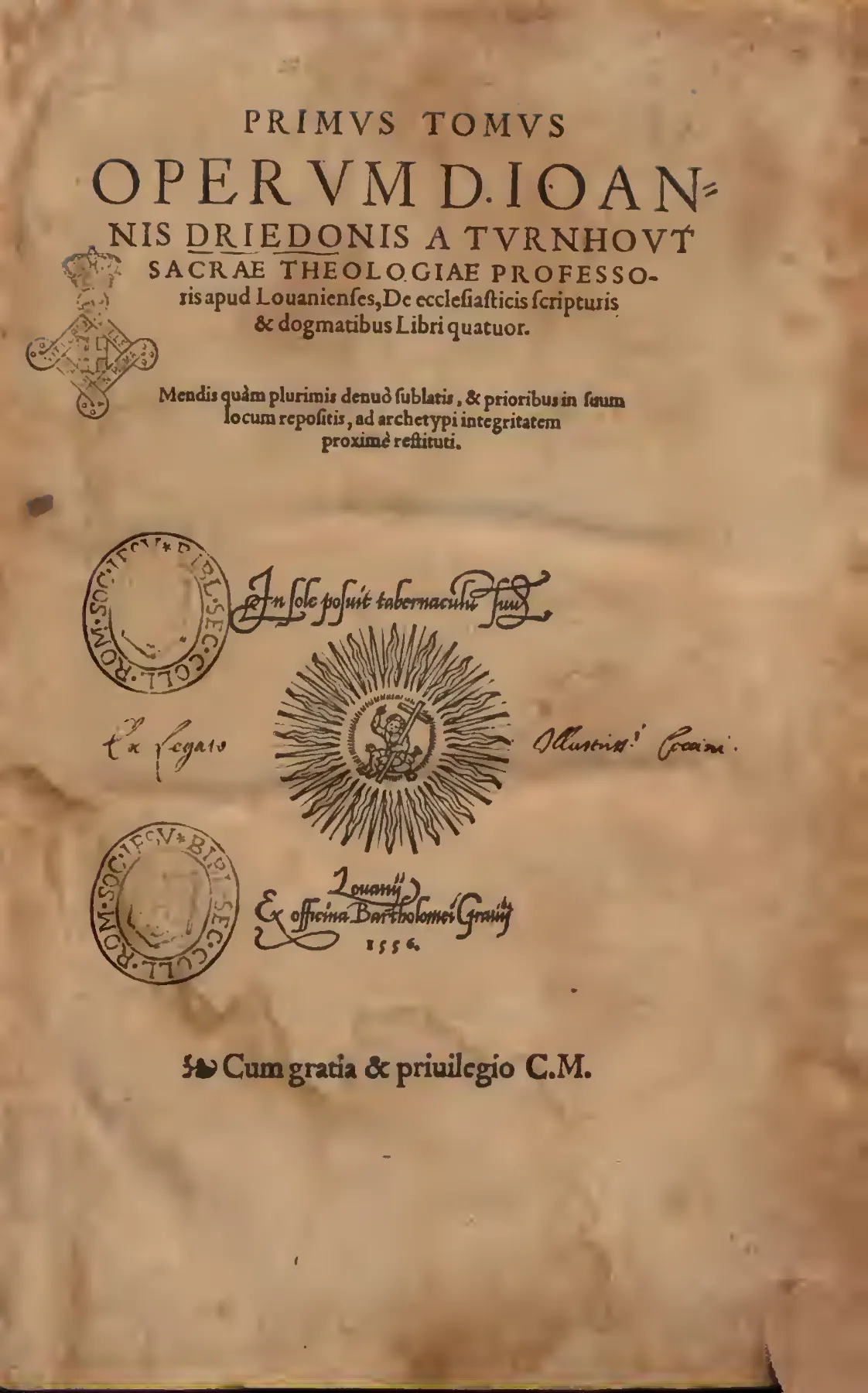
The scan's title page: the first tome of Driedo's Opera, from Bartholomeus Gravius's press in 1556, not the 1533 edition or Ceva's work. Its correction notice and formula "Cum gratia & priuilegio C.M." are printed claims of fidelity and protection; Collegio Romano stamps record the copy's later history. Source ↗.
Placing Driedo Before Trent: The Vulgate, Tradition, and the Historiography of Leuven Theology
Driedo's treatise is significant because it places the reception of Scripture, ecclesial teaching, and interpretive authority in a Leuven theological work printed before Trent's fourth session in 1546. It offers a historically situated point of comparison with later conciliar formulations. A direct influence on their wording cannot be inferred merely from chronological priority or similarity of subject.
The comparison is sharpest on the Latin text. Driedo defends the Vulgate by its reception: it was brought into use and accepted, and this Latin edition has been received for a thousand years, with heretics and schismatics raising no objection against it, sic in vsum deducta & accepta, quæadmodum hæc nostra æditio Latina, iam per mille annos fuit recepta, hæreticis atque schismaticis nihil contra eam. He adds that for the Latin Church skill in one language, namely Latin, seems to suffice, sufficere nobis videtur vnius linguę, vtpotę Latinę peritia. His ground for the Vulgate's authority is long and uncontested use, not the inerrancy of its translator. That rationale bears on later debates about the sense in which Trent declared the Vulgate authentic. The resemblance, however, does not by itself establish a line of dependence.
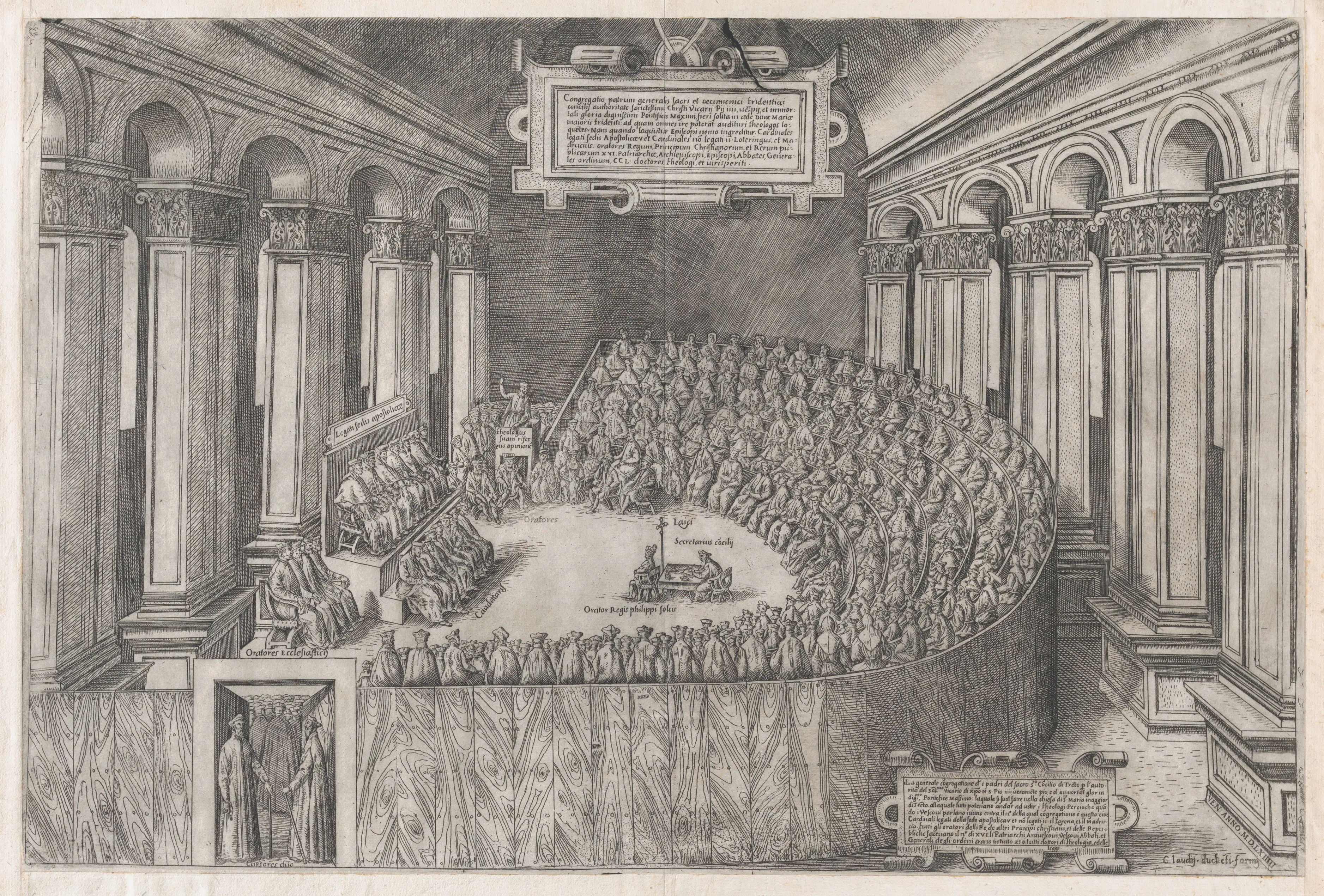
A print associated with the Council of Trent, catalogued on Wikimedia Commons under Braun and Hogenberg's Beschreibung der Städt der Welt. It recalls the conciliar setting where the Vulgate's authority would later be adjudicated—an analogy to Driedo's argument from reception, not evidence of dependence. Source ↗.
.jpg)
The treatise's Latin and its Leuven printing also place it within a setting in which theological judgments and renewed attention to biblical languages could bear on the same questions. Those relationships require comparison of particular passages rather than an assumption that philological inquiry and ecclesial authority were invariably opposed. Driedo's own practice supports that caution. He weighs authority by competence: in versions and translations of Scripture Jerome's authority outweighs Augustine's, though Augustine gave not a false opinion but a true one, if irrelevant to the Apostle's sense, in scripturarum versionibus seu interpretationibus magis valet Hieronymi, q[uæ] Augustini authoritas. Neque tamen falsam dedit August. sententiam, sed veram, licet Apostolico sensui impertinentem. Here the distinction between the truth of a reading and its fidelity to the text allows philological precedence and doctrinal respect to stand together.
Wim François's study is expressly framed as a controversy over the "sources of the truth" and offers the most focused identified route into the 1533 work. John L. Murphy's book concentrates on Driedo's notion of tradition, while George H. Tavard situates Scripture and Church within the wider Reformation crisis. These are different emphases, not a demonstrated disagreement among the three scholars.
Each emphasis finds purchase in the text. Driedo treats patristic consensus as an instrument of interpretation, for understanding the canonical Scriptures an irrefragable engine that those before him also used, canonicis intelligendis irrefragabilem machinam, qua & ante nos vsi sunt. Yet he does not claim that the Fathers speak with one voice. He does not intend to defend that the ecclesiastical Fathers agree in all things, non intendimus defendere, ecclesiasticos patres sic. On contested opinions he claims for himself no authority as a censorious arbiter, sententias, nequaquam vendico mihi authoritatem censorij arbitri, sed ex. This combination of consensus as a weapon against heresy and latitude for pious disagreement is part of what makes Driedo difficult to assign to any single later position.
Larger debates make Driedo important to the historiography. These include whether Trent conceived Scripture and tradition as distinct portions of revelation, and the authority of the Vulgate in relation to Hebrew and Greek. His ecclesiology adds a further complication for any account that reads the pre-Tridentine Leuven faculty simply as a precursor of later papal doctrine. Distinguishing the chair of Peter from the person of the pope, he concedes that the pope, in cases of faith and schism touching and concerning his own person, is subject to the judgement of the universal Church, Papa in causis fidei & schismatis personam suam tangentis atque concernentis subijcitur iudicio vniuersalis ecclesiæ.
His diagnosis of the schism of his own day also resists reduction to disputes over rite. The Church, he writes, has not come to this pass in our age on account of bare ceremonies, Non propter nudis ceremonias hac nostra ætate venit. The precise positions taken by individual historians in these debates, and Driedo's degree of influence on the conciliar decree, could not be established with enough precision to adjudicate them.
Tracing the Printings of Driedo's Treatise from Leuven 1533 to the Collected Opera
The first printing is USTC 400529, De ecclesiasticis scripturis et dogmatibus libri IV, Leuven, 1533. The USTC describes an imprint involving Rutger Rescius and Bartholomeus Gravius, in folio (2°), with [20] preliminary pages and 634 numbered pages. Its recorded signature formula is a10 A-E G-R6 S8 T-Z a6 b4 c-r6 s8 t-z Aa-Ff6 Gg8; that formula is reproduced as catalogued, not independently checked gathering by gathering. Nijhoff–Kronenberg, no. 744, assigns 10 June 1533 and describes Rescius as printing for Gravius. The first printing therefore should not be attributed to Gravius alone without qualification. Neither an independently inspected colophon nor a printer's device has been established.
The four books that make up the text follow a deliberate progression. Book I treats the canon: its sacred status, a series of difficulties concerning authorship and dates, and their solutions. Book II treats the Septuagint, the Vulgate, the plural senses of Scripture, and the way to the true sense. Book III sets out rules for obscurity. It includes a digest of Augustinian and Tyconian rules, a treatment of obscurity of diction and of things, and an extended excursus on chronology. Book IV turns to dogmas beyond the canon: the apocrypha, the one Church, the chair of Peter, the relation of Church and Scripture, and custom and tradition.
Book III closes on an epilogue gathering the causes of difficulty, in which Driedo concludes that for many reasons the sacred Scriptures are difficult or obscure to the studious reader of theology, possumus colligere multis ex causis, scripturas sacras studioso lectori sacræ theologiæ esse difficiles seu obscuras. Its chronographical sections carry the treatise's textual principles into the reckoning of time. It follows, Driedo argues, that in computing the years of the world one must not rely on the ancient Fathers, who relied on the edition of the Seventy, Ex quibus consequens est, in supputationibus annorum mundi, non esse innitendum patribus antiquis, innitentibus nimirum æditioni septuaginta interpretum. The movement from canon to text, from text to sense, and from written Scripture to received tradition mirrors the treatise's central method: each stage is settled by distinction and by appeal to what the Church has received.
The treatise subsequently appeared at the head of collected works. A catalogue of a 1552 Leuven folio Opera attributes its care to Ruard Tapper. After De ecclesiasticis scripturis et dogmatibus, it lists works on human captivity and redemption, free will, grace and predestination, and Christian liberty; the historical collection is recorded as CL034-10.
The Google Books record for n6fKzIHpbSMC instead specifies 1556, ex officina Bartholomei Gravii, and identifies the digitized copy as originating in the National Central Library of Rome. Its title describes a primus tomus within a four-volume Opera and claims correction toward an archetype. That claim is a printed editorial claim, not proof from a collation of its readings. It is a claim about the fidelity of a received text of the kind the treatise itself subjects to distinction. The record does not supply a shelfmark or establish that all four volumes survive together in that binding.
The 1533 digitization has the distinct Google identifier j9jJIzqqle4C. No separate later reprint, transcription lineage, or translation has been securely established from the records examined.
USTC records 1533 copies at KBR, Brussels, and KU Leuven's Central Library, without shelfmarks in its entry. Shelfmarked examples include Erfgoedbibliotheek Hendrik Conscience, Antwerp, F 218055 [C2-520 c]; Trinity College Library, Cambridge, D.4.61; and the University of Otago, Shoults Collection Lc 1533 D. These are records for copies of the 1533 edition, not identifications of the 1556 Google Books copy. The Roman holding library is identified for the scan, but its shelfmark could not be located. Holdings at Portuguese institutions and the British Library could not be confirmed to shelfmark level.
The work's Leuven authorship and the later attribution of editorial care to Tapper establish its academic and printing context. A dedication to João III of Portugal, and roles for Diogo de Murça or Damião de Góis in its circulation, could not be verified from securely read prefatory leaves; their precise relationships to this printing remain open. An imperial privilege, a theological approbation, action against the edition in an index, or a chain of contemporary replies likewise could not be established. Absence of verification is not evidence that none existed.
The Ceva attribution cannot be explained as a Sammelband on the present evidence, because the directly accessible Google record itself identifies a Driedo collected volume. The particular external catalogue operation that produced the conflicting attribution remains undetermined.
Following Driedo's Argument from the Canon to Custom, Book by Book
The Prefatory Apparatus of the Collected Volume
The collected volume opens with the apparatus of its printing, and that apparatus already frames the treatise's concern with authorized reception. The imperial privilege of Charles V printed there places the text under the emperor's protection. It names the licensed agent of its diffusion, the sworn bookseller of Leuven, Bartholomæo Grauio librario Louaniensi iurato, and records that the works had been corrected and approved by Ruard Tapper. A text arguing that Scripture is known through a chain of public and accredited witnesses thus reaches its reader through a comparable chain of attestation: emperor, faculty censor, sworn printer.
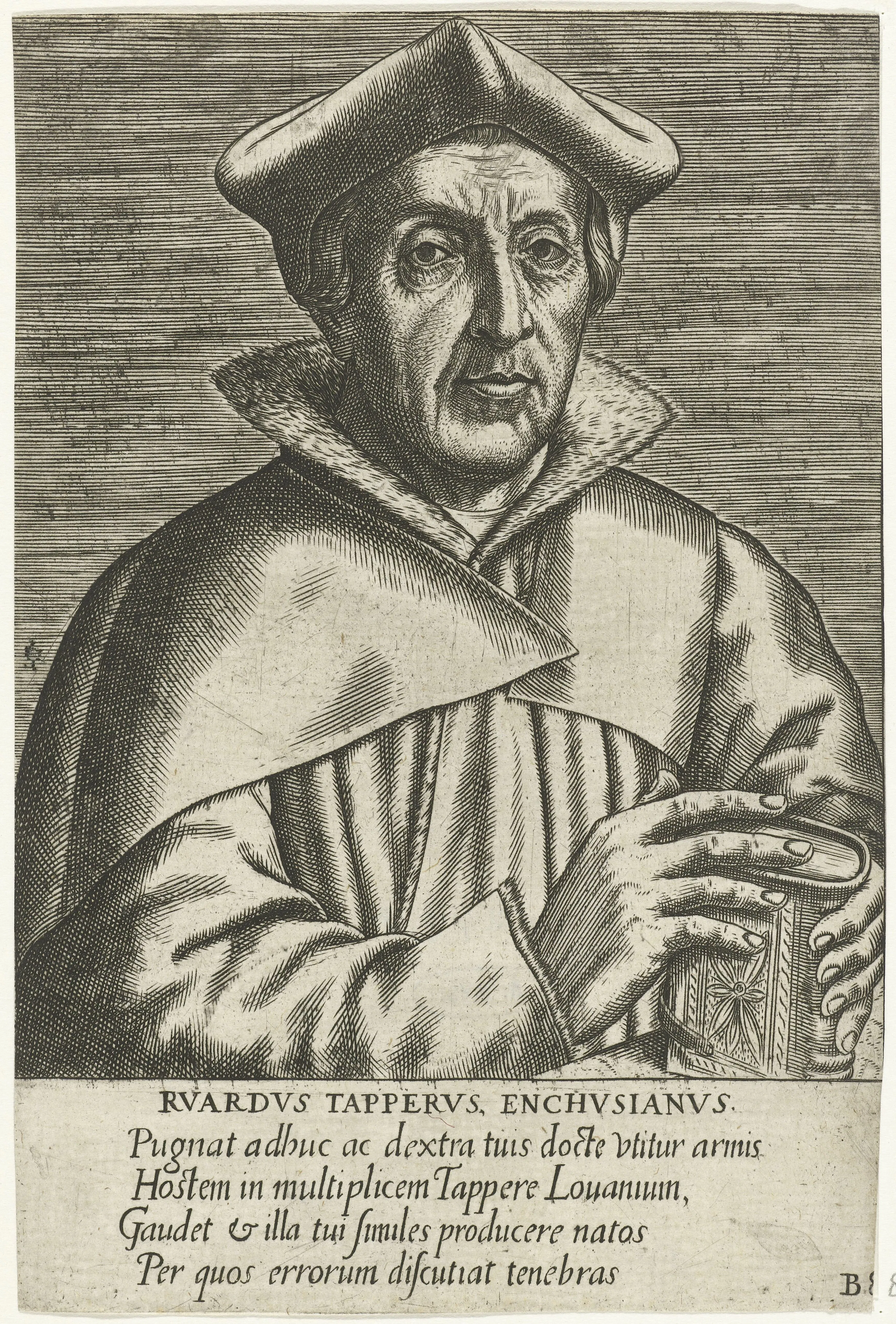
Portrait of Ruard Tapper, the Leuven theologian credited with editorial care of the 1552 Opera and named in the privilege as having corrected and approved Driedo's works. He is the middle link in the chain of attestation—emperor, faculty censor, sworn printer—that carried Driedo's argument for received authority to readers. Source ↗.

Driedo's dedication to John III of Portugal, as the collected volume prints it, extends the frame from Leuven to the whole world of Christian mission. He justifies the address by the Portuguese crown's inherited vocation, cuius bene hæreditarium officium est, Christianam religioné, whose office it is by right of inheritance to spread the Christian religion. The notion of an officium passed down through a line of kings quietly anticipates the argument from succession that will govern Book I.
The alphabetical index maps the whole four-book work, and the rubrics it selects reveal where the pressure points of the controversy lie. Custom is given juridical weight in the entry Consuetudo ecclesiæ habet vim legis, the custom of the Church has the force of law. The most delicate ecclesiological question is posed as an open disputation, Pontifex an subsit authoritati totius ecclesiæ vel generalis concilij, whether the pontiff is subject to the authority of the whole Church or of a general council. The interrogative an is scholastic form, but it also signals that the relation of pope to council remains, for this Leuven theologian, a matter for determination rather than assumption.
Gravius's address to students, dated 1550, reframes the book for a second generation. He presents Driedo's works as needed huic præsertim seculo contra hærese, above all for this age against heresies, and so recasts a work of 1533 as standing armament for the post-conciliar decades.
Book I: The Canon and the Witness of Succession
The prologue to Book I names the social anxiety behind the whole enterprise. Driedo sets his argument against an age in which the Church's unity is torn. He singles out translators whose prefaces and annotations have exposed the sacred books to contempt, and he laments, in the complaint already noted for its pastoral alarm, that the unlearned, the common people and untaught little women now hold the most sacred books turned into other tongues. The rhetoric is class-inflected and gendered. Its theological point, however, is precise. A vernacular Bible circulated with its own apparatus detaches the text from the patristic and conciliar antiquity through which, Driedo will argue, alone it is recognized as Scripture. Against this he announces a method built on Scripture, universal councils and venerable patristic consensus.
The first chapter lays the foundation on which Book I rests. After defining Scripture as pure, stable and integral, the norm to which all other disciplines must bend, Driedo states how the canon is known. We demonstrate Scripture, he writes, to be divine and canonical through the testimony of the Church, and not of that Church alone, the formula already encountered in considering the vocabulary of the Church's testimony. The sentence continues: not the Church that now is, but the Church understood according to the successions of churches. The qualification carries the argument. The witness that authenticates the canon is diachronic, the handing on of the books from church to church since the Apostles, after the model of Irenaeus. It is neither the private testimony of the believer's conscience nor the synchronic decree of the present hierarchy.
In the same chapter Driedo marks out a zone of latitude that later chapters will exploit. Of Scripture's assertions omnino dubitare non licet. Est quidem inter ecclesiasticos patres: it is not lawful to doubt them at all, yet there is indeed among the ecclesiastical Fathers a pious diversity over interpretation. The hinge between the two clauses separates the inviolable truth of the text from the fallible, and tolerable, variety of its exposition.
The common profession of the Fathers becomes, in Driedo's figure, a single instrument of war. Hæc est sola religionis Christianæ, this is the sole engine of the Christian religion, he says of the consensus by which all heresies have been overthrown. The index echoes the image in its reference to the machina of the Fathers against heretics. The metaphor is martial, drawn from siege warfare. It presents patristic agreement as a single engine, though the chapter has just conceded diversity among its parts.
Driedo then grounds Scripture's superiority over pagan learning, Platonism included, in a strictly soteriological theology of history. There would have been no need, he writes, proinde opus hac scriptura, si non peccasset humana natura, of this Scripture had human nature not sinned. Scripture is defined by its subject, the works of restoration rather than creation. It is therefore a remedy, and what philosophers could know of the created order was never its province.
From this definition he turns to a pagan objection that sharpens the problem of textual certainty. How can Christians know their books are genuine when they lack the originals? Respondemus hoc constare ex ipsius ecclesiæ testimo, we reply that this is established from the testimony of the Church itself. Following Augustine, Driedo argues that even an autograph Gospel would be recognized as such only through the churches' witness. The argument deliberately denies that textual criticism could found the canon. Philology may serve the text, but it cannot authenticate it.
A telling concession follows. Quanquam in dignoscendis canonicis libris vnicuique sufficere, although in discerning the canonical books the authority of the Church and the Apostolic See ought to suffice for each person, Driedo elects to argue "higher," from the Fathers. The quanquam grants that Innocent I, Gelasius, Carthage and Laodicea have already settled the question. Yet he chooses to demonstrate historically what he might simply have asserted on authority. There follows a patristic survey from Dionysius and Ignatius to Jerome and Augustine, which shows that the disputed books were cited as Scripture from the earliest times.
The chapter ends in polemic, and the polemic shows how inseparable the canon was from sacramental and penitential practice. Driedo reports that the critics of Maccabees allege that what is written there facta super oblatione pro animabus defunctis, intra quadringentos annos esse, concerning the offering for the souls of the dead, was fabricated within the last four hundred years through priestly avarice. The dispute over a book's canonicity is here a dispute over purgatory and suffrages. Driedo answers it with Augustine's De cura pro mortuis gerenda, and so again makes patristic reception the court of appeal.
The second chapter turns this confidence against itself, setting out ten "difficulties" drawn largely from the discord between Jerome and Augustine. Driedo dramatizes the stakes in a rhetorical question: must patristic disagreement mean that incertus nobis relinquatur numerus diuinorum voluminum, & nondum, the number of the divine volumes is left uncertain to us, and not yet fixed? The question threatens the very succession on which Book I depends, for if the witnesses disagree, their testimony seems to dissolve.
The sharpest of the difficulties concerns Jerome's remark that the Epistle of James "gradually obtained authority." Driedo presses the objection with full force. Such a claim seems to imply that a book obtinuerit authoritatem, cùm tamen neque consuetudo temporis, neque tacitus, acquired authority, although neither the custom of time nor tacit consent could confer it. Scripture must be canonical and of divine authority, for, as the clause already cited in defining the Church's testimony insists, it is not in the power of men to make it so. Custom, which the index credited with the force of law, meets its limit here: it can bind in discipline, but it cannot generate revelation.
After a long third chapter on the authors and dates of the books, the fourth supplies the solutions. Their common logic is a series of distinctions between the thing itself and its recognition. Driedo adopts a twofold sense of Hagiographa: holy writings probative for faith, and holy writings merely true and edifying. He notes pointedly that Erasmus did not correct Jerome here, nec Erasmus emendauit, dicens duplicia esse apud Hebræos Hagiographa, though Jerome's usage shows that there were two kinds of Hagiographa among the Hebrews. The remark reproves the humanist editor on his own philological ground. At the same time it lets Driedo reconcile Jerome with the Church's larger canon.
Human authorship is relativized in the same spirit. Whoever judges canonicum librum aut scripturæ testimoniiu[m], alterius quàm sit authoris esse,, a canonical book or testimony of Scripture to belong to another author than its true one, is not perniciously deceived, so long as the Holy Spirit is faithfully believed to be its author. The Solomonic ascription of Wisdom can therefore be historically mistaken without doctrinal harm. Divine authorship secures the book, and human attribution becomes a question for historical inquiry.
The central ecclesiological solution follows in the sentence, already weighed in framing the treatise's terms, that neither written councils nor appended ecclesiastical canons made the Scriptures divine. The sentence continues that oracles of the living voice declared them so. The councils declare what was already divine, and the answer to James follows the same pattern: the epistle possessed its authority from the beginning, though it did not become known to all churches at first. The distinction between what a book is and how it becomes known preserves both the priority of revelation and the necessity of the Church's witness. It also yields Driedo's own classification of the deuterocanonical books, quartus est apud nos ordo veteris testantenti eorum librorum, the fourth order among us of the books of the old covenant, consisting of those books received by the Christian but not the Hebrew school. They rank below the other orders yet above every later expositor.
The resolution of patristic discord is the most striking concession of the book. Driedo admits, in the disclaimer already noticed among his historiographically telling positions, that he does not intend to defend the ecclesiastical Fathers as agreeing in all things. On matters of fact, or on questions not demonstrable from Scripture, one view may simply be false. Cyprian's dissent shows that such error need not breach communion. The engine of consensus is thus confined to its proper field, and the anxious question of the second chapter receives a sober answer. The canon is certain because the Church's reception of it is continuous and public, not because every Father spoke correctly on every point.
Book II: Translation, Text, and Sense
The opening of Book II carries the same structure of distinction into the problem of translation, where the controversy was sharpest in Driedo's own day. He reports the rigorist party in their own voice: Nam si quid falsitatis, inquiunt, esset, for if there were anything false, they say, in our Latin edition, the faith itself would totter. On this view critics of the Vulgate were heretics. Driedo sets them against the reformers who would correct the Latin from the Hebrew and Greek, and he refuses to judge between them, disclaiming, in the phrase already cited for the latitude it grants, any authority as a censorious arbiter over these opinions. He exhorts students not to excommunicate one another before the Church has defined the question. This irenicism sits uneasily beside his contempt for the scioli, the would-be learned. The tension is resolved in his diagnosis of the dispute itself. The controversy, Sathana iam sua sumpsit incrementa, quæ neque tanta suit olim apud Latinos, has now through Satan's instigation grown to a size it never had among the Latins of old. The ancient Fathers, he says, cared more for the sense of Scripture than for words. The idealization of patristic indifference to verbal minutiae is a rebuke to the philological quarrels of the present.
After surveying the sacred languages and the successive Greek and Latin versions, Driedo resolves the question of the Septuagint with a further distinction: Aliud est prophetare, seu per spiritum, it is one thing to prophesy, that is, through the Spirit to foretell. The Seventy were moved by the Holy Spirit, yet translating what had already been foretold is not prophecy. Augustine's inspired translators and Jerome's "interpreters, not prophets" can therefore both stand.
Jerome's fresh translation from the Hebrew is justified in turn, and its first rationale is apologetic: Ne ludæi Ecclesiis Christi diutius insultarent, improperantes, in Hebræo non, lest the Jews should any longer insult the churches of Christ, taunting that it was not so in the Hebrew. Hebrew philology is enlisted as a weapon, so that opponents might be struck with their own arms. The same study of the languages that the rigorists feared as a solvent of the faith is here claimed, on Jerome's authority, as its defence.
Driedo next gives full voice to an objector's case that the Latin Bible is more certain than the Hebrew and Greek from which it was made. The argument runs through a chain of authorities: Jerome's suspicion that Hebrew books had been altered, Platina's notice that Damasus first conferred authority on Jerome's version, and Gregory's endorsement of the "new translation." It then reaches beyond the Christian tradition into rabbinic self-description. Following the medieval polemicist Porchetus, the objector recalls that the Talmudic masters themselves meminerunt Tiqny sofrim, id est, aptationis, seu correctionis sapientum, that is, they record the tiqqun soferim, the "adaptation or correction of the sages." The rhetorical force of the move lies in turning the custodians of the Hebrew text into witnesses against its integrity. On this view the Latin, corrected by Jerome and approved by the Apostolic See, would be the only stable text. Driedo lets the case gather full weight before answering it. The opposing voice is again Jerome, who taught non esse fidem adhibendam Latinis exemplaribus: cum, that no trust is to be placed in Latin exemplars. The dispute therefore opens as a contest within Jerome's own authority, and Driedo must reconcile the patron of the Vulgate with the patron of the veritas Hebraica.
He resolves it, characteristically, by definition before judgement. A translation is true and right, he states, when it is Translatio seu interpretatio verax ac recta est, ex vna lingua in aliam facta conuersio, cuius sensus à suo fonte suaque originali lingua non deviat, a conversion from one tongue into another whose sense does not depart from its source and original language. The criterion is semantic rather than verbal. Fidelity is measured by the sense and not by the wording, and this allows a formally rough version to count as true. A corollary sharpens the rule: Et idcirco boni interpretis officium est, vt vertendo vnum idioma in aliud, sententias reddat easdem, & æquales, nec ampliores scilicet, nec strictiores:, so that the good interpreter renders sentences "the same and equal, neither broader nor narrower." Within this frame Driedo states his thesis on the Hebrew: dicimus sacras Hebræorum historias, Prophetarumque scripturas non esse de industria vniuersaliter corruptas ac deprauatas, neque ante Christi, "we say that the sacred histories of the Hebrews and the writings of the prophets have not been deliberately and universally corrupted." The weight of the thesis rests on its two adverbs. De industria excludes only malicious falsification and vniuersaliter excludes only corruption of the whole tradition, so the thesis concedes the accidental scribal variation that the objector had exploited while protecting the Hebrew fons as a norm.
The proof Driedo offers is historical and providential rather than philological. The Jewish people, latèque notus Iudæorum populus, Christianæ fidei inimicus, in omnes gentes portauit, & custodiuit libros suos propheticos, in quibus legimus omnia, "widely known, an enemy of the Christian faith, carried and guarded its prophetic books among all nations." Here the Augustinian theology of Jewish witness is recast as a text-critical guarantee. The hostility of the custodians is the very ground of their reliability, since enemies would have had every motive to suppress the Christological prophecies, yet the books survived intact. The argument carries a tension it does not resolve. The same people whom the eighth argument accused of doctoring the text become, in the reply, its providential and unwilling guardians. The argument from silence runs alongside: Christ reproached the Jews for much but never for this "greatest crime." Jerome's scorn at the notion that the Evangelists quoted texts the Jews would falsify only later completes the defence.
The hinge of the whole book follows in the separation of offices already set out in framing the appeal to the Hebrew truth: a prophet or evangelist issuing sacred Scripture cannot depart from the truth, but an interpreter can stray from the sense. Inspiration is thereby located in the original act of writing, not in any version, and translation is set down plainly as idioma, humanum est opus, & officium eius qui novit idiomata, etiam si, a human work and the office of one who knows languages. The consequence Driedo draws is striking. A learned Jew might translate better than an unlearned Christian moved by the Spirit, because the gift at issue is competence and not grace. From this principle the historical diagnosis follows directly. The Latin in use for the books of the old covenant is, in the judgement already quoted, mixed and not pure, neither wholly pre-Hieronymian nor wholly Jerome's. Driedo supports the claim with a catalogue of loci that Jerome himself criticised and with the objections of Lyra and FitzRalph. The Vulgate is thus historicised rather than sacralised, and its claim to honour must rest on something other than purity.
That something is its sufficiency in faith and morals, which Driedo defends through the propositions that no Gospel precept or mystery is omitted or obscured in it. The freedom he grants the critic is accordingly real: to say the interpreter was mistaken, as he puts it in a sentence noticed at the outset, is not impious, especially when a passage is produced in which he is shown to have deviated. Blasphemy attaches to calling the author of Scripture deceived, never to calling a translator so. Yet the licence is at once bounded in time: Et id vnicuiq[ue] eousque licitum est, donec vniuersalis, "and this is permitted to each until the universal [Church]" has defined the matter. Even here Driedo holds open recourse to the sources after any such definition. The ecclesial judgement he anticipates is therefore a judgement of reception and use, not a declaration that the translator was inspired.
The same logic governs his treatment of the Vulgate's solecisms. Driedo catalogues grammatical faults that Cyprian, Jerome and Augustine tolerated, and he justifies the tolerance by an Augustinian preference for the idiom of the people. Sic olim docuit venerabilis Augustinus, co[n]suetudinem vulgarem cum barbarismo plerunq[ue] esse vtiliorem, quàm literatam integritatem Latini; thus Augustine taught that common usage, barbarism included, is often more useful than the literary integrity of Latin. The appeal to consuetudo against humanist purism is significant. The same category that later in the treatise grounds unwritten tradition here grounds a linguistic toleration, and the Latin Church is said to have kept the "inveterate" version so as not to unsettle simple believers. Gregory the Great supplies the sharpest formulation, judging it unworthy vt verba cœlestis oraculi restringam sub regulis Donati, "that I should confine the words of the heavenly oracle under the rules of Donatus." The rusticitas of Scripture, a patristic commonplace, is here deployed so that the grammarian's standards cannot become the measure of the sacred text, even though the grammarian's corrections are permitted as aids.
After replying to the eight opening arguments, Driedo settles the question in terms of reception, in the passage already cited for its bearing on later conciliar debate: the Latin edition, brought into use and accepted, has stood for a thousand years, with heretics and schismatics raising nothing against it. The argument is one of prescription by long and uncontested use, and the witness of adversaries again underwrites the claim, as with the Jewish custodians of the Hebrew. The resulting settlement divides public from private. The Vulgate governs lectures, disputations and schools, while new versions are honoured quibus tamen suum honorem tribuimus in priuatis studiis, legentes illas tanquam explanationes quasdam & elucidationes,, "to which we nevertheless grant their honour in private studies, reading them as certain explanations and elucidations." The distinction between the received public text and private philological labour allows the humanist annotator a secure place without allowing his work to displace the Church's text.
The second chapter carries the same method from text to sense. Driedo redefines the literal sense so broadly that the familiar opposition between letter and figure largely dissolves, for on the definition already cited the literal sense is whatever the Holy Spirit asserts through words taken properly or metaphorically. The plough of Luke 9 and the new Jerusalem of the Apocalypse thus carry a single literal sense, however figurative their expression. Yet the redefinition does not license unrestrained allegory. Driedo warns that care is needed vt auseramus historiæ veritatem, quæ est fundamentu[m] spiritualis intelligentiæ, lest we take away the truth of history, "which is the foundation of spiritual understanding." The spiritual senses are real and intended, and to deny that the fathers of the old covenant intended them is heresy. But they rest on the historical letter, and doctrine may not be proved from allegory alone. The admission that a single text may bear several true literal senses intended by the Spirit then turns patristic divergence from a scandal into a providential abundance. Contradictory readings, however, cannot all be intended.
The third chapter confronts the Reformation question directly: can Scripture be learned from Scripture alone? Driedo gives the objector a strong patristic weapon: Optimus, inquit Hiliarius, scripturæ interpres, qui sensum potius ex scripturis retulerit, quàm attulerit, "the best interpreter of Scripture, says Hilary, is he who draws the sense out of the Scriptures rather than bringing it to them." He later reclaims the maxim as corruptly cited. Against the view that Scripture is clear and interprets itself, he sets its intended obscurity, which humbles pride. The decisive instrument is succession: apostolic tradition, handed down through Clement, Irenaeus, Tertullian, Cyprian, Nicaea, Jerome and Augustine, is the irrefragable engine for understanding the canonical Scriptures, the figure already encountered, which those before us also used. The metaphor is martial, a siege engine of argument, and it recasts tradition as the weapon that earlier defenders of the faith had wielded against heresy.
Tertullian's prescription gives this weapon its juridical form. The Church declares habeo origines firmas. Ego sum Apostoloru[m] hæres, "I hold firm origins; I am the heir of the Apostles." The language of possessio and inheritance denies the heretic any standing in Scripture at all. The same passage supplies Driedo's bridge between his first and third chapters: Tantùm veritati obstrepit sensus adulter, quantum corruptor stylus, an adulterous sense obstructs the truth as much as a corrupting pen. Misinterpretation is thereby treated as a species of textual corruption. The integrity of Scripture turns out to require not only faithful codices but a faithful heir to read them.
From here Driedo reaches his most pointed anti-Lutheran distinction. The written form of the Gospel is set apart from the Gospel itself: sacred Scripture written on parchment, being the testimony of the Church itself, is posterior to the Church, in the formula already set beside François's account of the sources of truth. Augustine's celebrated sentence from Contra epistulam fundamenti seals the point, that he would non crederem, nisi me ecclesiæ commoneret authoritas:, not believe the Gospel unless the authority of the Church moved him. Driedo's gloss, that the Church's authority is in some respects greater than Scripture's and in some respects equal, preserves the double relation that runs through the book. The Church does not make the text true, yet the text reaches the believer only through the Church's witness.
The objection from patristic disagreement receives an answer in the same spirit. The Fathers differ on sense, not on faith, and Fides exercitationi scripturarum est præferenda: faith is to be preferred to exercise in the Scriptures. The aphorism orders the whole of Book II. Philological inquiry, divergent exegesis and even an imperfect translation are tolerable because they operate beneath a faith already secured by succession and reception.
Book III: The Augustinian Digest and the Ordering of Love
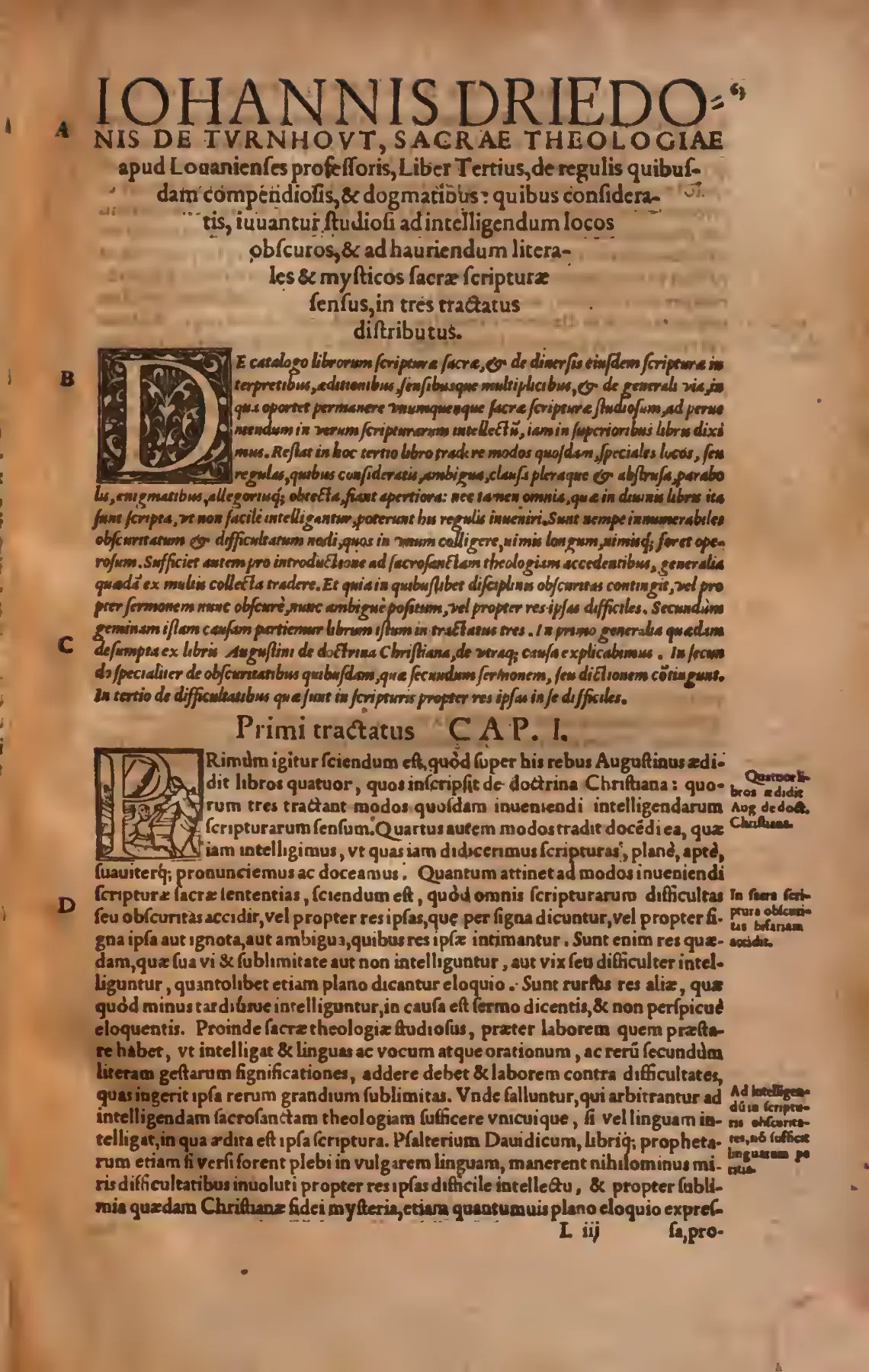
The opening of Liber Tertius, where Driedo turns from foundational claims to compact rules for reading Scripture. Its printed appeal to Augustine's De doctrina christiana frames the book's argument that obscurity yields not to linguistic competence alone but to disciplined interpretation under patristic and ecclesial guidance. Source ↗.
With the ordering of Book II in place, Book III turns to Augustine's De doctrina christiana, to things and signs and to the ordering of love. It begins from the definition Frui est amore alicui, "to enjoy is [to cling] with love to something." The pilgrim soul must use Scripture as a vehicle toward God, never rest in it as an end, and the question of textual certainty thus gives way to the question of the reader's rightly ordered love.
The book proceeds as a compendium of the De doctrina christiana, and the digest's next decisive act is to name the goal toward which every exegetical rule is ordered. Scripture's whole content is summed up in a single Augustinian axiom, that the fullness and end of the law and of all the divine Scriptures be understood to be love, vt intelligatur legis & omnium diuinarum scripturarum plenitudo & finis, esse. The consequence is drawn at once. Whoever derives from Scripture a sense useful for building up this charity, Quisquis verò talem inde sententiam dixerit, quæ huic ædificandæ charitati est vtilis, non perniciosè fallitur, is not perniciously deceived, even if he misses the writer's meaning.
The adverb carries the weight. Driedo does not say that such a reader is not deceived, only that the error is not ruinous. The distinction is characteristic of the treatise's habit of grading error rather than dividing it into a simple binary. It also opens a zone of tolerated interpretive latitude, bounded not by the author's intention but by the end that Scripture itself serves. The book's later insistence on the rule of faith is thus prepared by a prior teleology. A reading is judged first by what it builds.
The same Augustinian frame governs the treatment of signs, and here obscurity itself is theologized. Having defined the sign and divided signs into natural and given, Driedo reproduces Augustine's conviction that the difficulty of Scripture is intended. Of all this obscurity, says Augustine, quod totum non dubito, inquit Augustinus, diuinitus esse proui, "I do not doubt that it was divinely provided." Its purpose is to tame pride and to make discovery sweeter. Obscurity is therefore not a defect to be removed by the reader's ingenuity but a providential pedagogy. The reader must approach it through the plain places, memorizing the canonical books and gathering precepts of faith and morals from them before venturing into the dark ones.
The digest's handling of language study shows Driedo shaping inherited authority to present use. Augustine's remedy against unknown literal signs is transmitted faithfully: a great remedy, he writes, is skill in the three languages, magnum remedium est trium linguarum peritia. In Leuven, seat of the Collegium Trilingue, the phrase could hardly have sounded neutral. Driedo nonetheless adds a gloss of his own that sharply restricts its reach. Learned Christians, he argues, have already compiled the necessary information, and the Latin text has been examined in many ways. For the student of the Latin Church, therefore, skill in one language, namely Latin, seems to suffice, a sentence already weighed for its bearing on the Vulgate's later standing.
The concession is carefully hedged. It is videtur, it seems, not est, and its ground is the accumulated labour of prior scholars rather than any claim about the translator's inspiration. The Latin suffices because it has been received and worked over, which is the treatise's recurring logic of authority through reception. The trilingual ideal is not repudiated. It is relocated from the individual reader to a body of compiled aids that the Church already possesses.
Augustine's taxonomy of pagan learning follows, and Driedo's selection preserves both its generosity and its limits. The charter of appropriation is stated without qualification: let every good and true Christian understand that wherever he finds truth, it is his Lord's, quisquis bonus verusque Christianus est, Domini sui esse intelligat, vbicunque inuenerit veritatem. Yet the same pages repudiate superstition. Astrologers are pointedly identified with those commonly called mathematicians, pellati vulgò Mathematici, qui ex stellarum positionibus nascentium mores,, who read character from the positions of the stars at birth.
The culminating image of the spoiling of the Egyptians is cast in juridical terms. What the philosophers, especially the Platonists, said truly is to be claimed for Christian use from them as from unjust possessors, ab eis tanquam iniustis possessoribus in vsum nostrum vendicanda. The verb vendicare belongs to the vocabulary of legal recovery. Pagan truth was always Christian property held without title, and appropriating it is restitution rather than borrowing. The liberality is then bounded by a claim of scriptural sufficiency. Whatever a man has learned, if harmful, is condemned in Holy Scripture, Nam quicquid homo didicerit, si noxium est, in scriptura sacra damnatur:. Scripture becomes both the court that judges profane learning and the storehouse that contains its useful residue more abundantly.
The third chapter, on ambiguous signs, turns this Augustinian framework toward the controversies of Driedo's own day. When punctuation or pronunciation leaves a passage uncertain, the reader is first to consult the rules of faith, which he has received from the plainer places of Scripture and from the authority of the Church, consulat regulas fidei, quam de scripturarum planioribus locis & Ecclesiæ authoritate percepit. The pairing is significant. The rule of faith is not a private deduction from the text, nor an ecclesial imposition external to it. It is received jointly from clear Scripture and from the Church.
Only after that rule, the context, and the original languages have been exhausted does Driedo permit any orthodox reading to stand. The order of appeal thus ranks ecclesial reception above philology, while leaving philology a real office within the process of settling a reading.
The criterion for passing from letter to figure is framed not grammatically but morally and doctrinally. Whatever in divine speech cannot properly be referred either to moral uprightness or to the truth of faith is known to be figurative, Quicquid in sermone diuino, neque ad morum honestatem, neque ad fidei veritatem propriè referri potest, figuratum esse cognoscitur. The test rests on a reduction of Scripture's whole moral content to a single opposition. Scripture, the formulation runs, commands nothing but charity and condemns nothing but cupidity, præcipit scriptura, nisi charitatem: nec culpat, nisi cupiditatem, & eo modo.
The two terms receive formal definition. Charity is the motion of the soul toward enjoying God for his own sake, Charitatem voco, motum ad fruendum Deo propter ipsum in se, atque. Cupidity is the soul's motion toward enjoying itself, its neighbour, and any thing not for God's sake, Cupiditatem verò voco, motum animi ad fruendum se & proximo, & qualibet re non. The use–enjoyment distinction that opened the digest thereby returns as an operative instrument of exegesis. It sorts the harsh or scandalous passages of Scripture into figures.
The same chapter confronts the diversity of scriptural morals without surrendering to it. Patriarchal polygamy was lawful then but is not to be imitated now. Driedo rejects, with Augustine, the conclusion of those sleepers who, not waking in the light of wisdom, thought there was no justice in itself, euiqilantes in sapientiæ luce, putauerunt nullam esse iustitiam per seipsam,. Variation of custom across times is conceded, but it is read as the varied application of an immutable justice, not as evidence against it. The structure parallels the treatise's larger handling of ecclesial custom, where diversity of practice is held within a continuous and unchanging deposit.
The fourth chapter's digest of Augustine on the preacher subordinates eloquence to its moral source. Rhetorical precepts are useful for defending truth, sunt vtilia ad defendendu[m] veritate[m], and the Ciceronian duties are transmitted intact. Teaching belongs to necessity, delighting to sweetness, and moving to victory, necessitatis est, delectare suauitatis, flectere victoriæ. But the paronomasia that follows reorders the orator's art from within. He is to be a man of prayer before he is a speaker, sit orator, antequam dictor, and in the end the life of the speaker carries greater weight, maius pondus habet vita dicentis.
Driedo closes the first tractate by naming his method with the compiler's modesty. He has taken and gathered these rules from the four books of Augustine, the most illuminated doctor, sumpsi atq[ue] collegi ex quatuor libris Augustini, illuminatissimi doctoris,. He has done so for young students who lack books, leisure, or talent. The digest is thus itself an act of transmission: received authority passed on to those who cannot reach its source.
Book III: Obscurity of Diction
The second tractate, on obscurity arising from diction, speaks in Driedo's own voice and restates the providential thesis with a polemical edge. Scriptural obscurity arises not from lack of skill, as with most writers on other subjects, but from the providence of the Holy Spirit, non quidem ex imperitia, quemadmodum pleriq[ue] cæterarum rerum scriptores, sed ex spiritus sancti providentia. The contrast answers humanist disparagement of the sacred writers' style. Where a grammarian might see solecism, Driedo sees design.
Yet this defence of the text's providential difficulty coexists with close attention to its transmission. Discussing the confusion of Jehoiakim and Jehoiachin, he observes that countless faultily written copies have created confusion for students, codices mendose scripti confusionem secerunt studiosis, habentes duos istos. The inspired diction and the corrupted copy are thereby kept distinct. The first is intended; the second calls for correction.
The long chapter on equivocal terms is governed by a principle of semantic economy. Driedo insists from the outset that a word is not necessarily equivocal merely because it is used in both good and bad senses, In primis sciendum est, non ideo oportere vocabulum esse æquiuocum, quia. The principle is applied with particular clarity to zeal. After comparing the Hebrew, Greek, and Latin vocabularies with the help of Jerome, Origen, Suidas, and Santes Pagnini, Driedo unifies the apparently contrary senses under one root. Every zeal, mediately or immediately, draws its origin from love, aut mediatè, aut immediatè ex amore trahit origenem. Philology serves a reductive unity here, and that unity quietly echoes the first tractate's reduction of Scripture to charity.
In the analysis of necessity, the lexical inquiry becomes doctrinal defence. Driedo's scholastic typology begins from the claim that God alone is absolute necessity, Sic solus Deus est necessitas absoluta. It then applies its distinctions to the saying that offences must needs come. Christ, Driedo argues, sufficiently taught that this necessity neither compels nor excuses the one who gives scandal, Satis docuit hanc necessitatem, neque cogere, neque excusare eum, qui scandalizat.
The conclusion is drawn toward foreknowledge: Ex quo concluditur infallibilem Dei præscientiam ac prouidentiam, "from which it is concluded that God's infallible foreknowledge and providence" does not remove human liberty. A glossary entry thereby becomes a bulwark for free will against the necessitarian readings current in the controversies of the 1520s. Driedo promises a fuller treatment in a separate work on predestination and free will.
The crux of the two swords shows the same method set against a contemporary. Driedo defends the second grammatical sense of Luke 22:36, that Christ foretold hardship rather than commanding arms. He rebukes an unnamed expositor for whom the first sense so pleased that he rejects the second altogether as laughable, expositori adeò placuit, vt secundum prorsus tanquam ridendum, & à Christia. The Fathers are set against the novelty as its norm, in keeping with the treatise's appeal to patristic consensus as the measure of interpretation.
In the treatment of spirit, a comparable defensive move addresses the liturgy. Glossing speech in tongues, Driedo considers the minds of those who in the Latin Church sing the Psalter and pray without understanding, mentes eorum, quæ in Ecclesia Latina canunt Psalteria & orant, non. He holds that such worship is not wholly without fruit. The concession answers in advance the Reformed charge that unintelligible prayer is empty. It also coheres with the earlier claim that received Latin suffices for the Church.
The chapter on prepositions and conjunctions grounds all this in speculative grammar. Through ignorance of the force and modes of signifying of these words, Driedo warns, many have strayed from the true understanding of the Scriptures, Propter ignorantiam virium ac modorum significandi harum dictionum multi errauerunt à verò scripturarum intellectu. The payoff is doctrinal precision at the level of a single particle. Taking up Augustine's anti-Manichaean distinction, he writes that all things are indeed from God, but not of God, Sunt quidem omnia ex Deo, sed non de Deo,. The pairing of ex and de separates creation from consubstantial generation, making the Trinitarian distinction turn on the choice of a preposition.
The chapter on ambiguous locutions then supplies the counterweight to the earlier sufficiency of Latin. Interpreters must not create obscurity where the original is clear. Where they do, Driedo does not spare the Vulgate. The Latin translator, he judges, did not render considerately enough, reddat nobis obscuriores. Non satis igitur consideranter interpres Latinus.
Set beside the claim that one language suffices, the censure shows the two positions held together by distinction rather than set in contradiction. The Latin is sufficient for the Church's student because it has been received and examined. Its translator, being an interpreter and not a prophet, can still be faulted, and the Hebrew and Greek remain the measure against which his particular choices are tested.
Book III as a whole is organized as a practical manual for the studiosus lector: each species of difficulty is named, illustrated from the sacred text, and paired with a rule for resolving it. The later part of the same chapter on amphibology takes up ambiguities of grammar and diction, and it opens by establishing a hierarchy of competence among the Fathers. Weighing whether bonum, malum and iustum are to be taken substantively or adjectivally, Driedo holds, in a judgement already cited among his historiographically significant positions, that in versions and translations Jerome's authority outweighs Augustine's, yet Augustine's reading remains true, though irrelevant to the Apostle's meaning.
The formulation does two things at once. It ranks the Fathers by domain, making Jerome the arbiter of translation and Augustine the theologian. It also separates the truth of a proposition from its fidelity to the text in hand. A reading may therefore fail as exegesis without failing as doctrine. This is the same logic of distinction by which the treatise elsewhere separates canonical authority from canonical truth, here applied to the smaller economy of a single Pauline phrase.
That separation of philological error from doctrinal danger recurs throughout the discussion of vocabulary, translators and corrupted copies. Driedo concedes that patristic disagreement arises sometimes through the fault of the translator, sometimes through the corruption of the codex, interdum ob vitium interpretis, interdum ob depravationem codicis. He extends the same frankness to the Angelic Doctor himself. When Aquinas took melotes, sheepskins, to mean the skins of camels, he was mistaken, but not ruinously so: In vocabulo melotes, quo significantur pelles ouillæ, dum intellexit diuus Thomas candelorum pelles, fallitur quidem, sed non perniciosè fallitur. The adverb perniciosè carries the weight of the argument. Error is graded, not binary, and a lexical slip by the foremost scholastic authority is admitted without scandal because it touches nothing de necessitate fidei. The confidence with which a Leuven theologian corrects Thomas on a point of Greek lexicography shows that renewed attention to the biblical languages could operate inside, rather than against, the scholastic inheritance.
The same latitude governs textual variants that produced divergent patristic readings, above all the two forms of 1 Corinthians 15, omnes quidem resurgemus and omnes quidem dormiemus. Both are declared Catholic. Jerome, Driedo notes, preferred the reading the Church now uses, non damnantis tamen alteram tanquam hæresim, aut contrariam fidei orthodoxæ, without condemning the other as heresy or as contrary to orthodox faith. The reception of one reading into ecclesial use does not require the anathema of its rival.
Where the question remains open, Driedo counsels restraint rather than contention. One should not wrangle until this pious disagreement of the masters, arising from Scripture, has been settled by the judgment of the Church or by Scripture itself, donec pia hæc magistroru[m] dissensio ex scripturis orta, per iudicium Ecclesiæ aut per scripturas fuerit definna. The disjunction deserves notice, for Scripture stands beside the Church as a possible arbiter. The Church is thus not the sole source of resolution but one of two tribunals before which a textual question may be closed. The paragraph ends on a refrain that summarizes the whole section: such was the diversity among the holy doctors in certain places because of the variety of codices, Talis fui quibusdam in locis inter sanctos doctores diuersitas ob codicum varietatem, cum pace tamen & vnitate catholicæ fidei, yet with the peace and unity of the Catholic faith preserved. Textual plurality is absorbed into doctrinal unity rather than denied.
The relation between the original languages and the received Latin is handled with the same double movement. Driedo grants the humanist principle that ambiguity is sometimes resolved by consulting the original tongue, ambiguitas interdum soluitur ex inspecta originali lingua. He also recognizes its limits. The punishments of Cain and Lamech remain obscure even in the Hebrew. There he rests on the received text, relying on our common edition according to the shared exposition of the doctors, Nos autem innitentes æditioni nostræ vulgari, secundum communem doctorum expositionem.
The Vulgate here is not declared superior to the Hebrew. It is the place of rest when the source text cannot decide, and its authority is joined to the communis expositio of the doctors: a text received and read in common. Driedo then theologizes the residual difficulty. He believes that this and similar difficulties were made by the inspiration of the divine Spirit for the exercise of the studious, Et credimus hanc & similes difficultates factas diuini spiritus inspiratione ad exercitium studioru[m],. This Augustinian theme answers directly the Lutheran claim to a Scripture clear in itself. Obscurity is not a defect demanding a private resolution. It is a providential discipline that presupposes a community of learned readers.
The hardest case of the chapter is Romans 9:16, non est volentis neque currentis. Augustine, Gregory and Aquinas read the verse as an assertion against the Pelagians. Chrysostom and Jerome read it as the voice of an objector. Driedo displays the disagreement openly: behold the most illustrious lights of the Church, Jerome, Chrysostom and Augustine, holding divergent views in expounding Scripture, En vides præclarissima Ecclesiæ luminaria: Hieronymum, Chrysostomum, & Augustinum in scripturis exponendis diuersas habuisse sententias. He then reconciles the two readings in a paired formula: willing and running are ours, yet it is not of him that wills or runs but of God who shows mercy, Nostrum est velle & currere: Non est volentis neq[ue] currentis, sed Dei miserentis.
The formula is the point at which the hermeneutics of ambiguity touches the central soteriological controversy of the age. By holding both clauses as true, Driedo keeps human cooperation and the priority of grace together. He defers their full adjustment to his books on grace and free will, and so exhibits patristic diversity as the very ground on which a Catholic synthesis is built. A comparable dogmatic purpose governs the treatment of universal locutions. The restriction of omnes and nemo to one kind of person serves to deny that God will at last have mercy on all and condemn no one forever, quòd Deus omnium tandem miserebitur, & neminem in perpetuum sit damnaturus, quemadmodu[m] credit Origenes ex scripturis malè intellectis, as Origen believed from Scriptures badly understood.
The treatment of hyperbole and inverted order turns exegetical technique toward the coherence of sacred history. Prophetic excess, such as the darkening of sun and stars or the fall of Lucifer read as the death of the king of Babylon, signals a higher reference. The studious reader should understand the Babylonian captivity as a shadow and figure of a harsher desolation at the end of the world, vt studiosus lector illam Babyloniorum captiuitatem intelligat esse vmbram & figuram durioris sequentis in fine mundi.
The disorder of the Gospel narratives is met by a comparable principle. Driedo begins from the admission that prophets and Evangelists did not keep the order of events, Sciendum est primùm, quòd prophetæ & Euangelistæ suis in historijs non seruauerunt rerum gestarum ordinem. He concludes that the Evangelists' office was to report not the names, words or order of words spoken by Christ or others, but the things themselves, Euangelistaru[m] officium fuit, recitare non nomina aut verba, ordinemq[ue] verborum vel à Christo, vel ab alijs prolata, sed res ipsas. With Jerome, he extends the principle to citations of the older Scriptures in the New: the Spirit's care was not to chase words or syllables but to set down the sense of doctrines, cui (vt inquit Hieronymus) curæ suit, non verba aut syllabas aucupari, sed sententias dogmatum ponere.
This sense-for-sense account of inspired reportage is significant for a treatise that elsewhere defends a Latin translation as authoritative. If the Spirit itself did not bind the sacred writers to verbal exactness, then the authority of a faithful version can rest on its rendering of res and sententiae, not on identity of words with the original.
The chapter on tropes supplies the theoretical foundation for all of this. Driedo distinguishes the signification of words, which rests on human convention, from the signification of things, which rests on the will of God acting through his Spirit, Significatio rerum est ex voluntate Dei, per spiritu[m] suum. From this arises the twofold sense of Scripture, hinc iam oritur geminus scripturæ sensus: alius literalis, alter mysticus,. The mystical sense is thus not a reader's ingenuity laid over the letter. It is a second order of signification written by God into the events the letter narrates. The plurality of true senses that follows is not indeterminacy but praiseworthy richness, Et hæc est laudanda scripturæ sacræ fœcunditas, vt sub eisdem verbis plures, a fruitfulness by which several meanings lie beneath the same words.
This theory of figures has a sharply polemical edge. Driedo organizes the metaphorical language of Scripture around two opposed kingdoms. As the faithful cleaving to Christ are one people and one mystical body of Christ, so the impious and unfaithful are one mystical body of the devil, Quemadmodum fideles Christo adhærentes sunt vns populus, vnum mysticum corpus Christi: sic impij & in fideles sunt vnum mysticum corpus diaboli. Within this Augustinian framework, literal expectation of an earthly messianic kingdom becomes the paradigmatic misreading. Jerome's fourfold sense of Jerusalem culminates in the counterfeit city which the Jews carnally await, which is nowhere and never will be, Quartò appellatur Hierusalem conficta, quam ludæi carnaliter expectant futuram, quæ nusquam est nec erit vnquam.
Yet the figurative method that dissolves carnal literalism is stopped abruptly at the altar. Driedo sets "I am the true vine" against the words of institution and insists that Christ's words over the blessed bread are not to be taken metaphorically, as the following clause "which will be given for you" shows, Cõtrà verò q[uæ] dicit Christus, dum accipiens panè benedictu[m] dixit: Hoc est corpus meum non metaphoricè est accipiendu[m] intimat particula sequês: quod pro vobis tradetur. The theory of tropes thus cuts in two directions. It licenses spiritual reading against Jewish expectation and forbids it against sacramentarian exegesis. The boundary between the two is fixed not by a grammatical criterion alone but by the circumstance of the letter read under the rule of faith.
The treatment of parables applies the same restraint to allegorical excess. Not every part of a parable must bear a likeness to the things for which it was composed, scientes non esse necessarium, vt omnes illius partes gerant similitudines earum rerum, propter quas ipsa est composita. Its meaning lies in a single intended point, Et hic est scopus, in quem tendit parabola tota, the goal toward which the whole parable tends.
The opening of the chapter on shifts of tense completes this defence of the letter. Prophecy speaks of past, present and future interchangeably because all times are present to God. Driedo nonetheless warns that the eschatological must not swallow the historical, for, as Jerome says, the prophets foretell the future in such a way that they do not in the meantime neglect the present, sic prophetę (inquit Hieronimui) ita dicunt futura, vt interim præsentia non negligant. Across these chapters obscurity is never permitted to become arbitrariness. Every figure, variant and disorder is referred to a reading that is at once textually disciplined and held within the common faith of the Church.
Book III: The Change of Persons and the Difficulty of Things
The later chapters of Book III on scriptural difficulty "by reason of diction" turn on one technical device, the mutatio personarum, the silent shift of speaker or addressee. Driedo frames it under its own heading, the second part of this chapter, on the change of persons, Secunda pars huius capitis, de mutatione personarum. Before setting out its mechanics, he answers the question that shadows the whole of Book III: why the Holy Spirit should have permitted Scripture to be obscure at all. Following Augustine, he replies that God acts not as one who hostilely begrudges us the understanding of the Scriptures but as one who exercises us medicinally, scripturarum nobis hostiliter innidens, sed medicinaliter exer. The theodicy of difficulty matters for everything that follows. If obscurity is therapeutic rather than accidental, the interpreter's labour is part of the divine economy of the text, and no reader can claim immediate access to its sense.
The programmatic statement of the method shows how far Driedo is prepared to extend it. In the psalms and prophets, he writes, the words are now those of Christ the man, now of God the Father, now of the Church, now of the prophet, now of Satan: In psalmis & prophetis sunt verba nunc Christi hominis, nunc Dei patris, nunc ecclesiæ, nûc prophetæ, nunc sathanæ. The inclusion of Satan at the end of the series is the decisive detail. Canonical Scripture contains, and truly records, speech that is not itself true. From this Driedo draws a consequence with sharp controversial implications. It is clear from this consideration, he concludes, that not from just any statement of a person speaking in Scripture is authority for proving truth to be taken, Ex hac consideratione patet, quòd non ex quauis sententia personæ. The principle refines the very notion of scriptural authority on which the sola scriptura appeal relied. Scripture is wholly true as a record, but not every sentence it records is an assertion of the Holy Spirit. The distinction belongs to the family of separations that organizes the treatise, here between the truth of the inspired report and the truth of the reported utterance, and it makes the proof-text dependent on a prior act of discernment.
Gregory the Great supplies the paradigm. Reading Job through the Moralia, Driedo holds that the friends of Job, although they came with good intention, nevertheless bear the likeness of heretics, because by speaking indiscreetly they slip into fault, tamen speciem tenent, quia ad culpam indiscretè loquendo dilabuntur. The typology allows whole stretches of a canonical book to be classified as non-authoritative speech without any diminution of the book's canonicity. The same logic governs Solomon voicing the fool in Ecclesiastes, which Gregory glosses as a concionator gathering tumultuous opinions. Driedo then gives the method a rhetorical formulation drawn from the doctrine of circumstantiae. One must consider not only what is said but by whom, on what occasion, with what affection and intention, to whom and about whom, oportet considerare non modò quid dicatur, sed à quo, qua occasione, affectione, & intentione, ad quem, & de quo dicatur. The checklist joins the scholastic habit of distinction to the humanist grammarian's attention to speaker and occasion. It turns reading into an inquiry that the unlearned reader, whose possession of vernacular Bibles Driedo deplores elsewhere, is ill-equipped to conduct.
The worked examples show how the method serves polemic as well as understanding. In the running commentary on Isaiah, the fulfilment of the prophet's threats "under Titus and Vespasian" becomes a present proof. This desolation, long since accomplished, we still see with our eyes today, Hanc sanè desolationem iam olim completam vsq[ue]; hodie cernimus oculis. The condition of Judaea is enlisted, in the manner of the adversus Iudaeos tradition, as evidence that Genesis 49:10 has been fulfilled. Exegesis and historical witness are fused, so that what the eye sees becomes testimony to the prophetic sense.
In the Psalms the method reaches its theological foundation. To explain how Christ can confess sins as his own, Driedo invokes the Augustinian doctrine of the whole Christ, urging the reader to notice and recognize the whole and full Christ, that is, head and body, animaduertere & cognoscere totum & plenum Christum, id est, caput & corpus. The voice of the penitent sinner and the voice of the sinless head are reconciled through the Church as Christ's body. Ecclesiology thus becomes a hermeneutical principle: the identity of the speaker in the Psalter cannot be settled without an account of the Church. Augustine's warrant generalizes the procedure beyond Driedo's catalogue. "If anyone attends," says Augustine, the divine pages "are full of these changes of persons," Si quis aduertit (inquit Augustinus) plenæ sunt his mutationibus personaru[m].
The Song of Songs, conducted wholly through such shifts among bride, bridegroom and maidens, closes the unit with an allegorical glossary in which ecclesiology and anti-Jewish polemic coincide. The daughters of Jerusalem, Driedo writes, are the Jewish people, which fights against the Church, Filiæ Hierusalem, est gens Iudaica, quæ pugnat contra Ecclesiam. Against this apparatus of discrimination stands a brief devotional counterweight in the discussion of the "change of affections." You read Scripture profitably, he advises, if you put on the affection of each saint who speaks, Scripturam vtiliter legis, si vniuscuiusq[ue] sancti loquentis. The voice that must be identified analytically is also a voice to be inhabited affectively.
The summary that closes the treatment of diction bears directly on the treatise's position concerning the Latin text. Such obscurity, Driedo insists, arises in many places not through the translator's unskill or carelessness but by the providence of the Holy Spirit, propter interpretis imperitiam aut incuriam, sed & spiritu sancto prouidente (vt. The claim is calibrated rather than absolute. It does not deny that the interpreter can err, a concession the treatise makes openly. It locates much of the difficulty that humanist critics laid at Jerome's door in the original itself, so that obscurity in the received Latin is not by that fact evidence of corruption.
The ensuing treatise on difficulty "by reason of the things themselves" moves from grammar to mystery: the Trinity, the Incarnation, the two wills in Christ. Here Driedo's appeal to reception takes the form of an insistence on antiquity. These most sacred mysteries of our faith, he declares, do not hang uncertain on the vague and varying opinions of masters, but the dogma of our faith in these matters is ancient, Neque pendent hæc sacratissima fidei nostræ sacramenta sub incerto in vagis ac varijs magistrorum opinionibus, sed antiquum est in his eiusdem fidei nostræ dogma,. The sentence faces two ways, against scholastic speculation and against doctrinal novelty. It is reinforced by the appeal to pre-Nicene witnesses such as Ignatius and Irenaeus, who show that the faith was spoken before Arius. The Trinitarian distinctions themselves follow the method of the whole work. The Son receives from the Father as a son by generation, not as a needy one by grace, dedit inquam ei, quasi filio per generationem, no[n] quasi inopi per gratiâ. Christological predication is governed by the Pauline pair, according to the form of a servant he hung on the cross, according to the form of God he reigned with the Father, Secundum formâ serui pendebat in cruce, secundum Dei formâ regnabat cum patre.
At the limit of distinction, however, Driedo concedes its insufficiency. On the unexplained difference between the Son's generation and the Spirit's procession he writes that it is holier to confess with humble faith than to wish to discuss with many questions, sanctius est humili side consiteri, quàm quæstionibus multis velle discutere. The chapter closes on an epistemological programme. The student of sacred theology must apply faith before reason and, against the searching of human reason, take the intellect captive into obedience, Et ideo sacræ theologiæ discipulum oportet fidem ante ratione adhibere, & contra humanæ rationis indaginem intellectum captiare in obsequium. Dialectic and analogy, including the closing image of an accident in its subject, serve to defend the faith against heretical argument, not to demonstrate it.
The chapter on the passage from letter to spirit carries this Christocentrism into the theory of the senses. Its foundation is Jerome's dictum, "that is the prophetic custom," to open the light of truth after shadow and figure, Illa est consuetudo prophetica (inquit Hieronymus) post. Its decisive move is a distinction between two senses often confused. We must beware, Driedo warns, of understanding the literal sense to be the carnal sense, caueamus oportet, ne literalem sensum intelligamus, esse carnalem sensum. Against Christian critics he brands as those who, "Judaizing," judge patristic expositions forced, qui ludaizantes arbitrantur expositiones, he rules that when a psalm's content exceeds its historical occasion the Christological reading is itself literal, for, as the formula already noted in framing the vocabulary of sense has it, most often the mystical sense is itself the literal meaning. The redefinition protects Christological exegesis from the scholastic maxim that only the literal sense grounds argument. It also explains his measured censure of Nicholas of Lyra, who, leaning on the exposition of the Jewish rabbis, sometimes does violence to the words of Scripture, innixus expositioni Rabbinorum Iudæorum, interdum vim facit verbis scripturæ.
The chapter on the twofold advent pairs this polemical edge with an irenic rule. Where prophecy announces everything without distinction of time, the reader should rather hold that the prophetic spirit spoke of both advents, teneas potiùs propheticum spiritum de vtroque aduentu. The rule absorbs patristic disagreement instead of adjudicating it. The answer to the Jewish objection that messianic peace has not come yields a definition of the Church that is itself framed by distinction. This kingdom of Christ is fittingly called ecclesia, which is interpreted as community or assembly, from coming together into one, Vnde regnum istud Christi congruo nomine appellatur ecclesia, quod interpretatur communitas seu coetus, à coeundo seu conueniendo in vnum. The Church is constituted by one faith, not by place, and the peace it enjoys is spiritual.
The chapter on apparent contradictions formalizes harmonization as a rule-governed discipline. Its principle is borrowed, with evident awareness of the source's own irregular standing, from Tertullian. Every saying of the Lord, he says, has its causes, rules and limits, Omnium (inquit) dominicarum sententiarum suæ sunt causæ, & regulæ, & termini. The harmonist's axiom follows: it is no harm to Gospel truth if one evangelist records what another passes over, Nihil enim obest veritati euangelicæ, si vnsus commemorat, quod alter tacet. Within the long concordance of the resurrection narratives Driedo transmits, without apparent alarm, Jerome's report that Mark's closing testimony is carried in few Gospel books, almost all Greek copies lacking it, Marci testimoniu[m], quod in raris fertur euangelijs omnibus Græciæ.
The composure is characteristic. A textual datum that might unsettle the received text is admitted, attributed to a patristic authority, and absorbed into the work of reconciliation. Throughout these chapters difficulty, disagreement and even textual uncertainty are received and set in order by distinction, never denied, and the resolving judgement rests on the continuous witness of the Fathers and the Church.
Book III: Chronology and the Reckoning of Time
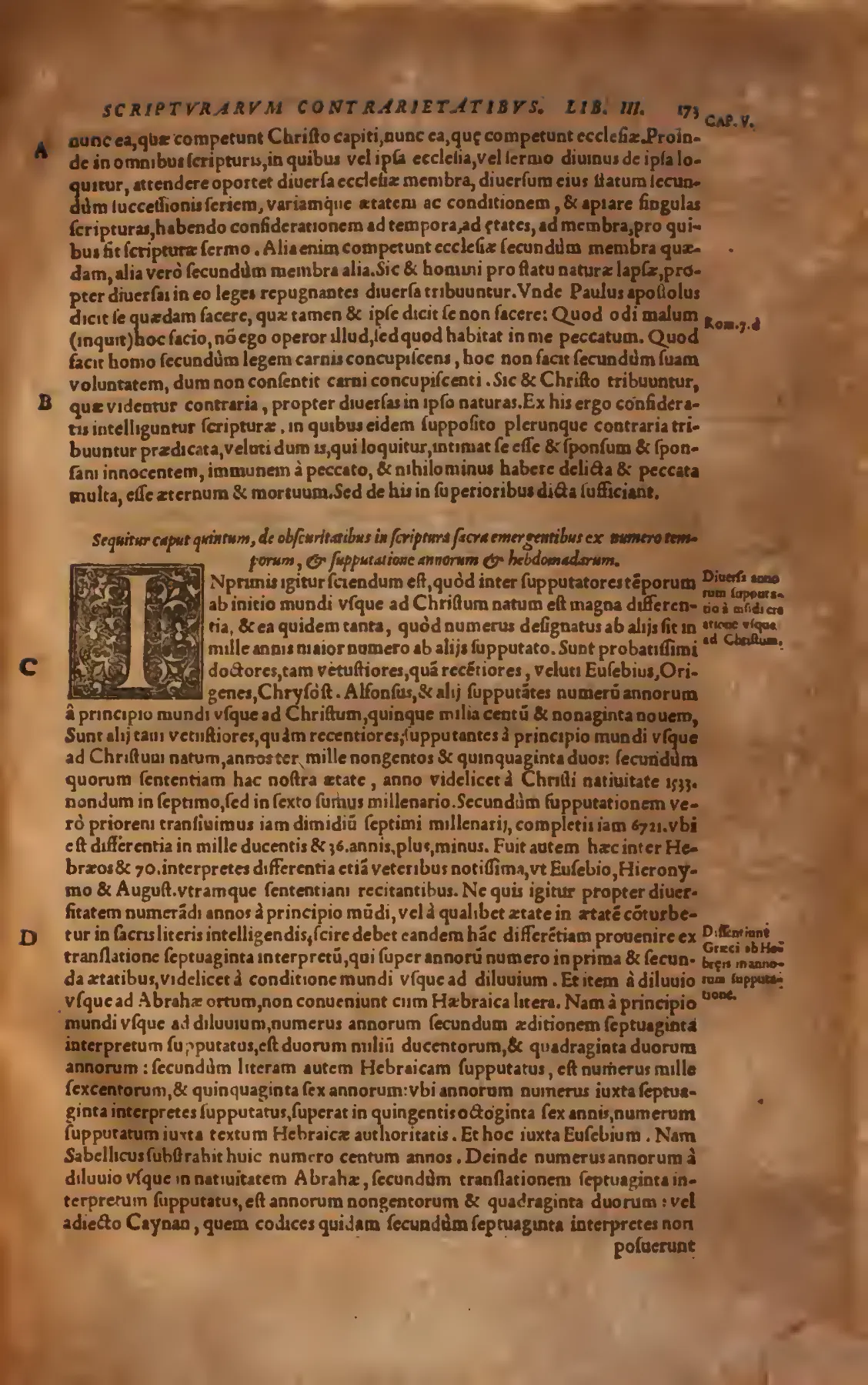
The opening of Book III, Chapter Five, where a decorated initial marks Driedo's turn to obscurities arising from the counting of times, years and weeks. Setting rival reckonings beside the 1533 dateline and the Septuagint–Hebrew divergence, the page treats chronology as a problem of textual transmission, not antiquarian curiosity. Source ↗.
Driedo turns from the reconciliation of apparent contradictions to a new order of difficulty. He announces the next chapter as one on the obscurities in sacred Scripture that arise from the number of times and the reckoning of years and weeks, Sequitur caput quintum, de obscuritatibus in scriptura sacra emergentibus ex numero temporum, & supputatione annorum & hebdomadorum. The placement matters. Chronology is not treated as an antiquarian appendix but as one of the causes of scriptural darkness. It stands beside equivocation, trope, and the hidden passage from letter to spirit, all of which, on this account, prevent the sacred page from interpreting itself without skilled and ecclesially disciplined labour. The term supputatio, reckoning, governs everything that follows. It turns exegesis into a discipline of summing generations and reigns, and it brings the treatise's broader question, how a received text binds, into the domain of number.
The problem is posed in stark terms. Chronographers differ by some twelve centuries between Creation and Christ. Driedo fixes his own moment within that uncertainty when he writes that, according to the shorter reckoning, in this our age, namely in the year 1533 from Christ's nativity, we are not yet in the seventh but in the sixth millennium, secundum quorum sententiam hac nostra ætate, anno videlicet à Christi natiuitate 1533. nondum in septimo, sed in sexto sumus millenario. The sentence is the only explicit date in this portion of the work. It also shows why the computation carried weight: the scheme of world-millennia bore on how near the end might be.
Driedo traces the discrepancy to the inflated patriarchal ages of the Septuagint set against the Hebrew. Yet he declines to impute fraud to either side. Following Augustine, he holds that the variance is to be attributed neither to the malice or diligence of the Jews nor to the error of the Seventy, but to the negligence of the scribe who first received the codex for copying from King Ptolemy's library, non est tribuenda nec ludorum malitiæ aut diligentiæ, nec septuaginta interpretum errori, sed negligentiæ scriptoris, qui de bibliotheca Ptolomæi regis codicem describendum primus accepit. The explanation is a careful piece of theological economy. It protects the integrity of the Hebrew against the old charge of Jewish corruption. It also leaves the Seventy's reputation untouched and locates error in the most fallible link of transmission, the copyist. This extends to chronology the distinction between inspired origin and fallible transmission that Driedo elsewhere draws between prophet and translator.
The method that follows sets a hierarchy of witnesses. The student of sacred theology, Driedo insists, must not rely on the histories or chronographies of the Greeks, sacræ theologiæ studiosum nô oportere inmiti Græcorum aut historijs aut chronographijs. He supports the prohibition with a compressed genealogy of mutual refutation drawn from the Josephan tradition: Ephorus is refuted by Timaeus, Timaeus by those who came after, and everyone arraigns Herodotus, Epaphorum verò Timæus, Timæum posteri. Herodotum arguunt cuncti.
Against this discord he sets a positive criterion. Only the priests of each kingdom are to be trusted, those in whose keeping rests the public and approved credibility of their annals, such as Berosus, sed solum sacerdotes illius regni, penes quos est publica & probata fides annalium suorum, qualis Berosus. The phrase publica et probata fides is the hinge of the chapter, and it is revealingly double. It derives from the Annian apparatus through which "Berosus," "Metasthenes," and "Philo" reached Driedo. It also closely resembles his ecclesiology, in which authority rests on public, continuous, and approved reception rather than on private opinion. The Greek historians fail because they wrote from opinion. The priestly annals succeed on the same grounds that, in the treatise's larger argument, secure the Church's witness to the canon.
Above every human witness stands the text itself. First, then, Driedo writes, from sacred Scripture, which cannot be deceived, we shall gather the age and years of the world, In primis igitur ex sacra scriptura, quæ falli non potest, ætatem & mundi annos. The consequence for patristic authority is striking. It follows, he concludes, in a passage already cited in describing the book's design, that in computing the years of the world one must not rely on the ancient Fathers, since they relied on the edition of the Seventy. For an apologist who will soon defend the Fathers against sola scriptura, the concession is considerable. In chronology, patristic consensus yields to Hebrew philology. The Fathers' authority, it appears, is graded by subject matter and is not uniform across every question they touched.
The demonstration then takes on the architecture of the schools. The first conclusion, that from Adam to the Flood there passed one thousand six hundred and fifty-six years, Prima conclusio: Ab Adam vsque ad diluuium fluxeruit anni mille, sexcenti, & quinquaginta sex, opens a chain of numbered theses. Each is proved from genealogies and reign-lengths. Along the way the chain harmonizes Exodus with Galatians, resolves Jerome's crux on the age of Ahaziah, and reaches a recapitulation. There, Driedo notes, the number of years from the beginning of the world to the desolation of Jerusalem has been gathered from sacred Scripture, and on it Catholic writers agree with the chronographers of the Hebrews, Hactenus numerus annorum à principio mundi vsque ad desolationem Hierusalem, collectus ex scripturis sacris: in quo conueniunt catholici tractatores cum Hebræorum chronographis. Agreement across confessional lines is presented as a mark of certainty.
At precisely this point the method halts before the future. The sixth age of the world, now in course, which Christ consecrated by his coming, has no series of times certain to us, but as a decrepit age must be ended by the death of the whole world, Sexta mundi ætas, quæ nunc agitur, cuius & iostrum Christus suo aduentu consecrauit, nulla temporum serie nobis certa, sed vt ætas decrepita, ipsa totius seculi morte si nienda est. The Augustinian and Bedan refusal to compute the end stands in deliberate contrast with the exactitude lavished on the past. The same calculating reason that establishes the age of the world is barred from predicting its term.
The second part of the chapter admits Gentile monarchies as corroborating witnesses. Here the Annian inheritance is fully visible. Driedo writes that he whom Scripture calls Noah is called Ogyges and Janus by Berosus and other pagans, quòd is, quem appellat scriptura Noe, apud Berosum & alios ethnicos vocatur Ogyges & Ianus. When the Gentile total from the Flood to Cyrus is shown to match the scriptural sum, he states the rule that has governed the whole exercise. In understanding sacred Scripture, whatever is consonant and conformable with it is to be accepted even from pagans, above all in histories and reckonings of times, and whatever dissents from it is to be rejected, Nam in scripturis sacris intelligedis, etiam ab ethnicis est accipiendum, præsertim in historijs & temporum supputationibus, quicquid scripturæ sacræ consonum est & conforme: quicquid autem ab hac dissentit, est reijciendum.
The rule is candid about its circularity. Pagan testimony confirms Scripture only after Scripture has certified it. Yet the circle is not naive, because the pagan sources were first admitted on the independent ground of public priestly credibility. The chronology's confidence therefore rests on two supports at once: the infallible text, and a class of witnesses whose authority was modelled on reception. The same critical scalpel cuts within the fringe of the canon. In the apocryphal Third Esdras, Driedo judges that the words "This is Zerubbabel" were added by some sciolist, Hoc quod dicitur, Hic est Sorobabel, per sciolum quendam adiectum est. Conjectural interpolation criticism thus operates freely where canonical authority is absent.
The grand total of 3,969 years from Creation to Christ is followed by a declaration of allegiance that joins humanist philology to ecclesial usage. We must stand and remain, Driedo writes, in the edition of St Jerome and the other Fathers set before us according to the Hebrew truth, which the Church throughout the world now uses, Nobis autem standum & permanendum est in æditione diui Hieron. & aliorum patrum iuxta Hebraicam veritatem nobis propositam, qua & ecclesia per vniuersum orbem iam vtitur. The Hebraica veritas and the universal use of the Church are here not rivals but the same text seen from two sides. That convergence allows Driedo to criticize Eusebius and the early Fathers without appearing to set private scholarship against the received Bible.
The treatment of Daniel's seventy weeks shows the limits Driedo sets on his own authority. Before proposing a solution he disclaims the office of judge: since it is dangerous, as Jerome says, to judge the opinions of the Church's masters and to prefer one to another, I leave it to the reader's judgement whose exposition he ought to follow, Et quia periculosum est (vt inquit Hieron.) de magistrorum ecclesiæ iudicare sententijs, & alterum præferre alteri, lectoris arbitrio relinquo, cuius expositionem sequi debeat. Having worked out the weeks from the second year of Darius Longimanus to Christ, he qualifies the result in explicitly conditional terms. These things, he says, are said not as prejudging the interpretations of other Fathers, but as consequences drawn from the presupposed chronography of Metasthenes and Philo, Hæc autem dicta sint non tanquam præiudicantia aliorum patrum interpretationibus, sed tanquam documenta quædam consequentia ex præsupposita chronographia Metasthenis & Philonis. The exegesis is openly hypothetical, valid only on its premises.
The polemical purpose of the apparatus is nonetheless unmistakable. The same reckoning that fixes the passing of the sceptre from Judah at Herod's abolition of the Sanhedrin yields the conclusion that carnal Jews vainly await another carnal Messiah in an earthly Jerusalem, frustra carnales ludæi expectant alium carnalem Messiam in terrena Hierusalem. Tentativeness toward the Fathers thus coexists with certainty against the synagogue. Driedo is modest about the route and absolute about the destination.
The closing pages of Book III then draw the lesson for the controversy of the day. For many reasons, Driedo concludes in the epilogue's judgement already quoted, the sacred Scriptures are difficult or obscure to the studious reader of theology. Ten causes are listed, with number last among them. The whole chronological labour thus becomes an argument against the claim that Scripture is plain to every reader.
Book IV: Authority Beyond the Canon
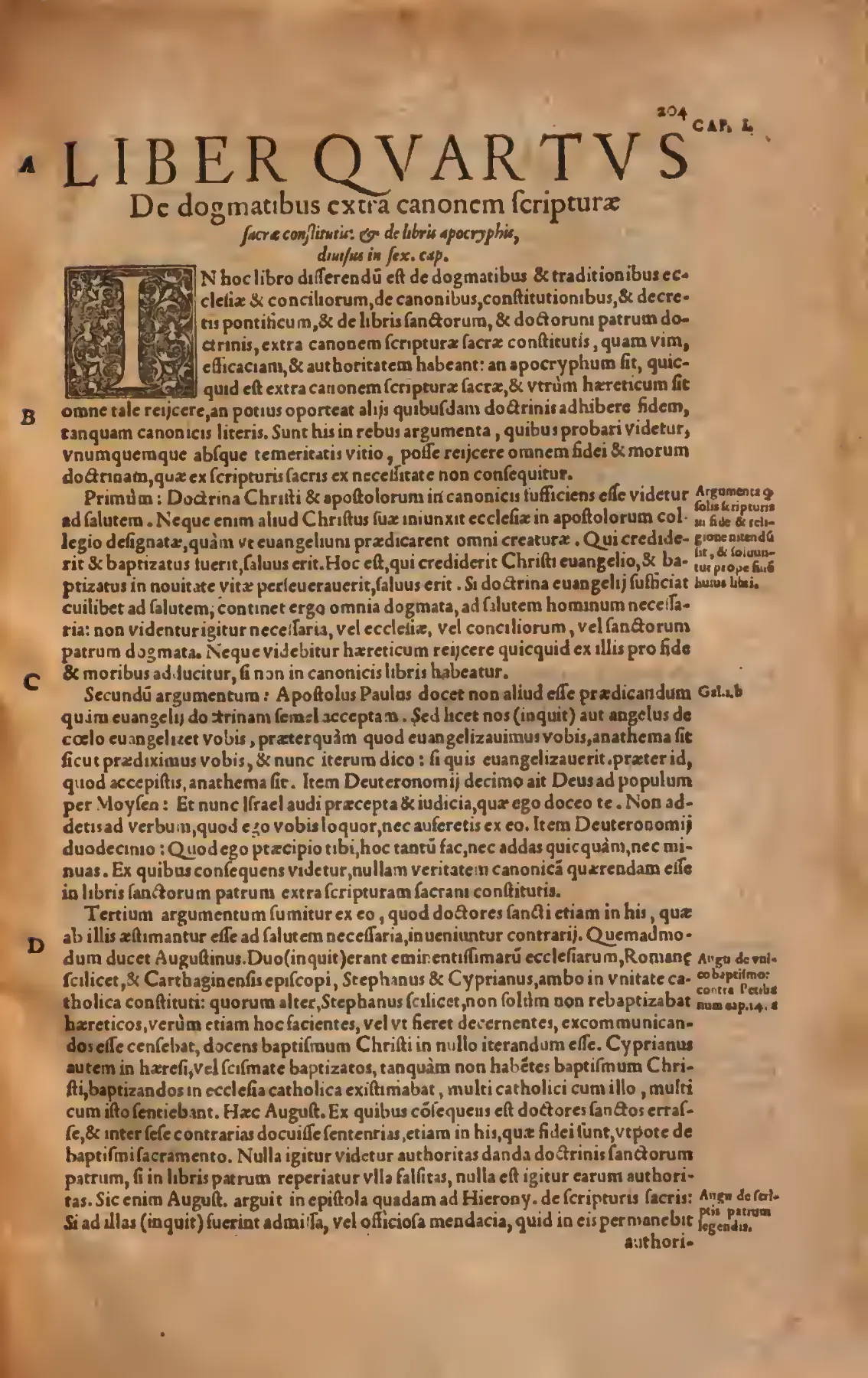
The opening of Liber Quartus, marked by a large ornamental initial, turns from canon and text to dogmas beyond Scripture. Pairing the objection that canonical teaching suffices for salvation with patristic disagreement, it prepares Driedo's case that apostolic witness lives in Scripture and the Church's received voice. Source ↗.
The fourth book opens on exactly the adversary Book III's epilogue had in view, the reader who holds Scripture plain and sufficient. In the scholastic form of the objection, the doctrine of Christ and the apostles in the canonical books seems sufficient for salvation, Doctrina Christi & apostolorum in canonicis sufficiens esse videtur ad salutem. Driedo's reply begins with the manner of the apostolic mission: the apostles and their disciples, sent among the nations, strove to profit them by the living voice more than by writings, Apostoli & Apostolorum discipuli missi inter gentes, viua voce magis, quàm scriptis prodesse studuerunt. He then separates two kinds of standing, in the distinction already set out among the treatise's instruments: it is one thing to say that there is no canonical authority in the apocrypha, another to say that there is no canonical truth in them. Extra-canonical writings may therefore carry truth without binding force.
The Fathers are placed on the same graded scale. Augustine, possessing the Holy Spirit, does not wish faith to be given to all his sayings, Spiritum sanctum habens Augustinus, non vult fidem haberi omnibus suis dictis. Jerome's retort to Vigilantius models the selective reading of erring authors: Origen a heretic, what is that to me, who do not deny that he was a heretic in most things?, Origenes hæreticus: quid (inquit) ad me, qui illum in plerisque hæreticum non nego?.
The discussion of canonization carries the historical candour of the chronology into ecclesiology. Although the formal censure of canonizing such persons is not an ancient but a new observance, Driedo concedes, the cult and memory of the saints is an ancient thing, Et quanquam censura tales canonizandi, non antiqua, sed noua sit observatio, cultus tamen & memoria sanctorum, vt infra videbitur, antiqua res est. He then sets the boundaries of certainty. It is true that the Church can err in matters of fact, Verum quidem est ecclesiam in his, quæ sunt facti errare posse. Yet concerning the saints attested in Scripture, to believe or doubt that the Church could have been deluded is heresy, Super istis enim credere aut dubitare ecclesiam posse fuisse delusam, hæresis est.
The same gradation that separated Hebrew from Septuagint, public annal from Greek opinion, and consequence from prejudgement now separates faith from fact. Within Book III, the Church's received text sets the measure of pagan chronology. At the opening of Book IV, the Church's witness sets the measure of every writing and every saint outside that text.
The fourth book pursues its account of extra-canonical authority by ranking the witnesses the Church has received, and this grading prepares the ground for everything that follows. Having separated the teachings of the Fathers from the authority of the sacred letters, and having conceded that patristic writers sometimes spoke according to human sense, above all in matters of history, Driedo turns to the most recent of those witnesses, the scholastic doctors. He presents them as raised by the counsel of the divine Spirit to defend the faith by questions and distinctions.
His defence is notably measured. Citing Gerson, he grants that the scholastics are more concise, more convenient and more useful, even though the ancients are more vehement in inflaming the affections, sunt (inquit Gerson) compendiosiores, commodiosiores & utiliores, tametsi veteres sint ad inflammandum affectus vehementiores. The division of labour is significant. It assigns the understanding to the schools and the moving of the will to the Fathers. The humanist devotion to patristic eloquence is thereby conceded on its own ground, not refuted. The schools are made indispensable without being made sufficient.
The polemical edge sharpens when Driedo answers the charge that grammatical and logical subtlety has defiled divinity. We do not, he protests, pollute the whiteness of most sacred theology with the filth of frivolous things, but rather illuminate it, Nequaquam igitur candore sacratissimæ theologiæ polluimus fruolarum rerum sordibus, sed magis illustramus,. The metaphorical schema of purity and contamination belongs to his opponents, and Driedo turns it back on them. On his account, the analysis of exclusive terms such as solus and of the gender of alius and aliud in Trinitarian predication is what keeps theological speech clean. The Jerome catalogue of pagan-learned apologists then closes on a programmatic thesis. Natural philosophy, found out by the light of internal reason, is not contrary to the Christian religion but is to be taken up as follower and handmaid, Neque enim naturalis philosophia per lumen rationis internæ adinuenta, est Christianæ religioni contraria, sed assumenda est vt pedissequa & ancilla. The doubled servile noun is more than rhetorical fullness. It fixes philosophy's place in a hierarchy, in which it serves but does not rule, and that is the same logic by which the treatise elsewhere orders testimony beneath what it testifies to.
This ordering of authorities becomes an instrument of judgement in the threefold grid of propositions: those necessary to faith, those pertaining to its piety, and those irrelevant to it. The grid acquires juridical force through a single definition. Falsity contrary to any proposition of the first class is heresy, Falsitas contraria alicui sententiæ primi generis, est hæresis. The definition cuts in two directions. It gives the censor a precise criterion. It also shields a wide zone of opinion, concerning secondary causes, moral philosophy, and historical detail, from the charge of heresy altogether, since error there incurs only suspicion or no theological note at all. Driedo's careful separation of the obstinate sinner from the heretic belongs to the same economy of restraint. Condemnation is reserved for denial of what faith strictly requires.
Chapter II transfers the method of distinction from propositions to the Church itself. Once ecclesia has been defined as assembly and its unity placed in faith rather than place, the first conclusion establishes an uninterrupted body. The Church that began in Adam, Eve and Abel remains to these times, and never ceased nor passed into another church, Ecclesia, quæ coepit in Adam, Æua, & Abel hæc vsq[ue] tempora manet, neque desijt vnquam, neque transijt in aliam ecclesiam. Any account of a refounded or recovered Church is thus excluded in principle. Continuity is not a property the Church happens to possess but the condition of its being the Church at all.
Continuity of this kind, however, is not sameness of practice, and Driedo draws the consequence with striking candour. Because the Church has ages as a human body does, the rites observed in the primitive Church of Christ need not be kept by us, Et idcirco non oportet ritus in ecclesia Christi primitiua obseruatos à nobis seruari. The organic figure disarms the primitivist appeal, since the infancy of the body cannot bind its maturity. He supports the point with a jurisprudential principle of accommodation. Human law is that which is just and equitable according to place, time, cause, reason, and the quality of persons, quæ pro loco, tempore, causa, ratione, & personarum qualitate est iusta & æqua.
A tension is latent here. The same argument that makes the present Church the legitimate judge of its own discipline also concedes that discipline is contingent. The community of goods, for instance, survives only as a counsel of perfection. Driedo resolves the difficulty of Old and New Law in scholastic form: the Church is in one way the same and in another way other, Est ergo quodam modo eadem ecclesia, & quodâ modo altera: quemadmodu[m] est. The quodammodo formula is the treatise's characteristic gesture in miniature. It declines to choose between identity and change and assigns each to its proper respect.
The second part of the chapter applies the same device to membership. Against the Donatists, Driedo distinguishes modes of being in the Church. One may be in it as a member in the compact of justice, vno modo esse in ea tanqua[m] membru[m] in co[n]page iustitiæ, or one may adhere to it as chaff to wheat, sicut palea tritico. The agrarian image, drawn from the parables of the tares and the threshing floor, makes the mixed Church a matter of eschatological patience rather than present purgation.
From it follows the objectivity of the sacraments: the sacrament is not better that is given through a better minister, Et idcirco non est melius sacrametum, quod per melioré datur. The anti-Donatist principle bears unmistakably on contemporary complaints against unworthy clergy. It is balanced at once by a restriction, that outside the Church even true sacrifice profits no one, Extra ecclesiam nulli prodest etiam verum sacrificium,. Validity and fruitfulness are separated in the way canonical authority and canonical truth are separated elsewhere in the treatise. A thing may be real without being salutary to one who holds it in the wrong place.
The objection that the Roman Church occupies only a corner of Europe draws from Driedo one of the most historically revealing moments of the book. He allows that the Commission to preach to all nations may not yet be fulfilled. He observes that not many years ago, under Ferdinand and Manuel, kings of the Spaniards, there were found, quandoquidem & non multis effluxis annis sub Ferdinando & Emanuele Hispanorum regibus inuentæ, lands wholly unknown to earlier ages. He therefore reads the patristic claim of universal preaching with historical discrimination. When the Fathers said that it had long ago been fulfilled among all nations, they spoke of the nations of the earth then known or discovered to them, id olim in omnibus gentibus esse completum, loquuti sunt de nationibus terræ tunc cognitis sibi, aut inuentis.
This is a significant concession. The Fathers' testimony is received, but it is bounded by the horizon of their knowledge, exactly as their history was earlier said to be written according to human sense. Catholicity thereby becomes a process unfolding in time rather than a completed geographical fact. That reading suits the treatise's larger conception of authority as something received and extended through succession.
Book IV: Peter's Chair and the Church's Witness
Chapter III, on Peter's chair, is the longest movement in this stretch, and its argument depends on keeping three referents apart: the person of the pope, the universal chair, and the Roman diocese. The historical chain of appeals to Rome, from Basilides to Jerome and on through Bernard, is gathered under Augustine's figure of consensus as a siege-weapon. Against the heretics must be set the unconquerable engine of the Christian religion, objicienda est illis Christianæ religionis machina inuincibilis. The martial metaphor presents tradition as a constructed and cumulative force, built across generations and irresistible because it is collective.
Yet Driedo tempers the Bernardine vocabulary of primacy with limits on its exercise. To the objection that remote Christians cannot know papal decrees, he replies that the positive constitutions of the Roman Church do not bind those probably ignorant of them, Insuper sciat constitutiones positius Roman�� ecclesiæ non ligare probabiliter ignorantes. He also insists, with reforming emphasis, that the name of bishop sounds not lordship but office, Episcopi nomen non dominium, sed officium sonat. Primacy is defended as solicitude and service, not as dominion over the churches.
The third part turns to the promise that Peter's faith shall not fail. Here Driedo rejects the application to the person outright: there seems to be no scripture by which we are compelled to believe that the pontiff of the universal Church never becomes a heretic, videtur vlla esse scriptura qua cogamur credere vniuersalis ecclesiæ potisicem non fieri vnuquam hæreticum. The indefectibility of the universal chair is held as of faith. The permanence of the Roman see is held only as pious belief, a placement that uses the censure grid of Chapter I to calibrate ecclesiology itself. It is shadowed by the Turkish advance and by an Islam that he reads as the falling away foretold in 2 Thessalonians.
The pastoral conclusion follows from these distinctions. Even in wicked pontiffs the life is to be hated, but in them Peter's chair is to be honoured, Etiam in prauis pontificibus odienda est vita, sed in ipsis honoranda est Petri cathedra. The sentence gives the anti-Donatist logic of the mixed Church a papal application. The unworthiness of the occupant, like the unworthiness of the minister, cannot void the office. Schism justified by clerical vice is thus deprived of its warrant.
Chapter IV states the thesis on which the whole treatise's account of the canon depends, the formulation already set against the alternative posed in Tavard's title: sacred Scripture is the testimony of the Church testifying from the Holy Spirit, and therefore the scripture of the Gospel is posterior to the Church. Priority here is priority of witness, not of origin, for the testimony is given ex spiritu sancto. The chronological excursus that accompanies the thesis is dated internally to the year 1532, and in it Moses is set before all pagan writers. That excursus gives the claim a historical dimension, since the assembly of God is shown to have existed before any of its writings.
Driedo immediately fences this authority. We do not say, he writes, that the Church which now is can define at will whatever it pleases as pertaining to faith, Neque enim dicimus ecclesiam quæ nûc est, pro libito posse definire quodlibet ad fidem pertinere. The present Church judges only in continuity with the apostolic Church. That Church's certification is described in notarial terms: the Gospels themselves stand as public instruments under the testimony of the primitive Church, ipsa verò euangelia tanquam instrumenta publica sub testimonio primitiuæ ecclesiæ. The juridical figure is exact. A public instrument derives its credit from the attesting notary, yet the notary does not invent the transaction recorded. The Church witnesses, and does not author.
The chapter closes by extending the conciliar concession within this papalist frame. On the authority of Matthew 18 and of Constance, the pope, in cases of faith and schism touching and concerning his own person, is subject to the judgement of the universal Church, a concession already noticed for the complication it poses to accounts of the pre-Tridentine Leuven faculty. The chair-person distinction now yields its juridical consequence. The universal Church, as bearer of the indefectible chair, may judge the fallible occupant.
Chapter V argues that Scripture alone cannot refute every heresy. Perpetual virginity and infant baptism cannot be proved evidently from the text, so custom is raised to the rank of a co-principle: custom is the augmenter and confirmer of faith, Au[n]ctrix, & confirmatrix fidei est consuetudo. The argument then turns genealogical. From Bernard's report of the Cologne heretics it is clear that the heresiarch of this age was not the inventor of new heresies, Ex qua patet hæresiarcham huius seculi non fuisse inuentorem nouarum hæresium. The unnamed reformer is thus absorbed into a recurring pattern. Novelty is denied to him precisely because antiquity is the Church's own criterion of truth.
Driedo's charity toward error does not reach this far. Constancy under execution is reclassified as devilish pertinacity, since the constancy of martyrs and the pertinacity of heretics have nothing in common, Nihil ergo simile habent, constantia martyrum, & pertinacia hæreticoru[m]:. The social alarm latent throughout surfaces in open scorn for certain most impudent unlettered laymen and little women, nonnulli impudentissimi idiotæ absque literis laici viri, & mulierculæ.
The spaciousness of the censure grid, which protects learned disagreement, thus coexists with a hard boundary around who may dispute at all. The distinctions that open a latitude for the schools close it for the unlearned. That asymmetry marks the limit of the method in this stretch of the work.
Book IV: Custom, Tradition, and the Resolution of Objections
Within the same chapter, the catalogue of doctrines "learned from the Scriptures" runs on through the eucharist celebrated by ordained presbyters, reception while fasting, the anointing of the sick, confession, the indissolubility of marriage, vows, feasts and fasts, and the intercession of saints. It reaches even an intermediate state of purgation, which Driedo presents as passed for a time, with the Maccabees, aut ad tèpus cum Machabæis in loco quodam medio, per ignem, in a certain middle place, through fire. The list then gathers into its governing figure, the image, already set beside Murphy's study of tradition, of these and many other matters as seedbeds and foundations delivered in the Scriptures, sometimes plainly expressed.
The agricultural metaphor carries the argument. A seedbed is neither the full plant nor something foreign to it. The image thus concedes that Scripture is often silent about rite and order, while denying that what grows in the Church is a human planting. The rites and their order, Driedo explains, were left by the Holy Spirit to the apostles and their successors. From this follows a concession that cuts against the primitivism of his opponents: Proinde non omnia quæ in ecclesia primitiua seruabantur, conueniunt, that is, not everything observed in the primitive church fits the present ordering. The criterion of continuity is set with care. Driedo seeks to show that the present Church conforms to the state of the ancient Church, namely in its foundations, nunc est, antiquæ ecclesiæ statui esse conformem, hoc est, in fundamentis. The Church need not resemble the apostolic community in every particular, only in the foundations of faith and the substance of the sacraments. Continuity of substance, not identity of usage, becomes the standard by which reception is measured.
The fourth part of the chapter turns from Scripture's seedbeds to ancient custom. It opens with sacramental theology and at once marks out the limits of what is binding. On the curious question of how the sacraments contain grace, Driedo allows that it will not be heretical to dispute, provided obstinacy be absent from the mind, disputare non erit hæreticum, modò absit ab animis pertinacia, & firmiter. Heresy is placed in pertinacity of will rather than in opinion. This leaves the Leuven schools their latitude of disputation even as the treatise hardens its front against the reformers.
Against those who demand Scripture for everything, Driedo sets the Augustinian axiom, already met in considering the weight of custom, drawn from the controversy with the Donatists over infant baptism: what the whole Church holds, not established in councils but always retained, is most rightly believed to have been handed down only by apostolic authority. The rule makes universality and perpetuity into evidence of origin. What is always and everywhere retained, and was never decreed, can have entered the Church only through the apostles. Driedo then turns the same logic back upon Scripture itself, which, he says, is nothing other than the testimony of the apostles concerning Christ Jesus and his teaching, neque aliud est scriptura, quàm apostolorum de Christo lesu & de doctrina illius testimonium. Written text and unwritten custom thereby become two modes of one apostolic witness, received through the same channel. This is the treatise's characteristic move: the witness of reception governs both, and neither is set against the other.
The long sequence of paragraphs beginning mos fuit ("it was the custom") applies this principle to chrism, sacred places, images, consecrated vessels, the mixed chalice, and the Mass. Here Driedo builds a genealogy in three tiers. The Church has the sacrifice itself from Christ, but a certain order and manner of offering it from the apostles, sacrificium perficitur, habet ecclesia à Christo, ordinem autem & modum, and later pontiffs augment that order. The structure admits liturgical accretion without conceding human invention in substance.
The same discrimination governs fasting. Yet the holy fathers did not consider all these things to be observed as though they were wholly immutable, like things of divine law, à carnibus. Sed tamen omnia sancti patres non ita æstimabant obseruanda, vt traderent illa omnino esse immutabilia, veluti ea, quæ sunt diuini iuris. Nam. The anecdote of Spiridion eating pork in Lent illustrates the point. Custom binds, but it does not bind as divine law binds. The argument from reception is thereby graded, in keeping with the treatise's wider habit of distinguishing degrees of obligation.
Six objections against the Mass, the cult of saints, and ceremonies follow, and their solutions display the distinction-making method at its most compact. To the claim that the cross was sufficient, Driedo answers with the identity of the victim. We now offer no other sacrifice, no other victim, but the same that once offered itself on the altar of the cross, semel pro nobis immolati. Non aliud sacrificium nunc offerimus, non aliam. The Mass does not repeat or supplement Calvary; it re-presents it. Within the same answer Driedo gives a notably Augustinian account of justification: through Christ's faith we are justified freely, that is, without our merits, yet not without the consent of our wills, ex cuius side iustificamur gratis, hoc est, absque meritis nostris, non tamen [printed "side" for fide]. The gratis concedes much of the language the reformers claimed. Driedo's reply lies in the qualifying consent of the will, not in any denial of grace's priority.
On the cult of saints, the answer rests on vocabulary. Driedo holds that the objection does not conclude, for it is one thing to adore the saints and another to invoke them, non concludere: nam aliud est sanctos adorare, aliud est sanctos inuocare, vt. On images he follows Gregory: hence it is one thing to adore a picture, another to be taught through a picture what is to be adored, factus. Vnde aliud est picturam adorare, aliud per picturam quid sit adorandum. In each case a practice that seems forbidden is saved by separating the act from its object.
The answer to the sixth objection, Augustine's praise of "few and easy sacraments," becomes an exposition of the letters to Januarius. There Augustine sets out three kinds of rites: those contained in Scripture, those universal throughout the world, and those varying by place. For the third kind Augustine gives counsel in the same passage: let each do, he says, what he finds in the church to which he comes, tertio genere ibidem Augustinus dans consilium: Faciat quisque, inquit, quod. Ambrose's counsel to Monica and Gregory's instructions to Augustine of Canterbury follow as further precedents. The effect is to confine the reformers' objection to local and variable usage, while universal custom keeps its apostolic weight.
The fifth part converts this principle into a historical method. Customs are dated "from the beginning" by a chain of witnesses secundum seriem successionis, in the order of succession, much as the Pauline epistles are authenticated by their continuous reception. The series opens with first blessed Ignatius, disciple of John the evangelist, ordained second bishop of Antioch, Primùm beatus Ignatius discipulus Iohannis evangelistæ, ordinatus secundus.
The candour of the method is striking. Driedo concedes that Tertullian fell into the dogma of the heretic Montanus and published volumes against the churches, Montani hæretici dogma delapsus, aduersus ecclesias volumina ediderit,. He manages this by limiting the witness to what Tertullian wrote before his lapse. Tertullian nonetheless supplies the triad that names the whole category: custom is author, confirmer, and guardian of faith, Auctrix est consuetudo, confirmatrix est, & fidei obseruatrix consuetudo,. Origen receives similar handling: let us pass over, therefore, the opinions of Origen on purgatory, Prætermittamus igitur sententias Origenis de purgatorio,. What Origen taught is set aside as universal restoration rather than the Church's purgation.
The chain thus works by discrimination within each witness. A Father's testimony counts where it agrees with the continuous body, not by the Father's personal standing. Basil completes the case for the unwritten with the discipline of reserve: dogmas are kept in silence, edicts are published, nâ dogmata silentur, edicta publicantur. By this principle the silence of the written page itself becomes evidence for tradition. Jerome's reply to Vigilantius closes off the charge of idolatry, since we venerate the relics of the martyrs, we do not adore them, aliquid mox illud adorat: veneramur martyru[m] reliquias, no[n] adoramus.
The fifth part ends with a diagnosis of Driedo's own day, already cited for its resistance to any reduction of the schism to disputes over rite: it is not on account of bare ceremonies that the Church in our age has come into this schism. The cause, on his account, is contumacy against universal custom. The distinction between variable ceremony and universal custom thereby becomes a moral judgement on the rupture itself. To make that judgement exact, Driedo separates three offences: disobedience, schism, which arises without heresy, and third, heresy, schismatis quod contingit absq[ue] hæresi. Tertium est hæresis. Schism belongs to the will and heresy to the intellect. This graded censure preserves the latitude Driedo granted to scholastic disputation, even as it condemns those who break communion.
The final chapter, announced as that in which the arguments are resolved, Sequitur huius libri caput sextum, in quo soluuntur argumenta, returns to the objections raised at the opening of the book. Its first move is that Christ did not command his apostles to write the gospel to every creature, suis Apostolis, vt evangelium scriberent omni creaturæ: neq[ue] item dixit, vt. The mandate was oral. Driedo then restates the argument associated with Irenaeus in its strongest form: even if the apostles had left us no writings, we would still have to hear the apostolic Church, quàmuis Apostoli nulla nobis scripta reliquissent, tamen oporteret nos.
This hypothetical does not devalue Scripture. It locates the Church's certainty in a reception that comes before writing. The same logic disarms Galatians 1. When Paul wrote, no gospels had yet been issued, and the gospel is one thing, the scripture of the gospel another, euangelia adhuc erant ædita. Aliud est euangelium, aliud scriptura.
Patristic disagreement, such as that between Stephen and Cyprian, shows only that the Fathers are not canonical. Driedo refuses the further inference: it would be a most absurd argument to say that because a book has no canonical authority, it contains no canonical truth, Absurdissimum est argumentum, si dixero: Huius libri nulla. Heresy, by contrast, arises when Scripture is read apart from tradition. Driedo names the contemporary adversary only here, and he does so by assimilating the reformers to an ancient error. The predestinarian heresy of the monks, once extinct, now revives together with the other Lutheran heresies, iam vna cum alijs hæresibus Lutheranis reuiuiscit. Harum & omnium similium.
The book closes on the infallibility of the Church through the Paraclete, and on the objection that one man demonstrating from Scripture might outweigh a council. Driedo does not deny that such a man would be right. He denies instead that the assembly would be a council at all: this whole council, that one man excluded, is not a general council but a council of Satan, scripturis sacris, iam totum hoc concilium, secluso vno illo, non est. The resolution is characteristic of the whole treatise. The difficulty is not refuted head-on but dissolved by definition. What counts as the Church's voice is fixed by its conformity to what the Church has always received, and a gathering that defines against Scripture has, by that very act, ceased to be the witness it claims to be.
The treatise's closing leaf, where a gathering that defines against Scripture ceases to be a general council at all. Before the printed FINIS, a brief recapitulation surveys Book IV's ground: apocrypha, patristic authority, the Church's unity, Peter's Roman chair, and the relative authority of Church and Scripture. Source ↗.
Reading Further on Driedo, Tradition, and the Sources of Truth
- Wim François, "John Driedo's De ecclesiasticis scripturis et dogmatibus (1533): A Controversy on the Sources of the Truth," in Orthodoxy, Process and Product: On the Meta-Question, ed. Lieven Boeve, Mathijs Lamberigts, and Terrence Merrigan (2009), 85–118. The most directly relevant specialist study identified, it places the treatise within disputes over the sources of religious truth. Those disputes turn in Driedo's Latin on his account of the written text as ecclesial witness: sacred Scripture written on parchment, since it is the testimony of the Church itself, scriptura sacra in pargamena scripta, cùm sit ipsius ecclesiæ testimonium,.
- John L. Murphy, The Notion of Tradition in John Driedo (Pontificia Universitas Gregoriana, 1959). This book-length investigation is devoted to the concept that must be understood before assigning Driedo a position in later Scripture–tradition debates. Its subject is well illustrated by Driedo's image of Scripture as the ground of received teaching. He describes these and many other matters of the kind as, as it were, seedbeds and foundations handed down in the Scriptures, sometimes plainly expressed, Hæc & id genus alia multa, sunt tanquam seminaria quædam & fundamenta in scripturis tradita, nunc quidem planè expressa,. How far this image separates tradition from Scripture, or roots tradition within it, is the kind of question Murphy's study equips the reader to pose.
- George H. Tavard, Holy Writ or Holy Church? The Crisis of the Protestant Reformation (London, 1959). Its wider account of Reformation-era arguments about scriptural and ecclesial authority supplies a comparative setting for Driedo. Its treatment should not be substituted for examination of Driedo's Latin. The alternative in Tavard's title is one that Driedo's own formulation declines to pose as a choice. Driedo holds that sacred Scripture is the testimony of the Church testifying from the Holy Spirit, and that the scripture of the Gospel is therefore posterior to the Church, Sciendum est igitur quòd sacra scriptura est testimonium ecclesiæ, ex spiritu sancto testificantis, & idcirco ipsa scriptura euangelij posterior est ecclesia.
Frequently Asked Questions
What is Johannes Driedo's De ecclesiasticis scripturis et dogmatibus?
It is a Latin treatise of controversial theology in four books. Its author was Johannes Driedo of Turnhout (Jan Driedoens), a theologian of the Leuven faculty. Rutger Rescius printed it at Leuven on 10 June 1533 for Bartholomeus Gravius. Written against the Lutheran appeal to Scripture alone, it asks how the Church knows which books are divine, which Latin text binds, and what binds beyond the written page. Book I treats the canon, Book II the Septuagint, the Vulgate and the senses of Scripture, Book III rules for obscurity and chronology, and Book IV custom, tradition and the chair of Peter. The treatise later headed Driedo's collected Opera, a 1552 Leuven folio edited under the care of Ruard Tapper.
Why did Driedo call the Latin Old Testament "mixed and not pure"?
He separated the inspired writer from the translator. A prophet or evangelist issuing Scripture cannot depart from the truth, but an interpreter can stray from the sense. On his account, the Latin Old Testament in use is neither wholly pre-Hieronymian nor wholly Jerome's. He supports this with passages Jerome himself criticised and with objections from Lyra and FitzRalph. A scholar may therefore say the translator erred without impiety, at least until the universal Church defines the matter. The Vulgate's authority rests instead on reception. It had been accepted for a thousand years without objection from heretics or schismatics, so it governs lectures and disputations, while newer versions serve private study.
Does Driedo think the Church creates the biblical canon?
No. He holds that the Church witnesses to Scripture rather than authoring it. Scripture is known as divine through the testimonium ecclesiae, the Church's testimony. By this he means the witness handed on through the succession of churches since the Apostles, not the verdict of the present Church alone. It is not in the power of men to make a book canonical, and neither councils nor ecclesiastical canons made the Scriptures divine; they declared what already was. So when Jerome said the Epistle of James gradually obtained authority, Driedo replies that it possessed authority from the beginning and only became known to all churches over time.
Did Driedo's treatise influence the Council of Trent?
Direct influence on Trent's wording has not been established. Driedo's work was printed thirteen years before Trent's fourth session in 1546, and it addressed the same questions. These include Scripture and tradition, the Vulgate against the Hebrew and Greek, the proper sense of Scripture, and patristic consensus. That makes it a valuable point of comparison, but earlier date and shared subject do not prove dependence. Scholars stress different aspects of the work. Wim François reads it as a controversy over the "sources of the truth," John L. Murphy studies Driedo's notion of tradition, and George H. Tavard places it within the wider Reformation crisis.
Is there an English translation of Driedo's De ecclesiasticis scripturis et dogmatibus?
No complete translation of the treatise into English or any other language has been verified. No translation has been securely established from the printed and catalogue records examined. The work survives in its Latin first printing of 1533 and in Driedo's collected Opera. The Leo edition is a separate undertaking. Leo seeks to make freely available online, at no cost, English translations of every text printed in Latin in early modern Europe between 1450 and 1750. Its edition presents the full transcription and a complete English translation for the first time, and that translation is generated by AI.
This report was generated by an advanced AI assistant that conducted deep research alongside an extensive interpretation of the transcribed original text. Every effort has been made to preserve fidelity to the source and to guard against inaccuracy, but corruption in the text recognition process and model hallucination may nonetheless have entered the text. Treat every claim, quotation, translation, and citation as provisional, and verify each against the original source before relying on or citing it.
Bibliography
- Wim François, "John Driedo's De ecclesiasticis scripturis et dogmatibus (1533): A Controversy on the Sources of the Truth," Orthodoxy, Process and Product: On the Meta-Question: The one study that takes the 1533 treatise as its whole subject. François reads Driedo as a combatant in the argument over where religious truth comes from, which is the ground this report covers when it treats Scripture as the Church's testimony. Anyone wanting to test the claim that Driedo casts the Church as witness rather than author will find the case argued at chapter length by a Leuven scholar writing about a Leuven theologian, which is at least a sound division of labour.
- John L. Murphy, The Notion of Tradition in John Driedo: Murphy gave an entire Gregorian monograph to a single concept in Driedo, and it is the concept on which later readings of Trent's fourth session most depend. Read alongside the report's pages on consuetudo, the "seedbeds and foundations," and the Augustinian rule about what the whole Church has always held, it turns the question of whether Driedo divides revelation into two sources into one that can actually be answered.
- Wouter Nijhoff and M. E. Kronenberg, Nederlandsche Bibliographie van 1500 tot 1540: The standard bibliography of early Low Countries printing, and the source, under no. 744, for the report's date of 10 June 1533 and for the detail that Rescius printed for Gravius. Consult it before repeating any catalogue that credits the first edition to Gravius alone. Bibliographers of this period earned their reputation for exactness, and here the exactness changes the imprint.
- Projet La Flèche (UQAM), Catalogue record for Johannes Driedo, Opera (Leuven, 1552): This record, from a historical collection catalogued as CL034-10, documents the 1552 Leuven folio Opera and its attribution of editorial care to Ruard Tapper, on which the report's account of the collected edition partly rests. Its main value lies in the list of what follows the treatise: works on captivity and redemption, free will, grace and predestination, and Christian liberty. Together they show that Driedo's collected works were assembled as a complete controversial armoury, with De ecclesiasticis scripturis at its head.
- George H. Tavard, Holy Writ or Holy Church? The Crisis of the Protestant Reformation: Tavard's survey supplies the wider Reformation debate into which Driedo's treatise fits, and it is useful for seeing which of his moves were shared by other controversialists and which were his own. The either/or in its title is precisely the choice Driedo declines to make. That refusal is reason enough to read the book with the Latin open beside it.
- Universal Short Title Catalogue, USTC 400529: De ecclesiasticis scripturis et dogmatibus libri IV (Leuven, 1533): The authoritative record of the first printing. It gives the folio format, the [20] preliminary and 634 numbered pages, the full signature formula, and copies at KBR and KU Leuven. Because the report reproduces that collation as catalogued rather than checked gathering by gathering, anyone handling a physical copy can use the entry as a checklist and settle the matter.