A Nose of Wax: Albert Pighius's The Assertion of the Ecclesiastical Hierarchy
Albert Pighius, provost of St John's at Utrecht, printed his Hierarchiae ecclesiasticae assertio at Cologne in 1538. It is a six-book Latin defence of papal authority, dedicated to Paul III and aimed at Luther, at the conciliarists, and at Henry VIII's new headship of the English Church. Its argument is that Scripture alone, a wax nose that bends to every reader, cannot settle religious quarrels, and that truth must be guarded by a living, ordered Church under one visible head; written before Trent fixed Catholic teaching, it shows a combative humanist theologian rebuilding the case for Rome from consensus, antiquity, and succession.
ExLatinis
October 1, 2026

Contents
Albert Pighius, provost of St John's at Utrecht, printed his Hierarchiae ecclesiasticae assertio at Cologne in 1538. It is a six-book Latin defence of papal authority, dedicated to Paul III and aimed at Luther, at the conciliarists, and at Henry VIII's new headship of the English Church. Its argument is that Scripture alone, a wax nose that bends to every reader, cannot settle religious quarrels, and that truth must be guarded by a living, ordered Church under one visible head; written before Trent fixed Catholic teaching, it shows a combative humanist theologian rebuilding the case for Rome from consensus, antiquity, and succession.
Albert Pigge (Albertus Pighius), a Dutch theologian from Kampen and provost of the chapter of St John at Utrecht, wrote the Hierarchiae ecclesiasticae assertio, a long Latin defence of the Church's hierarchical order. It was printed at Cologne by Melchior Novesianus in 1538 and dedicated to Pope Paul III. The book belongs to the controversial theology of the decade before the Council of Trent. In that decade Catholic writers in the Low Countries and the Rhineland answered the reformers in Germany and Switzerland. They also answered Henry VIII's claim to supreme headship over the English Church, and the older conciliar and imperial theories that both camps could invoke. Its precise place and dates of composition have not been securely established beyond the fact that it was finished before the 1538 printing. No published translation of the complete work is known. For an English reader it therefore survives almost entirely in its original Latin, and in the replies it provoked: John Leland's Antiphilarchia answered it from the English side.
The problem at the centre of the Assertio is epistemic before it is institutional. Pighius diagnoses the religious upheaval of his age as the collapse of the vigour of public discipline. He traces that collapse to a question of knowledge. If Scripture is a mute and malleable text, open to every reader's construction, what certifies Christian truth and settles controversy? His answer is built in stages and repeats a single move. He relocates the criterion of truth from the written text to a living, continuous, hierarchically ordered Church. Scripture and unwritten tradition are the first principles of faith, yet both rest on the Church's prior authority and on the universal consent of its members. Doctrine is tested by antiquity, so that any belief with a datable author, time, and place stands condemned as novelty. The living consensus is then placed in a visible order that culminates in a single head, and the definition of the apostolic see becomes, in effect, a further principle of faith. The rival claimants to final authority are each reduced in turn to a human derivative of, or a subordinate to, Roman authority. These rivals are the secular ruler, as theorised by Marsilius of Padua and, in Pighius's telling, inherited by the Lutherans, and the general council. Throughout, the argument relies on three grounds: consensus, antiquity, and succession. It also relies on two distinctions: between an office and the person who holds it, and between right (ius) and fact (factum).
The stakes of this argument were concrete in 1538. Paul III's proposed general council was being called and disputed. The Schmalkaldic League was demanding a "free council" on its own terms. In England, royal supremacy had recently been enacted at the cost of John Fisher's life. Behind these disputes lay a medieval inheritance of quarrels over pope and council, regnum and sacerdotium, and the meaning of papal "fullness of power." Pighius's positions predate both the Tridentine decree on Scripture and tradition and the definition of the First Vatican Council. They should not be read as early statements of either. They are better read as one forceful, personal, and in places idiosyncratic intervention in a debate whose outcome was still open.

Hans Holbein the Younger’s portrait of Henry VIII puts a face to one of Pighius’s chief adversaries: the king whose claim to supremacy over the English Church made the conflict between royal and papal authority immediate, and bloody, in 1538. Source ↗.

Several features of the work stand out. Pighius argues that Christ wrote nothing and commanded nothing to be written. He calls Scripture a "wax nose" and a "mute judge" that cannot settle the quarrels it occasions. He calls councils a Constantinian, wholly human institution that can err and often has. He defines the heretic not as one who rejects Scripture but as one who refuses to believe the Church, and he holds that such a person should be rebuked rather than engaged in disputation. He uses the philology of his humanist contemporaries: Septuagint, Hebrew, Targum, and Aramaic arguments over petra and Cephas, together with criticism of the Vulgate. Alongside these he uses the Galenic and Dioscoridean medicine of his day as analogies for the Church's disease and cure. His loyalty is also not uncritical. He treats the Donation of Constantine as interpolated and criticises episcopal courts. He openly mocks Gratian, the very canonist on whose texts so much papalist argument rested.
What unites the work's vocabulary, its production, and its argument is the double sense of hierarchia itself. The word carries the sacred ordering inherited from Pseudo-Dionysian theology, and it also names a juridical structure of jurisdiction descending from a visible head. The book was printed in Catholic Cologne, addressed to the pontiff whose authority it defends, and answered across the Channel by a royal apologist. As an object, therefore, it took part in the same contest over headship that its pages argue. Its later Cologne editions are reported for 1544, 1558, and 1572, and their textual relationship to the first printing still awaits edition-by-edition comparison. Much in its bibliographic record also remains unsettled. Its argument nonetheless follows one consistent logic: that truth, order, and authority are secured in a living succession rather than in a text.
Read the full text and English translation on Leo
This text was transcribed and translated as part of the ExLatinis project, an effort by Leo to make free English translations of every text published in Latin in early modern Europe (1450–1750) available online. The complete transcription and English translation of this work can be read free of charge:
→ Read the original Latin text and full English translation on Leo
You can save a copy of this document into your Leo account to run deep text searches, conduct further analysis, or cross-reference it with your own research.
Naming the Assertio: Pighius's Title and Its Vocabulary of Order
The Assertion of the Ecclesiastical Hierarchy is an editorial English title supplied for convenience; no established English title or published translation was located. The printed Latin title is Hierarchiae ecclesiasticae assertio, with a title-page attribution to Albertus Pighius Campensis. The author is Albert Pigge or Pighius, identified by his association with Kampen. Assertio denotes an affirmative defence of a disputed claim, not merely a description of church offices.
Hierarchia carries the inherited sense of a sacred ordering associated with Pseudo-Dionysian writing. In this controversy, its force is also institutional. Ecclesiastical order is defended against accounts that make jurisdiction depend principally on princes or councils rather than on a visible head. Pighius joins the two senses when he sets out to show that the unity of the Catholic Church necessarily consists in its order, Vnitatem catholicæ Christi ecclesiæ, in eius ordine necessario. That formulation makes ordo the condition of unitas rather than one of its attributes, so the polysemy of hierarchia carries the weight of the whole argument.
Disciplina publica names the Church's publicly exercised discipline, not simply an individual's moral self-command; its alleged weakening makes the defence of order urgent. The text states the diagnosis directly. It locates the cause of the evil in the dissolved vigour of a public discipline that the hierarchy had upheld for so many centuries, nempe, disciplinæ publicæ dissolutum uigorem, quam tot seculis. The pairing of disciplina with vigor recurs when Pighius describes the remedy as the restoration of the hierarchy's order and strength, so that the keyword frames the book's diagnosis and cure alike.
The contrast between viva traditio and Scripture treated as a mutus iudex concerns who can authoritatively determine Christian doctrine. Both terms appear in the text's own wording. The first ground offered for a living judge is that the Scriptures are mute judges, Primum, quoniam scripturæ sunt muti iudictsquare [reading uncertain]. The corollary is that the evangelical law is more a matter of living tradition than of writing, quod nostra lex euangelica, viuæ traditionis magis est quàm scripturæ. These formulations should be read as positions advanced in polemic, not as transparent statements of a uniform Catholic teaching or as advance quotations from Trent.
Albert Pighius's 1538 Case for Papal Authority in Brief
Albertus Pighius Campensis's Hierarchiae ecclesiasticae assertio is a Latin theological polemic printed at Cologne by Melchior Novesianus (Melchior von Neuss) in 1538 and dedicated to Pope Paul III. Its driving purpose is to defend ecclesiastical hierarchy and papal authority amid disputes with reformers and Henry VIII's assertion of royal supremacy.
The defence begins from epistemology. Pighius first undertakes to demonstrate the principles of faith, namely canonical Scripture and unwritten ecclesiastical tradition, nempe canonicam scripturam, & fine scripto ecclesiasticam traditionem, demonstrare iam aggrediemur. He then grounds both in the agreement of the whole Christian body: where there is the sense and consensus of the whole body, there are Christ and the truth, ille totius corporis sensus & consensus est, illic Christus & veritas. From that living consensus the argument moves to the visible order that embodies it, and to the papal head of that order.
Pighius's vantage was closely connected to Utrecht, but the precise place and dates of composition have not been securely established; composition before the 1538 printing is certain. No published translation of the complete work could be located. Bibliographic evidence for the identified digitization names Pighius, not the seventeenth-century Jesuit Paolo Casati.
Where the Assertio Stands in Debates on Scripture, Councils, and Papal Primacy
The Assertio matters because it places the defence of a visible, jurisdictional Church in the years before the Council of Trent. It bears on disputes over royal supremacy, the relative authority of pope and council, the interpretation of Scripture and tradition, and the relation of spiritual to temporal jurisdiction.
On Scripture and tradition, the book's starting point is a historical claim about the origins of the New Law. Pighius observes that Christ wrote nothing and commanded nothing to be written, Nihil enim scripsit Christus, nihil scribendu[m] mandauit. He draws the consequence that the Christian religion is older than its scriptures, and that the Church, its faith, its tradition, and its observance are older too, hoc nimirum sciêtes antiquiorem esse Christianam religionem, quam sint illæ scripturæ, antiquiorem ecclesiam, antiquiorem eius fidem, traditionem & obseruationem. This priority yields his hermeneutic rule. The truly genuine sense of the Scriptures is the common sense of the Catholic Church throughout the world, Is enim scripturarum vere germanus sensus est, qui est communis catholicæ per orbem ecclesiæ.
The rule in turn redefines heresy. Such opponents are heretics not because they disbelieve the Scriptures but because they disbelieve the Church and read the Scriptures in their own sense rather than the Church's, Hi, inquam, vniuersi non ideo sunt hæretici, quia scripturis non credunt: sed quia non credunt ecclesiæ, quia scripturas suo non ecclesiæ sensu intelligunt,. From this follows the procedural conclusion that the heretic is to be rebuked, not convinced by disputation, Corripiendus igitur est, non disputatione conuincendus hæreticus. The test of orthodoxy is antiquity, taken without acknowledgement from Vincent of Lérins. Whatever has bubbled up with a definite author, at a definite time, in a definite place of novelty is evidently not Catholic, certo authore, certo tempore, certo loco nouitatis vsquam ebulluit, id constat. Pighius qualifies this by admitting doctrinal growth, provided it is truly a growth of faith and not an alteration, Sed ita tamen, vt vere profectus sit ille fidei, non permutatio.
On primacy, the same move relocates authority from text to person and succession. Pighius argues that the Church necessarily required a head of its own kind, remaining on earth, to govern it, requirebat necessario secum manens in terris caput congenu[m], quod gubernaret. He binds that authority to Peter rather than to Rome as a place: authority came to the place with Peter, wherever he finally resided, not to Peter from the place, Cum Petro venit loco authoritas, vbicunq[ue] tandem is resideret, non Petro à loco. He supports it with the Irenaean dictum that every church must agree with the Roman church on account of its more powerful principality, Ad hanc enim ecclesiam propter potentior e[m] principalitatem, necessis est o[mn]em conuenire ecclesiam. The definition of the Church's prelate pronounced from the chair of Peter is presented as the means, and he asks by what other means it could be, by which controversies are settled, ecclesiæ præsulis, quæ ex cathedra Petri profertur. Quo, inquam, pacto aliter,. Schism is defined correspondingly: whoever refuses to be subject to the head of the ecclesiastical hierarchy is a schismatic, Schismaticum autem esse, quicunq[ue] recusat sub esse ecclesiasticæ hierarchiæ capiti,.
The book's engagement with temporal power carries the same logic into the dispute over regnum and sacerdotium. Pighius sets out to explain the view of Marsilius of Padua on ecclesiastical authority, which he says is now the view of all the Lutherans, Marfilij Patauini sententiam, quæ iam Lutheranorum est omnium de authoritate,. This genealogy explains why a book addressed to continental controversy also bore directly on the English royal supremacy. Its dedication to Paul III and Leland's Antiphilarchia establish an immediate political and literary setting extending beyond an exchange solely with continental reformers.
Pighius's 1537 defence of Paul III's proposed council and his later Regensburg-related publication place the book within a continuing sequence of controversy, without proving that every proposition in those separate works appears in the Assertio. On councils, the Assertio itself states its view sharply. It holds that councils are not divine or supernatural but wholly human, being an invention of Constantine, diuinam aut supernaturalem, sed prorsus humanam. Sunt enim Constantini. It concludes that they therefore both can err and have frequently erred, ac propterea & errare posse, & errasse frequêter.
Jedin's study of Pighius's writings is a foundation for reconstructing that sequence. Tavard's work on Scripture and tradition and Tierney's study of medieval arguments about papal infallibility provide different scales of context: the former for Reformation-era doctrinal authority, the latter for the older legal and theological inheritance. Neither framework should collapse Pighius's assertions into the eventual Tridentine decree or the definition of Vatican I.
Claims that he denied a council's authority over an undoubted pope, or held that a pope could not personally become a heretic, require attention to his qualifications and to the particular work in which each claim appears. Within the Assertio, the text itself advances strong formulations on both points. It treats the supposition of a heretical pope as though Christ, praying, had not been heard for his reverence, hæreticus: quasi non fuisset exauditus pro sua reverentia Christus, rogans. It holds that the vicar of Jesus Christ stands or falls to his own lord, Domino suo stat, & domino suo cadit Iesu Christi vicarius. The same formulations come with exactly the kind of qualification that calls for care. Faced with historical counter-examples, Pighius replies briefly that he is disputing about law, not about fact, hoc breuiter respondemus, iuris, non facti hic à nobis disputari. The book also allows an exception for a case of doubtful election, such as the one resolved at Constance. It grants councils a deliberative role and acknowledges that the pope needs a priestly council. These distinctions between right and fact, and between office and person, are where his positions are most open to divergent reading.
A securely documented disagreement among modern specialists specifically about passages of this 1538 printing could not be established here. Assigning opposing interpretations to named scholars would therefore overstate the available evidence.
Tracing the 1538 Cologne Printing and Its Later Editions
The 1538 title-page record reads Hierarchiae ecclesiasticae assertio, per Albertum Pighium Campensem, D. Iohannis Vltraiectensis praepositum and advertises indices duo copiosissimi of noteworthy matters. The identified imprint is "Melchior Nouesianus excudebat, 1538." Its Cologne setting and dedication to Paul III locate the printed book within Catholic controversial theology and papal-facing argument. The book is thus addressed to the very head whose authority its argument sets out to vindicate.
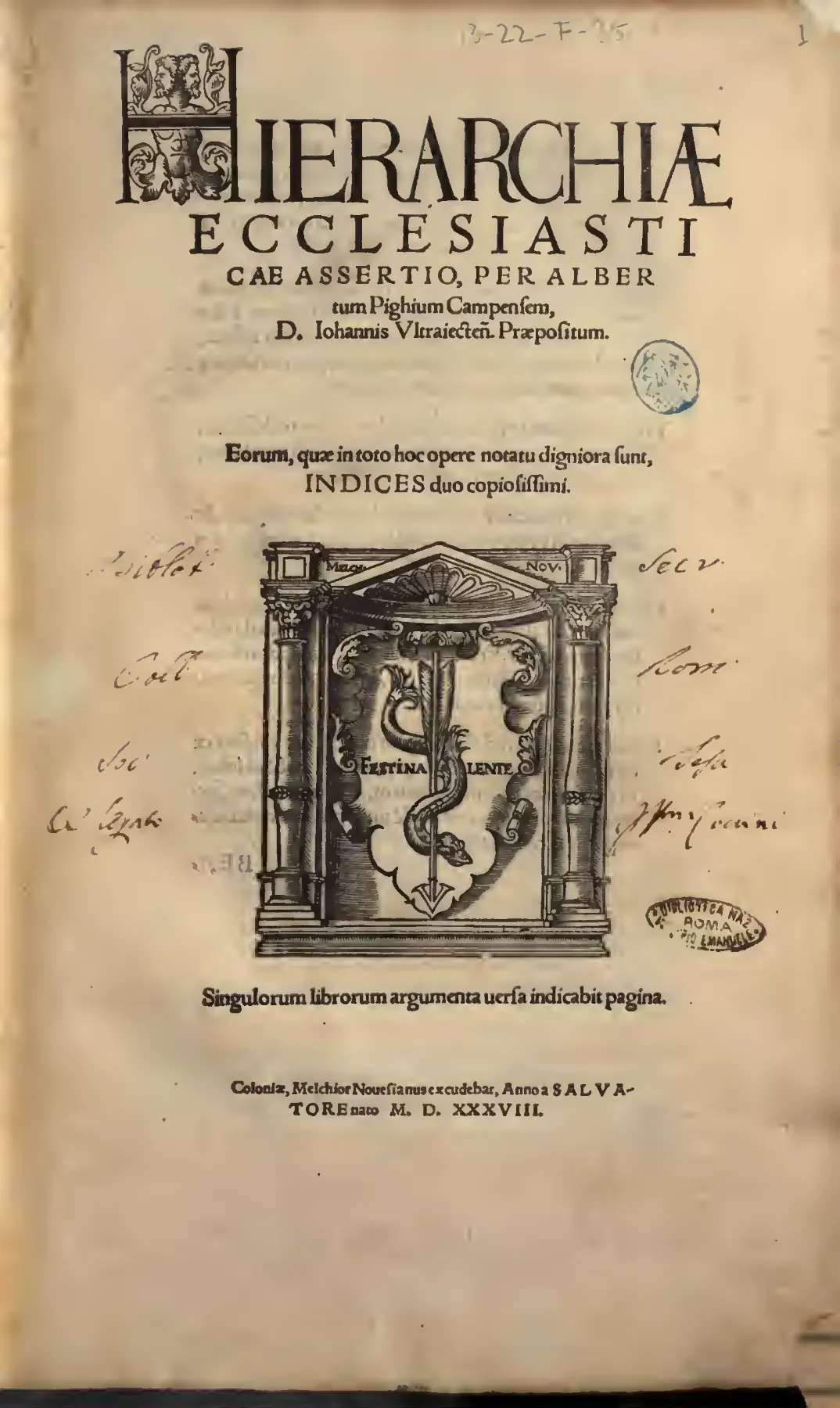
The 1538 Cologne title page announces Pighius’s Hierarchiae ecclesiasticae assertio and its indices duo copiosissimi. Novesianus’s FESTINA LENTE device and the Cologne imprint anchor the edition, while the Biblioteca Nazionale di Roma stamp and later manuscript marks record the copy’s subsequent history. Source ↗.
The book's opening programme matches that address. Having identified the dissolution of public discipline as the root of the evil, Pighius states that it seemed right first to lay the axe to this so fruitful root of all evils, omnium radici, securim in primis admouere uisum est. He frames the hoped-for outcome as the restoration to the ecclesiastical hierarchy of its order, its vigour, and its majesty, quàm vt hierarchiæ ecclesiasticæ suus ordo, suus vigor, sua restituatur. The production of the book and its stated purpose therefore converge on the same object: the restoration of hierarchical order under its papal head.
A contemporary reply is attributed to John Leland under the title Antiphilarchia. Pighius also published Apologia indicti a Paulo III concilii, adversus Lutheranas confederationes (Cologne, 1537), and in 1542 works on free will and on the controversies discussed at Regensburg. Those are related works, not parts of the 1538 edition.
The digitization identified as Google Books Ipj2CdUZhIsC currently gives Pighius as author, Novesianus and 1538 as its imprint, and the National Central Library of Rome as the source library; its metadata also names the Collegio Romano among contributors. That contributor field alone does not establish copy-specific ownership. Its stated length of 27 pages cannot safely be used as the printed treatise's extent. No verified shelfmark, signature collation, complete foliation, privilege, approbation, censorship decision, or binding and provenance description was located for this copy. Likewise, an exact VD16 identifier and a USTC identifier securely matched to the Novesianus printing could not be established. A specialist bibliographic notice associates USTC 662680 with a 1538 Birckmann imprint. The difference in printer attribution must be resolved against copies before that number is assigned to Novesianus's printing.
Later Cologne editions dated 1544, 1558 and 1572 are reported in an older reference work; a catalogue description independently identifies a 1558 Birckmann printing. Their relationship to the 1538 setting, including any authorial revision, requires edition-by-edition comparison. Neither a complete transmission history nor a verified list of shelfmarked copies at other repositories could be established.
Paolo Casati's unrelated Mechanicorum libri octo is a Latin book printed at Lyon in 1684 by Anisson, Jean Posuel and Claude Rigaud. It must not be identified with Pighius's work. A purported catalogue attachment of Casati's title to the Pighius digitization could not be confirmed in its current public record: that record presently identifies the 1538 Assertio correctly. An earlier erroneous attribution, if one existed, cannot be dated or documented from the available record.
Following Pighius's Argument Through the Six Books of the Assertio
The Dedicatory Epistle to Paul III
The dedicatory epistle to Paul III frames the book's address before any doctrine is argued. Pighius salutes the pontiff not with the customary titles of the Roman see but as presiding officer of a sacred order: cæ hierarchiæ præsidi, eius nominis III. Albertus, "to the president of the [ecclesiasti]cal hierarchy, third of that name, Albert." The title praeses is quasi-constitutional. It casts the pope as the head of an ordered body, which is precisely what the six books will try to vindicate.
The ills the epistle laments are concrete, a Church tot hæresibus ac impietatibus foedæ,, befouled by so many heresies and impieties. The diagnosis, however, does not stop at doctrinal error. The cause of the evil, as the epistle states in the sentence that supplies the work's keyword, lies in the dissolved vigour of a public discipline which the hierarchy had maintained for so many centuries. This sentence carries the whole work in compressed form. The crisis of the 1530s is read as a slackening of order, and the cure will therefore be the restoration of that order's strength.

The closing leaf of the dedicatory epistle, where Pighius insists that his appeal to Paul III serves truth rather than princely flattery. Its colophon, dated 1538, dates the edition, and the closing image of Peter’s storm-tossed bark anticipates the defence of papal order to come. Source ↗.
The epistle's method is medical. Pighius invokes ipsa medendi methodus a medicorum principe Galeno doctissime, the very method of healing most learnedly set out by Galen, prince of physicians. Galenic therapeutics holds that diseases must be treated in their proper sequence, root before symptom, and Pighius takes over that order of cure. To this fertile root of all evils, he writes, it seemed right first to lay the axe.
The image fuses the physician's order of treatment with the Baptist's axe at the root of the tree (Matthew 3:10). It also explains why the treatise opens with epistemology rather than with the papacy. The root is identified as the reformers' repudiation of ecclesiastical tradition. Pighius claims that tradition has an efficacy not lesser, indeed far greater and more effective, than Scripture's, nis nihilo minorem, ne dicam multo etiam ampliorem, efficacioremque,.
The relation between the two is then fixed in an artisanal metaphor that recurs through Book I. Tradition is scripturarum amussim, qua illis non adhibita, uelut plumbeam quam, the carpenter's rule of the Scriptures, without whose application they become like a leaden rule. The leaden or "Lesbian" rule of Aristotle's Ethics bends to the shape of whatever it measures. The metaphor therefore makes Scripture's pliancy a defect that only an external, rigid standard can correct. In doing so it anticipates, in craftsman's terms, the later image of Scripture as a wax nose.
The epistle's sketch of the six books names the adversary who will govern the later polemic on regnum and sacerdotium. Pighius has read legimus Marsilium Patauinum, quo nemo omnium acrior & infestior, Marsilius of Padua, than whom no one at all was fiercer or more hostile. He sets the Defensor pacis in its historical frame, written some two centuries earlier on behalf of the Bavarian emperor, annos circiter ducentos, in gratiam Ludouici Bauari,. This genealogy is the polemical core of the dedication.
By tracing Lutheran ecclesiology to a fourteenth-century imperial apologist, Pighius turns the reformers' claim to recover the apostolic Church against them. Their teaching becomes a datable, partisan invention, the kind of novelty that Book I will define as heresy. He adds that counsellors of secular rulers were reading Marsilius, and in the Henrician 1530s that charge pointed unmistakably toward England.
Book I: Scripture, Tradition, and the Consensus of the Church
Book I proper begins from the problem that every sect calls itself the true Church. Pighius illustrates this with Cyprian's jibe that Novatian behaved like an ape, Sic olim, inquit Cyprianus, Nouatianus simiarum more, imitating the Church it had left. He sets beside it the reformers' description of the orthodox body, orthodoxa & catholica Christi ecclesia, papistica,, "the orthodox and catholic Church of Christ, [called] papist." He reports the epithet only in order to turn it back on its users.
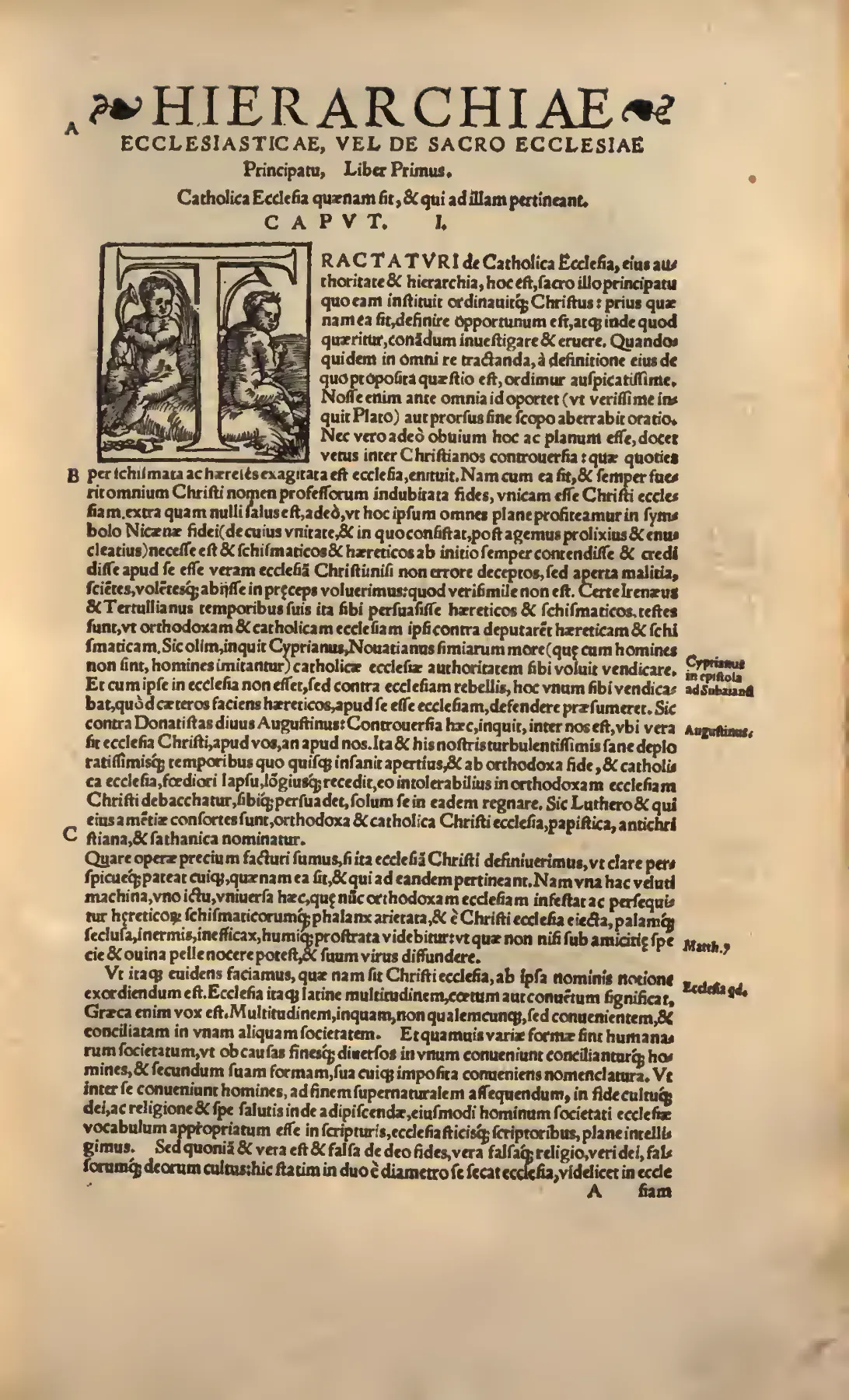
The opening of Book I, beginning “TRACTATVRI” with a large historiated initial, moves at once into controversy: before papal authority can be defended, Pighius must define the true Church against Novatianists, Donatists, Lutherans, and others who claim its name. Source ↗.
Against such counterfeits a definition is needed, and it rests on extension. The Church is Vna, inq[uam], & vniuersalis, nullo certo loco, nulla regione aut, one, I say, and universal, confined to no fixed place, no region or [nation]. Catholicity is thus defined against the sectarian conventicle, the gathering bounded by a town or a teacher.
Pighius then extends the definition through time. He narrates the Church's life through the ages of man: infancy from Adam, boyhood to Abraham, adolescence under the Mosaic paedagogus, and maturity in Christ. His conclusion holds continuity and renewal together: Vetus est ergo Christi Ecclesia, & quodammodo noua à Christo per, the Church of Christ is therefore old, and in a certain manner made new by Christ. The formula quietly prepares the later distinction between growth and alteration. A body can mature without becoming another body.
Chapter II states the formal thesis: the work will now undertake to demonstrate the principles of faith, namely canonical Scripture and ecclesiastical tradition without writing. In the printed sentence fine stands for sine. The pairing looks balanced, but the chapter at once unsettles the balance.
Pighius coins a name for his opponents and flags the coinage himself. He calls them scripturarii, choosing nouo nomine noua hæc portenta appellare), to call these new monsters by a new name. The teratological vocabulary already counts them as unnatural births. He then presses them with the question of the canon: how do they know which books are authentically Moses' or the evangelists'? The answer is that Nunquam sane poterunt, quoquo se verterint,, they will never be able to show it, however they twist and turn, except through the testimony of the Church, sæ, quæ columna est & firmamentum veritatis, ab initio sic testificantis, which is the pillar and firmament of truth and has so testified from the beginning. The Pauline title of 1 Timothy 3:15 thus becomes the warrant for the canon itself.
The historical argument that follows is the most radical stretch of the chapter. Unlike Moses, Christ wrote nothing and commanded nothing to be written; he commanded preaching. The Gospels therefore appear as later aids to memory: Mark as Peter's notary, Luke compiling from reports. Their purpose was Nô quidem, vt scripta illa præessent fidei religioniq[ue] nostræ, sed subessent potius,, not that those writings should preside over our faith and religion, but rather be subordinate to it.
The verbs praeesse and subesse carry the language of jurisdiction into hermeneutics. Scripture is placed within the hierarchy, beneath the faith it records, rather than above it as judge. Pighius illustrates this with an analogy from chancery practice. A notarial transumpt of a papal or imperial diploma has force only through the authority that certifies it. The argument then culminates in its Augustinian epitome: we give credence scripturis nostris, propter ecclesiam, non contrà co[n]fesæ propter, to our Scriptures because of the Church, not conversely to the Church because of Scripture. Here the order of dependence is fully reversed.
Chapter III extends tradition's reach beyond the text, using the patristic witness to practices with no scriptural warrant. Tertullian's De corona supplies the principle that auctrix est co[n]suetudo, & idonea testis est traditionis veteris, custom is the author, and a fit witness, of ancient tradition. The doubled role is significant. Custom both originates and attests, so that liturgical observance becomes self-authenticating evidence of apostolic teaching. Pighius closes the chapter with the formula of Hormisda the Roman pontiff, Hermisda Romano pontifice, a Roman confession imposed after the Acacian schism. The choice is telling: even the argument for unwritten custom ends in a papal text.
Chapter IV draws the consequence for heresy. Because Scripture is obscure, heretics share the text without sharing its sense. They are heretics, in the sentence already cited, not because they disbelieve the Scriptures but because they disbelieve the Church and understand the Scriptures in their own sense, not the Church's. Heresy is redefined as a refusal of hermeneutic authority rather than a denial of revelation, and from this a procedural rule follows.
The heretic is therefore to be rebuked, not convinced by disputation. The rule carries Pauline warrant (Titus 3), and it also passes judgement on the colloquies of the preceding decades, which Pighius blames for fanning the conflagration around Luther. Its juridical basis is Tertullian's praescriptio. In that plea the Church speaks as lawful possessor: olim possideo, habeo o origines firmas. Ego sum apostolorum hæres, I have possessed of old, I hold firm origins; I am heir of the apostles. Scripture becomes inherited property, and the heretic, lacking title, has no standing to plead from it.
Chapter V turns from refutation to detection and, without naming him, takes over extended stretches of Vincent of Lérins's Commonitorium. The true believer is defined at its outset: ille demum verus est & germane catholicus, qui veritatem Dei,, he alone is truly and genuinely catholic who [loves] the truth of God. The corollary defines catholicity negatively, so that what is nouum, quod particulare, id catholicum non esse,, new and particular, is not catholic. The reasoning is axiomatic: Nam si vitanda est nouitas, tenenda est vetustas, for if novelty is to be avoided, antiquity is to be held.
The contemporary edge of this antiquarianism is sharp. In the same stretch Pighius attacks princes driven quid impuls in prodigiosam & crassissima[m] hæresim qua seipsos faciit, into a monstrous and grossest heresy by which they make themselves [heads of the Church]. The allusion to Henry VIII's supremacy is unmistakable. A national headship, being particular and new, fails the Vincentian test by definition.
Yet the Vincentian framework obliges Pighius to account for doctrinal change, and here the tension in the argument becomes visible. The faith may advance, but only in such a way that it is truly a growth of the faith and not an alteration. The teacher's charge is captured in Vincent's chiasmus, doce, vt cum dicas uoue, non dicas noua, teach so that when you speak in a new way you do not say new things; the printed uoue stands for noue. The distinction rescues the earlier image of the Church as old yet renewed. It also leaves open who is to judge whether a given formulation is growth or alteration, and the later books will assign that judgement to the apostolic see.
The chapter's exemplum gives the answer in homely form. Asked what he believed, the collier nihil responderet aliud, quàm hoc se credere, quod ecclesia crederet, answered nothing else than that he believed what the Church believed. The tale's force lies in reversing learned expectation. The theologian on his deathbed is said to take refuge in the same implicit faith, so that the unlettered man's deference becomes the final security of the learned.
The case of rebaptism then shows that same deference working institutionally. Against Agrippinus and Cyprian's African council, Pope Stephen ruled Nihil, inquit, nouandum est,, nothing, he said, is to be innovated. A council errs and the Roman see corrects it, which previews in miniature the subordination of councils that the later books will argue at length.
Chapter VI restates the method in its simplest terms. Whoever believes of each matter what the Church believes, ita ille in omnibus orthodoxam, rectamque fidem tenet, qui hoc, so holds an orthodox and right faith in all things. On this account even someone who errs in particulars cannot err damnably while remaining within the ark. The criterion of truth has moved by stages from the written text to the believing community, and that community is now poised to be identified with the visible order under its praeses.
The criterion of catholicity that Pighius then develops is historical before it is doctrinal. The Catholic Church is the universal body propagated from Christ through the apostles in an unbroken episcopal succession. Heresy therefore reveals itself by being datable: whatever has bubbled up anywhere with a definite author, at a definite time, in a definite place of novelty is evidently not catholic. The fourfold anaphora of certo comes from Vincent of Lérins, whose Commonitorium the surrounding narrative of the Arian contagion closely paraphrases without acknowledgement. The verb ebullire treats heresy as something that boils over or wells up, a local eruption rather than a continuous current. The criterion is also argumentatively aggressive. The reformers' own sense that they were recovering a lost gospel, at an identifiable moment and under identifiable names, becomes the proof of their guilt. To have a founder is already to be convicted.
The remedy is phrased as a return, a recall of the world to the ancient faith from novel perfidy, to ancient sanity from the madness of novelty, to ancient light from the blindness of novelty, ad antiquam fidem, à nouella perfidia, ad antiquam sanitatem à nouitatis vesania, ad antiquam lucem à nouitatis cecitate. The triple antithesis joins three registers that the treatise elsewhere keeps apart: the fiduciary (fides/perfidia), the medical (sanitas/vesania), and the illuminative (lux/cecitas). In each pair novelty is a privation, a falling away from a prior wholeness, so that orthodoxy needs no positive content beyond continuity. The Pauline injunction behind the whole passage, given in Vincent's mediation as a warning to Timothy to guard the deposit and avoid profane novelties of words, O Timothee, depositu[m] custodi, deuitans prophanas vocum nouitates, defines the bishop's role. He is to be not the author but the guardian of that deposit, Cuius tu non author, sed custos esse. The opposition of author and custos restates the heresiological criterion as a theory of office. Heresy has an author, and episcopacy by definition must not.
An interlocutor then raises a practical question: how can the common sentence of so widely diffused a Church be known? Here Pighius makes a concession that shapes the method of the rest of the book. He recalls the Irenaean shortcut, which is to hold and believe, on each point, that the Catholic Church of Christ holds what the Roman church holds and believes, hoc de singulis tenere & credere catholicam Christi ecclesiâ, quod tenet & credit Romana ecclesia. He then sets it aside, because Roman authority is the very point in dispute. The move is tactically disciplined. A defence of the hierarchy that assumed papal authority at the outset would beg the question against the reformers and the English supremacists alike. Pighius instead undertakes to establish catholicity without the papacy, so that the papacy can afterwards be shown to crown an order already proved on independent grounds. The renunciation is provisional, but it governs everything that follows in this portion of the work.
The substitute method rests on a distinction between two kinds of disputed matter. The first concerns matters on which even the common run of the faithful have some explicit and distinct faith, quibus etiam vulgus Christifidelium explicitam, distinctamque fidem aliquam habet. Such questions are settled by surveying the Church across places and times. The second concerns higher mysteries, which are decided by the doctors, the learned whom Christ designates by the name of eagles, quos Christus aquilaram appellatione designat. The exegesis rests on Matthew 24:28, where the eagles gather about the body. Pighius turns an eschatological image into a theory of learned convergence on the corpus of the Church. The formula that results is of the highest consequence for the book's argument: this agreement, in the principle already quoted, is the sense and consensus of the whole body, and there Christ and the truth are found. The first kind of question is the more striking of the two. The vulgus, so often the object of humanist disdain, becomes a source of evidence: lay practice and lay belief directly attest catholic doctrine. The long demonstrations of Book I follow from this. The catalogue of contested matters that Pighius now works through comprises infant baptism, the real presence, suffrages for the dead, saints and images, ceremonies, chant, feasts, and vows. It is a catalogue of observances that ordinary Christians perform and therefore know.
The treatment of infant baptism shows the method at work and the polemic it serves. Pighius begins with a genealogy. From Luther's principle of private scriptural judgement, as from a Trojan horse, the fury of the Anabaptists burst forth, illo veluti Troiano equo prosint ista Anabaptistarum furia. The Virgilian image casts Luther as the deceptive gift admitted within the walls and the radicals as the armed men concealed inside it. The recent events at Münster lend the figure its menace. Against this sect he sets a map. Consensus on paedobaptism is shown to extend across England, Scotland, Ireland, Gothia, Swabia, and Norway, Angliam, Scotiam, Hyberniam, Gothiam, Svueuiam, Noortvngiam, ex. The survey then reaches the Greeks and Muscovites, who are schismatics but agree on this point, and passes to Syrians, Armenians, and the Ethiopian "Indians." The inclusion of schismatics is revealing. For this kind of question, catholicity is measured by the extent of a practice in space and time, not by communion with Rome. The Roman shortcut has been laid aside in earnest.
The section also shows where consensus turns into coercion. Through Bernard's sermons on the Song of Songs, Pighius denies the reformers the witness of their dead: the constancy of martyrs and the obstinacy of heretics have nothing in common, Nihil ergo simile habent constantia martyrum, & pertinacia hæreticorum. He then quotes Bernard's judgement with approval: it would no doubt be better that the heretic be restrained by the sword, Melius tamen foret procul dubio quòd coerceretur gladio. Book I has already held that the heretic is to be rebuked rather than disputed with. Here that position acquires its magisterial corollary, set out in monastic and Pauline terms, and the epistemology of consensus is made to carry the power of the magistrate.
The Eucharist receives by far the longest treatment, and Pighius himself admits that this exemplary digression grew beyond its bounds. His thesis is that no heresy touched the sacrament before Berengar. He traces a single line of descent from Berengar through Wyclif and Hus to Luther and the Sacramentarians, and then supports the antiquity of the real presence with a dense chain of Greek and Latin Fathers. The decisive problem is terminological. Luther had alleged that the doctrine was recent, an invention of the scholastics, affirmare, recens hoc esse scholastici. Pighius answers by separating word from sentence. What later writers, not without significance, called "being transubstantiated" is, in his formula already quoted, a new word indeed but the ancient sentence of the Catholic faith. The distinction is necessary because the criterion of datability, applied without qualification, would condemn the Church's own vocabulary. Nouitas is therefore narrowed to sententia and relaxed for vocabulum. The prophanae vocum nouitates of the Pauline warning become profane only when the new word carries a new belief.
The same section shows a critical independence unexpected in a polemic built on authority. Pighius corrects his own chief medieval witness. Lanfranc had read the letter and anathematisms of Ephesus as condemnations of eucharistic sects, and Pighius replies that, saving the reverence due to so great a man, Lanfranc rather imagined those heresies from those words, Sed salua tanti viri reuerentia, ipse potius ex illis verbis imaginatus est. He shows that the conciliar texts were aimed at Nestorius's Christology, and he notes that later heresiologists inherited Lanfranc's mistake. The deference formula salua reuerentia allows correction without rebellion. Yet the episode concedes that a recognised doctor could misread the councils and pass the error on, which is exactly the kind of fallibility the treatise elsewhere ascribes to councils themselves. The appeal to the eagles evidently does not exclude philological correction of an individual eagle.
When Pighius turns to ceremonies, which Luther had called the masks and faces of Antichrist, he gives his most programmatic statement against Scripture as sole rule. His opponents should know, he insists, that the Christian religion is older than those scriptures, and that the Church is older, and its faith, tradition, and observance older too. The repeated antiquiorem applies the test of antiquity to the written canon itself. If priority confers authority, then the Church, which existed before any apostolic writing, authorises the text and not the reverse. The demonstrative illae keeps the scriptures at a slight rhetorical distance. They are one product of the Church's life, not its foundation.
Book II: Visible Order, Priesthood, and Sacrifice
Book II moves from the location of truth to the form of the body that holds it. Pighius first rejects the Hussite and Lutheran account, which he states precisely in order to refute it: that the body of the Church is bound, as by a kind of bond, by the grace of predestination, sed gratia prædestinationis, velut vinculo quodam colligari dicit. An invisible bond would produce an invisible Church, which could not perform the public work of judging that the preceding demonstrations require. Using the parables of the dragnet and the wedding feast and the apostolate of Judas, Pighius insists on a visible bond that includes sinners, and he defers the Church's spotlessness to the end of time. The positive thesis then appears in the chapter heading, already met as the formula that makes ordo the condition of unitas: the unity of Christ's Catholic Church necessarily consists in its order.

At the hinge between the books, “LIBRI PRIMI FINIS” gives way to “HIERARCHIAE ECCLESIASTICAE LIBER SECUNDVS” and a large historiated initial. The chapter heading’s rejection of an inward bond of charity or grace marks Pighius’s turn from the criteria of faith to the visible order that constitutes unity. Source ↗.
The proof treats ordo as a law of nature written at every level of creation. In the heavens the sun proceeds in the middle like an emperor, prescribing to all the rest, imperator, sol medius incedat, reliquis omnibus, directing the motions, stations, and retrogradations of the planets as a general directs his troops. This is a Ptolemaic cosmos read as a monarchy, and the primum mobile above it confirms the rule. The argument descends through the angelic choirs and the government of the body by the soul to the hive, where the reader will find a perfect simulacrum of human polity, absolutum plane quoddam humanæ politiæ umulacrum inuenies. The Virgilian bee-commonwealth is presented as a lesson taught by nature itself, which Pighius sets above the political books of Socrates, Plato, or Aristotle. The analogy works by an argument from the lesser to the greater. If a natural multitude cannot cohere without a single presiding authority, a supernatural society modelled on the celestial hierarchy needs one all the more. The Dionysian sense of hierarchia as sacred ordering and its juridical sense as a structure of command are joined here into a single cosmology.
The visible order then has to be shown to be sacred and set apart. Pighius reports Luther's teaching that all are equally priests, men, women, and children, without any distinction of status or sex, omnes æque sacerdotes esse, viros, mulieres, pueros, nulla status, sexus,. He answers with a collective reading of 1 Peter 2:9: the state of our Church is called not a kingdom but a royal priesthood, At nostræ ecclesiæ status, non regnum, sed sacerdotium regale. The predicate belongs to the body as a whole, not to each member taken singly. The emphasis on non regnum also bears on the dispute over royal headship. Christian unity, he concludes, hangs on priestly rather than royal unity, which is why kings kiss the feet of priests. The typology of shadow and body supports this conclusion, with the punishments of Uzziah, Uzzah, and Korah serving as warnings from the Old Law against lay usurpation.
The defence of the grades of order ends with an attack within the Catholic camp. Against those who reduce the diaconate to service at table, Pighius protests that it is not so, as Cardinal Cajetan, no less incautiously and impiously, following Luther, affirms, Nec est, vt æque incircûspecte ac impie post Lutheræ affirmat Cardinalis Caetanus. By the logic established earlier in the book, the most eminent Dominican exegete of the age falls under suspicion as soon as his reading coincides with a datable heresy. In Pighius's hands the criterion of antiquity and consensus serves as a rule for policing every interpreter, cardinals included, and not only as a weapon against the reformers.
From the grades of order Pighius passes to the sacrifice they exist to offer. The exposition of sacrifice rests on a typological rule that he states as a law of proportion. The Levitical tabernacle is vmbra & figura, and the Church is its veritas. A shadow may display the outline of its body, but it cannot surpass that body in distinctness: T Ametsi in vmbra sit videre effigiem sui solidi corporis, nulla tamen vmbra, "although in a shadow one may see the likeness of its solid body, yet no shadow." This is more than devotional allegory. The rule obliges the Christian dispensation to contain distinctions at least as sharp as those of Aaron's house: grades of order, a sacrificing priesthood, and a mediating ministry. The Old Law becomes a minimum that the New must exceed, never a pattern it may discard.
From this follows the argument of Chapter V. Pighius opens it with the Epistle to the Hebrews, Translato autem sacerdotio, necesse est vt & legis translatio fiat, "for the priesthood being transferred, it is necessary that a transfer of the law also take place." Reformed exegetes read the verse as abolishing priestly sacrifice. Pighius turns it the other way. A translatio is a handing-over, not an extinction, and a transferred priesthood must have a sacrifice proper to the order of Melchizedek. Malachi supplies the content: Ab ortu enim solis vscq[ue] ad occasum magnum est nomen meum ingentibus, &, "for from the rising of the sun to its setting my name is great among the nations, and." The universality of the prophecy, offered in omni loco, becomes the mark that separates the Catholic altar from the single Temple of Jerusalem and also from the merely interior offering of contrite hearts.
Luther's objections are stated fairly fully before they are answered. Before replying, however, Pighius makes a methodological concession that colours everything after it. He invokes Origen's counsel that debemus, nec exire à paterna ecclesiasticaq[ue] traditione, nec aliter credere,, that "we must neither depart from paternal and ecclesiastical tradition nor believe otherwise." The polemicist thereby secures his conclusion in advance against the weakness of his own arguments. If his refutation fails, the reader is still bound to the tradition. This posture reveals the structure of the whole work. Disputation serves only to display a certainty whose ground lies elsewhere, in the received practice of the Church. In this sense the book's controversial apparatus is subordinate to its ecclesiology.
The reply to the objection from "once for all" turns on a grammatical distinction between active and reflexive offering: Sed nos ipsum quotidie offerimus in ecclesia. Non negat Apostolus ipsum sæpius offerri, sed negat sæpe offerre seipsum, "but we offer him daily in the Church; the Apostle does not deny that he is offered often, but denies that he often offers himself." The uniqueness of Calvary is kept, while the Church's repeated offering of the same victim is made possible. The distinction resembles formulations later debated at Trent, but here it belongs to Pighius's personal argument against Luther. The efficacy of the repeated offering is also detached from the merit of the minister. Pighius cites Chrysostom: Nihil habet ista præ illa minus. Cur ita? quia non sanctificant hanc homines, sed Christus qui ante sacrificauerat, "this one has nothing less than that one. Why so? Because men do not sanctify it, but Christ, who sacrificed before." The principle that office, not personal sanctity, makes the act valid recurs in the treatment of priestly prayer and absolution. It is a local form of the distinction between office and holder on which the work's papalism also depends.
At this point Pighius states the hermeneutic thesis that governs the treatise. Luther errs because he looks for his own sense rather than the Apostle's, and the remedy is a communal rule of meaning, the principle already cited that the truly genuine sense of the scriptures is the common sense of the Catholic Church throughout the world. The adjective germanus, "legitimate," "of true birth," treats meaning as a matter of lineage. A reading is authentic when it descends within the family of the Church, not when it can be extracted from the words alone. The same passage carries a striking physiological figure: Idem ad rationem accidit in corpore Christi mystico, "the same happens, by reason, in the mystical body of Christ." Grace descends from the head through the nerves of the body. Mortal sin blocks it as a ligature or an obstructing humour blocks the animal spirit. The analogy draws on the Galenic physiology of his day, and it does real argumentative work. It explains how a sacrifice can benefit some members and not others without making the benefit depend on the recipient alone. It also makes the head-and-members relation the natural model for the Church's order.
Two further replies complete the chapter. Luther's category of testamentum is first set in opposition to sacrifice, At diuersa sunt toto genere testam[en]tum & sacrificium, "but testamentum and sacrifice are wholly different in kind." Pighius then redefines it through the parallel of old and new covenants: quædam est testatoris. Vnde prior, vetus testamentum dictum est, & lex noua,, "is a certain thing of the testator; whence the former was called the old testamentum, and the new law." By assimilating testamentum to law, he removes the private, promissory sense on which Luther's argument depended. The final objection receives open scorn: quàm quæso ridiculum teipsum facis, & malignitate stupidum? Adeò non inteligis de ratione sacrificij esse, vt offerri possit pro alio? Omnis, "how ridiculous, I ask, do you make yourself, and stupid with malice? Do you so fail to understand that it belongs to the nature of sacrifice that it can be offered for another? Every." Defined as essentially vicarious, sacrifice supports Masses for the living and the dead. The abuse shows how polemical register and scholastic definition sit together in the same sentence.
Chapter VI moves from the altar to intercession, and through Judas Maccabaeus into the question of the canon. Pighius follows Augustine in grounding canonicity in reception: affirmat Machabæoæ libros, inquit, non Iudæi, sed ecclesia Christi pro canonicis habet, "he affirms that the books of the Maccabees are held as canonical not by the Jews but by the Church of Christ." The principle at once becomes a weapon against Erasmus's doubts about James, 2 Peter, and Hebrews. Against a humanist critic who claimed to judge the scriptural text himself, Pighius sets out three ways in which the Church's judgment may be known: universal consent, a lawful general council, and the definition of the Church's prelate pronounced from the chair of Peter, beside which he asks by what other means the matter could be settled. The rhetorical question is significant. Pighius presents the papal definition as the only practicable instrument where consensus cannot be gathered and councils cannot be convened. In this discussion of the canon the Roman see already stands as a working principle of faith, before Book III argues its foundations.
The treatment of confession in Chapters VII and VIII combines Levitical allegory, Dioscoridean pharmacy, and patristic proof. A papal witness serves as the decisive authority. Leo writes vt indulgentia Dei nisi supplicatione sacerdotum nequeat obtineri, "so that God's indulgence cannot be obtained except by the supplication of priests." Pighius frames the letter as Christ speaking from Peter's boat and chair, so that the sacramental argument also rehearses the Petrine one. He is not rigid about the form of confession, however. He concedes that the custom Sed vt secreto atq[ue] vni in aurem confiteri, "but that one should confess secretly and to one person into the ear," is a concession to shame and not of the essence of the sacrament. Shame itself becomes penitential through Chrysostom: bescit, non timet, perfectus enim timor soluit omnem pudorem. Illic enim, "is ashamed, does not fear, for perfect fear dissolves all shame. For there." The burden that critics alleged is recast as part of the remedy.
The polemic against Erasmus is sharpest here. Pighius judges the Colloquia more dangerous to schoolboys than Luther's open blasphemies and wishes that they might be expelled pontificio, sed etiam imperiall edicto & anathema exularent perpetuo à, "by pontifical but also imperial edict and anathema, would be banished forever from." The call for joint papal and imperial action shows that Pighius did not separate the two powers in disciplinary practice. Both are to serve the restoration of public discipline. With the historians' evidence on Nectarius, Pighius uses a typical tactic of reversal. Sozomen's report that esse præcepit. Ex illo tempore antiquitatis consuetudo sublata est. Cum, vt, "ordered it to be. From that time the custom of antiquity was abolished. Since, as," becomes an admission that the penitential practice was ancient. Its abolition is then treated as a local measure of the church of Constantinople, later reversed. The criterion of antiquity is turned back on the opponents: what was abolished was older than the abolition.
The episcopal chapters apply the same logic of order to the bishop and the presbyter. Against Luther's grounding of ministry in the people's right, Pighius limits the laity to assent and testimony: cui non licuit habere quem voluit. Itaq[ue] non plebis, sed cleri erat eligere,, "who was not permitted to have whom he wished. Therefore it belonged not to the people but to the clergy to elect." The more serious threat comes from Jerome, the opponents' chief patristic witness, who compares the elevation of a bishop to the acclamation of an emperor: quomodo si exercitus sibi imperatorem faciat. Quid enim facit, excepta, "as if an army were to make an emperor for itself. For what does he do, excepting." Pighius answers philologically. Presbyter is a generic term, ter enim Græca vox est, Latine seniorem significans, hoc est, honoratiorum, "for -ter is a Greek word, signifying in Latin an elder, that is, one of the more honoured." The later specialisation of the terms is a matter of usage, not of the thing itself. Jerome's own exception, ordination, is then turned into evidence of a divinely grounded difference. Humanist lexical method is put to use for a hierarchical conclusion, and the Pauline vocabulary on which the reformers relied is shown to be too loose to bear their argument. Erasmus's tools are being turned against Erasmus's party.
Book III: Peter, the Keys, and the Living Interpreter
Book III gives this order its summit. Leo's letter to Anastasius describes metropolitans and primates solicitudinem susciperent ampliorem, per quos ad vnam Petri sedem vniuersalis ecclesiæ cura conflueret, "should take up a wider solicitude, through whom the care of the universal Church should flow together to the one see of Peter." The verb confluere picks up the earlier physiological figure. Care rises to the head as grace descends from it, so that hierarchy is a circulation within one body. The Pseudo-Isidorian Anacletus, accepted as genuine, then places the origin of the primacy beyond the apostolic college: Hæc vero sancta Romana & apostolica ecclesia, non ab ipsis apostolis, sed ab ipso domino saluatore nostro primatum obtinuit, "this holy Roman and apostolic Church obtained the primacy not from the apostles themselves but from the Lord our Saviour himself." Reliance on the False Decretals coexists in this treatise with philological criticism elsewhere.
When the exegesis of petra begins, the hermeneutic thesis of Chapter V returns in proverbial form. Scripture left to private readers is a wax nose, cereus, qui se horsum, illorum, & in quam volueris partem, trahi, retrahi,, "waxen, which lets itself be drawn this way and that, and in whatever direction you wish, drawn and drawn back." Against this pliability Pighius sets the Church's common sense as earundem intelligentiæ Lydius lapis est,, "is the Lydian touchstone of their understanding." The two images of the material and the measure, malleable wax and the assayer's unyielding stone, sum up the argument of this part of the book. Every sacramental and ministerial question is settled by moving the criterion from the text to a living, ordered community and, in the end, to the see in which that community's judgment is concentrated.
Pighius opens his treatment of the Petrine confession by refusing to let Peter dissolve into a spokesman for the apostolic college. The gospels, he notes, record apostles who were questioned and stayed silent, so the reader should not suppose Peter was always the mouth and instrument of all, Ne ita os & organum omnium existimes fuisse Petrum. The more delicate problem is allegory. Augustine had read Peter at Matthew 16 as bearing the figure of the Church, and that reading lay ready to hand for anyone wishing to dissolve personal primacy into a collective possession. Pighius does not contest the typology head-on. Of those who would have Peter here bear the figure of the Church he says, Qui vero Petrum hic figurâ gestasse volunt ecclesiæ, no[n] multum eis pugnabo, that is, he will not fight them much. He immediately sets a limit: Non tamen propterea illi negabimus suam veritatem historicam, we shall not on that account deny the passage its historical truth.
The types he lines up from the Old Law support this limit: Abel, the rock struck by Moses, Isaac, Jacob, Joseph, and Samson. Each was a real person or event before it was a sign. The relation of umbra to veritas that structures patristic exegesis is therefore made to protect the letter rather than to dissolve it.

Perugino’s Sistine Chapel fresco of Christ giving the keys to Peter (1481–82) depicts the kind of Gospel event that, for Pighius, was real before it was a sign: a concrete scene on which he grounds the keys’ passage to Peter’s successors. Source ↗.
.jpg)
The concession then becomes a weapon, and the keys are its edge. If the keys belong to the Church, they belong to it through Peter. Pighius accordingly argues that the gift looked not to Peter's person alone, respexisse vnam personam Petri, sed permanisse ac permanere in ecclesia, etiam post Petrum, & trânsisse ad eius successores, but remained, and remains, in the Church after Peter and passed to his successors. Augustine's figural reading thus becomes the hinge of succession. The same page names what is transmitted in pointedly constitutional terms: monarchicum ecclesiæ primatum, illas claues regni coelorum, illam magnificam potestatem alligandi & soluendi, the monarchical primacy of the Church, the keys of the kingdom of heaven, the magnificent power of binding and loosing. The adjective monarchicum sets the vocabulary of polity directly beside the dominical metaphor of the keys. This is the double register of hierarchia, sacred order and juridical structure, operating within a single phrase.
The charge Pighius must then meet is ecclesiological. If both Christ and Peter are rock and head, the Church appears grotesque. He states the objection in his opponents' own terms: we do not thereby make two foundations of the Church, two heads, a monstrous Church as they would have it, Nec tamen propterea bina ecclesiæ funda mēta facimus, bina capita, monstrosamq[ue] (vt illi volunt) ecclesiam.
His solution rests on what a human society needs rather than on a lexical distinction. Christ is foundation by his own power. After the Ascension, however, a Church gathered from all nations necessarily required, in the sentence already quoted, a head of its own kind, remaining with it on earth, to govern it. The word congeneum carries the argument. A body of mortal members needs a mortal head. Christ, the eternal priest, ascends like Moses on Sinai and leaves below him an Aaron, vicarium mortalem Petrum, qui inter mortales nos, suum Deiq[ue] ageret, Peter as mortal vicar who would act for him and for God among us mortals. The Moses–Aaron pairing does double duty. It supplies a scriptural model of graded priestly authority, and it implies that the synagogue was never "two-headed" either.
Chapter V turns from exegesis to the method that governs it, and here the book states its exegetical charter. Scripture admits several senses. Where the literal sense intended by the Spirit is doubtful, ea esse indubie putanda est, quam communis tenet ecclesiæ sententia, & in quam orthodoxi, sanctique patres magis conuenisse deprehenduntur: that sense is to be held beyond doubt which the common judgement of the Church holds and on which the orthodox and holy fathers are found most to agree. Consensus thus does more than supplement the text. It fixes its meaning, and dissent must bear the burden of proof.
The principle has an awkward consequence. Augustine, the Fathers' most protean exegete, does not always agree with the others, and the reformers prized him. Pighius therefore characterises him with unusual candour: In Augustino maior fuit varietas, quæ huic in scripturarum expositione pene familiaris est. Nusquam hæret, nusquam figit pedem, sed vbiq[ue] explorat,. There was greater variety in Augustine, almost habitual in his exposition of Scripture; he clings nowhere, plants his foot nowhere, but explores everywhere. The portrait detaches Augustine's authority from his hypotheses without accusing him of error. A distinction of genre completes the move: Sed aliud est, aliquid attruere & docere tanquam certu[m] & indubium: aliud vero, velut inuestigando tanquam probabile referre. It is one thing to assert and teach something as certain and beyond doubt, another to report it as probable in the course of inquiry. Augustine the preacher teaches the common view of Peter as the rock. Augustine the inquirer tries out Christ or Peter's faith as the rock, and his Retractationes show him doing so.
The rescue is completed by the humanists' own instrument. Christ did not speak Greek to Peter, nor did Matthew write in Greek, Non enim Græce illi loquebatur CHRISTVS, neque etiam Græce scriptu Matthæus. Pighius dismisses doubters of Matthew's Hebrew original as those qui nouitatu[m] titillatur prurigine, tickled by an itch for novelties. The Aramaic Cephas admits no gap between Petrus and petra. He calls Erasmus, the philologist of the age, as witness for John 1:42: Quem locum ita nobis reddidit Erasmus: Tu vocaberis Cephas, quod sonat (si interpreteris) lapis, a passage Erasmus rendered "You shall be called Cephas, which, if you translate it, means stone." Augustine's hesitation is thereby traced to a translator's choice. A doctrinal difficulty is resolved as a problem of transmission.
The long refutation of the opponents' four rationes for apostolic equality shows Pighius reading the primitive college through the institutions of his own Church. He may grant, hypothetically, that every apostle held universal authority, but only & oecumenica, eaque plenaria: tamen sub Romano p[ræ]tifice, & dependenter ab, ecumenical and plenary, yet under the Roman pontiff and dependent on him. The model is the papal legate. Such legates essent quidem hi, quandiu duraret illa eorum legatio, æquales Rom. pontifici, quantum ad præsentem administrationem attinet: nequaquam tamen in ipsa fontali authoritatis plenitudine: for the duration of their legation they would equal the Roman pontiff as regards present administration, but by no means in the source-fullness of authority itself. The scholastic distinction between delegated exercise and fontal possession lets apostolic plenitude stand while keeping a single source. The governing image for this ordering appears on the same page. Christ nec voluit Babylonem quandam ædificare, sed coelestem illam Hierusalem in terris effingere: he did not wish to build some Babylon but to fashion on earth an image of the heavenly Jerusalem. Babylon stands for confusion of tongues and orders, and this is the Pseudo-Dionysian logic beneath the institutional argument. A Church without graded order would be the opposite of the city it copies.
The keys, Pighius insists, were not merely promised to Peter but actually given to him alone: Quas claues, sicut vni singulariter promisit Petro, ita vni singulariter dedit, as he promised them singly to Peter alone, so he gave them singly to him alone. To assign Matthew 18 to the Church as a congregation rather than to individual apostles, however, he makes a striking admission about current practice. Denunciation is now made & loco ecclesiæ nunc solius seorsum episcopis, aut etiam Archidiaconibus, aut substitutis ab eis Officialibus sit densitiatio ista, haud scio an satis Euangelica: in place of the church, to bishops alone apart, or even to archdeacons, or to Officials substituted by them, a practice he doubts is evangelical enough. A defender of hierarchy concedes that its lower jurisdictional layers have displaced the primitive assembly. This is the voice of pre-Tridentine reform within papalist argument, and it shows that his loyalty attaches to the head and its order, not to every ministry of the episcopal courts.
The narrative of Acts is handled with the same mixture of source criticism and classical analogy. Luke wrote the history of Paul, his inseparable companion, rather than of the apostles: clarissime intelliget no[n] apostolicor[um] actorum, quàm vnius Pauli, cuius erat comes indiuiduus, texere studuisse historiam. On this account Luke's silence about Peter proves nothing. That Peter was "sent" to Samaria implies no subordination either. The apostles sent him veluti si decerneret Senatus, fore ex republica, vt non Prætor, non Legatus, non Proconsul, sed ipse per se Consul, Senatus,, as if the Senate decreed it in the public interest that neither praetor nor legate nor proconsul but the Consul himself should go.
The Jerusalem council produces the most revealing tension in this part of the argument. To explain how James's sentence could carry without his outranking Peter, Pighius reasons: Plus enim vident multi, quàm vnicus: alioqui, si authoritate tantum maiore definienda erant proposita, quid opus erat concilio?. Many see more than one; otherwise, if questions were to be settled by greater authority alone, what need was there of a council? The monarchical argument here makes room for genuine deliberation, a concession not easily squared with the unqualified headship asserted elsewhere.
The question of the Roman see is settled by detaching authority from topography. Against the claim of Jerusalem, the place of redemption, Pighius gives the aphorism already cited, that authority came to the place with Peter, wherever he finally resided, not to Peter from the place. Rome is the see in qua velut hæreditario quodam iure successione perpetua continueretur, in which that authority would be continued in perpetual succession as by a kind of hereditary right. The juridical metaphor of inheritance turns the figure of the tabernacle at Shiloh into a law of succession.
The denial that Peter ever reached Rome draws the fiercest invective of Book III. It is aimed at the cry Verbum domini, verbum dominieuangeliu[m], euangelium,, "the word of the Lord, the word of the Lord, the gospel, the gospel," and at its fruits, detractiones, seditiones, blasphemiæ, rapinæ,, slanders, seditions, blasphemies, plunderings. Paul's anathema in Galatians is turned against the slogan: Nec de scripturis quicquâ loquitur apostolus, sed de ecclesiastica traditione,, the Apostle says nothing of the Scriptures but speaks of ecclesiastical tradition. The proof-text of evangelical scripturalism becomes a warrant for unwritten tradition.
The catena of witnesses that follows is reinforced by an argument from motive. In the early centuries the Roman pontificate potificatus nihil erat nisi labor immensus, & certu[m] martyrum?, was nothing but immense labour and certain martyrdom, so no flatterer had a curia to please. Against the chronological objection Pighius sets a reductio: Ita & inter scriptores vniuersos non conuenit de tempore, quo aut natus aut crucifixus est Salvator nostrar, so too writers do not agree on the time when our Saviour was born or crucified. Discord over dates, which he partly attributes to careless copyists, cannot unsettle a fact attested by consensus.
Book IV: The Apostolic See as the Third Principle of Faith
The opening of Book IV generalises the premise underlying the whole Petrine argument into a theory of society. Every society needs order and a head. Against those who teach that breaking human precepts is no sin, quasi no[n] debeat obedie[n]tiam homo homini, sed soli Deo, as though man owed obedience not to man but to God alone, Pighius argues a fortiori from the natural order of commonwealths to the Church. The teleological principle Suam autem cuiq[ue] formam ac speciem societati præscribit finis, ob quem ipsa contracta est societas, the end for which a society was formed prescribes to each society its form and species, promises to derive the scope of papal authority from the Church's purpose.
Judgement in controversy must therefore lie with the living head, first, in the formulation already met, because the Scriptures are mute judges. Scripture becomes scripturæ, velut Lesbiæ cuiusdam ædificationis plumbes reguls, the leaden Lesbian rule of the builders, which bends to whatever stone it measures. It is set against tunc est ad inflexibilem illam rectæ intelligentiæ earundem a mussim, the inflexible straight-edge of right understanding of the Scriptures, which is the Church's consensus. The architectural image completes the logic of this whole stretch of argument. The text is pliable, the living order is rigid, and the Church that copies the heavenly Jerusalem is measured by a rule that succession and agreement hold straight.
The close of the second chapter of this book turns on the problem of the text itself. Pighius accepts Tertullian's counsel that heretics are not to be met on the ground of Scripture alone, and he sharpens it with an epistemic claim: it is entirely certain that the true understanding of Scripture belongs neither to everyone nor comes easily, Iam & illud omnino certum est, non esse cuiusuis, nec facile veram. Behind this lies the Tertullianic image of Scripture as a leaden rule, pliable in heretical hands. The appeal to 2 Peter on Paul's hard sayings gives the obscurity of Scripture an apostolic warrant, so that the case for a living interpreter does not depend on Pighius alone. The private method of verification set out in Book I, he concedes, cannot secure the peace of a church spread across the world. Controversy must therefore be ended by the president of the hierarchy.
The argument then rests on a contrast between divine and human legislation. Since the matter concerns not human laws, which a civil ruler could interpret, Quoniam autem non de humanis hic legibus agitur, quas posset ciuilis, the ecclesiastical president cannot simply moderate or amend the law he administers as a prince may. He needs a special divine privilege, or the blind leader of the blind will draw the flock into the ditch. The comparison with the civil prince is pointed in a decade when princes were claiming precisely this interpretive office over religion.
Pighius then states the premise on which the rest of the book depends, the claim already met that the evangelical law is more a matter of living tradition than of writing. This premise turns the Reformers' charge into its opposite. If the Gospel was committed to living voice rather than to a written code like the Mosaic law, the absence of a written guarantee is no weakness. It is the reason a single preserving see must exist. A law transmitted orally and kept identical across all nations until the end of time is, he says, plainly astonishing and wholly beyond human capacity, plane stupendum est, atq[ue] omnem omnino humanum captum superat. The language of wonder does argumentative work here. Because such preservation exceeds what human beings could achieve, the actual continuity of the Roman succession becomes a proof from effect to cause, and the cause is divine assistance.
The third chapter announces a proof from the shadow of the old synagogue. Its heading claims for the president of the ecclesiastical hierarchy an authority of jurisdiction so great, Ecclesiasticæ hierarchiæ præsidi talem tantâq[ue] jurisdictionis authoritatem, that the Mosaic order can serve only as its prefiguring outline. Deuteronomy 17 carries the argument. Moses sent disputants certainly not to the Scriptures but to the priests, remiserit Moyses. Certe non ad scripturas, sed ad, and the Levitical court of appeal becomes the type of appeal to Rome.
Pighius foresees the obvious reply. Opponents will fasten on the clause iuxta legem eius and argue that obedience is owed only when the priests teach according to the law. His answer is philological, and it shows the humanist character of his controversial method. He sets the Vulgate against the Septuagint, a literal Latin version of the Hebrew, and the Chaldaic Targum. He then declares that the words were inserted and stitched in by some unknown hand and had made the Latin translator suspect at this point, intrusa & assuta à nescio quo, suspectumque reddiderunt hoc loco nostrum. A defender of the Roman see thus impugns the received Latin text in order to remove a clause that would have made priestly authority answerable to Scripture. The criticism of the Vulgate is real, but it serves the claim that the text cannot judge its own interpreters.
He names his collaborator in a rare autobiographical aside, recalling the time when they lived together in the City and Ioannes Stunica, a Spaniard, was a man distinguished in the three languages, cum vna in vrbe viueremus, loannes Stunica Hispanus, vir trium linguarum. The trilingual ideal and the Targum printed under Cardinal Jiménez de Cisneros place the argument in the Complutensian milieu. They show that the philological resources the Reformers claimed as their own were already being used in defence of the hierarchy.
From the purified text Pighius draws a double authority, judicial and doctrinal. He supports the claim that God would not leave priests without grace for their office by appeal to the charisms of Bezalel, Oholiab, the seventy elders, Saul and David. The decisive step is the separation of office from person. On the authority of Christ's command concerning the scribes in Moses' seat, God's law is to be learned from the mouth and lips, not from the works of priests, operibus sacerdotum discendam esse Deilegem. The principle prepares for the later chapters on wicked popes: the sins of the one who sits do not lessen the privilege of the chair. It also builds monarchy into the type itself, since disobedience to "the priest," in the singular, was punished by death.
The Petrine chapter defends the move from type to fulfilment as Pauline method and then turns to the keys. These, he insists, Christ promised and gave to Peter alone, Has, inquam, claues regni ipsius ecclestis, vni promisit, deditq[ue] Petro. They were not given to the Church immediately, and they pass by a kind of hereditary succession to his successors, hæreditaria quadam successione transire in eius successores. The metaphor of inheritance from Roman law gives succession the stability of a patrimony. It also anticipates the defence of the office regardless of the merit of whoever holds it.
The keys are then given juridical content. The one who presides over the household of the Church binds us, Pighius writes, not with ropes or chains but with a bond, Ligat autem nos ecclesia sticæ domui præsidens, non funibus aut catenis, sed vinculo, the bond of precept. Binding and loosing are no longer sacramental absolution, which belongs to all priests. They are a legislative power over conscience, likened to the authority of a paterfamilias. The domestic figure makes papal monarchy sound familiar rather than tyrannical, while the power it describes remains universal and unlimited.
Pighius then treats history as providential evidence. Taking up Jerome's image of the ark, he laments the once-proud churches of the East and asks where that Constantinopolitan rival of Roman authority has gone, quondam superbæ Orientis ecclesiæ? Vbi illa Constantinopoli tana Romanæ authoris. In his reading, the patriarchates under Ottoman rule perished in the flood, while those churches survived that Peter's boat saved and that rested firmly on the foundation of the ecclesiastical building, quas saluauit nauicula Petri, & quæ ecclesiastici ædifici fundamento firmiter. The argument from antiquity becomes an argument from recent events, and the condition of the East serves as a warning to the schismatics of the West.
The fifth chapter turns from exegesis to documents. Its centre is the libellus by which John of Constantinople ended the Acacian schism, reproduced in full with its subscription and date. The libellus confesses that in the Apostolic See the catholic faith has always been kept inviolate, Quoniam in apostolica sede, inuiolabilis semper fide catholicæ. The polemical value lies in who is speaking: the see that once rivalled Rome is made to testify to Roman indefectibility. The Alexandrian synodal letter, a Pseudo-Isidorian text which Pighius accepts as Athanasian, adds canons ordering that nothing be decreed on major causes without the Roman pontiff, iubentibus, de maioribus causis nos absq[ue] Romano pontifice nihil debere.
The dossier has an explicit target. It is assembled so that the blind impudence of Luther and his followers may be confounded, Vt confundatur cæca Lutheri & suorum impudentia, &, because they claimed that Roman primacy was a recent usurpation. The irony is plain to a later reader. The documents meant to refute the charge of novelty include texts whose own antiquity was soon to be questioned, but Pighius treats them as transparent evidence.
The sixth chapter makes the most consequential claim of Book IV. To the canonical Scripture and ecclesiastical tradition of Book I it adds the faith and definition of the Apostolic See, named as the third certain principle of their truth, tertium indubiè veritatis eorum. Irenaeus heads the list of witnesses with the dictum, cited earlier, that every church must agree with this church on account of its more powerful principality. Pighius glosses principalitas as primacy and stresses how close Irenaeus stood to the apostles.
Jerome is brought in as an Eastern witness. Writing near Antioch, he declares that now in the West the Sun of justice rises while in the East it fails, Nunc in Occidente Sol iustitiæ oritur: in Oriente. Justinian then supplies the voice of empire, writing so that matters may come to the Pope's notice because his see is the head of all the churches, vt non etiam vestræ innotescat sanctitati, quia caput est omnium. The choice of witnesses is deliberate. An emperor and Eastern bishops confess the Roman headship that Henry VIII and the Marsilian tradition placed in the secular ruler.
The chapters that follow defend the principle against objections. The answer to the scandal of wicked popes rests on the distinction already drawn from Matthew 23: the promise concerns faith, not freedom from sin. The Sixth Council is cited at its strongest: through Agatho Peter was speaking, and these are the words of the synod, per Agathonem Petrus loquebarur. Hæc verba synodi sunt. The same acts, however, contain the condemnation of Honorius, so this witness creates a difficulty that the eighth chapter has to resolve.
Before he does so, Pighius protests his integrity against the charge of flattery and of making gods of men. Nothing, so may he find Christ merciful on the day of judgement, has he said here for any other end, Nihil enim (ita mihi velim Christum propitium in die iudicij) hic, than truth. The oath shows that he knew how his thesis would be received. It also prepares the reader for his break with the canonists.
The eighth chapter argues that a pope cannot become a heretic. Its method depends on a precise definition: heresy is a fault not of confession but of faith, by which someone holds something singular apart from the common sense, non confessionis, sed fidei vitium, quo quis singulare aliquid à communi ca. By this definition Marcellinus's denial under fear and Liberius's weakness fall outside heresy, since they were lapses of outward confession rather than of belief.
Against the Gratianic tradition on Anastasius II, Pighius turns openly scornful. Who could bear these follies, who would not laugh at them, who in Gratian, he asks, Quis has ferat, quis non rideat ineptias? Quis in Gratiano. A humanist contempt for the uncritical compiler is used, paradoxically, to defend papal orthodoxy against the canon law that the papacy itself had authorised. Honorius is cleared by a further act of textual suspicion: the conciliar condemnation was corrupted through forgers and lying petty Greeks, per falsarios & mendaces Græculos. The same critical temper that removed a clause from the Vulgate here removes a sentence from a council. Textual criticism and the defence of the papacy are not in tension in this book; the first serves the second.
The chapter's conclusion extends the privilege from the chair to the persons who hold it. Peter and his successors possess the privilege of unfailing faith for confirming the brethren, Petri & successorum eius indefectibilis fidei priuilegium, ad confirmandos fratres. Pighius then makes a notable concession. Popes ought to take with them a priestly council, as shown earlier from the words of Deuteronomy, debeant sacerdotale conciliu[m]quê admodum superius ex verbis Deuteronomij. Papal definition is to be consultative. Yet he adds at once that the council shares the privilege only through its head, so the concession leaves the source of authority unchanged.
The canonists' principal text is disposed of by logic: one sees a conditional, which posits nothing and does not affirm that a pope can be a heretic, Vides conditionalem, quæ nihil ponit, nec affirmat papam esse posse hære. The clause nisi deprehendatur a fide devius thus loses its force as an assertion.
The chapters that follow turn from right to the record of practice, and to the image of a well-ordered hierarchy. Leo's letter to Anastasius of Thessalonica gives the canonistic formula its patristic source: the vicar is called into a share of solicitude, not fullness of power, vt in partem sis vocatus sollicitudinis, non plenitudinem. The same letter supplies the principle of graded order. Bishops share a common dignity, but their authority is not equal, quibus cum dignitas sit communis, non est tamen authoritas æquæ. In this sentence hierarchia carries both its senses at once: a sacred order of shared priestly dignity, and a juridical gradation that converges on Peter's see.
Against this fifth-century picture Pighius sets his own time. With all bishops claiming everything for themselves, he writes, the whole order has collapsed, omnibus sibi omnia vendicantibus episcopis, consensus est omnis ordo. He adds to this the tyranny of princes. The patristic narratives of Julius I and the Arian synod of Antioch that follow are offered as an image of lost discipline. They show a pope who once corrected an episcopal assembly that defied him, invoking the canon that made councils depend on Roman consent.
The closing chapters of Book IV, which prove the primacy from late-antique history, argue that Peter's chair held its "singular privilege" in practice and not merely in words, and the argument is conducted almost entirely through narrative. Pighius draws on Socrates, Sozomen and the Historia Tripartita for Julius I's restoration of Athanasius, Paul of Constantinople, Marcellus of Ancyra and Asclepas of Gaza against the Eusebian synod. From these histories he extracts a juridical rule rather than a pious example. Without the authority of that see, he writes, it is not lawful to hold solemn episcopal assemblies and councils other than ordinary ones, which would otherwise be conspiracies rather than councils: Sine eius authoritate celebri non licere episcopales conuentus & co[n]cilia, nisi ordinaria. Quæ alioqui conspirationes magis forent quàm concilia.
The decisive term is conspiratio. A synod convened without Rome is not reclassified as a lesser or imperfect council but as a faction, and the fourth-century Arian assemblies are thereby made to serve a debate whose living referents were Constance, Basel, and the free council demanded by the Protestant estates. The polemical point follows directly. Those who claim that the Roman primacy over other churches began only recently, nuper & à recenti pene memoria coepisse primatum Romanæ ecclesiæ super alias, should be ashamed when the events in question lie some twelve centuries in the past.
At this point Pighius makes a striking concession. Roman authority, he admits, was more widely acknowledged then than it is now, quàm nunc in vno hoc, qui restat, orbis angulo, Germania, Gallia, Hispania: "now, in this one corner of the world that remains, Germany, France, Spain." The image of a Latin Christendom shrunk to an angulus is an unusually candid admission of contraction. Pighius turns it to account all the same. The visible narrowing of obedience becomes evidence of decline from an ancient universality, not of papal novelty, and the argument from antiquity that governs the work's epistemology is here transposed into ecclesiastical geography.
The chapter on Agapetus and Anthemius of Trebizond extends the demonstration from councils to the imperial court. Anthemius had entered the see of Constantinople uncanonically, under the protection of Justinian and Theodora. Pighius reproduces the Eastern clergy's supplication to the pope and the deposition that followed, and he lingers on the retort with which Agapetus met imperial pressure. Agapetus said he had thought he was coming to the most Christian emperor Justinian but found Diocletian: Ego, inquit, ad Iustinianu[m] Christianissimum imperatorem me venire pataui, sed Diocletianu[m] inuenio.
The anecdote models a pontifical libertas that names an orthodox emperor a persecutor, and it prefigures the case for coercion over princes that Pighius later develops at length. The sequel is more delicate, and it shows the distinction between office and person already at work. Vigilius was raised to the chair by intrigue, yet once seated he refused to restore Anthemius. Pighius concludes that the chair itself tamen illiua cathedra no[n] est destitutus priuilegio, was not deprived of its privilege. The moral character of the occupant is thus made irrelevant to the efficacy of the see, a principle that sustains the book's whole doctrine of indefectibility.
The catalogue that follows covers Leo against Dioscorus and against Anatolius's ambitions, and Innocent I in the aftermath of the Chrysostom affair. Its purpose is to answer the reformers' charge of tyrannis. Pighius insists that these things were achieved no[n] vi vlla, aut tyrannide, sed verbo solo, at tam potenti, tantæ: not by any force or tyranny but by the word alone, yet a word so powerful. Papal authority is recast as spiritual efficacy, a power of persuasion and sentence rather than of arms. This allows Pighius to describe a jurisdiction of great reach while denying that it rested on violence.
The Acacian chapter restates the thesis in openly monarchical terms. Reason, the figure of the tabernacle, and Christ's institution all require that the Church as a whole be governed under a single president and monarch, vt sub vno præside & monarcha gubernar etur vniuersa. The pairing of præses with monarcha is significant. Pseudo-Dionysian hierarchia names a graded order of sacred illumination, but the vocabulary here belongs to Aristotelian political science and to the juridical language of rule, so that the two senses of the governing concept fuse in a single phrase.
The core of the chapter is Gelasian. Pighius quotes the pope's letters to show that it is the canons themselves that direct the appeals of the whole Church to the examination of this see, Ipsi sunt canones qui appellationes totius ecclesiæ ad huius se dis examen. From that see, the passage continues, no appeal is permitted. The principle that the first see is judged by no one is thus grounded not in the pope's own assertion but in the canons, which places Roman supremacy beyond the reach of any synodal correction.
Yet the same dossier contains a text that sits uneasily with where Pighius later takes it. Against Constantinople's claim to rank from the imperial residence, Gelasius declares that the power of the secular kingdom is one thing and the distribution of ecclesiastical dignities another: ciuitatis episcopum, alia est potestas regni secularis, alia ecclesiasticarum distributio dignitatum. In its own setting the sentence protects ecclesiastical order from imperial definition. It is a dualist formula. Book V, however, will argue for a papal power to correct sovereigns, and the distinction that here separates the two powers will there be subordinated to a single head.
The Acacian narrative culminates in a lesson on the rigour of ancient discipline against communion with heretics. The lesson then breaks into the present with unusual sharpness, and the target is Erasmus. Pighius singles out Erasmus of Rotterdam, qui se insigniter pium & orthodoxum, "who [wished to appear] eminently pious and orthodox." Erasmus had printed Luther's friendly letter and his own reply in his latest collected epistles, and he had corresponded with Oecolampadius. By the standard applied to Acacius, Pighius argues, this was a far graver communion with heresy.
He then generalizes the charge into a complaint against the indifference of the age. He asks who now anxiously shuns the Lutherans and the Sacramentarians, Quis nunc curiose denitat Lutheranos, Sacramentas. Communio thus becomes the visible test of membership in the hierarchical body, and humanist sociability is reclassified as a breach of that discipline. The diagnosis ends where the book's opening programme began. The present confusion of all things springs from neglected discipline, and nothing remains but the restoration to the ecclesiastical hierarchy of its order, its vigour, and its majesty, the very formula in which that programme was first announced.
A second dossier presents Rome as guardian and teacher of the faith. Its exempla run from Damasus to Leo and Felix, and it closes with the Florentine definition of primacy and the Armenians' act of submission. With it Book IV ends.
Book V: Regnum and Sacerdotium
Book V opens under the classic medieval binary of its title, De controuersijs inter Regnum & Sacerdotium, on the controversies between kingdom and priesthood. Pighius has chosen Marsilius of Padua as the most thorough champion of secular power, and he portrays him with deliberate hostility. Marsilius was a man more Aristotelian than Christian, Fuit homo Aristotelicus magis, quàm Christianus,. He was so bitter against the popes that one might doubt whether Luther learned his rhetoric from him or he from Luther, Lutherus ab isto, suam didicerit rhetoricam.
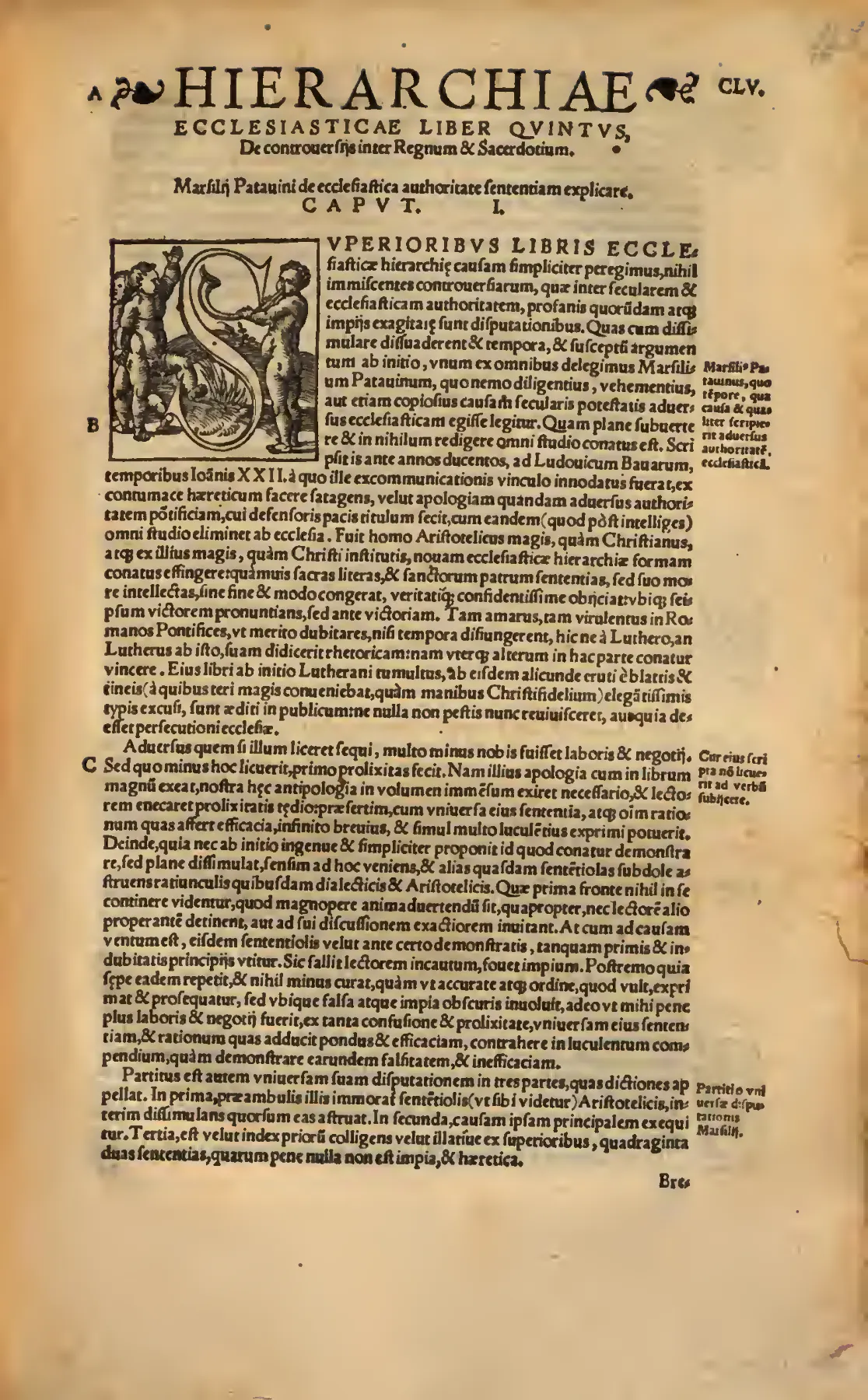
The opening of Book V, “De controuersijs inter Regnum & Sacerdotium,” beneath a large historiated initial of armed figures suited to its combative register. Here Pighius begins the genealogy linking Marsilius of Padua, “homo Aristotelicus magis, quàm Christianus,” to Lutheran rhetoric. Source ↗.
The genealogy is deliberate. Pighius notes that the Defensor pacis had been reprinted at the outbreak of the Lutheran tumult, and he makes a fourteenth-century antipapal treatise the doctrinal parent of the reformers. The charge of Aristotelianism also sets the method of the refutation. Pighius will meet Marsilius on Aristotelian ground, conceding his political premises and turning them against him.
Pighius summarizes rather than follows a text he calls prolix and dissembling. He reports the Marsilian thesis that coercive authority resides originally in the vniuersitas multitudinis, apud quam solam originaliter & causatiue (vt verbis: "with which alone [it resides] originally and causatively (to use [his] words)." He also reports its corollary, that priests and bishops are, in short, bare ministers of sacred things, Breuiter, sacerdotes & episcopos, nudos esse saccrorum ministros, seculari potestati in, subject to the secular power. The scholastic causal vocabulary is preserved with care, because Pighius means to show that the error lies in the premises themselves.
The refutation proceeds from the Aristotelian axiom that every multitude needs one ruling part. Princes, as members of the Church, are therefore subject to its head. Pighius immediately limits the consequence: Per hoc tamen nô tollimus, sed stabilimus potius ordinem politicum, by this we do not abolish but rather establish the political order. Kings remain supreme in their own order, and papal correction touches only sovereigns who have no civil superior.
Against popular legislative sovereignty Pighius offers counter-examples. Caesar and Octavian took power by force, Charlemagne received the empire from the pope, and Charles V was chosen by electors whose college Pighius ascribes to Gregory V. Behind these lies an open contempt for the crowd. He cites the commonplace that nothing is further from truth than the opinion of the multitude or the common people: dixit quidam: Nihil à veritate remotius multitudinis aut vulgi sententia. The anti-populism matches the epistemology that runs through the rest of the work. Consensus, for Pighius, is the agreement of an ordered body under its head, never the sum of individual judgments.
The proof of coercive efficacy reaches its climax at Canossa, narrated from Lampert of Hersfeld. Henry IV, nudis pedibus, ieiunus à mane ad vesperam perstabat Romani, stood barefoot and fasting from morning to evening awaiting the Roman pontiff's sentence. The scene is followed at once by a defensive admission. If ecclesiastical force nunc languidior vis sentitur & parum efficax, alia nulla causa est, "is now felt more feebly and is scarcely effective, there is no other cause" than the decay of Christian faith. The explanation is revealing, because it makes the efficacy of the spiritual sword proportional to belief. The same faith whose decay Pighius laments is presupposed as the condition of the power he defends.
Marsilius's Christological argument is met with the distinction between right and fact. Christ was subject to Pilate, Subiectus quidem illi fuit sed quia voluit, non quia debuit: subject indeed, but because he willed it, not because he was bound to. Roman rule over Judaea is accordingly treated as Pompey's usurpation. Clerical liberty under hostile princes then finds a modern martyr: Quorum exemplum sanctus Thomas Cantuariensis episcopus & martyr seipsum exhibuit, of these the holy Thomas, bishop of Canterbury and martyr, offered himself as an example. To invoke Becket in the later 1530s, while his cult was under royal attack in England, was to align the argument with the opponents of the royal supremacy.
The reading of Vos autem non sic reclaims Marsilius's own authority, Bernard's De consideratione. Others are called to a share of the solicitude, alij in partem solicitudinis, tu in plenitudinem vocatus es potestatis, but you to the fullness of power. Bernard's litany of titles follows: Sacerdos magnus, summus Pontifex, tu princeps episcoporum, tu hæres apostolorum, tu primatu Abel, great priest, supreme pontiff, prince of bishops, heir of the apostles, Abel in primacy. Christ's precept prescribes the form of rule, not its abolition, and it binds lay rulers as much as prelates. Whoever exercises rule otherwise, Quod si aliter principatu[m] exerceas, tyrânus es no[n], is a tyrant. The term the reformers had turned against Rome becomes the general criterion of illegitimate rule. Pighius completes the turn by extending the papal formula to every Christian ruler: the prince who governs by right reason and the light of faith, rationis, & luminis Christianæ fidei principatu suum exercet, q[uæ] minister seruor[um] Dei, is nothing other than a minister of the servants of God.
Coercion is then graded by kind according to each relation, and the grades culminate in excommunication, lis ille gladius, quo potest ecclesiasticæ domus paters familias,, "that sword by which the father of the ecclesiastical household can" strike. The domestic image of the Church as a household under a father makes the coercive power seem natural and paternal rather than tyrannical. The exposition of Romans 13 closes the run. Pighius extends obedience to every superior power, defends clerical exemption with pagan precedents, and asserts tithes as a matter of divine right: Decimæ enim ex debito requiruntur & qui eas, tithes are required as a debt, and whoever withholds them is answerable for that debt. The claim to coercive jurisdiction thus extends, finally, into the economic sustenance of the clergy, which Pighius places beyond the competence of any human legislator.
As the fifth book proceeds, Pighius's handling of Marsilius's "reserve" arguments shows his controversial method at its most deliberate. He states that he answers these secondary reasons so that no friend of a badly argued cause can claim he dodged their force. He then restates each premise in the adversary's own terms before conceding or denying it. The first premise is reported neutrally: Marsilius supposes, first of all, that voluntary human acts are governed by two kinds of law, In primis supponit actus humanos voluntarios regulari duplicibus legibus. The neutrality is tactical. Pighius grants the duality of divine and human law and contests only the corollary Marsilius draws from it, that human law alone punishes in this life. From that corollary Marsilius had derived the subjection of every cleric, up to the pope, to the coercion of the civil judge. The dispute is therefore joined at the point the throughline of the Assertio makes decisive: whether coactiva iurisdictio, the power that gives discipline its vigour, belongs by nature to the secular polity or to the Church as a distinct and prior order.
Pighius's answer redefines the Church as a kingdom rather than a voluntary association lodged inside a civil commonwealth. It is that kingdom of Christ to which all nations and realms are to submit, ecclesiam esse illud regnum Christi, cui vt vniuersæ gentes & regna,. It wields a sword of its own kind, the sword, that is, of anathema, of the interdict of divine offices, and of exclusion from entry into the church, enti gladio, hoc est, anathematis, interdicti diuinorum officiorum, ingressus. The concession is real: the Church does not bear steel. But the rhetoric reverses the hierarchy of force. Spiritual sanctions are exalted above arms because they subdue even emperors without violence, so that what Marsilius treats as the absence of coercion becomes, in Pighius's telling, its highest form.
The argument then turns, without apparent unease, to the physical sword in Christian hands. Against the claim that divine law punishes only in the next life, Pighius retrieves the Mosaic penal code and the zeal of Phinehas. In that zeal Christian princes have a pattern for being zealous for the honour of their Lord and for pursuing blasphemers with the penalty of death, zelandi honorem domini sui, & mortis supplicio persequendi blasphemos,. The tension is instructive. The Church's own sword is spiritual, yet the magistrate is enlisted as executor of a divine law whose content the Church defines. The prince's coercion is not denied but redirected, from a sovereign power over clergy to a ministerial power exercised on the Church's behalf.
A second model complements the first, drawn from the oeconomic rather than the political order. Pighius asks who does not know that in some great house the father of the household can make laws binding each member of it, in magna aliqua domo patrem familias posse leges condere, quibus singulis. The appeal to the household undercuts Marsilius's monopoly of legislation in the civic legislator humanus. If every paterfamilias and every lawful society may legislate under penalty, then the Church's ancient body of canons needs no civil delegation. The image also prepares the figure of the pope as father of the ecclesiastical household. From these premises the conclusion follows crisply: Christian magistrates must be under the hierarchy and not over it, they must obey and not command, subesse & non præesse debere: obsequi, non imperare. The four infinitives in strict antithesis give the entire anti-Marsilian case its grammatical form.
The second Marsilian argument held that ecclesiastical coercion is futile because salvation cannot be compelled. Pighius meets it with an Augustinian concession and pivot. Granted that no one can be forced to salvation against his will, punishment nonetheless often opens the eyes that guilt had closed, Esto, nemo inuitus cogi possit ad salutem, tamen poena sep[er]e oculos aperit, quos culpa clauserat. The voluntarist premise survives intact. What changes is the function assigned to penalty, which becomes medicinal and illuminative rather than constitutive of faith. That understanding fits the book's broader diagnosis of the Church's ills as a disease requiring cure.
The third argument, that Christ separated priesthood from princely rule by imposing poverty and humility on priests, draws Pighius into an excursus on counsels and precepts. Here his position is pointed. Poverty, he holds, is required of no one and has nothing desirable in itself. The printed reading of the line is corrupt at its close: Paupertatem vero à nullo exigi, nec in se aliquid habere vlll per se. Perfection lies in charity, not destitution. This places Pighius on the line John XXII had taken against the Michaelist Franciscans, the same milieu from which Marsilius's patron Ludwig of Bavaria drew his allies. The same reasoning lets him accept Bernard's dictum that dominatio and apostolatus cannot coexist while distinguishing dominatio from lawful princely rule. He even turns De consideratione, a classic text of curial self-criticism, to his purpose. Bernard himself, he notes, says that the pope in his regalia succeeded Constantine, not Peter, Cõstantino successisse, nô Petro. The admission is double-edged. It concedes that papal temporal splendour is not apostolic in origin, yet it legitimates that splendour as a lawful principatus. The distinction between office and the accessory dignities attached to it, one of the work's governing distinctions, here protects the papacy from the poverty argument.
The next chapter names the stakes in the present tense. Pighius sets out, in the sentence already quoted, to explain the view of Marsilius on ecclesiastical authority, which he says is now the view of all the Lutherans. The Defensor pacis is thus treated not as a fourteenth-century curiosity but as the arsenal of the reformers. Its doctrines are paraphrased at some length and with a measure of fairness: the equality of priests, the elective authority of the universitas fidelium, and the general council convoked by the human legislator. In refutation, Pighius first repudiates political philosophy as a measure of the Church. Let such trifles and Aristotelian dreams be gone from the hierarchy of the Christian Church, which is not to be measured by Aristotle's rule, Aristotelica somnia in hierarchia Christianæ ecclesiæ, quæ ad Aristotelis.
Yet within a few leaves he borrows Aristotle's own vocabulary of a ruling part. Every unified multitude, he argues, must find a governing and ruling principle, which is altogether necessary, inueniat ægemonicum & principans, prorsus est necessarium. The apparent contradiction resolves into a principle of method: philosophy may confirm the Church's order but cannot constitute it. The confirmation is then given an empirical turn. The plurality of sovereign crowns within Christendom shows that no civil prince can be the Church's single head: those of France, the Spains, England, Portugal, Scotland, Denmark, Sweden, Hungary, Franciæ, Hispaniarum, Angliæ, Portugalliæ, Scotiæ, Daniæ, Sueciæ, Hungariæ,. The list is pointed in 1538. Among the kingdoms that disqualify any secular claim to universal headship stands England, whose king had just claimed headship over his own national church.
The general council fares no better as a candidate for the hēgemonikon. It is rarely available, and it has not been shown to enjoy divine assistance exclusively. The Psalmist's verdict, for every man is a liar, Omnis siquidem homo mendax, therefore demands a judge who is both continuously present and divinely sustained. Constant accessibility becomes the criterion of the true head, and on it the papal argument rests. The same chapter shows how far Pighius will stretch canonistic texts to include the whole baptized body under that head. Unam sanctam is read through a subjection that is virtual, necessary and sufficient for salvation, virtualis subiectio ad salutè & necessaria & sufficiens, so that infants and the unlearned are bound to the pope by baptism alone.
At this point the book's critical loyalty becomes visible. Pighius attacks the Donation of Constantine as interpolated, since it names Constantinople among the four patriarchal sees, above which Rome is set as the fifth, supra quas quinta Romana statuitur, at a time when no such see existed. The philological reasoning stands in the line of Valla. It costs the papacy nothing, however, because a primacy instituted by Christ needs no imperial donation. Pighius's humanist critique of documents thus serves his ecclesiology as readily as it had served its opponents. He turns the same textual vigilance against Marsilius's habits of quotation. Marsilius, spider-fashion, sucks venom from every author, quàm araneorum more venenum exugat ex authoribus omnibus, from whom Christians draw the purest honey. The image of spider and bee, long used in patristic and humanist moralising on reading, prefaces a restoration of the Pseudo-Isidorian preface to Nicaea that Marsilius had truncated. The restored text gives Pighius Constantine addressing the bishops: God appointed you priests, Deus vos constituit sacerdotes,, and gave you power to judge even us. The emperor most often invoked as founder of imperial authority over the Church becomes its witness for the reverse.
Having catalogued Marsilius's grievances against curial practice, Pighius reasserts the contested formula itself. This, then, is that fullness of power, Hæc ita q[ui] est illa plenitudo potestatis. He redefines it as the power, committed to Peter, to govern Christ's flock. Defined pastorally rather than as unbounded dominion, the formula comes with a corresponding ethic for subjects: bad prelates are a punishment for the people's sins, to be met with self-amendment and prayer rather than judgement from below.
The following chapter replaces argument with a chronological dossier on papal election and investiture. Its hinge is Hildebrand's retort to the archbishop of Cologne that no right and no command over papal election ever belonged to kings or emperors, Nullum vnquam ius, nullum imperium. Imperial participation in elections, amply documented in the same dossier, is thereby reclassified as a revocable papal indulgence. The distinction between ius and factum that governs the whole work does its heaviest labour here. The historical record of imperial interference is admitted in full and denied any constitutive force.
The episode of Paschal II puts that distinction under strain. Pighius concedes that the pope erred in granting the privilege Henry V extorted. He insists, however, through Paschal's own words at the Lateran synod, that this Church has never held heresy, Fratres, inquit, ecclesia ista nunquam habuit hæresim. Personal fault in the pontiff is separated from the indefectibility of the see. The dossier closes with the Concordat of Worms reproduced in full, beginning with the imperial instrument: I, Henry, by the grace of God august emperor of the Romans, Ego Henricus Dei gratia Romanoru[m] imperator Augustus. Reprinting the instrument entire lets the emperor's own renunciation of investiture by ring and staff serve as proof.
The final movement of this argument extends that dependence from the Church's offices to the Empire itself. Innocent III's Venerabilem is quoted as the canonical locus of the translatio imperii: the apostolic see transferred the Roman Empire from the Greeks to the Germans in the person of the great Charles, manum imperium, in persona magnifici Caroli à Græcis transtulit in Germanos. Even the Greek emperors are made to confess the doctrine. When Manuel Komnenos sought to reunite the two empires, Alexander III refused to join into one what his forebears had deliberately divided, se id in vnum coniungere, quod olim maiorea sui disunxissent de industria. The Byzantine petition is read as tacit acknowledgement that the pope disposes of the imperial crown.
The capstone is Unam sanctam, printed entire and defended as a plain statement of divine law. The material sword is wielded at the nod and sufferance of the priest, and the sword must be subject to the sword, sed ad nutum & patientiam sacerdotis. Oportet autem gladium esse. Against Marsilius's appeal to Clement V's Meruit as an exemption for France, Pighius closes with counter-invective: I call him a livid detractor and a manifest falsifier, Ego vero hunc dico liuidum detractorem, & manifeste salsarium. On his reading the bull declared only that France was no more subject than before. The charge of falsification answers the charge of selective quotation laid earlier. It confirms that, for Pighius, the contest over the two swords is also a contest over who reads the documentary record faithfully.
That contest continues in Pighius's refutation of Ludwig of Bavaria's Frankfurt manifesto against John XXII, which shows the Assertio's method under pressure. He has to dismantle an imperial document without dishonouring the imperial office, and he does so by separating the seal from the hand that drafted it. Having summarised Ludwig's claims, he pronounces them unworthy of the source they pretend to: this, he says, is the sum of those letters, which are wholly unworthy of an imperial council, Hæc summa est illarum literarum, quæ prorsus indigtuæ sunt imperiali concilio,. The manoeuvre is precise. He attributes the text to its drafters, a circle he brands as false theologians composing under the emperor's name, vt sub nomine prodirent imperatoris aut imperij, sed cõcinnatæ pseudotheologorum. This lets him treat the manifesto as a usurpation of majesty rather than an act of it. The distinction between office and person that governs his account of the papacy thus appears here in an imperial key. The empire is spared, and its fourteenth-century spokesmen are condemned.
Against Ludwig's canonistic claim that imperial power comes immediately from God, Pighius sets a counter-thesis of complete dependence: the entire authority of the empire depends on ecclesiastical authority, vniuersam hanc authoritatem imperij, dependere ab authoritate. His treatment of Gelasius I is the most audacious step in the argument. The Gelasian letter is the classic charter of a dual government of the world. Pighius quotes its opening, that there are two by which this world is principally ruled, Duosunt quippe imperator Auguste, quibus principaliter hic mundus regitur:, and asks why Ludwig's advisers, so eager to invoke canons, passed over this one. Read his way, the greater weight that Gelasius assigns to priestly responsibility becomes a hierarchy of jurisdiction. Two powers do not entail two independent sovereignties. He makes the point with the organic image the whole Assertio relies on, asking whether a living body does not have distinct members, hands, feet and head, Nunquid in animantis corpore distincta membra non sunt, manus, pedes, & caput?. Distinction of office and subordination of office are made compatible, which is what hierarchia as sacred order requires.
Scorn does argumentative work in this chapter. Confronting the use of Jerome's dictum that the army makes the emperor (Legimus), Pighius professes not to know where to turn or what to wonder at more in these letters, Nescio quo me hic vertam, aut quid potius mirabor in his. The bewilderment exposes a contradiction: if the army makes the emperor, the emperor does not hold his empire from God alone. Pighius then reduces the canon to its historical setting. Among the pagan emperors it was once true that the emperor was made by the army, but among the Carolingian ones never, In illis aliquando verum fuit factum imperatorè ab exercitu. In his nunquam,. This sentence holds the whole two-empires thesis. The Julian empire, founded in usurpation, is one thing. The empire begun in Charlemagne, Nam quod adhuc durat imperium inchoatum ab illo Carolo,, the empire which still endures, begun by that Charles, is an ecclesiastical creation. It does not continue Rome; it runs concurrently with Rome's decay. The test of antiquity is turned here against a canonical authority. A text is binding only within the order of things it actually describes.
Pighius also limits his claim, and the limit matters. He does not argue that every temporal suit may be appealed to Rome. He grounds the point in the judicial geography he knew at first hand: just as no appeal is admitted from the council of Mechelen, nor from Brussels, nor finally from Utrecht, vt nec à senatu Mechlinensi, nec à Bruxellensi, nec deniq[ue] à Traiectensi, vlla, so final courts may exist beneath a supreme power without diminishing it. The analogy places the argument in the Habsburg Netherlands of a Utrecht provost. It also blocks the inference that subordination means papal management of civil affairs. Hence the ironic question, who ever dreamt that the empire is held from the pope?, Sed quis vnguam somnauit à Papa haberi imperium?. The empire is not a papal fief. Civil authority among Christians is subject to the governance of the hierarchy. The difference between holding something from the pope and being ordered under him is the juridical form that the sacral sense of order takes.
The chapter closes in a sermon register, an exhortation to Christian concord addressed to princes in purple. It reminds them, in the words of Genesis, that you too are earth, and into ashes you shall be turned, Nam & tu terra es, & in cinere conuerteris. Christendom's wars are traced to rulers who act like pagan lords rather than Christian magistrates, Ethnicam potius dominationem, quàm Christianum magistratum se gerere,. This is the exact counterpart of the Julian empire of usurpation. The exhortation ends by naming the theorist behind the Bavarian court obliquely, as the one who attacks the Church more than an enemy would, under the name of defender of peace, (quam ille sub nomine defensoris pacis impugnat plus. The allusion to Marsilius links the fourteenth-century quarrel to the present. Ludwig's pamphleteers, Marsilius, and the princes of the 1530s are treated as one continuous temptation to make the Church a department of the ruler.
The defence of the papal temporal dominion that follows is narrated after Biondo Flavio and is more historiographical than polemical. It rests the Roman ditio on legitimate donation and voluntary subjection, sed legitimæ donationis, & vltroneæ subiectionis titulo maxima, rather than on force. What stands out here is Pighius's refusal to fight over the Donation of Constantine. He brushes Lorenzo Valla aside as a man hardly ecclesiastical, rentius ille Valen. homo parum ecclesiasticus), but he does not answer Valla's philology. He makes the Constantinian question juridically idle, since the emperors of his day succeed Charlemagne, not Constantine. His curialist case is thus rebuilt on Carolingian ground, a tacit acknowledgement of humanist criticism disguised as dismissal.
Book VI: Councils
Book VI concerns councils. Its occasion is a general council proclaimed and imminent, and it opens with a claim to completeness: Pighius will explain the whole case of councils, in the proverb, from head to toe, à vertice (quod aiunt) vscor ad extremum vnguem. His first move concedes a natural basis to councils in order to deny them a supernatural one. They rest on the commonplace that eyes see more than an eye, quod dici solet, plus vident oculi, quàm oculus. They are an invention of prudence, and their proper work is consultation. Faculty psychology then supplies the political model. In the soul the will rules, while reason holds the place of a senate and a free council, at ratio, senatus cuiusdam liberisq[ue] concilij locu[m] tenens, illi. It advises but does not coerce. A council is to the pope as reason is to will: necessary for good deliberation, without executive or coercive power. The standing form of this counsel is accordingly the pope's own sacred senate of cardinals, senatus sacri cardinalium, quos nunc dicimus, aut etiam, vicinorum,. With that domestic body in place, the extraordinary assembly is no longer structurally indispensable.
The de-sacralising conclusion follows directly, in the sentences already quoted: universal councils are not divine or supernatural but wholly human, Constantine's invention, and they therefore can err and have frequently erred. The work's central move reappears here in institutional form. Pighius had displaced the criterion of truth from the mute text to the living Church. Now he displaces it from the assembled Church to its head, and a council without Rome becomes, like Scripture without the Church, a judge unable to bind.
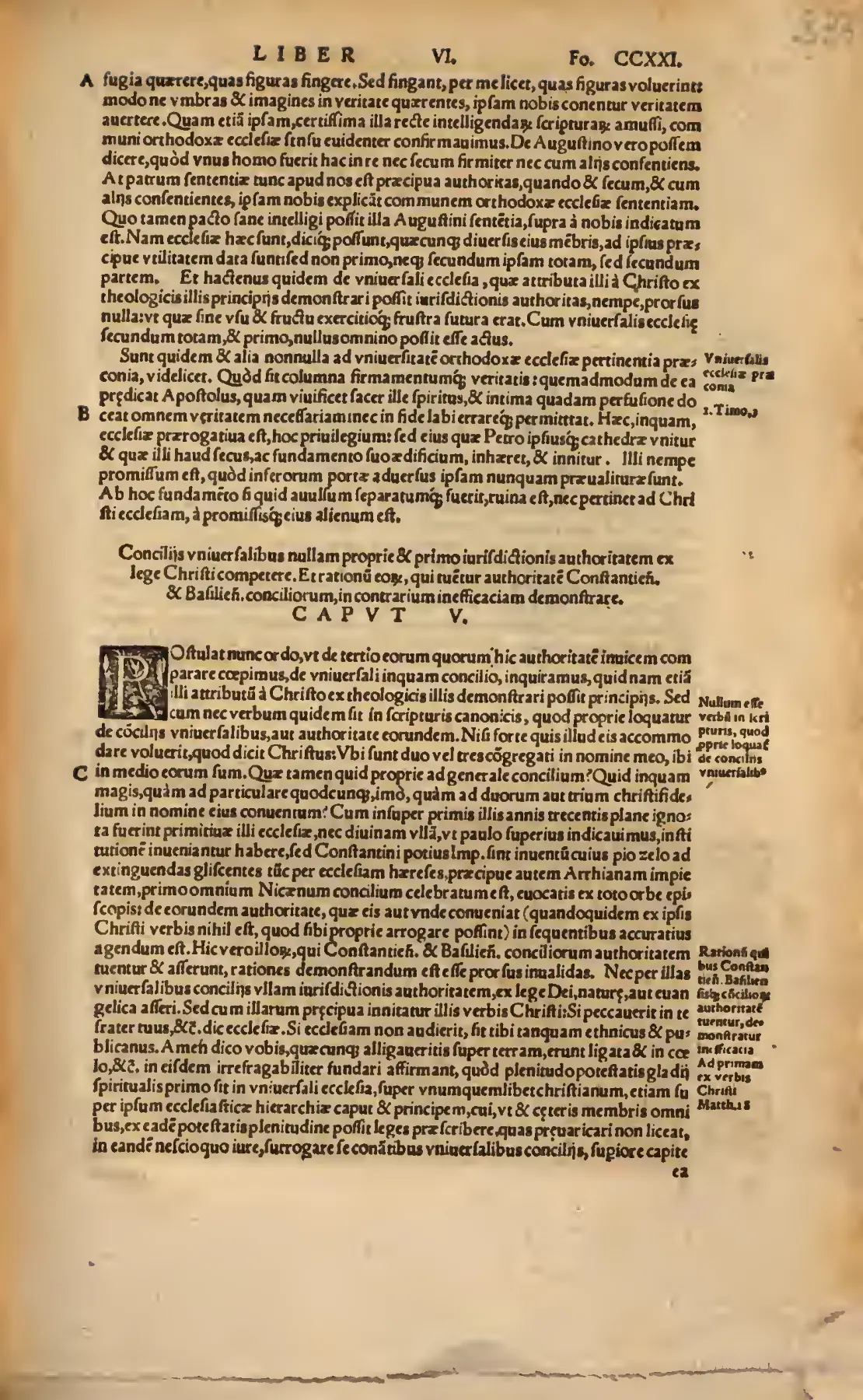
At the opening of Book VI, Chapter V, the heading denies that universal councils hold jurisdiction “from the law of Christ,” while marginal glosses frame the attack on Constance, Basel, and conciliar readings of Matthew 18. Councils become contingent assemblies that must yield to the Church’s living head. Source ↗.
The opponent's position is set out with documentary care. Pighius reproduces Haec sancta verbatim: this holy synod declares that, lawfully assembled in the Holy Spirit, Hæc sancta synodus declarat, quod ipsa in spiritu sancto legitime congregata,. The decree's own claim, that the council represents the Catholic Church and holds its power immediately, concilium generale faciens, & ecclesiam catholicam repræsentans, potestatem à, is what the rest of the book takes apart. The response is pitched at two levels of feeling. Constance and Basel are charged with trying to revive Babylon itself, hoc est, Babylonem ipsam refusitare conati sunt, the confused rule of the multitude set against ordered hierarchy. Gerson, by contrast, receives a fair summary of his whole-and-part reasoning, in which he compares the whole to the part and asks which is greater, ecclesiasticam authoritatem Papali, comparat totu[m] parti, & querit quid sit. He then receives a measured verdict as a man otherwise pious and learned, Hæc serme sunt, quæ Gersonus ille, vir alioqui & pius, & doctus, sed hac in. Ludwig's advisers were dismissed with invective, while Gerson is excused as misled. The contrast shows that Pighius reserves contempt for those who would subordinate the Church to princes, and saves argument for those who err within it.
The positive argument draws on several of the author's characteristic resources. Philology disposes of the Constance formula that granted Rome primacy over particular churches but not over the universal Church: no one ever understood the universal church by "Roman church," unless perhaps someone ignorant of Latin, ecclesiâ nemo intellexit vnquam, nisi forte Latini sermonis ignarus. Aristotelian natural philosophy supports his "paradox" that the universal Church as such has no jurisdiction. A power that could never be exercised by the whole would violate the axiom that God and nature do nothing in vain, naturam nihil frustra facere. The office-person distinction is stated with notable candour. Annas and Caiaphas may sit in Peter's chair as they once sat in Moses', yet Christ does not fail his promise, si, ita nunc Petri, sedeant Annas & Caiphas: sui tamen promissi Christus non. Behind all this lies a general maxim of monarchical prudence: governing authority is never well committed to a multitude, Nunquam enim multitudini bene com[m]ittitur regiminis. Here ecclesiology and the theory of the ordered commonwealth speak with one voice.
The historical chapters on early major causes and conciliar convocation show the limits of Pighius's criticism. Having set Valla aside, he accepts the pre-Nicene papal letters as certain on Isidore's testimony, cu ex 1sidori testimonio coëstet certissimo. He resolves conflicting witnesses by rank rather than by source criticism: one Julius, he answers, outweighs ten Rufinuses, Respondebo vni Iulio, quàm decem. The appeal to antiquity is thereby fused with the appeal to succession, since a pope's testimony to the past counts as authoritative because he is pope. The rule drawn from these sources is the Damasan dictum that to hold a synod without Roman authority is not catholic, sine eius authoritate fieri, non est catholicum. The conclusion of the eighth chapter carries this rule to its limit. Gatherings convened against Rome are not merely irregular. They are to be abhorred as councils of Satan, tanquam Satanæ concilia, and denied even the name of synod. The council is first reduced to a human invention for counsel. Detached from its head, it becomes in the end the very anti-order of which "Babylon" was the figure.
From that rule Pighius turns to the conciliar history of the fifth century, where he builds his case for the Roman see less by deduction than by assembling documents. Leo the Great's letters are reproduced at length, so that the historical record appears to speak for itself. The commentary then tells the reader how to hear it. The pivotal document is Leo's letter to Chalcedon, in which he asks the assembled bishops to regard him as present in his legates: me synodo vestra fraternitas æstimet præsidere, "let your brotherhood reckon that I preside over your synod."
Read on its own, the sentence could mean a pastoral presence at a distance. Pighius makes it the documentary core of papal presidency over every ecumenical council. The same letter supplies a second principle that recurs throughout this part of the book. Leo refuses to let defined doctrine be argued again, lest the Church be drawn back, through the folly of a few, vt per paucorum inæpientiam ad coniecturas opinionum & bella, into conjectures of opinion and into wars. Leo's phrase sets coniectura against definition, the instability of opinion against the fixity of a settled judgement. It is the fifth-century form of the epistemic anxiety that drives the whole Assertio: once a matter is reopened, the outcome is not more truth but bella.
The interpretive key comes in Pighius's own gloss. He says Leo acted toward the synod videlicet, tanquam authoritatem & potestatem super ipsam habens atq[ue], "namely, as one having authority and power over it." This is the hermeneutical turn of the chapter. Epistolary exhortation is re-described as a juridical act of superiority. The pairing of authoritas with potestas joins the Gelasian vocabulary of moral standing to the language of coercive jurisdiction.
Pighius reads the council's own words in the same way. He quotes Chalcedon's synodal letter asking that its acts be ratified by Leo, vt à vobis quæ gesta sunt statuantur, roborentur, & concedantur, &c, "that what has been done may be established, strengthened, and granted by you." He treats this as the council's own understanding of its dependence. The three verbs move from establishing, to strengthening, to granting. That sequence lets him argue that conciliar acts have no complete force until Rome adds its robur.
A subtler move follows. Anatolius of Constantinople was hardly a friend of Roman claims, and Pighius uses him as a hostile witness for the cause of Dioscorus's deposition: Propter fidem, inquit, no[n] fuit damnatus Dioscorus, sed quia in, "Dioscorus, he says, was not condemned on account of the faith, but because against" Leo he had dared to pronounce excommunication. The implication is pointed. In the council's own eyes, offence against the apostolic see outweighed doctrinal error. Disobedience to the head is thus made the gravest ecclesial crime, and the definition of schism as refusal of subjection is given an ancient precedent.
The next chapter, on the "privilege of the second see," moves from the presidency of councils to their nullity. The quarrel over canon 28 of Chalcedon lets Pighius state a general thesis. From Gelasius he draws the claim that the validity of every council depends on the apostolic see, conciliorum vniuersalium, actionumque synodalium omnium robur & authoritas, "the strength and authority of universal councils and of all synodal acts." The corresponding term of nullity follows in Leo's verdict on whatever contravenes the Nicene canons: infirmum & irritum erit, quicquid à, "whatever is done by [them] shall be infirm and void."
Leo's letters to Anatolius supply two distinctions that do structural work well beyond this episode. The first separates institutional rank from personal standing, sunt sedes, aliud præsidentes, & magnus cuique honor est integritas sua: sees are one thing, their presidents another, and to each his own integrity is great honour. This is the distinction of office and person on which Pighius later builds his treatment of the unworthy pope. The second separates the order of empire from the order of the Church, ratio est rerum secularium, alia diuinarum, "the reckoning of secular things is one, that of divine things another." It answers the claim that imperial residence in a "New Rome" could confer ecclesiastical precedence. In 1538 it could hardly be read without thinking of royal and princely claims to govern the Church.
From these texts Pighius again infers jurisdiction from duty. Leo was bound to prevent the violation of Nicaea, and Pighius asks how he could have restrained the bishops had he not held power over the councils themselves: At cohibere qui potuisset, si nô super ipsa con. The reasoning runs from obligation to the power that obligation presupposes. It is typical of the method of these chapters, which turn historical narrative into proof of legal competence.
The survey of the fifth through eighth councils extends this reasoning across three centuries. In the process it takes over and reverses the vocabulary of Pighius's conciliarist opponents. He marks their technical idiom as theirs and then turns it against them: Vides, quam non ipsa concilia regulatiuam (vt illi loquuntur) authoritatem, "you see how it is not the councils themselves that hold regulative authority, as they put it." The parenthesis vt illi loquuntur is a small but telling philological gesture. It holds the conciliar school's regulativa authoritas at a distance as jargon, while the narrative assigns the reality the term names to Rome.
The emblem of this transfer is the Sixth Council's acclamation of Agatho's letter, atra mentum videbatur, & per Agathonem Petrus loquebatur: the ink seemed [merely ink], yet Peter spoke through Agatho. The acclamation unites the work's guiding contrast between dead letter and living voice. The written letter is ink, but through it the apostle speaks in his successor, so the authority of the text is subordinated to the person who utters it. The chapter ends in a rhetorical climax: Ariminum and Ephesus II erred without Rome, and Athanasius, Chrysostom and Ignatius would have perished without it. Its conclusion is that councils can err, but the Roman see has not.
The argument next turns from the distant councils to the controversy of the day. It rebuts the critique of Paul III's indicted council that was drawn up at Smalcald, and the printed layout stages a dialogue under alternating speaker labels for the heretic's confession and for Pighius. He first reports the Protestant demand in its own terms, for a council that should be esse libera & christiana synodo, hoc est tali, in qua iuxta verbum Dei, "a free and Christian synod, that is, one in which according to the word of God" all matters would be judged. His answer goes after the practical meaning of the formula. Who would choose the "impartial" judges? The only names the reformers would accept, he jeers, are Lutheræ, Melanchthonê, Oecolapadiu[m], Prentiu[m], Svuingliu[m], Luther, Melanchthon, Oecolampadius, Brenz and Zwingli, that is, parties to the very case. If the emperor were to be the arbiter, Christendom beyond the Empire would refuse: Et quid dicent Galli, Hispani, Britanni, Scoti,, "and what will the French, Spaniards, Britons, Scots say?" The reductio has edge in 1538. It quietly recalls that the respublica Christiana is plural in its kingdoms, and that only a jurisdiction above them all could bind them all.
The decisive move, though, is epistemological, and it shows the throughline of the work at its sharpest. Against the Smalcaldic appeal to verbum Dei, Pighius makes the first-person avowal already noted, that he has never heard Christ speaking except through the Church's testimony. He follows this with the Augustinian corollary, testimonium. Matthæi, Marci, Luce[m], aut Ioannis scripta minime agnosco, nisi quia cre, "I by no means acknowledge the writings of Matthew, Mark, Luke or John, except because I believe" the Church. Within the controversy, this is what decides the question of a "free" council. If Scripture is recognised as Scripture only on the Church's warrant, then a synod that judges "according to the word of God" against the Church destroys the ground on which it stands.
Leo's refusal to reopen Eutyches's case is redeployed here against the call for fresh doctrinal cognition at the new council. The chapter closes in invective, and its most vivid image is of sacred objects turned to war. The Lutherans take bells quibus ad Dei cultum antiquo ritu conuocatur fidelis populus, conuertunt in, bells "by which the faithful people are called to the worship of God by ancient rite," and turn them into cannon. The detail brings the language of the chapter together. The antiquus ritus of convocation is literally melted down into the bella that Leo had warned would follow from the abandonment of settled judgement.
The final movement asks whether a pope can be judged by a council. It is notable for the sharpness with which Pighius parts company even from allies. Cajetan had argued that heresy alone makes a pope deposable, and Pighius dismisses his syllogism with open contempt: ratio plura fere vitia habet, quàm verba, "that reasoning has almost more faults than words." The quarrel is over method as well as conclusion. Pighius cannot accept any concession that leaves a door open to judgement from below, even one made by a fellow opponent of the conciliarists.
Against every claim of jurisdiction over the pope he assembles a chain of precedents. Its centrepiece is the legendary Council of Sinuessa on Marcellinus, whose verdict reads prima sedes non iudicabitur à quoquam, "the first see will be judged by no one." The principle is then stated, in terms close to Unam sanctam, as evident from the very meaning of its terms: vero suprema, à solo Deo, non ab homine potest iudicari, "but the supreme power can be judged by God alone, not by man." He also rejects Cajetan's attempt to save deposition by assigning to the Church or to a general council ministerialem quandam authoritatem in ecclesia aut generali concilio, "a certain ministerial authority in the Church or a general council." On Pighius's account, even an instrumental power over the joining of papal office to a person would subject the head to its members.
His treatment of heresy rests on an analysis of the term itself. Heresy, from electio, is a chosen and defended opinion, so it presupposes the Christian profession it contradicts: Neque illi contrariatur hæresis, quin potius ab eadem præsupponitur, "heresy is not contrary to it, but rather is presupposed by it." In the discussion of the cardinals' electoral power the text also dates its own composition. It remarks that the elective power of the universal Church has not been exercised his annis M. D. X X V I I, "in these years 1527," which places the drafting of this section about a decade before the printing.
The argument culminates in Pighius's most distinctive thesis. A pope cannot become a heretic at all; to suppose otherwise, in the formulation already cited, is to argue as though Christ, praying, had not been heard for his reverence. This turns Luke 22:32 into a guarantee resting on the efficacy of Christ's own prayer. Papal fidelity becomes a consequence of Christology rather than a matter for canonical procedure.
What remains for a bad pope is not judgement but subjection to his own master. Pighius adapts Romans 14:4 to this end in the dictum, quoted earlier, that the vicar of Jesus Christ stands or falls to his own lord. Rebellion against the vicar is thereby classed as maiestatis crimen against Christ, and prayer is left as the only remedy. The distinction between see and occupant, first drawn from Leo's letter to Anatolius, here reaches its limit. The person may be unworthy, but the office places him beyond the reach of every human tribunal. By the time Pighius turns to the canonists' objection from purgation, still citing Paschal I and Damasus, the whole conciliar record of the earlier chapters has been made to support a single conclusion: the councils' voice is valid only as an echo of Peter's.
Book VI closes on the problem that this conclusion makes unavoidable. If the Roman pontiff stands beyond all human judgment, the historical record of popes who cleared themselves before princes, or who were deposed by synods, must be accounted for. Pighius meets the problem in two stages. He first disarms the precedents one by one. He then turns the defence into a positive doctrine of when, and how narrowly, a universal council may assemble without papal summons. The result is the most concentrated application in the work of the two distinctions on which its ecclesiology rests: between right and fact, and between the office and the person who holds it.
The episodes of papal self-purgation come first: Leo III's oath before Charlemagne, and Gregory VII's offer to take the Eucharist as a test of innocence before King Henry. Pighius does not hide the apologetic purpose of telling them at length. He writes that he has set these things down rather fully so that his reader might understand, Hæc ideo ascripsi aliquâto prolixius, vt intelligeres,. What the reader is to understand is that such submissions were made sua sponte, & vt satisfacerent imbecillioribus, freely and to satisfy the weaker brethren. The narrative turns what conciliarist readers had taken as evidence of papal accountability into evidence of papal humility. An act of condescension, by its nature, cannot bind the one who condescends. The Pauline category of the infirmi, whose consciences the strong must spare, recasts the pope's appearance before a secular ruler as pastoral accommodation, not juridical subjection.
The fifth objection, from the historical depositions of popes, is met with the methodological principle that governs the whole reply. Pighius answers briefly, in the reply already noted, that he is disputing about law, not about fact. The distinction draws on the schools and the canonists, and it does decisive work here. A deposition that occurred, however solemnly, shows only that men did something, not that they had the right to do it. Yet Pighius does not rest on the principle alone. He also contests the facts, insisting that almost none of those whom his opponents list as deposed was an undoubted pope, sit, nullum fere omnium quos hi depositos commemorant, fuisse indubitatum. The qualifier indubitatus becomes the criterion that sorts every case: Felix, intruded while Liberius lived; Christopher, who seized the see by imprisoning Leo V. Each is reclassified as a usurpation, not a judgment upon a true pontiff. The double defence, a denial in principle followed by a correction of the record, shows how much weight the argument places on the boundary between ius and factum. Pighius will not let the facts decide, but neither will he leave them to his opponents.
The case of John XII and Benedict V receives the longest treatment, because it was the strongest precedent the opposing side possessed. Pighius announces an inversion. The history of John XII and Benedict V, he says, is continuous, but it is such as does not oppose his view, and rather supports and subscribes to it, Ioannis vero XII. & Benedicti V. continens est historia: sed talis, quæ non aduersatur, imò suffragatur & subscribit nostræ sententiæ. The juridical verbs suffragari and subscribere cast the tenth-century Romans as witnesses who sign their names to his thesis. The wrong he identifies lies in the act by which, with headlong counsel, they ordained over John, as a deserter of his see, a certain Leo, eighth of that name, as pontiff, Leonem quêdam eius nominis VIII, illi tanq[uam] desertori suæ cathedræ super ordinarunt Pontificem. The compound super ordinare does the polemical work: Leo's elevation is not a succession but the setting of a rival over a living occupant of the chair. The Romans' later repentance and their election of Benedict V in defiance of Otto I then become a moral drama of recognition. They resolved to undergo every danger rather than hand down to posterity the ruin of such an example, omne tamen periculum decreuerunt subire potius, q[uæ] perniciem exempli eiusmodi transmittere ad posteros. The language of exemplum matters. For a humanist reader, history teaches by examples, and the danger Pighius identifies is precedent itself, the transmission of a pernicious model to later ages. By making the Romans guardians against that transmission, he enlists the very episode that seemed to prove conciliar or imperial judgment of popes as testimony to the see's inviolability.
The same criterion then disposes of the fifteenth-century councils. At Constance three claimants were removed because none was certain. At Basel the attempt to replace a certain pontiff failed: the same was attempted against Eugenius, undoubted pope, and in his place a certain Amadeus was elected, but in vain and without any effect, idem aduersus Eugenium indubitatum Pontificem tentatum est, & in locum eius Amadeus quidam electus sed frustra, & sine vllô effectu. Here the argument quietly reverses its own method. Having refused to let fact establish right, Pighius now lets the failure of Basel's antipope stand as a sign that the Church at large did not receive the act. The ineffectiveness of the attempt confirms the illegitimacy of the attempt. The tension is not resolved but managed: facts may not create papal liability, but they may disclose where the Church's consent lay.
Chapter XVIII asks openly in what case a universal council may be gathered apart from the authority of the apostolic see, An quo casu congregari ac celebrari possit vniuersale concilium, præter authoritas tem sedis apostolicæ. Pighius concedes that nearly everyone admits some such case. He then sets out the rival schemes, beginning with the chief theorist of the opposing view. Gerson, he says, gathering all these cases together in summary, comprehends them under three general heads, Quos omnes Gersonus ille summatim colligens, sub tribus generaliter comprehendit. The first of these heads borrows the vocabulary of Roman and canon law: the pope ceases to be pope either by his natural death or, as Gerson puts it, by civil death, aut morte eius naturali, aut morte (vt dicit) ciuili,. The parenthetical vt dicit already holds the category at arm's length. Against Gerson, and against the more moderate canonists' list, Pighius places his own premise: the Roman pontiff has been shown to be in no case subject to human judgment, vt quem nullo vniq[uam] casu subijci humano in dicio demonstratum est.
From that premise follows the reclassification of any council held against the pope. Such an assembly is nothing but an open rebellion and conspiracy of subjects against their own head and prince, sed præter apertam quandam rebellionem, co[n]spirationemq[ue] subditor[um] aduersus suum caput & principem,. The vocabulary is drawn from the political order, subditi, caput, princeps, and it shows the double register of hierarchia. The sacred ordering becomes legible as a polity, and dissent within it as sedition. The question of remedy is answered in a strikingly different register. If the pope neglects what belongs to his office, he has his own judge, Si ille quod sui officij est facere negligat, habet iudicem suum,. That judge is Christ, and the faithful's recourse is prayer. The juridical gap is deliberate. Pighius will not supply an earthly tribunal, because to do so would concede the very superiority he denies.
Within this closed system Pighius allows exactly one opening, defined with scholastic precision. He finds altogether one case in which a universal council could be convened apart from the authority of the apostolic see, Vnum itaque omnino casum inuenio, quo præter apostolicæ sedis authoritatem. He sets against it the flat denial that there is any case at all in which this is lawful against that see's authority, tra vero huius sedis authoritatem, quo id liceat, prorsus nullum. The opposition of praeter and contra is the chapter's conceptual hinge. A council may act beside papal authority when that authority is uncertain, never in opposition to it when it is certain. The one case is the doubtful election, and its rationale is ecclesial unity itself, since the unity of the Church does not suffer that there be two or more popes, cum vt duo, pluresve sint non patiatur vnitas ecclesiæ. Unity therefore both licenses and limits the emergency council. It may meet only to discover who the one head is, and its competence ends there.
Constance, the conciliarists' paradigm, is thereby confined to the termination of the schism and the election of Martin V. Everything else, including the condemnations of Wyclif, Hus and Jerome of Prague, holds only by Martin's confirmation. Pighius makes the council fathers testify against their own supposed supremacy. If they were superior, why then do they beg the same man that their acts might have force, and that he impart authority to them, quorsum ergo orant eundem vt robur habeant, authoritatemque illis impartiat?. The rhetorical question argues from the conduct of the parties, a mode familiar from forensic oratory. It also extends the logic of the earlier histories: those who petition confirm by their petition the authority of the one they petition.
The refutation of Gerson's three "deaths" finally reduces the juristic categories to scriptural and providential ones. Captivity does not vacate the see, for when Peter was kept in prison the primitive Church did not assemble to choose him a successor, Nam cum Petrus seruaretur in carcere, nequaq[ue] primitiua illa conuenit ecclesia ad successorem illi deligendum:. The apostolic Church of Acts becomes the normative witness against the canonists' mors civilis. On perpetual insanity Pighius appeals to providence: such a thing has never happened from the beginning in fifteen hundred years, nunquam id accidisse ab initio annis quindecies centenis. The argument from the absence of an event is presented as the trace of Christ's care for Peter's chair. History thus returns, not as a source of right, but as the visible record of a protection that right alone could not secure.
The peroration gathers the book's imagery of salvation. Readers outside the communion are urged to seek reception into that little boat of Peter which alone shows unharmed those it has taken up while the world is shipwrecked, conentur recipi in illam nauculam Petri, quæ sola quos suscepit, naufragante mundo, illæsos exhibet. The exhortation's decisive sentence restates the distinction between office and person that had governed the treatment of John XII. Thence, Pighius promises, we shall hear Christ speaking to us, whatever kind of man he may be who presides in that chair, Inde audiemus nobis loquentem Christum qualiscunq[ue] tandem sit, qui in eadr[um] præsederit. The voice of Christ is attached to the chair, not to the virtue of its occupant. This is the theological ground that made the narrative of a scandalous tenth-century pontiff usable as evidence rather than as embarrassment.
The definition that follows the biblical punishments of schism, from Jeroboam to Uzziah, is accordingly framed in terms of the hierarchy itself: whoever refuses to be subject to the head of the ecclesiastical hierarchy is a schismatic. Pighius then joins schism to doctrinal error with Origen's maxim that where there are schisms, there are heresies and dissensions, Vbi sunt (inquit ille) schismata, ibi hæreses, ibi diffensiones:. He seals the connection with his own aphorism: either schism does not come unaccompanied, or without a worse companion than itself it does not long subsist, Aut enim incomitatum non venit schisma, aut ab soq[ue] peiore se comite diu no[n] subsistit. The final turn makes ecclesial separation the matrix of heresy, not its consequence, so that refusal of the head becomes the root from which every doctrinal novelty grows. The argument ends where the book's programme began, with order as the condition of truth, before the doxology and the printed formula marking the end of the sixth book, ECCLESIASTICAE HIERAR. CHIAE LIBRI SEXTI FINIS. The errata list that follows, keyed to folio, side and line and ending with the customary request that the reader take it in good part and correct, returns the volume to its condition as a printed object in a reader's hands.
Reading Pighius Alongside Jedin, Tavard, and Tierney
Hubert Jedin, Studien über die Schriftstellertätigkeit Albert Pigges (Münster: Aschendorff, 1931). The dedicated study of Pighius's writings is the essential starting point for relating the Assertio to his other polemical works; its individual conclusions require consultation in the original.
George H. Tavard, Holy Writ or Holy Church: The Crisis of the Protestant Reformation (1959). Its treatment of Scripture and ecclesiastical tradition supplies a framework for investigating Pighius's claims about their respective authority, rather than treating later Tridentine formulations as already settled in 1538. Those claims include his insistence that the Church is the warrant for hearing Christ at all. In his own words, he has never heard Christ speaking except through the Church's testimony, Ego Christum loquentem nunquam audiui, nisi. They also include his defence of later theological vocabulary as faithful to ancient belief, as when he describes "being transubstantiated" as a new word but the ancient sentence of the Catholic faith, quod posteriores haud insignificanter transtubstantiari dixerunt: nouo quidem vocabulo, sed antiqua catholicæ fidei sententia. Tavard's framework is well suited to weighing such moves within the Reformation-era debate over doctrinal authority.
Brian Tierney, Origins of Papal Infallibility, 1150–1350: A Study on the Concepts of Infallibility, Sovereignty and Tradition in the Middle Ages, 2nd rev. ed. (Leiden: Brill). Its medieval account helps distinguish inherited debates about papal authority from Pighius's particular sixteenth-century positions, including his treatment of papal indefectibility and of the canonistic Si papa text. It is contextual reading, not a direct study of the Assertio.
Frequently Asked Questions
What is Albert Pighius's Hierarchiae ecclesiasticae assertio?
It is a six-book Latin defence of ecclesiastical hierarchy and papal authority by Albert Pigge (Albertus Pighius), a Dutch theologian from Kampen who served as provost of the chapter of St John at Utrecht. Melchior Novesianus printed it at Cologne in 1538, and Pighius dedicated it to Pope Paul III. Written in the decade before the Council of Trent, it answers Luther and the reformers, the conciliar theorists, and Henry VIII's claim to supreme headship over the English Church. Its exact place and dates of composition have not been securely established, though one passage refers to the year 1527. Later Cologne editions are reported for 1544, 1558 and 1572.
Why did Pighius call Scripture a "wax nose"?
Pighius used the proverbial image to argue that Scripture, left to private readers, can be pulled in any direction and so cannot settle the quarrels it provokes. He also called it a mute judge and compared it to the builders' leaden Lesbian rule, which bends to whatever it measures. Against this pliancy he set the common understanding of the Catholic Church, which he called a Lydian touchstone. The claim rests on a historical argument. Christ wrote nothing and commanded nothing to be written, so the Church, its faith and its tradition are older than the Gospels. Scripture is therefore received because of the Church, and the Church is not received because of Scripture.
Did Albert Pighius believe a pope could become a heretic?
Pighius held that a true pope cannot become a heretic at all. To suppose otherwise, he argued, would imply that Christ's prayer for Peter in Luke 22:32 went unheard. He classed the failures of Marcellinus and Liberius as lapses of outward confession rather than of faith. He blamed forgers among the Greeks for the condemnation of Honorius, and he openly mocked Gratian's treatment of Anastasius II.
He qualified the position, however. Faced with historical depositions of popes, he replied that he was disputing about right, not fact. He also allowed a council to meet apart from papal authority in one case: a doubtful election, such as the one resolved at Constance. A bad pope, he wrote, stands or falls to his own lord.
How did Pighius use humanist philology to defend papal authority?
Pighius turned the methods of his humanist contemporaries to Rome's defence. On Deuteronomy 17 he compared the Vulgate with the Septuagint, a literal Latin version of the Hebrew, and the Chaldaic Targum. He judged the clause "according to his law" a later intrusion, and he recalled working with the Spanish trilingual scholar Ioannes Stunica. He used the Aramaic Cephas, citing Erasmus's rendering of John 1:42, to close any gap between Petrus and petra. He also treated the Donation of Constantine as interpolated, because it names Constantinople as a patriarchal see before that see existed. His criticism had limits, however, since he still accepted Pseudo-Isidorian texts as genuine.
Is there an English translation of Pighius's Assertion of the Ecclesiastical Hierarchy?
No published English translation of the complete work has been identified, and the work has no established English title. "The Assertion of the Ecclesiastical Hierarchy" is an editorial rendering. English readers have known it mainly through its Latin original and through replies such as John Leland's Antiphilarchia. The Leo edition, a separate undertaking, presents the full Latin transcription and a complete English translation for the first time; that translation is generated by AI. Leo is an effort to make English translations of every text printed in Latin in early modern Europe between 1450 and 1750 freely available online, at no cost.
This report was generated by an advanced AI assistant that conducted deep research alongside an extensive interpretation of the transcribed original text. Every effort has been made to preserve fidelity to the source and to guard against inaccuracy, but corruption in the text recognition process and model hallucination may nonetheless have entered the text. Treat every claim, quotation, translation, and citation as provisional, and verify each against the original source before relying on or citing it.
Bibliography
- Hubert Jedin, Studien über die Schriftstellertätigkeit Albert Pigges: Jedin's 1931 monograph is still the only sustained attempt to put Pighius's output in order, and anyone trying to place the Assertio between the 1537 Apologia for Paul III's council and the 1542 Regensburg writings must start here. It was written by the future historian of Trent before he had Trent to write about, which makes it an unusually clean guide to the pre-conciliar Pighius this report insists on. Read it in the German, and read it slowly.
- Klemens Löffler, "Albert Pighius," The Catholic Encyclopedia: This short notice is the older reference work behind the reported Cologne editions of 1544, 1558 and 1572, so it is the first thing to check before attempting the edition-by-edition comparison that Section 4 calls for. It also calls the Assertio "a rejoinder to Henry VIII," a label that is too narrow for a book aimed just as hard at Marsilius, Luther and Gerson. That narrowness is useful: it shows how a single English quarrel came to stand for the whole work. Treat it as a convenient starting point, not a final authority.
- George H. Tavard, Holy Writ or Holy Church: The Crisis of the Protestant Reformation: Tavard gives the clearest account in English of how the relation between Scripture and tradition was argued before Trent settled it, and that is the ground Pighius occupies when he calls Scripture a mute judge and a leaden rule. The book helps a reader see how far Pighius's claim that Christ wrote nothing goes beyond what the council would later say. It also makes plain why his views did not become the Church's official position.
- Brian Tierney, Origins of Papal Infallibility, 1150–1350: Tierney traces the medieval canonists, the Franciscan poverty quarrel, and the Si papa gloss on which Pighius pours such scorn. With that background, a reader can tell which of Pighius's positions were inherited and which were genuinely his own, above all his claim that a pope cannot become a heretic at all. The book stops in 1350, nearly two centuries before the Assertio, so it supplies the background to Pighius's argument rather than an account of it.