Begging Not to Be Held an Impostor: John Pearson's A Vindication of the Epistles of St. Ignatius
John Pearson, Cambridge theologian and future Bishop of Chester, published Vindiciae epistolarum S. Ignatii in 1672 to prove that seven short letters written under guard on the road to Rome were genuinely the work of Ignatius of Antioch, and not, as the Huguenot scholar Jean Daillé had charged, a fabrication of some later century. The stakes were never merely bibliographical: those letters are the oldest surviving witness to bishops, presbyters, and deacons as three distinct offices, and if they fell, so did the Church of England's oldest documentary claim to apostolic order. Pearson answered with a two-tier method — external testimony marshalled against a carefully calibrated argument from silence, internal evidence tested for anachronism in chronology, heresy, diction, and title — whose procedures long outlasted the ecclesiology they were built to defend.
ExLatinis
August 4, 2026
Contents
John Pearson, Cambridge theologian and future Bishop of Chester, published Vindiciae epistolarum S. Ignatii in 1672 to prove that seven short letters written under guard on the road to Rome were genuinely the work of Ignatius of Antioch, and not, as the Huguenot scholar Jean Daillé had charged, a fabrication of some later century. The stakes were never merely bibliographical: those letters are the oldest surviving witness to bishops, presbyters, and deacons as three distinct offices, and if they fell, so did the Church of England's oldest documentary claim to apostolic order. Pearson answered with a two-tier method — external testimony marshalled against a carefully calibrated argument from silence, internal evidence tested for anachronism in chronology, heresy, diction, and title — whose procedures long outlasted the ecclesiology they were built to defend.
John Pearson's Vindiciae epistolarum S. Ignatii, printed at Cambridge in 1672 by the University Printer John Hayes and offered for sale in London at the sign of the Prince in Little Britain, is a Latin monograph in two parts on a single question of authenticity: whether the seven letters transmitted under the name of Ignatius, bishop of Antioch, in the shorter Greek recension recovered by James Ussher and Isaac Vossius in the 1640s, are the genuine writings of a martyr of the apostolic age. Its author, John Pearson (1613–1686), was a Cambridge theologian already known for An Exposition of the Creed (1659) and would be raised to the see of Chester in 1673; the volume is dedicated to Gilbert Sheldon, Archbishop of Canterbury from 1663 to 1677, and answers, chapter by chapter, the French Huguenot scholar Jean Daillé, whose De scriptis quae sub Dionysii Areopagitae et Ignatii Antiocheni nominibus circumferuntur (Geneva, 1666) had pronounced the whole Ignatian corpus a later fabrication. Appended to it are two letters of Isaac Vossius against David Blondel, printed with Pearson's own counter-notes interleaved.
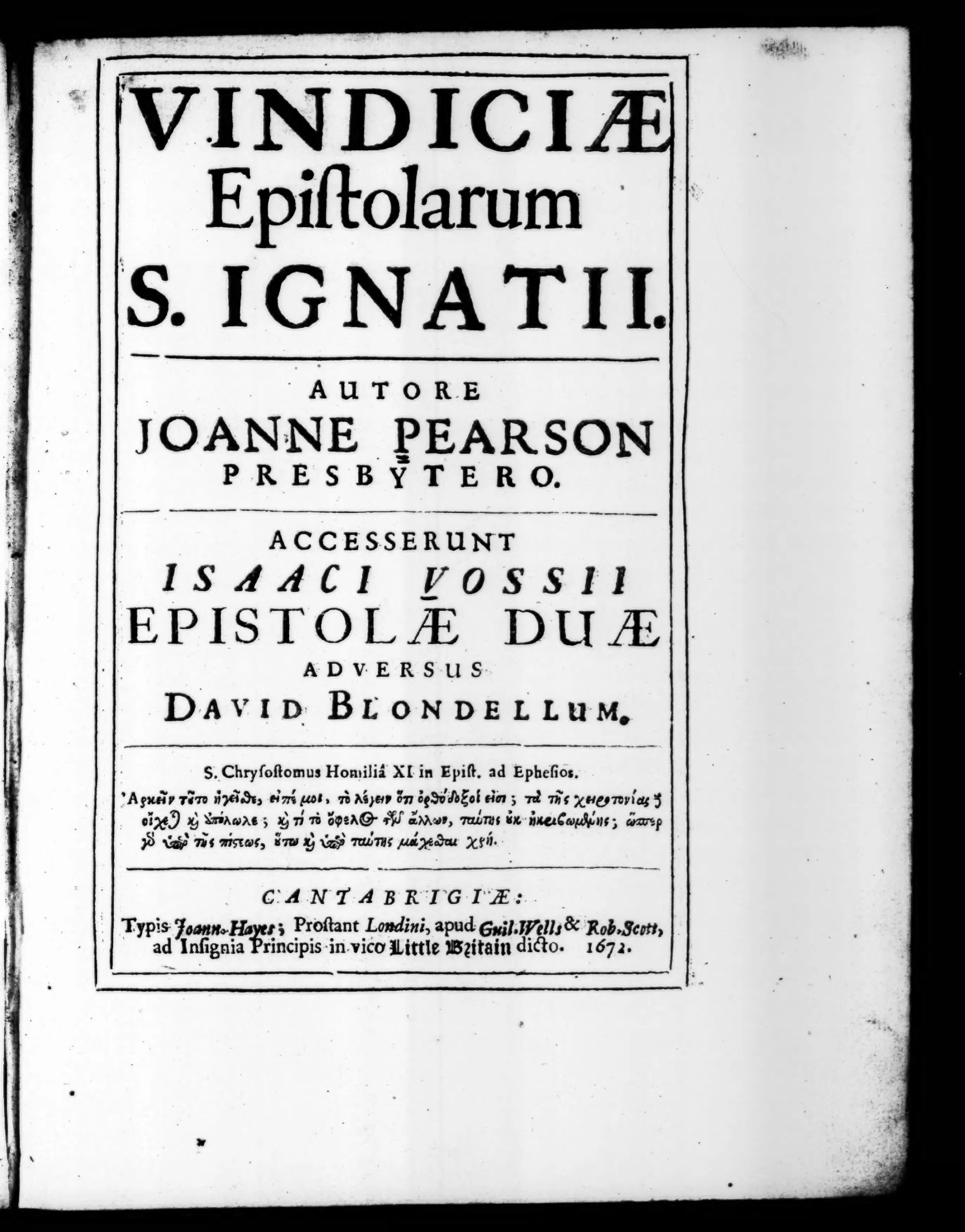
Pearson's title page fixes the volume's bibliographical coordinates: he is still named "presbytero," the Cambridge imprint identifies John Hayes and the London sellers Wells and Scott in Little Britain, and the date reads 1672. Its advertisement of Vossius's letters against Blondel and its Greek epigraph from Chrysostom frame the defence from the outset. Source ↗.
The question was never merely a bibliographical one, and Pearson does not pretend otherwise. The Ignatian letters supply the earliest surviving attestation of a differentiated threefold ministry of bishops, presbyters, and deacons; if they are spurious, the appeal to Christian antiquity on which the Church of England's order rested loses its oldest witness, and the Reformed case for original presbyteral parity — descending from Claude Saumaise's Walo Messalinus (1641) through Blondel's Apologia pro sententia Hieronymi (1646) to Daillé — gains its strongest support. The recurring move by which Pearson meets this pressure is a disciplined separation and successive exhaustion of two orders of proof. External testimony is assembled as a chronological catena running from Polycarp through the Greek and Latin Fathers to late Syriac and Arabic historians, and set against the adversaries' argument from silence; internal evidence then tests the letters themselves against chronology, heresiology, martyrological character, diction, and ecclesiastical nomenclature. Characteristically, he first concedes his opponents' criteria — that violated chronology or anachronistic vocabulary would indeed convict a text — and only then argues that the letters satisfy them. Equally characteristic is his insistence on keeping the vocabulary of falsification graduated: forger, interpolator, and translator are not interchangeable, and a demonstrated interpolation does not convict the text it was fastened onto.
Behind both tiers lies a third commitment that gives the work much of its methodological interest: the manuscript tradition, the versions in Old Latin, Syriac, Arabic, and Ethiopic, and the printed editions are treated as stages of a recensional history that must themselves be dated before any verdict on authorship becomes possible. Ussher's three recensions are replaced by a census of four ancient editions; the Codex Mediceus is weighed against the commonly circulating Greek copies; rubricated interpolations are identified as such rather than allowed to contaminate the whole. The evidentiary field is unusually wide for a Restoration patristic dissertation: alongside Polycarp, Irenaeus, Origen, Eusebius, and Chrysostom stand Bar Hebraeus, Saʿīd ibn Baṭrīq, al-Makīn, and Ibn Zurʿa, the last reaching Pearson through the Oxford Arabist Edward Bernard, together with epigraphic and numismatic exhibits and a chapter of Greek lexicography in which even the word leopardus is pressed into service as a dating lexeme.
What is most memorable about the volume is the way its learning and its ecclesial situation interpenetrate. The dedication stages Ignatius as an archbishop fleeing to an archiepiscopal see for asylum — a conceit built on the appeal of Anastasius of Antioch to Gregory the Great — and speaks of enmities bred by "the most sorrowful times," a phrase that gestures at the Interregnum and the settlement of 1662 without naming either. A Greek epigraph from Chrysostom stands on the title page. The book's internal architecture is elaborately articulated: dedication, Ad Lectorem, a six-chapter Prooemium narrating the rise, progress, and present state of the controversy in publication order, Part I on external testimonies, Part II on internal proof, Addenda et Interserenda, Corrigenda, the Vossius–Blondel correspondence with counter-notes, and an analytical Elenchus Capitum. Some of the volume's basic particulars remain unsettled. Its date is bibliographically unstable, with a 1671 line appearing in catalogue display against the 1672 of the imprint tradition; its collation and format are not established by the records so far consulted; and reports that the Vindiciae was reprinted within Cotelier's Patres Apostolici or within Migne's Patrologia Graeca have not been confirmed. No complete English translation has been located, and the 1852 Oxford reissue in the Library of Anglo-Catholic Theology is a Latin editio nova rather than a rendering.
One figure holds the work's vocabulary, its making, and its argument together: vindicatio, the legal action by which a thing wrongfully possessed is restored to its owner. The letters, on Pearson's reckoning, have been occupied by interpolators and impugned by critics; the monograph is the suit that returns them to the martyr who wrote them, filed before a metropolitan patron, printed with visible traces of correction and supplementation still in progress, and argued in a taxonomy of fraud borrowed in part from Roman law. Whether Pearson permanently settled the question he took up is not something the modern discussion concedes: the date and historical setting of the middle recension remain live, and Timothy Barnes and others have sought to move past the inherited terms of the dispute altogether. What the work did secure was a set of procedures — the calibration of silence, the detection of anachronism, the collation of Oriental versions, the discrimination among kinds of falsification — that could be, and later were, detached from the ecclesiological conclusion they were built to serve.
Read the full text and English translation on Leo
This text was transcribed and translated as part of the ExLatinis project, an effort by Leo to make free English translations of every text published in Latin in early modern Europe (1450–1750) available online. The complete transcription and English translation of this work can be read free of charge:
→ Read the original Latin text and full English translation on Leo
You can save a copy of this document into your Leo account to run deep text searches, conduct further analysis, or cross-reference it with your own research.
Rendering Vindiciae epistolarum S. Ignatii into English: Pearson's Legal Vocabulary of Forgery
The Latin short title Vindiciae Ignatianae is itself the settled scholarly designation in the modern historiography of the Ignatian controversy: Schaff writes of "Bishop John Pearson in his Vindiciae Ignatianae, 1672" as if he were naming a book with a proper title, and the Catalogue of the Bodleian's Early Collections records the title in the same Latin adjectival form under which it is requested from major libraries. For Anglophone readers, the conventional rendering is A Vindication of the Epistles of St. Ignatius, supplied here as an editorial English title adopted for convenience; no complete English translation of the Latin monograph itself has been located (see §2 on translation status).
The philological weight of vindiciae reaches well beyond the English "defence." In Roman legal usage vindicatio asserted a right against wrongful possession and sought the formal restoration of the thing or person to its rightful status. Pearson transports that juridical figure into the patristic arena: the genuine letters of Ignatius, in his reckoning, have been wrongfully occupied by interpolators and hostile critics, and the philological monograph is the act by which the corpus is restored to its rightful possessor, the bishop-martyr of Antioch. The dedication to Gilbert Sheldon, Archbishop of Canterbury 1663–1677, extends the figure into an ecclesial drama of the Restoration: Ignatius, the "Theophorus" carried before Rome, appears as one whose testimony is presented before a metropolitan patron after "the most sorrowful times" — a phrase that echoes the Act of Uniformity of 1662 and the Interregnum without ever naming them. The image of a Suppliant at Canterbury is interpretive reading of the dedication, but it accords with the work's language of restoration, defence, and rightful possession, and the dedication itself casts the martyr in precisely that posture: to your archiepiscopal see, therefore, an archbishop himself takes refuge, and begs this one thing, that he be not held for an impostor, Ad sedem igitur vestram Archiepiscopalem confugit ipse Archiepiscopus, & hoc unum efflagitat, nè pro impostore habeatur. The suit is thus filed on the martyr's behalf, and the single relief sought is the retraction of a name — impostor — whose technical force the following paragraph makes plain.
Pearson's philological critique also rests on a graduated vocabulary of textual corruption that must be kept analytically distinct. An impostor is one who knowingly assumes a false identity; a fictor fabricates; an interpolator alters an older text without necessarily composing any of it. The adjectives supposititiae ("supposititious," passed off under someone else's name) and adulterinae ("adulterated," contaminated with foreign matter) therefore do not collapse into a single undifferentiated "false." Stelliones — drawn from the Roman delict of stellionatus, fraudulent dealing concealed under shifting appearances — designates a kind of compounded deceit. Assumenta denotes additions fastened onto an older textual body. The taxonomy carries argumentative load because a charge of interpolation does not logically entail that every underlying Ignatian letter is fabricated; this distinction is the hinge on which Pearson's entire defence of the middle-recension core turns.
The temporal vocabulary is equally exact. Fides temporum names the credibility of a text's chronology and historical horizon; violatio temporum is not a misplaced date but a breach of the institutional, linguistic, doctrinal, or social conditions of the period in which a text claims authorship. Pearson grants the criterion in the strongest possible terms before applying it, conceding that nothing more certainly or more solidly proves a writing, or a narrative, spurious than the violated faith of chronology, Concedendum quidem est nihil certiùs aut solidiùs scriptum aliquod, aut narrationem spuriam probare quàm fidem temporum violatam — a concession that converts his opponents' sharpest instrument into a test the letters must be shown to survive. He treats anachronism — detected through ecclesiastical title, office, doctrine, or expression demonstrably belonging to a later age — as the strongest internal test of spuriousness even where a manuscript tradition is respectable. His handling of the argumentum negativum is more cautious than a naïve appeal to silence: absence becomes probative only when the witness could reasonably have known, had reason to mention, and belonged to a sufficiently long and continuous chain of testimony; the two-hundred-year rule associated with Jean de Launoy calibrates rather than absolutizes the inference, and Pearson takes care to quote the rule in its author's own formulation, that when no writer at all, contemporary or nearly contemporary, furnishes testimony, then an effective argument is drawn from the general silence, which may be reckoned at more or less two hundred years, Sed Launoyus ipse ita sententiam suam protulit, Cùm nullus omnino scriptor aqualis vel suppar præstat testimonium, tunc ex generali silentio, quod ducentorum plus minùs annorum æstimari potest, efficax depromitur argumentum, so that the condition of general silence is made to do the discriminating work. Positive testimony, especially Polycarp's notice of the letters he transmitted, is allowed to outweigh calibrated silence. It should be recorded, however, that the text's own concluding formula on this head is blunter than a calibrating rule would suggest: we pronounce that an argument drawn negatively from silence is of no force whatever, Argumentum à silentio negativè ductum nihil omnino valere pronuntiamus. The verdict is absolute in form, while the reasoning by which it is reached proceeds through the conditions Launoy himself had set.
The same philological discipline governs ecclesiastical vocabulary. Apocryphus, in Pearson's historical usage, marks exclusion from the scriptural canon and does not by itself pronounce a work forged — a contention that recasts the appeal to the Gelasian Decree that Jean Daillé's De scriptis had weaponized. The disputed Greek phrase νεωτερικὴ τάξις in Ad Magnesios is construed as the relative youth of a bishop, not as the novelty of the episcopate. The Ad Lectorem states both halves of the refusal in a single breath: neither point is to be conceded, not the first, because the author of the letter to the Magnesians, like that of the six others, was not an impostor but the true Ignatius, bishop of Antioch, as is proved throughout the work; nor the second, because that writer, whoever he was, never called episcopacy a new institution, since the word denotes not the newness of the episcopate but the youth of the bishop, Sed neutrum concedendum est; non primum, quia Author Epistolæ ad Magnesios, ut & sex reliquarum, non Impostor, sed verus Ignatius, Antiochiæ Episcopus fuit, ut toto hoc Opere probatum est; non secundum, quia Scriptor ille, quisquis fuit, Episcopatum novellam institutionem nunquam vocavit. Illa enim vox non novitatem Episcopatûs, sed juventutem Episcopi denotat — the second limb being framed so as to hold even if the first were surrendered, which is the same defensive architecture that governs the distinction between interpolation and fabrication. The opposing Saumur thesis, transmitted through Louis Cappel, converts a temporal adjective into an ecclesiological thesis about the late invention of differentiated order. Pearson's reading restores the term to the social and grammatical setting in which he believes the sentence was written. Terms such as novella institutio and paritas Presbyterana consequently carry the weight of the larger controversy: whether bishop, presbyter, and deacon go back to apostolic times, or whether Hieronymian parity was the original and Aërius of Sebaste merely its first named sectarian proponent.
The nomenclature question is where the vocabulary and the ecclesiology meet most directly, and Pearson does not soften the objection he must answer. He states his adversary's strongest case — the palmarium argumentum — in its own terms: the author of the Epistles uses the names presbyter and bishop otherwise than the apostles and apostolic men and their disciples, indeed uses them in the same way as Christians of the third and following centuries, Autor Epistolarum aliter usurpat nomina Presbyteri & Episcopi, quàm Apostoli & Apostolici viri, & eorum discipuli: imò eodem modo usurpat quo tertii sæculi & sequentium Christiani. Here the confusio nominum of the apostolic writings, in which episcopus and presbyter are not consistently distinguished, is turned into a chronological argument for late composition — precisely the violatio temporum charge, applied to ecclesiastical title rather than to event. The vocabulary is confessional and methodological at once — and this is precisely why the work has been read both as erudite confessional apologetic and as a genuine critical advance (see §3).
Pearson's Two-Tier Case for the Ignatian Letters in Brief
The work is a Latin two-part apologetic and philological monograph by the Cambridge theologian John Pearson (1613–1686), who would become Bishop of Chester in 1673. It sits at the intersection of three neighbouring seventeenth-century genres — the patristic dissertation, the animadversiones against a particular critic, and the confessional ecclesiological controversy over episcopacy — and adopts the learned apparatus of all three without being reducible to any one of them. Pearson's driving purpose is to defend the genuine core of the Ignatian correspondence, conventionally the seven-letter middle recension recovered by James Ussher and Isaac Vossius in the 1640s, against the doubts raised by the French Huguenot scholar Jean Daillé in his De scriptis quae sub Dionysii Areopagitae et Ignatii Antiocheni nominibus circumferuntur (Geneva, 1666).
The argument is organized in two tiers, and the division is announced as an exhaustive one: for establishing and confirming the authority of the Ignatian writings, or of any other ancient authors, only two kinds of argument can be brought — external, that is, or internal; of which the former are sought from testimonies, the latter from the writings themselves, Ad autoritatem enim Ignatianorum, aut aliorum quorumcunque veterum Scriptorum, asserendam confirmandâmque duo tantùm argumentorum genera afferri possunt, Externa scilicet, vel Interna; quorum priora ex testimoniis, posteriora è scriptis ipsis petuntur. Part I assembles external testimony century by century from Polycarp and other early Christian witnesses through the later patristic authors, working backwards from Vossius's Codex Mediceus. Part II turns to internal evidence: chronology, ecclesiastical nomenclature, heresiology, diction, imitation of apostolic forms, and the martyrial setting. On the external side, Pearson is able to record that his adversary has already yielded the decisive witness: we confess that Eusebius acknowledges those letters and holds them for truly Ignatian, nor do we dissemble that those of which he speaks appear to have been these very ones which circulate today under these names, Fatemur Eusebium illas Epistolas agnoscere, & pro verè Ignatianis habere: neq; dissimulamus eas de quibus ille verba facit has ipsas fuisse videri, quæ his bodie nominibus circumferuntur. On the internal side, the chapter on diction states its claim as a negative that admits no exception, that in the writer's diction nothing whatever is contained that suits the age of Ignatius less than that of Eusebius, ego verò asserendum esse non dubito in Scriptoris sermone nihil omnino contineri quod ævo Ignatiano minùs quàm Eusebiano congruat — the linguistic counterpart to the chronological test of fides temporum.
The appeal to Polycarp has a disjunctive form: either the letters Polycarp says he transmitted are the extant middle recension, or critics must identify another collection that fits Polycarp's notice — and the second disjunct is not, on the evidence Pearson assembles, supported. The inference is set out as a formal disjunction with its second limb eliminated: for either those letters which Polycarp published are these very ones which our side defends, or they were others and different from these; but others, and different from these, they were not; it remains, therefore, that they were these very ones, Aut enim illæ Epistolæ quas publicavit Polycarpus hæ ipsæ sunt, quas nostri defendunt, aut fuerunt aliæ & ab his diversæ. Sed aliæ, & ab his diversæ non fuerunt. Reliquum igitur est ut hæ ipsæ fuerint.
The language of composition is Latin, with extensive Greek quotation and with Syriac, Arabic, Ethiopic, and Old Latin materials brought into the evidentiary field. The printing is associated with Cambridge, John Hayes (University Printer 1669–1680), and London booksellers William Wells and Robert Scott, advertised at the sign of the Prince in Little Britain. The date is bibliographically unstable: the EEBO/MARC display at Michigan carries a 1671 publication line while the imprint date field and the title-page tradition support 1672. The responsible citation is therefore "1672," with the catalogue discrepancy recorded and not erased.
No complete English translation of Pearson's monograph has been located. The 1852 Oxford reissue by J. H. Parker in the Library of Anglo-Catholic Theology (volumes 69–70) is a Latin editio nova, not an English translation; William Cureton's 1846 Vindiciae Ignatianae is a separate English work defending the Syriac version of the Ignatian letters, not a translation of Pearson; J. B. Lightfoot's Apostolic Fathers, Part II (1885–1889), translates the Ignatian letters themselves, not Pearson's monograph. A possible reprinting of the Vindiciae within the Antwerp/Amsterdam Le Clerc re-edition of Cotelier's SS. Patrum qui temporibus apostolicis floruerunt opera, or within Migne's Patrologia Graeca vol. 5, could not be verified from the consulted OCR and contents; no column or page reference should be supplied for either.
Lightfoot introduces Pearson's Vindiciae as a "full and learned reply" to the objections against the Ignatian letters, and the modern chapter by Monfasani confirms the same characterization while placing the work in a long history of philological and epistemological dispute. The work is therefore best understood as erudite confessional philology whose procedures could be — and were — later detached from its ecclesiological conclusion.
Placing Pearson's Vindiciae in the Ignatian Controversy, from Daillé to Barnes
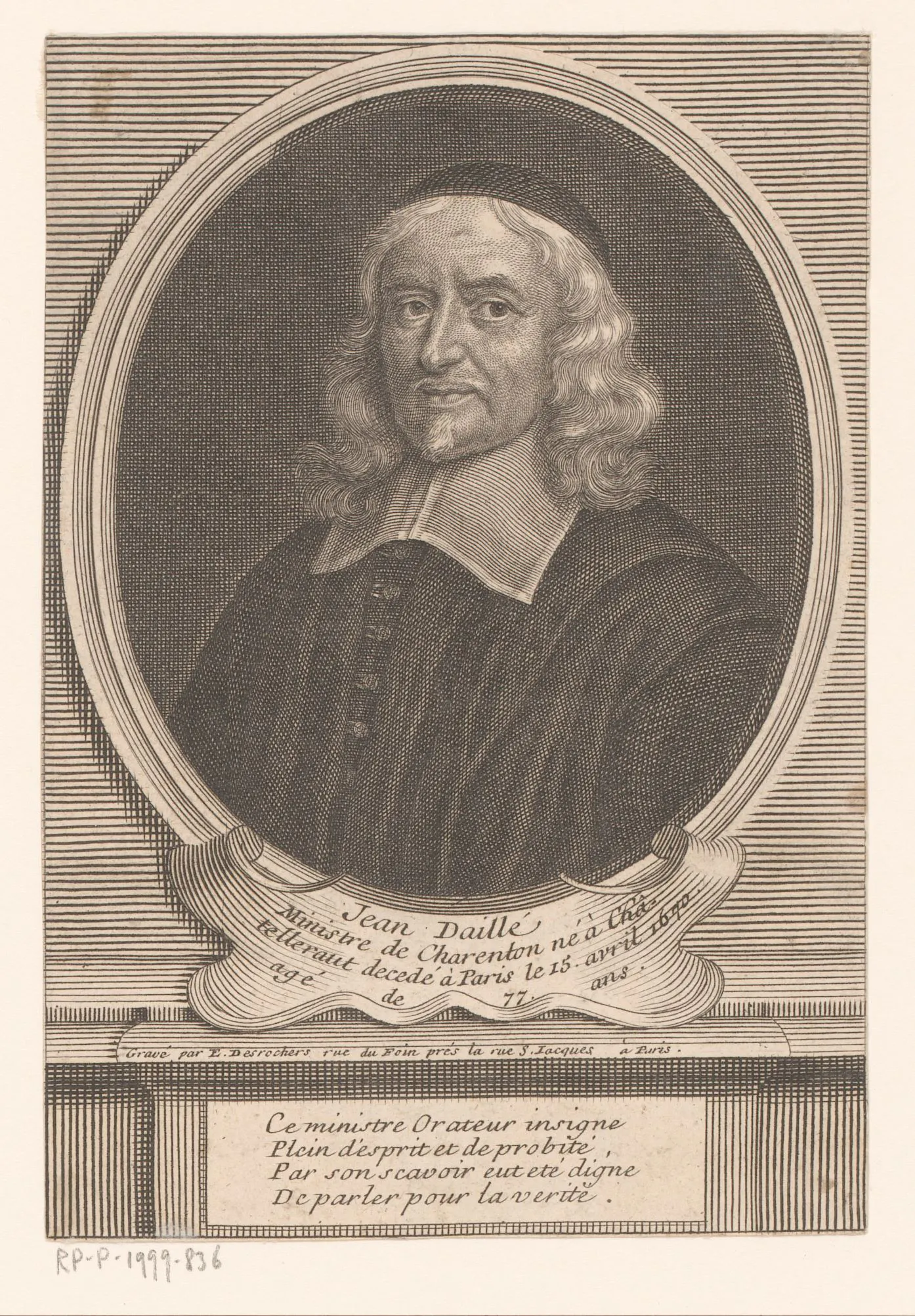
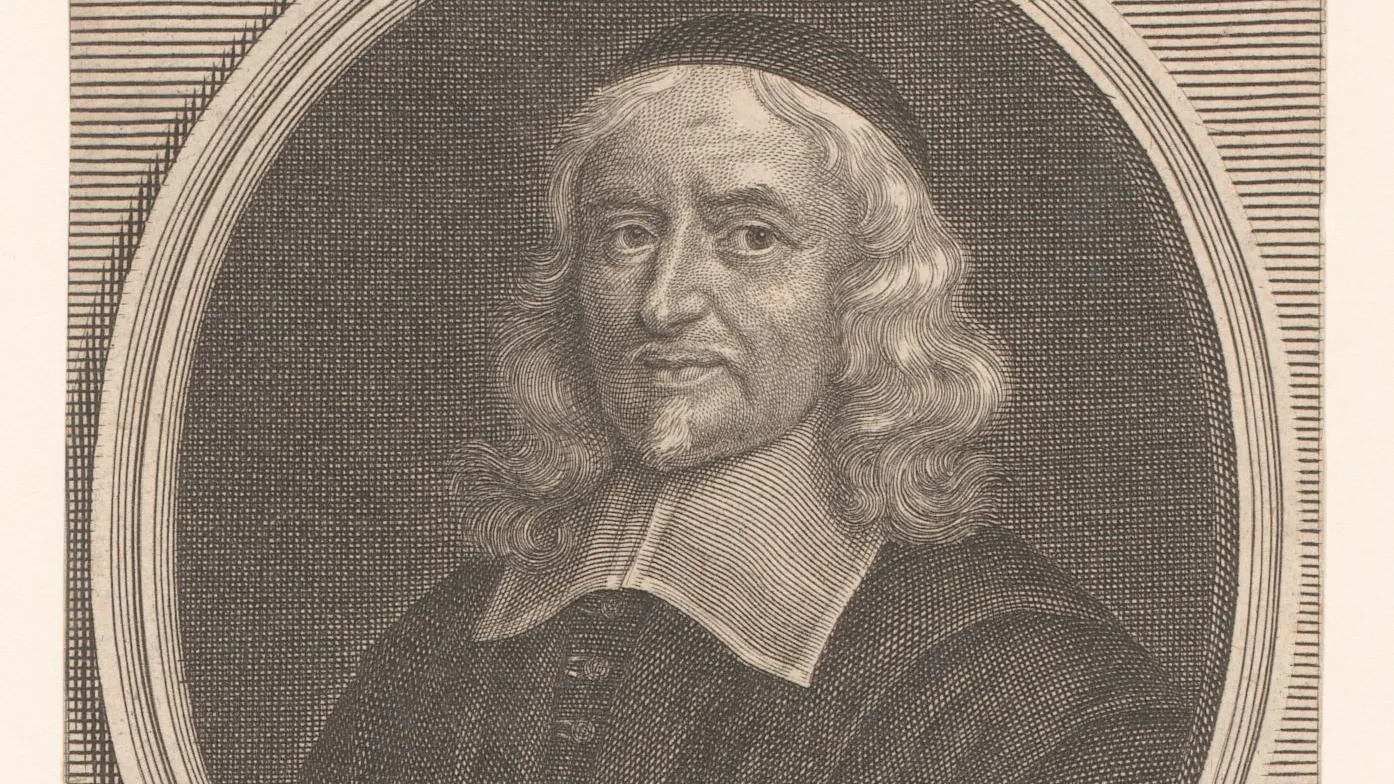
An engraved portrait of Jean Daillé, the Huguenot minister whose 1666 treatise on the Dionysian and Ignatian writings made him Pearson's principal antagonist. The Vindiciae was no abstract exercise in patristic chronology but a sustained chapter-by-chapter answer to a named and influential opponent. Source ↗.
The Vindiciae belongs to the Restoration effort, after the Act of Uniformity of 1662 and the end of the Interregnum, to make the Church of England's appeal to Christian antiquity credible through erudition. Its dedication to Gilbert Sheldon, Archbishop of Canterbury, locates the volume within the institutional world of Restoration episcopacy, but the argument is not confined to English ecclesiastical administration. The dedication also frames the indignity that, for Pearson, the whole dispute has produced — that letters written with utmost presence of mind in chains, among the hands of raging soldiers and the confinement of prisons, are rejected as if artless, Epistolas in vinculis inter ferocientium militum manus & carcerum angustias animo præsentissimo exaratas tanquam invenustas rejici — binding the martyrological character of the letters, which Part II will treat as internal evidence, to the suppliant posture of the dedication itself. Pearson mines Catholic, Reformed, Anglican, Greek, Syriac, Arabic, and Ethiopic witnesses and answers continental scholarship in the shared learned idiom of the transconfessional respublica litteraria. Its modern importance lies in the conjunction of confessional purpose with unusually explicit procedures for testing manuscripts, versions, chronology, ecclesiastical nomenclature, and calibrated silence.
The immediate controversy is shaped by the recovery of the middle Ignatian recension. James Ussher's Latin materials printed at Oxford in 1644 and Isaac Vossius's Greek edition from the Codex Mediceus in 1646 challenged the medieval long recension defended by Francisco Torres; Pearson explicitly takes Ussher's identification of interpolated material as the textual starting-point. Jean Daillé, De scriptis quae sub Dionysii Areopagitae et Ignatii Antiocheni nominibus circumferuntur (Geneva, 1666), supplied the immediate target, with its Stichometria argument, its deployment of the Gelasian Decree and of the category apocrypha, and its appeal to the argumentum negativum. Monfasani's Habent sua fata libelli chapter describes Daillé's treatise as the work to which Pearson's monograph replies, and Lookadoo's 2020 Church History article recovers Pearson's Vindiciae as a response to Daillé situated within the seventeenth-century British political-religious context. Pearson contends with the wider Reformed genealogy that runs from Claude Saumaise (writing as Walo Messalinus, De episcopis et presbyteris, 1641), through David Blondel's Apologia pro sententia Hieronymi (1646), to the Saumur reading of νεωτερικὴ τάξις in Ad Magnesios, and to the polemical construction of an Aëriana haeresis as the fabricated origin of presbyteral parity.
That last strand is pressed as a genealogical claim about the parity thesis itself: we shall find that the very first of all who advanced it in confirmation of his own view was the heretic Aërius, whose opinion, as soon as it was published, was at once exploded by St Epiphanius, primum omnium qui illam ad suam sententiam confirmandam protulit, Aërium hæreticum fuisse comperiemus: cujus sententia quamprimum publicata est à S. Epiphanio statim explosa est. The Hieronymian text on which the Reformed case chiefly rested is likewise reproduced and then read against its own grain, Jerome's report that it was decreed throughout the whole world that one chosen from among the presbyters should be set over the rest, to whom the whole care of the Church should pertain, in toto orbe decretum est, ut unus de presbyteris electus superponeretur cæteris, ad quem omnis Ecclesiæ cura pertineret. Against it Pearson marshals patristic testimony for apostolic-age gradation, including Theodoret, from whose view he draws the conclusion that in the Apostles' time there were three grades in the Church — bishops, then called Apostles; presbyters, called now bishops and now presbyters; and deacons, Unde apparet ex sententiâ B. Theodoreti, tempore Apostolorum tres fuisse gradus in Ecclesiâ, Episcopos, qui tum dicebantur Apostoli, Presbyteros, qui nunc Episcopi nunc presbyteri vocabantur, & diaconos — and the Alexandrian witness that since here too in the Church the progressions of bishops, presbyters, and deacons are, as he reckons, imitations of the angelic glory and of that dispensation, Quoniam & hîc in Ecclesiâ progressiones Episcoporum, Presbyterorum, & Diaconorum imitationes, ut arbitror, sunt gloriæ Angelicæ & illius dispensationis. The confusio nominum is thereby granted at the level of vocabulary and denied at the level of office — the same analytic separation of word from thing that governs Section 1's taxonomy of forgery.
The book matters for the history of criticism because it separates external from internal evidence without treating them as unrelated disciplines. External testimony includes Polycarp, Irenaeus, Origen, Eusebius, Chrysostom, and other witnesses; internal evidence tests nomenclature, diction, heresiological vocabulary, and imitation of apostolic forms. The stake of the exercise is stated in general terms that reach beyond Ignatius: nor will any reason be assignable why any work of an ancient writer should be held legitimate, if these, once duly proved, are repudiated, Neq[ue] aliqua ratio assignari poterit quare ullum antiqui scriptoris Opus pro legitimo habeatur, si hæc à nobis rite probata repudientur — an argument that the criteria proposed for rejecting the Ignatian letters, if applied consistently, would dissolve the transmitted corpus of classical and patristic literature entire. The same reductio is turned on the demand that ancient authors vouch for modern copies: which of the ancients ever said that the books we now possess were written by those to whom they are now ascribed, did any of them see our copies, could he know in any way what we in this age read, Quis unquam Veterum dixit eos libros, quos nunc habemus, fuisse ab illis scriptos quibus jam tribuuntur? An eorum quisquam vidit nostra exemplaria? an scire ullo modo potuit quid nos hac ætate legeremus?. A parallel manoeuvre exposes what Pearson takes to be a circularity in the hypothesis of a forger who worked from Polycarp's epistle: such a man could not learn from Polycarp's letter that some letters had once been written by Ignatius and at the same time insert into that letter the very words which indicate this, for if he himself first inserted them, they were not previously in Polycarp's letter, and therefore he could not learn it from there, non potuit ex Polycarpi Epistolâ discere, scriptas fuisse olim ab Ignatio aliquas Epistolas, & eidem ea verba, quæ hoc ipsum indicant, inferere. Si ipse primus ea inseruit, non igitur in Polycarpi Epistolâ priùs fuerunt quare inde discere non potuit.
The critique of the argumentum negativum is pursued as a matter of logic and not merely of evidentiary weight, the objection being that in this case the negative argument denies itself, for it is founded on general silence, but when either several or even one speaks, the silence is not general, Hoc quidem casu argumentum negans seipsum negat: fundatur enim in generali silentio; at cùm vel plures vel etiam unus loquitur, generale silentium non est. The corollary is that silence must also be weighed by the competence and date of the witness who keeps it, as in the comparison of a late Melkite chronicler with Bede: for that Arab was not only far younger than our Bede, and more remote from the origins of the Church, being born A.D. 876, while Bede's birthday is referred to A.D. 673, so that ours appears earlier by more than two hundred years, but was also far less equipped and less fit for unearthing and explaining the antiquities of his own Church, Arabs enim ille non tantùm Bedâ nostro longè junior fuit, & ab Originibus Ecclesiæ remotior, ( utpote qui natus sit A. D. 876, cùm natalis Bedæ dies ad A. D. 673 referatur, ut annis pluribus quàm CC noster superior appareat) sed etiam ad antiquitates Ecclesiæ suæ eruendas atque explicandas multò imparatior & ineptior erat. The two-hundred-year interval invoked here is the same measure Launoy's rule had proposed, redeployed to rank witnesses rather than to license an inference from silence. Conversely, the letters' own silences are turned into positive evidence of early date, since nothing about feasts, nothing about the fixed times of fasts, nothing about the manner of celebrating Easter, nothing about the observance of Pentecost or the Sabbath, nothing finally about any rite whose antiquity can come into controversy, does the writer transmit, Nihil de Festis, nihil de statis jejuniorum temporibus, nihil de more Paschatis celebrandi, nihil de Pentecostes aut Sabbati observatione, nihil denique de quocunque ritu, cujus antiquitas in controversiam venire potest, tradit — a forger with confessional interests, on this reasoning, would not have resisted the opportunity.
Documentary as well as literary exhibits enter the argument about nomenclature. The Hadrianic letter reporting the religious confusion of Alexandria is adduced for the early currency of Christian titles, in the terms that those who worship Serapis are Christians, and those who call themselves bishops of Christ are devoted to Serapis; there is no ruler of the synagogue of the Jews there, no Samaritan, no presbyter of the Christians, no mathematician, no soothsayer, no anointer, Illi qui Serapin colunt, Christiani sunt: & devoti sunt Serapi qui se Christi Episcopos dicunt. Nemo illic Archisynagogus Iudæorum, nemo Samarites, nemo Christianorum presbyter, non mathematicus, non aruspex, non aliptes. Judgements about books, too, are treated as a competence that ancient critics possessed and could exercise, Eusebius being credited with the discrimination to detect a recent fabrication had one been laid before him: was there nothing in the membranes, nothing in the writing, which might betray the novelty of the work, that a man most practised and most shrewd in matters of this kind could discover, Nihilne in membranis, nihil in scriptione, quod novitatem Operis detegeret, reperire potuit Vir in rebus hujusmodi exercitatissimus sagacissimusque?. The appeal to Oriental versions and to Arabic and Syriac historians shows that "antiquity" was not restricted to Latin and Greek ecclesiastical authorities. The treatment of the Constitutiones Apostolicae, the lost Didascalia Ignatii, and the Gelasian material illustrates the difficulty of distinguishing canon exclusion from transmission, from compilation, and from forgery.
J. B. Lightfoot's The Apostolic Fathers, Part II (1885/1889), is a major later critical successor to Pearson's work. The accessible evidence identifies Lightfoot as presenting Pearson's book as a "full and learned reply" to the objections against the Ignatian letters. The exact wording of any further received estimate of Pearson's polemical mastery or of Lightfoot's methodological indebtedness could not be securely recovered from the consulted text and should not be quoted as more than the extract establishes. Lightfoot's part of The Apostolic Fathers is not an English translation of Pearson's monograph.
Jean-Louis Quantin's The Church of England and Christian Antiquity: The Construction of a Confessional Identity in the Seventeenth Century (Oxford, 2009) demonstrates that Anglican appeals to the Fathers were deeply involved in confessional identity and polemic rather than being neutral antiquarianism. That framework illuminates Pearson's dedication, his defence of differentiated orders, and his simultaneous deployment of rigorous erudition. A precise Pearson-specific passage could not be verified in the consulted reviews and chapter previews. Dmitri Levitin's Ancient Wisdom in the Age of the New Science (Cambridge, 2015) supplies the broader intellectual history of late-seventeenth-century English learning, the relationship between patristic scholarship, philology, and historical reasoning; a detailed treatment of the Vindiciae could not be located from the consulted material. Anthony Grafton's Forgers and Critics (Princeton, 1990) helps clarify why Pearson's distinctions among fabricator, impostor, and interpolator are historically meaningful, though it is not a monograph on Pearson.
John Monfasani's chapter "The Letters of Ignatius of Antioch as a Philological and Epistemological Issue from the Reformation to Today," in Habent sua fata libelli (Brill, 2021), is the most directly relevant modern secondary study located and presents Pearson "incomparably" as an exceptionally important contribution to the long Ignatian dispute. Jonathon Lookadoo's 2020 Church History article explicitly treats Pearson's whole book as a response to Daillé and identifies the sixth chapter of Pearson's Prooemium as a summary and counterargument; Lookadoo makes clear that British arguments about Ignatius were entangled with debates over ecclesial government and the political experience of the seventeenth century.
The modern dating debate should not be reduced to a list of unverified positions. Timothy D. Barnes's 2008 Expository Times article, "The Date of Ignatius," explicitly seeks to move beyond the inherited terms of the dating and authenticity debate. Reinhard M. Hübner, Thomas Lechner, Otto Zwierlein, Allen Brent, Markus Vinzent, Andreas Lindemann, Mark J. Edwards, Paul Foster, and Michael W. Holmes together constitute the live discussion named in the scholarship, but individual arguments and datings were not independently confirmed in the consulted sources. The live disagreement concerns the date and historical setting of the middle recension, the evidentiary value of later witnesses, and the extent to which a stable recension can be defended without accepting every traditional attribution. It is therefore safer to say that Pearson stabilized a powerful seventeenth-century case than to say that he permanently settled the modern question.
The historiographical choice between "confessional apologetic" and "critical advance" is false if treated as exhaustive. The confessional reading is supported by the dedication to Sheldon, the defence of episcopal distinction, the attack on Reformed uses of Jerome and Aërius, and the insistence that Christian antiquity vindicates the Church of England's order. The methodological reading is supported by the separation of external and internal evidence, the insistence that silence be calibrated, the use of versional and Oriental materials, the detection of anachronism, and the distinction among kinds of falsification. The two readings meet in the paradox with which the work closes, addressed to those who would surrender the letters in defence of presbyteral parity: they will not find in any truly ancient writer outside these letters so many and so great encomia of the presbyterate, nor will they anywhere find that order's honour established without the prerogative of episcopacy, neque enim in ullo verè antiquo scriptore extra has Epistolas tot ac tanta presbyteratûs præconia invenient, neque illius ordinis honorem sine Episcopatûs prærogativâ ullibi constitutum reperient. Pearson's criticism is best understood as confessional scholarship conducted through procedures that could be, and later were, detached from his ecclesiological conclusion.
Printing, Recensions, and Surviving Copies of the Cambridge 1672 Vindiciae
The principal digital witness is the EEBO-TCP item, whose catalogue record runs in the P-series as Wing P1010 and whose imprint reads "Vindiciae epistolarum S. Ignatii autore Joanne Pearson. Accesserunt Isaaci Vossii Epistolae duae adversus Davidem Blondellum". The EEBO record at Michigan represents the source as a reproduction of the copy from Union Theological Seminary Library, New York, and gives the microfilm location as reel 797:35 of Early English Books, 1641–1700. The Oxford Text Archive XML records the imprint, the Pearson authorship, and the appended Vossius–Blondel letters. The catalogue extent is recorded as "[21], 29, [3], 110, [2], 221, [7], 36, [14] p.," a sequence of separately paginated components and not a reliable basis for collapsing the book into a single unqualified page count. Google Books reports 496 pages, but that figure conflicts with the detailed MARC extent and should not replace it without examination of a physical copy. No ESTC R-number beyond the cited catalogue of R16166 / 13617723 / 100789 in the EEBO/MARC metadata was independently verified, and no USTC or WorldCat record was located at this depth of searching.
The imprint tradition reads: "CANTABRIGIAE: Typis Joann. Hayes; Prostant Londini, apud Guil. Wells & Rob. Scott, ad Insignia Principis in vico Little Britain dicto. 1672". The EEBO/MARC display at Michigan also carries a "1671" publication line, while its date field and the title-page tradition support 1672. A bibliographical description should therefore print 1672 and record the 1671 catalogue variant rather than silently selecting one. John Hayes was University Printer at Cambridge from 1669 to 1680; his involvement is institutionally and chronologically consistent with the imprint. The title page advertises Isaac Vossius's two letters against David Blondel, printed with Pearson's interleaved counter-notes. A Chrysostom Greek epigraph stands on the title page; the dedication to Sheldon is visible in the EEBO contents. No confirmed Cambridge University Press licence or formal imprimatur was located in the consulted records; no verified variant state or separate issue of the Vossius–Blondel letters was documented.
The internal arrangement is unusually legible even where the physical collation remains unresolved: dedication; Ad Lectorem; Prooemium (headed De Ortu, Progressu, Et Hodierno Statu Controversiae); Part I on external testimonies; Part II on internal evidence; Addenda et Interserenda; Corrigenda; the Vossius–Blondel correspondence with counter-notes; an analytical Elenchus Capitum. The original format is customarily described as quarto, but the consulted catalogue and OCR do not establish the format, signature statement, catchwords, or full collation. The Addenda and Corrigenda demonstrate active correction and supplementation during the printing of the object; they do not, without comparison of copies, prove variant states. No evidence of suppression, censorship, or loss was located.
The textual history that the work itself reconstructs is a history of recensions rather than of copies, and its aim is stated as a convergence of transmission with authorship: that we at last have the same letters which Eusebius had, which Polycarp published, which Ignatius wrote, easdem Epistolas tandem nos habere quas habuit Eusebius, quas edidit Polycarpus, quas scripsit Ignatius. Within that programme Ussher's three recensions are replaced by a census of four ancient editions; the Codex Mediceus is set against the commonly circulating Greek copies; and the rubricated matter of the interpolated tradition is identified as miniata so that additions can be separated from the body they were fastened onto — the codicological application of the distinction between interpolator and fictor. The editorial rule Pearson derives from this is a rule of documented consensus, that it is a most equitable demand that those things be held as the words of the author of the Epistles which are acknowledged by all Greek exemplars and the ancient excerpts, & æquissima postulatio est, ut ea pro verbis Epistolarum Autoris habeantur, quæ ab omnibus Græcis exemplaribus, & veteribus Excerptis agnoscuntur — a criterion that places the burden of proof on the party alleging corruption in a unanimously attested reading.
The only physical holding directly verified is the Union Theological Seminary Library copy represented by EEBO and by the Ohio State Library record of the microform reproduction under Z2002.W76 E242 Microfilm. No full shelfmarks for Cambridge University Library, Trinity College Cambridge, the Bodleian's physical collections, the British Library, Lambeth Palace Library, or major Continental or North American holdings were retrieved. The Bodleian "A53901" record is a digital repository record, not a verified physical shelfmark.
The 1852 Oxford item issued by J. H. Parker in the Library of Anglo-Catholic Theology (volumes 69–70) is a Latin editio nova, not an English translation. The claim that Pearson's monograph was reprinted in the Antwerp or Amsterdam editions of Cotelier's Patres Apostolici or in any Le Clerc re-edition could not be confirmed; the Catholic Encyclopedia entry that links Pearson with the Le Clerc edition reports that the 1724 Le Clerc Patres Apostolici contains the Ignatian letters themselves, not necessarily Pearson's Vindiciae. Patrologia Graeca vol. 5 (1857) is a collection of ancient Ignatian and related texts; the consulted OCR and contents did not verify Pearson's Vindiciae as a reprint within it, and no column reference should be supplied. The apparent association may result from conflation of Pearson's arguments with the ancient texts reproduced by Migne.
Pearson's collaborative network is visible in the work's engagement with Daillé, Saumaise, Blondel, Cappel, Launoy, Ussher, Vossius, and the ancient heresiologists (Aërius, Valentinus, the Docetae, the Ebionites). The dedication to Sheldon seeks or acknowledges the protection of the Restoration archiepiscopal establishment, although financial or commissioning patronage cannot be inferred from the dedication alone; its juridical figure of a suppliant seeking recognition rather than favour is consistent with that reading. Edward Bernard, John Fell, and Oxford Oriental scholarship are important contextual names, and the catena of external testimony reaches its latest Arabic witnesses by way of Bernard, but specific personal contributions or correspondence connected with this volume were not independently documented. A complete chain of Continental Reformed replies, Roman Catholic responses, or direct engagements by Henry Dodwell, William Whiston, John Toland, Richard Bentley, and Nathaniel Lardner was not recovered; those figures should therefore be treated as possible reception contexts rather than as documented participants in a verified reply sequence.
The Vindiciae stands beside Pearson's An Exposition of the Creed (1659) and the Opera posthuma chronologica (1688) edited by Henry Dodwell. Across these writings, the recovery of early Christian testimony depends on historical ordering, textual discrimination, and continuity of ecclesial teaching. The relationship to the Exposition is best described as one of ecclesiological continuity: the Vindiciae supplies a historical and philological defence of apostolic order, while the Exposition presents doctrine in a more systematic catechetical form. No evidence was located to show that the Vindiciae was formally designed as a companion volume to the Exposition.
Following Pearson's Argument from the Dedication to the Vossius–Blondel Letters
The Dedication and the Address to the Reader
The volume announces its jurisdictional figure before it argues anything. Pearson's dedicatory epistle to Gilbert Sheldon is built on a piece of sixth-century epistolary history: Anastasius of Antioch had closed a letter to Gregory the Great with Ignatius' own subscription, and Gregory returned the martyr with the observation that he was not only the Antiochene's but Rome's as well, so that the patriarchs of East and West contended with one another over the same saint. Out of that ancient rivalry of honour Pearson fashions a Restoration conceit in which the martyr, no longer disputed between sees but disowned by critics, presents himself at Canterbury as a petitioner, taking refuge at an archiepiscopal see as an archbishop himself and begging, in the plea quoted earlier, this one thing only: that he be not held for an impostor. The verb confugit belongs to the law of asylum and efflagitat to the language of formal demand; what is sought is not favour but the retraction of a name, and the relief requested is negative — the removal of a title of infamy rather than the grant of an honour. The dedication accordingly does not ask Sheldon to pronounce on manuscripts. It asks him to receive a suppliant of equal rank, which is itself an ecclesiological claim smuggled into a courtesy: Ignatius is presented already vested as Archiepiscopus, the very status that the letters are being adduced to prove.
The Ad Lectorem narrows from the whole controversy to a single Greek phrase, the νεωτερικὴ τάξις of Ad Magnesios, on which a thesis defended at Saumur under Louis Cappel had rested an inference to the novelty of episcopal order. Pearson's reply proceeds on two independent levels, and the architecture matters more than either limb: he denies that the letter is spurious, and denies separately that the phrase, even in a spurious letter, would bear the ecclesiological weight placed on it. The second denial is where the preface expends its philology, assembling glossaries, Aristotle, Basil, Philo and Chrysostom, the Old Latin, Syriac, Arabic and Ethiopic versions, and the Latin and Greek commentators on 2 Timothy 2:22, to establish that νεωτερικός means juvenilis. But before the lexical dossier he deploys an argument from dramatic coherence directed at the forger himself: for neither Ignatius himself, nor any sane man under his persona, would have discoursed on the newness of the episcopate, in which he had himself already grown old, Neque enim ipse Ignatius, neque sanus quisquam sub illius personâ, de novitate Episcopatûs disseruisset, in quo ipse jam consenuerat. The move is characteristic of Pearson's handling of the impostor hypothesis throughout: the hypothetical falsifier is granted the minimum competence required for his fraud to have succeeded, and is then found to have behaved in a way incompatible with that competence. A forger able to persuade Polycarp's readers would not have let his persona confess the recency of the office that persona holds. The impostor is thus made to fail by the standard his own postulation requires.
The preface closes on a metaphor with a Reformed pedigree deliberately turned. Larva, the stage-mask, was Calvin's own term for spurious patristica paraded as antiquity; Pearson predicts that controversy will improve once its questions are stripped bare, disputes being pudendo / Impostorum patrocinio nudata, & fictâ Antiquitatis larvâ spoliatæ, divested of the shameful patronage of impostors and stripped of the counterfeit mask of Antiquity. The image cuts both ways by design: those who defend forged texts and those who convict genuine ones of forgery are alike wearing or imputing a mask, and the cure in both cases is the same documentary undressing.
The Prooemium and the Controversy Narrated in Publication Order
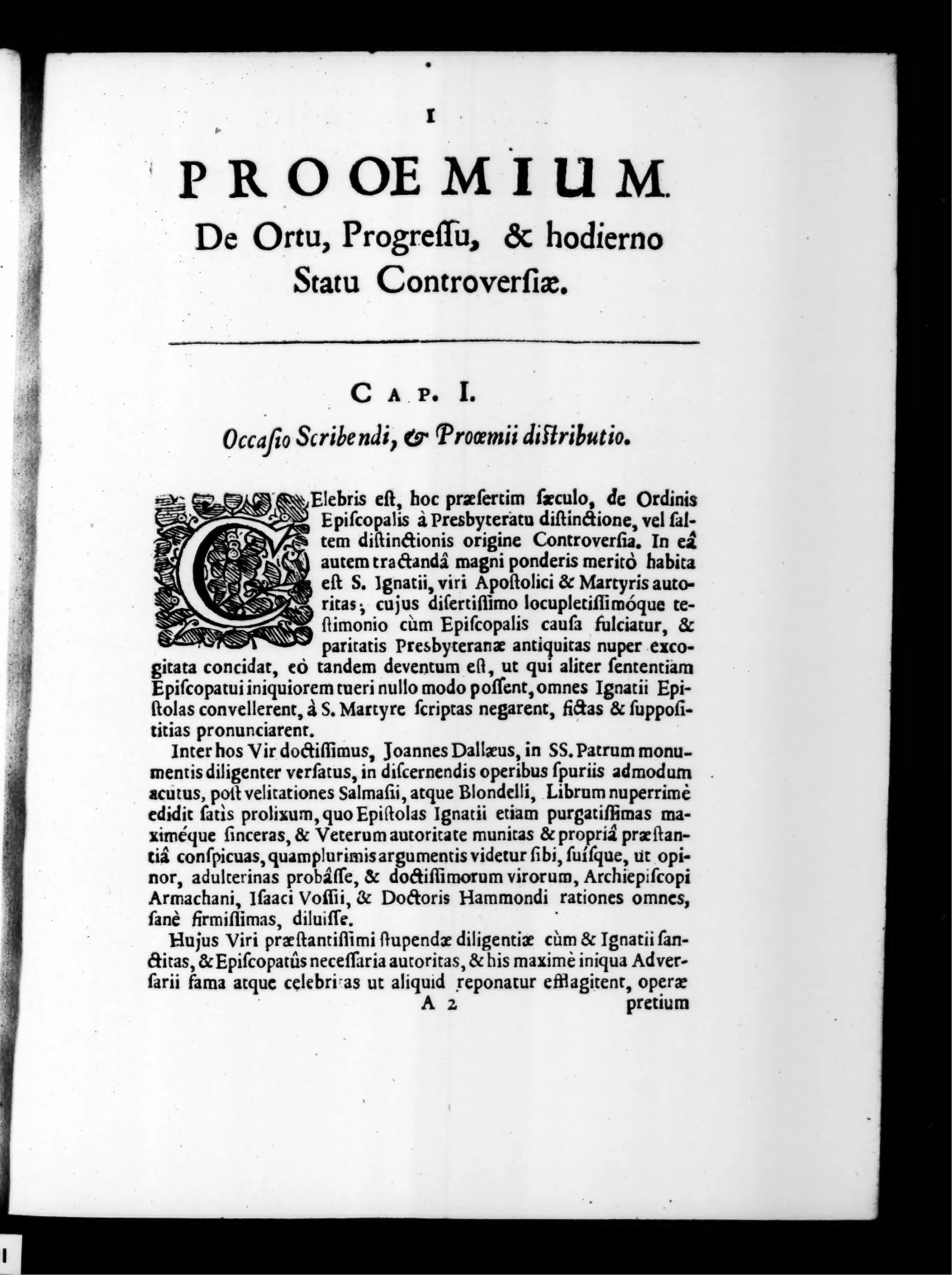
The first page of Pearson's Prooemium, headed "De Ortu, Progressu, & hodierno Statu Controversiæ," announces a work organized as a history of the Ignatian controversy rather than a narrowly textual rebuttal. Its opening chapter places Daillé after Salmasius and Blondel, tying the letters' authenticity to the defence of apostolic episcopal order. Source ↗.
The Prooemium then supplies what is arguably the volume's most durable methodological gesture: a six-chapter history of the dispute, reporting each opinion in the order in which it was published and pairing it with the edition its author could have consulted. The diagnosis with which it opens is frankly motivational — the letters were torn apart, Pearson holds, because a view unfavourable to episcopacy could be sustained no other way — but the narrative that follows answers motive with bibliography. Hostile testimony is quoted intact and then dated rather than suppressed. Calvin's celebrated contempt is reproduced whole, with its demand that those who allege Ignatius first prove the apostles legislated about Lent, since nothing is more insipid than what has been published under Ignatius' name, Ignatium quod obtendunt, si v. lint quicquam habere momenti, probent Apostolos legem tulisse de Quadragesimâ, & similibus corruptelis; nihil enim nanius illis, quæ sub Ignatii nomine editæ sunt, putidius. Pearson does not soften the verdict; he historicizes it. Calvin was reading the interpolated Latin corpus and reacting to Antitrinitarian use of the letter to the Tarsians, not to the seven letters Eusebius knew — so that the most damaging Reformed judgement, once located in the editions available to it, becomes evidence about the state of the text in the 1540s rather than about Ignatius. The chronological ordering of opinions is thus not antiquarian courtesy but an argumentative instrument: a censure can only bind the text its author actually saw.
The same catalogue exposes what Pearson takes to be a telling coincidence in the opposing camp. He quotes Salmasius' dating without comment on the motive, letting the two clauses of the sentence do the work: those letters seem to have been born and foisted about the beginning or middle of the second century, at the time when the first single episcopate above the presbyterate was introduced, Epistolæ illæ natæ & suppositæ videntur, circa initium, aut medium secundi sæculi, quo tempore primus singularis Episcopatus supra Presbyteratum introductus est. The date assigned to the forgery is identical with the date the same scholar assigns to monepiscopacy, and the identity is not accidental but structural: the forgery must be dated wherever the institution is dated, because the letters are the institution's earliest witness. Pearson's later insistence that his adversaries cannot agree whether their impostor belongs to the second, third, or fourth century draws its force from this observation — a construct whose century floats with the polemical need of the scholar positing it is, on his reckoning, not a historical person at all.
Against that floating figure he sets Ussher's editorial achievement, described in the vocabulary of vermin and patchwork that governs his whole account of interpolation: the primate, he writes, separated the graftings of the stelliones from the genuine matter easily and openly, assumpta stellionum à genuinis / facilè & apertè secrevit. Stellio, the gecko and thence the cheat of the Roman delict stellionatus, names a fraud that works by shifting appearance, and assumenta are patches sewn onto an existing garment: the metaphor presupposes exactly the distinction on which the defence depends, since a patch implies a body it was fastened to. Interpolation, so figured, testifies to the antiquity of what was interpolated. Pearson's own positive thesis is stated in the same key, both authenticity and worth being asserted at once, that he acknowledges not merely that Ignatius wrote some letters but asserts that these very letters, mentioned by Eusebius and in every way worthy of so great a man, were penned by the martyr himself, tùm aliquas Epistolas agnosco, sed & has ipsas, ab Eusebio memoratas, & tanto Viro usquequaq; dignissimas, ab ipso Ignatio, sanctissimo illo Martyre, exaratas fuisse assero. The coupling of dignissimas with authenticity is not ornamental: since the critics' stylistic objection is that the letters are unworthy of an apostolic man, worth and genuineness must be defended together.
Recensional history is where Pearson makes his own contribution rather than adjudicating others'. On the strength of a privately communicated Greek exemplar of the seven letters in interpolated form he revises the received census, holding that in place of Ussher's three, four different editions of Ignatius once existed, Hanc ego Editionem peculiarem & ab aliis distinctam invenio, ideóque pro tribus Usserii quatuor diversas Ignatii Editiones olim obtinuisse statuo. The gain is precise: a fourth edition explains why the letter to Polycarp appears interpolated in some witnesses and clean in others, and so removes the ground for detaching it from the Eusebian seven. The history of editions, dated in its own right, becomes a premiss in the argument about authorship rather than a preliminary to it.
Part I: External Testimony and the Chain of Witnesses
Part I then converts the adversary's candour into the pivot of the external case. The concession recorded earlier is Daillé's own — that Eusebius acknowledges the letters and holds them genuinely Ignatian, and that those he speaks of appear to be the very ones now circulating — and once the extant text is identified with the Eusebian text, every forgery must be pushed behind Eusebius, and the further back it is pushed the nearer it comes to the witnesses, Polycarp and Irenaeus, whom the catena is assembled to marshal.
Against Daillé's chief documentary exhibit, the Stichometria listing "Ignatius" among New Testament apocrypha, Pearson refuses the merely negative reply. Having denied the list to the patriarch Nicephorus and drained apocrypha of any verdict beyond exclusion from the canon, he supplies a positive referent: he concludes that in the Stichometria objected against him the name of Ignatius set among the apocrypha of the New Testament does not denote Ignatius' Epistles, Concludo itaque in Stichometriâ nobis objectâ ἐγνατίε nomen inter libros Novi Testamenti Apocryphos positum, non denotare Ignatii Epistolas, the referent being instead a lost Didascalia Ignatii, one of the family of pseudo-apostolic Didascaliae and Diataxeis out of which the eight books of the Constitutiones Apostolicae were compiled. The reasoning behind the substitution is chronological: letters written in transit after the apostles were dead could never have been candidates for canonical status, and so could not appear on a list of near-canonical rejects at all.
The defence of Polycarp's testimony proceeds in the register of the courtroom. Daillé had excised the letter's final section on the ground that a decorous closing formula stands just before it; Pearson reduces the criterion to its implied premiss with mock syllogistic solemnity, that in Daillé's judgement the clause was most decorous, therefore Polycarp ought to have added nothing further, therefore the letter ended there, since it is not to be supposed that Polycarp wished to write more than Daillé would permit, Iudicio Jo. Dallæi ea clausula erat decentissima: quare non debuit Polycarpus plura addere: igitur in ea verba desinebat Epistola. Neque enim putandum est Polycarpum plura scribere voluisse, quàm permitteret Dallæus. The sarcasm carries a methodological charge, since the parallels immediately adduced from Romans, Ephesians and Clement show that apostolic and sub-apostolic letters regularly resume after a valedictory formula. What is at stake is the status of the critic's aesthetic intuition as evidence: a sense of what an ancient writer ought to have found sufficient is here made to yield, in Pearson's presentation, a conclusion about what he wrote — and it is precisely that inference, rather than any particular verdict on Polycarp's last chapter, that the ridicule is designed to disqualify.
The running heads that alternate across these chapters keep the juridical register of the whole enterprise audible on every opening — Testimonium S. Polycarpi set against ab exceptionibus vindicatur, Testimonium S. Irenæi against ab objectionibus liberatur, Eusebii autoritas against defenditur, and finally Argumentum Negativum against refutatur — so that the Fathers appear less as sources than as witnesses whose competence is under challenge and whose depositions must be cleared of imputation one by one. The procedure is correspondingly forensic. Pearson's first care in closing the defence of Polycarp is not to vindicate the Epistle to the Philippians entire but to reduce the contested ground to precisely those words Eusebius transcribed, observing that the words we adduce, transcribed by Eusebius from Polycarp's letter, indicate neither that Ignatius was then alive nor that he was dead, and make no mention of life or death, but indicate only letters first requested, then sent, which could be both requested and sent whether Ignatius were living or dead, Verba quæ producimus ab Eusebio ex Polycarpi Epistolâ transcripta nec Ignatium tunc temporis in vivis, nec mortuum fuisse significant, nec vitæ aut necis mentionem ullam faciunt: Epistolas tantùm primò petitas, dein missas indicant, quæ gnatio vel vivente vel mortuo & peti & mitti potuerunt. The tactic is deliberately minimalist: the alleged mendacii vestigium is located in a continuation Pearson does not need, and the citation on which he does rely is shown to assert nothing chronologically compromising at all. It is the same discipline that governs his refusal to let a demonstrated interpolation convict the body it was fastened onto, applied here at the level of the single sentence.
Having secured the integrity of the quoted window, Pearson marks the pivot explicitly, and these things concerning the credibility of the testimony; now the force of the testimony must be treated, Atque hæc de fide: nunc de vi Testimonii agendum est. The distinction between fides and vis is the analytic instrument that organises the entire external tier: a testimony may be textually sound and yet fail to reach the disputed proposition, and Daillé's concession that Polycarp attests some Ignatian letters while denying that they are these exploits exactly that gap. Pearson's answer is to convert the gap into an unsatisfiable demand — no ancient witness ever inspected a modern copy — and then to close it positively by the disjunctive syllogism already noticed: either the letters Polycarp published are the extant seven, or they were others; they were not others; therefore they are the extant seven. The whole weight falls on the minor premise, and the argument that carries it is itself an argument from silence: but if we consult the books of all Christians through three centuries, not only after Ignatius' but also after Polycarp's death, we shall find that no mention was ever made of any letters of Ignatius other than those we possess, so that it is manifest there never were others, At si omnium Christianorum per tria sæcula non tantùm post Ignatii, sed & Polycarpi mortem, libros consulamus, nullam aliarum, quàm quas nos habemus, Ignatii Epistolarum mentionem unquam factam inveniemus. Alias igitur nunquam fuisse. The manoeuvre is knowingly reciprocal rather than inconsistent: Daillé and Ussher had inferred the non-existence of the six additional epistles from the silence of Eusebius and Jerome, and Pearson claims only the same licence for the non-existence of an alternative collection, insisting that his silence is general in Launoy's precise sense while his adversary's is punctuated by affirmative witnesses. The symmetry is the strongest and the most exposed feature of this part of the book, since it commits him to a criterion he will shortly labour to restrict.
The Irenaean chapter turns on closing a single escape route. If the celebrated sentence about being ground by the teeth of beasts circulated as a detached maxim, Irenaeus need never have read the Epistle to the Romans, and the earliest link in the catena dissolves. Pearson therefore makes the point empirically rather than by assertion, explaining that they are in the Letters and nowhere else in the most ancient monuments, not even in modern ones except when transcribed from the Letters, and that not one single apophthegm of Ignatius is recorded by the ancients, quia sunt in Epistolis, alibi in antiquissimis monumentis nusquam; ne quidem in modernis, nisi quando ex Epistolis transcripta. Ne unum quidem Ignatii apophthegma à Veteribus memoratum est. The apophthegma is exposed as a category imported from Maximus the Confessor and unattested for Ignatius, which allows Pearson to spring the trap he most enjoys, that when Daillé disputes against our side he is Maximus, and when he disputes against Maximus he is entirely ours, Nam cùm Dallæus contra nostros disputat, Maximus est; cùm adversus Maximum, planè noster est. The epigram is more than a debating flourish: it registers Pearson's steady conviction that his opponent's criteria are not stable across cases, and that a critic who denies the Areopagitica by one standard and the Ignatiana by another has no standard at all.
The same chapter yields his most exact piece of source criticism, directed not at an adversary but at a Father whose report threatens the argument. Conceding that Jerome places the words on Ignatius' lips as he heard the lions roaring, Pearson demonstrates derivation and then isolates the surplus: all that he has about the Ignatian matter in the Catalogue he took from Eusebius, from whom he transcribed this sentence praised by Irenaeus, yet Eusebius has nothing of the sort and Irenaeus nothing, so that those words which seem to denote the time he added of his own, either incautiously or rhetorically, Omnia quæ de Ignatianis habet in Catalogo, ex Eusebio sumpsit: ex illo transcripsit sententiam hanc ab Irenæo laudatam. Nihil tale Eusebius, nihil Irenæus: de suo illa verba quæ tempus denotare videantur aut incautè, aut Rhetoricè addidit. Establishing the dependence, subtracting the common matter, and attributing the residue to the derivative writer's known habit of amplification — a habit then corroborated from his handling of Apollonius, Rhodon, and the anti-Montanist source — is a method that costs Pearson a witness's precision in order to protect the chain's integrity, and it shows how little the defence of the corpus depends on the inerrancy of any single patristic report.
Origen supplies the chronological counterstroke, and here Pearson argues wholly within his adversary's own measurements: how could this have happened, he asks, if Origen saw, read, and copied out two sentences from those same Letters 140 years after the Martyr's last contest, and could Adamantius have praised them 60 years before they were published, Quomodo enim hoc fieri potuit, si 140 annis post ultimum Martyris certamen easdem Epistolas vidit, legit, duasque ex iis sententias exscripsit Origenes? An annis 60, antequam editæ sunt, eas laudare potuit Adamantius?. Daillé's own interval is accepted and shown to collide with his own dating of the fabrication, while the suppar status of a witness writing within Launoy's two-hundred-year span removes the precondition on which the negative argument was to operate. Because the Origenian testimonies survive only in Latin, the chapter must also secure them against the charge of translator's contamination, and Pearson again borrows the adversary's rule, that those things in Origen's works translated by Rufinus ought to be suspected which depart from the marks either of the author himself or of the opinions and customs of the age in which he lived, and that if any are shown from elsewhere to agree with them, these it is right to acknowledge as the author's genuine work, illa in Origenicis à Ruffino interpretatis suspecta esse debere quæ à notis vel Autoris ipsius, vel ejus quo vixit saculi placitis atque moribus abludunt; & si quæ iis congruere aliunde constet, ea verò fas esse pro Auctoris genuinis agnoscere. The rule is a criterion of anachronism run in the affirmative direction, and it depends on the discrimination between Autor and Interpres that lets a Latin garment be stripped from a Greek body without discarding either.
When the argument finally reaches the chapter that refutes the negative argument outright, Pearson's stated position is narrower than the running head implies, for he protests that he is not now disputing about the force of the argument negative from testimony, or drawn from the silence of writers, Non nunc de vi Argumenti à testimonio Negativi, sive à silentio scriptorum petiti disputo. What he denies is not validity but applicability: the inference presupposes a general silence, and the catena of Polycarp, Philo and Agathopus, Irenaeus, the ancient author in Basil, and Origen twice has already broken it. The accumulation of affirmative witnesses in the preceding chapters is thus not cumulative embellishment but the logical precondition of the concluding refutation.
The Alexandrian and Egyptian Dossier
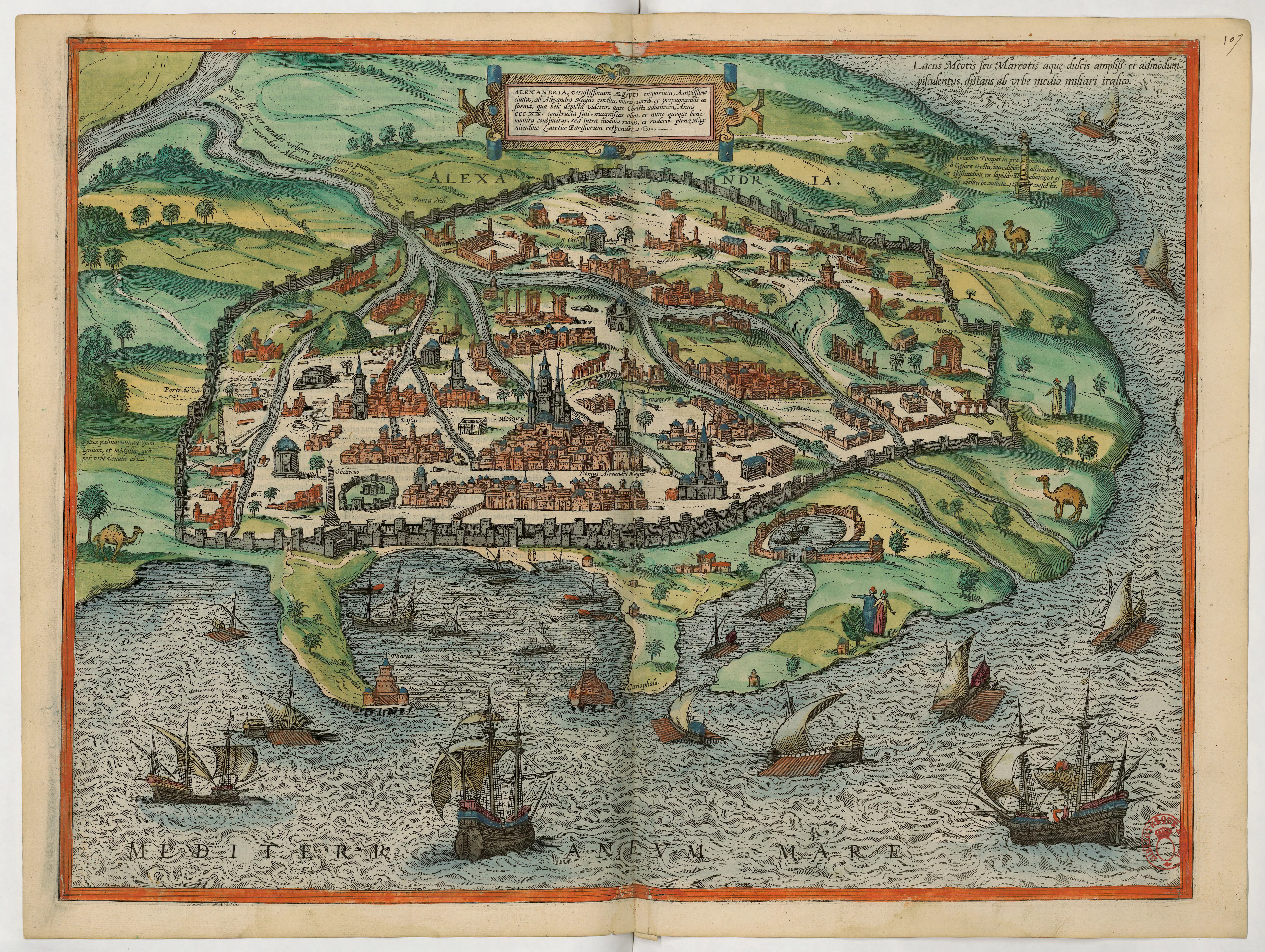
A view of Alexandria from Braun and Hogenberg's Beschreibung der Städt der Welt sets Pearson's Alexandrian dossier in a place rather than an abstraction: the Egyptian setting against which he tested reports of episcopal plurality, the testimony of Eutychius and Bar Hebraeus, Hadrian's letter to Servianus, and the contested memory of the Alexandrian Library. Source ↗.
The Alexandrian dossier that follows brings the volume's ecclesiological stake into the open, and Pearson meets it with the same two instruments. Against the Eutychian tradition of presbyteral creation of the Alexandrian patriarch he applies anachronism-criticism to a tenth-century Arabic source, holding that it cannot be doubted Eutychius spoke according to the custom of his own age, since there were no patriarchs among Christians in the earliest times of the Alexandrian Church, Sed Eutychium ex more sui sæculi loquutum fuisse dubitari non potest. Patriarchæ enim primævis Ecclesiæ Alexandrinæ temporibus nulli inter Christianos fuêre — the intruded title convicting the report of retrojection. And where the alleged Alexandrian custom is supposed to contradict Ignatian ecclesiology, he narrows the martyr's precept exactly as he had narrowed Polycarp's sentence, noting that Ignatius addresses the Christian people and exhorts them to render obedience to the bishops set over them, and warns that nothing in ecclesiastical affairs be done without them, but by no means teaches what is to be done when the bishop has died, Alloquitur populum Christianum, eumq[ue] ad obedientiam Episcopis suis sibi præpositis præstandam hortatur, & nihil in Ecclesiasticis negotiis sine illis agendum monet: quid, Episcopo defuncto, faciendum sit minimè docet. Sacramental and disciplinary order is distinguished from the mode of episcopal election, and the supposed incompatibility between Ignatius and Alexandria evaporates without any concession about the antiquity of the three grades.
The dismantling of the Egyptian counter-evidence proper opens with a declaration of procedure rather than of result. Against the report that Demetrius of Alexandria was the first to consecrate bishops in Egypt — a report on which Daillé's demographic case against an early plural episcopate rested — Pearson answers, secondly, that this little story about the three bishops first made in Egypt by Demetrius is by no means worthy of credit, whether one looks at the author or at the thing itself, Respondeo secundò, historiolam illam de tribus Episcopis à Demetrio primùm in Ægypto factis minimè fide dignam esse, sive autorem, sive rem ipsam spectes. The sentence performs two operations at once. The diminutive historiola demotes the testimony from historia to anecdote before any evidence is weighed, and the alternative sive autorem, sive rem ipsam sets out the two independent lines — the credibility of the transmitter and the internal coherence of what he transmits — along which the remainder of the chapter proceeds. This is the same two-tier discipline that governs the architecture of the whole work, here applied not to the Ignatian letters but to a hostile witness: the calibration of silence in Part One requires that the competence and date of the one who keeps silence, or who speaks, be established first.
The impeachment of Saʿīd ibn Baṭrīq turns on the second of the great appeals by which a late chronicler might claim access to first-century Alexandria, namely the archives of the city. Pearson closes that avenue with a report drawn from Bar Hebraeus, that all the books of the Alexandrian Library perished at once when the city was taken by the Muslims, ʿAmr ibn al-ʿĀṣ having ordered them distributed among the baths of Alexandria and burnt to heat them, so that in the space of six months they were consumed, Libri omnes Bibliothecæ Alexandrinæ, captâ à Meslemiis urbe, statim perierunt. Iussit Amrus Ebno'l As dispergi eos per balnea Alexandriæ atque illis calefaciendis comburi: ita spatio semestri consumpti sunt, ut tradit Gregorius Abulfaraius. The stroke is characteristic of the volume's evidentiary reach: an Arabic ecclesiastical historian is used to disqualify an Arabic ecclesiastical historian, and the material history of a library — the destruction of the physical books, dated and given a duration — becomes the ground on which a documentary claim is refused. The argument is negative in form but not an argument from silence: Pearson is not inferring that the archive said nothing, but that there was no archive to consult.
With the tenth-century witness set aside, the positive demonstration that Egypt possessed bishops in the plural long before Demetrius rests chiefly on Hadrian's letter to Servianus, and its evidentiary force depends on a lexical decision about the term patriarcha which the letter also contains. Pearson refuses the reading of Casaubon and Salmasius, holding that the patriarch there named by Hadrian seems to him in no way to have to be understood of the bishop of Alexandria, Mihi verò, ipse ille Patriarcha Hadriano dictus de Episcopo Alexandrino intelligi debere nullo modo videtur, referring it instead to the Jewish patriarch of Palestine. The move is required by the logic of his own case. If the pagan emperor's patriarcha were the Alexandrian bishop, the letter would document a single monarchical head; construed of the Jewish patriarchate, the letter's separate mention of those who call themselves bishops of Christ and of the presbyter of the Christians yields exactly the differentiated and plural hierarchy that the Ignatian letters presuppose. Anachronism-detection here works in both directions: a title must not be permitted an application it acquired only later, and the same rigour that convicts a forged text of using third-century nomenclature forbids the critic from reading a fourth-century sense into a second-century document.
The excursus on Papa completes the demolition by explaining the fable rather than merely refuting it. Pearson's reconstruction is that the story of Demetrius and the three bishops was invented to answer an Arabic philological puzzle — why the Alexandrian primate bears the title of grandfather — and the puzzle dissolves once the Greek word is traced through Homer, Hesychius, Eustathius and Aristophanes to its root sense, for the primitive signification of πάπας, or in poetic form, is Father, Primæva igitur significatio τὴ πάπας, vel poëticè πάπας, est Pater. Etymology thus does the work of source criticism: an etiological narrative built on a false gloss falls with the gloss, and the demonstration that the honorific belonged to bishops generally — Cyprian, Epiphanius, Augustine, and, earlier than any Alexandrian, the Roman bishop addressed in Tertullian's De Pudicitia — removes the title's supposed testimony to Alexandrian singularity.
The Ethiopian corollary shows the same method operating on the shape of an inference rather than on a word. Daillé had adduced the single Abuna of the Ethiopians as a survival of an originally undivided Egyptian regime; Pearson restates the argument as a bare syllogism, that there were no bishops in Ethiopia except one Abuna in the sixteenth century, therefore none in the whole Egyptian diocese in the first or second century down to A.D. 190 except the Alexandrian patriarch, and therefore the letters of Ignatius are forged, Nulli fuerunt in Æthiopiâ Episcopi præter unum Abunam sæculo 16o. Ergò nulli erant in totâ Ægyptiacâ Diœcesi primo vel secundo sæculo usque ad A. D. 190 Episcopi præter Alexandrinum Patriarcham; ideóque Epistolæ Ignatii conficæ sunt. Hostile paraphrase is here an instrument of exposure: by supplying the suppressed premisses and setting the fourteen-century leap in a single sentence, Pearson makes visible both the non-sequitur and the disproportion between a sixteenth-century Jesuit and Dominican testimony and a conclusion about the apostolic age.
The treatment of Jerome, the witness upon whom the Reformed case for presbyteral parity most heavily leaned, reverses the polarity of a text rather than impugning it. Pearson produces from Jerome the maxim that the safety of the Church depends on the dignity of the chief priest, and that if some pre-eminent power raised above other men be not granted him, there will be as many schisms in the Church as there are priests, Ecclesiæ salus in summi sacerdotis dignitate pendet; cui si non exors quædam, & ab hominibus eminens detur potestas, tot in Ecclesiâ efficientur schismata, quot sacerdotes, and pronounces the sentiment purely and simply Ignatian. The claim is not merely that Jerome may be reconciled with the letters but that his reasoning about unity and schism is theirs; the adversary's chief patristic authority is thus enrolled among the internal witnesses to their authenticity, and Blondel's use of Jerome is met on Jerome's own page.
Part II: The Proof Drawn from the Letters Themselves
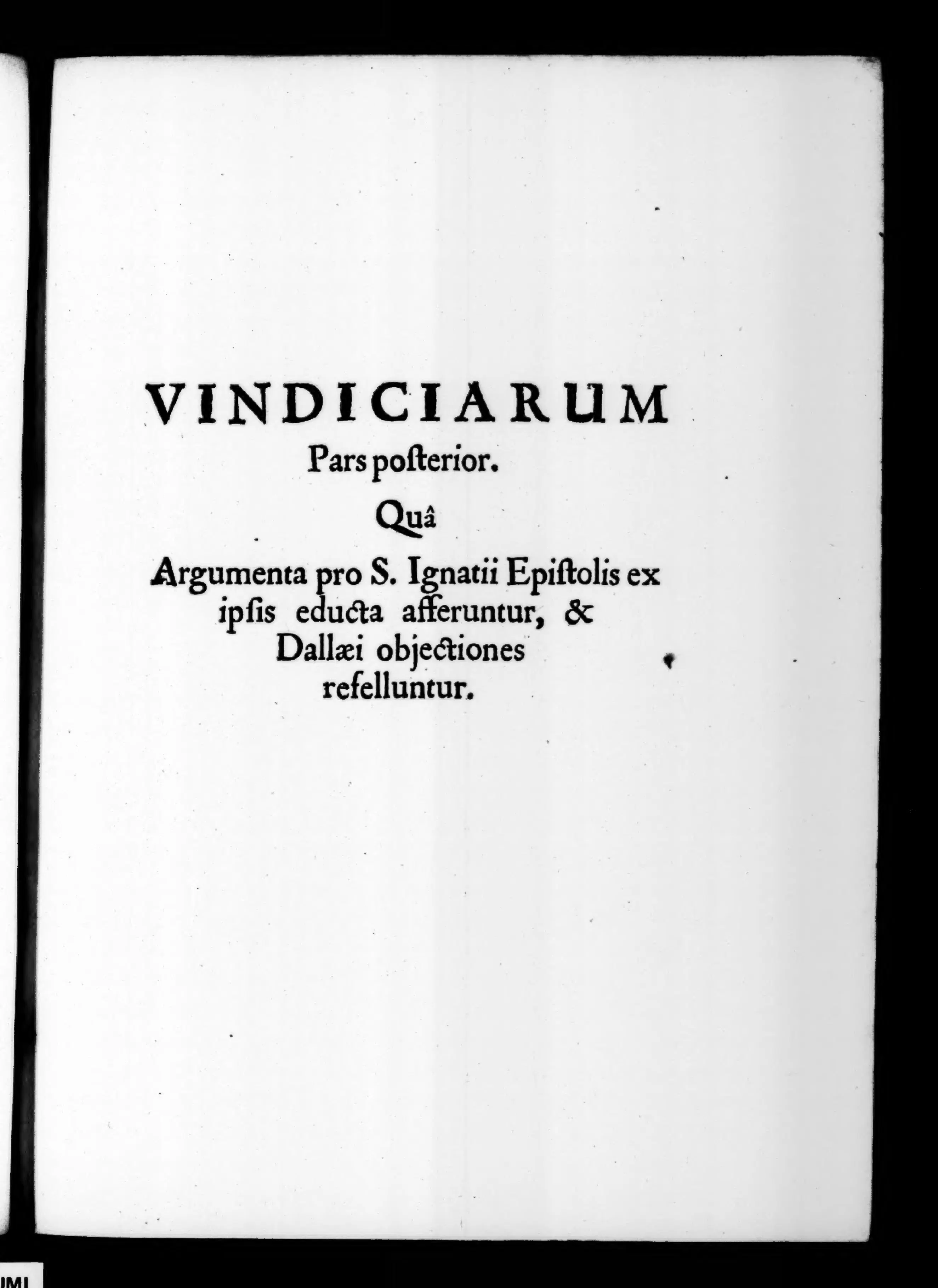
This spare divisional title-page announces the Pars posterior of the Vindiciae, shifting the case for the Ignatian letters from external witnesses to argumenta drawn from the epistles themselves — the book's architecture made visible on the page, as Part I's testimonia give way to Part II's internal proof. Source ↗.
Part One ends with a summary retort and a terminal FINIS, the running heads that have alternated Argumentum Negativum against refutatur giving way at that divisional title-page to the programme of the second part: the arguments for the letters are now to be drawn out of the letters themselves, with the pagination restarting and each chapter prefaced by its own argument-summary. The turn from testimony to text brings with it a criterion of the writer's own age rather than of his readers' expectations, and one of its sharpest applications is a portrait rather than a proof: in the author of the letters, Pearson writes, we perceive a purely Christian soul, not formed in the schools, not exercised in libraries, not fed in the Academies and the Attic porticoes, in eo igitur perspicimus animam purè Christianam, non Scholis formatam, non Bibliothecis exercitatam, non Academiis & porticibus Articis pastam. The absence of philosophical ornament, which a hostile critic might read as literary poverty, is converted into a dating lexeme: apologists of the later second and third centuries imported pagan learning as a matter of course, so that a writer wholly innocent of it belongs before them.
The chronological chapters of Part Two rest on a textual operation performed at their threshold, the removal from the genuine letters of every named heretic. Pearson's lever is the writer's own refusal, in the old Latin version, to record the names of the unbelievers, that their names, being unbelieving, it did not seem good to him to write, nor might it happen to him to remember them until they repent, Nomina autem ipsorum existentia infidelia non visum est mihi inscribere: sed neque fiat mihi ipsorum recordari usque quo poeniteant. Basilides, Theodotus and Cleobulus, on whose late date the adversary's chronological objection depended, thereby fall to the interpolator, and the transfer is licensed by a principle of priority taken from Tertullian, that every interpolation must be believed to be the later thing, omnis autem interpolatio posterior credenda est, ut loquitur Tertullianus. The taxonomy that keeps interpolator distinct from fictor is thus not a merely lexical scruple: it is what allows a demonstrated anachronism to be assigned to an accretion without convicting the body onto which it was fastened.
In the long controversy over the Magnesian phrase concerning the Word who did not proceed from silence, Pearson's conduct toward his sources is as revealing as his argument. The Jesuit Denis Pétau's report of the Valentinian system is decisive for both parties, and Pearson declines to discount it on confessional grounds: if there is any faith to be given to a man, in this cause Petavius is ours; if none, he is theirs — but he judges that there is no ground at all for doubting Pétau's good faith, Si ulla homini fides est, in hac causâ noster est Petavius; si nulla, illorum est. Sed ego de fide Petavii dubitandum esse minimè censeo. The formulation makes scholarly honesty indivisible and unpartisan, and it exhibits the transconfessional discipline on which the volume's erudition depends even where its ecclesiology is polemical. The refutation itself is then conducted as formal logic: since a negative proposition can strike nothing but the affirmation it opposes, one who denies what his supposed adversary never affirmed does not directly wound him, est nisi oppositam affirmationem; ut si quis neget id quod ille nunquam affirmavit, ejus negatio Valentinum directè non feriat. Everything then depends on the Valentinian genealogy of the Aeons, set out in the printed type-tables that accompany the chapter, in which the Logos issues not from Bythus and Sige but from Nous and Aletheia; the denial in the letter therefore cannot be aimed at a system it does not describe, and is referred instead to the Ebionite denial of pre-existence and to Gnostic teaching older than Valentinus.
The refutation of Daillé's chronological case enters its closing phase with a caution about the shape of the sources on which that case depends. Daillé had argued that the heresy denounced in Ad Magnesios is Valentinian, and therefore later than any Ignatius of Trajan's reign; Pearson's counter is that Irenaeus, from whose first book the alleged Valentinian pedigree is drawn, was not compiling a complete register of Gnostic filiations at all but describing the systems of Valentinus's disciples, and that the demonstrable gaps in his account — Basilides' Justice and Peace, known from Clement of Alexandria, or Ptolemaeus on the first tetrad — forbid any inference from what he leaves unsaid. The principle is stated as a rule of evidence: from imperfect and truncated genealogies of the ancient Gnostics in Irenaeus a negative argument cannot rightly be formed, Ex / imperfectis igitur & decurtatis apud Irenæum Veterum / Gnosticorum Genealiogiis negativum Argumentum rectè formari / non potest. This is the argumentum negativum met on new ground. In Part I the question had been the silence of witnesses about the letters; here it is the silence of a heresiologist about doctrines, and the same condition governs both: silence is probative only where the source is comprehensive, and a source shown to be selective cannot license the inference. The heresiological chapters thus operate the same instrument as the testimonial chapters, and one of the volume's structural claims — that internal and external proof are two applications of a single critical discipline — is visible in the transfer.
The seventh chapter states the fourth of Pearson's assertions with a deliberately modest burden of proof: it cannot be certainly proved that the errors of Valentinus himself were wholly unknown to Ignatius the Martyr, Probari certò non posse, ipsius Valentini errores / Ignatio Martyri fuisse penitus incognitos. The formulation is not a lapse into weakness but a calculated allocation of the onus probandi. Since the objection is that the letters commit a violatio temporum, the objector must show impossibility, not improbability; bare possibility on Pearson's side suffices to dissolve the charge. He makes the logical geometry explicit: if it cannot be proved that Valentinus's own delirium could in no way have been known to the holy martyr before his death, the argument drawn from the violation of time perishes, Quòd si Valentini / ipsius delirium à S. Martyre ante mortem nullo modo cognosci potuisse / probari non possit, perit argumentum à violatione temporis ductum,. The verb perit is chosen for a single-point failure: the adversaries' chronological case is a chain, and one broken link ends it. Pearson then supplies the possibility by a chain of his own — Polycarp ordained bishop by John and the apostles, his doctrine therefore known a quarter-century before Ignatius' martyrdom, and Valentinus dead before Polycarp — so that the heresiarch's teaching falls within a horizon the martyr could have touched.
The chronological repairs on which this depends are performed by source criticism rather than by assertion. Tertullian's report in De Praescriptione 30 of a repeated expulsion and permanent rupture, which Daillé had used to extend Valentinus's life into the episcopate of Eleutherus, is shown to describe Cerdo in Irenaeus's third book, so that Tertullian becomes a derivative and confused witness whose error can be diagnosed from his own source. Eusebius's notice of Basilides at Alexandria in Hadrian's seventeenth year is subjected to a still finer distinction between the terminus of a life and the origin of a doctrine: but how wrongly are these words dragged to the beginning of the heresy, when they rather indicate the end of the heretic, Sed quàm perperam hæc ad initium hæreseos trahuntur; / quæ potiùs exi um hæretici indicant?, the construal being secured by Jerome's paraphrase that Basilides then died. What looks like a quibble over a chronicle entry is in fact the whole method of dating by testimony in miniature: a chronicler's date attaches to an event, and the event must be identified before the date can be used at all.
The battery of four residual objections in the eighth chapter shows the same procedures applied to vocabulary. The most celebrated is the phrase about the ten leopards, quod est militaris ordo, which Samuel Bochart's Hierozoicon had made a mark of post-Constantinian composition. Pearson quotes the objection in his adversary's own words — the word leopard, he says, began to be used rather late, Leopardi vox, inquit, seriùs usurpari coepit, — and answers it with a lexical dossier assembled from the Passio Perpetuae, Aelius Spartianus on Geta, the old Glossary, Pompeius Festus reporting Verrius Flaccus, Varro, Pliny, and the Vita Antonii, while denying that leopardus ever named a unit of soldiery. A single noun is thereby made to carry a dating verdict, and the pattern of the reply is instructive: the adversary's criterion is granted in full — a demonstrably later word would convict the text — and the dispute is confined to whether the lexeme in fact belongs to the later age. The other three objections are handled by the same method of relocating the burden: ἄρχοντες is shown to be ordinary usage for magistrates and even for ecclesiastical prelates, so that no allusion to Constantius or Constantine can be extracted from it; the reception of the lapsed is documented before Novatian and Montanus from Cyprian and from Tertullian's account of the edict of Zephyrinus; and the Ephesian Onesimus is doubled, a second bearer of the name succeeding Timothy and Gaius, which disposes of a long file of Byzantine and Latin martyrological witnesses at one stroke.
With the ninth chapter the objections shift from time to character, and the register of the answer changes with them. Daillé had found the letters' appetite for the beasts unworthy of a saint; Pearson refuses the criterion of modestia outright and revalues the very passages complained of as holy and brave and to be received with all veneration, imò verò sanctas, & fortes, & omni veneratione accipiendas,. The argument is then converted from taste into evidence by a verbal coincidence: Germanicus, in the Smyrnaean account of Polycarp's martyrdom, did exactly what Ignatius had said he would do, and seems to have done it because Ignatius had said it, since the church of Smyrna uses the same word, Ignatius se facturum dixit; imò hoc fecisse ideo videtur quòd Ignatius / dixerat: eadem enim voce utitur Ecclesia Smyrnensis. The shared term (προσβιάσομαι) is made to do double duty, establishing that the martyrological temper of the letters is native to the age of the Antonine persecutions and that the letters were being read in Smyrna within a generation of their composition. An objection from decorum is thus turned into a positive testimony of early reception — the characteristic manoeuvre by which internal evidence is made to yield external attestation.
The tenth chapter is philology in the narrow sense. The crux of the Smyrnaeans passage on the risen Christ turns on a single Greek form, and Pearson's insistence is that Jerome's Latin rendering presupposes a reading the Greek exemplars do not support: for it is one thing to write εἶδον, which in Greek is "I saw," and another οἶδα, which in the same writers always means "I know" or "I understand," Aliud enim est o[mn]ia, aliud e[ss]evel idor non / scriptum est e[ss]eor, quod est Græcis vidi, sed o[mn]ia, quod iisdem semper / est novi, vel scio [reading uncertain]. Grotius is then enlisted to give the grammatical point its doctrinal consequence: whoever inspects the Ignatian passage with care will see that the reading is correct, and that the matter there is not of the sense of sight but of faith, which the writer confirms not by his own testimony but by others', Si quis locum Ignatiicum curâ inspiciat videbit rectam esse / lectionem , neque de Visus sensuibi agi, sed de Fide, quam non suo, / sed aliorum testimonio confirmat. A charge that the letter's author had falsely claimed autopsy of the resurrection collapses once the verb is read as cognition resting on the apostolic witnesses; the alleged mendacity was an artefact of a Latin translator's construal, not of the Greek text.
The chapter on Θεοφόρος inverts an argument rather than merely rebutting it. The legend of the infant carried in Christ's arms, and the passive accentuation of the epithet that generates it, are traced no further back than Anastasius Bibliothecarius and Symeon Metaphrastes, and are located plausibly in ninth-century polemic on behalf of Ignatius of Constantinople against Photius. If this is the true history of the fable, as it seems to Pearson, that fable was so many centuries later than the name Theophorus, Hæc si vera sit Fabulæ / historia, ut mihi videtur: tot sæculis nomine Θεοφόρος posterior illa fuit, — from which it follows that the name cannot have been fabricated out of the fable, since the fable was fabricated out of a misunderstood name. The recensional habit of mind is at work here on an epithet rather than on a paragraph: a late accretion is dated and detached, and the ancient element beneath it survives the amputation.
The Palmary Argument: Nomenclature, Diction, and the Inscriptions
This last movement takes up what Daillé himself called his palmary argument, restated by Pearson without softening in the terms already set out — that the author of the Epistles uses the names presbyter and bishop otherwise than the apostles and apostolic men and their disciples, indeed in the same way as Christians of the third and following centuries. The reply is first strategic and only then evidential: if any force seems to inhere in this argument, its author has placed the whole of it upon the ruins of his own party, si quæ vis huic Argumento / inesse videatur, eam omnem in suarum partium ruinis ab eo positam / esse. The retort exposes a cost the Reformed case had not reckoned: to date differentiated nomenclature to the third century is to concede that no truly apostolic text sustains presbyteral parity either, so that the argument which discredits the letters also dismantles the position it was raised to defend. Pearson then proves his own assertions seriatim from the Acts of Ignatius, the Smyrnaean letter on Polycarp, Dionysius of Corinth, the martyrs of Lyons, Hegesippus, Polycrates, Serapion and the Apostolic Canons, and answers the negative half from Papias, Irenaeus, Clement, Polycarp, Pius and Hermas. The distinction on which the whole rests is drawn from Chrysostom, who holds that bishops excel only in the power of ordaining, and in this one thing alone appear superior to presbyters, solâ enim ordinandi potestate excellunt, & hac una re videntur presbyteris superiores esse. Here word and thing are prised apart with the same instrument used earlier on leopardus and Θεοφόρος: the confusio nominum of the earliest documents is conceded at the level of title and denied at the level of function, since χειροτονία remains the juridical mark of a distinct order however loosely the names circulate.
That objection — that the writer of the letters distinguishes episcopus from presbyter in a manner unknown to the apostolic age — Pearson meets not by disputing the patristic witnesses who assert the interchange of names but by mining them for a datum they all concede. Theodoret is the first of the catena, and the argument extracted from him is cast in strict syllogistic form, the minor premise supplying a terminus and the conclusion converting a hostile authority into a friendly one: but the name "Apostle" ceased to be given to priests of the first order before Ignatius's martyrdom, therefore on Theodoret's own view, under Ignatius bishops and presbyters were distinguished in both office and name, At Apostoli nomen primi ordinis sacerdotibus tribui desit ante martyrium Ignatii. Ergo ex sententiâ Theodoreti sub Ignatio, & officio & nomine distinguebantur Episcopi & presbyteri. The manoeuvre is the same one that governs the treatment of Jerome's Titus commentary and of Ambrosiaster, whose date Pearson fixes by the author's own profession of writing under Damasus: the exegetical thesis of confusio nominum is granted at the level of vocabulary and then dated, so that the very authors invoked against the Ignatian usage become witnesses to a terminological shift completed before Ignatius wrote. What the adversary offers as evidence of anachronism becomes, once its chronology is made explicit, evidence of exactness.
The chapter's structural pivot is a disjunctive concession drawn so widely that no member of the disjunction can serve the opposing case: all those who transmitted that the names bishop and presbyter were confused in the apostolic writings likewise taught that, whether from the beginning, or while Peter and Paul were still living, or before the second century began while John yet survived, there were three sacred orders or grades in the Church, Omnes igitur illi qui confusa Episcopi & Presbyteri nomina in Apostolicis scriptis tradiderunt, simul etiam docuerunt vel ab origine vel viventibus adhuc Petro & Paulo, vel ante secundi sæculi initium, superstite adhuc S. Joanne, tres fuisse ordines sacros seu gradus in Ecclesiâ. The rhetorical economy is considerable: three alternative datings are offered, and each of them falls on the near side of Ignatius's episcopate, so that the dispute over words is quarantined from the dispute over things. On that footing the chapter's formal conclusion follows, that no reason appears why he who so chastely and constantly preserved the distinction of orders in his letters should not be held for the true Ignatius, that bishop and martyr of Antioch, ratio nulla apparet cur ille, qui eo modo distinctionem ordinum in Epistolis suis castè & perpetuò servavit, pro vero Ignatio Antiocheno illo Episcopo & Martyre non habeatur. The adverb castè does considerable work here, transferring to a habit of usage a predicate ordinarily moral: the writer's terminological consistency is figured as a kind of continence, and the imagined forger's supposed license as its opposite. It is a small instance of a larger pattern in which philological regularity and sanctity are made to reinforce one another.
The three numbered observations that follow open a methodological fault line that repays attention. The first is stated as a comprehensive negative, that it must be observed in the first place that no writer of the second, or even of the third century, noticed that the names of bishop and presbyter were confused in the apostolic writings, Observandum enim est primò, Nullum secundi, vel etiam tertii fæculi scriptorem in scriptis Apostolicis confusa esse nomina Episcopi & Presbyteri observâsse. This is, in form, precisely the argumentum negativum whose force Pearson has been at pains to restrict when his adversaries deploy it against the letters' early attestation. He is not simply inconsistent, and the difference he relies on is the one Launoy's rule had built in: here the silence is general within a bounded class of writers — Irenaeus, Clement of Alexandria, Tertullian, Origen, Justin — who wrote about ecclesiastical order continuously and had every occasion to remark the anomaly, and it is immediately reinforced by positive testimony to graded orders rather than left to stand alone. Whether the calibration is applied with equal severity in both directions is a question the text does not raise about itself; what it does show is that the criterion of the competent and interested witness, rather than mere absence, is being made to carry the inference. The observations culminate in the genealogical charge that traces the parity thesis to A��rius, condemned by Epiphanius — an argument ad originem by which a living Reformed position is relocated into the heresiological catalogues, and by which the palmarium argumentum is declared reduced to nothing.
The chapter on diction shifts the terrain from institutional nomenclature to lexicon, and with it the criterion of anachronism from title to word. Against the inference that unusual compounds and neologisms betray a later hand, Pearson lays down a principle of religious idiolect: Ignatius speaks as a Christian; he has words proper to his own religion, and not at all used by the heathen, which ought not to be turned to his discredit, Loquitur Ignatius ut Christianus: verba habet suæ religioni propria, & à Gentilibus minimè usurpata; quod illi vitio verti non debet. The supporting analogies are drawn from the technical vocabularies of the philosophical sects and from the neologisms of the Evangelists remarked by Gregory of Nyssa and Origen, and the effect is to deny that rarity is by itself a dating lexeme. Novelty of expression is referred to the novelty of the thing expressed rather than to distance in time — a move that neutralises much of the adversary's word-list, though at the cost of narrowing the range of lexical features that could ever count against authenticity. The same deflationary hermeneutic governs the treatment of the ἀξιο- and -φόρος compounds and of the metaphors of chains as spiritual pearls: the alleged bombast is dissolved by paraphrase into ordinary doctrinal content.
In the chapter on the inscriptions, style is converted from a liability into a positive indication, since the swelling salutations are referred to a regional rhetorical habit: if the Ignatian inscriptions seem redundant and tumid, no one will wonder who knows that the author set out from Asia or Syria, Si redundantes & tumidæ videantur Inscriptiones Ignatianæ, nemo mirabitur qui Autorem ex Asiâ vel Syriâ profectum esse novit. Asianism, an ancient critical category rather than a modern one, thus becomes a mark of provenance. The decisive argument of the chapter, however, is one of comparative probability: it is far more likely that St Ignatius, an apostolic man, really imitated St Paul in his inscriptions than that an impostor at the end of the third or the beginning of the fourth century should feign a man writing, against the common custom of the whole Church, in the manner of the apostolic age, in Inscriptionibus imitaretur, quàm ut Impostor, circa finem tertii aut initium quarti sæculi, hominem contra communem totius Ecclesiæ consuetudinem ab Apostolorum tempore scribentem fingeret. The hypothesis of forgery is here required to supply not merely a motive but an antiquarian competence, and the fictor becomes an implausibly learned archaiser. Against the fallback conjecture that a forger worked up genuine Ignatian sayings rather than writings, the external witness is decisive, Origen reporting that he found it elegantly written in the letter of a certain martyr, meaning Ignatius, second bishop of Antioch after Peter, who fought with beasts in persecution, that the prince of this world was ignorant of Mary's virginity, Eleganter in cujusdam Martyris Epistolâ scriptum reperi (Ignatium dico Episcopum Antiochia post Petrum secundum) qui in persecutione pugnavit ad bestias; Principem sæculi hujus latuit virginitas Mariæ — name, see, manner of death, and, crucially, the medium of an Epistola.
Part II ends by turning the internal evidence of order into a chronological instrument. From the repeated exhortation to obey bishops, presbyters, and deacons together, Pearson judges it rightly to be concluded that these things were not written at the beginning of the fourth century or the end of the third, but rather at the beginning of the second, ex hac frequenti admonitione de obedientiâ Episcopis, presbyteris, & diaconis simul præstandâ ego optimo jure colligendum reor, non hæc scripta fuisse sub initio quarti sæculi, aut tertii fine, sed potiùs sub initio secundi, the premise being that by the later date the diaconate and presbyterate had lost precisely the dignity the letters accord them. The closing appeal is addressed over the adversary's head to the party whose interests the sceptical case was supposed to serve: whoever most zealously pursues presbyteral dignity and authority has no firmer or more solid foundation for that estimation than the letters of our St Ignatius, quicunque presbyterali dignitati autoritati que maximè student, non habent suæ existimationis firmius aut solidius fundamentum quàm Epistolas S. Ignatii nostri. The invitation is irenic in tone and adversarial in substance: the honour of the second order is real, but it is available only within a graded hierarchy, so that to destroy the letters is to destroy the presbyterate's oldest encomium.
The Appended Matter: Addenda, Corrigenda, and the Vossius–Blondel Letters
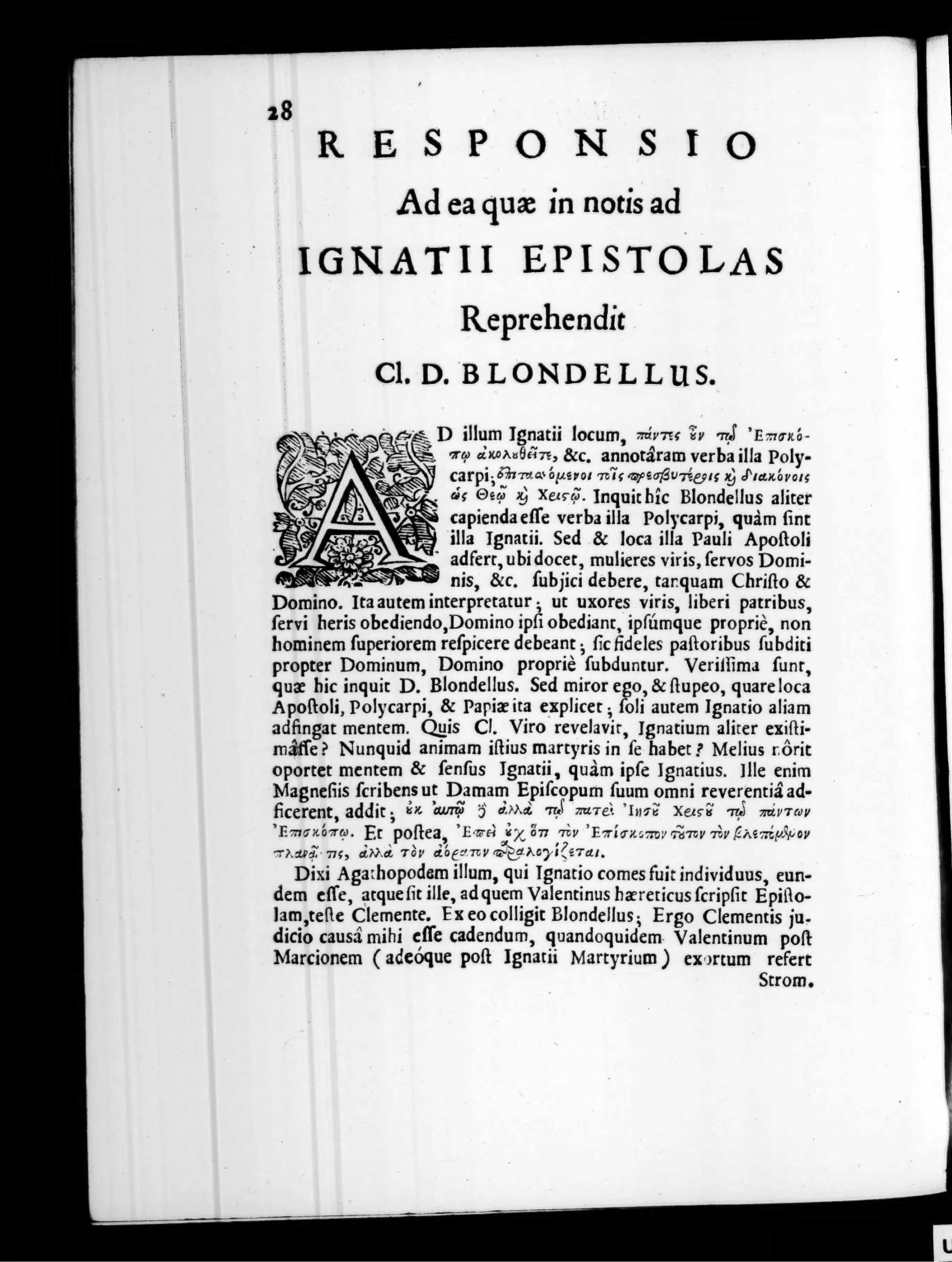
The appended Vossius–Blondel section opens under the printed heading "RESPONSIO," marked with a large ornamental initial as a new argumentative division rather than an afterthought. Moving from Blondel's reading of Ignatius and Polycarp on episcopal obedience to the chronology of Valentinus, Marcion, and Clement's Stromata, it continues the volume's central defence. Source ↗.
The matter printed after the treatise is argumentatively continuous with it rather than merely supplementary. The Addenda & Interserenda, keyed by page and line to the Prooemium and both Parts, resume the fight over the Nicene terminus with a citation from Gerard Vossius that carries its own audible impatience, reporting that others reply that Ignatius's letters are supposititious and mentioned by no one before the Council of Nicaea — is that so indeed?, Alii respondent, Ignatii Epistolas esse supposititias, nec ulli ante Nicenum concilium memoratas. Itane verò?. That such testimonia were still being gathered after the body of the work was set, and that the Corrigenda which follow ask pardon especially for the diphthongs, exposes the volume as an object caught in the act of correction and accretion. The appended correspondence performs a different service, supplying documentary evidence of the 1646 exchange in which the middle recension was first defended; and its most consequential chronological argument is Isaac Vossius's dating of Clement of Rome from an internal sign, since it is clear from the letter sent to the Corinthians in the name of the Church over which he presided that it was drawn up while the Temple of Jerusalem was standing and its sacrifices continuing, Patet namque ex Epistola ejus ad Corinthios missâ, nomine ejus, cui præerat, Ecclesiæ, exaratam eam esse stante Templo Hierosolymitano, ac durantibus ejus sacrifiis. The procedure is the one the treatise has just exercised at length — an incidental detail of a text's assumed world used to fix its date against a received chronology — and its appearance in the appendix, with Blondel's dissenting notes printed beneath, lets the reader watch the same critical instrument being handled by both parties to the quarrel.
Frequently Asked Questions
What is Vindiciae epistolarum S. Ignatii, and who wrote it?
It is a Latin monograph in two parts, printed at Cambridge in 1672 by the University Printer John Hayes and sold in London at the sign of the Prince in Little Britain, arguing that the seven letters transmitted under the name of Ignatius, bishop of Antioch, in the shorter Greek recension recovered by James Ussher and Isaac Vossius in the 1640s, are genuine writings of an apostolic-age martyr. Its author, John Pearson (1613–1686), was a Cambridge theologian already known for An Exposition of the Creed (1659) and raised to the see of Chester in 1673. He dedicated the volume to Gilbert Sheldon, Archbishop of Canterbury.
Why did it matter so much whether the letters of Ignatius of Antioch were genuine?
Because those letters are the oldest surviving witness to bishops, presbyters, and deacons as three distinct offices. If they were fabrications, the Church of England's appeal to Christian antiquity lost its earliest documentary support, and the Reformed case for original presbyteral parity — running from Claude Saumaise's Walo Messalinus (1641) through David Blondel's Apologia pro sententia Hieronymi (1646) to Jean Daillé's Geneva treatise of 1666 — gained its strongest prop. Pearson wrote in the Restoration aftermath of the Interregnum and the Act of Uniformity of 1662, when making that appeal credible through erudition was an institutional necessity.
Why does Pearson insist that a forger and an interpolator are not the same thing?
Because a demonstrated interpolation does not convict the text onto which it was fastened. In his vocabulary an impostor knowingly assumes a false identity, a fictor fabricates outright, and an interpolator alters an older writing without composing any of it; additions are patches sewn onto an existing body, and a patch presupposes the garment. Citing Tertullian's rule that every interpolation must be believed the later thing, Pearson assigns the named heretics Basilides, Theodotus, and Cleobulus to an interpolator, so that the chronological objection built on them falls without touching the letters themselves.
Why did a single word about ten leopards matter to the dating of the Ignatian letters?

A page from a sixteenth-century Latin natural history treats the spotted cat under the overlapping names panthera, pardalis, pardo, and leopardo — the lexical terrain Pearson entered in rebutting Bochart's claim that leopardus betrayed a late date. It does not illustrate Ignatius, but it shows how early modern scholarship turned animal nomenclature and classical citation into evidence for textual chronology. Source ↗.
Because Samuel Bochart's Hierozoicon had treated leopardus — leopard — as a term that came into use only after Constantine, making the phrase about ten leopards in the letters a mark of late composition. Pearson granted the criterion in full: a demonstrably later word would convict a text. He then confined the dispute to the word's actual history, assembling the Passio Perpetuae, Aelius Spartianus on Geta, the old Glossary, Pompeius Festus reporting Verrius Flaccus, Varro, Pliny, and the Vita Antonii, and denying that the word ever named a unit of soldiery.
Is there an English translation of Pearson's Vindiciae epistolarum S. Ignatii?
No complete English translation of the Latin monograph has been located. The 1852 Oxford reissue by J. H. Parker in the Library of Anglo-Catholic Theology (volumes 69–70) is a Latin new edition, not a rendering; William Cureton's 1846 Vindiciae Ignatianae is a separate English work defending the Syriac version of the Ignatian letters; and J. B. Lightfoot's Apostolic Fathers translates the letters themselves, not Pearson. The Leo edition presents the full transcription together with a complete English translation, generated by AI, for the first time. Leo works to make English translations of every text printed in Latin in Europe between 1450 and 1750 freely available online.
This report was generated by an advanced AI assistant that conducted deep research alongside an extensive interpretation of the transcribed original text. Every effort has been made to preserve fidelity to the source and to guard against inaccuracy, but corruption in the text recognition process and model hallucination may nonetheless have entered the text. Treat every claim, quotation, translation, and citation as provisional, and verify each against the original source before relying on or citing it.
Critical Further Reading on Pearson, Daillé, and the Ignatian Controversy
- Timothy D. Barnes, "The Date of Ignatius," The Expository Times: The principal modern English-language article that explicitly seeks to move beyond the inherited terms of the dating and authenticity debate, supplying the current state of the question on which any further assessment of Pearson's argument must build. That inherited framing is set out with unusual candour by Pearson himself, who states the concession on which his chronological chapters stake everything: so, if anything in the Letters really struck at the faith of chronology, I would freely concede that the Ignatius of the Letters was not that apostolic man, ita si quid in Epistolis fidem temporum reverâ pulsaret, Ignatium Epistolicum non fuisse Apostolicum illum libenter concederem. Anyone tempted to treat the 1672 verdict as final should read Barnes first and then reread that sentence.
- Cambridge Core, Journal of Anglican Studies review of Jean-Louis Quantin, The Church of England and Antiquity: A compact assessment that isolates Quantin's central contention — that the Church of England never held a single, uniform view of the ancient Fathers — which is exactly the caution needed before reading Pearson's dedication to Sheldon as the voice of a settled national consensus. Useful as an orientation for readers who want the argument's shape before committing to nearly five hundred pages.
- Jonathon Lookadoo, "Expanding the Narrative: The Reception of Ignatius of Antioch in Britain, ca. 1200–1700," Church History: This article supplies the clearest documented account of Pearson's British setting and explicitly interprets the Vindiciae as a response to Daillé, relating recension criticism to debates over ecclesial government and the political-religious history of seventeenth-century Britain. The polemical temper of that response is audible in Pearson's own characterisation of his adversary's failure, where he declines the charge of malice while pressing the charge of prejudgement: I do not say that hatred of episcopacy and hierarchy blinded Daillé from seeing this; I do say that a preconceived opinion about some inept forger prevented him from seeking out the author's mind, or from noticing that the best sense, and one worthy of such a man, lies in his words, Non dico Dallæum Episcopatûs & Hierarchiæodium excacasse, quò minùs hæc videret: hoc dico, præconceptam de Fictore nescio quo inepto sententiam impedivisse, quo minus mentem Autoris exquireret, aut optimum ejus verbis sensum & tali viro dignum inesse animadverteret.
- John Monfasani, "The Letters of Ignatius of Antioch as a Philological and Epistemological Issue from the Reformation to Today," Habent sua fata libelli: Studies in Book History, the Classical Tradition, and Humanism in Honor of Craig Kallendorf: The most directly relevant modern study for Pearson's place in the long history of Ignatian criticism; it connects the controversy's textual questions to changing standards of philological knowledge and helps distinguish Pearson's evidentiary procedures from his confessional conclusions, while substantiating Pearson's standing as "incomparably the most" distinguished contribution to the dispute.
- Jean-Louis Quantin, The Church of England and Christian Antiquity: The Construction of a Confessional Identity in the Seventeenth Century: Quantin's account explains why Anglican appeals to patristic antiquity were simultaneously historical, polemical, and identity-forming, providing the indispensable context for reading Pearson's dedication to Sheldon and his defence of episcopal order without treating the work's erudition as confessionally neutral. The confessional formulary to which Pearson's historical case is tied is quoted in the work itself — the declaration that it is evident to all diligently reading Holy Scripture and the ancient writers that from the apostles' time these three orders of ministers have been in Christ's church, bishops, presbyters and deacons, Evidens est omnibus diligenter legentibus S. Scripturam & veteres scriptores, ab Apostolorum tempore hos tres Ordines Ministrorum in Ecclesiâ Christi fuisse, Episcopos, / presbyteros & diaconos — so that the philological verdict on the letters and the doctrinal position of the English Ordinal stand or fall together.
- recensio.net, Rezension: The Church of England and Christian Antiquity: A second review of Quantin's monograph, framing its subject as the reception of the Fathers in England and thus locating Pearson's work within a reception history rather than an isolated act of scholarship. Worth consulting alongside the Cambridge notice for a sense of how differently the book was received on either side of the Channel.
- Philip Schaff, History of the Christian Church, Volume II: Ante-Nicene Christianity, A.D. 100–325: Schaff's nineteenth-century overview preserves the older doxography through which Pearson's polemic was transmitted, including Lightfoot's transmitted judgement of the Vindiciae as a "full and learned reply" to the objections against the Ignatian letters, and it usefully divides the whole controversy into three periods. Pearson's own account of how the controversy arose gives that doxography its polemical starting-point, in the claim that it has at last come to this, that those who could in no other way maintain an opinion less favourable to episcopacy tore at all the letters of Ignatius, denied that they were written by the holy martyr, and pronounced them fabricated and suppositious, eò tandem deventum est, ut qui aliter sententiam Episcopatui iniquiorem tueri nullo modo possent, omnes Ignatii Epistolas convellerent, à S. Martyre scriptas negarent, fictas & supposititias pronunciarent — a genealogy of motive that later summaries of the dispute inherited along with its bibliography.





.jpg)
