Galen's Enormous Dragon: Johann Ewich's The Duty of a Faithful and Prudent Magistrate to Preserve and Deliver the Commonwealth from Contagion in Time of Pestilence
Johann Ewich, salaried physician to the city of Bremen, published De officio fidelis et prudentis magistratus tempore pestilentiae rempub. a contagio praeseruandi liberandique libri duo in 1582 to tell town councils something they had not been told at book length before: that epidemic disease was their business, not merely God's. Out of a threefold division of plague into the divine, the natural, and the contagious he built an entire municipal apparatus — health conservators modelled on Venice, sealed health passes at the gates, marked and sealed houses, extramural graveyards, licensed physicians sworn not to flee — and closed it with a penal schedule under which contempt of medicine counted as heresy and the claim that all plague is God's immediate stroke as blasphemy. Translated into English within a year, it is one of the sharpest surviving statements of how sixteenth-century Protestant civic authority learned to treat a disease as an enemy at the walls.
ExLatinis
August 22, 2026
Contents
Johann Ewich, salaried physician to the city of Bremen, published De officio fidelis et prudentis magistratus tempore pestilentiae rempub. a contagio praeseruandi liberandique libri duo in 1582 to tell town councils something they had not been told at book length before: that epidemic disease was their business, not merely God's. Out of a threefold division of plague into the divine, the natural, and the contagious he built an entire municipal apparatus — health conservators modelled on Venice, sealed health passes at the gates, marked and sealed houses, extramural graveyards, licensed physicians sworn not to flee — and closed it with a penal schedule under which contempt of medicine counted as heresy and the claim that all plague is God's immediate stroke as blasphemy. Translated into English within a year, it is one of the sharpest surviving statements of how sixteenth-century Protestant civic authority learned to treat a disease as an enemy at the walls.
Johann Ewich — variously Johann von Ewich, Johannes Ewichius, and on the title page of 1582 Iohannes Evvich — was a physician attached to the city of Bremen, and the two-book Latin treatise he published in that year, De officio fidelis et prudentis magistratus tempore pestilentiae rempub. a contagio praeseruandi liberandique libri duo, printed by Matthaeus Harnisch at Neapolis Nemetum, Neustadt an der Haardt, is not a plague regimen for the sickbed. It is a work of civic policy written by a medical man for magistrates: a sustained argument that the preservation of a commonwealth from epidemic disease is a jurisdictional duty of those who govern it, executed with the apparatus of academic Galenic-Hippocratic medicine, public law, and pastoral theology. Within a year the treatise reached an English readership as The duetie of a faithfull and wise magistrate, in preseruing and deliuering of the common wealth from infection, in the time of the plague or pestilence, translated by John Stockwood and printed in London by Thomas Dawson in 1583.
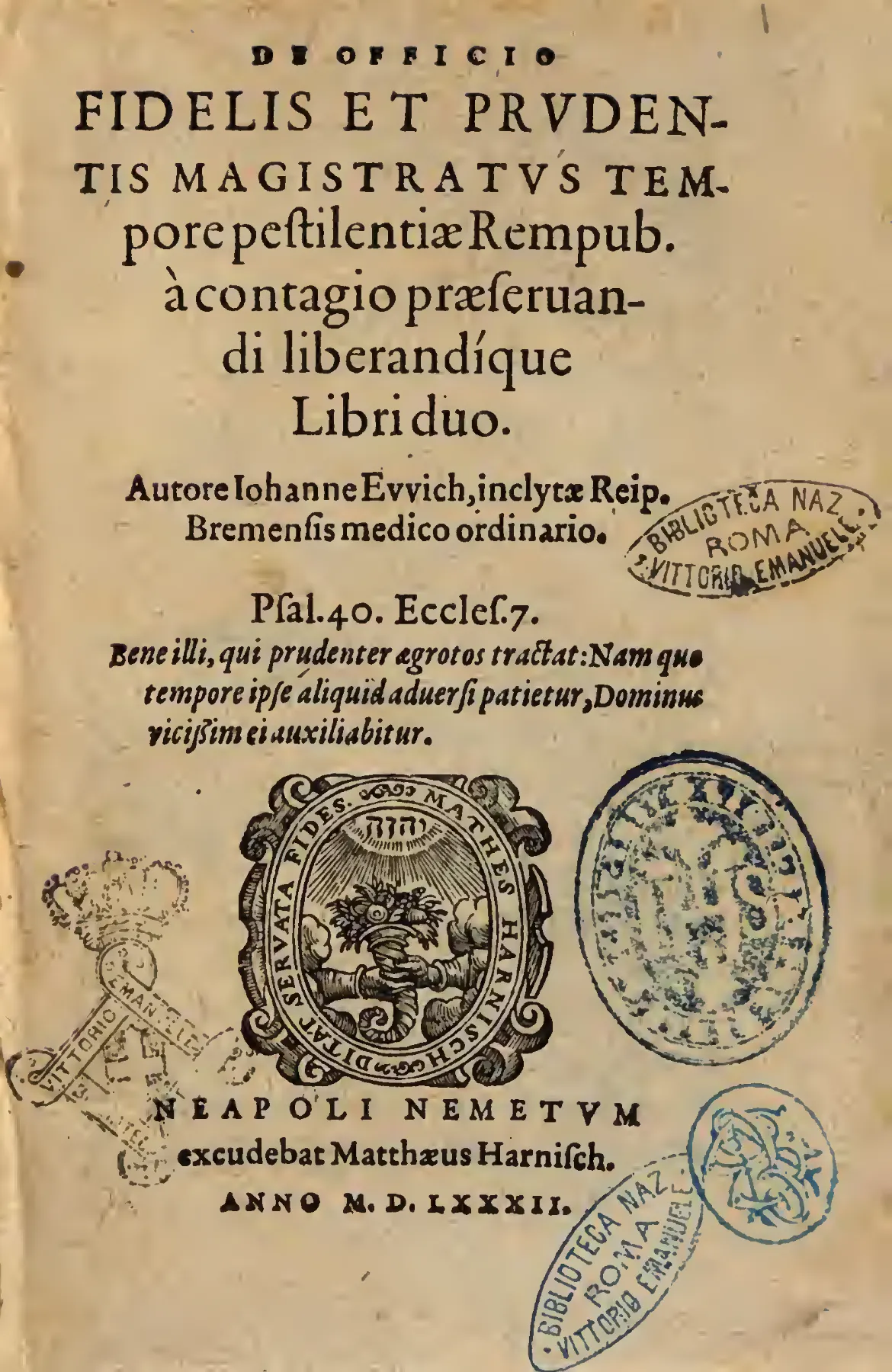
The 1582 Latin title page casts plague governance as a magistrate's duty: Ewich is named Bremen's medicus ordinarius, while Matthaeus Harnisch's Neustadt imprint and woodcut device place the book in a Palatine printing network. Later Biblioteca Nazionale di Roma stamps mark this copy's modern institutional history. Source ↗.
The problem Ewich sets himself is at once medical and confessional: whether, and by what right, a Christian commonwealth may act against plague rather than merely pray against it. His connective move throughout is aetiological. Pestilence is divided into three kinds — the immediately divine, the natural, and the contagious — and this classification is made to carry the entire burden of policy. Only the immediate stroke of God excludes flight and medicine, leaving room for supplication alone; natural and contagious plague, being material and transmissible through air, persons, animals, textiles, and merchandise, lies open to human counsel, and what lies open to human counsel falls within the magistrate's competence. Diagnosis, in other words, generates jurisdiction. The same distinction is turned polemically against those who make every pestilence an unmediated divine blow — a position he brands with the name of the ancient Euchites — and against astrological aetiology, while public penitence, prayer, fasting, and almsgiving are not displaced but placed first, as the prior term of one continuous programme rather than as a rival to it.
From that single distinction the treatise unfolds an institutional scheme of remarkable concreteness. Ewich argues civic competence outward from walls, ditches, ramparts, and warhorses — expenditures no one disputes — to the health of the citizen body, against learned authorities who would confine rulers to the protection of life and property, and he figures the ruler as nutritius and pastor populi. He proposes a standing magistracy of conseruatores sanitatis, conservators of health in name and in fact, modelled on the Venetian sanità and endowed with delegated authority over the whole apparatus: purpose-built plague-houses distinguished from ordinary hospitals and sited for elevation, northern air, and ventilation; written and sealed health passes for persons and goods, with instructed gatekeepers; the marking and enclosure of infected households for six or seven weeks; corps of bearers, buriers, and cleansers; extramural cemeteries and curtailed funeral pomp; the suppression of assemblies, spectacles, fairs, schools, church services, and public baths; the cleansing of lanes and the removal of animals; fire as the sovereign public remedy; the licensing of practitioners and the exclusion of itinerant medicastri, empirics, and Paracelsists; and salaried, sworn city physicians forbidden to flee. A penal schedule closes the argument, and its symmetry is the sharpest thing in the book: contempt of medicine is to be punished as heresy, and the assertion that all plague is God's immediate stroke as blasphemy — the two errors treated as mirror offences against the same aetiological truth.
Much else in the treatise is memorable in its particulars. Galen's draco, the enormous dragon, serves as the governing emblem of implacable pestilence and returns to open the second book. Contagion itself is historicised: on Cardano's testimony this kind of epidemic was unknown to Greeks and Arabs alike, a claim that lets Ewich present the material and adherent poison borne by unharmed carriers as a properly modern object of knowledge. Luther's Wittenberg plague booklet of 1527 is quoted repeatedly, including its complaint about a burial ground trodden like a market square; a plague mandate of Landgrave Philip of Hesse is reproduced entire; case dossiers run from Cologne, Padua, and Hamburg to Verona's fur and Venice's mattress; biblical philology distinguishes the saharath of the Old Testament from what contemporaries called elephantiasis, so that segregation rests on natural rather than ritual grounds; and the flight controversy is argued out in six arguments for and four against before a mediated verdict keyed, again, to the aetiological distinction and to magisterial decree. Over all of it lies a claim of priority: no one, Ewich says, has treated this subject comprehensively before, and the novelty of his politia is defended rather than concealed.

Lucas Cranach the Elder's 1528 portrait of Martin Luther. Luther's plague writings gave Ewich an authoritative Protestant precedent — one he could cite freely while still insisting that his own politia offered the first comprehensive treatment of epidemic burial and civic governance. Source ↗.
.jpg)
The stakes are those of a confessionalized north German municipality in the later sixteenth century, where the boundaries among magistrate, physician, pastor, household, and marketplace healer were genuinely disputed, and where a treatise that made health a branch of civic discipline was simultaneously making a claim about the reach of secular authority and about the theological legitimacy of natural explanation. Its interest is therefore comparative as much as local: it draws Italian sanitary practice north into a Reformed civic setting and translates it into penal law. Yet the modern literature is thin. Tilmann Walter's article of 2024 on Ewich's religious and intellectual world is the principal dedicated treatment to be found; no monograph on Ewich and no sustained study of this plague book were located, and certain features of the object — the exact twenty articles of the closing Synopsis seu recapitulatio, the subscription of the dedicatory epistle at Bremen in 1581, the precise dedicatee formula, and the route by which a Bremen physician's manuscript reached a Palatine press — await verification against the printed witness itself.
Read the full text and English translation on Leo
This text was transcribed and translated as part of the ExLatinis project, an effort by Leo to make free English translations of every text published in Latin in early modern Europe (1450–1750) available online. The complete transcription and English translation of this work can be read free of charge:
→ Read the original Latin text and full English translation on Leo
You can save a copy of this document into your Leo account to run deep text searches, conduct further analysis, or cross-reference it with your own research.
Rendering Ewich's Latin Title and the Vocabulary of Civic Health
Editorial English title, supplied for convenience rather than established in scholarship: The Duty of a Faithful and Prudent Magistrate to Preserve and Deliver the Commonwealth from Contagion in Time of Pestilence. The title is a close modernization of De officio fidelis et prudentis magistratus tempore pestilentiae rempub. a contagio praeseruandi liberandique libri duo, whose surviving catalogue and digitization records preserve the typography and orthography of the 1582 title. A contemporary English rendering appeared in London in 1583 as The duetie of a faithfull and wise magistrate, in preseruing and deliuering of the common wealth from infection, in the time of the plague or pestilence. In Ewich's civic vocabulary, politia means the ordered discipline and administration of the commonwealth, not merely abstract government. His proposal for a new or specially constituted part of politia gives medical knowledge an institutional place within magistracy, and he anticipates the objection that the thing is unheard of by conceding and defending the innovation, telling the reader that what is being attempted is a new institution — new, he says, perhaps in some places, or at least in part new, yet by no means useless or unnecessary, is sciat nouum nos institutum moliri nouum, inquam, fortassis alicubi, aut saltem aliqua ex parte nouum, sed neutiquam tamen inutile, aut nô necessarium. Contagium, associated in the primary text with poisonous air and with the retention of danger in houses, bedding, walls, tools, and other material settings, denotes an adherent and transmissible corruption rather than an exclusively internal illness; aura pestifera therefore belongs to a Galenic-Hippocratic account of environmental and bodily relations. The same Galenic framing supplies the work's governing figure, the treatise announcing its occasion in the language of a monstrous serpent — since at this time throughout almost all our Germany that dread pestilential plague, rightly called by Galen an enormous dragon, is everywhere creeping abroad, and in places not far from us raging savagely, Quando igitur hoc tempore in tota ferè Germania nostra dira illa pestilentiæ lues, quæ rectè immanis Draco à Galeno appellatur, passim gliscat, & alicubi no[n] procul à nobis atrociter grassetur, — an emblem that carries the aetiological argument in figural form, since a dragon is a natural creature to be fought rather than a portent to be endured. The language does not amount to a modern germ theory: it joins miasmatic vapour, material contamination, medical regimen, and divine providence.
Conservatores sanitatis names the proposed civic officers whose task is to organize healthy and sick persons, spaces, practitioners, burial, and enforcement; the text states the institution in exactly those terms, holding that in the care of public health too a certain magistracy must be established, who shall be conservators in fact and in name and shall by their own authority manage all the business of the institution, Ita quoque in cura publicæ sanitatis certus aliquis Magistratus constituendus est, quire & nomine conseruatores sint, suâque autoritate omnia huius instituti negotia procurent. The office extends the ordinary meaning of magistratus by making collective preservation of the respublica a positive jurisdictional duty. The related language of the ruler as nutritius and pastor populi, and of vera charitas, frames coercive separation and punishment as bounded forms of pastoral care rather than as alternatives to charity. Philological work of a scriptural kind serves the same end: the Hebrew saharath of the Old Testament is held apart from the disease contemporaries called elephantiasis, so that separation rests on a natural rather than a ritual ground — our elephantics, the text argues, are removed from the company of men for this reason, that they have a disease both grave and contagious, Nostri autem Elephantici ob id ex hominum coetu remouentur, quia morbum habent tum grauem, tum contagiosum, which is the same aetiological logic that elsewhere converts a diagnosis into a jurisdiction. The accessible OCR does not securely establish every requested phrase, especially vera charitas and aura pestifera as exact printed strings; their interpretation is consequently partly contextual rather than a claim about a fully verified critical text. That caution can be narrowed rather than lifted: the transmitted text does carry the maxim that true charity begins from itself but does not end in itself alone, Vera charitas à se ipsa incipit, sed in se vna non desinit, and the pestilential exhalation appears in inflected form in the statement that carriers can bear such an exhalation about and convey it to others though it itself often remains unharmed, Nam eiusmodi pestiferam auram, licet ipsa sæpe illæsa maneat, circunferre & ad alios deferre possunt, so that the residual uncertainty concerns the precise printed form of the nominative phrase rather than the presence of the concept.
What Ewich Argues, and How the Treatise Reached England in 1583
Johann Ewich (also Johann von Ewich, Johannes Ewichius), a physician of Bremen, wrote a Latin two-book treatise on the duty of magistrates during pestilence. The 1582 imprint identifies the author as Iohannes Evvich and was printed by Matthaeus Harnisch; catalogue records place it at Neapolis Nemetum, the Latin name for Neustadt an der Haardt. The work argues that civic authorities possess an active medical and disciplinary responsibility: they must organize prevention before plague enters and remedial administration after contagion is present, the division of labour following directly from the division of causes. The surviving primary-text excerpts describe a new office or branch of civic policy, coordination among physicians and surgeons, management of houses and burial, treatment of contaminated objects, and penalties for dangerous violations. Border regulation is set out with administrative precision, the conservators being required to appoint and instruct gatekeepers so as to admit no foreigner and permit no goods to be brought in unless they carry some written or sealed testimonial of soundness worthy of credit, eiusmodi cautio est adhibenda conseruatoribus nostris, vt constitutis institutisque portarum custodibus, nullum peregrinum recipiant, neque res vllas inferri permittant, nisi habeant testimonium aliquod scriptum, signatumve integritatis fide dignum. The treatise also advances an explicit claim of priority, the author observing that since, so far as he knows, this subject has never before been treated comprehensively by anyone or published in writing, he will at least achieve that much, tamen quoniam à nemine antehac (quod equidem sciam) hoc argumétum vniuersim tractatum, literisq[ue] vulgatum est, si nihil aliud, saltem hoc efficiam,.
A closing twenty-article Synopsis seu recapitulatio with a schedule of penalties is recorded in the descriptive account under which the work has been transmitted, but the accessible scan excerpts do not permit independent confirmation of the exact twenty articles or their complete sequence. They do, however, show penal provisions and two headings marked CAPVT IX, while the placement of both headings within Book II remains unverified. The work is in Latin. John Stockwood translated it into English as The duetie of a faithfull and wise magistrate..., printed in London by Thomas Dawson in 1583; the surviving English catalogue record describes 272 pages and octavo format and identifies the University of Michigan/EEBO witness A00472.0001.001. No dependable evidence of a German, Dutch, or French translation, modern-language translation, or critical edition was located. The claimed Bremen subscription of the dedicatory epistle in 1581 and the precise dedicatee formula require direct title-page and epistle verification.
Placing Ewich in the Historiography of Plague, Magistracy, and Civic Health
Ewich matters because the treatise makes public health a problem of confessional civic government rather than a merely private medical consultation. It joins learned medicine, municipal police, clerical duty, quarantine-like separation, regulation of practitioners, burial, and criminal sanction. The hinge is methodological before it is political: it is the constant teaching of physicians, the text begins, that the first part of every cure must be referred to the knowledge of causes and symptoms, ONSTANS medicorum doctrina est, priorem parte[m] omnis curationis ad causarum iudiciorumque cognitionem esse reuocadam, and it is this Galenic commonplace, applied to a body politic rather than a patient, that licenses the whole institutional scheme. Its conceptual structure allows divine, natural, and contagious causes to coexist: providence is not denied, but natural explanation and prudent action authorize medicine, flight under conditions, segregation, and coercive intervention. The concession to the first species is stated without qualification — of the immediate divine plague it is said that we can neither escape nor avoid it by flight or by medicines, nor ought we to, but there is room only for supplications, vows and expiations, quam neq[ue] fuga, neque medicamentis euitare possumus, aut debemus, sed tantùm supplicationibus, votis & expiationibus locus est — and precisely because the concession is genuine and bounded, everything outside it becomes actionable. The contagious species is further presented as a comparatively recent object of knowledge, since on the testimony adduced this kind of epidemic was known neither to the Greeks nor to the Arabs, Hoc aute[m] genus Epidemiæ neq[ue] Græcos, neq[ue] Arabes cognouisse, testis est Hier. Cardamus,, the appeal to Cardano historicising contagion rather than deriving it from the ancient canon.
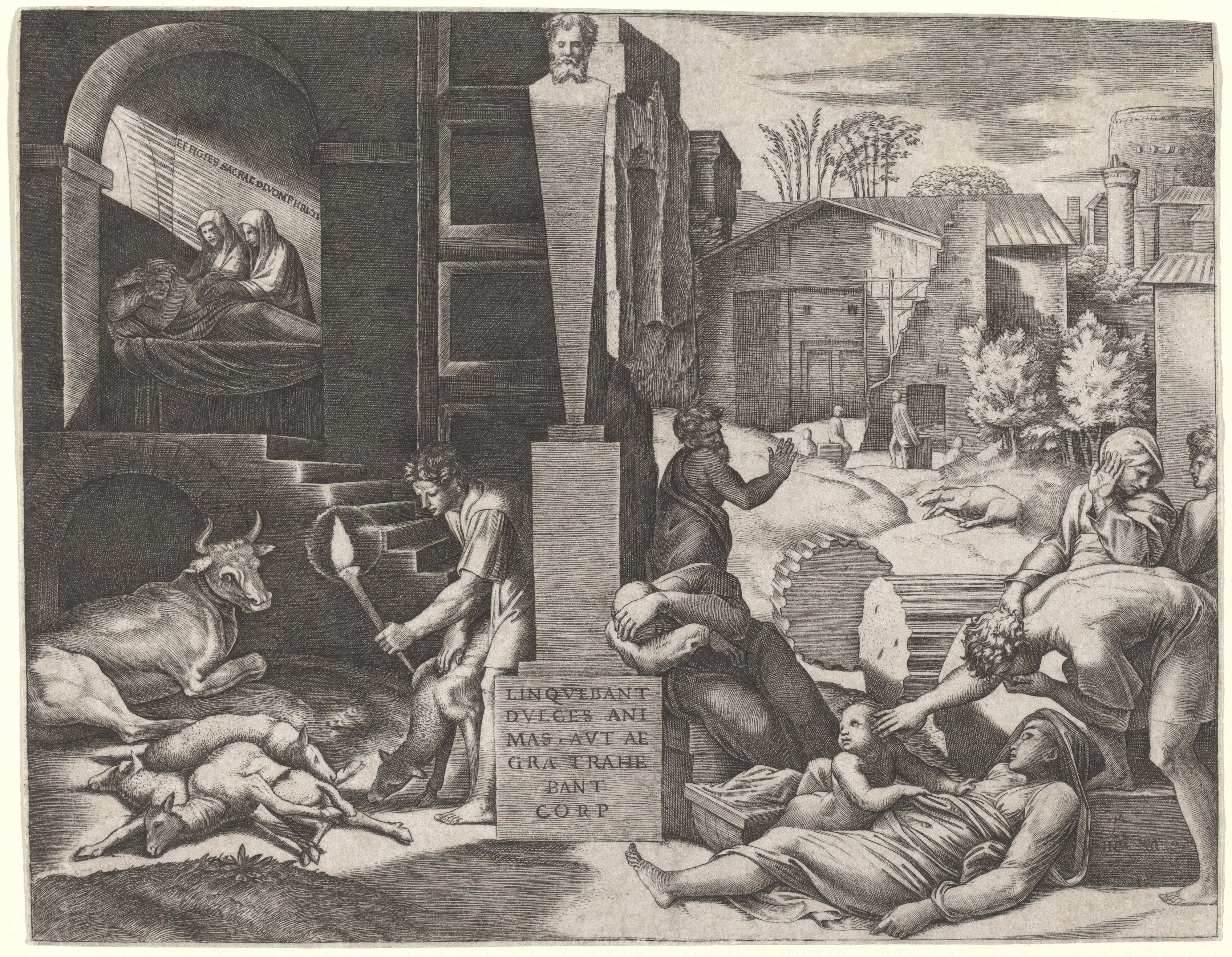
Marcantonio Raimondi's engraving after Raphael, known as Il Morbetto (The Plague), renders epidemic catastrophe in a learned classical idiom, with human and animal death set beside an inscribed plinth. Providential terror and observable bodily crisis coexist here much as they do in Ewich's threefold division of causes. Source ↗.
,_NGA_654.jpg)
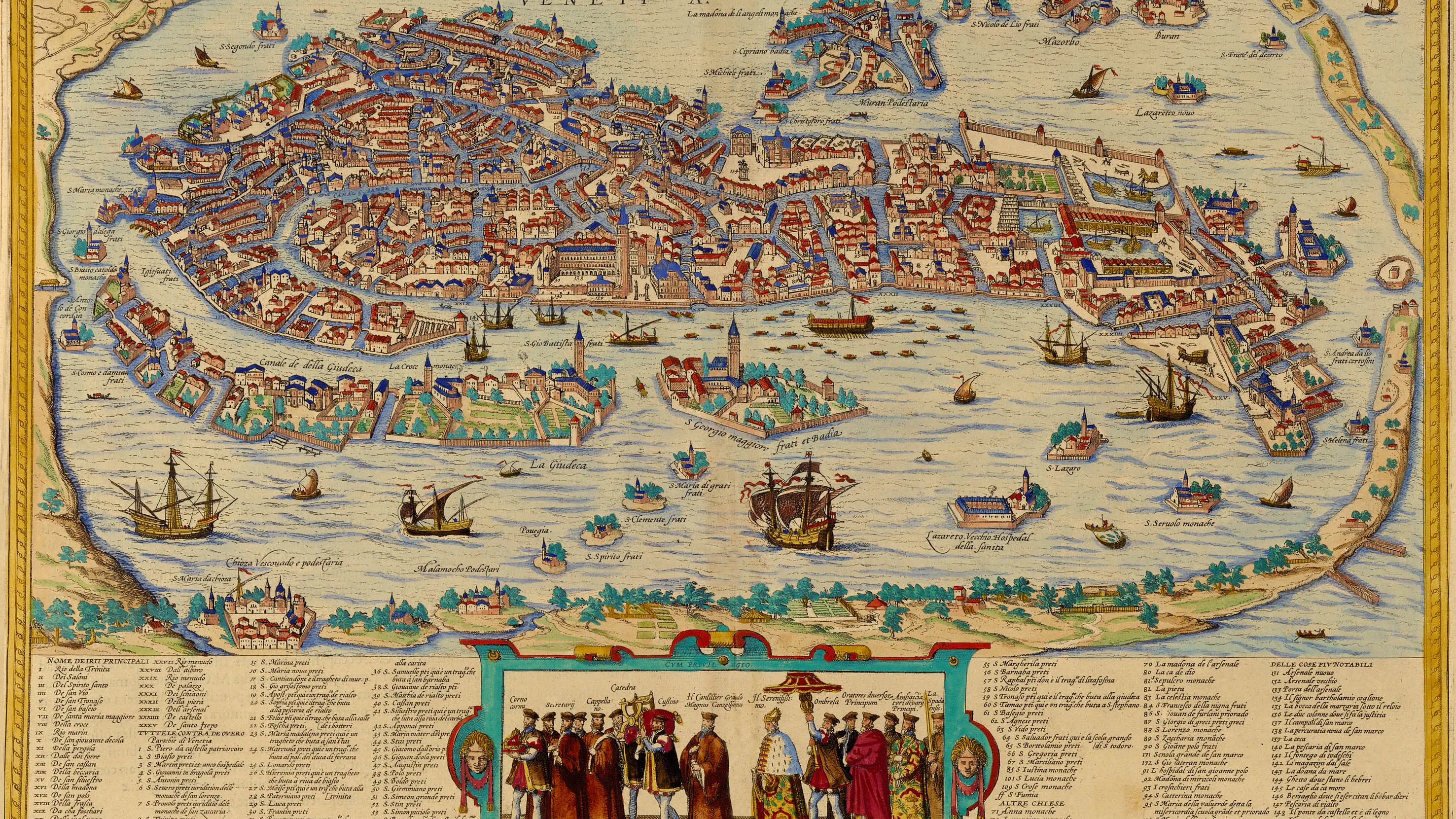
The polemical edge of the taxonomy is directed at fatalist providentialism. Since what is said agrees with truth, the text urges, let there be an end of the ignorant obstinacy of those who, persuaded that every plague is an immediate stroke of God, will have no effort and no exertion applied by men to drive it off, but hold that recourse must be had, with the Euchites, only to prayers and supplications, Quare cùm veritati consentaneum sit quod dicimus, facessat illorum imperita pertinacia, qui omnem pestem immediatam Dei plagam esse persuasi, nullum conatum, nullu[m] studium ab hominibus adhiberi ad eam abigendam; sed tantùm cum Euchitis ad preces & supplicationes confugiendum esse volunt:, the heresiological label doing polemical work by assimilating a contemporary devotional posture to a condemned ancient sect. The jurisdictional argument follows as its constructive counterpart, and is made against named learned opinion, the text refusing to be moved by the authority of certain distinguished and most learned men who very imprudently seem to deny that this care belongs to the magistrate, quorundam insignium & eruditissimorum virorum autoritas, qui nimium imprudenter negare videntur, ad Magistratum hanc curam pertinere,. Its favoured proof is an argument a fortiori from undisputed defensive expenditure: why are horses fed, ships built, walls repaired, ditches drawn round, towers and ramparts raised, except that the citizens may live more comfortably, safe against hostile assaults, Quare aluntur equi, ædificantur naues, reparantur moenia, circumducuntur fossæ, eriguntur turres & aggeres, nisi vt ciues tuti contra hostiles insultus viuant commodiùs? — pestilence being construed as an enemy of the same order as a besieging army.
The text is therefore valuable for studying the disputed boundaries among magistrate, physician, pastor, household, and marketplace practitioner in the later sixteenth century. The boundary with the unlicensed practitioner is drawn polemically, the offenders named as those itinerant quacksalvers and, to the destruction of many men, Jewish empiric-physicians and Paracelsists, Quales sunt circumforanei illi medicastri, atque cum multorum hominum exitio empiriatri Iudæi, Paracelsistæ,, and the remedy proposed is statutory rather than merely corporate, the author wishing that it were provided by law that no one be permitted to administer medicines to anyone, especially purgatives, unless approved by public authority, vtinam lege cautum sit, ne quis pharmaca, præsertim catharctica, nisi publica authoritate approbatus sit, alicui propinare permittatur!. The Italian comparison is acknowledged as the model rather than concealed: the same custom and the same prudence, the text observes, is retained today in the judging and handling of plague victims by the most celebrated and almost the most powerful commonwealth in the whole world, the Venetian, to the image of whose skill this scheme has been roughly sketched, Eandem retinet consuetudinem, eademq[ue] prudentia clarissima hodie, & toto ferè orbeterrarum potentissima Respublica Venetiana (ad cuius solertiæ imaginem hanc meam qualemcûque institutionem ruderiter adumbraui) in diiudicandis tractandisque pestiferis. The flight controversy is resolved by the same aetiological key, with a Lutheran precedent invoked for the case in which calamities arise, as chiefly at this time and as Luther says of the Wittenberg plague of the year 1527, from our own imprudence and rashness, not to say malice and contempt of good counsel, Sin verò, vt hoc tempore potissimùm sit, & vt Lutherus de peste VVittebergensi, anni 1527 ait, nostramet ipsorum imprudentia & temeritate, ne dicam maleuolentia & bonorum consiliorum contemtu oriantur huiusmodi co[m]munia incommoda,. Most striking for the confessional history of civic discipline is the penal symmetry in which the argument terminates, since whoever, whether healthy or sick, shall despise medicine is to be condemned for obstinacy and held as a heretic, Qui sanus vel æger Medicinam contemserit, pertinaciæ damnandus est, & tanquam hæreticus habendus:, while whoever shall assert that every plague is an immediate stroke of God is to be condemned for ignorance and spurned as a blasphemer, Qui autem omnem pestem tanquam immediatam Dei plagam esse affirmaucrit, ille ignorantiæ condemnandus, & vt blasphemus spernendus est: — the aetiological distinction here becoming directly punishable doctrine on both flanks.
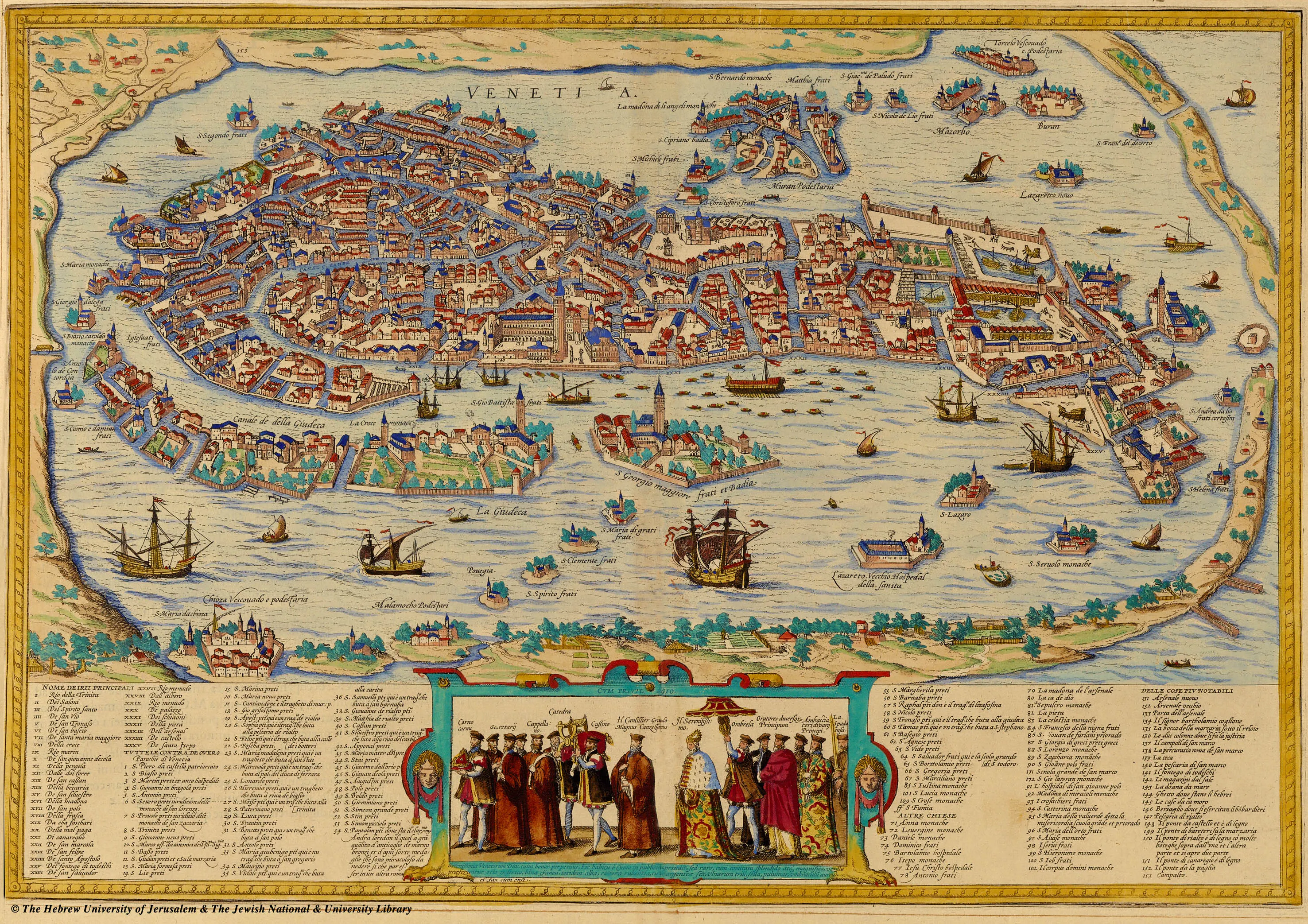
A 1572 bird's-eye view of Venice, its lagoon presented as a managed civic landscape with labelled quarantine sites such as Lazzaretto Nuovo and S. Lazere. Venice supplied Ewich with his working model for lifting plague control out of household and market improvisation into a coordinated civic regime. Source ↗.

Relevant historiographical conversations include Carlo M. Cipolla and Richard Palmer on Italian health boards and the Venetian sanità; Jane Stevens Crawshaw on Venetian plague hospitals and lazaretti; Paul Slack on the social meanings of plague policy; Ann G. Carmichael on changing languages of plague and the danger of treating all historical pestilence as epidemiologically identical; Samuel K. Cohn Jr. on contagion, control, and the limits of simple narratives of early modern plague response; Ole Peter Grell and Andrew Cunningham on Protestant medicine, religious duty, and apocalyptic interpretation; Vivian Nutton on pre-Fracastorian and Fracastorian traditions of seeds and contagion; Annemarie Kinzelbach and the contributors to Civic Medicine on physicians as civic actors; the German historiography of Medizinalpolizei and its critics; Heinz Schilling on confessionalized civic order; and Robert Jütte on the medical marketplace and polemic against unauthorized practitioners. Wolfgang Behringer, H. C. Erik Midelfort, Gerhild Scholz Williams, and scholarship on Johann Weyer's circle provide the appropriate comparative frame for Ewich's anti-demonological work. These scholars should not be represented as having written specifically on the 1582 plague treatise unless a dedicated study is demonstrated. The evidence located here indicates that Ewich's historiography is thin: Tilmann Walter has supplied a dedicated article-length study of Ewich's religious and intellectual world, published in Archiv für Reformationsgeschichte 115 (2024), but no monograph devoted to Ewich and no sustained study specifically of this plague-policy book was located. The most secure modern interpretation is consequently comparative and contextual, not the result of a settled Ewich school.
Tracing the 1582 Neustadt Printing and the Book's Bibliographic Afterlife
The correct bibliographic object is Ewich's De officio fidelis et prudentis magistratus tempore pestilentiae rempub. a contagio praeseruandi liberandique libri duo, printed by Matthaeus Harnisch in 1582 at Neapolis Nemetum (Neustadt an der Haardt). The catalogue form varies between praeseruandi and praeservandi, magistratus and abbreviated magistratvs, and repub. and rempublicam. VD16 records the item as E 4692. Google Books describes a 191-page copy whose original is attributed to the Bavarian State Library's Staats- und Stadtbibliothek Augsburg and whose digitization was made in 2014; a separate Google record describes a Rome-origin scan by the same printer and year. MDZ/BSB and WorldCat records likewise identify Ewich, Neapolis, 1582, and Harnisch. WorldCat displayed one edition in one library and linked the Bayerische Staatsbibliothek, but the accessible record did not expose a shelfmark. No reliable full shelfmark was confirmed for the 1582 Latin witness at HAB Wolfenbüttel, SUUB Bremen, Staatsbibliothek zu Berlin, Wellcome, or the British Library. The octavo format is plausible from catalogue practice, but it was not independently established for the Latin copy; the octavo record returned by USTC 6614 is a false match, since USTC 6614 is Nicolas Barnaud's French Le cabinet du roy de France, not Ewich. An aggregator's statement that nine editions exist is not sufficient to establish nine bibliographically distinct editions or issues. Harnisch's activity at Neustadt is independently documented: he moved there around the end of 1577 with the Heidelberg printer Johann Mayer, acquired the house Zum Ochsen, and produced roughly 140 prints, including medical and Reformed academic works. That setting makes Neustadt a credible confessional and scholarly production centre, but the exact route by which a Bremen physician's manuscript reached Harnisch, and any privilege or censorship history, remain unproven.
The primary-text OCR records medical coordination, proposed civic officers, contaminated walls and furnishings, burial concerns, and punishments ranging from fines and public disgrace through suspension, imprisonment, and death. The transition between the treatise's two books is marked in the text by the return of the Galenic emblem at the point where prevention gives way to remedy, the second book opening on the case in which this monstrous pestilence and savage dragon, as Galen calls it, has invaded, immanis hæc lues, & truculentus draco (vt Galenus eam vocat) inuaserit, so that the same figure that announced the occasion of the whole work also articulates its internal division. Among the preventive materials the accessible text carries an order to be established among the citizens, that they avoid public gatherings, spectacles, banquets, drinking-parties, fairs, schools, churches and public baths, est ordo inter ciues, vt publicos conuentus, spectacula, conuiuia, symposia, nudinas, schoolas, templa, balnea publica vitent, and an environmental remedy urged on the authority of experience and reason, the author replying with some right that the first, second and third defence is fire, as all the best men so taught have determined, respondere possem, primum, secundum & tertium præsidium esse ignem, quod optimi quicq[ue] sic experientia & ratione edocti statueru[n]t. The work also incorporates whole documents of magisterial provenance in its argument, among them a princely mandate opening with the declaration that it is to be known to each and all of the subjects that it has been reported that that contagious evil of pestilence is raging violently all around in places neighbouring the prince's dominions, Notum omnibus & singulis subditis nostris esse volumus, ad nos referri, contagiosum illud pestilentiæ malum in locis ditionibus nostris vicinis circumquaque vehementer grassari, — a compositional habit that makes the treatise partly a collection of administrative exemplars as well as a continuous argument.
The regime of sequestration is set out with the same documentary concreteness: that the contaminated house be marked with certain woods, such as torches set at the doors, which by the custom of the nations are borne before the dead, or with poles, or straw bundles, or a black, white or red veil hung out to signify sickness or death, and that at the same time it be proclaimed to the whole household that they dare not go out to others nor admit anyone to themselves, for at least six or seven weeks, vt domus illa contaminata certis lignis, vt expositis ad fores tædis, quæ gentium more mortuis præferri solent, vel fultibus, qui punitionem, vel fasciis stramineis, vel nigro, albo rubróve suspenso velo morbum mortemve designantibus, notetur: simulque edicatur toti familię, ne egredi ad alios, neque quenquam ad se admittere ausint, ad minimum sex vel septem hebdomadarum spatio,. Burial and cemetery policy is argued partly through quotation of Luther, whose complaint is reproduced that ours is anything rather than a cemetery, indeed nothing else than four or five public streets and two or three market-places, so that there is scarcely a more trodden and restless spot in the city, Nostrum autem quiduis potiùs est, quàm cæmeteriu[m], imò verò nihil est aliud, quàm quatuor aut quinque publicæ plateæ, & duo, triáve fora, adeo vt ferè nullus in vrbe locus sit tritior & irrequietior. The penal sections rest in part on the author's own testimony to deliberate or reckless infection, since he can truly assert that he has seen with these eyes men who, though labouring under this affliction already so swollen that they could not doubt it, thrust themselves into church and secretly took the Lord's bread together with others and drank the Lord's wine from the same cup, At reuera asserere possum, his oculis me vidisse, qui, cùm hoc affectu iam extuberanti, vt dubitare non possent, laborarent, templo se ingererent, & clam panem Domini simul cum alijs sumerent, atque ex eodem calice vinum Domini biberent:. The accessible text also records two CAPVT IX headings, one concerning domestic animals and another in an enforcement context; the scan does not securely establish their book-level placement, catchwords, signature sequence, or a complete collation.
No contemporary reply, prosecution, suppression, or identifiable counter-text was located. Ewich's related De sagarum ... natura, arte, viribus et factis, item de notis indicisque quibus agnoscantur et poena ... censura is recorded as a Bremen 1584 work and was reprinted in Theatrum de Veneficis (Frankfurt, 1586), pp. 325–355; its printer was not confirmed. The 1613 Catalogus sanctorum Italiae in menses duodecim distributus is a separate Catholic hagiographical book by Filippo Ferrari, published at Milan by Hieronymus Bordon(i) in 1613, in Latin, in quarto, with [84], 2, 822 [i.e. 824] pages. It has its own HathiTrust/Complutense and Internet Archive records, including a scan with an old-vellum binding, red-sprinkled edges, and a printer's device. The distinct authors, dates, genres, imprints, and digital records establish bibliographic conflation or misattachment where the Ferrari record has been joined to the Ewich object; the evidence does not identify the precise catalogue or digitization operation that first made the attachment.
Reading the Two Books: Structure, Argument, and Textual Evidence
Title page and dedicatory epistle: the utterance of an office
The book presents itself, from its first printed leaf, as the utterance of an office rather than of a private savant: the title page names its author as Autore Iohanne Evvich, inclytæ Reip. Bremensis medico ordinario, Johann Ewich, ordinary physician of the renowned commonwealth of Bremen. The formula is not decorative. A medicus ordinarius is a salaried servant of a civic body, and the treatise that follows will argue that such salaried service ought to be generalised into a whole branch of municipal administration; the title page therefore already contains, in miniature, the argument's claim to standing. The dedication extends that standing across a region rather than a single town, being addressed CONSVLIBVS, AC SENATORIBVS REIPUBLICAE Bremensis, Stadiensis & Boxtehudensis,, to the consuls and senators of the commonwealths of Bremen, Stade and Buxtehude — three Elbe-and-Weser civic bodies treated as limbs of one ecclesiastical whole and figured, in a conceit that is itself medical, as brain, heart and liver. The epistle opens on the Fall and on man's incapacity to discern either the causes of his evils or their remedies, pairs theologian and physician as the two professions equally burdened with public odium, and insists that care of soul and care of body are distinct but inseparable, so that neglect of either is impiety or inhumanity. From that anthropology the occasion follows: physicians have written copiously on cure and on individual prophylaxis, but there exists no publica ratio & ordo, and the want must be supplied where alone it can be supplied, in the magistrate, in cuius opera potissima spes tanti infortunij compescendi posita est, in whose activity the chief hope of restraining so great a misfortune is placed. The rhetorical work of the epistle is thus to convert a gap in the medical literature into a deficiency in government.
The preface on causes: aetiology as the apportionment of jurisdiction
The preface on the causes of pestilence is the theoretical hinge on which everything after it turns, and it begins by borrowing the authority of clinical method for a political conclusion. The axiom already noticed above — that the constant doctrine of physicians refers the earlier part of every cure back to the knowledge of causes and of signs — is stated here as the treatise's first premise, and applied to a city rather than a patient it licenses the whole procedure that follows: policy is a species of therapy, and therapy begins with aetiology. The threefold division that comes next — plague divine, natural, contagious — is accordingly not a scholastic ornament but the instrument by which jurisdiction is apportioned. The concession made to the first species is unhedged and, precisely because unhedged, strategically decisive: as the passage discussed earlier states, the immediately divine stroke can be neither escaped nor avoided by flight or by medicines, nor ought it to be, and leaves room only for supplications, vows and expiations. Granting the devout their strongest case in its purest form allows the author to confine it: everything not immediately divine — the natural plague born of air, water or earth, and the contagious plague born of human negligence and intemperance — falls to counsel and therefore to command. The preface's polemic against those who make every pestilence God's unmediated blow, and against astrological aetiology as mere conjecture, works within this same economy. Nothing in it denies providence; what it denies is that providence exhausts causation, and that denial is what makes the rest of the book thinkable as law rather than as impiety.
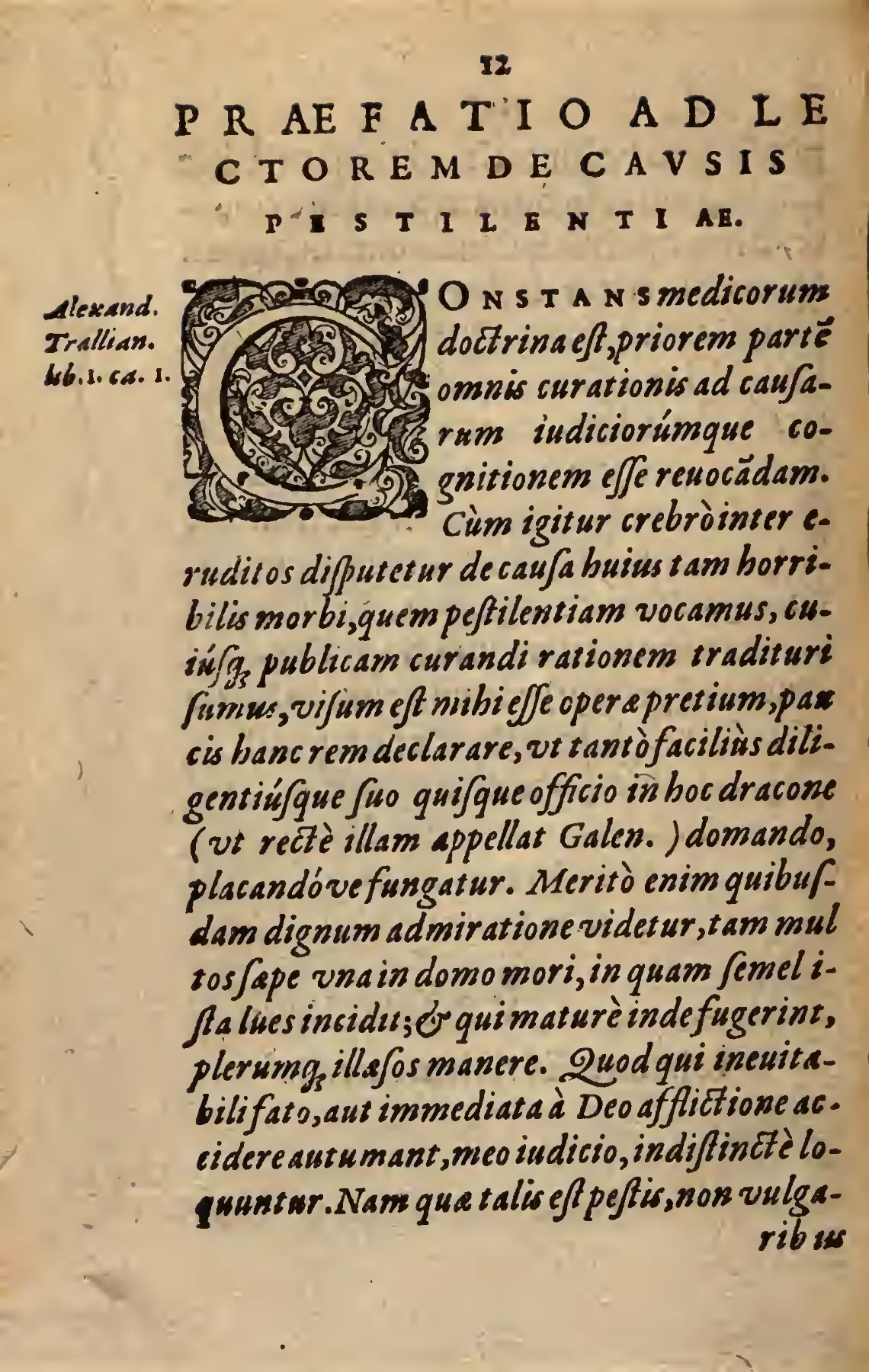
The decorated initial opening Ewich's preface on the causes of pestilence lends visual weight to its governing premise: cure begins with knowledge of causes and signs, an axiom here redirected toward civic governance. A marginal citation to Alexander of Tralles and Galen's "dragon" ground what follows in medical authority. Source ↗.
Book I: from defensive expenditure to a new part of civic polity
Book I converts the aetiological argument into a jurisdictional one. Against the objection that healing belongs to God alone, and against the more formidable learned opinion that the magistrate's competence ends at the security of life and property, the text argues a fortiori from expenditures no citizen disputes — the fed horses, the built ships, the repaired walls, the encircling ditches, the raised towers and ramparts already cited above, all of them maintained so that the citizens, safe against hostile assaults, may live more comfortably. That rhetorical question does two things at once. It assimilates pestilence to a besieging enemy, so that sanitary outlay becomes a species of defence spending; and it shifts the criterion of good government from bare survival to living commodiùs, comfortably, a term that quietly widens magisterial duty beyond the minimalist definition the objectors had proposed. The institution built on that foundation is stated as an innovation without apology: the author declares himself to be attempting nouam quidem, sed tamen prorsus vtilem, necessariamque politiæ partem moliri, a new part of civic polity indeed, yet one wholly useful and necessary. The concessive quidem … sed tamen registers the pressure that novelty carried in a culture where custom was itself an argument, and the treatise meets that pressure by claiming utility and necessity rather than precedent — though precedent is supplied all the same, from Venice, Antwerp, Padua, the Hessian mandate translated whole into Latin, and Bremen's own senate in the plague of 1565.
The regulatory chapters that follow show how thoroughly humoral physiology could be rendered as enforceable ordinance. Dietetic doctrine about moist and putrescible foods emerges directly as market police: Primum igitur seuerè prohibebitur, ne quis vel rusticorum, vel incolarum venum exponat aut vendat, dulcia cerasa, pruna (exceptis Vngaricis & Damascenis) vuas sicúsque recentes, persica, pira, pomáq[ue] mollia & dulcia, melones, pepones, & minimè omnium cucumeres — first, then, it shall be strictly forbidden that any countryman or inhabitant expose for sale or sell sweet cherries, plums (Hungarian and Damascene excepted), grapes and fresh figs, peaches, pears and soft sweet apples, melons, pumpkins, and least of all cucumbers. The exemption of Hungarian and Damascene plums is the telling detail: the prohibition is not a blanket austerity but a graded application of qualitative pharmacology to the stalls of a market square, and it presupposes an inspectorate capable of distinguishing varieties. The same logic governs the suppression of assemblies, spectacles, fairs, schools, churches and baths, the dispersal of markets into several squares, the removal of livestock from lanes, and the health passes without which neither stranger nor returning citizen nor bale of goods may enter the gates. Book I closes by disarming the obvious charity objection to exclusion with the maxim of studied balance already quoted in this report, that true charity begins from itself but does not end in itself alone. The sentence concedes the priority of self-preservation only in order to make prudence the form that love takes in a plague-time city; charity is not curtailed but administered.
Book II: from preservation to liberation
Book II turns from preservation to liberation, and marks the turn by recalling the emblem announced in the dedicatory epistle, opening on the case in which the monstrous plague and savage dragon — Galen's phrase, noticed earlier as the marker of the treatise's internal division — has already invaded. The figure carries the aetiology it illustrates: a dragon is a beast to be hunted, not a portent to be endured, and the second book is a treatise on hunting it — house-marking and enclosure of infected families for six or seven weeks, the objection of cruelty answered by the greater interest of the whole society, and the legitimacy of medicine defended at length from Sirach, from Luther's Wittenberg booklet, and from the author's Paduan teacher. In that defence the opponents are given a heresiological name, being reckoned Euchitis antiquis hæreticis non dissimiles, not unlike the ancient heretics the Euchites, the fourth-century "praying men" who rejected all secondary means. The label is polemically economical: it makes a contemporary devotional posture into a condemned sect rather than a pious excess, and thereby transfers the burden of orthodoxy to the party of medicine. The purpose-built plague-house is then specified with the precision of a building contract governed by environmental medicine: Secundò de loco ac situ, cui annexus est aer, istud obseruandum est, vt vel in vrbis remota aliqua parte, vel, quod malim, extra vrbem sit, non humilis, sed apricus ac editus, & si fieri potest, ad flumen, secondly, concerning place and site, to which air is annexed, this is to be observed: that it be either in some remote part of the city or, as the author would prefer, outside the city, not low-lying but sunlit and elevated, and if possible beside a river. Elevation, exposure and running water are doctrinal requirements of air quality rendered as siting rules, and they generate in turn the sharp criticism of ordinary charitable hospitals built so tightly that no wind can penetrate them.
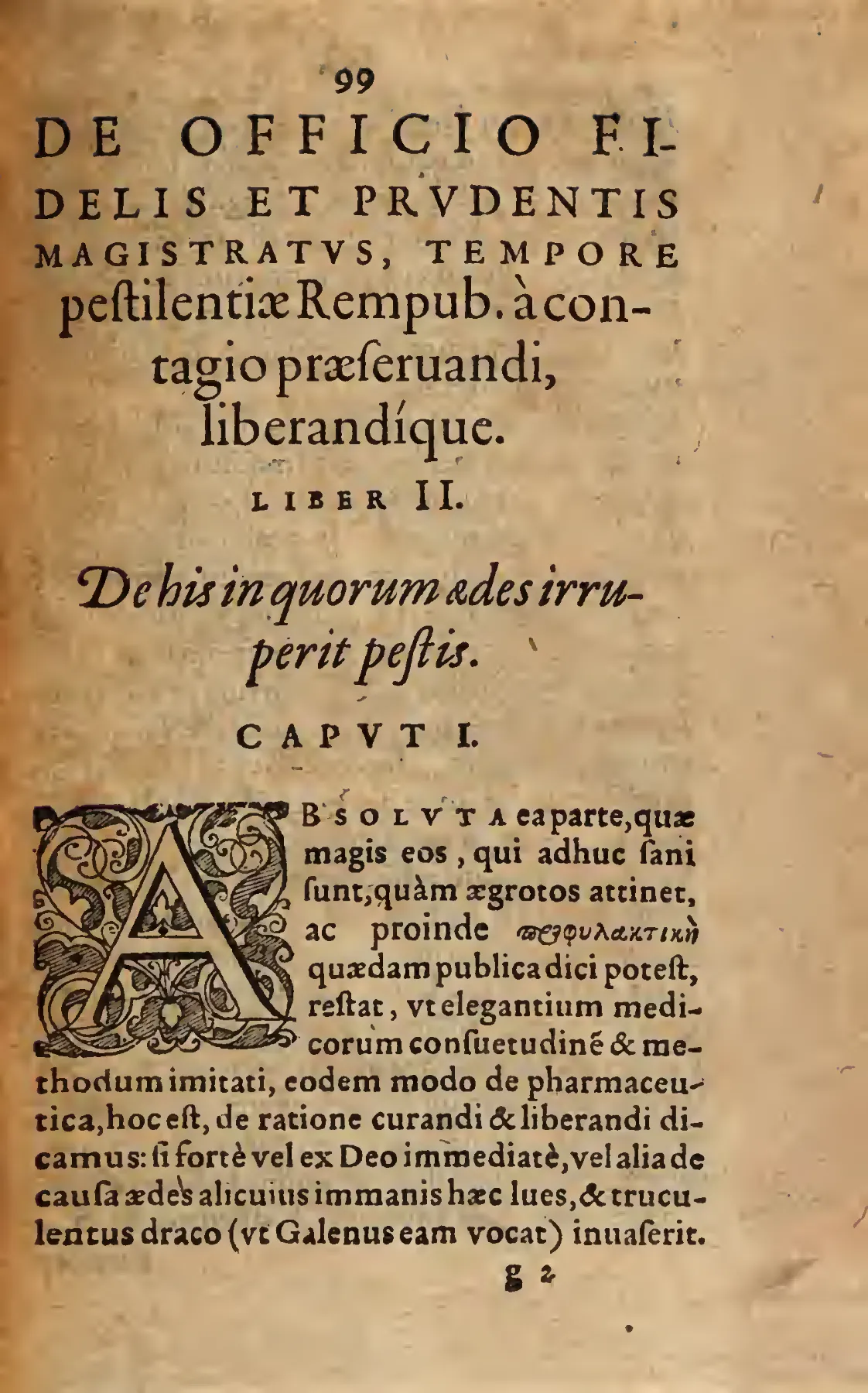
The opening of Book II turns from preserving the healthy to governing households already breached: the chapter heading "De his in quorum aedes irruperit pestis" and its foliate initial mark the moment Galen's savage dragon has invaded, making the turn from preservation to liberation part of the book's architecture. Source ↗.
The penal schedule and the closing recapitulation
The book's culmination is penal, and its symmetry is the most striking construction in the whole work. The offender who refuses treatment is assimilated to the heretic, condemned for obstinacy whether he be healthy or sick; the doctrinaire providentialist who asserts that every plague is the immediate stroke of God is condemned for ignorance and spurned as a blasphemer. Both clauses have been quoted above; what deserves emphasis here is that they are mirror images, and that each borrows a category from ecclesiastical discipline to punish an error of natural philosophy. Contempt of medicine is pertinacia, the technical mark of the heretic who persists after admonition, while the providentialist's fault is ignorantia, which is nevertheless prosecuted under the gravest of religious charges. The preface's taxonomy has here become actionable doctrine on both flanks, and the confessional vocabulary that might have been used against the physician is turned to his defence.
The recapitulation that closes the work restates the programme in a clipped statutory idiom quite unlike the discursive chapters, as when the plague-houses are prescribed — Duo ædifica, Loemodochia vocata, sat ampla, materia solida, aere septentrionali, forma apta, in semota vrbis parte, two buildings, called loemodochia, sufficiently ample, of solid material, with northern air, of apt form, in a remote part of the city — and when border control is reduced to a single rule, Nulli alienigenæ, neque ciues, qui ex infectis locis veniunt, sine testimonio sanitatis, in vrbem sunt recipiendi, no foreigners, nor citizens who come from infected places, are to be received into the city without a testimonial of health. The ablative strings and gerundives of these articles are the syntax of an ordinance rather than of a consilium, and their coinage loemodochium, set against the nosodochium the author has just condemned, insists lexically that the institution proposed is not the old hospital renamed. That the whole is then followed by a defence of borrowing from other authors and by a verse Precatio invoking David's pestilence shows how the treatise wishes to be received: as an innovation in polity that remains, in its final words, an act of supplication.
Frequently Asked Questions
What is Johann Ewich's De officio fidelis et prudentis magistratus tempore pestilentiae?
It is a two-book Latin treatise of 1582 arguing that guarding a commonwealth against epidemic disease is a jurisdictional duty of those who govern it. Printed by Matthaeus Harnisch at Neapolis Nemetum, Neustadt an der Haardt, it is not a bedside plague regimen but a work of civic policy addressed to magistrates. Ewich divides pestilence into the immediately divine, the natural, and the contagious, reserving prayer alone for the first and opening the other two to human counsel and therefore to magisterial command. Galen's enormous dragon serves as its emblem for implacable plague.
Who was Johann Ewich?
Johann Ewich — also Johann von Ewich or Johannes Ewichius, and on the 1582 title page Iohannes Evvich — was a physician of Bremen, styled there medicus ordinarius, the salaried physician of the city. He dedicated the treatise to the consuls and senators of Bremen, Stade and Buxtehude, figuring the three towns as brain, heart and liver, and cites his Paduan teacher in defending medicine. A related work on witches is recorded as a Bremen book of 1584, reprinted in the Frankfurt Theatrum de Veneficis of 1586. Modern scholarship on him is thin: Tilmann Walter's article of 2024 on his religious and intellectual world is the principal dedicated study located.
What did Ewich actually want town councils to do about plague?
He wanted a standing magistracy of health. His central proposal is a college of conservatores sanitatis — conservators of health in fact and in name — endowed with authority over the whole apparatus, on the model of the Venetian sanità, which he names openly as his pattern. Under them: purpose-built plague-houses sited outside the walls, elevated, sunlit and if possible beside a river; written and sealed health passes checked by instructed gatekeepers; infected houses marked and enclosed for six or seven weeks; extramural burial; suppression of fairs, schools, churches and baths; fire as the chief public remedy; and salaried, sworn city physicians forbidden to flee.
Why does the treatise punish contempt of medicine as heresy and providentialism as blasphemy?
Because both errors offend the same aetiological truth. The closing penal schedule mirrors two offences: whoever, healthy or sick, despises medicine is condemned for obstinacy and held a heretic; whoever asserts that every plague is God's immediate stroke is condemned for ignorance and spurned as a blasphemer. Ewich brands the latter party with the name of the ancient Euchites, the fourth-century "praying men" who rejected secondary means, so that a contemporary devotional posture becomes a condemned sect. Public penitence, prayer and fasting stand first in his programme, but as its opening term, not as a rival to sanitary action.
Is there an English translation of Ewich's plague treatise?
Yes, a contemporary one: John Stockwood translated it as The duetie of a faithfull and wise magistrate, in preseruing and deliuering of the common wealth from infection, in the time of the plague or pestilence, printed in London by Thomas Dawson in 1583, recorded at 272 pages in octavo. No modern-language translation or critical edition has been identified. Separately, the Leo edition offers the full transcription alongside a complete English translation that is generated by AI; Leo works to make free English translations of every text printed in Latin in early modern Europe between 1450 and 1750 available online at no cost.
This report was generated by an advanced AI assistant that conducted deep research alongside an extensive interpretation of the transcribed original text. Every effort has been made to preserve fidelity to the source and to guard against inaccuracy, but corruption in the text recognition process and model hallucination may nonetheless have entered the text. Treat every claim, quotation, translation, and citation as provisional, and verify each against the original source before relying on or citing it.
Critical Further Reading and Contextual Resources
- Ann G. Carmichael, "Universal and Particular: The Language of Plague, 1348–1500," Medical History, Supplement 27: Carmichael's attention to changing plague vocabularies and to local variation supplies an essential guard against treating Ewich's pestis, lues, contagium, and environmental language as transparent equivalents of later epidemiological categories. Ewich himself treats contagion as a historically dated category rather than a perennial one, adducing Cardano for the claim that this kind of epidemic was known neither to the Greeks nor to the Arabs, Hoc aute[m] genus Epidemiæ neq[ue] Græcos, neq[ue] Arabes cognouisse, testis est Hier. Cardamus,, which is precisely the kind of periodising claim Carmichael's method invites the reader to weigh.
- Jane L. Stevens Crawshaw, Plague Hospitals: Public Health for the City in Early Modern Venice: Crawshaw's study of Venetian plague hospitals and civic health administration offers the most relevant comparative institutional context for Ewich's appropriation of Italian sanitary practices in a north German municipal setting, and it illuminates his sharp distinction between purpose-built plague-houses and ordinary charitable hospitals, where he asks how grave is the error of those who so construct ordinary hospitals that the wind cannot penetrate, than which nothing more pernicious could be imagined in this disease above all, quàm grauis sit eorum error, qui vulgaria nosodochia ita instituunt, vt ventus non possit penetrare: quo nulla res in hoc maximè morbo perniciosior cogitari possit. Read alongside Ewich's siting rules, it shows how much of his supposed novelty was Venetian practice under a Latin name.
- J. Andrew Mendelsohn, Annemarie Kinzelbach, and Ruth Schilling, eds., Civic Medicine: Physician, Polity, and Pen in Early Modern Europe: This collection places physicians within urban administration, law, and public responsibility—the institutional setting needed to interpret Ewich's proposed health officers and his insistence that magistrates regulate persons, places, practitioners, and penalties. The salaried and sworn physician of that literature is exactly the figure Ewich stipulates, hired at an honourable salary and bound to the commonwealth by oath lest, human weakness being what it is, he seize any occasion of departing out of dread of the worsening evil, and admonished individually of his duties, Hi verò salario honesto conducti, & iureiurando, ne quam discedendi occasionem (vt est humana imbecillitas) ob ingrauescentis fortè mali horrorem, captent, Reipub. obstricti,. It is also freely downloadable, which spares the reader the usual Routledge toll.
- Tilmann Walter, "The Soul of Johann Ewich (1525–88): Faith, Doubt, and Fear of Satan's Power in Early Modern Bremen," Archiv für Reformationsgeschichte: Walter's article is the principal dedicated modern treatment located for Ewich; it illuminates the Bremen religious and intellectual environment in which his medical, anti-demonological, and civic arguments should be read, while not replacing a missing monograph on the plague treatise itself. That environment is audible in the treatise's ordering of remedies, where the first care enjoined upon rulers is that they themselves, turned to God in earnest fear, forthwith impose public penitence upon all their subjects, principio hoc curæ sit illis, vt ipsi serio timore ad Deum conuersi, subditis subinde vniuersis publicam poenitentiam, — penitence standing first in the same programme whose later articles are sanitary and penal, rather than in competition with them.