Even While the Workmen Sleep: Paolo Casati's Eight Books of Mechanics
Paolo Casati, a Jesuit mathematician from Piacenza who taught at the Collegio Romano, published Mechanicorum libri octo at Lyon in 1684. The eight-hundred-page Latin treatise promises to explain every machine by the lever, then spends much of its length showing why the lever cannot carry that burden. What it offers instead is a strict account of exchange, in which a machine creates no force and only trades speed, space, and time against weight in what Casati calls a "perpetual justice," which makes the book an unusually candid witness to how mechanics was turning into a unified science before Newton.
ExLatinis
September 29, 2026
Contents
Paolo Casati, a Jesuit mathematician from Piacenza who taught at the Collegio Romano, published Mechanicorum libri octo at Lyon in 1684. The eight-hundred-page Latin treatise promises to explain every machine by the lever, then spends much of its length showing why the lever cannot carry that burden. What it offers instead is a strict account of exchange, in which a machine creates no force and only trades speed, space, and time against weight in what Casati calls a "perpetual justice," which makes the book an unusually candid witness to how mechanics was turning into a unified science before Newton.
Paolo Casati (1617–1707) was a Jesuit mathematician whom his title page styles Placentinus, "of Piacenza," and who taught mathematics at the Collegio Romano. His Mechanicorum libri octo, the Eight Books of Mechanics, is a Latin treatise on the science of machines, printed at Lyon in 1684 by the Anisson firm with Jean Posuel and Claude Rigaud. It is an illustrated volume of some eight hundred pages. Its books move through the centre of gravity, the causes of machine motion, the balance, the lever, the axle-in-wheel, the pulley, the wedge with percussion, and the screw. The treatise belongs to the tradition of mixed mathematics as it was practised in Jesuit colleges, and Casati himself traces it to his teaching in Rome. Twenty-nine years earlier he had published Terra machinis mota (Rome, 1655), a fictive dialogue among Galileo, Marin Mersenne, and Paulus Guldin on moving the earth by mechanical means. The later treatise is therefore the systematic work of an author long occupied with the question of what machines can do.
The problem the work confronts can be stated simply. What gives a machine its power, and can that power be known with the certainty of geometry, given that it belongs to physics? The title answers with a programme: every mechanical power will be explained physically and demonstrated geometrically "by one and the same principle of the lever." In its own words, however, the treatise calls it vain labour to refer the powers of each mechanical faculty to the lever. It declines equally to reduce them to the circle, the balance, or the inclined plane. In their place Casati proposes a relational principle. A machine creates no force and removes no weight. It accommodates a resistance to a power by apportioning velocities, spaces, and times, preserving among them what he calls a "perpetual justice." His recurring method is to set physicè against geometricè. He applies geometry where it holds, admits physical approximation openly, and confesses ignorance where friction, cohesion, or oblique resistance escape measure. He tests Aristotle, Galileo, the Accademia del Cimento, and the schools against experience and counter-example. Secondary scholarship has not yet settled how the title's lever programme should be reconciled with this argument, or how far the body's resistance to reduction is sustained.
The stakes are those of seventeenth-century natural philosophy at a moment of pressure. The standing of the mathematical sciences within Aristotelian physics was contested. Jesuit mathematicians were negotiating how far the Galilean science of motion could be accommodated within their teaching. Mechanics itself was passing from a collection of problems about the five simple machines toward a unified theory. A recent bookseller description, citing later scholarship, calls the book an early systematic synthesis of mechanics before Newton's Principia. That is a reported assessment rather than an established priority claim. It nonetheless marks the kind of interest the treatise can hold for historians of Jesuit science and of early modern mechanics.
What makes the work memorable is the range of ground Casati's relational logic covers:
- Gravity and levity. He defends a positive levity against the Cimento academicians.
- Impetus. He makes impetus the cause of motion rather than its effect, and defends its transfer in percussion by analogy with the Eucharistic accidents that persist by divine power without their subject.
- Percussion. He compounds the force of a blow from the mass and velocity of the striking body.
- Elasticity. He names a vis elastica.
- Power and weight. He treats these as roles in a relation rather than as natures.
- The balance. He reads it as the emblem of commutative justice, and defines the fraudulent balance as one that shows equilibrium while concealing injustice.
The applied material ranges from the Asinelli tower at Bologna to oars, anchors, pumps, mills, odometers, clockwork, theatre machinery, and bells. Its geography runs from the Po and the Elbe to Fujian, the last reached through Martino Martini's atlas of China. The declared aim of the whole is demystification: the powers of machines are wonderful only while their cause is hidden.
A single tension unites the work's vocabulary, its origins, and its argument. On one side stands the promise of one principle; on the other, the recognition that mechanical power is a matter of relations that no single figure captures. The tension is legible in the keywords. Vires, momentum, and iustitia move between physical, geometrical, and juridical senses, so that the balance is at once an instrument, a demonstration, and a moral symbol. It is legible in the work's origins, as Casati tells them: material first expounded publicly in a Roman lecture hall and only much later written up for a Lyon press. The bibliographic evidence, however, does not fix the precise place or date of final composition. Above all, it is legible in the argument, which begins under the sign of the lever and repeatedly shows that the lever cannot bear the explanatory weight the title placed on it.
Read the full text and English translation on Leo
This text was transcribed and translated as part of the ExLatinis project, an effort by Leo to make free English translations of every text published in Latin in early modern Europe (1450–1750) available online. The complete transcription and English translation of this work can be read free of charge:
→ Read the original Latin text and full English translation on Leo
You can save a copy of this document into your Leo account to run deep text searches, conduct further analysis, or cross-reference it with your own research.
Translating the Title of Casati's Eight Books of Mechanics
- Paolo Casati’s Eight Books of Mechanics
Eight Books of Mechanics is an editorial English title supplied for convenience, not an identified established translation. The fuller Latin title promises that the powers of machines are explained physically and demonstrated geometrically through one and the same principle of the lever, and that a method for composing machines of every kind is proposed. Its operative clause, announcing that the powers are set out physically and geometrically on the principle of the lever, reads principio Vectis vires Physicè explicantur & Geometricè.
Vires denotes the powers or capacities under investigation, rather than a quantity that can safely be assigned an unqualified later definition of force. The opening of the treatise's physics confirms this broad and relational sense. Casati announces that, since he is to explore the powers of machines by which we resist the innate propensity of bodies to motion or rest, he cannot pass over gravity itself, lest it remain unknown what art must conquer: MACHINARUM vires, quibus innatæ corporum in motum aut quietem propensioni obsistimus, exploraturus, præterire non possum gravitatem ipsam: ne scilicet ignoretur, quid arte vincendum sit. Here the vires of machines are defined by their opposition to a natural propensity, so from the outset the keyword names a relation between art and nature rather than a self-standing magnitude. Neighbouring vocabulary is coined with the same attention to naming a faculty rather than defining a quantity. Of plates that recover their form, the text says facultatem illam, qua sibi congruentem figuram atque positionem hæc laminæ reparant, Vim Elasticam appellamus, calling the faculty by which they restore their proper shape and position the Elastic Force.
Vectis names the lever and gives the title its announced principle of explanation. As the treatise proceeds, the lever's claim to be that single principle itself becomes a matter the text disputes.
The paired adverbs physicè and geometricè distinguish physical explanation from geometrical demonstration while presenting both as necessary to the enterprise. The title alone does not establish how consistently Casati maintains that distinction throughout the books. The body does show the pairing at work. In treating verticals as physically parallel, Casati concedes that the contrary claim holds in geometry, Id quod Geometricè quidem verum est; Physicè tamen parallelismus cum perpendiculis consentit:, granting that it is true geometrically while holding that, physically, parallelism agrees with the perpendiculars. One such instance shows the distinction operating beyond the title. It does not by itself settle its consistency across all eight books.
Claims about a specialized definition of momentum, or a migration of iustitia commutativa into Casati’s statics, require passage-level verification. The text does supply the relevant wording.
- Momentum. It is glossed as an actual inclination to motion, while in action: hoc est actualis ad motum inclinatio, dum in actione. The word appears to carry further senses elsewhere in the treatise. It is related to weight together with velocity or position, composed after the manner of a parallelogram, and even used for a physical minimum of time. How far this polysemy amounts to a specialized and consistent definition still calls for fuller study.
- Juristic vocabulary. The balance is described as that quod Iustitiæ commutativæ symbolum datur, which is given as the symbol of commutative justice. The machine's operation is summed up in the formula that a certain perpetual justice is preserved among the power's forces and the other terms of the relation, Servatur itaque perpetua quædam justitia inter potentiæ. The treatise extends this justice across forces, weights, spaces, and times.
Whether these usages amount to a migration of the scholastic concept of commutative justice into statics, rather than an emblematic or analogical borrowing, remains an interpretive question the wording alone does not decide. The keyword's double register, at once mechanical equilibrium and equity in exchange, is nonetheless one of the clearest places where the treatise's relational conception of mechanical power becomes visible.
What Casati's Mechanicorum libri octo Argues About Machines
Paolo Casati, SJ (1617–1707), wrote the Latin mathematical treatise Mechanicorum libri octo, published at Lyon in 1684 by the Anissons, Jean Posuel, and Claude Rigaud. Its title announces an explanation and geometrical demonstration of the powers of machines by reference to the lever, together with a method of composing machines.
At the centre of the treatise's own argument stands a definitional claim: the machine neither increases the forces of the power nor diminishes the weight of the load, but accommodates the resistance of the weight to the strength of the power. The text reads Neque enim Machina aut Potentiæ vires auget, aut oneris gravitatem minuit, sed Ponderis resistentiam ad Potentiæ virtutem accommodat. How this relational formulation stands to the title's lever programme is one of the work's central interpretive questions.
Casati taught mathematics at the Collegio Romano. The treatise itself recalls that teaching. The author states that, expounding the matter at the Roman College in the year '54 of the century, he made public the same things he now writes after twenty years: nam anno labentis sæculi 54 in Collegio Romano explicans, publici juris facerem hæc eadem, quæ nunc post annos viginti scribo. This retrospective statement concerns the public exposition of the material. The available bibliographic evidence establishes publication and language, but not a precise place or date of final composition. No translation of the complete treatise was located.
The Internet Archive item identified as bub_gb_JrASfg_mV2sC is presently catalogued as Casati’s Mechanicorum libri octo, not as Giovanni Ceva’s Opuscula mathematica. Its displayed author and publication date are Casati and 1684. A proposed misattribution of this particular catalogue record to Ceva therefore cannot be reported as fact. The accessible record does not substitute for direct inspection of every leaf of the scan.
Placing Casati Among Jesuit Mathematicians and Historians of Mechanics
Casati’s published title places mechanics at the meeting of physical explanation, geometrical demonstration, and the composition of machines. That combination makes the book pertinent to the history of Jesuit mathematical teaching. It also bears on how seventeenth-century authors related established mechanical principles to newer inquiries into motion.
The treatise's own statement of purpose sharpens the point. Casati writes that his chief concern was to investigate the physical cause of the wondrous motions produced by machines, and that, in seeking a geometrical mode of knowing within physics, he feared being refuted by Aristotle: Hoc videlicet mihi potissimum curæ suit, ut Physicam admirandorum per Machinas motuum causam investigarem: in Physicis autem modum sciendi Geometricum inquirens, ne ab Aristotele redarguerer, timerem. The confession places the book squarely within the problem of whether demonstration of the geometrical kind can be had in physical matters. That problem gives the pairing of physicè and geometricè its disciplinary weight.
The same sobriety governs the treatise's account of what machines are for. It insists that fatendum est apertè, adhiberi machinas in subsidium infirmitatis;, that it must be openly admitted that machines are employed in aid of weakness. This accords with the relational claim that a machine accommodates rather than creates force. The natural philosophy is framed, moreover, in a physico-theological register. In treating animal motion, the text declares that God's wisdom, which shines forth in ordering the motions of nature, can never be sufficiently admired: Dei sapientiam nunquam satis admirari possumus, quæ in ordinandis naturæ motibus elucet;.
One recent bookseller description calls the work an early systematic synthesis of mechanics before Newton’s Principia, citing subsequent scholarship. This is a reported assessment, not an independently established priority claim.
Rivka Feldhay’s peer-reviewed study argues, with particular reference to Casati’s different work Terra machinis mota, that some Jesuit mathematicians accommodated Galileo’s early mechanical project within mixed mathematics, while the rhetoric of that accommodation exposed tensions within Jesuit scientific culture. Her argument provides a well-supported comparison, not a demonstrated reading of every disputed proposition in the 1684 treatise. Marcus Hellyer’s work on Jesuit natural philosophy and Sheila Rabin’s historiographical essay provide broader institutional perspectives. A searchable description of a study specifically examining Casati’s mechanical project in Mechanicorum libri octo was found, but its author and publication particulars were not established. It would be unwarranted to assert that no dedicated study exists.
The supposed opposition between the title’s lever programme and a sustained anti-reductionism in the body remains a question for verified passage-level study. So do claims concerning positive levity against the Cimento, indivisibles, Eucharistic analogies for impetus, and mathematical limits imposed by friction or cohesion. None of these is a finding established by the catalogues and secondary evidence available. They are not, however, questions on which the text is silent, and its wording can be set out without prejudging how historians should interpret it.
Reduction to the lever and other simple figures. Against the title's single principle, the treatise says it wished to note in passing, so that the reader may persuade himself of it, that it is vain labour to try to refer the powers of each faculty to the lever: placuit tamen id obiter innuere, ut ipse tibi persuadeas inanem esse laborem, quo quis singularum Facultatum vires ad Vectem revocare conatur. It presses the point by counter-example. Of a ring that certainly cannot rotate at all, it asks how a trace of the lever is to be detected: hîc autem in annulo, quem nullatenus convolvi certum est, quomodo Vectis vestigium deprehendes?. Of another case it observes that here one sees no marvels of the circle and here no balance, At hîc nulla circuli vides miracula; hîc libra nulla; nullus. And it declares that it does not like the opinion of those who refer the screw's powers to the inclined plane, Hinc est mihi non arridere corum sententiam, qui cochleæ vires referunt ad planum inclinatum, quod ab.
In place of these reductions stands the relational account in which a machine accommodates resistance to power. Passage-level study must still determine whether this constitutes a sustained anti-reductionism opposed to the title, or a refinement of what "the principle of the lever" was meant to name.
Positive levity and the Cimento. The text states that constat præter descendentium gravitatem dari etiam positivam levitatem,, that it is established that besides the gravity of descending things there is also a positive levity. It turns explicitly to the experiment by which the ingenious Academicians, understood as those of the Accademia del Cimento, were chiefly led to assert that levity must be taken away from bodies: Ut autem levitatem corporibus adimendam assererent ingeniosi Academici, hoc potissimum ducti sunt experimento.
The continuum. The treatise treats the continuum through a figure it would have called ita ut non simpliciter infinitus, sed indefinitus dicatur, not simply infinite but indefinite. The bearing of this terminological caution on contemporary debates over indivisibles remains to be established.
Impetus and the Eucharistic analogy. The text reverses the order of dependence familiar from some accounts: Non igitur impetum motus, sed motum impetus efficit, impetus is not produced by motion, but motion by impetus. Where the transfer of impetus in percussion is at issue, it appeals to the teaching that by divine power accidents torn from their subject can persist: Divinâ siquidem vi accidentia à Subjecto avulsa permanere posse docemur ex Mysteriis. The analogy with the Eucharistic accidents is therefore present in the wording. Its function in the argument, whether illustration, defence of possibility, or something stronger, awaits closer study.
Resistance and percussion. The related analysis of resistance holds that the whole repugnance of a body moved against nature is to be measured partly from the very principle that refuses motion and partly from the speed or slowness of the motion: Tota igitur corporis, quod præter naturam movendum est, repugnantia metienda est, quâ ex principio ipso motum detrectante, quâ ex motûs celeritate, aut tarditate. Percussion is said to have forces compounded of the mass and the velocity of the striking body, Ex his habetur percussionis vires componi ex mole & ex velocitate corporis percutientis. The word vires here again names a composed relation rather than a simple magnitude.
The limits of mathematics. Of friction, the text judges that it seems rather to be estimated from old experiments than investigated by mathematical reasonings: assequi valemus, illa potius ex antiquis experimentis æstimanda videtur, quàm mathematicis ratiocinationibus indaganda. Elsewhere the author prefers to profess that he does not know by what ratio a certain analogy is established rather than fix something certain by guessing: Ego autem libentius profiteor me nescire, quâ Ratione analogia hæc instituatur, quam aliquid certi divinando statuere. Cohesion, also named among the contested subjects, remains to be examined at the level of the text.
Moral mechanics. The moral register of the balance extends to a definition of fraud: Libram dolosam voco, quæ solitariè accepta sine ponderibus justa apparet, & æquilibrium ostentat, re tamen verâ injusta est,. A deceitful balance is one that, taken alone without weights, appears just and displays equilibrium, yet in truth is unjust. The "perpetual justice" of the machine and the injustice of the false balance are thus articulated in one vocabulary.
No disagreement among named historians on those particular passages can responsibly be assigned without their arguments in hand.
Tracing the 1684 Lyon Edition and Its Surviving Copies
The 1684 Lyon imprint reads apud Anissonios, Joan. Posuel, & Claudium Rigaud in the independently catalogued Casati edition. Its fuller recorded title begins R. P. Pauli Casati Placentini Societ. Jesu Mechanicorum libri octo, in quibus uno eodemque principio vectis vires physicè explicantur & geometricè demonstrantur, atque machinarum omnis generis componendarum methodus proponitur. A HathiTrust record describes the illustrated volume as [16], 799, [1 blank] pages.
The illustrated character of the edition suits the way the argument is written, since its demonstrations call on lettered figures. It asks the reader to suppose two men applied to the lever AB, one at A and the other at C, striving in opposite directions, so that each is a power and each a weight while they resist each other: Finge siquidem duos homines applicari vecti AB, alterum quidem in A, alterum verò in C, sed in adversa conantes; uterque est potentia, uterque est pondus, dum sibi reluctantur. The example also carries the treatise's claim that power and weight are roles within a relation rather than natures.
A bookseller describes a surviving copy as a quarto, approximately 225 × 161 mm, with a woodcut title vignette and diagrams in the text. That copy’s eighteenth-century binding and 1755 Discalced Carmelite ownership inscription belong to the bookseller’s copy, not demonstrably to the Internet Archive copy.
The Internet Archive record for bub_gb_JrASfg_mV2sC names Casati, gives 1684, and identifies the scanned book as coming from the Biblioteca Nazionale Centrale di Roma. Its Google identifier is JrASfg_mV2sC. A different Casati record at Google Books, with identifier tZIpGj8hrGIC, identifies the Complutense University of Madrid as its original library. The two source-library attributions must not be merged. The Archive record also notes Mechanica as a title of the work. Neither its displayed title nor its author field identifies Ceva. Giovanni Ceva’s Opuscula mathematica (1682) must consequently remain a distinct bibliographic question. A Ceva attribution for this specified Archive record, and matching USTC and WorldCat records for both editions, could not be confirmed from the evidence available.
Casati’s Terra machinis mota was published in Rome in 1655. Scholarship describes its fictive discussion among Galileo, Marin Mersenne, and Paulus Guldin about moving the earth by mechanical means. It establishes an earlier interest in machines and in the question of what their powers can achieve, but does not by itself prove a textual revision history for Mechanicorum libri octo.
The following were not established:
- a securely identified shelfmark for the Rome scan, or comparable shelfmarks for the other repositories that have been proposed;
- signatures, errata, or variant issues;
- named approbation signatories;
- evidence of suppression.
Nor were the purpose of a reported Louis XIV dedication, a specific Schott counter-text, or contemporary journal reviews and replies verified. No chain of contemporary refutations should be inferred from the presence of controversy-related subjects in the work.
Following Casati's Argument Through the Eight Books
The Dedication and the Preface: Wonder Converted into Method
The printed volume opens under a mechanical conceit addressed to Louis XIV. The dedication, dated at Parma in May 1683, has the author present himself as a contemplative of machines: Me verò Naturæ atque Artis mutuam societatem coëuntium in Machinis, ferè dixerim, miracula contemplari assuetum rapuere admirabundum. In this passage, one accustomed to contemplate the "miracles," as he almost ventures to call them, of nature and art entering into mutual partnership in machines is carried away in wonder. The phrase ferè dixerim is a small but telling hedge. The rhetoric of the courtly admiratio allows the word miracula, yet the philologist-mathematician qualifies it at the moment of use.
The encomium then turns the machine into a foil for the monarch. The machine overcomes weight, but only by prolonged driving: gravitatem vincit adhibita Machina, sed diuturno impulsu agitanda, ut proficiat aliquid. It conquers gravity, yet must be worked by long-continued impulse if it is to achieve anything, whereas the king accomplishes immense things at once. The flattery rests on a principle the treatise will later make technical. A machine purchases its advantage with time and labour and creates no power from nothing. The courtly topos thus already contains, in panegyric form, the relational economy of force, time, and effort that the body of the work will call a perpetual justice.
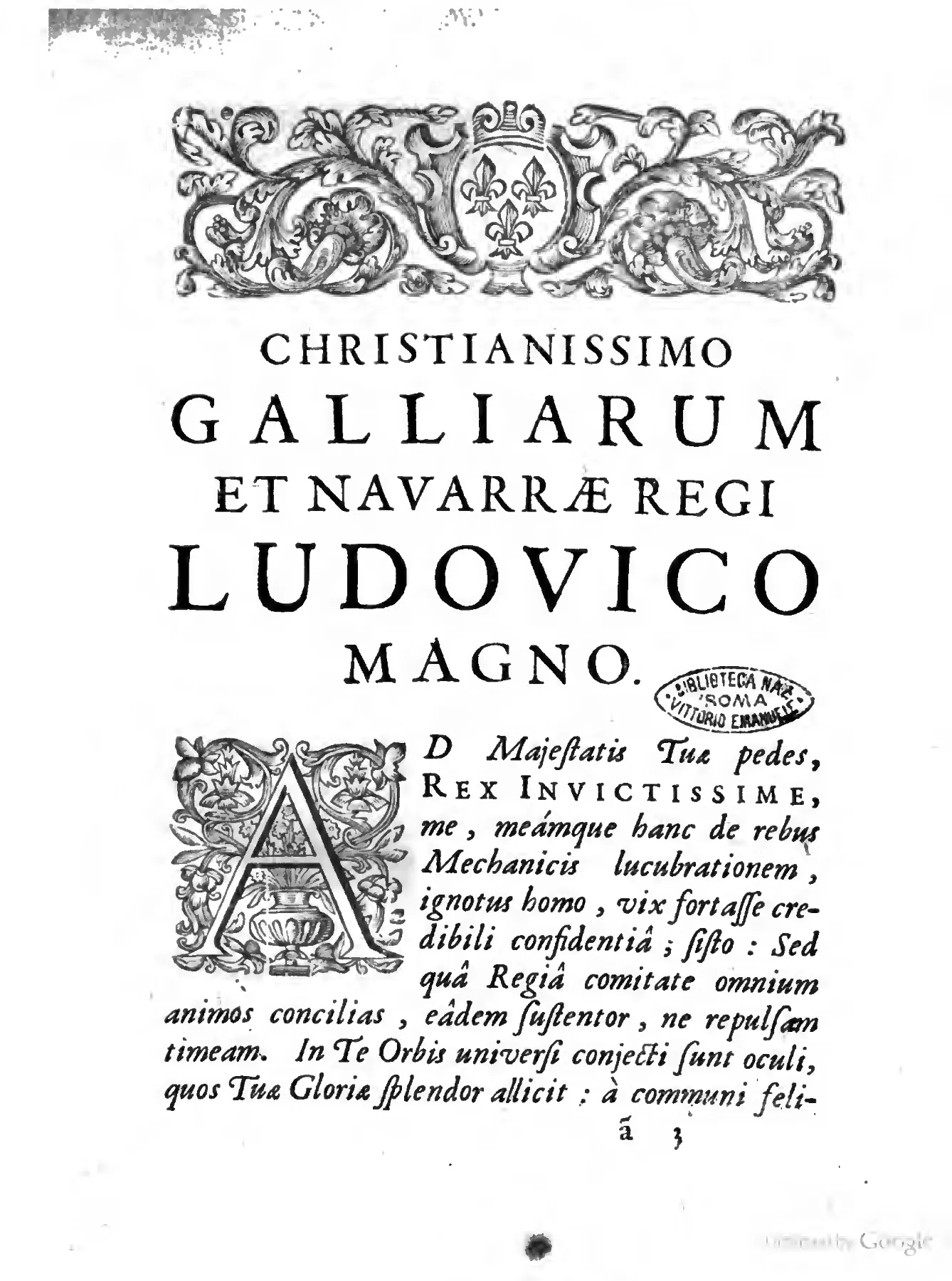
The dedicatory epistle opens under a fleur-de-lis headpiece, with Louis XIV’s titles in display capitals before Casati places himself and his work on mechanics at the king’s feet. The panegyric sets royal power, which acts at once, against machines that achieve only by sustained action. Source ↗.
The preface to the reader converts this wonder into an account of method and origin. Casati describes the work as reviving animo tractationem, cujus brevem Synopsum auditoribus meis in Romano Collegio, anno labentis sæculi decimi septimi quinquagesimo quarto, tradideram,. The treatise he takes up again is the one whose brief synopsis he had delivered to his hearers at the Roman College in the fifty-fourth year of the seventeenth century. The printed book thus presents itself as the late fruit of a classroom course, published three decades after its oral exposition.
The preface then frames the enterprise forensically. Because tamen & apud Physicos & apud Mathematicos agenda erat causa, multa fuere ad Philosophicas rationes revocanda;, many things had to be referred back to philosophical reasons, since the case had to be pleaded before physicists and mathematicians alike. The idiom agenda causa belongs to the lawcourt, and it casts the treatise as an advocate before two tribunals with different rules of evidence. The same double jurisdiction produces the most candid avowal of the preface, the confession already considered among the treatise's statements of purpose: that his chief concern was the physical cause of the wondrous motions produced by machines, and that in seeking a geometrical mode of knowing within physics he feared refutation by Aristotle. The printed suit in that sentence is a long-s misreading for fuit.
The fear is structural rather than ornamental. The Aristotelian distinction between the sciences denied that mathematical demonstration could reach physical causes. Casati's decision, reported in the preface, to arrange the work in chapters rather than in theorems and propositions follows directly from that anxiety. It is a typographical and architectural concession, meant to prevent probable physical conjecture from wearing the dress of geometrical demonstration. The title's promise of physical explanation and geometrical demonstration by the single principle of the lever is here quietly qualified before the argument has begun.
Book I: The Centre of Gravity and the Relational Account of Heaviness
Book I justifies its subject, the centre of gravity, through an agonistic image of art contending against nature. Its opening sentence, discussed earlier for what it reveals about the keyword vires, frames the powers of machines as the means by which we resist the innate propensity of bodies to motion or rest, and so obliges Casati not to pass over gravity itself, lest what art must conquer remain unknown. Statics precedes the machines because one must know the adversary before one can apportion the means of overcoming it. The vires of machines are defined oppositionally, as a counter-propensity, not as a quantity possessed in isolation.
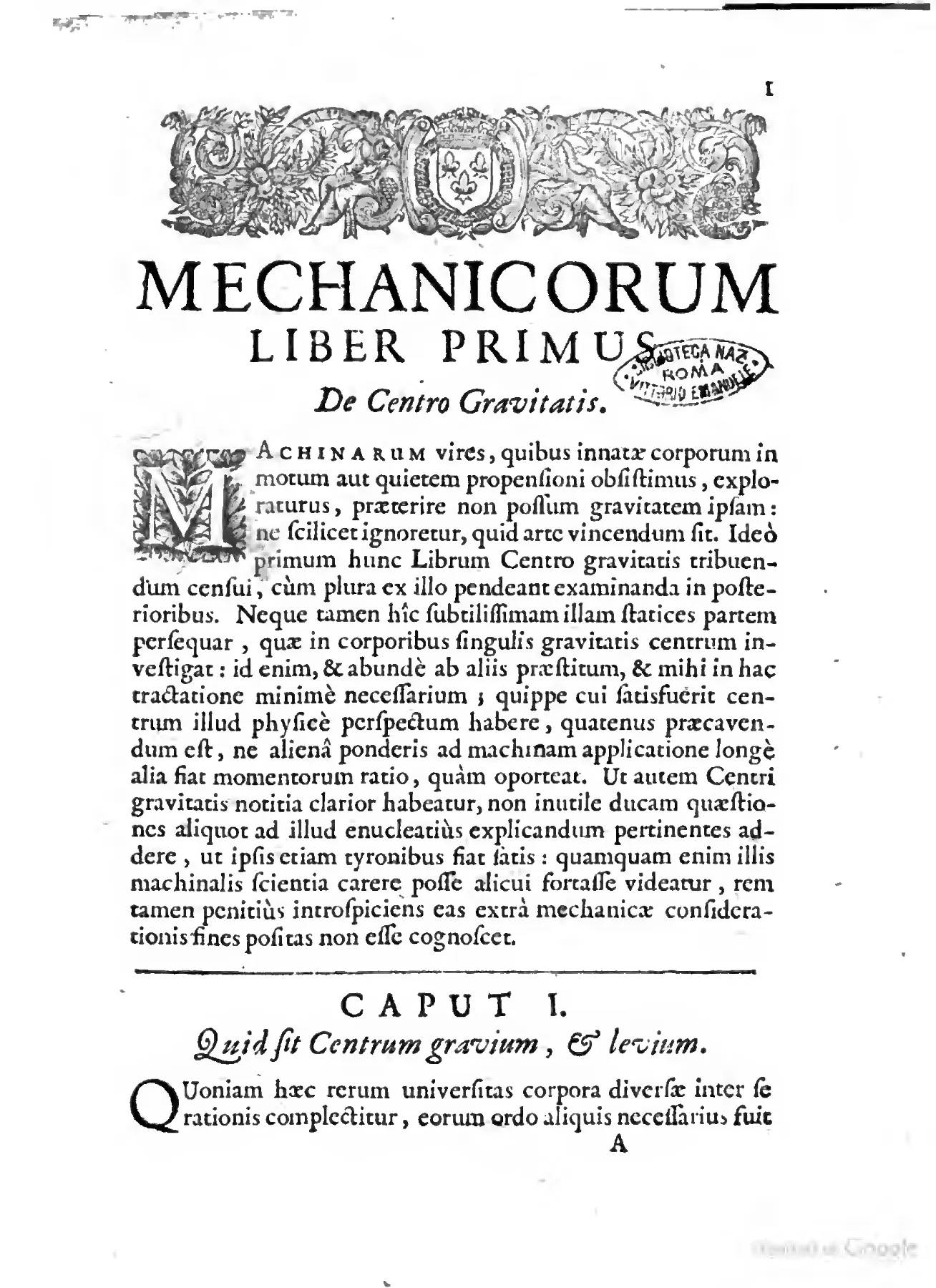
The opening of Book I, “De Centro Gravitatis,” begins with the emphatic “MACHINARUM vires” and turns at once to gravity, the natural propensity that mechanical art must learn to oppose. Its lavish headpiece and large ornamental initial mark the threshold of Casati’s physics: statics comes first because the adversary must be known. Source ↗.
The first major polemic of the book defends a scholastic thesis, positive levity, with experimental means. Casati names the target obliquely but unmistakably, in the sentence already noted, which turns to the experiment by which the ingenious Academicians, the Florentine Accademia del Cimento, were chiefly led to assert that levity must be taken from bodies. The epithet ingeniosi concedes their skill even as the argument turns against them. Casati does not reject the authority of experiment. He contests the apparatus, arguing that the balance tilted the wooden cylinder in mercury and so underestimated the adhesion attributed to horror vacui. His own trials yield a carefully modest claim, quid pro se afferre hîc possent aliter sentientes) visus mihi sum deprehendere non obscurum positivæ levitatis vestigium. From the experiment, he writes, he seemed to himself to detect no obscure trace of positive levity, while admitting parenthetically what those of contrary opinion might allege on their own behalf. The litotes non obscurum, the subjective visus mihi sum, and the noun vestigium, a trace rather than a proof, together measure the evidential weight he claims. The chapter's conclusion reduces the opposition still further. It makes gravity and levity comparative effects of a single motive principle acting under different conditions, a relational resolution that anticipates the shape of the whole treatise.
The technical vocabulary that follows is built with explicit guards against equivocation. The centre of gravity is defined kinematically, not in the Archimedean manner through equilibrium of planes: Illud itaquè punctum in quocumque corpore gravi, quod semper in motu describit lineam rectà in terræ centrum ductam, dicitur Centrum Gravitatis;. That point in any heavy body which always, in motion, describes a straight line drawn toward the centre of the earth is called the centre of gravity. The definition binds the concept to a cosmology with a physical centre, and therefore to the non-parallelism of verticals that Casati repeatedly treats as geometrically true but physically negligible.
Immediately afterwards he insists on the distinction that will carry the argument of the remaining chapters: Gravitatum, inquam, momenta, non gravitates; ne locus pateat æquivocationi;. It is the momenta of the gravities that are meant, not the gravities themselves, lest room be left for equivocation. Weight as a nature and momentum as a positional inclination to motion are thus separated at the threshold. Much of what the title assigns to the lever is in fact entrusted to this second, relational magnitude.
The chapter on gravitation near the earth's centre shows how pliable the empirical evidence of the period could be within this framework. Casati confesses that the barometric trial hoc in valle, & in monte sumere mihi otium non fuit,, that he had no leisure to perform it in valley and on mountain himself. He therefore relies on testes in Galliâ luculentissimi, qui discrimen hoc in mercurij altitudine observârunt in altioribus montibus, most illustrious witnesses in France who observed this difference in the height of the mercury on higher mountains. The Puy-de-Dôme observations are thereby enlisted in support of a thesis their authors did not advance, namely that the denser medium below diminishes gravitation near the centre.
The same relational logic governs the account of the earth's supposed trembling. Casati rejects any appetite of heavy things for the centre as such: Restituunt se gravia in locum suum versùs centrum pergendo, non ut ad centrum veniant; sed ut nihil levius infra se habeant;. Heavy bodies restore themselves to their place by proceeding toward the centre, not in order to arrive at the centre, but so as to have nothing lighter beneath them. Gravity becomes an ordering among bodies rather than an attraction to a point. The Aristotelian natural place survives, but it is re-described as a relation.
Physico-theology enters in the treatment of animal motion, where the mechanical analysis is set within the doxology, already cited, on the wisdom of God that shines forth in ordering the motions of nature and can never be sufficiently admired. The wonder here is directed away from the machine and toward its providential exemplar. Animals find their line of direction ut nemo mathematicus Geometriæ apices perscrutatus possit tam subtiliter deprehendere,, so that no mathematician who has scrutinised the finest points of geometry could detect it so subtly. The passage subordinates geometrical skill to the natural art implanted by God, a humility consonant with the preface's reluctance to overclaim demonstrative certainty.
The chapters on the inclined plane show Casati building a mechanics of momenta that proceeds by distinction, rule, correction, and experimental confirmation. He first separates two things commonly run together: aliud est gravitare in plano inclinato, aliud gravitare in planum inclinatum:. To gravitate along an inclined plane is one thing, and to gravitate against it another. From the measure of resistance by the violence of forced ascent he derives his law: Manet itaque constituta regula gravitationis, videlicet gravitationem in plano inclinato ad gravitationem in perpendiculari esse, ut est Radius ad secantem anguli inclinationis. The rule of gravitation thus stands established: gravitation on the inclined plane is to gravitation in the perpendicular as the radius to the secant of the angle of inclination. The trigonometric idiom, reckoned from the angle with the vertical, keeps the result within the tabular practice of the period.
When suspended bodies generate apparent absurdities under simple addition, Casati revises the procedure rather than the phenomena. A composite momentum, he writes, re autem ipsâ quod ex iis componitur momentum, non ex ipsorum momentum additione constatur, sed ex ipsis temperatur. What is in fact compounded from them is not produced by adding the momenta but is tempered out of them. The verb temperatur, with its sense of blending in due proportion, gives a philosophical gloss to the parallelogram rule. The procedure is then submitted to the court of experience: sed potiùs ipsi naturæ nostra consentit hypothesis, cui robur adjicit experientia;, our hypothesis rather agrees with nature itself, and experience adds strength to it. Calling the construction a hypothesis confirmed by experiment is exactly the mixed epistemic status the preface had promised, neither pure demonstration nor mere conjecture.
Book II: The Causes of Machine Motion
The opening of Book II turns from statics to the causes of machine motion, and it begins by deflating the ancient boast of Antiphon that art conquers what nature conquers. Casati concedes instead, in the frank admission already noted, that it must be openly granted that machines are employed in aid of weakness. The admission bounds the power of art. Its companion bounds the power of geometry: frictional resistance, in the judgement cited earlier, seems rather to be estimated from old experiments than tracked down by mathematical reasonings.
Within these limits the machine receives a strict definition. It must bring it about est, quod ejus ope naturalem ac insitam vim corporis loco dimovendi superet vis minor extrinsecùs adhibita: by its help a lesser force applied from outside overcomes the natural and innate power of a body with respect to being moved from its place. The definition is relational throughout, a lesser against a greater, the extrinsic against the innate. It owes nothing specifically to the lever.
Book II then turns to the metaphysics of impetus, where Casati argues from the scholastic principle that the cause must not be inferior to its effect. Impetus is naturâ suâ aliquandiu permanens: labentia enim stantibus deteriora esse, cæteris paribus, quis neget?. It is by its nature enduring for some time, and who would deny that things which flow away are, other things being equal, inferior to things that stand? The conclusion follows in the epigrammatic chiasmus already quoted, by which motion does not produce impetus, but impetus produces motion. The machinal science of Book II thus rests its account of causation on a hierarchy of the stable over the transient, drawn from the schools. That foundation is metaphysical rather than geometrical, and it again places the explanatory weight elsewhere than on the single principle of the lever that the title had announced.
From causation Casati passes to the theory of resistance, where he turns a siphon, a magnet dragged from an iron door-handle, and the slow violence of sprouting stalks and wild figs splitting marble into a single thesis. The whole repugnance of a body to be moved against nature, he concludes in the sentence already discussed, must be measured partly from the principle that refuses motion and partly from the speed or slowness of the motion. The balanced quâ … quâ construction divides the measure of resistance between an intrinsic principle, the scholastic nature that "refuses" motion, and a kinematic circumstance, the velocity that the mover demands. The corollary makes the dynamical consequence explicit. A body resists motion the more, the faster it must be driven, Eò igitur magis resistit corpus motui, quò celeriùs agitandum est. Everything the later books claim for machines depends on this premise, since it allows the slowness of the load to stand in for the strength that the power lacks.
Casati then draws the epistemic lesson, and it is the decisive conceptual step of the chapter. It is manifest, he writes, that the resistance of a body to be moved by force cannot be defined absolutely from its nature and implanted principle alone: Ex his præterea manifestum est corporis per vim dimovendi resistentiam ex solâ naturâ, & principio insito, quod motui repugnat, absolutè definiri non posse. The adverb absolutè is loaded. In the vocabulary of the schools, a quantity defined absolutely belongs to the thing in itself. By denying resistance that status, Casati makes it a relation among the body, the mover, and the motion required. The relational conception of mechanical power announced in the work's central definition is here prepared at the level of resistance, before any machine has been named.
The third chapter, on how conceived impetus perishes, pursues the same relational logic in the ontology of motion's cause. Casati divides natural impetus into an innate and an acquired kind. The innate is identified with weight itself. This impetus, he says, which answers to the natural faculty of self-motion and is gravitation itself, the natural propensity to descend, naturali se movendi facultati respondet, & est ipsa gravitatio, seu naturalis ad descensum propensio, Innatum voco, he calls innate. The identification has a double edge. It naturalises heaviness as a tendency rather than a static property. It also threatens the distinction between a body's gravitas and the impetus it produces, a distinction that more conservative Peripatetic accounts kept apart. The acquired impetus, the increment gathered at each moment of fall, behaves differently. The pendulum supplies the evidence: acquired impetus perishes not all at once, but is gradually attenuated, Perit igitur Acquisitus impetus non totus simul; sed sensim extenuatur. The decay is proportioned to impediments, air above all, which explains why each swing is shorter than the last. The formulation is couched entirely in impetus language, yet it treats persistence as the default and diminution as the work of external hindrance.
The geometrical treatment of the pendulum brings out the book's methodological anxiety with particular clarity. To compute the impetus acquired along the quadrant, Casati borrows the procedure of the Cavalierian school, but only under an explicit condition, in re Physicâ si liceat cum geometrizantibus per Indivisibilia ratiocinari, "if in a physical matter one may reason by indivisibles with the geometers." The conditional clause restates in miniature the tension between physicè and geometricè. The geometers' method is used and yields a definite ratio. The phrase cum geometrizantibus, with its faintly distancing participle, nonetheless keeps the practitioners of that method at arm's length, and the hedge reserves judgment on whether a physical continuum admits such reasoning at all. The chapter closes by giving impetus a teleological definition. It is qualitas propter motum instituta, a quality instituted for the sake of motion. The final-cause clause propter motum explains why impetus survives in a coasting ship but dies once motion is wholly blocked. A quality ordered to an end has no reason to remain when that end is frustrated. In this way scholastic causal categories are made to carry quantitative mechanics rather than being displaced by it.
The fourth chapter, comparing moving force with impediments, reaches the limit of this apparatus. Where two bodies resist each other obliquely and produce a mixed motion, Casati declines to fix the governing proportion, preferring, in the profession of ignorance already quoted, to admit that he does not know by what ratio the analogy is established rather than settle something certain by guessing. The opposition of profiteri to divinare is a professor's distinction between what may be taught and what may only be conjectured. The confession is not a failure of nerve. It marks the precise point at which the composition of oblique resistances escapes the arithmetic of impetus particles that the chapter has just built.
The fifth chapter, on what the powers of machines consist in, gathers the preceding theory into its programmatic definition, the sentence placed at the centre of this report's summary: the machine neither increases the forces of the power nor diminishes the heaviness of the load, but accommodates the load's resistance to the strength of the power. The verb accommodat repays attention. What is adjusted is not weight but resistance, and resistance has already been shown to depend on velocity. The machine therefore works on the only variable left free, the speed at which the load must move. Casati then frames this kinematic claim in the language of the four causes: Formalem igitur Machinæ Rationem, quâ Machina est, in eo sitam esse deprehendimus, "we find the formal ratio of the machine, as machine, to lie in this," namely in the figure that makes the power move fast and the load slowly. The reduplicative quâ Machina est is a standard scholastic device for isolating an essence. Its content is a ratio of motions rather than a substance or a shape valued for its own sake.
From that ratio follows the juridical formula that runs through the work, the perpetual justice, already noted, that is preserved among the power's forces and the other terms of the relation. The word justitia here names neither sentiment nor ornament. It is the equality of exchange that the schools called commutative: what the power gains in ease it pays for in space and time. The machine is a contract that cannot be broken, and its "perpetuity" places it beyond the reach of art itself.
With this definition secured, Casati turns on the tradition of the Quaestiones mechanicae. Many, he complains, have laboured more than was fitting in cleaving to Aristotle by referring the powers of machines to the plainly wondrous nature of the circle, machinarum viribus in circuli naturam planè admirandam. The irony of planè admirandam belongs to the treatise's broader programme of demystification, since wonder is the posture of one who does not yet know the cause. Casati shows that the ellipse, the helix, and the spirals share the circle's supposed paradoxes. He also turns Aristotle's De Caelo against the Quaestiones, since it makes circular motion natural. The polemic ends in experiment. A ring-and-rope arrangement lets a lesser power overcome a greater weight with no rotation at all, and the conclusion is pressed home in the anaphora already cited, which finds here no wonders of the circle, here no balance, no lever. The rhetoric of this passage stands in open tension with the title's promise. The lever, the balance, and the circle are equally dispensable, and what remains indispensable is the ratio of rectilinear motions.
The practical chapters that follow translate the ratio into engineering counsel. It is better to diminish the load's motion than to increase the power's motion by enlarging the machine, Quapropter satius est Ponderis motum minuere, quam potentiæ motum auctâ machinâ augere. The maxim applies arithmetic about ratios of greater inequality to the choice between building larger machines and compounding smaller ones.
The chapter on concentric circles and Aristotle's wheel returns the argument to the continuum. Against Galileo's circle as a polygon of infinitely many sides, Casati accepts the polygon only on condition that the number of its sides be called, in the formula already noted, not simply infinite but indefinite. The distinction between infinitus and indefinitus is the Aristotelian one between an actual and a potential infinite, here given mathematical work to do. It is reinforced by a compressed profession of divisibility: in continuous quantity, vera, ut opinor, Philosophia admittit, true philosophy, as I think, admits ever smaller parts. The modest ut opinor echoes the earlier hedge on indivisibles. The geometer may divide without end, but the philosopher will not grant a completed infinity of parts.
Book III: The Balance, Emblem and Instrument of Commutative Justice
The third book, on the balance, gives the juridical metaphor its literal object. Casati justifies his treatment of the instrument, which strictly arrests motion rather than producing it, by its moral charge. Frauds are to be exposed so that the instrument which, in the phrase already examined, is given as the symbol of commutative justice may be free of every suspicion of injustice. The preface's appeals to Josephus on Cain as inventor of weights and to the psalmist's "lying sons of men in the balances" locate the instrument in sacred history as well as in the market. The same concern returns in the chapter on unequal arms, which warns that such balances would offer furacibus, & dolosis mercatoribus præberet decipiendi, to thieving and deceitful merchants, occasion for deceiving.
Yet the moral register never displaces experimental scruple. When wooden bodies measured in ancient Roman feet and palms confirm that an arm's weight acts at its midpoint, Casati still asks who could be sure that omnes parallelepipedi partes æquali prorsùs fuisse præditas gravitate, all parts of the parallelepiped had been endowed with exactly equal heaviness. The question concedes that a hidden knot or uneven grain may confound a demonstration, and that physical bodies approach the geometer's ideal figures only imperfectly.
The same temper governs the treatment of authority in the chapter on whether a displaced balance returns to level. Casati first quotes Kepler's charge that whoever denies it declares war sed rerum naturæ, sed utilitati generis humani bellum indicere, on the nature of things and on the utility of the human race, and then dismantles the proof behind the rhetoric. Tartaglia receives the same treatment: Sed peccat hæc Tartaleæ argumentatio, but this argument of Tartaglia's is faulty. The geometrical demonstration that settles the case replaces both men's claims. A pivot above the line of the beam restores equilibrium, and one below it overturns the balance. It is characteristic of Casati's handling of the balance that the grand appeal to nature and human utility yields to a figure and a diagnostic test, and that the balance, once emblem of justice, is itself held to account by the same measure of just proportion it was made to symbolise.
The analysis then passes to the bent balance, the libra curva, and at once shows momentum at work as a relational rather than an absolute quantity. Casati warns that the weight of the arms themselves cannot be neglected. He observes that pro variâ autem inclinatione ipsam ejusdem lateris gravitatem varia obtinere momenta manifestum videtur, that it seems manifest that one and the same weight of an arm obtains varying moments according to its varying inclination. The gravity of the arm is constant, yet its moment is not. The difference is supplied by position, which Casati models on the inclined plane.
The conclusion is stated as a composition of ratios: Ex quo patet laterum inclinatorum in librâ curvâ momenta componi & ex Ratione distantiarum, & ex Ratione momenti, quod habent singula latera ex inclinatione ad perpendicularum. Hence it is plain that the moments of inclined arms in a bent balance are compounded both from the ratio of distances and from the ratio of the moment each arm has from its inclination to the perpendicular. The distance ratio alone would belong to the lever. Casati joins to it a second ratio that belongs to the inclined plane. In the very instrument that the tradition took as the paradigm of mechanical explanation, the balance already requires more than one principle. The lever programme of the title is thus qualified before Book IV on the lever has even begun.
Chapter VI turns from calculation to the question of which balance is most exact, and it opens on a final cause. Casati lays down that Instrumenti cujusque bonitas æstimatur ex fine, ad quem fuit institutum, prout ad illum assequendum aptum fuerit, aut ineptum,, that the goodness of any instrument is judged by the end for which it was instituted, according as it is apt or inept to attain it. The scholastic grammar of ends is made to generate a practical criterion. The best balance is the one that most readily leaves equilibrium.
That criterion brings him into dispute with the received reading of the first of the pseudo-Aristotelian Mechanical Problems, which asks why larger balances are more exact than smaller ones. Of the common interpretation he writes that Verùm si hæc ita accipiantur, prout communi huic interpretationi subest Aristoteles, vix aliquid habent momenti:. If these things are taken as Aristotle stands beneath this common interpretation, they carry scarcely any weight. The phrase vix aliquid habent momenti turns the chapter's technical term against the commentators. An argument, like an arm, can lack moment. The target is the interpretation, not Aristotle. Observers watch the tongue of the balance, not the ends of the beam, so the argument from larger arcs is idle.
Casati therefore reconstructs the case Aristotle must have had in view: Locutus igitur videtur Aristoteles de librâ spartum habente in superiore jugi loco extrà lineam, quæ jugi longitudinem definit. Aristotle, then, seems to have spoken of a balance whose pivot lies in the upper part of the beam, outside the line that defines the beam's length. By locating the spartum off the beam line, Casati makes the authority true under a geometrical condition he can prove from Euclid. This charitable salvage recurs throughout Book III. Authority is kept, but only as a proposition whose conditions demonstration has fixed.
The same chapter marks where demonstration stops. On the friction and pressure that slow the axle of a loaded balance, Casati declines to proceed: Definire autem hujusmodi pressionum vires motum libræ retardantes, meæ tenuitatis non est; quippè qui nec divinare audeo, nec certam rationem pressiones illas dimetiendi invenio. To define the forces of such pressures retarding the balance's motion is beyond his slender powers, for he neither dares to divine nor finds a certain method of measuring them. The refusal to divinare is an epistemic discipline. Where no certa ratio of measurement exists, geometry has no purchase, and conjecture would counterfeit certainty.
Yet the confession does not end the inquiry. It redirects the inquiry to what can be said. Even without a measure of the pressures, Casati can draw a comparative conclusion: Hinc ulteriùs patet hujusmodi librâ satius esse multam mercem simul ponderare, quàm per partes:. Hence it further appears that with such a balance it is better to weigh much merchandise at once than in parts. The admitted limit of mathematics turns directly into counsel for the marketplace.
Chapter VII makes that marketplace explicit, and here the juridical register of the balance becomes structural. Casati defines his object in the sentence already considered, calling a deceitful balance one that, taken alone and without weights, appears just and displays equilibrium, yet is in truth unjust. The definition hinges on the gap between apparet and re verâ. Fraud is a false show of equilibrium, so the vice is at once physical and moral.
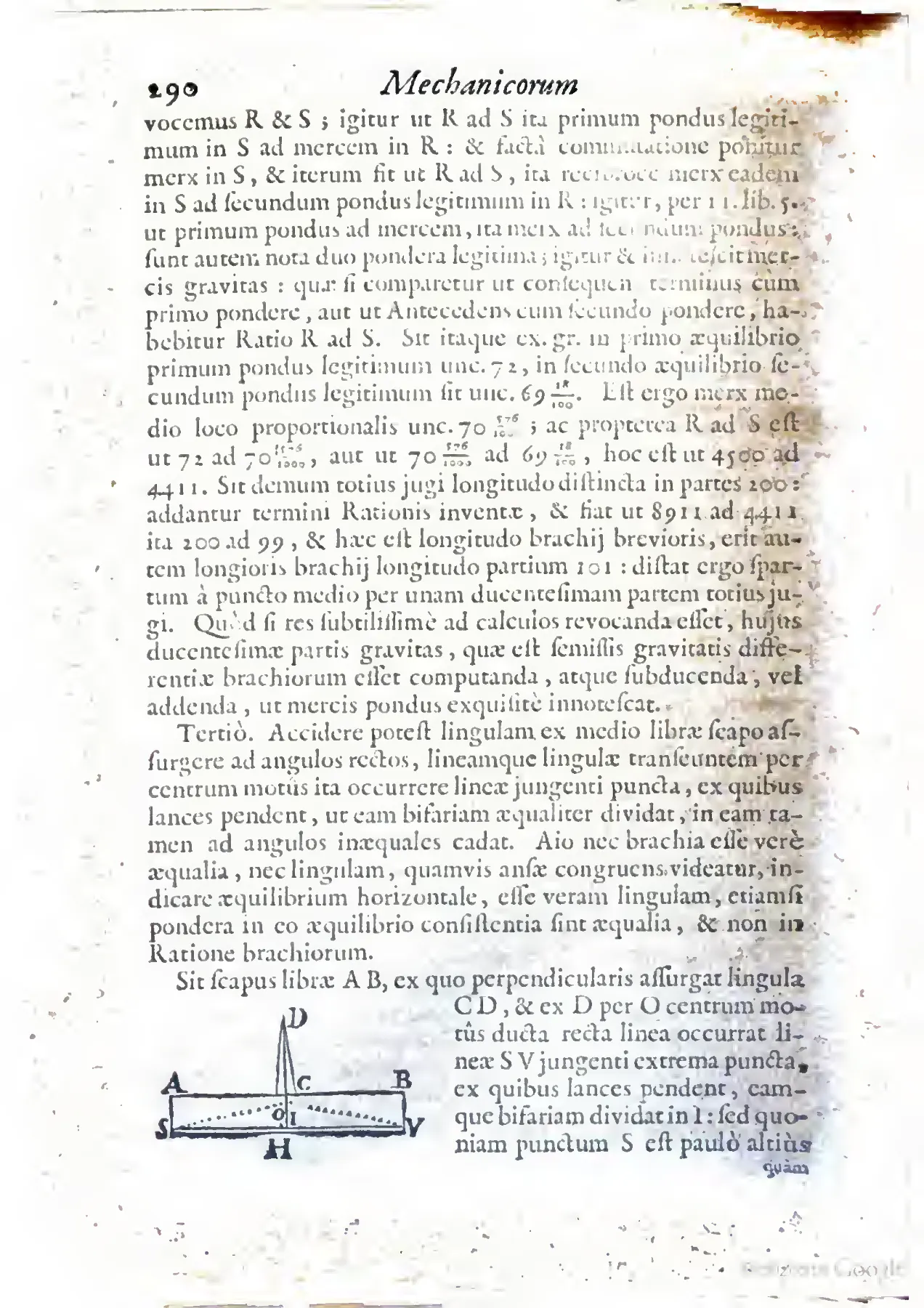
Book III makes false equilibrium calculable: a worked example takes the mean proportional between two legitimate weights to find the merchandise’s true weight. A small lettered woodcut of a balance then introduces the third case, where a seemingly level tongue marks oblique rather than horizontal equilibrium. Source ↗.
Casati is careful, however, to confine his science to its proper object. He excludes the human tricks of the market, Quare nullus mihi sermo de iniquorum venditorum sycophantiis, quibus, justam licèt libram adhibentes,: he says nothing of the chicaneries of wicked sellers who cheat even while using a just balance. Only injustice built into the instrument belongs to mechanics.
The remedy is mathematical. Against unequal arms masked by dense wood or lead, which was the purple-sellers' trick, the fraud is exposed by weighing in each pan in turn: Demum inter hæc duo pondera legitima invenio terminum medio loco proportionalem, & hoc est mercis pondus,. Finally, between these two legal weights he finds the mean proportional term, and this is the weight of the merchandise. Euclidean proportion here becomes a forensic instrument that restores commutative justice where the balance itself has betrayed it.
The same logic of appearance and reality governs the defective tongue. Its seemingly level reading is unmasked with the verdict non est igitur æquilibrium horizontale, sed obliquum:, that it is therefore not horizontal equilibrium but oblique. Chapter X later turns this very distinction to constructive use in its sand-clock balance.
With the steelyard of Chapters VIII and IX, the horizon widens from the individual transaction to the fragmented metrology of Europe. Casati notes that pondera simili nomine in pluribus regionibus donata, non esse inter se æquales docemur experientiâ, quæ libras Parisiensem: weights given the same name in several regions are not equal to one another, as experience teaches, which shows the Paris pound, and with it the Roman and Venetian, to differ. His answer is to inscribe several regional scales on one bar, an artisanal solution to a problem of commerce between regions.
The Biancani controversy then brings Casati's own teaching into the argument, through the recollection, cited earlier in this report, that he had made these same matters public while expounding them at the Roman College in the year '54 and now wrote them twenty years later. The recollection serves the dispute. It places his refutation of Biancani's reconstructed ancient steelyard, which Gaspar Schott took up, in the lecture hall.
The refutation itself argues from what is plausible in the conduct of trades, not from the text alone: sed hunc laborem subiisse antiquos Mathematicos, ut stateras carnem in macello vendentibus pararent, suaderi non potest; artificibus autem tantum fuisse industriæ, omnem fidem superat. It cannot be believed that ancient mathematicians undertook such labour to furnish steelyards for meat-sellers in the market, and that artisans possessed so much industry surpasses all credence. The capacities of craftsmen become a criterion for testing a reading of Aristotle. The result is again salvage: Aristotle may be read, without violent interpretation, as describing a steelyard like the modern one.
Chapter X opens a programme of invention: Quæ semel aliquem in finem excogitata sunt, non ea sunt, ut illis tantùm terminis coërceantur, sed ad plura extendi possunt;. Things once devised for some end are not to be confined within those bounds alone, but can be extended to more. The instrument's end, fixed in Chapter VI, now proves open in its uses.
Here Casati also states the tolerance proper to physics: liceat mihi dissimulare partes illas, si res subtilissimè examinetur, non esse omninò inter se æquales; sed in re Physicâ subtilitatem hanc persequi inutile est. He asks leave to pass over the fact that those parts, examined most subtly, are not wholly equal, since in a physical matter it is useless to pursue such subtlety. The division between physicè and geometricè here takes the form of a licence to approximate.
The same discussion registers his ironic distance from perpetual motion, Hoc saxum jamdiu multi versant; sua cuique cogitata placent;. Many have long been rolling this stone, and each is pleased with his own thoughts. Yet he still offers a device of his own: Liceat & mihi hîc aliquid proponêre quasi rudimentum naturæ motum perpetuum efficere condiscentis. He too would propose something here as a rudiment of nature learning to produce perpetual motion. Personifying nature as a pupil softens the claim. At the same moment it reveals how far the rhetoric of demystification can coexist with speculative ambition.
The geometrical lemmas of Chapter XI prepare the strongest polemical passage of Book III. Chapter XII resolves the cord experiment of Book II, in which a small weight hung at the middle of a cord lifts two larger end-weights. Casati concludes that potest igitur gravitas minor velociùs descendens præstare utrique ponderi tardiùs ascendenti: a smaller weight descending faster can therefore prevail over each of the weights ascending more slowly. Resistance is measured by speed as well as weight, through a tangent set against the excess of a secant.
The consequence is drawn against the whole reductive tradition. Machine-powers are not to be referred to the ratios circuli aut Vectis, quandoquidem hic videmus minori pondere majus pondus moveri absque ullo motu circulari, of the circle or the lever, since here we see a greater weight moved by a smaller without any circular motion. The book announced by the title's lever principle ends by denying that the lever and the circle can bear the explanatory weight.
Book IV: The Lever Considered in Itself
Book IV on the lever then enacts that denial in its own structure. Rejecting Aristotle's third question, which makes the lever a balance, Casati declares: igitur me frustra conficiam labore enitens rationes libræ in vecte recognoscere, sed ipsum per se considerans, quæ opportuniora censuero, disputabo. He will not exhaust himself in vain striving to recognise the ratios of the balance in the lever, but will consider it in itself and dispute what he judges more fitting. The lever becomes one facultas among others, no longer the principle of them all.
The explanatory ideal is stated in the chiasmus already quoted, by which the powers of machines cause wonder only so long as their cause remains hidden, and once that cause is brought forward our very wonder becomes a wonder to us. This answers the thaumata with which the pseudo-Aristotelian Mechanica opens.
The cause, when it is brought forward, is impetus redistributed. Casati speaks of entitas eadem impetûs, quæ est intensivè minor,, the same entity of impetus which is intensively smaller and extensively larger. He illustrates the idea domestically: ten gold pieces spent on one guest's feast might instead serve decem hominibus frugalem mensam instrueret singulis aureis in singulos homines tributis?, furnishing a frugal table for ten men with a gold piece allotted to each. The economy of the household mirrors the economy of the machine, and the summary is phrased in the language of profit: Quare semper in motu ponderis per vectem aliquid lucri habetur, nimirum aut major ponderis gravitas, quæ movetur, aut saltem major velocitas, qua movetur. In moving a weight by a lever some gain is always had, either a greater weight moved or at least a greater speed of motion. The gain is an exchange and never a creation, so the perpetual justice of the machine holds even in the vocabulary of lucrum.
Roles, not natures, define the lever's parts. With a clod in place of a fulcrum, Casati warns, si glebam, hypomochlij loco, supposueris, non marmor attolles, sed glebam vecte conteres:. If you set a clod in place of the fulcrum, you will not raise the marble but crush the clod with the lever. The same relational caution governs rope traction: Verùm non leviter hallucinaretur, quisquis momenta vectis ex alligati funis loco simpliciter & absolutè definiret;. Anyone who defined the lever's moments simply and absolutely from the place where the rope is tied would be seriously deceived. Simpliciter & absolutè names precisely what the treatise everywhere refuses.
In the chapter on direction, that concept becomes the governing relation: Voco autem Directionem motûs lineam illam, quam potentia ex vi concepti impetûs sponte percurreret,. He calls the Direction of motion that line which the power would run through of its own accord by the force of its conceived impetus. From the resulting sine law, which makes the moment greatest at right angles, follows an explanation of a practice of the bell-tower: Propterea majoribus gravioribusque campanis non simplicem vectem CB sed rotam, aut rotæ segmentum adjungunt,. For this reason they fit to the larger and heavier bells not a simple lever but a wheel or a segment of a wheel. The wheel keeps the rope tangent and so preserves the greatest moment. Even within the book devoted to the lever, the practice of the craft shows the simple lever giving way to a composite contrivance whose power depends on the direction and angle of application.
The analysis of direction leads directly into the question at the conceptual centre of Casati's handling of the lever: why a load suspended from an inclined bar weighs differently at different angles. Before answering, he clears the ground by denying that "power" and "weight" name fixed natures, through the image, already quoted in connection with the edition's lettered figures, of two men applied to a single bar AB and striving in opposite directions, each of them a power and each a weight so long as they resist one another. The clause dum sibi reluctantur carries the whole doctrine. A body is a potentia or a pondus only while it stands in a relation of opposition, and it has no such status outside that relation. This is the relational conception announced in the treatise's definition of the machine, now worked out on the lever itself. It also licenses the method that governs everything that follows. Because the roles are functional, any device may be reclassified by asking what it actually does, whatever it appears to be.
Casati joins this relational ontology to a polemical habit that recurs throughout his treatment of the lever. Once he has shown that the moment of a hanging load diminishes in proportion to the sine of the angle, he warns against a common mistake. The reader should beware of thinking, Cave autem ne putes (ut non pauci hallucinantur) ita ex I termino rectæ GI perpendicularis detumendam esse mensuram decrementi momentorum, as not a few blunder, that the measure of the decrease of moments is to be taken from the end-point of the perpendicular. The verb hallucinantur is pointed, and the unnamed non pauci mark a rebuke to a body of mechanical writers rather than to a single adversary. The refutation proceeds by reductio: an indefinitely lengthened cord would make the moment vanish altogether. The geometrical construction is kept, and it is protected from misuse by testing it against a consequence that is physically absurd.
The chapter on porters' poles shows scholastic distinctions put to work on practical matters. Casati separates holding up from being pressed down, and treats each bearer as a double lever of the second class for the first effect and of the third class for the second. To explain why a passive support earns no place in the calculus of powers, he borrows a distinction of scholastic cast. If the load rested on two fulcra, they solam resistentiam Formalem suâ soliditate exercerent, impediendo ne onus cum palangâ descenderet, sed nullam haberent Resistentiâ Activam, quæ illis Potentiæ vocabulum tribueret. They would exercise only formal resistance by their solidity, preventing the load from descending with the pole, but would have no active resistance to earn them the name of power. The name Potentia is conferred by activity. Whatever merely stands firm does not qualify, however much it bears. The distinction yields a rule for spreading a load between unequally strong men. Casati then sets the rule against those who judged otherwise, remarking that Quæ omnia tam aperte respondent quotidiano experimento, ut mirum videatur potuisse aliquos authores idem planè opinari: all this so plainly answers daily experience that it seems strange some authors could have held quite the same opinion. Everyday practice, the porter lifting on a signal and the peasant moving the swingletree for a tired horse, here serves as the court of appeal against written authority.
The chapter asking whether elastic force belongs to a class of lever begins as philology before it becomes mechanics. Casati glosses the Greek elasma, notes the Italian vernacular names for springs, and then coins the term Vis Elastica, in the definition already cited, for the faculty by which the plates restore their proper figure and position. The term is attached to the language of faculties, and so to the Aristotelian vocabulary of powers. Yet the analysis beneath it treats compressed and stretched particles restoring themselves, and it locates the effective force with a precision that the older vocabulary does not require. The chief elastic force, Casati writes, is to be considered where the greatest bending inflicts the greatest force on the particles, potissima tamen vis elastica ibi consideranda est, ubi summa inflexio summam vim particulis infert; ibi enim majore conatu quàm alibi violentiam excutit natura, for there nature shakes off violence with greater effort than elsewhere. The opposition of natural and violent motion is thoroughly peripatetic. Here, however, it serves to fix a point, and that point decides the device's class: the turner's pole becomes a lever of the third class with its power seated at the place of maximum flexion. By contrast, the coiled clock-spring is excluded because it lacks any lever-like length. The lever therefore remains a diagnostic grid, but not every elastic body passes through it.
The same functional diagnosis is applied to pincers and tongs, and there Casati relaxes into memory. Recalling boys who cracked nuts in the hinges of doors, he concludes, Usque adeò natura ipsa Mechanicen, usumque vectis, vel pueros docet, so far does nature herself teach mechanics and the use of the lever even to boys. The remark does more than add colour. It presents mechanics as a knowledge rooted in nature and available before instruction. Casati's task is to bring to the level of demonstrated cause what practice already grasps, a demystifying aim that parallels his broader claim that the powers of machines astonish only while their cause is hidden.
The chapter on oars shows the functional criterion at its sharpest. Casati first reports the pseudo-Aristotelian position: Si Aristoteles audiendus esset mechan. quæst. 4. hypomochlion fit scalmus, stat enim ille; pondus verò mare est. If Aristotle were to be heeded, the thole would be the fulcrum because it stands still, and the sea would be the weight. The objection turns on what rowers intend to accomplish: Cæterùm nautæ remorum pulsu non aquam verberare, sed navim impellere contendunt, sailors strive by the stroke of their oars not to beat the water but to drive the ship. Because the weight is whatever resists the intended effect, the ship takes the place of the weight and the water takes the place of the fulcrum. Casati concludes, adeóque remum censendum esse vectem secundi generis, cujus extremitates potentia & fulcrum occupant, that the oar must accordingly be judged a lever of the second class, whose extremities are occupied by the power and the fulcrum. The two men on the bar return here in maritime form. The thole looks like a pivot, but appearance does not decide the role, and function does. The reclassification then requires further refinements, for the fulcrum is now a movable body, and water that yields under the blade must be treated kinematically.
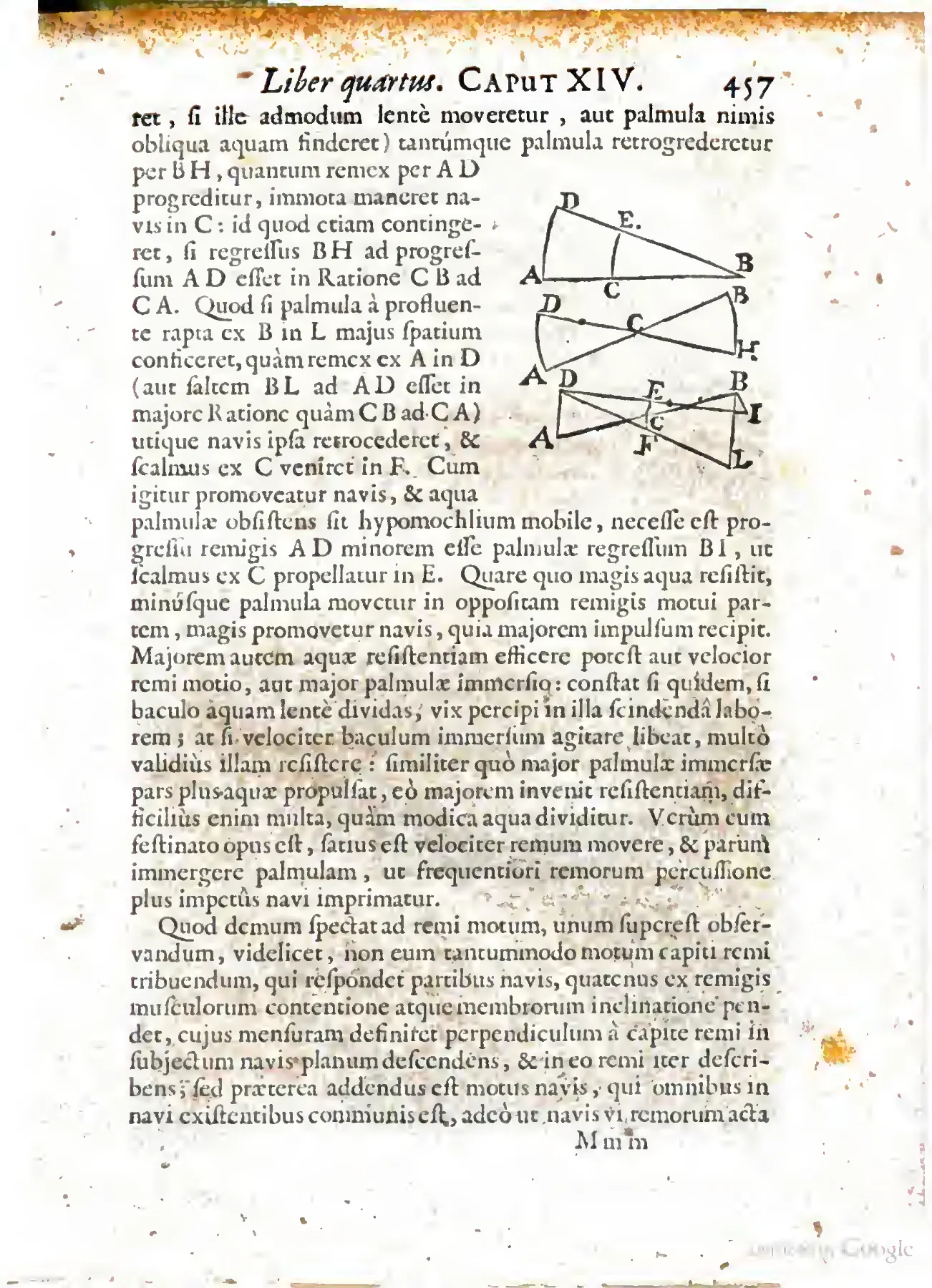
Casati’s lettered oar diagram treats rowing kinematically, plotting hand, blade, thole-pin, and yielding water through successive positions so that the resisting water can serve as a movable fulcrum. Mechanical roles follow operation, not appearance, and advantage comes only by exchanging stroke length, speed, immersion, and resistance. Source ↗.
The empirical temper that corrects Aristotle is turned just as readily on recent reports, including those of Casati's own order. Martino Martini's Atlas Sinicus claimed that a single Chinese oarsman equals six or eight European sailors. Casati finds the claim grandly stated and meagrely explained, and declares himself resolved, ut verba mihi dari non facilè patiar, nec me libenter præbeam credulum, not easily to allow himself to be deceived nor willingly to show himself credulous. The idiom verba dare, to cheat with words, sets the report apart from a proper description. Casati asks for a description or a figure as the foundation of belief, and so applies to a Jesuit informant the same standard of explanation by which he measures the ancients.
He applies that standard to himself as well. In the geometrical discussion of a ship's point of rotation that closes the chapter on the rudder, he admits an earlier mistake about a floating cylinder, confessing himself veri quadam specie deceptum existimasse intervallum, deceived by a certain appearance of truth into estimating the interval. The corrected model does not close the question, and Casati says so: cur dodrantem potiùs quàm bessem pronunciemus, nisi aliunde doceamur?, why should we pronounce for three-quarters rather than two-thirds, unless we are taught from some other source? The Roman fractional terms dodrans and bes give the doubt a precise arithmetical shape. The admission is a local instance of the treatise's recurring readiness to leave undetermined what its principles cannot settle. Geometry narrows the possibilities, but without further physical information it cannot choose among them.
The chapter on the mast turns the lever's diagnostic function against the lever itself. Aristotle had explained the greater speed given by higher sails through leverage, and Casati rejects the explanation outright: Non igitur malus in motu, quo navis progreditur, Rationem vectis habere dicendus est, the mast, therefore, is not to be said to have the nature of a lever in the motion by which the ship advances. The argument rests on the equality of motions. Where the fulcrum, the power, and the weight all move alike, the unequal velocities that constitute a lever's action are absent. He sharpens the point with a rhetorical question, Quis autem motus per Vectem, qua Vectis est Facultas mechanica, hujusmodi æqualitatem admittit?, what motion through a lever, insofar as the lever is a mechanical faculty, admits such equality? The phrase qua Vectis est Facultas mechanica uses the scholastic reduplicative to isolate the lever's proper operation, and it shows that the mast has none. Experience confirms the conclusion, since a true lever would bring ease rather than speed, and experience testifies that the lever reading is far from the truth, quæ idcirco confirmat navigij malo nihil esse cum vecte commercij ad navim promovendam, and so confirms that the ship's mast has no dealings with the lever in driving the ship forward. The true causes he substitutes are the distribution of weights on board, the practice of towing from the mast, and the stronger and steadier wind aloft. All of them lie outside the lever.
When the lever is at last put to productive use, in the propositions that close Book IV, the quantity doing the work is always the same compound. In one worked case Casati writes utriusque enim momenta singillatim accepta sunt 15 composita ex virtute movendi & motûs velocitate, the moments of each, taken separately, are 15, compounded of the virtue of moving and the velocity of motion. The formula states in arithmetical form what the whole book has argued by counter-example. The moment arises from a power multiplied by a velocity, and the lever is only one arrangement that apportions it.
Book V: The Axle-in-Wheel, Its Applications, and the Critique of Instruments
Book V turns this implication into an explicit programme. Casati proposes to rename the axle-in-wheel, suggesting that the force of the word would be grasped more clearly si Axem Convolutum vocaremus, if we called it the Convolved Axle, on the ground that convolution is always present even where no wheel is. He then puts the decisive question: Sed quid Axem ad Vectem revocare opus est?, but what need is there to refer the axle to the lever? The traditional description of the device as a "perpetual lever" gives way to a deeper ground, the ratio of velocities. Within the same book Casati states the general lesson in the second person, in the passing remark already quoted, so that the reader might persuade himself that it is vain labour to try to refer the powers of each faculty to the lever. The obiter is modest, but the claim is programmatic. The title's uno eodemque principio vectis here meets a body of argument in which the lever is kept as one faculty among several, and the "one principle" appears to be the proportion of motions that underlies them all.
That proportion governs even the most extravagant ambitions of the art. Discussing multi-stage gear trains, Casati concedes that adeò ut omni arrogantiæ notâ vacent magnificæ illæ Mechanicorum propositiones, quibus se quodcumque etiam immane pondus moturos spondent, immò tellurem ipsam, those grand propositions of the mechanicians by which they promise to move any weight however immense, even the earth itself, are free from any mark of arrogance. The concession echoes the Archimedean boast, which Casati had already dramatised in his earlier dialogue on moving the earth by machines. He at once qualifies it by computing the load's slowness, some 651¼ hours to advance a single foot. What the machine gains in force it pays for in time, and the perpetual justice among the terms of the relation holds even at the scale of the globe.
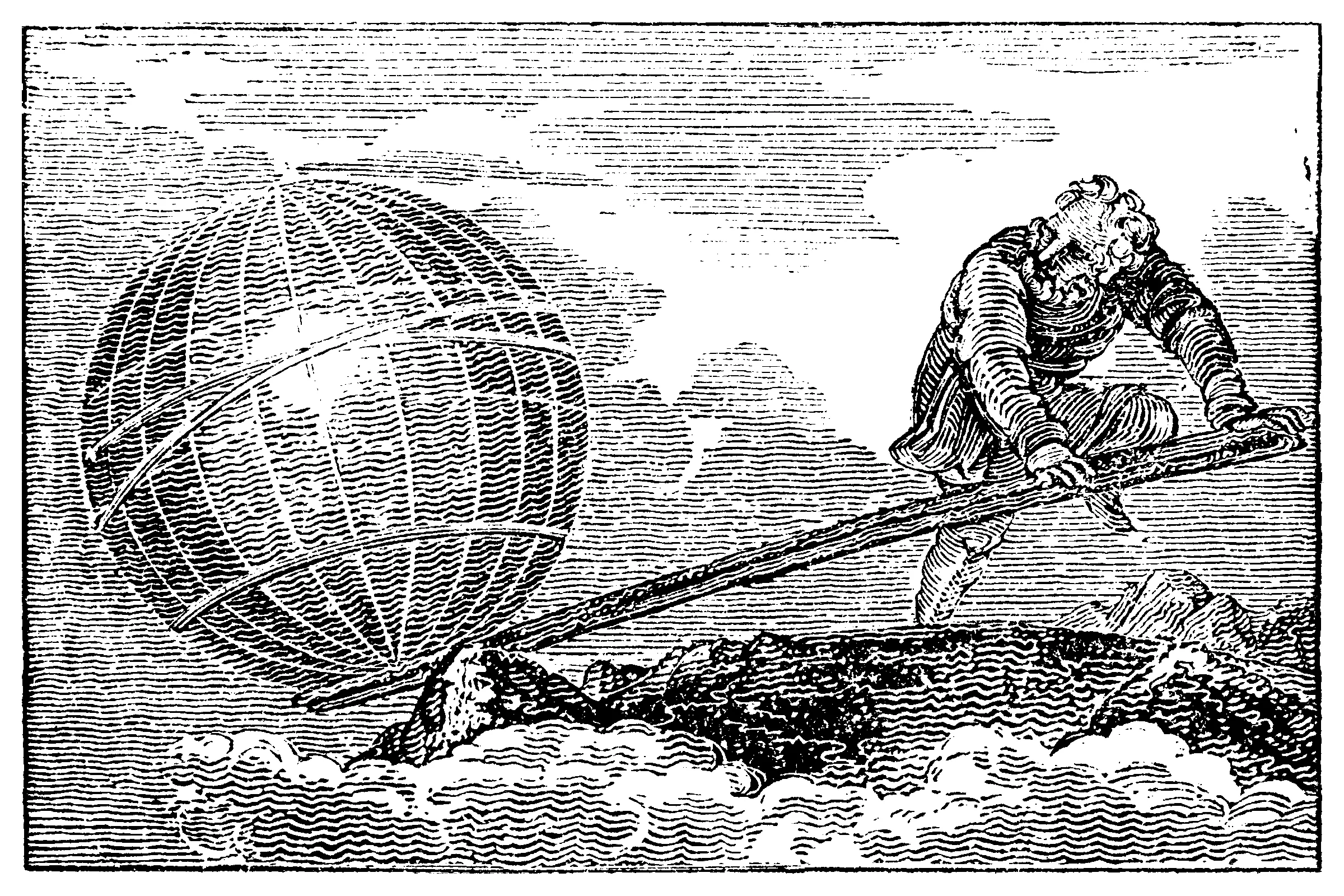
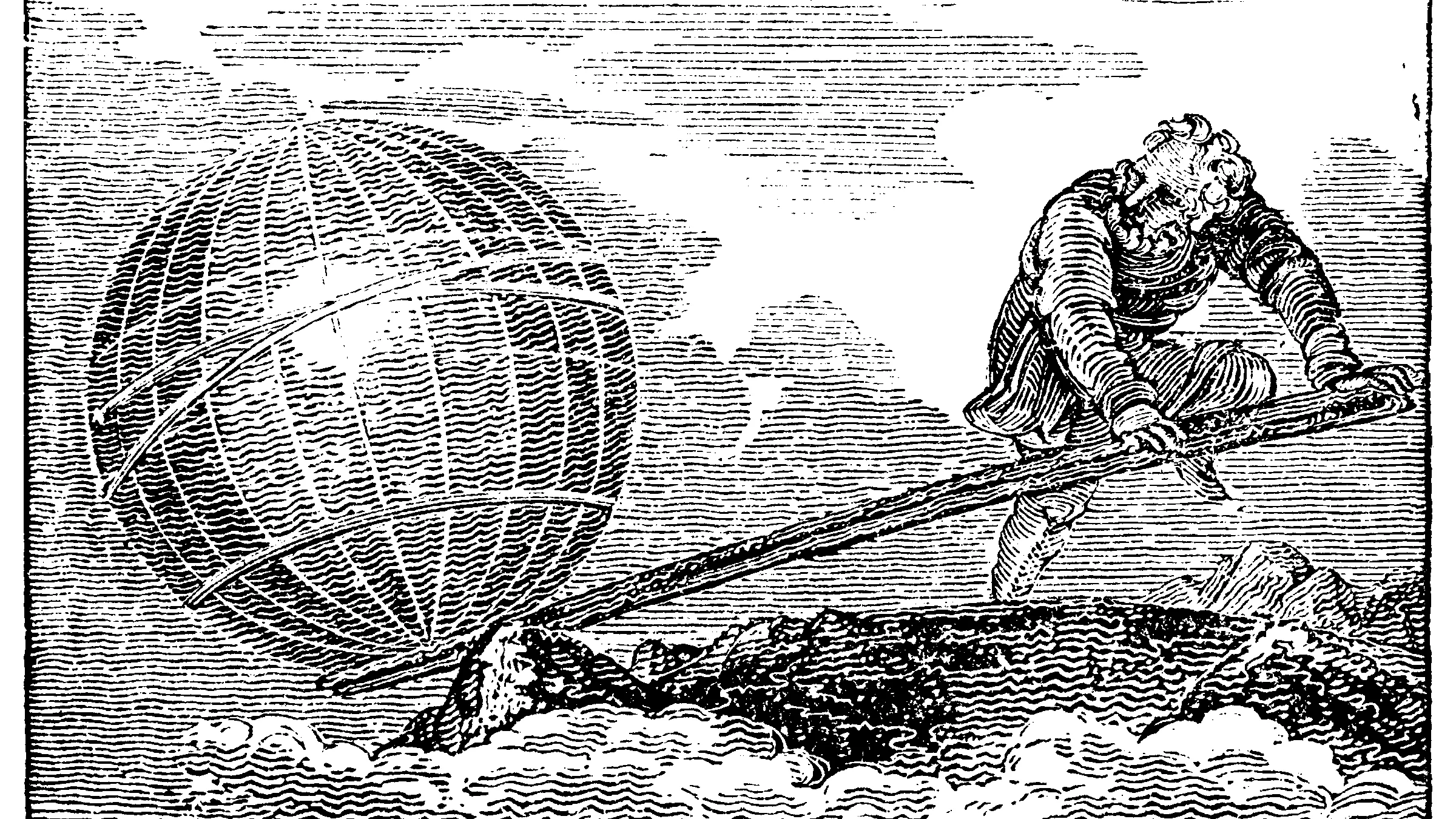
A period-style engraving of the traditional Archimedean conceit: a lever long enough, given a fixed point, to move the earth. Casati concedes the boast is free of arrogance, then shows its price, since any gain in force is repaid in time. Source ↗.

The survey of mills, clocks, and gearing that follows is governed by a stated principle of selection. To enumerate every such device, Casati says, would be historiam potiùs redolens, quam theoriam, smacking of history rather than of theory, which he chiefly serves. Historia is used here in its period sense of a descriptive record of particulars, as opposed to theoria, the knowledge of causes. Casati aims to show the sources from which machines arise and leaves the complete inventory aside. The many particulars his treatment of the lever and the axle has gathered, from the tholes of Greek triremes and the ferries of the Po to Chinese porters, Hamburg units of burden, and a carters' jack from Germany, are all made to answer to one relational measure rather than stored as curiosities.
The counting machines that follow show the same method at work, and the treatment of Vitruvius sets a pattern: the ancient authority is defended on one point and corrected on another. Casati clears Vitruvius' slightly enlarged carriage wheel of any charge of carelessness, since the extra diameter compensates for the wheel sinking into soft ground, but rejects the four-hundred-toothed drum in favour of a spring-loaded ratchet driving a train of ten-toothed wheels, one for each decimal place. The critique of instruments then sharpens into a formal exposure. A tracing device, in which a prism with a sighting tube drives a toothed half-wheel and a stylus, is presented as an abuse that easily deceives, and Casati warns the practitioner against self-deception: cavendu[m] tamen, ne ipsi nobis assentates quasi exacta[m] Ichnographiam, & subtilem, servatis corporis partiu[m] Rationibus,, that we must beware of flattering ourselves that we have obtained an exact ground-plan and a fine description preserving the proportions of the body's parts. The moral vocabulary is striking. Assentari belongs to the lexicon of flattery at court and in friendship, and Casati turns it inward, so that the error of the instrument becomes a vice of the observer who trusts it. The Vitruvian Ichnographia, the ground-plan of the architect, raises the stakes, because the device promises the very proportionality on which architectural drawing rests.
The refutation that follows is trigonometric. Casati compares differences of tangents at paired angles and shows that equal angular steps of the sighting tube produce unequal traced intervals. His verdict comes in the language of logical censure: Quapropter descriptum schema non servans objecti Rationes, ceniendum est pseudographum, therefore the traced figure, which does not preserve the object's proportions, must be judged a false drawing. The press prints ceniendum for censendum. The coinage pseudographum carries the Aristotelian sense of a pseudographema, a fallacious diagram that seems to demonstrate but does not. The debunking thus applies the treatise's declared purpose of demystification on a small scale: geometry reveals what the machine conceals, and the correct construction is left to the ingenious reader.
Book VI: The Pulley and the Case against Universal Reduction
Book VI, on the pulley, begins with a characteristically scholastic act of definition. After cataloguing the Greek names Monospastos, Dispastos, and Trispastos and Vitruvius' Rechamum, Casati cuts through the equivocation: Cæterùm in vocabulis non est hærendum: Ego Trochleam, but one must not cling to words; I call a pulley one housing with its sheaves. The gesture matters for what follows, because the dispute over whether the pulley is a lever will turn precisely on what counts as a pulley. The first chapter sets out the familiar rule that each pulley in the movable block doubles the power's moment. It closes, however, on a theoretical thesis that governs the rest of the book. The moment of resistance is compounded, Casati repeats, resistentiam ponderis minui ex tarditate; poterit igitur augeri ex gravitate: sæpiùs quippe dictum est adæquatum resistentiæ momentum componi ex insita gravitate, & ex dispositione ad motûs velocitatem, aut tarditatem: the resistance of the weight is diminished by slowness and may therefore be increased by gravity, for it has often been said that the adequate moment of resistance is composed of innate gravity and of the disposition to speed or slowness of motion. From this follows the refusal to say that the machine multiplies force: semper enim Potentia vincit æqualem resistentiam, for the Power always overcomes an equal resistance. Equality is secured by the scholastic distinction between entity and intensity. The slow motion of a great weight is entitativè equal to the swift motion of a small power, tamen ponderis motus entitativè acceptus æqualis est, since the weight's motion, taken entitatively, is equal. Here the "perpetual justice" of the machine receives its metaphysical warrant. The exchange is just because what is given in velocity is received in gravity, measured as a quantity of being rather than a degree of intensity.
With this principle in place, the second chapter opens as a programmatic assault on the lever's claim to universality. Casati writes that he undertakes it UT Machinalis motûs causa meliùs innotescat, neque opus esse Facultates omnes ad Vectem revocare, ut non pauci hactenus conati sunt, & adhuc conantur, so that the cause of machine motion may be better known and so that it may appear unnecessary to reduce all Faculties to the lever, as many have tried and still try. The phrase adhuc conantur makes the polemic contemporary, directed against living practitioners of the reduction inherited from the pseudo-Aristotelian Mechanica and its Renaissance commentators, and not only against the ancients. The tension with the title's promise of "one and the same principle of the lever" is here at its most acute. The chapter's argument, however, proceeds by counter-example rather than by pronouncement. A fixed pulley that does not turn still yields the twofold advantage, and so does a bare ring, of which Casati asks, in the challenge already cited, how any trace of the lever could be detected in something that certainly cannot rotate at all. The logic is exact. The lever explanation depends on the pulley's radius acting as a rotating arm. If the advantage survives where rotation is excluded, the rotation cannot be its cause. The rolling cylinder, drawn by ropes more easily than it can be pushed, supplies a further test, and Casati concludes, manifesto igitur experimento habetur non ex Vectis rationibus ducendam esse majorem movendi facilitatem,, that by manifest experiment it is established that the greater ease of moving must not be derived from the principles of the lever. Experiment arbitrates against a geometrical reduction, though the geometrical form of the claim is never abandoned.
The polemic acquires a personal dimension when Casati turns to the sailors' holed wooden blocks used to tension shrouds, pulleys without sheaves. Argumentum hoc, quod olim ante annos vigintiquinque in Collegio Romano meis Auditoribus insinuavi, conatus est P. Schott ubi supra cap. 3. eludere dicens: this argument, which I once put to my students at the Collegio Romano twenty-five years ago, Father Schott tried to evade. The disagreement is therefore internal to the Society, between two Jesuit mathematicians of the same generation. Casati presents it as a contest of the lecture hall carried into print, with Schott's Magia mechanica as the published record of the reply. The chapter ends in a dilemma: the blocks either constitute a new mechanical Faculty or they are pulleys. Either way, the lever is not their principle.
The seventh chapter of Book VI extends the relational conception to the fixing point itself. The nail or stake that holds the tackle becomes a third party to the mechanical relation. Casati distinguishes its resisting Formaliter from resisting Activè, and admits a scruple about a commutatio inter Potentiam, Pondus, & Clavum, an exchange among Power, Weight, and Nail depending on which effect is considered. Power and weight are thus not natures but positions, and here even the fixed point can change places with them.
Book VII: The Wedge, Percussion, and the Transfer of Impetus
Book VII carries the anti-lever argument to the wedge. Casati refutes the double-lever account of Mechanica q. 17 and grounds the wedge instead in the principle of velocity ratios: Cùm itaque à Cuneo absint Rationes Vectis, illius vires petendæ sunt ex eo,, since the principles of the lever are absent from the wedge, its powers must be sought from the principle already established as common to all the Faculties. The common principle is not a figure but the relation of velocities, which is why the rotary "curved wedge" of the second chapter can be tabulated as though an ever sharper wedge were being applied and yield the conclusion that there is nullam esse in Cunco Vectis umbram, not a shadow of the lever in the wedge. Yet the same chapter confesses where geometry fails. The resistance of materials to splitting varies with stone and grain, and Et quidem in scissione corporum vi cunei faciendâ non est ita proclivè Geometricas leges persequi, ad explicandam eorum resistentiam, in the splitting of bodies by the wedge it is not so easy to pursue geometrical laws in explaining their resistance. The pairing of physicè and geometricè thus operates as a boundary. Geometry governs the ratio of motions, but cohesion lies beyond its easy reach.
Percussion requires a physics of its own, and Casati lays its foundations in Peripatetic terms. He fixes the plenist premise that no place is void, and then distinguishes his terms: Simplex nimirum Impulsio nullum per se antecedentem corporis impellentis motum exigit: at Percussio ob idipsum, quia Percussio est, corporis percutientis motum requirit, qui ipsorum corporum collisionem præcedat, simple impulsion requires no antecedent motion of the impelling body, but percussion, precisely because it is percussion, requires a motion of the striking body preceding the collision. The force of the blow comes from acquired impetus. Aristotle's puzzle of the axe that splits when swung but not when merely loaded is resolved by reinterpretation rather than rejection. The moving body plus habet gravitatis non Formaliter, sed Virtualiter & Æquivalenter, ut ipsorum Peripateticorum vocabulis utar, that is, it has more gravity not formally but virtually and equivalently, to use the Peripatetics' own terms. The concession is double-edged. Aristotle's conclusion is kept, but his "gravity in motion" is converted into impetus, and the Peripatetics' own modal vocabulary becomes the instrument of the conversion.
The seventh chapter takes up falling bodies, the most contested ground of the period, and positions itself between two extremes: Hinc duæ ferè ex diametro oppositæ sententiæ cavendæ sunt, quarum altera gravium inæqualium motum statuit ipsorum gravitatibus analogum, ut decuplò velociùs moveatur illud, quod est decuplò gravius: altera æqualem omnibus velocitatem tribuit. Two almost diametrically opposed opinions are to be avoided: one makes the motion of unequal heavy bodies proportional to their weights, the other assigns equal speed to all. The middle position rests on observation, Et ex altissimâ turri Bononiensi dimissa pondera inæqualia observavi initio quasi æqualiter descendere ita, ut, from the very high tower of Bologna I observed unequal weights, released together, descend at first almost equally, with the heavier leading by forty feet at the end because of the medium's resistance. The epistemic register is explicitly probable: Confirmatis igitur experimentis me duci sinam, quatenus ad veritatis similitudinem me proximè accessurum spero, I shall let myself be led by confirmed experiments, insofar as I hope thereby to come nearest to verisimilitude.
This probabilism frames a notable act of self-correction. As a young interpreter of Aristotle, Casati had supposed an impetus living only two moments, which generated the odd-number series. He now dismisses it: Verùm commentitia, & fabulæ proxima videbatur tàm brevis impetûs vita, such a brief life of impetus seemed fictitious and close to fable. In its place he sets a persisting and accumulating impetus, Velocitatum igitur incrementa fiunt juxta naturalem numerorum progressionem 1.2.3.4.5, &c, so that the increments of velocity follow the natural progression of numbers. The "moments" are carefully construed as finite physical minima of time, and the construal is defended against the composition of the continuum from indivisibles: Quemadmodum enim corpora punctis prorsùs individuis non constare suadetur multiplici argumento præsertim ex Asymptotis lineis desumpto, just as it is shown by many arguments, especially one drawn from asymptotic lines, that bodies do not consist of utterly indivisible points. The mechanical momentum of Book VI thus becomes a temporal momentum, and the word's polysemy is marked by a deliberate choice within the Jesuit debate over the continuum.

Joan Blaeu’s seventeenth-century engraved plan of Bologna, from his Theatrum civitatum et admirandorum Italiae. From the city’s “very high tower” Casati watched unequal weights released together, anchoring his account of falling bodies in a named place rather than in geometry alone. Source ↗.
.jpg)
The argument then returns to the relational principle in a new domain, drawing the conclusion, already noted, that the powers of percussion are compounded of the mass and the velocity of the striking body. Moles is at once given a metaphysical definition that forecloses a purely geometrical reading: vis producendi impetum connata est substantiæ, quâ substantia talis est, non quantitati, prout extensio est, the power of producing impetus is innate to substance as such, not to quantity as extension. A wooden ball and a lead ball of equal size therefore strike differently, because what measures the blow is the quantity of substance, not the space it occupies. Composition, rather than reduction to a single figure, remains the treatise's operative method. The same relation of gravity to velocity that governed the pulley now governs the blow, extended through the Centre of Impetus to battering rams, jousting lances, and thonged spears, until the text reaches the centre of percussion of a swung body.
That chapter on percussion turns on a definition of momentum which is dynamic rather than static. Casati states that momentum is the excess of the moving virtue over the resistance by which an impediment prevents motion from following its natural propension: Momentum siquidem est Excessus virtutis moventis supra resistentiam, qua impedimentum prohibet, ne sequatur motus juxta naturalem propensionem. The formulation is relational in exactly the sense the treatise's larger argument requires. Momentum is not a property lodged in the moving body. It is a surplus measured across two terms, a power and an impediment, and it is set against a natural propensity that art must overcome.
From this definition he builds a locus. He calls it the point at which the moments of impetus along a swinging rigid body are divided equally in two, Centrum Momentorum Impetus, illud esse, in quo momento illa bifariam æqualiter dividuntur. He finds it by numerical trial with arithmetic progressions, which place it between two-thirds and three-quarters of the length, and he approximates it as 407/576. Having coined a term, he at once declines to defend it. If anyone likes to call this centre of moments the Centre of Percussion, he permits it, for he does not cling to words: momentorum si appellare libeat Centrum Percussionis, per me licet; neque enim hæreo in vocabulis. The gesture matters beyond courtesy. It subordinates nomenclature to the relation named, echoing the refusal to cling to words with which Book VI opened, and it anticipates the indifference to terminological quarrels that recurs in Book VIII.
The move from geometrical to physical determination is made openly. For irregular implements such as the hammer, the club, and the axe, the progression method fails. Casati substitutes a procedure: the implement is suspended and its swings are matched against those of an isochronous simple pendulum. The result is offered as the pendulum's length, not indeed with utmost exactness and geometrically, but as far as suffices for physical work: pendiculi longitudo, non quidem exactissimè & Geometricè, sed quantum satis est ad Physicum opus. Here the physicè/geometricè polarity works not as a concession wrung from the author but as a declared standard of adequacy. The physical opus, the work of the artisan and the machinator, sets the degree of precision that counts as knowledge. He then corrects his own procedure, telling the reader to hold as certain that the sought centre lies beyond the point found from the length of the pendulum used, Quare hoc certum habebis, quæsitum Centrum Momentorum esse ultra punctum illud inventum ex longitudine perpendiculi adhibiti. Certainty (certum) is thus claimed for the direction of the error while the magnitude remains physical approximation. This is a characteristic division of epistemic labour in the treatise.
Chapter X, on the resistance of the struck body, begins from impenetrability and fences that principle with a theological reservation. Every body, insofar as it is body, is penetrable by no other body, nor can it happen except by divine power: porum naturâ; omne siquidem corpus, quâ corpus est, nulli corpori penetrabile est, neque fieri potest, citrà Divinam vir. The clause quâ corpus est marks a natural necessity. The exception for divine power keeps that necessity within the bounds of scholastic doctrine on God's absolute power, and it prepares, several chapters in advance, the Eucharistic argument of chapter XII.
Resistance is modulated by the constitution of the body, by its difficulty in receding, and by its position. The evidence Casati marshals for these heads is strikingly worldly. He writes from his own sight: in the citadel of Antwerp he remembers seeing huge bronze cannon, carried off from the Schenck fortress when it came into Spanish hands, durius censetur. Sic in arce Antuerpiensi memini me vidisse ænea aliquot ingentia tormenta bellica, olim ex Skenckianâ munitione, cum in Hispanorum potestatem venit, asportata,. The dented bronze serves as witness to ductility, and the testimony of autopsy stands beside Aristotle's Meteorologica as a source for the distinction of hard and soft.
The same reasoning yields a theory of armour for an age of firearms. Hence, he writes, one sees why soldiers' iron cuirasses and helmets must in our age be tempered otherwise than in ancient times: Hinc vides cur ferreos militum thoraces, & galeas nostro hoc ævo aliter temperare oporteat, ac antiquis temporibus,. Soft iron yields to the musket ball and so absorbs it, whereas brittle steel shatters. The juxtaposition of nostro hoc ævo with antiquis temporibus is not a quarrel of ancients and moderns in the literary sense. It is a recognition that changed instruments of force demand a changed accommodation of resistance, the machine's relational logic applied to the body that receives the blow.
The Chinese matter drawn from Martini's Atlas Sinicus frames the limiting case: the absolutely greatest of all resistances is when the body remains wholly unmoved by the blow, Nam omnium resistentiarum absolutè maxima est, cùm prorsus immotum à percussione manet corpus. The anecdote of the Modenese sword-catcher illustrates the reverse case, in which yielding reduces relative velocity. The chapter closes not with a law but with a procedure. Finally, the compounding of ratios of mass, velocity, direction, and hardness will show the ratio of the blows: atque demum facta Rationum compositio indicabit Rationem ictuum. Hinc vides quàm multæ fieri possint hujusmodi. The Euclidean compound ratio is the instrument through which the treatise expresses a relation of several magnitudes. The appended remark on how many such combinations are possible concedes that the relation is a method of comparison rather than a single figure.
In chapter XI, on reflection, the analysis splits real bodies into two kinds. Those that are compressed restore themselves without delay to their former shape when the external force ceases, having conceived a new impetus: Quæ verò comprimuntur, externâ vi deficiente se in pristinam figuram absque cunctatione restituunt concepto novo impetu. Lead and wax, which are merely depressed, lose impetus. To state the geometry of reflection at all, however, Casati must set this physics aside. Resistance must be considered and assumed without any yielding, as if the collision were of the hardest bodies: consideranda & assumenda est resistentia absque ullâ cessione, perinde atque si durissimorum corporum collisio fieret. The gerundives consideranda & assumenda announce an idealization chosen for the sake of demonstration, and perinde atque si marks it as counterfactual. Geometry holds, the reader is told, under a supposition that nature does not supply.
Within that supposition Casati draws a conceptual separation that governs the rest of the chapter. From what has been said it is clear that reflection is to be taken not from impetus but from the direction of motion to which the body is opposed: Ex dictis satis apertè constat reflexionem non ex impetu desumendam esse, sed ex directione motus, cui opponitur corpus. Quantity and direction are thereby distinguished. The perpendicular component is reversed, the parallel component retained, and the equality of angles follows from Euclid I.4 and I.15. The physical condition for rebound is then restored in a compact criterion: where resistance is less than yielding, there can be no reflection, impetus deperditur à majore; & ubi resistentia minor est cessione, esse nequit reflexio. The effect is once more a comparison of two terms, resistance against yielding.
Chapter XII is the philosophical centre of the treatment of percussion. Here Casati departs from Peripatetic impetus theory and frames the departure as the petition already quoted, asking the philosophers to grant him leave in this case to depart somewhat from their tenets. The diminutive aliquantulum softens a substantial claim. Against the view that the striker's impetus, or its motive virtue, generates a new impetus in the struck body, he proposes that nothing seems closer to the truth than to say that impetus passes from the striker into the struck body: satisfiat, quas percussiones excitant, nihil se mihi offert vero propius, quàm si dicamus ex percutiente in corpus percussum. The comparative vero propius keeps the thesis within the register of probable opinion.
The obstacle is a school axiom, which he quotes with deliberate irony: that accidents do not pass from subject to subject, the very walls of the schools cry out, Accidentia autem ex subjecto in subjectum non transire, ipsi scholarum parietes clamant. His diagnosis of such maxims borrows the language of weighing that the treatise elsewhere invests with moral force. They are handed on without scrutiny, not brought back to the goldsmith's balance but left to the popular scale: non ad aurificis stateram revocata, sed populari trutinæ permissa. In illis. The contrast between the assayer's statera and the market trutina transfers the ideal of an exact and just balance from the workshop to the testing of doctrine. The school axiom stands accused of having been weighed on an imprecise instrument.
The theological premise follows: the teaching of the Mysteries, already cited, that by divine power accidents torn from their subject can persist. The Eucharistic teaching establishes that separation of accident from subject is not contradictory, and so the axiom cannot be absolute. Casati does not, however, rest the physics on miracle. He argues instead that, although other accidents must either inhere in their subject or perish, it is not incongruous that a private law was imposed by Nature on impetus, aut in illo insidere necesse sit, aut interire; impetui tamen privatam legem à Naturâ irrogatam fuisse non est incongruum,. The juridical vocabulary of a privata lex, a privilege exempting one class from the common rule, recalls the treatise's language of justice. Impetus, ordained to local motion, enjoys a natural exemption whose possibility the Mysteries have secured.
Book VIII: The Screw and the Accommodation of Slight Powers
Book VIII, on the screw, opens by restating the treatise's resistance to reduction in its most explicit form. Casati acknowledges each faculty as so far absolute from the rest, qui Facultates singulas ita à reliquis absolutas agnosco, that none is to be derived from another, even as all share a common principle. He reports the traditional derivation only to reject it: some will say the screw is a wedge, because the screw can be regarded as a longer wedge wound on a cylinder, Cochleam autumabunt, quia Cochlea longior quidam Cuneus cylindro convolutus censeri potest, cujus. After constructing the helix by wrapping a right triangle round a cylinder, he declines the alternative reduction as well, stating, in the sentence already noted, that he does not like the opinion of those who refer the screw's powers to the inclined plane. The construction of the helix from a triangle might seem to invite exactly that reduction, which is why the refusal is pointed. Geometrical genesis is not, for Casati, the same as mechanical cause.
What he offers instead is a property he treats as proper to the screw: it is the same whether the cylinder is turned with the matrix fixed, or the matrix turned with the cylinder fixed, perinde est si matrice immotâ cylindrus convertatur, atque si manente cylindro matrix ipsa convolvatur, modò Potentia. This reciprocity of fixed and moving parts belongs to the same family of ideas as the interchangeability of power and weight. It locates the screw's efficacy in a relation between members rather than in the nature of either.
The applied chapters that follow keep the polarity of method in view. A phrase naming disregard of geometric accuracy, ex hoc Geometricæ accurationis contemptu, reaffirms that practical sufficiency governs this terrain. The compound gear-trains of the endless screw reach magnitudes that the Latin can express only by admitting a vernacular word. They culminate in the image of a mechanism whose driving wheel turns the screw and the successive drums, so that at last, even while the workmen sleep, the mass is moved by a little water: circumacta cochleam & consequentia tympana versabit, ac demum vel dormientibus operis moles ab exiguâ aquâ dimovebitur. The sentence is the treatise's relational principle rendered as spectacle. A slight power, patiently apportioned across time and space, is accommodated to an enormous resistance, and nothing is added to the force of the water itself.
The final uses carry the same accommodation into the measurement of the heavens. For a lunar-phase movement, Casati sets the gearing to the synodic month of 29 days, 12 hours, and 44 minutes, horis 12 promoveantur; siquidem mensis lunaris Synodicus complectitur dies 29, horas 12, minuta 44, hoc est ferè tres horæ quadrantes;. The gloss ferè tres horæ quadrantes, "nearly three quarters of an hour," is a last instance of the method that runs through the whole treatise. An exact datum, taken from the ephemerides, is restated in the approximate terms in which the artisan will actually cut his wheels.
Reading Further on Casati and Jesuit Mechanics
Feldhay, Rivka. “On Wonderful Machines: The Transmission of Mechanical Knowledge by Jesuits.” Science & Education 15, nos. 2–4 (2006): 151–172. Feldhay studies Casati’s earlier Terra machinis mota, not Mechanicorum libri octo. Her account of dialogue, practical mathematics, and Jesuit teaching provides a closely related comparison. The theme of wonder named in her title finds a direct counterpart in the 1684 treatise's declared aim. There Casati holds that tamdiu solùm admirationi esse machinarum vires, quamdiu causa occulta manet; quæ si in medium proferatur, admirationi nobis est ipsa nostra admiratio: the powers of machines cause wonder only so long as their cause stays hidden, and once it is brought to light our very wonder becomes a wonder to us.
Hellyer, Marcus. Catholic Physics: Jesuit Natural Philosophy in Early Modern Germany. Notre Dame, IN: University of Notre Dame Press, 2005. Its account of Jesuit natural philosophy supplies institutional context, particularly for investigating Kaspar Schott, without establishing that Schott answered this particular book. Such context bears on moments where the treatise negotiates with school doctrine. One example is Casati's request that the philosophers grant him leave in this case to depart somewhat from their tenets: quæso à Philosophis, ut in hac causâ mihi dent hanc veniam, ut patiantur me ab eorum placitis aliquantulum discedere, nec.
Rabin, Sheila J. “Early Modern Jesuit Science: A Historiographical Essay.” Journal of Jesuit Studies 1 (2014). This historiographical survey helps place Casati within scholarship that treats Jesuit scientific practice as more varied than simple opposition to Galileo. The treatise's own acknowledgement that so many most learned men after Galileo have worked on these matters with equal outcome and the highest agreement, in iis siquidem tot doctissimi viri post Galilæum versati sunt pari exitu, & summo consensu, is the kind of evidence to which that more varied picture directs attention.
Frequently Asked Questions
Who was Paolo Casati?
Paolo Casati (1617–1707) was a Jesuit mathematician from Piacenza who taught mathematics at the Collegio Romano in Rome. In 1654 he presented the substance of his mechanics to his students there. Three decades later he published it as Mechanicorum libri octo at Lyon in 1684, with a dedication to Louis XIV dated at Parma in May 1683. His earlier Terra machinis mota (Rome, 1655) was a fictive dialogue among Galileo, Marin Mersenne, and Paulus Guldin on moving the earth by mechanical means. He also carried on a dispute with his fellow Jesuit Kaspar Schott over pulleys without sheaves.
What is Casati's Mechanicorum libri octo about?
Mechanicorum libri octo is an illustrated Latin treatise of some eight hundred pages on the science of machines. It was printed at Lyon in 1684 by the Anisson firm with Jean Posuel and Claude Rigaud. Its eight books cover the centre of gravity, the causes of machine motion, the balance, the lever, the axle-in-wheel, the pulley, the wedge with percussion, and the screw. The title promises to explain every mechanical power by the lever, yet the body calls that reduction vain labour. Casati's alternative holds that a machine creates no force. It accommodates resistance to power by trading velocities, spaces, and times, preserving what he calls a "perpetual justice." How far this sustains an opposition to the title remains unsettled.
Why does Casati compare impetus to the Eucharist?
Casati invokes the Eucharist to defend his view that impetus passes directly from a striking body into the body it strikes. The school axiom that accidents cannot pass from one subject to another stood against that view. Casati answers with the teaching of the Mysteries, which holds that, by divine power, accidents torn from their subject can persist. This shows that such separation involves no contradiction. He then argues that Nature imposed a "private law" on impetus, exempting it from the common rule. Whether the analogy serves as illustration, as a defence of possibility, or as something stronger still awaits closer study.
What does Casati mean by a fraudulent balance?
For Casati, a fraudulent balance is one that, taken alone without weights, appears just and shows equilibrium, yet is in truth unjust. He treats the balance as the symbol of commutative justice, meaning equity in exchange. He confines his analysis to injustice built into the instrument itself and sets aside the tricks of dishonest sellers using a true balance. Against unequal arms disguised with dense wood or lead, his remedy is to weigh the goods in each pan in turn and take the mean proportional of the two results. It remains an open question whether this juridical vocabulary transfers the scholastic concept into statics or borrows it as analogy.
Is there an English translation of Casati's Mechanicorum libri octo?
No translation of the complete treatise has been identified. The English title Eight Books of Mechanics is a convenient rendering rather than the title of any established translation. Separately, the Leo edition presents the full Latin transcription together with a complete English translation, for the first time. That translation is generated by AI. Leo is an effort to make English translations of every text printed in Latin in early modern Europe between 1450 and 1750 freely available online, at no cost.
This report was generated by an advanced AI assistant that conducted deep research alongside an extensive interpretation of the transcribed original text. Every effort has been made to preserve fidelity to the source and to guard against inaccuracy, but corruption in the text recognition process and model hallucination may nonetheless have entered the text. Treat every claim, quotation, translation, and citation as provisional, and verify each against the original source before relying on or citing it.
Bibliography
- Christie's, Mechanicorum libri octo, Paolo Casati, 1684 (Fine Printed Books and Manuscripts including Americana): An auction lot page, and therefore a document written to sell a copy, not to settle a question. Its value to readers of this report lies in its apparatus: it names the Friedmann–Markschies volume, Riccardi, and Sommervogel. That makes it a useful trailhead for the "systematic synthesis before Newton" assessment the report handles at arm's length. Consult it for the physical description of a surviving copy, and treat its superlatives as the report does, as reported enthusiasm.
- Rivka Feldhay, "On Wonderful Machines: The Transmission of Mechanical Knowledge by Jesuits," Science & Education: The one peer-reviewed study here that puts Casati at its centre, though the Casati in question is the author of the 1655 Terra machinis mota rather than the 1684 treatise. Feldhay's attention to dialogue and practical mathematics as modes of transmission in Jesuit colleges explains why a Roman classroom course of 1654 could resurface thirty years later as eight books printed at Lyon. Read it alongside the chapters on wonder and demystification, where Casati makes admiration itself the thing to be explained.
- Yohanan Friedmann and Christoph Markschies, eds., Religious Responses to Modernity: Cited in the Christie's description as later scholarship bearing on Casati's treatise, this 2021 collection is the most likely source of the claim that the book counts as an early systematic mechanics before the Principia. The relevant contribution has not been identified here, so the reader will need to find the pertinent chapter before quoting it. The volume's framing suits a treatise that defends the transfer of impetus with an argument from the Eucharistic accidents.
- Marcus Hellyer, Catholic Physics: Jesuit Natural Philosophy in Early Modern Germany: The standard institutional account of how Jesuit colleges policed, taught, and quietly stretched Aristotelian natural philosophy. It is the right companion for Casati's quarrel with Kaspar Schott over sheaveless pulleys and for his polite request to "depart somewhat" from the Peripatetics on impetus. It shows how much latitude that politeness was buying, although Hellyer's German focus leaves the Collegio Romano itself mostly offstage.
- Sheila J. Rabin, "Early Modern Jesuit Science: A Historiographical Essay," Journal of Jesuit Studies: A compact map of how historians have argued about Jesuit science, from the old story of obstruction to the newer picture of varied and often experimental practice. Casati, who admires Galileo's successors while defending positive levity against the Cimento, is exactly the kind of figure that resists the older story. Read it first if you want to know which interpretive camp the questions left open in this report would be sent to.
- Pietro Riccardi, Biblioteca matematica italiana: The nineteenth-century bibliographer's census of Italian mathematical printing, cited by Christie's for Casati's entry (vol. I, col. 272). It will not interpret a single proposition, but it is where one begins to settle the edition questions this report leaves open. Among them are the issues, variants, and companion titles that no digitized scan answers on its own.
- Carlos Sommervogel, Bibliothèque de la Compagnie de Jésus: The monumental bibliography of Jesuit authors, whose entry on Casati (vol. II, cols. 799–803) lists his published works in one place. For a reader trying to connect the 1655 dialogue, the Roman lectures of 1654, and the Lyon treatise of 1684, it is the least glamorous and most necessary tool on this list. It is also the fastest way to learn whether the Louis XIV dedication and the Schott exchange left traces in print elsewhere.