Imaginary Money at the Piacenza Fairs: Sigismondo Scaccia's On Commerce and Exchange
Sigismondo Scaccia, a judge of the civil Rota of Genoa who later sat as a magistrate at Rome, wrote Tractatus de commerciis et cambio to settle the question that tormented merchants, confessors, and tribunals after Trent: when is a bill of exchange a genuine transfer of money between distant places, and when is it a loan at interest wearing borrowed clothes? Licensed at Rome between 1616 and 1618 and reprinted for a century afterwards in Cologne, Venice, and Geneva, the folio anatomises insurance, annuities, partnership in venal office, and the fictive money of account reckoned at the Piacenza fairs, testing each against commutative equality rather than against the shape of the contract. It has never been translated into any vernacular, and is still read chiefly at second hand.
ExLatinis
August 2, 2026

Contents
Sigismondo Scaccia, a judge of the civil Rota of Genoa who later sat as a magistrate at Rome, wrote Tractatus de commerciis et cambio to settle the question that tormented merchants, confessors, and tribunals after Trent: when is a bill of exchange a genuine transfer of money between distant places, and when is it a loan at interest wearing borrowed clothes? Licensed at Rome between 1616 and 1618 and reprinted for a century afterwards in Cologne, Venice, and Geneva, the folio anatomises insurance, annuities, partnership in venal office, and the fictive money of account reckoned at the Piacenza fairs, testing each against commutative equality rather than against the shape of the contract. It has never been translated into any vernacular, and is still read chiefly at second hand.
Sigismondo Scaccia (born at Camerata around 1564, dead at Rome in 1634) spent his career inside the tribunals where the money of early modern Europe actually came to judgment: as advocate and auditor, as a judge of the civil Rota of Genoa between 1612 and 1615, and as a sitting magistrate at Rome. The Tractatus de commerciis et cambio is his great folio on trade and exchange — a Latin treatise of legal and moral jurisprudence rather than a merchant's manual, a theological disputation, or a work of speculative economics. Its text was prepared and licensed at Rome between 1616 and 1618, the strongest surviving evidence for a first printing pointing to Rome, 1619, though some records give 1618; thereafter it was reissued repeatedly across the seventeenth century and into the eighteenth, the Cologne folio of 1738 presenting itself as a fourth edition purged of errors. No modern critical edition or translation into any vernacular has been located, and the work is still read chiefly at second hand.
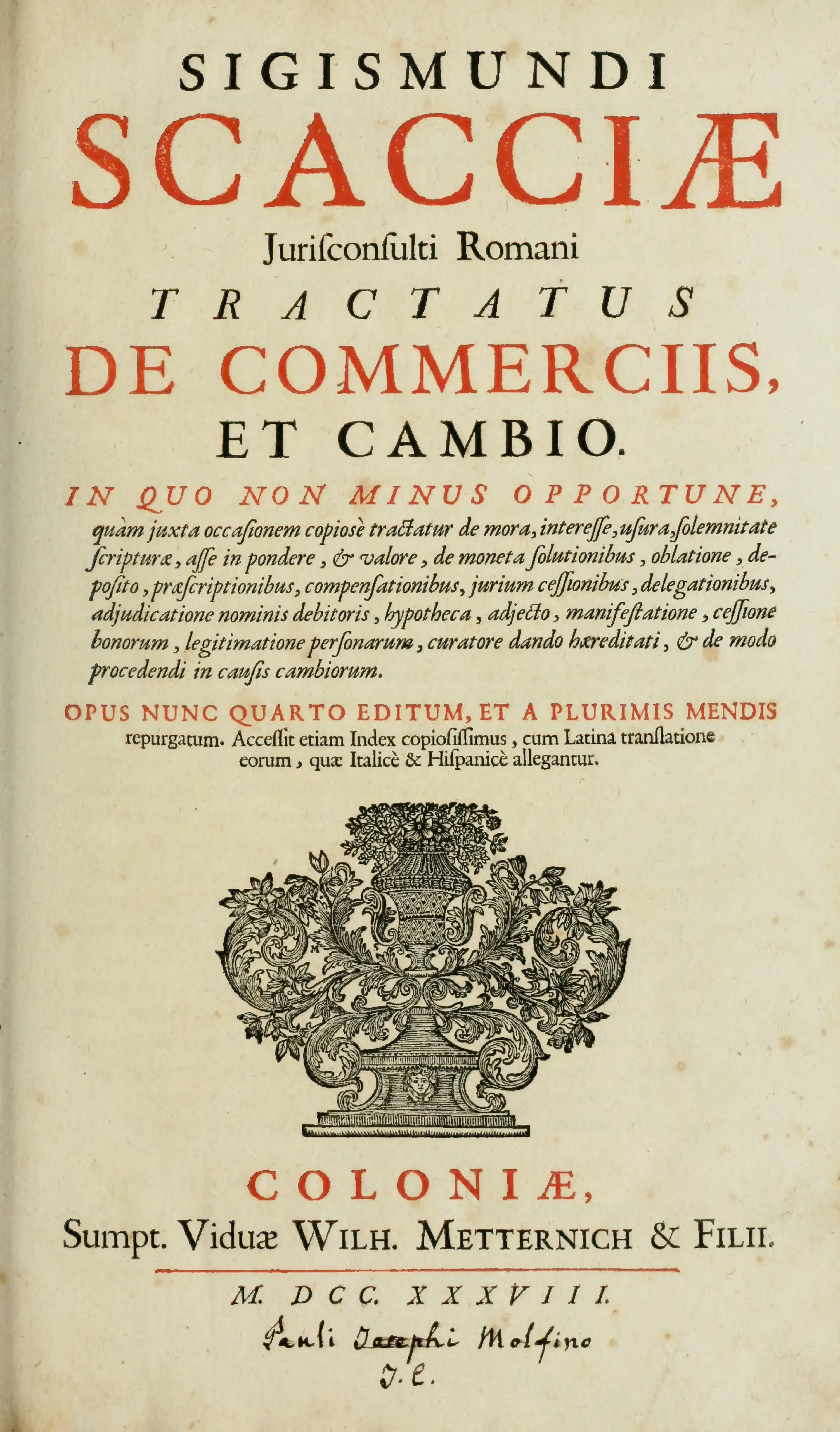
The red-and-black title page of the 1738 Cologne folio names Scaccia “Jurisconsulti Romani” and advertises a fourth, corrected edition, anchoring the Metternich printing in a transmission that began with the work's Roman preparation in the 1610s. Its formal imprint marks this out as a substantial juristic folio on commerce and exchange, not a merchant's pocket manual. Source ↗.
The problem the treatise confronts is one that pressed hard on jurists, confessors, and merchants alike after Trent. The contractual repertoire of European commerce had multiplied — insurance, wager, the various forms of census, loca montium, partnership in venal office, deposit both regular and irregular, the triple contract, and above all the bill of exchange transacted at the Piacenza fairs conventionally called Bisenzone, reckoned in a money of account that circulated nowhere as coin — while the canonical prohibition of usury remained in force and undiminished. Every one of these instruments could be described either as a legitimate species of contract or as a loan wearing borrowed clothes. To condemn too freely was to paralyse the traffic on which cities lived; to absolve too freely was to license gain that the canons forbade. Scaccia's whole enterprise is the construction of a method for telling the two apart, case by case, in terms a tribunal could apply and a confessor could use.
His recurring move is at once jurisdictional and analytic. He removes the question of usury from the theologians and assigns it principally to the doctors of canon law and to operative positive law — above all the constitutions of Pius V — and he treats commerce itself as belonging de genere permissorum, licit unless expressly prohibited, so that the burden of proof falls on the party alleging illicitness. Between the scruple that condemns everything and the coarse conscience that condemns nothing he steers what he calls a via quasi media. He then holds the external and the internal forum apart while keeping them in conversation: the tribunal judges by external equality, presumption, and proof; conscience judges by truth, yet its law must be a law of the possible. Within that frame he insists that impropriety, fiction, and novelty in mercantile forms do not by themselves vitiate a contract — only injustice palliated by fiction does — and he tests each instrument in turn for commutative equality, for the latitude within which a just price may fall, for a real transfer of money to another place, and for a genuine extrinsic title such as damnum emergens, lucrum cessans, the price of risk, or delay. Strikingly, the very multiplication of licit contractual forms becomes for him a remedy rather than a danger: the more licit species merchants have to hand, the less need they have of disguised usury.
The stakes are considerable for several fields at once. For the history of commercial law, the treatise is a rare point of contact between the learned ius commune, post-Tridentine casuistry, and the documentary routines of merchants and exchange courts; Vito Piergiovanni reads Scaccia as helping to bring mercantile material into a properly juristic field rather than abandoning exchange to theological condemnation. For the debate over a supposed autonomous lex mercatoria, Scaccia's simultaneous appeal to custom, to statute, to Rota practice, and to the civil and canon law makes him evidence of interaction between normative orders rather than of a separate merchant code. For the history of economic thought, his sources — Soto, Azpilcueta, Covarrubias, Azor, Molina, Lessius, Cajetan, alongside Bartolus, Baldus, Panormitanus, Stracca, and Santarém — place him in the contested field usually associated with the School of Salamanca, though he corrects those authors as readily as he follows them. And for the economic history of the Genoese exchange system, whose Bisenzone fairs Pezzolo and Tattara have argued functioned as an international capital market, the treatise is a witness written from inside the machinery, by a judge who says he interviewed Genoese merchants.
What is most memorable about the book is its texture. It contains a Roman licensing dossier naming its censors and their dates, one of whom praises the author for making the matter of exchanges — confessedly most difficult to state and deeply hidden even from theologians and men of the courts — lucid and orderly. It carries an internal apparatus in which Italian and sometimes Spanish mercantile documents are rendered into Latin deliberately in merchant style, so that nothing in the technical idiom should give offence. It anatomises a fictive money of account, the scutus marcharum, alongside carats, assays, and the conscience of the prince in coinage. It works through a hypothetical of a thousand scudi that a gentleman will neither bury in land nor leave sterile. It concedes, with unusual candour for a work defending exchange, that a commonwealth would be better served if its citizens gave themselves to trade rather than to exchange, since from exchange a few grow marvellously rich while the multitude remains destitute. And when the doctors' requisites for licit exchange become hopelessly entangled, the author proposes to imitate Alexander and cut the Gordian knot with silence. Around these arguments stands a production history that mirrors them: a folio licensed under Roman scrutiny for faith, morals, and usefulness to jurists, theologians, and confessors, and reprinted in Cologne, Venice, and Geneva for a market of practitioners. Much remains unresolved — the patron behind the work has not been securely identified, the Ludovisi connection the author himself invokes cannot yet be pinned to a particular member of that family, the edition sequence does not form a clean chronology, and the 1618/1619 discrepancy stands unreconciled.
Read the full text and English translation on Leo
This text was transcribed and translated as part of the ExLatinis project, an effort by Leo to make free English translations of every text published in Latin in early modern Europe (1450–1750) available online. The complete transcription and English translation of this work can be read free of charge:
→ Read the original Latin text and full English translation on Leo
You can save a copy of this document into your Leo account to run deep text searches, conduct further analysis, or cross-reference it with your own research.
Rendering the Title: Commercium, Cambium, and Scaccia's Working Vocabulary
On Commerce and Exchange: Sigismondo Scaccia's Tractatus de commerciis et cambio — an editorial title supplied for convenience, since no established English title or modern critical translation has been located. The Latin title cannot be reduced in modern usage to a free-standing treatment of 'trade' in its contemporary commercial sense: commercium designates legally consequential dealings, obligations, payments, and transactions, while cambium names the juridical and economic complex of exchange, remittance, money-changing, and the bill. The title-page epithet jurisconsultus romanus is an occupational designation and does not by itself prove a Roman origin for its bearer.
The oppositional vocabulary of cambium reale and cambium siccum belongs to a post-Tridentine register in which canonists, moral theologians, jurists, and merchants tested whether a given exchange was a genuine transfer of money between distant places or was, in substance, a loan dressed in exchange's vocabulary. Conceived as the cambium reale, an actual movement or payment of money at a different place was conventionally present; conceived as the cambium siccum, that material transfer was treated as missing, and the transaction was suspected of concealing usura. These were not merely descriptive categories: they reallocate the burden of proof between the external tribunal of law and the forum of conscience. The treatise makes the distinction operative by listing the marks a licit exchange must bear — first, that it be a just contract; secondly, that it be a real exchange — notas; primò ut sit contractus justus. Secundò, ut sit cambium reale, so that justice of price and reality of transfer are held together as separate but cumulative tests. Scaccia's joining of cambium, recambium, interest, usury, and the procedure of exchange litigation places his work inside that controversy; whether a particular operation was illicit or defensible in his classification requires page-level reading of the Latin text rather than reliance on catalogue summaries. The related expression moneta imaginaria, including the scutus marcharum used in exchange reckoning, denotes a unit of account whose juridical force need not coincide with a physically circulating coin; the text draws precisely that line when it distinguishes a second money, one that is finite, is not found in the nature of things, may perhaps therefore be called imaginary, and is the money named in the exchange, altera est moneta finita, & quæ in rerum natura non invenitur, unde forte, dicenda imaginaria, & in cambio nominatur.
The iustum pretium was not normally a single immutable figure. Its latitudo was the legally and morally significant latitude generated by common estimation, place, time, quality, risk, scarcity, and the circumstances of the bargain. Scaccia grounds that latitude in the limits of human judgment itself, reasoning that a price not fixed by law is not indivisible but has latitude, since human justice and prudence cannot so measure all the circumstances and qualities of the thing to be sold as to hit the price's exact mark, quia hoc pretium, quod non est lege positum, non est indivisibile, sed habet latitudinum, cum justitia & prudentia humana illas omnes circumstantias, & qualitates rei uendendæ non valeat ita metiri, ut pretij metam possit inde punctualiter attingere. In exchange cases this idiom intersected with interesse, damnum emergens, and lucrum cessans: a claimed loss or foregone gain could be relevant only when it amounted to a recognized extrinsic title, not merely because a lender wished for return. The result is a jurisprudence of title, estimation, custom, and conscience rather than a free-standing theory of price.

Raphael's Vatican roundel of Iustitia, enthroned with sword and scales and framed by the maxim assigning each person their due, gives visual form to the commutative justice underwriting early modern reasoning about exchange — a reminder that the iustum pretium was no fixed arithmetical point but a judgment of title, circumstance, and equitable measure. Source ↗.
Forum conscientiae and forum fori name two related but non-identical jurisdictions: the former concerns the confessor's or moral theologian's judgment of restitution and culpability, the latter what a tribunal can prove and enforce according to law, procedure, documentary form, and mercantile custom. The treatise keeps the asymmetry sharp — a debtor who has ceded his goods may be discharged before the judge, yet in the interior forum he is bound to pay and to restore in full, even though he remain needy and destitute, In foro autem interiori tenetur solvere, & restituere integrum, etiam quòd remaneat indigens, & inops — while refusing to let the internal forum demand the impossible, the reason that moves him being that even the law of conscience must concern what is possible, ratio, qua moveor, est quia etiam lex conscientiæ debet esse de possibili. Scaccia's importance lies partly in making these jurisdictions address one another through the stylus mercantilis and through Roman and Genoese judicial experience; the mercantile standard he invokes is summary and anti-formalist, proceeding in the manner of a good merchant, where all cavilling is rejected and the pure truth of the fact is considered purely and simply, ad modum boni mercatoris, ubi omnis cavillatio rejicitur, & pura veritas facti purè & simpliciter consideratur. Formulae such as fictio, improprietas, via quasi media, and cadaver legis should not be assigned a settled meaning from secondary summaries alone: the accessible scan confirms the treatise's legal-moral apparatus, but a critical edition is needed to determine the exact local force of each phrase. Their local force can nonetheless be sampled. The middle way is announced as a deliberate posture of prudence, the author declaring that, taught by the peril of others, in matters not perhaps clearly defined by the sacred canons, and fleeing scrupulosity no more than laxity of conscience, he will follow a middle way that neither exasperates nor softens, Nos istorum periculo edocti, in his, quæ à sacris Canonibus clare definita forsan non sunt, non magis scrupulositatem, quam conscientiæ crassitudinem fugientes, viam quasi mediam, quæ nec exasperet, uec emolliat, sequemur. Improprietas and fictio are conceded as endemic to the trade — he supposes, fourthly, that in exchanges many improprieties and fictions are tolerated, from which the business of exchange seems chimerical, the necessity of the traffic in money so demanding, Quartò suppono, quòd in cambiis tolerantur multæ improprietates, & fictiones, ex quibus cambiorum negotiatio videtur chimærica, sic negotiationis pecuniarum necessitate exigente — and are then neutralised by a discrimination that carries much of the treatise's analytic weight, since it is not fiction that infects the contract but injustice, which is palliated by fiction, quia non fictio inficit contractum, sed injustitia, quæ fictione palliatur.
What the Tractatus de commerciis et cambio Contains, and Who Wrote It
Tractatus de commerciis et cambio is a Latin legal and moral-jurisprudential treatise by Sigismondo Scaccia, not a private letter, petition, or purely theological disputation. It treats exchange transactions and their litigation together with delay, interest, usury, the formalities of writing, money and payment, deposit, prescription, compensation, assignment, delegation, hypothecation, insolvency, the status of persons, and procedure in exchange causes. Its governing presumption, stated against the authorities marshalled on the other side, is that commercial dealings belong to the genus of permitted things and are therefore licit except where they are found expressly prohibited, His non obstantibus, concludo, contrarium esse verum, nempe commercia esse de genere permissorum; & ideo licita, præterquam in calibus, in quibus reperirentur expresse prohibita; the argument from public necessity that supports it is put starkly, for take away human commerce and it will be necessary either that men seize others' goods in order to survive or that very many perish miserably by hunger, nakedness, or otherwise, tolle enim humana commercia, & tunc necessè erit, homines aliena rapere ut sustentari possint, aut certe fame, nuditate, aut alias miserabiliter quam plures repitire. The surviving Roman licensing dossier places the work's preparation and authorization in 1616–1618; the strongest physical first-edition record is Rome, 1619, although some catalogues and secondary records give 1618. The 1738 Cologne issue presents itself as the fourth edition, revised and purged of errors.
The author is generally identified as Sigismondo Scaccia, also catalogued as Sigismundus Scaccia, Scaccius, Scacia, or Scàccia. A specialized biographical account places him at Camerata around 1564 and records his death at Rome in 1634; it reconstructs service as a jurist, judge, advocate, and auditor, including the civil Rota of Genoa in 1612–1615. Treccani calls him a Genoese jurist, while the Camerata account makes his precise local identity more complicated. The title-page's jurisconsultus romanus is therefore to be treated as a professional designation. No pseudonym or anagram was located in the authority and catalogue searches. The proposed identification of a Ludovisi patron or auditor relationship could not be securely resolved: no authoritative source found in the investigation establishes whether the relevant figure was Ludovico Ludovisi or another member of that family, though the treatise's own self-presentation includes service as auditor to a Cardinal Ludovisi at Bologna.
The language of composition is Latin. The 1738 title-page advertises a 'copious index' and Latin renderings of passages cited in Italian and Spanish. A Berlin catalogue for a related German issue records the internal heading Sequuntur Translationes Allegatorum Hinc Inde, Quae Ex Idiomate Italo, Aliquando Etiam Hispano, sic redduntur latine: Italian, and at times Spanish, mercantile materials are rendered into Latin for the learned reader, in a mercantile register. The heading as it stands in the text makes that register and its motive explicit, announcing that there follow the translations of the documents cited here and there, which from the Italian tongue, and sometimes also the Spanish, are thus rendered into Latin, but in merchant style, lest anything give offence, SEQUUNTUR TRANSLATIONES ALLEGATORUM HINC INDE, QUÆ ex idiomate Italo, aliquando etiam Hispano, sic redduntur latinè, sed stylo mercantili, ne quid offendare. This is an internal translation apparatus, not evidence of a complete vernacular translation of Scaccia's treatise; the clause on merchant style shows the apparatus serving the same purpose as the work's jurisdictional argument, namely the admission of mercantile idiom into learned Latin without deforming it. No modern English, Italian, French, or German translation was located in the catalogues and digital repositories searched; that negative result is not proof that no unpublished or unindexed translation exists.
Scaccia, the Bisenzone Fairs, and the Argument over a Law Merchant
Scaccia matters because the treatise is a rare point of contact between the learned ius commune, post-Tridentine moral casuistry, and the documentary practices of merchants and exchange courts. Its legal method asks how customary mercantile forms, bills, remittances, recourse, money of account, and documentary proof could be evaluated by jurists, confessors, and judges. That method is not merely accumulative: where the doctors' apparatus of requisites had become impassable, he proposes to imitate Alexander the Great, who cut the inexplicable Gordian knot with his sword, and to lacerate these confused and inexplicable perplexities with silence, satius existimo, si, Alexandri Magni exemplum imitati, dum inexplicabilem Gordium nodum gladio abscidit, has confusas, & inexplicabiles perplexitates silentio laceremus, a gesture that clears space for his own criteria of equality, latitude, real transfer, and extrinsic title. The Roman and Genoese settings also make it a valuable witness to institutional movement between the Rota, the consulatus mercatorum, and merchant practice.
Vito Piergiovanni is the most directly relevant modern scholar located. In 'Il valore del documento alle origini della scienza del diritto commerciale: Sigismondo Scaccia giudice a Genova nel XVII secolo,' he interprets Scaccia as helping to 'decanonize' commercial law in the sense of bringing mercantile material and professional practice into a juristic field rather than leaving exchange entirely to theological condemnation. The jurisdictional premise is stated flatly in the treatise: the second thing to be noted is that the decision of cases, questions and difficulties arising in the matter of usuries and illicit commerce pertains principally to the doctors of canon law, and therefore their opinion prevails over the opinion of the theologians, SECUNDUM NOTABILE est, quod decisio casuum, quæstionum, & difficultatum, quæ emergunt in materia usurarum, & commerciorum illicitorum, spectat principaliter ad Doctores juris canonici; & ideo eorum opinio prævalet opinioni Theologorum. Piergiovanni emphasizes Scaccia's claim that jurists and experienced merchants could possess decisive competence in exchange questions, and he uses the Genoese Rota to show how custom could enter the ius commune. That competence is asserted polemically against the received literature, the second ground of rejection being that the Doctors, saving always their peace and reverence, have entangled themselves and others too much in these requisites, having written partly obscurely, partly meagrely, and partly untruly, Secundo rejicienda est, quia Doct. (salva semper eorum pace, & reverentia) in his requisitis se, & alios nimis intricarunt: partim enim obscure, partim jejune, & partim non vere scripserunt. His argument also resists a simple opposition between a supposedly case-bound Italian tradition and a later, purely legislative French model.
The history of the Bisenzone or Besançon fairs supplies the economic setting against which Scaccia's terminology should be read. Pezzolo and Tattara, in 'Una fiera senza luogo: Was Bisenzone an International Capital Market in Sixteenth-Century Italy?' (2008), argue that Bisenzone functioned as an international capital market under strong Genoese control and that short-term exchange instruments helped finance the Spanish Crown's longer-term obligations. Their interpretation challenges older narratives in which usury law is assumed to have prevented the development of capital markets, and the treatise supports that revision from the juristic side, since Scaccia holds that we shall necessarily say that exchanges are not only licit but even necessary to the commonwealth, not inasmuch as the use of money is considered by itself alone, but inasmuch as it is the servant of economy and polity, necessario dicemus, cambia esse nedum licita, sed etiam necessaria Reip. non quatenus pecuniæ usus de per se solus consideratur, sed quatenus oeconomice, politiceque minister est. Marsilio's study of Genoese, Florentine, and Portuguese operators in seventeenth-century exchange fairs likewise foregrounds professional skill, liquidity, bills, spacci, and patto di ricorsa.
The legal-historical debate over ius mercatorum is equally important. Charles Donahue Jr.'s 'Medieval and Early Modern Lex Mercatoria: An Attempt at the Probatio Diabolica' (2004) rejects the idea that a single coherent, transnational 'law merchant' operated independently of territorial statutes and learned law. He presents mercantile rules as a mixture of local legislation, commercial practice, and juristic adaptation of the ius commune. Scaccia's insistence on mercantile custom, documentary form, and judicial competence is therefore better read as evidence of interaction between normative orders than as proof of an autonomous law merchant. Piergiovanni's reading of Scaccia is broadly compatible with that approach.
The School of Salamanca and late-scholastic literature provide much of the moral and conceptual vocabulary: common estimation and the just price, restitution, extrinsic titles to interest, insurance, census, the triple contract, the mons pietatis, the legitimacy of office partnerships, and the prince's duty in coinage. Several of Scaccia's characteristic positions can be read as juristic reworkings of that material. The defence of trade against moralist attack turns on a distinction between agent and art, since the merchant, greedy to acquire, blasphemes over a loss and lies and perjures himself over the prices of things, but these are vices of the man, not of the art, which can be practised without them, so that trading is not in itself unlawful, negotiator, avidus acquirendi, pro damno blasphemat, pro pretiis rerum mentitur, & pejerat, sed hæc vitia hominis, non sunt artis, quæ sine his agi potest: ergo negotiari secundum se non est illicitum. The proliferation of contractual forms is welcomed rather than feared: many commercial forms have therefore been devised and invented day by day, and if more were found it would be better, both that palliated and implicit usuries might be avoided, multa propterea sunt in dies excogitata, & inventa commercia, ut dixi supra n. 68. & 70. & plura si invenirentur, melius foret, tum ut palliatæ, ac in plicitæ usuræ evitareorur. The mechanism by which that prophylaxis works is the doctrine that a loan, if it is made gratis, remains a loan, but if it is made not gratis it will pass into another species of licit contract, provided that commutative justice be present in it, ita etiam mutuum, si gratis fiat, remanet mutuum, sed si fiat non gratis, transsibit in aliam speciem contractûs liciti, dummodo in eo adsit justitia commutativa. Marjorie Grice-Hutchinson's Early Economic Thought in Spain, 1177–1740 remains useful for the Spanish scholastic background; Annabel Brett's work on later scholastic right, liberty, and nature clarifies the juridical anthropology behind many discussions of obligation and consent, an anthropology visible in Scaccia's account of positive law, which differs from the law of nature only as part from whole, stream from spring, begotten from begetter, founded thing from foundation, and so flows not from men's opinion but from nature's decree, quòd lex humana non differit à lege naturæ, nisi prout differunt pars à toto, riuus à fonte, genitum à generante, fundatum à fundamento; quare non ab hominum opinione, sed à naturæ decreto profluit, and equally in his consensual construction of legislation, for law is a contract between subjects and the Prince, who as father of all and lawful administrator establishes law among his subjects as a kind of contract, and the subjects effectually consent in that contract, that is, in the law, lex enim est contractus inter subditos, & Principem, qui tanquam omnium pater, & legitimus administrator, lcgem inter subditos, quasi contractum constituit, & subditi in eo contractum id est, lege, effectualiter consentiunt. Scaccia's sources — among them Soto, Azpilcueta, Azor, Molina, Lessius, Cajetan, Bartolus, Baldus, Panormitanus, Stracca, and Santarém — should not be treated as a homogeneous 'school.' The treatise belongs to a contested field in which canonists, theologians, jurists, merchants, and tribunals disagreed over who could determine the justice of an exchange and in which forum.

An engraved portrait of Martín de Azpilcueta, the “Doctor Navarrus,” evokes the Spanish scholastic milieu from which Scaccia drew arguments about just price, restitution, and commutative justice. Azpilcueta figures here not as the author of the treatise but as one of the authorities whose moral jurisprudence helped structure its analysis of exchange. Source ↗.
The work's repeated reprinting demonstrates sustained bibliographical use, but no contemporary refutation, formal proceeding, or identifiable chain of replies was located. Nor was a systematic citation history in later commercial and canonistic literature established. Scaccia is often named as a precursor or authority in broad histories of commercial law and scholastic economic thought; direct analysis of his arguments, editions, and documentary appendices remains comparatively uncommon. That historiographical silence is itself significant: the treatise can test narratives that move too quickly from medieval usury doctrine to modern commercial law. It is also worth registering that the conclusions Scaccia himself reaches on fair exchange are qualified rather than triumphal. He concludes therefore that where the just price is not exceeded in exchange — of which he is persuaded in most cases — the transaction will not be illicit but, as to such a dealing, good and just, Concludo igitur, ubi in cambio non exceditur justum pretium, quod mihi de pluribus persuadeo, illud non fore illicitum, sed quoad talem partitam bonum & justum., and he immediately professes his own hesitation in the adage that to doubt is pious, to abstain is safer, and to condemn is not, Ego quidam valde dubito (Dubitare est pium, abstinere est tutius, damnare non est — a posture of calibrated uncertainty that any account of his 'position' on exchange must accommodate.
From Rome 1619 to Cologne 1738: Editions, Licences, and the Physical Book
The 1738 Cologne witness is catalogued as Sigismundi Scacciae jurisconsulti romani Tractatus de commerciis, et cambio, Cologne, sumptibus Viduae Wilhelmi Metternich & Filii, 1738. Its title-page states Opus nunc quarto editum, et a plurimis mendis repurgatum and announces the index and Latin translations of Italian and Spanish citations; the title-page formula reads in full as a work now issued for the fourth time and purged of very many errors, to which a most copious index has also been added, together with a Latin translation of the passages cited in Italian and Spanish, OPUS NUNC QUARTO EDITUM, ET A PLURIMIS MENDIS repurgatum. Accessit etiam Index copiosissimus, cum Latina translatione eorum, quæ Italicè & Hispanicè allegantur. Google Books identifies the issue as 520 pages; HathiTrust records a 1738 copy; Stanford describes the same Cologne issue; and an Internet Archive scan is available under identifier `sigismundiscacci00scac`. The scan is a folio witness with a red-and-black title-page, a Typographus Lectori, the licensing material, the Totius tractatus ordo distinctus in novem §§, summaries before divisions, and a terminal alphabetical index. Antiquarian descriptions disagree about the preliminaries and terminal leaves — for example, descriptions variously give forms such as [8], 520, [92] or [4], 520 with different final counts. An exact sheet-by-sheet collation and press-figure record has not been confirmed. The 628-page figure belongs to a Berlin record for a 1648 issue and should not be silently transferred to the 1738 folio.
The edition sequence is only partly recoverable and the edition numbers do not form a completely secure linear chronology. A physical-book description reports the first Roman edition as Rome, Jacopo Mascardi, for Andrea Brugiotti, 1619, in folio, with [8], 755, and [125] pages and a red-and-black title-page with vignette. Some records give Rome 1618, so 1618/1619 remains a bibliographical discrepancy; the 1619 title-page description is the stronger evidence currently available. Cologne, Antonij Boëtzeri, 1620, is described as the first German edition, in large sextodecimo, [8], 507, [83] pages. A Berlin copy, PPN1000603474, is dated 1648 and bears the description Opus nunc iterum in Germania editum; its exact city and printer have not been recovered. A Venice issue is catalogued as sumptibus Bertanorum, 1650, 521 pages. Geneva, sumptibus Ioannis Hermanni Widerhold, 1664, is explicitly described as Opus nunc tertio editum et a plurimis mendis repurgatum and is recorded at 520 pages. Venice, sumptibus Bertanorum, 1669, is recorded by the University of Pennsylvania and HathiTrust. Because a 1648 German reprint, a 1650 Venice record, and a 1669 Venice record coexist with a 1664 'third edition' and a 1738 'fourth edition,' some entries may be reissues, regional reprints, or edition-count exclusions. A definitive census through VD18, USTC, EDIT16, ICCU, and copy-level comparison remains necessary.
The Roman licensing dossier is unusually valuable primary evidence. The 1738 scan preserves approbations made under Fr. Hyacinthus Petronius, Master of the Sacred Palace. Angelus Ludanus, identified as a jurist and public professor or interpreter of pontifical law at the Roman Gymnasium, approved the work on 15 December 1616. Joannes Baptista Blanchetti, O.F.M., professor of sacred theology and lector jubilatus, approved it on 17 February 1617. Antonius Sandarellus, S.J., appears in an approval dated in 1617 and in a further review dated 19 November 1618. An Apostolic Referendary named Machiavellus appears in an approval dated 13 November 1618, although the initial and exact reading of the name require verification against the page image. The concluding formula names Gregorius Donatus Romanus as Master or examiner together with Petronius. The censors' own terms register why the licence mattered: one approbation commends the author because he elucidates the matter of exchanges in particular — not only most difficult to state and utter but most difficult to grasp, and deeply hidden from many theologians and forensic men — in a fine order and a clearer method, speciatim materiam de Cambiis, non solum dictu, & effatu perdifficilem, verum etiam captu difficillimam, & multis Theologis, & Forensibus penitus reconditam, pulchro ordine, & clariori methodo dilucidat, a judgment that mirrors the author's own claim that competence in exchange questions is technical and unevenly distributed. A Stanford catalogue note gives 29 November 1618 as the last imprimatur, whereas the scanned front matter yields 13 November 1618 in the relevant approval; both dates should be reported until the original type or a second witness resolves the discrepancy. No 1619 licence has been confirmed. The dossier records scrutiny for faith, morals, and usefulness to jurists, theologians, and confessors. No reliable evidence of suppression, expurgation, or placement on an Index has been located; the absence of a located Index entry is not proof that no such record exists.
The Metternich imprint belongs to a documented Cologne printing and bookselling milieu. Isabel Heitjan's Die Druckerei und Buchhandlung Metternich im Schwarz(en)haus vor den Augustinern zu Köln 1629–1733 establishes the earlier house and its activities; a Yale Law Library record also documents the formula 'Widow of Wilhelm Metternich & sons' in a 1732 Cologne imprint. The 1738 title-page itself proves the widow-and-son form, but the precise identity of the son, the legal succession, the press personnel, and the house's specific distribution into German and Netherlandish markets have not been established from the accessible records. The BnF authority record for Franz Wilhelm Metternich (1691–1755) does not, by itself, prove his role in this particular issue.
The internal translation heading Sequuntur Translationes Allegatorum Hinc Inde, Quae Ex Idiomate Italo, Aliquando Etiam Hispano, sic redduntur latine is independently visible in the Berlin catalogue, and the same heading in the text carries the further specification that the rendering is made in merchant style. By contrast, the alleged series of Pius V briefs, Bolognese decrees, exchange-place articles, the 1,000-scudi Piacenza casus, and sixteen conclusions on fair exchange could not all be verified in the accessible 1738 OCR. They may be present in a different issue, under headings not recognized by the OCR, or in an appended textual layer; they should not be presented as securely belonging to the 1738 witness without page-image confirmation. Two qualifications on the content of that documentary layer can nonetheless be stated. The chancery formula of a papal grant of the relevant type does occur in the work's documentary matter, in the language of a pope acting of his own motion, not at the instance of any petition offered on the merchants' behalf by them or by another, but of his mere liberality, of certain knowledge, and out of the fullness of Apostolic power, motu proprio, non ad ipsorum mercatorum, vel alicujus alterius pro eis nobis super hoc oblatæ petitionis instantiam, sed de nostra mera liberalitate, & ex certa scientia, ac de Apostolicæ potestatis plenitudine, which is consistent with the treatise's reliance on operative papal legislation rather than theological opinion. And the thousand-scudi hypothetical, as the text frames it, is not localised at Piacenza: a certain man of knightly rank at Genoa or Florence has 1,000 scudi which he will not put into land, nor into census, nor into merchandise, nor yet leave sterile, H Abet quidam equestris ordinis Genuæ aut Florentiæ 1000. sc. quos non vult conferre in prædia nec in censum nec in merces: neque etiam steriles relinquere — the fairs supply the mechanism of the discourse, but the casus itself begins from a Genoese or Florentine investor.
No dedicatee or patron has been securely identified. The Ludovisi connection mentioned in secondary descriptions could not be resolved between Ludovico and Alessandro/Ludovico's later papal identity, and the licensing material alone does not establish it; the treatise's own reference to an auditorship under a Cardinal Ludovisi at Bologna does not by itself settle which member of the family is meant. The same author is associated in catalogues with Tractatus de iudiciis causarum civilium, criminalium et haereticalium, Tractatus de appellationibus, and Tractatus de sententia et re iudicata. The dates and places of those companion works vary among records, but they form a coherent juristic corpus rather than evidence for a separate Scacchi medical or musical author. No independent collection of Consilia, contemporary counter-text, or formal proceeding directed specifically against Tractatus de commerciis et cambio has been securely located.
How the Argument Runs: From the Licitness of Commerce to the Law of the Bill
Threshold: the printer's address and the lexicon of commerce
The Cologne folio's front matter already stages a small paradox that the treatise itself will spend hundreds of columns adjudicating: a book about the licitness of buying and selling is itself a saleable commodity, and its vendor must praise it without appearing to praise. The printer's address to the reader resolves this by disavowal, asking what need saleable wine, as they say, has of an ivy-branch, since useful and distinguished things, pleasing of themselves, spurn foreign praise, sed quid vino vendibili, ut aiunt, opus est hæderâ, utilia & præclara ut ista cùm ex se placeant exoticam laudem respuunt. The proverb of the tavern-sign, reinforced on the same page by Horace against the vendor who talks up his wares, allows the house to advertise the fourth edition's corrected text and reformed indices under a rhetoric of restraint. It is a fitting threshold, because Scaccia's own argument will turn repeatedly on the difference between the substance of a transaction and the appearances that clothe it.
The treatise proper opens not with doctrine but with lexicography, and the justification offered for that delay is methodological rather than ornamental: so that we may know the matter fundamentally and from its root, and not proceed from unknowns to unknowns, which must be guarded against in every kind of discipline, since if a blind man leads a blind man both will fall into the pit, Et quo rem fundamentaliter, & ex radice sciamus, aut ne ex ignotis ad ignota procedamus; (quod in omni disciplinarum genere præcavendum est, quia, si coecus coecum ducat, ambo in foveant cadent.
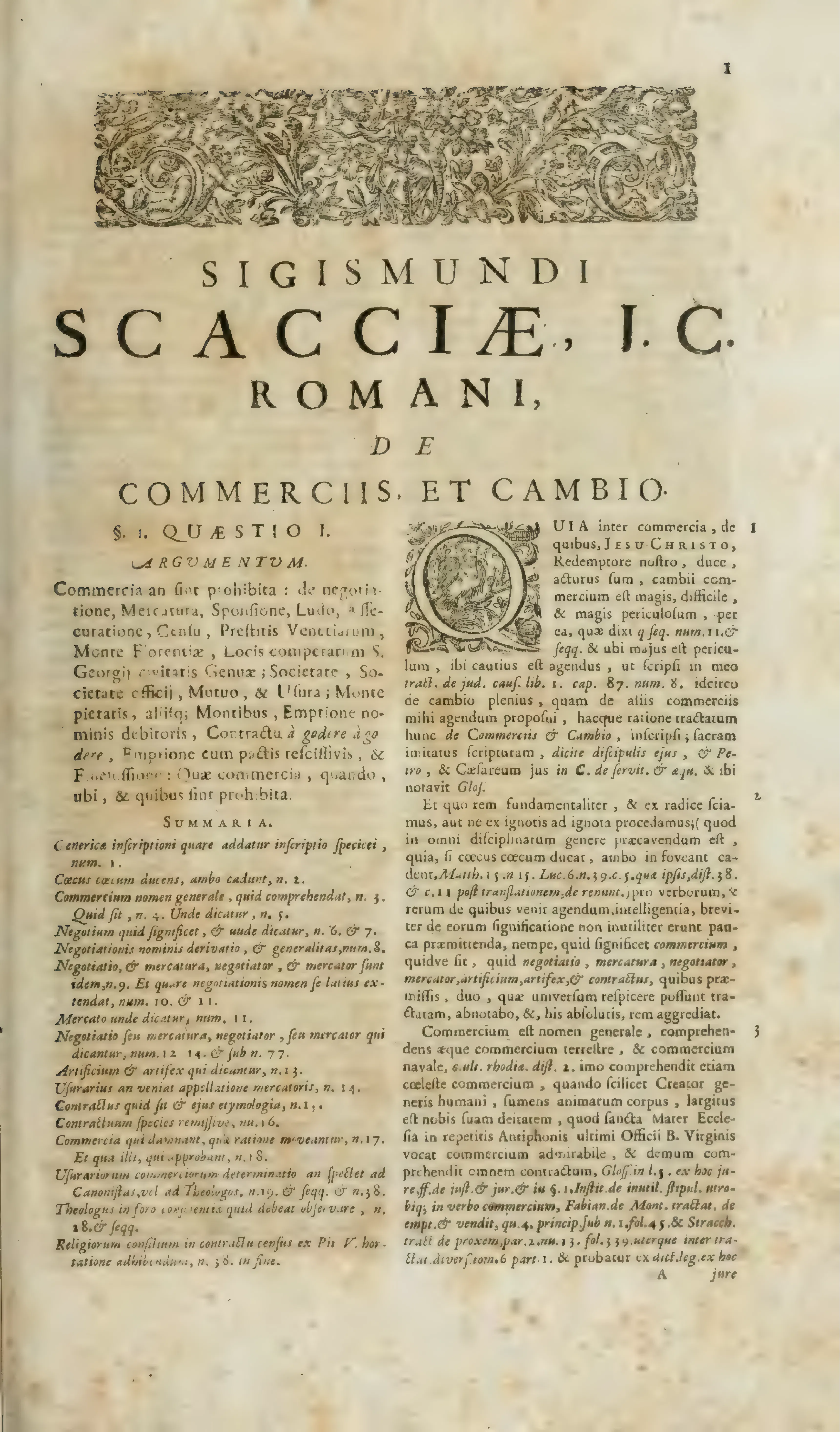
The decorated opening of Quaestio I turns typography into method: beneath the headpiece and ornamental initial, the Argumentum compresses insurance, census, public debt, Genoese luoghi, mutuum, usury, and charitable credit into a single agenda. The first numbered paragraphs then justify beginning from definitions rather than moral conclusions, so that disputed commercial forms can be sorted before they are judged. Source ↗.
The gospel image is doing serious juristic work. In a field where the same operation could be named mutuum, emptio, societas, or cambium according to who described it, the placement of definition before doctrine is what makes adjudication possible at all: the long prologue distinguishing commercium in its widest reach from negotium, negotiatio from mercatura, and the merchant who resells unaltered from the artifex who transforms what he buys, supplies the grid onto which every later contract will be mapped. That the same noun can extend to the commercium admirabile of the Incarnation is not a pious digression but a demonstration of the term's generic breadth, and hence of the author's right to make it the title of a work that will end in the technicalities of the fairs.
Posture and jurisdiction: the two notabilia
Two notabilia then fix the posture and the jurisdiction of the whole enterprise. The first sets the rigorists who condemn nearly all dealing against the lax who approve all, and refuses both in the declaration of a middle way that neither exasperates nor softens, already met above as the treatise's governing stance. Its load-bearing element is the qualification that the matters in view are those not perhaps clearly defined by the sacred canons. The middle way is not proposed as a temperamental preference but as the proper response to a determinate legal condition — the silence or obscurity of the operative canons — so that the author's discretion is licensed precisely where positive law has not spoken, and correspondingly bounded where it has. The paired verbs, that the doctrine should neither exasperet nor emolliat, neither irritate nor soften, borrow the vocabulary of medical regimen: doctrine, like a remedy, may be too harsh or too emollient for the constitution it treats.
The second notabile converts that posture into a claim of competence, assigning the decision of cases, questions and difficulties arising in the matter of usuries and illicit commerce principally to the doctors of canon law, whose opinion is therefore said to prevail over that of the theologians — the jurisdictional premise already quoted above. The vocabulary is deliberately forensic — casus, quæstiones, difficultates, decisio — as though usury were less a moral condition than a species of litigation, resolvable by the professional apparatus of extensio, explicatio, and numbered conclusiones that immediately follows. Yet the claim is qualified by principaliter, principally and not exclusively, and the seven conclusions on when a confessor must follow the letter of positive law and when its mens keep the theologian in the room. What is being asserted is priority in a shared field, not exclusion from it; the anxiety animating the passage is that a matter requiring technical mastery of decretals, statutes, and fair practice had been left to those who possessed the moral vocabulary without the documentary training.
The licitness of commerce and the aleatory contracts
With posture and jurisdiction settled, the first question can be answered. Against arguments drawn from the primitive community of goods, from the Senecan and elegiac commonplaces on meum and tuum, and from the poverty of Christ, Scaccia concludes, in the formulation already discussed, that commercial dealings belong to the genus of permitted things and are therefore licit except in cases where they are found expressly prohibited. The formulation is a rule about the location of the burden of proof: prohibition must be expressa, express, and must be reperta, found in a text, so that the party alleging illicitness bears the task of production. The supporting apparatus — that a prohibitive law derogates from a permissive one, that negatives bind semper, & pro semper — is standard ius commune doctrine, but its application to the whole genus of trade converts a rule of statutory construction into a presumption of commercial liberty. The two-state anthropology of natura incorrupta and natura corrupta then disarms the communism objection without conceding that private dominion is merely a fallen expedient: property belongs to the secondary natural law, appropriate to the condition men actually inhabit.
That the presumption is not merely permissive but affirmative appears in the consequentialist supplement already noticed above, the thought-experiment which supposes human commerce abolished and finds that men must then either seize others' goods in order to survive or perish miserably by hunger and nakedness. The imperative tolle, take away, frames the experiment, and the alternatives it yields — rapine or death — are precisely the two evils that the law of nature and the law of nations exist to avert. Commerce is thereby placed among the instruments of natural self-preservation, which is why the ampliations can escalate to the assertion that denying its licitness verges on heresy.
The treatment of aleatory contracts shows the method working on harder material. Wagering, ordinarily suspect as a gain without labour, is analysed by attending to what the parties actually secure: in the case put, whichever of us loses, wins, because he obtains his desire, and so the wager is as it were a remedy, a consolation, and a kind of compensation with the outcome of the affair, quo casu quisque nostrum, perdendo vincit, quia consequitur desiderium, ac proinde sponsio est veluti remedium; consolatio, & compensatio quædam cum casu finis strio. The paradox perdendo vincit is not rhetorical excess: it identifies a structure in which the stake offsets the disappointment, so that the contract's causa is compensation rather than gain from chance. That analysis is then made explicit in the comparison with underwriting, where Scaccia concedes that this contract of insurance does not differ in substance and in the justice of its price from the contract of wager, and that they differ only in this quality, that insurance has an evident, just and useful cause — since the insured intends to avoid loss — whereas the wager has a latent cause whose utility does not appear, hic contractus assecurationis in substantia, & justitia pretii non differt à contractu sponsionis, differunt autem solum in hac qualitate, quod assecuratio habet evidentem causam, justam, & utilem quia assecuratus intendit evitare damnum, at sponsio habet latentem causam, cujus utilitas non apparet. The concession is analytically bold and doctrinally risky: identity in substantia means that no structural feature of the premium distinguishes the underwriter's gain from the gambler's, and the entire discriminating weight falls on the visibility of purpose, on evidens against latens. Licitness here is a function of what can be shown, which returns the question to the evidentiary competence claimed for the canonist-judge.
The insurance discussion accordingly turns from classification to proof, and there Scaccia records a Genoese statutory device of considerable ingenuity, ordaining that notice be presumed when so much time had elapsed as would allow it to have been had from the place where the sinister case occurred to the place where the insurance was made, reckoning two miles for each hour, statuendo, ut notitia præsumatur, quando fuit transactum spatium tanti temporis, quo à loco, ubi securus fuerit casus sinister, calcularis millaribus duobus pro qualibet hora, ad locum, in quo facta est securitas, haberi potuisset. A fact inaccessible to direct proof — whether the insured already knew his ship was lost — is replaced by a calculable presumption derived from the ordinary velocity of report. This is the forum fori at its most characteristic: not truth but the best measurable proxy for it, fixed by statute so that litigants may know in advance what will be presumed against them.
Census, montes, and the partnership in venal office
Behind the whole catalogue of contracts lies a diagnosis of why the catalogue keeps growing, offered without moralising: since money has increased marvellously, and the contract of sale often fails, and men naturally desire riches and therefore gain, and the good faith of borrowers fails, so that scarcely anyone lends any more, quia cum auctæ mirum in modum sint pecuniae, & emptionis, & venditionis contractus sæpe deficiat, & homines naturaliter divitias, & ideo lucrum appetant, & mutuatariorum fides deficiat, & ideo, qui mu[n]uet, fere amplius non reperitur. Abundance of coin, failure of credit, and the natural appetite for gain are treated as data rather than sins, and the invention of new contractual species follows as their consequence; from which Scaccia draws the counter-intuitive policy that a wider repertoire of approved forms is itself prophylactic against simulation, since merchants denied licit instruments resort to disguised ones.
The De censibus section applies that policy to the most heavily regulated of these devices. The annuity is first redescribed so as to remove it from the law of loan altogether, a census being a right of receiving fruit, or some other useful thing, or even money, from that thing in which the census is said to be constituted, quare census est jus percipiendi fructum, seu remaliquam utilem, aut etiam pecuniam de re illa, in qua dicitur census constitutus. What is bought is a ius attached to a res, not the use of money over time; the fruitfulness and boundedness of the underlying fund therefore become substantive conditions rather than formalities, and the buyer, not the seller, must bear the risk of the fund's destruction. From that classification the papal requisites follow as corollaries of the sale-analysis, the fourth being that the price of the census must truly be paid in counted money, because the contract of census is truly a contract of purchase and sale, Quartò debet pretium census vero solvi in pecunia numerata; quia contractu census est vere contractus emptionis, & venditionis — the rule against set-off, payment in merchandise, or the extinction of a prior debt being aimed exactly at the case where an existing loan is repackaged as a purchase.
Most revealing is Scaccia's reconstruction of the legislator's reasoning behind redeemability at the seller's pleasure, since the legislator, having on the one hand recognised that this commerce is agitated by very many difficulties touching usury, while on the other the necessity of commerce pressed, prudently applied this tempering among others, that the life of a suspect and difficult commerce should be established as one destined to die rather than perpetual, quia cum legislator ex una parte cognovisset, commercium hoc quampluribus agitari difficultatibus, usuram respicientibus & ex alia parte commercii necessitas urgeeret, hoc prudenter inter alia adhibuit temperamentum, ut suspecti, ac difficilis commercii vita potius moritura, quam perpetua statueretur. The metaphor of a contract's vita which is moritura rather than perpetua casts the requirement not as a doctrinal test of usury but as a containment measure: a suspect instrument is tolerated on condition that the debtor can always end it. Temperamentum is the same regimen-vocabulary as the via quasi media, now attributed to the legislator himself, so that Pius V's constitution is read as the very balance between necessity and suspicion that the treatise proposes to administer case by case.
The last stretch of the census question turns on a problem of contractual mechanics — whether a buyer may be compelled to admit redemption piecemeal — and Scaccia converts it into a lesson in how pontifical legislation is to be read. Where the parties have made an express stipulation on the point, he holds that the pact must be kept, since such a negative pact is not against the nature of a census, even given the constitution allowing that a census may be redeemed by parts, servandum esse pactum; quia nec istud pactum negatiuum est contra naturam census, etiam stante constitutione, quod census possit redimi per partes. The reasoning is characteristic and consequential: the constitutions of Martin V, Calixtus III, and Pius V are read as declaring what the parties may lawfully agree, not as imposing a mandatory regime, so that private contractual autonomy survives intact inside the regulatory frame and the papal text becomes an instrument of permission rather than of constraint. The permissive reading is not, however, unconditional. Scaccia at once qualifies it by the seller's poverty: a negative pact barring partial redemption demands a correspondingly higher price, failing which the price is injustum. Formal licitness and substantive equality are thus kept apart as separate tests, and a contract impeccable in its structure may still fail on the second — an ordering that governs the whole of what follows.
That second test is stated in an image of building that recurs as a load-bearing principle: the reason in every case is always the same, that when the foundation fails, what is built upon it collapses, Ratio omnium semper est, quia, deficiente fundamento, corruunt ædificata. The architectural figure does real analytic work. Each of the instruments Scaccia now takes up in his short exemplifications — the loca montium, whose licitness depends on the capital taken matching the capitalised value of genuine revenues; the impraestita of Venice and the loca comperarum of St George at Genoa; the simple partnership with insured capital, licit only if truly and not fictitiously contracted — is tested by asking whether a real, revenue-bearing thing stands underneath the money paid. Where there is no such thing, the superstructure of pensions, fruits, and terms falls with it, and what remains is a loan in fancy dress. The maxim is the private-law counterpart of the requirement, elsewhere in the treatise, that an exchange be reale: in both cases the criterion is the presence of a substrate that the contract can genuinely bear upon.
The treatment of the ius congrui and the dominus census's right of pre-emption produces the boldest hermeneutic claim of this part. Asking whether the parties may expressly renounce the right conferred by Pius V's constitution, Scaccia concedes the clarity of the words and then subordinates them to their reason, for as a man stripped of his soul remains a corpse, so too a law with its reason removed remains the corpse of a law, quia sicut homo, spoliatus anima, remanet cadaver, sic etiam lex, sublata ratione, remanet cadaver legis. The anthropomorphic figure licenses reading a papal constitution against its apparent tenor whenever the protective purpose it serves has lapsed — here, because the party renouncing is precisely the party the provision was framed to protect. Scaccia does not leave the maxim unguarded: the long methodological excursus that follows fences cessante ratione legis cessat lex with a distinction between a particular and a universal ratio, and with four further conditions requiring that the reason be expressed in the law, be as general as the law, not touch the ius naturale, and be final rather than merely impulsive. The very boldness of the corpse-metaphor thus generates the apparatus that domesticates it, and the tension between the two is one of the more revealing seams in his method. The substantive result rests on a diagnostic that carries much analytic weight: the suspicion of usury arises from what tends to the buyer's advantage, not from what tends to his loss and the seller's benefit, because usury consists in an accession to the loan, not in a diminution, usuræ suspicio oritur ex iis, quæ tendunt ad ementis utilitatem, non autem ex his, quæ tendum in ejus damnum, & ad utilitatem vendentis, quia usura consistit in accessione ad mutuum, non in diminutione. Usury is located not in the shape of a clause but in the direction in which advantage runs; a party who burdens himself cannot be suspected of exacting increase, and self-harm is therefore outside the reach of the prohibition altogether.
The societas officii — money placed with the holder of a venal Curial office, ordinarily for six months, at twelve per hundred, on the risk of a named life — receives the longest and most circumstantial handling. Scaccia narrates its origin in the papal sale of offices and in co-purchase by those who could not afford the whole price, and then its decay, telling how, with the growth of commercial necessity or rather the cunning astuteness of men panting after gain, such partnerships began to be made even with an official who has no need of money to buy an office, Verum, succrescente commerciorum necessitate aut potius callida hominum astutia, anhelantium ad lucrum, hæc societates fieri cœperunt etiam cum officiali, qui pecunia non indigeat ad emendum officium. The self-correction — necessitate aut potius astutia — is the treatise's frankest concession that the instruments it defends were reshaped by appetite, and Scaccia at once draws the parallel with cambium, which likewise mutated from a service to travellers into a business of profit. The consequence is the hollowed-out contract in which the officeholder supplies only a nudum nomen, a name to colour the transaction, so that the foundation-maxim bites: an office incapable of yielding the promised fruits cannot sustain a partnership in them.
Why the dispensation should attach to Curial offices in particular is answered institutionally rather than morally: the reason why it is restricted to offices of the Roman Curia is that the Roman Curia is a common forum, to which peoples flow together from all parts of the Christian world, Ratio rationis, quare hæc dispensatio restringatur ad officia Rom. Curiæ, est, quia Curia Rom. est forum commune, ad quod ex totius Orbis Christiani partibus gentes confluunt. Rome's peculiar credit needs follow from its jurisdictional universality. Yet the same geography cuts the other way when the office is incapable and the partnership can only be salvaged as a sponsio, a wager whose cause, unlike insurance, is latent: in the City, where the tribunal of the Vicar of Christ is, those forms of commerce nourished by idleness and, as it were, by gaming must be restricted, quia in Urbe, ubi est tribunal Vicarii Christi restringi debent commercia, quæ otio & quasi ludo nutriuntur. What is defensible de jure communi outside the Papal State is refused within it — a relativism of place, not of principle, which lets Scaccia hold a strict Roman discipline and a permissive general doctrine simultaneously, and which is reinforced by his division of custom into the interpretativa, carrying tacit pontifical consent, and the merely tolerativa, which endures a lesser evil without approving it.
Against that strictness stands the policy stated most memorably here, that in doubt commerce and contracts are to be upheld, whence neither the Rota nor legislators themselves ought to be forward in breaking up forms of commerce which the people's usage earnestly desires, ut dubio sustineri debeant commercium, & contractus; & proinde videtur dicendum, quòd tam Rota, quam ipsimet legislatores prodi esse non debent ad infringenda commercia, quæ Populi usus enixe desiderat. The supporting observation is historical: census, montes, and office-partnerships were not abolished by the popes but regulated, which Scaccia takes as legislative confirmation that the presumption runs toward sustaining usage. He immediately couples it with the claim that the prince should so far as he can bring his law back to the people's usage, since laws bind only because they rest on consent — a proposition he then restrains against customs irreconcilable with divine law.
Mutuum, extrinsic titles, and the mons pietatis
The section on mutuum recasts these results in their strictest form. Having rehearsed the Aristotelian sterility argument, Scaccia prefers the property-transfer rationale as clearer and more effective, that the lender would receive gain from what is not his, for a loan is what becomes yours out of mine, ratio, quin Iuriss æ communiter adducunt, & ipse eam sequitur n. 15. versus finem, & mihi cæteris efficacior & clarior videtur, est quia mutuator reciperet lucrum ex eo, quod non est suum; mutuum enim est, quod de meo sit tuum. Grounding the prohibition in dominion rather than in the nature of money is strategically decisive, since it leaves untouched every title arising from something that is the lender's — his loss, his foregone gain, his risk, his labour. Those titles are then measured against a definition of equality in which the just price of any thing is that in which are weighed the thing's intrinsic goodness, abundance and scarcity, outlay and labour, pretium justum cujusque rei dicitur illud, in quo æstimatur, & considerantur bonitas intrinseca ipsius rei, copia, & inopia, impensa, & labor, to which transport, conservation, and the risk borne in acquisition are added — a price constituted by circumstance rather than by an abstract equivalence, and thus capable of absorbing the money-changer's lucrum cessans, since one whose whole livelihood is exchange contracts virtually about the gain he forgoes.
The mons pietatis supplies the limiting case, and Scaccia protects it with corporate theory: just as the body of a partnership is one thing and each partner another, so the monies belong to the universitas of the poor, since the name of Peter, John and Martin, poor men, is one thing, and the name of the corporation of the poor another, siquidem aliud est nomen, Petri, Joannis, & Martini pauperum, & aliud nomen universitatis pauperum, with the consequence that the individual poor man borrows in his own name from a person distinct from himself and the charge for administration is no gain taken from oneself. He then presses the institution's logic outward — charity must begin at home, and a falling man cannot be required to hold up one who stands — so that what began as a defence of a charitable pawn-bank becomes an argument for extrinsic titles generally. The same movement governs the discrimination with which this part ends, where a lender who would have lent in any case, and who receives the price of insurance beyond the principal, is not usurious in the forum of conscience: the forum of heaven inspects truth, the forum of the court inspects presumptions and conjectures, and where the presumption on which the positive prohibition rests is shown false, the prohibition ceases to bind the soul while the tribunal, judging by what is alleged and proved, continues to condemn.
Question VII: the case against fair exchange
Question VII, on the exchanges of the fairs, belongs to the part of the treatise where Scaccia builds the case against them at its full strength before answering it, and the printed apparatus of the folio makes the architecture visible: numbered rubrics set in the margin (32, 34, 35, 36…) mark each successive objection and each successive reply, while the signature marks and running heads carry the reader through an argument deliberately extended over several openings. The objections are numbered in an ordinal series — nono, decimo, undecimo, and so on — so that the reader confronts a cumulative indictment rather than a scattering of doubts. What gives the sequence its force is that it is assembled almost entirely out of the authorities a confessor would consult: Sylvester, Conradus, Soto, and Azpilcueta are cited not as adversaries to be dismissed but as the very doctors whose criteria the argument turns against the fairs.
The ninth objection begins away from exchange altogether, in the grain trade, where the mechanics of a time-price can be exhibited without the complications of two currencies and two places. The case is put as a rule of practical casuistry, that whoever with ready money buys grain in the month of May, at the time when it is cheaper, on terms that it be consigned to him in October, when in that region where the sale was made it will probably be worth more, buys it at an unjust and usurious price, quare qui pecunia præsenti emit frumentum de mense Maii, tempore quo est vilius, ut sibi consignetur de mense Octobris, quando in illa regione, ubi facta est venditio, verisimiliter plus valebit, illud emit pretio injusto, & usurario. The reasoning is deliberately independent of any excess over the principal: what is condemned is not a surcharge but a differential generated by the calendar, and the diagnosis is compressed into the formula that there is, in effect, open usury, because he has sold time, aperta est in effectu usura, quia tempus vendidit. The phrase carries the whole weight of the scholastic prohibition: time belongs to no one, it is res communis, and a price attached to duration alone is a price on something the seller does not own. Reproduced here at the head of the objections, it sets the standard the defence of exchange will eventually have to satisfy, since the interval between the delivery of money at one fair and its repayment at the next is precisely a stretch of time to which a differential attaches.
Two anticipated rebuttals are met with replies that disclose the treatise's juridical method more than its moral doctrine. To the claim that the borrower's own industry, not the lapse of time, produces the gain, the answer is that the profit follows from the loan and not from that industry exercised upon the money, because the law does not attend to accidents but considers what frequently happens, and so considers the loan, which is frequently made gratuitously, quia respondeo, quòd lucrum ex mutuo consequitur, & non ex illa pecuniæ industria, quia lex non attendit accidentia, sed considerat quod frequenter accidit, & sic considerat mutuum, quod frequenter fit gratis. This is the language of the external tribunal rather than of the confessional: the qualification of a contract follows the ordinary and presumable course of such transactions, not the particular industry of a particular contractor, because a tribunal cannot adjudicate on accidents. The second reply performs an equally consequential abstraction, holding that one must not look to the wheat itself but to its value, since a thing is considered only by reason of its value and estimation. Grain, once reduced to valor, becomes commensurable with money and with any other quantity of grain of like worth; and it is exactly that reduction which makes it possible, a few lines later, to carry the argument from the granary to the fair.
The transfer is made explicitly. The same vice is alleged of the man who with ready money but deferred consignment buys at Genoa scudi de marche payable at the Piacenza fairs, the objection being that by giving at Genoa, for example, one hundred scudi as a price, he afterwards receives at the Piacenza fairs one hundred scudi with some augmentation in the principal, namely either in the number or in the valuation, quia dando in Civitate Genuæ, verbi gratia, scutos 100. tanquam pretium, accipit postea in nundinis Placentiæ scutos 100. cum aliquo augmento in sorte, videlicet, aut in numero, aut in appretiatione. The precision of the alternative — augmentation either in the count of units or in the rate at which the money of account is appraised — shows how thoroughly the objection understands the mechanism it attacks: the fictive unit of the fairs, the scutus de marche, allows the increase to hide in the valuation rather than in the number, so that nothing on the face of the bill exceeds the principal.
From this the tenth objection draws the charge of fiction, alleging that exchanges nowadays at the fairs are for the most part fictitious, since they are not made for the sake of trade but are made for the sake of gain, sed cambia hodierna in nundinis magna ex parte sunt fictitia; siquidem non fiunt gratia mercaturæ, sed fiunt causa lucri, the premise being the maxim that a feigned contract does not bring forth fruits. Here the vocabulary of fictio stands on the accusing side, and the pressure it exerts is severe, since a fictitious contract is held to generate no interusuria at all. The eleventh and thirteenth objections then attack the extrinsic titles one by one, and it is worth noticing that they do so from inside the received doctrine rather than against it. Granting that a money-changer may take something for his labour and expenses, the objection denies the factual predicate at the fairs: the whole labour and industry, it insists, is performed by the merchant who takes the money, and he indeed is bound to transport it or to see that payment is made at the fairs, totam vero laborem, & industriam facit mercator campfuarius, qui pecunias accipit, ideoque tenetur illas transportare, seu curare, ut solutio fiat in nundinis. The party who hands over money and takes back a bill, on this account, does no more than a lender in his own city who takes a written acknowledgement for security. The thirteenth objection turns to the just price and finds no independent measure at all, since the rate is imposed by the merchants themselves, so that, being imposed by interested parties, it cannot be just, seeing that in it they always gain, unde, cum sit ab interessatis impositum, non potest esse justum, ita ut in eo semper lucrentur. Common estimation, the ordinary guarantor of a just price, is alleged to collapse where the estimators are the beneficiaries.
The fourteenth objection is the broadest, and it is here that the treatise's forensic curiosity breaks the surface of the scholastic form. Exchange was invented and permitted for the sake of trade, but today, the objection runs, the money-changers do not practise exchanges so as to serve trade, but carry on a business of exchanges out of which they make gain and profit, Sed hodie campfores non exercent cambia, ut mercaturæ inserviant, sed exercent negotiationem cambiorum, ex qua faciunt lucrum, quæstumque. The empirical support is Genoese and is offered as first-hand inquiry: after the reasons produced for him proved nothing, one honest man told him, with a certain embarrassment, that he was moved at least by this consideration, unus honeste, & cum quadam confusione mihi dixit, se saltem hac ratione moveri — namely the scarcity of land and stable goods at Genoa and the perils of seaborne trade. Investigation into motive, conducted among merchants and reported with the informant's discomposure intact, is here made to do argumentative work; and it is joined to the observation that at Genoa persons of every sex and condition put money out to exchange, a social datum that the two supporting confirmations press further, since money by itself is not merely unfruitful but sterile, and since interest at the fairs can be seen to multiply until the interest itself becomes capital.
The pivot to positive law and the seven causes
Against this accumulation the pivot at the forty-first rubric is abrupt and, in its ground, jurisdictional rather than moral. The second opinion is negative, holding that this exchange is not prohibited but licit, and Scaccia concludes that this is the true one — not first by refuting the objections seriatim, but by appeal to operative positive law: the law does not condemn it, as appears in the constitution of Pius V, since that constitution permits exchanges at the Bisenzone fairs, but condemns certain particular modes which it there enumerates, quia non damnat lex, ut patet in constitutione Pii V. quam retuli infra §. 9. num. 52. cum ea permittat cambia in nundinis Bezenzonis: sed damnat certos illos modos, quos ibi enumerat. Prohibition is thus made specific and enumerated rather than generic, and the doctors are read the same way: they condemn not simply but under a qualification. Only then does the affirmative case unfold as a numbered inventory of causes justifying the changer's gain — expenses, the peril of transporting money, damnum emergens and lucrum cessans, labour and industry, the plenty or scarcity of coin at the place of payment, the diversity of the value of moneys, and finally the diversity of time, on the ground that present money is worth more than absent, Septima causa est diversitas temporis, quia pecunia præsens plus valet, quam absens. The seven causes answer the objections point for point — the third and fourth restoring precisely the titles the eleventh objection had denied — and the seventh comes as close to the earlier condemnation as the doctrine will allow, since it admits a differential attaching to time while insisting that time here is a circumstance qualifying two genuinely distinct things, money here and money there, rather than a commodity sold. On that distinction the whole defence rests when the enumeration closes, from all which causes the gain of exchange is justified, and consequently exchange is licit and permitted, as all commonly conclude, Ex his omnibus causis lucrum cambii justificatur, & consequenter cambium est licitum, & permissum, ut concludunt communiter omnes.
The objections repay a second pass, for several of them press points which the inventory of causes meets only obliquely. The seventh argument against fair exchange, which the treatise sets out at length before answering it, rests on a single observation drawn from the tariffs of the fairs: the price of a scutus de marche rises by regular increments the further the settlement date recedes. If the differential tracks time rather than distance, then whatever the parties call the transaction, its surplus arises from a certain tacit loan, in which to exact anything beyond the principal by reason of longer time is usury, sed taciti cujusdam mutui, in quo aliquid exigere ultra sortem ratione temporis longioris est usura. The force of the objection is that it does not need to prove fraud; it needs only to establish that time is being priced, since a price of time is by definition the price of a mutuum. Scaccia reinforces the attack from the strongest possible quarter, the operative papal legislation on which he will later rely for the opposite conclusion, quoting the constitution of Pius V to the effect that care must be taken with the terms, so that account be had of the remoteness and nearness of the places in which payment is destined, lest, when longer terms are set than the places of destined payment require, occasion be given for lending at interest, cavendum autem erit in terminis, ut ratio habeatur longinquitatis. & vicinitatis locorum, in quibus solutio destinatur, ne dum longiores præfiguntur, quam loca destinatæ solutionis desiderant, foenerandi detur occasio. The clause is doubly useful to him. As an argument against exchange it supplies a legislative criterion — the licit term is a function of geography — but as a piece of positive law it also concedes, by regulating terms rather than abolishing them, that terms as such are permissible. Scaccia is quietly building his own case out of the materials of the objection.
He then admits a hostile witness from inside the Genoese banking world, the jurisconsult Nicolaus Senarega, who held that since by anticipated disbursement of the price merchants buy a thing at a lower price to be consigned at another time, they fall into the contract of loan, which is therefore reckoned illicit, adding that if we wish to look at the truth, merchants invented this kind of contract to avoid the name of usury, cum emant per anticipatam pretii exbursationem rem minori pretio, alio tempore consignandam, cadunt in contractum mutui. qui propterea censetur illicitus; subdens, quòd si veritatem intueri velimus. mercatores invenerunt hujusmodi contractum, ad evitandum nomen usuræ. That a Genoese lawyer should accuse Genoese practice of nominalism — of an invention devised to escape a name — is the sharpest form the charge can take, and Scaccia prints it without softening. His willingness to do so is methodologically significant: the answer he will eventually give does not deny that the forms are contrived, only that contrivance is the same thing as injustice.
The thirteenth argument, met already on the score of common estimation, shifts in its other formulation from the substance of the contract to the constitution of the market that prices it. Because the conto of the fair was fixed by the very houses trading on it, the objection concludes that therefore that price is suspect of injustice, because they pronounce the law in their own cause, whence it follows further that those who give in exchange almost always gain, Ergo illud pretium est suspectum de injustitia, quia ipsi dicunt jus in causa propria. Unde sequitur postea, quòd dantes cambio fere semper lucrentur. This is the most institutionally acute of the fourteen, since it attacks not the doctrine of the just price but the machinery by which common estimation was supposed to be generated: if the estimators are the interested party, the latitudo of the just price collapses into whatever the syndicate declares. Scaccia's later reply — that givers and takers are equally represented, so that opposed interests converge on a middle figure — accepts the premise that the price is conventional and defends it by the balance of the convention rather than by any external measure.
The affirmative case begins from the exchanger's costs. Regard is had, Scaccia argues, not to the money but to the exchanger's interest by reason of labour, of workmen, of rents, of salaries, of factors and of apprentices, which the exchanger undergoes in order to exercise this art, since it is not fitting that he should be obliged to work at his own expense for the benefit of others, sed ad interesse camporis ratione laboris, operarum, pensionum, salariorum, factotum, & discipulorum, quæ subit campor pro exercenda ista arte; cum non sit decens ut debeat propriis impensis operari in aliorum utilitatem. The list is not rhetorical padding: it is the cost structure of an actual exchange house, and by enumerating it Scaccia converts an abstract question about the fecundity of money into a question about the remuneration of an ars. What follows is a jurisdictional short-circuit that carries much of the treatise's weight. Even if the authorities cited on the other side had not spoken of this exchange at all, he replies twofold, first, that all difficulty ceases, because we have a law, namely the constitution of Pius V, which approves this exchange, and where there is a case of law, disputation ceases, Quia respondeo dupliciter: Primo, quod etiam si præfati excepti non loquerentur de hoc cambio, tamen cessant omnis difficultas, quia habemus legem, nempe Pii V. constitutione, quæ approbat hoc cambium, & ubi est casus legis, cessat disputatio. The maxim ubi est casus legis, cessat disputatio is a courtroom instrument imported into a moral controversy: it subordinates the communis opinio doctorum to enacted pontifical law and thereby transfers the question from the schools to the tribunal.
Against the objection that the exchange trade endangers souls, Scaccia produces a sociological observation of unusual candour, describing a city where men, whether holding magistracy or leading a private life, whether constituted in dignity, as Doctors, or anyone else, are so intent upon the business of exchanges and merchandise that the thing has even reached the women, sive magistratum gerentes, sive privatam viram agentes, sive in dignitate constituti, ut Doctores sive alius quisque adeo negotiis cambiorum, & mercium incumbunt, ut res etiam ad mulieres pervenerit. The passage does double duty. It defuses the argument by showing that the peril is occurrent rather than overwhelming — a whole city cannot be presumed damned — but it also registers, without embarrassment, the saturation of Genoese society by exchange banking, including female participation, as a datum a jurist must accommodate rather than deplore.
The decisive analogy of the whole quaestio is drawn from hire. For he who hires a horse owes the lessor the greater fee the longer the time he is to use the horse, since the lessor meanwhile cannot let it to another, but the exchanger makes from money what the lessor of the horse makes from the horse, nam & qui equum conducit, eo majorem debet locatori mercedem, quo longiori tempore est usurus equo, qui eum interim locator non potest alteri locare, sed campor facit ex pecunia lucrum quod locator equi facit ex equo. The move recasts banking as locatio. It concedes the objectors' premise that time is being priced and denies their inference, on the ground that time is lawfully priced in every hire of a fruitful thing; the residual question is only whether money committed to the exchange trade is such a thing. The whole apparatus of extrinsic titles is thereby reframed as a question about the deprivation suffered by the party who parts with a productive instrument.
Part II converts these conclusions into a graduated system of extensions. The third ampliatio opens onto the law of banking proper, extending licitness to exchange with deposit, whereby the price of the exchange is increased, because the depositary can by reason of the custody of the moneys lawfully obtain some honest gain, just as such gain is wont to be obtained by argentarii or bankers constituted by public authority to guard moneys, AMPLIA III. in cambio cum deposito, quo augeatur prestium cambii, quia depositarius ratione custodiæ pecuniaram potest licite lucrum aliquod honestum consequi, prout simile lucrum consequi solent argentarii, sive Bancherii, auctoritate publica constituti, ad custodiendas pecunias. Public authorisation is doing the analytic work here: the banker's fee is licit because his office is a public one, and the ensuing discussion of regular and irregular deposit turns on whether dominion in the coin has passed. The eighth ampliatio draws the boldest inference of this part, extending the doctrine so that just as it is licit to give in exchange, so also it is licit to give in loan and to covenant that the borrower be bound to pay, beyond the principal, by way of interest, the whole of that gain which the lender would have obtained from the exchange from which he desisted on account of the loan, AMPLIA VIII. ut quemadmodum est licitum dare cambio, per ea, quæ dixi per. præced. nu.41. & seqq. ita etiam sit licitum dare mutuo, & pacisci ut mutuatarius teneatur ultra sortem solvere pro interesse totum illud lucrum quod mutuator ex cambio, à quo propter mutuum cessavit, consecutus fuisset?. Once exchange profit is licit, it becomes the measure of lucrum cessans on an ordinary loan — which is to say that the vindication of the fairs feeds back into the law of the mutuum itself.
Scaccia knows how exposed that position is, and he preserves the canonists' classic reductio against it in its most theatrical form: otherwise the way would easily be opened to lending at interest, for the usurer would stand ready with cap, boots, spurs and cloak in the manner of the men of Forlì, saying that he wishes to go to the fairs, if under this colour of hoped-for gain it were lawful for him to stipulate something beyond the principal, staret enim usurarius paratus cum cappollo, ocreis, calcaribus, & mantello ad modum Forolivensium, dicens, se velle ire ad nundinas, si sub hoc colore sperati lucri liceret sibi aliquid ultra sortem stipulari. The image is one of costume and pretence — the same idiom of fictio that the treatise elsewhere refuses to treat as vitiating in itself — and his answer is that the objection has become improbable in his own day, precisely because licit forms of commerce now abound. The multiplication of contractual species, which the moralists feared as a proliferation of disguises, is turned into the reason the disguise is no longer needed.
The internal treatise on default that closes this stretch supplies the ethical rationale for the entire structure of extrinsic title. The distinction is drawn between retention with and without the owner's consent: otherwise, if he were to take and retain it with the owner consenting, because then he would not be bound to the interest of cessant gain, so too if a debtor retains money after default, he is said to retain it as a thief, against the owner's will, secus, si eam acciperet, & retineret, domino consentiente, quia tunc non teneretur ad interesse lucri cessantis: ita etiam si debitor retineat pecuniam post moram, dicitur eam retinere quasi fur, invito domino. Consent is thus the pivot on which the whole scheme turns. Where the creditor has willed the delay, no title to gain arises; where the delay is imposed against his will, the debtor is assimilated to a thief and owes what the thief owes, including the profit the owner would have made. What began as a controversy over the arithmetic of the fairs ends in a proposition about the injury done by holding another's property without his leave.
Mora and interesse: default, proof, and local practice
The treatment of mora and interesse that occupies the remainder of Part II, Quaestio VII rests on an operative rule of deceptive simplicity, one that shifts default from a procedural event to a state of knowledge: the firm rule being, as Scaccia puts it, that delay is caused when a man knows, or ought to know, that he owes, cum regula firma sit, quòd mora causatur, quando aliquis scit, vel scire deber se debere. Where the civilian tradition made interpellation the trigger, this formulation makes culpable awareness the trigger, and in consequence the whole apparatus of interesse can be attached to detentions that never involved a formal demand at all. The four illationes that open the discussion exploit exactly this. Each concerns a loan procured by deceit — persuading a merchant that lending at interest is permitted, promising a venture at twenty per cent that never existed, taking money into a societas officii for an office never purchased — and each is resolved by a single equitable maxim, that the laws must come to the aid of the deceived and not of the deceivers, tum quia jura deceptis, & non decipientibus debent subvenire. The argumentative economy here is worth noting: because the defrauded party never truly consented, no fresh act of consent (interpellation) is needed to constitute the deceiver's default, and the deceiver is therefore perpetually in mora. Fraud thus becomes a self-executing source of liability, and the treatise obtains a title to compensation that owes nothing to the prohibited ratio temporis — it is the wrongdoing, not the passage of time, that generates the debt.
The same technique, applied to the sale of a thing delivered before payment, produces one of the clearest statements of the treatise's underlying principle. Rejecting Soccinus's attempt to explain the celebrated lex curabit through an irregular species of mora, Scaccia substitutes a reason drawn directly from equality: it is utterly repugnant both to equity and to commutative justice, which consists in equality, that the buyer should enjoy the fruits of a thing whose price he promised and did not pay, quia & æquitati, & justitiæ commutativæ, quæ in æqualitate consistit, valde repugnat, ut emptor lucretur fructus rei, cujus pretium promisit solvere, & non solvit. The move is characteristic. A textual crux of the Code is settled not by a technical refinement of default doctrine but by an appeal to the balance of the exchange itself, which allows fruits to follow the substance of the bargain rather than the formalities of demand. The gain in coherence is considerable, since the same test — has one side enjoyed what belongs to the other? — will serve equally for dowries, for partnership capital, and for exchange.
Jurisdictional sorting accompanies this analytic work at every turn. Where the civil law tolerates moderate usurae and the canon law does not, the treatise does not attempt harmonisation but simply assigns competence, asking what the Canonists say, by whom one must stand in this, not the Legists, & quid dicant Canonistæ, quibus in hoc standum est, non Legistis. The criterion is that a question involving sin belongs to the canonical doctors; the civilians retain their authority over everything else. The corollary appears when the argument turns to the vexed question whether one may lawfully covenant for lucrum cessans in a loan. Cravetta's objection against the affirmative is reported at its full strength, that if such a covenant were valid, merchants would readily set their minds to lending in this way, because the profit would be safer and more frequent, and money would acquire money, de facili mercatores applicarent animum ad ita mutuandum, quia lucrum esset tutius, & frequentius, & pecunia pecuniam acquireret. The phrase pecunia pecuniam acquireret condenses the Aristotelian-scholastic objection to the sterility of money into five words, and Scaccia's willingness to state it so forcefully before proceeding to a qualified affirmative shows the method at work: the extrinsic title is admitted, but only after the strongest reason for refusing it has been given its due, and only under conditions designed to prevent a covenant for foregone gain from becoming a covenant for time.
The refusal to let a defective commercial arrangement collapse into a loan is the same instinct in reverse. When a partnership in a venal office fails because the office was never bought, seven arguments are marshalled to show that the contract is not resolved into a simple loan, but is resolved into a credit for a cause that did not follow, ille contractus non resolvitur in simplex mutuum, sed resolvitur in creditum ob causam non secutam. Much hangs on this refusal. To call the residue a mutuum would be to bring every accrual upon it under the usury prohibition; to call it a creditum ob causam non secutam preserves the profit-seeking character of the original undertaking and leaves restitution to be measured by the failed cause rather than by the law of the loan. The Rota held the contrary, and Scaccia's response is the most carefully calibrated professional gesture in this part of the work: in the declaration already met, the Rota's opinions are not held as law but are weighed from law and reason. Forensic authority is thus admitted as evidence of learned reasoning and denied the force of statute — a position that lets the treatise absorb an enormous body of Rota practice without being bound by its inconsistencies.
The requisites of proof then supply the most vivid comparative material of this part. Roman doctrine required the creditor claiming lucrum cessans to show a ready occasion of profit; Genoa is excepted from the requirement by the sheer notoriety of its market, because in that City the exchange market is always ready for those wishing to give or take money by exchange on any day and hour, in the piazza of the banks, quia in ista Civitate forus cambiorum semper est paratus volent bus dare, vel accipere pecunias cambio quolibet die, & hora, in platea banchorum. Continuous availability converts a fact requiring proof into a presumption of law, and yields the summary formula that a man is Genoese, therefore a merchant. Against this stands a description of the papal capital that is nearly ethnographic in its precision: at Rome and in other cities, where trade does not so flourish and men live from the revenues of estates, the name of interusurium and of interesse is odious, ac Romæ, aliisque Civitatibus, in quibus non ita viget mercatura, & vivunt ex prædiorum reditibus, odiosum est interusurii, & interesse nomen. The proposition is that doctrine varies with local economic structure — that a rentier city produces a suspicious jurisprudence and a mercantile city a permissive one — without either being simply wrong. It is a striking admission for a work that elsewhere seeks universal criteria.
That admission is followed by a diagnosis of the Roman tribunals' motive and its cost. Lest in their tribunal a cloaked and masked usury pass under the appearance of interesse, they proceed so cautiously that they would rather exclude a just interest than admit a condemned usury, ne in eorum tribunali sub specie interesse transeat palliata, & personata usura, ita caute procedunt, ut potius justum excludant interesse, quam damnatam admittant usuram. The metaphorical schema is theatrical — usury personata, wearing a mask, palliata, wearing a cloak — and the consequence is a proliferation of evidentiary requisites which, as the treatise observes, multiply like the heads of the Hydra. Scaccia's counter-principle is the impossibility of the demand, since such an exact proof, excluding every suspicion of fraud, being impossible and containing an infinity, is not to be required, quia tam exacta probatio, quæ excludat omnem fraudis suspicionem, cum sit impossibilis, & contineat infinitatem, non est requirenda. The remedy proposed is legislative rather than doctrinal: he judges it would be exceedingly useful if a certain law were passed, whether differentiated according to the creditor's quality — whether he is a merchant and accustomed to trade, or not accustomed to trade — or uniform, Vtile tamen admodum fore arbitror, si (considerata qualitate creditoris, an sit mercator, & solitus negotari, vel non solitus negotiari,) difformis, vel uniformis, sed certa ferretur lex. Here a jurist steeped in ius commune and forensic opinion concedes that only positive enactment can end the arbitrariness of proof in interusuria — a quiet acknowledgement that learned consensus has failed at precisely the point where merchants most need certainty.
Ampliatio IX turns from proof to practice, and the practice described is unmistakably observed rather than deduced: women are accustomed to give money to some trader who binds himself at his own risk to trade those monies upon true and real exchanges from Genoa to Piacenza and from Piacenza to Genoa, mulieres solent dare pecunias licui negotiatori, qui se obligat periculo suo illas pecunias negotiari super cambiis veris, & realibus ex Genua ad Placentiam, & ex Placentia ad Genuam. The passage matters both economically, as testimony to the participation of non-merchant capital in the fair circuit, and doctrinally, since the trader's assumption of risk is what keeps the arrangement a partnership rather than a disguised loan; the objection that a guaranteed capital makes the association a societas leonina is precisely what the sub-ampliations must answer.
Ampliatio X generalises the criterion that has been operating throughout: the common condition of all commerce is that equality be preserved, quia communis omnium commerciorum conditio est, ut servetur æqualitas. From this single premise the ampliatio derives rescission for laesio, the rules of gaming and wagering, the pricing of insurance risk, and the treatment of simulated contracts, of which the sharpest instance is the author's own consultation on a share of the Capitoline notariate sold for nine hundred scudi and at once leased back at sixty-seven and a half a year: there is here in truth no contract of sale nor of lease, but a contract of lucrative loan with a pledge, that is, a pledge-contract, simulated and illicit, sed est contractus mutui lucratorii cum pignore, seu est contractus pignoratius, simulatus, & illicitus. The reasoning is the one that governs the whole treatise — the nomen of the instrument yields to its substance, and the arithmetic of the return exposes what the parties called it.
The ampliatio closes on the widest of the treatise's distinctions. To the objection that human law admits deception between contractors, the answer is that it tolerates but does not approve, respondeo, quòd tolerat, sed non approbat — toleration remitting the penalty and never the guilt, so that usury, prostitution, bad-faith prescription and Jewish lending stand permitted in the forum fori while remaining condemned in the forum poli. What is remarkable is where the argument then lands. Having defended commerce at every technical turn, the author draws from the gap between the two fora a personal admonition rather than a licence: whence I am compelled to warn us that, so far as we can, we abstain from trading and from buying and selling, unde cogor admonere nos, ut, quantum possumus, abstineamus à negotiatione, & ab emptione & venditione, and, when the necessity of human society compels us to them, that we take every care not to injure the other party. The counsel is not a retraction of the jurisprudence but its shadow: what the tribunal may not condemn, the conscience may still be advised to avoid.
Just price, latitude, and the theory of law
The ampliationes on exchange open by finishing a casuistry of just price begun in the discussion of sale, and their first move is to fix the price to the object rather than to the person who acquires it. Price is given for the seller's thing, not for the advantage that accrues to the buyer from his own person and condition, since that advantage is not called the seller's property nor is it handed over by him, for it was never in his possession, quia prætium datur propter rem vendentis, non autem propter utilitatem, quæ emptori provenit ex persona, & conditione sua, quia illa utilitas non dicitur res venditoris, neque tradia à venditore; quia non erat penes eum. The reasoning is proprietary before it is economic: what the seller may charge for is bounded by what he actually transfers, and the buyer's peculiar capacity to profit — the alchemist's use of an ounce of gold as against the goldsmith's — lies outside the res and therefore outside the price. The doctrine cuts symmetrically, forbidding the depression of price on account of the seller's condition as well, and it leaves only a supererogatory remedy: the advantaged buyer may add something propria sponte, of his own accord, but out of honestas, not out of debt. This is the objectivist premise that will later permit exchange to be measured at all, since an exchange price detached from the particular need of the party who takes money can be compared against a common estimation.
Against that objectivism the treatise sets the one circumstance that unambiguously belongs to the seller: peril. Among the circumstances for which a merchant may raise the price of his wares is the danger he undergoes in transporting or preserving them, and if that danger materialises it must not redound against the commonwealth but against himself, who exposed the goods to it, quia inter circumstantias, ob quas mercator potest augere pretium mercium una est periculum, quod subit in illis mercibus trans vehendis, seu conseruandis: unde sit periculum eveniat, non debet redundare contra Remp. sed contra seipsum, qui perculo eas exposuit. The formulation is doubly disciplinary. It licenses a premium for risk — the extrinsic title that will do so much work in the exchange chapters — while denying the merchant any recourse when jettison, shipwreck, or fire converts the risk into loss: gain beyond expenses, labours, and perils is matched by the capacity to lose. The commonwealth is named as the party that must not bear the cost, which places the whole calculus within a public-utility frame rather than a private one, consistent with the treatise's larger claim that commerce is defensible because the res publica cannot subsist without it.
Applied to exchange, this apparatus produces the most candid admission of this part. The price of a fair exchange is not the whole value of the scutus marcharum but the fraction deducted from its ordinary value, and once that differential is isolated, laesio becomes measurable and the two parties can be sorted into buyer and seller. The one who gives money at exchange, and so is the buyer, seems in some manner to bear the person of a lender, and for this cause, since he is creditor for the capital and further for some accession, the contract of exchange is agitated among the Doctors and Theologians in countless controversies, quia dans ad cambium, & sic emptor, videtur quodammodo habere personam mutuantis, hacque de causa, cum is sit creditor in capitali, & ulterius in aliqua accessione, cambii contractus inter Doct. & Theologos innummeris agitatur controuersiis. Nothing in the treatise concedes more. The quodammodo is doing enormous labour: the deliverer of money is not a lender, but he wears the lender's persona, and the whole scholastic quarrel is acknowledged to arise from precisely that resemblance. Scaccia does not dissolve the likeness; he exploits it, importing from the law of mutuum the rule that a creditor may voluntarily suffer loss, so that injury to the giver at exchange is tolerable in a way that injury to the taker is not.
The asymmetry is then generalised across the money contracts. In exchange, census, and societas officii the legal price is always understood to be so set in the debtor's favour that the creditor may never diminish it, pretium legale intelligitur semper, & adeo appositum favore debitoris, ut creditori illud nunquam minuere liceat — a rule confirmed from the constitutions on census of Nicholas V, Martin V, and Calixtus III, and from the Castilian rate of fourteen to one. The justification for treating these contracts more severely than sale is stated in terms that concede a great deal to the rigorists: in them is found matter apt for usury, namely money for money, in which mutuum has its chief seat and usury its seat in mutuum, wherefore the law may declare such contracts usurious on the ground of injury alone, in order to forestall the frauds of usurers, quia in istis reperitur materia apta ad vsuram, nempe pecunia pro pecunia, in qua mutuum præcipuam habet sedem, & in mutuo vsura; quare potest lex hos contractus ob solam læsionem declarare foeneratitios ad obuiandum vsurarum fraudibus. The admission is prophylactic rather than substantive — positive law may brand a contract usurious by a rule of thumb, not because the particular bargain is unjust — and it shows the treatise's defence of exchange operating inside, not around, the machinery of legislative suspicion.
What makes exchange assessable in practice is not doctrine alone but the merchant's own evaluative vocabulary, which the text absorbs without translating. Creditworthiness is reported as an ethical and reputational fact: the name of a good debtor obtains when he is not only sufficient in means but also peaceable, truthful, and fears God and honour, whereas the name of a bad debtor obtains when he is quarrelsome, litigious, fraudulent, a cutthroat, and fears neither God nor honour, Nomen autem boni debioris dicitur, quando debitor est non solum facultaribus idoneus, sed est etiam pacificus, vericus, & timet Deum, & honorem; at è conuerso nomen mali debitoris dicitur, quando est rixosus, litigiosus, fraudulentus, sicarius, & Deum, & honorem non timer, the point immediately buttressed from Ecclesiastes and Proverbs on the good name. The empirical warrant for such usage is given in the merchants' own idiom, that they would blush for their bone lettere, their good letters of credit, as the author says he heard from the merchants themselves, & erubescerent bone lettere, ut audivi ab ipsis mercatoribus. Vernacular commercial terminology enters the Latin as evidence, and the ethical differential between a good and a bad nomen becomes a ground on which a price differential can be defended.
Behind these operative rules stands the epistemological doctrine that governs the whole, already set out above: a price not fixed by law is not indivisible but has latitude, since human justice and prudence cannot so measure all the circumstances and qualities of the thing to be sold as to strike the price's exact mark. The latitude of the summum, medium, and infimum price is thus grounded not in indulgence but in the limits of created judgment, and it is paired with a frankly forensic reason for tolerating injury short of the half: where price has latitude, exact justice is hard to locate, lawsuits arise easily and end with difficulty, whereas a statutory price yields certainty and quick settlement, so that there no injury at all is borne. The rule of laesio ultra dimidium is presented, in other words, as a doctrine of judicial administration as much as of justice.
The apology for exchange reaches its highest pitch when the treatise turns to who may lawfully practise it. Exchange dealing is itself trade, indeed the trade of trades and as it were the queen of other dealings, quia ista etiam dicitur mercatura, imo dicitur mercatura mercaturarum, & quasi regina aliarum negotiationum, since it disposes of money, and all things obey money — a claim supported from Ecclesiastes, from Horace's Virtus post nummos, and from the leonine couplet on the honoured coin before which Cicero himself falls silent. The rhetorical escalation is immediately checked: the same discussion divides negotiatio into the economic, the political, and the lucrative, forbids the last to clerics except through lay intermediaries, and recalls Jerome's warning that it is the disgrace of a priest to study his own riches. The satirical verses that dignify money are, in effect, quoted against the very persons the ampliatio is licensing.
The final movement of this part lifts these particular determinations onto the plane of legal theory. Every law is always just, and in this it is the same among all and invariable, so that were it otherwise it would not be law, omnis lex semper est justa, & in hoc adest est eadem apud omnes, atque in hoc invariabilis, ut si aliter foret, non esset lex — the variation lying in the matter governed, not in the law, as a physician's identical rule prescribes wine to one patient and withholds it from another. The catalogue of divergent marriage customs among Persians, Parthians, and Arabs, adduced to prove the mutability of human ordinance, is thereby neutralised: diversity of usage does not fracture the unity of the norm. From this follows the refusal of the very idea that positive law might derogate from natural or divine law, for since human law flows from them, if it could remove them it would destroy its own principle and, like a building undermining its foundation, would demolish itself, tum quia cum profluat à jure naturali, & divino, si illud posset tollere, seu derogare, destrueret suum principium, & tanquam ædificium, destruendo suum fundamentum, se ipsum demoliretur; the Doctors' talk of derogation is accordingly to be replaced by explicatio, the Prince being guardian and interpreter of natural law, not its abolisher. The architectural figure is not ornamental — it secures the treatise's method, for if statute merely explicates nature, then the papal constitutions on census and exchange can be applied as operative law without any suggestion that they invent the wrongfulness they declare.
The consequence for usury is stated at its harshest: usury is rapine, and one who takes usury commits robbery, usura est rapina, c. 10. 14. q. 4. si quis usum acceperit rapinam facit, distinguished from theft as manifest rather than occult, and from rapine proper in that the usurpation is effected through a consent coerced and extorted by reason of the loan. The refinement matters, because it locates the wrong precisely where the treatise has been careful never to locate exchange: in a consent that is not free. Restitution, treated at length thereafter, is then bounded by the same regard for what can actually be required of a conscience, since it is impossible that anyone be obliged to restore what he justly does not know to be another's, quia est impossibile, ut quis obligetur restituere id, quod juste ignotat esse alienum, the good-faith possessor owing only so much as he has been made the richer. Between an objectivist just price, a latitude conceded to human ignorance, a positive law that only explicates nature, and a restitution measured by knowledge and enrichment, the exchange contract is left standing — not vindicated in the abstract, but rendered tractable case by case.
Nullity, consent, and the competence to judge exchange
From restitution the argument passes into the Roman-law casuistry of the condictio ob turpem causam, where Scaccia sorts payments by the location of the baseness. His operative criterion is not the moral quality of the transaction taken as a whole but the asymmetry between what was paid for and what was already owed: recovery is granted, as in the first example, when a judge or a witness accepts money for justly discharging his office, and baseness is said to lie on the receiver's side when he takes something in order to do what he would be bound to do even without that payment, tunc datur repetitio, ut primo exemplo, quando judex, seu testis pro juste obeundo eorum officio accipiunt; & dicitor versari turpitudo ex parte accipientis, quando accipit aliquid, ut faciat id, quod sine illo dato teneatur facere. The formulation matters far beyond its immediate case, because it isolates the same defect that will govern the treatment of usury: a price charged for something that is not a saleable object at all, whether an official duty owed gratis or bare time. Where a genuine good, however disreputable, has been rendered, the maxim in pari causa melior est conditio possidentis leaves the payment where it lies; where nothing vendible has passed, the money remains the payer's.
Against extending recovery into the internal forum Scaccia stages the strongest patristic objection available, Augustine's letter to Macedonius, whose force lies in an a fortiori from stealth to publicity: unless, says St Augustine, restitution is owed for another's property carried off secretly by theft, and not for another's property obtained in the very forum where sins are punished, the judge deceived and the laws circumvented, nisi, inquit D. Augustinus, restituendum forte sit alienum, quod per furtum clanculum ausertur; & non, alienum, quod in ipso foro, ubi peccata puniuntur, decepto judice, & circum ventis legibus, obtinetur?. The rhetorical scandal is precise: the tribunal instituted to punish sin becomes the instrument of an unpunished one. Scaccia does not deny the argument; he relocates it, conceding the duty of restitution in conscience while refusing to let the confessional conclusion dictate the civil action. That double register is the working shape of his whole method, and it is not evasion but jurisdictional hygiene — the two fora ask different questions of the same act and may therefore answer differently without contradiction.
The taxonomy that follows makes the division principled rather than merely convenient. Scaccia distinguishes nullities by the interest the invalidating rule protects: either the nullity rests on a defect of consent, in which case it binds everywhere, or the nullity is founded on the lack of some other solemnity introduced to avoid frauds, as in the present case, and then confirmation does not proceed in the forum of conscience, because truth prevails over presumption, aut nullitas est fundata in defectu alterius solemnitatis, introductæ ad evitandas fraudes, ut in casu nostro, & tunc confirmatio in foro conscientiæ non procedit, quia veritas prævalet præsumptioni. Solemnities are here demoted to evidentiary devices: they exist to prove the will, not to constitute it, so that where the will is certainly known the form has nothing left to do. The heir who knows what the testator wanted cannot shelter behind a defective instrument, and by the same logic the merchant cannot shelter behind a correct one. What the tribunal presumes, conscience must test against the fact.
Consent, so promoted, then becomes the sole efficient cause of transfer of dominion, and Scaccia pushes the doctrine into territory where the received learning had relied on negligence and penalty. Acquisitive prescription, he argues, must be grounded not in punishment of the sleeping owner but in his tacit consent, since in one who alienates consent is always present, and this is beyond doubt, but he who suffers usucapion is seen to alienate, so that the word alienation contains usucapion also, quia in alienante semper inest consensus, & hoc est indubitabile, sed qui patitur usucapi, videtur alienare; ideoque alienationis verbum vsucapionem etiam continet. The move is elegantly self-serving in the best sense: if the possessor acquires by the owner's presumed consent rather than by a penalty visited on him, then the possessor's mala fides, fatal under the canons, ceases to be the decisive obstacle, and the notorious divergence between the civil and canon law of prescription — and with it the divergence between the two fora — is dissolved rather than merely tolerated. The same consensual construction, extended to consensus virtualis, will carry confiscation, penal statutes, and legislative presumptions of payment.
Ampliatio XX applies this apparatus to the exchange contract itself, and the result is a firm refusal to let moral condemnation operate as forfeiture: though the contract of exchange be null, and therefore appear reducible to the species of usurious contract, nevertheless the campsor who gave money in exchange does not lose it, A Mplia XX. vt quamvis contractus cambij sit nullus ideoque reduci videatur ad speciem contractus vsurarijs, tamen campor, qui pecunias dedit cambio, illas non perdit, since otherwise one party would be enriched by another's loss, which is against nature. Nullity, in other words, undoes the bargain but does not transfer the capital to the wrongdoer's counterparty. The technique that makes this possible is the doctrine of severability, stated in its canonical formula: a usurious pact annexed to a loan is itself vitiated and does not vitiate, because the contract of loan is of itself licit and must be invalidated only so far as it contains usury, pactum usurarium, mutuo adjectam, vitiatur, & non vitiat, quia contractus mutui de se est licitus, & debet infirmari, quatenus continet uluras. The surgical metaphor is exact and deliberate: the illicit pact is excised, the licit substrate survives, and the transaction is reduced to a loan carrying only such interest as lucrum cessans and damnum emergens will justify. Buttressed by a dense file of Rota decisions on censuses and by Pius V's constitution, and refined by the criterion that a condition against the substance of a contract vitiates it while one against its accidents does not, this severability is what allows condemnation of usury to remain absolute in principle without becoming ruinous in practice.
Part III, cataloguing which exchanges are illicit, immediately raises the jurisdictional question implicit in everything preceding: who is competent to answer? Scaccia's reply is programmatic, since the causes on which the justice of an exchange and its gain depend are hidden, not easily known, and have legal disposition mixed into them, the resolution of the proposed doubt is to be sought not from merchants but from men of the greatest expertise informed as to the fact, & quia eiusmodi causæ, à quibus pendet iustitia cambii, eiusp; lucri sunt occultæ, cognitu non faciles, & admixtam habent iuris dispositionem non à mercatoribus, sed à peritissimis viris, informatis de facto, petenda est propositæ dubitationis resolutio. The phrase admixtam habent iuris dispositionem does the decisive work: because law is compounded into the facts, the question cannot be surrendered to mercantile self-report, yet because the facts are technical and concealed, the jurist must be informatus de facto before he may judge. The consequence for the merchant is correspondingly generous rather than inquisitorial: those who trade under good and public faith are not bound to inquire further into the justice of the dealing, because that would be to know more than is fitting, & mercatores, alijq; negotiares, qui propterea sub bona, & publica fide negotiantur, non tenentur vlterius de huius negotiationis iustitia inquirere, quia esset plus sapere, quam oporteat. Public faith and received usage supply a working presumption of licitness, and the burden of unmasking a disguised loan falls on the expert, not on the party to the bargain.
That distribution of labour is consistent with the objectivism Scaccia takes over from Navarrus, that the just and the unjust do not consist in the goodness or depravity of minds and intentions but in the equality or inequality of things and of external works, quia iustum & iniustum non consistit, in bonitate, aut prauitate animorum & intentionum, sed consistit in rerum, & operum externorum æqualitate, & inqualitate. Commutative justice is measured on the exchange itself, not on the appetite of the parties; a corrupt hope may sin against charity while leaving the contract intact. This is what permits a jurisprudence of exchange at all, since intention is precisely what a tribunal cannot weigh, and it also explains why fiction and impropriety in mercantile forms are survivable while inequality is not.
The same insistence that legal form serves justice rather than displacing it governs his handling of the Genoese statute forbidding any extrinsecus intellectus, any construction brought in from outside. Interpretation cannot be legislated away where its absence would produce absurdity, and the natural-law ceiling is stated without softening: if a statute is rendered iniquitous it is not a statute, quia si statutum redditur iniquum, non est statutum, per ea, quæ dixi pari.præced. ampl. 19 nu.16 — and still less, he adds, is that a statute which forbids anyone to allege that it is iniquitous. A local commercial legislator may bind judges to the letter; he cannot bind them to injustice, and the clause that tries to immunize itself from the charge is self-refuting.
The metrological gloss that closes this stretch subjects the fair's own unit of reckoning to the same scrutiny. Of the scutus marcharum as it is currently dealt in the fairs Scaccia says flatly that it is wholly fictitious or imaginary and therefore not to be found in kind, illum esse penitus fictum, seu imaginarium, & sic non reperibilem, and yet he immediately fixes its value against the mark of eight ounces from which sixty-five gold scudi are struck, and records its actual taxation at Piacenza and its pricing at Genoa. Fictitiousness, that is, does not entail indeterminacy: an imaginary money can be certain in value because it is a fixed portion of a real weight of metal, and the campsor's licit gain must be measured against that certainty rather than against the price he chooses to impose. The point is then illustrated from an unexpected quarter, the author's own judicial experience of alchemy, where he refuses both the affirmative and the negative opinions and answers that it is given and is not given — given, he says, because it is true that gold can be made by the art of alchemy, sed dico, dari, & non dari: dari inquam, quia verum est, quod aurum potest confici arte alchimiæ — having as delegated judge under the Cardinal of Bologna seen the operation performed in his own chamber and had the product assayed by the most expert goldsmiths and merchants, who deposed with one voice that it was true and purest gold; yet it is not given as an art, because the process consumes more than it produces, and where there is no use or utility there is no art. The reasoning is exactly that applied to exchange: the substance is tested by assay and by the sworn report of experts examined in a cause, while the question whether the practice is a legitimate art is settled by its utility, not by the wonder it provokes.
Assay, coinage, and the fiction of the scutus marcharum
That judicial experience belongs to a wider discussion of the physical substrate of money itself — the touchstone that Pliny and Theophrastus describe, the reckoning of gold in twenty-four carats and of silver in twelve denarii of liga, the assayer's vocabulary of obrussa and argentum de copella — and it is characteristic of Scaccia that this metallurgical apparatus is immediately converted into a question of law: may coin be struck from metal produced by alchemy? He states the prior question and then declines it, writing that whether true silver and gold can be made, and whether that science is therefore true, he does not here dare to affirm anything, Sed an verum argentum, & aurum confici possit. The reticence is not evasion but jurisdictional hygiene of the sort that organises the whole treatise. Whether alchemists fall under inquisitorial suspicion is a matter for Eymerich and Peña, whose Directorium he duly cites; whether alchemical metal may lawfully be minted is a monetary and legal question that can be answered hypothetically without settling the first. Having drawn that line, he nonetheless allows the empirical argument to do the work the formal refusal withholds: the art is judged useless and pernicious to the commonwealth, and the report of Brunus's aged practitioner, who could bring an ounce of silver to the weight and ductility of gold but never to its saffron colour, condemns the operation as sophisticum. The verdict rests on the failure of centuries rather than on doctrinal authority, which is the evidentiary temper of everything that follows.
From the assay of real metal the argument moves at once to money that has no metal at all. The mark-crown of the fairs is defined without hedging, Scaccia answering that the mark-crown is a fictitious and imaginary crown, Respondeo, scutum marcharum esse scutum fictum,. This is the definitional core of the fair-exchange system, and the manner of its proof deserves notice: he confirms it by enumeration — the Roman baioccus, carolenus, libra, ducatus, scutus argenteus, the Genoese libra of twenty solidi and the gold crown of sixty-eight, this last expressly invented by the Genoese for the exchange business — until the absence of any struck mass corresponding to these values becomes a matter of fact rather than of theory. He then separates the price of the mark-crown in the contractus, fixed anew by the merchants' magistrate at each fair, from its invariable price in the distractus, and reduces the relation to arithmetic: 101 mark-crowns to 100 gold crowns, sixty-seven soldi four denari against sixty-eight. Against Cavalcanti's contrary opinion he observes that among those versed in the facts the point admits no difficulty — practitioner consensus preferred to a doctor's authority, in exactly the register in which he elsewhere claims decisive competence for jurists and experienced merchants.
The prince enters where the essence of coin is analysed into matter, weight, and form, each obligation binding in foro conscientiae. The limiting case is the most instructive: on the island of Milevum, in time of siege and war with a most hostile enemy, bronze money was struck to be spent not as bronze but as silver, with its value marked on it and with these words, not bronze, but faith, in Insula Mileuitana tempore obsessionis, & belli cum inimicissimo hoste, fuit percussa moneta ærea, quæ expenderetur, non tanquam ærea, sed tanquam argentea, signato in ea valore, & cum istis verbis: non as, sed fides. The exemplum licenses debasement under necessity, and the motto names, with unusual economy, the fiduciary principle that Scaccia is prepared to admit as an emergency dispensation and precisely not to generalise. Money's honesty ordinarily consists in the correspondence of intrinsic content to stamped value; siege coin substitutes public faith for that correspondence, and the substitution is defensible only because necessitas suspends the ordinary rule rather than abolishing it.
The pivot on which the prince's competence turns is the double use of money. Scaccia distinguishes the first use, which is active purchase, when we buy other things with money, Primus vsus est emptio actiua, quando pecunia emimus alias res, from the second, in which money is itself bought as merchandise; the sovereign tariff governs the former and not the latter. This is the conceptual foundation on which a market in money can be lawful at all, since passive money, once bought and sold, is priced by common estimation and mercantile custom rather than by edict — as the Genoese proclamation quoted in the vernacular is made to concede, its prohibitory words contrattata and negotiata being classed as executive and penal rather than dispositive, and so left inoperative. Yet Scaccia declines to leave the field ungoverned, and departs from the communis traditio by separating whether the prince is presumed to have priced passive money from whether he could; answering the second affirmatively, he ascends to the higher jurisdiction, holding that it belongs to the Pope, as Christ's Vicar, to know whether and when the contract of exchange contains a usurious loan, since to him belongs the interpretation of divine law, & ad Papam, vti Christi Vicarium spectat cognoscere, an & quando contractus cambii, contineat mutuum vsurarium. The claim is of a piece with his assignment of usury questions to the doctors of canon law and to operative papal legislation, and it carries an implicit complaint: the constitutions of Pius IV and Pius V are insufficiently clear, and the reigning pontiff is invited to declare the matter afresh.
Gloss. IV supplies the institutional history that this jurisprudence presupposes, and its aetiology of the fairs is strikingly material. Merchants trading with large capital, especially after the Indies were opened, which gilded Spain and buried it in silver, could not keep money present in the chest, proceres mercatores, qui amplo ære negotiantur, maxime postquam patefactæ sunt Indiæ, quæ Hispaniam inaurarunt, argentoque obruerunt: American bullion is presented not as a source of wealth simply but as a logistical impossibility, whose very volume forced settlement out of coin and into chirographa. The justification of the resulting institution is then made by analogy at one remove: just as money was introduced on account of the inequality of things to be exchanged, so also for the same inequality fairs of monies were usefully instituted, ita etiam ob eandem inæqualitatem institutæ vtiliter sunt nundinæ nummorum. The Aristotelian and Digest account of the invention of coin is redeployed one storey higher, so that a market in money stands to money as money stands to barter — an argument that makes the fairs a remedy for inequality rather than a device for evading the canons, and that harmonises with the treatise's general presumption in favour of commerce.
Institutional description does not, however, soften the evidentiary standards. The rough ledger of the fair, the scartafaccio in which acceptances are entered, is stripped of contractual force: its writing does not induce any obligation, nor novation, nor promise, since what is noted in it can be varied and written against and denotes an imperfect matter, & ideo scriptura illius non inducit aliqua obligatione[m], neq[ue] nouatione[m], nec promissione[m]. Supported by the Genoese Rota and Menochio, the ruling refuses to let a working memorandum acquire the authority of an instrument — a discrimination between mercantile convenience and juridical form that protects the security of fair acceptances precisely by narrowing what the ledger proves.
Gloss. V builds its taxonomy of payment on a criterion that is operative rather than descriptive: the difference between proper and improper payment is gathered from the fact that the creditor is not compelled to receive improper payment as he is compelled to receive proper payment, vt creditor non cogatur recipere impropriam solutionem, provt cogitur recipere propriam, and from that right of refusal the rules on compensation, acceptilation, cession, and delegation are made to follow. Against it stands the observed practice of high commerce, that from usage we learn that among merchants of great name money is rarely counted out, but a line of credit or debit is written up, & quod usu discamus, apud magni nominis mercatores raro numerari pecunias, sed ad adscribi littera crediti, vel debiti — Azpilcueta's observation admitted as the empirical premise obliging the law to accommodate book-transfer as genuine satisfaction. The method by which mercantile usage is admitted without being obeyed appears most clearly in the treatment of avaria. Two Genoese merchant attestations in Italian are reproduced on the meaning of writing a desperate credit off all'avarie, and the usage is then dissected: to suffer an average is not to give, remit, or renounce, but to suffer loss under compulsion, Sed pati auariam, non est donare, remittere, vel renunciare, sed est coactè damnum pati, so that the entry does not free the debtor. The semantic result is aligned with the civilian rule that renunciation is of strictest interpretation, and the merchants' own testimony is cited as corroboration of a conclusion reached on other grounds.
The same discipline governs the allocation of monetary risk, where Scaccia converts a maxim of the Codex into a principle of symmetry, since no one ought to be admitted to demand that whose contrary he would not be about to request, quia nemo debet admitti ad petendum id cujus contrarium postulaturus non esset, reinforcing it with the Golden Rule in two hexameters and with Matthew 7. A party who would refuse the loss may not claim the gain: absent mora, changes in a coin's extrinsic valuation fall on the creditor, while alterations of intrinsic goodness are measured from the time of the contract. Most telling is what happens when the reported universal custom permitting payment in a substitute coin is tested against the requirement that the creditor suffer no loss. Once damnum is expanded to include bulk, transport, exportability, the superiority of the Bank of St George's ledger money, and the several uses of gold, the custom collapses under its own qualification, and Scaccia says so: it is difficult, finally, to admit a case in which the creditor suffers no loss whatever, Et demum difficile est recipere casum, in quo creditor aliquod damnum non patiatur. His reason is drawn from practice — creditors would not otherwise trouble to stipulate for a particular species — and the concession leads him to the courts' actual rule of condemning to payment in the coin owed. A custom carefully documented is thus not simply ratified but measured against commutative equality, and found to yield almost nothing.
Place of payment, cession and delegation, and the law of the bill
The question of the locus solutionis, which closes this part, shows the taxonomic method under strain from the practice it is meant to govern. Having sorted the obligation to pay according to the cause from which the debt springs — gratuitous, onerous, delictual, or the bare fact that the thing belongs to another — and having established within the onerous case that the debtor must seek out the creditor's house, Scaccia immediately undercuts the rule he has just fortified with two confirmationes: in fact this conclusion is not observed, since the whole opposite happens, for the creditor goes to the debtor's house, and would that after many visits the debtor might pay, especially when the debtor is the more eminent, as are those lords who are debtors of poor artisans, Cæterum de facto hæc conclusio non servatur, quia sit totum oppositum; nam creditor accedit ad domum debitoris, & utinam post multas accessiones, debitor solveret, præsertim quando debitor est dignior, ut sunt isti domini, qui sunt debitores pauperum artificum. The utinam is not ornament. It registers, inside a technical quæstio on the place of payment, that the doctrinal allocation of the burden of locomotion is silently reversed by social rank, and that the reversal falls upon the pauperes artifices whose claims the learned law nominally privileges. The observation belongs to the same candour that elsewhere allows Scaccia to concede the maldistributive effects of exchange itself: the ius commune states a rule, and the author of a practical treatise is obliged to say when the rule is a cadaver in the streets.
The pivot into the law of the bill is made through the great hypothetical of the hundred scudi payable at the Piacenza fair, drawn by the debtor's own debtor upon a Roman bank and released by the creditor in cauta forma before the drawee's failure. The affirmative case for discharge rests not on the civil law of obligations but on usage hardened into statute: it is an inveterate custom that any promise made in a merchant bank should stand in place of payment, a position he has followed above and which the Genoese confirmed by their statutes, & inveteratam esse consuetudinem, quòd quælibet promissio, facta in bancho mercantili, cedat loco solutionis, fecatus sum supra num. 63. & 64. hancque consuetudinem Genuenses statutis lib. 4. cap. 7. & penult. confirmarunt. The layering is deliberate — usage first, municipal statute as confirmation, the author's own prior treatment as third support — and it is compounded by the twofold maxim he takes over from Straccha, warning two things, first that among merchants a pact is held in place of a stipulation, second that it is received from custom that once the exchanger or merchant has promised the creditor and the creditor has approved, the debtor is held discharged by the law itself, admonens duo: primum, quod inter mercatores pactum haberur loco stipulationis: secundum, quòd à consuetudine receptum est, ut postquam campfor, seu mercator promisit creditori, & creditor approbavit, debitor censetur ipso jure liberatus. Two Roman formalities are here dissolved at once — the solemnity of stipulation and the requirement of an act of release — and dissolved not by legislation but by consuetudo read as constitutive of mercantile obligation. The interest of the passage lies in what Scaccia then does with it: rather than let custom decide the case, he subjects the whole matter to multiplex distinctio and resolves it through five constructed casus, so that merchant usage furnishes the premise but the learned apparatus retains control of the conclusion.
The first casus, cession of an absent debtor's name, yields the most consequential piece of conceptual engineering in this part. The cessionary must act at once, and the reason he assigns is that the cedent transferred the possession of the ceded debtor's claim to the cessionary himself, since the cession of an action in incorporeal things has the force of the delivery that occurs in corporeal things, Ratio autem quare cessionarius debeat uti diligentia statim, alias periculum spectet ad eum, est quia cedens transtulit possessionem nominis debitoris cessi in ipsum cessionarium, cum cessio actionis in incorporalibus habeat vim traditionis, quæ fit in corporalibus. Assimilating the nomen debitoris to a thing capable of traditio does two kinds of work simultaneously: it makes the claim circulate as property, and it imports the doctrine of risk that attaches to delivered goods, so that the cessionary's failure of diligentia and excussio shifts the loss onto him. Property language, in other words, is not decorative but distributive; it decides who bears the insolvency of a distant debtor.
Against this stands delegation, which requires the debtor's presence and consent and therefore imports novation. Scaccia rehearses the received three-part test with a correction of his own inserted into it: first, that the delegate be the delegant's debtor — and he says that this requisite is always inherent in the substance of cession, because a cession cannot be made unless he whose claim is ceded is the cedent's debtor — second, that the delegate promise by stipulation on the delegant's mandate, third, that he promise as a debtor, Primò, quod delegatus sit debitor delegantis, (& ego dico, hoc requisitum in cessione semper ex substantia cessionis inesse, quia non potest fieri cessio, nisi is cujus nomen ceditur, sit debitor cedentis;) Secundo, quod delegatus promittat per stipulationem de mandato ipsius delegantis. Tertio, quod promittat tanquam debitor. The consequence is the risk rule that governs mercantile practice: one selling, giving in payment, or delegating a debtor's claim is not bound to warrant the debtor solvent, but only that he is a true debtor and effectively obliged, dicens, quòd vendens, dux in solutum, seu delegans nomen debitoris, non tenetur præstare debitorem locupletem, sed solum, eum esse verum debitorem, & efficaciter obligatum. Warranty of verity, not of solvency: the creditor who takes a name in payment buys the credit as he finds it, and imputet sibi qui acceptavit — let him blame himself who accepted it.
Having built the distinction, Scaccia proceeds to loosen it where it obstructs commerce. Certainly on the part of the matter itself this difference does not seem able to be considered, whether he who has taken another's debt upon himself is a debtor of the debtor, so that it be called delegation and novation, or is not that man's debtor, so that then it be not delegation and novation but suretyship, for it ought to suffice that the creditor accept that promisor as his new debtor, & certè ex parte rei non videtur posse considerari hæc differentia, utrum iste, qui in se suscepit debitum alterius, sit debitor debitoris, ut tunc dicatur delegatio, & novatio, an vero non sit illius debitor, ut tunc non sit delegatio & novatio, sed sit fidejussio; satis namque esse debet, quòd creditor acceptet illum promittentem pro suo novo debitore. The appeal ex parte rei — to the nature of the transaction rather than to the inherited nomenclature — is the same instinct that elsewhere refuses to let improprietas or fictio vitiate a contract: what matters is the substance of consent and the equality it produces, not whether the operation can be fitted to a classical name. Yet the loosening is not indiscriminate, as the reply to the contrary foundations shows. The bill's acceptance cannot serve two ends at once, since letters accepted, when they are received to induce an obligation and the proof of that obligation, cannot possibly induce payment or discharge, because things introduced for one end ought not to work the contrary, unde si litteræ illæ acceptantur, dum accipiuntur ad inducendam obligationem, & probationem ipsius obligationis, impossibile est, quòd possint inducere solutionem, seu liberationem, quia inducta, ad unum finem, non debent contrarium operari. The argument is evidentiary before it is doctrinal: the letter is a writing of a debt contracted, and a document that proves an obligation cannot in the same breath extinguish one.
The practical questions that follow show the same technique of fitting Roman categories to fair usage without abolishing them. Payment super protestu honore litterarum is explained as gestion of another's affairs: a third party pays in honour of the letters in the name of the one who wrote them, the payment holds, and an action is acquired for the payer against the debtor who wrote them, because he is said usefully to conduct the business of the writing debtor, since by paying he freed him from his creditor, tertius in honorem litterarum solvit nomine illius, qui eas scripsit; quia solutio tenet, & actio acquiritur ipsi solventi contra debitorem scribentem, quia dicitur utiliter genere negotium debitoris, qui scripsit, dum solvendo liberavit eum à suo creditore. What the negotiorum gestor preserves is not only the drawer's purse but his honor and creditum — reputation being, in fair practice, an asset the law can be asked to protect. The independence with which Scaccia handles authority here is characteristic: this response of the Rota, be it said with its leave, does not please, for three reasons, first because it does not seem faithfully to report Decius's consultation, Hæc responsio Rotæ (sit ejus pace dictum) non placet ex tribus. Primò, quia non videtur fideliter referre consultationem Decii. A tribunal's decision is collated against the consilium it claims to follow and found wanting in the reporting, which is a philological objection as much as a juristic one.
The Genoese material is then generalized by a hermeneutic move that explains how a treatise saturated with local statute can present itself as a law of exchange for everywhere: he judges this municipal law to be conformable to the jus commune, and friendly to equity, and therefore to be observed everywhere, both because otherwise mercantile faith would be greatly defrauded, quam legem municipalem censeo esse conformem juri communi, per ea, quæ secutus sum supra sub nu.424. vers. ratio. & esse æquitati amicam, & ideò ubique servandam, tum quia alias valde fraudaretur fides mercatoria. Statute is read as declaratory rather than derogatory, and fides mercatoria supplies the equitable measure by which the reading is justified — an operation that keeps mercantile usage inside a single normative order rather than beside it. That the moral register is never far off is clear from the peroration on delay: conversely, when the debt is clear and payment is rightly made to him to whom it is paid, it is blameworthy among men of proven faith, sinful among Christians of sincere religion, and condemnable among all, if it proceeds from inexcusable delay and is harmful to the creditor, because then he who pays late would pay too little of what is owed, ita ex opposito, quando debitum est clarum; & is, cui solvitur, rectè solvitur, est apud spectatæ fidei viros vituperabilis, inter Christianos sinceræ religionis peccaminosa, & apud omnes condemnabilis, si ex inexcusabili mora procedat, creditorique sit nociva: quia tunc tarde solvens, nimis debito solveret. The three tiers — mercantile estimation, Christian conscience, universal condemnation — are the two fora placed side by side, with mora treated as a diminution of the thing owed and therefore as a breach of commutative equality, not merely a discourtesy.
The glosses on the vernacular formulary carry the same logic into the smallest particles of the bill, and it is there that the question of the exchanger's fee is met head on. Asked whether the commission of a third per hundred scudi may lawfully be deducted, Scaccia replies that it may, because it is given as the wage of labour, and the labourer is worthy of his hire, Respondeo, quod sic, quia datur pro mercede laboris, & dignus est operarius mercede sua. The scriptural maxim is doing precise juristic work: provisio is severed from the mutuum and attached to labour and to the price of risk, that is, to an extrinsic title, so that a charge which looks like a premium on money is reclassified as remuneration for service. Registering that Bonincontri found none who doubted it while Mercado dissented, Scaccia maps the controversy rather than closing it, which is the posture the whole sequence adopts toward the instruments of the fairs.
The price of risk, recourse exchange, and the limits of fiction
The pricing of security is taken up next, and turns on a question only apparently simple: what exactly does a surety, an endorser, or an insurer sell when he takes his customary third of a scudo per hundred? Scaccia's answer separates the object of the charge from the event it contemplates, reasoning that this is not the price of a certain or manifest peril, for no one is so foolish that for the gain of one third of a scudo he would be willing to lose a hundred scudi for certain, but it is the price of a possible risk, nam hoc non est pretium periculi certi, seu manifesti, nemo enim est adeo stultus, ut pro lucro unius tertiae partis unius scuti vellet certo perdere scutos centum, sed est pretium periculi per possibile. The proof is drawn from the rationality of the bargaining parties rather than from authority: a price so small could not conceivably be the equivalent of a certain loss, therefore what is bought and sold must be exposure to contingency, and exposure to contingency is a saleable thing. From this the extensions follow in series — that the customary third holds whether the debtor be more or less solvent, that it holds in the internal forum as well as the external, that it may be taken even by a guarantor who is himself secured by pledge — each resting on the impossibility of weighing solvency minutatim per uncias, ounce by ounce, and each hedged by the intellige clauses that follow: a taxed price may be diminished but never increased, what stands far from peril carries no price at all, and equal pricing of unequal risk fails where the disparity is notorious, since there dolus is committed by the thing itself.
The same reduction of a doubtful charge to a measurable equivalent governs the treatment of provisio. Scaccia frames the rule negatively and grounds it in labour, answering that he lays down a negative rule, that the exchanger cannot take more than one commission only, and the reason is evident, because if he labours once, he ought once to receive a commission, Respondeo, constituendo regulam negativam, quod non potest accipere, nisi unam tantum: & ratio est evidens, quia si semel laborat, semel debet accipere provisionem. The move is characteristic: by making the commission a wage rather than a fruit of money, he renders it immune to the usury objection, but he pays for the immunity with a strict quantitative limit, and the limit binds even against agreement, since whoever takes more is held to restitution etiam si accepisset ex conventione, even if he had taken it by covenant. Consent, here, does not cure excess — a striking constraint in a treatise so often accused of indulgence toward merchants. The application to exchange continued fair after fair is correspondingly precise: a commission falls due at each fair on the outward leg, because the creditor who advances at the fair does the work of a surety and fidejussori debetur pretium periculi, but no second commission attaches to the return to Genoa, where no new labour is performed. That this was contested in practice rather than only in the schools is shown by the vernacular attestations Scaccia reproduces, three extrajudicial fedi on the stile mercantile of Genoa subscribed respectively by eight, twenty-two, and fifteen merchants, one of them a consul of the fairs; he does not suppress their mutually contrary subscriptions but treats the disagreement itself as evidence of what custom does and does not settle.
The most theologically exposed moment in this discussion is the case of the exchanger who pays himself out of his own money and still charges a commission. Scaccia states the objection at its full strength, in the language of divine omniscience — since God himself is truth and light, all things are naked and clear before him, cum enim ipse sit veritas, & lux, omnia coram eo sunt nuda, & clara — the corollary being that the simulator, who hates the light because he does evil, convicts himself by the very concealment. His reply relocates the motive of the simulation: it proceeds not from awareness of illicitness but from fear of how the external forum will construe an act licit in itself, and the wage may be taken for labour whose benefit to another is per accidens, as with the messenger already bound for Tusculum. The resolution is then deliberately asymmetrical, concluding in this doubt that the money-changer acts rather against charity than that he is bound to restitution, Concludo in hac dubitatione, campsorem potius agere contra charitatem, quam teneatur ad restitutionem, with a warning to exchangers who introduce the practice to take counsel for their consciences. The distinction between an enforceable duty of justice and an unenforceable duty of charity is the pressure valve of the whole method: the usage survives the tribunal, but it is left standing under reproach, and the two verdicts are not permitted to collapse into one another.
The long passage on partnership with secured capital shows the same technique applied to a papal prohibition. Having recorded the constitution Detestabilis of Sixtus V against such arrangements, Scaccia constructs the contractus trinus out of society, insurance, and sale of an uncertain gain, arguing from parity that what a third party might lawfully do the partner may do, cessante omni fraude, & simulatione. What secures the construction is not argument alone but attested practice, and here he reports that this declaration was lately approved at Rome by most learned men without any difficulty, and is everywhere in use throughout Italy, hancque declarationem nuper à doctissimis viris absque ulla difficultate fuisse Romæ approbatam, & passim per Italiam esse in usu — the notice extending to Spain, Germany, and France, and recording that the Genoese contract at five or six per cent ex consilio Iesuitarum illius civitatis, on the advice of the Jesuits of that city. The invocation of an entire European usage, and of named religious counsel operating directly upon Genoese exchange banking, functions as a species of proof: a practice universally received and unrebuked by the learned cannot be presumed criminal. The question of the price of risk is then closed by a criterion of equivalence, since for the justice of the insurance contract there is required equality between the price given to the insurer and the obligation which he takes upon himself, ad justitiam enim contractus assecurationis requiritur æqualitas inter pretium, quod datur assecuranti, & obligationem, quam in se suscipit, measured judicio viri intelligentis — and Scaccia concedes frankly that no more certain rule can be had, before illustrating the point with the insurance taken on the life of a Bailiff of the Grand Cross of Malta, where the insurers succeeded in proving læsio ultra dimidium.
Between this and the great disputation stand the philological glosses that display the treatise's other face: the tabulated distinction of gabella, vectigal, dacium and their kin, with vectigal à vehendo and portorium à portu; the hostile characterisation of the publicani as public dogs baying at the city gates; the resolution that the Genoese undecena means two gold soldi in the hundred, a tenth of a scudo, contracted for brevity of speech and paralleled to the Portuguese onzena; and the candid admission that where law makes the buyer liable but Genoese witnesses depose that the taker pays, the jurist has reached a question of fact on which he does not pronounce. The gloss on four kinds of solidus, two of them fictitious moneys of account, carries the further observation that this very diversity conceals gains which might otherwise appear illicit — a remark that prepares the ground for what follows.
For the disputation on cambium cum recursa meets the charge of fiction not by denial but by concession, and then by a redefinition of what fiction can and cannot do. Against the ten arguments for illicitness — the perversion of the use of letters, the sale of scudi the seller does not possess, the identity of actor and patient in one subject, the anatocismus of interest converted to capital, the fraud upon Pius V's constitution — Scaccia answers with the discrimination that carries the analytic weight of the whole question, and which has already been quoted above: it is not fiction that infects a contract, but injustice palliated by fiction. He dismisses the accumulated subtleties of his opponents as puerilia sophismata, childish sophisms, with Seneca's O pueriles ineptias. The criterion of licitness migrates from the form of the transaction to its substantive equality — a migration that also fixes the competence of the judge, since the just and the unjust consist not in the goodness or depravity of minds, but in the equality and inequality of things and external works, justum, & injustum, non in bonitate, aut pravitate mentium, sed in rerum, & operum externorum æqualitate, & inæqualitate consistit. A corrupt intention remains punishable, but by God rather than by the tribunal, provided the exchange yields no inequality between the parties.
Vindication is immediately tempered. Having defended recourse exchange against its ten accusers, Scaccia proposes a statute to limit it, on the ground that it greatly concerns the commonwealth that the substance of subjects should not be cruelly devoured by superfoetating usury, tamen quia valde Resp. interest, ne subditorum substantiæ à superfoetante foenore crudeliter devorentur, such a law tolerating recambia only to a fixed number and extinguishing the rest by prescription being, in his word, sanctam, holy, with creditors described as panting to consume their debtors' resources. The defence of the instrument and the desire to see it curbed by positive law coexist without contradiction precisely because the two fora have been kept distinct: what cannot be condemned as unjust between parties may still be restrained as harmful to the republic.
The treatment of interesse that follows exhibits the same willingness to declare a source unusable. Confronting the imperial text on the maximum recoverable interest, Scaccia records that in the world there is no statute so obscure as the said l. unica when it lays down up to what quantity interest may be sought, quòd in mundo non est statutum ita obscurum, sicut est d. l. unica, C. de sent. quæ pro eo, &c. dum statuit usque ad quam quantitatem petatur interesse, catalogues twelve competing readings, reports Cynus's despair, and turns Horace's obscurus fio, dum brevis esse laboro against the legislator himself. His way out is to sever the knot rather than untie it, and then to substitute a distinction of his own: where the obligation has a determinate quantity or nature, interest is capped at double; where the case is uncertain and the very object of the delay is the gain foregone — which is the situation of exchange dealings — no cap applies. Finally, the evidentiary base of Genoese practice is stated in terms of public authenticity, since the ledger of San Giorgio enjoys public and authentic faith, both because it is kept in a public building and because it is written by the hand of a public notary, hic liber publica, & authetica pollet fide, tum quia custoditur in publica æde, tum quia scribitur manu publici notarii. Custody and notarial hand together generate parate execution; and Scaccia, having built so much on merchants' testimony, is careful to mark the limit of his own knowledge, reporting the particulars that follow de auditu, & non de visu, by hearsay and not by sight.
The ninth division: papal constitutions and the Bolognese chapters
The ninth and final division of the treatise, as its running head declares, abandons disputation altogether and prints operative papal legislation verbatim: the constitutions of Pius V confirming the mercantile chapters of Bologna. The change of register is itself an argument. Where the body of the work reasons from doctors, from Rota practice, and from the requisites of commutative justice, here the folio becomes a repository of enacted law, supplying in extenso the very species of authority the treatise elsewhere prefers to theological opinion. A judge or confessor who accepted the jurisdictional premise that decision in matters of usury and illicit commerce belongs principally to the canonists needed the pontifical instruments themselves at hand, in their chancery form, with their clauses of derogation and their sanctions intact; this division furnishes them.
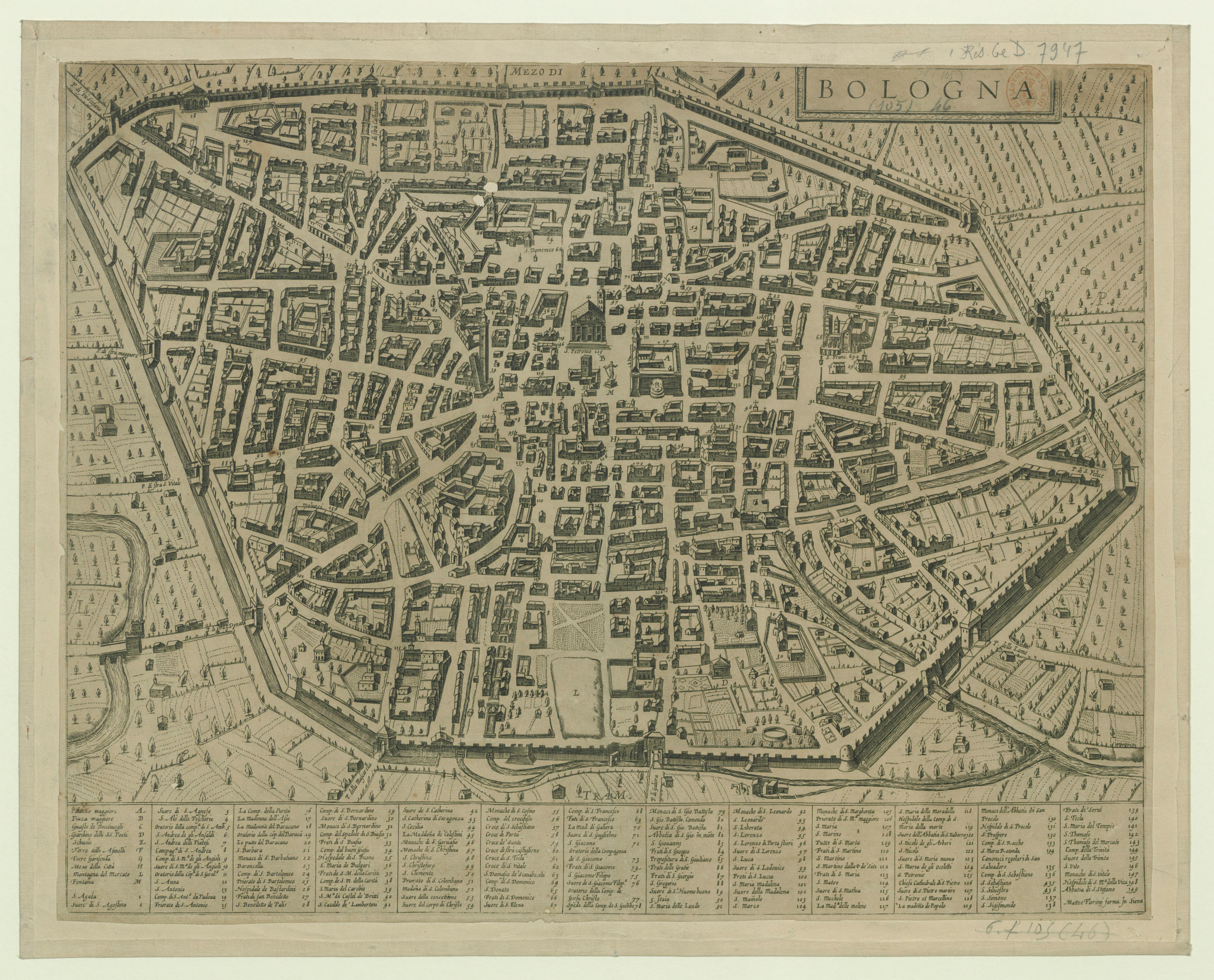
A period printed view of Bologna gives urban form to the jurisdictional setting invoked in the treatise's final division, where papal authority confirms the city's mercantile chapters rather than adjudicating abstract doctrine. Its dense civic fabric is a reminder that the Forum Mercantiae and the legislation around it were institutions embedded in a specific Bolognese legal landscape. Source ↗.
The first constitution opens by rehearsing an earlier act of confirmation, and in doing so discloses precisely where the norms it validates were found. Pius records that he had already, by other letters in the form of a brief, approved and confirmed all and singular the statutes, chapters, ordinances and other things published and established by the said merchants, or by the Gonfalonier and Elders of that city then holding office, as those things are found written down in the books of the aforesaid merchants themselves, Nos autem, qui alias omnia, & singula statuta, capitula, ordinationes, & alia per dictos mercatores, seu Vexilliferum, & Ancianos ipsius Civitatis, tunc pro tempore existentes edita, & condita, prout illa in libris ipsorum mercatorum prædictorum descripta reperiuntur, auctoritate Apostolica per alias nostras litteras in forma brevis approbavimus, & confirmavimus. Three features of the clause repay attention. The norms are authored by the mercantile body and by the civic magistracy jointly, so that the distinction between merchant self-regulation and municipal legislation is already blurred at the source. Their authentic text is located not in a promulgated code but in the merchants' own registers, the libri whose evidentiary weight the treatise's handling of documentary proof elsewhere presupposes; papal confirmation attaches to what is descripta reperiuntur, to what is discovered inscribed, which makes the merchants' books the operative witness of the law confirmed. And the mode of the earlier grant, in forma brevis, is specified, a point of chancery discrimination that matters for the force and revocability of what follows. For a reader interested in whether a separate merchant law stood apart from the learned and territorial orders, the clause is decisive in the opposite direction: mercantile normativity here enters the higher order not by displacing it but by being taken up, transcribed, and clothed with apostolic authority.
The motive alleged for the grant places commerce squarely within the pastoral office. The pope declares that he desires most greatly in the Lord that the aforesaid city of Bologna be adorned with every ornament of the Christian commonwealth and endowed with richer gifts, and that provision be made for its public good, as by the duty of the pastoral office he is bound to do, prædictamque Civitatem Bononiæ omni Christianæ Reipublicæ ornamento decorari, ac uberioribus donis affici, ipsiusque bono publico, sicut ex debito pastoralis officii tenemur, consultum esse plurimum in Domino cupientes. The mercantile chapters are thus construed not as a concession wrung from the Church by a suspect estate but as an instrument of the bonum publicum which the pastor is obliged to secure. That framing is exactly congruent with the treatise's own defence of trade as belonging to the genus of permitted things and as necessary to the commonwealth: the constitution supplies, from the highest positive source, the premise that commercial ordinances are objects of solicitude rather than of suspicion. The theological vocabulary of ornament and gift domesticates the traffic of a merchant city within the language of ecclesiastical benefaction.
The grant then asserts its own spontaneity in the strongest chancery terms, in the motu proprio formula already discussed above, which denies that any petition was offered by the merchants or by another on their behalf and grounds the act instead in the pope's mere liberality, certain knowledge, and fullness of apostolic power. The formula is not ornamental. A rescript procured upon petition was vulnerable to attack for obreption and subreption — for a false or incomplete narrative supplied by the petitioners — and the merchants of Bologna were precisely the interested parties whose account of their own chapters might be impugned. By denying any petition and grounding the act in certa scientia and plenitudo potestatis, the constitution forecloses that line of challenge in advance. Here the treatise's own analytic vocabulary illuminates the document it prints: this is a fiction of the chancery, since a confirmation of merchant statutes did not in fact fall from heaven unsolicited, and yet it is a fiction that vitiates nothing, because no injustice is palliated by it. The distinction the work draws between impropriety in form and injustice in substance is exhibited in the very instruments it reproduces.
The dispositive clause performs a curative as well as a ratifying office. By the tenor of these presents and by Apostolic authority the pope approves and confirms the aforesaid chapters and all and singular things contained in them, adds to them the strength of inviolable Apostolic firmness, and supplies all and singular defects of law and of fact, if any have in any way intervened in the matter, capitula prædicta ac omnia, & singula in eis contenta, auctoritate Apostolica tenore præsentium approbamus, & confirmamus, illisque inviolabilis Apostolicæ firmitatis robur adjicimus, ac omnes, & singulos juris, & facti defectus, si qui desuper quomodolibet intervenerint, supplemus. The clause on defects concedes what the confirmation might otherwise have concealed: statutes made by a mercantile college and a civic magistracy could well suffer from want of competence, of form, or of due enactment, and the suppletio of defectus juris et facti heals them without specifying them. This is the mechanism by which custom and local ordinance are absorbed into the superior order — not by demonstration that they were valid all along, but by an act of sovereign authority that renders the question of their original validity moot. A jurist reading exchange cases against these chapters could therefore treat them as unassailable in their foundation and argue only about their construction.
The protective apparatus is correspondingly severe and universal in address. Ecclesiastical and secular persons alike, cardinals, patriarchs, archbishops, bishops, marquises, dukes, counts, knights and other barons, and every community, university, college, chapter and congregation, are forbidden to act against the aforesaid chapters, or any of them, in any manner or under any sought pretext, or to set themselves in opposition to them, or to disturb or impede the chapters in whole or in part, or to molest anyone contrary to their form in any way, or by their mandate or consent to cause him to be molested directly or indirectly, contra capitula prædicta, aut aliquod ipsorum quovis modo, seu quæsito colore facere, aut sese eis opponere, ac etiam capitula prædicta perturbare, seu impedire in totum, vel in partem, aut aliquem contra formam illorum molestare quovis modo aut de eorum mandato, seu consensu directe, vel indirecte molestari facere, minime possint, under pain of excommunication latæ sententiæ incurred by the fact itself without further declaration. The phrase quæsito colore is the same idiom of sought-out coloration that governs the treatise's analysis of palliated usury, transposed from substantive contract to procedural evasion: what the canonist watches for in a disguised loan, the pope watches for in a nobleman or corporation who would nullify the merchants' chapters by indirection. Enforcement is entrusted not to the ordinary courts but to the provosts of Santa Maria Maggiore and San Petronio as executors, who are to publish the letters solemnly whenever the merchants request it and to compel contradictors by censure with appeal excluded, calling in the secular arm if need be.
The second constitution, dated at St Peter's under the Fisherman's ring on 12 July 1571, addresses the problem that any confirmation of a living statute-book must face. Since chapters had been made and published in the interval since the earlier letters, the pope confirms these later ones as well, holding their tenors as expressed in the present grant though they are nowhere recited, and repeats the whole apparatus of inhibition, executory commission and derogation. The derogatory clause is the most revealing element of the pair: the letters prevail notwithstanding Boniface VIII's constitution on the two days' journey, notwithstanding provincial and synodal decrees, and notwithstanding the statutes and customs of the city itself and of the Forum Mercantiae — the merchant court's own law is set aside, hac vice dumtaxat, for this turn only, in order to secure the merchants' chapters. Against that, the reservation that any future addition or correction must be approved by the Apostolic See installs a standing mechanism of review, so that the Bolognese mercantile order remains capable of amendment yet permanently referable upward. What the division prints, then, is neither an autonomous merchant law nor a simple ecclesiastical prohibition, but the documented interlocking of merchant registers, civic magistracy, and pontifical authority — the positive-law substratum on which the treatise's discriminations between licit and illicit dealing are meant to rest.
The closing clauses of that same confirmation run through the whole executory apparatus of the papal chancery — reservation of judgment, removal of contrary faculty from the Auditors of the Apostolic Palace and from legates de latere, commission of execution to the Auditor of the Chamber, to the Governor of Bologna and to the Vicar of the venerable brother Bishop of Bologna, Gubernatori, ac venerabilis fratris Episcopi Bononiensis Vicario, with censures and, if needed, the secular arm — before closing on a dating formula that identifies the instrument precisely as a brief rather than a bull, given at Rome at Saint Peter's, under the Fisherman's Ring, on 25 November 1569, in the third year of the pontificate, sub Anulo Piscatoris die xxv. Novembris MDLXIX. Pontificatus nostri anno iii. The detail is not antiquarian. Scaccia's jurisdictional wager — that the matter of usury belongs principally to the canonists and to operative papal legislation — requires that the operative texts be reproduced with their diplomatic marks intact, so that a reader may judge for himself what Pius V enacted and by what species of act. The same page prints, in Italian, the municipal decree binding exchange payments contracted at Bologna to a defined metallic standard, ordering that for the payments of real exchanges contracted there under the name of gold scudi of mint gold, Che per li pagamenti delli Cambii reali, che qui si cambiaranno sotto nomen di scudi d'oro in oro di Zeccha, the rate be four lire five soldi to the scudo, with base silver excluded from tender. Papal brief and civic decree stand side by side: the abstract unit named in bills is pinned, at the level of the city, to coin of assayed fineness — a local answer to the very problem of imaginary money that the discourses will shortly theorise.
The appendix of translations, the two discourses, and the terminal index
What follows is announced with unusual methodological candour. The appendix of translations, in the heading already quoted above, declares that the vernacular documents cited throughout the treatise are rendered stylo mercantili, in merchant style, so that nothing should give offence. The clause concedes that the Latin of a learned folio is inadequate to the object, and it licenses the calques that fill the following leaves — tracta, remissa, partita, avaria, provisio, scutus marcharum. This is the linguistic form of the jurisdictional argument itself: mercantile usage is admitted into the learned tongue on its own terms rather than paraphrased into classicising equivalents that would blur the technical distinctions on which liability turns. The documents so rendered reach back well beyond the Piacenza fairs, including a specimen prima of the late Trecento reckoned in Venetian money of account, in the name of the Lord, amen, the first of February 1381, pay according to this first letter, by our own custom, forty-three pounds of groats, In nomine Domini Amen. Primo Februarii 1381. numerate secundum istam primam litteram ex confuetudine nobismetipsis 43. libr. grossorum — the form confuetudine betraying a long-s misreading of consuetudine — a letter payable "to ourselves" that already contains, in embryo, the recourse structure the discourses will interrogate.
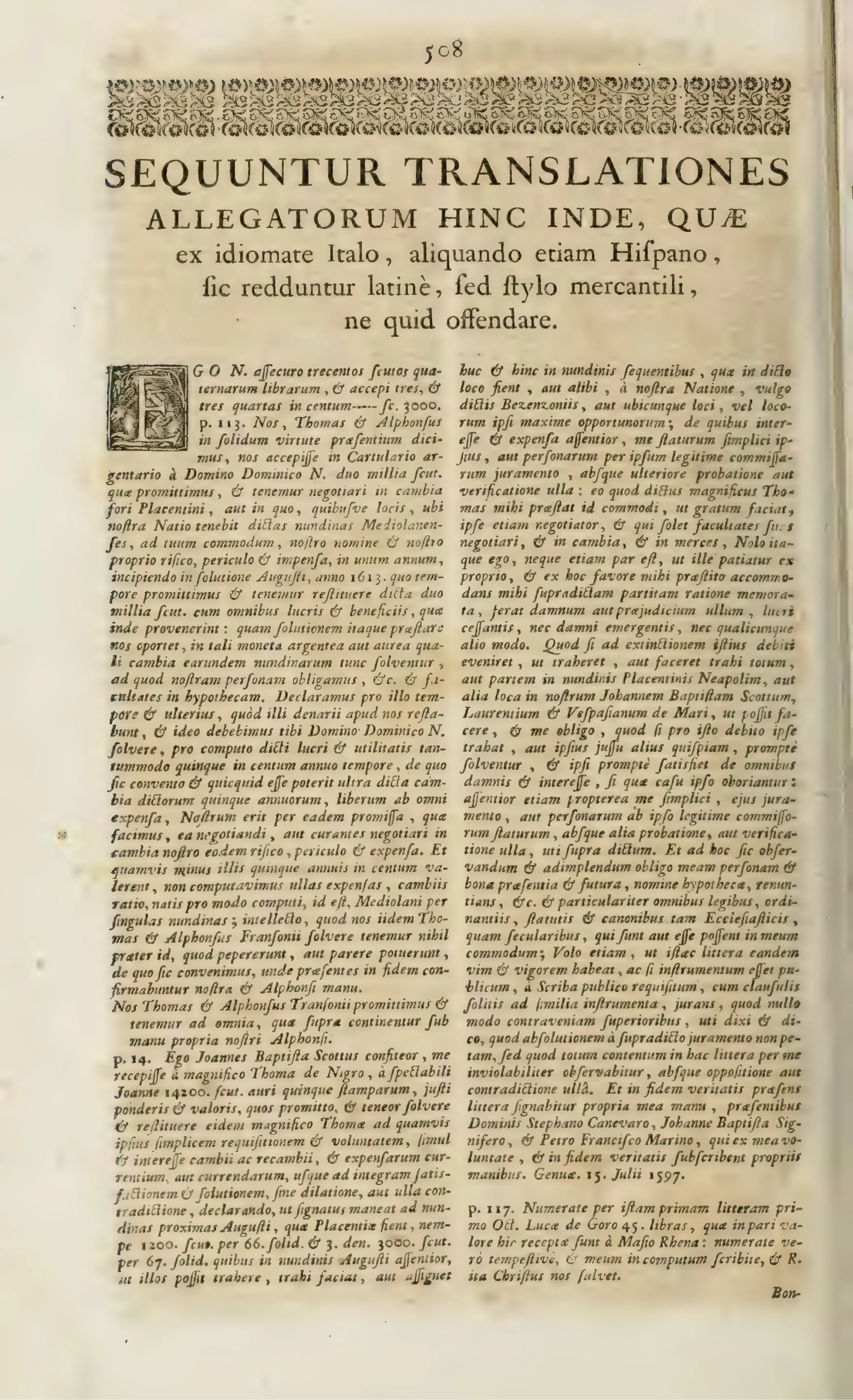
At the threshold of the appendix, the full-width heading and decorated initial announce a documentary laboratory: vernacular exchange instruments turned into Latin “stylo mercantili,” preserving the technical idiom on which recourse, risk, and interest depended. The two-column folio opens with fair-exchange and credit instruments tied to Piacenza, Genoa, Lucca, and the Bisenzone circuit. Source ↗.
The evidentiary layer is at its most revealing where it shows moral categories being converted into pleadable facts. A set of drafted articles of proof opens by establishing not a title but a habit, and first, how that magnificent Ottaviano Imperiale had for eight years and more been a dealer, not accustomed to keep his money idle, but to trade the same in exchanges and other business, Et primò, qualiter magnificus ille Octavianus Imperialis ab octo annis & amplius fuit negotiator, non solitus nummos tenere otiosos, sed eosdem negotiari in cambiis & aliis negotiis. Lucrum cessans, in the theologians' hands an extrinsic title depending on a counterfactual, here becomes a matter of witness testimony about a man's settled practice — the external forum's way of making an internal question triable. Alongside such articles the appendix prints sworn merchant attestations on practice, among them a certificate from those engaged in the business of the Piacenza fairs that bills are commonly subscribed with the address left blank, we the undersigned, occupied in the business of exchange through the fairs of Piacenza, make it certain that very many letters of exchange are wont to be made out to the debtors of the exchange and subscribed by them, leaving the superscription blank, Nos subscripti occupati in negotiis cambii per nundinas Placentiæ, certum facimus, prout solent fieri plurimæ litteræ cambiorum debitoribus cambii, subscripti ab illis, linguendo in blanco suprascriptum, the drawee and payee to be filled in at the creditor's election. The document is a first-rank witness to the circulation of blank bills in the second decade of the seventeenth century, and it exposes the tension running through the whole appendix: the more a form departs from the four-cornered transaction the doctors describe, the more it must be underwritten by attested custom rather than by definition. That custom is not univocal. Two contradictory expert opinions on whether a debt written off in avariam is thereby released are printed one after the other, the first holding that the creditor nihil sibi præjudicasse, has in no way prejudiced himself, and Scaccia allows the contradiction to stand — a quiet demonstration that stylus mercantilis was itself contested terrain and not a self-executing code.
With the primus discursus the register changes from documents to disputation, and the argument begins where the appendix's monetary decrees leave off. The first foundation is that the money of the fairs has no physical existence at all, the money of the fairs in question being the scudo di marche, which is not formally found in the nature of things, ut moneta nundinarum, de qua agitur, sit scutus marcharum: qui formaliter in reru[m] natura non invenitur. Everything depends on this premise. If the unit exchanged is not a commodity, the movement of its price cannot be explained as the price of a thing, and the analysis is forced back upon distance, scarcity of money in a given place, or — the dangerous residue — the passage of time. The discourse then applies the bull's taxonomy to practice, isolating first the case in which no letters are drawn at all but it is merely said, "I give you at the fairs," a transaction usurious of its very nature, sed tantùm dicitur. Do tibi in nundinis; est enim ex natura sua usurarium. Against this, the mark of a genuine exchange is the completion of the contract elsewhere: he says secondly that this contract, in order to be an exchange, must be real, that is, that we exchange really from one place into another, in which payment is then made, so that the contract is terminated, Dico secundò, quòd iste contractus, ut sit cambium, debet esse realis, id est, ut cambiamur realiter ex uno loco in alium, in quo postea fiat solutio, adeò ut contractus finiatur. Termination at the destination is the structural fact that separates exchange from a loan wearing exchange's dress.
Yet the discourse refuses to let reality of transfer do all the work. Having secured it, Scaccia concludes that where any gain accrues by reason of time, then, granted that the exchange be real, it remains in every way usurious, supposito quod cambium sit reale, omni modo usurarium restare. The two tests are cumulative and independent, and the second bites hardest precisely on the practices the appendix has just documented. This is why the technical anatomy of the secundus discursus matters so much: it observes that in the contract of exchange, in order that it be wholly perfect, the ministry of four persons is required, Quartò in contractu cambii, ut totus perfectus sit quatuor personarum requiritur ministerium, and then concedes that in practice these four are frequently collapsed into one or two. The limiting case is named without euphemism: and this form of exchange is called exchange with recourse, Et hæc forma cambii dicitur cambium cum recursa, the form in which the same person pays for one party and receives for another, and the obligation never truly leaves the city where it began. The documents have already shown this circuit in operation, with partite re-drawn across the fairs of August, All Saints and Epiphany until mutual satisfaction; the doctrine now supplies the criteria by which such a circuit may or may not be acquitted.
The concluding documents return the doctrine to positive enactment. The articles petitioned by the merchants of Bologna for a public exchange place adopt the theologians' criterion verbatim into municipal law — real exchange is where money effectively given in one place is payable in another — and reinforce it with a schedule of usances calibrated to actual distance, from Lyon, Besançon and Spain reckoned by the fairs, De Lugduno Bizanzio & Hispania juxta nundinas, through two months for Antwerp, Paris and the cities of Flanders and France, to three for London and the East. The proportion between term and distance that Pius V's constitution demanded is thereby written into a tariff. Procedure is correspondingly summary: protested letters admit only two exceptions, no prescription runs upon them, and execution proceeds in the manner of a good merchant, in the phrase already met above, where all cavilling is rejected and the pure truth of the fact is considered purely and simply. The series closes with the Latin version of the Bolognese siting decree already printed in Italian, that afterwards it was determined that the place of exchange should be, not the shed of the mercantile court, but the portico before the Hospital of Death, Postea determinatum est, ut locus camporii sit, non mapale fori mercantilis, sed porticus ante Xenodochium Mortis. The classicising mapale and Xenodochium coexisting with the frank vernacularism of the merchant-style translations mark the two idioms the appendix is holding together.
The terminal index makes the volume's conceptual architecture explicit, warning that certain master-words aggregate matter dispersed under other heads, and naming them as these: Insurance, Exchange, Census, Contract, Interest, Law, Gaming, Money, Delay, Loan, Coin, Prescription, Price, Restitution, Partnership in office, Payment, Wager, Usury, sunt ista, Assecuratio, Cambium, Census, Contractus, Interesse, Lex, Ludus, Moneta, Mora, Mutuum, Pecunia, Præscriptio, Pretium, Restitutio, Societas officii, Solutio, Sponsio, Vsura.
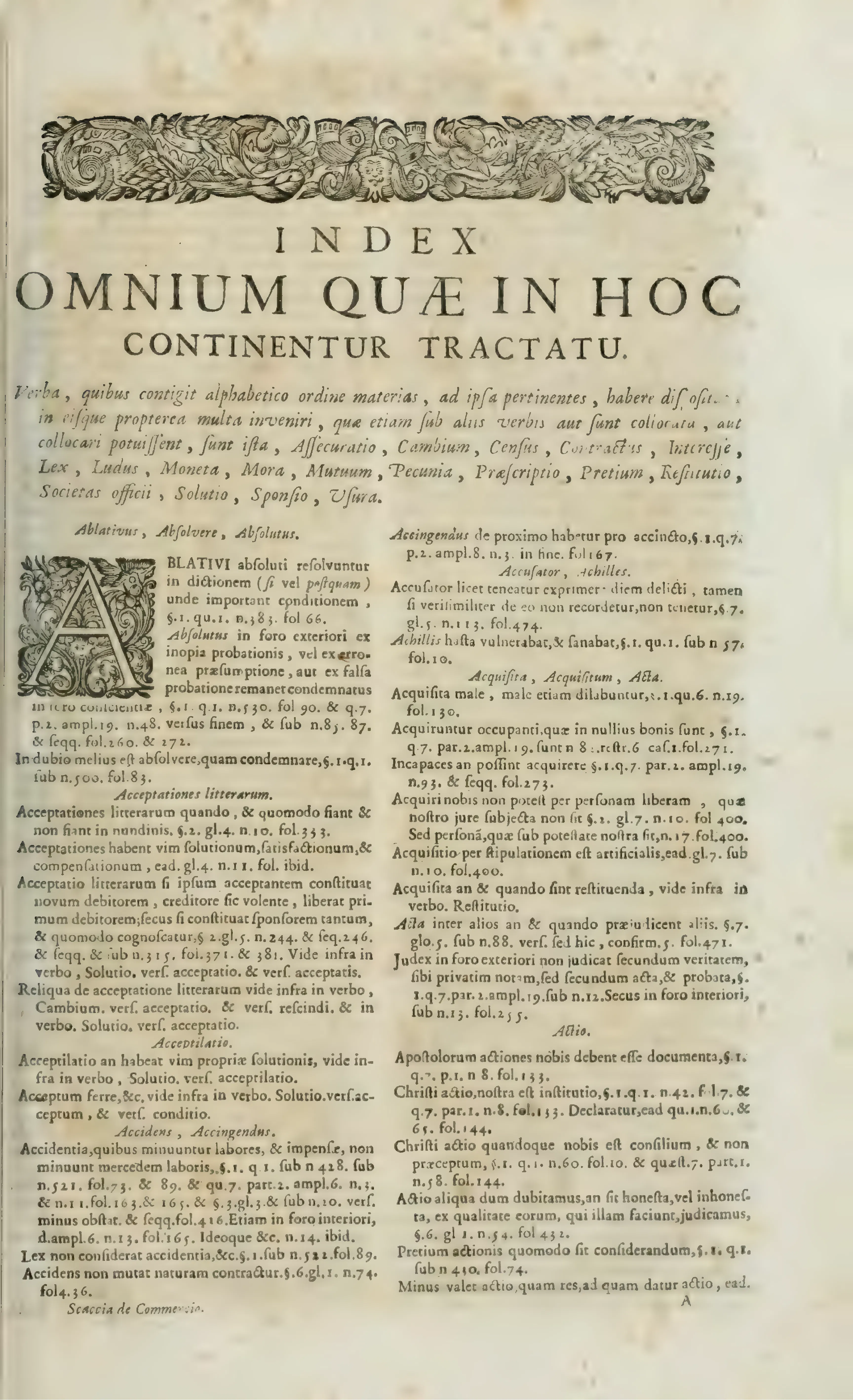
The terminal index opens beneath a decorative headpiece by naming the master-words — insurance, exchange, gaming, money, partnership in office, wager, usury — that gather dispersed arguments into a single map of contracts and illicit gain. Its dense alphabetical entries show how the treatise's doctrinal architecture became a portable finding apparatus, preserving even the maxim about exchange dealers as “new alchemists.” Source ↗.
Insurance, wager, census, the venal-office partnership and exchange are thus filed as species of one genus, exactly as the treatise's method requires. The index also preserves the sharpest epigram in this stretch of the book, entered under the letter A, that the exchange dealers and other traders in exchanges are new alchemists, who make gold scudi out of fictitious scudi di marche, Campsores, aliiq; cambiorum negotiatores sunt novi alchimistæ, qui ex fictis marcharum scutis scutos faciunt aureos. Coming from a jurist who has just defended exchange as necessary to the commonwealth, the phrase registers the cost of his own premise: once the materia of the contract is conceded to be a unit found nowhere in the nature of things, the suspicion of transmutation can be answered only by the tests of price, reality of transfer, and freedom from gain by time — which is precisely what the two discourses set out to supply.
The volume ends not in argument but in apparatus, and the apparatus is doctrine in compressed form. The terminal Index rerum et verborum, running from Fructus through Uxor to its closing FINIS, is organized so that each headword carries beneath it a file of propositions, every one stated as a maxim and then located by the treatise's own internal grammar of paragraph, quæstio, pars, ampliatio, limitatio, glossa, number, versicle, and folio. The effect is that a jurist consulting the book for a single point of exchange practice encounters not a page reference but a ruling, already formulated for citation. That format has consequences for how the doctrine reads. Definitions are pared to their operative element, as when theft is reduced to knowing retention, he being a thief who knowingly keeps back another's property, Fur est, qui scienter rem retinet alienam, paragrapho 1. q. 7. par. 2. ampl. The displacement from taking to retaining is not incidental: it is the hinge that allows the defaulting debtor, the bad-faith possessor, and the merchant who withholds a sum after the term to be brought under a single moral description, and thus the bridge between the law of mora and the duty of restitution in the interior forum. The index preserves that bridge in a single clause where the treatise required an ampliatio to build it.
The index also records which places count as sources of law rather than as mere scenery. Genoa is registered with a formula of civic distinction, Genoa the head of Liguria and a city of note, Genua caput Liguriæ, & Civitas insignis, &c. 1. gl. 2. n. 6. fol. 313; but the surrounding entries make plain that the encomium is functional, since the same city supplies its abundance of coin, its gabelle on exchange, the stylus of its court on interest, and its statutes, all cited as operative authority beside the ius commune. Piacenza appears in a definition rather than a description, Piacenza being the city where the Genoese hold their fairs, Placentia est civitas, ubi Genuenses exercent nundinas — a formulation that treats the fair not as a local market but as a Genoese institution that happens to be sited elsewhere, exactly the abstraction of place from jurisdiction which the exchange business required and which the doctrine of cambium reale had to accommodate. The fairs enter the index with their own periodicity, the payment fairs for exchanges being held four times in the year, Nundinæ solutionum pro cambiis fiunt quater in anno,, so that the quarterly cycle stands as the temporal frame within which delay, term, and recambium are all reckoned.
Alongside these jurisdictional entries the index admits vernacular commercial forms under their own names, refusing to let a contract escape scrutiny merely because the learned language has no word for it. One such entry registers a usage current in Italy, the godere à godere being a contract in common use there, Godere à godere est contractus usitatus in Italia, quid. The headword is Italian, the predicate Latin, and the following sub-entries subject the arrangement to the ordinary tests of licitness, with the risk of the thing delivered as the deciding criterion. The same procedure governs the darker end of the register, where a family of circular credit-sales is named in the merchants' own idiom and condemned collectively, stocchi, barocoli, ciavanze, rompicolli and retrangoli being one and the same thing, Stocchi, Barocoli, Ciavanze, Rompicolli, & Retrangoli, idem sunt, suntque. Vernacular nomenclature is thus neither suppressed nor privileged: it is the means by which practice becomes visible to the tribunal, and the multiplication of merchants' names for a single oppressive device is itself treated as evidence that the device is one thing wearing several disguises.
The price doctrine is condensed with equal economy. Value is made to move with the relation between supply and demand, scarcity of a commodity raising its value, and scarcity being said to exist when the number of buyers is the greater, Inopia mercis auget mercis valorem, & dicitur inopia quando major est copia. Stated thus baldly, the maxim performs heavy juridical work: it supplies a non-usurious explanation for differentials of price across places and terms, and so removes from the exchange rate the presumption that any excess over the sum advanced must be a return on time. Against this the index sets the limit of positive tolerance, loss in contracts as to price being tolerated up to a fixed measure by the common laws, Læsio in contractibus circa pretium toleratur secundum. The verb toleratur is precisely chosen and the index keeps it: the half-price threshold of laesio enormis is a forbearance of the human forum, not a licence in conscience, and the neighbouring entries insist that below that threshold the deceived party is still owed restitution. The asymmetry is made general in a rubric of the interior forum, the penalty of the external forum not removing the penalty of the internal, Poena fori exterioris non tollit poenam fori interioris,. What in the body of the treatise is an argued architecture of two jurisdictions here becomes a portable rule of thumb, and its placement among entries on prescription and payment shows how routinely it was expected to be applied.
The interest doctrine receives the most elaborate treatment, and its governing thesis is stated in a form designed to be unassailable, interest being owed by natural, divine, and human law alike, Iure naturali, divino, & humano deberur interesse, &. By enrolling all three normative orders at once, the entry immunizes interesse against the canonical prohibition that governs usura: what natural and divine law require cannot be what ecclesiastical law forbids, and the entire casuistry of extrinsic titles follows as specification rather than as exception. The gradation of that title is likewise reduced to a maxim, the more certain the interest, the more justly it is owed, Certius quo magis est interesse, eo justius debetur, §. 1. q. 7. par. 2 — a rule of proof masquerading as a rule of substance, since certainty here is a function of what conjecture and documentary evidence can establish before a judge. The most contested head is flagged with an almost metaphysical candour, ceasing gain being a non-entity, Lucrum cessans est non ens, ead. ampl. 8. n. 239. fol. 100. The index preserves the difficulty rather than concealing it: a title whose object does not exist cannot be proved by inspection, and must therefore be reached by presumption from the claimant's trade, opportunities, and habitual employment of his capital — which is why the surrounding entries on conjecture, on the stylus of the Genoese court, and on double limits cluster exactly here.
The boundary the work will not cross is marked with equal brevity. The loan for consumption is named as the site of the vice, the mutuum being the seat of usury, Mutuum est sedes usuræ, &c. §.1. q.7. par.1. n.25. fol.137, from which nothing beyond the principal may be exacted; and the doctrinal perimeter is fixed confessionally, it being heresy to assert that usury is not a mortal sin, Hæresis est, asserere usuram non esse peccatum mortale,. That entry, standing a few lines from the whole apparatus of licit gain, defines the space within which the treatise operates: no capaciousness in the theory of extrinsic titles is permitted to soften the prohibition itself, and the adjacent flagging of Charles du Moulin's distinction as hæreticale shows where the line was thought to have been crossed by others. The index also retains a rule that sits uneasily with its own interest doctrine, usuries of usuries being prohibited even by the civil law, Usurarum usuræ sunt prohibitæ, etiam de jure civili,, while elsewhere conceding that interest converted into capital may itself generate interest without limit where the head of claim is lucrum cessans. The tension is not resolved in the apparatus; preserving both maxims side by side leaves the practitioner to distinguish anatocism from the compounding of a genuine extrinsic title, which is precisely the discrimination the treatise's method demands and the index cannot perform for him.
Monetary doctrine is bound by the same twin-forum logic, the sovereign's own coinage being subject to it, the prince who strikes money being held in the forum of conscience, Princeps, cudens monetam, tenetur in foro conscientiæ — to right metal, just weight, and a valuation proportioned to the material, with debasement admitted only upon a just cause. Against that discipline of real money the index sets a striking suspicion about money of account, so various an acceptation of the scudo seeming to serve for palliating gains that are perhaps not sufficiently defensible, Scuti tam varia acceptio videtur ad pallianda lucra, quæ non satis forsan. This is the treatise's own analytic vocabulary of palliatio turned upon the technical instrument at the heart of the fair reckoning, and it is notable that the entry survives in the finding-apparatus, where it is most easily found. The same evenhandedness governs the indexing of the gospel locus classicus against the trade, the tables of the money-changers overturned by Christ, Nummulariorum mensa à Christo eversæ, §.1. q.7. par, an entry placed among others qualifying the conditions under which merchants displease God: the objection is catalogued for the reader rather than quietly omitted.
What holds this heterogeneous register together is the assumption that merchants' speech is itself a technical language capable of precise juristic definition, and the index says so of the commonest verb of the bill market, trahere being a merchant's word, used of him who draws, Trahere est verbum mercatorium, quod dicunt de eo,. That an alphabetical index of a folio in Latin should carry the bookkeeping formulae of a Genoese ledger under the headword Verba, glossed and cross-referenced like a term of the Digest, is the clearest sign of what the apparatus was built to do: to make mercantile usage citable, and therefore justiciable, in the same breath as natural law and papal constitution.
Frequently Asked Questions
Who was Sigismondo Scaccia?
Sigismondo Scaccia (born at Camerata around 1564, dead at Rome in 1634) was a jurist who spent his career inside the tribunals where early modern money came to judgment: as advocate and auditor, as a judge of the civil Rota of Genoa between 1612 and 1615, and as a sitting magistrate at Rome. He is also catalogued as Sigismundus Scaccia, Scaccius, or Scacia. The title-page epithet jurisconsultus romanus is an occupational designation and does not prove a Roman origin; Treccani calls him a Genoese jurist, while the Camerata account complicates that. He presents himself as having served as auditor to a Cardinal Ludovisi at Bologna, though which member of the family is meant remains unresolved.
What is the Tractatus de commerciis et cambio, and what question does it try to settle?
It is Scaccia's Latin folio of legal and moral jurisprudence on trade and exchange — not a merchant's manual or a theological disputation. Prepared and licensed at Rome between 1616 and 1618, with the strongest evidence for a first printing pointing to Rome, 1619, it asks when a bill of exchange is a genuine transfer of money between distant places and when it is a loan wearing borrowed clothes. It anatomises insurance, wager, census, loca montium, partnership in venal office, deposit, and procedure in exchange causes, holding that commerce belongs to the genus of permitted things and is licit unless expressly prohibited, and testing each instrument against commutative equality.
What did Scaccia mean by calling the money of the Piacenza fairs "imaginary"?
He meant that the unit in which the fairs reckoned exchange — the scutus marcharum, or mark-crown — was wholly fictitious, not found in the nature of things, since no struck coin corresponded to it. Fictitiousness did not entail indeterminacy: he fixes its value against the mark of eight ounces from which sixty-five gold scudi are struck, records its taxation at Piacenza and its pricing at Genoa, and reduces the relation to 101 mark-crowns for 100 gold crowns. The treatise's own index nonetheless preserves the suspicion that so various an acceptation of the scudo could serve to palliate gains perhaps not sufficiently defensible.
Did Scaccia have reservations about the exchange trade he defended?
Yes, and he states them with unusual candour. He concedes that a commonwealth would be better served if its citizens gave themselves to trade rather than to exchange, since from exchange a few grow marvellously rich while the multitude of the people remains in the greatest destitution. Having concluded that where the just price is not exceeded the transaction is good and just, he immediately professes hesitation: to doubt is pious, to abstain is safer, and to condemn is not. He also urges a statute limiting recourse exchange, and his index preserves the epigram that exchange dealers are new alchemists who make gold scudi out of fictitious mark-crowns.
Is there an English translation of the Tractatus de commerciis et cambio?
No modern English translation has been identified, nor any Italian, French, or German rendering, in the catalogues and digital repositories searched; that negative result is not proof that an unpublished or unindexed translation does not exist. The Latin volume does carry an internal apparatus turning Italian and sometimes Spanish mercantile documents into Latin in merchant style, but that is not a vernacular translation of the treatise. Separately, the Leo edition presents the full transcription together with a complete English translation, generated by AI, for the first time. Leo works to make free English translations of every text printed in Latin in early modern Europe, 1450–1750, available online.
This report was generated by an advanced AI assistant that conducted deep research alongside an extensive interpretation of the transcribed original text. Every effort has been made to preserve fidelity to the source and to guard against inaccuracy, but corruption in the text recognition process and model hallucination may nonetheless have entered the text. Treat every claim, quotation, translation, and citation as provisional, and verify each against the original source before relying on or citing it.
Further Reading on Scaccia, Genoese Exchange, and Early Modern Commercial Law
- Charles Donahue Jr., "Medieval and Early Modern Lex Mercatoria: An Attempt at the Probatio Diabolica," Chicago Journal of International Law: Offers a necessary legal-historical control, encouraging readers to view Scaccia's exchange law as a composite of ius commune, statutes, judicial practice, and merchant custom rather than as an already separate commercial code. It pairs naturally with the treatise's derivation of human law from natural law and its consensual account of legislation, both of which keep mercantile usage inside a single normative order rather than beside it. Donahue's demand that anyone asserting an autonomous law merchant actually produce it is the discipline this material most needs.
- Marjorie Grice-Hutchinson, Early Economic Thought in Spain, 1177–1740: Provides a concise scholarly map of the Spanish scholastic debates on price, money, interest, and exchange that form part of Scaccia's intellectual environment. The axiom on which those debates converge is stated by Scaccia in its barest form, that we have also an evident natural reason, because time cannot bring forth money, habemus etiam rationem naturalem euidentem, quia tempus non potest parere pecuniam, the premise against which every extrinsic title had to be justified. The book is contextual rather than a study of Scaccia himself, so its claims should be used alongside the treatise and the Genoese legal scholarship below.
- Claudio Marsilio, "'A Wise Man Is Always Ready to Face a Disaster': The Professional Skill of Genoese, Florentine and Portuguese Financial Operators in Seventeenth-Century Exchange Fairs," State Cash Resources and State Building in Europe, Thirteenth–Eighteenth Century: Reconstructs the practical competencies of operators, the circulation of bills, spacci, and patto di ricorsa, and the relation between exchange fairs and state finance. That institutional and professional emphasis helps explain why Scaccia repeatedly places mercantile custom beside learned juridical authority, and why he treats the summary standard of the good merchant as a genuine measure of proof rather than a concession to laymen. It is also the fastest route to understanding why the Genoese Senate kept relocating a fair that was, in practice, a settlement system rather than a place.
- Giuseppe Pezzolo and Gino Tattara, "Una fiera senza luogo: Was Bisenzone an International Capital Market in Sixteenth-Century Italy?," The Journal of Economic History: Supplies the economic history needed to interpret Scaccia's discussions of fairs, remittance, Genoese operators, and exchange risk. Its argument that Bisenzone operated as an international capital market complicates any account that treats usury law as simply preventing large-scale credit, and it can be set beside the treatise's own social observation, in which the author confesses that it would nevertheless be more useful to the commonwealth if the citizens gave themselves to trade and not to exchanges, since the utility of trade would spread more widely, whereas from exchanges a few grow marvellously rich and the multitude of the people is in the greatest destitution, fateor tamen, quòd utilius Reip. foret, si civs vacarent mercaturæ, & non cambiiis, quia mercaturæ utilitas latius pateret, cum ex cambiiis pauci aliqui mirum in modum ditescant, & populi multitudo sit in maxima egestate.
- Giuseppe Pezzolo and Gino Tattara, "Was Bisenzone an Offshore Capital Market in Sixteenth-Century Italy?," Social Science Research Network: The freely accessible working-paper version of the same research, circulated under the sharper label 'offshore,' which names exactly what the Genoese achieved by holding a fair with no fixed location and no sovereign supervising it. Readers without a Cambridge subscription should start here, then consult the published article for the final argument and apparatus. Its direct challenge to the thesis that usury law restrained credit is the point at which economic history and Scaccia's casuistry meet.
- Vito Piergiovanni, "Il valore del documento alle origini della scienza del diritto commerciale: Sigismondo Scaccia giudice a Genova nel XVII secolo," Società Ligure di Storia Patria: The most directly relevant modern treatment of Scaccia located. It connects his Genoese judicial experience, documentary proof, mercantile custom, and the formation of commercial jurisprudence, while warning against treating Italian commercial law as a simple precursor to later codification. Read alongside the treatise's own handling of judicial authority, where Rota decisions are weighed rather than obeyed — for we do not hold the Rota's opinions as law, but consider them from law and reason, Rotæ enim opiniones non ut legem habemus, sed eas ex lege, & ratione consideramus — the study clarifies how forensic practice entered juristic science without becoming legislation.
- Società Ligure di Storia Patria, Norme, scienza e pratica giuridica tra Genova e l'Occidente medievale e moderno: A freely downloadable extract from the Genoese society's digital library, containing an English-language discussion of Scaccia as a scholar of commercial law active across the turn of the seventeenth century. Its value is practical: it puts a scholarly assessment of Scaccia in English in front of readers who cannot easily reach the Italian secondary literature, and it situates him among the other Ligurian jurists whose work fed the same tradition. Treat it as a way into the Genoese archival scholarship rather than as a substitute for Piergiovanni's fuller study.