Nusquamia: Nicolau Godinho's On Abyssinian Affairs and the Ethiopian Patriarchs João Nunes Barreto and Andrés de Oviedo
In 1615 the Portuguese Jesuit Nicolau Godinho published at Lyon a three-book Latin defence, De Abassinorum rebus, deque Aethiopiae patriarchis Ioanne Nonio Barreto et Andrea Oviedo, libri tres, arguing that Ethiopia had stood in schism from Rome ever since Dioscorus carried his condemned Christology south from Chalcedon — against a Dominican rival who insisted the Abyssinians had never left the Roman communion at all. Godinho's weapons are not travellers' wonders but sworn depositions, papal briefs, Jesuit letters carried from Goa and Fremona, and the direct interrogation of a living cardinal; his opponent's Ethiopian capital he rechristens Nusquamia, Nowhere-land, because it is nowhere. The stake is jurisdiction rather than curiosity: to classify the Abyssinians as schismatics is to justify a century of popes, kings, and bishops dispatched to reclaim them.
ExLatinis
August 1, 2026
Contents
In 1615 the Portuguese Jesuit Nicolau Godinho published at Lyon a three-book Latin defence, De Abassinorum rebus, deque Aethiopiae patriarchis Ioanne Nonio Barreto et Andrea Oviedo, libri tres, arguing that Ethiopia had stood in schism from Rome ever since Dioscorus carried his condemned Christology south from Chalcedon — against a Dominican rival who insisted the Abyssinians had never left the Roman communion at all. Godinho's weapons are not travellers' wonders but sworn depositions, papal briefs, Jesuit letters carried from Goa and Fremona, and the direct interrogation of a living cardinal; his opponent's Ethiopian capital he rechristens Nusquamia, Nowhere-land, because it is nowhere. The stake is jurisdiction rather than curiosity: to classify the Abyssinians as schismatics is to justify a century of popes, kings, and bishops dispatched to reclaim them.
Nicolau Godinho — in the Latin of his own title-page Nicolaus Godignus, and in the ablative author-formula of the imprint Nicolao Godigno — was a Portuguese member of the Society of Jesus whose three-book Latin treatise on Abyssinian affairs and the Ethiopian patriarchs was printed at Lyon in 1615 at the expense of the bookseller Horace Cardon. It is not a travel narrative and not, in the ordinary sense, a chronicle. It is a defence: a work of ecclesiastical history and controversial theology that assembles letters, sworn depositions, papal briefs, and the testimony of surviving eyewitnesses in order to vindicate the Jesuit patriarchate of Ethiopia and the reputations of its first two incumbents, João Nunes Barreto and Andrés de Oviedo, against an unnamed recent author whom bibliographical and contextual evidence identifies with the Dominican Luis de Urreta, whose histories of Ethiopia appeared at Valencia in 1610 and 1611. Godinho's own life remains imperfectly documented — the sources give either 1559–1616 or 1561–1616 — and neither the place nor the date of the book's composition has been independently established.
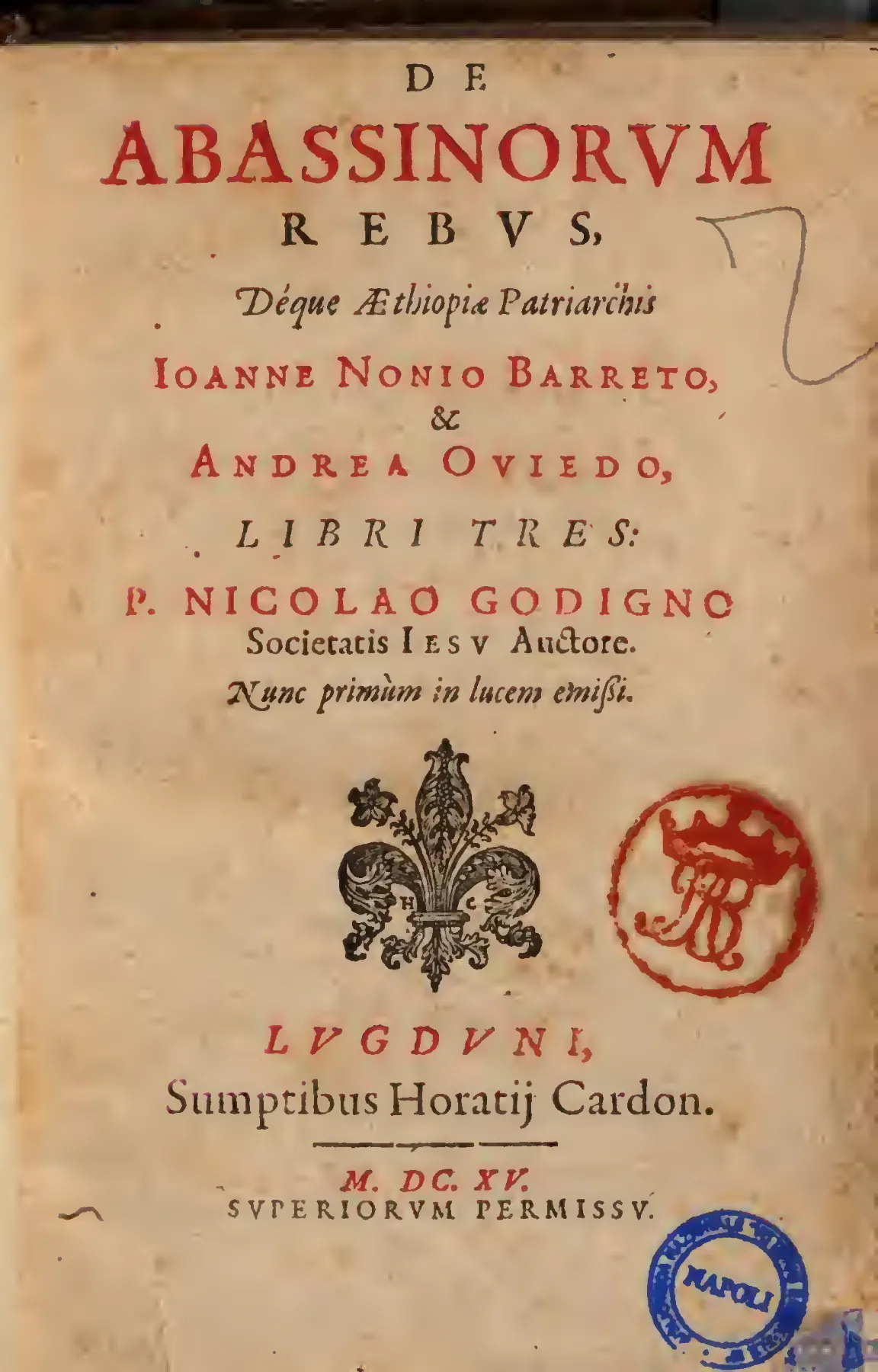
Godinho's 1615 Lyon title page states the book's claims before the argument begins: display type names Abyssinia and the two Ethiopian patriarchs, while the imprint records Horace Cardon's financing, Godinho's Jesuit authorship, and the work's status as newly issued. The closing permission formula frames the defence within the very chain of authority it sets out to vindicate. Source ↗.
The intellectual problem the work confronts is deceptively simple and institutionally explosive: was the Ethiopian church ever separated from Rome at all? Godinho's adversary had argued that the Abyssinians are, and always were, in communion with the Roman see, and that a Dominican establishment of great antiquity — with its own inquisitors, a Latin senate, Antonine knights, and a celebrated library on Mount Amara — had long flourished among them. Godinho's answer is that Ethiopia has stood in schism since Dioscorus, condemned at Chalcedon, carried his teaching south, and that its Christology, its sacramental practice, its dependence on an Egyptian Abuna sent by the patriarch of Alexandria, and its retained Judaizing observances place it, whatever it holds in common with Latin Christendom, outside the Roman body. What gives the work its character is less this conclusion than the recurring move by which it is defended. Godinho displaces printed authorities, poets, and legendary geography with a documentary apparatus: depositions taken under oath, Jesuit correspondence carried from Goa and Fremona, briefs issued from Rome, a Portuguese letter turned into Latin, and, in at least one instance, the direct interrogation of a living cardinal about what he had and had not learned from Ethiopians in Rome. He then treats the resulting record as itself the refutation of his opponent's fictions.
The stakes, as the work states them, are institutional rather than ethnographic. If Abyssinia was never estranged, then a century of papal, royal, and religious action — the erection of a patriarchate, the dispatch of bishops, the diplomacy of the Portuguese crown — rested on a mistake, and the honour of pontiffs, kings, and religious orders is impugned by implication. Godinho accordingly frames the controversy as an exclusive disjunction: either those authorities acted rashly, or his adversary is rash to suggest as much. That framing explains why the book classifies its own genre as apologetic rather than historical, and why its evidentiary vocabulary reads so much like a legal brief. Classification is here a juridical act with consequences: to call the Abyssinians schismatici is to license episcopal jurisdiction and missionary intervention, and Godinho knows it.
Several features of the text will strike a first-time reader. There is the satire, unexpected in a work of this gravity, by which the adversary's Ethiopian capital "Zambra" is renamed Nowhere-land because it is nowhere, and the twice-born emperor and phantom Latin institutions are dismissed with it. There is the catalogue of some forty Ethiopian errors drawn from António Fernandes — Eutychianism and one will in Christ, the denial of the descent into hell and of purgatory, five sacraments, rebaptism at Epiphany, dissoluble marriage, Alexandrian primacy — set beside an inventory of persisting Mosaic observance: circumcision, sabbath, purification, clean and unclean animals, shewbread, the veiled sanctuary. There is the philological work of stripping European misattribution from Ethiopian realities, the Prester John of Latin imagination separated from the Acegus and Nigus of actual usage, and the Solomonic descent through Menelik rejected outright. And there is the calibration by which the Abyssinians, though held to be outside the Church, are judged less pertinacious than European heretics and therefore recoverable — a distinction that keeps the missionary case alive at the very moment the schismatic verdict is pronounced.
Books II and III convert the polemic into documentary biography. Barreto's refusal of the mitre, his six years' waiting at Goa, and his death there in December 1562; Oviedo's Louvain formation, his episcopal consecration for Hierapolis, his three exiles, his years at Fremona and his death in 1577; the imperial refusals of Roman obedience, the papal precept ordering Oviedo to Japan and China under holy obedience, the appeal for five hundred Portuguese soldiers, the Ottoman seizure of Massawa and Arkiko that closed the Red Sea — all are edited into the argument so that the mission's failure becomes itself a proof of the schism the adversary denies. The book's own production reinforces the same chain of authority it defends: a licence from the Jesuit general at Rome, a privilege transmitted through the Lyon provincial, archiepiscopal approbation and permission at Lyon, and a dedication to a Portuguese bishop and inquisitor general bind the Society, the Portuguese padroado, and Roman authorization into a single warrant standing behind the text.
Read the full text and English translation on Leo
This text was transcribed and translated as part of the ExLatinis project, an effort by Leo to make free English translations of every text published in Latin in early modern Europe (1450–1750) available online. The complete transcription and English translation of this work can be read free of charge:
→ Read the original Latin text and full English translation on Leo
You can save a copy of this document into your Leo account to run deep text searches, conduct further analysis, or cross-reference it with your own research.
How Godinho Classifies the Abyssinians: Title, Terms, and the Charge of Schism
Editorial English title supplied for convenience, not an established title: On Abyssinian Affairs and the Ethiopian Patriarchs João Nunes Barreto and Andrés de Oviedo: A Latin Jesuit Defence. The bibliographically secure Latin title is De Abassinorum rebus, deque Aethiopiae patriarchis Ioanne Nonio Barreto et Andrea Oviedo, libri tres.
Godinho's phrase schismatici belongs to the period's juridical and ecclesiological vocabulary of separation from an acknowledged ecclesial head. In the recovered text the question is phrased as how the Abyssinians came to be regarded 'among us' as schismatics. The wording therefore does more than describe a doctrinal category: it makes classification itself an object of inquiry and prepares a distinction between inherited Latin judgments and the evidence the author believes should correct them. The term should not be read as a neutral ethnographic designation; it is a polemical status whose application carries consequences for the legitimacy of episcopal jurisdiction and missionary intervention. The operative principle governing the term is stated with the economy of a canonical maxim: although the Abyssinians believe many things which 'we' also believe, yet because in others, and those very grave, they dissent from the Church, they cannot be called Catholics, Quare licèt Abassini multa credant, quæ nos credimus, tamen quia in aliis, & quidem grauissimis, ab Ecclesia dissentiunt, non possunt catholici appellari. Shared belief, on this reasoning, does not mitigate; a single denied article of sufficient gravity severs, and the extent of agreement invoked by the adversary is therefore beside the juridical point.
Because the category turns on the will rather than on error alone, pertinacia carries much of the argumentative weight. The persistence of Mosaic observance is presented as a case in point: the Abyssinians so cling to these legal ceremonies that, although they plainly recognise them to be condemned by divine law and even confess as much, they are nevertheless unwilling to be drawn away from them, Adeò verò his legalibus cæremoniis adhærent, vt cùm | euidenter agnoscant diuina lege esse damnatas, idque etiam fateantur, abduci | tamen ab iis nolint. The rites in question are dated to an origin in sacred history and reported as continuous: they join circumcision with baptism even now, and hold it to have been retained from the very time of the Queen of Sheba throughout all Ethiopia down to the present day, Circumcisionem cum Baptismo etiam nunc coniungunt; ferunt eam ex ipso Reginæ Sabæ tempore per omnem Æthiopiam vsque ad hunc diem esse retentam. Yet pertinacia is graded rather than absolute, and the gradation does real work in the argument: the Abyssinians do not dissent from the Roman Church with as great a pertinacity as the European heretics, and there is great hope of recalling these emperors and their whole empire to sound doctrine, Neque enim Abassini tanta | pertinacia, quanta Europæi hæretici, à Romana dissident Ecclesia; & hosce Imperatores, atque vniuersum | eorum Imperium ad sanam doctrinam reuocandi magna spes est. The classificatory vocabulary thus separates without foreclosing, keeping the missionary enterprise juridically warranted and pastorally intelligible at once.
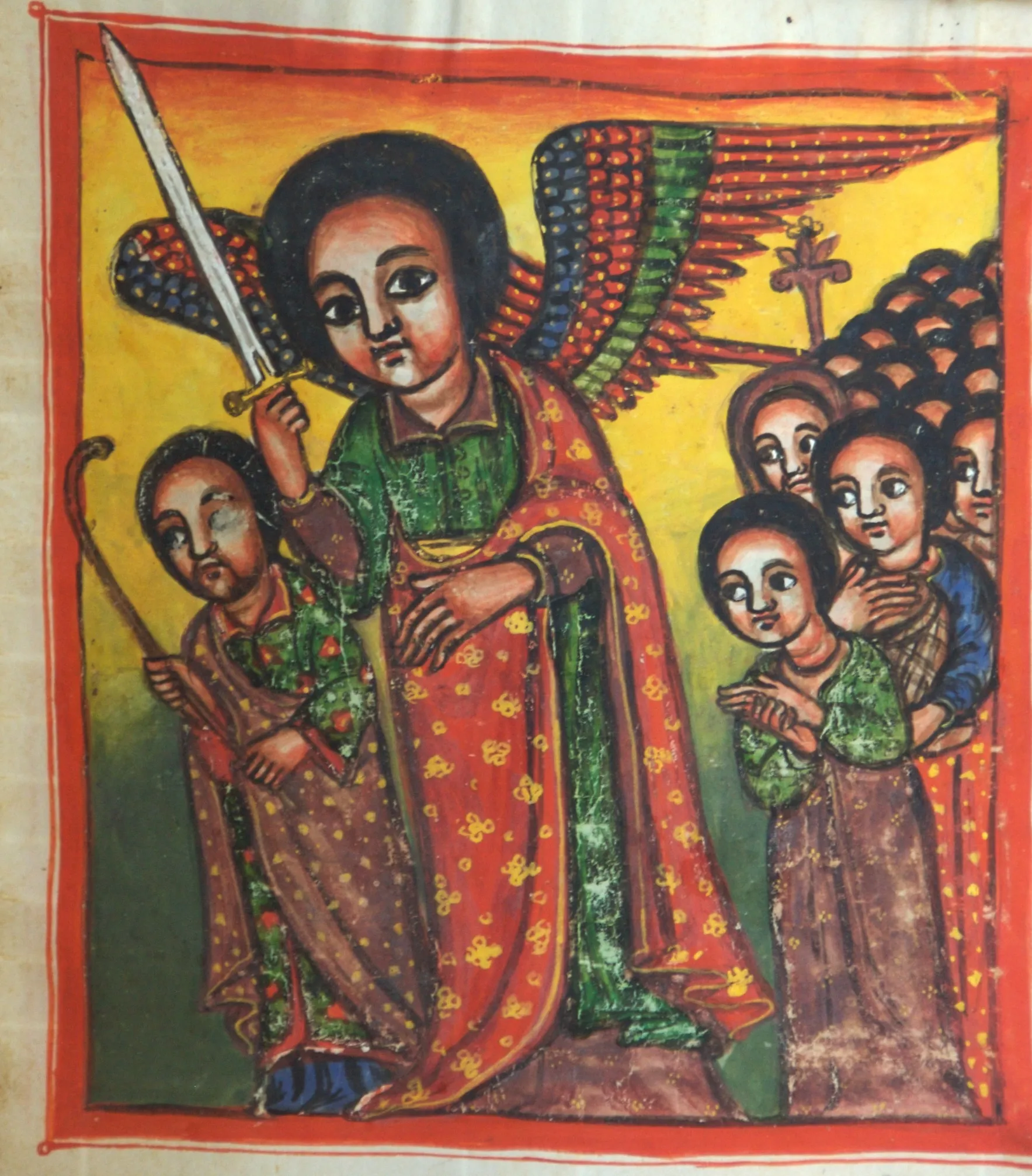
An engraved view of Anfa attributed to Frans Hogenberg — an African city rendered through the conventions of European print. It is not Abyssinia, but it belongs to the same visual economy that made distant African polities legible in Europe, much as Godinho's graded vocabulary of error and pertinacia made Abyssinian difference classifiable without placing it beyond recall. Source ↗.
The author's description of his method as apologetico magis quàm historico more signals that the work is a defence as well as a history. The declaration is explicit that the mode is dictated by the occasion, since in an apologetic rather than a historical manner — for so the case requires — falsity will be condemned where it shall be necessary, apologetico magis quàm historico more (sic enim opus est) falsitatis, vbi oportebit, damnabimus. Apologeticus retains its learned sense of a reasoned defence, while historicus marks the evidentiary and narrative mode that Godinho is deliberately qualifying. The book consequently presents its historical materials—letters, depositions, reports, and testimony—not from a posture of disinterested annalistic narration, but in order to vindicate the Jesuit patriarchal project and expose what he regards as false or extravagant claims. His appeal to iurati testes, 'sworn witnesses,' invokes a juridical standard of credibility, and the standard is set out as a rule of composition: nothing will be laid down as certain except what has been established either from sworn witnesses or from the letters and narration of men to whom it would be sinful to deny credence even unsworn, nihil ponam pro certo, nisi quod vel ex iuratis testibus, vel ex eorum hominum, quibus etiam iniuratis abrogare fidem nefas est, literis & narratione mihi constiterit. In context the expression makes testimony function as probative evidence, although it does not by itself establish that every witness was examined under a procedure equivalent to a formal court deposition; the second limb of the rule, admitting unsworn but religiously credible informants, is itself an acknowledgment that the juridical standard is being extended by analogy rather than applied in a forensic setting. The contrast between sworn testimony and the nouus auctor's marvels is central to the work's claim to disciplined knowledge.
That the vocabulary of classification runs in both directions is registered within the text itself. Reporting the mutual incomprehension of the two confessional idioms, the work observes that the Abyssinians are of the opinion that 'we' assert four persons in the divinity, because 'we' confess two natures in Christ and two wills, in whom they say there is only one nature and only one will, Abassini, inquit, in ea sunt opinione, vt credant, | quatuor nos in diuinis asserere personas, quia duas in Christo naturas, duas | confitemur voluntates, in quo illi naturam tantùm vnam, & vnam tantùm dicunt | esse voluntatem. The remark is made in the service of the schismatic verdict, not against it; but it shows that the terms schismaticus and hæreticus are here understood as positions within a contested field of mutual heresiological ascription, which is precisely why their application must be argued from documents rather than assumed.
Godinho's Case in Brief: A Lyon Imprint of 1615 Against an Unnamed Adversary
De Abassinorum rebus is a three-book Neo-Latin historical and polemical treatise by the Portuguese Jesuit Nicolau Godinho, whose title-page Latin form is Nicolaus Godignus or, in the ablative-author formula, Nicolao Godigno. It was printed at Lyon (Lugduni) in 1615 at the expense of the bookseller Horace Cardon (Horatius Cardon). The place and date of composition have not been independently established. Its driving purpose is to defend the Jesuit Ethiopian patriarchate and the reputations of João Nunes Barreto and Andrés de Oviedo while correcting an unnamed recent author conventionally identified, on bibliographical and contextual grounds, as the Dominican Luis de Urreta. The occasion is announced at the outset as a matter of incredulity: who would believe that in this age, when everything about the Abyssinians is so widely known throughout the world, anyone could be found to assert that that nation is not, and never was, estranged from the Roman faith, Quis crederet hac tempestate, quando Abassinorum omnia tantopere sunt per orbem nota, reperiri posse, qui gentem illam assereret à Romana fide neque modò esse, neque vmquam fuisse alienam?. The rhetorical question sets the terms of the whole undertaking: the adversary's thesis is treated not as an alternative reading of scarce evidence but as an assertion contradicted by an abundance of accessible report.
The work is in Latin. No separately catalogued complete translation into Portuguese, Spanish, Italian, French, English, or Amharic was located. The accessible transmission is principally Latin: digitized copies survive through the Bayerische Staatsbibliothek/MDZ, Google Books, and Internet Archive. This negative finding is bibliographical rather than absolute; a translation or extract outside the searched catalogues cannot be ruled out. The book itself incorporates or reports vernacular and translated documentary materials, including material attributed to António Fernandes, and Barreto's Portuguese letter declining the patriarchal office is presented as rendered faithfully out of Portuguese into Latin, its author protesting that because he certainly knows himself most unworthy of every dignity, he so shudders at the very name of dignity that he is compelled to press again and again that the office by no means be conferred on him, Cæterùm quia me omni dignitate indignissimum esse certè scio, sic ipsum dignitatis nomen | perhorresco, vt cogar, quantum possum, etiam atque | etiam à te cõtendere, hoc vt mihi munus deferre nullo modo patiare. That internal translation activity — documents moved from Portuguese into the learned language and set within the argument as evidence — is not a translation of the whole treatise.
Why the Godinho–Urreta Controversy Matters to Ethiopian Mission History
The work matters because it is an unusually concentrated witness to the making of knowledge about Ethiopia at the intersection of Jesuit mission history, Portuguese patronage, Roman ecclesiology, and early modern print controversy. It treats the Ethiopian church not simply as a distant object of description but as a jurisdictional and confessional problem: the status of the Abuna and the Alexandrian connection, the authority of the patriarchs, the reliability of reports from the interior, and the relationship between conversion, episcopal succession, and Portuguese military power are all entangled. The dependence of the Ethiopian hierarchy on Alexandria is described in precisely jurisdictional terms — when the incumbent dies, legates are sent to the Alexandrian patriarch that he may send another, which is done at great expense and often only after many years, so that meanwhile the Abyssinian church lacks a pastor, Cùm moritur, mittuntur legati ad Alexandrinum Patriarcham, vt alium mittat; quod fit magno cum sumptu, & sæpe post multos annos, ita vt interim Ecclesia Abassina pastore careat — a vacancy argument that simultaneously demonstrates the foreign obedience Godinho wishes to establish and supplies a pastoral rationale for the Latin patriarchate he defends. The work's evidentiary vocabulary also shows how missionary knowledge could be presented as a legal case, assembled from letters, sworn testimony, official permissions, and reports attributed to people with access to Goa, Rome, or Ethiopia.
The immediate polemical field is the rivalry between Godinho's Jesuit defence and Luis de Urreta's Dominican histories of Ethiopia, printed at Valencia in 1610 and 1611. Urreta's works claimed a deep Dominican presence in Ethiopia and circulated information associated with Juan de Baltasar, described in modern scholarship as an Ethiopian knight of Saint Anthony. The decision to answer such claims at length is itself defended on a classical maxim, since there were nevertheless those who warned, out of Seneca, that a false and empty thing, unless it is refuted, sometimes gains credence, Fuere tamen, qui ex Seneca monerent, Rem falsam & inanem, nisi coarguatur, habere nonnumquam fidem. The injury alleged is corporate and reputational: because this defence of theirs, as was said above, does no small harm to the authority and standing of pontiffs, kings, religious families, and eminent men, it greatly matters that its distance from the truth be plainly shown, Sed | quoniam hæc illorum defensio, vt suprà dixi, Pontificum, Regum religiosarum familiarum, atque excellentium virorum auctoritatem & existimationem nô | parum lædit, magni interest, vt quantum distet à vero, dilucidè ostendatur. From that injury the argument proceeds to a stark disjunction, one of two things the adversary must certainly grant: either that the pontiffs and kings were rash in believing and acting, or that he is excessively rash who dares, even tacitly, to fix this mark of ignominy upon them, Alterum certè necesse est, auctor iste nobis concedat, aut Pontifices, | Regésque credendo, & agendo temerarios fuisse, aut | nimis esse temerarium, qui vel tacitè hanc illis ignominiæ notam audet impingere. Marina Alfonso Mola and Carlos Martínez Shaw, in 'La etiopía imaginaria de Luis de Urreta,' treat Urreta's Ethiopia as a historically consequential imaginative construction rather than a reliable record of Dominican antiquity. Rendel Harris's older study, 'Prester John's Library,' reconstructs the sequence from Urreta through Godignus, Pedro Páez, Baltasar Teles, and Job Ludolf, while retaining the older historiographical interest in separating marvel from verifiable report. The attribution of Godinho's unnamed nouus auctor to Urreta is strong as a contextual identification, but it is not a literal self-identification in the passages recovered from the accessible OCR; the rationale for withholding the Dominican's name ob reverentiam Ordinis was not independently recovered with secure page-level evidence.
The historical case against communion is built on a patristic origin and a doctrinal inventory. The origin is asserted as a matter of established record: it is certain, and known from approved histories, that Dioscorus, the heretical bishop of Alexandria, when he had been condemned by the holy Fathers at the Council of Chalcedon, then the fourth, fled into Ethiopia and there poured out his impious venom, Certum enim est, & ex historiis probatis notum, Dioscorum hæreticum Alexandrinum Episcopum, cùm Chalcedonensi Concilio, quod tunc quartum erat, esset ab sanctis Patribus damnatus, in Æthiopiam confugisse, ibique impium suum virus effudisse. The catalogue of errors drawn from António Fernandes then opens with the Christological article, the Abyssinians following the error of Eutyches and contending that there are not two natures in Christ, EVtychis errorem sequuntur, non duas in Christo. Placing Chalcedon at the head of the sequence allows the schism to be dated, documented from the received historical canon, and thereby removed from the sphere of contemporary missionary impression — the same displacement of report by record that governs the work's method throughout.
Modern scholarship has shifted the emphasis from simply deciding which missionary account is true to examining the institutional production and circulation of those accounts. Andreu M. d'Alòs-Moner's study of the Jesuit patriarchate clarifies the Portuguese, Roman, and Jesuit foundations of the mission. Matteo Salvadore's analysis of Loyola's Ethiopian planning documents emphasizes the crown's patronage, the problem of succession, delays in communication, the limits placed on military assistance, and the Jesuits' effort to secure a durable ecclesiastical presence. Leonardo Cohen's monograph supplies a sustained institutional history of Jesuit missionary strategy between 1555 and 1632. Hervé Pennec's work is valuable for treating the mission's later documentary corpus and its historiographical layers as constructed accumulations rather than transparent windows onto Ethiopia. These approaches do not erase the older source-critical question; they relocate it within the history of archives, religious orders, patronage, translation, and competing claims to apostolic precedence. Godinho's own periodizing claim is a useful object for such analysis, since he grounds the reliability of Portuguese knowledge in an institutional date: from the year of Christ's birth 1560, in which religious of the Society of Jesus entered Abassia, everything lay so open to the Portuguese that they know it no differently from their own domestic affairs, Ab anno quidem nati Christi 1560. quo religiosi Societatis Iesu in Abassiam sunt ingressi, sic omnia Lusitanis patuere, vt non secus ea, quàm propria & domestica norint. Epistemic authority is thus made a function of the Society's presence, which is at once the argument's strength as a claim to access and its vulnerability as a claim to disinterest.
The same logic governs the models of scholarship the work commends. Maffei is praised for research travel and archival consultation rather than for eloquence, in that he was not content to do what the most diligent writers do, but leaving Italy in the year 1579 betook himself to Portugal and went to Lisbon, the royal city, Masseius ne qua in re, quoad fieri posset, | ne minimum quidem aberraret, non satis habuit id | facere, quod solent diligentissimi scriptores, & qui | maxi nè amant veritatem; sed Italia relicta anno millesimo | quingentesimo septu[m] gesimo nono in Lusitaniam | se conferens Olisiponem adiit, regiam vrbem;. Holding up archival travel as the standard of historical diligence indicates how far the controversy was fought over method as much as over Ethiopia, and it aligns with the work's preference for documents obtained at their source over authorities transmitted in print.
The text also belongs to a longer sequence of corrections and reworkings. Fernão Guerreiro's annual relations, Páez's História da Etiópia—composed in the early 1620s and later edited by Camillo Beccari—Manuel de Almeida's materials, Teles's Historia geral de Ethiopia a Alta of 1660, and Ludolf's Historia Aethiopica of 1681 formed successive stages in the contest over Ethiopian history. Within Godinho's own dossier the schism is corroborated from two opposite directions, imperial and papal. On the Ethiopian side an emperor is reported to have declared that the negotiation was futile, warning the envoy to know that in the matter he was treating he was wasting effort and time, and that it would never come about that he allow the yoke of the Roman prelate to be imposed on himself or on his people, Scias in re, de qua agis, operâ te & tempus perdere; neque vmquam futurum, vt Romani Antistitis iugum mihi aut meis imponi sinam. On the Roman side a pontifical letter records the mission's frustration as an official finding, that on account of the hardness of their heart and their obstinacy of mind in retaining their ancient errors, the addressee's labour and pious industry could accomplish nothing, propter duritiam cordis eorum, & in vetustis erroribus suis retinendis animi pertinaciam, opera & pia industria tua nihil proficere potuisse. The convergence is the argumentative pivot of the later books: failure, documented from both chanceries, is converted into proof of the separation the adversary denies. The later dismantling of both Dominican and Jesuit marvels should not be projected backward onto Godinho: in 1615 he was defending one confessional and institutional account against another, not producing the later critical historiography. The accessible evidence supports a chain of polemical response, but does not prove that every later compilation directly incorporated Godinho's text.
Tracing the 1615 Lyon Edition: Printing, Permissions, and Surviving Copies
The principal bibliographical form is: De Abassinorum rebus, deque Aethiopiae patriarchis Ioanne Nonio Barreto, et Andrea Oviedo, libri tres. P. Nicolao Godigno Societatis Iesu auctore. Lyon: sumptibus Horatij Cardon, 1615. The Catalogue collectif de France record bmr:UNIMARC:4390189 describes a Latin Lyon imprint of 1615 in octavo, XVI–414 pages, and identifies a Reims, Bibliothèque municipale copy at shelfmark P3279 (Fonds régional). A Swann catalogue description gives the physical formula as 8vo, [16], 414, [2], with a final blank, in a vellum copy. A complete signature sequence and a distinct errata leaf have not been securely established; neither should be supplied as fact. The actual press that produced the sheets has not been identified. Cardon is documented as the person at whose expense the book was printed, but the surviving catalogue evidence does not name a separate printing shop.
A Bayerische Staatsbibliothek/MDZ digital object is indexed at https://www.digitale-sammlungen.de/en/view/bsb10024932. The BSB search record reports the shelfmark H.eccl. 442, location Munich, and a 426-image viewer. The viewer's accessible metadata does not itself expose all catalogue fields, so the shelfmark should be cited as a catalogue/search-record identification rather than as a claim about an image-visible handwritten shelf label. No VD17 identifier was located; the item is a French Lyon imprint, and VD17 registration has not been established. Other accessible digital witnesses include the Internet Archive item https://archive.org/details/bub_gb_Tscabx30t80C, whose metadata carries the Google Books identifier 2itKAAAAcAAJ and an ex-library Jesuit provenance, and Google Books records associated with the Library of Catalonia. These are witnesses to the printed Latin text, not evidence of a later translation.
The preliminary matter records the institutional permissions expected of a Lyon Jesuit imprint. An approval attributed to Claudio Acquaviva is dated Rome, 3 November 1614. Antonius Suffren, identified in the text as provincial of the Society of Jesus in the Lyon province, granted or transmitted the printing privilege at Lyon on 5 July 1615 and invoked earlier privileges of Henri III (10 May 1588), Henri IV (10 December 1606), and Louis XIII (14 February 1611). Ioannes Claudius Deville, described as a master of sacred theology, preacher, and canon of Saint Paul, approved the work at Saint Paul on 1 July 1615 in the capacity assigned by Denis-Simon de Marquemont, Archbishop of Lyon. Thomas de Meschatin la Faye, described as a count, canon and camerarius of the church of Lyon and vicar general in the archbishopric, supplied the Lyon permission on 8 July 1615. The exact wording and leaf locations of these paratexts should be checked against the high-resolution scan; the dates and offices are reported from the accessible OCR and catalogue analysis, not from a modern critical edition. Taken together, these approvals reproduce in the book's own production the chain of Jesuit, royal, and episcopal authorization that the argument inside the book is written to defend.
The dedicatee is Fernão/Fernando Martins de Mascarenhas, printed as Fernandus Martinius Mascaregna. Portuguese biographical and archival records identify him as bishop of the Algarve and inquisitor general from 1616; biographical records give 1548–1628. The dedication places a Portuguese episcopal and inquisitorial patron within the book's wider chain linking the Society of Jesus, the Portuguese padroado, Goa, and Roman authorization. No evidence of formal suppression was located, although the absence of such evidence does not demonstrate that no copy was lost or censored.
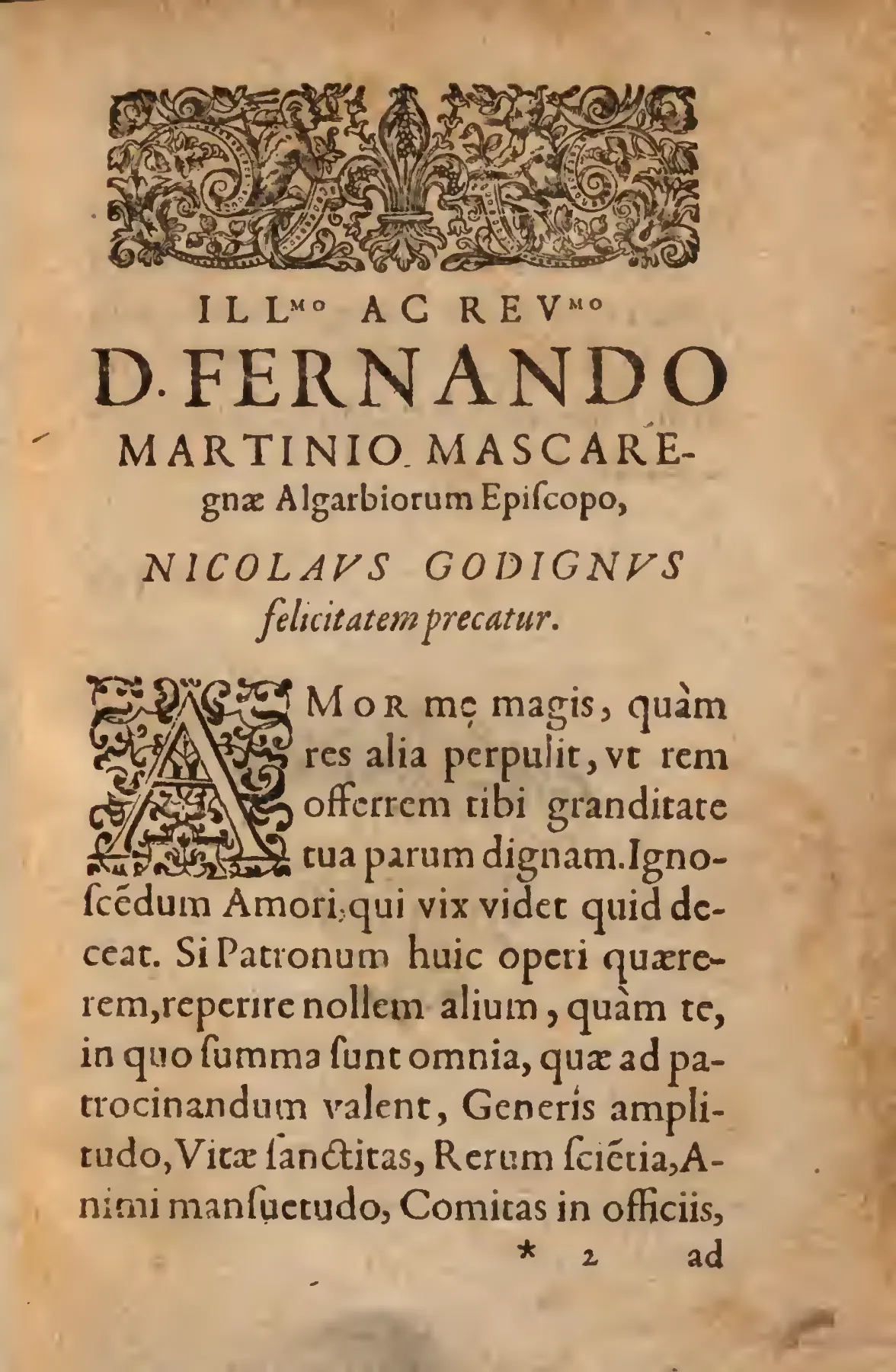
The opening of Godinho's dedicatory epistle sets Fernandus Martinius Mascaregna's name beneath an ornate woodcut headpiece, making patronage a visible part of the book's argument. Naming the Algarve bishop whose career also carried inquisitorial authority helps bind Jesuit authorship, Portuguese ecclesiastical power, Goa, and Roman authorization into a single institutional warrant. Source ↗.
The title and the preliminary index establish three books and an INDEX LIBRORVM ET CAPITVM. Running heads such as De Abassinorum rebus and Liber I. Cap. are visible in the digitized text; signatures and catchwords are also present, but the complete sequence was not recovered reliably. The book therefore has a clear codex-like navigational apparatus while its full physical collation remains a matter for direct copy examination.
The recovered OCR repeatedly uses nouus auctor for the unnamed opponent and contains Google Books search hits for Nusquamia, the satirical 'nowhere' name associated with the supposed Ethiopian capital Zambra. The coinage is made explicitly as a jest with an argumentative edge, the text remarking that these and other things that author says about his Zambra, which he might more aptly call 'Nowhere-land,' because it is nowhere, Hæc & alia auctor ille de sua Zamba, quam posset aptiùs Nusquamiam appellare, quòd nusquam sit. Modern bibliographical and historiographical evidence identifies the opponent with Luis de Urreta, author of the Valencia histories of 1610 and 1611, and connects his account with Juan de Baltasar. Claims associated with that polemical dossier include a Dominican antiquity in Ethiopia, an Ethiopian Dominican institutional network, an inquisition, a Latin senate, Antonine knights, and a library on Mount Amara. The accessible OCR and search snippets do not permit a secure passage-by-passage verification of every one of those motifs, so they are best treated as reported features of the controversy rather than all as independently demonstrated assertions in Godinho's text.
The reception sequence is clearer at the level of broad chronology than at the level of direct textual borrowing. Godinho's 1615 book answers the Urreta controversy; Rendel Harris describes Páez as a subsequent refuter, while Teles reworked Almeida's materials in 1660 and Ludolf used a more critical historical method in 1681. Direct incorporation of Godinho into Teles or Beccari's Rerum Aethiopicarum Scriptores Occidentales Inediti has not been demonstrated. Godinho's related Vita Patris Gonzali Sylveriae Lusitani e Societate Iesu ... in Africana regione regni Monomotapae is catalogued by the Museum Bollandianum as a 1612 Lyon/Cardon octavo of 200 pages, shelfmark R Hagiog A-1674, PID 43855. A separately digitized metadata record gives a different 1616 Kinckius imprint; the discrepancy remains unresolved and should not be silently harmonized.
The principal names and places require controlled normalization: Ioannes Nonius Barretus is João Nunes Barreto; Andreas Ouiedus is Andrés de Oviedo; Lugduni is Lyon; Abassia is Abyssinia or Ethiopia; Olisipo, Conimbrica, and Ebora are Lisbon, Coimbra, and Évora; Mazua is Massawa; Arquicho is Arkiko/Härgigo; and Fremona is the Jesuit settlement in Tigray. The text performs some of this equivalence work itself, and does so with an antiquarian's insistence on classical identification, as when it reports that on the fourth day before the Nones of April the prefect of the Turkish fleet seized with a great armed force the Red Sea island of Massawa, which the author had said was once called Ptolemais of the Beasts, Quarto enim Nonas Aprilis insulam maris rubri Mazuam, quam Ptolemaidam ferarum olim dictam dixi, ingenti armatoru[m] manu Turcicæ classis præfectus occupauit. The same critical impulse is turned against dynastic legend, where the descent of the Ethiopian sovereigns from Solomon is dismissed on the authority of others, since learned and grave authors rightly teach, as the author judges, that it is a most inept little fable, worthy neither of belief nor of a hearing, rectè, vt opinor, docti & graues auctores docent, fabellam esse ineptissimam, neque creditu, neque auditu dignam. Ethiopian titles such as Acegus, Nigus, and Barnagallus should be checked against the conventions of the Encyclopaedia Aethiopica before a critical edition is prepared. Godinho's own biographical record remains internally inconsistent: sources give either 1559–1616 or 1561–1616, and the evidence for Lisbon, Coimbra, Évora, and Rome is not equally strong. The conflict is bibliographically material and should remain visible rather than being resolved by conjecture.
Following the Argument Book by Book, from Nusquamia to Fremona
The preface: occasion, rule of evidence, and the unnamed adversary
The decision to write at all is presented as a reversal, and the preface stages it as such: Godinho reports having thought a manifest fiction would collapse under its own weight, until advisers pressed upon him the Senecan maxim already noticed in this study, that a false and empty thing, unless it is refuted, sometimes gains credence. The maxim does more than supply a decorous classical warrant. It converts silence into risk and thereby licenses a book that would otherwise be superfluous, since on Godinho's own account the facts about Abyssinia are notorious. The whole treatise thus rests on a productive tension between the claim that the truth is already public and the claim that it must be established afresh, page by page, against a printed adversary whose very implausibility is what makes him dangerous. From that tension follows the treatise's characteristic labour: not discovery, but the marshalling of testimony sufficient to make what is allegedly already known juridically unassailable.
The rule of evidence is announced in the same preliminary matter and functions as the work's constitution, since Godinho undertakes, in the sentence already set out above, that he will lay down nothing as certain except what has been established for him either from sworn witnesses or from the letters and narration of men to whom it would be sinful to deny credence even unsworn. The formulation is doubled, and the doubling is the interesting part. The first limb borrows the forensic standard of the oath; the second admits informants whose credibility is guaranteed not by procedure but by religious status, so that nefas — the sin of disbelief — substitutes for the sanction of perjury. What is being constructed is a hierarchy of credit in which members of the Society of Jesus writing from Goa, Fremona, or the imperial camp occupy the highest rank precisely because their character makes the oath redundant. Printed authority, by contrast, enters the argument only to be weighed and, in most cases, discounted.
This hierarchy is given a date. Reliable knowledge of Abyssinia, Godinho argues, begins with Portuguese contact and reaches completeness with the mission, in the periodizing claim discussed earlier: from the year of Christ's birth 1560, in which religious of the Society of Jesus entered Abassia, everything lay so open to the Portuguese that they know it no differently from their own domestic affairs. The metaphor of the domestic — knowledge of another empire assimilated to knowledge of one's own household — is a strong claim about intimacy of access, and it silently converts a missionary presence into an epistemological privilege. Everything written before 1560, including the reports that fed Damião de Góis and the poets, is thereby relegated to a prehistory of rumour; everything written after it by the Society is authenticated by the mere fact of residence. The adversary is disqualified not principally by argument but by chronology and location.
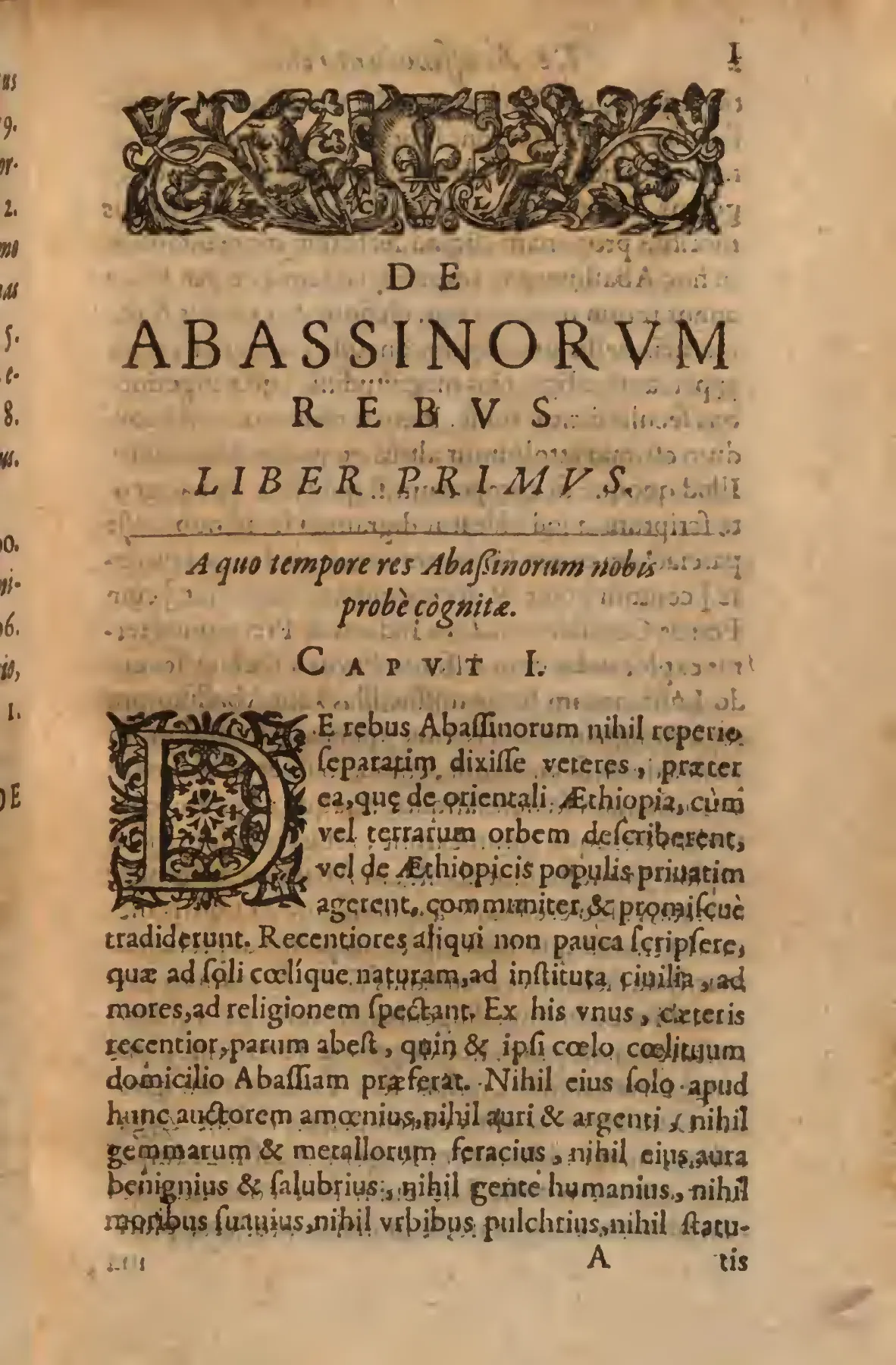
The set-piece opening of Book I, with its woodcut headpiece and ornamental initial, turns the first chapter into a ceremonial threshold to the treatise's central claim: that Abyssinia became truly knowable only through Portuguese and Jesuit access. Beginning with the question of when Abyssinian affairs were properly known makes chronology and location weapons against rival accounts. Source ↗.
The opponent is correspondingly denied a name and given an epithet instead: we shall therefore call this author the "new author," and others like him, Nos igitur auctorem hunc, quem nouum appellabimus, & similes alios. The suppression of the name is presented as deference to his religious order, yet the substituted title performs polemical work of its own. Nouus marks the adversary as recent against a tradition of testimony, and as novel in the pejorative theological sense that attaches to innovation; the plural extension, "and others like him," turns an individual into a species of error that can be refuted collectively. Having created this persona, Godinho can quote him at length — Book I is structured throughout by extended paraphrase followed by demolition — without ever conceding him the standing of a named authority in the republic of letters.
Book I: the demolition of the adversary's Ethiopia
The demolitions of the middle chapters are calibrated to the kind of claim in view. Dynastic legend is dismissed by an appeal to the silence of the sources, the descent of the Abyssinian emperors from Solomon through Melilechus being, as the learned and grave authors cited above are made to teach, a most inept little fable, worthy neither of belief nor of a hearing. The diminutive fabella and the paired supines refuse the story even the dignity of examination. Geography receives a sharper instrument, satire, in the renaming already discussed, by which the adversary's Zambra might more aptly be called Nowhere-land because it is nowhere. The coinage borrows the learned humanist habit of forming place-names from Greek and Latin negatives, and it works because the adversary's capital cannot be attested by any of the Portuguese who have crossed the country; the joke is an evidentiary judgment compressed into a proper noun. Against the invented emperor, Godinho turns instead to internal contradiction, offering the reader a mock-syllogism: whoever can believe that this Alexander was twice born, twice dead, twice succeeded to the empire, and did very many things that were never done, let him also believe that he once existed and governed Ethiopia, Qui credere potuerit, hunc Alexandrum bis fuisse natum, bis mortuum, bis in Imperio successisse, & fecisse plurima, quæ numquam facta sunt; is etiam credat, cum aliquando extitisse, & Æthiopiam gubernasse. The reduplicated bis mimics the incoherence of the source; existence is made the last and least credible item in a list of impossibilities, so that chronological inconsistency does duty as ontological disproof.
Where the adversary offers abundance, Godinho characteristically answers with a single dated document recording an absence. The claim of a flourishing Ethiopian viticulture is met by the report that Pedro Páez wrote to us not long ago that in 1604 he was with the emperor, who wished and even asked that he celebrate mass in the Roman rite, and wine was diligently sought for the purpose throughout the whole place, but not a drop was found, Nec diu est, cùm Petrus Paëz ad nos scripsit, se anno 1604. apud Imperatorem fuisse, illumque optasse, atque etiam petuisse, vt Romano ritu rem diuinam faceret, quæsitumque ad id per totum locum diligenter vinum: at ne guttam quidem fuisse repertam. The anecdote is doubly useful: the failed search refutes the ethnographic claim, while the emperor's request preserves the missionary hope on which the enterprise depends, showing curiosity about the Latin rite in the very episode that documents material incapacity. The same preference for the concrete negative governs the treatment of Abyssinian justice, where the report transmitted from António Fernandes states that they use neither scribes nor any kind of writing in this whole business of lawsuits, que scribis, neque vllo vtuntur scripturæ genere in toto hoc litium negotio. A wholly oral procedure disposes at once of the adversary's posted statutes and codified senate, and it does so by an observation that only a resident could make.
The verdict of schism and the injury to Latin authority
At chapter XXVII the treatise pivots from correction to indictment, and the register changes from satire to ecclesiastical history. The origin of the separation is fixed by the received canon of church historiography, in the passage rehearsed earlier in this study: Dioscorus, the heretical bishop of Alexandria, condemned by the holy Fathers at Chalcedon, fled into Ethiopia and there poured out his impious venom. The medical metaphor of poured-out venom presents heresy as contagion rather than argument, and the Alexandrian dependence of the Ethiopian hierarchy explains both how the infection spread and why it persists — cause and continuing condition are the same institutional fact.
Persistence is then demonstrated empirically against the adversary's plea that the Judaizing rites were abandoned once recognised as errors, in the report noticed above that circumcision is practised together with baptism even now, and said to have been retained from the very time of the Queen of Sheba throughout all Ethiopia down to the present day. The conjunction of the two rites, not the circumcision alone, is what carries the charge, since it makes the Mosaic observance liturgically simultaneous with the Christian sacrament rather than a superseded custom. The refutation that follows presses the point into a dilemma: on Godinho's reading the Abyssinians, if driven from Jewish observance, have fallen into Eutychian error, so that neither exit from the double bind is available to their defender.
The nine arguments of the opponent are answered seriatim, and the answer to the first states the juridical axiom on which the whole verdict rests — the maxim already given, that although the Abyssinians believe many things which we believe, yet because in others, and those very grave, they dissent from the Church, they cannot be called Catholics. This single sentence neutralises the adversary's entire cumulative method. Because denial of one article of sufficient gravity severs a member from the body of the Church, an inventory of shared beliefs, councils attended, and papal salutations received cannot aggregate into communion; quantity of agreement is simply the wrong measure. The precedent supplied immediately afterwards, the Greeks who submitted at Florence and afterwards fell away, further denies the opponent the inference from a past act of obedience to a present state of it.
Book I ends by converting doctrine into administration. The Ethiopian church has one prelate, sent from Egypt, and his replacement is a matter of embassy and delay: the vacancy argument set out earlier, by which legates must be sent to the Alexandrian patriarch that he may send another, at great expense and often only after many years, so that meanwhile the Abyssinian church lacks a pastor. The observation completes the argument on two fronts at once. It fixes the obedience of the Abyssinian church upon a see that Chalcedon condemned, and it presents the resulting vacancies as a pastoral emergency for which a resident Latin patriarch is the obvious remedy — the office whose first two holders the remainder of the work is written to vindicate.
That administrative close rests on a decision taken a few chapters earlier, where Godinho makes a concession only in order to withdraw it. Having reported Génébrard's explanation that the Eastern churches inclining toward Rome were routinely defamed by the Greeks — an explanation elegant enough to account for the Abyssinians' reputation without impugning their faith — he refuses to let the argument stand on its rhetorical merits, because what is at issue is not the reputation of a distant people but the record of Latin Christendom's own governing bodies: the adversary's defence, as the passage cited above insists, does no small injury to the authority and standing of pontiffs, kings, religious families, and eminent men, and it therefore greatly matters that its distance from the truth be plainly shown. The verb lædit is the decisive term. It converts a disagreement over Ethiopian doctrine into an alleged injury sustained by identifiable corporate persons, and it thereby licenses the shift of genre the treatise has already announced for itself: what follows is pleaded rather than narrated.
The plea is immediately given the form of an exclusive disjunction, the choice already reported in this study and offered as one the adversary cannot decline: either the pontiffs and kings were rash in believing and in acting, or he is excessively rash who dares, even tacitly, to fix this mark of ignominy upon them. Temeritas is not chosen for its ordinary sense of impetuosity: in canonical and theological usage it names a censurable defect of judgement, the fault of asserting or acting without sufficient warrant, and a proposition could itself be branded temeraria. By locating the fault, whichever way the disjunction falls, in the assenting will rather than in the evidence, Godinho makes the burden of proof institutional. The century of papal briefs, royal embassies, and religious foundations directed at Ethiopia becomes a standing testimony whose weight the adversary must either honour or discredit; the qualification "even tacitly" forecloses even the defence that no such imputation was intended, since the imputation is treated as a logical entailment rather than an authorial intention.
Alongside this argument from authority runs a subtler distinction concerning culpability in error. Older writers who reported the Abyssinians favourably are excused as having written before the facts were accessible, whereas the adversary, writing when everything might have been known, is denied that shelter: the new author seems to lack a just excuse for his deception, Nouus | auctor videtur iusta carere deceptionis suæ excusatione. The epithet nouus, repeated on page after page as the adversary's only name, does double service: it marks him as recent to the controversy and as an innovator, both liabilities in a genre where antiquity of witness confers credit. Godinho then closes the remaining escape route, which would be to trust the Abyssinian informants themselves on the grounds of their unlettered candour, with a sententia of Tacitean cast, that vast cunning nowhere more confidently sets its seat than in a rude breast, sed vasta calliditas nusquam fidentius, quàm in rudi pectore sibi sedem statuit. The aphorism dismantles the equation of rusticity with truthfulness that underwrote much European reliance on native informants, and it is precisely calibrated to the case at hand: the single Abyssinian voice on which the adversary's Ethiopia is said to rest cannot be credited merely because it is artless.
Having disposed of the sources, Godinho states the verdict in the technical vocabulary of separation, that the Abyssinians are heretics and cut off from the Roman head, Abassinos esse hæreticos, & à Romano capite præcisos,. The participle præcisos is the operative image — amputation from a head, not distance from a centre — and it is sustained institutionally by the figure of the single Ethiopian prelate, of whom the text explains that he is called Abuna, that is, Father, and by another name is called Macus, Abuna dicitur, id est, Pater; nomine alio Macus appellatur. The philological gloss is polemically loaded. By fixing the term as a simple honorific and refusing the reading that would make the Abuna a mere visitator subordinate to some higher, Rome-facing hierarchy, Godinho removes the interpretive space in which the adversary's archbishops, canons, and deans could be accommodated; a single Egyptian-sent Father, and no metropolitan structure beneath him, is what the evidence is made to yield.
Sacraments, monastic life, and the denial of sanctity
The sacramental chapters supply the substance behind the juridical finding, and they proceed by way of privation. Azevedo's report is set out as a tripartite negation: nor are they strengthened by the sacrament of chrism, nor are those near death anointed with holy oil, nor finally are those about to depart from life sustained by the bread of life, Non | roborantur Chrismatis sacramento; neque vicini | morti sacro inunguntur oleo; neque demum è vita | discessuri vitæ pane stabiliuntur. The rhetorical figure — three clauses each opening on a negative particle, each removing a rite that in Latin practice attends the boundaries of life — makes absence itself into evidence, and the sequence culminates at the deathbed, where the want of viaticum bears most heavily on the pastoral case for a Latin patriarchate. Confession is treated in the same register, but here the text preserves the vernacular formula itself, reporting that they say only in a general way, Habessen, Habessen, sed tantùm generatim dicere, Habessen, Habessen,. The transliterated Ethiopic word, glossed as an admission of sin, is adduced to show that the integrity of confession required by Latin sacramental theology — the specification of kind and number — is not observed; the very fidelity of the citation is what makes the deficiency demonstrable.
The account of monastic life closes with a still sharper turn, in which a familiar Latin adage is redirected as ethnographic indictment: nor among the Abyssinians does that hold which is worn as a proverb among us, that not the cowl but the manner of living makes the monk, neque apud Abassinos valet, quod apud nos prouerbio teritur, Monachum non | cucullus, sed viuendi ratio facit. The proverb ordinarily rebukes Latin hypocrisy by subordinating habit to conduct; Fernandes's report inverts it, so that among the Abyssinians the habit is said to be all that remains, monastic houses standing open and unenclosed and their inmates keeping households and frequenting markets. The move exemplifies the treatise's characteristic procedure of turning the reader's own moral commonplaces into instruments of comparison. It also prepares the harshest of the chapter's conclusions, that as there is no true faith among the Abyssinians, so neither is there true sanctity — most certain; if any of them live rightly, they are those who have crossed over to the Catholic camp, Vt | enim vera apud Abassinos fides non est, ita neque veram esse sanctitatem, certissimum. Si qui ex iis rectè | viuunt, illi sunt, qui ad Catholica castra transiere. The reported austerities cannot count as evidence of grace, since sanctity is made strictly consequent upon faith; the military metaphor of the Catholica castra then converts an ascetic question into a question of allegiance, and reserves genuine virtue to the converted, which is exactly the class the mission exists to enlarge.
Book II: Barreto, the archive, and a patriarch without a see
When the argument turns, in Book II, from refutation to the life of the first patriarch, the evidentiary logic does not change: the biography is constructed out of quoted letters, and the text pauses to explain how such letters came to be preservable. Of Barreto's written refusal of the patriarchal dignity it records that Ignatius, not content with having read them, decided that the letters should be read again and more often before others, and, confirmed by public faith and authority, preserved in the archive of the Society as an example to posterity and for the everlasting memory of Nunes, nec legisse contentus, statuit vt iterum & sæpius coram aliis legerentur, fideique & auctoritate publica firmatæ in Societatis tabulario, ad | exemplum posterorum, & memoriam Nonij sempiternam seruarentur. Three functions are compressed here — edification by public reading, authentication by fides publica, and deposit in the tabularium — and they describe the very conditions that allow Godinho, decades later, to produce the document as proof. The refusal of prelacy, a topos of hagiography, is thus simultaneously an archival act, and the exemplarity of the letter is inseparable from its notarised survival.
The embassy narrative then furnishes the documentary hinge of the whole mission. Gonçalo Rodrigues's letter reports the emperor's final position that, apart from the Alexandrian patriarch, whom he had always faithfully obeyed, he was unwilling to acknowledge absolutely any other superior in sacred matters, Tandem præter Alexandrinum Patriarcha, cui | semper fideliter obedierit, nolle se vllum prorsus alium agnoscere in sacris | superiorem. The force of the sentence for Godinho lies in the adverb semper and the perfect obedience it claims: the emperor himself, in the mouth of a hostile but eyewitness reporter, describes an unbroken Alexandrian allegiance, which is precisely the continuity the adversary's thesis must deny. Refutation here is delegated to the refuted party.
Against this institutional impasse the narrative sets the counter-evidence of Jesuit willingness, embodied in the crippled preacher whose retort to his superior is preserved verbatim: but I, he said, do not seek the faculty of walking, but of sailing, At ego, inquit, non ambulandi peto facultatem, sed nauigandi. The wit is exact — the objection concerned feet, the voyage requires wind and sails — and it functions as more than an anecdote, since the mission's obstacles are consistently presented as external and physical rather than internal to the Society's resolve. That contrast prepares the decision at Goa, taken by common consent, that with Nunes the patriarch left behind, Andrés de Oviedo with some religious of the Society should seek Ethiopia and attempt the matter himself, communi consensu | statutum, vt relicto Nonio Patriarcha, Andreas | Ouiedus cum aliquot ex Societate religionis Æthiopiam | peteret, remque ipse tentaret per se. The passive statutum and the ablative absolute relicto Nonio Patriarcha register, without comment, the structural anomaly the rest of the work must explain: a patriarch who never enters his see, and a suffragan who goes in his stead.
The remaining chapters of Book II live with that anomaly, compressing the last six years of João Nunes Barreto's patriarchate into a paradox of place: a patriarch of Ethiopia who lived at Goa in body and in Abyssinia only in spirit. The pressure Barreto exerts on the viceroy is framed not as personal desire but as the enforcement of a commission, since he claimed to have been given to those peoples as pastor and leader by God and by the supreme Pontiff, Christ's Vicar, se à Deo & à Pontifice maximo Christi Vicario datum illis populis pastorem ac ducem. The double derivation of title — divine and papal, in that order but with the second doing the juridical work — converts the viceroy's refusal of even a wretched catur into an obstruction of Roman authority by a secular officer of the padroado. That is the first of several places in the later books where the mission's failure is redescribed as a failure of transport, arms, and harbours rather than of the papal design, a redescription on which the whole apologetic strategy depends.
Blocked, Barreto attempts to lay down the office, and Godinho inserts his Portuguese letter to Luís Gonçalves da Câmara with an explicit declaration that it has been faithfully turned out of Portuguese into Latin. The plea is addressed to the man he holds responsible for the appointment: I beseech you for God's sake, my Luís, that you who were in great part the cause why this heavy burden of the patriarchate was laid on my weak shoulders, Obsecro te propter Deu[m], mi Ludouice, vt qui magna ex parte causa fuisti, cur graue hoc Patriarchatus onus. The dignity is figured throughout as onus, a canonical burden whose removal is to be sought through procedural channels — royal instruction to the Indian prætor, or, failing that, a petition to the pope through the Portuguese ambassador at Rome. What follows is more striking still, and it is preserved rather than softened: the confession, already quoted in this report, that he pays the penalty in full, since countless sheep have been committed to his care and faith which can neither be fed by him nor wish to be. The doubling of the two clauses — they cannot be fed by him, and they do not wish to be — separates two distinct impediments, physical inaccessibility and settled unwillingness, and it is the second that Godinho needs. An admission of pastoral impotence, voiced by the patriarch himself and not by the narrator, is thereby made to testify to the Abyssinians' estrangement; the humility topos and the schism thesis are welded together, so that the very language of self-accusation functions as evidence against the adversary.
Book III: Oviedo, providence, and the sworn inquiry
Book III opens on Andrés de Oviedo and, before any narrative of Ethiopia, sets out the constitutional machinery by which a patriarch for Ethiopia could exist at all: the matter having been communicated by letter with Ignatius Loyola, the king in Portugal creates João Nunes Barreto patriarch, whom he knew well from the Moroccan mission and elsewhere, and leaves to Ignatius the care of naming a successor, rex ipse in Lusitania loannem Nonium Barretum, quem ex Mauritanica missione & aliunde probè norat, Patriarcham creat, successorem nominandi curam Ignatio relinquit. Three authorities are distributed across a single sentence — a papal faculty of election, a royal act of creation, a delegated designation by the general of the Society — and the ordering is not decorative. It is the answer to the charge that the patriarchate was an improvisation: each link is nameable, datable, and traceable to a superior, and Ignatius commands acceptance pro imperio, so that even the reluctance of the appointee is absorbed into the chain of obedience.
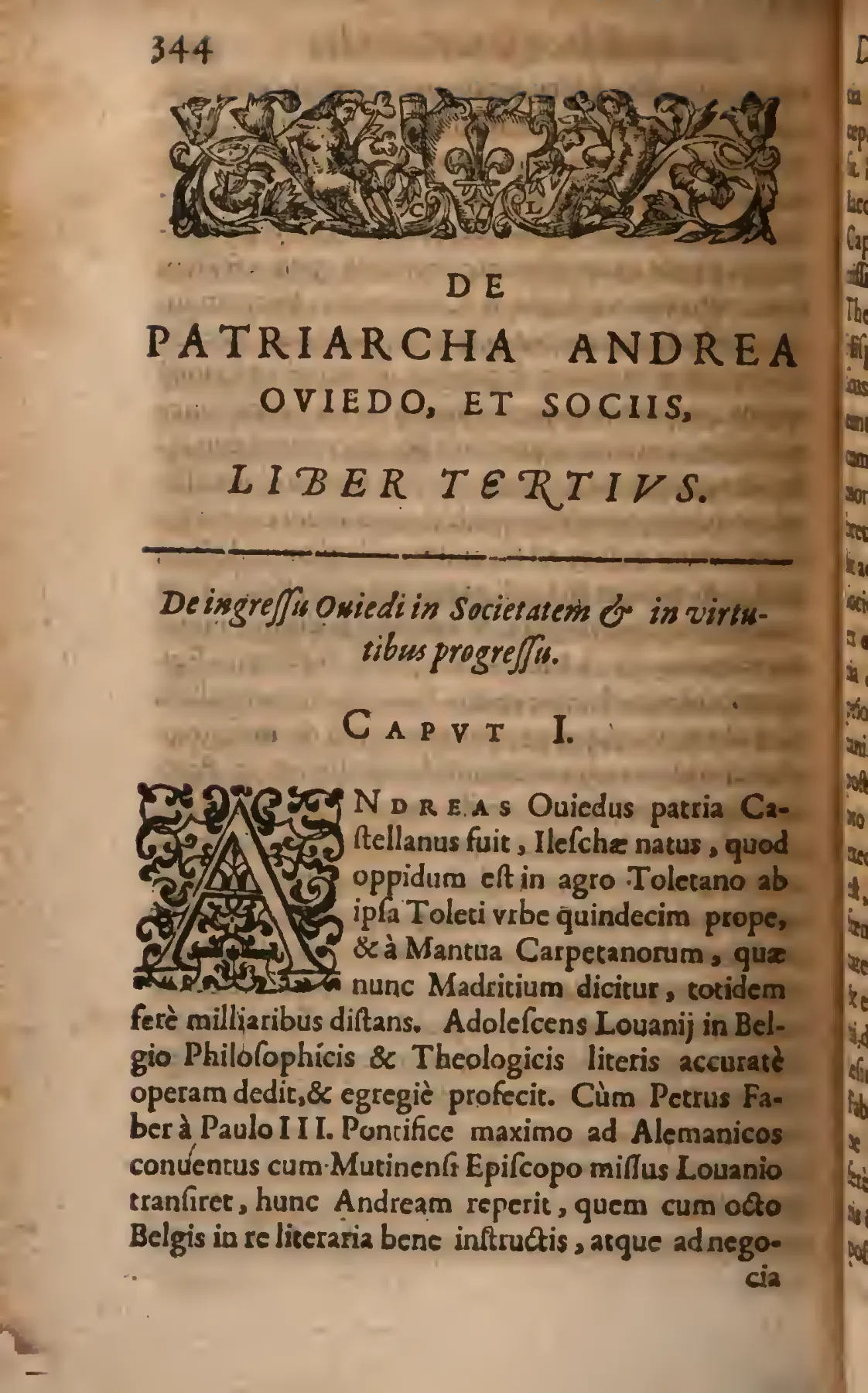
A full-width woodcut headpiece, italic incipit, and large initial announce Book III as a new evidentiary section, in which Godinho turns to the constructed life of Andrés de Oviedo. Even the opening biographical notice — Oviedo's Castilian birth, Louvain studies, and recruitment by Peter Faber — anchors the patriarchate in the papal, Jesuit, and royal chains of authority the book defends. Source ↗.
The hagiographic material that surrounds Oviedo's consecration at Lisbon and his visitation of the Alentejo for Cardinal Henry generates a genuine tension, and Godinho notices it. Having narrated the bishop who serves at table, sweeps, makes beds for the sick, and washes feet, he interposes a doctrinal excursus refusing the inference an ascetic reader might draw, holding that whoever thinks that paupers, humble men, stripped of wealth and resources and all power, ought to be the Church's princes would judge most unjustly, since the splendour of the order and the commendation of the office require otherwise, debere esse Ecclesiæ principes, is sanè iniquissimè sentiat; cùm ad splendorem ordinis, ad commendationem muneris. The excursus is an act of controversial hygiene: in a decade when the external apparatus of prelacy was under attack from several directions, exemplary episcopal poverty had to be quarantined as personal virtue rather than admitted as ecclesiological principle. The quarantine is imperfect, however, because Oviedo's own reported speech pushes in the other direction. To the notables scandalized by his lodging in pauper hospices he answers that he knows the hospice to be a very honourable and splendid place, since it is the dwelling of most holy poverty, in whose lodging the founder of things, when he came to men as man, willed to be received, At ego, inquit, scio, xenodochium esse locum valde honestum & splendidum, cùm domicilium sit sanctissimæ paupertatis, cuius hospitio conditor ille rerum, cùm ad homines homo venit, excipi voluit. The vocabulary of honestum & splendidum is deliberately lifted from the register the author has just defended and reassigned to the hospice, and the Nativity is made the warrant. Godinho lets both stand, and the unresolved friction between prelatial splendour as a public necessity and its christological inversion in the person of the bishop is one of the more revealing seams in the book.
The Ethiopian narrative proper turns on a decision taken at Goa by a viceregal council rather than at Rome — that Barreto remain in India while Oviedo go forward — and on the interval of days by which the party landed near Arkiko before the Turkish fleet-commander seized Massawa and Arkiko on 2 April 1557. Godinho supplies the interpretive rule under which contingency is to be read: he will seem to think too meanly of divine providence who does not think it was done by God's particular counsel and nod, Minus æquè de diuina providentia sentire videbitur, qui non sentiat peculiari eius consilio & nutu factum. The formulation is carefully aggressive: dissent from the providential reading is not an alternative historical judgement but a defect of piety. What the rule accomplishes is considerable, for the same Ottoman closure of the Red Sea that vindicates the timing of the entry also seals the mission's fate, and providence must therefore be credited with the arrival and not blamed for the entrapment.
Against printed authority Godinho sets, here as elsewhere, a documentary base gathered on the ground: the inquiry commissioned in Ethiopia by Aleixo de Menezes, archbishop of Goa, and conducted by his vicar general, whose materials are introduced as things handed down by those same witnesses and confirmed by oath, Quæ igitur ab eisdem illis testibus tradita, & iureiurando firmata sunt. The clause is the evidentiary charter of Book III, and it is applied without embarrassment to miracles as well as to chronology — the dried river on the desert march, the lions that refuse the confessors, the vanishing thief — so that the canonical apparatus of sworn testimony guarantees the marvellous rather than restraining it. The methodological contrast with the adversary is thus not one of credulity against scepticism but of attested wonder against unattested fable.
The letter of Manuel Fernandes to Diego Laínez supplies the mission's decisive rebuff. After the honourable reception at Baroa, the concourse of every rank admiring the Roman rites, and fifty days' march to the imperial camp, Claudius closes the negotiation with the refusal already recorded above, warning the envoy that in the matter he is treating he is wasting effort and time, and that it will never come about that he allow the yoke of the Roman prelate to be imposed on himself or on his people. The image of the yoke recasts the question as subjection rather than doctrine, and Godinho has no motive to soften it, since an emperor who refuses the yoke of the Roman prelate refutes the claim that his people never stood outside Roman obedience more economically than any doctrinal catalogue could.
That refutation is completed from the opposite chancery. The brief of Pius V of 4 February 1566, transcribed in part, records as an official finding — the finding already noticed in this study — that on account of the hardness of their heart and their obstinacy of mind in retaining their ancient errors, the addressee's labour and pious industry could accomplish nothing. The document is quoted not for its command — the transfer of the patriarch to Japan and China under holy obedience — but for its premise, and Godinho says so, turning the brief against the unnamed recent author twice over: it certifies both the Abyssinians' alienation and the pontiff's diligence, so that neither the schism nor the papal prudence can be denied without contradicting a Roman instrument.
A portrait of Pius V attributed to Bartolomeo Passarotti. In Godinho's polemic the brief issued under this pope in 1566 works precisely through such Roman authority — not merely as a command, but as an instrument whose apostolic weight could be turned against any denial of Ethiopian schism or of papal diligence. Source ↗.
Oviedo's reply of June 1567 is consequently a delicate performance, since a precept issued in virtute sanctæ obedientiæ leaves little room for negotiation. He argues from impossibility of passage at Massawa, asks for five hundred Portuguese soldiers, denounces a slave traffic and a ruler who prefers subjects as chattels to brothers in religion, and grounds the refusal pastorally, urging that to desert these sheep and leave them to be devoured by wolves is not humane, and is far removed from the charity of the supreme Shepherd Christ Jesus, Oues istas deserere & lupis relinquere deuorandas, haud humanum est; longéque abest, à caritate summi Pastoris Christi Iesu. The move is subtler than mere resistance: by invoking the summus Pastor, he reminds the pope that the flock in question is also the pope's, transferring the burden of abandonment upward. The juridical danger is then neutralized by the formula of submission already quoted, the assurance that if it should seem otherwise to His Holiness he will bow his head — remonstrance and unconditional obedience held in a single sentence, after which papal and royal approval of his remaining retrospectively ratifies the whole exchange.
Fremona: confinement, death, and the last companion
The closing chapters convert twenty years of confinement at Fremona into sanctity. Oviedo, reduced to writing to King Sebastian and to Pius V on leaves cut from his breviary, dies of the stone amid the greatest torments in September of 1577 from the Virgin's childbearing, expirauit, mense Septembri anno à partu Virginis millesimo quingentesimo septuagesimo septimo, the dating formula matching that used for Barreto and binding the two patriarchates into one continuous reckoning. Burial in the small church at Fremona is asserted expressly against the adversary's Mount Amara, so that even a grave becomes a point of controversy. The last companion, Francisco Lopes, supplies the book's terminal proof: first he warns them that the two years' time he had received by divine gift had elapsed, and that no more than seven days of life remained, Principio eos monet, elapsum esse, quòd diuino munere acceperat biennij tempus, nec iam plus quàm septem vitæ dies superesse. His farewell couples prophecy with a programme — perseverance in Roman doctrine and obedience, avoidance of marriage with heretics, concord — and its fulfilment in the landing of a successor at Massawa within the year allows the narrative to end not on extinction but on a verified prediction of continuity, the surviving Catholic remnant standing as the residue of a mission whose documented frustration has been made to argue for the separation it was sent to end.
Frequently Asked Questions
What is Nicolau Godinho's De Abassinorum rebus?
It is a three-book Latin treatise printed at Lyon in 1615 at the expense of the bookseller Horace Cardon, with the full title De Abassinorum rebus, deque Aethiopiae patriarchis Ioanne Nonio Barreto et Andrea Oviedo, libri tres. Neither travel narrative nor plain chronicle, it is a defence of the Jesuit patriarchate of Ethiopia and of its first two incumbents, João Nunes Barreto and Andrés de Oviedo, built from letters, sworn depositions, papal briefs and eyewitness testimony. Its central contention is that Ethiopia has stood in schism from Rome since Dioscorus, condemned at Chalcedon, carried his teaching south.
Who was Nicolau Godinho?
A Portuguese member of the Society of Jesus, whose name appears on his own title-page in the Latin forms Nicolaus Godignus and, in the imprint's ablative author-formula, Nicolao Godigno. His life remains imperfectly documented: the sources give either 1559–1616 or 1561–1616, and the evidence for Lisbon, Coimbra, Évora and Rome is not equally strong. Neither the place nor the date of his book's composition has been independently established. He also wrote a life of Gonçalo da Silveira, catalogued as a Lyon octavo of 1612 printed by Cardon, though a conflicting 1616 imprint record remains unresolved.
Why did Godinho rename his opponent's Ethiopian capital "Nusquamia"?
Because, in his judgement, the place did not exist. His unnamed adversary — identified on bibliographical and contextual grounds with the Dominican Luis de Urreta, whose histories appeared at Valencia in 1610 and 1611 — described a capital called Zambra, which Godinho remarks might more aptly be called Nowhere-land, since it is nowhere. The jest compresses an evidentiary verdict into a proper noun: no Portuguese who had crossed the country could attest the city. The same treatment dispatches the twice-born emperor Alexander and the phantom Latin senate, inquisitors, Antonine knights and library on Mount Amara.
What rule of evidence did Godinho set for himself?
He undertook to lay down nothing as certain except what was established either from sworn witnesses — iurati testes — or from the letters and narration of men whom it would be sinful to disbelieve even unsworn. The second limb extends the forensic standard by analogy, admitting Jesuits writing from Goa, Fremona or the imperial camp on the strength of religious character rather than procedure. He also declares his manner apologetic rather than historical, as the case requires. Notably, the sworn inquiry commissioned by Aleixo de Menezes, archbishop of Goa, underwrites miracles as readily as chronology.
Is there an English translation of De Abassinorum rebus?
No separately catalogued complete translation into English — or into Portuguese, Spanish, Italian, French or Amharic — has been identified; the finding is bibliographical rather than absolute, and a version outside the searched catalogues cannot be ruled out. Accessible transmission is principally Latin, through digitized copies at the Bayerische Staatsbibliothek, Google Books and the Internet Archive. The Leo edition is a separate undertaking: part of an effort to make English translations of every text printed in Latin in early modern Europe between 1450 and 1750 freely available online, it presents the full transcription with a complete, AI-generated English translation for the first time.
This report was generated by an advanced AI assistant that conducted deep research alongside an extensive interpretation of the transcribed original text. Every effort has been made to preserve fidelity to the source and to guard against inaccuracy, but corruption in the text recognition process and model hallucination may nonetheless have entered the text. Treat every claim, quotation, translation, and citation as provisional, and verify each against the original source before relying on or citing it.
Critical Further Reading on Godinho, Urreta, and the Jesuit Mission to Ethiopia
- Alfonso Mola, Marina, and Carlos Martínez Shaw, "La etiopía imaginaria de Luis de Urreta," Cuadernos de Historia de España: This specialist study is indispensable for the Dominican counter-history, the role attributed to Juan de Baltasar, and the formation of an imagined Ethiopian past in Urreta's books. It provides the modern historiographical basis for identifying the unnamed nouus auctor while preserving the distinction between contextual attribution and an explicit name in Godinho's recovered text. It also helps explain the force of Godinho's recourse to living witnesses against printed assertion, as when the most illustrious Cardinal Bellarmine, the only survivor of those the author names, being asked about this matter, affirmed that he had never learned any language from those Ethiopians, nor wished to learn one, Illustrissimus Cardinalis | Bellarminus, qui solus ex iis, quos auctor nominat, superstes est, hac de re | quæsitus, nullam se vmquam ab | istis Æthiopibus linguam didicisse, nec discere voluisse affirmauit.
- Cohen, Leonardo, The Missionary Strategies of the Jesuits in Ethiopia (1555–1632): This monograph supplies the institutional and strategic setting for Godinho's defence of the patriarchate, especially the relation among Jesuit authority, Portuguese patronage, episcopal succession, and missionary practice. It is the most direct modern framework for reading the work as a product of mission policy rather than as an isolated geographical treatise. Its account of strategic adaptation is particularly useful against the reported imperial rebuffs that structure Godinho's later books, where a sovereign answered that he had in his own kingdoms men religious and lettered, and therefore had no need of others being sent to him from elsewhere, nor had it ever been in his mind to subject himself or his people to the Roman Pontiff, Respondit suis se in regnis viros habere religiosos ac literatos, non indigere proinde vt | aliunde alij ad se mitterentur; nec sibi vmquam fuisse | in animo, se aut gentem suam Romano subiicere Potifici.
- d'Alòs-Moner, Andreu M., "The Birth of a Mission: The Jesuit Patriarchate in Ethiopia," Portuguese Studies Review: The article reconstructs the creation of the patriarchate as a joint undertaking of the Portuguese crown, the Holy See, and the Society of Jesus, and clarifies the institutional interests standing behind the careers of Barreto and Oviedo. It helps distinguish Godinho's retrospective defence from the earlier administrative history of the mission, and it supplies the administrative background against which the patriarchal office is heard lamenting its own impotence, in the confession that he pays the penalty in full, since countless sheep have been committed to his care and faith which can neither be fed by him nor wish to be, Et verò satis luo; cùm innumerabiles oves fidei meæ curæque sint commissæ, quæ neque pasci possunt à me, neque volunt — a pastoral failure that Godinho's argument converts into evidence of the schism.
- Pennec, Hervé, An Ethiopian Mille-feuille: Unearthing the History of the Jesuit Mission to Ethiopia: Pennec's layered treatment of the mission's documentary and historiographical corpus helps situate Godinho among later compilations, editions, and retrospective reconstructions. It is particularly useful for avoiding the assumption that Teles, Beccari, or later European histories transmit Godinho unchanged, and for reading the edited documents in Books II and III as shaped materials rather than neutral deposits — among them the remonstrance that qualifies its own resistance with the assurance that he says this in such a way that, if it seem otherwise to His Holiness, he will bow his head, Hoc tamen ita dico, vt si vestræ sanctitati aliud videatur, submittam caput.
- Salvadore, Matteo, "Gaining the Heart of Prester John: Loyola's Blueprint for Ethiopia in Three Key Documents," World History Connected: Salvadore reads the Jesuit planning documents alongside crown and Roman interests, highlighting succession, communication, conversion, and the contested place of military assistance, and he shows how steady traffic between Ethiopia, Portugal, and Rome fixed the Prester's kingdom onto Christian Ethiopia. Those questions illuminate why Godinho treats Ethiopian ecclesiology and Portuguese intervention as inseparable, and they bear directly on his defence of armed protection for prospective converts, the reason why in these places above all religion requires an armed hand, so that those who wish may come over to the Catholic camp undaunted, cur in his maximè locis armatam Religio desideret manum, vt ad Catholica castra accedant intrepidi, qui velint. They equally illuminate the problem of long-distance command, evident in the papal precept that exhorts in the Lord, and by virtue of holy obedience and in remission of sins enjoins, that after receiving this letter, as soon as he safely can and has opportunity of sailing, he betake himself to the island called Japan and to the region of the Chinese, hortamur in Domino, & in virtute sanctæ obedientiæ, atque in remissionem peccatorum, iniungimus, vt postquam has literas acceperis, cumprimùm tutè potueris, & nauigandi facultatem habueris, ad Insulam Iapam, & ad Sinatum regionem te conferas.





.jpg)
