Twenty Drachms of White Poppy Seed: Ludovico Settala's Medical Animadversions and Cautions, Books Eight and Nine
Ludovico Settala, chief medical officer of Spanish Milan and a physician of forty years' standing at the Ospedale Maggiore, published in 1630 two further books of his Animadversionum, & Cautionum Medicarum LIBRI DUO — one on the treatment of wounds, one on the compounding of medicines — at the height of the plague that would kill a sixth of his city. Written by a man who could both argue from Galen and shut down an apothecary's shop, the volume turns learned criticism into enforceable rule: tents and pledgets are condemned as customs that smother the body's own healing heat, corrupt drug recipes are corrected by philology where the manuscripts allow and by decree where they do not. Appended to it is a short treatise claiming that a mole on the forehead always has a twin in the chest — natural philosophy, its author insists, and emphatically not astrology.
ExLatinis
July 31, 2026

Contents
Ludovico Settala, chief medical officer of Spanish Milan and a physician of forty years' standing at the Ospedale Maggiore, published in 1630 two further books of his Animadversionum, & Cautionum Medicarum LIBRI DUO — one on the treatment of wounds, one on the compounding of medicines — at the height of the plague that would kill a sixth of his city. Written by a man who could both argue from Galen and shut down an apothecary's shop, the volume turns learned criticism into enforceable rule: tents and pledgets are condemned as customs that smother the body's own healing heat, corrupt drug recipes are corrected by philology where the manuscripts allow and by decree where they do not. Appended to it is a short treatise claiming that a mole on the forehead always has a twin in the chest — natural philosophy, its author insists, and emphatically not astrology.
Ludovico Settala (Milan, 27 February 1552 – Milan, 12 September 1633) spent his working life at the intersection of learning and jurisdiction: physician to the Ospedale Maggiore, lecturer on Aristotle, author of a treatise on plague published in 1622, and from 1628 Protophysicus Generalis Status Mediolani, the chief medical officer of the Duchy of Milan under Philip IV of Spain. The volume printed at Padua in 1630 — sold at the shop of Paolo Frambotto, printed by Joseph Sardi and his brothers — adds two books, an eighth on the cure of wounds and a ninth on the compounding of medicines, to a series of Animadversionum et cautionum medicarum libri that had already appeared in seven books at Milan in 1626. Bound with it is a separately titled work of 1628, the De naevis liber, on the reading of moles as marks of the body. The genre is announced in the title itself and is neither the systematic treatise nor the consultative consilium: animadversio, the corrective observation of a master, paired with cautio, the binding warning of an inspector.
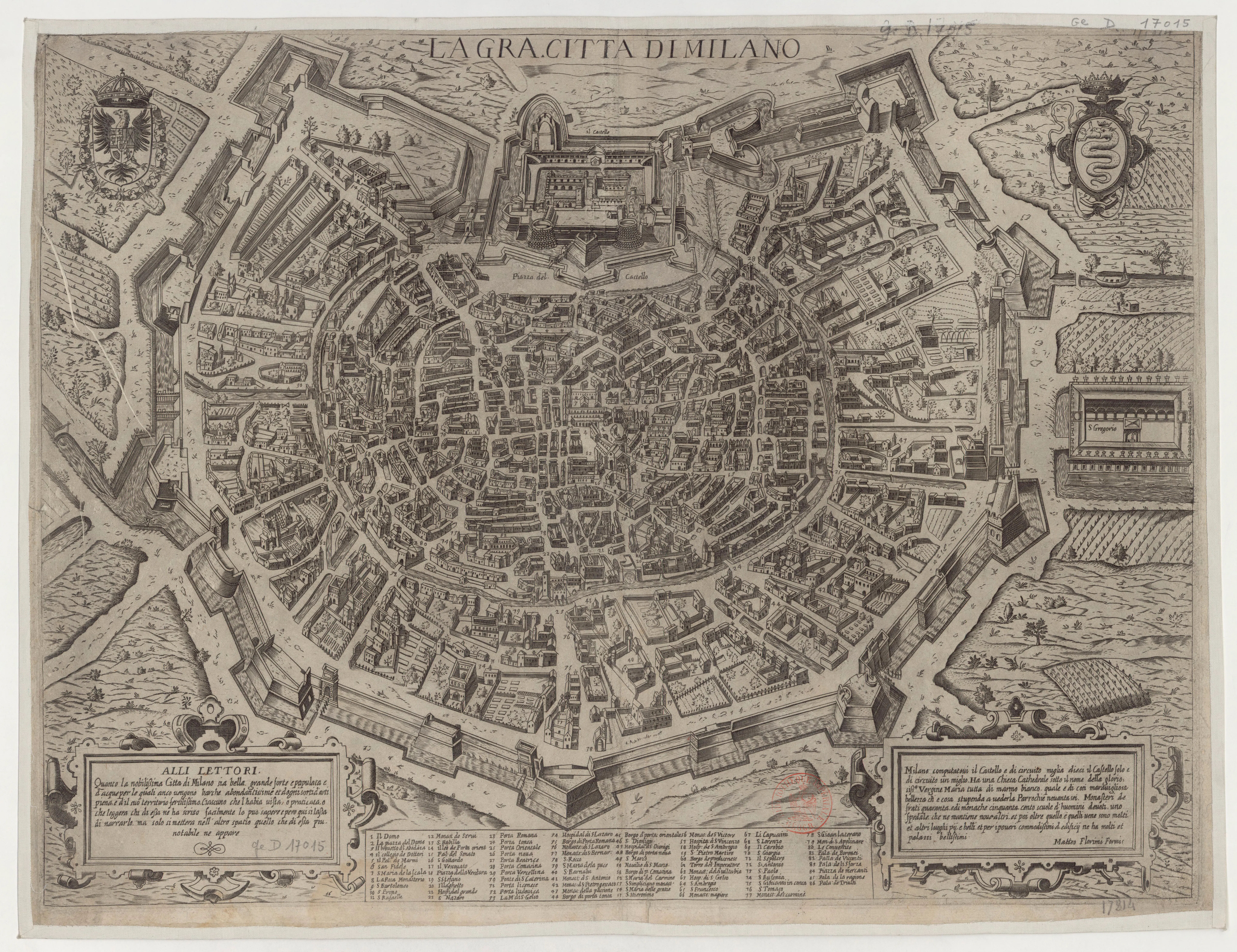
A period printed plan of Milan makes visible the urban field over which Settala's authority ran: the fortified circuit, the Castello Sforzesco, and the Ospedale Maggiore named in the plan's printed key. In such a city his animadversiones and cautiones functioned as instruments of oversight. Source ↗.
The problem the work confronts is single, though it is pursued in two arenas. Medical practice, as Settala describes it, has drifted from its rational and textual foundations — surgeons dress and probe and bore according to custom, apothecaries compound according to corrupt recipes and local habit — and no authority binds either group to a corrected standard. The recurring move by which he answers is likewise single: received custom is set against demonstrated cause and against the recovered ancient text, and the resulting judgement is then converted into a rule enforceable by the public office he holds. In the eighth book, tents, pledgets, and hasty trepanation are dismissed as customs that obstruct nature's own healing power, and against them is set the "new" method of rare dressing, warranted by forty years in the great hospital of Milan, by named witnesses and oath formulae, and by counted outcomes. In the ninth, lacking any fixed Milanese antidotary that apothecaries might be compelled to follow, he issues selective, aphoristic corrections of collection, extraction, washing, decoction, and compounding, settling corrupt Arabic-Latin readings by philology where the evidence permits and by administrative decision where it does not.
The stakes of that procedure are not confined to Milan. The eighth book is the principal Lombard witness to the controversy over rara medicatio vulnerum that Cesare Magati had opened in 1616, a dispute that ran for decades through hospital wards, university chairs, and the offices of protomedici, and in which Settala's insistence on the conservation of the innate heat beneath an undisturbed covering supplied the Galenic-Aristotelian counterweight. The ninth book belongs to the history of pharmaceutical humanism, where the identity and virtue of a drug had to be established by textual criticism, sensory testing, and regulatory inspection at once, and where the names inherited from the Arabic-Latin lexicographers were themselves a technical problem. Both books belong to the history of medical governance: the printed animadversion functions as an extension of the visitation of apothecaries' shops, reaching practitioners the protophysician could not personally inspect. That the volume issued in the years of the Milanese plague of 1629–1631 gives its brisk, impatient tone a particular historical density.
What a first-time reader is most likely to remember are the particulars. Settala argues for the dignity of manual operation on the ground that an art takes its nobility from its end, and health is the physician's end. He grounds his surgical claim in institutional experience — four decades of practice in the Ospedale Maggiore — and stakes it on a counted result, calling God, the hospital's governors, and its surviving officers to witness that of fourteen men wounded in the head only one died. He compares surgeons who reach for the trepan at the first suspicion of gathered matter to men boring an earthen pot to patch its broken parts, and confesses the fear that the operation kills as many as the wounds do. He accuses the packers of pledgets of emptying purses while they fill wounds. In pharmacy he holds that ancient readings must never be altered unless something false in them has been manifestly demonstrated — and then, where the manuscripts will not decide between poppy seed and pepper in the Philonium Persicum, prescribes for his own province by authority. An intercalated address to the reader abandons projected books on ulcers and tumours, pleading office, age, consultations, and the Aristotle lectures. The appended De naevis claims to treat a subject no one has handled before, advances the arresting thesis that a mole on the forehead has a companion in the thorax, describes God as a geographer sketching the great world on the small map of man, and closes by insisting that its author has worked as a philosopher and not as an astrologer.
A single throughline binds the volume's vocabulary, its making, and its argument. Animadversio and cautio name at once a humanist critical practice and a magistrate's instrument; the office title on the title-page is not decoration but the warrant that turns the second into the first. The book's own theory of accretion — that the arts are perfected by additions, since the first discoverers found the principles but not everything — is enacted in its bibliographical form, two books added to seven already published, with a further nine-book state issued later in the century. Against that openness to addition stands a strict conservatism toward texts, and between the two the De naevis extends the same discipline of legible correspondence to the surface of the body. Much about the volume remains unsettled: no modern translation has been located in the consulted catalogues and repositories, the senatorial dedicatee named as the author's son has not been securely identified, and a sustained scholarship devoted to the Animadversiones themselves does not yet exist.
Read the full text and English translation on Leo
This text was transcribed and translated as part of the ExLatinis project, an effort by Leo to make free English translations of every text published in Latin in early modern Europe (1450–1750) available online. The complete transcription and English translation of this work can be read free of charge:
→ Read the original Latin text and full English translation on Leo
You can save a copy of this document into your Leo account to run deep text searches, conduct further analysis, or cross-reference it with your own research.
Naming Settala's Animadversions: Title, Office, and the Technical Vocabulary of Wounds and Moles
Editorial English Title (supplied; not an established conventional translation):
Medical Animadversions and Cautions: Books Eight and Nine — On the Cure of Wounds and On the Compounding of Medicines — by Ludovico Settala, Protophysician General of the State of Milan, together with the appended Treatise on Moles.
The 1630 Paduan volume bears on its title-page the Latin legend LVDOVICVS SEPTALIVS PATRICII MEDIOLANENSIS ... Protophysici Generalis Status Mediolani ... Animadversionum, & Cautionum Medicarum LIBRI DUO, Septem aliis iam editis additi ... Patauij; Apud Paulum Frambottum. MDCXXX. Typis Iosephi Sardi, & Fratrum. Superiorum Permissu. This composite designation announces both a continuation and a doubling: the two added books extend a previously published seven-book series, and they are paired on the title-page with a separately titled treatise on moles that was printed separately at Padua in 1628 by the press of Giovanni Thuilio and sold by Paolo Frambotto. The English title above is editorial, not transmitted by any catalogue, and is offered to capture the structure of the volume as Settala conceived it: a regulatory official's learned interventions in surgery and pharmacy, presented in the classical genre of the critical observation and the cautionary maxim.
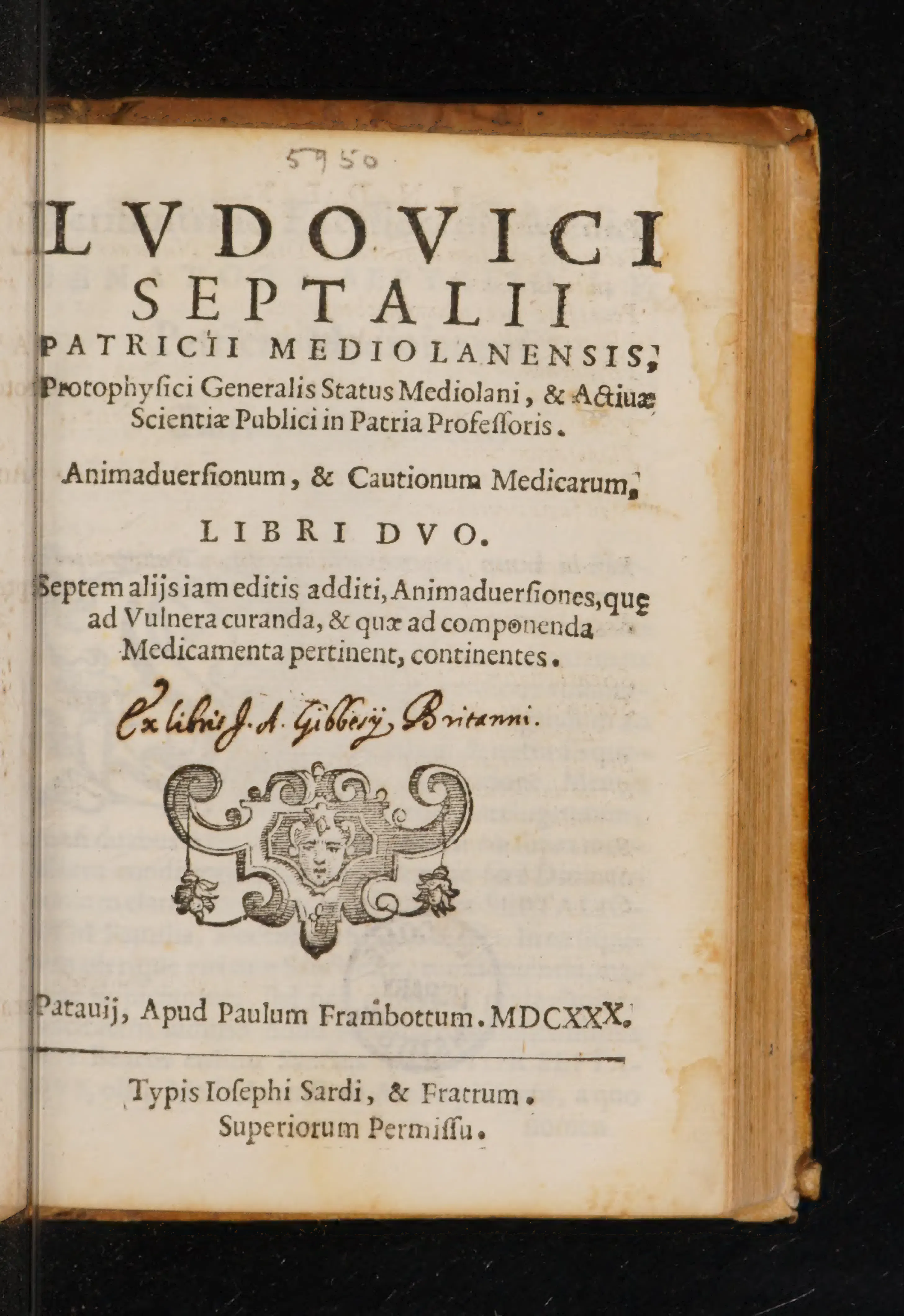
Office and method are inseparable here: “Protophysici Generalis Status Mediolani” stands above “Animadversionum, & Cautionum Medicarum,” and “Septem aliis iam editis additi” frames the two books as additions to a growing series. The imprint names Paolo Frambotto and the Sardi press, with “Superiorum Permissu”; a later hand records ownership. Source ↗.
The first term that requires philological unpacking is animadversio. In classical and late-medieval Latin, animadversio denotes a turning of the mind toward an object (animum advertere), and thus an attentive observation or critical remark; in the technical language of the schools it came to designate the corrective note of a master or censor. Settala's choice of the word does double duty: it places the volume in the humanist tradition of learned marginal and corrective writing—precisely the genre in which textual scholars from Poliziano to Manuzio had intervened against the corruption of ancient texts—and it claims for the Milanese protophysico the magisterial authority of the learned censor. The paired term cautio adds a second register: in legal and medical Latin alike, cautio is a warning, a safeguard, or a precautionary instruction. Settala thus presents himself simultaneously as philological critic and as regulatory inspector, intervening upon received practice by reasoned correction and by binding safeguard. The two words together constitute a genre declaration that is neither treatise nor consilium in the technical sense, but a hybrid form suited to a learned official who acts both as scholar and as magistrate of the medical profession. The book states that declaration in its own words in the ninth book, since our purpose in this book is not to give you a complete antidotary, but animadversions, in our usual manner, on the common way of compounding medicines, Cum institutum nostrum sit in hoc libro non Antid rium integrum vobis dare, sed animaduersiones alic more nostro circa communem componendorum med mentorum modum — the phrase more nostro, "in our usual manner," marking the selectivity and reactivity of the form as a settled habit rather than an expedient.
The second cluster of terms concerns office. On the title-page Settala styles himself Protophysicus Generalis Status Mediolani — Protophysician General of the State of Milan — and this designation is not merely honorific. The Milanese protomedicato was, by the early seventeenth century, a mature jurisdictional regime in which the protophysico exercised visitation over apothecaries' shops (pharmacopolia), licensed practitioners of physic and surgery, and the preparation of compound medicines within the territories of the Spanish crown in Lombardy. David Gentilcore's comparative study of the Italian protomedicati establishes that the Milanese office, although it shared features with Neapolitan, Sicilian, and Roman analogues, was distinguished by its particular entanglement with the Collegio dei Nobili Fisici and with the administration of the Ospedale Maggiore. Settala's claim to the title in 1630 therefore situates his surgical and pharmaceutical corrections not within the academy or the private consultation chamber alone, but within an active jurisdiction: the animadversions upon wound-dressing and upon Mesue's pills are at once literary interventions and official acts of surveillance over practice. The text itself derives its authority from the royal commission in exactly these terms, invoking the duty of Protomedicus imposed upon him by his most powerful King and Lord, quo per munus mihi à Potentissimo Rege & Im mino meo Protomedici impositum, where munus carries its full weight as a public charge rather than a private distinction. The title-page's proximity of Protophysicus to Animadversiones thus performs the conceptual fusion that the book enacts.
The third lexical field belongs to the doctrine of wound healing and is technical rather than titular. The eighth book's central therapeutic claim is that the natural agent of consolidation is the innate heat of the body, calor naturalis, and that the indispensable condition of its operation is the integrity of the tegumentum — the covering, whether natural skin or applied dressing, that conserves that heat. This is not merely physiological vocabulary. Calor naturalis in the Galenic-Aristotelian tradition is the instrument of the vegetative soul, the active power by which the body nourishes itself, concocts humors, and welds its broken continuity; it is a principle whose disturbance is itself a cause of disease. Tegumentum in this context names whatever preserves that principle from dissipation, and the term appears in the book's own definition of the newer surgical practice: the other method is new, born in our times, wandering through many places of Italy and there received, in which wounds are rarely uncovered or unbound, they are cherished with a covering and quickly cured without any use of tents or pledgets, Alteram nouam, nostris temporibus natam, per multa iam Italiæ loca vagantem, ac receptam, in qua rarò deteguntur soluunturue vulnera; tegumento fouentur, & citò curantur sine vllo turundarum spleniorumue vsu. The practical corollary, which the book develops at length, is that the surgeon who repeatedly lifts and replaces dressings, who tents cavities with turundae, and who lays on harsh or greasy splenia, obstructs the very operation of nature that he claims to assist. Underlying this is a hierarchy of agency stated as a formal principle, since nature is the healer of all diseases, the physician her minister, and medicaments her instruments, cum natura omnium morborum sit medica, Medicus minister, & medicamenta instrumenta — the vocabulary of natura medica and medicus minister being the common Galenic inheritance from which both parties to the dressing controversy drew. The pairing of these terms therefore carries an implicit polemic: the traditional surgical dressing is redescribed as an obstacle to the natural healer, and the physician who prescribes rest to wounds is shown to be obeying the same logic that the protophysico obeys when he regulates apothecaries — the logic of removing what hinders and conserving what conserves.
The final term, naevus, belongs to the appended treatise and requires a brief but careful unpacking of its own. In ordinary Latin naevus names a bodily mark, mole, or birthmark, and it can carry connotations of disfigurement or blemish; but Settala's treatise recasts the mole as a signum naturale, a natural sign whose form, position, and coloration are taken to indicate correspondences between the microcosm of the body and the macrocosm of the heavens, and between the proportions of the human face and the canonical proportions of Vitruvian and Pythagorean geometry. The governing claim is one of paired correspondence within the body itself — a thing indeed wonderful, but nonetheless certain: the mole which is seen on the forehead has its companion, as it were its comrade, in the thorax, Res profectò mira, sed tamen certa: Nævus, qui in fronte conspicitur, comitem, & velut sodalem, suum in thorace habet — the diction of comes and sodalis naturalizing the relation as companionship rather than portent. The shift from naevus as flaw to naevus as sign is not a merely lexical curiosity; it reflects the early modern recomposition of the body as a legible text, in which the physician and the natural philosopher share the task of reading what nature has written. The disclaimer that closes the treatise — declaring that in this explanation of moles he wished to engage not as an astrologer, but as a philosopher, non tamquam Astrologus, sed tamquam Philosophus versari voluerim — marks the boundary within which the sign remains natural and does not become judicial-astrological, and it thereby secures the treatise's claim to belong to natural philosophy rather than to the divinatory arts that the protomedicato was institutionally engaged in policing.
What the 1630 Paduan Volume Contains: Wounds, Compound Medicines, and the Treatise on Moles
The 1630 Paduan volume is a Neo-Latin medical treatise by Ludovico Settala (Milan 27 February 1552 – Milan 12 September 1633), who from 1628 held the office of Protophysicus Generalis Status Mediolani under Philip IV of Spain. Its full title announces two books of Animadversiones et cautiones medicae — Septem aliis iam editis additi — added to seven previously published books. Book VIII treats the cure of wounds; Book IX treats the compounding of medicines. Together they stage a learned physician's interventions in received surgical and pharmaceutical practice: a defense of the dignity of manual operation in wounds, an extended polemic against the routine dressing, tenting, and probing of wounds in favor of rest, and a numbered series of cautions on simple wounds, wounds with cavities, nerve injuries, and head wounds with trepanation. The eighth book organizes itself around an explicit division of the field, observing that in these our times there is a twofold and mutually most opposed method of curing wounds, one ancient, which Hippocrates, Galen and all the other chiefs handed down, Vulnerum curandorum rationem duplicem esse, & maximè inter se opposiram temporibus ijs nostris animaduerto; Antiquam vnam, quam Hip. Gal. & reliqui omnes, and its criterion of judgement between the two is stated as a triad of therapeutic goods — that hereafter all mortals may know this to be the true way of curing all wounds, and above all those of the head, namely that by it men are brought to health safely, quickly and pleasantly, the three things to be sought in every method of healing, vt in posteru[m] mortales omnes cognoscant, veram hanc esse vulnerum omnium, potissimum autem capitis, curandi rationem: quod per illam tutò, citò, & iucundè, quæ tria in omni medendi ratio ne procurari debent, homines ad sanitatem deducantur, the formula tuto, cito, iucunde being a commonplace of the Galenic therapeutic tradition here made to serve as a test of competing methods. Book IX turns from surgery to pharmacy, opening with the metaphysics of mixture and the substantial form of a compound, then descending through canons for the collection, washing, decoction, and trituration of simples before issuing specific animadversions on Mesue's pills, syrups, and decoctions and on contested simples including doronicum, opium-bearing electuaries, Arabic drug nomenclature, New World balsams, and chermes versus cochineal. Its occasion is the duty of shop visitation, of which the chief part was the visiting of the apothecary shops of this whole province, in which, since the apothecaries have no fixed Antidotary to follow, they fall into many errors, quæ illud erat præcipuum visitandi Pharmacopolia totium huius prouinciæ; in qua cum pharmacopolæ nullum certum, quod sequantur, habeant Antidotarium, in multos errores.
The volume's third component is a separately titled treatise, De naevis liber, first printed at Padua in 1628 by the press of Giovanni Thuilio and sold at the same Frambotto bookshop. Its inclusion in 1630 is therefore an act of reissue or of bookseller aggregation rather than of authorial pairing at the moment of original composition; a surviving Pisa composite binding demonstrates that the two were physically bound together at least by the late 1620s, but the imprint and title-page sequence establish that the De naevis had an independent publication history of its own. The treatise reads the bodily mark (naevus) as a natural sign — a legible inscription of microcosm-macrocosm correspondence, of planetary and zodiacal melothesia, of Pythagorean-Vitruvian facial proportion with the hand as canon — and closes with an explicit disclaimer that such indication does not amount to judicial-astrological determination of destiny. Its author presents the undertaking as unprecedented, announcing that he has come forward into this arena too, to sift a matter difficult by nature, useful to know, pleasant to hear, hitherto treated by no one, Quare in hanc quoque arenam prodii, rem aliquam natura sua difficilem, scitu utilem, auditu jucundam, nulli hactenus pertractatam — a claim of novelty that should be read in the context of an already crowded physiognomic literature, and one that carries over into the De naevis the same criterion of the useful and the pleasant that governs the surgical books.
The treatise is in Latin throughout. The technical vocabulary draws upon the standard Hellenistic and Arabic-Latin pharmaceutical nomenclature of the late Galenic tradition — theriaca, philonium, rob, alkitram, doronicum, symphytum, consolida, turunda, splenium, modiolus, terebratio, calor naturalis, tegumentum — and incorporates vernacular and Arabic-derived terms (papaver, piper, chermes) where the Arabic-Latin lexicographers had not stabilized a form. No modern translation into English, Italian, French, or any other modern European language has been located in the consulted catalogues and digital repositories, and the absence is an absence of located evidence rather than a proof that none exists.
Where Settala's Animadversions Stand in the Historiography of Italian Medicine
The 1630 Paduan volume matters to modern scholarship as a node where several distinct historiographical currents intersect, and its scholarly significance is best read through those currents in turn. Across all of them the same movement recurs: a custom is measured against demonstrated cause or recovered text, and the verdict is then given the force of a rule by the authority of office.
First, the text sits at the center of the early seventeenth-century Italian debate over the dignity of surgery and the relative authority of physic and the manual arts. Settala's defense of operative wound care, articulated by a learned physician addressing learned readers while deliberately taking responsibility for surgical practice, exemplifies the late-Humanist and Counter-Reformation argument that the dignity of an act is determined by its end (the health of the body) rather than by the manual character of its execution. That argument is made in the book's own prologue in teleological form: but if the physician's end, which is health — the source from which the excellence and nobility of anything must be drawn — be considered, no one would ever assert that manual work detracts from his dignity, sed si finis medici, qui sanitas est, vnde rei cuiusque præstantia, & nobilitas de sumi debet, consideretur; nunquam quispiam affirmauerit,. This is the same argumentative structure that Girolamo Mercuriale, Fabricius ab Aquapendente, and the surgical writers of the Paduan academic sphere had been refining since the 1570s, and the Settala text can be placed as a Milanese counterpart to their work — distinct in genre but parallel in argumentative strategy.
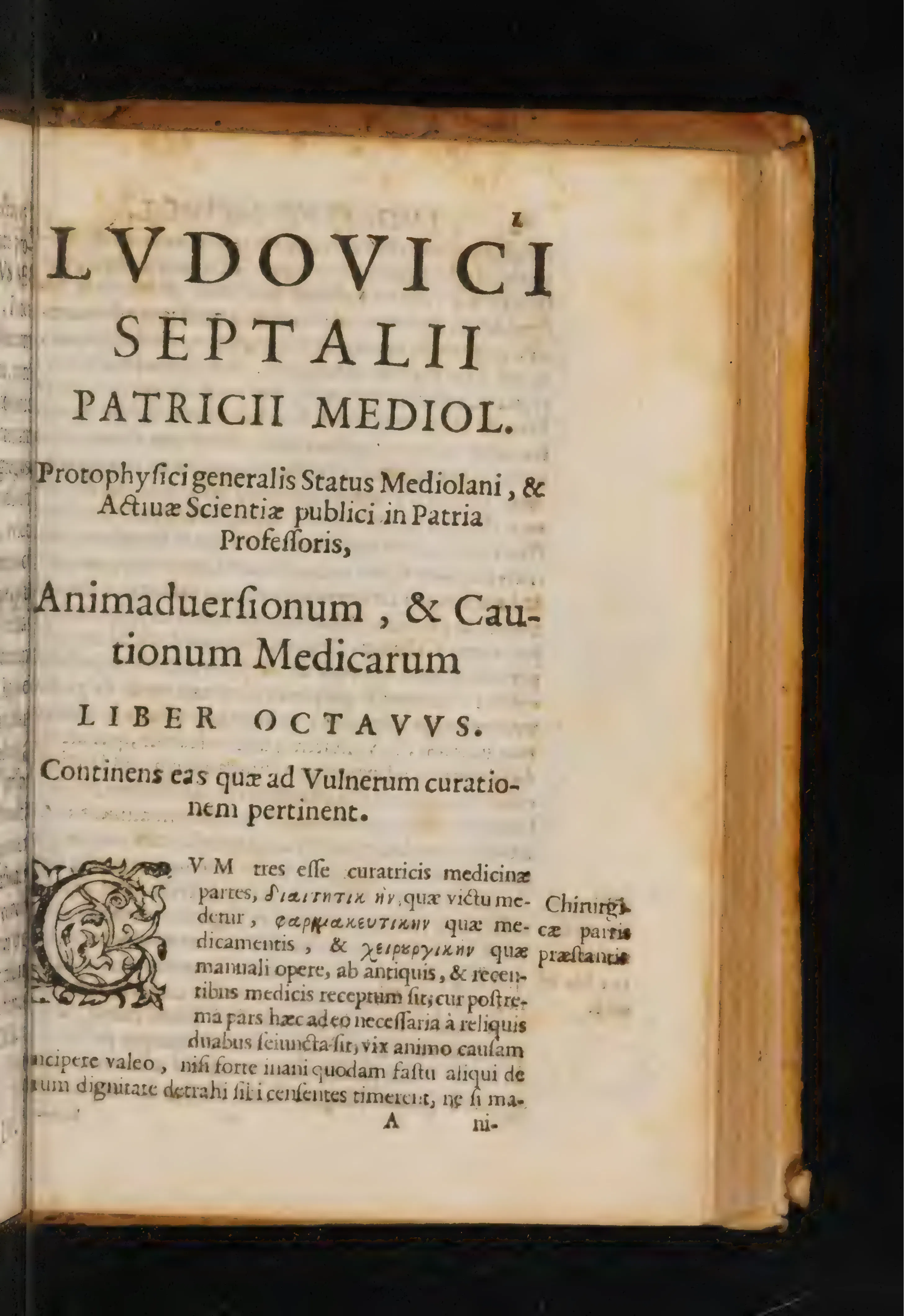
The internal title page of Book VIII sets the credential in large type—“Protophysici generalis Status Mediolani”—above the subject, “Vulnerum curationem,” the cure of wounds. Title block and opening initial together stage the prologue's claim: operative wound care, however manual, belongs to learned medicine because its end is health. Source ↗.
Second, the book is the principal Milanese witness to the controversy over rare dressing (rara medicatio vulnerum) initiated by Cesare Magati's De rara medicatione vulnerum of 1616. Patrizia Fughelli's reconstruction of the dispute establishes that Magati's challenge to frequent dressing, splenia, tents, and pledgets provoked a multi-decade controversy involving hospital surgeons, academic physicians, and protomedici. The Magati literature is the indispensable entry point into Book VIII of the 1630 volume: Settala is one of the named antagonists on the conservative side, and his argument that the surgeon who frequently lifts dressings obstructs the natural heat (calor naturalis) and its protective covering (tegumentum) is the Galenic-Aristotelian framing against which Magati's empirico-religious appeal to natura medicatrix was directed. It should be registered that the text as it stands does not present rare dressing merely as an opponent's position: it describes the newer, seldom-unbound method as already received through many parts of Italy, and the eighth book's polemical energy falls upon tents and pledgets rather than upon rarity of dressing as such. The evidential warrant offered for that stance is institutional and quantitative in character. Settala grounds it in his hospital service, in this Great Hospital of ours, in which for forty years I have devoted myself to healing the sick, In Magno hoc nosvaletudinario in quo per annos quadraginta medendis gris operam dedi,, and he stakes the claim on a counted and sworn outcome, calling God to witness, and the most illustrious governors and all the officers who are still alive, that of fourteen men wounded in the head only one died, testor Deum, & præfectos viros per illustres, & minuistros omnes, qui adhuc viuunt ex quatuordecim vulneratis in capite, vnum solum iuterijsse; — an oath formula that recruits the juridical apparatus of testimony into a therapeutic argument, and that names the hospital's own officers as the witnesses competent to confirm it. The Magati–Settala exchange is the most fully documented Milanese episode in the historiography of the rare-dressing controversy.
The same book supplies one of the period's more pointed critiques of cranial surgery, and it belongs to this current as well. Settala rebukes those who at the slightest suspicion of gathering matter descend to this operation, exercising themselves in it as if they were boring some earthen or clay pot to mend its broken parts, qui in leui qualibet colligendæ ma[teri]ariæ suspicione ad operationem hanc descendunt, in ea se exercentes, ac si ollam aliquam terream aut fictilem resarciendas disruptas partes perforarent:, the potter's simile reducing the trepanned skull to an artefact under repair and thereby denying the operator any share in the natural agency that the treatise reserves to natura medica. The consequence is stated as an estimate of harm, that he greatly fears that no fewer die from this operation, even when correctly performed, than from the wound itself, maximè verear ne non pauciores ex hac operatione etiam pe rectè exercita moriantur, quam ex ipso vulnere — a judgement notable for conceding the competence of the operator while indicting the operation, and one that historians of early modern terebratio may set beside the technical apparatus of modiolus, serrata terebra, and scalprum rasorium that the book also describes.
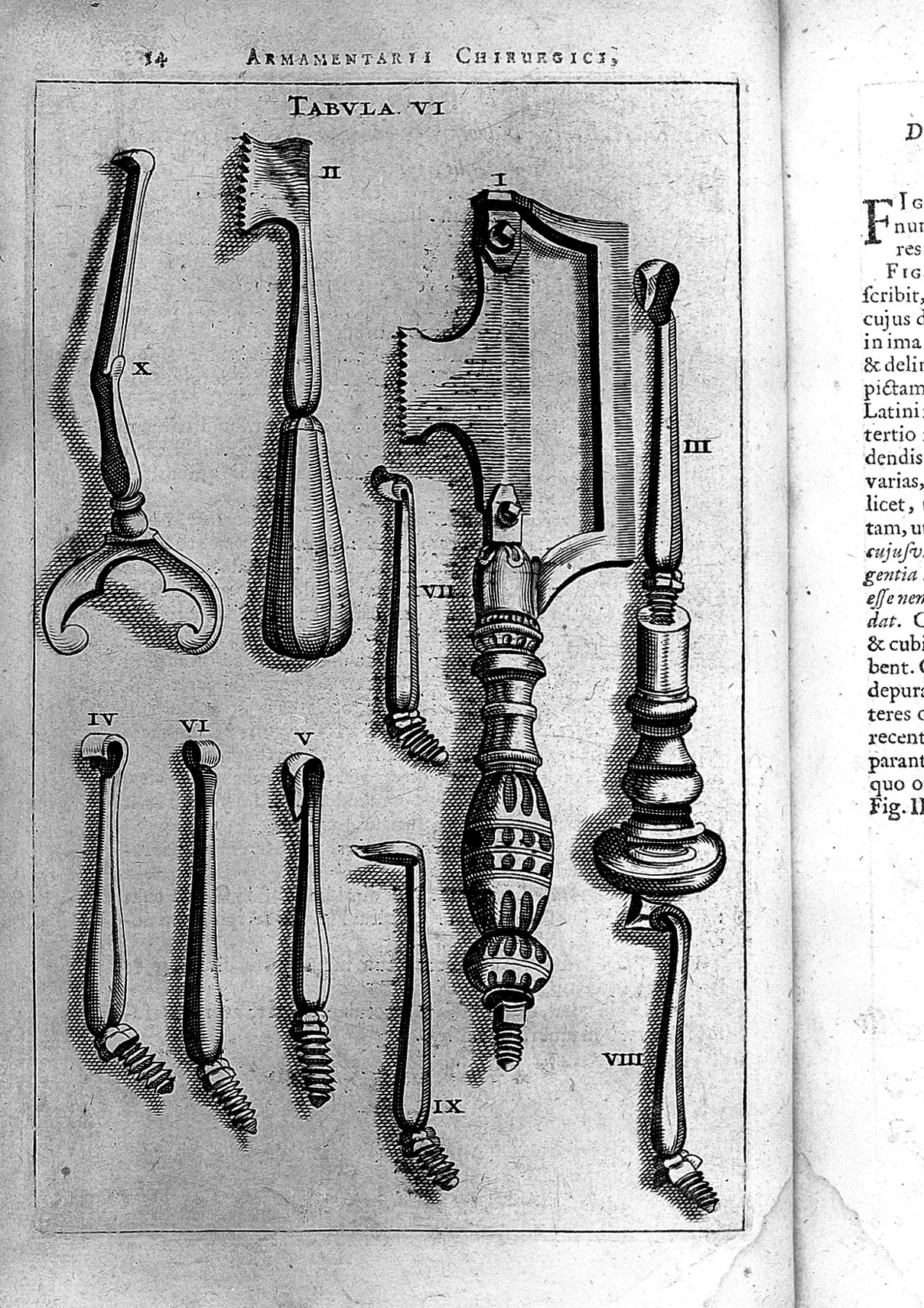
A plate from Johannes Scultetus's Armamentarium chirurgicum, printed a generation after Settala, displays the drills, trepans, and retractors of seventeenth-century surgery—the instrument culture behind the modiolus and serrated trepan. Its orderly confidence is what the eighth book qualifies, warning that cranial boring could rival the wound in lethality. Source ↗.
Third, the text is a primary source for the history of the Milanese protomedicato and its exercise of jurisdiction over apothecaries. David Gentilcore's Medical Charlatanism in Early Modern Italy (1998) and his article on protomedici situate Settala as the most prominent protofisico of the duchy under Spanish rule, appointed by Philip IV in 1628, and they use his published work as evidence for the way in which learned physicians used the printing press to extend the regulatory reach of their office beyond personal visitation. The 1630 volume functions as a written extension of the protofisico's inspection of apothecary shops: each animadversion upon a Mesue preparation or a contested drug name is also a public correction of a professional practice. The text derives the ninth book directly from that duty, declaring that to meet this inconvenience, in accordance with the office of Protophysicus imposed on him, he adds these animadversions, cui incommodo, vt occurramus pro minere imposito Protophysici,, and it identifies the inconvenience as a structural vacuum rather than individual incompetence: in this Dominion of Milan, the apothecaries as yet have no certain antidotary which they must necessarily follow, & in Dominio hoc Mediolanensi vt pharmacopolæ, postquam nullum adhuc certum Antidotari habeant, quod sequi necessario debeant. The projected remedy — a novum Antidotarium Mediolanense on the model of the Bergamask, Roman, and Augsburg antidotaries — remains a stated intention within the text rather than an accomplished instrument, and the animadversion is offered as what can be issued in its absence. Gentilcore's framework allows the volume to be read not merely as a learned miscellany but as an instrument of medical governance, and it also accounts for the recurrence of financial motive in the polemic: of the pledget-packers Settala remarks that this does not displease some, for while they fill the wound with pledgets they empty the purses of the sick, quod tamen aliquibus non displicere video dum enim splenijs vulnus replent ærorum crumenas exhauriunt, an imputation of avarice that assimilates bad surgery to the fraud the protomedicato existed to suppress.
Fourth, the book contributes to the historiography of Renaissance and early modern materia medica and pharmaceutical humanism. Valentina Pugliano's work on pharmacy, testing, and the rhetoric of truth in sixteenth-century Italy (Bulletin of the History of Medicine, 2017) provides the methodological model for reading the long sections on doronicum, opium preparations, Arabic drug nomenclature, and the New World balsams. Pugliano argues that early modern pharmacists and physicians used philological, sensory, and regulatory evidence in combination to establish the identity and virtue of drugs, and her framework clarifies why Settala's animadversions on Mesue proceed through a layered argument from textual criticism to physical observation to institutional correction. The layering is visible in the book's own statements of principle. Its editorial rule is conservative — his opinion has been that the ancient readings of writers are never to be altered, nor judged corrupt, unless it has been manifestly discovered that they contain something false, Sed hæc mea fuit sententia, nu[m] m variandas esse antiquas scriptorum lectiones, aut vis censendas, nisi falsi aliquid continere manifestè comerimus — and its recovery programme is Galenic and ad fontes, leaving the muddy streams and drawing from the true fountain, turbidis igitur ruiis omisis ex vero fonte io hauriamus, the metaphor of fountain and turbid stream being the standard humanist figure for the priority of the Greek source over Arabic-medieval mediation. Where lexicography can settle a question it is invoked, as when a predecessor is said to have been deceived by the error of Matteo Silvatico, who at chapter 322 held that Harmel, written with the aspirate among the Arabs, meant something other than it does, deceptus errore Matthæi Syluatici, qui c. 322. per Harmel cum aspiratione scriptum apud Arabes censuit. Where it cannot, jurisdiction supplies the deficiency: on the crux of papaver against piper in the Philonium Persicum, the ruling is territorial rather than philological — it will be better that in this Milanese province committed to our care we should have the Philonium Persicum made with twenty drachms of white poppy seed, præstabit in nost hac Mediolanensi prouincia curæ nostræ commissa, Ph lonium Persicum habere ex viginti drachmis seminis paueris albi;. The pharmacological reasoning is likewise attentive to the species-relativity of virtue and harm, adducing that nature differs from nature, and food from food, as Hippocrates said in the book On Breaths: aloes kills the fox, not man; nux vomica is deadly to cats, mice and birds, to us a healthful medicine; hemlock is food for starlings, poison for us, differt natura à natura, alimentum ab alimenebat Hip. lib. de flatibus. Aloe enecat vulpem, non nem. Nux vomica feles, mures, & aues, nobis est salumedicina; sturnis cicuta est cibus, nobis venenum. The volume is also relevant to the history of the confrontation between Galenic polypharmacy and Paracelsian or spagyric chemistry; the ars spagirica is named among the book's topics of drug connoisseurship, but a documented direct engagement with Paracelsian doctrine as such has not been established for the 1630 text.
Fifth, the appended De naevis opens a window onto the historiography of physiognomy, microcosm-macrocosm correspondence, and the policing of astrology. The treatise reads the bodily mark as a natural sign participating in cosmic sympathies, while explicitly disclaiming astral determinism — a careful demarcation that maps onto the boundary work documented by historians of Renaissance science between natural philosophical sign-reading and judicial astrology, which the Milanese protomedicato was institutionally engaged in suppressing. Its cosmological warrant is stated through the figure of divine cartography: like a skilled geographer, God willed to describe that great and admirable mass on a tiny map, that is, in man himself, quasi peritus Geographus, in exiguâ tabulâ, id est, ipso homine magnam, ac admirabilem illam molem describere — the parvus mundus rendered not as a poetic conceit but as a claim about the legibility of a deliberately drawn correspondence. The treatise also anticipates professional disdain for its subject, its author fearing that anyone summoned to the inspection of moles may turn away his eyes as from a vile thing, ad Navorum inspectionem vocatus accesserit, ut avertat velut à re vili oculos, a defensive gesture that itself testifies to the contested standing of physiognomic inquiry within learned medicine. The treatise can be read alongside Giambattista Della Porta's De humana physiognomonia (1586) and the wider Renaissance physiognomic tradition, though the specifically Settalan historiography remains thin.
Sixth, the volume belongs to the broader historiography of the Milanese Ospedale Maggiore (Ca' Granda) and of Milanese medicine under Spanish rule. The plague of 1629–1631 in Milan — the historical setting of Manzoni's I promessi sposi — frames the volume's publication, and Settala's earlier De peste et pestiferis affectibus (1622) is the immediate textual antecedent. Settala appears in the standard Italian histories of Milanese medicine and in the Dizionario Biografico degli Italiani entry, but a dedicated monograph-length study of his Animadversiones does not appear to exist in the consulted literature.
The scholarly terrain on which the volume now sits is therefore one in which Italian surgery, hospital medicine, pharmaceutical humanism, medical governance, and the policing of astrology are active fields, each with substantial specialist literatures, but in which a sustained Settala-specific scholarship remains underdeveloped. The principal scholarly debate most directly engaging the text is the Magati controversy, reconstructed principally by Fughelli; the principal historiographical contribution is Gentilcore's reconstruction of the Italian protomedicati; and the principal methodological model for reading the pharmaceutical sections is Pugliano. Where these literatures disagree, it is generally over the chronology and geography of medical humanism (court vs. university, north vs. south) and over the question of how thoroughly the protomedicato actually regulated practice on the ground rather than on paper — a question on which the volume is itself a witness of a particular kind, since it repeatedly records the gap between the standard an officer may pronounce and the standard the shops in fact observe.
Tracing the Editions: From Seven Books at Milan to Nine Books at Padua
The textual history of the Animadversiones series falls into three principal stages: an initial seven-book state, a transitional nine-book state achieved through the 1630 Paduan printing that is the subject of this study, and a later collected nine-book state issued in the mid-seventeenth century. The accretive form is not incidental to the work's doctrine but consonant with it: the eighth book states as a general principle that the arts are perfected by additions, and that the first discoverers did not find out everything, though they found the principles, Artes enim perfectæ per additamenta: nec primi omnia inuenerunt, quam principia inuenerint — the doctrine of additamenta that the title-page formula Septem aliis iam editis additi enacts bibliographically, and that stands in deliberate tension with the strict conservatism the same author professes toward the wording of ancient texts.
The earliest known appearance of the series is the seven-book Animadversionum et cautionum medicarum libri septem, printed at Milan by J. B. Bidellius in 1626 (some catalogue entries give 1627). A Wellcome Collection record describes this Milanese edition as consisting of two parts in 16mo. This Milanese seven-book issue was followed by a Paduan re-issue of the same seven-book text in 1628, printed ex typographia Io. Thuilii, prostat apud Paulum Frambottum. The Pisa copy (shelfmark IT-PI0112 FEROCI a. 64. 1) is bound with Settala's separately titled 1628 De naevis liber, and the catalogue note explicitly records the composite binding, supplying the strongest direct evidence that the De naevis circulated as a physical companion to the seven-book Animadversiones already in 1628. The Paduan imprint places the book's production within a recognizable Paduan publishing nexus in which Giovanni Thuilio served as printer and Paolo Frambotto as bookseller.
The 1630 Paduan printing now under study adds two new books — Book VIII on wounds and Book IX on pharmaceutical compounding — to the existing seven, producing a nine-book volume. The imprint names Paolo Frambotto as the bookseller at whose shop the volume was available, and Joseph Sardi and his associates (Typis Iosephi Sardi, & Fratrum) as the actual printers. The title-page carries the formula Superiorum Permissu — the standard declaration that the volume had cleared civil or ecclesiastical censorship — but no separate privilegium, formal approbatio, or named licensor has been located. The Wellcome catalogue describes the 1630 volume as 8vo, with two unnumbered preliminary leaves, 212 numbered pages, and sixteen unnumbered pages; the Wellcome copy is also noted for portions of type running into the gutter and for some text printed askew — material evidence of a hurried print run rather than a deluxe production. The compass of the added books is itself a matter the author addresses: he defends compression on the ground that in so numerous a throng of medicaments, moderation of words is preferable, and the matter should rather be pressed into brief sentences, medicamentorum turba, potior est verborum moderario, breuibusque sententijs res potius premenda videtur, the aphoristic sententia being offered as the form proper to a subject too vast for systematic treatment. An address to the well-disposed reader intercalated between the two books records that projected further books on ulcers and tumours were abandoned, the author pleading the burdens of office, his seventieth year, the demands of consultation, and his lectures on Aristotle; the nine-book state is thus presented within the work as a curtailed rather than a completed programme. The 1630 volume closes with an alphabetical index to Books VIII and IX keyed by book and paragraph.
The 1630 volume carries a dedication by Paolo Frambotto to a Senator Septalius described as the author's son and a member of the Milanese Senate. The dedicatee has not been securely identified with any historically documented son of Ludovico Settala in the consulted literature; the genealogical identification is therefore left open. The appended 1628 De naevis liber carries a separate dedication by the bookseller to Johannes Rhodius (Johan Rhode, 1587–1659), the Copenhagen-born physician and philologist resident in Padua, whose Paduan career has been reconstructed by Snorrason. The 1628 De naevis also has its own Index rerum, preceded by an address to the curious reader. That both dedications are the bookseller's rather than the author's is consistent with the Milanese-Paduan division of labour visible throughout the volume's production: the text is the work of a Milanese officer, its publication the enterprise of a Paduan trade.
Two later printings complete the known transmission of the text. A 1650 Dordrecht issue is described by Wellcome and by a Books LLC reprint notice as Animadversionum, Et Cautionum Medicarum Libri Novem.
Following Settala's Argument: From the Dignity of the Hand to the Reading of Moles
The dignity of manual operation and the criterion of judgement
The eighth book opens not with a wound but with a grievance about status. Settala divides the curative part of medicine into regimen, medicament, and manuale opus, and asks why the third and most necessary member has been severed from the other two; the answer he suspects is social rather than doctrinal, a fear among learned physicians of being reckoned among the operarii, the men who work with their hands. The rebuttal is teleological in the strict Aristotelian sense, and it is the argument from the physician's end already noticed above: since health is the end from which the excellence and nobility of anything must be drawn, no one could maintain that the means by which health is introduced detracts from the physician's dignity. The argument does not elevate surgery as a craft; it dissolves the distinction between hand and precept by making both instruments of a single finis. That move licenses everything that follows, for it permits a physician who holds a magistracy over practitioners to legislate on bandages and trepans without descending from his own order.
The criterion by which the book will judge between rival practices is announced immediately, and it is a criterion of effect rather than of pedigree: the claim, discussed above, that hereafter all mortals may know the true way of curing all wounds, and above all those of the head, to be the way by which men are brought to health safely, quickly, and pleasantly. The triad tuto, cito, iucunde is a Galenic commonplace, but its deployment here is polemical: a formula that ordinarily describes the physician's obligation is converted into a test that an inherited consensus can fail. Against the ancient practice of opening wounds once or twice daily and repacking them with linamenta, penicilli, turundæ, licinia, splenia and the workshop's vernacular faldellæ, Settala sets the rival method characterized earlier in this report as new, born in his own times, wandering through many places of Italy and there received, in which wounds are rarely uncovered or unbound but cherished beneath a covering and cured without tents or pledgets. The participle vagantem in that description is worth pausing over: the method travels of itself, is recepta by those it reaches, and thus arrives already possessed of a kind of consensual authority independent of any book — a description of diffusion that a protophysician might equally have used of an abuse requiring suppression, and which here does the opposite work.
The covering, the innate heat, and the ministerial doctrine
The physiological warrant is stated as a settled matter of fact rather than a hypothesis, resting on the substitution of an applied covering for the natural covering that the wound has destroyed: it is agreed that if, with a covering applied to the wound, as we shall say, we cherish the heat of the part, and rarely uncover the wound, nature is the more cherished and its heat conserved, Constat autem si tegumento, vt dicemus, vulneri apposito, calorem partis foueamus, raroque vulnus detegmus, magis naturam foueri, illiusque calorem conseruari,. Here the tegumentum is not a device but a restitution: the surgeon supplies artificially what the incision removed, and does so precisely in order to withdraw his own agency, since nature is the healer of all diseases and the physician only her minister. The polemic against daily dressing is therefore not empirical opportunism but the disciplined consequence of a ministerial anthropology of healing — every uncovering dissipates the innate heat, multiplies excrement, and interrupts a work not the operator's own.
Doctrine so derived still requires warrant in the order of fact, and Settala supplies it from the institution where he had spent his career, invoking the forty years he had given to healing the sick in the Great Hospital of Milan. The claim that follows is quantitative and, more strikingly, sworn: God is called to witness, together with the most illustrious governors and all the officers still living, that of fourteen men wounded in the head only one died. The count is small and the comparison informal, but the epistemic architecture is telling: a therapeutic result is authenticated by the same apparatus that authenticates a legal fact — an oath before God, and living witnesses of standing who could in principle be examined. The governors and officers of the Ospedale Maggiore are named not as colleagues but as competent deponents, and the hospital is thereby made to function as a place where outcomes can be publicly certified rather than merely privately observed.
Additions, pledgets, and the limits of the rule
Because the new method is confessedly new, the objection from silence must be met, and Settala meets it with the general theory of the arts already cited in connection with the volume's accretive bibliographical form: the arts are perfected by additions, and the first discoverers, having found the principles, did not find out everything. The doctrine of additamenta concedes foundational authority to Hippocrates and Galen while reserving the whole field of accretion to experience, and it is the formula that permits a professed traditionalist to defend an innovation without appearing to break with his masters. The polemic then narrows to a single target. Reviewing the eight uses of pledgets catalogued by Guy de Chauliac, Settala reduces the legitimate to three — keeping an orifice patent for manual operation, enlarging access to bone, extracting a foreign body — and imputes to the remainder a motive that is not therapeutic at all, in the charge already registered above that those who fill the wound with pledgets empty the purses of the sick. The antithesis of filling and emptying is deliberate, and it assimilates a technical fault to the species of fraud that the protomedicato existed to punish.
Yet the rule of rare dressing is immediately hedged. The numbered sequence of exceptions — manual operation, change of medicament, spongy flesh, excessive moisture, cacochymia, gangrene and sphacelus, worms, obstructed efflux, inflammation, retained foreign bodies, separated bone, abscess, violent pain, erosion — is long enough to look like an abandonment of the principle, and Settala forestalls the charge by insisting that these arise ob superuenientia symptomata and not from the cure of the wound as such. The distinction saves the rule by relocating its scope: rarity of dressing governs the wound considered in itself, while supervening accidents belong to a different indication altogether. The same disciplining of intervention governs the treatment of the skull, where the reproach falls upon operators who at the slightest suspicion of gathering matter descend to the operation and exercise themselves in it as though they were boring an earthen or clay pot to mend its broken parts. The potter's simile, already noticed above, is precisely calibrated: a vessel has no innate heat and no healing nature, so the man who treats a cranium as earthenware has silently denied the ministerial doctrine on which the whole book rests. The estimate of harm that follows is more remarkable still, conceding technical competence while indicting the procedure, in the fear that no fewer die from the operation, even correctly performed, than from the wound itself. Iatrogenic and natural mortality are here set side by side as commensurable quantities, and the narrated Milanese cases that close the sequence — a girl of the Burri family, an old woman of the Galarati — serve as observationes whose named patrician households function, like the hospital's officers, as guarantors of report.
The intercalated address and the turn to pharmacy
The address intercalated between the two books converts an interruption of the writing programme into a statement of office: the projected cautions on ulcers and preternatural tumours are abandoned for the visitation of the province's apothecary shops, the author's seventieth year, the press of consultations, and his continuing exposition of Aristotle's Moralia and Politica. It closes by making concision a doctrine of genre, in the defence of compression already quoted, that amid so numerous a throng of medicaments moderation of words is preferable and the matter should rather be pressed into brief sentences. The turba of medicaments is met not by system but by sententia, the aphoristic unit proper to an inspector who must correct many things quickly.
The ninth book accordingly declares itself an act of office rather than of scholarship, addressed to the inconvenience of shops without a standard: to meet that inconvenience, in accordance with the office of Protophysicus imposed upon him, and while a Milanese antidotary is being prepared with the consent of the colleges of the other cities, he adds these animadversions. The animadversion is thus explicitly provisional, a stopgap for a normative pharmacopoeia not yet made — which is also to say that its authority derives from jurisdiction rather than from completeness. Within that frame the philological rule is strict, in the maxim discussed above: the ancient readings of writers are never to be altered, nor judged corrupt, unless something false in them has been manifestly discovered. Applied to a dispute over two drachms or twelve of lapis lazuli, the maxim places the burden of proof upon the emender, and it stands in instructive tension with the doctrine of additamenta: practice may accrete, texts may not. The tension is resolved by distinguishing accretion from adulteration, which is why the recovery of Galen's authentic Hiera picra can be framed as a purge rather than an emendation, a matter of leaving the muddy streams and drawing from the true fountain.
Where the argument is pharmacological rather than textual, the reasoning turns on the relativity of virtue to species, as against Mattioli's condemnation of doronicum: nature differs from nature and food from food, as Hippocrates said in the book On Breaths; aloes kills the fox and not man, nux vomica is deadly to cats, mice, and birds but to us a healthful medicine, hemlock food for starlings and poison for us. The examples are traditional, but their function is to deny that a toxic effect observed in one nature may be transferred by analogy to another — a principle that protects a suspect simple from an inference drawn too quickly from experiment. When neither philology nor natural reason can decide, the third instrument is used openly. On the crux of poppy against pepper in the Philonium Persicum, the resolution is territorial and administrative, prescribing for the Milanese province committed to his care a Philonium Persicum made with twenty drachms of white poppy seed. The phrase curæ nostræ commissa does the decisive work: what cannot be established as the reading is nevertheless established as the practice, and only within the bounds of a jurisdiction. From that point the book descends compound by compound — the gem electuaries, the confections, the alkermes, the aromatics, and then the purgatives — each entry a small case in which a text, a sensory judgement, and an officer's decision are made to coincide.

A watercolour portrait of Mesue gives a face to the Arabic-Latin pharmaceutical authority Settala repeatedly weighs against reason, experience, and civic jurisdiction. In the Philonium Persicum and kindred preparations, Mesue is not a source to be copied but a text to be emended into regulated Milanese practice. Source ↗.
Disputation in the compounding room: the alefangine pills
The last movement of the ninth book takes up a technical quarrel over the pilulae alefanginae, and the manner in which Settala conducts it establishes the intellectual protocol of everything that follows. The question — whether aromatics may be committed whole or bruised to a long decoction without loss of their virtue — is first referred to Brasavola's two answers and then confronted with a named modern adversary, for, as he puts it, he sees the most learned Mercuriale disputing against this answer in the third book of the De compositione medicamentorum, chapter ten, Sed doctissimum Mercurialem video aduersus hanc responsionem disputantem lib. 3. de compos. med. cap. 10. The citation by book and chapter, the reproduction of the opponent's own words, and only then the reply: this is the disputational apparatus of the schools carried into the compounding room, and it defines what an animadversio is in practice — not a fresh exposition but a judgement rendered upon an existing dossier of opinions. What is striking is the ground on which the reply is made. Mercuriale had borrowed from Avenzoar and Averroes the case of unbruised barley grains, which are said to retain an attractive faculty through boiling; Settala refuses the analogy not by counter-experiment but by categorial objection, dismissing it as a claim that does not smell of the natural philosopher, nec sapit philosophum naturalem. To assign a vegetative faculty — a power of the living soul — to cinnamon bark long dried and to chips of aloewood is to blur the boundary between what lives and what has been reduced to inert drug substance, and the offence is therefore against the principles of physics rather than against the evidence of the shop. Yet the same paragraph immediately qualifies the authority of general rules, since he judges that in compounding these pills one must depart from the common canon, Censo igitur in his compon dis pilulis discedendum à communi canone. The concession is methodologically revealing: the canons of graduated decoction are upheld as canons and suspended in a particular case because the extraction here aims at earthy and corroborant parts rather than at fiery and volatile ones. Rule and exception are both derived from the same demonstrated cause, which is precisely what distinguishes the corrective observation from the mere recital of custom.
Connoisseurship, labour, and the detection of fraud
The connoisseurship sections that follow turn that philosophical apparatus outward onto the drug itself. Mesue's description of good rhubarb as heavy together with rarity is treated not as a formula to be memorised but as a physical difficulty demanding resolution, and Settala poses it as such: but how can it be heavy together with rarity, since lightness is always wont to be joined to rarity, Sed quomodo graue esse poterit cum raritate; cu leuitas semper raritati iuncta esse soleat. The solution distinguishes porosity — rarity of pores — from the compacted continuity of the substance itself, illustrated from the behaviour of iron slag, and only then returns to adjudicate the old interpreter and Sylvius on the reading of the phrase. The sequence matters: the physics settles the text, not the reverse, and the buyer at the counter is thereby equipped with a criterion that can be applied by hand and eye. The same insistence that the operations of the shop have determinate causes produces the moral edge of these pages, where the labour a preparation demands becomes an object of scrutiny in its own right. Of the threefold sun-imbibition required by the fumitory pills he writes that he sees certain enemies of labour and diligence, unwilling to spend so much time on those imbibitions of fumitory juice. The formulation is deliberate. Imbibitio and insolatio are not ornamental prescriptions but the operations by which the aloe and scammony are brought into union with the juice; skipping them is described as done to the great damage of the sick, and Settala supplies a forensic test — the undissolved grains visible when the mass is cut open — which converts an invisible negligence into a detectable one. Here the genre shows its jurisdictional face: an animadversion that teaches the reader how to catch a bad compounder is functionally an instrument of visitation carried in print.
The section on the trochisks of sealed earth shows the same reasoning defending, rather than correcting, an ancient simplex. Objections that the Lemnian earth arriving from the Ottoman court differs in colour and locality from Galen's are met by an argument drawn from mining practice — that in mines, and sometimes in the neighbourhood or in other places of the same province, new veins are found, so why should the same not happen in medicinal earth, fodinis, aliquando autem in vicinia, aut in aliis locis dem prouinciæ aliæ nouæ inueniuntur, cur idem in terra medicatæ euenire non poterit?. Difference of soil accounts for difference of colour while the virtue remains constant; an empirical regularity from an entirely different art is recruited to preserve the continuity between the ancient drug and the commodity actually purchasable in Milan. The move is characteristic of the whole book's economy: textual fidelity is not maintained by ignoring the market but by finding a natural cause that reconciles the two.
Where no such reconciliation is available, therapeutic indication decides. In the syrups, which are treated in Mesuean order and each as a crux at once textual and technical, the dispute over wormwood is introduced as a question of species, since in the syrup of wormwood they first doubt which kind of wormwood is to be put in, In Syrupo de absintio primum dubitant quodnam entij genus indendum sit. Mesue, Dioscorides and Galen are not harmonised philologically; the conflict is dissolved by splitting the indication, Roman wormwood with honey where attenuation and purgation are sought, Pontic with sugar where the stomach is to be strengthened and the liver unobstructed. Two authorised syrups replace one contested one, and the apothecary is left with a rule that requires him to know why he is compounding before he knows what to put in.
Externals, printing, and the interim rule
The pivot into the externals is marked explicitly — having thus far pursued the animadversions that pertain to compound medicines, Animaduersiones hactenus cum simus prosecuti, qui ad medicamenta composita pertinent — and the order announced is itself an argument, oils first because cerates, unguents and plasters borrow much of their composition from them. The oils bring the commercial dimension of the book to its sharpest point, since the oil-sellers, when they press out oil from unripe olives, are said to deceive in both colour and taste, Quoniam tamen olearij, quod ex immaturis oliuis cum olei exprimunt. Two adulterations are described and their detection taught by absence of limpidity and by a taste sharp rather than austere; the greening of oil in a copper vessel is condemned outright for the harm it works on the sick. The fraud of the vendor and the negligence of the compounder are thus assimilated to one another as failures detectable by the trained senses, and the animadversion functions as a manual of detection for the officer who cannot be present in every shop.
The book closes by stating its own occasion in terms that make the printed volume an instrument of governance. Settala appeals, unusually, to the press history of his own work as evidence of its standing, noting that within the space of thirteen years it has been printed five times, which perhaps has befallen no other book since the invention of printing, vt spatio tredecim norum quinquies sit impressum, quod fortam nulli alii libro post Calcographiam repertam. The claim is not vanity alone: the term Calcographia names the technology whose reach is precisely what makes the animadversion an adequate substitute for personal inspection, and repeated printings are offered as the measure of a corrective actually received. The remedy is nonetheless declared provisional, a road for the apothecaries to walk until either a new Milanese antidotary is instituted or one of those already printed is chosen, donec aut novum Mediolanense stituatur, aut certè ex editis aliquod eligatur. The ninth book thus ends by confessing itself an interim measure issued into a regulatory vacuum, a body of rulings that anticipates the pharmacopoeia it cannot yet promulgate.
The appended treatise on moles
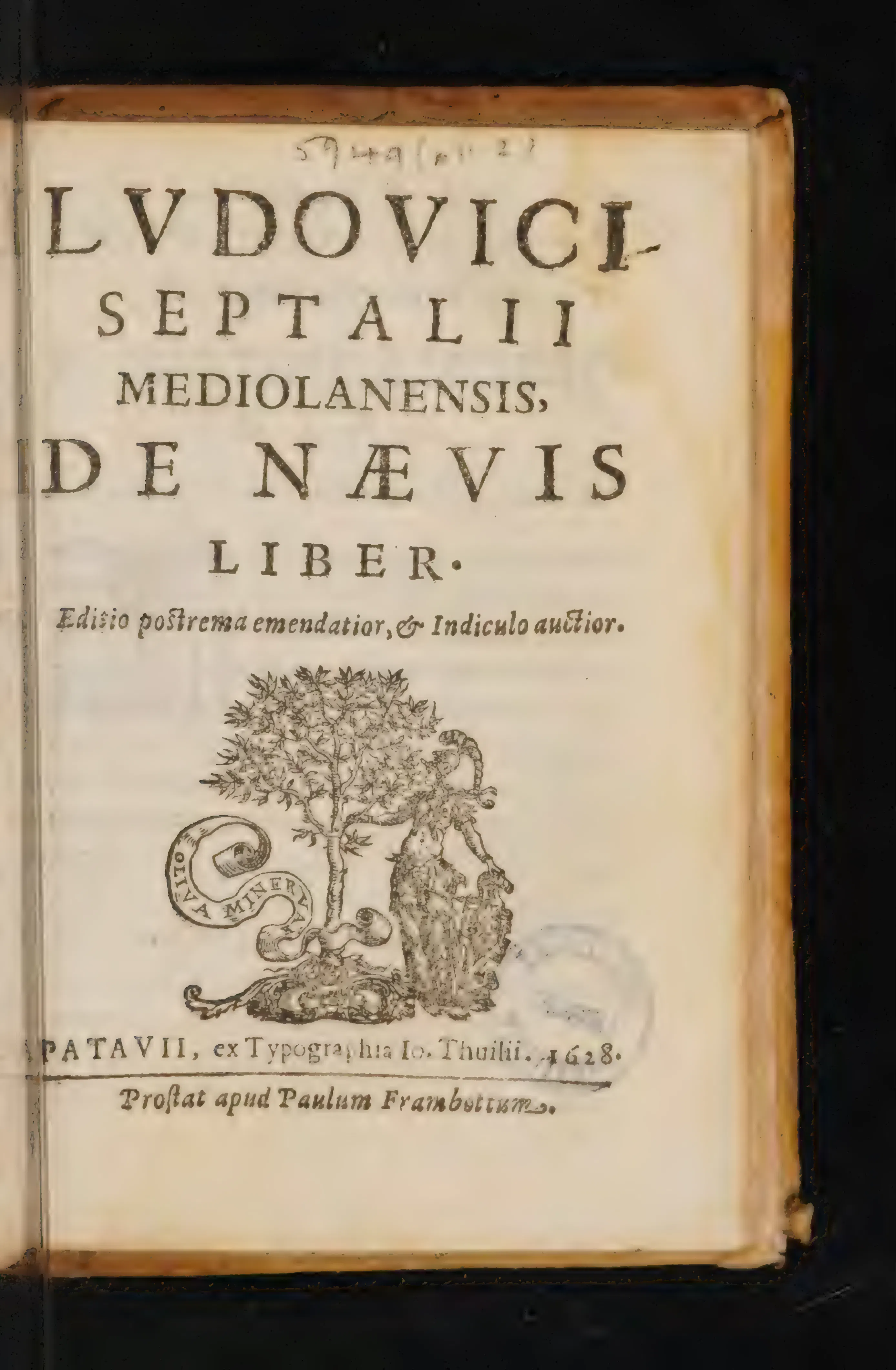
The title page of the De nævis liber, printed separately at Padua in 1628, announces an “Editio postrema emendatior, & Indiculo auctior”—a revised work circulating independently before its place in the composite volume. Its imprint names Giovanni Thuilio and Paolo Frambotto, and its device the motto “OLIVA MINERVAE.” Source ↗.
The separately titled treatise on moles that follows in the same volume transfers this discipline of legible correspondence from the drug to the body's surface, and it opens with the claim of priority already quoted above: he has come forward into this arena too, to sift a matter difficult by nature, useful to know, pleasant to hear, and hitherto treated by no one. The triad of the difficult, the useful and the pleasant is the same criterion of therapeutic goods redeployed as a criterion of subject matter, and the priority claim is qualified within the treatise itself by the admission that Melampus and Abenragel had written something, but without causes — the supplying of causes being exactly what converts a collection of signs into philosophy. The generative rule is announced with a rhetorical flourish that concedes its own improbability, in the assertion, discussed at the outset of this report, that the mole seen on the forehead has its companion, as it were its comrade, in the thorax, and it is then elaborated laterally and vertically into a full topography linking eyebrow to shoulder, cheek to hip, ear to arm. The vocabulary of comes and sodalis domesticates the relation as companionship rather than portent, and the caveat that non-congenital marks falsify the rules keeps the sign within the order of nature rather than of accident. Where a cause is owed, it is furnished theologically and commercially at once: God, unable to display the whole interior, exhibits a sample, Deus autem mercatorem repræsentare voluit, the merchant who cannot spread out his entire stock. The metrological apparatus that follows subjects this legibility to measure, converting the dignity of the hand — which builds cities, ships and spheres, and writes books — into a canon, since the hand, as it were the office of the whole body, is the measure of the face, Manus igitur veluti totius corporis munus, faciei mensura est, the natural length of the face being the distance from wrist to fingertip. The third analogy, astrological dominion, is handled with visible reserve: Ptolemy is reported as having assigned the right ear, bladder, spleen and bones to Saturn, Hinc quidem Prolomæus aurem dextram, vesicam, splenem, & ossa Saturno attribuit, and the zodiacal distribution follows immediately, but reported doctrine is not the same as professed doctrine. The treatise's insistence that the mole signifies by proportion and similitude before it signifies by planetary rule keeps its sign-reading on the side of natural philosophy, and the reserve with which the melothesia is transmitted is of a piece with the caution the same author exercises when he declines to alter an ancient reading without demonstrated cause.
Frequently Asked Questions
What is Ludovico Settala's Animadversionum, & Cautionum Medicarum Libri Duo of 1630?
It is a Neo-Latin medical volume printed at Padua in 1630, sold at Paolo Frambotto's shop and printed by Joseph Sardi and his brothers, adding an eighth book on the cure of wounds and a ninth on the compounding of medicines to seven books already published at Milan in 1626. The paired title-words declare its genre: animadversio, the corrective observation of a learned master, and cautio, the binding warning of an inspector. Bound with it is a separately titled treatise of 1628, the De naevis liber, on the reading of moles as marks of the body.
Who was Ludovico Settala?
Ludovico Settala (Milan, 27 February 1552 – Milan, 12 September 1633) was a Milanese physician who joined learning to jurisdiction. He served the Ospedale Maggiore for forty years, lectured on Aristotle's Moralia and Politica, published a treatise on plague in 1622, and from 1628 held the office of Protophysicus Generalis Status Mediolani, chief medical officer of the Duchy of Milan under Philip IV of Spain. That office carried visitation of apothecaries' shops and licensing of practitioners, and his two books of 1630 appeared during the Milanese plague of 1629–1631.
Why did Settala condemn tents, pledgets, and hasty trepanation?
Because he held them to obstruct the body's own healing. On his Galenic-Aristotelian account nature is the healer of all diseases, the physician her minister, and consolidation is the work of the innate heat, which an undisturbed covering conserves and every fresh unbinding dissipates. Reviewing the eight uses of pledgets catalogued by Guy de Chauliac he allowed three, and charged that those who fill wounds with pledgets empty the purses of the sick. Surgeons who reach for the trepan at the first suspicion of gathered matter he compared to men boring an earthen pot to patch it, fearing the operation kills as many as the wounds do.
How did Settala resolve disputed drug recipes, such as poppy versus pepper in the Philonium Persicum?
By three instruments in order: textual criticism, natural reason, and, failing both, the authority of his office. His editorial rule was strict — ancient readings are never to be altered unless something false in them has been manifestly demonstrated — and his recovery programme Galenic, leaving the muddy streams for the true fountain. Where the manuscripts would not decide between poppy seed and pepper, he ruled territorially, prescribing for the Milanese province committed to his care a Philonium Persicum made with twenty drachms of white poppy seed. The ninth book was offered as an interim measure, the duchy having no fixed antidotary.
Is there an English translation of Settala's Animadversiones et cautiones medicae?
No modern translation into English, Italian, French, or any other modern European language has been located in the consulted catalogues and digital repositories, an absence of located evidence rather than proof that none exists. Separately, the Leo edition presents the complete transcription of the 1630 Paduan volume together with a full English translation for the first time; that translation is generated by AI. Leo is an effort to make freely available online, at no cost, English translations of every text printed in Latin in early modern Europe between 1450 and 1750.
This report was generated by an advanced AI assistant that conducted deep research alongside an extensive interpretation of the transcribed original text. Every effort has been made to preserve fidelity to the source and to guard against inaccuracy, but corruption in the text recognition process and model hallucination may nonetheless have entered the text. Treat every claim, quotation, translation, and citation as provisional, and verify each against the original source before relying on or citing it.
Critical Further Reading and Contextual Resources
- Fughelli, Patrizia, "Cesare Magati. Spanning over centuries," Medicina Historica: Fughelli reconstructs the polemic between Magati and Settala over rare wound dressing, the controversy that directly provoked the eighth book of the 1630 Animadversiones. The article clarifies the surgical stakes of reducing wound interference, the polemical character of Settala's intervention, and the longer historiographical afterlife of the rare-dressing dispute. It is the most direct modern entry into the surgical milieu informing Book VIII, and it supplies the context in which the eighth book's charge of interested practice — that the packing of wounds with pledgets serves the operator's purse — should be weighed as a move within a professional quarrel rather than as a neutral observation.
- Gentilcore, David, "'All That Pertains to Medicine': Protomedici and Protomedicati in Early Modern Italy," Medical History: This article provides the essential comparative framework for understanding the Milanese protomedicato and the jurisdictional authority Settala exercised as protophysicus generalis Status Mediolani. Gentilcore demonstrates that protomedicati were not uniform institutions but varied significantly across Italian states, preventing any reading of Settala's office as a simple replication of Sicilian, Neapolitan, or Iberian models. The article is indispensable for situating Settala's regulatory pronouncements within Lombard institutional practice, and for making sense of the foil against which the learned officer defines himself when he objects that certain vendors extol their wares with wondrous praises to the sky, like mountebanks and circle-drawing quacks, tanquam Agyrtæ & circulatores miris laudibus ad cælum euehunt — the agyrta and circulator of the humanist lexicon being precisely the figures the protomedicato claimed competence to police.
- Park, Katharine, Doctors and Medicine in Early Renaissance Florence: Although focused on Florence rather than Milan, Park's study of the institutional, professional, and epistemic structures of early Renaissance medicine provides a comparative framework for understanding how physicians articulated learned authority over surgery and pharmacy. Her attention to guild structures, hospital practice, and the boundary between physic and manual operation helps locate Settala's defense of surgical dignity and his regulatory inspection of apothecaries within the broader Italian professional world of which Milan formed a part, and it supplies the institutional background against which the appeal to four decades of service in a great hospital acquires its evidential force.
- Pugliano, Valentina, "Pharmacy, Testing, and the Language of Truth in Sixteenth-Century Italy," Bulletin of the History of Medicine: Pugliano's study of pharmaceutical verification, recipe criticism, and the rhetoric of truth in early modern Italian pharmacy provides the methodological template for reading Book IX's animadversions on Mesue, doronicum, Arabic drug nomenclature, and vessel selection. Her argument that pharmacy was a site where textual authority, sensory testing, and regulatory inspection intersected illuminates why Settala frames pharmaceutical correction as a form of learned truth-telling rather than mere empirical adjustment, and why labour itself becomes an object of moral scrutiny in his prose, as when he complains that he sees certain enemies of labour and diligence, unwilling to spend so much time on those imbibitions of fumitory juice, Quoniam autem video aliquos laboris, & diligen inimicos, ne tantum temporis in imbibitionibus ijs ci fumariæ insumant — the skimped imbibitio standing, in his account, as a species of fraud rather than mere haste.
- Snorrason, E., "Der Däne Johan Rhode in Padua des 17. Jahrhunderts," Medicina Historica Patavina: Snorrason's biographical and intellectual reconstruction of Johannes Rhodius (Johan Rhode) situates the dedicatee of the 1628 De naevis within the Paduan medical-philological community. The study clarifies the philological networks surrounding Settala's Paduan publications and the transregional character of Settala's learned sociability, an indispensable context for the 1630 volume's Milanese-Paduan production axis and for the philological standards of textual conservatism that the ninth book professes.
- Wikipedia, Cesare Magati: A brief but serviceable orientation to Settala's chief antagonist, summarising Magati's career at Ferrara and his objection to frequent dressing changes and the heavy use of ointments. It is the fastest way to fix the outline of the opposing position before turning to Fughelli's fuller reconstruction, and should be treated as a signpost rather than a source of record.