Each of Us a Columbus: Celestino Sfondrati's The Knot of Predestination Untied, So Far as Is Permitted to Human Understanding
Written in the intervals of a fatal illness and printed at Rome in 1696, Cardinal Celestino Sfondrati's Nodus praedestinationis, ex sacris litteris doctrinaque SS. Augustini et Thomae, quantum homini licet, dissolutus takes on the oldest puzzle in Latin theology: how a God who chooses some for salvation can also sincerely will that all be saved and still leave them free. Sfondrati draws on Augustine, Aquinas, Roman law, painting, music and travel lore to argue that grace is offered to everyone and refused only by the human will, and he leaves what argument cannot settle, deliberately, to the secrets of God. The book drew a printed reply within two years, which shows how contentious even a moderate position on grace remained in the decades after the Jansenist condemnations.
ExLatinis
October 6, 2026
Contents
Written in the intervals of a fatal illness and printed at Rome in 1696, Cardinal Celestino Sfondrati's Nodus praedestinationis, ex sacris litteris doctrinaque SS. Augustini et Thomae, quantum homini licet, dissolutus takes on the oldest puzzle in Latin theology: how a God who chooses some for salvation can also sincerely will that all be saved and still leave them free. Sfondrati draws on Augustine, Aquinas, Roman law, painting, music and travel lore to argue that grace is offered to everyone and refused only by the human will, and he leaves what argument cannot settle, deliberately, to the secrets of God. The book drew a printed reply within two years, which shows how contentious even a moderate position on grace remained in the decades after the Jansenist condemnations.
Cardinal Celestino Sfondrati's Nodus praedestinationis, ex sacris litteris doctrinaque SS. Augustini et Thomae, quantum homini licet, dissolutus is a Latin theological treatise. It is recorded as printed at Rome in 1696 by J. J. Komarek. It belongs to the long aftermath of the early modern quarrels over grace, freedom and the divine decree. Its title promises to "untie the knot" of predestination from Scripture, Augustine and Thomas Aquinas, and it adds a qualification that governs the whole enterprise: quantum homini licet, "so far as is permitted to a human being." A place of composition has not been established. No complete translation into a modern language has been verified.
The problem the work confronts is the oldest in Latin soteriology, sharpened by a century and a half of confessional and intra-Catholic conflict. How can the gratuity of election and the sovereignty of God be held together with God's sincere will that all be saved and with genuine human freedom? And how can this be done so that no suspicion falls on God as the author of sin or damnation? Sfondrati's recurring answer is to redefine and redistribute.
- Two wills. He separates an antecedent divine will, universal and efficacious, from a consequent will. Predestination is assigned to the first. Reprobation becomes a response to foreseen obstinacy.
- Two kinds of grace. He separates "efficacious" grace, measured by the divine intention, from "effective" grace, measured by the outcome. Grace can then be abundant, offered to all and resistible, while the cause of loss is traced to the human will.
- The remainder. Whatever such distinctions cannot resolve is not forced but relocated to the hidden counsels of God. Speculation finally yields to the practice of prayer, effort and trust.
The stakes were considerable in the 1690s. The Dominican doctrine of physical premotion, the Jesuit appeal to foreseen merits and the Jansenist reading of Augustine all claimed the same patristic inheritance. The condemnation of Jansenist propositions in 1653 had not settled what an orthodox Augustinianism should look like. A treatise that invoked Augustine and Thomas together, while also arguing that Augustine's anti-Pelagian rhetoric belonged to its own polemical moment, entered contested ground.
Lessius's earlier teaching on predestination ex meritis praevisis had divided even the Society of Jesus. How far Sfondrati's book should be placed in that tradition is a question of real historiographical interest, but specialist scholarship on the Nodus itself remains thin.
What makes the text memorable is the breadth of its resources. It argues from:
- scriptural and patristic catenae;
- Roman law;
- the arts of the orator and the painter;
- the relation of a prince to his servants;
- a long historical catalogue of notorious sinners to whom grace was offered;
- natural philosophy, music theory and travel literature.
These are all deployed to show that hidden causes are no argument against known truths. The book also drew a printed answer within two years: Giovanni Maria Gabrielli's Dispunctio notarum quadraginta (1698) announces that it rebuts forty criticisms an anonymous writer had placed upon the Nodus. Accounts of French episcopal objections and of the treatise's fate before Roman authority remain unconfirmed.
The work's material history is as unsettled as its doctrine was contested. Antwerp and 1697 printings are recorded alongside the Roman 1696 imprint, and their relation is unresolved. Several reported paratexts await verification in an identified Roman copy. These include:
- a dying author's vow;
- a licence;
- a notice of the author's illness;
- a genealogy of authorities.
A single limit unites the treatise's key vocabulary, its argument and its history. The knot is untied only "so far as is permitted": by distinction where distinction reaches, by deference to the arcana Dei where it does not. The book's reception and transmission show that this bounded resolution was itself received as an intervention requiring answer.
Read the full text and English translation on Leo
This text was transcribed and translated as part of the ExLatinis project, an effort by Leo to make free English translations of every text published in Latin in early modern Europe (1450–1750) available online. The complete transcription and English translation of this work can be read free of charge:
→ Read the original Latin text and full English translation on Leo
You can save a copy of this document into your Leo account to run deep text searches, conduct further analysis, or cross-reference it with your own research.
Naming Sfondrati's Knot: The Title, Its Terms and the Limits of Inquiry
The editorial title. The Knot of Predestination Untied, So Far as Is Permitted to Human Understanding is an editorial English title supplied for convenience. It is not an established translation. The attested Latin title identifies Scripture and the teaching of Saints Augustine and Thomas as the grounds on which its nodus is to be dissolved.
What the title's terms mean. Nodus names an entanglement in theological reasoning, not merely a difficult isolated question. Its companion dissolutus presents an attempted resolution. The phrase quantum homini licet ("so far as is permitted to a human being") expressly limits the reach of that resolution. The phrase should not be mistaken for a claim that the divine decree has become wholly transparent.
The text's own use of the knot image. The body of the text sustains the image. It sets out the aim of untying a knot "otherwise most entangled" by argument rather than force, nodumque hunc, licèt aliàs implicatissimum, non ferro, sed calamo solvere. The pen, not the sword, is set against the Gordian solution of cutting the knot.
The limit stated in the text. The limiting clause of the title is matched by an explicit statement of method. The text holds that it suffices to free God from suspicion, and that the rest of the cause of predestination can and should not be searched out: suspicione liberandam sufficere; reliqua in causa Prædestinationis explorari nec posse, nec debere. Quantum homini licet thus marks a boundary that the argument itself observes. It is not a conventional modesty formula.
Related terms of suspension and secrecy. The same boundary is expressed by forensic and political vocabulary that recurs in the work. The text recalls the Roman judicial formula by which, in place of a verdict, the judges declared the matter unproven: in hæc verba loco sententiæ Patres pronuntiabant: Non liquet.
It also casts the divine secret as exceeding human measure, so that it calls for faith and obedience rather than inquiry. It draws a comparison from the relation of subject to ruler: id arcanum supra hominis modulum, & captum esse, & ideo non quæstionem, sed fidem, & obsequium mereri; tam enim non esse hominis, de Arcanis Dei, quàm non esse servi de arcanis Principis judicare. The servant may not judge the secrets of his prince. Nodus, non liquet and arcana therefore form a single semantic field: the knot is loosened up to the point where judgement must be suspended.
"Foreseen merits." The contested expression ex meritis praevisis means "on account of foreseen merits." It belongs to a dispute about the relation between divine foreknowledge, grace and a person's response. It does not, by itself, establish that merit precedes grace in time. Eleonora Rai shows that even theologians within the Society of Jesus disagreed over the expression and its implications.
"Efficacious grace" in the context of Lessius. Likewise, gratia efficax, "efficacious grace," names a disputed account of grace's efficacy. Rai describes Leonard Lessius's account as assigning a consequential role to human consent. That contextual finding must not be treated as a transcription of Sfondrati's own formulation without comparison with the printed text.
"Efficacious grace" in the text itself. The text itself reads differently from any simple borrowing of the Lessian terminology. It draws a terminological distinction of its own: one thing is an efficacious cause, another an effective one, the latter being the cause upon which the effect actually follows. Aliud ergo est causa efficax, aliud effectrix; ista, quam effectus consequitur.
On this usage efficax qualifies the divine intention and effectrix the outcome. The word efficax also enters the text's definition of predestination itself. Predestination is "nothing other than God's antecedent and efficacious will to bring man to eternal life," Nihil ergo aliud Prædestinatio est, quàm antecedens, & efficax Dei voluntas hominem ad vitam æternam promovendi.
Its counterpart is defined with deliberate parallelism: Reprobatio verò nihil aliud est, quàm voluntas Dei consequens, reprobation being "nothing other than God's consequent will." The pairing of antecedens and consequens with efficax and effectrix constitutes the lexical core of the attempted untying. How these terms relate to Lessius's own formulations remains a matter for direct comparison of the texts.
"Hardening." The same redistributive logic governs the verb obdurare, the biblical "hardening" of Pharaoh's heart. The text glosses this hardening as an asymmetry of agency: God hardens and the sinner hardens, but the sinner by acting and God by not impeding. Obdurat ergo Deus, obdurat peccator; sed peccator faciendo, Deus non impediendo. The scriptural word is retained, and its causal force is reassigned.
What Sfondrati's Nodus Argues: Resistible Grace and the Human Will
The treatise and its purpose. Celestino Sfondrati's Latin theological treatise Nodus praedestinationis, ex sacris litteris doctrinaque SS. Augustini et Thomae, quantum homini licet, dissolutus is recorded as printed at Rome in 1696 by J. J. Komarek (rendered "Komarck" in one catalogue). Its stated purpose is to resolve the difficulty of predestination within the limits of human understanding by appeal to Scripture, Augustine and Thomas. A place of composition has not been established, and no complete translation has been verified.
The central thesis. That purpose is given a theodicean edge in the text, which concludes that the falls of the damned are to be attributed not to divine predestination but to the human will: sicque damnatorum casus non Prædestinationi divinæ, sed humanæ voluntati tribuendos esse.
Resistible grace. The principal instrument of that attribution is a doctrine of resistible grace. It is stated in the text as a strict symmetry: just as no grace removes liberty, so none removes the power to resist. sicut enim nulla gratia est, quæ tollat libertatem; ita nulla est, quæ tollat potentiam resistendi;.
The practical conclusion. The limits announced in the title extend from speculation into practice. The text offers a working rule for the believer: one must act and strive as though there were no divine predestination, yet ascribe everything to God and place all hope in him. sic ergo agendum, & conandum est, ac si nulla Dei Prædestinatio; sic verò omnia Deo tribuenda, & spes omnis in eum. The untying of the knot is thus completed less by a final speculative resolution than by a rule of conduct.
The Tanner attribution. An attribution of this Roman 1696 treatise to Adam Tanner under Theologia scholastica, with a date of 1626, would conflate two different works. Tanner's Universa theologia scholastica belongs to the 1620s, whereas the Nodus is catalogued under Sfondrati with a Roman 1696 imprint. No specific copy-level record producing that conflation has been confirmed. Neither a bound-with explanation nor Tanner's inclusion in the Nodus's Corollarium Doctorum has been verified.
Placing Sfondrati Between Augustine, Thomists and Jesuits: Significance and Historiography
The work's controversial setting. The Nodus belongs to disputes over predestination, the efficacy of grace and the authority of Augustine after the sixteenth- and seventeenth-century controversies over divine assistance. Its title appeals to Augustine and Thomas at once. This makes the relation between inherited authorities and rival accounts of grace a central question for study.
How the text handles Augustine. The text handles that relation with notable historical self-consciousness. It argues that Augustine wrote when Calvin had not yet arisen to assail human choice and divine goodness, and that other weapons are now needed against another enemy and another war. Calvino necdum exorto, & hominis arbitrium, Deique bonitatem impugnante: aliis nunc armis opus est, alio hoste, belloque instantibus:.
Augustine's anti-Pelagian rhetoric is thereby placed in its occasion rather than read as a timeless doctrine of the decree. Augustine is nonetheless enlisted as an interpretive authority. The text invokes his rule that the most certain truths are not to be denied because of the most uncertain: regulam Augustini ista certissima propter illa incertissima neget. That hermeneutical rule is the patristic warrant for the boundary set by quantum homini licet.
Printing and reception. Its Roman imprint and the identifiable response published in 1698 also make it a subject for research into theological printing and immediate reception. Neither its precise doctrinal argument nor the extent of institutional action against it can be settled from a title record alone.
Analogies and the image of God. The printed text does, however, display the kinds of argument on which its doctrinal case rests. These include analogies drawn from Roman law, from rhetoric and from painting. A maxim of the Digest's titles de regulis iuris, that a benefit is not conferred on one unwilling, is carried into soteriology: beneficium non conferri invito. L. invito ß. de R. I.
The persuasive power of the orator becomes a measure of divine grace in a pointed rhetorical question, whether we shall allow more to the orator than to the Creator: Plùs dabimus Oratori, quàm Creatori?.
The permission of evil is figured through the painter's art. God, like a most skilled painter, renders the image of his goodness and wisdom not only in gold and vermilion but in shadow and ink: sicque instar peritissimi Pictoris non auro tantùm, minioque; verùmetiam umbris, & atramento imaginem Bonitatis, & sapientiæ suæ pingere;.
These analogies serve a stated concern with the image of God that the doctrine projects. The text declares that those who make God more fearsome than lovable deserve very ill of him: Planè de Deo pessimè merentur, quicumque formidabilem magis, quàm amabilem faciunt,. That sentence places the work against rigorist tendencies in a way that bears on its reception, though its precise targets remain to be identified.
Correcting the label "Molinist." A useful historiographical correction concerns the label "Molinist." Eleonora Rai finds that Lessius's teaching on predestination ex meritis praevisis provoked objections from fellow Jesuits, including Bellarmine and Claudio Acquaviva, over divine initiative, human agency and the order of predestination. Rai notes Lucien Ceyssens's identification of Lessius's position with Molinism. She argues for closer attention to its distinctive commitments and to disagreement within the order. Those are documented interpretations of the earlier Jesuit controversy, not demonstrated positions of Sfondrati.
What the text's opening sentence shows. The text opens with a sentence commending "that opinion" for its antiquity, its sweetness and the native authority of the Scriptures: Sententia illa antiquitate, suavitate, ac scripturarum nativa auctoritate. This makes the question of its school alignment a live one. The sentence alone does not settle where the Nodus stands within the intra-Jesuit range Rai reconstructs.
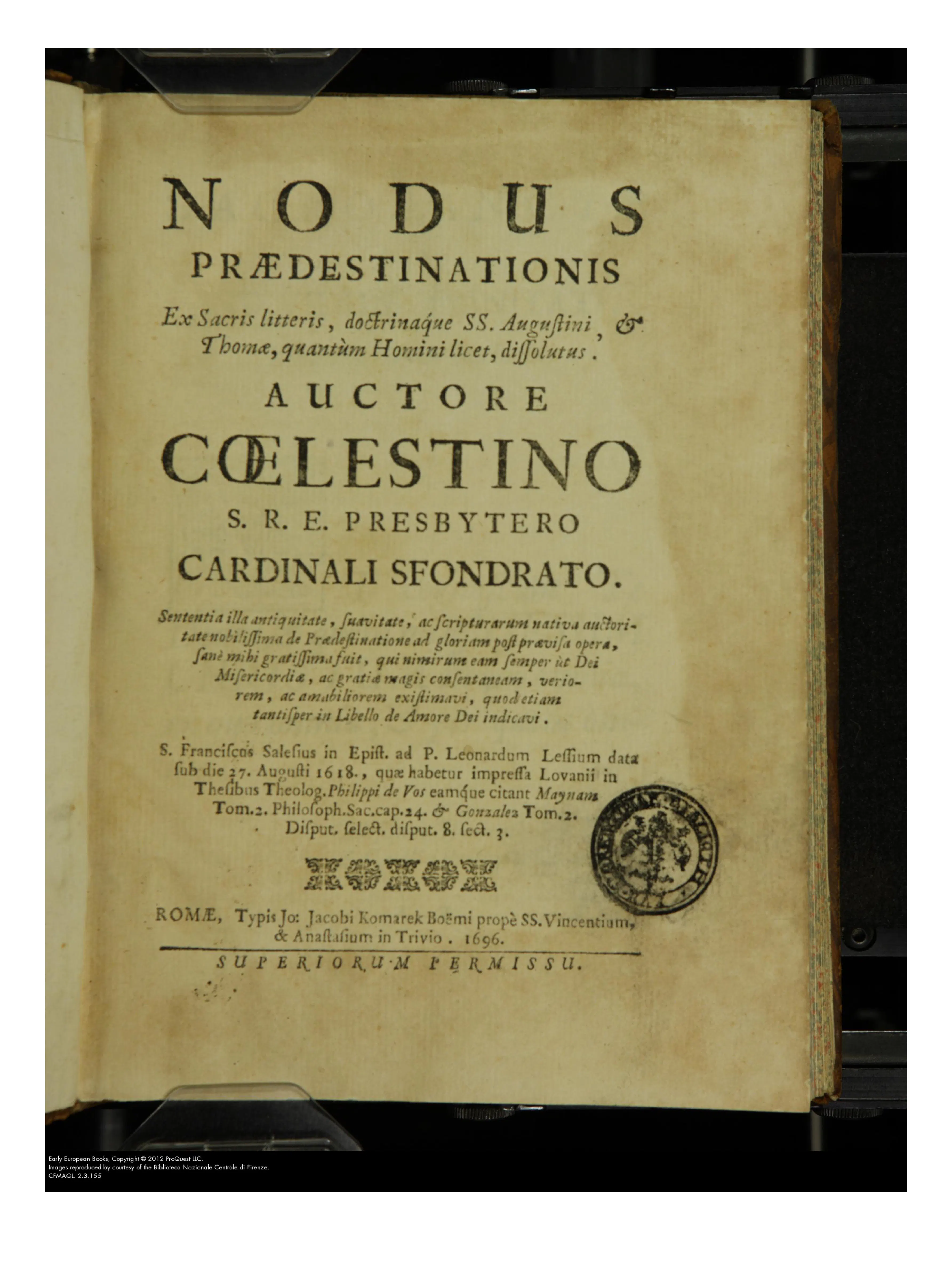
On the Roman 1696 title page, the limiting phrase quantum Homini licet, dissolutus sits above a Francis de Sales epigraph commending a predestination "opinion" for antiquity, sweetness and scriptural authority. Before the argument begins, the book's contested school alignment is placed under a canonised voice. Source ↗.
Limits of the existing scholarship. Specialist historiography on the Nodus itself has not been established sufficiently to claim a scholarly consensus about several questions:
- its relation to Jansenism;
- the French bishops' objections;
- the relation of Sfondrati's writings on papal authority to the treatise.
Any link between those writings and hostility to this treatise remains a hypothesis.
Tracing the 1696 Roman Imprint: Printings, Paratexts and the Book's Reception
The Roman record and related printings. A WorldCat record identifies a Latin Nodus by Cardinal Celestino Sfondrati, printed Romae, typis J. J. Komarck, 1696 (OCLC 493406343). The record establishes an independent Roman bibliographic identity for the work. It does not supply a reliable collation or copy shelfmark.
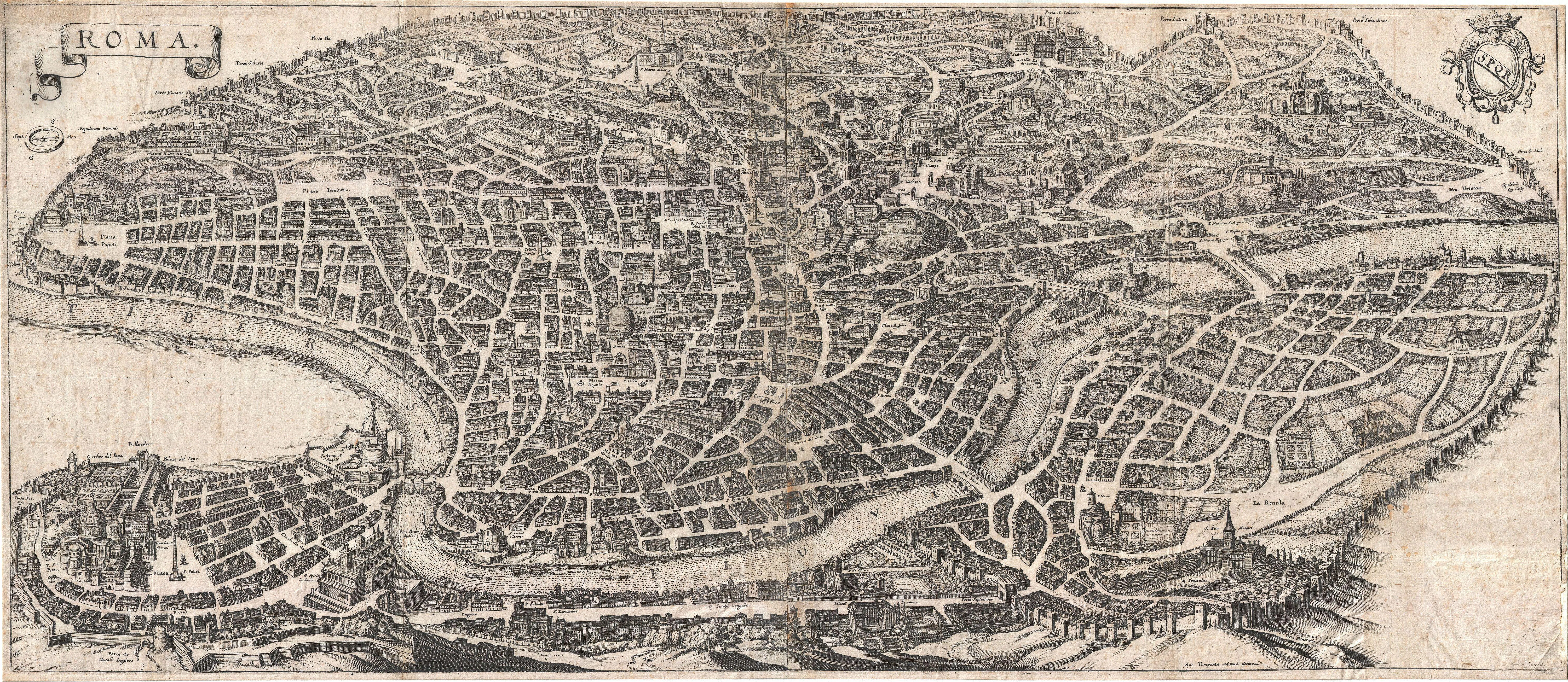
Merian's mid-seventeenth-century panoramic view of Rome depicts the city a few decades before the 1696 Roman printing recorded under J. J. Komarek. It illustrates no argument of the treatise; it situates the bibliographic record in the city whose ecclesiastical authority governed the book's licensing and publication. Source ↗.

Records also describe an Antwerp printing attributed to Petrus Jouret and dated 1696, and a Komarek printing catalogued as 1697. Their relationship to the Roman 1696 text remains unresolved: they may be separate settings, reissues or the result of erroneous dating. The format, signatures, pagination and plate count of the Roman impression could not be established securely.
The uncertainty of the book's transmission mirrors, at the level of the object, the bounded resolution its title claims for the doctrine. In both, what can be established is set beside what must await further evidence.
Unverified paratexts and persons. The identity and institutional function of the purported editor, the dedicatee of the Roman impression, the approvers and any Holy Office examiner remain unverified. Several reported elements all require inspection in an identified Roman copy before they can serve as evidence for licensing, posthumous editing or an unfinished text:
- an Italian memorial reportedly dated 25 July 1696;
- the half-title Triplici ictu solutus;
- a Votum morientis Auctoris;
- a Corollarium Doctorum;
- a notice of the author's illness.
In particular, a reported licence should not be confused with a finding that the book subsequently escaped examination or condemnation.
Unconfirmed copies and archival references. No securely established shelfmark emerged for the proposed Florence, St. Gall, Vatican, Casanatense, Munich, Paris, London or Salzburg copies. Nor was an archival reference for a Holy Office proceeding established.
Documented controversy. Controversy can nevertheless be documented beyond the title itself. Giovanni Maria Gabrielli's Dispunctio notarum quadraginta (1698) announces in its title that it addresses forty criticisms placed upon Sfondrati's Nodus by an anonymous writer. Its exact argumentative relationship to other alleged episcopal proceedings needs examination in the text and associated correspondence. The doctrines on which the anonymous criticisms fastened have yet to be matched against the treatise's distinctions between antecedent and consequent will and between efficacious and effective grace.
Unconfirmed episcopal and Roman action. Accounts of a joint French episcopal letter and of an absence of formal condemnation remain unconfirmed. An Index entry cannot be asserted or excluded on the evidence assembled.
The Tanner question. Likewise, no verified list of authorities in the Corollarium establishes whether Tanner is named there. His separate scholastic work cannot establish his authorship of the Nodus.
Following Sfondrati's Argument from the Dying Author's Vow to the Corollarium Doctorum
The Preliminaries: Epigraph, Vow, Licence and Approbations
The preliminaries of the Roman impression shape how the treatise is to be received before its argument begins. The title page carries an epigraph from Francis de Sales's 1618 letter to Leonardus Lessius. In it, predestination to glory post prævisa opera is commended as noble by its antiquity, its sweetness and the native authority of the Scriptures, in the opening sentence already considered for what it suggests about the work's school alignment. A Genevan bishop writing to a Louvain Jesuit sets the tone. The book places itself under a saintly patronage of the foreseen-works position, while the controversial edges of that position are borne by a canonised voice rather than by the author's own.
A dedication to the Trinity follows, styled the vow of the dying author, Votum morientis Auctoris. It turns the treatise into something close to a deathbed bequest. That framing gives the book a devotional rather than disputational character from the outset.
The Holy Office memorial of 25 July 1696 shows how unsettled the ground remained. It recalls the standing prohibition that no one may print on the matter of predestination and the divine helps without licence, niuno possa stampare in materia de Prædestinatione, & Divinis auxilis,. It then requests permission on the grounds that the cardinal had composed such a treatise, Il Card. Sfondrati havendo composto un Tratato de Prædestinatione,. The silence imposed after the de auxiliis disputes is thus present on the printed page. The book appears as a licensed exception to a rule of restraint, which suits a work whose title already limits its own reach.
The editor's preface, by the Conventual Franciscan Joannes Damascenus, presses that restraint into an irenic claim. The author had not written to contend with the schools holding the contrary opinion on predestination and grace, Se cum Scholis contrarium de Prædestinatione, & gratia sentientibus, ut. The preface also explains that the work is unfinished. Illness overtook the author while he was composing a historical demonstration that the grace of God is not lacking even to the most obstinate sinners, serie, Dei gratiam etiam obstinatissimis Peccatoribus. The incompleteness therefore falls exactly where the argument for universal grace was to become an argument from historical cases.
The approbations then gloss the doctrine in their own figurative terms. The Cistercian Gabrielli develops a conceit of scriptural "cords" binding grace and freedom. He concludes in a balanced formula, the efficacy of alluring grace and the inviolate liberty of the human will, gratiæ blandientis efficacia, & inviolata humanæ voluntatis libertas,. The participle blandiens, "coaxing" or "caressing," already marks the persuasive rather than coercive model of grace that the treatise will defend. Gabrielli also praises the author as sworn to the words of no master, the illusions of prejudice set aside, parti, nullius in verba juratus, summotis præjudiciorum præstigiis. The Horatian tag claims independence from every school, and in the climate of the 1690s that claim was itself a position.
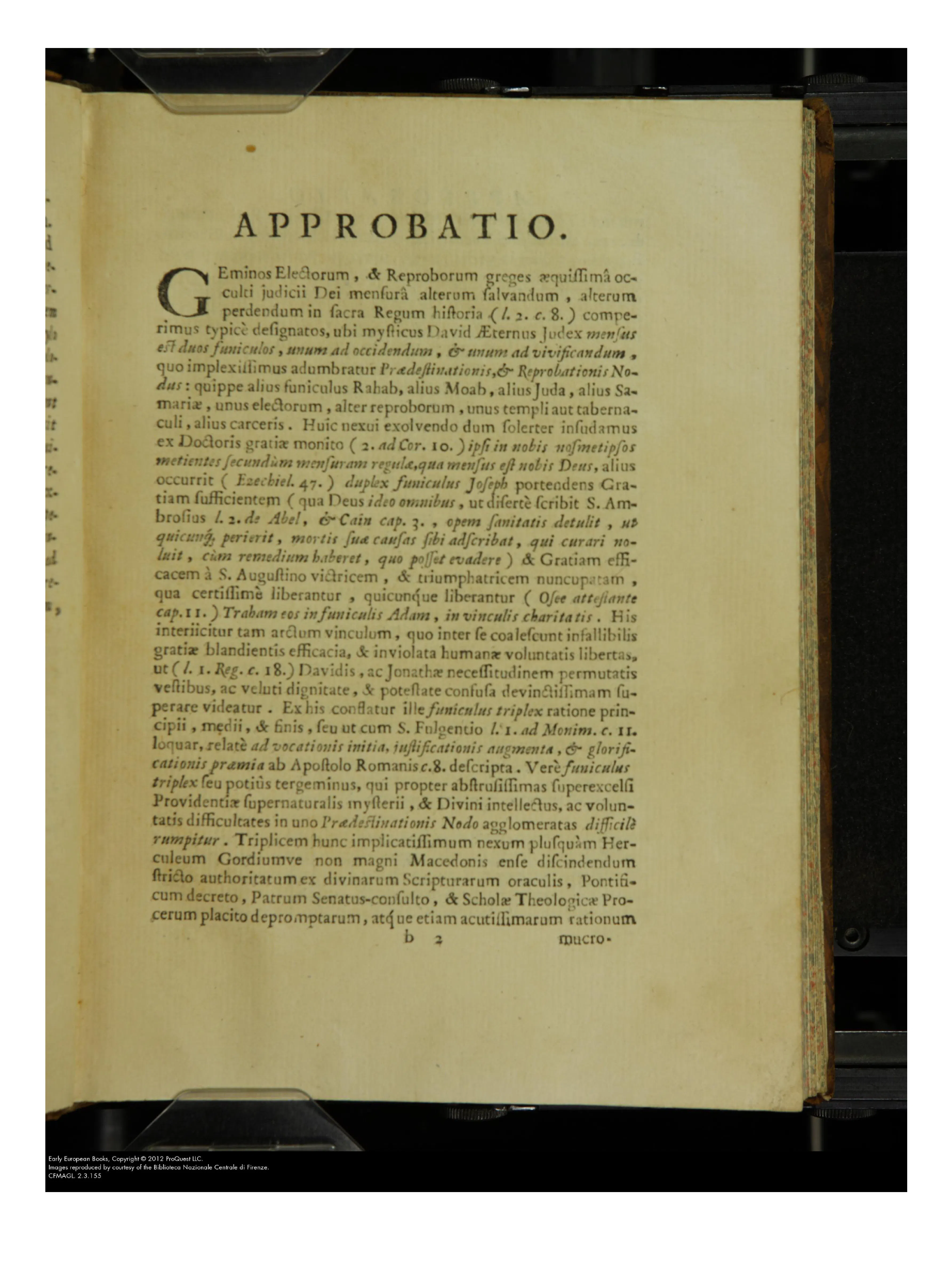
Gabrielli's approbation turns the treatise's knot into a network of scriptural cords binding predestination, grace and freedom. Its closing balance, "gratiæ blandientis efficacia, & inviolata humanæ voluntatis libertas," announces within the preliminaries the persuasive, non-coercive account of grace that the work goes on to defend. Source ↗.
Damascenus's own approbation opens on a line of Prudentius, that the right rule breaks tenacious knots, Nodos tenaces recta rumpit regula, ait Prudentius Poeta. The verb deserves notice. Rumpit speaks of breaking, while the author, as the exordium will show, insists on loosening. The approbator's figure is more forceful than the author's method, and the slight dissonance shows how readily the knot image could slide towards the Gordian solution the text disowns. Damascenus closes on the conditions of composition: almost dying, the author spent the intervals of his illness on the work, Opus intervalla valetudinis penè moriens impendebat.
The Exordium and the Four Theses
The exordium of Pars I opens with an ethic of knowing before it turns to doctrine. Two faults are named, ignorance and presumption, and they are held to be of equal harm and equal guilt. In the text's words, hoc est, ignorantiam, & præsumptionem; paris enim damni est, parisque delicti, & nescire, quod debeas, & velle scire, quod: it is equally culpable not to know what one ought to know and to wish to know what one ought not. The Pauline sapere ad sobrietatem is therefore not a closing disclaimer. It is the first methodological premise.
From it the author derives his purpose of untying, by the pen and not by the sword, a knot otherwise most entangled — the programmatic sentence already examined for its bearing on the title's imagery. The aim of the untying is stated as a theodicy, in the sentence already noted as the work's central thesis: the falls of the damned are to be attributed not to divine predestination but to the human will. The four theses then close on a limit built into the argument itself, the methodological declaration, considered earlier, that it suffices to free God from suspicion and that the rest in the cause of predestination neither can nor should be explored.
The structure is exact. Ignorance is answered by the first three theses, on universal will, abundant grace and easy means. Presumption is answered by the fourth. The exordium thus maps the twin vices onto the twin halves of the work as the index lays them out: Pars I on the will to save and Pars altera on inscrutability.
The Definitions of the Two Wills
The definitions of §I carry the lexical weight of the whole. The antecedent will, "of love," is illustrated by a prince who out of mere compassion makes a beggar youth his heir, sicut si Princeps Iuvenem mendicum sola miseratione. The analogy secures the gratuity of election and excludes merit at the level of the antecedent will, which matters given the epigraph's appeal to foreseen works.
The decisive move comes in the treatment of efficacy. The text gives voice to an objector, "but the effect failed," and answers with a concession that turns the objection around. Granted, but the efficacy of a cause, as far as it lies in itself, is judged not from the effect but from the endeavour and the wish: At effectus cessauit. Esto; sed efficacia causas quantùm est de se, non ex effectu, sed ex conatu, votoque censetur. The terminology is then fixed in the distinction, already set out in the discussion of the work's vocabulary, between an efficacious cause and an effective one, the latter being that upon which the effect follows.
This redefinition carries the weight of the argument against the Báñezian gratia ab intrinseco efficax. Without denying that grace is efficacious, it moves the measure of efficacy from outcome to intention. It thereby allows the author to call every grace efficacious and every loss human.
The consequent will is then made to feel the cost of that position. In the image of a merchant jettisoning cargo in a storm, the text declares that God loves even when he destroys, yet destroys lest he make shipwreck of justice, Sic Deus amat, etiam cùm perdit, perdit tamen, ne justitiæ naufragium faciat. Reprobation becomes a reluctant act forced by the storm, not a design. Its counterpart in the order of grace is erotic and courtly rather than mercantile: God's way with the free will is, in the text's words, not to compel but to invite, hoc est, non cogere liberam, sed invitare. Lover and merchant together describe a God bound by his own love and his own justice, but never the master of an arbitrary decree.
The Proofs and the First Objections
The proofs that follow draw on Roman antiquity as readily as on Scripture. Hannibal's promise of Carthaginian citizenship to whoever lays low an enemy, taken from Plutarch, is turned into a model of election. In the text's words, he will be predestined to me, whoever conquers sin, Prædestinatus mihi erit quicunq[ue] peccatum vicerit. The exemplum gives election the shape of a public offer with a condition attached. The force of the analogy depends on the fact that the general's promise excludes no one in advance.
The argument from reason culminates in pastoral necessity rather than metaphysics. If the antecedent will is restricted, the chief foundations of the whole Christian life give way, namely hope and love, totius vitæ Christianæ præcipua fundamenta, spes videlicet, & amor. The precept of hope becomes the ground on which the doctrine of the decree is tested. A theology that makes hope impossible is thereby shown to be false.
That practical orientation governs the reply to Calvin's "sophism," the fatalist inference from predestination to indifference of conduct. The author answers partly with wit. Who would think he has found by argument what even the Devil has not found, or that he knows logic better than the Devil? In the text: se aliquid argumentando invenisse, quod nec Dæmon invenit? aut meliùs Logicam callere, quàm calleat Dæmon?. The tireless tempter is thus made a witness against fatalism. The positive answer is the rule of conduct already cited as the treatise's practical conclusion: one must act and strive as though there were no predestination of God, yet ascribe all to God and place all hope in him.
The definition that follows makes the redistribution formal. Predestination is defined, in the formula already examined, as nothing other than the antecedent and efficacious will of God to bring man to eternal life. Because the antecedent will has been declared universal, predestination itself becomes universal in intention. The particularity of salvation is therefore left to the consequent order and to human refusal.
In the same sequence the text reaches the fate of unbaptised infants, holding that preservation from sin alone is worth more and of greater price than the heavenly kingdom itself, cùm sola præservatio à peccato pluris valeat, majorisque pretii sit, quàm Regnum ipsum cæleste. The thesis follows strictly from the argument's insistence that God is never the occasion of loss. Its very consistency shows how far the theodicean premise is prepared to reshape the received picture.
The long series of objections exposes the argument's most delicate dependency, which is its handling of Augustine. The author distinguishes between Augustine's saying and Augustine's settled opinion, holding that the latter requires discussion, aliud Augustini sententia; hæc enim discussionem. This hermeneutic allows narrower Augustinian texts to be treated as occasional. Its danger is named in the same breath, with the failure of Cornelius Jansenius, Bishop of Ypres, Iansenius Episcopus Iprenis docuit, whom the Supreme Pontiff struck with anathema, Pontifex Maximus anathemate percussit. The same distinction that frees Augustine from rigorist readings is presented as the one Jansenius neglected. Claiming the right reading of the doctor and condemning the wrong one become a single act.
Where distinction fails, the text suspends judgement rather than pressing further. To the question why God does not give each person the grace he foresees will succeed, it answers first with the Roman formula of non liquet, already discussed, by which the judges, in place of a verdict, pronounced the matter unproven. Only then does it turn to the sufficiency of the graces actually given. The military analogy follows: if a soldier throws away his lance it is not the general's crime, and if a Christian refuses grace it is not God's fault, nec si miles lanceam abiiciat, Ducis est crimen, nec si Christianus gratiam recuset, Dei est culpa.
The mode of grace's action is then specified against physical premotion, in the sentence already noted for its denial that grace acts upon the will like a thunderbolt shattering every resistance. The juridical maxim, likewise already noted, that a benefit is not conferred on one unwilling, is set beside the Augustinian question whether he who created you without you will save you without you, Qui creavit te sine te, non salvabit te sine te?. The canonist's rule and the patristic tag converge on the necessity of consent.
Romans 9 and the Non-Causation of Sin
The treatment of Romans 9 becomes a treatise on the non-causation of sin. God, the text insists, does not cause sin but permits it, and this he does justly, Non ergo causat Deus peccatum, sed permittit; hoc enim justè. Its most striking figure is the gnomon. As many shadows, so many testimonies of the Sun, and as many sins, so many arguments for God, Ergo quot vmbræ, tot testimonia Solis, & quot peccata, tot argumenta Dei. Evil, a privation, is ordered by God without being made by him, just as the shadow on the dial declares the sun it does not contain.
Hardening is reinterpreted in the same way, through the asymmetry of agency already observed: God hardens and the sinner hardens, but the sinner by acting and God by not impeding. Through the sermon the author assigns to Augustine or Caesarius, Pharaoh is said to be hardened not by divine power but by divine patience, sed divina patientia credenda est obdurâsse.
Augustine's axiom that God deserts no one unless first deserted then yields its sharpest consequence. Considered prior to foreseen desertion, no one is reprobate, and therefore no one is not elect, nemo reprobus; ergo nemo non electus. Within this portion of the treatise, the universality of the antecedent will is carried to its full extent, and the whole burden of loss is placed on the will that turns away.
Physician, Painter and Sewer: Images of Providence
Having reached that conclusion, Sfondrati closes his exegesis of Romans 9 by refusing the supralapsarian inference that God wills sin in order to display his attributes. He dismisses the idea with a medical reductio, which would make God like a physician who wounds some people in order to show others his skill in healing: id enim perinde fuerit, ac si Medicus aliquos vulneret, ut peritiam curandi aliis ostendat.
The image is more than ornament. Medicine supplies the governing metaphor of grace throughout this portion of the treatise, and the comparison works by appealing to an ethical intuition about the healer's art: a physician who manufactures illness forfeits the name of physician.
In place of this rejected picture, the author redeploys the antecedent and consequent wills. God antecedently wills Pharaoh's conversion. Only after refusal does he turn sin, as one might turn poison, to good ends. The figure for this second operation is aesthetic rather than medical: it is the image, already discussed, of God as a most skilled painter who depicts the image of his goodness and wisdom not only in gold and vermilion but also in shadows and ink.
The chiaroscuro analogy belongs to the Augustinian tradition of aesthetic theodicy. Sfondrati's precise contribution is to tie it to the consequent will. Shadow enters the picture only once the human refusal has supplied it, so the painter uses darkness but does not mix it.
A third image, drawn from Pliny's account of Rome's drainage works, completes the triad. Pharaoh, Herod and all the impious are sewers, yet the world is not the fouler for them: Cloaca ergo Pharao, cloaca Herodes, cloacæ omnes impii, sed non ideo istis turpior Mundus,. The engineering metaphor recasts providence as a civic architecture that channels filth without generating it. It also carries an implicit argument a fortiori: to order evil toward a clean city demonstrates a greater power than to order what is already good. God is thereby shown as ordinator rather than Author of sin, and the shift in agency that the treatise elsewhere performs on the verb obdurare is here performed in images.
The Limit of Inquiry and the Later Objections
Where analogy reaches its end, the author applies a deliberate brake. Why God preferred the Gospel to the Temple is a secret above human measure and understanding, which, in the comparison already examined, merits faith and obedience rather than questioning, since it no more belongs to a man to judge the secrets of God than to a servant to judge the secrets of his prince.
The political register is sharpened shortly afterward into an image of transgression. He is a thief, not a friend, who breaks into the prince's cabinet without key or permission: Latro est, non amicus, qui scrinium Principis sine clave, & permisso irrumpit.
The courtly vocabulary of arcana imperii and the private scrinium turns the title's quantum homini licet into a matter of decorum within a hierarchy. Excessive curiosity becomes a breach of fidelity rather than a mere intellectual error. The restraint is not purely negative, however, because it is exercised only after the distinctions have done as much as they can. The arcana receive what remains once the argument has been exhausted, not the substance of the argument.
The eighth objection, that God shows greater care for the elect, prompts one of the most consequential claims in this portion. Comparing the Gospel narratives, the author concludes that it cannot be denied that more helps were spent on the reprobate Judas than on the predestined Zacchaeus: negari ergo non potest, plura huic reprobo auxilia, quàm prædestinato Zachæo impensa esse.
The weight of this sentence lies in what it severs. If election does not correlate with a greater quantity of grace, then the Thomist and Jansenist association between predestination and an intrinsically efficacious grace loses its empirical support in Scripture. The cases of Lucifer and the faithful angels, together with the Augustinian and Thomist dictum that under equal helps one person consents and another dissents, reinforce the point.
The author then moves from exegesis to moral psychology. A "special benefit" prized because others lack it betrays an envious soul. Turning Augustine and Gregory's Moralia against particularism, he counsels that it is better to wish the number of the saved larger than to stand out among a few: Optandum tibi potius est, ut salvandorum amplior sit numerus, quàm ut inter paucos emineas. The doctrine of a restricted election is thus tested by the affections it breeds, and found to be at odds with charity.
The tenth objection, concerning unbaptized infants, receives an answer framed in juridical terms that early modern readers would have recognized from the law of treason and forfeiture. The infant will not be tortured as a rebel, yet will not be an heir, being a rebel's son: non torquebitur quidem ut rebellis, sed tamen non erit hæres, quia filius Rebellis. The scholastic pairing of poena damni and poena sensus is expressed here as the difference between disinheritance and corporal penalty.
The more striking move is the author's historicizing treatment of Augustine. Nothing, he observes, so agitated and tormented Augustine's mind as this question, as Augustine himself professes, especially in his letter to Jerome: nulla re magis Augustini animum (ut ipse profitetur, præsertim epistola 28. ad Hieronymum) agitatum, tortumque fuisse,. By presenting the harsher Augustinian pronouncements as the product of anguish and wavering, he opens room for a milder reading under the bishop's own authority.
The methodological rule follows. On hidden matters one should hold what best befits divine goodness, and the rule rests on the pastoral axiom, already cited, that those who make God more fearsome than lovable deserve very ill of him. The theology of the decree is answerable here to the image of God it projects. This criterion is exactly the kind that would make the treatise's teaching on infants contentious.
Abundant and Resistible Grace
The second paragraph of the treatise raises the thesis from sufficiency to abundance: all people receive copious grace. Its technical foundation is the terminological distinction, restated here in its own setting, that one thing is an efficacious cause and another an effective one, Aliud ergo est causa efficax, aliud effectrix;. The sun, which illumines unless the eyes are shut, illustrates a cause that possesses full power whose effect may still be impeded.
From this follows the anti-Jansenist symmetry, already noted as the principal instrument of the work's theodicy, that just as no grace takes away liberty, so none takes away the power of resisting. The falls of Lucifer and Adam despite the strongest graces serve as its proof.
Against the Jansenist and Thomist "sufficient grace" that never takes effect, the author mounts a reductio in his favoured medical and martial imagery. To grant such grace is like giving a remedy by which no sick person was ever healed, or a shield by which no one was ever defended against the enemy: quale est remedium dare, quo nullus ægrotus sanatus est, scutum dare, quo nullus aduersus hostem defensus est;.
The polemic becomes personal in the exegesis of Tyre and Sidon. There Jansenius, in claiming that Christ spoke of unequal interior grace, plays the soothsayer rather than the theologian: divinatorem potiùs, quàm Theologum agit:. The barb carries an epistemological point: interior grace can be known only through its exterior signs, so claims about its hidden inequality are mere divination.
Moral impossibility, a central category of the de auxiliis debates, is clarified by an image drawn from games of chance. A grace that achieves nothing unless a further predetermination is added is as if one ordered someone to play at dice all day and, on pain of death, throw nothing but sixes: ac si aliquem tota die ludere aleâ jubeas, nec sub poena capitis alium numerum, quàm senarium jacere,. The image makes vivid that a precept fulfillable in principle but not in practice imposes an obligation without real possibility.
The universality of grace is then extended to the world opened by the missions. The author holds that there is no person in Europe, Asia, Africa or America who is not moved by the beauty of creation toward its Maker: Ita omnino sentiendum est, nullum in Europa, nullum in Asia, nullum in Africa, America[que] hominem esse,. The four-continent formula shows the soteriological question reshaped by the geography of the age of discovery.
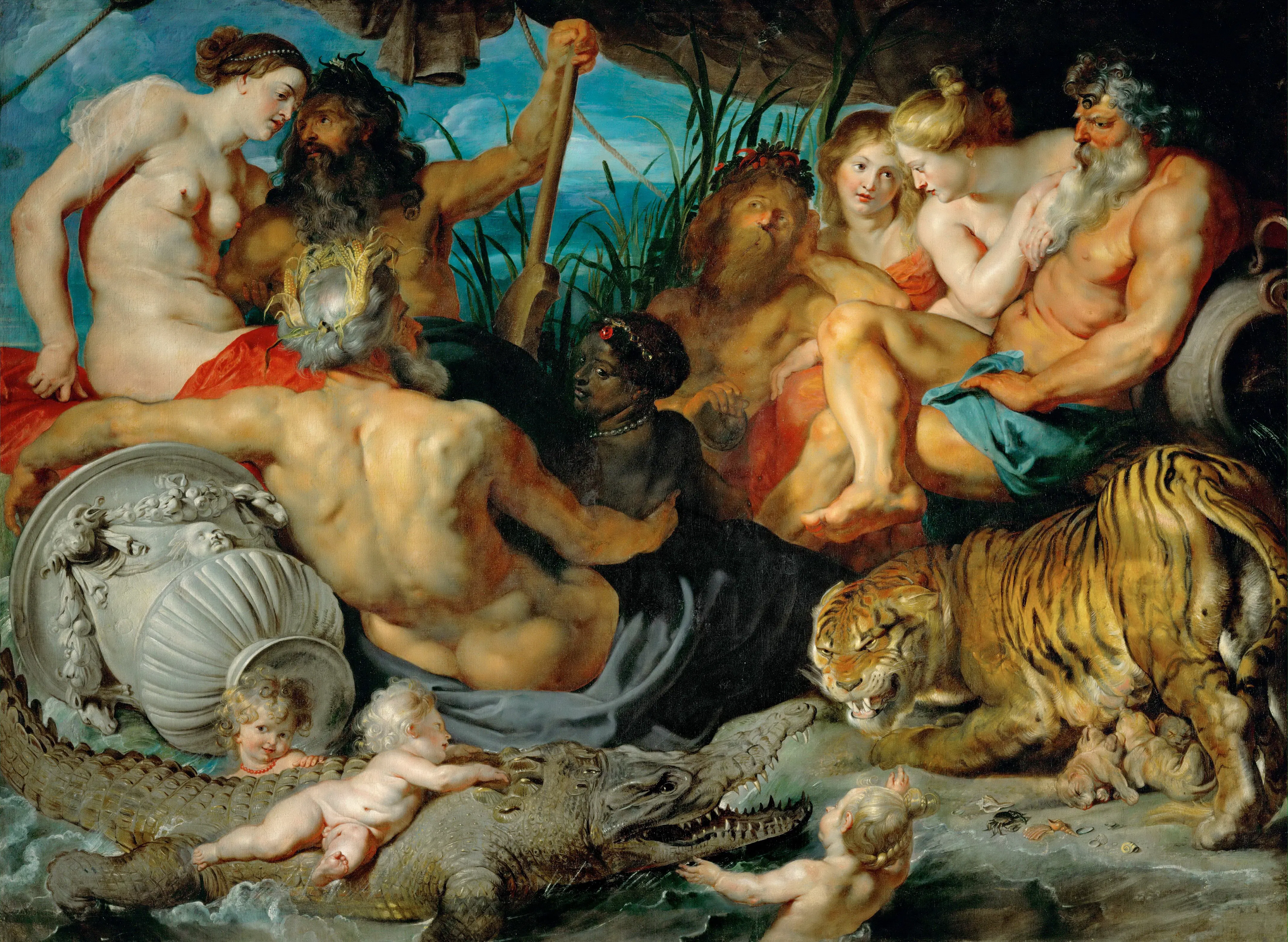
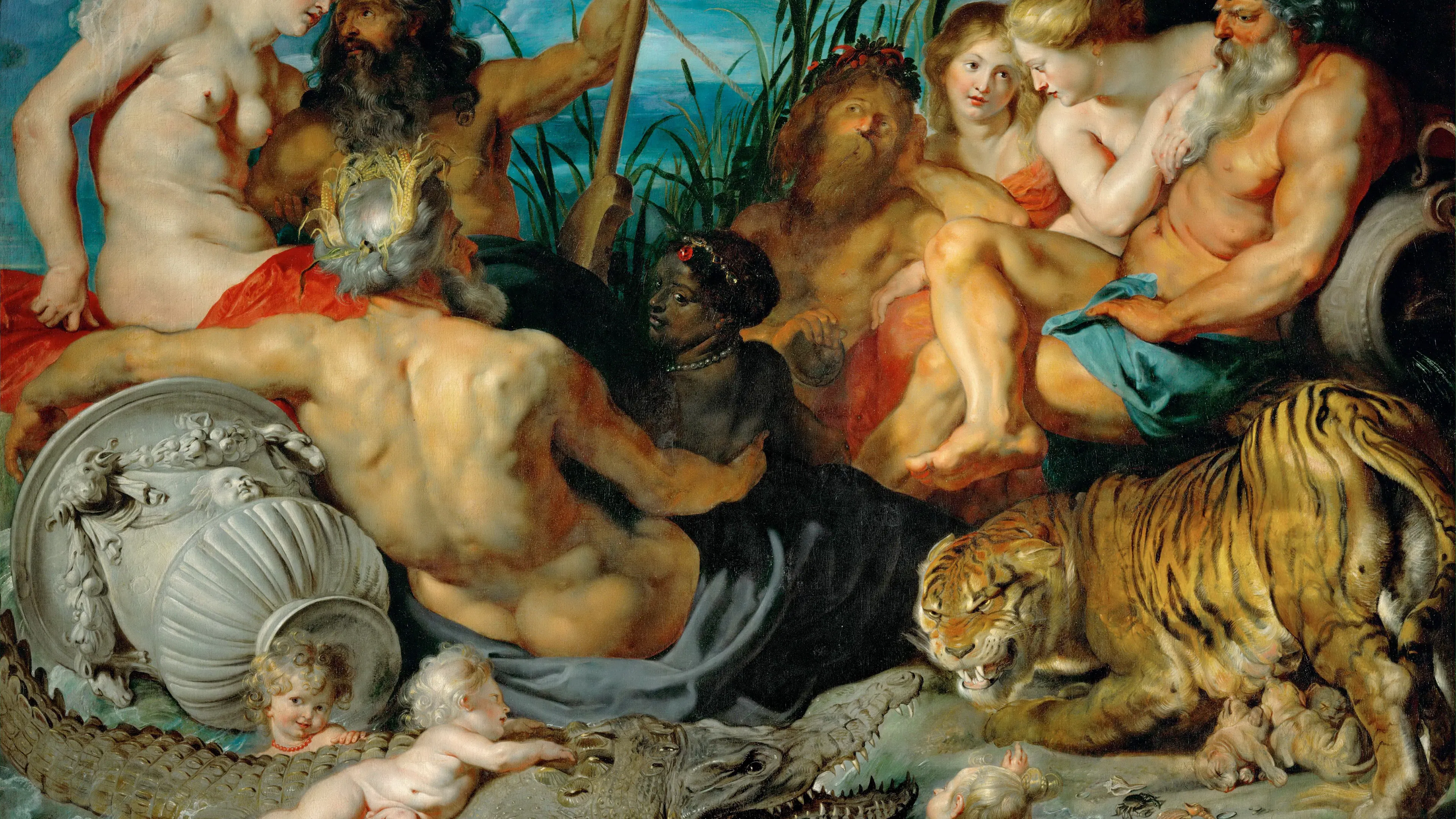
Peter Paul Rubens's allegory The Four Continents gives visual form to the fourfold world-picture of the early modern age. It does not illustrate the treatise, but it shares the schema of Europe, Asia, Africa and America through which grace is claimed to reach every quarter of the globe. Source ↗.

The author also treats the reports on which the counter-argument rests with critical suspicion. Faced with Molina's account of Brazilians ignorant of God, he asks who told Molina that the barbarians were ignorant in that inculpable way: at ita Barbaros ignorare, quis Molinæ narravit?. Even a fellow Jesuit's testimony is subjected to the distinction between ignorance as such and invincible ignorance.
The most self-conscious hermeneutical moment of this portion occurs within the objection on infants. Augustine wrote, in the passage already considered for its historical self-consciousness, when Calvin had not yet arisen to assail human choice and divine goodness, so that other weapons are now needed against another enemy and another war. Patristic emphasis is thus treated as polemical tactics fitted to its adversary.
This historicization is balanced by an irenic claim to the whole inheritance. No one conflicts with Augustine's teaching except one who defends grace so as to deny free will, or defends free will so as to deny grace: cum Augustini sententia pugnare, nisi eum solum, qui ita defendit gratiam, ut neget liberum arbitrium, ita defendit arbitrium,. Augustine is reread as the guardian of a middle position, and the extremes on either side are named as the true dissenters.
The Historical Proof and Its Interruption
The third paragraph turns the argument into history. It is an annalistic proof, dated by the years of the world, showing that grace was never lacking even to the most notorious. Tertullian's Apologeticum supplies the claim that the Caesars too would have believed in Christ, had Caesars been able to be Christians: sed & Cæsares credidissent in Christum, si & Christiani esse Cæsares potuissent. The obstacle to their conversion is located in political fear, not in any withholding of grace.
The catalogue's moral is condensed in the fate of the Arian emperor Valens, who perished because he utterly willed to perish: periit ergo valens, quia perire omnino voluit,. Every exemplum serves the same verdict, that damnation is traced to the obstinate will alone.
The historical series is not completed. The printed text itself breaks off with an editorial notice that the author, seized by illness, could not put the finishing touch to this narrative: Observandum hîc est Auctorem morbo correptum extremam manum huic narrationi imponere haud potuisse. This intervention, set in type within the body of the book, marks the edition as mediated by another hand. It is also the material counterpart of the argument's own limits, since the demonstration stops where the author's strength did.
Prayer, Delight and Persuasive Grace
The fourth paragraph opens with the thesis that the sinner's prayer for what is necessary to salvation is always heard, so that triumphant grace lies within reach. Augustine's delectatio victrix is reinterpreted through the psychology of delight, on the ground that the whole virtue and efficacy of triumphant grace is placed in this: tota gratiæ triumphatricis virtus, & efficacia in eo posita sit,.
What follows is a sustained argument from persuasive power. Esther before Ahasuerus, the beauty of Helen and Phryne, the musicians of antiquity and Saxo's harper, and the orators from Cicero to Mark Antony are all marshalled toward the single rhetorical question, already noted, whether we shall grant more to the orator than to the Creator. If human eloquence can move the will without compelling it, divine grace may be conceived as a higher rhetoric, a cognitio congrua fitted to its hearer.
The Thomist alternative is derided in the imagery of siege warfare. The author asks why we seek predetermining qualities, that is, battering rams, engines and mere words: Quid qualitates prædeterminantes, hoc est, quid arietes, & machinas, & vocabula quærimus. Against such machinery he sets the natural philosophy of Kircher's Musurgia, in which the will is drawn most surely by a kind of magnetism and sympathy: voluntas Magnetismo, & Sympathiâ quadam certissimè.
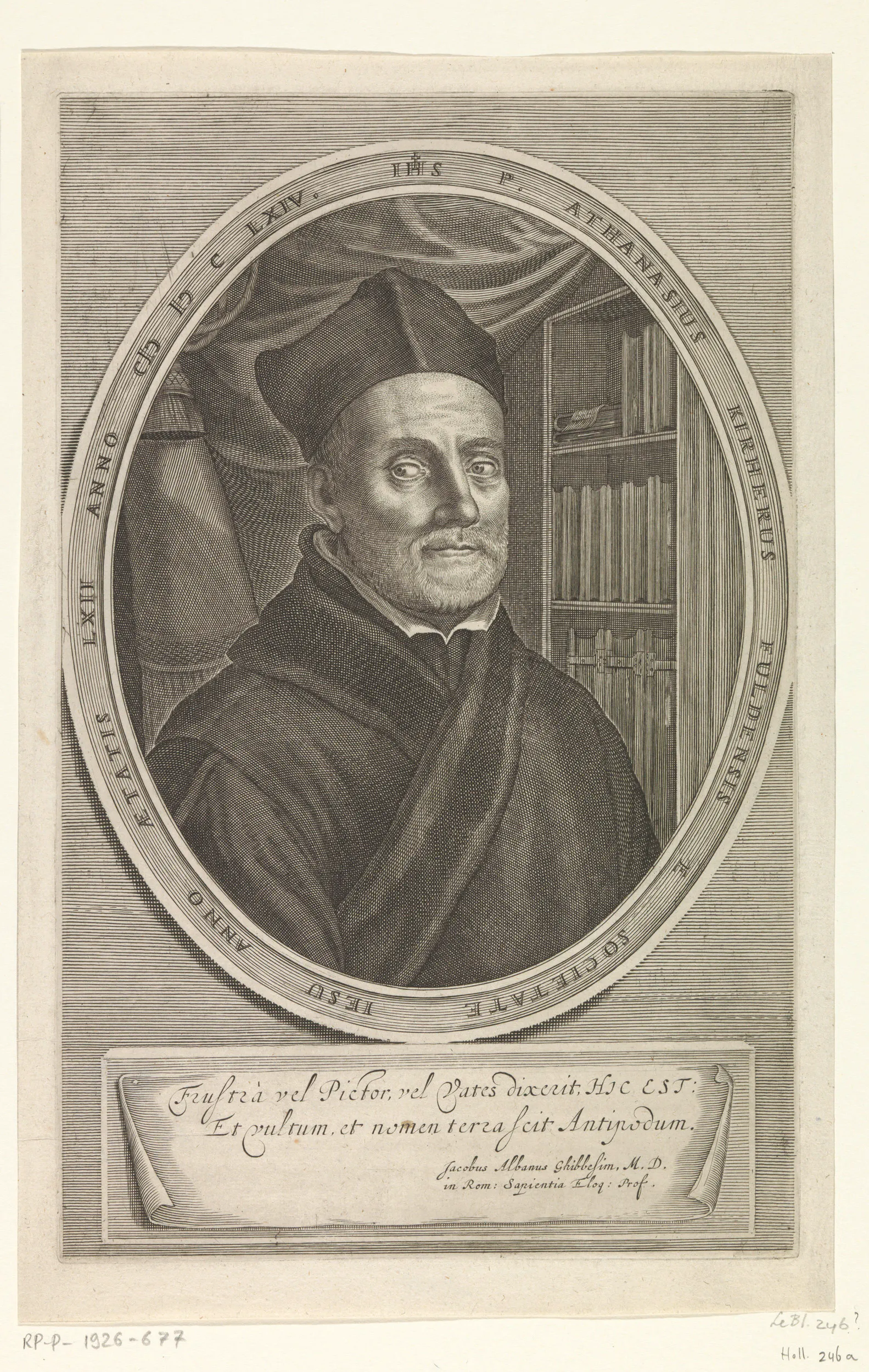
A portrait of the Jesuit polymath Athanasius Kircher at the age of sixty-two. Turning from the "machinery" of predetermination, Sfondrati cites Kircher's Musurgia, where the will is drawn by magnetism and sympathy, to model grace as persuasion rather than coercion. Source ↗.

The vocabulary of occult attraction allows the author to claim certainty of effect without physical determination. Grace that persuades, in this account, conquers the will as the beloved or the eloquent conquer, by delight rather than by force.
Against Physical Predetermination
That persuasive model prepares the ground for the final engagement of the argument. The surviving portion of Part I closes on a confrontation with the Báñezian doctrine of physical predetermination, and its tactics are as revealing as its conclusions. The objection is put in its strongest form: even infinite goodness, clearly proposed, leaves the will indifferent short of the beatific vision, so the will must be determined by a further principle subordinated to the First Cause. The reply does not first attack the metaphysics. It asks for a text. The author demands to know, first, whether the predeterminists have ever found such a predetermining quality in St Augustine, an in S. Augustino hanc qualitatem prædeterminantem aliquando re.
This move contests the Thomist school's claim to the auctoritas Augustini on its own philological ground. It is consistent with the title's promise to untie the knot ex doctrina SS. Augustini et Thomae. Augustine's superlatives for grace, omnipotentissimam, invictissimam, indeclinabilem, are not denied. They are reassigned to the register of rhetorical amplification and moral victory. They are no longer read as descriptions of a physical cause.
The second line of attack is epistemological rather than doctrinal. The predeterminists, the author charges, do not so much explain the enigma of predestination by another enigma as obscure it, alio Ænigmate non tam explicant, quàm obscurant, Ænigma. Here the governing image of the treatise is turned against its rivals. Elsewhere in this part of the treatise the predeterminist quality is called a knot harder than the Gordian. On this view the Dominican solution tightens the knot instead of loosening it. The complaint is one of explanatory economy. A supernatural entity added to the soul answers no question that the decree itself cannot answer. The objection is worded so that the author's own refusal to multiply entities can present itself as the more genuinely Thomist course.
The constructive account proceeds through a concrete case. Efficacy is lodged not in an inhering quality but in God's eternal yet time-operative decree: God wills, here and now, that Peter's will should love rather than not love, vult hîc, & nunc voluntatem Petri potiùs amare, quàm non amare. The indexicals hîc, & nunc matter. They insist that the eternal decree reaches the singular act at a singular moment, so that nothing of divine sovereignty is surrendered.
Yet the act itself is attributed to its human subject. Asked who determines the indeterminate will, the author answers, the will itself, though dependently on the First Cause, ipsam voluntatem, dependenter tamen à Causa prima, à qua. The concessive tamen carries the whole weight of the qualification. It separates this self-determination from Pelagian independence while denying any prior physical motion.
To hold decree and freedom together, the text reaches for the scholastic distinction between formal and eminent possession of a perfection. Both the divine decree and the human will, though formally indifferent, are eminently and virtually determined and therefore able to act: est tamen eminenter, & virtualiter determinatum, & ideo potest. The analogies of the sun, eminently hot, and of light, eminently coloured in the rainbow and the prism, bring natural philosophy into the service of the metaphysics of liberty.
Aquinas is then enlisted at length. The decisive citation is framed as a concession wrung from the opposing school's own master. St Thomas, the author claims, teaches that apart from the special case of grace the created will is determined by itself, excepto speciali casu gratiæ voluntatem creatam à se ipsa, non. The exceptive clause is double-edged. It concedes precisely the domain, grace, over which the dispute is fought, even as it establishes self-determination as the Thomist default. That tension is not resolved here; it is absorbed into the larger strategy of weighing certainties against uncertainties. The Scriptural loci on God's universal salvific will are made to outweigh speculative difficulty, and the author finds it astonishing that anyone should, against Augustine's rule already cited, deny these most certain truths on account of those most uncertain. Augustine's own exegetical principle, that the clear governs the obscure, thus becomes the warrant for setting aside an Augustinian predestinarianism.
Prayer as Impetration
From the metaphysics of the decree the argument turns, in §§ III–VI, to prayer as the infallible means of obtaining victorious grace and final perseverance. The hinge is a Thomist distinction from the Secunda secundae. The sinner's prayer avails not by way of merit, since merit presupposes the petitioner's worthiness, viam meriti, cùm hoc dignitatem postulantis supponat; sed per viam. It avails rather by way of impetration, which rests on God's mercy alone and on Christ's infinite merits, impetrationis, quæ solâ Dei misericordia, Christique infinitis meri.
The distinction does important theological work. It allows grace to be universally accessible without making it a reward, and so preserves gratuity while removing any excuse. The pastoral consequence is drawn as a direct apostrophe to the reader. Whose fault will it be, the text asks, God's, who wills to give if you ask, or yours, who refuse to ask? te! cujus culpa id erit? Dei volentis dare, si petas; an tua petere. The burden of responsibility is reassigned entirely to the human side, and the sinner who perishes is said to have held the key to heaven in his own hand. The redistribution announced in the treatise's distinction of antecedent and consequent wills here becomes a matter of individual conscience.
The Ascetic Aphorisms
A typographical and generic shift follows. A new heading, Aphorismi seu Regulæ Asceticæ de Mysterio, "Aphorisms or Ascetic Rules concerning the Mystery," marks the passage from scholastic disputation to devotional rule. The first aphorism directs attention to what God has commanded rather than to the hidden mystery. It figures speculation about predestination as the Euripus, the proverbially treacherous strait. The heresiological catalogue that follows is calibrated with care: here Origen, here Pelagius, here Calvin and others were swallowed up, so why follow those who perish? hîc Calvinus, aliique absorpti sunt; quid sequeris pereuntes?.
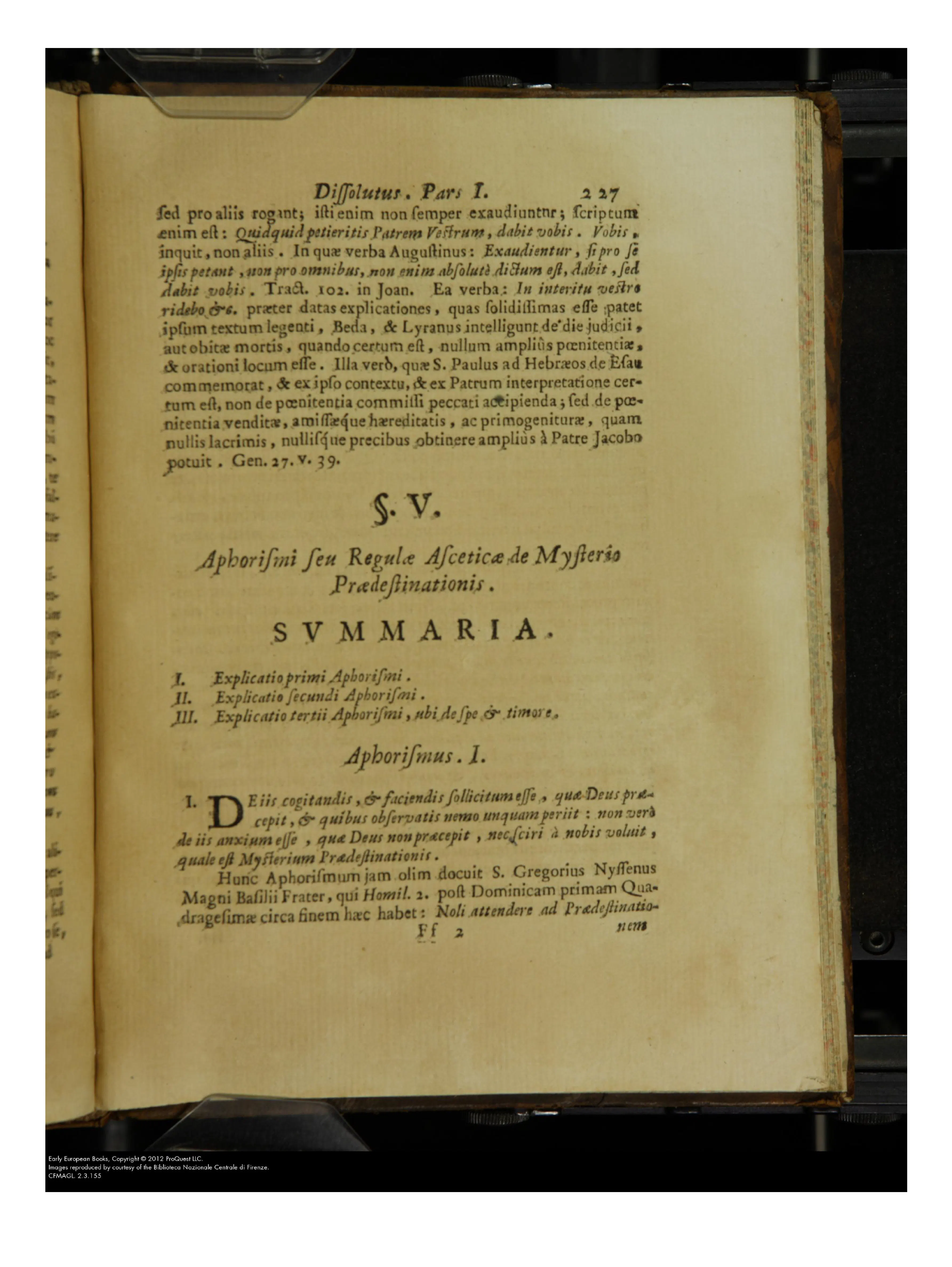
The heading "Aphorismi seu Regulæ Asceticæ de Mysterio Prædestinationis" makes the generic turn visible, recasting predestination as a matter of ascetic rule rather than speculative mastery. Following the printed discussion of prayer, the first aphorism redirects attention from the hidden decree to what God commands to be thought and done. Source ↗.
The shipwrecked figures of that catalogue stand on opposite shores. Pelagius over-reaches toward human sufficiency, Calvin toward divine necessity, and the via media appears as the only safe passage. That passage is compressed into the maxim, already cited in connection with the work's Ignatian self-identification, to do what you can and ask for what you cannot, and so arrive safely. The phrasing echoes Augustine and the Tridentine decree on justification. The whole preceding theory of decree and impetration is reduced to a rule of conduct.
The second aphorism, labour as if nothing depended on grace and hope as if nothing depended on labour, is given an explicit confessional genealogy: the author declares, in the words already quoted, that this doctrine was received from St Ignatius, Founder of the Society of Jesus. The Ignatian pedigree is routed through Augustine's Qui fecit te sine te. The effect is to present a Jesuit spirituality as continuous with the very patristic authority the predeterminists claimed.
The tension between effort and abasement is then held open through Gerson, whom the text calls Gerson noster. In Gerson's words, I want you to despair, but of yourself and in yourself, who are man and flesh: obiicitur, ut desperes; desperes volo, sed de te, & in te, qui homo & caro es;. Despair is not abolished but redirected. Its object is the self, so that theological hope may take God as its sole support.
The third aphorism, on placing all hope in God, ends with a striking quantification. Following the masters of the spiritual life, the proportion of fear to hope should be as seven to a hundred, talis sit proportio timoris ad spem, qualis septem ad centum. Cùm. The numerical precision has a polemical edge. It gives arithmetical form to the conviction that a God made more fearsome than lovable is a God misrepresented. Fear is retained as a salutary counterweight, but it is decisively subordinated.
Pars Altera: Inscrutability as No Objection
The Pars Altera, introduced under the half-title Triplici ictu solutus, changes the terms of the problem. Its thesis is that the inscrutability of predestination furnishes no objection against Providence. Incomprehensibility is reclassified as a sign of deity. The refrain of the part is the imperative to believe what you do not see and adore what you do not grasp, go, quod non vides, & adora, quod non capis. Notanda quoque.
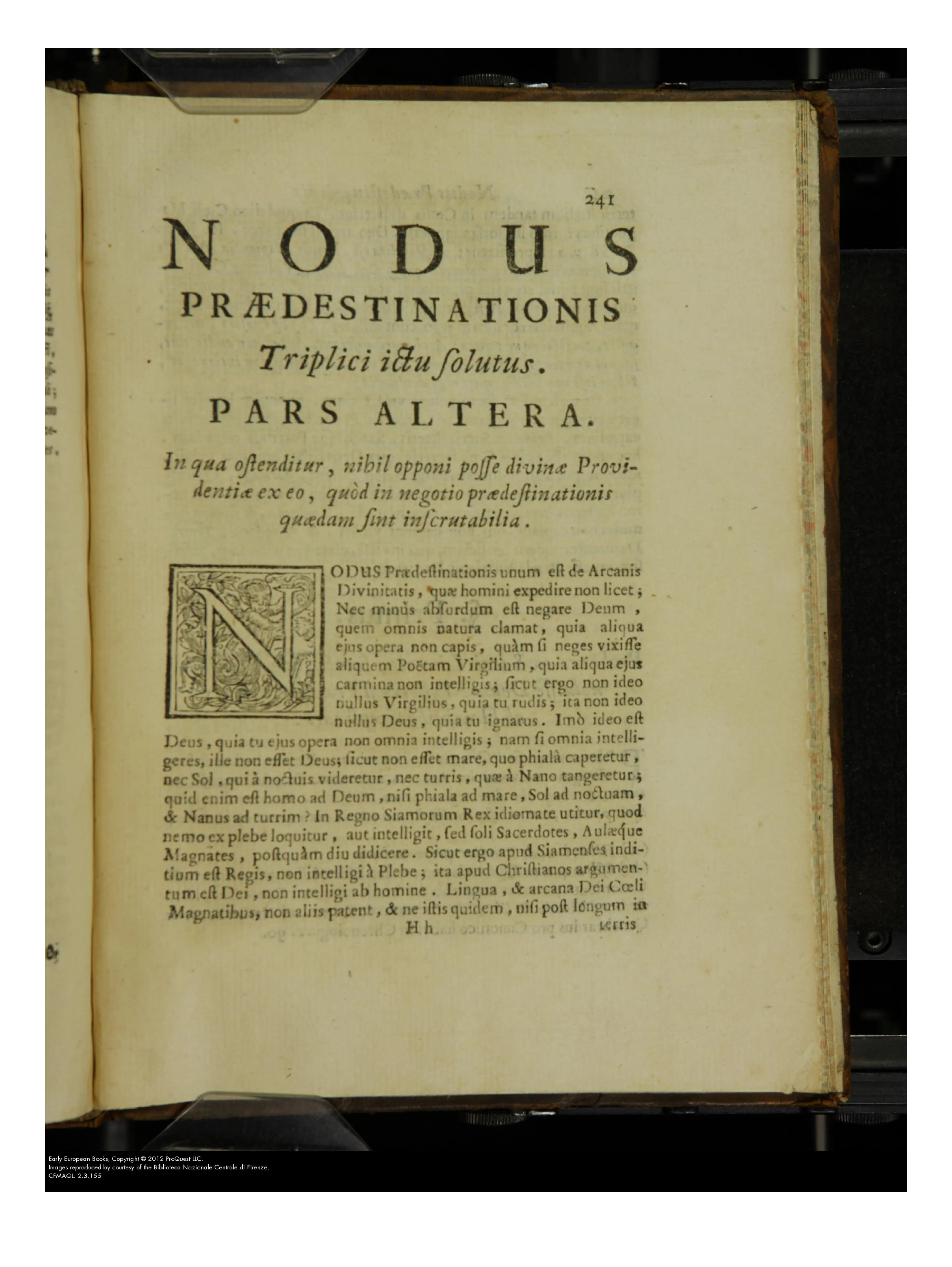
The opening of the Pars Altera, under the half-title Triplici ictu solutus, marks the turn from resolving ignorance to disciplining presumption. Its courtly analogy of guarded language makes inscrutability the theological point: divine arcana are no evidence against Providence but secrets exceeding human measure, calling for faith, not interrogation. Source ↗.
Section II then attacks the inference that underlies every complaint against hidden judgements. The worst argument, it declares, has always been: I do not see, I do not grasp, therefore it is not, P Essima semper fuit illa argumentatio: Non video, non capio, er. The refutation ranges across supernatural mysteries, providential histories, human counsels and nature. In nature the text finds the most surprising evidence. Reprobation itself is redefined optically: reprobation, the author asks, is it anything other than an eclipse of the divine Sun? rationes? nihil enim est aliud reprobatio, quàm Ecclipsis Divini. In an eclipse the obscuring body is interposed between the sun and the earth. The figure thus places the cause of darkness in the interposed human will rather than in any failure of the source of light.
The same register of discovery serves an eschatological argument. Six thousand years after the founding of the world, the author observes, Galileo first saw four new planets about Jupiter, à condito Mundo primus Galilæus quatuor, novosque Planetas ob. Truths long hidden, he infers, may await a future age, and in the revelation of glory each of us will be a Columbus, gatione; tunc nostrûm quilibet Columbus erit, nunc verò tam igna. Telescope and voyage are enlisted not as challenges to received authority but as figures of a deferred disclosure. This keeps the epistemic humility of quantum homini licet intact while granting the new knowledge its rhetorical prestige.
The rain-tree of the Isla de Hierro, documented by a long chain of eyewitnesses, is turned to the question of grace among peoples who have not heard the Gospel. The text answers with a formula of confident ignorance: I do not know the manner, but I know it is not lacking, nescio modum, sed scio, non deesse. The sentence epitomizes the treatise's method. It affirms the universality of sufficient grace and leaves its mode among the arcana.
Section III raises Salvian's dictum, that God as author and ordainer suffices in place of all reasons, into a quasi-Aristotelian demonstration from every genus of cause. Its starkest form is an enthymeme: God permitted Judas to be damned; therefore Judas was justly and rightly damned, Deus Iudam damnari permisit; ergo Iudas justè rectèq[ue] damnatus est:. The verb permisit is chosen with care. It preserves the asymmetry between divine permission and human agency on which the whole reconciliation rests. At the same time, the bare inference from divine permission to justice concedes that, at the limit, demonstration converges on faith in the goodness of the one who permits.
The treatise accordingly closes not with a verdict but with an adjournment modelled on the Areopagite postponement recorded by Gellius. If these arguments do not suffice, the reader is told to leave the Areopagus: what God does you do not know now, but you will know hereafter, sufficiunt, exi Areopago: Quod Deus facit, tunescis modò, scies autem. The forensic suspension of judgement gives the final form of the bounded resolution. Judgement is not abolished but deferred.
The Corollarium Doctorum
The appended Corollarium Doctorum then assembles the authorities who hold predestination ex prævisis meritis and read Augustine and Thomas in that sense. Its rhetorical centre is the voice of Vázquez: in this controversy Augustine alone will always count for many, nunc agitur, unus pro multis mihi semper erit Augustinus. The catalogue thus returns, in documentary form, to the contest over Augustine that ran through the objections of Part I.
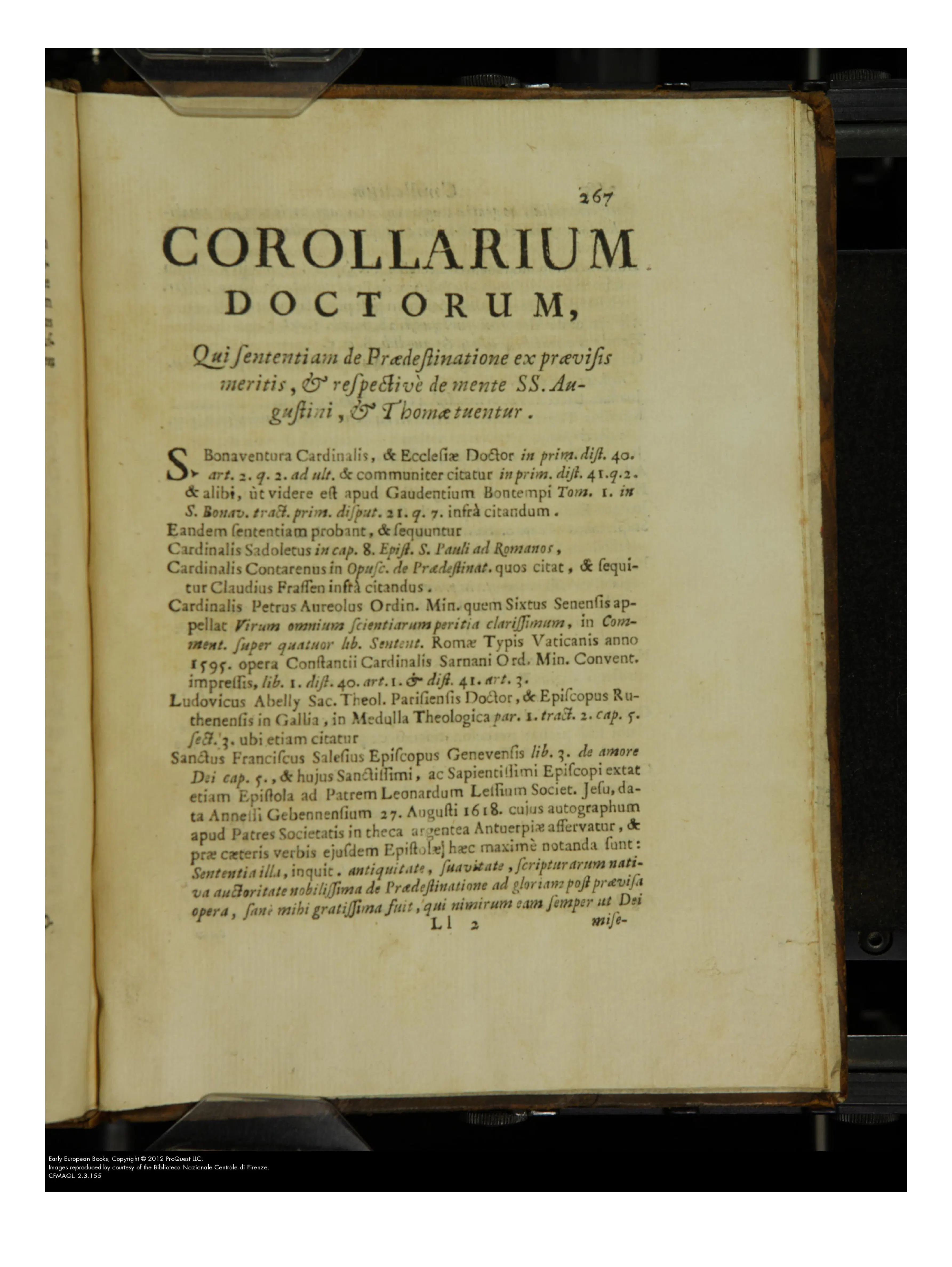
The opening of the Corollarium Doctorum announces the appendix's purpose: to gather the authorities for predestination ex prævisis meritis. Its early roll of names, from Bonaventura to Francis de Sales, turns the contest over Augustine into a catalogue of sanctioned voices. Source ↗.
Its treatment of Scotus is telling. Scotus is listed as problematic on the question, and the words quoted to show this restate the treatise's own anti-speculative caution: lest by searching into the deep one go into the deep, let whichever opinion pleases more be chosen, Ne scrutan lo de profundo eatur in profundum, eligatur, quæ magis. A list compiled to display the strength of one party ends by reaffirming the limit that governs the whole work. The profundum of the decree is to be approached only so far as is permitted to human understanding.
Reading Further on Sfondrati, Foreseen Merits and the De Auxiliis Controversy
Eleonora Rai, "Ex Meritis Praevisis: Predestination, Grace, and Free Will in intra-Jesuit Controversies (1587–1613)," Journal of Early Modern Christianity 7, no. 1 (2020): 111–150. Rai reconstructs disagreements over foreseen merits within the Society of Jesus. Her account prevents Sfondrati's position from being reduced to a single, undifferentiated "Jesuit" doctrine.
Her study offers a frame for one of the text's own self-identifications. Having stated the practical rule "do what you can, and ask for what you cannot; thus you will arrive safely," hoc est, age quod potes, & pete, quod non potes; sic tutus pervenies, the text claims the teaching as an Ignatian inheritance. It does so in the words "this doctrine we received from St Ignatius, Founder of the Society of Jesus," Hanc doctrinam à S. Ignatio societatis IESU Fundatore accepimus,. How that claimed inheritance relates to the specific positions Rai distinguishes remains to be examined.
Jean-Pascal Gay, Jesuit Civil Wars: Theology, Politics and Government under Tirso González (1687–1705) (Farnham: Ashgate, 2012). This is a contextual study of divisions within the Jesuit order during the years of the Nodus's publication, rather than a study of Sfondrati's book itself. Tirso González, the general at the centre of Gay's study, is among the contemporaries named in the treatise. Its publication particulars require independent catalogue confirmation before formal citation.
Robert J. Matava, Divine Causality and Human Free Choice: Domingo Báñez, Physical Premotion and the Controversy De Auxiliis (Leiden: Brill, 2016). This is a contextual treatment of the Dominican account of divine causality against which later predestination arguments must be situated, not a documented study of the Nodus. The relevance of that context is visible in the treatise's rejection of physical predetermination. The text insists that grace acts upon the human will not in the manner of a thunderbolt shattering all resistance: Agit quippe gratia in voluntatem humanam non more fulminis, resistentia quæque frangentis. Its publication particulars likewise require independent catalogue confirmation.
Frequently Asked Questions
What is Celestino Sfondrati's Nodus praedestinationis?
Nodus praedestinationis is a Latin theological treatise by Cardinal Celestino Sfondrati, recorded as printed at Rome in 1696 by J. J. Komarek. It sets out to untie the knot of predestination from Scripture, Augustine and Thomas Aquinas. Its central problem is how God can elect some, sincerely will the salvation of all, and still leave human beings free. The full title limits the attempt with quantum homini licet, "so far as is permitted to a human being." Sfondrati reportedly wrote the work in the intervals of a fatal illness. The printed text breaks off during its historical proof with a notice that the author, seized by illness, could not finish it.
How does Sfondrati distinguish "efficacious" from "effective" grace?
Sfondrati separates an efficacious cause, judged by intention and endeavour, from an effective cause, the one upon which the effect actually follows. Applied to grace, the distinction lets him call every grace efficacious on God's side while tracing every loss to the human will that refuses it. He pairs this with two divine wills. Predestination is God's antecedent and efficacious will to bring man to eternal life, while reprobation is God's consequent will, a response to foreseen obstinacy. The move is aimed against the Báñezian idea of grace efficacious from within. How it relates to Leonard Lessius's own formulations remains a matter for direct comparison of the texts.
Why does Sfondrati mention Galileo and Columbus in a treatise on predestination?
Sfondrati uses Galileo and Columbus as figures of truth disclosed late. Six thousand years after the founding of the world, he observes, Galileo first saw four new planets about Jupiter. Truths now hidden may therefore be revealed hereafter, and in the revelation of glory each of us will be a Columbus. The same horizon shapes his claim that no one in Europe, Asia, Africa or America lacks the movement toward God that the beauty of creation gives. It also shapes his scepticism toward Molina's report of Brazilians ignorant of God. Of grace among peoples without the Gospel he concludes: I do not know the manner, but I know it is not lacking.
Was Sfondrati's Nodus controversial when it appeared?
Yes. Within two years Giovanni Maria Gabrielli published Dispunctio notarum quadraginta (1698), which announces that it rebuts forty criticisms an anonymous writer had placed upon the Nodus. After the de auxiliis disputes, printing on predestination and divine helps still required a licence, and the book reportedly carries a Holy Office memorial dated 25 July 1696 requesting permission. Accounts of a joint letter of objection from French bishops, and of the book escaping formal condemnation, remain unconfirmed. An Index entry can be neither asserted nor excluded. The dispute shows how contested even a moderate position on grace remained after the 1653 condemnation of Jansenist propositions.
Is there an English translation of The Knot of Predestination Untied?
No complete translation of Sfondrati's Nodus praedestinationis into English or any other modern language has been verified. The English title The Knot of Predestination Untied is an editorial rendering, not an established translation. The Leo edition is a separate undertaking, part of an effort to make English translations of every text printed in Latin in early modern Europe between 1450 and 1750 freely available online at no cost. It presents the full transcription and a complete English translation of the treatise for the first time. That English translation is generated by AI.
This report was generated by an advanced AI assistant that conducted deep research alongside an extensive interpretation of the transcribed original text. Every effort has been made to preserve fidelity to the source and to guard against inaccuracy, but corruption in the text recognition process and model hallucination may nonetheless have entered the text. Treat every claim, quotation, translation, and citation as provisional, and verify each against the original source before relying on or citing it.
Bibliography
- Jean-Pascal Gay, Jesuit Civil Wars: Theology, Politics and Government under Tirso González (1687–1705): Gay reconstructs the Society of Jesus in the very years the Nodus went to press, when a general hostile to probabilism was fighting much of his own order. Sfondrati names Tirso González among his contemporaries, so readers who wonder why a cardinal's tract on grace needed a Holy Office licence and drew a rebuttal within two years will find the factional weather described here. The book does not discuss Sfondrati's treatise directly, but it makes plain how a mild doctrine could still start a quarrel.
- Robert J. Matava, Divine Causality and Human Free Choice: Domingo Báñez, Physical Premotion and the Controversy De Auxiliis: Sfondrati spends many pages mocking "battering rams and engines" and a grace that strikes "like a thunderbolt," and Matava supplies the Báñezian position under attack. His sympathetic and rigorous reconstruction of physical premotion shows what the Dominicans actually meant, which was rather more subtle than Sfondrati's rhetoric suggests. Read it to judge whether the Nodus unties the Dominican knot or simply cuts a caricature of it.
- Eleonora Rai, "Ex Meritis Praevisis: Predestination, Grace, and Free Will in intra-Jesuit Controversies (1587–1613)," Journal of Early Modern Christianity: Rai shows that Lessius's predestination "on account of foreseen merits" unsettled Bellarmine and Acquaviva as much as any Dominican, which takes apart the convenient label "Molinist." Because the Nodus opens with Francis de Sales's letter to Lessius and closes with a catalogue of foreseen-merits authorities, this article is the most direct guide to the lineage Sfondrati claims. It also gives readers the terms they need to test whether his "efficacious" and "effective" grace repeats Lessius or quietly revises him.