Whose Walls Are Ships: Giulio Ferretti's On the Law and Practice of Naval Affairs
Giulio Ferretti of Ravenna, a sixteenth-century jurist and administrator, set out to show that ships, storms and sea battles belonged to lawyers as much as to admirals. His De iure, & re nauali et de ipsius rei navalis et belli aquatici praeceptis legitimis, liber, which reached Venetian print only after his death in 1547, prices marine risk, condemns wreckers, outlaws pirates and hails Venice as a queen whose walls are ships. The result is a sustained attempt to bring the whole business of the sea, from insurance contracts to Greek fire, under learned law.
ExLatinis
October 7, 2026

Contents
Giulio Ferretti of Ravenna, a sixteenth-century jurist and administrator, set out to show that ships, storms and sea battles belonged to lawyers as much as to admirals. His De iure, & re nauali et de ipsius rei navalis et belli aquatici praeceptis legitimis, liber, which reached Venetian print only after his death in 1547, prices marine risk, condemns wreckers, outlaws pirates and hails Venice as a queen whose walls are ships. The result is a sustained attempt to bring the whole business of the sea, from insurance contracts to Greek fire, under learned law.
Giulio Ferretti of Ravenna, a jurist and administrator of the first half of the sixteenth century, wrote a Latin treatise that asks how the sea can be brought under law. Treccani dates his birth to 1487 and the Harvard and HathiTrust catalogues to 1480; all agree that he died in 1547. The sea, for him, was at once a theatre of war, a highway of commerce, a place of mortal peril and an object of contested rule. His treatise, De iure, & re navali et de ipsius rei navalis et belli aquatici praeceptis legitimis, is known in English by the convenience title On the Law and Practice of Naval Affairs. It reached print only after his death. Francesco de Franceschi issued it at Venice in 1579. The treatise had already appeared in Ferretti's collected Consilia et tractatus of 1562, and it was later absorbed into the great Venetian juristic compilation, the Tractatus universi iuris of 1584–86. The work therefore lived chiefly as an item of learned legal print, read alongside the consilia and tractates of the ius commune. No published translation is known, and the 1579 imprint cannot safely be called the first edition until its text is compared with that of 1562.
The intellectual problem the treatise confronts is one of jurisdictional reach. Can a jurist trained in civil and canon law speak with authority about ships, fleets, storms and naval battle, matters that belonged to captains, pilots and princes? Ferretti's answer rests on a commonplace drawn from the proem to Justinian's Institutes: law and arms are partners, each needing the other. That topos licenses him to treat naval warfare as properly juridical matter. It also lets him weave Bartolist jurisprudence together with the precepts of military and naval practice. His recurring procedure follows a triple scheme of chapters, examples and questions. Each topic is set out as precept, illustrated by ancient and modern exempla, and then resolved through scholastic quaestiones argued from the civil and canon law. Across that procedure runs a steady subordination of force, custom and gain to reason, natural law and divine providence.
The stakes reach well beyond naval matters. The treatise sits where several histories meet: the ius commune and its handling of merchant practice, the Mediterranean commerce of Venice and the Levant, and sixteenth-century arguments about who may rule at sea and on what title. Ferretti brings learned law to bear on concrete instruments: the liability of shipmasters, marine insurance, bills of exchange and the sea loan. He tests each against canonist doctrine on usury. His principle is that a price may be charged for risk but never for the mere passage of time. He condemns wrecking customs as abuses, treats pirates as public enemies and declares reprisals contrary to natural law. Yet the book is also an imperial manifesto. It casts Charles V as God's vicar in temporal affairs and takes the emperor's 1541 expedition against Algiers as its modern exemplum. Within the same frame it makes room for Venice as a free people that recognizes no superior, holds dominion over the Adriatic by immemorial prescription, and is figured as a queen whose walls are ships.
What makes the treatise striking to a first-time reader is its range. Alongside contract, partnership and servitude it discusses ship-timber and Greek fire, the winds and the Tower of the Winds at Athens, weather signs, venomous creatures and islands born in the sea. It is willing to concede that the pilots of its own day know some of these things better than the ancients did. Personal experience surfaces as well: cases witnessed at Naples, Venice and Ravenna, Ravenna's provisioning in the famine of 1528, and the author's standing as a count palatine by imperial grant. The scholarly literature on Ferretti remains thin. His positions on Adriatic dominion, commerce, piracy and imperial war have not been documented as subjects of modern controversy, and the biographical record itself disagrees on his birth year.
One throughline joins the treatise's vocabulary, its printed career and its internal argument: the claim that the domain of arms belongs within the domain of law. Its key terms each carry a double charge, normative and practical. Ius is both right and rule, res navalis both naval affairs and naval craft, iurisdictio and dominium both rule and ownership. Its question-and-answer form suited it for life among the collected tractates of the ius commune, where it reached most of its readers. Its argument repeatedly measures force, custom and profit against reason and natural law. On that common ground it places emperor and republic, merchant and admiral, Church and fleet.
Read the full text and English translation on Leo
This text was transcribed and translated as part of the ExLatinis project, an effort by Leo to make free English translations of every text published in Latin in early modern Europe (1450–1750) available online. The complete transcription and English translation of this work can be read free of charge:
→ Read the original Latin text and full English translation on Leo
You can save a copy of this document into your Leo account to run deep text searches, conduct further analysis, or cross-reference it with your own research.
Naming Ferretti's Treatise: Ius, Res Navalis, and War on Water
Giulio Ferretti, On the Law and Practice of Naval Affairs is an editorial English title supplied for convenience, not a verified established translation. The recorded Latin title continues De iure, & re nauali et de ipsius rei navalis et belli aquatici praeceptis legitimis, liber. Ius here calls for attention to legal right and normative rule, while res navalis encompasses naval affairs more broadly than a discrete body of sea law; the title's separate reference to legitimate precepts of belli aquatici makes armed conflict on water explicit. Rendering the whole simply as Maritime Law would obscure that breadth.
The pairing of iura and arma belongs to the juridical language of rulership familiar from Justinian's Institutes, but its precise deployment by Ferretti requires inspection of the relevant passage. The text itself supplies that passage. It restates the topos as a partnership, Iura & Arma insimul sunt consortia, vt aliàs dixi,, that is, "law and arms are partners together, as I have said elsewhere." The cross-reference shows that Ferretti treated the formula as a settled premise of his own juristic thought rather than a passing ornament. He then extends the Justinianic commonplace explicitly to the sea. The emperor, he writes, must excel armis Imperator in terra, sed etiam in aqua altero, in arms "not only on land but also on water, the other element." This second clause turns the proem's land-bound image of imperial majesty into a warrant for a naval jurisprudence. That move explains why the title's ius, res navalis and bellum aquaticum belong together, and why a single English noun cannot render them.

Justinian among clergy and armed attendants in the mosaic at San Vitale, Ravenna: a sixth-century image of imperial authority at once sacred and military. Ferretti, himself a Ravennate, built his naval jurisprudence on the Justinianic partnership of law and arms. Source ↗.

Equally, dominium maris and iurisdictio maris should not be collapsed: a claim to jurisdiction over navigation or persons does not, without further argument, establish ownership of the sea. The catalogue descriptions establish the title, not which of these latter expressions Ferretti used or how he resolved their implications.
The text itself shows that Ferretti used both terms, and used them together. Of the Venetians he writes, Nam hi prudentia sua maris Hadriatici iurisdictionem & dominium præscripsere per tantum tempus, cuius initii memoria hominum non extat, "by their prudence they prescribed jurisdiction and dominion over the Adriatic Sea for so long a time that no human memory of its beginning exists." The coordination of iurisdictio and dominium under a single verb of prescription is therefore Ferretti's own. Whether the pairing amounts to a claim of ownership of the sea or a cumulative claim of rule awaits closer reading of the surrounding argument.
Elsewhere the treatise sets limits on princely power over private rights in waters and property. It states that non potest princeps in damnum statuere priuati in ipsis, "the prince cannot legislate to the detriment of a private person in these things." That limit is consistent with a conception of princely authority as jurisdictional rather than proprietary. It also asks of the sea's most elementary phenomena, cuius sit Insula in mari nata omnibus communissima. Dic, "to whom belongs an island born in the sea, most common to all? Answer." The superlative communissima, used of the sea as a thing common to all, sits in deliberate tension with the language of prescribed dominium. The polysemy the title announces thus recurs as a working problem inside the treatise.
What Ferretti's On the Law and Practice of Naval Affairs Argues
De iure et re navali is a Latin juridical treatise by the Ravennate jurist Giulio Ferretti, concerning naval affairs and the legitimate precepts of warfare on water. Its organizing premise is the Justinianic partnership of law and arms, which Ferretti extends from land to sea. A separately catalogued edition was printed at Venice by Francesco de Franceschi in 1579. Since Ferretti died in 1547, that edition is posthumous; it is not securely identified as the first publication, because a catalogue of the 1584–86 Tractatus universi iuris also reports the work in Ferretti's Consilia et tractatus of 1562. The proposition that the work consists of seventeen books is borne out by the text itself, which runs in seventeen books, but its date and place of composition still require checking against the printed text. No published translation was verified. Treccani gives Ferretti's birth as 1487, whereas the Harvard and HathiTrust catalogue records give 1480; all place his death in 1547. Juan de Lugo's Christological disputations are a different work.
The treatise's legal core lies in the commercial and maritime law of the ius commune, worked through precept, exemplum and scholastic question. On the liability of shipowners it holds that de dolo, lata, leui, & leuissima culpa tenentur exercitores, & non de casu naufragii, neque de Pyratarum incursu. Ship-operators are thus "liable for fraud and for gross, light and lightest fault, but not for shipwreck or the incursion of pirates," a graded standard of care that separates human fault from the hazards of the sea.
Ferretti's handling of insurance, exchange and the sea loan turns on a canonist distinction. On a risk-bearing contract he concludes, hoc non est usura, sed pretium periculi, "this is not usury but the price of risk." He sets against it the contrasting case, Secus + si esset data noue pro decem ad annu[m], quia hoc pretium temporis esset usura: "but if nine were given for ten for a year, this price of time would be usury." Here, as throughout, gain is admitted only where reason and the law can justify it.
Why Ferretti Matters for the Ius Commune and Mediterranean Sea Power
Ferretti's recorded title places legal reasoning, naval practice, and war on water in the same work. That combination makes the treatise pertinent to the history of the ius commune, Mediterranean maritime commerce, and sixteenth-century arguments about maritime authority. Ferretti's administrative and juridical career supplies a further reason to investigate how practical governance and learned law meet in his writing. These are research implications of the identified work, not a verified account of the arguments of all its parts.
The text does, however, show how the partnership of law and arms shapes its political horizon. The treatise is framed as an imperial programme addressed to Charles V. It honours the emperor ut uero Dei Vicario in temporalibus, "as indeed to God's vicar in temporal matters," a formula that places the emperor's naval and juridical authority within a providential order. The modern exemplum of that authority is the emperor's expedition of 1541, recalled in a narrative that relates how autumni tempore nauigauit in Numidiam, in locum vulgò dictum Algerium, "in autumn he sailed to Numidia, to the place commonly called Algiers." The choice of a recent and contested campaign shows Ferretti setting contemporary naval war beside the ancient exempla of his juristic method.
The same imperial frame makes room for Venice, which the treatise celebrates in the idiom of the myth of Venice. It speaks of satalem ciuitate[m] Venetiarum dominari Diuino iudicio, the claim "that the fated city of Venice rules by divine judgment." Here the printed long s gives satalem for fatalis. It also hails the city as Reginam Hadriatici maris: cuius moenia sunt naues,, "Queen of the Adriatic Sea, whose walls are ships." How Ferretti reconciles an emperor styled as God's temporal vicar with a republic described as recognizing no superior is one of the treatise's most interesting tensions. It is a question for which no published scholarly discussion has been located.
The ethics of war form a second register in which law disciplines arms. Ferretti insists that Nam + sides est omnibus, & hostibus quoque, seruanda;, "for faith must be kept with all, enemies included," the printed sides standing for fides. He permits stratagem in a just war: pugnaretur, quia tunc no[n] refert an justo aperto Marte, an dolo uel insidiis, "for then it does not matter whether one fights justly in open battle or by guile or ambush." Yet he draws a firm line at falsehood: Mentiri [tha]t autem nunquam est licitum, neque fallere, "but it is never licit to lie, nor to deceive." Command and its outcome are likewise referred to higher principles. The treatise holds that quia obedientia est uera Regum Corona præclarissima;, "obedience is the true and most illustrious crown of kings." It enjoins the victor illam attribuere ipsi Omnipotenti Deo; & non humanè uirtuti,, "to attribute it to Almighty God himself, and not to human valour."
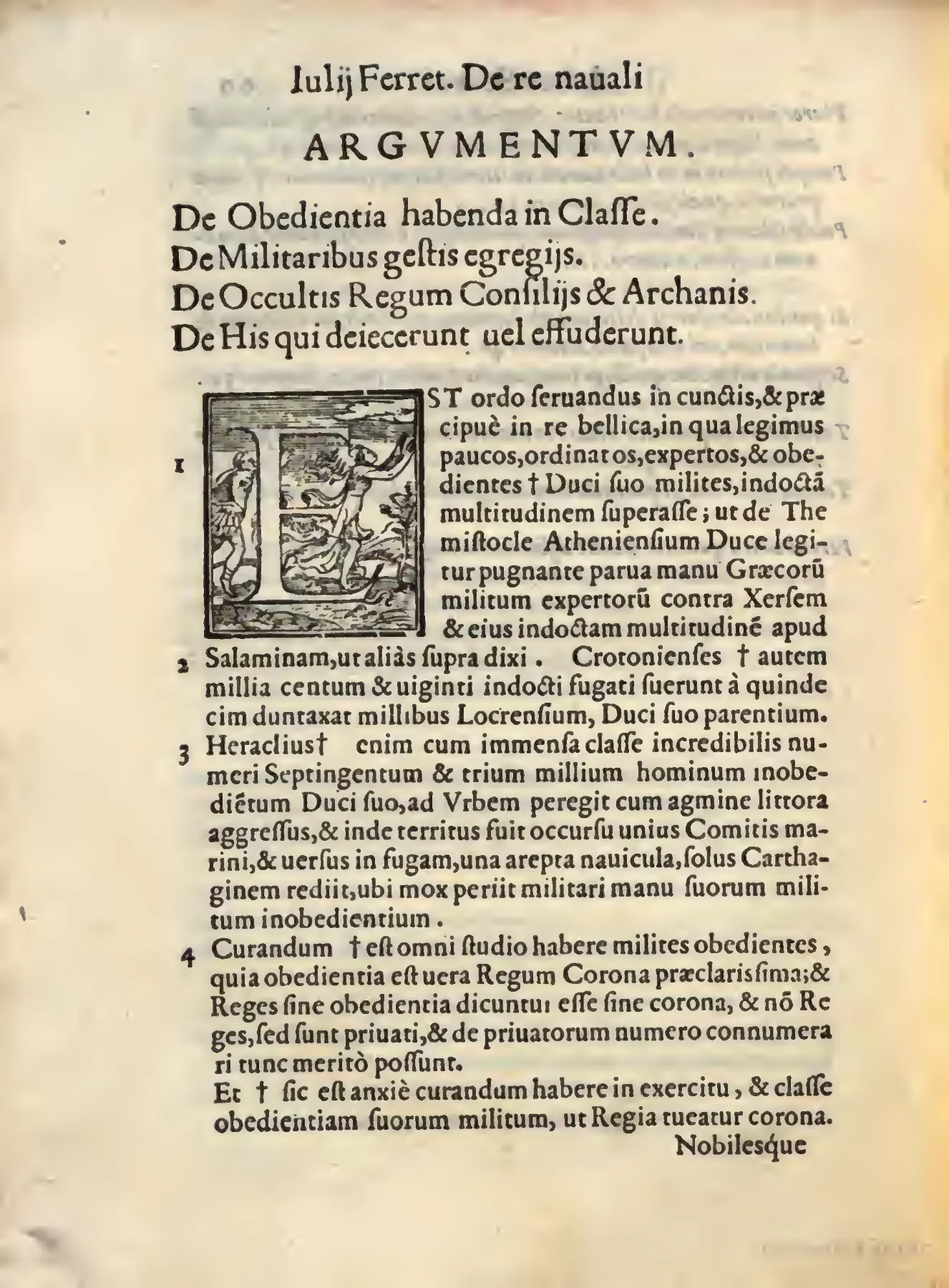
The “ARGUMENTVM” frames naval obedience as a legal and moral problem before the page turns, beneath a historiated initial, to exempla from Themistocles to Heraclius. Its maxim that obedience is the true crown of kings makes lawful discipline the condition of command. Source ↗.
The treatise also subordinates local custom and private gain to reason. On wreck it rules that quia omnia quæ recipiuntur ex naufragio sunt restituenda dominis suis, uel eorum hæredibus, nè addatur afflictio afflictis;: everything recovered from a shipwreck must be restored to its owners or their heirs, "lest affliction be added to the afflicted." Against the coastal customs that sanctioned plunder it invokes the canonist principle that consuetudo irrationabilis non ualet, & pro abusione habetur, & damnatur; nec seruari debet, ut statuit Papa Honorius. An unreasonable custom, that is, "is invalid, is held an abuse and condemned, and must not be observed, as Pope Honorius laid down."
The sea also furnishes Ferretti's ecclesiology, quoniam per figuram Religio Christiana dicitur esse nauis, quæ tuto regi debet temone per Prælatos: "figuratively the Christian religion is called a ship, which must be safely steered by the rudder through prelates." His political economy recasts princely virtue as just provisioning. Charitas † est Regum regere populos iustitia, qua se, "the charity of kings is to rule their peoples with justice," is a principle that the treatise connects with the punishment of grain monopolists and with Ravenna's famine measures of 1528. Commercial association receives a similarly moral gloss, quia societas habet instar fraternitatis;, "for partnership has the likeness of brotherhood."
Ferretti's respect for practical expertise is perhaps the most arresting note for a historian of learning. On winds and sea-lore he concedes, & experti nautæ nostri temporis sciunt, & fortè melius quàm Veteres sciuerint, that "the experienced sailors of our time know these things, perhaps better than the ancients knew them."
The historiography recoverable here is thin. Harvard's account establishes circulation in collected juristic print, while Treccani's short notices situate Ferretti among jurists concerned with international and maritime law, economic questions, and public finance. The notices disagree with catalogue authorities on his birth year: Treccani's concise entry gives 1487, Harvard and HathiTrust 1480, and the older Treccani notice specifies only the end of the fifteenth century. A distinct Dizionario Biografico degli Italiani entry titled 'Ferretti, Giulio,' with volume and year, was not confirmed; the located Treccani notices should not be presented as that entry. Specific scholarly disagreements about Ferretti's treatment of Adriatic dominion, commerce, piracy, or imperial war could not be documented. Broader histories of Mediterranean commerce, jurisdiction, and piracy offer questions with which to read him, but do not establish his position on those controversies. The passages quoted above show what Ferretti says on several of these subjects. They do not show how his contemporaries or later jurists received those positions.
Tracing Ferretti's Treatise from the 1562 Consilia to the Tractatus Universi Iuris
The separately recorded imprint is Ivlii Ferretti … De iure, & re nauali et de ipsivs rei navalis et belli aqvatici praeceptis legitimis, liber (Venetiis: apud Franciscum de Franciscis, 1579). Its HathiTrust catalogue describes four preliminary leaves and 163 leaves numbered in error for 167, at 22 cm; it notes numerous pagination errors, a printer's device on the title page, and a blank fourth preliminary leaf. Those particulars do not by themselves establish a bibliographical format or a full signature collation. The available catalogue evidence does not identify an editor, privilege, licence, or dedication. Internally, the text frames its programme as addressed to Charles V. It also furnishes each book with a summary of contents keyed to numbered paragraphs and an argumentum, apparatus suited to consultation by practising jurists.
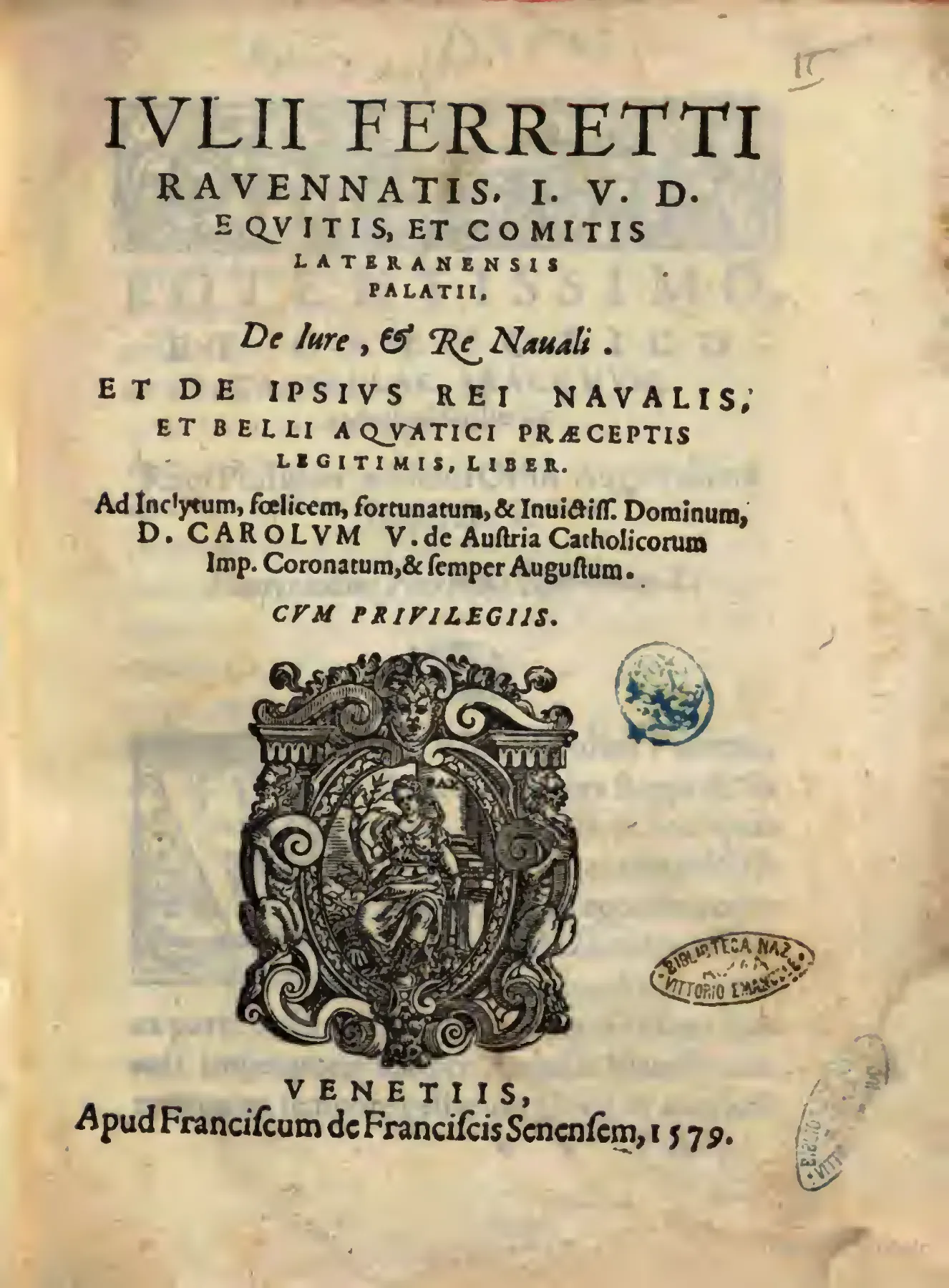
Francesco de Franceschi's woodcut device stands beneath the imprint “Venetiis, Apud Franciscum de Franciscis Senensem” on the 1579 title page. The typography stages the work's authority: Ferretti appears as a Lateran count palatine, and the dedication to Charles V presents naval law as a matter of imperial counsel. Source ↗.
The Harvard Law School copy of the Venetian Tractatus universi iuris (1584–86) includes Ferretti's De iure et re navali in tome 12 at folio 325va, item 655. Harvard's catalogue note also identifies the treatise in Consilia et tractatus (Venice, 1562), folios 170–217. Accordingly, 1579 cannot safely be called the editio princeps without comparing the 1562 and 1579 texts.
The work's absorption into collected juristic print fits its internal form. Much of its argument proceeds through the scholastic quaestio, as in the opening Quæro † de iure seruitutis nauigandi, de quibus sit seruitutibus, an de, "I ask about the right of the servitude of navigation: to which servitudes it belongs, whether to," a format that a compiler of tractates could readily set among other works of the ius commune. In this respect the material career of the treatise and its method of bringing naval matters under legal rule point the same way.
Harvard describes its collected-series copy as bound in 29 physical volumes; no individual shelfmark for the 1579 edition, or complete copy-specific provenance, was verified. Ferretti's other recorded works include De gabellis et publicanis … (1547) and the posthumous Consilia et tractatus (1562). No transcription lineage, translation, censorship proceeding, contemporary reply, or secure chain of ownership was established.
A catalogue description for Lugo's Disputationes scholasticae de incarnatione dominica identifies a Lyon second edition of 1646, with [16], 532, [16] pages and a stated signature formula. That description alone does not identify the alleged Google Books or Internet Archive record whose images contain Ferretti. The reported misattribution of a Ferretti scan to Lugo therefore could not be tied to a record identifier or holding library. Without an inspected sequence of images and binding evidence, neither a Sammelband nor a mislabelled scan can be established; an erroneous association between images and catalogue metadata remains a possibility, not a demonstrated object history. Lugo's theological title must not be assigned to Ferretti's naval text.
Following Ferretti's Argument Book by Book, from Ravenna to the Island Born in the Sea
The Address to the Emperor: Speed, Ravenna, and the Partnership of Law and Arms
Ferretti opens his address to the emperor with a strategic maxim, not a juridical one. He invokes Caesar's judgement that in warfare speed counts for more than courage, Quia in rebellica magis prodesse solet celeritas, quàm virtus, Cæsaris sententia,, where the printed rebellica is to be read as re bellica. The maxim explains why Rome kept standing fleets at the edges of Italy. It also lets the author write himself into that history, recalling that the Romans used to Rauennam patriam meam tenere Classem in Adriatico mari, to keep a fleet at Ravenna, "my homeland," in the Adriatic Sea. The local and the imperial are joined from the first lines. The Ravennate jurist speaks as a citizen of a former naval station of the empire, and that standing gives him a claim to counsel the empire's present heir.
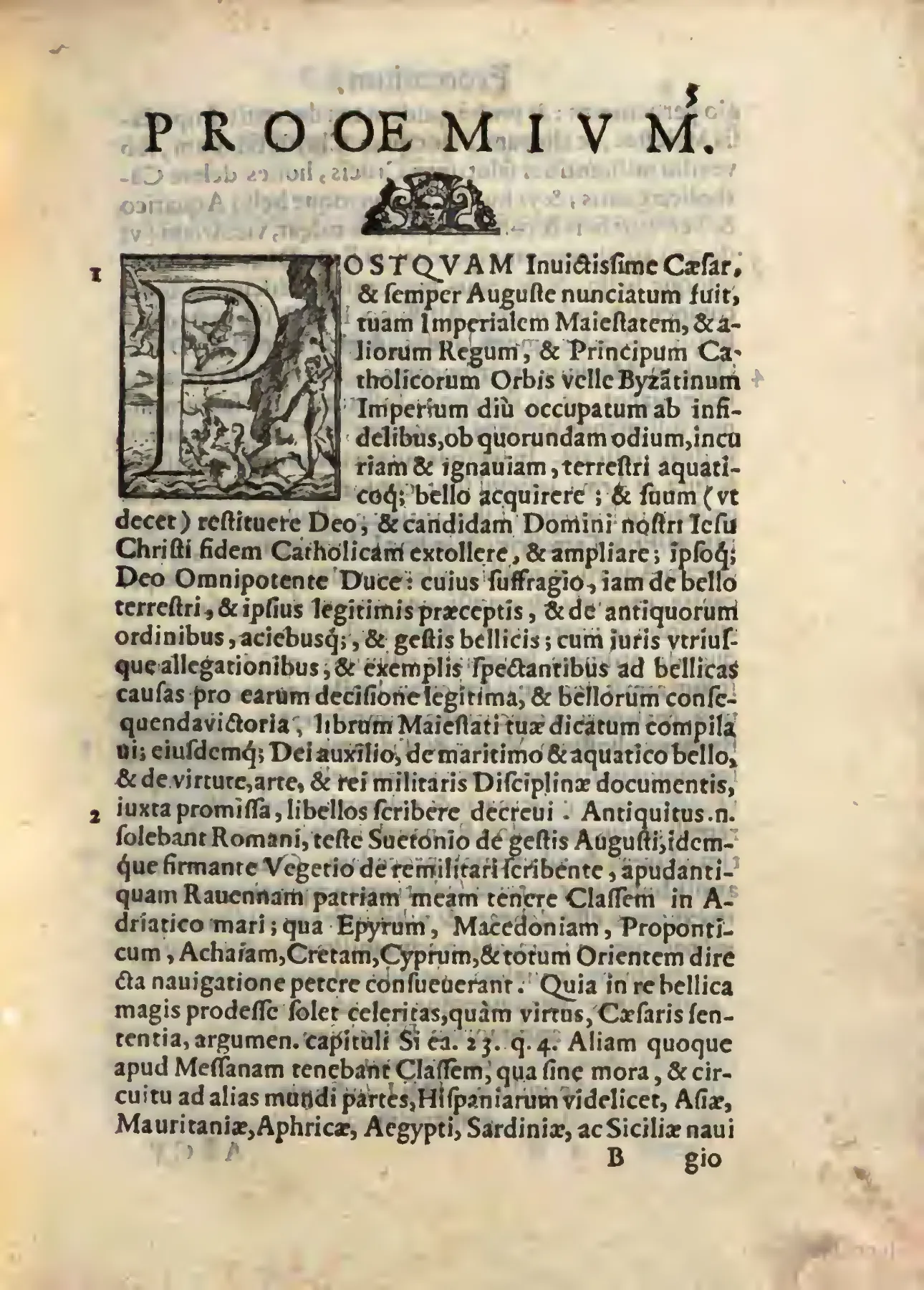
The Proemium opens with typographic ceremony, a headpiece and large pictorial initial, before Ferretti addresses Charles V. Its appeal to speed in war and to Rome's fleet at Ravenna turns the jurist's homeland into a credential for advising imperial power at sea. Source ↗.
The juridical warrant follows at once. Ferretti restates the Justinianic partnership of law and arms, the formula already examined above, which his own cross-reference marks as a settled premise of his thought. He then glosses the proem's chiasmus, that the emperor quòd voluit non solum armis decorari, sed etiam legibus armari;, wished to be not only adorned with arms but armed with laws. The rhetorical point lies in the exchange of predicates. Arms become ornament and laws become weaponry, so each domain borrows the other's attribute. The decisive extension comes when the emperor is required to excel in arms not only on land but also on water, the other element — the clause whose consequences for the title have already been traced. With that phrase the treatise becomes the maritime counterpart of Ferretti's earlier book on land warfare. The declared method, proceeding by chapters, examples and questions, is the procedure by which a jurist's competence is carried onto the sea.
Book I: Ships, Carriers, and the Price of Risk
What follows in the first book shows how far that competence reaches, and how quickly it settles on commerce rather than combat. After precepts on commanders and on ship-timber, Ferretti fixes his terms in the manner of the Digest titles. Nauis † propriè est maritima & impropriè,: a ship is properly a maritime vessel, and improperly a river craft. The distinction matters because liability attaches to defined objects. Before any carrier can be charged, the jurist must decide what counts as a navis.
The edictal liability of shipmen under receptum then supplies the book's doctrinal core. Ferretti holds, in the graded standard already cited in summary, that ship-operators answer for fraud and for every grade of fault down to the slightest, but not for shipwreck or the incursion of pirates. The scale is severe; levissima culpa imposes almost the strictest diligence the ius commune knew. Yet it stops at the two characteristic perils of the sea. Ferretti then sets the limit of vis maior within a providential order. Following Gratian, he writes that omnes casus uel euentus excusant, qui occurrunt humanæ naturæ, uel quæ fiunt in ciuitate justo Dei iudicio, all mishaps excuse which befall human nature or happen in a city by God's just judgement. The fortuitous event is therefore not blind chance. It is the domain of divine judgement, against which human diligence cannot be measured. Around this theological limit, however, stands a deep suspicion of the carrier. Ferretti recalls a cardinal's quip about the title on sailors, innkeepers and stablemen, quem titulum per excellentiam trium latronum, the title called, par excellence, that of the three thieves. The jest states in brief the evidentiary presumption that the edict encodes. The law excuses Providence but assumes the worst of the men who carry goods.
The same balance between trust and control governs the long treatment of merchants' books. A merchant's account proves only si fuerit mercator bonæ famæ & nominis & conditionis descriptus in matricula, if he is a merchant of good fame, name and condition, entered in the matriculation register. Commercial credit thus becomes a juridical status, conferred by guild enrolment and public repute rather than by the bare fact of keeping accounts.
The book's most finely balanced argument concerns exchange and insurance. Measured against canonist usury doctrine, a risk-bearing transaction passes the test: as already quoted, it is not usury but the price of risk. The contrary case follows immediately. It is otherwise if nine (the printed noue standing for novem) were given for ten payable within a year, for such a price of time would be usury. The opposition of periculum and tempus carries the whole argument. Time belongs to God and cannot be sold, whereas risk is a real burden borne by the lender and may lawfully be priced.
Ferretti grounds the doctrine in what he has himself seen. He recalls that Vidi [n]o[n] quosdam Florentinos in ciuitate Neapolis tempore domini mei, D. Clementis Septimi Medices: he saw certain Florentines at Naples, in the time of "my lord" Clement VII, wagering on whether the pontiff would die within the year, a bet the court upheld. He also describes the Venetian policies, noted earlier among the treatise's commercial materials, that were conditioned on a ship's safe arrival at Venice from Beirut, Candia or Crete, or from Asia. The two cases show that the treatise's commercial law is no abstraction. A wager on a pope's life and an insurance on a Levantine voyage are both treated as conditional stipulations, and both are justified by the same logic of uncertainty. That logic legitimates the Mediterranean trade itself, provided the line between risk and time holds.
Book II: Imperial Vicariate, Adriatic Dominion, and the Pirate
The second book shifts from contract to rule, and its political claims are its boldest. Even princes exempt from tribute owe reverence to the emperor as truly God's vicar in temporal matters, the formula already met in the treatise's imperial programme. Within a few paragraphs, however, the treatise grants the Venetians an Adriatic dominion of their own, in the sentence whose pairing of terms has been examined above: by their prudence they have prescribed jurisdiction and dominion over the Adriatic for so long a time that no human memory of its beginning survives. The tension with imperial supremacy is eased by a shared sanction, since the prescription ran sciente & patiente utroque Orbis Luminare, Papa uidelicèt, & Imperatore;, with both luminaries of the world, the Pope and the Emperor, knowing and tolerating it. The image of the two lights, inherited from medieval controversy over the relation of the powers, here serves an unexpected purpose. Venetian sea-power is not defended against the universal authorities but presented as their tacit concession. Immemorial prescription converts that long toleration into title, so that Venice's sovereignty at sea rests on the acquiescence of the emperor whose supremacy the treatise has just affirmed.
The same book draws the outer boundary of legal protection. Pirates are declared infamous by operation of law and public enemies, in the classification already cited. Citing Innocent IV, Ferretti concludes quòd pyratę possunt impunè derobari,, that pirates may be despoiled with impunity. The juridical order of the sea is thus marked out by exclusion. The carrier is presumed a thief yet stays within the edict, whereas the pirate stands wholly outside it.
Book III: Noble Trade and the Ethics of Partnership
The third book returns to the social foundations of commerce. Its most revealing question asks whether nobles may trade. Against the Neapolitan seggi, which expel merchants, Ferretti places Venice, ruling, in the passage cited earlier, that the imperial law Nobiliores fails in the case of Venetian nobles who trade; the print there gives Veneris for Venetis. The exception rests once more on custom beyond memory, so the prescriptive argument that founded Venetian dominion at sea also founds the mercantile character of its patriciate. The long tract on societas that follows brings the moral limits of association into view. A partnership in which one party bears no loss is & leonina societas, & non humana; neque legitima,, a leonine partnership, neither humane nor lawful. The positive principle is stated through kinship, in the maxim already quoted that partnership has the likeness of brotherhood. On that ground Ferretti presumes equal shares among Pisan partners who contributed ship, person, money and labour. The fraternal analogy carries the argument, because brothers share alike, and so equality becomes the default reading of an unspecified contract.
Books IV–VII: Wages, Faith, Necessity, Discipline, and Fire
The fourth and fifth books bring commerce and war into contact. On the pay of crews Ferretti draws on scriptural language: Vox enim oppressorum, & merces retenta laborum, innocentumque sanguis occisorum, exclamat assiduo ad Deum, the voice of the oppressed, wages withheld from labour, and the blood of innocents slain cry ceaselessly to God. Placing withheld wages beside innocent blood makes the commander's failure to pay his oarsmen a sin of the gravest order. The short tract on faith then lays down the principle, noted above, that faith must be kept with all, enemies included, the print's sides standing for fides. The principle is pointed in a work whose occasion is a war against the infidel, where the binding force of promises given to unbelievers was disputed. Prudence in command is set under the same discipline. Battle comitti no[n] debet nisi præmêre necessitate soluta legibus, should not be joined unless pressing necessity, which is loosed from the laws, compels it. The sentence turns on a paradox. The juristic maxim that necessity knows no law is invoked to restrain war, since only an extremity beyond law may justify combat.
The tract on reprisals carries this restraint into the law of nations. Following Baldus, Ferretti defines reprisals, in the words already cited, as against natural law, contrary to peace, and the beginning of war. The vernacular guerra beside the classical bellum is a telling choice. It names the private, creeping hostility of seizures against a debtor's compatriots, which the jurist treats as war's origin rather than its lawful form.
In the sixth book discipline becomes the substance of sovereignty. Ferretti holds, in the maxim quoted earlier, that obedience is the true and most illustrious crown of kings, so that a king without obedience is no more than a private person. Read beside the opening topos, the metaphor shows obedience as the point at which arms and laws coincide. It is both the discipline of a fleet and the condition of lawful majesty.
The seventh book goes furthest into technical craft and then returns to law. It introduces its recipes for incendiary fire with a genealogy: quod genus ignis incendiarii docuit Romanos Calymacus Græcus architectus, this kind of incendiary fire Callimachus, a Greek architect, taught the Romans. The garbled name, standing for Kallinikos, and the transfer of the invention to Rome show the humanist habit of seeking a classical inventor for every art. After fire-pots and slow-match, however, the jurist recovers his ground in the criminal law of arson. Asked the penalty for incendiaries, he answers Dic esse ignis quo deliquit, seu mors naturalis,: it is the fire by which the offender sinned, or natural death. The same art the treatise teaches for use against an enemy's fleet becomes a capital crime when turned against the city. The penalty is talionic in principle and is then graded by dolus and degrees of fault, so that technical knowledge and its legal limit appear side by side.
Book VIII: The Winds, Algiers, and the Law of Wreck
The eighth book opens on the nature of the winds. It draws on the octagonal tower of Andronicus, on Aristotle and Varro, and on the poets. Its single modern exemplum returns to the dedicatee: the emperor's autumn voyage to Numidia, to the place commonly called Algiers, already recalled above as the treatise's chief modern instance of imperial authority. The expedition of 1541 ended in disaster at sea, but here the choice of season is cast as imperial resolve set against the weather. Placed within a treatise on the winds, the episode joins the book's natural philosophy to its political frame. In Ferretti's account the sea's elemental forces are a stage on which the emperor's mastery of "the other element" is displayed.

Algiers in a city view from Braun and Hogenberg's Beschreibung der Städt der Welt. The North African port was the target of Charles V's 1541 expedition, the single modern exemplum that Book VIII sets amid its discussion of the winds. Source ↗.
.jpg)
The same book closes on the law of wreck, and the decisive move in its final sections is to make restitution the governing rule. Against an unnamed contrary opinion, introduced only as what someone once said, Ferretti holds, in the ruling already quoted, that everything recovered from a shipwreck must be returned to its owners or their heirs. The final clause, "lest affliction be added to the afflicted," carries most of the argument's moral weight. Ferretti does not treat shipwreck as a moment when ownership lapses and the shore reclaims its goods. He treats it as a calamity, and a calamity summons the law to protect the sufferer.
The legal machinery behind this sentiment is Roman, canonical and Sicilian at once. Its sharpest instrument is the canonist doctrine, cited earlier in Ferretti's own words, that an unreasonable custom is invalid, is reckoned an abuse, is condemned and must not be kept, as Pope Honorius laid down. The reference is to the capitula that Honorius IV issued for the Regno in 1285 at the petition of Charles II of Anjou. Ferretti thus sets papal legislation for a southern kingdom against the coastal usages that licensed plunder of the wrecked.
Here a procedure that recurs throughout the later books appears in its clearest form. Practice is not denied; it is tried before the bar of ratio, and where it fails it is reclassified. What the shore-dweller calls consuetudo, the jurist renames abusio. The renaming is not idle, because in the vocabulary of the ius commune it strips the practice of the normative force that long observance would otherwise confer.
The same reasoning sets a limit on commercial rescue. Some lords appoint salvors for a fixed price. Ferretti finds no sound legal footing for this, because so pious a work is owed out of charity, quoniam opus tale pium cum charitate teneatur quis facere, ut dicebat Guilielmus de Cuneo. He does not leave the principle unqualified. He immediately admits a statute that grants a moderate reward. The resulting position is characteristic: the rescue is classed as an obligation of charity, and remuneration is tolerated only as a regulated measure rather than as a price fixed by private lordship.
Between these two rulings the wreck law opens onto ecclesiology. The etymology of naufragium as the breaking of a ship lets Ferretti read heresy and apostasy as the shipwreck of faith. He grounds the figure in the commonplace already quoted, that the Christian religion is figuratively called a ship which must be steered safely by prelates at the rudder. The allegory is more than ornament, because it shows how readily the treatise's naval subject matter becomes a vehicle for ordering the Church. The polemic against Islam that follows rides on the same figure, and the navis Ecclesiae returns in Book XIV.
Books IX–X: Weather Signs, Princely Provision, and the Limits of Stratagem
Book IX turns from the aftermath of disaster to the prudence that should forestall it, and here the treatise's most interesting epistemological tension appears. In a long gathering of weather proverbs, signs from sky and animals, and Virgilian lore, Ferretti makes the notable concession already quoted: the experienced sailors of his own time know these signs, perhaps better than the ancients did. For a humanist jurist whose method relies on classical exempla, the admission is significant. Mariners' tacit knowledge is placed above the authority of the ancients in its own domain.
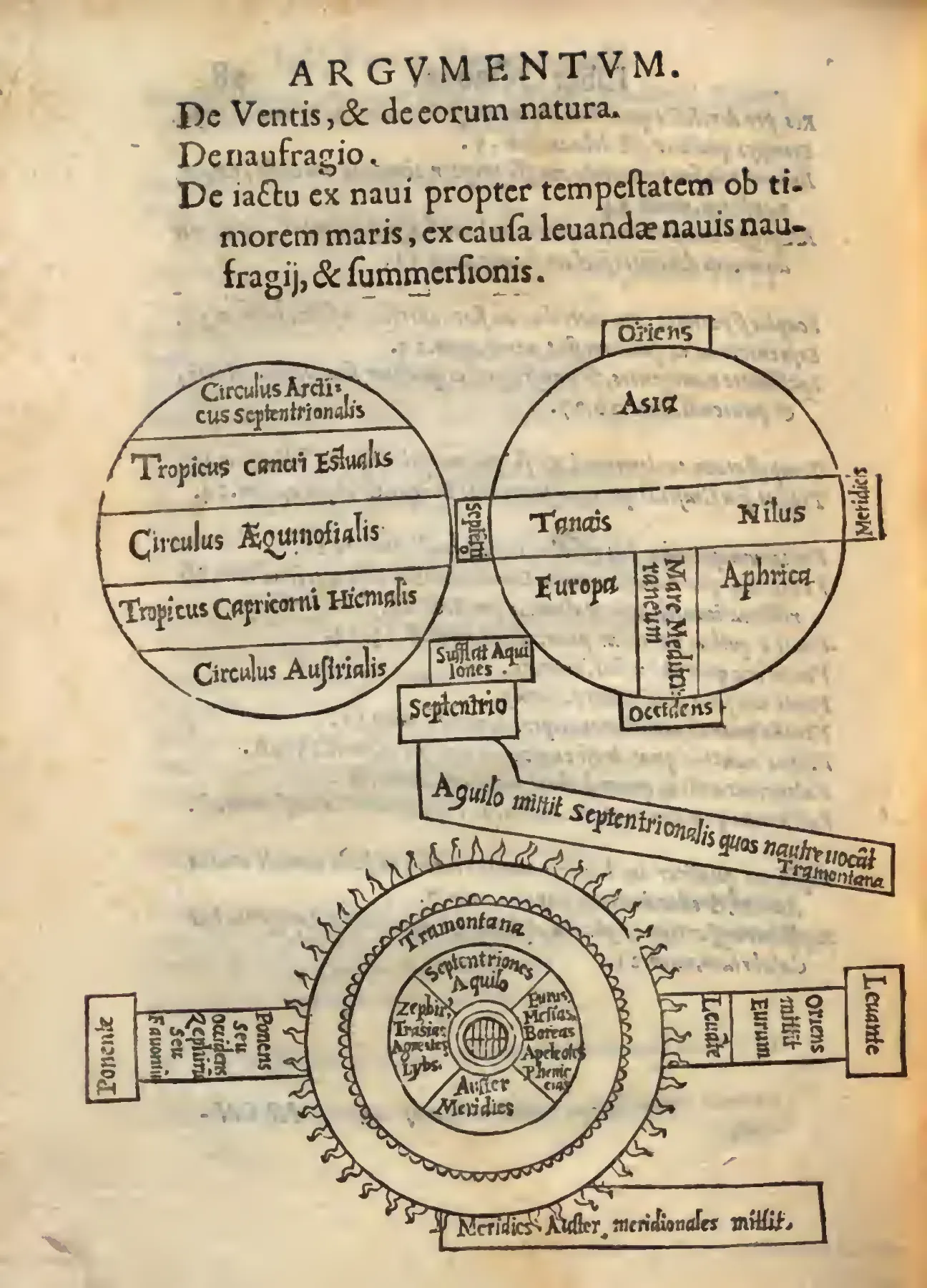
Book VIII's printed argumentum is accompanied by three woodcut schematics: celestial zones, a Mediterranean-centred world division and a wind rose pairing classical wind names with sailors' vernacular terms. The pairing anticipates Book IX's tension, in which seamanship is acknowledged but set within humanist cosmology. Source ↗.
The concession is promptly folded into a providential cosmology. Everything that comes from the heavens, the earth and the remaining elements proceeds from God, Omnia † à Deo procedunt, quæ à coelo, & à terra, ab. Empirical observation is therefore licensed, but only as the reading of signs within a divinely governed order. The same logic explains why the portents recounted shortly afterwards, those of Alexander, Antony, Brutus and Cassius, are dismissed as diabolical vanities rather than credited. Natural signs are legible because God orders nature. Prodigies claiming independent foreknowledge fall outside that order.
The book then makes its most consequential pivot, from the weather to the duties of rule. Ferretti defines royal "charity" in political terms as the ruling of peoples with justice, the definition cited earlier. He completes the thought with the Augustinian corollary from De civitate Dei 4.4, that without justice kingdoms are nothing but robberies, aliter Regna no[n] s[un]t nisi latrocinia. In this register charitas designates a princely office rather than a private affection, and its first concrete object is food.
The discussion of monopoly rests on Ferretti's own forensic experience. He recounts that he invoked the first law of the Code title on monopoly before the Camera on behalf of the Apostolic fisc, Ego allegavi in dicta Camera legem primâ, C. de monopolio pro fauore fisci Apostolici. Under Clement VII that plea secured the arrest of grain hoarders and a substantial composition for the fisc. Civic administration follows. In 1528, he reports, the Senate of Ravenna acted prudently during the dearth, prudenter anno domini 1528. fecit Senatus no[n], through price controls, hospital relief and imports.
These episodes are the hinge on which Ferretti's political economy turns. The profit-seeking of merchants is subordinated to the subsistence of the populus, and that subordination is justified with a juristic gloss on the maxim that necessity knows no law, quia necessitas non subest legi, cum legem non. Necessity here does not abolish law. Rather, it marks the point where ordinary rules of toll and procedure give way to the prince's higher duty of provision.
Book X brings the argument to its most delicate moral boundary, the ethics of stratagem. After a series of ruses drawn from Mago, Miltiades, Lysander and others, Ferretti asks whether such deceits are lawful. Following the Augustinian just-war doctrine transmitted by Gratian, he concludes, in the passage cited earlier, that once a war is just it makes no difference whether one fights openly or by guile and ambush. He confines Fabricius's celebrated refusal of treachery to unjust wars.
Yet he immediately draws the line, also quoted above, that stratagem may not cross: it is never lawful to lie or to deceive by falsehood. The distinction between concealment of design, which belongs to the art of war, and assertion of falsehood, which offends against truth itself, is a scholastic one. Ferretti's application of it is unstable, and that instability is revealing. He adds that deceit practised against infidels, brigands and pirates is not even to be counted as dolus. The concession quietly reintroduces, by reclassifying the victim, the very latitude that the prohibition on lying had seemed to foreclose. As with the wreckers' custom, the decisive work is done by categorization. Pirates, already public enemies, stand outside the community within which deception counts as fraud.
Books XII–XIV: Venice, Fratricidal War, and Providential Victory
Book XII, devoted to Venice, shows the treatise's imperial and republican commitments pressing against each other. Ferretti reports that he has read that the most noble city of Venice took its beginning on 25 March, Legi † nobilissimam urbem Venetiarum habuisse initium sui fundamenti. In the tradition he follows, that day is also the day of Adam's creation, the Annunciation and the Crucifixion. From this coincidence he draws the conclusion, already quoted, that the fated city rules by divine judgment.

Carpaccio's Miracle of the Holy Cross at Rialto, a late-fifteenth-century painting now in the Accademia, sets its scene at the Rialto on the Grand Canal. It evokes the maritime city that Book XII presents as ruling by divine judgment and recognizing no superior. Source ↗.

Ferretti's account of Venice's sacred founding is the myth of Venice in its sacral form, and it has juristic consequences. In the mercantile quaestiones that close the book, Ferretti contrasts Roman paternal power with the law of the Venetians and the French, the peoples he describes, in the phrase cited earlier, as living not by Roman law but by their own particular law, recognizing no superior. The doctrine of the civitas superiorem non recognoscens is thus applied to a practical question, the legal capacity of sons in power. In a treatise that elsewhere exalts the emperor, this opens a jurisdictional plurality that Ferretti does not try to resolve. He accommodates it case by case, granting Venice providential legitimacy alongside, rather than beneath, the imperial order.
The naval narratives of Book XIII contain the treatise's one moment of open authorial grief. Recounting the wars between Genoa and Venice, Ferretti writes that reading of the slaughter compelled him to weep, since such savagery occurred among Catholics: quòd me legendo lacrymare coegit, cum inter Catholicos secula fuerint. The intrusion matters because it exposes the ideal behind the treatise's naval jurisprudence. Arms at sea are legitimate when turned outward in a just cause; fratricidal war among Christian powers is the inversion of that order.
Book XIV states the corresponding theology without qualification. Victory, once won, must be attributed to Almighty God and not to human valour, as the injunction already quoted requires. The same book closes by extending the Roman privilege of the military testament to fleets. The reasoning is explicitly elemental: the ground of military virtue is the same on land and on water, quia est eadem ratio virtutis militare in vno & altero elemento, terra. In that analogical step the treatise's founding premise becomes operative doctrine. A privilege born of land warfare passes to the sea by identity of ratio, with Matteo d'Afflitto cited in support, and the domain of arms on water is brought within the reach of civil law.
Book XVI: The Law of Waters, Servitudes, and Mills
The law of waters in Book XVI returns to Venice and to the limits of power. Ferretti transfers Themistocles' wooden walls to the republic, hailing it, in the image quoted earlier, as queen of the Adriatic whose walls are ships. He couples the image with the claim that the Adriatic shore belongs to the Venetian lords in genere.
The same book nonetheless sets a firm boundary on what any ruler may do with what belongs to others. Where cause is certainly absent, the prince cannot legislate to the detriment of a private person, the limit already examined above. Ferretti extends the protection even to the goods of infidels, reasoning that the emperor's universal lordship is jurisdictional rather than proprietary. Set beside the regalian claims over roads and rivers, and beside the lordship over the Adriatic, this principle shows the treatise's characteristic balance. Rule over sea and shore is asserted expansively as iurisdictio, while dominium in the strict sense of ownership remains, in the last resort, a matter that natural law shields from the prince's will.
The closing quaestiones of Book XVI turn from the open sea to the law of land, water-rights and mills, but the shift is one of scale rather than subject. Ferretti brings the Roman law of things to bear on the port, the river and the mill-race. In doing so he makes plain that his naval jurisprudence rests on the ordinary doctrinal apparatus of the ius commune. The first question, whether a seigneurial jurisdiction marked by gallows passes with an estate sold "with all its rights," is resolved against transfer on Baldus's authority. Ferretti then states the governing rule, that a pact does not bind the purchaser unless it is real, Nam pactum non afficit emptorem nisi sit reale,. The distinction between personal and real pacts is the commentators' instrument for deciding what "runs with" a thing to a singular successor.
The conclusion that jurisdiction does not follow the soil as an accessory carries weight in a treatise that elsewhere joins iurisdictio and dominium under a single verb of prescription. Here, at least, rule and ownership are held apart: a gallows on the estate does not make the buyer a judge.
The doctrine is immediately brought home to Ravenna. The case concerns a shipmaster who for thirty years entered the harbour without paying harbour dues, entering in portum Primarii Rauennæ absque, "into the port of Primaro of Ravenna without" payment. Ferretti's answer preserves the immunity, sic, quia non perditur beneficium pacti per triginta annos, sed illud etiam: the benefit of a pact is not lost through thirty years but endures even beyond them. The reasoning follows the logic of possession. Mere lapse of time, uncontested, confirms a privilege rather than dissolving it. Prescription against the holder begins only when an explicit prohibition has been met by the full statutory period.
The harbour of Ferretti's own city thus becomes a test case for Bartolist doctrine. The sea-borne trade the treatise addresses at large is governed, at the level of the individual quay, by the same rules that govern a field or a right of way.
The digest of praedial servitudes that follows is compact and conventional. Its most consequential move is classificatory. Ferretti opens the relevant question with the commentator's formula, already quoted as an instance of the treatise's scholastic method, asking about the right of the servitude of navigation and to which class of servitudes it belongs. He answers by placing the ius navigandi among rustic servitudes.
The decision is small in compass but revealing in method. The right to pass by water is assimilated to the right to pass over land, and the entire Roman law of easements becomes available for maritime and fluvial use. The treatise's claim that naval matter is juridical matter is here enacted not by grand assertion but by taxonomy.
The gradations of passage follow from the Institutes, reproduced as working definitions. Iter is the right of a man only, hominis tantum, & no[n] cum iumento, aut vehiculo, seu curru, "and not with a beast, vehicle, or cart." The via has a fixed default measure, Dic eam esse debere regulariter octo pedum, "answer that it must regularly be eight feet," with sixteen allowed at bends. The adverb regulariter matters. The ancient width is a default rule that the parties may vary, not an inviolable command. This is characteristic of a jurist who writes for practitioners and who treats inherited norms as presumptions subject to agreement.
The co-ownership case that closes the servitudes shows the same attention to the texture of shared property. When one brother grants a right of way without the other's consent, Ferretti asks whether the grant can parte valere, & pro parte non, an maneat in suspéso donec, that is, "be valid in part and not in part, whether it remains in suspense until" the other consents. Because a servitude cannot be divided, the grant is held in suspension. Ferretti sharpens the point by contrast with the regula Catoniana, under which acts of the dying that could not have stood at the moment of making are void from the outset. The living may wait upon a co-owner's will; the testator's act cannot be rescued by time.
The treatment of mills is the most fully developed portion of the book's end, and it exposes the ethical limits Ferretti sets on custom and habit. Long use of another man's mill, he holds, creates no obligation to continue grinding there. The habitual patron has not thereby acquired adepta possessio, uel quasi alicuius iuris, cum seruitus non, "possession, or quasi-possession of any right, since servitude does not" fall upon a free man.
The principle marks the boundary between real servitudes and persons. Things may be burdened in favour of other things, but repetition cannot convert a free man's choice into a personal subjection. What was exercised as a faculty remains a faculty. The passage belongs with the treatise's wider refusal to let custom ripen automatically into right. Here it protects liberty rather than property.
Public rivers raise the problem of harm to neighbours. Mills and weirs that injure others are to be reduced ad congruum modum arbitrio eorum, qui habent peritiâ,, "to a fitting measure by the judgment of those who have expertise." The deference parallels the respect the treatise elsewhere accords to experienced pilots. Learned law determines the standard of no harm, but it entrusts the measurement to the periti who understand water and works. Law governs the question; craft supplies the facts.
The privilege to build on a river is construed restrictively, as befits a grant in derogation of common use. Church millers, by contrast, are protected by ecclesiastical immunity from lay gabellae, collectae and angariae. For this Ferretti relies on an opinion of an old doctor of Perugia, which he says he holds per mulca iura, quod consilium habeo manuscriptum in, "by many laws, which consilium I hold in manuscript in" his collection. The remark discloses the working library of a practising jurist. Unprinted consilia circulated in written collections, and a printed treatise could draw them into wider currency.
The book ends on a thoroughly mundane note: Riccardo Malombra's opinion that an episcopal miller owes nothing to the tax-farmer who demanded a gold piece together with a pig. The juxtaposition of ecclesiastical immunity with the details of communal tax-farming is typical of the treatise's register, in which principle is always tested on the particular case.
Book XVII: Unknown Islands and the Title to New Land
Book XVII, introduced by its own alphabetical index of matters and an argumentum, returns to the fleet but in an unexpected mode. Its opening scenario is a fleet driven by storm onto an unknown island. The precepts are practical: send scouts with watch-dogs, keep constant guard, and avoid unknown plants. They are buttressed at once by humanist natural history. Mark Antony's soldiers poisoned in Parthia are joined by the herba Sardoa, and Ferretti adds an etymology, videtur. Vnde ortum est Prouerbrum de risu Sardonio, &, "whence arose the proverb of the Sardonic laugh."
The serpents that follow receive a scriptural frame before a medical one. Serpens † enim antiquus hostis decepit Euam primam, "for the serpent, the ancient enemy, deceived Eve the first," Ferretti writes, before assembling Virgil on fumigating stalls, the Psylli whom Cato led in Africa, and the antidotes of Dioscorides and Galen. The ordering matters. The venomous creature is first located in the history of the Fall, as an enemy of human nature, and only then treated as a hazard to be managed by remedy. Natural danger, like human violence, is set within a providential order before it is handled by art.
The locust digression extends that order to ecclesiastical power. Swarms off Cyprus can sink ships, and God scourged Pharaoh with locusts. Then comes a modern instance: Locustas + Marchiam Anchonitanam affligentes destruxit sententia, "a sentence destroyed the locusts afflicting the March of Ancona." The sentence was a prelate's excommunication, set beside the humbler remedy of pigs.
The juristic instinct reasserts itself immediately. Who held authority in the March? Ferretti answers that the pope cet o[mn]i modam iurisd[ic]ionem in ipsa Marchia Anchonitana, "exercises plenary jurisdiction in that March of Ancona," spiritual and temporal alike, and he cites John XXII's extravagant Dierum ex crescente malitia. The excommunication of pests is therefore not a mere prodigy. It is an exercise of jurisdiction, valid because the prelate's spiritual sentence fell within a territory where the Roman see also held temporal rule. In a treatise that honours the emperor as God's vicar in temporal matters, the passage quietly registers a second temporal sovereignty on the Adriatic coast.
Sea monsters receive the same matter-of-fact treatment. Mariners err, credentes coetas esse Insulas maritimas & nemorosas, &, "believing whales to be maritime and wooded islands." The legendary King "Saphet" of Syria, who kindled fires on a whale's back, perished when it sounded. The old whale-island motif is offered as a real navigational danger, of a piece with the earlier caution about unknown landfalls.
From lore Ferretti passes to tactics. An enemy fleet caught at an island is to be enveloped in forma forficis, seu lunæ bicornis, omni suorum collocato, "in the form of a forceps or a two-horned moon, with all one's strength placed" upon the horns. The Venetian–Genoese rivalry over Acre supplies the precedent. The transposition of the land army's crescent to the line of galleys is itself a small instance of the treatise's governing analogy between land and water.
The programmatic statement that follows gathers the whole into a precept of command: Optimum nempè est in remilitari habere doctos, prudentes,, "it is best in military affairs to have learned, prudent" men. Agamemnon and Ulysses are its exemplars. The ideal is the union of knowledge and counsel with force, which is the partnership of law and arms reduced to the person of the commander.
The treatise closes not on battle but on title. After establishing that Italian islands belong to Italy, and that insula also denotes a house bounded by water or street, as among the palaces of Venice, Ferretti puts the final question of the law of the sea, the question already quoted: to whom belongs an island born in the sea, most common to all?
The answer turns on the sea's status as a thing common to all. New land rising from common water falls to the first taker, effici primo occupantis, vt olim fuit de Insula Riualti Al, "it becomes the first occupant's, as was once the case with the island of Rialto." An island born in a river, by contrast, belongs to the riparian owners.

The treatise's final page carries its closing quaestio: a sea-born island, common to all, falls to the first occupant, as Rialto once did, while lands assigned by imperial grant take no alluvial increase. “Laus Deo,” “FINIS” and a printer's device close the volume. Source ↗.
The choice of exemplar is pointed. The founding ground of Venice is presented as the paradigm of lawful occupation from the common sea. The republic's origin is thus rooted in natural-law title, standing alongside, and in some tension with, the prescriptive dominium over the Adriatic claimed elsewhere in the treatise.
A last exception preserves the imperial order. Agri limitati, surveyed lands granted Imperatore militibus suis pro benemeritis, ut firmat glosa, "by the emperor to his soldiers for their merits, as the gloss affirms," take no accretion. Bartolus's Tractatus Tyberiadis stands behind the point. The treatise thus ends with the emperor's reward to his veterans fixed against the shifting increments of water. Arms are once more set within boundaries drawn by law, and the commons of the sea sit beside the measured grants of empire.
Reading Ferretti alongside Studies of Venice, Maritime Sovereignty, and Piracy
Maria Fusaro, Political Economies of Empire in the Early Modern Mediterranean: The Decline of Venice and the Rise of England, 1450–1700 (Cambridge: Cambridge University Press, 2015). Its account of Mediterranean commerce and political power offers a context for investigating the commercial-law questions associated with Ferretti; it should not be treated as an established interpretation of his treatise.
Readers who bring Fusaro's questions to the text will find Venetian commercial practice treated directly. One example is an insurance clause conditioned on whether si ipsa nauis ex Baruto, Candia, & seu Creta, uel ex Asia tuta peruenerit Venetias, "the ship should arrive safe in Venice from Beirut, Candia or Crete, or from Asia." Another is the exemption of the Venetian patriciate from the imperial ban on noble trading: Fallit lex prædicta Nobiliores, C. de mercatoribus & com[m]erciis, in Nobilibus Veneris exercentibus mercantias, "the aforesaid law Nobiliores fails in the case of Venetian nobles who carry on trade," where the print gives Veneris for Venetis.
Lauren Benton, A Search for Sovereignty: Law and Geography in European Empires, 1400–1900 (Cambridge: Cambridge University Press, 2010). Its attention to jurisdiction across maritime spaces provides a framework for asking what a sixteenth-century claim about rule at sea actually asserted. Ferretti's own language of plural legal orders is relevant here. He refers to polities vt est in hoc ius Venetorum, & Francorum qui non viuunt iure Romano, sed proprio iure suo particulari no[n] recognoscentiu[m], "as is the law of the Venetians and the French in this matter, who do not live by Roman law but by their own particular law, recognizing no superior." The phrase bears on the tension between imperial and particularist claims that runs through the treatise.
Alberto Tenenti, Piracy and the Decline of Venice, 1580–1615 (Berkeley: University of California Press, 1967). Its study of Adriatic and Mediterranean maritime violence illuminates the later circumstances in which questions of piracy and Venetian naval power remained consequential. Its period begins after Ferretti's death. For the earlier juristic background, Ferretti classes pirates as infames sunt ipso iure, & hostes publici, "infamous by the law itself, and public enemies." He condemns the customary remedy of private redress on the ground that Represaliæ autem sunt co[n]tra ius naturale, & paci contrariæ, ac initium guerræ,, that "reprisals are against natural law, contrary to peace, and the beginning of war."
These are contextual recommendations, not verified studies of De iure et re navali. A specialist bibliography devoted to the treatise could not be established.
Frequently Asked Questions
Who was Giulio Ferretti of Ravenna?
Giulio Ferretti was a jurist and administrator from Ravenna who was active in the first half of the sixteenth century and died in 1547. His birth year is disputed: Treccani gives 1487, while the Harvard and HathiTrust catalogues give 1480. He held the rank of count palatine by imperial grant. Under Clement VII he pleaded before the Camera for the Apostolic fisc and secured the arrest of grain hoarders. He also recorded the measures the Senate of Ravenna took during the famine of 1528. Besides his naval treatise, his recorded works include De gabellis et publicanis (1547) and the posthumous Consilia et tractatus (1562).
What is Ferretti's De iure et re navali about?
It is a Latin treatise in seventeen books arguing that ships, fleets, storms and sea battles fall within the competence of learned law. Ferretti builds on the commonplace from the proem to Justinian's Institutes that law and arms are partners, and he extends it from land to water, "the other element." Each topic moves from precept to ancient and modern examples, and then to scholastic questions argued from civil and canon law. Its subjects range from carriers' liability and wreck to Greek fire, the winds and venomous creatures. The treatise is addressed to Charles V and uses his 1541 expedition against Algiers as its modern example. It also hails Venice as queen of the Adriatic, whose walls are ships.
How did Ferretti distinguish lawful marine insurance from usury?
Ferretti held that a price may be charged for risk but never for the mere passage of time. In his formula, a contract in which one party bears risk is not usury but the price of risk. By contrast, giving nine in order to receive ten after a year sells time, which belongs to God, and is therefore usurious. He applied this test to marine insurance, bills of exchange and the sea loan. His examples include Venetian policies conditioned on a ship's safe arrival from Beirut, Candia or Asia. He also cites a wager he saw at Naples, where Florentines bet on whether Clement VII would die within the year.
Did Ferretti claim that Venice owned the Adriatic Sea?
Ferretti wrote that the Venetians had acquired both jurisdiction and dominion over the Adriatic by prescription, held for so long that no one remembered its beginning. Both the Pope and the Emperor, he added, knew of this and tolerated it. Whether this pairing of terms amounts to ownership of the sea or a cumulative claim of rule still awaits closer reading. Elsewhere he calls the sea most common to all. He also holds that a prince cannot legislate to a private person's harm and treats imperial lordship as a matter of jurisdiction rather than ownership. He even traces Venice's origin to first occupation, citing Rialto as an island risen from the common sea.
Is there an English translation of Ferretti's De iure et re navali?
No published English translation of Ferretti's De iure, & re navali has been identified. The Leo edition is a separate undertaking. It presents the full transcription of the Latin text and a complete English translation for the first time. That translation is generated by AI, not produced by a human translator. Leo is an effort to make English translations of every text printed in Latin in early modern Europe between 1450 and 1750 freely available online, at no cost.
This report was generated by an advanced AI assistant that conducted deep research alongside an extensive interpretation of the transcribed original text. Every effort has been made to preserve fidelity to the source and to guard against inaccuracy, but corruption in the text recognition process and model hallucination may nonetheless have entered the text. Treat every claim, quotation, translation, and citation as provisional, and verify each against the original source before relying on or citing it.
Bibliography
- Lauren Benton, A Search for Sovereignty: Law and Geography in European Empires, 1400–1900: Benton argues that early modern sovereignty at sea was a lumpy patchwork of corridors and enclaves rather than a smooth blanket of ownership. That is exactly the distinction Ferretti keeps prising open between iurisdictio and dominium. Read her before deciding whether his prescribed Adriatic is a claim to own water or merely to police the people floating on it.
- Maria Fusaro, Political Economies of Empire in the Early Modern Mediterranean: The Decline of Venice and the Rise of England, 1450–1700: Fusaro reconstructs the commercial and legal machinery of the Venetian Levant trade, including the insurers, carriers and merchants whose contracts Ferretti tests against canonist usury doctrine. She supplies the ledgers behind his policies on ships returning from Beirut and Candia. Her Venice is also a republic losing its grip on the sea it claimed to rule, which gives a certain poignancy to Ferretti's queen whose walls are ships.
- Alberto Tenenti, Piracy and the Decline of Venice, 1580–1615: Tenenti's classic study begins a generation after Ferretti's death, by which point the pirates he had tidily declared public enemies were proving considerably less tidy in practice. It is the best available test of how his juristic categories fared against Uskoks, corsairs and northern interlopers in the Adriatic. Read it as an account of what happened after the treatise had settled the question on paper.