As Many Princes as There Are Houses: Nikolaus Reusner's Five Books of Turkish Letters by Various and Diverse Authors
In 1598 the Jena jurist Nikolaus Reusner gathered five books of letters — papal, imperial, Ottoman, Mongol, and frankly forged — into Epistolarum Turcicarum variorum et diversorum authorum libri V, a Latin dossier printed at Frankfurt while imperial armies were losing Győr and Eger on the Hungarian frontier. Rather than compose a history of Ottoman power, he printed the parties' own documents and let the chanceries speak in their own voices, on the Plinian principle that what is to come mostly resembles what has already been done. The result is an archive assembled as political counsel, and its recurring verdict is that Christendom's want of a head whom all will obey is the sultan's most dependable ally.
ExLatinis
September 18, 2026
Contents
In 1598 the Jena jurist Nikolaus Reusner gathered five books of letters — papal, imperial, Ottoman, Mongol, and frankly forged — into Epistolarum Turcicarum variorum et diversorum authorum libri V, a Latin dossier printed at Frankfurt while imperial armies were losing Győr and Eger on the Hungarian frontier. Rather than compose a history of Ottoman power, he printed the parties' own documents and let the chanceries speak in their own voices, on the Plinian principle that what is to come mostly resembles what has already been done. The result is an archive assembled as political counsel, and its recurring verdict is that Christendom's want of a head whom all will obey is the sultan's most dependable ally.
In 1598 the Frankfurt printer Johann Kollitz produced, for the bookseller Paul Brachfeld, a substantial Latin volume of some three hundred pages bearing the title Epistolarum Turcicarum variorum et diversorum authorum libri V.
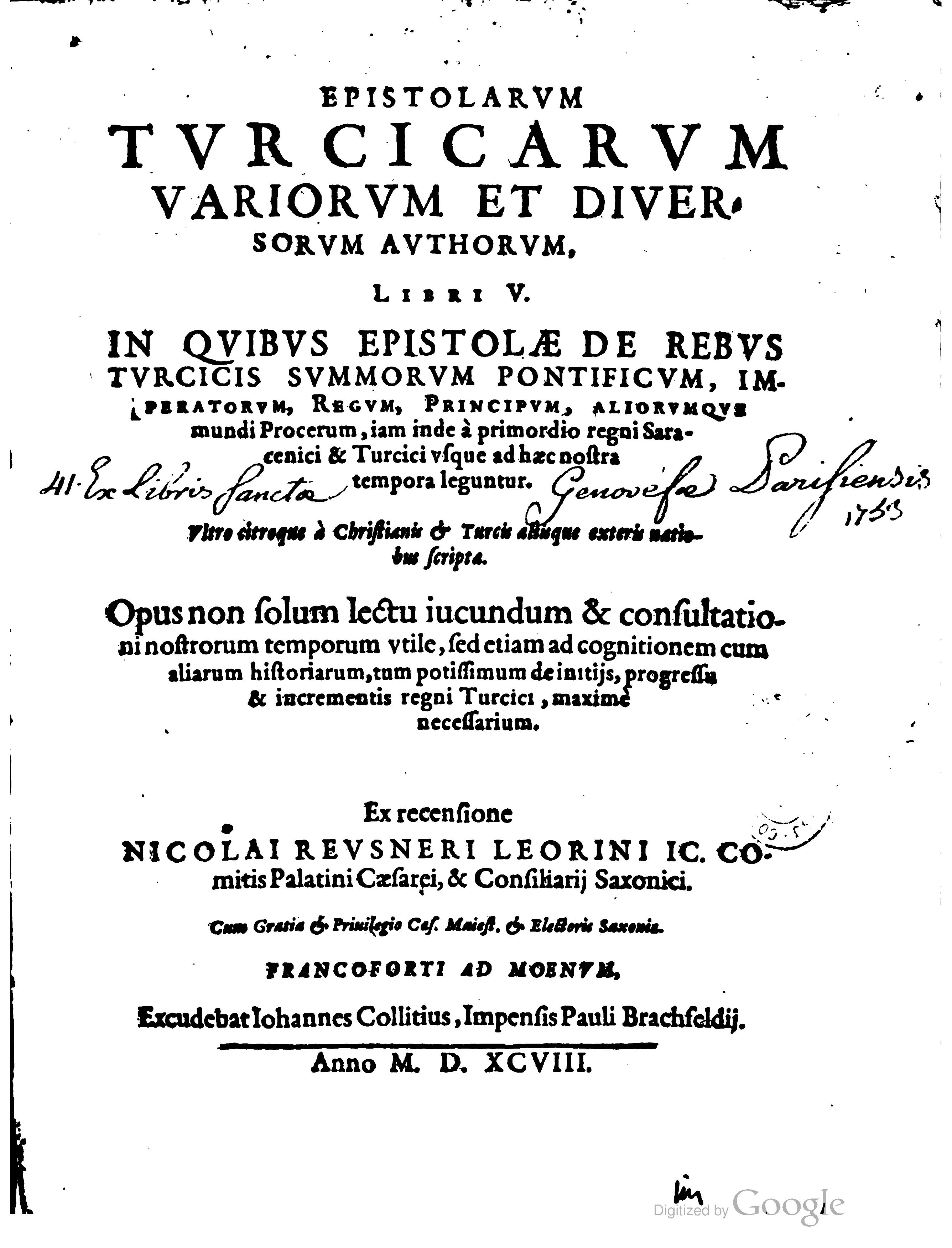
The 1598 Frankfurt title page makes the anthology's programme explicit: its printed "Epistolae de rebus Turcicis" are letters about Turkish affairs, gathered in five books from popes, emperors, kings, princes, Christians, Turks, and other nations, not a corpus of Turkish-language correspondence. The imprint and privilege formula — Kollitz, Brachfeld, Frankfurt am Main, and imperial and Electoral Saxon authorization — frame the collection as both a product of the Long Turkish War's print culture and an instrument for political deliberation. Source ↗.
Its compiler was Nikolaus Reusner (1545–1602), a jurist and humanist associated with the university at Jena, whose dedicatory epistle to Heinrich Julius, Duke of Brunswick-Lüneburg and Prince of Wolfenbüttel, is subscribed at Jena in February 1599. The book is neither a treatise nor a personal correspondence. It is a documentary anthology: five books of letters de rebus Turcicis, gathered from papal, imperial, royal, conciliar, municipal, Ottoman, and Mongol chanceries — and from frankly fictive and pseudepigraphic pens — and arranged in rough chronological order from the age of Gregory the Great to the campaigns of the 1590s, with an appended medieval account of Frederick I Barbarossa's Asian expedition closing the volume.
The problem the collection confronts is single and urgent: how a fractured Christendom might be made to understand, and then to act against, a Muslim and specifically Ottoman power that had grown from the first Saracen conquests into a present force on the Hungarian frontier. Reusner's recurring move in answer to it is documentary rather than narrative. Instead of composing a history of that power, he prints the parties' own letters and lets them speak in their chancery voices, so that the reader is left to draw the political lesson himself. The method is justified by an explicitly historical warrant — that what is to come resembles for the most part what has already been done — which converts the assembled record of appeals, leagues, truces, betrayals, and defeats into an instrument of counsel for the war then in progress. Two diagnoses surface again and again across the documents so arranged. The first is constitutional: that Christian disunity, the want of a head whom all will obey, the rivalry of princes, the hollowness of a merely feigned church union, is the adversary's most reliable ally. The second is definitional: that the adversary must be fixed juridically and theologically — as tyrant, as hostis Christiani nominis, and as the promulgator of a lex which the collection's polemical pieces set against reason and undertake to refute.
The stakes of that undertaking were immediate. The volume was assembled during the Long Turkish War, and its prefatory matter names the recent losses on the Hungarian frontier, Győr and Eger, as the proof of its own necessity; it reportedly carried imperial and Electoral Saxon privileges, and it was addressed to a Protestant imperial prince at a moment when anti-Ottoman policy in the German lands remained hostage to confessional and territorial division. Reusner presented the anthology as the capstone of a serial anti-Turkish enterprise that had already included his Orationes Turcicae, and the enterprise itself continued after 1598 in further books catalogued separately. To read the volume is therefore to watch fifteenth-century humanist crusade rhetoric, medieval papal and imperial letters, and Ottoman self-presentation deliberately reactivated for late-sixteenth-century deliberation, with the older polemical vocabulary not paraphrased away but reprinted intact.
What makes the collection memorable is the breadth and the frankness of its documentary mixture. Within one sequence stand Gregory the Great's exchange with the emperor Maurice, Charles Martel and Poitiers, Nicephorus I and Hārūn al-Rashīd, the letters of the first four crusades, Barbarossa's drowning and Gregory VIII on Hattin; Laudivius Zacchia's invented letter-book of Mehmed II and genuine Ottoman chancery pieces; Skanderbeg against Murad II, Piccolomini, Filelfo, and Campano reporting from the Diet of Regensburg; a dense dossier on the fall of Constantinople in 1453 assembled from Isidore of Kiev, Frederick III, the Doge Francesco Foscari, Leonardo of Chios, and Alfonso V of Aragon; the Cyprus succession and Genoese state letters; Pius II's projected eastern league with Trebizond, Georgia, and Uzun Hasan; Negroponte in 1470, Rhodes and Otranto in 1480, the affair of Cem Sultan; chancery letters ascribed to Chinggis Khan and to Baiju; the pseudepigraphic Morbasanus; Pius II's celebrated Epistola ad Mahumetem; and, appended at the end, the Expeditio Asiatica associated with Tageno, dean of Passau. Authentic instruments, literary imitations, and outright forgeries sit side by side, and the volume itself thematizes the difficulty, preserving a witness's insistence that what is seen is reported more truly than what is heard.
Three strands run together through the work. Its conceptual vocabulary — respublica Christiana, virtus against fortuna, tyrannus, lex — is doing argumentative rather than descriptive work, invoking a Christian commonwealth precisely where jurisdictional unity was absent and defining the enemy in terms that carry juridical and doctrinal consequence. Its production history belongs to the same logic of accumulation: a Frankfurt imprint dated 1598 whose dedicatory subscription runs into February 1599, followed by continuation books recorded under their own titles, and eventually by catalogue shorthand that aggregates the series into a single string. And its internal arrangement makes the archive argue by sequence, moving from the earliest Saracen conquests to the present frontier so that the accumulated record of Christian discord becomes the counsel it was gathered to deliver. Much about the volume nonetheless remains unsettled: no modern critical edition or complete translation has been located, the identity of the author of its commendatory verse and the exact wording of its privileges are inadequately documented, and the account of how the appended medieval diary was recovered awaits confirmation against the surviving text and the relevant critical editions.
Read the full text and English translation on Leo
This text was transcribed and translated as part of the ExLatinis project, an effort by Leo to make free English translations of every text published in Latin in early modern Europe (1450–1750) available online. The complete transcription and English translation of this work can be read free of charge:
→ Read the original Latin text and full English translation on Leo
You can save a copy of this document into your Leo account to run deep text searches, conduct further analysis, or cross-reference it with your own research.
Titling Reusner's Turkish Letters: The Latin Wording and Its Philological Stakes
Editorial English title supplied for convenience: "Five Books of Turkish Letters by Various and Diverse Authors: A Documentary History of Ottoman Affairs from the Saracen Kingdom to the Present." No established English title for the complete anthology was located. The Latin title, Epistolarum Turcicarum variorum et diversorum authorum libri V, should not be translated as "letters written in Turkish." Here Turcicarum is a topical adjective: the letters concern Turkish or Ottoman affairs, while the volume itself is a Latin compilation. The title page accordingly advertises a collection of letters de rebus Turcicis reaching from the origins of Saracen and Turkish power to the present day. The title's libri V identifies the 1598 issue as a five-book unit, even though later catalogue records sometimes append "[-XIV]" because they aggregate the initial volume with subsequent continuations or expanded recensions.
The anthology's epistolae are not a private correspondence in the modern sense. In the sixteenth-century humanist environment, an epistle could be a public historical document, a diplomatic memorandum, a moral exemplum, a papal appeal, a chancery specimen, or a literary imitation presented within a documentary sequence. Reusner's arrangement therefore belongs to the printed Turcica and Türkenbuch tradition: texts concerning the Ottoman enemy were gathered as historical authorities and as resources for political and confessional deliberation. The enemy so gathered is named in juridical terms from the outset, the prefatory matter declaring that war is being waged with the monstrous and overpowering tyrant of the Turks, the enemy of the Christian name, bellum geritur cum immani & præpotente Turcarum tyranno,, a formulation in which tyrannus and hostis Christiani nominis function less as invective than as categories with legal and doctrinal consequence.
The expression respublica Christiana, which provides an important interpretive horizon for this kind of collection, did not denote a secular international system. It named an imagined but institutionally fractured Christian commonwealth whose unity was invoked precisely because papal, imperial, royal, territorial, and confessional interests repeatedly failed to produce it. The anthology's documentary form exposes that tension: letters appeal to Christian unity while preserving the competing jurisdictions and political interests that made a common anti-Ottoman policy difficult. The diagnosis is stated flatly within the corpus, in the observation that Christendom has no head whom all are willing to obey, that neither to the supreme priest nor to the Emperor are their own rights granted, and that there is no reverence and no obedience, Christianitas nullum habet caput, cui parere omnes velint. Neque summo sacerdoti, neque Imperatori, quæ sua sunt, dantur: nulla reverentia, nulla obedientia est. Against that constitutional deficit the collection also preserves the unitary ecclesiological formula it fails to realize, one God, one faith, one baptism, one vicar of Christ on earth, Vnus DEVS: vna fides: vnum Baptisma: vnus Christi vicarius in terris est; the juxtaposition of norm and practice is itself part of the anthology's argumentative structure.
Virtus likewise carries a specifically early modern political and moral burden. It can signify martial courage, princely capacity, civic excellence, and providentially meaningful conduct rather than merely private moral goodness. When paired with fortuna, as in the maxim that Christians are overcome by fortune rather than virtue, it becomes an explanation of historical defeat and a summons to renewed political action. The term lex is similarly polemical rather than neutral when applied to Islam: in Christian Latin it can mean law, revealed rule, or rational norm, but in anti-Ottoman discourse it may be displaced by the language of the pseudopropheta, the Alcoranus, or false law. The collection's own polemical pieces make that displacement explicit as a philosophical test, recalling first that philosophers say law is what is prescribed by reason, and that there are those who affirm law to be nothing other than right reason drawn from the divine will, Legem dicunt esse Philosophi, quod ratione præcipitur: & sunt, qui nil aliud legem affirmant, quam rectam rationem, à diuino numine ductam, and then withdrawing the term in the same breath in which it is conceded: we have called it a law because he himself calls it a law, though we more rightly call it blasphemy, Legem diximus; quia ipse legé vocat: nos blasphemiam rectius appellamus. Such usage belongs to the inherited polemics that Reusner's collection preserves and republishes; it should be analyzed as historically situated confessional language, not as transparent description. The same caution applies to the ethnographic and etymological vocabulary the volume transmits, including the claim of Trojan descent advanced on the ground that they themselves and their forebears in those ancient times sprang from Trojan blood, eo quod ipsi & parentes eorum priscis illis temporibus à Troianorum sanguine oriundi sunt, a genealogy that trades on the humanist play between Teucri and Turci and that functioned in these texts as an argument about legitimacy rather than as a neutral report of origins.
Summarizing the Anthology: Reusner's Documentary Dossier on Ottoman Affairs
Nicolaus Reusner's Epistolarum Turcicarum variorum et diversorum authorum libri V is a Latin documentary anthology rather than a single-author treatise or a collection of private letters. The 1598 issue gathers historical, papal, imperial, princely, diplomatic, crusading, and Ottoman-related correspondence and closes with an appended account of Frederick I Barbarossa's Asian expedition attributed to the Tageño tradition. Its governing purpose is to construct a long historical dossier on relations between Latin Christendom and the Turks, thereby making earlier conflicts available for the political and confessional concerns of the late sixteenth century. That purpose is stated as a methodological principle in the prefatory matter, where the compiler argues that, on Pliny's authority, things that are to come are for the most part equal or similar to those that have already been done, Etenim, auctore Plinio, quæ futura sunt, plerunque sunt paria aut similia his, quæ iam facta sunt: — the warrant on which an archive of medieval and fifteenth-century letters becomes serviceable as counsel for present policy.
The dossier's chronological reach from the Saracen conquests to the Ottoman present is itself argued rather than merely assumed, the prefatory matter holding that the later enemy surpasses the earlier in that their counsels too are more cunning, their undertakings bolder, their attempts greater, and their outcomes more successful, silia etiam callidiora, coepta audaciora, & conatus majores, & exitus secun. The contemporary frontier supplies the evidence for that escalation, with the recent imperial losses in Hungary adduced as witnesses — Győr lately, and soon conquered Eger, confess it, Iaurinum nuper, mox Agria victa fatentur, — which places the compilation squarely within the deliberative context of the Long Turkish War.
The authoritative catalogue records identify Nikolaus Reusner, 1545–1602, as compiler; Frankfurt am Main as the place of publication; Johann Kollitz as printer for Paul Brachfeld; 1598 as the imprint year; and Latin as the language. Reusner was a jurist and humanist associated with Jena, and the dedicatory epistle in the surviving volume is subscribed at Jena in February 1599. The discrepancy is best treated cautiously as a production or issue chronology in a volume dated 1598, not as proof of a distinct 1599 edition. A separate continuation, comprising Liber VI and subsequent books, is independently catalogued.
No complete modern translation of the anthology as a whole was located. Individual materials within its documentary corpus have separate transmission histories: Pius II's Epistola ad Mahumetem II, for example, has been edited and translated independently. The language of the Reusner compilation itself remains Latin in the identified editions and digital copies.
Placing the Turkish Letters in the Historiography of Humanist Crusade Writing
The anthology matters because it turns the history of Ottoman–Latin Christian relations into a curated documentary archive. Its five-book form places papal appeals, imperial and princely letters, crusading materials, Ottoman chancery texts, fictive or pseudepigraphic epistles, and late-medieval eyewitness traditions in a single humanist sequence. The heterogeneity is not smoothed away in the interest of a single confessional or political line: the collection prints an imperial challenge to papal temporalities, asserting that whatever the papacy is known to hold of royal right it obtains by the largess of princes, & quicquid Papatus vester regalis habere dignoscitur, largitionem Principum obtinet; it reproduces crusading atrocity reportage unsoftened, as in the boast that our men rode in the blood of the Saracens up to the horses' knees, equitabant nostri in sanguine Saracenorum vsque ad equorum genua; and it admits letters in which the adversary dictates rather than petitions, one such piece observing parenthetically that it belongs to the party which does not sue for peace to lay down its terms, (scio enim eius qui non petit esse, leges dicere pacis.). The compilation therefore raises questions about how historical authority was manufactured in print: which texts were treated as evidence, how literary imitations acquired documentary force, and how older conflicts were made serviceable to the Long Turkish War of Reusner's own time.
The most relevant modern historiography begins with the study of Renaissance humanist crusade writing.
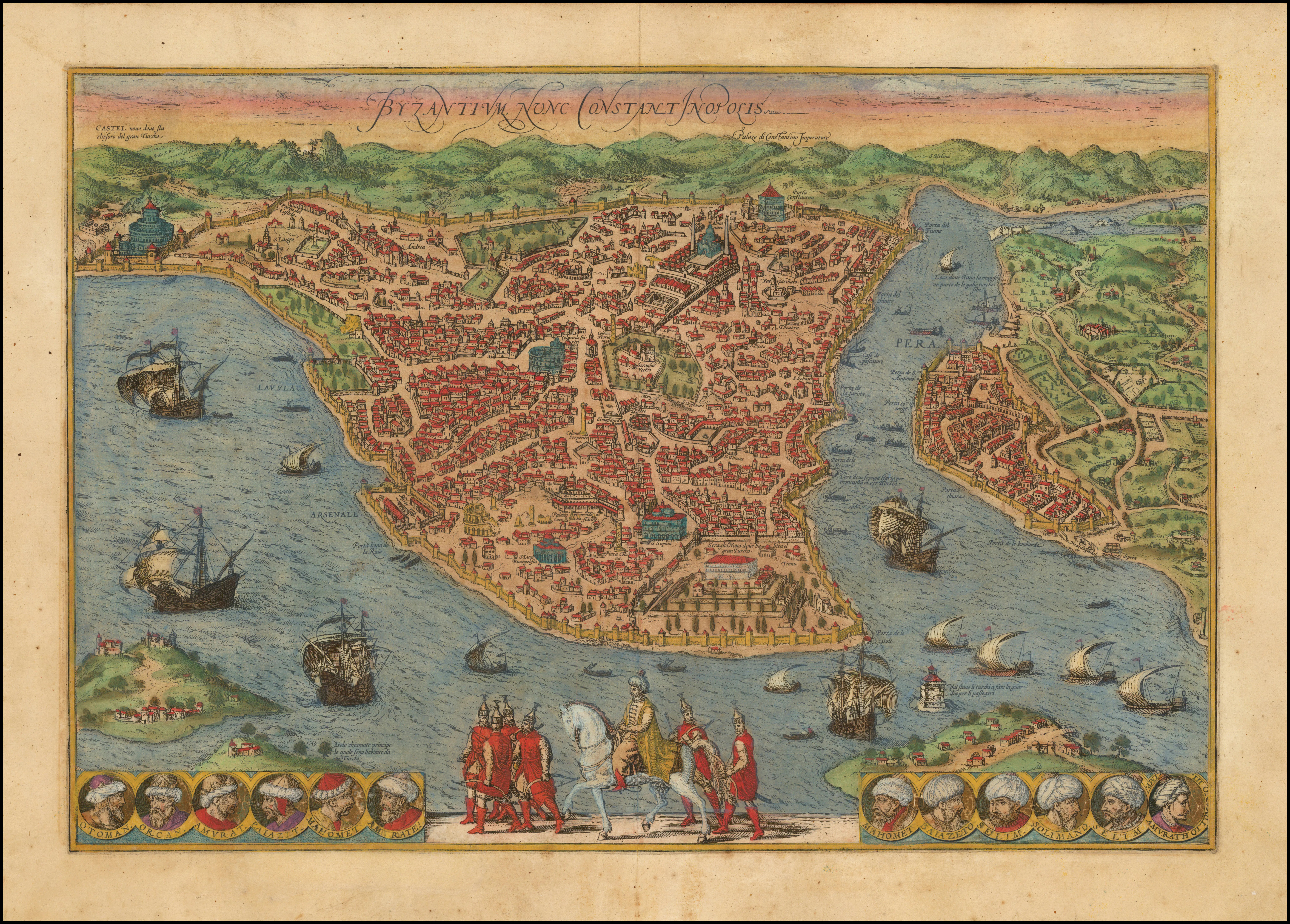
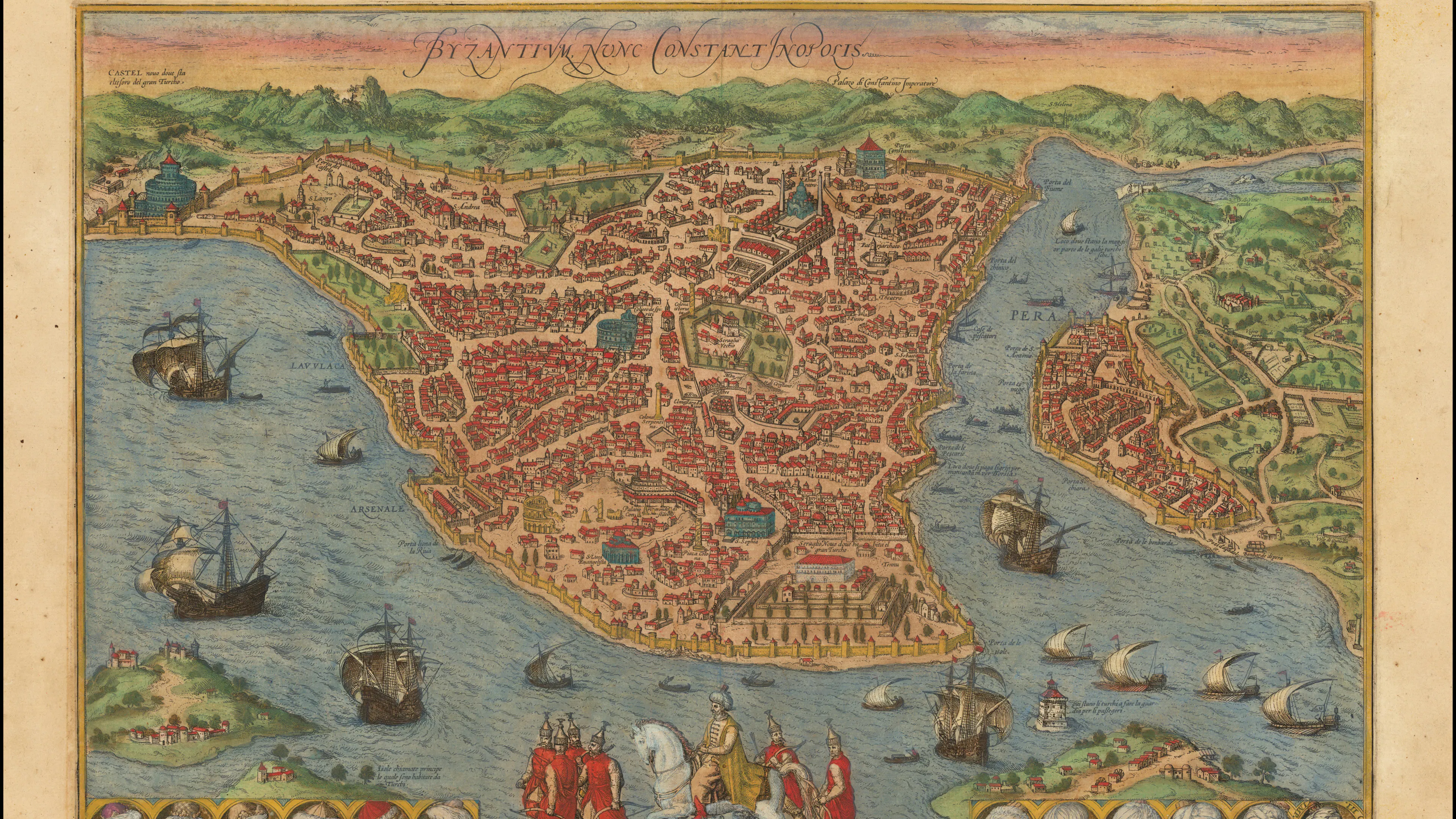
This 1572 bird's-eye view of Constantinople, framed by Ottoman sultan medallions and showing Pera across the Golden Horn, presents the city at the centre of Renaissance humanist crusade writing after 1453. Its urban panorama and dynastic border together evoke the lost Byzantine capital mourned by Latin authors and the Ottoman power whose rulers such writing catalogued. Source ↗.

James Hankins's "Renaissance Crusaders" reconstructs the humanist effort to convert classical learning, historical exempla, and Christian rhetoric into programs for political unity against Mehmed II and Ottoman expansion. Nancy Bisaha's Creating East and West broadens that discussion by showing how Renaissance humanists constructed accounts of Europe, Asia, Islam, and Ottoman power through a combination of classical ethnography, Christian polemic, and claims about civilization. The anthology's 1453 dossier illustrates exactly the fusion both scholars describe, registering the fall of the city at once as a geographical scandal and as a catastrophe for letters: in Europe, on our own soil, among Christians, a most powerful city, the head of the Eastern Empire, the column of Greece, the home of letters, is allowed to be stormed by an enemy hand, in Europa, in nostro solo, inter Christianos potentissimâ vrbem, Orientalis imperij caput, Græciæ column, literarum domicilium, ab hostili manu, and the loss is voiced philologically in the lament that the finest colour of Greek eloquence has been changed into the barbarism of the Turk, modo mutatus est color optimus Græcæ eloquentiæ in barbariem Turcæ!. The same dossier supplies the consoling counter-figure of translatio studii, in the claim that it can most rightly be said that Greece has not perished but has migrated into Italy — once called Magna Graecia — by the clemency of that one pontiff Nicholas, Itaque iure optimo dici potest, non perijsse Græciam: sed in Italiam, quæ olim Magna Græcia dicta est, vnius illius Nicolai Pontificis clementia, commigrasse. Together, these works prevent the anthology from being read either as simple anti-Turkish propaganda or as neutral diplomatic documentation: its documentary apparatus is itself an argument about Christian history and political action.
Stephen Fischer-Galati's Ottoman Imperialism and German Protestantism supplies the confessional and imperial background for the German lands. Its focus on Ottoman pressure and Protestant political experience before Reusner's compilation helps explain why a late-sixteenth-century Jena jurist could address Ottoman affairs through a corpus that crossed papal, imperial, Catholic, Orthodox, and Protestant materials. That crossing is unusually wide: the corpus reaches past the Latin–Greek divide to preserve a chancery letter from the Mongol side urging that in the law of God there be no difference between Latin and Greek and Armenian, Nestorian and Jacobite, and all who adore the cross, quod in lege Dei non sit differentia inter Latinum & Græcum & Armenium, Nestorinum & Iacobinum, & omnes qui adorent crucem, while elsewhere it transmits the sharply theodical reading of the Union of Florence, that the cause of disaster was not that a union was made but that the union made was not true but feigned, Non hæc causa est, quod vnionem, sed quod vnionem non veram, sed fictam fecistis — an argument about insincere ecclesiastical concord that a reader in the confessionally divided Empire could hardly have read as antiquarian. The anthology is consequently situated within the overlapping histories of Türkenbücher, imperial military finance, confessional division, princely patronage, and the recurrent demand for Christian unity.
The anthology also belongs to the history of humanist source criticism. Anthony Grafton's work on Joseph Scaliger demonstrates how early modern scholars evaluated chronology, forgery, non-biblical evidence, and conflicting authorities through philological comparison rather than through a simple opposition between "fact" and "fiction." That framework is especially relevant to Reusner's inclusion of literary letters, contested Ottoman materials, the Pius II–Mehmed correspondence, and the pseudepigraphic Morbasanus tradition. It is relevant too to the collection's willingness to let its documents cut against expectation, as when Christian readers are told that the Turks show by example that oaths are to be kept not only towards those of one's own faith but even towards enemies, domesticis fidei, sed et hostibus servenda, exéplo demonstrant, a use of the adversary as exemplar of fides that demands judgment of the reader rather than assent to a slogan. The central historiographical problem is not merely whether every letter is authentic, but how Reusner's editorial ordering instructs readers to understand authenticity, exemplarity, and historical probability.
Pius II's Epistola ad Mahumetem II provides a particularly important case. Modern scholarship describes the letter as a fusion of theological and political argument, combining an appeal to conversion with a programmatic intervention in the struggle against the Ottomans. Its rhetorical method is announced as a quasi-judicial procedure, the pope exhorting his addressee to hear his words kindly, and not to condemn before he judges, nor to judge before he understands each point diligently, hortamur, vt benigne audias nostra: nec prius damnes, quam iudices: nec prius iudices quam singula diligenter intelligas; its political inducement is the offer of Christian legitimation, that if the sultan does this there will be no prince in the world who surpasses him in glory or can equal him in power, Hoc si feceris: non erit in orbe princeps, qui te gloria superet, aut æquare potentia valeat; and its doctrinal attack turns on the charge that the rival law promises in the other life rivers of milk and honey and wine, delicate foods, many wives and concubines, and that such a paradise belongs to an ox and an ass rather than to a man, Tua lex in alia vita lumina lactis & mellis & vini promittit, & cibaria delicata, vxores multas, & concubinas, & virginum coitus, & angelorum in turpibus obsequijs, ministeria, & quicquid caro depositit. Bouis hæc paradisus, & asini potius, quam hominis est. The collection frames that offer of legitimation with replies addressed to Mehmed II that deny his universal pretensions outright, asking whether a principate of the whole world can be claimed by one whose foot has never trodden Africa, Africam nunquam pes tuus calcavit. Hicne vniversi orbis est principatus?, and setting his power against the mortality of all empires: where are the Medes, where the Persians, where the Greeks, where finally the Romans, lords of the world — surely that Tamerlane, king of the Scythians, the terror of nations, was greater than you, Vbi Medi? Vbi Persæ? Vbi Græci? vbi denique Romani rerum Domini? Maior certè fuit Tamberlanus ille Scythiarum rex, terror (vt scribitur) gentium, quam tui. The presence of the Pian letter near the end of Reusner's collection reveals the persistence of medieval polemical language within humanist and papal political rhetoric. The anthology therefore complicates any sharp narrative in which Renaissance humanism simply secularized European responses to the Ottoman Empire: religious polemic, imperial history, classical exemplarity, and practical war policy remain interwoven, and the keyword pair of lex and respublica Christiana remains load-bearing throughout.
The historiography is thinner for Reusner's anthology as a material object. Bibliographic records securely establish its title, date, Frankfurt imprint, printer-bookseller network, physical extent, and relation to later continuations, but a modern critical edition, complete study of the prefatory apparatus, or comprehensive reception history was not located. Arnoldus Helius, the exact privilege texts, the copy-specific binding history, the recovery tradition of the Tageño material, and the mechanism by which the Pictorius title entered an erroneous catalogue association remain open research problems rather than settled conclusions.
Tracing the 1598 Frankfurt Imprint: Kollitz, Brachfeld, the Continuations, and a Misattributed Herbal
The correct bibliographic identity is Epistolarum Turcicarum variorum et diversorum authorum libri V, attributed to Nicolaus Reusnerus Leorinus. The 1598 Frankfurt record is supported by several independent catalogues: the MDZ/Bayerische Staatsbibliothek record gives Francofurti ad Moenum, Brachfeld and Kollitz, 1598, with an extent of [4] leaves, 304 pages, and [2] leaves; Brill identifies Johann Kollitz as printer for Paul Brachfeld and gives the BSB shelfmark 4 Ph.pr.; Google Books records a 304-page copy; and a digitized MDZ copy contains 302 scanned images. These records establish a substantial Latin book, but the retrieved authority records do not securely establish its gatherings, signature formula, or a separate errata leaf.
The volume belongs to a larger editorial sequence, and it says so itself: the compiler describes his undertaking as an anti-Turkish work still under construction, to which he now sets the gable and, as it were, a kind of colophon, of the same argument, Cæteru[m] operi huic Anti Turcico, de quo dixi, exædificado, fastigiu[m] & veluti colophonem quendam nunc impono, eiuldem argu, a self-description of a serial enterprise rather than of a closed book. WorldCat and Google Books use the composite form Epistolarum Turcicarum variorum et diversorum authorum libri V[-XIV], while the Lower Silesian Digital Library separately records Continuatio operis collectanei Epistolarum Turcicarum Liber VI, VII et VIII. The Wrocław record links that continuation to the 1598–1600 publication sequence and separately identifies the first volume as the five-book Frankfurt issue. A 1599 catalogue record also associates a continuation with the widow of Johann Kollitz. These data explain why catalogue records may collapse several volumes into a single bibliographic string: "V[-XIV]" is a series-level or aggregated description, not adequate evidence that the 1598 object itself contained fourteen books.
The 1598/1599 dating requires similar caution. The imprint is consistently dated 1598, whereas the dedicatory epistle is subscribed Jena in February 1599. The evidence supports a volume printed or title-dated in 1598 whose prefatory or dedicatory completion extended into 1599. It does not establish a reissue, corrected edition, or new title page in 1599. The separate continuation demonstrates that 1599 was also an active date in the series' subsequent production, but it does not convert the five-book issue into a 1599 edition.
The dedicatee, Heinrich Julius, Duke of Brunswick-Lüneburg and Prince of Wolfenbüttel, places the book within princely and imperial patronage networks, and that patronage context belongs to the same argument the volume makes about Christian unity: a compilation urging concerted action against the Ottoman power was addressed to a prince whose cooperation such action would require. The reported imperial and Electoral Saxon privileges, the commendatory verse attributed to Arnoldus Helius and dated Prague, and the dedicatory apparatus should be cited directly from the scanned prefatory leaves: the catalogue records retrieved here do not transcribe them sufficiently to establish their exact wording or chancery provenance. Likewise, the identification of Helius with a particular Prague-based writer in Rudolf II's circle remains inadequately documented in the records consulted.
The appended Expeditio Asiatica gives the anthology an additional medievalist dimension. Its association with the Tageño or Tagino account of Frederick Barbarossa's Third Crusade is historically plausible within the volume's documentary program, and the text itself carries a note to that effect, stating that Tageno, dean of Passau, who took part in this expedition, wrote it, and that Johannes Aventinus found it at Richobergomum and saw to its publication, Tageno Decanus Bathaven. qui huic expeditioni interfuit, scripsit: loannes Aventinus Richobergomi invenit, & publicandam curavit. The accuracy of that claim about Aventinus, and the identification of the place so rendered, could not be securely verified from the records consulted; those points should remain qualified until checked against the relevant critical editions of the Tageño tradition. The presence of the note does, however, show that the collection presents its final item with an explicit account of transmission, consistent with the attention to autopsy and testimony that surfaces elsewhere in the corpus.
The botanical title is not an alternative title for Reusner's anthology. Georg Pictorius's De herbarum virtutibus poesis, cum succincta Georgii Pictorii Villingani expositione is a distinct Latin medical-herbal book: the Wellcome record identifies Basel, Heinrich Petri, 1559; an octavo format; woodcuts; twelve unnumbered leaves, 199 pages, and three final unnumbered leaves. Its catalogue attribution involves Georg Pictorius, approximately 1500–1569, and the pseudo- or disputed author Aemilius Macer. The Reusner volume, by contrast, is a Frankfurt 1598 Latin Turcica anthology by Nikolaus Reusner, printed by Kollitz for Brachfeld.
No examined repository record establishes that the 1559 herbal was bound with the 1598 Turkish-letter anthology, and no copy-level description was found in which Pictorius's title properly serves as the title of a Reusner volume. The proposition supported by the bibliographic evidence is therefore negative and firm: the works are separate editions by different authors, in different cities, fifteen years apart, with different printers, genres, and physical profiles. The reason the botanical title became attached to a Reusner record cannot presently be demonstrated. The most economical explanation is a catalogue aggregation, mis-associated digitized object, or mistaken transcription arising from multi-volume or bound-book metadata, but that remains an inference rather than an established binding history. A definitive explanation would require the full catalogue provenance and copy-level records for the specific erroneous entry.
Reading the Five Books in Sequence: Structure, Argument, and Textual Evidence
The prefatory warrant
The volume's prefatory matter states its method before it prints a single medieval letter. Reusner grounds documentary compilation on an authority drawn from natural history rather than from theology, in the Plinian maxim discussed above, that things which are to come are for the most part equal or similar to those already done. The claim is modest in form and consequential in effect: it converts an assemblage of chancery pieces, papal encyclicals, and humanist letters into an instrument of deliberation, since a reader who grants the premise must treat a letter of 1095 or 1444 as testimony about 1598. The same page describes the enterprise architecturally, in the builder's figure already noticed, the compiler setting upon his still unfinished Anti-Turkish work a gable and, as it were, a kind of colophon — the Orationes Turcicae and the Sturmian Sermones being the lower storeys and this epistolary corpus the crowning member. The figure is worth pressing, because fastigium and colophon claim completion for a project that in fact continued to accumulate; the metaphor of the finished building sits uneasily with a serial publishing programme whose later books were still to come. The sentence as set also preserves the press's own orthography, eiuldem for eiusdem, a reminder that the volume's typography must be read as printed rather than normalised.
The commendatory verse that follows fixes this historical warrant to a datable emergency, confessing the losses of the current war in the elegiac line, cited earlier, that names Győr lately taken and Eger soon conquered as witnesses to the claim. Placing the fortresses of the 1590s Hungarian front in verse, immediately before a dossier that opens with Gregory the Great, is the volume's central compositional gesture: the reader is told what the archive is for before he is told what it contains, and the fall of two named citadels is made the empirical proof of the Plinian premise.
Liber I: the crusading archive and its self-indictments
Liber I supplies the escalation on which the title's long chronology depends.
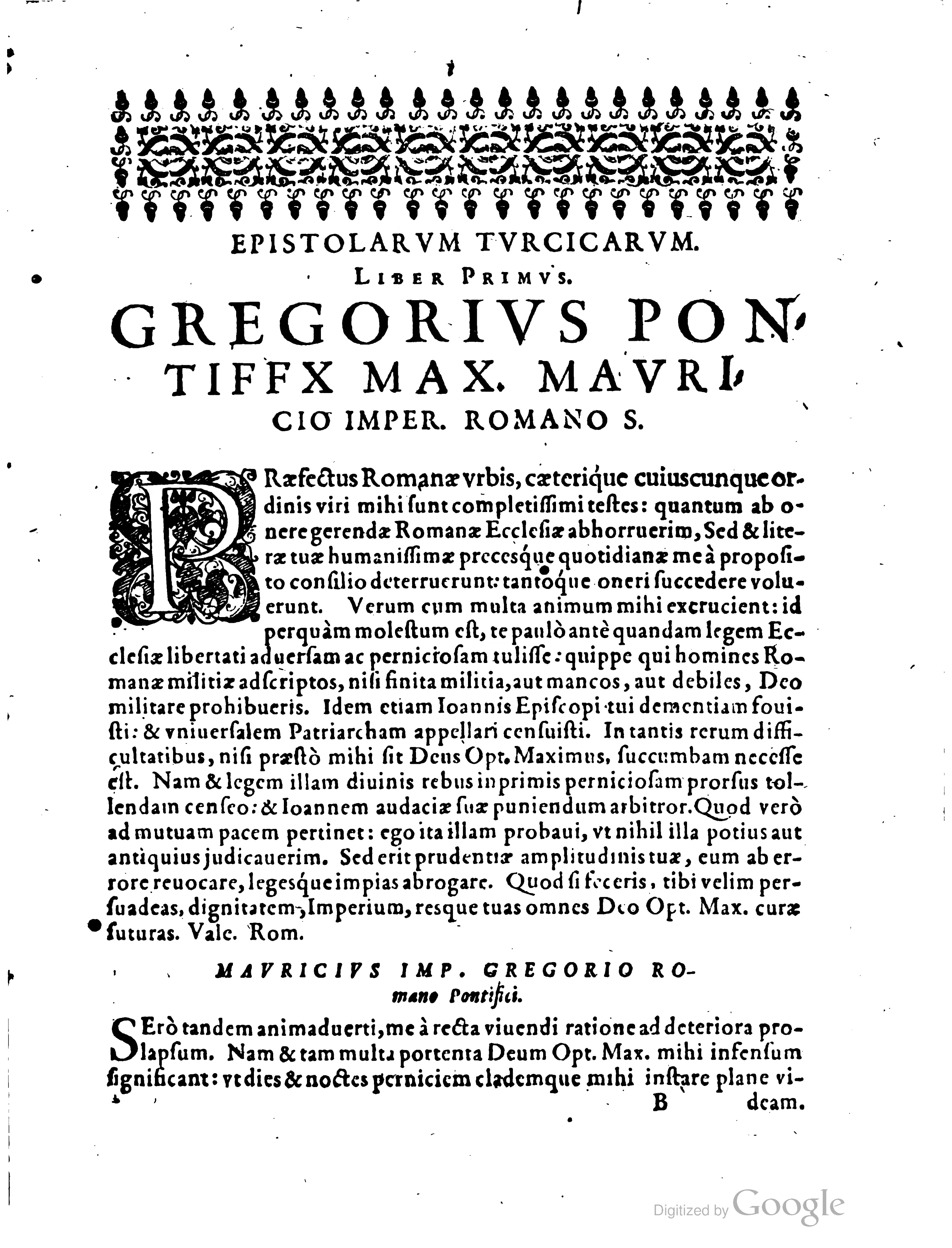
With its full-width ornamental headpiece, large printed heading for Liber Primus, and historiated initial, this page makes the Gregory–Maurice exchange the formal threshold of the anthology's documentary sequence. Beginning with a papal-imperial dispute from the age of Gregory the Great casts the later Ottoman crisis within a far longer escalation of fractured Christian authority. Source ↗.
The appeal ascribed to the patriarch of Jerusalem does not merely lament persecution; it distinguishes the new adversary from the old in the comparative judgment set out above, that the Turks' counsels too are more cunning, their undertakings bolder, their attempts greater, and their outcomes more successful. That judgment is the hinge of the compilation's periodisation à primordio regni Saracenici & Turcici: the Turk is not a new phenomenon requiring new categories but the intensified form of a danger already known, which allows an eleventh-century letter to function as prophecy rather than as antiquarian curiosity. The rhetorical asymmetry is instructive — the escalation is registered in the enemy's consilia first, counsel against counsel, precisely the faculty Reusner's preface demands of Christian subjects.
What distinguishes the crusading archive of Liber I from a straightforwardly celebratory dossier is that its documents repeatedly indict the cause they advocate, and the compilation leaves the indictment standing. The leaders of the Fourth Crusade name their own sin in the act of excusing it, writing that they went out from the city of transgression — for so, they say, they name Zara, whose destruction they saw, grieving indeed, exiuimus (Sic enim Iaderam nominamus, cuius excidium vidimus do. The parenthesis performs the whole moral manoeuvre: the crusaders supply the epithet themselves, appropriate the language of penitence, and then plead necessity, so that confession functions as exculpation. A few leaves later the same expedition's apologetics justify the storming of a Christian capital by a frank dehumanisation of its inhabitants, in the imperial encyclical's reproach, quoted below in another connection, that Constantinople had thought all Latins worthy not of the name of men but of dogs. The sentence is ideologically double-edged within Reusner's arrangement. It licenses 1204, but in a collection whose governing thesis is that Christian discord is the adversary's most reliable ally, it also preserves the documentary root of the Latin–Greek breach that no later anti-Ottoman league could repair — the reproach is transmitted as a Greek slander against Latins, yet it is the Latin author who reproduces and exploits it.
Liber I likewise refuses to suppress the theodicy that crusading failure forces on its own sources. The anonymous eyewitness report of Barbarossa's Anatolian march, a letter otherwise crowded with victories and apparitions of riders in white, closes on the emperor's death in a river: when, after unbounded labours, he wished to wash in that same water and to cool himself by swimming, by God's judgment, in a pitiable and unforeseen mishap, cum vellet lavare in eadem aqua, & refrigerare se ita natando. Dei iudicio, casu lachrymabili inopina. Dei iudicio and casus are placed in apposition without reconciliation; providence and accident are asserted of the same event, and the letter's providentialist frame survives the disaster only by absorbing it.
Liber II: the fictive letter-book of Mehmed II
Liber II shifts register abruptly, from chancery and homiletic prose to a humanist letter-book, and the shift exposes how literary invention acquired documentary standing.
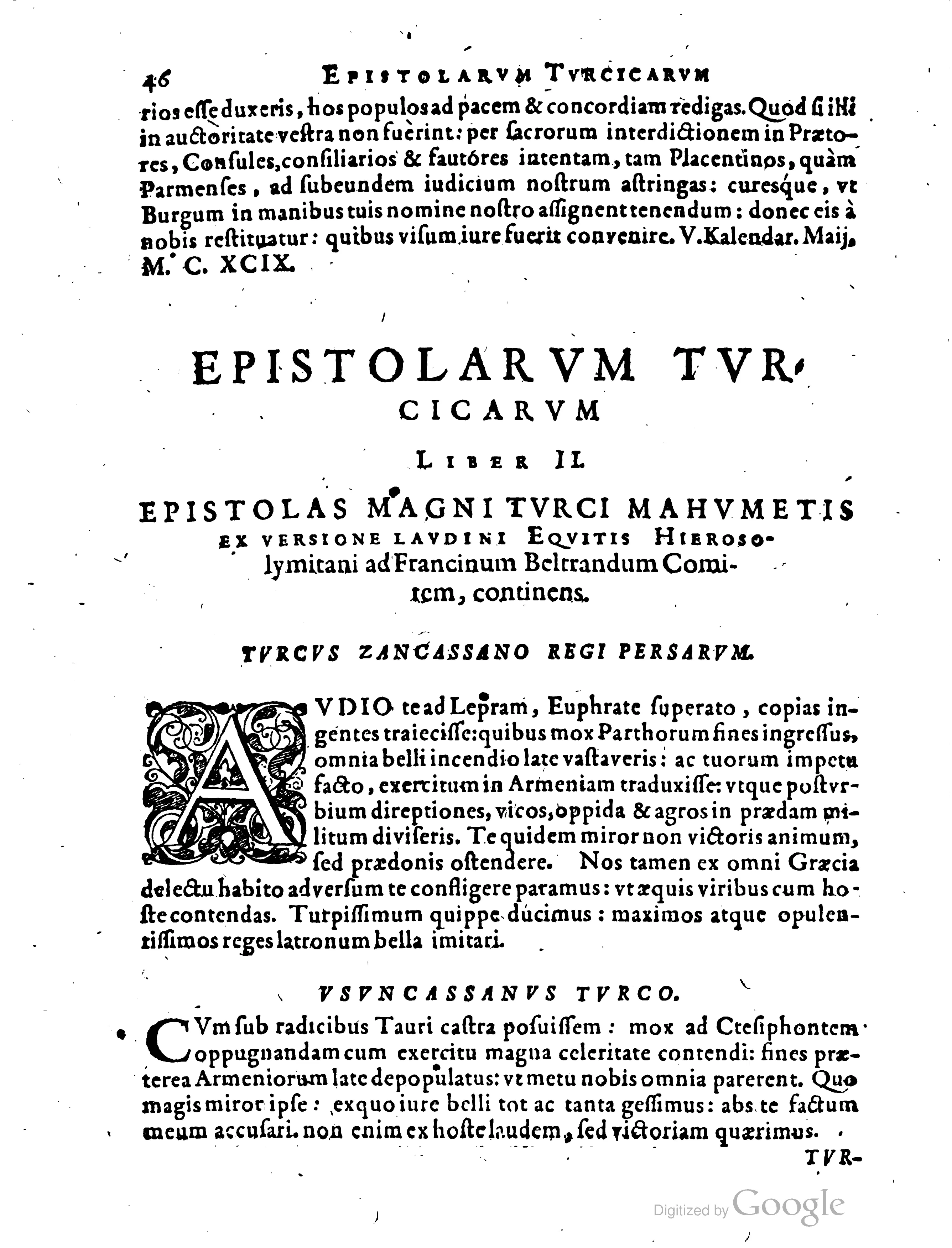
At the opening of Liber II, the display heading and subtitle naming Laudivius's version of Mehmed's letters announce the turn from documentary prose to a humanist fiction presented in documentary form. The ornate initial beginning the address from TVRCVS to the Persian king introduces the antiphonal letter-and-reply structure by which Ottoman boasting is made to invite moral rebuttal. Source ↗.
Laudivius Zacchia's fabricated Mehmed reports a Peloponnesian campaign in Caesar's cadence, writing that he came to Patras with a huge army, saw, and conquered, AD Patras ingenti cum exercitu veni. Vidi: & vici. The forgery's technique is to lend the sultan a classical persona: the borrowed veni, vidi, vici simultaneously magnifies him into a conqueror of Roman stature and convicts him of vainglory, and the antiphonal construction of the book — letter, reply, and sententia — makes each Ottoman boast the occasion of a Christian moral rebuttal. The vocabulary of that rebuttal is the fortuna–virtus antithesis on which the whole letter-book turns, as when an addressee concedes defeat while denying its moral significance, telling the sultan that they are overcome by him by fortune, assuredly, not by virtue, à te profecto fortuna, non virtute superamur. The formula is an argumentative device of some delicacy: it concedes every fact on the ground while withholding the inference that success confers legitimacy, and it thereby keeps Ottoman victory from becoming Ottoman right. Alongside it the fictive Italian replies articulate a criterion of legitimate war that is civil rather than confessional, holding that most just indeed are those arms by which the common safety of all is maintained, Iustissima quidem arma sunt quibus publica omnium salus continetur — a publica salus standard congenial to a jurist-compiler addressing a war conducted by confessionally divided estates.
Liber III: frontier diplomacy and the constitutional diagnosis
Liber III turns from invention to the documented politics of the Hungarian and Albanian front, and here the collection's own method comes under strain. Scanderbeg's reply to Murad II rejects the very transaction that Reusner's preface performs, declaring that meanwhile they neither seek counsels for the conduct of affairs from an enemy, nor peace from him, but victory, neque consilia rerum gerendarum petimus ab hoste, neque pa. The compilation is built on the premise that counsel may be extracted from any quarter of the past, including the adversary's own chancery, while its exemplary hero makes refusal of enemy counsel a point of honour; the tension is left unresolved, and the book's readers are given both positions to weigh. The same book documents the scandal the whole volume circles, printing a Christian king's formal defiance of the Emperor: we declare just war upon you, and we pray Jesus Christ the Best and Greatest, the Divine Mother, the peculiar deity of Hungary, and the other ancestral gods, iustum tibi bellum indicimus: & Iesum Christum Opt. Max. Diuam genitricem, peculiare Vngariæ numen, cæterosque deos patrios. The chancery's humanist dress — Optimus Maximus transferred from Jupiter to Christ, the Virgin made a tutelary numen, the dei patrii invoked by a Catholic king — is not incidental ornament: it shows how thoroughly classicising formulae had penetrated the diplomatic idiom in which Christian princes declared war on one another while the Ottomans advanced.
The analytic centre of the book is Piccolomini's diagnosis that the obstacle is constitutional rather than military — the want of a head whom all will obey, the withholding from pope and Emperor alike of what is theirs, the absence of all reverence and obedience, in the passage already set out — compressed a few lines later into the epigram that there are as many princes as there are houses, Tot sunt princeps, quot domus. What follows the epigram is not lamentation but a series of operational objections — who will command, provision, and interpret for a polyglot host — so that the rhetoric of Christian unity is tested against the logistics of coalition. The Varna dossier then delivers the collection's most disconcerting concession, noticed above, that the Turks show by their own example that oaths are to be kept not only towards those of one's own faith but even towards enemies. In a compilation that names the adversary a tyrant and enemy of the Christian name, the infidel is there made the exemplar of fides, and Christian defeat is explained as the punishment of Christian perjury — an argument that requires judgment from the reader rather than assent. Campano's dispatches from Regensburg carry the same critique into the institutions of the Empire with the single sarcasm quoted below, that if we shall one day fight as well as we now snore, we have won, set beside the diet's one concrete achievement, a proportional levy assessed on income.
The dossier of 1453: report, counsel, and collation
The 1453 dossier opens with a legate's eyewitness encyclical and then registers the news as it struck the imperial court, in an exclamation of shame rather than analysis: alas for wretched Christendom, now life itself shames me, would that we had happily died before this disaster, Heu miseram Christianitatem! Pudet iam vitæ: feliciter vtinam ante hunc casum obijssimus!. Written as an official duty to report novelties, the sentence discloses the affective economy on which the whole compilation trades: the archive is assembled so that a loss already two centuries into the past may still be felt as intolerable, and so that the shame recorded in 1453 may be made to do political work in the year of Győr and Eger.
Within the same dossier, the letters to Rome are arranged so as to begin not with the siege but with the problem of how the siege will be remembered. The first of them, addressed to Nicholas V, drafts the pope's obituary in advance: a catalogue of achievements — the patrimony recovered, the schism healed, Bernardino of Siena canonised, the Vatican palace built, the Jubilee held, Frederick III crowned — is imagined as already composed by future chroniclers and then ruined by a single appended clause, so that, in the writer's projection, your fame will pay the penalty though you are not at fault, Itaque luet vestra fama sine vestra culpa. The rhetorical mechanism is worth dwelling on, because it governs much of what follows: the letter does not accuse the pope of negligence but of exposure to the historical record, and the remedy it proposes is action undertaken for the sake of the sentence posterity will write. That remedy arrives as a compact agenda of verbs, the claim being that it is for the pope now to rise up, to write to kings, to send legates, Vestrum est, iam assurgere: scribere Regibus: mittere legatos; — the diplomatic repertoire of the curia reduced to an imperative list, with a common assembly and negotiated truces to follow.
What the anthology's arrangement then exposes, by simple juxtaposition, is that the identical programme reappears within a few pages in the emperor's own voice. Frederick III's formal notification announces that when it was reported to him in these days that Constantinople, the head of Greece and once the seat of the Eastern Empire, had been stormed by the lord of the Turks and reduced to slavery, Cum nobis renunciatum Besset his diebus Constantinopolim Græciæ caput & orientalis imperij quondam sedem per Turcorum Dominum expugnatam & in servitutem redactam; the form "Besset" for esset is a mis-set initial in the forme, one of several such accidents in this stretch of the printing, and a reminder that the documentary authority the volume claims is mediated by compositors. More consequential is the near-verbatim recurrence of the six-fold papal agenda inside the imperial letter. Read as the collection presents them — consecutively, without editorial comment — the two pieces disclose either chancery borrowing or a single drafting hand behind both, and the reader who notices the repetition is being trained in precisely the kind of comparative judgement the anthology's heterogeneous materials require. The imperial letter also converts lament into a political maxim, arguing that victory, insolent by its very nature, makes even the mild fierce and shameless; from this the inference of continued Ottoman advance follows as a matter of the psychology of conquerors rather than of prophecy.
With the relation of Leonardo of Chios the register shifts from counsel to testimony, and the letter announces its own evidentiary standing before it narrates anything, in the declaration discussed below that, since what is seen is reported more truly than what is heard, the writer will speak what he knows and will testify more faithfully to what he saw. The hierarchy of visus over auditus is not an idle topos here, for the letter proceeds to adjudicate contested matters — Greek obstruction, Venetian and Genoese recriminations, the conduct of individual captains — on the strength of that claim. Yet the same letter subordinates its autopsy to a theological frame that no eyewitness could verify, and it does so by inverting the anti-unionist reading of the catastrophe: where the Greeks had argued that God punished the Florentine union, the letter replies, in the formula already examined, that the cause lay not in a union having been made but in the union made being feigned rather than true. The distinction between vnio vera and vnio ficta carries the entire theodicy, and it is a formula with a long afterlife in a confessionally divided Empire, since it makes the sincerity of concord, not its legal instrument, the object of divine scrutiny.
The military narrative that follows continually assimilates the unfamiliar to the classical. When the biremes are dragged over the hill behind Pera into the harbour, the act is registered as imitatus Xerxis potentiam, qui ex Asia in Thraciam Bosphoro exercitum traduxit, that is, as an imitation of the power of Xerxes, who led an army from Asia into Thrace across the Bosphorus — the sultan's engineering becomes legible only once it has been given a Herodotean ancestor, and the analogy simultaneously dignifies and orientalises the feat. The same procedure governs the janissaries, made intelligible as the Myrmidons of a new Macedon. The limits of such assimilation appear most sharply where the text tries to transmit Arabic. The Chios letter reproduces the Ottoman battle-cry with a Latin gloss that has broken down, (Mala, Mala, Mahomet Russolalla, scilicet quod DEVS est & semper erit, & Mahometus est ferum eius), where the closing word leaves the profession of faith unintelligible; the abridgement commissioned for Gottschalk of Meschede, printed in the same book, transmits the cry differently and glosses it correctly, that God is and always will be, and Mahomet is his servant, Illola Illola Machumet rufalcilla, h[oc] e[st] Deus est, & semper erit, & Machumetus est servus eius. Here the anthology's duplication of witnesses, which might look like editorial redundancy, performs textual work: servus restores what ferum had corrupted, and the shahāda becomes recoverable only through collation of two Latin reports. A collection that prints two accounts of the same siege thus supplies its reader with the means to correct each by the other.
Cyprus, the German grievances, and the argument from office
Among the responses to the loss, the Cypriot dossier shows how far the volume will go in preserving documents that embarrass the categories it elsewhere enforces. The succession is argued as a legal contest under Mamluk suzerainty, with nature invoked for male right, Christian testamentary law for Charlotte's, and fiscal sovereignty for the sultan's competence to judge the king. Its final piece, the tributary oath of James of Lusignan, scripts the penalty for perjury as apostasy in the first person, dicam, Evangelium falsum esse: negabo Christum vivere, in which the oath-taker undertakes to say that the Gospel is false and to deny that Christ lives. That such a formula could be drafted, sworn, and then reprinted in an anti-Ottoman compilation indicates how thoroughly the frontier ran through the documents themselves rather than merely between the parties to them.
The papal letters of Calixtus III answer the German nation's grievances over annates, the concordats, and episcopal confirmations with an accounting of expenditure and then with an argument from office. The Emperor is reminded of his juridical title in terms that make private war a dereliction, Considera quæso, quod tu Imperator es: advocatus Ecclesiæ, protector fidei Catholicæ, primus inter seculi principes — consider, I beg, that you are Emperor, advocate of the Church, protector of the Catholic faith, first among the princes of the age. The appeal is constitutional rather than hortatory: it locates the obligation in the dignity, not in the will, of its holder.
Liber V: the eastern league, Gallican business, and the Scanderbeg exchange
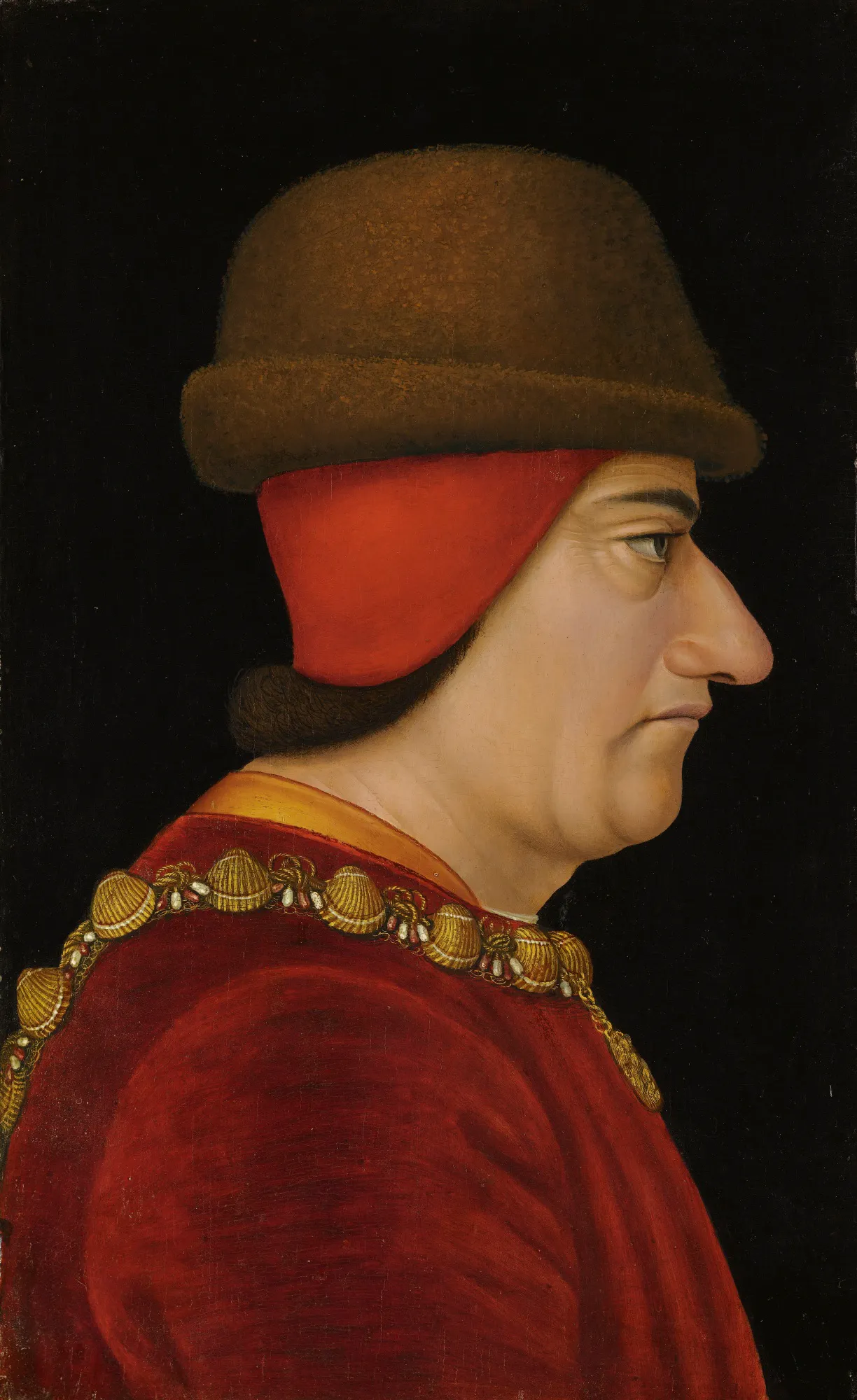
This period portrait of Louis XI evokes the French counterpart in the exchange printed in Liber V, where Pius II turned crusade diplomacy toward the abrogation of the Pragmatic Sanction of Bourges. The king's formal, impassive likeness suits the constitutional stakes of that correspondence: a diplomatic route around conciliar decision-making and Gallican autonomy. Source ↗.

An internal title, EpistolarVM TVRCICARVM Liber V., opens the fifth book of Turkish letters, and with it the diplomacy of Pius II. The projected eastern league is documented from the far side, and the replies of the Caucasian and Anatolian princes make the crusade a contract with a suspensive condition: contingents are enumerated, and then the undertaking lapses unless the Latins appear, since otherwise, as the Georgian prince states, we are released from that league and confederation, alioqui soluti sumus ab ista Liga & confæderatione. The mirror-image of the Latin complaint about Greek and Oriental unreliability could hardly be plainer. In the French correspondence the pope's remedy for delay turns against the very instrument the earlier letters demanded, for where the 1453 dossier had called for a common assembly, Pius now praises Louis XI for acting without one on the ground that it often happens that the greater part overcomes the better, Sæpe enim fit, vt maior pars meliorem vincat. The collection thus preserves both the summons to collective deliberation and a pointed argument that counting heads corrupts judgement — a tension internal to the anti-conciliar papacy that the anthology neither resolves nor conceals. Louis's answer is printed as a letter though it functions as an act of state, declaring that as you have commanded, we expel, cast down and utterly abrogate that Pragmatic from our kingdom and from our Dauphiné of Vienne and from all our dominion, sicut mandasti, Pragmaticam ipsam à nostro regno, nostroque Viennensi Delphinatu, & omni ditione nostra per præsentes pellimus, deijcimus, penitusque abrogamus; the crusade appeal furnishes the occasion for a settlement of Gallican jurisdiction, and the war against the Turk is revealed as the medium through which intra-Christian constitutional business is transacted.
The Mehmed–Scanderbeg exchange closes the sequence with the adversary composing in the idiom of friendship while dictating. Mehmed recalls their shared boyhood at the Porte, proposes terms, and concedes the principle of his own advantage in the parenthesis already remarked, that it belongs to the party which does not sue for peace to lay down the terms of peace. Kastriota's answer declines on grounds that are conspicuously secular, holding that to consent to this request of Mehmed's would be neither equitable nor consistent with his own dignity, quidem petitioni tuæ, Mahumetes Princeps, consentire me, neque ex æquitate foret, neque ex dignitate mea: treaty obligation to Venice, paternal affection against the surrender of a hostage son, and the requirements of governing, with only the commercial clause accepted. The sequel is stranger still, since the Ottoman chancery then confirms the peace and grants recognition, declaring that henceforth I hold you always as prince of the Albanians and Epirotes, deinceps in principem Albanorum Epirotarumque semper habeo. A compilation assembled to define the Turk as tyrant and enemy of the Christian name here prints the sultan conferring a title, honouring a treaty, and blaming Venetian seduction for its later rupture — evidence that the anthology's documentary method admits material its polemical vocabulary cannot easily absorb.
The later dossiers of the fifth book: Italy, the Tartars, and Bohemia
The physical presentation of that fifth book matches its editorial reticence. It proceeds without preamble, opening in the middle of a letter, and the abruptness is itself informative about the volume's method: the book is a sequence of chancery objects, each fitted with its own display-capital address heading and dating clause, gathered under the alternating running heads of the fifth book and carried through the quires signed Ff to Qq to a closing FINIS. The reader is given no editorial narration between documents; sequence does the arguing. What that sequence supplies next is a lay prince's refusal of Ottoman universal monarchy, conducted not by theological denunciation but by an audit of provinces and a meditation on the mortality of empires, in the pair of ripostes discussed earlier — and then, having historicized the sultan's power, the letter arrives at precisely the bargain the anthology's final and longest piece will elaborate at treatise length: if, laying aside that treachery and the errors of the Mahometan sect, he should be willing to turn to the faith and truth of Christ, si perfidia ista, & Mahumetanæ sectæ erroribus depositis, ad Christi fidem & veritatem te convertere volueris, the Christian princes will confirm as lawful what he now holds by usurpation. That the offer of legitimation-through-baptism should appear here in the mouth of an Albanian dominus rather than of a pope indicates how far the topos had passed from curial theology into ordinary diplomatic idiom, and it sets up the anthology's most striking editorial effect: the same proposal will return, magnified, as Pius II's own.
The two papal briefs that follow shift register from frontier defiance to curial government, and the first of them offers a constitutional rather than a devotional diagnosis. Rebuking an archbishop who had assumed the temporal dukedom of Genoa, Pius characterizes the city as one which, delighting in novelty beyond all Italians, always wavers, is always in motion, and endures no ruler or duke for long, quæ super omnes Italos novitate gaudens, semper nutat: semper in motu est: nec vllum diu rectorem ducemque patitur. The judgement is pointed in a collection whose governing complaint is the absence of a head whom all will obey: instability is located not in the adversary but in the internal constitution of a Christian republic, and the pope's conditional benediction rests on that political appraisal. The second brief converts diagnosis into decree. Announcing that in the coming summer war will be moved against the Turks, that the apostolic sacred senate will be his companion, and that sturdy cohorts of soldiers will not be wanting, Æstate proxima bellum contra Turcas movebimus: & Apostolicus sacer senatus comes erit: nec deerunt robustæ militu[m] cohortes, Pius styles the College of Cardinals a senate on campaign, a Romanizing figure that dignifies the curia as a deliberative war council and simultaneously commits it bodily to the expedition. The rhetorical burden of the letter is then to remove the Venetian doge's excuse of age, which it does by redefining what a naval league requires of its senior partner — counsel and authority rather than sinew — so that the elderly ruler's auctoritas is treated as itself a species of force.
Against these appeals the dossier at once sets Christian conduct. The Milanese remonstrance to Ferdinand of Aragon-Naples reproaches him for abetting revolt at Genoa while the Turk, courted with embassies and gifts, watched from Epirus; its normative claim is that league-fidelity outranks advantage. The Negroponte relation then supplies the counter-case in narrative form, and its interpretive key is stated flatly: the affair was carried through by treachery, and there was no fighting on equal terms, Sicque proditiones res acta est: non æquo Marte pugnatum. The formula non æquo Marte does considerable ideological work. It denies the Ottoman army the honour of a fair victory, preserving the reputation of Latin arms; but it also relocates responsibility inside Christendom, since the betrayal of the master of ordnance is compounded by a Venetian admiral who hovered in sight of the besieged and did nothing. When the piece turns to atrocity, the rhetorical temperature rises to hagiography, most conspicuously in the report of the archbishop of Otranto, vested in pontificals, holding the most holy cross in trembling hands, cruelly divided into pieces with a wooden saw, Pontificalibus induto, sacratissimam crucem manibus tremulis tenente, serra lignea crudeliter in frusta diuifo. The specification of vestments and of the cross held in the victim's own hands makes the killing a desecration of the liturgy rather than a casualty of storm; the wooden saw imports the iconography of prophetic martyrdom into contemporary reportage, converting a strategic disaster in Apulia into an item of sacred history.
The anthology does not harmonize the political vocabulary it transmits, and the Neapolitan letters that follow expose the contradiction without comment. Ferdinand levies horse, foot and a fleet with this design, that for the liberty of Italy he may break the enemy's attempts and recover what has been occupied, eo consilio: vt pro libertate Italii hostium conatus infringamus & occupata recuperemus — and the enemy in question is Venice, seizing Apulian towns in a province already depopulated by the Turkish war, a Venice praised a few leaves earlier as the naval bulwark of the faith. Libertas Italiae and hostis communis are thus shown to be transferable predicates, available to whichever Italian power is currently aggrieved. Printed side by side, the letters make the constitutional diagnosis of Christian disunity something the reader deduces from the documents rather than something the compiler asserts.
The Tartar dossier interrupts the Italian material with a wholly foreign chancery idiom, and its interest lies partly in its illegibility to Latin diplomatic categories. The Mongol ultimatum to the Roman pontiff admits no negotiation of status: if you wish to sit upon our land, water and patrimony, it behoves that you, Pope, come to us in your own person, Si vultis super terram nostram, aquam & patrimonium sedere: oportet, vt tu, Papa, ipse in propria persona ad nos venias. The triad of land, water and patrimony belongs to the submission formula of the yarligh, and the demand for bodily attendance inverts the entire economy of legatine representation on which papal diplomacy rested. Set beside the accompanying promise of immunities for all who adore the cross, the Mongol pieces function within a Turkish-letters collection as an alternative eastern power — one that dictates terms to Rome while dissolving the confessional distinctions that Latin orthodoxy held to be salvific.
The Bohemian letters restore a humanist voice and, with it, an explicitly deliberative maxim: open war is both safer and more useful to the Christian cause than a doubtful peace hanging upon barbarian faith, & apertum bellum, quam dubiam pacem, atq[ue] ex barbara fide pendentem, & tutius, & rei Christianæ vtilius arbitror. The formulation is juridical as much as martial: barbara fides is invoked to void the binding force of a treaty in advance, so that the choice between war and peace is decided by the alleged incapacity of the other party to be bound. Elsewhere in the same correspondence the pseudepigraphic reply ascribed to "Morbasanus" turns the machinery of Latin argument against its makers, protesting the crusade indulgence on the ground that our people of the Turks has been innocent of the death and injury of your Christ, populus noster Turcarum innocens fuerit mortis & iniurix Christi vestri. The constructed enemy voice argues from Latin premises — blood-guilt for the passion, the requirement of just cause for preaching remission of sins — to deny the war its warrant, and thereby records what western polemicists imagined a reasoned Ottoman objection would look like.
Pius II's Epistola ad Mahumetem
In the Epistola ad Mahumetem the collection's longest movement, Pius stages persuasion as judicial procedure and then, remarkably, ventriloquises the strongest political objection to his own proposal: born of Turks, will you desert the Turks? among Turks you grew up; the hand of Turks raised you, Ex Turcis natus, Turcas deseres? Inter Turcas creuisti: Turcarum te manus extulit. The objection is put in the mouths of the sultan's courtiers, and its force is acknowledged before being answered with a scheme of reliance on Christian-born servitors — an admission that the conversion project is a question of household and military constituency, not merely of conviction. The typological answer is Constantinian: he had seen in sleep the sign of the cross in the air, and had heard a voice saying, in this, Constantine, you shall conquer, Viderat per quietem in aere signum crucis: & vocem audiuerat dicentem: IN HOC, CONSTANTINE, VINCES, the majuscules giving the vision a typographic prominence that makes the printed page participate in the letter's climax. The polemical half of the treatise proceeds by juridical demotion, titling Muhammad Legifer, lawgiver rather than prophet, and locating the fatal defect of his code in its prohibition of inquiry: but your lawgiver stands in the way, and forbids inquiring into the truth, sed obstat Legifer tuus, & inquirere verum prohibet. The charge is calibrated to the letter's own opening request for patient examination, so that the adversary's law is convicted of forbidding precisely the procedure Pius asks of his reader; and it is completed by the alleged self-description, I was not sent except in the power of the sword, and let him who does not accept my prophecy be killed, or pay tribute, the price for his unbelief, Non sum missus (inquit) nisi in virtute gladij: & qui non susceperit meam prophetiam, occidatur; aut reddat tributum, precium pro infidelitate sua, in which coercion and the poll-tax are made to stand in for the testimonium of miracle.
The appended Expeditio Asiatica
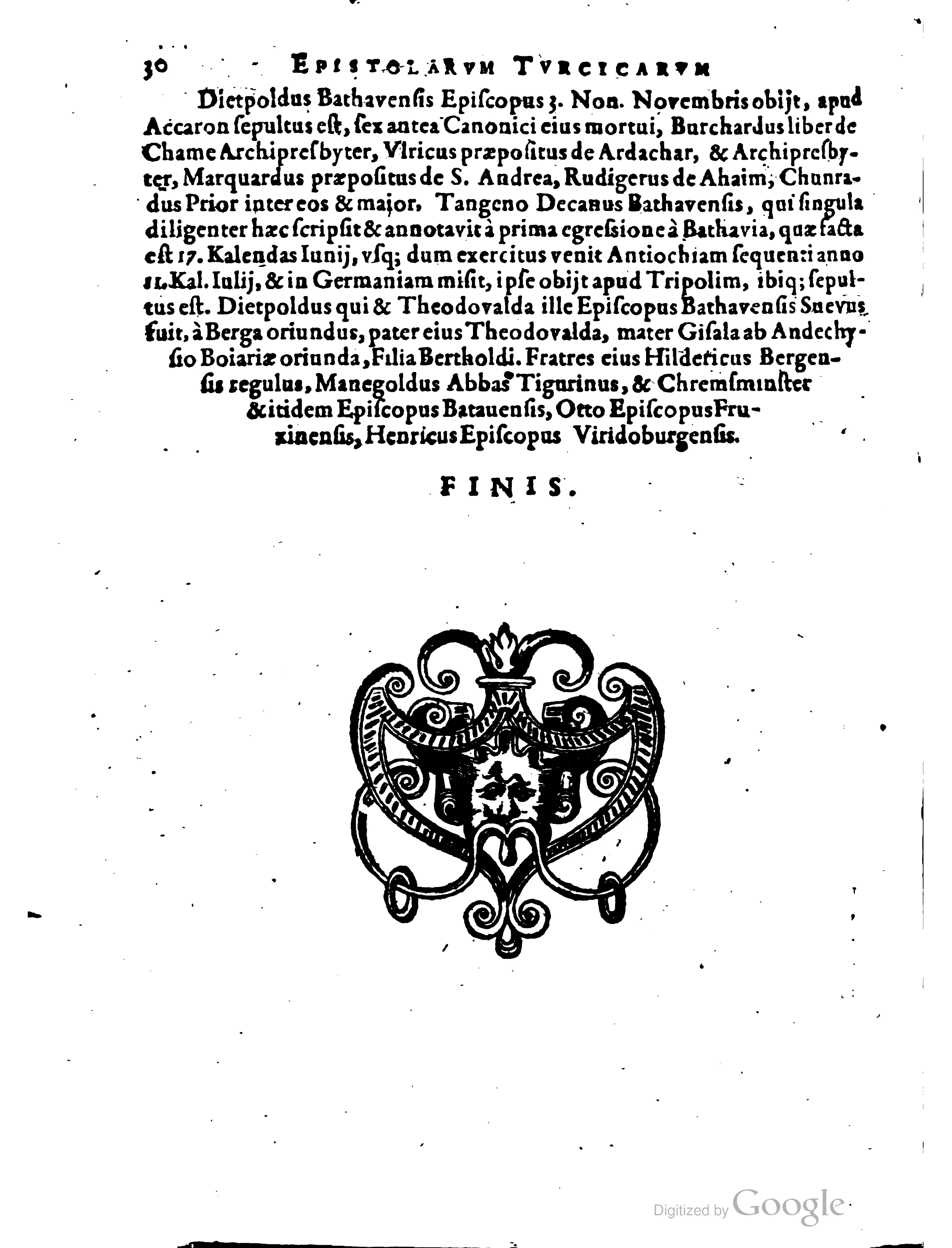
The final leaf of the appended Expeditio Asiatica turns its ending into a warrant of transmission: before the emphatic "FINIS," the obituary notice for Bishop Dietpoldus and the Passau canons culminates in the claim that Tangeno, dean of Passau, wrote and annotated the account from the expedition's departure and sent it back to Germany. The ornamental printer's device below seals the appendix's appeal to named witnesses and documentary authority. Source ↗.
The appended twelfth-century expedition report returns the volume to documentary narration, and it dramatizes intra-Christian rivalry in the sharpest available form: the king of the Greeks, proudly and arrogantly naming himself angel of God and origin of our faith and Roman Emperor, rex Græcoru[m] superbe & arroganter, angelu[m] Dei & originé nostræ fidei, & Romanu[m] Imperatore[m] se nominans — the two-emperors quarrel reduced to a dispute over the wording of an address, which then generates hostage-taking and the detention of legates on the road to the Holy Land. Against the Seljuq demand for gold and territory the same army defines its honour negatively: it is not the way of our empire, nor of Christians, nor of the militia of the life-giving Cross, to buy a road with gold and silver, No[n] est imperij nostri & Christianoru[m] & militiæ viuificæ crucis, viâ auro & argento emere. After such a sequence of dated marches and refusals, the catastrophe is registered with a brevity that is itself rhetorical: suddenly the emperor died, and the army was scattered in grief, subito Imp. obijt. Exercitus tristitia dissipatus est. The closing obituary list functions as a certificate of authority for the whole appendix, recording that Tageno, dean of Passau, diligently wrote and noted down these individual things from the first departure from Passau, Tangeno Decanus Bathavensis, qui singula diligenter hæc scripsit & annotavit à prima egressione à Bathavia, and that he himself died at Tripoli — a witness whose death is the guarantee of his autopsy, and whose journal closes the fifth book by making transmission, not exhortation, the last word.
Locating the Copies: Turcica Bibliography and Bibliographic Control for the 1598 Issue
For bibliographic control, Carl Göllner's Turcica bibliography and the German retrospective bibliographies VD16/VD17 should be consulted alongside the digital copies at the Bayerische Staatsbibliothek/MDZ, WorldCat, and the Lower Silesian Digital Library. These resources are necessary for distinguishing the 1598 five-book issue from later continuations and expanded records, rather than treating the catalogue shorthand "V[-XIV]" as the title of a single undifferentiated edition.
Frequently Asked Questions
What is Nikolaus Reusner's Epistolarum Turcicarum variorum et diversorum authorum libri V?
It is a Latin documentary anthology in five books, printed at Frankfurt in 1598, gathering letters on Turkish and Ottoman affairs rather than narrating a history of them. Papal, imperial, royal, conciliar, municipal, Ottoman and Mongol chancery pieces stand beside frankly fictive and pseudepigraphic ones, arranged in rough chronological order from the age of Gregory the Great to the campaigns of the 1590s, with a medieval account of Frederick I Barbarossa's Asian expedition appended at the close. Its recurring verdict is that Christendom's want of a head whom all will obey is the sultan's most dependable ally.
Who was Nikolaus Reusner, and where and when was the collection printed?
Nikolaus Reusner (1545–1602) was a jurist and humanist associated with the university at Jena, who compiled rather than composed the volume. Catalogue records give Frankfurt am Main, 1598, with Johann Kollitz printing for the bookseller Paul Brachfeld, in a book of some three hundred pages; the dedicatory epistle to Heinrich Julius, Duke of Brunswick-Lüneburg and Prince of Wolfenbüttel, is subscribed at Jena in February 1599, best treated as a production chronology rather than as evidence of a separate 1599 edition. Reusner presented the anthology as the capstone of an anti-Turkish enterprise that already included his Orationes Turcicae; it reportedly carried imperial and Electoral Saxon privileges.
Does the title mean the letters were written in Turkish?
No. In Epistolarum Turcicarum the adjective is topical: the letters concern Turkish and Ottoman affairs, while the volume itself is a Latin compilation, its title page advertising letters on Turkish matters from the origins of Saracen and Turkish power to the present day. The words libri V identify the 1598 issue as a five-book unit; later catalogue records that append "[-XIV]" are aggregating it with subsequent continuations, among them a separately catalogued Liber VI and following books. No established English title for the complete anthology has been located.
Why does the anthology print forged letters alongside genuine chancery documents?
Because its method is accumulation and juxtaposition rather than authentication. Laudivius Zacchia's invented letter-book of Mehmed II, which has the sultan report Patras in Caesar's cadence, sits beside genuine Ottoman chancery pieces, letters ascribed to Chinggis Khan and to Baiju, the pseudepigraphic Morbasanus, and Pius II's Epistola ad Mahumetem. The volume nonetheless thematizes the difficulty, preserving a witness's insistence that what is seen is reported more truly than what is heard, and its duplicated reports of the 1453 siege let one Latin version correct the corrupt reading of another.
Is there an English translation of Reusner's Turkish Letters?
No complete modern translation of the anthology as a whole has been identified, and no modern critical edition has been located; individual items within it have separate histories, Pius II's Epistola ad Mahumetem II having been edited and translated independently. Separately, the Leo edition presents the full transcription of the 1598 volume together with a complete English translation for the first time. That translation is generated by AI. Leo is an effort to make freely available online, at no cost, English translations of every text printed in Latin in early modern Europe between 1450 and 1750.
This report was generated by an advanced AI assistant that conducted deep research alongside an extensive interpretation of the transcribed original text. Every effort has been made to preserve fidelity to the source and to guard against inaccuracy, but corruption in the text recognition process and model hallucination may nonetheless have entered the text. Treat every claim, quotation, translation, and citation as provisional, and verify each against the original source before relying on or citing it.
Bibliography
- Nancy Bisaha, Creating East and West: Renaissance Humanists and the Ottoman Turks: Bisaha's study explains how Renaissance humanists represented Ottoman power through classical ethnography, Christian polemic, and competing accounts of civilization. It is particularly useful for interpreting the anthology's vocabulary of Turkish tyranny, Christian commonwealth, imperial translation, and cultural threat without reducing those categories to modern geopolitical concepts. It is equally useful for the anthology's internal Latin–Greek polemic, which the collection preserves in the justification of 1204 that this is she who used to think all Latins worthy not of the name of men but of dogs, Hæc est, quæ Latinos omnes no[n] hominum nomine dignabatur sed canum, a reminder that the fractured commonwealth the volume laments was fractured internally as well as confessionally.
- Stephen A. Fischer-Galati, Ottoman Imperialism and German Protestantism, 1521–1555: Fischer-Galati reconstructs the political and confessional pressures generated by Ottoman expansion in the German lands. Although it precedes Reusner's compilation, it supplies indispensable background for the Protestant, imperial, and territorial politics that made a documentary anti-Ottoman anthology intelligible at Frankfurt and Jena. The collection's own diagnosis of imperial torpor is caustic on precisely that point, in the gibe that if we shall one day fight as well as we now snore, we have won, Si tam bene olim pugnabimus, quam nunc stertimus, vicimus.
- Anthony T. Grafton, "Joseph Scaliger and Historical Chronology: The Rise and Fall of a Discipline," History and Theory: Grafton's analysis of philological chronology, source criticism, forgery detection, and the negotiation between biblical and non-biblical historical evidence offers a methodological analogue for Reusner's treatment of heterogeneous letters, fictive epistles, and retrospective documentary authority. The anthology itself articulates a criterion of testimony in the eyewitness claim that, since what is seen is reported more truly than what is heard, the writer will speak what he knows and will testify more faithfully to what he saw, Sed quoniam quæ visu magis quàm quæ auditu, verius exponuntur, quod scio loquar: & quod vidi, fidelius contestabor. The relevance is methodological rather than genealogical: Reusner was not simply reproducing archival evidence but arranging materials whose authority required historical judgment; Scaliger's exposure of forgeries is the natural comparison for a compiler who prints forgeries without flagging them.
- James Hankins, "Renaissance Crusaders: Humanist Crusade Literature in the Age of Mehmed II," Dumbarton Oaks Papers: Hankins provides the essential account of the humanist crusade writings that supplied many of the rhetorical and documentary precedents later assembled by Reusner. His emphasis on political unity, classical exemplarity, and the adaptation of older crusading language clarifies the anthology's fifteenth-century materials and their late-sixteenth-century reactivation. The anthology preserves in the pope's own voice the personal binding of papal credit to the expedition that Hankins analyzes as a rhetorical strategy, in the assurance that no one will say that Pius the Pontiff promised this and did not do it, that he said he would go and did not go, Nemo dicturus est: hoc promisit Pius Pontifex, & non fecit: Iturum se dixit, & non ivit.