Weights in Place of Lines: Giovanni Ceva's On Straight Lines Intersecting One Another: A Construction by Statics
In 1678 the Milanese mathematician Giovanni Ceva published De lineis rectis se invicem secantibus statica constructio, a slim Latin quarto that untangles knots of mutually intersecting lines by hanging imaginary weights on them and reading off their centres of gravity. It gave modern geometry the triangle result still called Ceva's theorem. Its larger interest lies in its method: a disciplined raid on mechanics, made under ducal patronage, that ends by auditing the very infinitesimal techniques that set it in motion.
ExLatinis
September 28, 2026
Contents
In 1678 the Milanese mathematician Giovanni Ceva published De lineis rectis se invicem secantibus statica constructio, a slim Latin quarto that untangles knots of mutually intersecting lines by hanging imaginary weights on them and reading off their centres of gravity. It gave modern geometry the triangle result still called Ceva's theorem. Its larger interest lies in its method: a disciplined raid on mechanics, made under ducal patronage, that ends by auditing the very infinitesimal techniques that set it in motion.
Giovanni Ceva's De lineis rectis se invicem secantibus statica constructio is a Latin treatise in geometry. Its title may be rendered, for convenience, as "On Straight Lines Intersecting One Another: A Construction by Statics." It was printed at Milan by Lodovico Monza in 1678 and dedicated to Ferdinando Carlo Gonzaga, duke of Mantua and Montferrat. Its author was a Milanese mathematician trained at the Jesuit college of his native city and then at Pisa under Donato Rossetti and Alessandro Marchetti. He went on to write on the geometry of motion, on hydraulics, and on money. The 1678 book is a quarto of little more than eighty pages with ten folded plates. It is remembered chiefly because it contains the triangle-concurrence result that modern geometry calls Ceva's theorem. No complete modern English or Italian translation of it has been located.
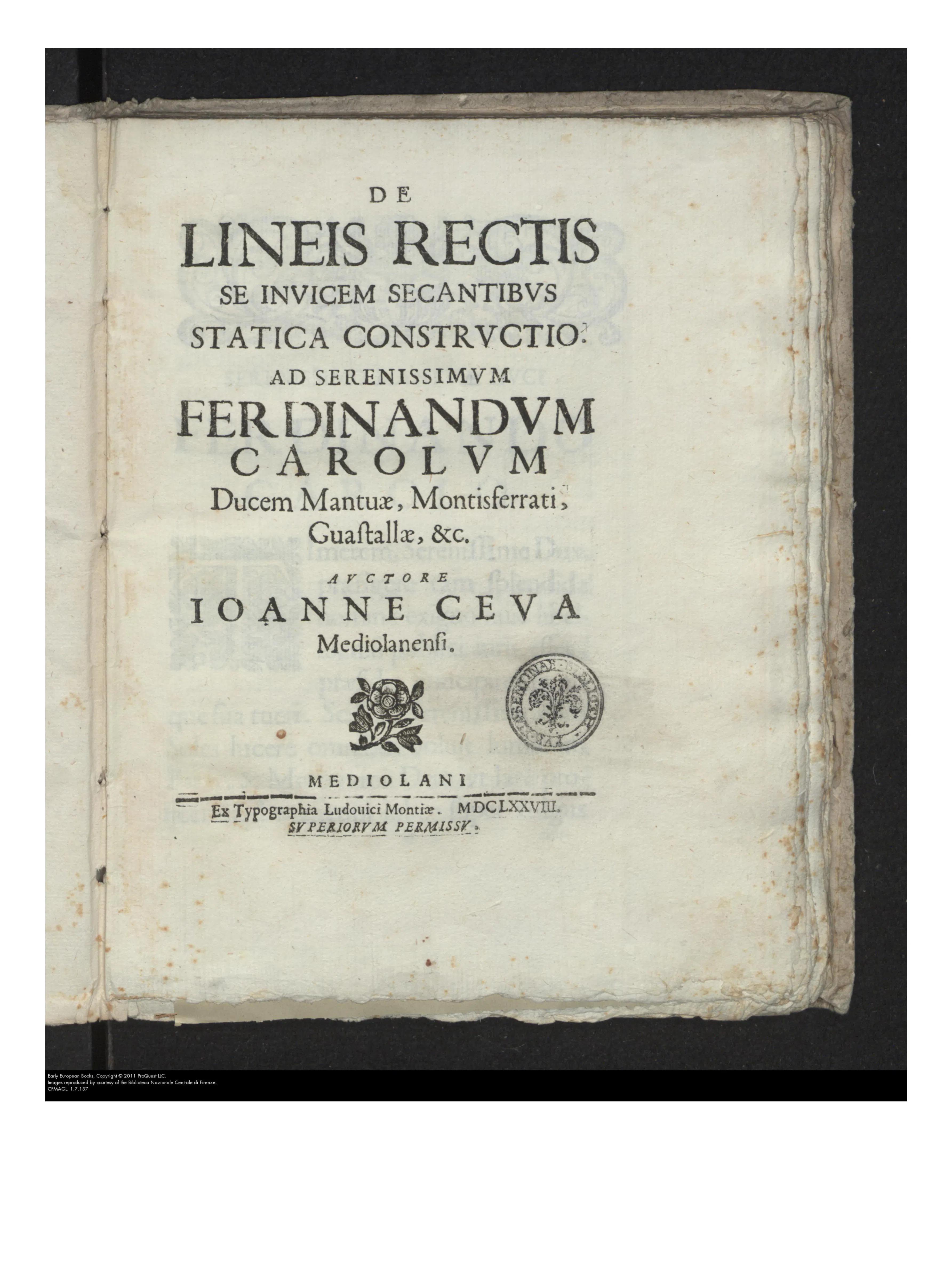
The title page of the 1678 Milan edition sets Ceva's governing conceit in display type: intersecting straight lines resolved by “statica constructio,” construction through statics. Its dedication to Ferdinando Carlo Gonzaga and Lodovico Monza's imprint record the patronage, place, and licensing under which the small quarto first appeared. Source ↗.
The problem the treatise confronts is one of geometrical method. When several straight lines cut one another, they determine one another reciprocally: move any one of them and every other must move too. Such tangles resist the usual ruler-and-compass construction, which proceeds by fixing one element and deriving the next. Ceva's recurring move is to set weights in the place of lines. He treats points as centres of gravity and segments as Archimedean balances. From a few static axioms concerning common and unique centres of gravity, he derives a small set of propositions he calls "elements." He then claims that every configuration of mutually intersecting lines can be resolved by weights alone. The phrase statica constructio names this procedure. It is a construction in the geometer's sense, a determination of a figure, reached by the route of statics. The same substitution of mechanical reasoning for purely figural reasoning runs through the work's vocabulary, its account of its own origins, and its closing appendix.
The stakes of that move are those of seventeenth-century "mixed" mathematics. Borrowing from mechanics to establish geometrical truths raised the same question that divided contemporaries over Bonaventura Cavalieri's indivisibles: what standing such procedures had beside classical demonstration. Ceva stands at an instructive point in that debate. His treatise presents its own origin as a release from years of fruitless labour on the quadrature of the circle and hyperbola, which he compares to the torment of Sisyphus. That release came first through Cavalieri's indivisibles and then through statics. Yet the book closes by praising indivisibles as a great shortcut while exposing their unreliability for curved surfaces. The method that freed him is thus also held to account. Historians have read the work as methodologically original despite its classical subject matter, and have placed it among the precursors of later analytic and projective geometry. That judgement concerns affinities, not a claim that Ceva possessed those later systems. The name of the theorem, moreover, records its later association with Ceva, not exclusive priority. The mathematical work of the eleventh-century ruler al-Muʾtaman ibn Hūd of Zaragoza bears on that question. Whether the medieval and the 1678 demonstrations are equivalent, and whether any line of transmission joined them, remains unestablished.
Much in the book rewards a first reading beyond its famous theorem. Ceva casts geometry as a queen deprived of patrons and in need of princely protection. He grounds his innovation in Apollonius, Archimedes, and Pappus. He writes in Euclidean form while adopting a nascent algebraic notation for aggregate weights. He opens his worked problems by counting cases in the manner of the combinatorial art, and he claims that impossible cases reveal themselves in the operation itself. He describes the reciprocal correspondences among his weights in the language of concord and beauty. The book extends the method to circles, ellipses, and parabolas, and to a surveying instrument that measures distances along visual rays without a known baseline. Its geometrical appendix salvages results from the abandoned quadrature, including a treatment of Torricelli's infinite solid as possessing a centre of gravity.
A single thread unites these particulars. The keyword statica constructio joins mechanical means to geometrical ends. The production of the book casts a new method on geometry's behalf under ducal patronage. The internal argument moves from static axioms, through elements, to a claim of universality, and ends in a candid audit of the infinitesimal method from which it sprang. At each level the work argues that geometry's bounds may be lawfully enlarged by borrowing from statics, provided the borrowing is disciplined by the ancient canon and checked against demonstration. Several particulars of the printed volume still await confirmation against a complete copy. These include the wording of its licences, the attribution of a geometrical verification to Pietro Paolo Caravaggio the Younger, and an erratum concerning the printer's type.
Read the full text and English translation on Leo
This text was transcribed and translated as part of the ExLatinis project, an effort by Leo to make free English translations of every text published in Latin in early modern Europe (1450–1750) available online. The complete transcription and English translation of this work can be read free of charge:
→ Read the original Latin text and full English translation on Leo
You can save a copy of this document into your Leo account to run deep text searches, conduct further analysis, or cross-reference it with your own research.
Naming Giovanni Ceva's Static Construction
"On Straight Lines Intersecting One Another: A Construction by Statics" is an editorial English title supplied for convenience, not an established translation. The Latin statica constructio makes the means of construction part of the title: Ceva obtains relations among intersecting lines from the equilibrium and centres of gravity of weighted points.
Ceva explains the coinage himself. Having described how the method arose, he writes, Hinc staticam constructionem libuit appellare, quæ, that is, "hence it pleased me to call it static construction, which." He defines its task against the usual practice of geometers as the resolution of such problems by weights alone, apud geometras, solis ponderibus staticè enodare;, "among geometers, to untangle statically by weights alone." The verb enodare, to unknot, fits the object of the method. The configurations in question are those in which the lines determine one another reciprocally, so that, as Ceva puts it, qualibet variata, cæteras omnes variari necesse sit: "if any one is varied, all the others must necessarily vary."
Constructio thus retains geometry's concern with determining a figure, while statica specifies a mechanical route to that determination; neither word warrants treating the work as a manual of physical building. The pairing is the work's governing idea in miniature, a geometrical end reached by statical means.
The centrum gravitatis is likewise a mathematical resource for relating positions and weights, not evidence that Ceva used the later formalism of barycentric coordinates. Its foundational role is set out in axiomatic form, beginning Grauia ex communi centro grauitatis suspensa, ita ponde, "heavy bodies suspended from a common centre of gravity so weigh." This is the Archimedean language of the balance, not that of a coordinate system. The same caution applies to Ceva's notation. He announces that he will write certain aggregate quantities verò L more analytico, seu algebrico ita scribemus F A, hoc, "but L, in the analytic or algebraic manner, we shall write thus, F A, that is." The phrase more analytico, seu algebrico marks the adoption of a nascent symbolic convention for sums of weights. It is not the later analytic apparatus.
His engagement with Cavalieri's indivisibilia belongs to a different question of method. The term denotes a seventeenth-century procedure for reasoning about magnitudes through their constituent lines or sections, whose evidentiary standing was disputed. Ceva's use of that procedure in work on quadrature and centres of gravity should not be made into either an unqualified rejection of it or a claim that it furnished every demonstration in the 1678 book. The text itself holds both sides of that balance. In the geometrical appendix Ceva grants that the method of indivisibles is a great shortcut in geometry, induisibilium magnum esse in geometria compendium, præsertim in. He also warns that Cavalieri's reasoning illa Cauallerij minimè succedat, præsertim vbi de superficiebus, "by no means succeeds, especially where it concerns surfaces." The term compendium, a shortcut or abridgement rather than a demonstration in the full classical sense, captures exactly the qualified standing that the method holds in the book.
Giovanni Ceva's 1678 Treatise and Ceva's Theorem in Brief
Giovanni Ceva's Latin mathematical treatise De lineis rectis se invicem secantibus statica constructio was printed at Milan by Lodovico Monza (Ludovicus Montia) in 1678 and dedicated to Ferdinando Carlo Gonzaga, duke of Mantua. Ceva studied at the Jesuit college in Milan and subsequently at Pisa under Donato Rossetti and Alessandro Marchetti; a place of composition for this particular treatise has not been established.
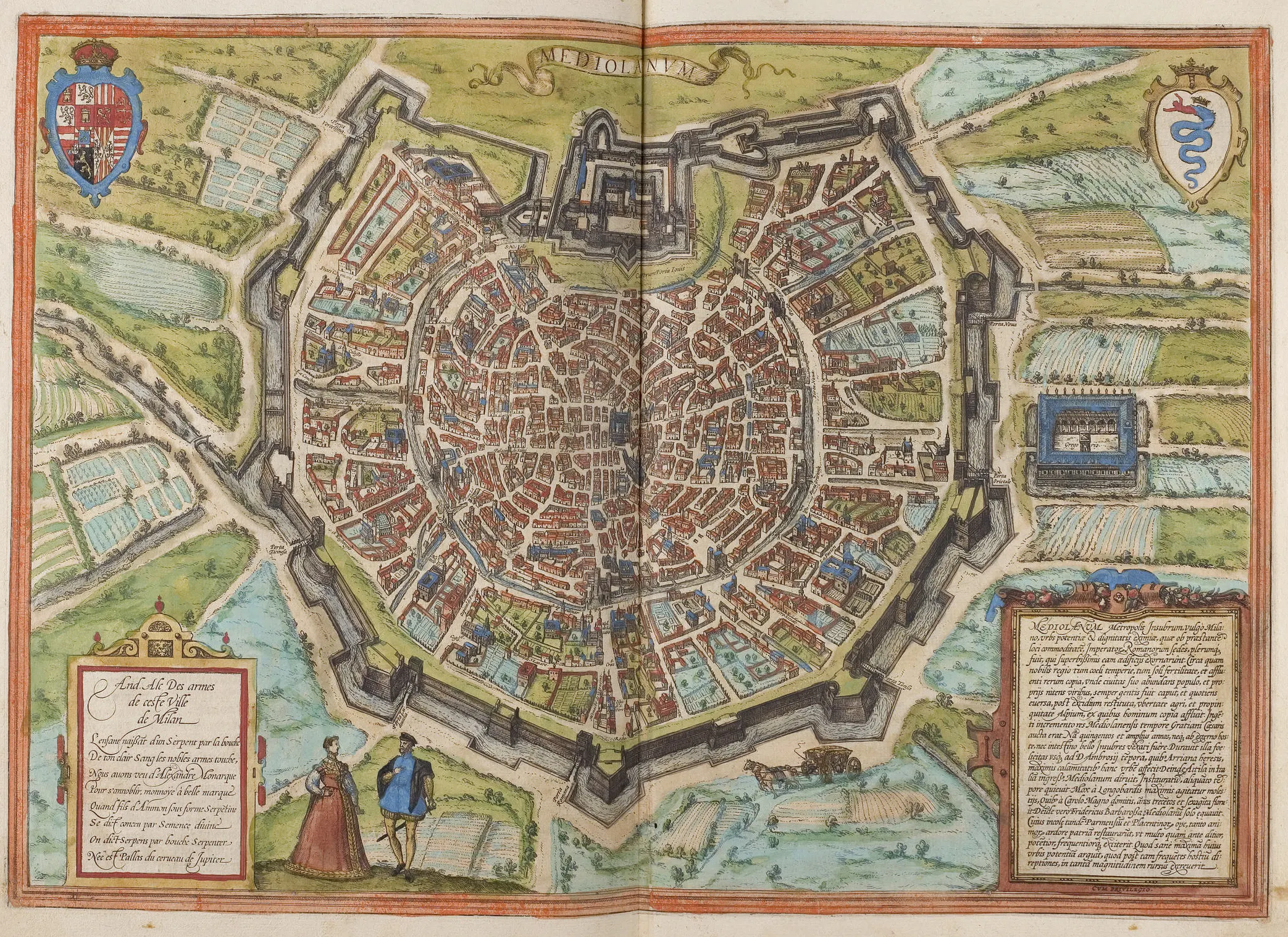
Milan, the “Mediolani” of Ceva's imprint, in a bird's-eye view from Braun and Hogenberg: the city of his Jesuit schooling and of the 1678 printing. The view illustrates none of the geometry but sets the treatise within the civic landscape in which it was printed. Source ↗.

Its central procedure uses properties of centres of gravity to derive relations among intersecting straight lines, including the triangle-concurrence result now called Ceva's theorem and a treatment of Menelaus's theorem. Ceva describes the decisive step in his own words as setting linearum vice ponderibus, dum rationes quasdam, "weights in place of lines, while examining certain ratios." The concurrence result belongs to a short foundational sequence that Ceva formally designates as elements. He writes Hanc propositionem, & quatuor, quæ deinceps sequuntur elementa voco, vtpotè, "this proposition, and the four that follow, I call elements, inasmuch as." The Euclidean term signals his claim that these five propositions underlie everything built upon them.
No complete modern English or Italian translation, or independently verified published translation of its original theorem passage, was located. Modern statements and proofs of the theorem are not, without textual comparison, translations of Ceva's Latin.
Weighing Ceva's Theorem in the History of Geometry and Indivisibles
The 1678 treatise matters for more than the theorem subsequently attached to Ceva's name. Herbert Oettel describes its use of the centre of gravity of weighted points to derive relations among line segments, its demonstrations concerning Menelaus's transversal and triangle concurrence, and its extension to conic problems.
Ceva presents that extension as an enlargement of geometry itself. He speaks of the benefit his method brings to geometry, sequutura, & quanto Geometriæ bono, cuius fines amplificare hoc, "to how great a benefit of Geometry, whose bounds I have tried to enlarge by this." He frames the enlargement as continuous with the ancient canon, invoking Apollonij, Archimedis, Pappi, aliorumque inuenta, "the discoveries of Apollonius, Archimedes, Pappus, and others." The book's procedures show the same mixture of classical form and new technique. Worked problems open with an enumeration of cases, as in H Vius problematis sunt sex casus; etenim (vt ex arte combi, "this problem has six cases; for, as from the combinatorial art." Ceva further claims that the static procedure itself discloses when no solution exists: Quoties autem problema fuerit impossibile ex ipsa operatione, "but whenever the problem is impossible, from the operation itself." He describes the correspondences among his weights aesthetically. They answer one another reciprocally ad vnumerunt inter sese reciprocè mira quadam concordia, vt, "with a certain wondrous concord," and in a later configuration they will correspond quæ ita sibi inuicem pulcherrimè respondebunt, "most beautifully to one another."
The applications reach beyond pure configuration. They include an instrument by which one radiorum visualium interuallametiatur, nulla præcognita dis, "may measure the intervals of visual rays, with no distance known beforehand." The book culminates in a claim of universality. No windings of mutually meeting lines exist, Ceva argues, sibi inuicem occurrentium ambages, quæ in nostra elementa non, "which do not resolve into our elements."
Ugo Baldini argues that Ceva's classical geometrical subject matter should not obscure his methodological originality; Baldini places these investigations among precursors to later analytic and projective geometry. That is a historical assessment of affinities, not a claim that Ceva possessed the later systems in their developed form. Oettel's discussion of coordinate-like and infinitesimal features chiefly concerns Ceva's later Geometria motus and must not be transferred without qualification to the 1678 book.
The theorem's name establishes its later association with Ceva, not exclusive historical priority. Jan P. Hogendijk's research on the mathematical work of the eleventh-century ruler al-Muʾtaman ibn Hūd of Zaragoza is indispensable to the medieval-priority question. Without a located and compared pair of the exact medieval and 1678 demonstrations, their precise equivalence and transmission to Ceva remain unestablished. Likewise, a formal line of descent from Ceva to nineteenth-century barycentric calculation would require evidence of reception, rather than resemblance of methods alone.
Priority of a more local kind is asserted within the text itself. The book concerns itself with checking static results against geometrical demonstration. At one point Ceva introduces another geometer's proof: Eius demonstrationem appono, quæ methodum hanc staticam, "I append his demonstration, which will set this static method." The attribution of that verification to Pietro Paolo Caravaggio the Younger still requires confirmation against a complete copy. Elsewhere Ceva insists on his own independent success by geometrical means: Idem ego geometricè præstiti nondum tradita mihi solutione, "I myself accomplished the same geometrically, the solution not yet having been passed to me." These claims concern the relation between his static and geometrical proofs among contemporaries. They have no bearing on the medieval-priority question.
Ceva's early use of Cavalieri's indivisibles in the circle-quadrature problem, and the discussion of a hemisphere's centre of gravity recorded by Oettel, connect his mathematics to seventeenth-century disputes about the standing of such methods relative to classical demonstration.
The treatise's proem narrates this connection autobiographically. Ceva recalls his youthful pursuit of Quadraturam circuli, & adhuc indomitam hyper, "the quadrature of the circle and the hitherto untamed hyperbola." He compares its endless renewal to the labour of Sisyphus: subinde oriebatur, tandiu relabenti saxo Sisyphus, "kept arising, as long as Sisyphus with the stone rolling back." Release came when successu indiuisibilia Cauallerij omnem animi pertinaciam, that is, when Cavalieri's indivisibles, applied without success, subdued all obstinacy of mind.
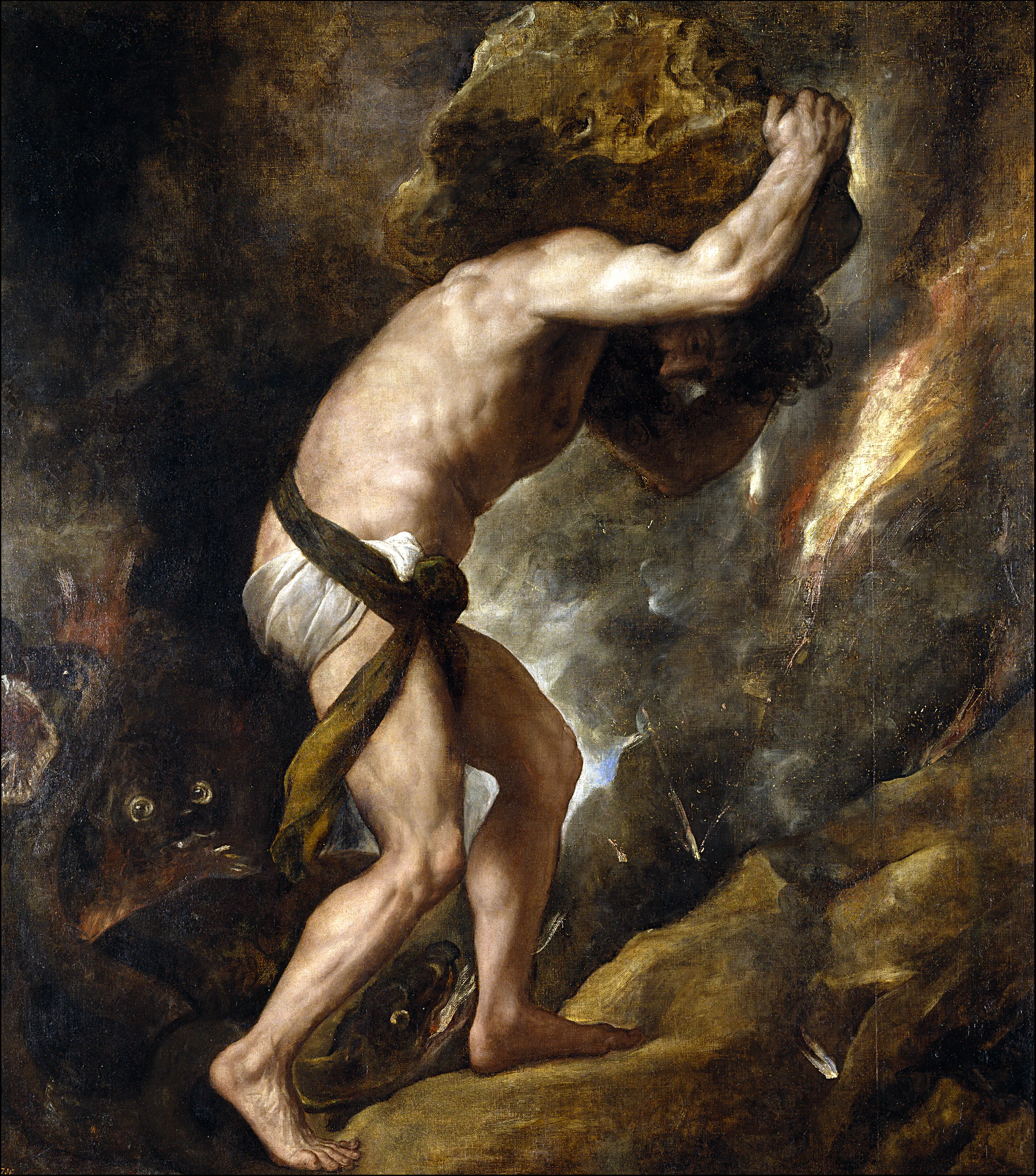
Titian's Sisyphus bears the stone of the myth Ceva chose for his proem: labour endlessly renewed. For Ceva, the quadrature of the circle and the “untamed” hyperbola were such a burden, forever rolling back, until Cavalieri's indivisibles, applied without success, broke his obstinacy. Source ↗.

The appendix returns to that episode. Ceva rescues its by-products on the principle that enim in circulo inutiliter quadrando, hæc omnia non inutiliter: all these things, found while uselessly squaring the circle, were not found uselessly. The appendix hails nostri cui Archimedes Lucas Valerius, Luca Valerio as the Archimedes of the age. It also confronts the paradoxes of the infinite, treating an unbounded solid tanquam vnius magnitudinis, & ideò (licet incredibile videatur), "as of a single magnitude, and therefore, though it may seem incredible." It ends by judging tiendis, quam incerta sic methodus cæteroquin ingeniosissima, "how uncertain is this otherwise most ingenious method." This arc, from liberation by indivisibles to a reckoning with their limits, is the same concern for disciplined borrowing that governs the static method as a whole.
Work by Kirsti Andersen, Enrico Giusti, and Paolo Mancosu provides context for the mathematical objections; recent scholarship notes that the theological dimensions of disputes over indivisibles have received less detailed study. Ceva's education at the Milanese Jesuit college and at Pisa makes those debates pertinent context, but does not itself establish his allegiance to a particular Jesuit position. His dedication to the duke of Mantua and subsequent mathematical and hydraulic publications also show that the treatise belonged to a career extending beyond triangle geometry. Baldini notes a separate, unresolved historiographical disagreement over whether Ceva's later De re numaria should count among the first attempts at mathematical economics.
Tracing the Milan 1678 Edition, Its Dedication, and Its Surviving Copies
The identified edition bears the imprint Mediolani: ex typographia Ludouici Montiae, 1678, and names Ioannes Ceua Mediolanensis on its title page. Descriptive metadata accompanying an image of the edition records a quarto of [8], 83, [1] pages, with illustrations and ten folded plates. The image is identified as media from BEIC, Milan; that identification does not, by itself, establish the holding library or shelfmark of the volume photographed. The Huntington also identifies the 1678 work in its collections, but the accessible record did not establish a call number or copy-specific collation. No USTC, SBN, or WorldCat identifier, full signature collation, or further verified physical shelfmark was located.
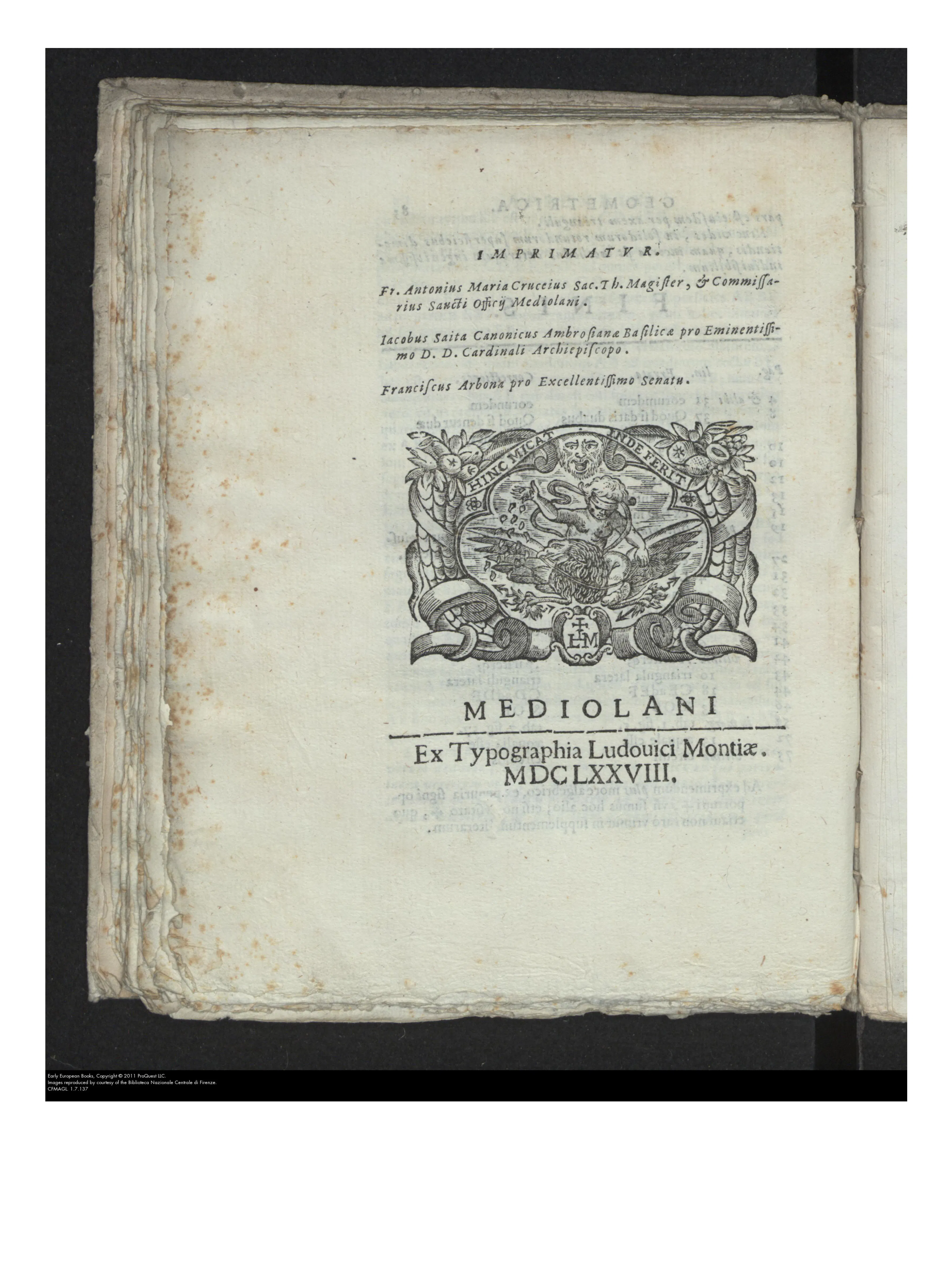
The imprimatur leaf of the 1678 edition records permissions from the Holy Office, the archiepiscopal authority, and the Senate, naming Cruceius, Saita, and Arbona. Beneath them, Montia's device and the imprint “Ex Typographia Ludouici Montiæ. MDCLXXVIII” confirm the Milanese printing. Source ↗.
The dedication to Ferdinando Carlo Gonzaga identifies a Mantuan court recipient. Its rhetoric casts the treatise's new method as a service to a neglected discipline. Ceva writes of Geometria, cui si desit Mæcenatum, "Geometry, which, if it lacks Maecenases." He presents her as the sovereign of the sciences, those who omnium Reginæ excubias agunt. Nihil, who "keep watch over the queen of all." In this framing the patronage context and the method's claim to enlarge geometry's bounds belong to a single argument: the queen of the sciences requires both princely shelter and new instruments of demonstration.
Ceva's Milanese schooling and subsequent study with Rossetti and Marchetti at Pisa place the work within connected mathematical settings, although a documented chain of responses to this particular publication was not established. A geometrical verification attributed to Pietro Paolo Caravaggio the Younger, the names of officials in reported Milanese ecclesiastical and senatorial licences, and the reported erratum concerning the printer's lack of a plus sign all require checking against a complete copy before their wording or participants can be stated as verified facts. No evidence located establishes suppression, a contemporary refutation, or a second edition.
A reported catalogue or surrogate association with Gaspar Schott's Technica curiosa concerns a different author and a Nuremberg publication of 1664; it cannot displace the Ceva authorship and Milanese imprint of the identified 1678 edition. The precise offending record and whether its association arose from shared binding, surrogate linkage, or metadata error were not confirmed. Ceva later published Opuscula mathematica (Milan, 1682), Geometria motus (Bologna, 1692), De re numaria (Mantua, 1711), and Opus hydrostaticum (Mantua, 1728). His brother Tommaso Ceva, a Jesuit mathematician and poet, was a distinct author.
Following Ceva's Argument from Dedication to Geometrical Appendix
The Dedicatory Epistle: Geometry as a Neglected Queen
The dedicatory epistle opens the book in the register of court patronage. Ceva argues that geometry, more than any other learning, depends on princely protection, and he develops the image, already met in the account of the dedication, of a discipline that languishes when it lacks its Maecenases. He adds that its guardians are few, though it is the sovereign discipline, since they alone keep watch over the queen of all the sciences. The figure of a neglected queen with a thin guard is more than ornament. It frames the method the book proposes as a service rendered to an undermanned sovereign. Ferdinando Carlo Gonzaga is asked to shelter the discipline while its author supplies it with new instruments. The dedication thus establishes, in the idiom of Mantuan favour, the claim that the treatise later makes in mathematical terms: geometry's dominion can and should be extended.
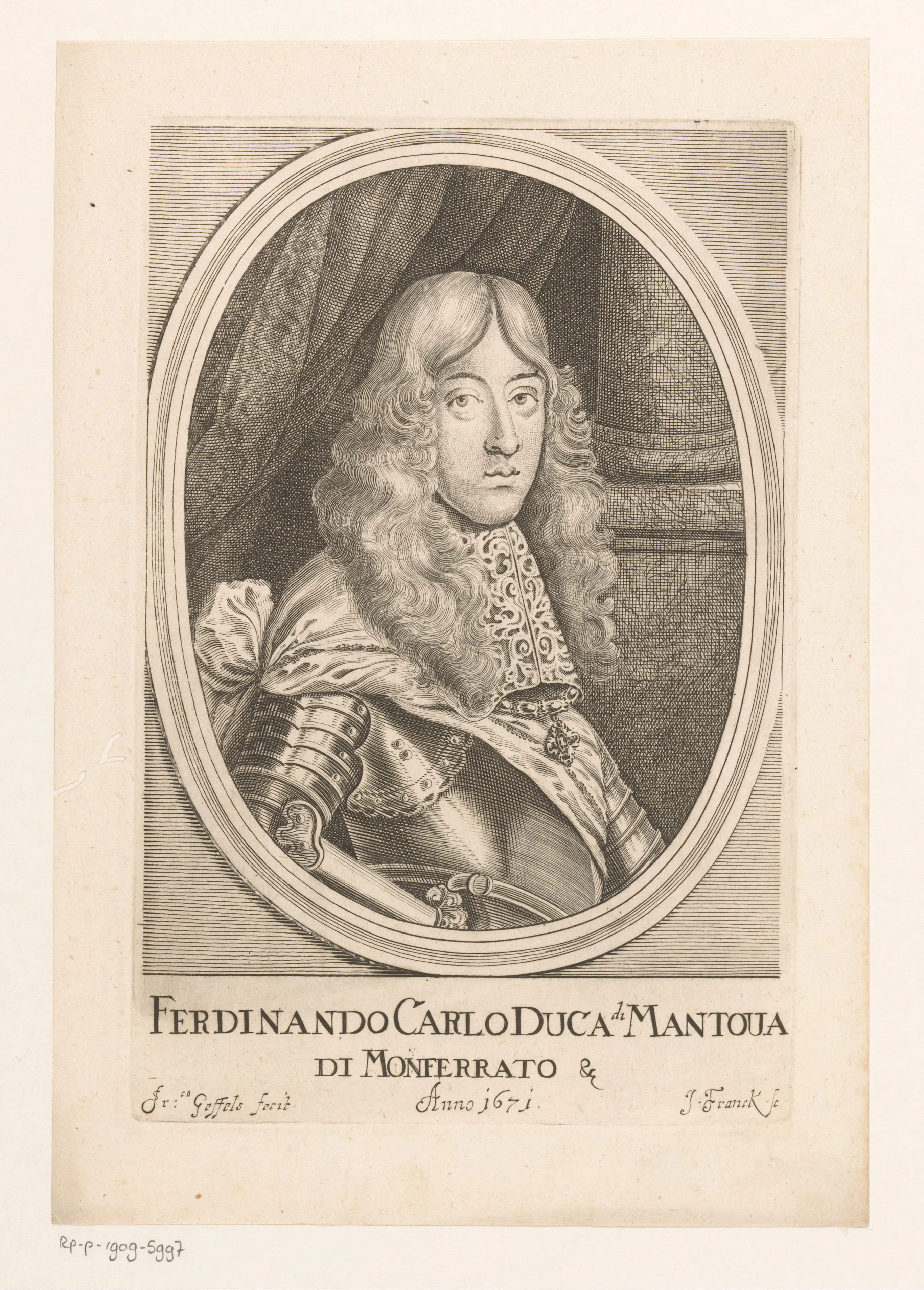
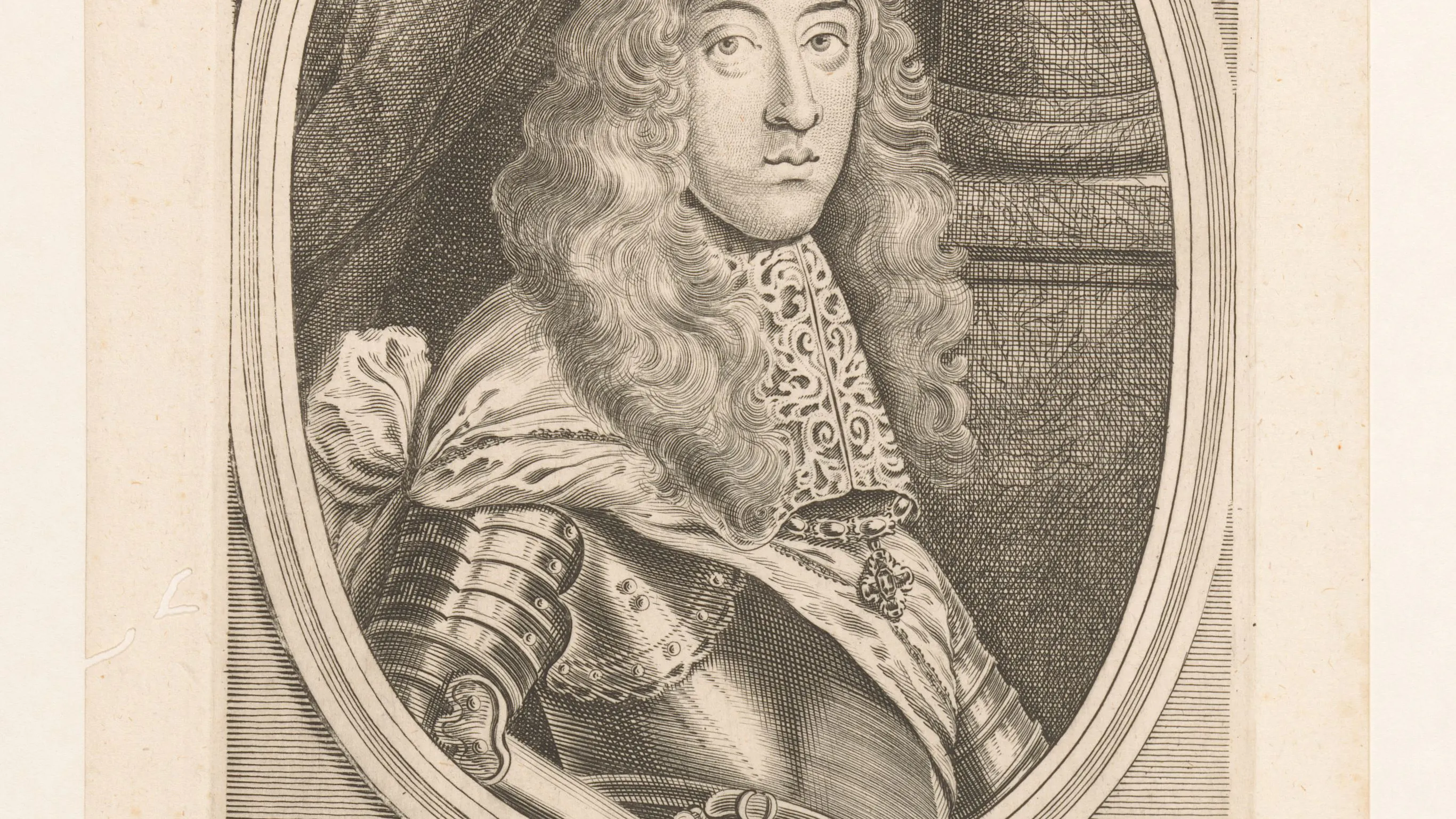
Ferdinando Carlo Gonzaga, duke of Mantua and Montferrat, in an engraved portrait made seven years before the treatise appeared. Ceva's dedication placed geometry under this Mantuan duke's shelter, translating a mathematical programme into the courtly economy of favour and guardianship. Source ↗.

The Proem: From Sisyphean Labour to Static Construction
The proem shifts from ceremony to autobiography, and here the conceptual origin of statica constructio is narrated as release from a futile labour. Ceva recalls, in the passage quoted earlier, his youthful pursuit of the quadrature of the circle and of a hyperbola he calls still untamed. The adjective indomitam, "untamed," casts the curve as a wild creature resisting subjugation, and it prepares the mythological image that follows: the difficulty, he writes, kept rising again, as though Sisyphus were forever pursuing his stone as it rolled back. Sisyphus is an apt emblem for the circle-squarer: each apparent advance returns the problem to its starting point, and the labour is endless rather than merely hard.
The agent of deliverance is surprising. Cavalieri's indivisibles did not solve the problem. Instead, when they were at last applied without success, they broke his resolve, subduing, in the phrase already cited, all obstinacy of mind. The most powerful contemporary technique serves here as a proof of futility. That makes it the negative condition of the book's existence, not its positive foundation, and the ambivalence returns at the close of the appendix.
The positive turn is described as a fusion of disciplines. Ceva speaks of a new thing born of geometrical and mechanical reasonings joined to one another and mingled, a formulation already placed among the practices of seventeenth-century mixed mathematics. The participle permixtis, "mingled," is striking. The humanist and Aristotelian tradition generally preferred to keep the subordinate mechanical sciences distinct from pure geometry, yet here mixture is presented as generative. The decisive operation is named with great economy in the sentence already quoted: having set aside the customary apparatus, he placed weights in the stead of lines while examining certain ratios. The substitution is literal. A segment ceases to be a figural magnitude and becomes the arm of a balance, and a point becomes a place of suspension.
The proem then defines the object and task of the method with some precision. Its domain is configurations in which the sections of the lines are so bound together that, as the passage discussed at the outset has it, a variation in any one of them compels a variation in all the others. This is the defining difficulty. In such systems no element can be fixed first and the others derived from it, as the usual order of construction requires, because every determination presupposes all the rest. Ceva's answer is to dispense with the prævia constructio, the preliminary construction customary among geometers, and to untangle such knots statically, by weights alone. The metaphor in enodare, to unknot, fits the problem it addresses. Mutual dependence is imagined as a tangle, and a balance, in which every weight bears on every other at once, can loosen it in a way that a sequential construction cannot. Ceva names the result himself in the sentence, already cited, that coins the term static construction. The coinage keeps the geometer's constructio as the end and marks statics as the means.
Book I: Axioms, Elements, and the Discipline of Demonstration
Book I lays its foundations in the Archimedean manner of axiom and lemma. The first axiom, quoted earlier, declares that heavy bodies suspended from a common centre of gravity weigh as though their whole weight were collected at that centre. The second axiom carries the argumentative force of the whole enterprise: Pondera in eadem positione vnicu[m] habent centru[m] grauitatis, "weights in the same position have a unique centre of gravity." Uniqueness is what turns statics into a means of proof. Ceva suspends weights at the vertices in reciprocal proportion to the segments, and each line through partial and total centres (his libra, or balance-beam) must then pass through a single point. Concurrence, and the ratios that accompany it, follow because a system of weights cannot have two centres.
The first of the foundational propositions is given a deliberately Euclidean name: Ceva calls it, together with the four propositions that follow, "elements," in the sentence already cited. Among these five is the triangle with three concurrent lines from its vertices, the configuration later known by Ceva's name. The book, however, gives it no special prominence. It stands as one element among five, valued for what can be built on it rather than as a crowning discovery. Ceva states the stakes of the building directly, declaring in the passage quoted earlier how great a benefit the ensuing theorems bring to geometry, whose bounds he has tried to enlarge. The territorial language of fines amplificare, "to enlarge the bounds," answers the dedication's image of a thinly guarded queen: the method is offered as an enlargement of her realm.
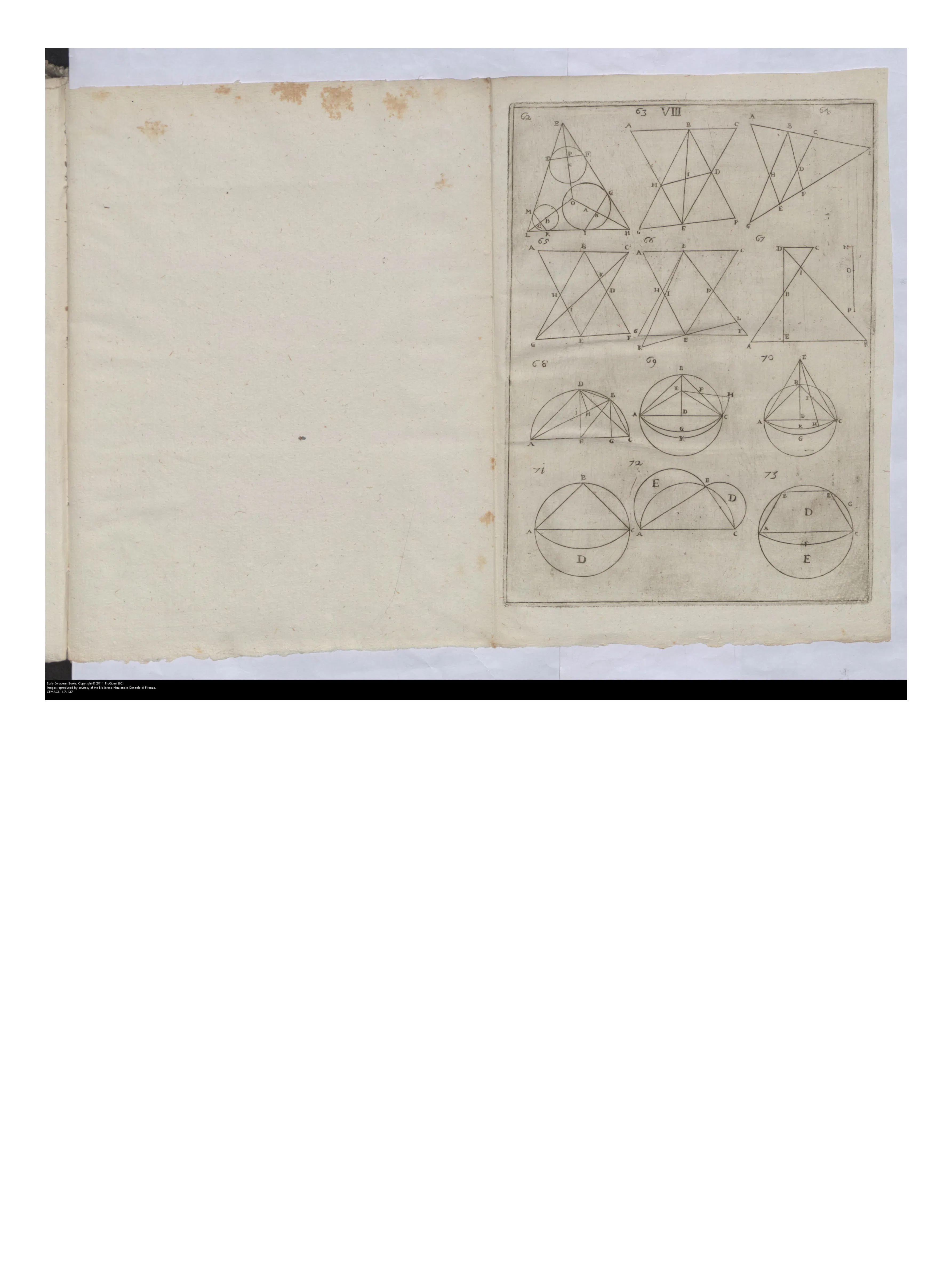
Plate VIII puts Ceva's “elements” to work. The concurrent lines later attached to his name appear among many numbered figures, not singled out; the progression to denser line networks and curved or solid sections shows geometry's bounds being enlarged from a few elementary configurations. Source ↗.
The worked problems combine this classical scaffolding with techniques of more recent standing. Each opens by counting its cases; the first, as already noted, is said to have six, reckoned in the manner of the combinatorial art. Later problems are counted in the same way, at fifteen, ten and twenty cases. Before any single figure is solved, the ars combinatoria surveys the whole space of the problem, as a preliminary inventory of which quantities are given and which are sought. Ceva also claims, in words cited earlier, that the static operation itself discloses whenever a problem is impossible. A method that shows its own limits in the course of working belongs to the classical interest in diorismos, the determination of the conditions under which a problem is possible. Here that determination is folded into the mechanical procedure instead of being added afterwards.
At this point the book handles its own novelty most revealingly. Ceva does not let the static method stand on its own authority. He appends a purely geometrical proof by a younger mathematician, whom the printed text names as Petrus Paulus Carauaggius Petri Pauli filius præceptoris sui, "Pietro Paolo Caravaggio, son of Pietro Paolo, his teacher." He explains the purpose plainly in the sentence already quoted: the appended demonstration is meant to set the static method in geometrical light. The concession matters. The mechanical route is presented as legitimate, but its results are shown to agree with demonstration of the traditional kind. That agreement is the discipline which, as observed at the outset, conditions any lawful borrowing.
Ceva then protects his own standing within the same arrangement, insisting, in the words already seen, that he had accomplished the same result geometrically before the solution was passed to him. The sentence holds together two anxieties. One is the familiar seventeenth-century concern for independent discovery. The other is less obvious: the author of a mechanical method wishes to be seen as fully capable in the geometry he proposes to supplement. The static method is thus both advanced and hedged. It is new, but its inventor did not need it in order to reach the result.
As the argument extends into pyramids and three-dimensional configurations, the vocabulary moves from demonstration toward admiration. The weights are said, in the phrase quoted earlier, to answer one another reciprocally with a certain wondrous concord. Concordia belongs to the harmonic language of proportion inherited from the quadrivium, in which agreement among ratios was a species of musical consonance. Ceva uses it to name what uniqueness of the centre of gravity produces: when every weight bears on every other and the whole system rests at one point, the mutually determining sections that seemed a knot in the proem are shown to be a harmony.
Book II: Curves, Instruments, and the Claim of Universality
Book II carries the method beyond straight lines, to polygons circumscribed about circles and ellipses and to tangents of the parabola. It then turns toward practice. From these theorems, Ceva says, anyone may make the instrument already noted among the book's applications, one that measures the intervals of visual rays with no distance known beforehand, and without repeated stations. The surveyor's usual need for a measured baseline is removed by the same reciprocal determination that the elements govern. The application places the treatise within the period's culture of mathematical instruments, where pure geometry was expected to show its worth in mensuration.
The peroration of the book states the universality claim that the proem's definition of scope had prepared. No windings of mutually meeting lines exist, Ceva declares in the sentence cited earlier, that do not resolve into his elements. Ambages, "windings" or circuitous tangles, returns to the image of the knot in enodare, and the claim is total. Every such tangle falls within the five elements, much as the whole of classical geometry was thought to rest on Euclid's.
The Geometrical Appendix: Salvage and Audit
The geometrical appendix changes the tone. Its justification is the piece of rhetorical wit already noted: whatever was found while uselessly squaring the circle was not found uselessly, and so deserved publication. The antithesis inutiliter / non inutiliter reclaims the Sisyphean years of the proem. The labour that seemed wholly lost left behind theorems on lunes, cylindrical segments, hyperbolic solids and centres of gravity.
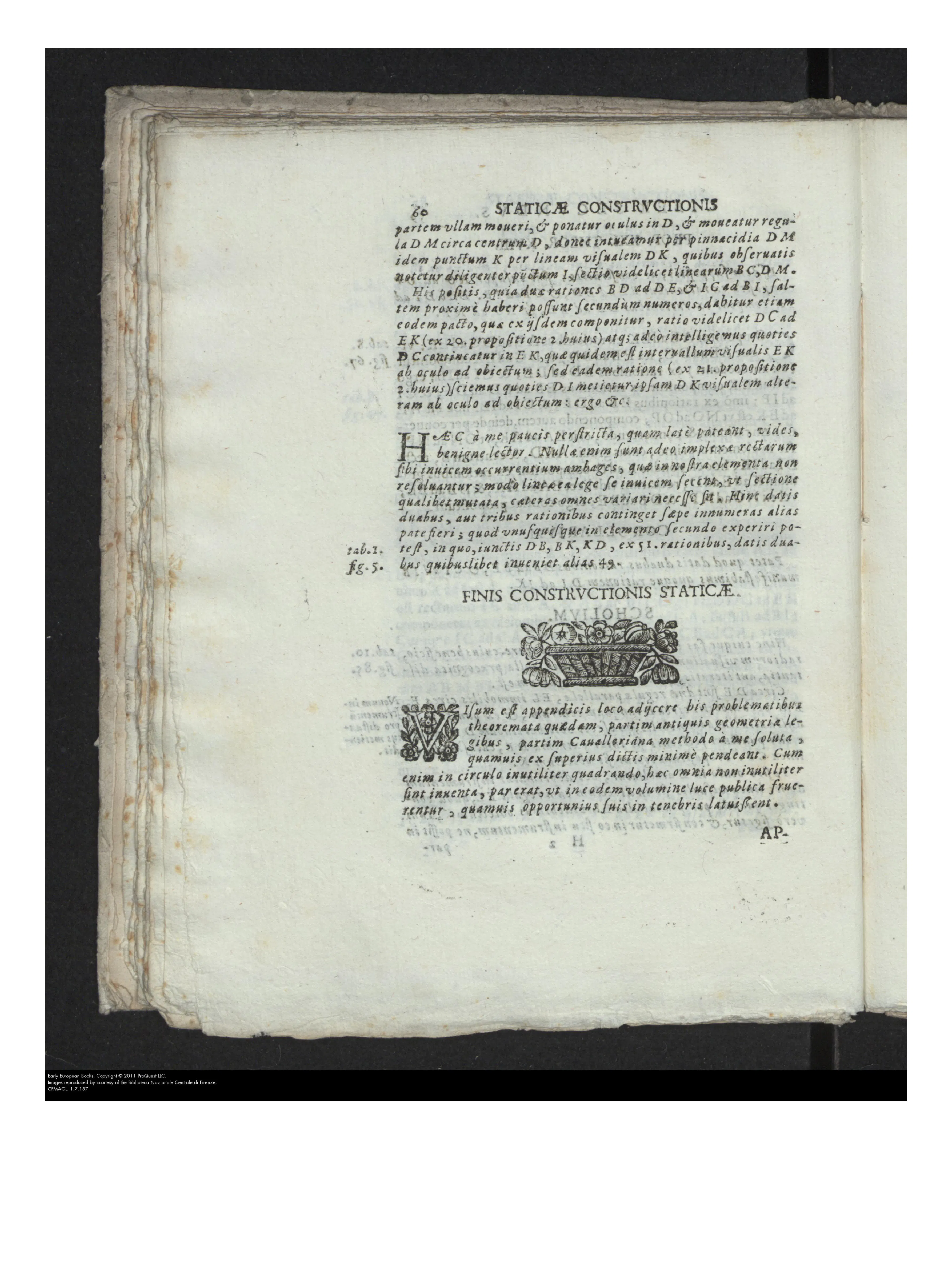
This hinge page closes Book II with the colophon “FINIS CONSTRUCTIONIS STATICÆ,” just after Ceva's universality peroration, and opens the geometrical appendix. Its apology for results found “in circulo inutiliter quadrando” yet not uselessly, and its mention of Cavalieri's method, mark the turn to salvage and audit. Source ↗.
The appendix ends in the unsettled ground of infinitesimal reasoning. Taking up Torricelli's infinitely long hyperbolic solid, Ceva treats it, in the passage already quoted, as a single magnitude and therefore, though it may seem incredible, as having a centre of gravity. His parenthetical admission of incredibility concedes the paradox openly: a body without end is assigned the Archimedean point of rest on which the whole book depends.
In the closing scholium Ceva finally judges the method that had released him. He urges caution, since Cavalieri's reasoning, as already cited, by no means succeeds where the surfaces of round solids are concerned. He shows the failure through a deliberately fallacious derivation concerning the surface of the sphere, and concludes, in the verdict quoted earlier, that this otherwise most ingenious method is uncertain in the measurement of such surfaces. The verdict is carefully balanced. Ingeniosissima, "most ingenious," grants the method's power, and incerta, "uncertain," denies it the certainty of demonstration.
The book therefore returns to its starting point. The technique whose failure freed Ceva for statics is admired but held to account, just as the static method itself was held to account by Caravaggio's geometry. The same rule governs both judgements: a borrowed procedure may enlarge geometry's bounds only as far as demonstration can confirm its results.
Reading Further on Ceva, Cavalieri, and Seventeenth-Century Mixed Mathematics
Baldini, Ugo. "Ceva, Giovanni." Dizionario Biografico degli Italiani 24 (1980), https://www.treccani.it/enciclopedia/giovanni-ceva_(Dizionario-Biografico)/. The most useful biographical starting point for Ceva's Milanese and Pisan formation, the place of the 1678 treatise among his works, and the tension between classical subject matter and methodological originality.
Hogendijk, Jan P. "Al-Muʾtaman ibn Hūd, 11th-Century King of Saragossa and Brilliant Mathematician." Historia Mathematica 22, no. 1 (1995): 1–18. Its account of al-Muʾtaman's mathematical work supplies the essential starting point for investigating medieval precedents; an exact priority claim for Ceva's concurrence theorem requires comparison of the relevant passages.
Andersen, Kirsti. "Cavalieri's Method of Indivisibles." Archive for History of Exact Sciences (1985), https://doi.org/10.1007/BF00348519. Andersen's reconstruction of the method clarifies what was at stake when a geometer used indivisibles alongside demonstrations grounded in classical geometry. That combination defines Ceva's own trajectory from reliance on indivisibles to a qualified critique of them.
Mancosu, Paolo. Philosophy of Mathematics and Mathematical Practice in the Seventeenth Century. Oxford: Oxford University Press, 1996. Its treatment of seventeenth-century mathematical practice offers a wider framework for examining the relation between mechanical reasoning, geometrical demonstration, and objections to indivisibles. Ceva himself characterizes the origin of his method as a new thing born of rationibus iunctis inuicem, permixtisque, nouum,, "reasonings joined to one another and mingled." That description of mixed geometrical and statical argument places the treatise squarely within the practices Mancosu analyses. These contextual studies should not be mistaken for editions or translations of Ceva's treatise.
Frequently Asked Questions
What is Giovanni Ceva's De lineis rectis se invicem secantibus statica constructio?
It is a Latin geometry treatise printed at Milan by Lodovico Monza in 1678 and dedicated to Ferdinando Carlo Gonzaga, duke of Mantua and Montferrat. The book is a quarto of little more than eighty pages with ten folded plates, and it is remembered chiefly for containing the triangle-concurrence result now called Ceva's theorem. Its author was a Milanese mathematician educated at the Jesuit college of his native city and then at Pisa under Donato Rossetti and Alessandro Marchetti. He later wrote on the geometry of motion, hydraulics, and money, in works including Geometria motus (Bologna, 1692) and De re numaria (Mantua, 1711).
What does "static construction" mean in Ceva's geometry?
Static construction is Ceva's own name for resolving tangles of mutually intersecting lines by weights alone, treating points as centres of gravity and segments as Archimedean balances. In the phrase statica constructio ("static construction"), constructio keeps the geometer's aim of determining a figure, while statica names the mechanical route to it. The work is not a manual of physical building. The method addresses configurations in which varying any one line forces all the others to vary, so that no element can be fixed first. From axioms, above all that weights in the same position have a unique centre of gravity, Ceva derives five propositions he calls elements. He then claims that every such configuration resolves into them.
Was Ceva the first to discover Ceva's theorem?
Not necessarily. The theorem's name records its later association with Ceva, not exclusive priority. Jan P. Hogendijk's research on the eleventh-century ruler al-Muʾtaman ibn Hūd of Zaragoza is essential to the question of a medieval precedent. Whether the medieval and 1678 demonstrations are equivalent, and whether any line of transmission reached Ceva, remains unestablished without a side-by-side comparison of the passages. Ceva himself gave the concurrence result no special prominence, placing it as one element among five. Ugo Baldini has judged the treatise methodologically original and placed it among precursors of later analytic and projective geometry. That judgement concerns affinities, not Ceva's possession of those later systems.
Why did Ceva both praise and criticize Cavalieri's indivisibles?
Ceva's path to statics began with indivisibles, and his book ends by holding them to account. He recalls years spent on the quadrature of the circle and the "untamed" hyperbola, comparing their endless renewal to the labour of Sisyphus. Cavalieri's indivisibles, applied without success, finally subdued his obstinacy and freed him for statics. In the geometrical appendix he calls the method a great shortcut in geometry. He also warns that it by no means succeeds for the surfaces of round solids, exposing the failure through a deliberately fallacious derivation concerning the sphere. His verdict is that this otherwise most ingenious method is uncertain.
Is there an English translation of Giovanni Ceva's De lineis rectis se invicem secantibus statica constructio?
No complete modern English or Italian translation of the 1678 treatise has been identified. Nor has an independently verified published translation of its original theorem passage. Modern statements and proofs of Ceva's theorem are not translations of his Latin. Separately, the Leo edition presents the full transcription and a complete English translation for the first time, and that translation is generated by AI. Leo is an effort to make freely available online, at no cost, English translations of every text printed in Latin in early modern Europe between 1450 and 1750.
This report was generated by an advanced AI assistant that conducted deep research alongside an extensive interpretation of the transcribed original text. Every effort has been made to preserve fidelity to the source and to guard against inaccuracy, but corruption in the text recognition process and model hallucination may nonetheless have entered the text. Treat every claim, quotation, translation, and citation as provisional, and verify each against the original source before relying on or citing it.
Bibliography
- Kirsti Andersen, "Cavalieri's Method of Indivisibles," Archive for History of Exact Sciences: The standard technical reconstruction of what Cavalieri actually did, as opposed to what his admirers and enemies said he did. Reading it makes plain why Ceva could call the method a compendium and in the same breath catch it cheating on the surface of the sphere. Anyone tempted to treat the appendix's closing scholium as mere grumbling should consult Andersen first.
- arXiv, Preprint 2502.11145 (math.HO, 16 February 2025): A recent history-of-mathematics preprint that surveys the scholarship of Giusti, Andersen, and Mancosu on Cavalieri's indivisibles and the objections of Paul Guldin and other critics. It is the source behind the report's observation that the theological side of the indivisibles quarrel remains comparatively understudied. Useful as a compact map of the debate into which Ceva's appendix quietly steps, though as a preprint it has not yet passed through formal peer review.
- Ugo Baldini, "Ceva, Giovanni," Dizionario Biografico degli Italiani: The indispensable biographical entry, and the origin of the report's central historiographical judgement: that Ceva's traditional subject matter conceals a pronounced originality of method. Baldini also traces the career from Milan and Pisa to Mantuan service, hydraulics, and the disputed economics of De re numaria. Read it before anything else, if only to learn how little Ceva needed algebra to be interesting.
- Jan P. Hogendijk, "Al-Muʾtaman ibn Hūd, 11th-Century King of Saragossa and Brilliant Mathematician," Historia Mathematica: Hogendijk's study of a Zaragozan king who did serious geometry between affairs of state is the essential starting point for the question of whether Ceva's theorem was Ceva's first. It does not settle priority in Ceva's disfavour, and the report is right to insist that only a side-by-side comparison of demonstrations could. It is a salutary reminder that eponymy is a record of reception, not a certificate of invention.
- Paolo Mancosu, Philosophy of Mathematics and Mathematical Practice in the Seventeenth Century: The broadest framework available for understanding why mixing mechanical and geometrical reasoning was a methodological provocation, not merely a convenience. Mancosu's chapters on indivisibles and on the certainty of mathematics supply the philosophical stakes behind Ceva's word permixtis. Read alongside the proem, it shows a seventeenth-century geometer negotiating legitimacy one weighted point at a time.