Lightly Stained with Ink: Giovanni Ceva's Mathematical Essays on Oblique Forces, Pendulums, Vessels, and Rivers
In 1682 the Milanese geometer Giovanni Ceva published Opuscula mathematica de potentiis obliquis, de pendulis, de vasis et de fluminibus, four compact Latin treatises that apply one method of proof to the balance, the pendulum, the draining cask and the flowing river. Ceva tests each mechanical claim against geometry, contradicts Galileo on the pendulum, and closes by designing an instrument to gauge the speed of a river. The book shows an Italian mathematician trying to move the science of water from rule of thumb to demonstration, at a time when rivers were a matter of state.
ExLatinis
September 27, 2026
Contents
In 1682 the Milanese geometer Giovanni Ceva published Opuscula mathematica de potentiis obliquis, de pendulis, de vasis et de fluminibus, four compact Latin treatises that apply one method of proof to the balance, the pendulum, the draining cask and the flowing river. Ceva tests each mechanical claim against geometry, contradicts Galileo on the pendulum, and closes by designing an instrument to gauge the speed of a river. The book shows an Italian mathematician trying to move the science of water from rule of thumb to demonstration, at a time when rivers were a matter of state.
Giovanni Ceva, a Milanese mathematician, published the Opuscula mathematica de potentiis obliquis, de pendulis, de vasis et de fluminibus at Milan in 1682. The imprint is conventionally associated with Lodovico Monti. The book is a Latin collection of four short learned treatises: on oblique forces and balances, on pendulums, on the efflux of water from vessels, and on the flow of rivers. In the text itself these are followed by a geometrical appendix. Ceva dedicated the collection to Michelangelo Ricci, the mathematician-cardinal in Rome. In Ceva's publication history it sits between his geometrical De lineis rectis se invicem secantibus statica constructio of 1678 and the increasingly hydraulic writings of his later Mantuan career. It is the work of a geometer turning, with growing insistence, toward moving bodies and flowing water.
The problem that unites these apparently disparate subjects is one of foundations. Oblique forces, the oscillation of pendulums, the discharge of water from a pierced vessel and the course of a river were all branches of mechanics that the later seventeenth century largely held by assumption, by inherited authority, or by the rules of practitioners. Ceva undertakes to give each of them a demonstrative, mathematical footing. His recurring move is double. He first derives a result "mechanically," in a vocabulary of virtutes (powers or virtues) that are composed and resolved as they act on a mobile, a body capable of motion. He then submits that result to a geometrical or algebraic trial, a Periculum, so that mechanical truth is set in geometric light. The geometry serves as an assay of the mechanics. Where predecessors had taken a proposition as a first principle, Ceva sets out to prove it. Where received opinion conflicts with demonstration, he dissents. Where an instrument rests on an unacknowledged idealization, he exposes it.
The stakes were considerable, both intellectually and institutionally. In Italy after Galileo, the science of waters was a matter of state as well as of learning. Benedetto Castelli and Evangelista Torricelli had made flowing and falling water a mathematical object, and the governance of rivers set mathematicians and engineers at the heart of territorial disputes. To claim that such matters could be demonstrated, rather than managed by rule of thumb, was to claim a particular authority for the mathematician over the practitioner. Ceva's subsequent career gave that claim institutional form. He served as a technical official in Mantua and later held mathematical and fiscal offices, and he entered a dispute with Eustachio Manfredi over the Reno and the Po. That later controversy belongs to his mature career rather than to any reception of the 1682 collection.
The text holds a number of memorable particulars. Ceva openly opposes Galileo's law of the pendulum, and he voices that dissent with a studied reluctance before the authority of a famous name. He faults the common steelyard on the ground that its weights, tending toward the centre of the world, cannot hang truly perpendicular to its beam. He reports a first-person experiment in which he stained the surface of water in a cask with ink to watch how it drained, and he turns the result against Giovanni Battista Baliani and Claude-François Milliet de Chales. He likens a stream striking an obstacle to wind filling a sail. He reduces differences of specific gravity to degrees of rarity. He announces a new artifice, built from a pendulum and a carpenter's square, for measuring the velocity and discharge of rivers. The geometrical appendix reaches toward the quadrature of the circle and extends Bonaventura Cavalieri's method of indivisibles. The book also carries its own later history of revision: a historical account reports that Ceva corrected a pendulum error from the Opuscula in his Geometria motus of 1692. Evidence for the collection's immediate reviews, opponents, and circulation remains thin.
A single throughline connects the work's terminology, its circumstances of composition, and its argument: the conversion of physical practice into demonstrable geometry. The key terms of its title, above all potentiae, carry a mechanical rather than an abstract sense. The dedication presents the treatises as the fruit of spare hours offered to an algebraist, and so places Ceva's geometrical assays under the eye of a patron versed in the discipline that tests them. The argument moves from the balance to the pendulum, then to the vessel and the river, abstracting in the mathematical manner and then re-clothing its results with the circumstances of the physical world. The work's transmission adds a further twist. At least one digital record carries it under the name of Paolo Casati, author of the unrelated dialogue Terra machinis mota. The identification with Ceva rests on the independently attested author, date, and subjects of the four treatises. The cause of the misattribution has not been established.
Read the full text and English translation on Leo
This text was transcribed and translated as part of the ExLatinis project, an effort by Leo to make free English translations of every text published in Latin in early modern Europe (1450–1750) available online. The complete transcription and English translation of this work can be read free of charge:
→ Read the original Latin text and full English translation on Leo
You can save a copy of this document into your Leo account to run deep text searches, conduct further analysis, or cross-reference it with your own research.
Translating the Title and Working Vocabulary of Ceva's Mathematical Essays
Mathematical Essays on Oblique Forces, Pendulums, Vessels, and Rivers is an editorial English title supplied for convenience, not an established translation of Giovanni Ceva's Opuscula mathematica de potentiis obliquis, de pendulis, de vasis et de fluminibus. Opuscula presents the writings as relatively short, distinct learned works. The title's sequence moves from questions of mechanics to the behaviour and measurement of water. The collection announces this programme on its own title page, DE POTENTIIS OBLIQVIS, DE PENDVLIS, DE VASIS, ET DE FLVMINIBVS, on oblique forces, on pendulums, on vessels, and on rivers. The third treatise is headed as a treatise on waters that begins with vessels (De aquis, et primum de vasis), so the vessel is presented as the first setting of a broader aqueous inquiry rather than as a self-contained subject.
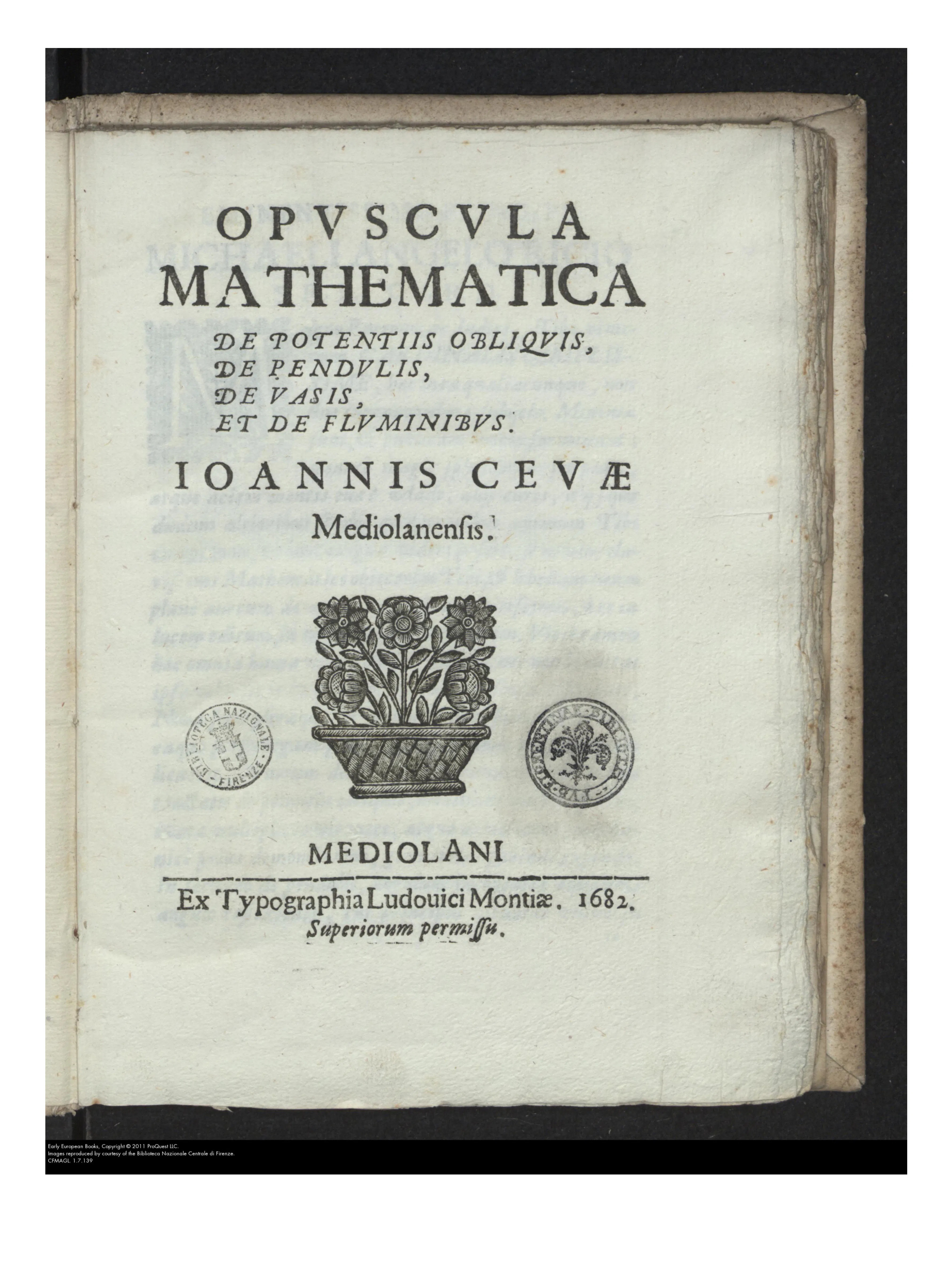
The title page names “IOANNIS CEVÆ Mediolanensis” and fixes the Latin identity behind the English title: Giovanni Ceva's Opuscula mathematica, with an imprint naming Lodovico Monti's press and dated 1682. Together with its licensing formula, the leaf guards against later catalogue confusion over authorship. Source ↗.
Potentiae obliquae denotes powers or forces considered in their direction of action; translating potentiae simply as abstract 'power' would obscure its mechanical setting. Within the treatises, the working idiom of force is the virtus acting on a mobile, a body susceptible of motion. The statics opens in exactly these terms, Si mobile fuerit affectum duabus virtutibus æqualibus in, "if a mobile be affected with two equal virtues in." This is a pre-vectorial vocabulary in which virtues are composed and resolved, the parallelogram rule is applied, and an equilibrating virtue is sought. The same term is extended to the pendulum, where Ceva names the tangential restoring force: dicatur naturalis penduli virtus in eo statu manentis, "let it be called the natural virtue of the pendulum remaining in that state." In both uses virtus is a quantity of mechanical tendency, measurable and composable, rather than a moral or occult quality. Its consistent use across statics and pendulum theory is one of the ways the collection binds its disparate subjects into a single mechanical idiom.
The hydraulic treatises coin and specialize their own terms. Ceva introduces a name for the jet issuing from a vessel, adhuc est in aere Cadentem voco, "which is still in the air I call the Falling [jet]." He thereby makes the cadens a defined object of analysis. He also invokes the laws of equilibrium as a constraint specific to fluids: Verùm quia leges æquilibrij non admittunt in fluido hanc momentorum inæqualitatem, vt vires proinde æquentur,, "but since the laws of equilibrium do not admit this inequality of moments in a fluid, so that the forces may accordingly be equalized." In that passage momentum keeps its statical sense of moment, the product of weight and its effective distance or tendency, rather than any later sense of quantity of motion. The matter theory that underwrites the hydraulics has a key term of its own. Differences of specific gravity are said oriri precisè ex maiori, vel minori raritate, quæ est instar cuiusdam, "to arise precisely from greater or lesser rarity, which is like a certain." Raritas here names a physical, quantifiable porosity of matter, which renders specific gravity tractable to measurement.
The statica constructio named in Ceva's earlier De lineis rectis likewise means a geometrical construction pursued through statical considerations, notably centres of gravity, rather than a building operation. The Opuscula reverses the direction of that earlier title. Where De lineis rectis brought statics to bear on geometry, the 1682 collection brings geometry to bear on mechanics. It declares its aim as ensuring veritates hæ mechanicæ in luce geometrica collocentur, that "these mechanical truths may be placed in geometric light." The instrument of that placement carries a telling name, announced in headings such as IDEM GEOMETRICE. PERICVLVM I, "the same geometrically: Test I." Periculum is the vocabulary of trial and assay, in which a metal is proved and a claim is put to the test. Geometry, in this usage, does not simply restate a mechanical result; it examines it.
The progression from vasa ('vessels') to flumina ('rivers') names two different settings for the mathematical inquiry into water: a bounded container and a flowing watercourse. These readings follow the works' titles and documented subjects, and the passages quoted above bear them out in the instances cited. The precise use of any term in passages beyond these awaits verification against the printed text.
What Ceva's 1682 Opuscula Mathematica Set Out to Prove
Giovanni Ceva's Opuscula mathematica de potentiis obliquis, de pendulis, de vasis et de fluminibus is a Latin collection of four mathematical treatises published at Milan in 1682, conventionally associated with the imprint of Lodovico Monti. In the text, the four treatises are followed by a geometrical appendix. Its documented subjects range from geometry and mechanics to measurements concerning water. They are unified by a single ambition: to furnish demonstrative foundations for branches of mechanics otherwise held by assumption or practice.
Ceva dedicated the work to the mathematician-cardinal Michelangelo Ricci. The dedicatory epistle addresses Ricci as a fellow mathematician, praising a work planè aureum de arcanis Algebraæ penitissimis, à te in, "wholly golden, on the deepest secrets of algebra, by you in." The tribute is apt for a collection whose geometrical and algebraic trials are meant to test its mechanical claims. The epistle frames the collection with a confident claim to novelty, Noua sunt pleraque, & nonnulla hucusque desiderata;, "most things are new, and some hitherto wanted." It pairs that claim with the conventional modesty of the learned amateur, Hæc succisuis horis à me elaborata, "these things, worked out by me in spare hours." It also previews the matter theory that supports the hydraulic treatises: ostendimus, inæqualitatem grauitatis specificæ oriri, "we have shown that the inequality of specific gravity arises."
The independently attested author, date, and subjects make Ceva's work the compelling identification for a printed text containing those four treatises; they do not, by themselves, establish what happened to the particular digital object catalogued under Paolo Casati. No complete published translation was confirmed. Casati's Terra machinis mota is a separate Latin dialogue, published in editions of 1655 and 1658, whose imagined speakers include Galileo, Paul Guldin, and Marin Mersenne.
How Ceva Tested Mechanics Against Geometry and Challenged Galileo
The Opuscula matters because its mathematical inquiries join geometrical demonstration to questions of moving bodies and waters. Ugo Baldini characterizes Ceva's De lineis rectis as rooted in classical geometry yet methodologically original, and sees a growing operational emphasis in the 1682 Opuscula, whose range extends to hydrodynamic measurement.
The text states its method with unusual explicitness. After deriving a statical result mechanically and then retesting it geometrically, Ceva addresses the reader directly: Vides quam bene respondeat mechanica hæc doctrina geometricis rationibus, cum ipsæ demonstrationes geometricæ accedant tanquam examina, ad id, quod mechanicè tradimus. The sense is "you see how well this mechanical doctrine corresponds to geometric reasons, since the geometric demonstrations themselves come as examinations of what we teach mechanically." The geometrical demonstrations are examina, assays of the mechanics. This is the same relation already signalled by the heading Periculum, and it is the connective principle of the whole collection.
That principle also leads Ceva to scrutinize instruments whose everyday reliability rested on unexamined idealizations. Of the common steelyard he observes that its theory requires the weights to stateræ insistant perpendiculariter; quod fieri non potest, cum tendant ad centrum Mundi, "stand perpendicular to the steelyard, which cannot happen, since they tend to the centre of the World." The objection does not concern practical adequacy. It concerns the difference between the instrument's working assumption and the demonstrable geometry of convergent lines of heaviness.
The most conspicuous consequence of the method is Ceva's dissent from Galileo on the pendulum. He states the challenge baldly, At ego assertionem illam falsam demonstro, "but I demonstrate that assertion to be false." He wraps it in a formula of reluctant deference, confessing that he proceeds non sine quadam animi displicantia, viri clarissimi auctoritati, & communiter receptæ opinioni, quo ad hoc, aduersari, "not without a certain displeasure of mind, to oppose on this point the authority of a most famous man and commonly received opinion." His counter-thesis is tempora vibrationum similium duorum pendulorum esse inter se vt eorum longitudines, "that the times of vibration of two similar pendulums are to each other as their lengths." The pendulum treatise also rests on an explicit inertial supposition, Ponimus vnumquodque mobile semel motum seruare semper eundem velocitatis gradum, nullo adueniente impedimento;, "we posit that every mobile once moved always preserves the same degree of velocity, no impediment intervening." Ceva uses that supposition to give the equality of the angles of incidence and reflection a mechanical basis, claiming priority in doing so: Vides ergo hinc demonstratum, quod plures nequidquam hactenus, "you see therefore demonstrated here what many hitherto in vain." Catoptrics, which had long treated the law of reflection as a first principle, is here drawn into the demonstrative programme of mechanics.
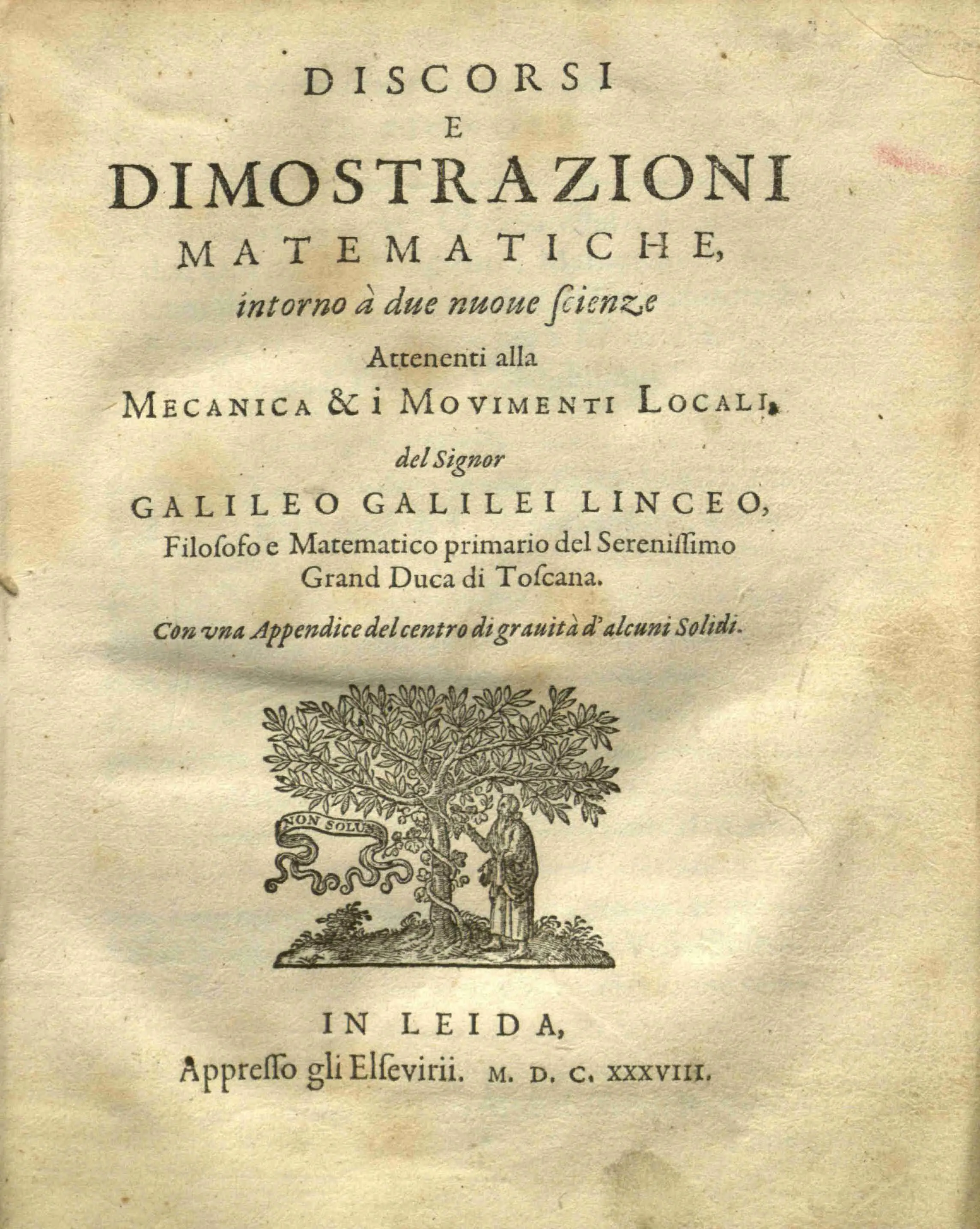
The title page of Galileo's Discorsi e dimostrazioni matematiche intorno a due nuove scienze, first published in 1638 and a canonical statement of the new mathematical physics. Against a pendulum law carrying this authority, Ceva offered not commentary but a claimed demonstration of error. Source ↗.

The hydraulic treatises extend the same programme. Ceva marks the contrast with his predecessors in methodological terms: Hanc propositionem arduam, & perutilem, cæteri vt principium supponunt, nos, "this difficult and very useful proposition others assume as a principle; we." What others postulate, he proposes to prove. He supports the claim with a first-person experiment on a cask, directed against Baliani and de Chales: eiusdem aquæ leuiter atramento infeci; permissoq; exitu, optima, "I lightly stained [the surface] of that same water with ink; and, the outlet opened, excellent." Experiment here serves demonstration rather than replacing it. Ceva states that theory exists so that constet id, quod omnibus obuium est trita experientia, "what is obvious to all by common experience may be established." Common experience supplies the phenomenon, and theory supplies its demonstrated ground.
In the treatise on rivers Ceva makes his procedure fully self-conscious. He acknowledges the irregularities with which real waters move, yet insists ferantur; necesse est tamen more mathematico ab his abstrahere, vt locus sit demonstrationi;, "they are carried; it is nevertheless necessary, in the mathematical manner, to abstract from these, so that there may be room for demonstration." He then describes the return journey: one must rem denuo sic vestire, aut exuere circumstantijs, vt ad id, quod verum est quam proximè accedat, "re-clothe the matter anew, or strip it of circumstances, so that it may approach as closely as possible to what is true." This paired movement of abstraction and re-clothing distinguishes the mathematician's claim on rivers from the practitioner's. It connects directly to the operational emphasis Baldini detects, since the treatise culminates in an instrument: Hinc vides nouum artificium ad explorandas rationes, "hence you see a new artifice for exploring the ratios." The artifice is a pendulum-and-square device for measuring velocity and discharge, which brings pendulum theory from the second treatise into the service of hydraulic measurement.
Ceva subsequently worked as a technical official in Mantua and, under the later administration, held mathematical and fiscal offices. His later dispute with Eustachio Manfredi over the Reno and the Po belongs to that subsequent career; it should not be treated as an exchange provoked by the 1682 publication.
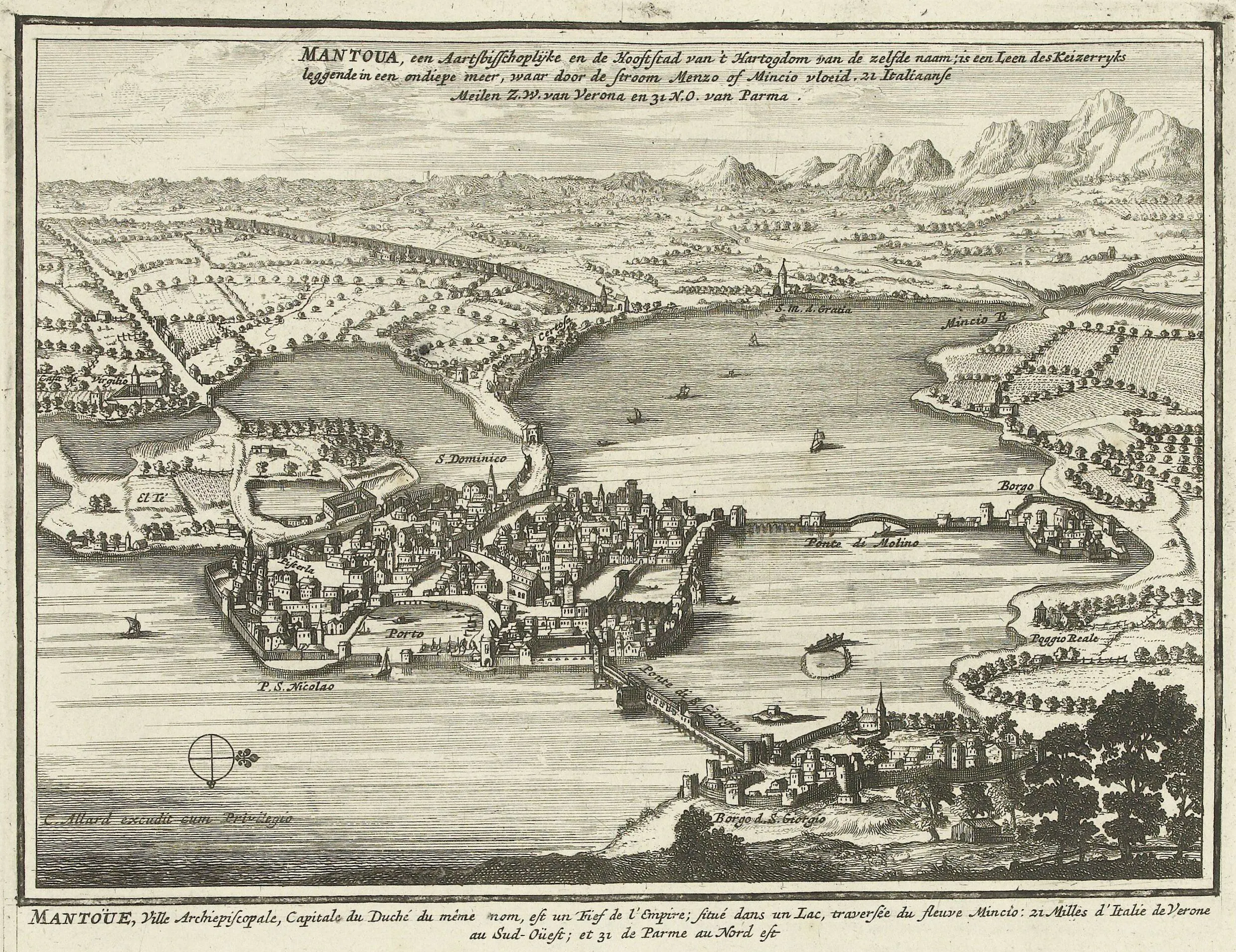
A view of Mantua from c. 1701–1713, attributed to Allard, sets the city amid the lakes and channels of the Mincio. This watery setting framed Ceva's Mantuan career, in which mathematical and fiscal offices preceded the river controversies of his later life. Source ↗.

One assessable error also complicates any account of uninterrupted progress: a historical account reports that Ceva corrected a pendulum error from the Opuscula in his Geometria motus. Whether that corrected error is the anti-Galilean proportion stated in the 1682 text, or some other pendulum proposition, awaits confirmation against both works. Baldini's discussion of Michel Chasles and Luigi Cremona concerns the later recognition and interpretation of results in Ceva's De lineis rectis, not a documented contemporary reception of the Opuscula. Maffioli's history of the science of waters and Bertoloni Meli's object-centred history of seventeenth-century mechanics provide pertinent frameworks, but their specific judgments on individual passages of Ceva's 1682 collection have not been established. Evidence for its immediate reviews, opponents, circulation, or responses remains thin; those matters cannot be supplied from the better-documented controversies of Ceva's later life.
Tracing the 1682 Milan Edition and Its Misattribution to Paolo Casati
Ceva's Opuscula mathematica belongs to his Milanese publication history between De lineis rectis se invicem secantibus statica constructio (1678) and the increasingly hydraulic work of his Mantuan career, including Geometria motus (Bologna, 1692) and Opus hydrostaticum (Mantua, 1728).
The collection's internal structure reflects this position between a geometrical past and a hydraulic future. Four opuscula, on statics, pendulums, vessels, and rivers, are followed by a geometrical appendix that returns to pure geometry within the same demonstrative programme. In it Ceva argues that the section of a ring solid is oval rather than elliptical, non elliptica, qua posita ellipsi inuenta esser quadratura circuli, "not elliptical, for if it were posited an ellipse, the quadrature of the circle would be found." He also generalizes Cavalieri's method by means of radial indivisibles: notatu dignum est, innumerabiles rectas lineas ex eodem puncto, "it is worth noting that innumerable straight lines from the same point." The appendix thus keeps alive, alongside the turn toward water, the geometrical interests of De lineis rectis.
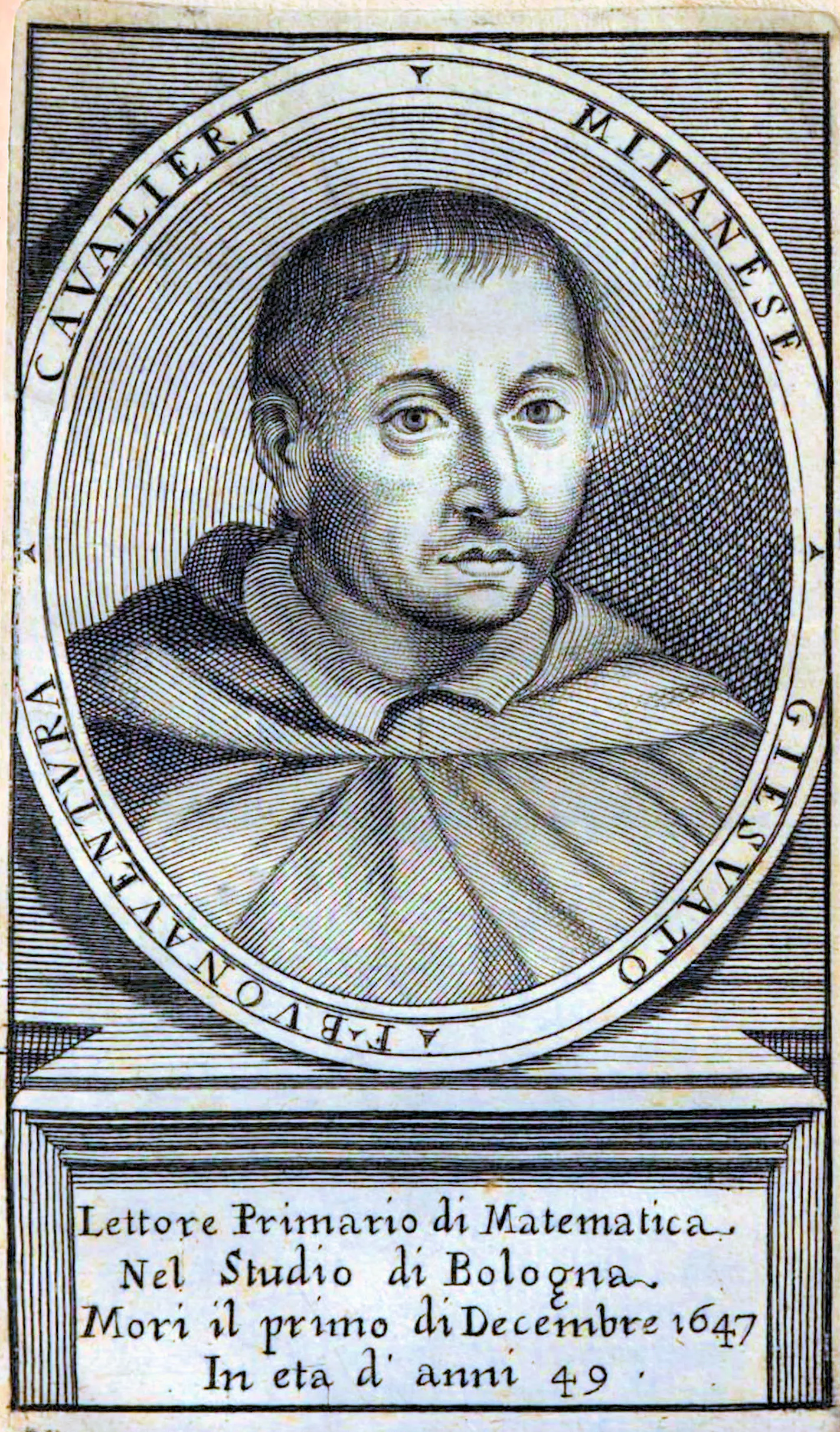
An engraved portrait of Bonaventura Cavalieri, whose method of indivisibles Ceva's geometrical appendix extends through radial indivisibles. Even as the collection turns toward water, the appendix carries forward this Galilean-era demonstrative geometry. Source ↗.

The 1682 collection's dedication to Michelangelo Ricci is independently reported. A later account states that Ceva corrected an error from the Opuscula in a scholium of Geometria motus; that relationship is more securely documented than any claim of a contemporary printed refutation.
The bibliographic distinction from Paolo Casati is substantial. A catalogue describes the 1658 Roman edition of Casati's Terra machinis mota as printed by Lazaro, with four preliminary leaves, 227 pages, two concluding leaves, illustrations, and quarto format; its record identifier is BV001387366. Scholarship identifies both a 1655 and a 1658 edition of Casati's dialogue. Those particulars describe Casati's book, not Ceva's Opuscula.
The four Ceva treatises cannot be reassigned to Casati merely because a digital record bears his name. Nevertheless, the available catalogue displays did not establish a matching USTC edition entry, a substantive SBN record, a usable WorldCat identification, or a shelfmarked copy for the digital object catalogued under Casati's name. Its page sequence, binding, title leaf, and relationship to the catalogue record were not verified. A composite binding, a misdescribed record, and a digitization mismatch therefore remain alternative explanations, not established causes. Ceva's exact collation, format, engraver and number of plates, licence names and dates, and present shelfmarks likewise could not be confirmed from the consulted records. No suppression or contemporary reply to this edition was established.
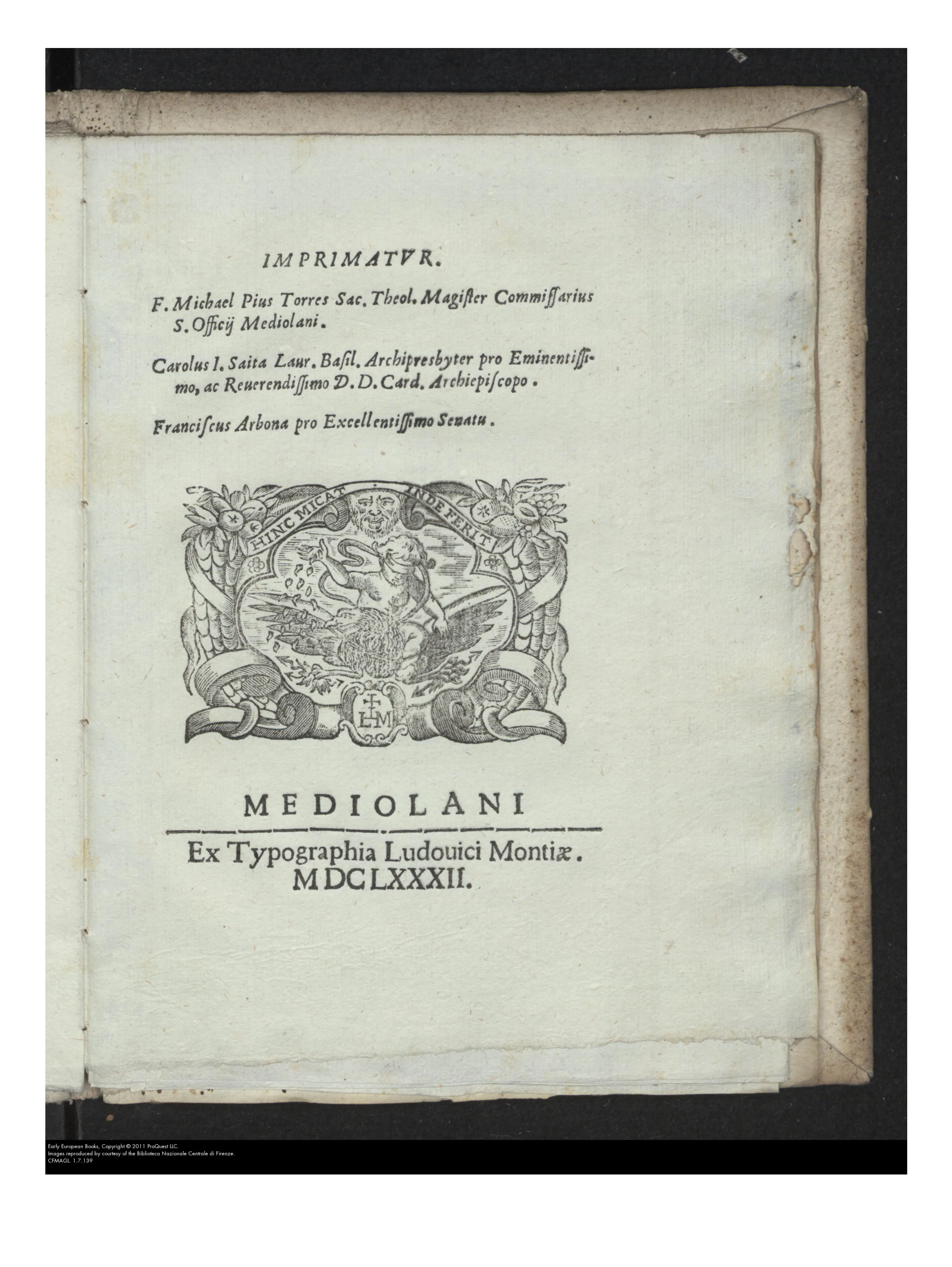
On the closing leaf, three Milanese licences—Holy Office, archiepiscopal, and senatorial—stand above Lodovico Monti's printer's device and the imprint “MEDIOLANI / Ex Typographia Ludouici Montiæ / MDCLXXXII.” The book's own documentary apparatus, rather than a digital record, must govern questions of authorship and edition. Source ↗.
Following Ceva's Argument from the Balance to the River
The Dedicatory Epistle: A Programme Announced
The printed collection opens its argument in the dedicatory epistle to Cardinal Michelangelo Ricci, where the conventions of patronage sit beside a claim to intellectual property. Having blushed at offering slight work to a man whose purple and learning outshine it, Ceva advances the claim to novelty already noted, that most of what follows is new and some of it hitherto wanted. The epistle then summarizes all four treatises in advance. Its précis of the pendulum treatise already announces the anti-Galilean proportion, and its précis of the rivers already promises a pendulum method of gauging discharge. The effect is to present the book as an ordered programme rather than a miscellany of spare-hour exercises, even as the dedication adopts the amateur's modest register. Addressed to a Torricellian algebraist and signed by a member of the Roman physico-mathematical academy, the epistle places the collection within a learned sodality competent to judge its demonstrations.
The First Treatise: Virtues Composed and Geometry as Assay
The first treatise, styled Geometricomechanicus, sets up the collection's epistemic apparatus. After defining a mobile "affected" by a virtue whose power is measured by the length of a line, and after axioms on opposed and concordant virtues, Ceva composes and resolves these virtues through five propositions that culminate in the parallelogram rule and the equilibrant. The procedure is doubled throughout, and he states its purpose early, in the phrase already considered, by which mechanical truths are to be placed in geometric light. The metaphor of illumination implies that the mechanical truths already exist before the geometry, which does not produce them but exposes them to view. The recurring heading of the geometrical test confirms that order of operations: each mechanical proof is followed by its periculum, and these pericula are often worked analytico more, with equations and the transposition of terms. The word belongs to the vocabulary of the assay, the proving of a metal or a claim. Ceva makes the relation explicit in the address to the reader discussed above, where the geometrical demonstrations are said to come to the mechanical teaching as examina, examinations of what has been taught mechanically.
The hierarchy this sentence encodes is subtle and consequential. In the Archimedean ideal inherited through Guidobaldo del Monte, statics descends from geometrical postulates. Here, by contrast, mechanical reasoning in the idiom of virtues generates the result, and geometry arrives afterwards as its examen. The verb accedant, "come to," "are added to," casts geometry as a second witness brought in to corroborate testimony already given. Ceva thereby claims two authorities at once. Mechanical intuition supplies the discovery, and geometry supplies the certification that makes the discovery demonstrable. This pairing is the formal signature of the whole book.
The same rigour produces the treatise's most arresting practical conclusion. Having established, through the bent lever and the pulley, that cord tensions stand in reciprocal ratio to the perpendicular distances from the point of suspension, Ceva turns to the common steelyard, whose theory, as his objection already cited makes plain, requires the weights to stand perpendicular to the beam, a condition that cannot be met since they tend toward the centre of the world. The objection revives the older debate over whether the lines of descent of heavy bodies converge on the centre of the world or may be treated as parallel. It has no bearing on the marketplace, where no merchant would detect the discrepancy. Its force is purely demonstrative, and it shows the programme's willingness to hold even a trusted instrument to the letter of geometry. The treatise then applies its theory to stakes meeting at a loaded vertex, a strut against a wall, an inclined pyramid and a system of pulleys. A closing scholium declines to multiply theorems, on the ground that the expert can now resolve almost any mechanical problem. That confidence is the fruit of the method just certified.
The Second Treatise: The Pendulum, Polemic and Supposition
From the balance the collection passes to the pendulum. The second treatise extends the vocabulary of virtue to the tangential force of a displaced bob and then moves to open polemic. Of Galileo's subduplicate law Ceva declares, in the blunt first-person sentence already quoted, that he demonstrates the assertion to be false. The pronoun and the verb demonstro matter: he claims a demonstration, not an opinion, which is the only register in which the method permits dissent. Yet he frames the claim with the formula of reluctance noted earlier, confessing a certain displeasure of mind at opposing, on this point, the authority of a most famous man and commonly received opinion. Galileo is not named in the formula, but vir clarissimus and auctoritas place him among those whose contradiction demands an apology, the position once held by the ancients. The limiting phrase quo ad hoc, "on this point," confines the dissent to one proposition and leaves the Galilean edifice otherwise standing. Elsewhere in the collection Ceva cites Galileo's propositions on uniform motion with approval. His counter-thesis, the plain proportion by which the times of vibration of two similar pendulums stand to each other as their lengths, is reached through four lemmas on bulk, specific gravity and the ratios of times and virtues. The argument proceeds by assimilating the pendulum's natural virtue to specific gravity, so that the matter theory which returns in the rivers treatise already shapes the pendulum demonstration.
Alongside the polemic stands a supposition that serves a more constructive end: the inertial posit, already cited, that every mobile once moved preserves the same degree of velocity so long as no impediment intervenes. The Galilean language of the gradus velocitatis and the setting aside of impediments frame conservation of motion as a suppositio, a posited ground rather than a demonstrated result. From it Ceva derives the equality of the angles of incidence and reflection, and he claims priority in the words noted above, announcing as demonstrated here what many had hitherto sought in vain. Catoptrics had treated that equality as a first principle. Reducing it to mechanics subordinates optics to the science of motion, the same move by which the first treatise subordinated the geometry of cords to the composition of virtues. The treatise closes with a scholium on damping, in which acquired degrees of velocity decay in a constant ratio at each instant. The ideal supposition is thus qualified by the physical world it had set aside.
The Third Treatise: Waters, and First Vessels
The third treatise, on waters and first on vessels, carries the principle of proof over postulate into hydraulics. After defining the falling jet as a geometrical solid and adopting the Torricellian relation between velocity and height fallen, Ceva proves that efflux velocities from ever-full vessels are in subduplicate ratio of their heights. He marks the achievement with the pointed antithesis already cited, in which others assume this difficult and very useful proposition as a principle while he undertakes to prove it. The opposition of cæteri and nos compresses the collection's self-understanding into a single contrast. Where the Torricellian tradition postulates, Ceva demonstrates.
The scholium that follows introduces a different kind of evidence. Against the view attributed to Baliani and de Chales, that only a "little cylinder" of water above the orifice descends, Ceva reports the trial on a cask discussed above, in which he lightly stained the surface of the water with ink before opening the outlet. He then gives the outcome, leuis quidem macula, vnquam visa est, donec atramentum vna: not even a slight spot was ever seen until the ink had come down, together with the level, to the bottom. The film stays whole, so the surface sinks as one body. The experiment does not stand alone, however. Ceva at once supplies its cause in the appeal to the laws of equilibrium already examined, which do not admit in a fluid an inequality of moments and so require the forces to be equalized. Experience displays the phenomenon, and the "laws of equilibrium," with momentum in its statical sense, render it intelligible. The ink trial thus plays the role the periculum played in the statics, as corroboration subordinate to demonstration.
Ceva is explicit that this subordination is deliberate. Of his theorems on communicating vessels he insists that he proves them not merely so that what is obvious to all by common experience may be established, in the phrase already quoted, but so that the principles of the science may be drawn out. Trita experientia, well-worn experience, is conceded its certainty but denied its capacity to found a science. A theorem whose content everyone already knows is valuable because it shows why the known is so. The treatise then proceeds through Torricelli's parabola to a sequence of efflux-time theorems in compound ratios, the mathematician's systematization of what practitioners measured case by case.
The Fourth Treatise: Rivers, Abstraction and Re-clothing
With the rivers treatise the method becomes fully reflexive. Ceva concedes that real waters move faster in mid-stream than along rough banks, and he declares, in the passage already considered, that it is nevertheless necessary in the mathematical manner to abstract from such irregularities so that there may be room for demonstration. The spatial image locus makes abstraction a clearing of ground on which proof can be built. The return journey, likewise already quoted, is described in the language of dress, as the re-clothing of the matter or its stripping of circumstances so that it may approach as closely as possible to what is true. The pairing vestire and exuere concedes that the demonstrated river is a stripped figure, and that truth in the physical sense is approached asymptotically, quam proximè, rather than attained. It also divides labour: the mathematician strips, and the skilled practitioner re-clothes.
The suppositions that follow draw physical analogy into the geometric frame. A stream striking an obstacle is likened, in the image already cited among the river treatise's physical premises, to wind driven into the sail of a ship. The sail makes the stream's momentum depend on the extent of the section struck, which prepares the measurement of force on an immersed body. A further supposition begins Si fuerit corpus grauius specie, quam aqua, sed intus ita excauatum,, "if there be a body heavier in species than water, but so hollowed within." Such a body moves "as a part" of the river, and from it Ceva infers the matter theory discussed earlier, by which differences of specific gravity arise precisely from greater or lesser rarity, rarity itself being likened to a kind of cavity. The hollowed body is the conceptual hinge of the treatise. It lets the invisible velocity of a current be read off the visible inclination of a thread bearing a bob, and it reduces heaviness itself to a geometry of internal void.
On that hinge Ceva builds the new artifice already noted, an instrument for exploring the ratios of velocities by means of one pendulum and a set-square. The pendulum of the second treatise is thereby turned from an object of polemic into a gauge. When a scholium concedes that a river's slope spoils the right angle, Ceva does not abandon the method but refines it, proposing DAto flumine, primò ipsius pendentiam vestigare, & deinde, "given a river, first to track down its gradient, and then" to determine the corrected momentum, by appeal back to the resolution of virtues in the first treatise. Here the re-clothing described in the abstract is actually performed: a circumstance first excluded, the declivity, is restored and itself brought under demonstration.
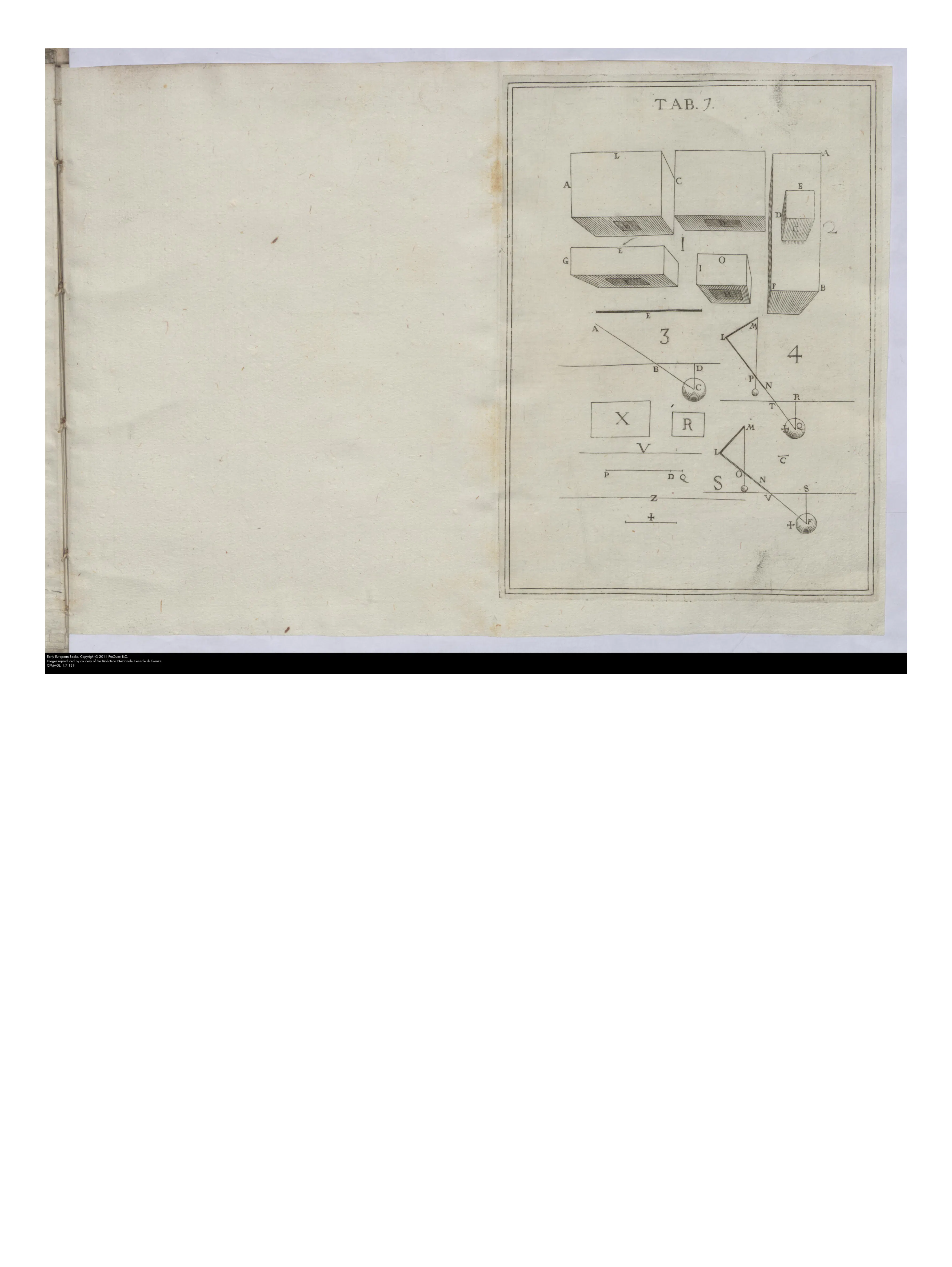
Engraved as TAB. 7, the plate compresses the move from proof to practice: figs. 1–2 serve Ceva's geometrical account of efflux, figs. 3–4 his pendulum-and-square gauge for river velocity and gradient. It belongs to the separately engraved figures that, Ceva confessed, could not be checked against the printed demonstrations. Source ↗.
The Geometrical Appendix and the Closing Confession
The geometrical appendix, added so that the last plate should not stand empty, returns to pure geometry without leaving the demonstrative programme. Ceva argues, in the passage already quoted, that the plane section of the ring-solid is oval and not elliptical, since an elliptical section would yield the quadrature of the circle; at that point the print reads esser where the sense requires esset. The argument uses the reputed impossibility of the quadrature as a limit that fixes a curve's identity. The printed book ends by acknowledging the conditions of its own making: Tot erratis in tam exiguo opere ignosce lector; nam figuras seorsim incisas, conferre non licuit cum demonstrationibus eodem tempore impressis, "forgive, reader, so many errors in so small a work; for it was not possible to compare the separately engraved figures with the demonstrations printed at the same time." A work that everywhere submits one mode of proof to the examination of another closes by confessing that its intaglio plates and its letterpress, produced side by side, escaped that mutual collation.
Reading Ceva's Opuscula with Maffioli, Bertoloni Meli, and Baldini
Cesare S. Maffioli, Out of Galileo: The Science of Waters, 1628–1718 (Rotterdam: Erasmus Publishing, 1994). Places Ceva's river studies within the Italian tradition of measuring and governing flowing water; consultation of the volume is necessary before attributing a particular hydraulic argument to him. The river treatise's analogical and physical premises are the natural points of comparison with that tradition. One is its image of a stream striking an obstacle, said inuehi quemadmodum ventus in velum alicuius nauigij; quare, "to be carried in just as wind into the sail of some ship; wherefore." Another is its principle that Nullum corpus quatenus graue potest ex se moueri, nisi simul descendat, "no body, insofar as heavy, can move of itself unless it simultaneously descends."
Domenico Bertoloni Meli, Thinking with Objects: The Transformation of Mechanics in the Seventeenth Century (Baltimore: Johns Hopkins University Press, 2006). Its account of mechanics through levers, pendulums, and other objects offers a method for situating Ceva's mathematical treatment of forces and motion without separating demonstration from practice. The approach is particularly apt for the Opuscula's engagement with cords, balances, the steelyard, and the pendulum as objects to be brought under geometric demonstration.
Ugo Baldini, "Ceva, Giovanni," in Dizionario Biografico degli Italiani, vol. 24 (1980), https://www.treccani.it/enciclopedia/giovanni-ceva_(Dizionario-Biografico)/. A specialist biographical entry, rather than a monograph or journal article, particularly useful for Ceva's mathematical formation, Mantuan service, and later hydraulic controversies.
Frequently Asked Questions
What is Giovanni Ceva's Opuscula mathematica?
Giovanni Ceva's Opuscula mathematica de potentiis obliquis, de pendulis, de vasis et de fluminibus is a Latin collection of four short treatises. The Milanese mathematician published it at Milan in 1682, with an imprint conventionally associated with Lodovico Monti. The treatises cover oblique forces and balances, pendulums, the efflux of water from vessels, and the flow of rivers, and a geometrical appendix follows them. Ceva dedicated the book to the mathematician-cardinal Michelangelo Ricci in Rome. It sits between his geometrical De lineis rectis of 1678 and his later hydraulic writings, including Geometria motus (Bologna, 1692) and Opus hydrostaticum (Mantua, 1728).
Why did Giovanni Ceva disagree with Galileo about the pendulum?
Ceva claimed to demonstrate that Galileo's subduplicate law of the pendulum was false. In its place he argued that the times of vibration of two similar pendulums stand to each other as their lengths. He reached this proportion through lemmas on bulk, specific gravity, and the ratios of times and virtues. He voiced the dissent with studied reluctance, confessing displeasure at opposing a most famous man and commonly received opinion, and he confined it to that single point. A later account reports that Ceva corrected a pendulum error from the 1682 book in his Geometria motus of 1692. Whether that correction concerns the anti-Galilean proportion remains unconfirmed.
What was Ceva's ink experiment with the draining cask?
Ceva lightly stained the surface of the water in a cask with ink and then opened the outlet. Not even a slight spot appeared until the ink had come down with the water level to the bottom, so the surface sank as a single body. He turned this result against Giovanni Battista Baliani and Claude-François Milliet de Chales, who held that only a little cylinder of water above the orifice descends. Ceva treated the trial as corroboration rather than foundation. He explained the result by the laws of equilibrium, which do not admit an inequality of moments in a fluid.
How did Ceva test mechanics against geometry in the Opuscula mathematica?
Ceva first derived each result mechanically, composing and resolving virtues acting on a body capable of motion. He then submitted the result to a geometrical or algebraic trial headed periculum ("test" or "trial"), a term from the assaying of metals. The geometric demonstrations, he told the reader, come as examinations of what he teaches mechanically. This rigour led him to fault the common steelyard, whose weights cannot hang truly perpendicular to its beam because they tend toward the centre of the world. In the rivers treatise he described a paired procedure: abstract from irregularities to make room for demonstration, then re-clothe the matter with circumstances.
Is there an English translation of Giovanni Ceva's Opuscula mathematica?
No complete published English translation of Ceva's 1682 Opuscula mathematica has been identified, though that negative finding does not prove none exists. The English title Mathematical Essays on Oblique Forces, Pendulums, Vessels, and Rivers is an editorial convenience, not an established translation. Separately, the Leo edition presents the full transcription and a complete English translation for the first time; that translation is generated by AI. Leo is an effort to make freely available online, at no cost, English translations of every text printed in Latin in early modern Europe between 1450 and 1750.
This report was generated by an advanced AI assistant that conducted deep research alongside an extensive interpretation of the transcribed original text. Every effort has been made to preserve fidelity to the source and to guard against inaccuracy, but corruption in the text recognition process and model hallucination may nonetheless have entered the text. Treat every claim, quotation, translation, and citation as provisional, and verify each against the original source before relying on or citing it.
Bibliography
- Ugo Baldini, "Ceva, Giovanni," Dizionario Biografico degli Italiani: The indispensable starting point, and the source of this report's view that the 1682 collection marks Ceva's shift from classical geometry toward operational, hydraulic measurement. Baldini also keeps the chronology straight: Mantuan offices, the quarrel with Manfredi over the Reno and the Po, and the nineteenth-century rediscovery of De lineis rectis by Chasles and Cremona all belong to the life, not to the reception of the Opuscula. Read it before crediting any claim that the book caused a stir in 1682, because the evidence for that is thin.
- Domenico Bertoloni Meli, Thinking with Objects: The Transformation of Mechanics in the Seventeenth Century: Bertoloni Meli writes the history of mechanics through levers, beams, pendulums and falling bodies, which is to say through exactly the hardware Ceva hauls before the tribunal of geometry. His framework lets a reader see the steelyard objection and the pendulum-and-square gauge as moves within a shared culture of objects, rather than as eccentric pedantry. He says little about Ceva himself, so treat the book as the map on which the Opuscula still has to be placed.
- Institución «Fernando el Católico», La renovación de la actividad científica (chapter PDF on the seventeenth-century novatores): A Spanish-language chapter of 2005, published by the Zaragoza institution, on the renewal of scientific activity among the Iberian novatores; its relevance here lies chiefly in its citation of Maffioli's work on the science of waters. It will not tell you anything about Ceva's pendulums, but it indicates how the Italian hydraulic tradition figured in scholarship on science beyond the Alps and the Pyrenees. Consult it for comparative context, and do not expect a Milanese geometer to appear in the index.
- Cesare S. Maffioli, Out of Galileo: The Science of Waters, 1628–1718: The standard account of the Italian scienza delle acque from Castelli to the early eighteenth century, the tradition within which Ceva's claim to prove what the Torricellians merely assumed has to be judged. Maffioli supplies the practitioners, commissions and river disputes that give Ceva's abstraction and "re-clothing" of rivers their institutional edge. Anyone tempted to call the ink-stained cask or the sail analogy original should check this volume first; priority in hydraulics was contested terrain even in Ceva's day.