Protasius's Hundred and Nineteen Years: Filippo Ferrari's The Catalogue of the Saints of Italy, Distributed through Twelve Months
Filippo Ferrari, a Servite friar who taught mathematics at Pavia and mapped the world for a living, spent the years before 1613 sorting the saints of Italy into a twelve-month calendar — and then printing beneath each life a short note asking whether the story could be true. His Catalogus Sanctorum Italiae in menses duodecim distributus, issued at Milan by Girolamo Bordone, reports legends it does not credit, marks their acts as wanting, corrupt or frankly fabulous, and dismantles a metropolitan see's episcopal records with arithmetic showing that its bishop would have had to sit for more than 119 years. It is a devotional calendar doing double duty as a manual of source criticism, assembled a generation before the Bollandists undertook the same labour on a European scale.
ExLatinis
August 21, 2026

Contents
Filippo Ferrari, a Servite friar who taught mathematics at Pavia and mapped the world for a living, spent the years before 1613 sorting the saints of Italy into a twelve-month calendar — and then printing beneath each life a short note asking whether the story could be true. His Catalogus Sanctorum Italiae in menses duodecim distributus, issued at Milan by Girolamo Bordone, reports legends it does not credit, marks their acts as wanting, corrupt or frankly fabulous, and dismantles a metropolitan see's episcopal records with arithmetic showing that its bishop would have had to sit for more than 119 years. It is a devotional calendar doing double duty as a manual of source criticism, assembled a generation before the Bollandists undertook the same labour on a European scale.
Filippo Ferrari's Catalogus Sanctorum Italiae in menses duodecim distributus is a Latin hagiographical catalogue printed at Milan by Girolamo Bordone in 1613, the work of a Servite friar from Oviglio in the Alessandria district (born 1551, died at Milan on 3 September 1626) who was at once a master of theology, a public lecturer in mathematics at the Studium of Pavia, and one of the more industrious geographers of his generation. The book distributes the saints of Italy through the twelve months of the year, giving under each day an abbreviated life or passion drawn, as its title announces, from the monuments of particular churches, and then — this is the feature that makes it more than a repertory — appending beneath the life a short critical note. It is a devotional calendar that doubles as an apparatus of source criticism.
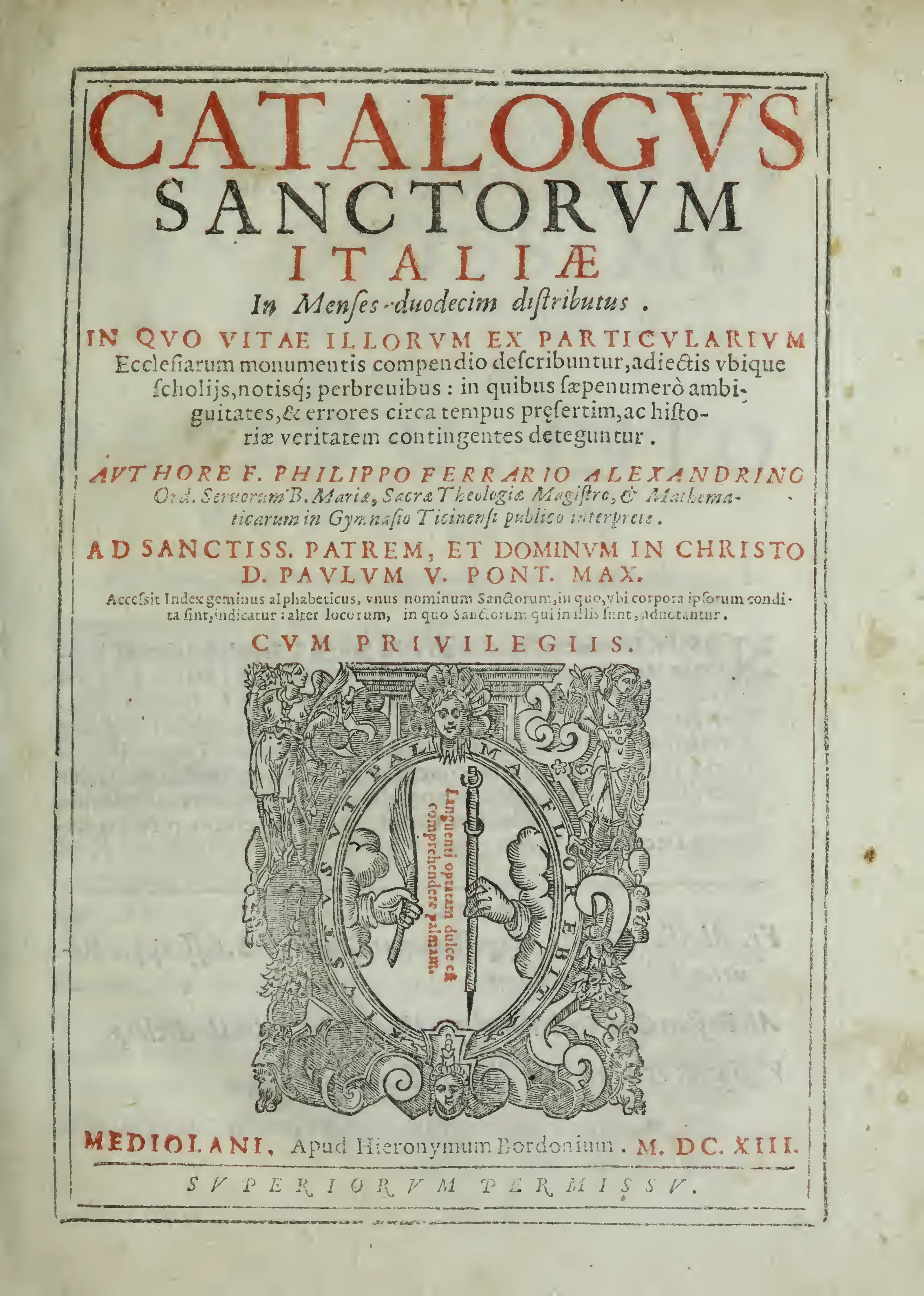
The 1613 Milan title page sets out Ferrari's programme at a glance: a saints' catalogue ordered through the twelve months and supplied with brief critical notes, issued under his authority as Servite theologian and public lecturer in mathematics. Its dedication to Paul V, notice of indices, permission formula, and Girolamo Bordone's printer's device place the book between local cult memory, scholarly verification, and the institutional permissions of post-Tridentine Catholic print. Source ↗.
The problem the work confronts is one of evidentiary disorder rather than of piety. Italy's saints were commemorated everywhere, in diocesan registers, proper calendars, legendaries, local chronicles and vernacular compilations, and these witnesses disagreed: about the year of a martyrdom, about which city possessed a body, about whether a given feast marked a death, a translation or the discovery of relics, and occasionally about whether the figure commemorated had existed at all. Ferrari's recurring move is to leave the liturgical frame intact and to insert beneath it an annotatio that tests the received account against datable external points — imperial reigns, councils, papal pontificates, inscriptions, documents he claims to have inspected himself — and against the internal coherence of the acts. What cannot be verified is still printed, but labelled: acts are said to be wanting, to stand in need of correction, to be of suspect faith; a tale of a bear that carried a saint in place of an ass is named a fable outright. Where two cities claim one entire body, a stated rule of nomenclature resolves the impasse, a notable part bearing the name of the whole by a figure of speech. And the criticism has a declared boundary: where the authority of the Church in the Breviary compels, the compiler defers, even against an ancient source he would otherwise follow.
The stakes of that procedure are considerable for the history of post-Tridentine religion. Sanctity after Trent was governed by a universal Roman norm — the reformed Martyrology, the Breviary, the Congregation of Rites and its slow, uneven canonisation machinery — while the substance of Italian cult remained stubbornly local, attached to particular altars, epitaphs, civic patronages and contested relics. Ferrari's catalogue works precisely in that gap. Its index marks whether a figure stands in the Roman Martyrology and records where a body is found or venerated, registering the difference between local ecclesiastical memory, historical proof and universal liturgical recognition without collapsing the three into one. The same book therefore belongs to two histories usually written apart: the construction of a sacred geography of Italy, in which cities and dioceses press territorial claims through their saints, and the emergence of critical hagiography in the decades between Heribert Rosweyde's programmatic proposals of 1607 and the first volumes of the Bollandist Acta Sanctorum from 1643.
What is most striking in the text is the range of instruments the compiler is willing to bring against a hallowed narrative, and the frankness with which he reports his own procedures and failures. A metropolitan see's records are demolished by simple arithmetic when they would require a bishop to have held his chair for more than 119 years. An epitaph is turned against the life it was cited to support, on the ground that it names no one and speaks only of resting in peace. A received genealogy that made a Roman virgin the daughter of the Apostle Peter is refuted from the acts of another saint. A synod convened without the authority of the Roman pontiff is denied the name of council and demoted to a conciliabulum. At the entry for the Virgin the compiler declares that he will report only what stands in the Gospels and in the weightiest authors, and abstains from miracles altogether because they are innumerable; elsewhere he dismisses the circulating vernacular Flos Sanctorum as containing matter close to fables. He speaks in the first person about his own institutional acts as well, recalling that while discharging the office of Prior General in 1609 he procured the approval of certain lessons from the Sacred Congregation of Rites and referring to a diploma of Paul V of that year — a reference the surviving text preserves, though no independent curial registration of such a diploma has been located, and the exact juridical form and scope of the act it names remain unestablished.
Much about the book's making is likewise recoverable only in part. A Servite approval to print, issued at the Milan convent on 30 November 1612, is visible on the title page; a Borromean patronage, a printing privilege and a complete series of licences have been suggested but not confirmed. Catalogue descriptions of the volume disagree over its pagination, and the several digital witnesses now available derive from distinct institutional copies rather than from one exemplar. There is no modern critical edition, no diplomatic transcription and no located translation into any vernacular; the Ferrari-specific secondary literature amounts to little more than a single close study, set against a rich general historiography of Counter-Reformation sanctity. A persistent catalogue conflation with the Lutheran chronologist Johann Funck, whose dates and confession are irreconcilable with this book, remains unexplained. The unifying thread runs from the vocabulary of the title through the institutional paratexts to the internal architecture of the entries: monumenta are memorial evidence rather than relics of stone, a catalogus is an instrument of retrieval and comparison rather than a florilegium, and the annotation beneath each life is where a church's memory is weighed as testimony.
Read the full text and English translation on Leo
This text was transcribed and translated as part of the ExLatinis project, an effort by Leo to make free English translations of every text published in Latin in early modern Europe (1450–1750) available online. The complete transcription and English translation of this work can be read free of charge:
→ Read the original Latin text and full English translation on Leo
You can save a copy of this document into your Leo account to run deep text searches, conduct further analysis, or cross-reference it with your own research.
Rendering Ferrari's Title: Catalogus, Monumenta, and the Saints of Italy
Editorial English title supplied for convenience, not an established English title: The Catalogue of the Saints of Italy, Distributed through Twelve Months: A Critical Calendar of Local Italian Cults.
The Latin title, Catalogus Sanctorum Italiae in menses duodecim distributus, presents the work as an ordered learned register rather than as a single saint's life or an unstructured collection of legends. In Ferrari's usage, catalogus implies systematic arrangement and retrieval: the saints are distributed through the twelve months, while the subtitle announces abbreviated lives drawn from the monuments of particular churches and accompanied by brief scholia and notes. The phrase in menses duodecim distributus therefore has a liturgical and calendrical force, but it does not make the book identical with the official Martyrologium Romanum; the surviving index explicitly distinguishes entries included in the Roman Martyrology from the wider body of Italian cultic material.
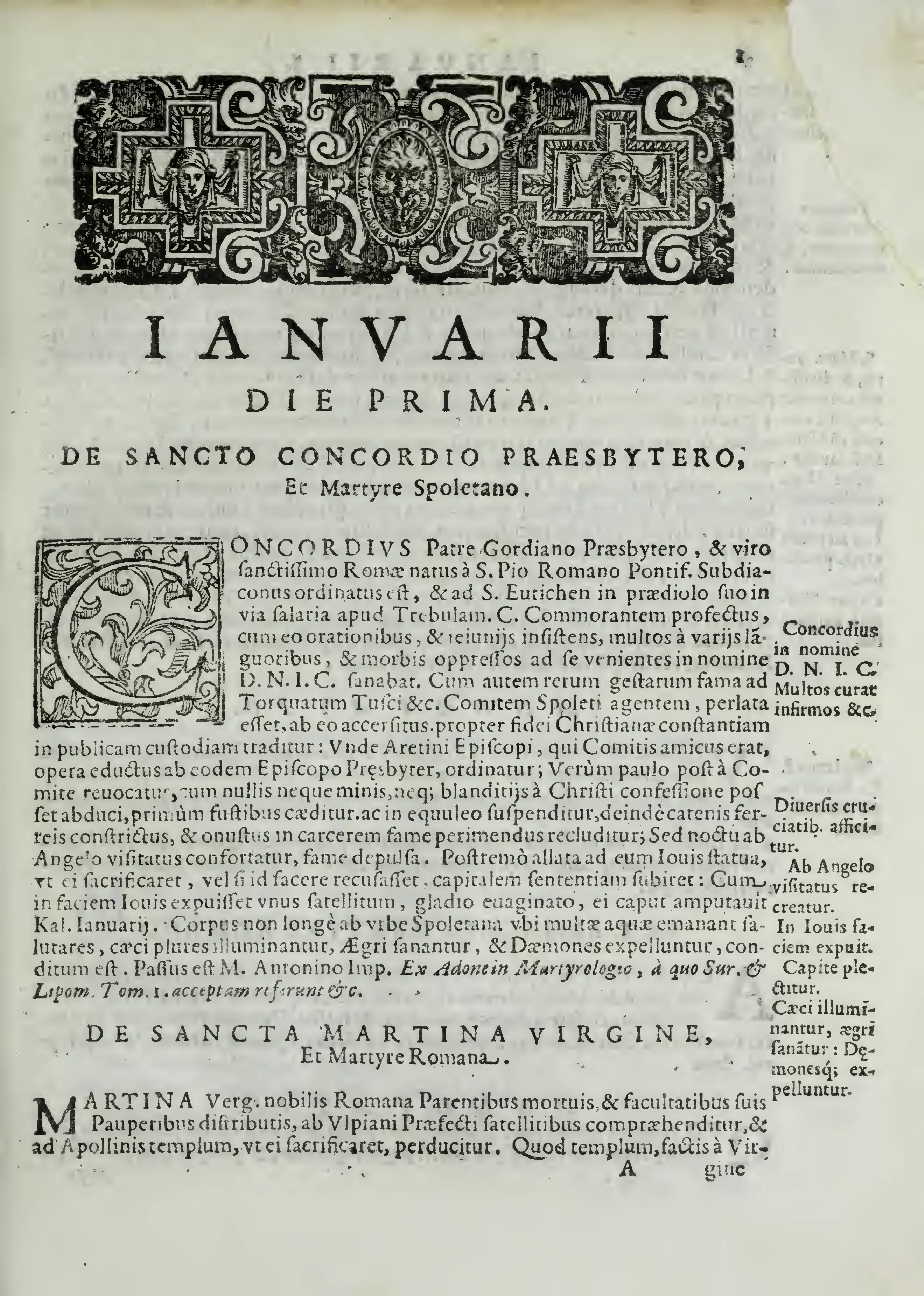
At the threshold of January, an ornamental headpiece, the rubric for the month's first day, and a decorated initial turn the promise of saints "distributed through twelve months" into a working calendar page. The opening life of Concordius pairs compact hagiographical narrative with printed marginal summaries and a source formula naming Ado, Surius, and Lipomanus — devotional in form, bibliographical in method. Source ↗.
The phrase ex particularium Ecclesiarum monumentis is especially important philologically. Here monumenta should not be reduced to ruins or antiquities in the modern archaeological sense. It denotes the memorial and documentary materials preserved or claimed by particular churches: ecclesiastical notices, epitaphs, inscriptions, local calendars, and related records. Ferrari's method turns those local witnesses into evidence with which chronological ambiguity and historical error can be corrected. The claim is consequently both antiquarian and institutional: a church's memorial tradition is a source of historical knowledge, but it must be tested, compared, and annotated rather than simply repeated.
The working vocabulary of that testing is visible in the notes themselves, where acta is a technical term for a documentary deposit that may be deficient, corrupt, or fabulous. Of a set of acts transmitted by Pietro de' Natali the compiler observes that many things in these acts of St Marinus reported by Petrus need correction, not so much as to the date — since St Gaudentius the bishop lived under Constantius in the heyday of the Arians and was martyred by the Arians in AD 359, as in Baronius' Annals for that year, killed with clubs and stones by the soldiers of the governor Marcianus — as to the substance, for who, among other things, would not judge that tale of the bear carrying Marinus in place of the ass to be a fable, M Vltæ egent correctione acta hac S. Marini à Pet. loco citatorelata, non tam circa tempus (cum S. Gaudentius Episcopus sub Constantio Imp. Arianorum fam[iliam] tore vixerit, martyrio affectus verò ab Arianis an. D. 359. vt apud Baron. in Annal. ad an. prædictum, a Marciani Præsidis militibus fustibus, & lapidibus occisus) quam circa res: quis enim inter alia: illud de vrsor Marinum loco aselli vehente fabulam non æstimet?. The vocabulary here — correctio applied to time and to substance alike, fabula as a verdict rather than a genre label — indicates that the "brief observations" promised on the title page are conceived as judgements on the evidentiary status of texts, not as devotional amplification.
The same philological posture governs the treatment of inscribed monumenta, which are read as documents capable of contradicting the narrative they were adduced to support. On the entry for Catervus the note records that on this day it is not the memory of his death or deposition but of his translation that is kept, from the epitaph above — which however does not seem to pertain to Catervus, since no mention is made of him and he is said to have rested in peace, Hac die non obitus, aut depositionis memoria, sed translationis recolitur. ex Epitaphio: superiori: quod tamen ad Cateruum non videtur pertinere, cum nulla eius mentio fiat, & in pace quiescisse dicatur. Two of the work's characteristic operations converge in that sentence: the discrimination of what a feast commemorates — natalis, depositio, translatio — and the refusal to let an epigraphic witness be assimilated to a life it does not name.
Finally, Alexandrinus in the author's name means "of Alessandria" in Piedmont. Filippo Ferrari was born at Oviglio in the Alessandria district, and the epithet does not identify Alexandria in Egypt. This geographical epithet belongs to the normal early modern practice of attaching a learned Latin place designation to an author's name; it is also a decisive authority-control safeguard against merging Ferrari with unrelated Ferraris or with Johann Funck. The work's conception of sancti is correspondingly layered: the catalogue gathers saints and local cults of Italy, while its index records whether a figure is in the Roman Martyrology and where a body is venerated. That arrangement registers the difference between local ecclesiastical memory, historical proof, and inclusion in the universal Roman liturgical book without making those categories identical. Where the record of bodies threatens to become self-contradictory, a stated rule of nomenclature intervenes: the body of St Benignus is held at Lucca with the body of St Vincent, and both are commemorated together on 6 June, but since St Vincent's body is said to rest at Mevania, these saints' bodies cannot be entire at Lucca, and instead some notable part usurps the name of the whole by a figure of speech, as very often happens, Corpus S. Benigni vnà cum corpore S. Vincentij Lucæ habetur. Et vtriusque simul memoria die 6. lunij celebratur. Cum verò corpus S. Vincentij Meuaniæ. quiescere dicatur, Lucæ horum SS. integracorpora esse non possunt, sed pars aliqua insignis nomenclotius per figuram, vt sæpenumero fieri solet, vsurpat. The formula per figuram is philological in the strict sense — a rule about how the language of relic notices signifies — and it allows rival local claims to be recorded rather than adjudicated away.
Filippo Ferrari's 1613 Catalogue of the Saints of Italy in Brief
Catalogus Sanctorum Italiae in menses duodecim distributus is a Latin printed hagiographical catalogue and monthly calendar, more precisely a martyrology-like reference compendium with critical scholia and notes. Its author is Filippo Ferrari, a Servite theologian and geographer, born at Oviglio in the Alessandria area in 1551 and deceased at Milan on 3 September 1626. Ferrari's authority formula identifies him as a Servite, a master of theology, and a public lecturer in mathematics at the Ticinese Gymnasium or Studium of Pavia; the text itself adds that he had held the office of Prior General of his order.
The established bibliographic imprint is Mediolani: apud Hieronymum Bordonium, 1613. The title states the work's driving purpose: to describe abbreviated lives from the monuments of particular Italian churches and to add brief observations exposing ambiguities and errors, especially those affecting chronology and historical truth. That purpose is executed through a declared editorial economy in which unverifiable material is printed under warning rather than suppressed: and although this history may justly seem suspect to someone, since, making no mention of time, it appears to relate improbable things, the compiler has nonetheless chosen to report it briefly, thinking he does a welcome service if, where accurately written accounts are lacking, whatever could be had is reported, ET si historia hæc meritò alicui suspecta videri poterit, quòd nullam temporis mentionem faciens inuerisimilia quædam narrare videatur; illam tamen paucis referre libuit, gratum me factum ratus, si vbi accuratè scripta desunt, qualiacunque haberi potuerunt, referantur. The accessible evidence establishes Milan as the place of printing, but not the exact place where the text was composed. A title-page approval from the Servite convent at Milan, dated the day before the Kalends of December 1612, demonstrates that the book had reached an authorized pre-publication stage; it does not by itself prove the separate Paul V diploma dated 1609 to which the text elsewhere refers.
The language of composition is Latin. One WorldCat record labels the language as Italian, but that field conflicts with the Latin title, the HathiTrust record, the surviving scan, and the Latin text itself; the Italian label is best treated as a catalogue inconsistency. No published English, Italian, French, German, or other vernacular translation was located in the catalogues and digital repositories examined. That negative finding is limited to the searchable records consulted and should not be converted into an absolute claim that no translation has ever existed.
Why the Catalogus Matters: Ferrari Between Tridentine Reform and the Bollandists
Ferrari's catalogue matters because it stands at the intersection of four early modern practices that are often studied separately: the ordering of sanctity by the liturgical year, the preservation of local ecclesiastical memory, the use of geography and epigraphy in historical argument, and the post-Tridentine effort to distinguish credible cult from chronologically or historically defective narrative. It is not merely a repertory of names. Its subtitle makes a methodological claim that particular churches preserve evidence capable of testing inherited hagiography, while its index gives that evidence a national and spatial frame.
The most directly relevant modern study is Serena Spanò Martinelli's essay, "Provincia Italia e province d'Italia: il grande abbraccio del Catalogus sanctorum Italiae di Filippo Ferrari (1613)." The available bibliographic record identifies it as a 2014 Viella publication, pp. 3–24. A review of the surrounding scholarship characterizes Ferrari's distinctive combination as hagiography, history, and geography, and associates it with the representation of Italy as pre-eminent in saints and with a carefully elaborated sacred cartography. The same discussion places territorial collections of saints within a process that redrew sacred geography and helped articulate local political and territorial identities. Ferrari thus provides unusually concentrated evidence for the relationship between universal Catholic sanctity and the claims of particular dioceses, cities, churches, and shrines. That relationship becomes audible when a civic counter-claim is entered into the record without being endorsed or erased: the Beneventans assert that they still have the body of St Bartholomew, they point out the place and display the body itself, saying that they deceived the emperor Otho, who was angry with them, by substituting another body for the Apostle's, Beneuentani corpus S. Barthol. se adhuc habere asserunt locum indicant; et corpus ipsum ostendunt, dicentes se Othonem Imp. sibi iratum fefellisse alterius corpore loco corporis Apostoli supposito. The reported speech is doing juridical as well as narrative work: the city's possession is stated as the city states it, and the reader is left with the competing claims in view — the same economy of registration without adjudication that the rule of nomenclature governs elsewhere.
The catalogue also belongs to the historiography of Tridentine liturgical and ecclesiastical reform. Simon Ditchfield's study of Pietro Maria Campi demonstrates how local hagiography, liturgy, and ecclesiastical history could preserve the particular while negotiating the authority of Rome. That framework illuminates Ferrari's use of local monuments without reducing the process to a simple Roman imposition. Clare Copeland's survey of early modern Italian sanctity and canonisation likewise describes a historiographical movement away from a purely top-down model toward negotiation among local communities, religious orders, and Roman institutions. Her account stresses that canonisation reform after Trent was slow and uncertain, and that unofficial or locally venerated holy figures could remain objects of devotion even when they had not entered the formal Roman canon.
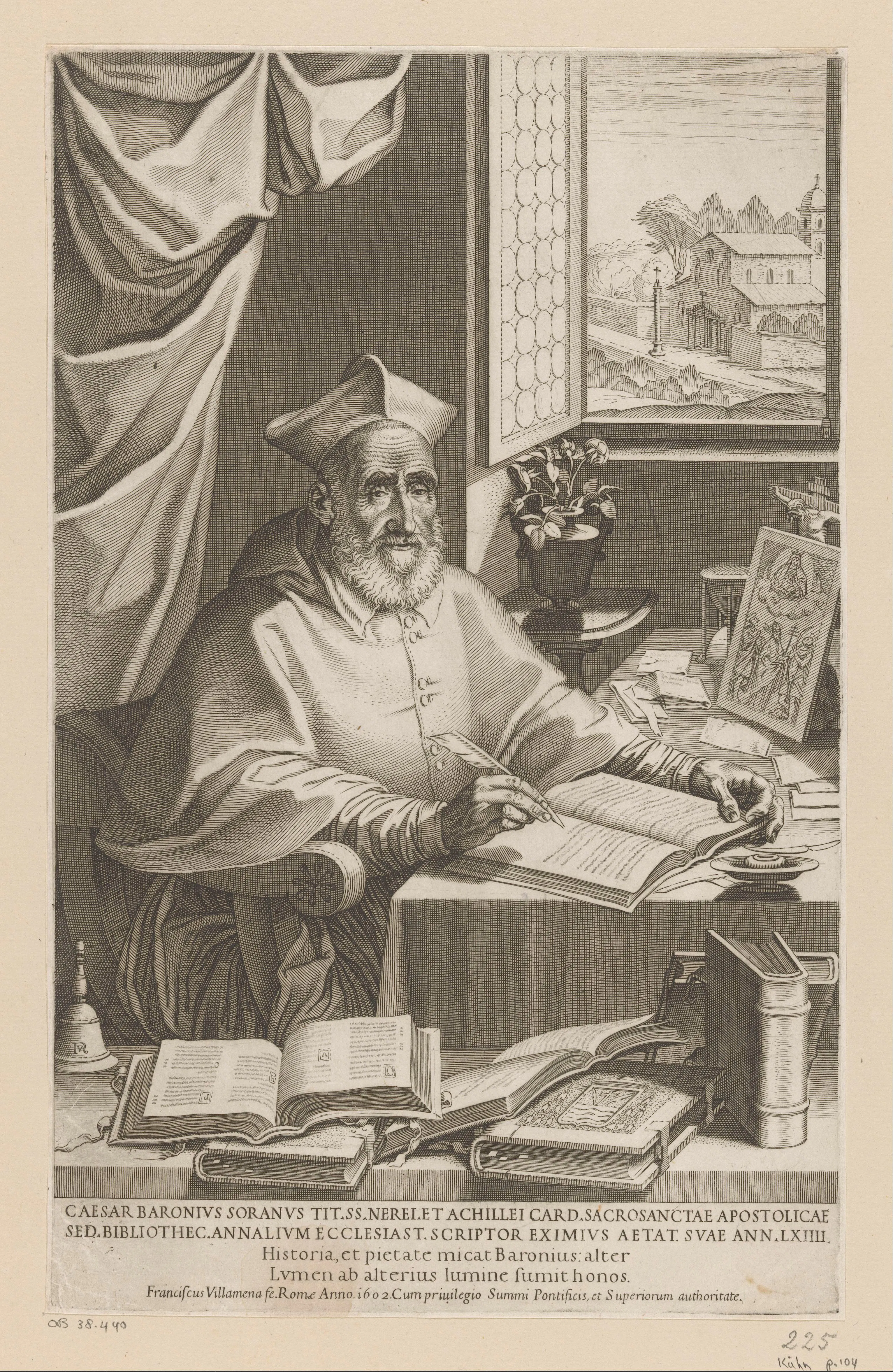
Francesco Villamena's 1602 engraving of Cardinal Cesare Baronio, shown in a scholar's study among books and devotional objects, with a view toward Santi Nereo e Achilleo in Rome. Baronio's Annales Ecclesiastici and his annotations on the Roman Martyrology supplied Ferrari with the chronological and hagiographical apparatus against which local cults, monuments, and traditions could be weighed rather than simply erased. Source ↗.

These arguments clarify the tension built into Ferrari's ordering system. The Roman Martyrology and Roman liturgical standards supply a universal norm, but local churches supply memorial evidence, bodies, epitaphs, and proper traditions. Ferrari's critical notes operate within that tension: they defend the value of local records while subjecting chronology and historical narrative to learned scrutiny. The boundary of the exercise is stated by the compiler himself in one of the shortest and most revealing notes in the book, where he concedes that were it not that the authority of the Church in the Breviary compelled him, he would side with Damasus, Ego nisi Eccles. autoritas in Breu. cogeret, cum Damaso sentirem. Historical judgement and liturgical obedience are here held apart and both are recorded, the scholar's preference declared even as the Breviary's ruling is followed — a distinction that supports Copeland's picture of an uneven, negotiated field rather than a single Roman command.
Within that boundary, the chronological instrument is used without deference to the dignity of the see whose records are at stake. Of the episcopal acts of Protasius of Milan the note reasons that if Protasius attended the Council of Sardica held in AD 347 under Julius I and consecrated Epiphanius bishop of Pavia in 466, he would have lived as bishop above 119 years, and that the Acts of St Protasius must therefore be corrected, Protasius interfuit concilio Sardicen. an. D. 347. celebrato sub Iulio I. Pont. & Epiphania Episcopum Ticinen. consecrauit an. 466. vixisset in Episcopum supra annos 119. corrigenda itaque sunt S. Protasij Acta. The argument proceeds entirely by synchronism between a datable council and a datable consecration, and the conclusion is directed at a metropolitan tradition. A comparable refutation of a received genealogy of sanctity turns instead on the internal testimony of a neighbouring dossier: on this matter, the compiler writes, I will say only that there is no way it can be said that Petronilla was born of the flesh of blessed Peter, chiefly by this argument, that Petronilla was foster-sister to St Felicula the Virgin, as the Acts of Felicula themselves attest before all, Quæ in re illud tantum dicam nullaratione dici posse Petronilla ex B. Petro S. carnem natam fuisse. eo præcipuè argumento, quod Petronilla S. Feliculæ V. erat collectanea sicuti acta ipsius Feliculæ apud omnes testantur. Both notes exhibit the procedure that connects this book to the movement toward Bollandist method: a claim about a saint is treated as a proposition answerable to documents.
Selection is as much a critical act as refutation, and at the most exposed entry in the calendar the compiler states his principle openly: here it has pleased him only to recount, or rather to indicate compendiously, what is clear from the Gospels and from the weightiest authors, while from miracles they abstain altogether, because they are innumerable, Hic tantùm, quæ ex euane[rum] & grauissimis Authoribus patent recensere, seu potius more compendij innuere libuis. Amiraculis prorsus, quòd innumera sint, abstinamus. Abstention on grounds of sheer number is not scepticism about the miraculous; it is an editorial ranking of sources, in which canonical text and weighty authority are admitted and an unbounded devotional accumulation is left aside.
The same discipline extends to ecclesiological vocabulary, where terminology carries doctrinal force. A synod convened without papal authority is denied the name of council: the council, or rather conciliabulum — since it had been convened without the authority of the Roman Pontiff — being concluded, the bishop returning to his own see revoked and condemned all its acts against the profession of the Nicene Synod, Concilio seu potius conciliabulo (cum absque Rom. Pontificis autoritate coactum fuisset) absoluto ad propriam sedem rediens acta omnia aduersus Nicæna Synodi professionem reuocauit, & damnauit. The correction is lexical and juridical at once, and it belongs to the post-Tridentine assertion of Roman primacy that Ditchfield's and Copeland's frameworks describe from different angles. Yet the endorsement of papal authority is not uncritical of its consequences: of the deposition of Henry IV the note records that the pontiff, not bearing so great an injury, as was fitting, deprived Henry of the communion of the faithful and of the empire, although this was the occasion of many evils, Qui tantam iniuriam, vt par erat, non ferens Henricum communione Fidelium, & Imperio priuat (licet id plurium malorum occasio fuerit). The parenthesis concedes the historical cost inside a sentence that upholds the act's propriety, a habit of qualified assent that recurs wherever the book's devotional frame and its historical judgement pull in different directions.
The book therefore belongs to the emergence of critical hagiography, in the period leading from Heribert Rosweyde's programmatic work of 1607 toward the Bollandist Acta Sanctorum from 1643 onward. A Servite institutional biography reports that Ferrari's 1625 companion catalogue was cited by Benedict XIV and used by the Bollandists; the exact chain of citations and the passages incorporated into the Acta Sanctorum still require a bibliographical concordance rather than assumption.
The wider historiography is substantially stronger than the Ferrari-specific one. The Cambridge Companion to Counter-Reformation Sanctity, edited by Jan Machielsen, Emily Michelson, and Katrina B. Olds, treats sanctity through religious identity, sacred tradition, devotional practice, theology, art, and material culture, and includes Simon Ditchfield's chapter on hagiography. Copeland emphasizes negotiation and institutional uncertainty; Ditchfield emphasizes the preservation of the particular within liturgical reform; Spanò Martinelli foregrounds Ferrari's Italian sacred geography. These approaches are complementary, but they imply different emphases: Ferrari can be read as an instrument of Roman confessional discipline, as a defender of local ecclesiastical particularity, or as a learned cartographer who made the two projects mutually intelligible. No sustained modern monograph, critical edition, or documented scholarly controversy devoted specifically to the 1613 Catalogus was located. The principal historiographical limitation is therefore not a settled disagreement about Ferrari, but the thinness of the Ferrari-specific evidentiary and editorial base.
Tracing the 1613 Milan Edition: Printers, Copies, and Digital Witnesses
The strongest bibliographic evidence identifies a single principal Milanese edition: Catalogus sanctorum Italiae in menses duodecim distributus ..., Filippo Ferrari, Mediolani: apud Hieronymum Bordonium, 1613. WorldCat records the item as OCLC 84441795, while HathiTrust names Girolamo Bordone as printer and describes a quarto volume of [2], 822, "i.e. 824," pages. Internet Archive metadata gives the same 1613 Milan/Bordone imprint but describes the scan as 718–719 pages and notes an index. The discrepancy is bibliographical and codicological: it may arise from differing pagination conventions, incomplete or irregular scan metadata, or a defective catalogue transcription. It does not by itself establish a second edition. The format and Hathi pagination are the most precise catalogue description currently located, but a full collation of leaves and signatures remains necessary.
The likely alternative Milanese printer or bookseller Pietro Martire Locarni, and references to his heirs, were not confirmed in the records examined. No reliable evidence was found for a dedicatee in the circle of Federico Borromeo, for a Borromean patronage relationship, or for a privilege and a complete series of licences from the Servite authorities, the Milanese ordinary, and the Inquisition. The title-page evidence does establish an approval to print issued at the Milan Servite convent on 30 November 1612. That approval is a concrete institutional paratext and should not be replaced by the more speculative attribution to the archiepiscopal circle. Internal evidence is consistent with that late terminus: one entry records that Paul V, Supreme Pontiff, inscribed a saint with solemn rite in the roll of the saints on the Kalends of November in the year of the Lord 1610, Pont. Max. illum solemni ritu Albo SS. apscripserit Kal. Nouembris, An. D. 1610, a notice of contemporary canonisation that also shows the calendar registering the formal Roman category — inscription in the Album Sanctorum — alongside the local cults that make up the bulk of its material.
The Paul V evidence bearing on the author's own petition remains unresolved. The searchable OCR of the book contains an annotation headed "Paulus V" and refers to the year 1609, a concession to a society or order concerning an ecclesiastical office, and the phrase quasi semicanonizatus. Much of the surrounding transcription is too corrupt to reconstruct the diplomatic wording safely, and no independent registration of a diploma dated 18 Kalends of May 1609 was located. Where the text can be read, however, it states the claim in the compiler's own voice: from these sources, he writes, we digested that life, briefly abridged, into lessons, which — while we were discharging the office of Prior General in the year of the Lord 1609 — we took care to have approved by the Sacred Congregation of Rites, and there exists a Diploma of Paul V dated 18 Kal. May in that year, Ex quibus nos illam paucis perstrictam in lectiones digessimus, quas à sacra Rit. congreg. dum off. Prioris Generalis fungeremur an. D. 1609. approbandas cur animus. Extat Diploma Pauli v. sum. Pont. 18. Kal. Maij. dat. an. prædicto. The book therefore preserves, in a legible formulation, Ferrari's own assertion of a Paul V authorization connected with 1609 and of the Congregation of Rites' role in approving the lessons; it does not establish, without comparison to a curial register, the juridical form and scope of the act, and the Congregation's documentary role in that specific authorization has not been independently verified. The passage is also the clearest instance of the work's habit of self-disclosure, in which the compiler's institutional office and his editorial labour are named together.
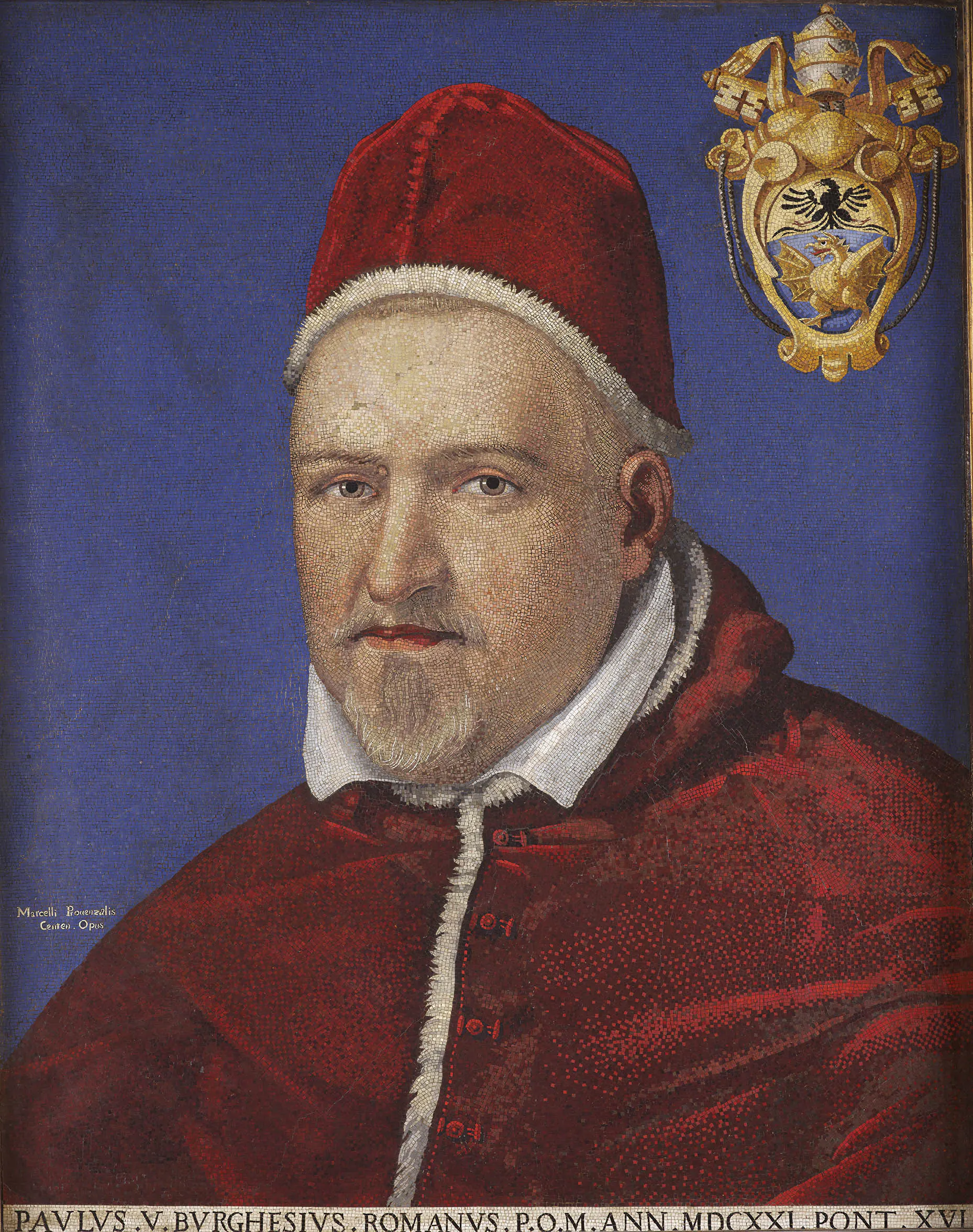
Marcello Provenzale's portrait of Pope Paul V, the pontiff under whom Ferrari's catalogue was compiled, approved, and printed. It gives a face to the authority Ferrari invokes when he links his 1609 work as Prior General to approval by the Sacred Congregation of Rites and to a diploma issued in Paul's name — a printed assertion that is legible, though its precise juridical form remains unverified against curial records. Source ↗.

The accessible text supports a substantial alphabetical index: INDEX ALPHABETICVS NOMINVM SS. It explains that the entries contained in the catalogue are marked according to their presence in the Roman Martyrology and gives the places where bodies are found or venerated — the same triage of universal norm, local cult, and physical resting place that the notes perform entry by entry. No separately headed index of dioceses and no separately headed index of feast days was visible in the accessible OCR. Similarly, searches of the OCR confirmed occurrences of FINIS, epitaphic and ecclesiastical evidence, and references to local church monuments, but did not provide a reliable basis for asserting the full January–December sequence, a second appendix of late-transmitted lives, the two-FINIS architecture, the continuous Gospel epitome, the stated chronological formulae, or the complete repertory of Sapphic and rhythmic hymns, distichs, inscriptions, antiphons, collects, subscriptions, and diplomas. Those features require page-by-page examination of a clean scan or a diplomatic transcription. They should not be treated as established bibliographical facts until that work is done.
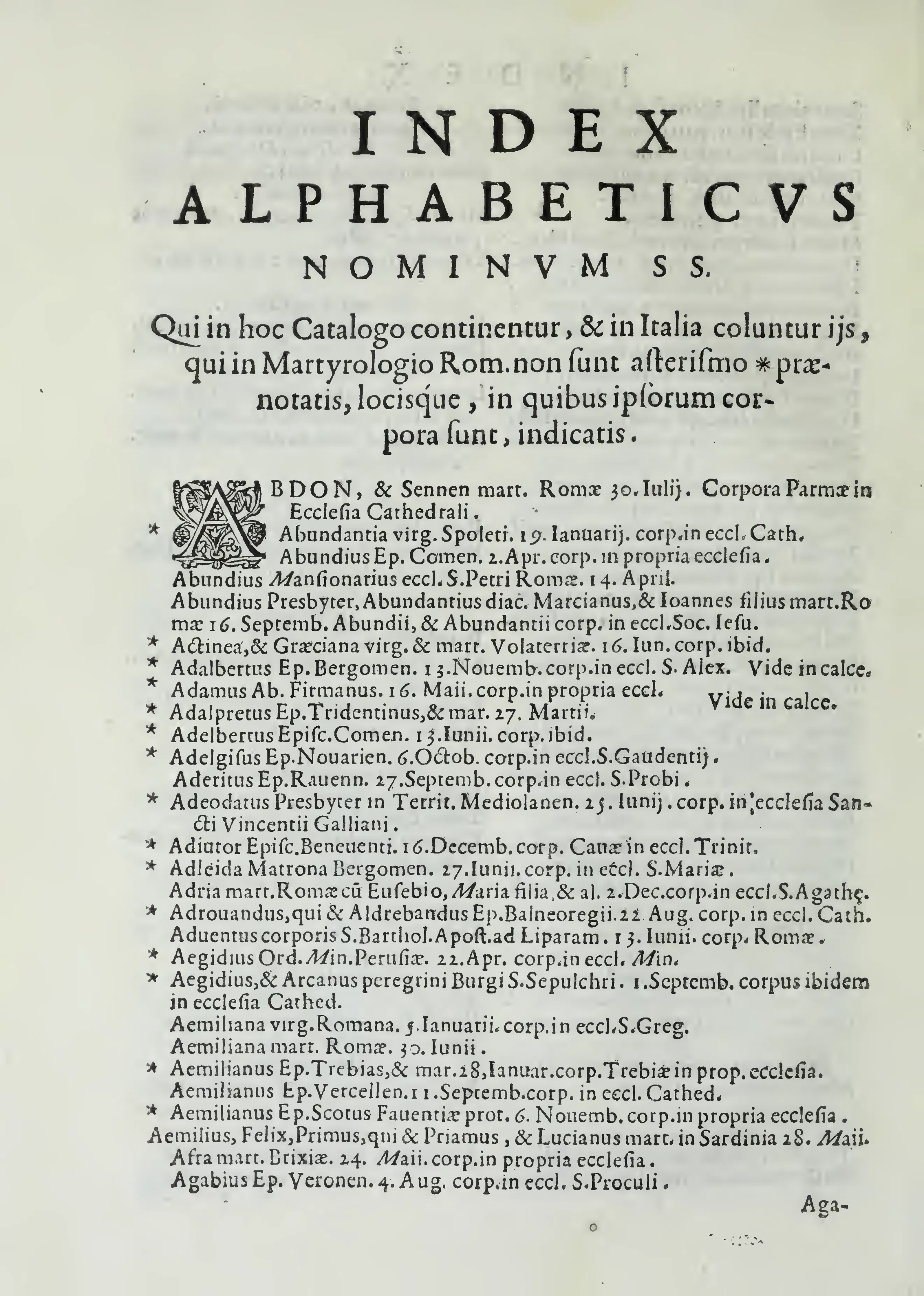
The opening leaf of the INDEX ALPHABETICVS NOMINVM SS. puts Ferrari's classificatory method into print: names alphabetized beneath a decorated initial, asterisks distinguishing saints absent from the Roman Martyrology, and entries recording places of veneration or bodily preservation. The catalogue's triage of universal recognition, local cult, and relic-site becomes a navigable apparatus rather than a simple list. Source ↗.
The transmission record is nevertheless unusually recoverable in digital form. The Internet Archive item catalogussanctor00ferr identifies the Getty Research Institute as source institution and records the archive identifier and scan metadata. A Google Books copy is attributed in its metadata to the Lyon Public Library's Bibliothèque jésuite des Fontaines. HathiTrust exposes a full-view copy from the Universidad Complutense de Madrid. A separate Münchener Digitalisierungszentrum/Bayerische Staatsbibliothek record, BSB11228183, provides a large image sequence. These are distinct digital witnesses with different institutional provenance; the available metadata does not justify treating them as scans of one and the same physical exemplar.
Specific shelfmarks for the Biblioteca Ambrosiana, Biblioteca Nazionale Braidense, Biblioteca Apostolica Vaticana, Biblioteca Nazionale Centrale di Roma, Biblioteca Nazionale Centrale di Firenze, British Library, Bibliothèque nationale de France, and Herzog August Bibliothek were not confirmed in the publicly indexed records consulted. The institutions may hold copies, but no shelfmark should be supplied without a direct catalogue record. No modern critical edition, scholarly diplomatic transcription, or published translation of the 1613 work was located. The surviving OCR is therefore a research aid, not an adequate textual edition.
Ferrari's bibliography situates the catalogue among his geographical and hagiographical works: Epitome geographicum (Pavia, 1605), Nova topographia in Martyrologium Romanum (Venice, 1609), the 1613 Catalogus, Topographia poetica, and the related Catalogus generalis sanctorum qui in Martyrologio Romano non sunt (Venice, 1625). The 1625 volume is a companion or expansion, not a second edition of the Milanese Catalogus: it has a different title, a different Venetian printer, Giovanni Guerigli, and a separate pagination of approximately 492 pages, with catalogue records varying slightly in the inclusive count. Its title explicitly gathers saints absent from the Roman Martyrology from martyrologies, calendars, tables, church monuments, and printed lives, making it an important continuation of Ferrari's documentary programme and of the distinction between Roman-Martyrology inclusion and wider cult that the 1613 index already operates.
Johann Funck is a separate author and textual tradition. Catalogue authority data identify Funck as a German Lutheran theologian, born in 1518 and deceased in 1566; his Chronologia is a world chronology with a title beginning Hoc est omnium temporum and a documented sixteenth-century tradition. The 1613 Ferrari title, Servite author formula, 1612 Milan approval, and references to Paul V in 1609 cannot be reconciled with Funck's authorship. The precise catalogue or digitisation record that generated the conflation was not identified: the Ferrari and Funck records located remain separate, and no evidentiary chain links the two. The conflation's provenance is consequently an unresolved bibliographical problem, not a viable attribution.
How Ferrari's Annotations Work: Entry by Entry Through the Calendar
The Working Unit of the Calendar: Life, Source Formula, Annotation
The run of days from the Nones of March exhibits the book's working unit with unusual clarity: a life set out in continuous Latin, flanked by printed marginal summaries that segment it into numbered episodes, closed by a source formula introduced by Ex, and followed by a rule and the word ANNOTATIO. What follows that rule is almost never a devotional coda. At the entry for Eusebius of Cremona, the disciple who accompanied Jerome, the life is credited to Pietro de' Natali and the Cremonese chronicle and is full of circumstantial matter — the garment in which the Doctor had been covered after death healing the possessed, the book de Trinitate carried back to Italy, the monastery built in his homeland to house the relics. The note beneath says nothing whatever about Eusebius' sanctity and instead raises a question of attribution: there survives, concerning the death of St Jerome, a letter to Damasus bishop of Porto and Theodosius the senator, which they ascribe to Eusebius, the disciple of the holy Doctor of the Church; there are nevertheless those who think that it was not written by that same Eusebius, Extat de Sancti Hieronymi obitu epistola ad Damasium Portuensem Episcopum, & Theodosium Senatorem: quam Eusebio S. Ecclesiæ Doctoris discipulo adscribunt. Sunt tamen, qui putant illam ab eodem Eusebio scriptam non fuisse.. The two impersonal verbs — adscribunt, putant — hold the question open between anonymous parties, and the note leaves the dispute unresolved. Its function is nevertheless precise: the reader is told that the principal documentary support for the most vivid element of the preceding narrative is a text of contested authorship, and is told this without a word of the narrative being withdrawn.
The immediately following entry shows the range of witness the compiler is prepared to name. The life of the Sicilian abbot John Joseph, who fled the Saracen incursion into Calabria and founded a monastery in the solitude of Nicephorus near Rossano, rests on no chronicler and no legendary but on a liturgy: from the lessons which are recited in Greek at Rossano on his feast, Ex Lectionibus, quæ apud Rossanum in eius solemnitate græcè recitantur.. The citation is exact about language and occasion rather than about a book, and it registers a category of evidence peculiar to the Italian south: the proper offices of the Italo-Greek churches, whose memory of their own saints is preserved in a rite that is neither Roman nor, in the ordinary sense, textual. The particulares ecclesiae of the title-page programme thus include churches whose monuments are recited aloud in Greek, and the annotation completes the entry in the register the index favours, locating the body still resting at Rossano in the church of that name.
Greek and Latin witnesses can also be set against one another, and the note on the abbot Gerasimus does exactly that in order to prevent a false identification. There are those who think Gerasimus to be the same man who is commemorated on this day in the Roman Martyrology; but since the Latins treat of Gerasimus a martyr, not a confessor, and treat of him without the place in which he suffered or was buried, while the Greeks treat of Gerasimus on this day at Jerusalem, who was a confessor, he seems to have been quite another than the Latins' man, Sunt qui putent Gerasimum eundem esse, qui in Martyrol. Rom. hac die commemoratur. Sed cum Latini de Gerasimo Martyre agant, non de Confessore, & de eo absque loco, in quo passus, aut sepultus sit, & Græci de Gerasimo hac die Hieroselimis, qui Confessor fuit, longe alium à Latinis fuisse videtur.. Three discriminants are deployed in a single sentence: the class of sanctity, martyr against confessor; the presence or absence of a localisation, where the Latin notice's silence about place of passion and burial is itself treated as a datum rather than as a gap to be filled; and the positive Jerusalem of the Greek menology. Coincidence of calendar day, the very thing that would tempt a compiler to merge the two, is refused the force of proof. The conclusion is nonetheless modal — videtur — and the annotation therefore establishes not an identity but a probable distinction, leaving both commemorations standing.
The same technique of reading a document against itself governs the most substantial life in this stretch, that of Perpetua and Felicitas, whose passion is retailed at length from the ancient acts in Surius, with the golden ladder, the dragon, the shepherd in the great garden, the contest with the Egyptian, and the vision of Dinocrates released from the place of punishment — matter the marginal apparatus interprets as the liberation of a brother from the prison of purgatory. The note beneath turns to topography. We have said that these holy martyrs suffered at Tuburbium, a town of Numidia, and we took this from the words of the first chapter of their acts; but since it appears in those same acts that they were exposed to the beasts in an amphitheatre, we can conjecture that they suffered at Carthage, seeing that Tuburbium was but a town, in which amphitheatres are by no means wont to be built; and in the old calendar one reads, of St Perpetua, of Africa and Carthage, Hos SS. Martyres apud Tuburbium (quod Numidiæ oppidum fuit) passos esse, diximus. Idque ex verbis primi capitis Actorum illarum accepimus, apparente autem in eijsdem Actis illos in Amphitheatro obiectos feris fuisse, coniectari possumus, Carthagine passos esse, siquidem Tuburbium haud oppidum tantum erat, in quo minimè Amphitheatra construi solent. In vet. autem Kal. legitur, S. Perpetuæ Africæ, & Carthagine. [reading uncertain]. The argument runs from the built fabric of Roman Africa: an amphitheatre implies a city of a certain rank, and the acts, by reporting one, contradict the place-name they open with. The compiler does not amend his own printed lemma; he lets diximus stand and adds a conjecture against it, then corroborates the conjecture from an independent liturgical witness, the old calendar, which is weighed alongside the acts rather than subordinated to them.
The following day poses the mirror-image problem, and is resolved by a distinction rather than a conjecture about rank. The memory of the martyrs Philemon and Apollonius is kept on this day in the Roman Martyrology, which holds that they suffered at Antinoë, a town of Egypt; but this is worthy of doubt, since from the words of St Jerome it appears that they were cast into the sea at Alexandria; yet perhaps, because they were condemned at Antinoë in the amphitheatre where Philemon, playing on pipe and flutes, was seized, and were subsequently sent to Alexandria, they are for that reason said to have suffered at Antinoë, Philemonis, & Apollonij Martyrum in Martyrol. Rom. hac die memoria recolitur: Quos vt supra scriptum est, apud Antinoum Aegypti oppidum passos habet. Verùm illud dubitatione dignum est: quod ex verbis Sancti Hieronymi Alexandriæ in mare coniectos apparet. Sed forte, quia in Amphitheatro, in quo Sanctus Philemon fistula, ac tibijs canens capitur, Antinoi damnati, ac subsequenter Alexandriam missi sunt, ideo Antinoi passi dicuntur.. The doubt is aimed at the universal Roman book, but its instrument is a patristic letter, so that one authority is weighed against another and neither is discarded; the harmonisation separates the place of sentence from the place of execution, a discrimination of the same species as the separation of natalis, depositio and translatio elsewhere in the calendar.
Where no such instruments exist, the note says so. The entry for Rogatus, Successus and their companions occupies barely two lines of narrative, and its annotation is a declaration of the archive's limit: concerning them we read nothing further; that they suffered under Diocletian and Maximian, Baronius in his notes and Galesini in his martyrology observe, DE ijs præterea non legimus. Quod autem sub Dioclet. & Max. passi sint, Baron. in Notis, & Gales. in suo Martyrol. adnotant.. The single surviving datum, the imperial synchronism, is not asserted on the compiler's own credit but referred to two named modern authorities; the entry's rubric and its text meanwhile give different numbers for the companions, fifteen and seventeen, a discrepancy the note passes over in silence, since it undertakes only what its authorities can carry.
Immediately after, the life of the presbyter Beatus of Ferentino is drawn Ex Monum. Eccles. Ferentinen., the title-page formula realised in a single local instance, and its note states both halves of such a cult's standing: St Beatus is not noted in the old calendars and martyrologies apart from Ferentino, so far as I have been able to know; his body is still preserved in that same city of Ferentino with the highest veneration of the citizens, Sanctus Beatus in vet. Kalendarijs, & Martyrologijs præter Ferentinum non adnotatur, quod scire potuerim. Illius Corpus in eadem Ferentinen. Ciuitate adhuc summa Ciuium veneratione asseruatur.. The qualifier quod scire potuerim is doing careful work, restricting the negative to the compiler's own reading rather than converting it into a claim about the whole tradition, and the second sentence supplies what the calendars do not: a body, a city, and the veneration of its citizens. Warrant here is corporeal and civic, not calendrical.
The most exposed formulation in the stretch closes the entry for the Florentine widow Humiliana de' Cerchi, whose life is credited to Pietro de' Natali, to a manuscript life at Florence and to the chronicle of the Minorites: the authors of her life reckon Humiliana among the saints — by what right I should not know, Sanctam Humilianam Vitæ eius Auctores in Sancto (haud sciam quo iure) computant.. The parenthesis is juridical in its vocabulary, quo iure asking after a title in law, and it assigns the act of enrolling her to her biographers rather than to any ecclesiastical authority. The heading of the entry, the day, and the sources all remain in place; what the annotation withholds is assent to the epithet the entry itself carries, so that the calendar prints the cult and records, in the same breath, that its title rests on no warrant the compiler can name.
The Anatomy of an Entry: Chronological Coordinates and Printed Judgement
Elsewhere in the calendar two consecutive entries show the same working unit in its plainest form, and precisely because neither entry involves a spectacular act of correction they display the routine machinery on which the more dramatic notes depend. The first closes a life of a Dominican devotee of the mid-thirteenth century whose sanctity is summarized in the formulaic language of a religious of unfailing counsel, prayer and aid to all who sought salvation, so that a great fame of holiness shone from him. That summation is followed immediately by the calendrical apparatus that makes such an entry usable: the years lived, the year of the Lord of the death, and the day given by the Roman reckoning of Nones. This triad — duration of life, year, and dies fixed by the ancient calendar — is not decorative. It is the formula by which each notice becomes commensurable with every other notice in the volume and, more importantly, with the external chronological grid of consulships, imperial reigns, councils and pontificates against which the compiler tests received narrative. A life without such coordinates cannot be examined; a life supplied with them enters the field of verifiable propositions.
The source line printed beneath the life, referring the whole account to the chronicle of the Order of Preachers under the year 1247, performs the second half of the same operation. The book's method requires not merely a date but a named witness, and the citation is deliberately granular, pointing to the annalistic year within the chronicle rather than to the work at large. The reader is thereby placed in a position to repeat the compiler's consultation — the essential courtesy of a catalogus conceived as an instrument of retrieval and comparison. The typographic disposition of the printed page reinforces the logic: the narrative is set off from its source attribution, and the source attribution from the note that follows, which is announced by its own line of display capitals, ANNOTATIO. The critical remark is not a marginal gloss or an incidental scholium buried in the flow of the life; it is a distinct printed member of the entry, structurally coordinate with the life it judges.
What that note contains is, in this instance, a verdict reached by silence rather than by contradiction. The compiler reports that as many writers of the Dominican Order as he has read say nothing about this man's sanctity, and then adds that his memory is nevertheless preserved in some martyrologies. The construction of the first clause deserves attention, for the phrasing is carefully bounded: not that the Dominican writers are silent, but that they are silent so far as the compiler has read them (quotquot legerim). The perfect subjunctive converts an argument from silence into a declaration about the extent of one man's reading, and it registers the limits of the negative finding at the moment it is announced — the same scrupulous refusal to convert absence of evidence into evidence of absence that governs the book's handling of contested relics. The second clause then supplies the counterweight. Liturgical commemoration exists where the order's own historiography does not support it, and the two facts are set side by side without resolution. This is the tension the whole catalogue inhabits, caught here in two lines: cult is a datum of ecclesiastical practice, sanctity attested by learned witnesses is a datum of documentary record, and the compiler's discipline consists in reporting both while allowing neither to manufacture the other. The entry is neither suppressed nor validated; it is printed under caution, which is the characteristic editorial economy of the volume.
The entry for Leo, bishop of Piacenza, which follows under its own line of capitals, shows the other face of the method — the abbreviated life as a structured deposit of testable claims. Its opening moves through the conventional stations of an episcopal vita: noble birth in the city, pious parents, upbringing in the Christian religion, initiation into sacred orders as a youth, and elevation to the priesthood by the merit of his virtues. Then comes the datum on which any chronological argument would have to turn, the succession itself: upon the death of Bishop Antoninus, Leo is made bishop by the common consent of all (communi omnium consensu). The formula does two things at once. It names a predecessor, and thus attaches the life to an episcopal list of the kind that elsewhere in the book supplies the arithmetic by which impossible tenures are exposed; and it characterizes the election as acclamatory and unanimous, the canonically irreproachable mode of accession, so that the pastoral portrait that follows rests on an unimpeachable title.
That portrait is itself a catalogue of episcopal duties rather than of wonders. Leo is assiduous in prayer, in the interpretation of sacred letters, in feeding his diocese, and in the distribution of alms; he wears down his body with abstinence, fasts and vigils; he is an outstanding defender of orphans and widows. Preaching, residence, catechesis, almsgiving and personal austerity are, in the decades after the Council of Trent and in a book printed at Milan, the recognized lineaments of the reforming bishop, and the medieval life is narrated in a vocabulary that a Milanese reader of 1613 would have recognized as the description of an ideal still being urged upon the episcopate. Notably absent from the sequence is the miraculous: the sanctity is administrative, ascetic and juridical, of the kind that documentary record can in principle sustain.
The concluding episode gives that juridical sanctity a concrete object. Leo's protection of widows is pressed so far that he bars Count Boso, who had injured a certain widow, from the sacred rites. The clause is a compressed statement of ecclesiastical discipline exercised against secular lordship, the bishop's power over access to the sacraments deployed as the remedy for a lay magnate's wrong against the classic protected person of canon law. The narrative logic of the entry thus runs from consent to office, through the discharge of pastoral duty, to the exercise of coercive spiritual jurisdiction — the same ascending order that the book observes elsewhere when it records the deprivation of an emperor. Set immediately after an annotation that quietly withholds credence from a fellow religious of a mendicant order, the Placentine life demonstrates the range within which this calendar operates: an entry may be reported and doubted, or reported and left to stand on the strength of a coherent, dateable, institutionally grounded account of a bishop's conduct in his see.
May: Homonymy, Curial Instruments, and the Ranking of Witnesses
The May sequence opens on the apostle Philip and, within a few lines of the vita's close, on the operation that gives the whole calendar its intellectual character. Having reported the tradition of a peaceful death and burial between two virgin daughters, the compiler interposes a corrective: there are those who record that Philip died in peace and was buried between his two virgin daughters, but he was not Philip the Apostle but the Deacon, of whom mention is made in the Acts of the Apostles, Sunt qui Philippum in pace, quæ cuisse, ac inter duas eius filias virgines sepultum tra sant. Verum is non Philippus Apostolus, sed Diaconus fuit. Cuius mentio fit in Act. bus Apost. The syntax is the syntax of the whole book: an impersonal sunt qui that registers what is transmitted without owning it, then an adversative verum that separates two homonymous figures whose merger had generated a spurious biographical detail. The remedy is not suppression of the story but reassignment of it to its rightful subject, and the warrant is canonical scripture buttressed by Eusebius and Baronius. Homonymy — the collapse of two persons into one cult, one grave, one feast — is among the most productive sources of error in the received legendaries, and the catalogue treats it as a problem of identification rather than of piety.
The entry for James on the same day shows that the critical instrument is not reserved for demolition. The Hegesippan portrait of the Lord's brother is reproduced intact, and so is the account of the Jerusalem assembly, where the arrangement of the clauses carries a doctrinal charge: when the Apostles held a council at Jerusalem over the controversy that had arisen concerning the Law and circumcision, James, following Peter's opinion, delivered an address in which he approved the calling of the Gentiles and said that the brethren should be written to, lest they impose the yoke of the Mosaic law upon the Gentiles, Cum autem Apostoli concilium Hierosolymis super orta de lege, & circuncisione controuersia haberent, Iacobus Petri sententiam secutus concionem habuit, in qua vocationem Gentium probauit, & fratribus scribendum dixit, ne Gentibus iugum Mosaycæ legis imponerent. The participial phrase Petri sententiam secutus is the load-bearing element. The narrative of Acts 15 is read so that the bishop of Jerusalem does not preside but concurs, and the conciliar decree issues from a sentence already pronounced by Peter. In a book compiled by a religious who had recently transacted business with the Roman congregations, this is not incidental: the primatial reading of the apostolic council supplies the model for the relation between local church and Roman see that the calendar everywhere presupposes, in which particular traditions are legitimate precisely insofar as they follow rather than initiate.
That relation becomes concrete two days later, at the Servite Peregrinus of Forlì, where the entry closes by recording an act of the reigning pontiff: Paul V, Supreme Pontiff, granted that his office be recited with proper lessons, from the office of the Servites approved at Rome, Paulus verò v. Pont. Max. vt officium illius proprijs lectionibus recitetur, indulsit. Ex off. servorum Romæ approbatis. The formula is worth pausing over. It is not a canonisation notice but the record of a liturgical concession — indulsit, a permission granted to an order to use proper lessons — and the source citation names the printed Roman-approved Servite office rather than a legendary or a diocesan register. Cult here is documented by the instrument that authorises it, so that the evidentiary status of the entry rests on a curial act rather than on a narrative tradition. Immediately beneath, the annotation discloses that the compiler himself had prepared those lessons and procured their approval while holding the generalate of his order, the first-person disclosure already examined among the book's institutional paratexts; the catalogue thus registers, as an external fact of Roman liturgical administration, a document its author had solicited.
Against this confidence in what can be documented stands the equally characteristic admission of what cannot. Of a bishop whose Acts fail him the compiler simply writes that when this holy bishop died, or under which pontiff he came to Rome, we have been quite unable to learn, Quando hic S. Episcopus obierit, quoue Pont. Romam venerit, scire minime potuimus. The formula recurs across the month with a frequency that turns it into a structural feature rather than an occasional lapse. Its two variables — the year of death and the pontificate — are precisely the coordinates by which the annotations elsewhere fix or falsify a life, so the confession is a statement about method: where the two synchronising axes are missing, the entry is left open rather than closed by conjecture. The devotional apparatus is unaffected, since the feast stands whether or not its date can be fixed in the reckoning of times; what suffers is only the historical claim, and the reader is told exactly where it fails.
Where documentation is abundant the annotations become adversarial. The entry for Alexander I transmits a dense body of decretal material: he decreed that in the mystery only bread and wine should be used, to which water should be added on account of the blood and water that flowed from Christ's side, and that there should be added in the Canon the words "Who the day before he suffered"; he decreed also that holy water mixed with salt be kept perpetually in churches and in bedchambers to drive off demons, and that clerics be immune from secular judgment, Constituit vt in mysterio panis tantummodo, & vinu[m], cui aqua propter sanguinem, & aquam, quæ ex Iesu Christi latere profluxerant, adhiberetur: addereturque in Canone Qui pridie, quàm pateretur. Decreuit ét, vt a qua benedicta sali admixto perpetuo in ecclesijs, & in cubiculis ad fugandos dæmones asseruaretur: & vt clerici à iudicio sæculari essent immunes tribus scriptis epistolis. Every item in the list had been contested in the confessional polemics of the preceding century — the mixed chalice, the wording of the Canon, sacramentals against demons, and above all the privilegium fori, clerical exemption from lay tribunals, which was a live jurisdictional question in the Milanese and Venetian states of the compiler's own lifetime. By attaching them to a second-century martyr-pope the entry converts disputed present practice into apostolic-age institution. Yet the annotation that follows does not protect the entry from correction; it attacks its chronology. Damasus in the Book of Pontiffs appears to place Alexander's passion under Trajan after ten years and some months of pontificate, a view Marianus Scotus, Panvinio and Petrus Galesinius affirm, but Eusebius states most plainly that he was martyred in the third year of Hadrian, Damasus in lib. Pontif. videtur Alexandrum post 10. annos, & menses, cum aliquot diebus Pontif. sub Traiano passum asserere, quod, & Marianus Scot. in Cron. & Panuin in Cronol. Eccles. & Pet. Gales. in martyrol. affirmant, sie vt opinantur supputatione temporum suadente. Sed Euseb. lib. 4. c. 4. Hist. Eccl. apertissimè Alexandrum III. Imp. anno Hadriani martyrio affectum fuisse scribit. The hierarchy of witnesses is explicit and unusual: a numerical majority of authorities, medieval and recent, one of them the most respected chronologist of the previous generation, is overruled by a single Greek ecclesiastical historian nearer the events, whose testimony is apertissimè — plain beyond dispute. Antiquity and proximity outrank consensus, and the supputatio temporum that the others thought favoured them is shown to have been misapplied.
The technical vocabulary of this discipline surfaces most nakedly in the shorter notes. Of the Anconitan bishop the compiler records that the Acts of St Cyriacus the bishop, in the church of Ancona and in Petrus's Catalogue at the place cited, stand in need of censure, A Cta S. Cyriaci Episcopi in Eccles. Anconit. & apud Petr. in Cat. loco citato censura indigent. Censura here is not ecclesiastical penalty but philological judgement passed upon a text, and the note is careful to name both witnesses that carry the defective Acts, the local church's own copy and the printed legendary of Pietro de' Natali, so that the verdict falls on the tradition rather than on a single careless transcriber. Elsewhere the operation is reported as already performed: the sources contained many fabulous things, plura fabulosa, quæ resecauimus, which we have cut away. The surgical metaphor of resecare discloses the editorial economy of the book with some precision. The compiler does not print the fabulous matter with a warning at every point, as he sometimes does; here he excises it and reports the excision, leaving the reader with an abridged narrative and a notice that abridgement has occurred, but not with the means to reconstruct what was removed.
Political material receives the same handling, with the annotation supplying the interpretation the narrative withholds. At Benedict II the entry records that, moved by the fame of his sanctity, the Emperor Heraclius Constantine remitted the inveterate custom of confirming pontiffs by the emperors, for a pontiff-elect was not consecrated before he had obtained confirmation from the emperor, or from his exarch, on payment of money, Farma sanctitatis illius commotus Heraclius Constantinus Imp. inueteratam confirmandi Pontifices ab Imperatoribus consuetudinem remisit. (Non enim electus Pont. ante consecrabatur, quàm ab Imperatore, siue ab eius Exarcho confirmationem soluta pecunia obtinuisset.). The parenthesis is doing the polemical work. What it describes is a constitutional procedure of the Byzantine administration in Italy; what its final ablative absolute, soluta pecunia, makes of that procedure is a traffic in consecration, which is to say simony. The remission is thereby narrated not as an imperial concession of a right but as the surrender of an abuse, and the personal cause assigned to it — the emperor's response to a reputation for sanctity — keeps the initiative on the side of the papacy even in an act performed by the lay power.
Two further passages show the limits within which such criticism operates. In one of the martyr-passions the authenticating subscription of the source is quoted rather than merely invoked: I, Maximianus the notary, a Christian from infancy, who although I bound myself by the oath of paganism, nevertheless reduced to writing by lamplight at night this contest of the martyr, which I beheld with my own eyes, and transmitted it to posterity in a faithful narration, Ego Maximianus notarius ab Infantia Christianus, qui licet Paganismi iuramento me constrinxerim, hoc tamen marty is certamen, quod oculis perspexi, noctu ad luminaria inscriptis redegi, fideliq[ue] narratione ad posteritatem transmisi. The subscription answers, in advance, exactly the questions the annotations habitually ask of a passio: who wrote it, when, on what basis, and with what access. Its crypto-Christian notary is an eyewitness embedded in the tribunal itself, and the concessive clause admitting the pagan oath functions as a guarantee of candour. Reproducing it verbatim allows the acts to carry their own credentials into the catalogue. In the other, drawn from Gregory the Great's Dialogi, the marvellous is retained without hesitation: truly wonderful, that the bear which had been accustomed to devour sheep should, at the command of the man of God, pasture and guard them and bring them back at the hour appointed for it, and neither before nor after, Mirandum planè quod vrsus, qui oues deuorare consueuerat, ad viri Dei præceptum illas pasceret, & custodiret, ad horamque sibi constitutam, & non ante, neque post reduceret. The tamed bear is precisely the kind of episode the annotations dismiss as fabula when it reaches them through a late legendary; here it stands unchallenged, and the horological exactitude of ad horam sibi constitutam, & non ante, neque post is offered as part of the wonder rather than as a strain on credibility. The discriminating principle is not the improbability of the event but the standing of the witness: what a Father of the Church relates in a work of undoubted authenticity is admitted whole, together with the morally uncomfortable sequel of the bear's killing and the saint's lifelong remorse, while the same motif transmitted anonymously through the legendaries is cut away.
Mid-July: Silence as Evidence and the Geography of Preaching
The mid-July sequence of the calendar shows the apparatus working in its ordinary register, where the note beneath the life is not a spectacular refutation but a piece of routine evidentiary triage. At the entry for Heraclea, honoured at Florence, the compiler records that Baronius reports on this day in his annotations on the Martyrology that the martyr suffered at Florence, Baronius in Annotationibus in Martyrologium hac die refert; cum tamen apud Florentinos nulla huius martyris memoria appareat. Sed neque quo tempore, aut sub quo Imperatore passus est, aliquis exprimit. — although among the Florentines no memory of this martyr appears, and neither does anyone state at what time or under what emperor the martyrdom took place. The move inverts the book's usual direction of correction. Elsewhere a particular church's memorial evidence is brought to bear against a received narrative; here the absence of any Florentine commemoration is set against the most authoritative living annotator of the Roman Martyrology, and the silence of the city is treated as a datum with probative weight. The second sentence names the two coordinates by which this catalogue habitually secures a passion — the year and the reigning emperor — and reports that neither can be supplied by any witness. The entry is nevertheless printed, and the instability runs deeper than the note admits: the heading commemorates a female martyr while the verb governing the passion is masculine, and the annotation immediately below must separate this figure from another Heraclius martyred at Nola in Campania. Name, sex and place all wobble, and the apparatus stabilises what it can while leaving the residue visible.
The entry for 15 July opens onto the largest geographical canvas in the slice, the division of the apostles: when the apostolic company had been commanded by Christ the Lord to go into the whole world and preach the Gospel to every creature, Cum Apostolica Concio à Christo Domino, vt euntes in mundum vniuersum, Euangelium omni creaturæ prædicaret esset, illa in diuersas orbis partes diuisa est, atque suum cuique Apostolo demandata prouincia., it was divided into the various parts of the globe, and to each apostle his province was assigned. The vocabulary is precisely that of the compiler's other professional labour: prouincia is at once a missionary charge and a territorial unit, and the paragraph that follows is a chorography rather than a martyrology, distributing Peter and Andrew across Cappadocia, Galatia, Bithynia and Asia, sending Thomas to the Parthians, Medes, Hyrcanians and Bactrians before India, and assigning Barnabas the foundation of many churches and pre-eminently the Milanese. The apostolic partition of the world thus supplies the theoretical warrant for a catalogue that partitions Italy, and the authority cited for it is not a printed universal history but an old manuscript book of the church of Monza — a single particular church's memorial deposit underwriting a global geography of preaching, and simultaneously grounding the apostolicity of the see in whose city the volume was printed.
Against that expansive frame the note appended to Grata of Bergamo is deliberately minimal. Her life is unusually rich in civic substance: she shelters Alexander in her house, buries him, builds and endows a church over his grave, founds a hospital, inherits as sole heir and governs the city, restores its temples and walls, and relieves a famine by selling her valuables, her body finally laid in a marble chest at S. Maria Vecchia. The annotation registers only what the record does not contain, observing that the acts do not state the years St Grata lived or the years she administered the city, S. Grata annos, quibus vixit, quibusque vrbem administrauit, Actanon exprimunt., the noun and its negative fused into a single word by the compositor. The lacuna is located exactly where a municipal history would most want a figure: not in the miraculous but in the constitutional, the length of a woman's rule over Bergamo. The office book of the Bergamasque church, cited as the source, suffices as liturgy and fails as chronicle, and the note says so without withdrawing the life.
Homonymy receives the same brisk handling on 16 July, where the note records that there was also another St Hilarinus in the company of the martyrs of Arezzo, Fvit & alter S. Hilarinus in comitatu SS. Donati Episcopi, & Marci, ac Ioannis martyrum Aretinorum. Cuius natalis 3. Nonas Augusti in Martyrol. Rom. recolitur., whose birthday into heaven is kept in the Roman Martyrology on the third Nones of August. Two saints of one name in one territory are held apart by two indices, the roll of companions in whose dossier each appears and the day on which each is kept, with the universal book supplying the discriminating date. The life above it has already performed the complementary separation between relic and cult, noting that the body was translated to Montecassino by Pope Zacharias while the memory of the martyr is still celebrated, and chiefly venerated, at the place of the passion — the distinction between where a body lies and where a saint is honoured that the volume's index is built to record.
The most characteristic intervention in the slice belongs to the bishop Vitalianus of Capua, whose life has him thrown into the Volturno, carried down to the sea, driven by winds to Sicily and received by monks on what the manuscript life kept at Benevento calls the Catanian island. Having weighed everything, the compiler proposes instead the island of Cathena, which lay between Baiae and Cumae and still stands in the stretch of sea between Baiae and Nisida, and then disposes of the obvious objection: it does not seem at all surprising that no Sicilian writer mentions this holy man, Illud tamen minimè mirandum videtur, quòd Sicutorum nemo huius S. viri meminerit: quandoquidem in Insula à monachis susceptus, cum in Insula illa in Siciliæ littore constituta esset, satis colebatur, vt etiamnum in ea, quæ in Vulturni littore est, ab Incolis colitur., since he was received by monks on the island and duly venerated there, as he is still venerated by the inhabitants of the island off the Volturno shore. The argument from silence, wielded as an accusation in the Florentine case, is here defused: once the island is relocated to the Campanian coast, Sicilian ignorance ceases to be evidence of anything, and surviving local veneration at the correct site becomes the confirming witness. The correction is made by coastal topography rather than by chronology, and it emends the transmitted text while leaving the saint, his cult and his miracles untouched.
Roman topography works the same way at the entry for Alexius, where the note reports that the annotator of the Martyrology — his name transmitted here in a corrupted form — affirms that the house of St Alexius was converted into the church of St Boniface, Aroniùs in Annotat. ad Martyrol. affirmat S. Alexij domum in ecclesia S. Bonifacij mutatam esse. Nam ecclesia illa, quæ pridem, S. Bonifacij nomine dicebatur (in qua nunc corpus asseruatur) ampliata, S. Alexij dicta est, ex antiq. tradit., since that church, formerly called by the name of St Boniface and now holding the body, was enlarged and named for St Alexius, on ancient tradition. The note explains a discrepancy the life would otherwise leave standing between the titulus named in the passion and the titulus a reader would find on the Aventine, and it does so by treating a dedication as a datable event in the history of a building. A church's name is here a document with a chronology of its own.
The densest note in the slice attaches to Hadrian III. In five sentences it reports that many think this is the Hadrian whose body rests in the Benedictine abbey of Nonantola, Plures putant hunc esse Hadrianum, cuius corpus in Nonantulano coenobio Ord. S. Benedicti quiescit. Sed hunc Nonantulæ obijsse, & sepultum fuisse Sigebertus in Cron. scribit. Illius corpus die 8. Iulij inuentum an. sal. 1567. fuit, quo die eius festiuitas ob translationem celebratur. Baron. in Annot. in Martyrol. scribit S. Hadrianum non tres, sed 16. Menses Sedi Apostolicæ præfuisse. Panuin. in Cron. Eccles. tribuit ei 1. an. dies 4. — that Sigebert in his chronicle writes that he died and was buried at Nonantola; that the body was found on 8 July in the year of salvation 1567, on which day his feast is kept for the translation; that Baronius assigns him not three months but sixteen at the Apostolic See; and that Panvinio allots him one year and four days. Four distinct operations are compressed here: an identification of a body, supported from a medieval chronicler; a dated invention of relics only forty-six years before publication, which converts a July feast from a commemoration of death into one of translation; and a flat juxtaposition of three irreconcilable measures of a pontificate, the life's own three months set beside the two leading Roman chronologists without arbitration. The entry above has just credited Hadrian with decreeing that the election of the Roman pontiff should not depend on the will of the emperors, so the disputed length of his reign is not an idle datum but the measure of a pontificate invoked for the independence of the papal office.
The slice closes on the same economy of registered doubt. At Centumcellae the body of Severa is preserved in the church of St Sabina beside that of the presbyter Severus, said to be her brother, though her passion is not found in the Roman Martyrology; and the note allows that some judge that this Severa was not the sister of Severus but another woman put to death, Aliqui Seueram ipsam Seueri sororem non fuisse, sed alteram, martyrio affectam existimant. Sed hæc in Ecclesia Centumcellensi, & alibi hac die colitur., yet she is venerated on this day at the church of Centumcellae and elsewhere. The counterweight to the doubt is not a document but a practice: the identification is left unsettled and the cult is left standing, the two orders of evidence held apart rather than made to decide each other. The neighbouring note on Aurea performs the opposite operation, judging that Aurea and Chryse, which in Latin means golden, appear to be one and the same, and referring the reader to the Roman Martyrology for that day. Between the separation of two saints who share a name and the fusion of one saint who bears two, the daily labour of this calendar is an arithmetic of persons, conducted so that neither a translated bilingual name nor a repeated Latin one should be allowed to multiply or to collapse the saints of Italy.
Late August: The Ostian Dossier and the Aporetic Note
The stretch of the calendar running from the twenty-third to the twenty-seventh of August offers an unusually concentrated view of how the annotatio functions when the received acts supply a name, a magistrate, and a manner of death, but no secure date. The cluster of Ostian saints — Quiriacus, Aurea, Herculanus, and the group of Pontia, Taurinus, Herculanus and Alexander — shares a single dossier and therefore a single chronological problem, and the compiler works through it not saint by saint in isolation but as a connected evidentiary exercise, with each note adjusting the conclusions available to the next.
The entry for Quiriacus, bishop of Ostia, states the passion in the conventional idiom of the Roman passio: the bishop, with Maximus the presbyter and Archilaus the deacon, is accused of Christianity under the emperor Alexander and the city prefect Ulpian, professes Christ as the living God while refuting the gods of the Jews and the gentiles as fabrications, and is beaten with coals and clubs until he and Maximus expire, Q Vriacus Episcopus Hostiensis vir spectatæ sanctitatis, cum Maximo Presbytero, & Archilao Diacono, ac alijs Alexandro Imp. Vlpiano Præfecto vrbis Christianæ religionis accusatus comprehenditur, & de fide interrogatus, cum Christum Deum vium ita esse professus fuisset, vt cæteros Iudæorum, & Gentilium Deos vt figmenta refutaret, adeò carbonibus, & fustibus mactatur, vt in supplicio ipse S. Episcopus, & Maximus expirauerint. The narrative furnishes precisely the sort of datable apparatus a critical reader wants — an emperor and a named prefect of the city — and it is on that apparatus that the annotation turns.
The note that follows is a model of the aporetic method that governs this portion of the book. It opens by declaring the doubt rather than resolving it, and then tests the named synchronism against an external, non-hagiographical authority: it is doubtful at what time and under which emperor these holy martyrs suffered, for if the reference is to Alexander Severus, under whom Ulpian was prefect of the city as the Acts say, this does not seem probable, since Lampridius writes that Alexander not only favoured Christians but even numbered Christ among the gods; yet in the same Acts mention is made of another Alexander, who is agreed to have lived in the time of Constantius, since the same Alexander was judge of St Aurea, virgin and martyr, who seems to have suffered not in the time of Alexander Severus but of the emperors Claudius and Aurelian, so that it must be said that these saints were martyred under the emperor Aurelian, Dubium est quo tempore, & sub quo Imp. hi SS. martyres passi sint. Nam si de Alex. Seueri Imp. sub quo Vlpianus, vt in Actis dicitur Præfectus vrbis fuit, sermo est, id verisimile non videtur, cum Lampridius Alexandrum non modò Christianis fauisse, sed etiam Christum inter Deos habuisse scribat. Verum in eorundem Actis alterius Alexandri, quem Constantij fuisse tempore constat, mentio fit: cum idem Alexander S. Aureæ virginis, & mart. Iudex fuerit; quæ non tempore Alexandri Seueri, sed Claudij, & Aureliani Imp. passa esse videtur. Vt propterea dicendum sit hos SS. sub Aureliano Imp. martyrio affectos fuisse. Several instruments are at work in a few lines. The first is the argument from imperial character, drawn from the Historia Augusta life of Alexander Severus attributed to Aelius Lampridius: a prince reported to have kept an image of Christ among his household gods is an implausible author of a persecution, so the internal ascription of the acts is judged non verisimile. The second is the recognition of homonymy — two men named Alexander — which allows the compiler to preserve the acts' own wording while detaching it from the emperor the reader would naturally supply. The third is a cross-reference to a neighbouring dossier, that of Aurea, whose judge is the same Alexander, so that the dating of one Ostian passion becomes a lever on the other. The result is characteristic in its rhetorical shape: the note ends in a dicendum sit, a duty of statement rather than a demonstration, and the conclusion it reaches — Aurelian — is not the same as either of the reigns the argument has just canvassed, since Constantius has been invoked to identify the second Alexander and Claudius and Aurelian to date Aurea. The reasoning leaves a visible residue of unresolved material, and the compiler does not smooth it away.
That residue becomes explicit in the note appended to Aurea's own life, where the admission of silence precedes the reconstruction: under which emperor Aurea suffered is not expressed in her Acts, but it is probable that it happened under the emperors Claudius and Aurelian, from the passion of Chrysanthus and Daria, which took place under the emperors Claudius and Numerian; Aurelian, however, succeeded Claudius in the empire, QVo Imp. Aurea passa sit, in eius Actis non exprimitur, sed sub Claudio, & Aureliano Impp. accidisse verisimile est, ex Chrysanthi, & Dariæ passione, quæ sub Claudio, & Numeriano Impp. contigit. Aurelianus tamen Claudio in Imperio successit. The vocabulary is carefully graded. What the acts do not say is marked with non exprimitur; what the compiler supplies in its place is verisimile, probable, not established. The bridge is again a neighbouring passion — that of Chrysanthus and Daria, which the life of Aurea itself had invoked when it made her resolve harden on hearing that Ulpian had put them to death — and the final clause, noting the imperial succession, is an exposed piece of the compiler's working: it supplies the chronological warrant by which a passion assigned to Claudius may be extended into the reign that followed. This is dating by adjacency, the sort of reasoning that would later be systematized, and it is offered under a label of probability rather than presented as fact.
Between these two notes stands the life itself, which is instructive for what the calendar admits when the annotation is going to be sceptical. Aurea's passio is reported at length, with her house at Ostia serving as a place where many came to receive the Eucharist, her execution by drowning with a stone tied to her neck, and the recovery of her body by the soldier Herculanus. The critical note does not touch any of this; it addresses only the imperial synchronism. The division of labour is consistent across the slice: the narrative register carries the cult, the annotatio carries the chronology, and the two are not permitted to contaminate one another. Where the compiler has nothing to test, he says so with equal economy, as in the note to a martyr of the Interamnate territory, that no memory survives in the Acts of the time at which this saint suffered, Non extat memoria in Actis, quo tempore hic sanctus passus sit. Such a sentence is not filler. It records that the question has been asked and the sources interrogated, and it converts a silence into a datum about the state of the evidence.
The same reflex governs the treatment of saints whose entire warrant is a line in the Roman Martyrology. Of a Sienese bishop the note observes flatly that the Acts of this holy bishop, whose memory is celebrated in the church of Siena, are altogether wanting, Acta S. huius Episcopi, cuius memoria in Ecclesia Senensi celebratur, minimè extant. The construction is worth attention: the liturgical fact — a memory celebrated in a named church — is affirmed in the same breath as the documentary void. The cult is real and the dossier is empty, and the note declines to let either cancel the other. A comparable formula covers the martyrs of Tomis in Scythia, where few things are reported in the Roman Martyrology and their Acts, in which more about their martyrdom might be contained, do not survive, De ijs pauca in Martyrol. Rom. referuntur, nec extant Acta illorum, in quibus plura de eorum martyrio contineantur. Here the counterfactual relative clause — acts in which more might be contained — measures the loss precisely, describing not merely that documents are absent but what kind of information their absence withholds.
Against these confessions of poverty, the entry for Flavianus of Rimini shows the instrument working at full strength. The life fixes the bishop by a double synchronism with Damasus and Valentinian I and then places him at a datable assembly: he was present at the Synod of Aquileia in the year of the Lord 381, held on the ninth Kalends of October, in which the Arian bishops Palladius and Secundianus were condemned and deposed, over which St Valerian bishop of Aquileia presided, and at which many other Italian bishops were present, among them Ambrose of Milan, Sabinus of Piacenza, Eusebius of Bologna, Constantius of Claterna, Filastrius of Brescia and Vigilius of Trent, Interfuit Synodo Aquileien. An. Domini 381. quæ nono Kal. Octobris habita est: in qua Palladius, & Secundianus Ariani Episcopi damnati, & depositi sunt: cui præsedit S. Valerianus Aquileiensis Episcopus, & interfuere plures alij Episcopi Italici, in quibus S. Ambrosius Mediolanensis, S. Sabinus Placentinus, S. Eusebius Bononiensis, S. Constantius Claternas, S. Filastrius Brixiensis, & S. Vigilius Tridentinus. A conciliar subscription list is the most secure dating device available to the compiler, and it does more than fix one bishop: by naming six colleagues from six Italian sees it knits the local cults of Rimini, Milan, Piacenza, Bologna, Claterna, Brescia and Trent into a single verifiable moment, so that the sacred geography of Italy is assembled here out of a documentary record rather than out of legend. The corresponding note then handles the relic history with the guarded verb the book reserves for local archival claims, reporting that the body of St Flavianus is handed down, from the records of the church of Rimini, to have been brought to Rimini from Bagno in the year of the Lord 1443, S. Flauiani corpus ex M. Balneæ, seu vt vulgus dicit Bagno, Arimimum an. D. 1443. delatum ex Tab. Eccl. Ariminen. traditur. The traditur keeps the diocesan tables at arm's length even as it prints their content, and the parenthetical gloss on the vernacular form of the place-name is a small piece of the geographer's craft, reconciling a Latin toponym with the name a reader would actually recognize.
Material witnesses receive the same weight where they exist. The note on Herculanus of Ostia grounds a claim about three bodies not in a legend but in stone and custom together: that the body of St Herculanus the martyr rests in the cathedral church of Ostia with the bodies of Saints Herculanus bishop of Perugia and Cyriacus is held from ancient tradition and from a marble inscription still extant there, Corpus S. Herculani martyris in eccl. cathedr. Ostien. cum corporibus sanctorum Herculani Episcopi Perusini, & Cyriaci quiescere ex antiqua traditione, & marmorea inscriptione ibi extante habetur. The pairing of antiqua traditio with marmorea inscriptio ibi extans is the evidentiary hierarchy of the book in miniature: oral or customary memory is admissible, but it is corroborated by an object that a visitor could go and read, and the participle extante insists on present survival rather than a reported epigraph. The same conjunction of two Herculani in one tomb, one a soldier of Ostia and one a bishop of Perugia, is precisely the kind of homonymic tangle that elsewhere generates a correction; here the inscription is allowed to settle it.
Homonymy is in fact the recurring hazard of this stretch, and the compiler names it directly in the shortest note of the sequence, distinguishing the Capuan bishop under discussion from another of the same name and see: he is different from the other Rufus, bishop of Capua, who is commemorated in the Roman Martyrology on 27 August, and about whom the present entry is concerned, Diuersus est ab alio Rufo Episcopo Capuano; qui in Martyrol. Rom. die 27. Aug. memoratur, & de quo hic agitur. The sentence is compressed to the point of strain, but its function is unmistakable: a catalogue arranged by day is vulnerable to the collapse of two figures into one, and the note polices the boundary so that a single see's episcopal series is not silently shortened.
The chronological criticism is not confined to remote antiquity. In the note on the Roman confessor John, the compiler corrects a modern authority on a point of calendrical placement, observing that Cardinal Baronius could rightly have noted his natal day at the eighth day of this month, on which he recounts the translation made by John of the bodies of the holy martyrs Cyriacus, Largus and Smaragdus, Poterat Cardin. Baron. dies illius natalis rectè ad diem 8. huius adnotari, in qua recitat translationem à Ioanne factam corporum SS. mart. Cyriaci, Largi, & Smaragdi. The most authoritative living apparatus of Counter-Reformation hagiography — the annotated Martyrologium Romanum of Baronius — is here treated as a text open to improvement on its own terms, using its own entries as the evidence. Nor is a bishop's sanctity allowed to suppress an unflattering document: to the life of Gregory of Todi, praised for obedience to the constitutions of Gregory the Great, the note appends the observation that there exists a letter of St Gregory the Pope to bishop Gregory, book 9, letter 30, which he sent by Redemptus and Nicholas, and that in the same letter the holy pontiff rebukes bishop Gregory for not having expelled the deacon Nicholas from the church, since he was criminous and had violated another man's wife, Extat epistola S. Gregorij Papæ ad Gregorium Episcopum lib. 9. epist. 30. quam misit Redemptum, & Nicolaum. In eadem verò epistola S. Pontifex Gregorium Episcopum reprehendit, quòd Nicolaum Diaconum non expulisset ex Ecclesia, cum esset criminosus, quique alienam vxorem violasset. The citation is exact to book and letter number, and its content is directly at odds with the hagiographical register of the life above it. The annotatio thus discloses a documentary embarrassment rather than concealing it, and in doing so demonstrates what distinguishes the apparatus from the calendar it serves: the life records what the church of Todi remembers, while the note records what the surviving correspondence of Gregory the Great can be made to say, including where the two do not agree.
From Bartholomew to Jerome: Grades of Cult and the Boundaries of Correction
The same architecture is unusually legible in the entries that follow, because it repeats without variation: a capitalised rubric naming saint, rank and city, a narrative vita or passio, a source formula, and then a separately headed ANNOTATIO in which the compiler steps out of the devotional register and treats what he has just printed as testimony. The standard verdict of that apparatus is contamination between dossiers, as when he reports that the acts of this martyr have been mixed together with the acts of St Rufinus, A Cta huius martyris cum actis sancti Rufini permixta sunt. The formulation is philological in the strict sense: two originally distinct textual deposits have interpenetrated in transmission, so that the narrative cannot be assigned securely to either martyr, and the reader is warned rather than persuaded. A second, quieter operation of the same apparatus concerns the calendar itself, since a day in a liturgical register is already an assertion about an event. Where the received rubric would suggest a death-day, the note corrects the category: on this day it is not the natalis but the consecration, or ordination, that is celebrated, Hac die non natalis, sed consecratio, seu ordinatio celebratur. Natalis, depositio, translatio, consecratio are not interchangeable pieties but distinct historical claims, and the annotation exists in large part to keep them apart.
The same precision governs the canonical standing of the figures listed. Cult is graded, and the grades are named. The Servite entry for Philip Benizi records the papal grant of the higher liturgical rank, that a double office concerning him be observed, vt de illo officiu[m] duplex 10. Kal, while elsewhere the compiler enters the opposite finding without embarrassment, that the person in question has not yet been enrolled among the saints, nor is he honoured with an ecclesiastical office, Nondum in SS. relatus est; neque officio Ecclesiastico colitur. The pairing is instructive. Inclusion in this catalogue is explicitly not equivalent to canonisation; a figure may be venerated locally, possess a body and a shrine, and still be marked as standing outside the formal roll and outside the liturgy. That the compiler applies the grading machinery to his own order's fifth Prior General — whose entry also credits him with quieting the factions of Guelphs and Ghibellines — indicates that the apparatus is not merely a device for disciplining other churches' claims.
The great feast of 24 August shows the method at its most restrained. Having chained the apostle's relics from Lipari to Benevento and thence to Rome, and having recorded the Beneventan counter-claim already discussed, the compiler turns to the manner of the death itself and declines to settle it: nor is the dispute among writers about Bartholomew's martyrdom a small one, for Metaphrastes and Nicephorus report that he was fixed to a cross with his head turned downwards, while almost all the rest write that he was flayed, Non mediocris quoque inter scriptores de Bartholomæi martyrio lis est. Metaphr. enim, & Niceph. illum cruci affixum capite deorsum verso tradunt; cæteri ferè omnes excoriatum scribunt. The datum at stake is the one every altarpiece in Italy depends on, and the note leaves it open, arraying the Greek hagiographical tradition against the Latin consensus as parties to a lis — a term borrowed from the law courts, as is the censura he pronounces elsewhere. Numerical preponderance is registered (cæteri ferè omnes) but not converted into proof.
Where narrative material carries doctrinal weight, by contrast, the compiler prints it at length. The passion of Genesius the mime, converted while burlesquing baptism before Diocletian, is retained precisely because the burlesque raises a question about sacramental efficacy: everything is performed upon him that is customarily done by true priests around the baptised, he is washed with water, the words having been pronounced, and, moved within by divine power at work, he is truly converted to Christ, Perficiuntur circa eum quæcunque, à veris Presbyteris circa baptizatos fieri solent, aqua prolatis verbis abluitur, interiùsque diuina virtute operante com motus, ad Christum re vera convertitur. The vocabulary is scrupulously scholastic — the matter (aqua) and the form (prolatis verbis) are itemised, and the comparison with veri Presbyteri holds the mock-rite at arm's length — yet the conversion is attributed not to the rite but to diuina virtus operante acting inwardly, so that the episode edifies without licensing the conclusion that a stage baptism confers the sacrament. The martyrdom then supplies the counterpart to the theatre: there is no God except Christ, for whom, if I were killed a thousand times, you could not take him from my mouth nor take him from my heart, non est Deus præter Christum: pro quo si millies occidar, ipsum mihi de ore, ipsum mihi de corde auferre non poteritis. Mouth and heart, the pair that mimicry had prised apart, are welded together by the confession under torture; the passio thus answers its own dramatic premise.
The Augustine entry for 28 August is selected along similar lines, drawing from Possidius those details most serviceable for clerical discipline and for controversy. Its climactic maxim is a rule about dying: he was accustomed to say that no one, even if conscious of no crime in himself, ought to allow himself to depart this life without penance, dicere solitus, neminem, & si nullius sceleris sibi conscius esset, comittere debere, vt sine poenitentia migraret è vita. Placed beside the reading of the penitential psalms during the Vandal siege of Hippo, the sentence does confessional work of an unmistakable kind, since it denies that a clear conscience dispenses anyone from sacramental penance; the greatest of the Latin fathers is made to speak against any doctrine of assurance, and to do so in the register of a personal habit rather than of a thesis.
Chronology remains the sharpest instrument. Of the Jesi material the note pronounces that the aforesaid documents stand in need of censure concerning the date, for if Septimius was ordained by St Marcellus the pope and killed at the beginning of his episcopate, this must have happened while Maxentius was usurping imperial power at Rome, between AD 305 and 310, Ensura egent prædicta monum. circa tempus. Nam si à S. Marcello Papa Septimius ordinatus est, & initio Episcopatus occisus, id Maxentio Romæ Imp. vsurpante inter annum D. 305. & 310. euenisse oportet. The reasoning is purely conditional and purely synchronistic: two fixed points, a pontificate and a usurpation, generate a window, and the local monumenta are then measured against it. The word usurpante is not incidental, since the legitimacy of the regime under which a martyr suffered is part of what the dating establishes.
Doctrinal instruction is also carried by the trial dialogues, which are printed as forensic exchanges rather than paraphrased. Seraphia, asked where the temple of Christ is to be found, replies that she, cultivating chastity, is the temple of Christ, to whom she offers her very self as a sacrifice, ego castitatem colens templum sum Christi, cui me ipsam in sacrificium offero. The consecrated body is at once shrine and victim, and the interrogator's subsequent threat — that chastity taken away would unmake the temple — is what the remainder of the passion exists to refute.
The entry for Cornelius on 14 September is where the two commitments of the book are held most visibly in tension. The historical note identifies the origin of ecclesiastical division, from which the first schism in the Church arose, Novatianus being created pontiff by his followers against Cornelius, Ex quo primum schisma in Ecclesia ortum est, Nouatiano Pontifice à suis sectatoribus aduersus Cornelium creato, and locates the pope's council between rigorism and laxity on the readmission of the lapsed — a media sententia whose relevance to early modern penitential controversy needs no underlining. Yet having canvassed Damasus, Platina, Eusebius and Panvinio on the length of the pontificate, the compiler closes the file by an appeal that is not historical at all: in which matter, since the Church has decreed that it be written in the Breviary that he lived about two years in the pontificate and suffered martyrdom under Gallus and Volusianus, we ought to acquiesce in that and not in others, Qua in re; cum Ecclesia in Breu. annos duos circiter illum in Pont. vixisse, & sub Gallo, & Volus. Imp. martyrium passum fuisse scribi decreuerit, illi, & non alijs acquiescere debemus. The verb acquiescere concedes that the learned authorities have not been refuted, only overruled; criticism is exercised up to the edge of the liturgical decree and there stops.
Within that boundary the wonderful is registered rather than argued. The Neapolitan prodigy is reported as continuing and inspectable: that also is remarkable, that his congealed blood, kept in a glass ampoule, when it is set in sight of the head of the same martyr, is seen down to these times to melt and to bubble up in a wondrous manner, just as if freshly shed, Illud quoque præclarum; quòd eius sanguis concretus in ampulla vitrea asseruatus cum in conspectu capitis eiusdem martyris ponitur, collique fieri, & mirandum in modu[m] ebullire, perinde atque recens effusus, adhæc vsque tempora cernitur. The temporal marker adhæc vsque tempora and the passive cernitur shift the claim from transmitted narrative, which the annotations habitually distrust, to present and public observation, which they cannot test but need not correct; the accompanying note assimilates the case to another liquefaction, making it a recognised species rather than a singular marvel.
Two late-September set-pieces show the political and jurisdictional reach of the genre. Of Nilus of Rossano before Otto III the text records that, these things being despised, he so bent the emperor to penance that, laying aside his diadem, he prostrated himself and with tears begged pardon, quibus ille spretis, sic Imperatorem ad poenitentiam flexit, vt posito diademate, prostratus cum lacrymis veniam posceret — the imperial insignia removed at an ascetic's word, immediately after the notice of the antipope's blinding, which supplies the offence. The dedication legend of Monte Gargano poses the opposite problem, a sanctuary that claims to require no bishop at all, since the archangel declares that you have no need to dedicate this church which I myself have built, for I who founded it have dedicated it, Non est vobis opus hanc, quam ego adificaui, ecclesiam dedicare: Ipse enim, qui condidi, dedicaui. The annotation immediately narrows the exemption by observing that the altars, at least, were consecrated by named archbishops and bishops — the hierarchy reinserted into a site whose fame rests on having bypassed it.
It is fitting that the last of the great September entries should be the philologist's. Jerome is presented through his labour on texts: he translated the Old Testament from the Hebrew, and the New, at the command of Damasus, he rendered according to the Greek text and expounded for the greater part, Vetus testamentum ex Hebræo conuertit: nouum iussu Damasi Græcæ fidei reddidit, & magna ex parte explicauit. Translation undertaken iussu Damasi, correction measured against the original languages, exposition added to emendation: the sequence describes the saint and also the compiler's own procedure, carried out under papal and liturgical authority upon the deposits of Italian churches, and it stands as the plainest emblem within these months of what the annotations beneath the lives are for.
October and November: Founder-Bishops, Juridical Status, and Dated Relics
The weeks from early October to late November show the compiler's apparatus working at full pressure, because they are unusually crowded with sees that claim founder-bishops and with cults whose documentation is either late, borrowed, or missing altogether. The entry for Petronius of Bologna sets the pattern: a vita of impeccable shape — Constantinopolitan birth to a praetorian prefect, embassy from Theodosius II to Celestine I against Nestorius, elevation to the see, and the dispersal of Arian remnants — is immediately followed by an annotation that opens by declaring the life defective in two respects, D Vo correctione digna in vita S. Petronij animaduertimus. The verb animaduertimus is worth pausing over: it belongs to the vocabulary of judicial notice, not of devotion, and the first-person plural claims for the compiler the standing of one who inspects rather than transmits. What follows in that annotation is directed against a named modern authority, Sigonio on the bishops of Bologna, and against an imperial synchronism, and the target is precisely the most flattering element of the life — the relics Petronius is said to have carried from Constantinople to his city. The correction therefore falls on the point of maximum civic investment. This is the characteristic asymmetry of the work: the more a narrative flatters a particular church, the more likely it is to be tested.
The same discipline is applied to the great printed hagiographic corpora on which any compiler of the period necessarily depended. Of the Messina acts of Placidus the note begins by pronouncing that the acts cited from Surius are corrupt in several particulars, especially in this, A Cita apud Sur. citata deprauata sunt in nonnullis præsertim in eo, quòd, and the ground of the verdict is not doctrinal but historical: the acts make the pirate who martyrs Placidus a subject of a Muslim king in Spain at a date when no such power existed there. Deprauata is the term a philologist applies to a corrupted text, and its use here transfers to a hagiographic dossier the assumption that a document has an original state from which transmission has departed. That the anachronism concerns Islam is instructive, since the chronology of the Muslim conquest was one of the few chronological grids that a Latin reader could apply with confidence from secular sources; the compiler reaches for the datum most external to the cult itself.
Against this critical pressure the calendar simultaneously registers, with unusual precision, the juridical condition of each cult, and the October and November entries make visible how many gradations that condition admits. Bruno of Cologne is entered as a saint, but the note qualifies the entry sharply: he was placed among the saints by Leo X, yet without the solemn rite customarily used in the canonisation of saints, IN SS. relatus est à Leone X. Pont. Max. absque tamen solemni ritu, qui in SS. Canonizatione adhiberi solitus est. John of Capistrano, a century and a half dead and liturgically honoured, is placed a step lower still, for although not yet granted apotheosis, he is nonetheless venerated with an office at Sulmona, ET si nondum Apotheosi donatus est; Sulmone tamen. The humanist term apotheosis for canonisation is not merely ornamental: it names the act as a formal, public, Roman elevation distinguishable from cult, and it lets the compiler hold apart what devotional practice constantly runs together — that a saint may be prayed to, have an approved office, and possess a body under an altar, and still not have been inscribed by the Apostolic See. The catalogue prints all three conditions and labels them.
Where the documentation fails entirely, the compiler prefers a declared blank to a plausible construction. On Probus of Gaeta the note concedes that whether he was bishop of the church of Formiae or of another see, and at what time he suffered martyrdom, it has not yet been possible to know, since his acts have not come into our hands, AN Formianæ fuerit Eccles. vel alterius Sedis Episcopus, & quo tempore martyrium passus sit: nondum scire licuit; cum Acta illius ad manus nostras non peruenerint. The formula ad manus nostras non peruenerint discloses the material conditions of the enterprise — a compiler dependent on what particular churches will send or permit him to see — and converts a gap in access into a positive statement about the limits of knowledge. Nondum is the operative word: the ignorance is provisional, awaiting a document, and the printed entry stands as a request for one.
The negative use of local liturgical books is the reverse face of the same procedure. Of Victor of Capua the note observes that his feast is not read in the tables of the church of Capua compiled for sacred use, in tab. tamen Eccl. Capuanæ ad vsum sacrum compositis minimè legitur. The point is subtle and depends on the post-Tridentine reform of the proper offices: since each church's tabulae ad usum sacrum were now compiled and approved as regulated instruments, their silence became evidence rather than accident. A name in the Roman Martyrology that the local church does not in fact observe marks a divergence between universal register and living cult, and the catalogue records the divergence instead of smoothing it. The positive counterpart appears where a local office has been cleared at Rome, and the compiler cites it with its date of approval, Ex offic. Eccl. Aquilana. Roma approbatis An. 1603 — a source-formula which is itself an argument, since the authority of the reading rests on curial ratification as much as on antiquity.
Two entries show what the compiler does when the historical material is not doubtful but merely impossible, and when it is merely variant. The manuscript life of Peregrinus is rejected on grounds of internal incoherence: it needs emendation in many places, for it contains improbabilities and mutually contradictory things, such as that St Peregrinus was Charlemagne's brother and yet lived in the time of Innocent IV, Cætum M.S. in multis indiget emendatione. Inuerisimilia enim continet, & inter se pugnantia: quale illud est, quod S. Peregrinus Karoli Magni frater fuerit, vixeritque Innocentij IV. Pont. Max. tempestate. Nothing doctrinal is at stake; the criterion is pugnantia, the self-contradiction of the witness, and the sanctity of Peregrinus survives the demolition of his legend intact. By contrast, where the disagreement lies between two authoritative books, the compiler records the variant without resolving it by fiat: in the Roman Breviary lately reformed under Clement VIII, "Hippolytus" is read in place of "Philip," IN Breuiario Rom: nuper sub Clem. VIII. Pont. Max. reformato pro Philippo, Hippolyto legitur. That the reformed Breviary of 1602 can be cited as a textual witness — collated against Baronius and the martyrologists like any other book — is the clearest sign of how the work holds together obedience and criticism: the liturgical norm binds practice, but its readings remain readings.
Contemporary material is handled by the same instruments, with the interesting consequence that recent sanctity is documented more securely than ancient. The Franciscans who went to Ceuta in 1237 are shown preparing themselves sacramentally for a provocation they know will kill them: cleansed by sacramental confession, refreshed by holy communion, having washed one another's feet, they entered the city proclaiming Christ and denouncing the sect of Muhammad, and came into the forum, Sacramentali itaque confessione expiati, sacraque communione refecti ablutis mutuò pedibus vrbem ingressi Christum annunciantes, & sectam Maumethis detestantes in Forum perueniunt. The sequence of confession, communion and mandatum makes the martyrdom liturgically licit rather than reckless, an ordering that matters in a period when voluntary provocation of infidel authorities required justification. In the entry for Carlo Borromeo, dead within living memory of the book's making, the exemplary act chosen is jurisdictional: for the defence of the Church's immunity he did not hesitate to separate the royal governor of the province of Milan from the communion of the faithful by a stroke of anathema, Nam & pro tuenda Ecclesiæ immunitate Prouinciæ Mediolanensis Gubernatorem Regium à Fidelium communione Anathemate ictum separare non dubitauit. Sanctity here is constituted by the exercise of ecclesiastical jurisdiction against the secular arm in the compiler's own city, and the phrase libertas and immunitas Ecclesiae, used a few weeks earlier in the calendar of a ninth-century abbot resisting a Lombard usurper, silently binds the two epochs into one continuous defence.
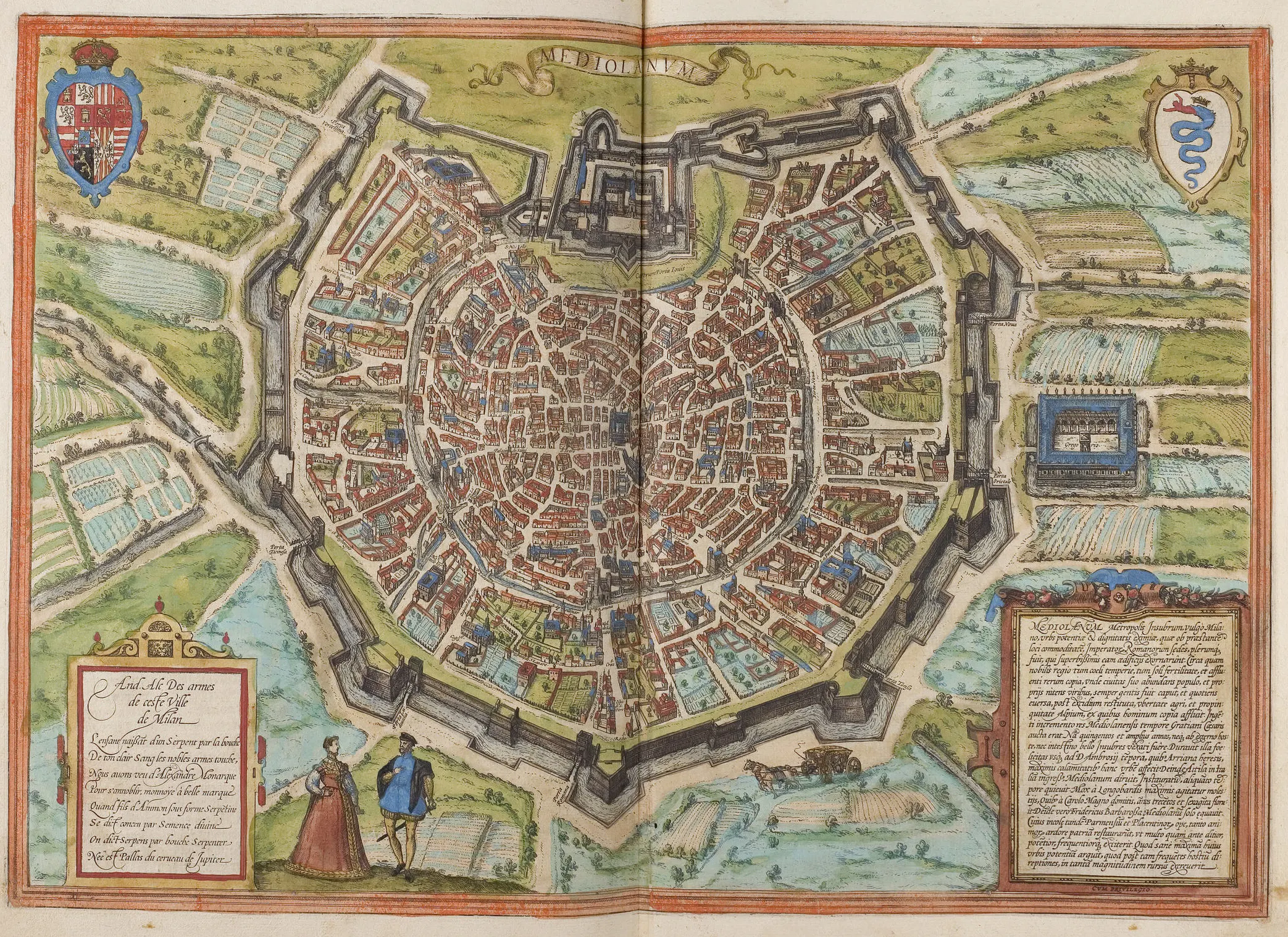
Braun and Hogenberg's sixteenth-century view of Milan places Ferrari's 1613 catalogue in the metropolitan city whose episcopal memory — Ambrose, Borromeo, Protasius — structures so many of his notes. This is the walled, institutionally dense setting in which Borromeo's defence of ecclesiastical immunity against the secular arm could be remembered as a local act of sanctity rather than a distant exemplum. Source ↗.

Finally, the relic notices are given historical depth rather than treated as timeless facts, and here the catalogue's antiquarian and its contemporary registers meet. The body of St Cecilia, the note records, was found by Paschal I in 821 in the cemetery of Callistus, veiled in golden garments and still sprinkled with blood, and was re-entombed by Clement VIII in the same church in 1599, Corpus S. Cæciliæ à Paschale I. An. D. 821. in coemet. Callisti inuentum fuit aureis vestibus velatum sanguine adhuc conspersum. Hoc a Clem. VIII. Pont. Max. reconditum est in eadem Eccl. An. D. 1599. A body has a documented itinerary with dates and named pontiffs, exactly as a text has a transmission; the Trastevere reburial of 1599, barely a decade before this book was printed, becomes the latest attested state of the evidence. The relic is thus subjected to the same historical mode as the acta: not doubted, but dated, and dated by the most recent verifiable act of authority available.
From Clement to the Nativity: Succession, Silence, and Liturgical Particularity
From 23 November to the last day of December the catalogue proceeds on a fixed two-part rhythm: a narrative of the saint, closed by a source-formula naming the Roman Breviary, the monumenta or the liturgical tables of a particular church, and beneath it a scholium headed ANNOTATIO in which that narrative is weighed. The note is not an appendix to the life but its assay, and across these five and a half weeks it performs a surprisingly wide range of operations — repairing a defective succession, diagnosing a duplicated saint, converting an absence of testimony into a dated argument, and, at intervals, declining to decide.
The first substantial entry of the stretch, Clement of Rome, shows the annotatio working constructively rather than only by subtraction. Having discarded the more extravagant matter of the legend as apocryphal, the compiler confronts the ancient disagreement over whether Linus, Cletus or Clement succeeded Peter, and resolves it by supposing that the first two had been Peter's helpers, or vicars, or, as others say, chorepiscopi, adiutores, siue Vicarios, vel vt alij dicunt, Chorepiscopos. The solution is frankly anachronising: the chorepiscopus, a subordinate rural bishop of the fourth-century Greek East, is retrojected into the apostolic generation so that two rival lists of pontiffs may both be true. What makes the move characteristic is not its plausibility but its shape — a canonical category is used as a harmonising instrument, exactly as a datable council will be used elsewhere as a destructive one, and the reader is sent on to Baronius for the fuller treatment. The same critical faculty that prunes the legend also supplies the joinery that keeps the received succession standing.
Against that constructive impulse stands the compiler's willingness to print a blank. At Perugia, pursuing the cult of Felicissimus, he reports his own fruitless enquiry on the spot, that neither could we learn whether his body exists, nor did we find any memory of him at all in that city, sed neque si corpus ipsius extet, scire potuimus, neque vllam prorsus. The first-person plural here is not the modesty of the compiler but the voice of the investigator, and the negative result is treated as a finding worth setting in type. The same discipline governs entries where a church venerates a name and possesses nothing else: of Audentius of Novara the note states that his acts are wanting in the church of Novara, so that up to now it has not been possible to know where and when he lived or died, Acta illius in Ecclesia Nouariensi desiderantur: vt hactenus sciri haud potuerit, vbi, & quando, vixerit, aut obierit. Acta is here the load-bearing evidentiary term, and its absence is declared rather than filled by inference: the cult is registered, the ignorance is dated (hactenus), and the entry becomes a notice of a gap in the documentary record instead of a manufactured biography.
Where documents exist in excess, the difficulty inverts, and the instrument required is philological. Two churches keep a Maximus, and the acts of each have absorbed the other; the note offers the hypothesis that it may be that the Maximus venerated at Reggio Emilia is a different man from the one famous at Riez in Gaul, although the life of the one has been confused with the life of the other, fieri potest vt Maximus, qui Regij Lepidi colitur, ab illo, qui Regij in Gallia celebris est, diuersus sit, licet vita vnius cum alterius vita fuerit confusa. The diagnosis identifies homonymy of place — Regium Lepidi and Regium in Gaul — as the mechanism that generates a phantom double and a disputed body, and it does so in the cautious modality of fieri potest. Neither civic claim is voided, and the authority of Baronius is not simply adopted; instead the disagreement is relocated from the realm of relics to the realm of textual transmission, where contamination between two dossiers is an ordinary and demonstrable event.
The lives themselves are not neutral matter awaiting judgement, and some are admitted intact precisely because they can be made to speak. In the expanded entry for the apostle Andrew the compiler reproduces the Breviary's passion verbatim, including the apostle's declaration to the proconsul that he daily immolates to Almighty God, who is one, not the flesh of bulls nor the blood of goats, but an immaculate Lamb, whose flesh, after the whole people of believers has eaten it, he who was sacrificed remains entire, Ego quotidie Omnipotenti Deo, qui vnus est, immolo non taurorum carnes, nec hircorum sanguinem; Sed immaculatum Agnum, cuius carnes postquam omnis populus credentium manducauerit: ille qui sacrificatus est integer perseverat. Every clause touches a controverted article of the later sixteenth century: the daily sacrifice of the Mass, the oral manducation of the true flesh, and the integrity of the victim under consumption. The apostolic voice is left to state the doctrine without a syllable of commentary, and the annotatio attached to the entry busies itself instead with divergent traditions about the apostle's career. The distribution of critical attention is itself an argument: what the universal liturgical book has already licensed is transmitted whole, while the surrounding historical apparatus absorbs the scepticism.
The pastoral entries carry a comparable double register. Of Peter Chrysologus the compiler records that an old custom had prevailed among the people of Ravenna, that on the Kalends of January masked men should run through the city with images of the gods as though at play, and that St Peter abolished this custom as pernicious by several sermons, Perualuerat apud Rauennates vetus consuetudo. vt Kalendis Ianuarij personati per vrbem cum Decrum simulacris, quasi ludêres discurrerent. Quâ consuetudinem S. Petrus vti pernitiosam aliquot habitis concionibus abstituit. The notice is drawn from the bishop's own sermons against the January mummery, but its placement in a catalogue printed in Borromean Milan gives it a second life as an exemplum of episcopal discipline exercised over inherited civic festivity by preaching alone — no edict, no magistrate, only concionibus. The entry thereby joins the reform of custom to the reform of record: both are matters of a bishop's competence over what his church has received.
The most technically accomplished note of the sequence turns silence into a dated proof. Those who affirm that Saints Antigius and Evasius lived between AD 680 and 700, the compiler writes, are plainly caught in error, for if they had lived before AD 843 they would not have been passed over by Rampert bishop of Brescia, who in that year celebrated the translation of St Philastrius, Qvi Sanctos Antigium, & Euasium inter Ann. Dom. 680. & 700. vixisse affirmant, apertè falli deprehenduntur: nam si ante annum D. 843. vixissent, à Ramperto Episcopo Brixiensi, qui eo anno translationem Sancti Philastrij celebrauit, haud prætermissi fuissent. The argument depends on treating a ninth-century translation narrative as an exhaustive register of the sainted bishops of its see at its own date, so that omission becomes testimony; the compiler then forestalls the natural objection, that the two might not yet have been reckoned among the saints, by appealing to the subsequent silence about their miracles. This is an argument from silence handled with the caution the form requires — the negative witness is dated, localised, and shown to be of a genre that ought to have included the men in question.
An equally exposed chronology, that of Syrus of Pavia, receives arithmetic rather than refutation. Faced with a tradition making him a disciple ordained by Peter and with figures that would give him one hundred and twelve years, the compiler discards the impossible datum, since it would make the saint older than the Lord according to the flesh, and offers instead a calculation: we may therefore conjecture that Syrus was ordained bishop in the thirtieth year of his age and reached his ninetieth year if he sat sixty years, or his eightieth if he sat fifty, Possumus itaq[ue] conijcere Syrum anno ætatis 30. Episcopum ordinatum fuisse, peruenisseque ad annum ætatis 90. si sedit annis 60. vel ad annum 80. S. sedet annis 50. The verb conijcere is doing exact work: the apostolic foundation claim of the Pavian church is neither confirmed nor demolished but made arithmetically survivable, and the compiler leaves two hypotheses standing rather than fabricate one certainty. The same restraint governs his handling of a recently printed Genoese life and office, of which he confesses that the history, to tell the truth, is suspect to me, since the time in which the holy virgin flourished is passed over in silence, Historia, vt verum fatear mihi suspecta est, cum tempus, quo S. virgo floruit — suspicion declared in the first person, directed at a modern printed book, and stopping short of denying the cult it supports.
At 24 and 25 December the calendar abandons its own form. In place of a saint's life the reader is given a continuous Gospel epitome in three movements, dated from the creation of the world and the foundation of the city and furnished with printed marginal references to the four evangelists, and its annotations argue the harmonist's case: but certainly there is no dissonance among the Evangelists; they seem to differ because the same deeds of the Lord are not narrated by all, Sed certè nulla est inter Euangelistas dissonantia. Videntur autem dissidere, quia non eadem ab omnibus gesta Domini narrantur. The principle of selective omission is stated as a general rule of reading and then applied item by item — Matthew silent on the census, Luke on the Magi and the Flight — before the compiler ventures his own opinion on the day of the adoration. It is the same hermeneutic he applies to competing diocesan traditions, that divergent witnesses may be partial without being false, here operating at the one point in the book where the texts under comparison are canonical and no correction is admissible.
The stakes of that calibration are clearest in the entry recording how the Milanese rite was preserved under Hadrian I, where both Missal and Breviary, the Gregorian and the Ambrosian, being closed and left in the church diligently locked, and all having earnestly prayed God to indicate by some sign which was to be used, those who entered found both open with the people looking on, the leaves of the Gregorian scattered through the whole church, Vtroque enim Missali, & Breuiario, hoc est Gregoriano, & Ambrosiano clausis in ecclesia diligenter obserata dimissis, cum Deum omnes enixè rogassent, vt signo aliquo indicaret, quo vtendum esset, ecclesiam ingressi spectante pop. vtrunque apertum inueniunt, Gregoriani paginis per totam ecclesiam sparsis. A judicial ordeal is here applied to liturgical books, and the verdict secures for one church the right to differ from Rome — a claim of no antiquarian innocence in a volume printed a generation after the Breviary and Missal of Pius V, which had exempted only rites of two centuries' standing. The attached annotatio is instructive in what it corrects: the identity of the Frankish king involved, not the prodigy. Chronology, nomenclature and the arithmetic of episcopal reigns remain fully corrigible; the divine ratification of local liturgical particularity does not enter the field of things a note may amend.
The Close of the Calendar and the Supplement of Late-Arriving Lives
The final calendrical entries display the two registers of the book in immediate succession. The life of Barbatianus, the Antiochene presbyter drawn into the orbit of the Theodosian court, closes with the ordinary furniture of a vita — miracles at the cemetery of Callistus, burial by Peter Chrysologus, translation to the Ursiana — and is followed by an annotatio that abandons the saint altogether for imperial chronology. Its business is to fix which of three homonymous emperors the narrative means: Valentinian, the emperor under whom St Barbatianus lived, was the third, who reigned with the younger Theodosius and stayed long at Ravenna and sometimes at Milan, Valentinianus Imp. sub quo S. Barbatianus vixit 3. fuit: qui cum Theodosio iuniore imperauit, diu Rauennæ, & quandoque Mediolani commoratus. Homonymy is resolved by two independent criteria, co-regency and imperial residence, and the note then supplies obits for all three Valentinians, so that the reader is given not an assertion but the apparatus by which the assertion could be checked. The excursus justifies itself in a clause that states the compiler's rationale for interrupting hagiography with dynastic history — something discovered, as he puts it, for the greater knowledge of history, quod ad maiorem historiæ notitiam inuenisse volumus. Notitia historiæ is the operative value: the entry exists to be dated, and the local cult of Ravenna is thereby fastened to a chronology that holds independently of Ravenna's own memory.
What that same entry does not do is equally instructive. The founding legend of S. Giovanni Evangelista is printed without editorial demur — Galla Placidia and her companions obtained by their prayers that St John the Evangelist, clothed in pontifical habit, should dedicate the church, and he, vanishing, left the sandal of his right foot to the same Augusta, precibus impetrant, vt S. Euangelista Pontificali habitu indutus illud dedicaret: qui disparens sandalium dextri pedis eidem Augustæ reliquit. An apparition producing a relic-token, and thus a permanent title to cultic prestige, passes unremarked on the very page whose annotatio is devoted to distinguishing emperors. The asymmetry is not inadvertence but the shape of the method: the instruments the compiler commands — synchronism, regnal lists, epigraphy, topography — bear on time, place, and identity, not on the possibility of a marvel, and where no datable proposition is at stake there is nothing for the apparatus to grip. Imperial patronage supplies the same entry's other load-bearing claim, since Barbatianus is taken with her to Ravenna by Galla Placidia Augusta, mother of Valentinian, on account of these and other signs performed at Rome, Romæ patrata à Galla Placidia Augusta Valentiniani matre secum Rauennâ deducitur: the thaumaturge is transferred by an Augusta, and the see's standing is grounded in a court connection that the chronological note has just made verifiable.
After the FINIS that closes December, a fresh title-block announces a supplement whose rationale is frankly bibliographic rather than devotional: lives of the saints which, being transmitted to us too late, could not be placed in their proper positions, SS. VITÆ QVÆ AD NOS TARDIVS transmissæ suis apponi locis non potuere. The formulation discloses the conditions of the book's making. Material reached the compiler by correspondence with particular churches and religious houses, and arrived at a rhythm the press could not accommodate; rather than suppress the late-comers or force them into an already-set calendar, he prints them as a distinct gathering re-sequenced from January onwards, each entry retaining its proper feast-date. The appended matter is thus declared integral to the work and simultaneously marked as extrinsic to its architecture — an admission that a catalogue of this kind is never closed, since the flow of local monumenta does not stop when the sheets are printed.
The first supplementary entry shows what happens when the documentary deposit has vanished entirely. Alexander of Fermo has no acta, and the entry substitutes for them an inscription reproduced in the printed text, where this epitaph, written in Lombardic letters, is read: here lies hidden the most blessed body of the glorious martyr and bishop Alexander, vbi epitaphium litteris Longobardicis scriptum hoc legitur. Hic IACET RECONDITVM BEATISSIMVM CORPVS GLORIOSI MARTIRIS, ET EPISCOPI ALEXANDRI. The palaeographic label carries an implicit argument: script-form is offered as evidence of antiquity, and the stone is asked to do the evidential work of a passio. The absence of the passio is itself explained historically rather than left as a lacuna, the records being those which are said to have perished when the city was burned under Frederick I, Emperor, sub Frid. I. Imp. incensa perysse ferantur — a causal account of silence that recurs in the same diocese's other entry. Documentary poverty is thereby converted from an embarrassment into a datable event of imperial politics, and the diocese's inability to prove its saints becomes evidence of what it suffered.
Against a named modern authority the technique is arithmetical. The Trentine chorographer Pincio supplies the episcopal sequence and is convicted from within his own pages, for he writes that the donation of Conrad to the church of Trent was confirmed by Frederick Barbarossa in AD 1101, whereas Frederick took the Empire in 1152, donationem Conrbandi Eccl. Tridentinæ factam a Frid. Ænobarbo an. D. 1101. confirmatum scribit, cum Fridericus Imperium an. 1152. ceperit. A single fixed accession date is set against a reported confirmation and the incompatibility is displayed rather than smoothed; the same operation is announced as a duty in the companion note on the same author's episcopal sequence, which takes from Pincio the ranking of Adalpretus as seventieth bishop of Trent and Vigilius as eighteenth while declaring that an error in this author concerning chronology has been noticed and must not be concealed. That refusal to dissemble is the ethical core of the apparatus: a source may be exploited and impeached in the same breath, and the impeachment is owed to the reader. Yet the criticism stops short of the entry's substance. Adalpretus dies in a feudal war he himself provoked, having enfeoffed Garda to the Veronese to secure their arms, and the narrative assimilates his end to martyrology without qualification — the Castelbarco run him through by guile with a lance in the said valley near the town of Rovereto and make away with him, on the sixth of the Kalends of April, in the year after Christ's birth 1181, not unpunished, fixum è medio tollunt. 6. Kal. Aprilis Anno post Christum natum 1181. non impunè:. The date is scrutinised; the transformation of a territorial war into a passion, and the providential retribution attached to it, are not.
The taxonomic discipline that governs the calendar as a whole surfaces in the neighbouring Fermo entry, where the day on which the saint's memory is celebrated is declared not his natalis, which is unknown, but his translation, non natalis (qui ignoratur) sed translations est. The parenthesis is the substance: ignorance of the death-day is stated, and the feast is reclassified accordingly, so that a liturgical observance is prevented from generating a spurious biographical datum.
The Istrian entry for Nicephorus of Pedena is where the book's economy is most exposed. A potentially scandalous report is neither excised nor defended but domesticated by scriptural typology: being now worn with age he kept two nieces with him, who would warm him with their heat, like another David, Is iam senio confectus duas apud se neptes habebat: quæ illum calore suo vti alterum Dauid fouerent. The allusion to the aged king warmed by the Shunammite converts a datum that had provoked a metropolitan accusation into a recognisable biblical figure, and the narrative then acquits the bishop by miracle, the pallium hung upon a sunbeam serving as judicial vindication before the patriarch of Aquileia. The annotatio that follows refuses to underwrite any of it while declining to suppress it, and it is here that the compiler makes the declaration of editorial economy already set out above: the history may justly seem suspect, since it makes no mention of time and appears to relate improbable things, yet he chooses to report it briefly all the same, reckoning it a welcome service that, where accurately written accounts are lacking, whatever could be had should be set down. Two grounds of suspicion are named, silence about time and intrinsic improbability, and the first is the operative one: a narrative that cannot be dated cannot be tested. Printing under warning is thus presented as a service to future inquiry rather than as credulity, and it is reinforced typographically by the shoulder-note branding the piece a history of suspect faith, so that the verdict travels with the text down the margin.
Philological control returns with the Augsburg entry, where the 1579 recognition of relics at Milan produced a leaden coffin naming the bishop Ardericus, and the annotatio treats the discrepancy as a problem of collation: this holy bishop is variously named, for he is Vidaricus at Augsburg, as also in the Roman Martyrology, V Ariè hic S. Episcopus nominatur: nam Vidaricus Augustæ, vti & in Martyrol. Local epigraphic usage and the universal liturgical book are placed side by side as two attestations of one person, the divergence explained rather than adjudicated away. The neighbouring Istrian entry shows the same restraint applied to time: whether St Pelagius suffered martyrdom in the same persecution as St Maximus the bishop, or in another before or after, is uncertain, AN S. Pelagius in eadem persecutione, in qua S. Maximus Episcopus, martyrium pertulerit, vel in alia ante, siue post, incertum est: — an argument from the silence of the companion passio, carefully bounded, which manufactures no persecution to fill the gap.
The work ends by narrating a relic's disappearance and recovery and then by leaving hagiography altogether. Of Sosius the note records that when that church, together with the city, had been laid waste by the Hagarenes, its relics long lay hidden, until in the year of salvation 920 they were found by John the Deacon of Naples, who wrote the history of the invention, Cum autem ea Ecclesia cum vrbe ab Agarenis vastata fuisset, reliquiæ ipsius diu latuerunt, donec anno salutis 9020. à Ioanne Diacono Neapolitano (qui inuentionis historiam scripsit), the whole cycle of devastation, latency and inventio compressed into a clause that names its ninth-century source. The final annotatio then asks not who the saint was but where Misenum stood, and answers from the ancient geographers, its situation being mentioned among others by Strabo book 5, Pliny book 3 chapter 5, Ptolemy book 3 chapter 1, mem. Strabo lib. 5. Plin. lib. 3. c. 5. Plot. lib. 3. c. 1. The catalogue closes, before its second FINIS, with the lecturer in mathematics and topographer at work inside the hagiographer: a cult site is fixed on the Campanian coast by humanist authority and surviving ruins, and the sacred geography of Italy is secured, at the last, by the same means as any other geography.
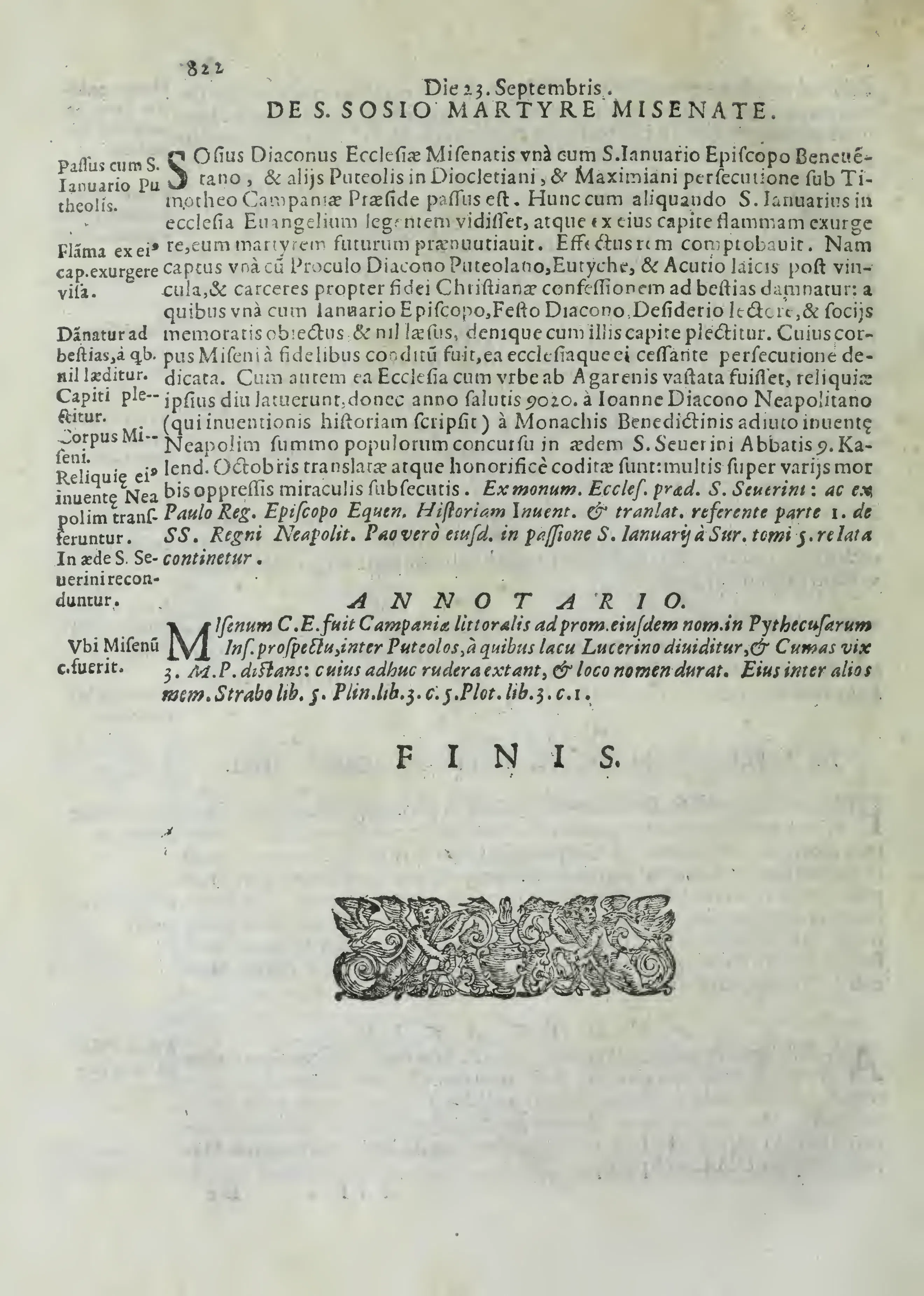
On the calendar's final substantive page, the entry for Sosius moves from martyrdom and relic history into an ANNOTATIO that locates Misenum through ancient geographical authorities, turning a saint's cult into a question of place. The large FINIS and ornamental woodcut tailpiece make that convergence materially visible, closing the catalogue with the tools of both hagiography and topography. Source ↗.
Frequently Asked Questions
What is Filippo Ferrari's Catalogus Sanctorum Italiae?
It is a Latin hagiographical catalogue of the saints of Italy, printed at Milan by Girolamo Bordone in 1613 and arranged as a calendar distributing the saints through the twelve months of the year. Under each day it gives an abbreviated life or passion drawn from the monuments of particular churches, and then prints beneath it a short critical note testing the account against imperial reigns, councils, pontificates, inscriptions and documents. Its alphabetical index records whether a figure appears in the Roman Martyrology and where a body is found or venerated, keeping local cult, historical proof and universal liturgical recognition distinct.
Who was Filippo Ferrari?
Filippo Ferrari was a Servite friar, theologian and geographer, born at Oviglio in the Alessandria district in 1551 and dead at Milan on 3 September 1626. His authority formula names him a master of theology and public lecturer in mathematics at the Studium of Pavia; the epithet Alexandrinus means "of Alessandria" in Piedmont, not Alexandria in Egypt. He published an Epitome geographicum at Pavia in 1605 and a Nova topographia in Martyrologium Romanum at Venice in 1609, and the 1613 catalogue records in his own voice that he held the office of Prior General of his order in 1609.
How did Ferrari argue that the acts of Protasius of Milan could not be true?
By arithmetic. If Protasius attended the Council of Sardica held in 347 under Julius I and also consecrated Epiphanius bishop of Pavia in 466, he would have sat as bishop for more than 119 years — so the Acts of St Protasius must be corrected. The argument turns entirely on synchronism between two datable events, a council and a consecration, and it is directed at a metropolitan see's own episcopal records. Comparable notes elsewhere reject a genealogy making the Roman virgin Petronilla a daughter of the Apostle Peter, and dismiss the tale of a bear carrying St Marinus as a fable.
What does the annotatio beneath each life do, and where does Ferrari's criticism stop?
The annotatio — the short critical note appended to each entry — weighs the preceding life as testimony rather than amplifying it devotionally. Acts are declared wanting, in need of correction, corrupt, or of suspect faith; feasts are reclassified as marking a translation or consecration rather than a death; homonymous saints are separated and doubled ones merged. Unverifiable matter is still printed, but under warning. The boundary is declared openly: where the Church's authority in the Breviary compels, the compiler defers, conceding at one point that were it not for that authority he would side with Damasus.
Is there an English translation of the Catalogus Sanctorum Italiae?
No published English, Italian, French, German or other vernacular translation of the 1613 work has been located in the catalogues and digital repositories consulted, and no modern critical edition or scholarly diplomatic transcription has been identified either; that negative finding reflects the searchable records examined and should not be treated as proof that none exists. Separately, the Leo edition presents the full transcription of the Latin text together with a complete English translation for the first time. That translation is generated by AI. Leo works to make free English translations of every text printed in Latin in early modern Europe, between 1450 and 1750, available online at no cost.
This report was generated by an advanced AI assistant that conducted deep research alongside an extensive interpretation of the transcribed original text. Every effort has been made to preserve fidelity to the source and to guard against inaccuracy, but corruption in the text recognition process and model hallucination may nonetheless have entered the text. Treat every claim, quotation, translation, and citation as provisional, and verify each against the original source before relying on or citing it.
Further Reading on Ferrari, Counter-Reformation Sanctity, and Critical Hagiography
- Clare Copeland, "Saints, Devotions and Canonisation in Early Modern Italy," History Compass: Copeland reconstructs canonisation as a slow, contested transaction among local devotees, religious orders and Roman congregations rather than a verdict handed down from above. Read alongside Ferrari, it explains why a single calendar can record a solemn inscription in the Album Sanctorum under Paul V, a locally approved office, and a cult with no formal standing at all, and treat the three as genuinely different things.
- Simon Ditchfield, Liturgy, Sanctity and History in Tridentine Italy: Pietro Maria Campi and the Preservation of the Particular: The indispensable comparative case, showing how a Piacentine contemporary of Ferrari used local liturgy, archives and ecclesiastical history to defend his church's particulars while operating inside Roman norms. It supplies the framework that makes sense of the moment when Ferrari's criticism halts at the Breviary and he records his own dissent instead of pressing it.
- Jan Machielsen, Emily Michelson, and Katrina B. Olds, eds., The Cambridge Companion to Counter-Reformation Sanctity: The best single orientation to sanctity between roughly 1500 and 1750, spanning theology, institutions, devotion, art and material culture, with Ditchfield's chapter on hagiography tracing the road toward Bollandist method. It clarifies what Ferrari was defining himself against when he wrote of the popular vernacular legendary that the life in the Flos Sanctorum, the one in circulation, contains certain things close to fables, among which is that about the lion, and about the ass devoured by the lion, Vita illius in Flore SS. & quæcircunfertur, quædam fabulis proxima continet, in quibus illud de Leone, & de asino à Leone deuorato.
- Serena Spanò Martinelli, "Provincia Italia e province d'Italia: il grande abbraccio del Catalogus sanctorum Italiae di Filippo Ferrari (1613)," Viella: The only sustained study devoted to this book, and the reason to read it as a construction of Italian ecclesiastical space rather than as a list of names. Her emphasis on the relation between Provincia Italia and the Italian provinces also explains why Ferrari audits the very chorographers he plunders: according to the aforesaid Pincius, Adalpretus was the seventieth bishop of Trent and St Vigilius the eighteenth, but we have noticed an error in this author concerning chronology that must not be concealed, Ex Pintio prædicto Adalpretus 70. Ep. Tridentinus fuit, & S. Vigilius 18. veru[m] errorem in hoc authore circa tempus non dissimulandum animaduertimus.