Both to Me and to Peter: Johann Funck's Chronologia
Johann Funck was executed at Königsberg in 1566, but the Latin chronicle he left behind — the Chronologia, a synchronistic register in which Romans, Jews, Franks, Goths, Saracens, Poles, Britons and the Teutonic Order run side by side down a single ruled column of years — carried on without him, extended by anonymous hands to 1578 and then to 1601. Its wager is that fixing a date is already an act of doctrine: the Roman monarchy is made to begin with Julius Caesar rather than Augustus, papal primacy becomes a grant obtained from a parricide emperor, and the 1,260 years of Antichrist are counted out to 1521, the year Luther stood before the Diet at Worms. For anyone curious about how sixteenth-century scholars turned arithmetic into argument, this is the machinery laid bare.
ExLatinis
August 20, 2026
Contents
Johann Funck was executed at Königsberg in 1566, but the Latin chronicle he left behind — the Chronologia, a synchronistic register in which Romans, Jews, Franks, Goths, Saracens, Poles, Britons and the Teutonic Order run side by side down a single ruled column of years — carried on without him, extended by anonymous hands to 1578 and then to 1601. Its wager is that fixing a date is already an act of doctrine: the Roman monarchy is made to begin with Julius Caesar rather than Augustus, papal primacy becomes a grant obtained from a parricide emperor, and the 1,260 years of Antichrist are counted out to 1521, the year Luther stood before the Diet at Worms. For anyone curious about how sixteenth-century scholars turned arithmetic into argument, this is the machinery laid bare.
Johann Funck (1518–1566) was born at Wöhrd near Nuremberg, studied at Wittenberg, and rose to become court preacher at Königsberg in the service of Duke Albrecht of Prussia and in the theological orbit of Andreas Osiander; he was executed there on 28 October 1566 in the collapse of the Prussian political and ecclesiastical crisis. The work for which he is chiefly remembered is not a sermon collection or a confessional treatise but a Latin synchronistic universal chronicle — a chronology of all times and years from the beginning of the world, laid out so that the reigns of many peoples can be read across a single register of years, and accompanied by discursive books of commentary and a large index of memorable things and words. First recorded at Nuremberg in 1545 from the press of Georg Wachter, and reaching then only to the Resurrection of Christ with a single book of commentary, it grew through a Königsberg issue of 1552 with ten books of commentary, a Basel issue associated with Oporinus in 1554, a Wittenberg issue of 1570, and a Wittenberg issue of 1601 printed by Zacharias Lehmann for the bookseller Andreas Hoffmann, whose title page distinguishes the author's own recensions from anonymous continuations carried to 1578 and again to 1601.
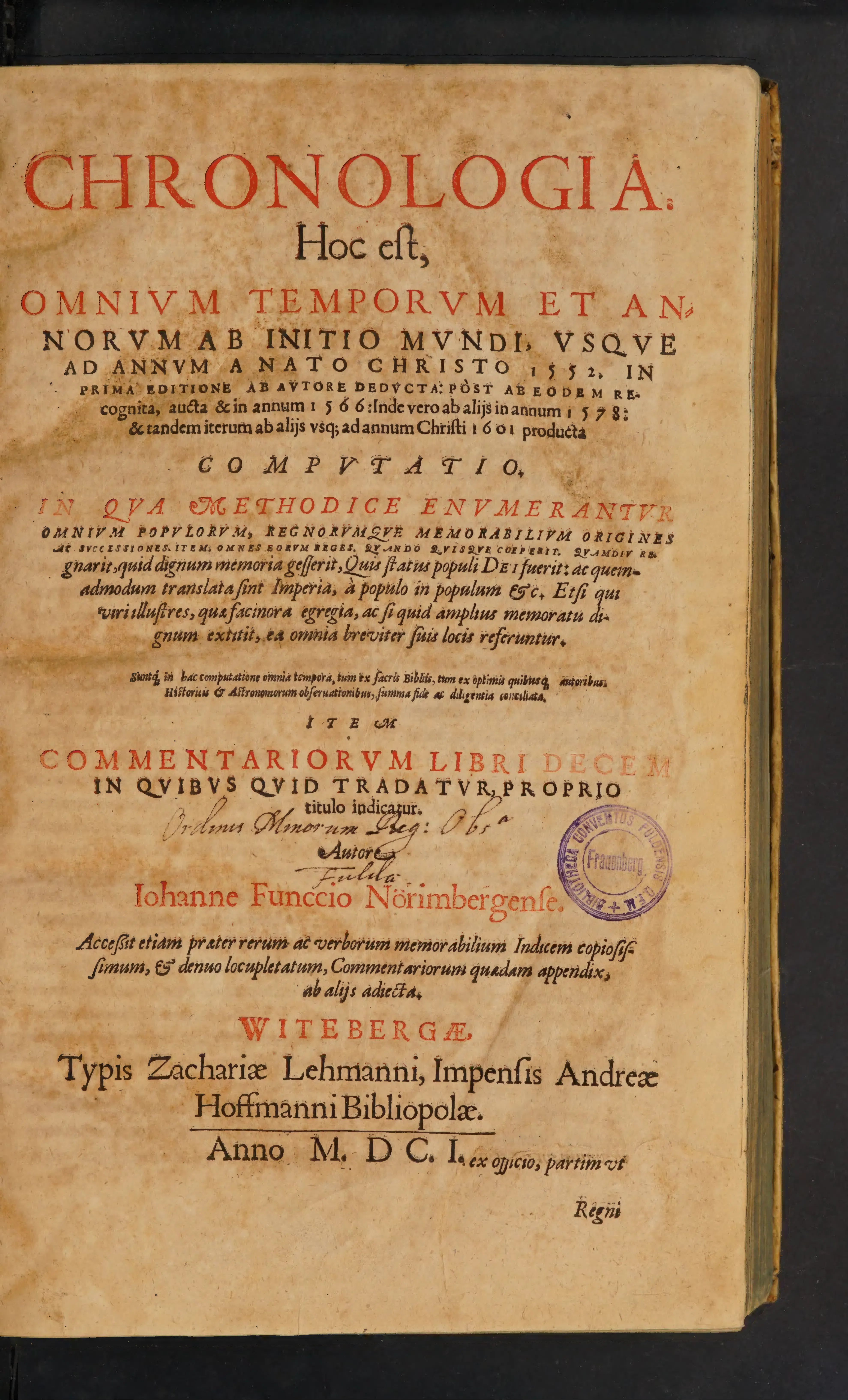
The 1601 Wittenberg title page makes visible the accumulated form of Funck's Chronologia, announcing a universal chronology carried beyond the author's own revisions by unnamed "ab alijs" continuators to 1578 and 1601. Its imprint names Zacharias Lehmann and Andreas Hoffmann and promises ten books of commentary, an enlarged index, and appended matter. Source ↗.
The intellectual problem the chronicle sets itself is the reconciliation of incompatible measures of time. Scripture, the Greek and Roman historians, the consular fasti, the Olympiads, years of the world, of the city, and of Christ, and the results of astronomical calculation do not agree; Funck's undertaking is to force them onto one verifiable line and then to read that line as the disclosure of a prophetic pattern. What gives the work its character is the move by which he joins those two ambitions: a date is established by collating and emending numerals in the received authorities, and the date so established is then made to carry doctrinal weight. Computation and polemic are not successive operations but one operation. The Roman monarchy is dated from Julius Caesar rather than from Augustus; the foundation of Roman primacy is contested by historical argument about when Peter reached Rome and by the claim that the see's headship was an imperial grant from Phocas; the Donation of Constantine is flatly denied; the 1,260 years of Antichrist are given a beginning in the year 261 and an end in 1521; and even the Hebrew etymology of the Jubilee is turned into an argument against works-righteousness.
The stakes of that procedure are both technical and confessional. Sixteenth-century chronology was in the process of becoming a discipline with its own standards of evidence, and Funck belongs to the generation working before that consolidation: he already collates heterogeneous authorities and worries openly about their disagreement, sometimes confessing his own errors, but his purpose remains providential and ecclesiological. At the same time, Lutheran universal history was performing institutional work, supplying a confession with a past and an account of how ecclesiastical and imperial authority ought to be periodized. The phrase translatio imperii, which the title-page synopsis expressly invokes, sits precisely on that seam: in a Lutheran chronicle the succession of empires is something to be demonstrated from historical evidence rather than conceded to papal claims as an ahistorical inheritance.
What a first-time reader is most likely to find striking is how far the polemical energy reaches into the machinery of dating itself. Parallel registers hold Romans, the church, Jews, Franks, Goths, Saracens, Poles, Britons, Scandinavians, and the Teutonic Order in synchrony, so that the ecclesiastical column can be read against the imperial one year by year. The commentary attacks papal succession-lists as the work of flatterers, narrates the pope treading on the neck of a prostrate emperor, and makes 1521 — Luther before the Diet at Worms — the terminal year of an apocalyptic arithmetic begun with a third-century heresiarch. Its philology is opportunistic and wide-ranging, pressing etymologies into evidentiary service and preferring, in contested matters, the conclusion drawn from Scripture over the conclusion drawn from the Fathers. Reports of a promised separate commentary on the Apocalypse, of a 666-year reckoning, and of a redefined abominatio desolationis circulate with the work, but they await confirmation against the printed leaves.
The most arresting fact about the object's later history is that the chronology outlived its author's condemnation. Funck was executed in 1566, yet Wittenberg presses issued the work in 1570 and again in 1601, and unnamed hands extended his timeline into a present he never saw — through the Gregorian calendar reform, whose bull is reproduced in the appended matter, and on toward the end of the century. The continuators are identified on the title page only as others, ab aliis, and no named continuator, corrector, or privilege holder has been recovered; nor has the status of the Chronologia in the Roman or Iberian indices been settled either way. The record has also acquired a foreign body: a Neapolitan Jesuit didactic poem of 1715 has become attached in catalogue transmission to a Funck object, an error of metadata rather than of authorship. What holds the work's vocabulary, its printing history, and its internal argument together is the same conviction that animates its columns — that the order of years is itself an argument, and that whoever fixes the numbers has begun to settle the doctrine.
Read the full text and English translation on Leo
This text was transcribed and translated as part of the ExLatinis project, an effort by Leo to make free English translations of every text published in Latin in early modern Europe (1450–1750) available online. The complete transcription and English translation of this work can be read free of charge:
→ Read the original Latin text and full English translation on Leo
You can save a copy of this document into your Leo account to run deep text searches, conduct further analysis, or cross-reference it with your own research.
Naming Funck's Chronologia and Reading Its Latin Vocabulary
Editorial title: Johann Funck's Chronologia: A Synchronistic Universal Chronicle, Commentary, and Continuation, 1545–1601. This English title is supplied for convenience; it is not an established title of a modern critical edition. The Latin title and catalogue descriptions identify a chronology of all times and years from the beginning of the world, with ten books of commentary, a comprehensive index, and later appended matter.
The phrase translatio imperii is especially apt for the work's historical architecture. In the period it did not mean merely that political power changed hands; it named a providential and historiographical account of the succession of imperia, by which the rise and decline of peoples, kingdoms, and dynasties could be arranged in a single temporal order. The title-page synopsis expressly asks how empires were transferred. In a Lutheran universal chronicle that formulation could carry a confessional charge: succession was to be demonstrated from historical evidence rather than conceded to papal claims as an ahistorical inheritance. The chronicle uses the vocabulary at the decisive juncture, registering that on this very day the dignity of the Roman Empire was transferred by the pope from the emperors of Constantinople to the Franks, hoc ipso die Romani Imperij digniras, à Constantinopolitanis Imperatoribus, per Papam ad Francos est translata — a formulation in which the transfer is an act performed per Papam, and therefore an act with an agent, a date, and a documentary history open to scrutiny rather than a silent fact of succession. The accessible catalogue evidence establishes the phrase's function in the synopsis, but not every polemical elaboration in the commentary.
The 1601 title's appendix, ab aliis adiecta performs the function ordinarily conveyed by auctarium: an addition that extends an inherited work beyond the author's last recension. Here the bibliographical point is material as well as semantic. The title page distinguishes Funck's original work, his revision to 1566, and later anonymous extensions to 1578 and 1601; it does not name the continuators. The exact heading Auctarium was not recovered from the accessible catalogue transcription, so it should not be silently substituted for the title-page's appendix. Likewise, superioritas is a juridical term for superior or overriding authority, not a general synonym for power. It is an appropriate description of the imperial-estates argument traditionally associated with Protestant resistance to the Gregorian calendar, but the relevant passage and its page location were not independently verified in the accessible scan and therefore remain a provisional textual attribution to this object. The question of who holds the superior authority is nevertheless staged narratively in the commentary, in the scene where the pope humiliates a prostrate emperor, Tum Bestia illa Papa prostrati Imperatoris (summæ Monarchæ) collum pedibus conculcans, ait Scriptum est: Super Aspidem & Basiliscum ambulabis [IMAGE ID: bib_fict_9736975-png-662.png] — then that Beast the pope, treading with his feet on the neck of the prostrate emperor (the supreme monarch), said: It is written, Thou shalt walk upon the asp and the basilisk — where the parenthetical designation of the emperor as supreme monarch does the juridical work that the technical noun would do in a legal brief.
The work's own philological habits supply the clearest gloss on why such keyword questions matter, and they exhibit in miniature the procedure that governs the whole: a word is established, and the established word is then made to carry doctrine. The treatment of the Jubilee begins from Hebrew etymology, observing that Jubilee takes its name from the Hebrew word iobel, which for the Hebrews signifies a trumpet, IVBILEVS nomen habet ab Hebræa voce lobel, quæ Hebræis Bucchinam significat, and it proceeds from the philological observation to a soteriological conclusion drawn from the sabbatical prohibition of harvest, Hoc est, nemo in Christi Regno constiutus, opus habet, vt suis laboribus, operibus, aut quicquid humanæ vires possunt, / itam mereatur æternam, sed hoc sub anathemate prohibetur, that is, no one established in Christ's kingdom needs to earn eternal life by his labours, by his works, or by whatever human powers can accomplish; rather this is forbidden under anathema. The etymological step is not ornamental: it is the evidentiary basis on which the doctrinal step is made to rest.
What Funck's Chronologia Is, and Which Editions Carry It
Johann Funck's Chronologia is a Latin synchronistic universal chronicle with a substantial historical and ecclesiastical polemical dimension, not a poem or a private theological memorandum. The first recorded issue is Nuremberg, Georg Wachter, 1545; its title reaches from the beginning of the world to Christ's Resurrection and includes a single book of commentary. A Königsberg issue of 1552, catalogued as Regiomontum Prussiae, presents the expanded title with ten books of commentary. The work was enlarged in subsequent recensions, including the Basel/Oporinus issue of 1554, the Wittenberg issue associated with Schwertel in 1570, and the Wittenberg issue printed by Zacharias Lehmann for Andreas Hoffmann in 1601.
The work's driving purpose was to reconcile chronological systems drawn from Scripture, historians, and astronomical observation while methodically enumerating the origins and successions of peoples and kingdoms, their rulers and regnal periods, memorable deeds, the condition of the people of God, and the transfer of empires. That enumeration is genuinely comprehensive in reach, extending well beyond Christian polities: the rise of Islam enters the register in the same annalistic form as any dynastic succession, MACHOMET in Arabia Pro, recording that Muhammad in Arabia is called a prophet. The periodizing decisions that follow from the programme are themselves substantive: the Roman monarchy is dated from Julius Caesar rather than from Augustus, the entry marking the end of the Republic reading, Gaius Julius Caesar, the Republic having been crushed, C. IVLIVS CAESAR oppressa Repub. C. Iulius Cæsar. II. The printed structure therefore combines synchronistic tabulation with discursive interpretation: the catalogue description expressly records ten books of Commentarii and a copious index of memorable things and words, while the 1601 title page adds an appendix by later hands. The chronological scheme is inseparable from confessional interpretation of church history and from the question of how imperial and ecclesiastical authority should be periodized; more detailed claims about its apocalyptic calculations and anti-papal vocabulary require direct examination of the relevant leaves. The commentary does, however, identify its principal target in explicit terms: it is known to all, the text asserts, that all the power and majesty of the whole Roman pontificate was first built upon this single foundation, that the Lord said to Peter, Thou art Peter, and upon this rock I will build my church, Notum est omnibus, quòd omnis totius Romani Pontificatus potentia atq[ue] / maiestas, / super vnicum hoc fundamentum primitus extructum est, Quòd Dominus / dixerit Petro: Tu es Petrus, & super hanc Petram ædificabo Ecclesiam meam — a statement of the adversary's position framed so that the whole edifice can be made to depend on a single historical and exegetical claim, and so brought within the reach of chronology.
Johann Funck, also Johannes Funccius or Funcke, is the correct authorial identification. He was born at Wöhrd near Nuremberg in 1518, studied at Wittenberg, served Duke Albrecht of Prussia, became court preacher at Königsberg in the orbit of Andreas Osiander, and was executed there on 28 October 1566 after the Prussian political and ecclesiastical crisis. The assertion that he was Osiander's son-in-law is not established by the authoritative biographical record and should not be repeated as fact; that record calls it an unprovable, though widespread, claim.
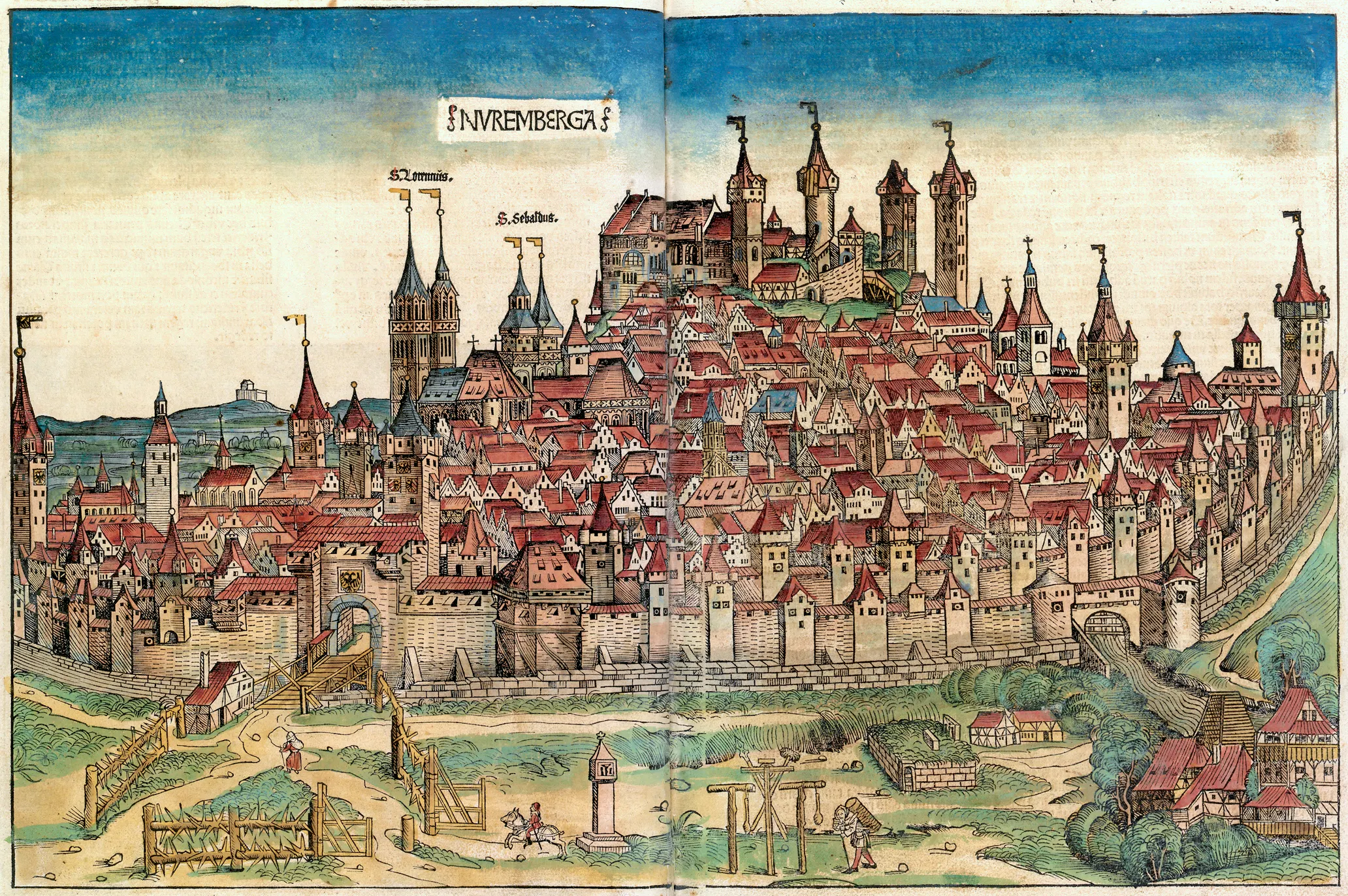
Woodcut view of Nuremberg from the Nuremberg Chronicle, the city beside which Funck was born at Wöhrd and in which his Chronologia was first printed in 1545. As a product of the same late-fifteenth-century humanist printing culture, the image evokes the learned milieu Funck inherited rather than a later romanticized memory of his birthplace. Source ↗.

No German translation or partial vernacular rendering of the Chronologia or its commentary was located in the catalogues and digital records searched. The work is consistently catalogued as Latin. Funck's separate German theological writings do not constitute evidence for a German version of the Chronologia, and the absence of a located translation is not proof that no such rendering ever circulated.
The 1715 Naumachica is a separate book: Nicolò Partenio Giannettasio's Neapolitan Jesuit didactic poem, printed at Naples by Bernardo Michele Raillard in 1715, in quarto, with its own pagination, signatures, engraved dedication material, and the Real Biblioteca shelfmark 12-II-49. Its author, date, genre, format, and contents exclude identification with Funck's Latin chronicle. The provenance of the erroneous attachment of the Giannettasio record to a Funck object was not documented; the evidence establishes a catalogue or metadata conflation, not its precise administrative cause.
Reading Funck between Scaliger's Chronology and Lutheran Confessional History
Funck's Chronologia matters because it stands at a productive intersection of Lutheran universal history, technical chronology, biblical exegesis, and the political history of Ducal Prussia. It preserves a form of historical reasoning in which chronological precision and confessional polemic are not separate enterprises. The fusion is visible wherever a date is also a fulfilment: the dynastic transition that brings Herod to power is read as the moment prophesied to the patriarchs, the text glossing it as the sceptre taken away from Judah of which Jacob spoke when about to die, Hic Sceptrum / ablatum à Iuda, de quo dicit Iacob Patriarcha moriturus. Gene. 49. The work's effort to coordinate Scripture, historians, and astronomical observation belongs to the sixteenth-century transformation of chronology, but its purpose remains providential and ecclesiological: temporal order is also an argument about the succession of peoples, churches, empires, and authorities.
The most useful broad historiographical contrast is between the methodological history of chronology and the history of confessional identity. Anthony Grafton's studies of Joseph Scaliger describe the latter's Julian Period, criticism of historical forgeries, and insistence on the independent evidentiary value of non-biblical sources. That framework helps locate Funck before the full consolidation of Scaligerian chronology: Funck already collates heterogeneous authorities and worries about chronological disagreement, yet the surviving catalogue evidence does not justify attributing to him Scaliger's later methodological system. The critical impulse is nonetheless present in his handling of the numerals themselves, as when he directs the reader to Eusebius, Ecclesiastical History book 2 chapter 24, where you will correct the error in the numbers of Nero's years, Hist. Eccl. li. 2. ca. 24. vbi emendabis erroré in nueris annoru[m] Nerois:, an instruction that sets the reader to emending an authoritative source rather than to harmonizing it. A direct, sustained modern study of Scaliger's treatment of Funck's computations was not located.
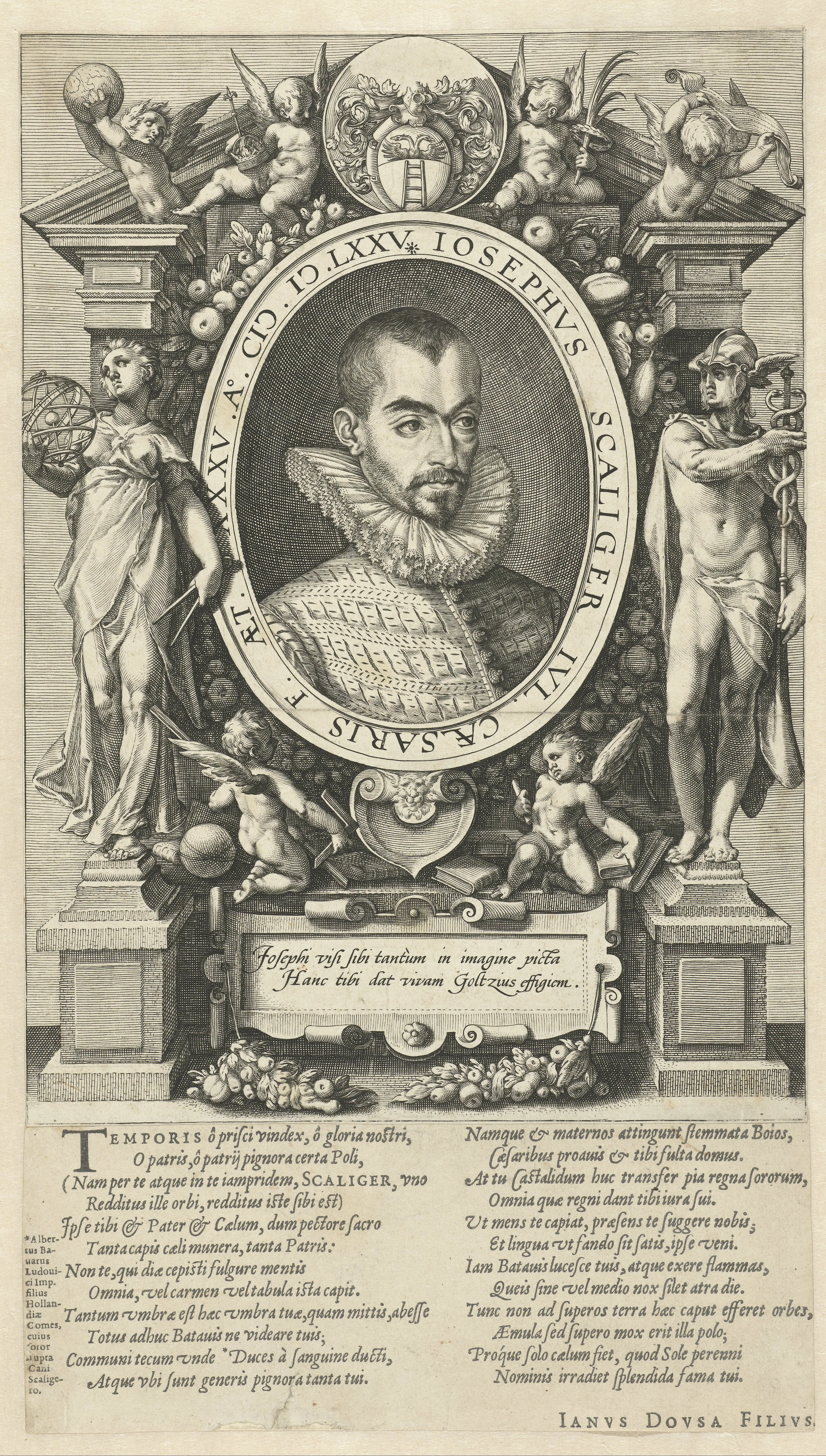
Hendrick Goltzius's 1575 engraved portrait of Joseph Scaliger, set within an architectural frame with emblems of learning. Scaliger stands here as the later methodological horizon for Funck's chronology — the figure of philological criticism and evidentiary consolidation against which Funck's earlier, still-confessional handling of authorities is measured. Source ↗.

C. Philipp E. Nothaft's work on calendrical astronomy and calendar reform supplies the technical context for the Gregorian-calendar material associated with the late continuation, but the source located for Nothaft did not establish a direct discussion of Funck. The same caution applies to Robin Bruce Barnes's 2002 article, “Varieties of Apocalyptic Experience in Reformation Europe,” and to Irena Backus's studies of Reformation readings of the Apocalypse: they are valuable for interpreting Lutheran and Reformed apocalyptic practice, but direct treatment of Funck was not verified. The 1601 catalogue transcription likewise does not independently expose the alleged passages on the 1260 years, 666, the abominatio desolationis, or the promised Apocalypse commentary. The commentary itself, however, does state the 1,260-year scheme in explicit and dated terms, reckoning from this year 261, in which that treading-down began through the Samosatene, the beginning of those years which end with the year of Christ 1521, in which Luther, victorious before the Empire, undertook most strongly to destroy the kingdom of Antichrist, ab hoc / anno 261. quo per Samosatenum calcatio illa initium sumpsit; ego quoq[ue] eorum / annorum principium facio, qui finiuntur cum anno Christi 1521. Quo Lutherus / coram imperio victor, Antichristi regnum fortissimè destruere aggressus est — the first person here marking the calculation as the author's own decision, and the terminal year converting an apocalyptic number into a datable event of the recent Lutheran past. The 666-year reckoning, the redefinition of the abominatio desolationis, and the separate Apocalypse commentary remain, on the evidence assembled here, unconfirmed against the printed leaves.
Matthias Pohlig's Zwischen Gelehrsamkeit und konfessioneller Identitätsstiftung: Lutherische Kirchen- und Universalgeschichtsschreibung, 1546–1617 places Lutheran ecclesiastical and universal historiography between learned historical method and confessional identity-making, and specifically treats Apocalypse commentaries as important to the development of Lutheran historiography. That emphasis complements, rather than simply repeats, Grafton's account of disciplinary chronology. The contrast is interpretive rather than a proven disagreement about Funck: Grafton foregrounds evidentiary and methodological change, whereas Pohlig foregrounds the institutional and confessional work performed by historical writing. Both emphases are legible in the Chronologia, and often in the same sentence, since Funck's confessional conclusions are reached by way of source criticism. The papal succession-list is polemicized at the level of its entries, with the remark that Platina and other papal flatterers place Cletus in this place, whose mention in the canon of the Mass follows, Platina & alij Pontificij adulatores CLETVM hoc loco ponunt: cuius in canone. The primacy is then relocated from apostolic institution to imperial concession, the text recording that he obtained from the emperor Phocas, after great contentions, that the Roman see should both be called and be held the head of all churches, is à Phoca Imperatore magnis contentionibus obtinuit, vt Romana sedes, & diceretur & haberetur omnium Ecclesiarum caput; and the principal documentary title to temporal dominion is dismissed outright as a fabrication, Hæc est illa Constantini Magni donatio, de qua Papa mentitur, this being that donation of Constantine the Great about which the pope lies. Each of these is a chronological claim before it is a doctrinal one — a matter of who granted what, and when — which is precisely the conjunction Pohlig's framework is designed to describe.
The Osiandrist setting is indispensable. Martin Stupperich's Osiander in Preussen 1549–1552 provides the specialist political and theological context for the Königsberg circle. Gottfried Seebaß's work on Osiander and Walther Hubatsch's work on Ducal Prussia and the Teutonic legacy are relevant contextual guides, but a page-specific treatment of Funck in either was not located. The biographical record establishes Funck's service as court preacher, his alignment with Osiander, the pressure exerted by the Prussian estates, and his execution. It also corrects the persistent kinship error concerning Osiander. The continuing appearance of posthumous Wittenberg editions in 1570 and 1601 shows that execution did not immediately eliminate the Chronologia from Lutheran print circulation.
Adalbert Klempt and Arno Seifert are relevant to the historiographical model that describes the dissolution or secularization of the older biblical-prophetic framework of universal history. The evidence gathered here was insufficient to state their exact arguments or to claim direct engagement with Funck. Their model should therefore be used heuristically, alongside Pohlig's account of confessional historiography, rather than as a ready-made description of Funck's intentions. Similarly, no dependable chain of named replies, defenses, or refutations of the Chronologia was recovered. The broader significance is secure; the precise place of Funck in each modern scholarly controversy remains under-researched.
Tracing the Printing History, Copies, and Posthumous Continuations
The printing history can be reconstructed in outline, with important limits. The 1545 Nuremberg record at the Ludwig-Maximilians-Universität identifies Georg Wachter as printer and describes a title extending to the Resurrection of Christ with Commentarium ... liber Unus. A 1552 Bayerische Staatsbibliothek/MDZ record identifies Funck, Chronologia ... Item commentariorum libri decem, Regiomontum Prussiae, 1552; its stable digital identifiers are URN urn:nbn:de:bvb:12-bsb00001609-3 and OPAC record BV035311761. The 1554 record, represented by a Bavarian State Library Google Books copy, gives Oporinus as printer or publisher, the title ending at 1553, 868 catalogue pages, and OCLC 220734499; Basel/Basileae is the city associated with the specialist catalogue records. The 1570 Wittenberg record reaches the year 1570 and credits Johann Schwertel; the Österreichische Nationalbibliothek record is AC09881566, with signature [47.Ee.16 ALT PRUNK] and barcode +Z178376801. Other catalogue descriptions associate Rühel and Schwertel with this issue, but their exact roles are not established.
The 1601 issue is the best-established identification for a copy whose title and back matter reach the end of the sixteenth century. Its title page states that the first edition was carried to 1552 by the author, was revised and enlarged by him to 1566, was continued by others to 1578, and was again continued by others to 1601. It names “Iohannes Funccius Nörimbergensis,” records the ten books of commentary, a copious and newly enlarged index, and an appendix added by others. The imprint is Witebergae, Typis Zachariae Lehmanni, impensis Andreae Hoffmanni bibliopolae, 1601. The Deutsche Digitale Bibliothek/ULB Sachsen-Anhalt record gives VD17 23:231122K, shelfmark Ung II 24, 2° (1/2), DOI 10.25673/opendata2-9125, and URN urn:nbn:de:gbv:3:1-325419. The Kórnik record identifies shelfmark 41920, copy Mf 10002, calls the item the fourth edition, records Wittenberg, Lehmann, and Hoffmann, identifies Duke Albert of Brandenburg as patron, and notes that the ten books of commentary have a separate title page.
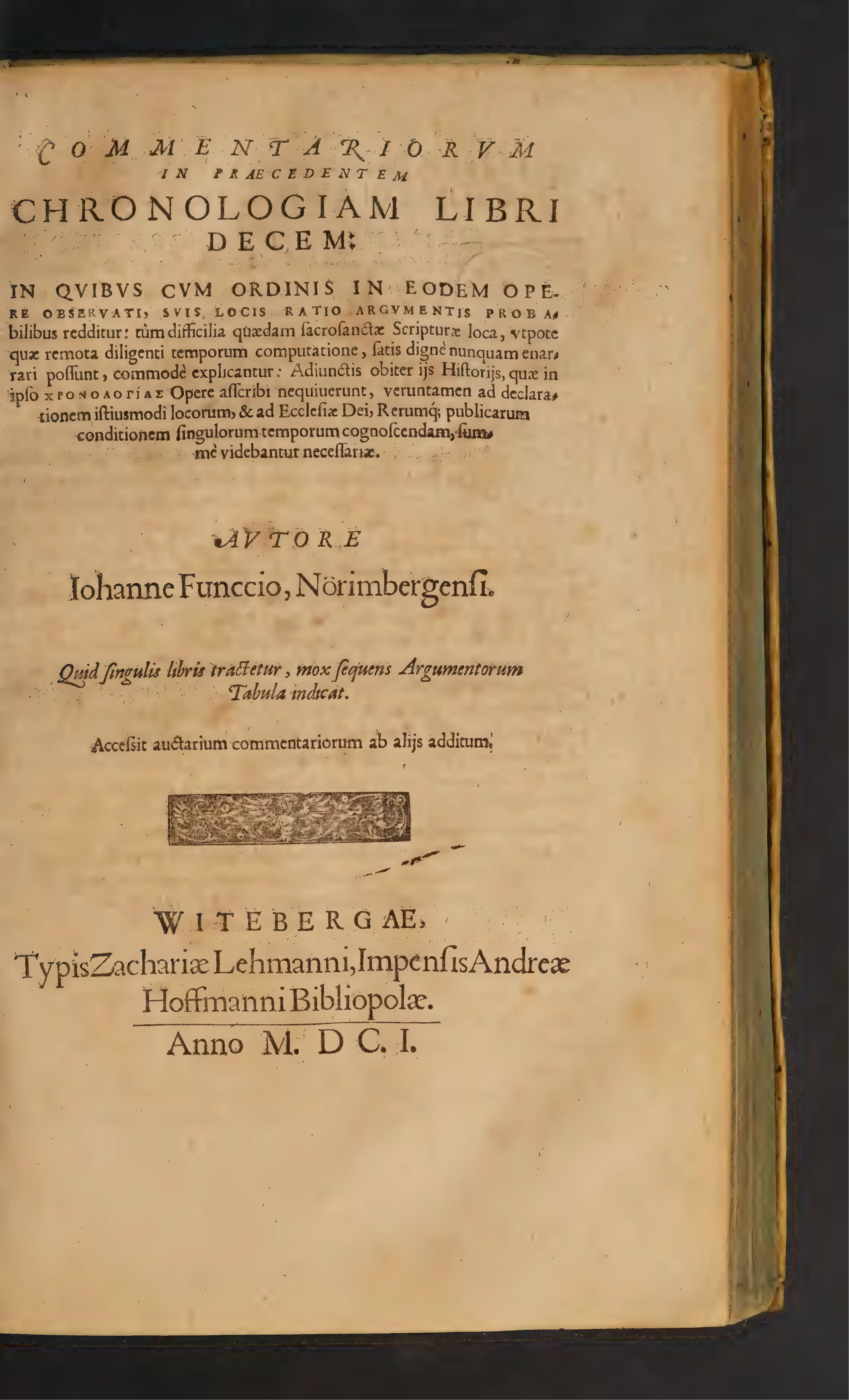
The separate title page to Funck's ten books of commentary in the 1601 Wittenberg edition names Johann Funck of Nuremberg, promises a following table of each book's subjects, and marks an added "auctarium" by unnamed later hands. Its imprint — Zacharias Lehmann for Andreas Hoffmann — sets the posthumous transmission in the same edition that carries the chronology beyond Funck's lifetime. Source ↗.
The 1601 object has a genuine catalogue discrepancy that should not be erased. The ULB description gives [6] leaves, 173 (i.e. 176) double-sided leaves, [33], [138] leaves, in folio, while the Kórnik record gives [288], 177 (misprinted 173), [34] pages, in quarto. The digitized bibliographical description also records the signatures )(6 A–Ll6 Mm4 A–Z6. These descriptions may reflect different cataloguing conventions or copy-level differences, but no collation of a single physical copy was performed here. The earlier issues likewise lack securely verified quiring, catchwords, marginal year-brackets, and genealogical-table data in the accessible records. The index and the commentary are catalogue-confirmed; the exact heading Auctarium, the full extent of the appendix, and the page locations of the alleged terminal events were not confirmed by the accessible transcription of the digitized pages.
The late date is therefore established by the 1601 title and imprint, not by an independently checked transcription of every event in the continuation. The listed references to Inter gravissimas, the Armada, Henri III, Henri IV, Mezőkeresztes, and Nagasaki are chronologically compatible with a continuation to 1601, but the accessible scan evidence did not expose page-level proof for each. For the calendar reform the text does more than notice the event: it reproduces the operative provision of the bull, Præcipimus & mandamus, vt de mense Octobri anni millesimi quingètesimi Octuagesimi secundi, decé dies inclusiuè, â tertia nonarum vsq; ad pridie Idus, eximantur, enjoining and commanding that in the month of October of the year 1582 ten days inclusive, from the third of the nones to the day before the ides, be removed — the documentary form in which a chronological instrument enters a chronicle that has been arguing about the measurement of years from its first page. That single verification does not extend to the remaining notices, and it remains safer to identify the object as the Wittenberg 1601 issue than to claim that every one of those notices has been collated.
The object biography is unusually recoverable for the 1601 issue. In addition to the ULB Halle copy at Ung II 24, 2°, the Kórnik copy at 41920/Mf 10002 preserves a parchment binding, seventeenth-century provenance notes, and a catalogue attribution to Duke Albert as patron. A Princeton description reports a Funck copy whose binding incorporates a bifolium from Boniface VIII's Liber sextus decretalium as waste; because that evidence is a library blog rather than a full catalogue record, it remains provisional and supplies no shelfmark. The records searched did not yield confirmed shelfmarks for the Bayerische Staatsbibliothek 1552 copy beyond its MDZ identifiers, nor for the requested Wolfenbüttel, Berlin, Basel, British Library, Gallica, BNE, or Polish/Baltic Königsberg holdings.
Funck's condemnation and execution in 1566 are secure biographical facts, but they do not amount to proof of a universal posthumous suppression. The 1570 and 1601 Wittenberg issues demonstrate continuing print transmission in Lutheran territories, and the anonymous extensions to 1578 and 1601 show the chronology being carried forward past its author's death into events he could not have registered. A source discussing the Roman Index mentions Funck and the 1557 Index, but no verified line entry for the Chronologia in the Tridentine, later Roman, Quiroga, or Sandoval indices was recovered. The correct conclusion is unresolved index status, not inclusion or exclusion. The tertiary biographical account lists Funck's Psalm expositions and several German theological or polemical writings; it does not establish a surviving separate Apocalypse commentary. No named continuator, corrector, privilege holder, or securely documented chain of replies to Funck was identified. The only defensible description of the post-1566 editors is the title page's anonymous ab aliis.
Inside the Register of Years: Tables, Index, and the Ten Books of Commentary
The apparatus that governs the earliest surviving stretch of the printed tables is not stated in prose but printed as a ruled grid, and its headings declare the whole enterprise in six words. The verso carries the computational and eastern series, Hebdomedes. / Olympiades mundi. / IVDAEOR: A / AEGYPT: B / Anni Reg: / SYRIAE. C. — weeks of years, Olympiads of the world, the Jews under the letter A, Egypt under B, and the regnal years of Syria under C — while the facing recto continues the same alphabetical sequence into the western series, MACED: D: / Anni Vrbis. / ROMANORVM: E. / FRANCO. F:, that is, Macedonia under D, the years of the City, the Romans under E, and the Franks under F. Two points follow immediately. First, the lettering A through F is a finding-device that runs across the gutter, so that the page-opening, not the page, is the unit of reading: a reader who wishes to follow one people vertically may do so by letter, while a reader who wishes to cut horizontally across peoples reads a single ruled line of the year. The book thus arranges its evidence so that synchronism is a visual fact before it is a demonstrated conclusion; the argument is discharged by the compositor's rules and column-measures rather than by a period of Latin prose. Second, the series is deliberately heterogeneous in kind. Hebdomades and Olympiads are artificial cycles, the anni mundi a computed absolute count, the anni Vrbis a civic era, and the columns lettered A through F dynastic regnal reckonings that begin and end with individual rulers. To set them side by side is to assert that all of them can be converted into one another without residue — precisely the claim that the reconciliation of incompatible measures of time requires, and the claim that the whole chronological programme exists to make good.
The columns are markedly unequal in their density of language, and the inequality is itself informative. The Egyptian and Syrian registers in this stretch carry bare numerals; the Roman register carries the full consular fasti, sometimes as a bare pair of names where nothing is to be reported, as in the six hundred and fifty-fifth year of the City under Lucius Licinius Crassus the orator and Quintus Mucius Scaevola, 655 L. Licinius Crassus Orator. / Coss. Q. Mutius Scæuola., and elsewhere with an event-notice attached, as at the Sullan dictatorship, 667 L. Corn: Sylla II. Dictator. Sylla à Mithridate in Asiam pergens (vrgentibus rebus pacem cum eo fecit., where the six hundred and sixty-seventh year of the City has Lucius Cornelius Sulla as consul for the second time and dictator, and where Sulla, marching into Asia against Mithridates, made peace with him because matters were pressing. The opening parenthesis before vrgentibus is not a syntactical mark but a typographical one, signalling to the eye that the words which follow are the continuation of the notice begun on the line above and have merely been driven down into the space beside the second consul's name. That convention recurs throughout the Roman column — as at the Marsic war, where the notice that Fulvius Flaccus and Marcus Porcius Cato were defeated and killed by the Marsi is broken in the same way, 660 L. Iulius Cæsar. Bellum Marficum. Fuluius Flaccus & M. Portius (Cato, à Marsis victi & interfecti. — and is a reminder that the register is a compositor's solution as much as a historian's: narrative must be poured into a fixed measure, and where it will not fit, the parenthesis stitches the line back together. The same pressure explains the compression of the notices themselves into a nominative-plus-perfect-verb formula — a victory, a subjection, a triumph — which turns the res gestae of the late Republic into a series of discrete, datable, countable acts. Anything that cannot be reduced to such an act cannot enter the grid at all.
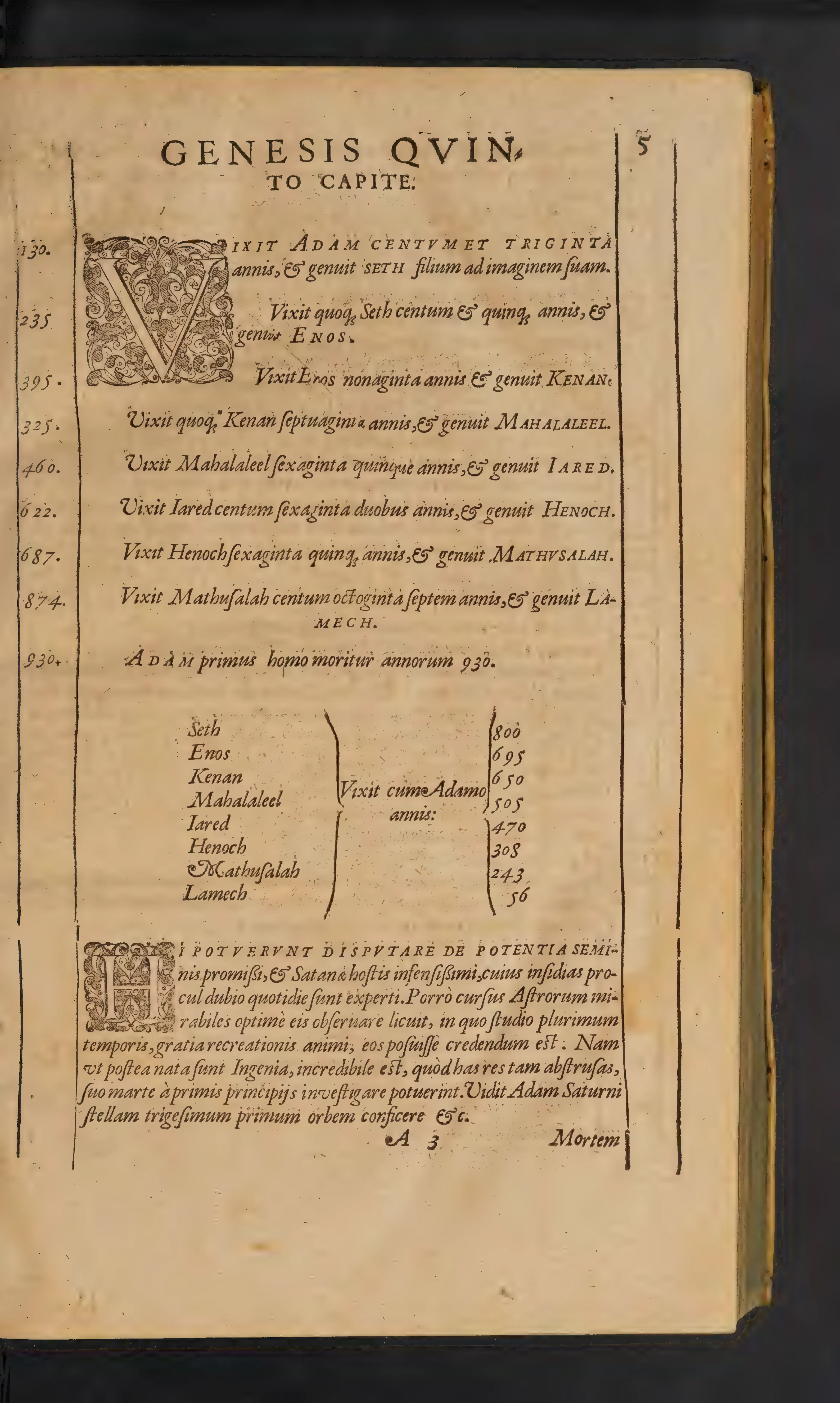
On this Genesis 5 page, cumulative figures in the margin and a ruled table of patriarchal overlaps with Adam turn biblical genealogy into the same countable, spatially managed synchronism that structures the later historical registers. The discursive paragraph below, opening with a decorated initial, shows the companion move: once chronology is fixed in the grid, it can be made to bear doctrinal weight. Source ↗.
Against that Roman fullness, the treatment of Judaea stands out, because it is here that the table permits itself the longest prose intrusion in this stretch and the only explicit source-citation: POMPEIVS Hierosolymam captam Romano Imperio addit, & Hircanum Sacerdotio & Regno restituit, sed Vectigalium & Tributorum pensionem imposuit. Iose. lib. 14. ca. 8. — Pompey adds captured Jerusalem to the Roman Empire, and restores Hyrcanus to the priesthood and the kingdom, but imposes the payment of taxes and tributes, with the reference to Josephus, book 14, chapter 8. The disproportion is deliberate. This is the moment at which the condition of the people of God alters, and the chronicle marks that alteration by suspending its numerals and speaking. The verb addit is the same one used of provincial annexations elsewhere in the register, but here it registers the loss of that independence whose beginning and end the chronicle has been counting since the return from exile; the concessive sed which introduces the tribute is the whole of the political analysis, compressed to a conjunction. The citation of Josephus by book and chapter is equally purposeful: in a column otherwise composed of naked numbers, a reference invites verification, and it displays the collating habit by which the chronicle's dates are held to be recoverable from the authorities rather than merely asserted. The same event is then entered a second time on the western side, 684 M. Pupius Piso. Pompeius Iudæam Rom. Imperio addit, Pompey adds Judaea to the Roman Empire in the six hundred and eighty-fourth year of the City. The double registration, with the year of the City supplied on one side and the year of the world and the regnal year on the other, is the synchronistic method performing its characteristic operation: one occurrence, two independent coordinate systems, and the identification of the two entries as the same event is the proof that the systems have been correctly aligned.
Dynastic endings, by contrast, are registered without any prose at all. The Seleucid column runs on into the seventies while the Egyptian series is simply displaced by a new count opening at one, CLEOPATRA 1. Here the grid does its work by the interruption of a number-series: a reign ends because its numerals stop, and a new reign begins because a new numeral one appears in the ruled space. No judgement, no notice, no cause. The reader who follows column B down the page learns of the last of the Ptolemies from an arithmetical discontinuity, and the method thereby demonstrates its economy and its limits at once — it can date a succession exactly and say nothing whatever about it.
The Roman column of these openings is dominated by the figure whose entries will decide the chronicle's periodization. The Gallic command is entered plainly, 686 C. Iulius Cæsar. CÆSAR in Gallia bellum gerit., Caesar wages war in Gaul, with the name set in capitals against the lower-case of the consular list; the crossing to Britain follows, 689 Cn. Pompeius Magnus. II. Cæsar Britanniam petit, ac veticalem facit., Caesar makes for Britain and renders it tributary — the form veticalem standing for vectigalem, one of several places in this typesetting where the reading must be recovered from the sense. These notices are not idle: the peoples whose columns the chronicle will carry in later centuries are here being given their first documented contact with the imperial series, so that the geography of the later synchronisms is laid down in advance within the Roman register itself.
Two entries in the same year-run are of a different order. The first is reflexive to the point of paradox: 698 C. Iulius Cæsar IIII. Cæsar Pompeij filios in Hispania vincit. Deinde Româ reuersus Dictator perpetuus creatur. Annum secundum Kalendarium ordinat. Ideo ipse habuit dies 445. — Caesar conquers Pompey's sons in Spain; then, returned to Rome, he is created perpetual dictator; he orders the year according to the Kalendarium; therefore that year itself had 445 days. A chronicle whose columns presuppose a uniform year here records the manufacture of that year, and records also the single monstrous year of 445 days which the reform required. The grid must absorb an anomaly in the very unit by which it is ruled, and the causal ideo is the chronicler's acknowledgement that the instrument of measurement has a datable history of its own. The second is the entry that fixes the period, the notice already discussed in which Gaius Julius Caesar, the Republic having been crushed, is followed on the same line by the opening of his own regnal count. The ablative absolute does the periodizing work, and the resumption of a numbered series under a personal name converts a magistrate into a monarch by the same typographical means used for Syrian and Egyptian kings. To begin the Roman monarchy here rather than with Augustus is to make the fourth of the world's monarchies commence in an act of suppression, and to make that commencement demonstrable from the consular fasti themselves. The assassination that follows is dated to the day, 699 C. Iulius Cæsar V. Cæsar in Curia à Bruto & Cassio interficitur ipsis Idibus Martij, aliquot Senatoribus in eo facinore conspirantibus. — Caesar is killed in the Curia by Brutus and Cassius on the very Ides of March, with a number of senators conspiring in the deed — an unusual descent below the year within an annalistic frame, permitted because the authorities supply the day. The new regnal count is not interrupted by it. The monarchy, once begun in the register, continues in the register; the man dies and the column does not.
The register from the late Republic to the crusading age
What holds for these Republican openings holds for the register as a whole: it is not a treatise but a ruled field of years, and its argument is carried as much by the geometry of the page as by any sentence printed on it. Recto pages carry the Roman consular fasti and the imperial series with narrative annotations; verso pages carry the arithmetical ruling — Hebdomades, Olympiades, Anni mundi, Anni Christi, later Indictiones — beside the ecclesiastical and Eastern notices. Running heads distribute the peoples across the opening: ROMANORVM, ECCLESIAE. A., ORIENT., IVDAEORVM, FRANCO., GOTH:, PERSARVM, SARACENO:, POLONI:, BRITAN:, SCAND:, ORD: TEVT:. Long vertical runs of bare numerals occupy much of the verso space and yield no quotable prose, but they are not inert: they are the instrument that makes the columns commensurable, and every polemical remark inserted into a column derives its force from standing at a determinate coordinate within that grid. What follows is the working out of that principle from the Social War to the crusade of Louis IX.
In the late Republican fasti events are compressed into single annalistic clauses whose grammar already contains a judgment of cause. Drusus, having promised citizenship to the Italian peoples, stirred them to arms and was himself killed at home, DVSVS Italicis populis ciuitate promissa, eos ad: the ablative absolute ciuitate promissa makes the offer of enfranchisement the juridical trigger of revolt, so that the bellum sociale enters the table not as a calamity but as the consequence of a specific constitutional promise made in a specific year. The same syntactic habit governs the decisive entry of the Roman series already examined, where the crushing of the commonwealth is stated in a participle and Caesar first obtains sole rule. Oppressa is doing constitutional work of the heaviest kind: the monarchy is dated from an act of suppression rather than from any grant, election, or senatorial settlement, and the choice to begin the imperial line at Caesar rather than Augustus is thereby defended within the entry itself, in a single word, without a line of discursive argument.
That decision is immediately complicated — and this is characteristic of the compiler's honesty about his own apparatus — by a second epochal marker a few lines later, where he notes that in this year the true rule of Augustus begins, in which an end was set to the civil wars, Hoc anno verum Augusti IMPERIVM (rino fluxit. C. Cæsar Octaui. II. The adjective verum concedes what the Caesarian entry had suppressed: that between the crushing of the Republic and the Augustan settlement there lies a stretch of power that is real but not yet imperium in the proper sense. Two beginnings are thus printed within a few lines of one another, one juridical and polemical, one pacificatory and epochal, and the reader is left to see that the imperial series has a hinge rather than a point of origin. For a chronicle whose synopsis promises to explain how empires were transferred, this doubling is not a lapse. It is a demonstration that the moment of transfer is itself a determination made by the chronologist, and that the determination can be shown, defended, and dated.
The Frankish column of the same opening turns from computation to philology and shows how far the chronicle is prepared to travel for an etymon. Against the theory that Germani was a name imposed by enemies, the compiler reports the derivation from the little words Gar and Mann, that is, wholly a man, entirely a man, nos ait à vocu la Gar & Mann, quam, siding with Beatus Rhenanus and buttressing the reading with a Hebrew parallel drawn from the Talmudic Aruch. The manoeuvre is the same one the chronicle applies elsewhere to sacred vocabulary: a word is established from its constituent parts, and the established word then carries a judgment — here, that the Germanic peoples bore a name of self-description and praise rather than a label fixed on them from outside. That an ethnological point about Sicambrian antiquity should be settled by collating a humanist's German etymology with a rabbinic lexicon indicates how catholic the evidentiary base has become, and how little the compiler distinguishes between the authority of grammar and the authority of narrative sources.
The methodological seriousness of the enterprise is most visible where the chronicle turns on its own authorities. Diagnosing a systematic displacement in the dating of the fall of Jerusalem, the compiler observes that the event fell in September in the second year of Vespasian, which began on the Kalends of July, and that those who fail to notice this place the history a year later, die Septéb anno secundo Vespasiani, qui KL. Iulijs incipiebat. Hoc non. The error is not one of testimony but of computistical alignment: an error about where a regnal year begins propagates through every subsequent entry keyed to it. This is precisely the class of problem that makes a synchronistic table necessary in the first place, since a one-year slip invisible within a single narrative source becomes glaring the moment two columns must be read across. The same page issues the instruction noticed earlier, sending the reader to Eusebius there to correct the error in the numbers of Nero's years — a second-person imperative that enlists the reader as collaborator in emendation and treats even the father of ecclesiastical history as a corrupted numeral awaiting repair.
The ecclesiastical column, running in parallel from the apostolic generation, converts these techniques into confessional argument. Under the second persecution the chronicle records that the Christians, accused of the burning of Rome though innocent, are destroyed by Nero with wretched deaths, HACHTENUS CHRISTIANI Rôani incensij insimulati miseris mortibus à Nerone, where the participle insimulati set against the assertion of innocence draws its force from the pagan authority behind it: Tacitus is made a hostile witness for the Christians, and the persecutions are numbered so that martyrdom acquires a serial, countable form parallel to the reigns beside it. The imperial column supplies the corresponding vice on the other side of the rule, noting from Cassiodorus that Domitian was the first to have himself addressed as Lord and God, Primus Domitianus DOMINVM & DEVM ie appelGlabrio — a notice placed among sham triumphs over the Dacians, so that blasphemous titulature and fraudulent victory appear as symptoms of one disorder. The template recurs with the tetrarchy, where after his triumph Diocletian wished to be adored, calling himself brother of the Sun and Moon, and ordered his feet to be kissed, nanus post Triumphum adorari voluit, fratrem So; the ceremonial notice, taken from Pomponius Laetus, stands immediately before the persecutions of his reign, so that the demand for adoration is presented as the same act, in a different register, as the killing of those who refuse it.
Between these two lines the sharpest confessional statement of the stretch is made by a strictly prosopographical argument. The charge already noticed, that Platina and the other papal flatterers place Cletus in this position — a name whose mention in the canon of the Mass is frequent — is completed on the same page by a denial of the man's existence, and the denial is turned into sarcasm: such a Cletus never existed in the nature of things, so certain are the foundations on which the Roman See rests, rerum natura non fuit. Adeò certis nittur fundamentis Sella Romana. The rhetorical economy is worth marking. Nothing doctrinal is asserted; a name is subtracted from a list. But because the list is also the liturgical memory recited in the canon and the litanies, the subtraction of a single fictitious bishop is made to indict the evidentiary basis of the whole succession, and the word adulatores assigns a motive to the compilers who inserted him. Chronology here is not the servant of polemic but its instrument of proof.
The editorial voice occasionally steps out from behind the fasti altogether. Antoninus Pius, the chronicle reports, withdrew salaries from many of his idle ministers, saying that nothing is baser or crueller than that those should gnaw at the commonwealth who contribute nothing to it by their own labour, Antoninus Imp. multis fuorum ministris. qui ociosi Rufinus, and the compiler appends his own wish that the magistrates of his own day would imitate the emperor. The intrusion is brief but reveals the exemplary function that underwrites the annalistic form: the table is a repository of precedents for governance as well as a proof of the sequence of years.
From the sixth century the apparatus itself changes, the Olympiad column ceasing on the compiler's declared judgment that Olympiads are no longer recorded in authentic histories, and a new column opening for the Saracens with the notice, quoted above, that Muhammad in Arabia is called a prophet; the entry adds that for a whole decade he spread his poison secretly until, his power increased, he might propagate his teaching by force and arms. The vocabulary of concealed venenum maturing into open conquest gives the new column its interpretive shape before a single caliph is numbered in it; thereafter the Saracen rulers are counted serially in the same manner as emperors and bishops, one dynastic line among the rest.
The Western columns then stage the two confrontations that matter most to the work's account of authority. By the counsel of Pope Zacharias, Pippin, Mayor of the Palace, was made king in Childeric's place, who was thrust into a monastery, Contilio Zachariæ Pontif: Rom: — the dynastic revolution of 751 registered with its papal authorization intact and undisguised, which is to say registered as a datable exercise of a deposing power rather than as an inherited prerogative. The counter-claim is printed opposite: Henry, having convened a council at Brixen, deposes the pope and substitutes Wibert, archbishop of Ravenna, Henricus co[n]cilio apud, set across the column rule from the notice of Gregory VII's excommunication of the emperor and his absolution of the subjects' oaths. Nothing adjudicates between them on the page except their coordination in a single year. Two jurisdictions each claim to unmake the other, and the synchronistic table, by placing the claims side by side at the same latitude of time, makes the collision itself the historical datum.
The index of memorable things and words
The alphabetical index of memorable things and words that the title page advertises is not an ornament appended to the tables but the instrument that makes a synchronistic grid consultable out of sequence, and its own conventions are worth reading as carefully as the commentary's arguments. Every headword in this stretch of the letters M through P carries two elements after it, a number and a capital letter, and the letter is not a subdivision of a page of prose but the designation of a horizontal band in the ruled register of years. A single entry can therefore carry a whole succession of such coordinates, as when five pontiffs of one name are gathered under one headword with their regnal numerals interleaved among their loci, Nicholaus PP. 134 A II. 144 A III. 155 A III I. 158 A V. 162 A, Nicholas, pope, with the second, third, fourth and fifth following in turn. The reader is not sent to a discussion of Nicholas but to five separate intersections of a year and a band, and the compression of the papal series into one line of type is only possible because the band letter is stable across those five loci: the ecclesiastical register holds them all. Retrieval here is by position in the grid, not by page of argument, and the index thereby confirms what the tables themselves assert — that a name means the place it occupies in a coordinated order of years.
That the numbers are leaf-numbers of the tabular sequence rather than pages of discourse is stated outright where the index turns to the apparatus of computation itself, in the entry on the rationale and use of the Olympiads, Olympiadum ratio & vius Fol. 57 G, where the abbreviation Fol. is written out and the band letter still attached. A chronicle that must reconcile Olympiads, years of the city, years of the world, and years of Christ makes its reconciling devices retrievable on the same terms as kings and battles: the Olympiad reckoning is itself an item of memorable matter, indexed like a dynasty. The same logic governs the entries that carry a bare number with no letter, which point away from the ruled bands to discursive or prefatory matter. Two of these register the chronicle's own source-base as an object of record — the notice that Nicolaus Marschalk writes a German history, Nicolaus Marchallus Historiam scribit Germanicam 33, and the notice of where the history of Orosius ends, Orosij Historia finit 113. To index the terminal point of an authority is to treat that authority as a finite resource whose exhaustion is a datable event in the history of knowledge; the reader who wishes to know from what point onward Orosius can no longer be collated is given a locus for the answer. This is the indexical form of the same critical instinct that elsewhere directs a reader to emend the numerals of a received text.
The band letters cannot be read as a fixed table of nations, since the peoples assigned to them change as the roster of the register changes; the letter is meaningful only in company with its folio. What remains constant is the separation of the ecclesiastical band from the imperial, and it is on that separation that the index's polemical work depends. Two entries at the same folio make the point without a word of argument: the beginning of the papacy, Papatus initium 128 A, and the donation of the Pentapolis to the pope, Pentapolis Papæ donata 128 A. The papacy is given a initium — a beginning in time, locatable on a leaf — and that beginning is placed at the same coordinate as a territorial grant from the Frankish power. Nothing in the index asserts a causal relation; the alphabet merely files the two headwords eleven entries apart and lets the identical folio and band do the work. The reader who follows either reference arrives at the same place in the grid. The insular version of the same arc is filed with equal economy, from the beginning of the papacy among the English, Papatus initium apud Anglos 132 F, through the subjection of England to the papacy, to its collapse, Papatus in Anglia ruina 167 G. Beginning and ruin are the two poles of a historicized institution: what has an origin at a folio may have a downfall at another, and both are memorable things retrievable under the letter P. Alongside them stands the concession of the Ottonian privilege to the pope, Ottonianum Priuilegium Papæ concessum 139 C, filed not in the ecclesiastical band but in the imperial one, so that the documentary title is registered where the granting power sits rather than where the recipient does. The index thus reproduces in miniature the commentary's insistence that papal prerogatives have donors, dates, and instruments.
Not every polemical headword names its content. The popes' notable deed concerning emperors, Paparum de Imperatoribus infigne factum 150 A, is a formula of pointed reticence, the noun factum carrying a charge that the index leaves the tables and the commentary to discharge. Beside such entries the same alphabet accommodates the institutional history of the religious orders — the order of the knights of Christ in Prussia, Ordo militum Christi in Prussia 152 K — where the Baltic band preserves the local horizon of a chronicle first enlarged at Königsberg, and where an order is registered, like a papacy, as something instituted at a determinable moment rather than received from the apostles.
Doctrine and computus meet in the P entries of the following leaf. The heresiarch on whom the chronicle's apocalyptic arithmetic turns receives no special notice whatever but a flat heresiological headword in the ecclesiastical band, Paulus Samolatanus hæreticus 104 A, Paul of Samosata, heretic; the interpretive weight placed on him elsewhere — the treading-down from which twelve and a half centuries are counted — is entirely invisible in the finding-aid, which supplies only the coordinate at which he may be found. The reverse case is the run of entries on the paschal reckoning, where a technical controversy is preserved as a recurring item of memorable matter: the day of Easter changed, and the controversy about it, Palchalis dies mutatus & controversia de eo 108 A [reading uncertain], the printed long s of Paschalis presenting throughout this cluster as an l. A chronicle whose continuation would eventually reproduce the operative clause of the Gregorian bull had already made the movable feast's history into a standing series of index entries; the alphabet allows the reader to assemble that series in one consultation. The imperial band supplies, with the same flatness, the emperor whom the commentary makes the source of Roman primacy, Phocas Imperator 121 C — a bare accession notice where the argument is contentious, the polemic reserved for the discursive books and the coordinate supplied here.
The index also carries the marks of its own recompilation. It reaches well past its author's death, filing the accession of a Spanish king of the very end of the century, Philippus III. Hispan. rex 172 D, and registering the deaths of the Lutheran learned in the ecclesiastical band, Philippus Melanchthon moritur 169 A; a Venetian plague of the same late decades is entered in the same series as the pestilences of antiquity, Pestis Venetijs 171 A. The title page's claim that the index was newly enlarged is borne out at the level of the single line: the anonymous extension of the timeline was matched by an extension of the apparatus, so that events Funck never saw are retrievable on precisely the terms he devised. Within the same leaf the long Ptolemaic series of Egyptian kings runs down the column and terminates in a figure of another kind altogether, Ptolemæus Astronomus 98 B, Ptolemy the astronomer, filed by name among the kings who share it. The accident of homonymy places the authority whose tables underwrite astronomical dating in the same alphabetical neighbourhood as the reigns his calculations help to fix — a coincidence of the alphabet, but one that exposes with unusual clarity the double constituency of the whole work, whose memorable things are at once the deeds of rulers and the instruments by which the years of those deeds are counted.
The books of commentary: prophecy, computation, and the apostolic church
In the discursive books the technique changes but the principle does not. The exposition of Daniel 11 proceeds by a running double column of its own: the prophetic text is set out clause by clause and each clause is immediately fitted, in parentheses, with a name drawn from Hellenistic dynastic history — the exactor sent into the kingdom's glory is Lysias, the despised man who comes secretly is Demetrius escaping from Roman hostage-keeping, the king of the south is the Ptolemaic claimant, and the Trieres and Romans are the fleet that expelled Demetrius from Syria. Prophecy is thus not so much interpreted as collated, matched item for item against Josephus and Justin. What matters most is where the collation stops. Having reached the verse about the polluted sanctuary and the abominatio in desolationem, the author declines to proceed, on the ground that the remaining material has not yet happened and that he speaks only of accomplished deeds: the rest, he writes, which is dragged by many to this place, since in our time it has not yet come about and perhaps does not properly belong to this place, we, who speak only of things done, will pass over, Reliqua enim, quæ à multis ad hunc locum trahuntur, quia tempore nostro nondum sunt facta, & fortasse propriè non ad hunc pertinent locum, nos verò de factis solummodò dicimus, ea prætermittemus. The self-limitation is genuine and consequential, but it is not a retreat from apocalyptic reading; it is a rule about the direction in which such reading may run. Prophecy is decipherable exactly insofar as it has already been converted into event and therefore into date. The consequence for a chronicle is that the register of years becomes the only admissible commentary on the unfulfilled portions of Daniel, and the polemical yield of prophecy is deferred until the annals catch up with it.
The fourth book opens by defending a periodizing decision already executed in the tabular chronology, that Julius Caesar and not Augustus begins the Roman monarchy. The first reason is assembled almost entirely out of Suetonius, whose long catalogue of Caesar's perpetual dictatorship, prefecture of morals, golden seat, statue among the kings, and month renamed from his own name is transcribed at length and then converted into a constitutional finding: from these things it is plain that he not only crushed the commonwealth but so abolished it that he held everything free, no otherwise than as things are usually done in kingdoms. The second reason is exegetical rather than antiquarian, resting on the fact that this Caesar is named first Roman emperor by Christ himself, since he says, Render unto Caesar the things that are Caesar's, and unto God the things that are God's, Altera causa fuit, quia Iulium Cæsarem hunc, vt eum Chronologia etiam appellat, primum Imperatorem Romanum, à Christo Domino nominari audio, cùm ait: Reddite quæ sunt Cæsaris Cæsari, & quæ sunt Dei Deo. The reasoning is candid about its own difficulty — Tiberius, not Julius, was then reigning — and resolves it by distinguishing the person from the denomination, so that the monarchy takes its name, and hence its starting year, from the man whose name the imperial title perpetuates. A gospel logion is thereby made to settle a question of Roman constitutional chronology, which is the characteristic move of the whole undertaking in miniature: the evidence of Suetonius establishes the fact, and the evidence of Scripture fixes the reckoning.
The dating of the Nativity proceeds by a frank collation of discrepant numerals. Luke's statement that Jesus was about thirty at his baptism and the fifteenth year of Tiberius are treated as the fixed quantities; Herod's regnal total is the variable. Reckoning Herod's years forward would carry him into a forty-second year had he lived, whereas Josephus assigns only thirty-four, and the difference is resolved arithmetically: since Josephus assigns only thirty-four, it is necessary that he ceased eight years before the fifteenth of Tiberius, and therefore the Nativity is placed in the penultimate or thirty-third year of Herod's reign, so that Christ may plainly have been baptized at thirty, Sed cùm Iosephus tantùm 3 4. attribuat: Necesse est vt octo annos ante 15. Tiberij desierit. Ideo natiuitatem Christi in penultimum, siue in annum regni Herodis 33. locavimus, vt sic manifestè annorum 3 o. baptizatus fuerit &c.. The passage exhibits the working assumption that governs the whole chronology: where authorities disagree, the numeral in the historian yields to the numeral implied by Scripture, and the adjustment is stated openly rather than smoothed away.
With the fifth book the commentary turns to the apostolic church, and its source criticism becomes correspondingly sharper. The correspondence of Abgar of Edessa with Christ, transmitted by Eusebius and Nicephorus, is rejected on two grounds, the silence of the evangelists and an argument from style, reinforced by an appeal to conversation with the Königsberg theologian: yet I find nothing of this among the sacred authors, and the simplicity of Christ, as the reverend lord Andreas Osiander discussed the matter with me, by no means permits that he be believed the author of that letter, Attamen nihil de hoc apud sacros autores inuenio, & simplicitas Christi (vt Reuerendus Dominus Andreas Osiander, ea de re mecum locutus est) omnino non patitur, vt illius epistolæ autor credatur. Two things are notable. The criterion invoked is internal and stylistic, a judgement about what kind of utterance is congruent with Christ's manner; and the authority cited for it is oral and contemporary, a remembered discussion rather than a printed page. From this single rejection the commentary generalizes, declaring that it omits much of what has been received on the authority of the ecclesiastical historians because it sees a great many fabrications in their histories.
The most substantial reversal in this portion concerns the abominatio desolationis, which the catalogue evidence alone had left unconfirmed but which the printed leaves supply in explicit terms. The commentary first reports Caligula's order to set his statue in the sanctuary and asks whether this is the abomination of which Christ speaks; it then records that its author had earlier affirmed precisely that, holding it along with the opinion of very many, before changing his mind: but when afterwards I considered the matter more diligently, I descended to an altogether different opinion, so as to determine that not this statue but the Roman army is that abomination foretold by Daniel, Sed cùm postea rem diligentius considerarem, in aliam prorsus sententiam descendi, vt statuerem, non hanc statuam, sed exercitum Romanorum, abominationem istam à Daniele prædictam esse. The demonstration is chronological before it is exegetical. Since thirty years separate the statue from the destruction of Jerusalem, a flight prompted by the statue would have emptied Judaea of Christians long before the danger, would have made nonsense of the woe pronounced on pregnant and nursing women, and would have frustrated the divine counsel; whereas the standards venerated as gods in the midst of the camp, attested by Tertullian and by Josephus on the sacrifices offered amid the ruins of the temple, satisfy both Luke's sign of the encircling army and the demand that the abomination stand in the holy place. The reading is then completed by a datable escape: Cestius Gallus besieged the city for nearly a month and withdrew, and the season was July, which accounts for the prayer that the flight be not in winter or on the Sabbath. A prophetic term is here validated by interval, topography, and campaign season — the same instruments used to place the Nativity.
The critique of Roman primacy in this book is likewise built from intervals. Against Nicephorus and Eusebius on Peter's summons to Rome to defeat Simon Magus, the commentary sets the record of Acts: but the sacred letters contradict these things, from which it may be known for certain that Peter did not come to Rome before the twenty-fifth year from the Lord's Ascension, Sed his contradicunt sacræ literæ, ex quibus certò cognoscere licet, quòd Petrus ante annum vicesimum quintum, ab ascensione Domini, non venerit Romam. The proof is cumulative and strictly documentary: Peter's imprisonment under Agrippa in the year forty-three, the Jerusalem consultation on circumcision, the ignorance of the Roman Jews reported at the end of Acts, Paul's refusal to build on another's foundation, and the address of the first Petrine epistle from Babylon to the dispersion of Pontus and Bithynia — a Babylon that is not conceded to be Rome, since Peter nowhere mentions Rome and was not writing in the prophetic idiom of the Apocalypse. The conclusion names an interested party for the tradition it dismantles: it is now manifest that the saying of Nicephorus and of certain others who write something similar is nothing, and was invented only by those who left nothing unattempted to establish and exalt the Roman papacy, Iam ergo manifestum est, Nicephori dictum, & aliorum quorundam, qui simile quiddam scribunt, nihil esse, & his tantùm fictum, qui ad Papatum Romanum stabiliendum, atq[ue] extollendum, nihil non moliebantur, ac probare studebant. Yet the concession that follows is as carefully measured as the denial: Peter did come to Rome and suffer there, perhaps in the very year of his passion, and may even have appointed Linus — which leaves the martyrdom intact while denying the long episcopate on which the succession-list depends.
The sixth book converts this into a narrative of growth. Victor's excommunication of the Asian churches over the Paschal date, and Irenaeus's letter of remonstrance recalling that Anicetus and Polycarp parted in peace, are reproduced from Eusebius and Nicephorus expressly so that the reader may see how early the Roman bishops began to exalt themselves out of ambition and arrogance; the inference drawn is that Rome's claim cannot be original, and I say this for these reasons, that it might appear how ineptly the Romanists exalt their papacy, as though from Christ's first institution and indeed from divine authority the Roman church, even were it in the highest degree Christian, ought to preside over the rest, when the contrary is taught by plain examples, Verum his de causis dico, vt appareret, quàm ineptè Romanenses suum papatum extollant, quasi ex prima Christi institutione, atque adeò ex autoritate diuina, Romanam Ecclesiam, si vel maximè ea Christiana esset, cæteris Ecclesijs præesse deberet, cùm tamen apertis exemplis contrarium doceatur. The same documents that transmit the institution are made to date its emergence. So too with Cornelius's letter against Novatus: its enumeration of forty-six presbyters, seven deacons, forty-two acolytes and the rest, and its insistence that there be one bishop in the catholic church, is read not as evidence of order but of pretension, from all of which it sufficiently appears how in these times both the papacy and other worldly rites took root in the church of Christ, Ex quibus omnibus satis apparet, quàm iam per hæc tempora, in Christi Ecclesia, tam Papatus, quàm alij mundani ritus, radicem egerint. Ambition is given a botanical metaphor and, with it, a growth rate that can be plotted year by year in the adjoining columns.
Behind that account of the church's early centuries lies a general thesis about how empires change hands, worked out first on the Seleucid collapse. The account of the fratricidal wars of Demetrius, Philip, and Antiochus Dionysus is not offered as dynastic curiosity but as an explanatory mechanism: when brothers and their sons fought among themselves and contended over the empire, the Syrians were compelled, having lost their own kings, to commit themselves to foreign guardianship, Cùm ita inter se / digladiarentur, & de imperio eertarent fratres, ipsorumq[ue] Filii: coacti sunt Syri, / pretis suis ipsorum regibus, sese in externam tutelam committere. The noun tutela is drawn from the vocabulary of private law, where it names the guardianship exercised over those incapable of managing their own affairs; applied to a kingdom, it converts annexation into a juridical consequence of internal incapacity. This is the pattern the commentary will replay for Judaea, where the quarrel of Aristobulus and Hyrcanus, the venality of Scaurus, and the calculations of Antipater deliver Jerusalem to Pompey. Transfers of dominion, in other words, are here given proximate historical causes and datable moments — consular year, Olympiad, year of the city — rather than being received as bare providential fact, and that insistence on an agent and a date is the same habit that governs the work's handling of ecclesiastical claims.
The Herodian narrative shows Funck defining what his genre will and will not carry. Having tabulated the building programme at Caesarea, Antipatris, and Sebaste, the famine relief, and the Temple renovation, he declines the moral narrative: there are besides many illustrious deeds of this king, by which he often displayed his heroic spirit, but on the other hand far more cruel and wicked deeds, toward his own and toward others, all of which it would be too long to relate here, Sunt præterea multa huius regis præclara facinora, quibus sæpenerò heroicum suum animum ostentauit. Contra / quoque multò sunt plura, tum erga suos, cum alios, crudelissima & / scelestissima facta, quæ omnia hîc referre nimis longum. The praeteritio is a statement of economy: the commentary exists to secure the frame of years into which such deeds fall, and the reader is remitted to Josephus for the substance. That division of labour is what allows the chronicle to remain a register of computation even where its materials are lurid, and it makes the moments when Funck does pause — the Jubilee, the Petrine foundation, the Antichrist's term — legible as deliberate departures rather than as narrative drift.
The Jubilee treatise is the first such departure, and it is prefaced by an unusual admission. Funck confesses that he doubted about this for some time, so that he may acknowledge his own sloth and negligence in reading the sacred letters, and that he wasted much time in establishing the beginning of the Jubilee years, Nam de hoc aliquandiu & ego dubitaui: ut ignaviam & oscitantiam meam, in legendis sacris literis, ipse confitear: ita ut multum temporis / frustra insumpserim, de principio annorum Iubilei constituendo. The self-accusation is precisely located: the failure was not arithmetical but exegetical, a failure of reading, and the remedy is a retrograde computation counting back by fifties from the baptism of Christ to the entry into Canaan. The rhetoric of candour does evidentiary work, since a chronologer who reports his own false starts asks to be believed when he reports a result. What that result is made to prove appears in the first of the numbered heads: from the entry of the Israelites into the land of promise up to the year of Christ's preaching, thirty Jubilees are counted; in that year Christ had completed the thirtieth year of his age; and after this Mosaic Jubilee there was no Jubilee, 1. Ab introitu Israelitarum in terram promissionis, vsque ad annum prædicationis CHRISTI, triginta numerantur Iubilei. Eo anno CHRISTVS tricesimum / annum ætatis suæ absoluerat. Et post hunc Iubileum Mosaicum, nullus fuit Iubileus. The convergence of the thirtieth Jubilee with Christ's thirtieth year is offered as a numerical coincidence too exact to be accidental, and the cessation of the institution — the thirty-first cycle would have fallen when Temple and city lay in ashes — is turned into a proof from silence that the promised deliverance has already come. The argument cuts in two directions at once, against continued Jewish expectation and against any later institution claiming the name of Jubilee for itself.
Immediately after this doctrinal expansion Funck reasserts the limits of his office: it is not his purpose, he writes, to compose whole orations on such matters, as are delivered in churches to the people, but only to give the less learned something to know about these things, and to give teachers an occasion to explain them better and more learnedly, Non enim mei instituti est, eiusmodi de / ebus, integras orationes, vt in Ecclesijs ad populum habentur, conscribere, sed tanummodò rudioribus, vt de hisce rebus aliquid sciant, Doctoribus autem, vt hæc / nelius doctiusque explicent, præbere occasionem. The distinction between rudiores and Doctores places the commentary between catechesis and scholarship and disclaims the homiletic register that a court preacher might most naturally have reached for. The disclaimer is also strategic: material delivered as chronological finding rather than as pulpit exhortation invites assessment by computation, where Funck is confident of his ground.
That confidence becomes openly agonistic when the commentary reaches the Roman primacy. Having stated the adversary's position — that the whole edifice rests on the single foundation of Christ's word to Peter — Funck poses his undertaking as a wager: come then, if he overturns this foundation for them, as he trusts, and demonstrates that it is empty and false, will he not have won a notable victory, Agè ergo, si ego fundamentum hoc, eis, vt confido, / euertero, / vanum, mentitumq[ue] esse demonstrauero: Insignemne victoriam consecutus / ero?. The metaphor is architectural and the method is arithmetical: what follows is a computation from Galatians and Acts placing Paul's conversion, the fourteen-year interval, and the apostolic council in a sequence that leaves no room for Peter at Rome in the year the papal chronologies require. The polemical charge is carried by the demonstrative verb; demonstrare claims for a controversial conclusion the status of a result. Where the sources resist, the philological verdict is delivered with equal brevity — he answers that it is spurious, and suborned by some papal flatterer, Respondeo supposititium esse, & ab Adulatore quodam Pontificio subornatum — an application of the humanist criticism of interpolated texts that is genuine in technique while remaining asymmetrical in deployment, since the suspicion falls on testimony favourable to Rome and the criterion of spuriousness includes the doctrinal implausibility of the content itself.
Against forged supports Funck sets documents he transcribes entire, and the Pliny–Trajan correspondence is reproduced because it depicts, in an adversary's own hand, the condition of the ancient church: the governor reports that he asked them whether they were Christians, and those confessing he asked a second and a third time, threatening punishment, and those persevering he ordered to be led away, Interrogaui ipsos, an essent Christiani? confitentes / iterum, ac tertio interrogaui, supplicium minatus: perseverantes duci iussi. Pagan testimony is admitted as independent corroboration precisely because it is disinterested, and the same page yields the word superstitio in Pliny's mouth for the Christians — a term the commentary elsewhere turns back upon pilgrimage and relic-cult, so that the vocabulary of accusation is inherited and redirected rather than invented.
The heresiological books convert this documentary practice into apocalyptic argument. The reign of Antichrist is not assigned to a single future figure but identified institutionally, for this is a bishop sitting in the temple of God and blaspheming Christ in his highest majesty, detracting from him the divine essence, Est enim hic Episcopus sedens in templo Dei, ac blasphemans Christum in summa Maiestate sua, detrahens ei Diuinam essentiam. The criterion is christological: what defines the succession running from the Samosatene through Arius and onward is the denial of Christ's divine essence, which allows a line of doctrinal descent to be drawn where no institutional continuity exists, and which makes an episcopal chair, not an empire, the seat named in the Pauline prophecy.
The later books test that polemic against imperial and conciliar precedent, and the results are not uniformly convenient. Funck transcribes the Theodosian edict as an exemplum that pious princes may safely imitate — we will that all peoples whom the governance of our clemency rules should be engaged in that religion which the divine Peter the Apostle handed down to the Romans, CVNCTOS populos quos Clementiæ nostræ regit Temperamentum, in ea / volumus Religione versari, quam diuinum Petrum Apostolum tradidisse Romanis — extracting from it the competence of the Christian prince in religion while passing over the fact that the edict identifies orthodoxy by reference to the very Petrine-Roman transmission the earlier book had laboured to dissolve. The reading is selective in a way the commentary does not acknowledge. Elsewhere antiquity is made to authorize abolition rather than observance: after the scandal at Constantinople, from that time the custom of antiquity was abolished, Et ex illo antiquitatis consuetudo apud Constantinopolim sublata est, a notice narrated at length from Sozomen because it shows the ancient church itself discontinuing compulsory private confession, and so answers the charge that abolition is innovation with a precedent drawn from the age the adversary reveres.
The barbarian succession at Rome is finally read by the same prophetic key, with the first person again marking the interpretation as the author's own: and this one seems to him to be one of those concerning whom it is said in the Apocalypse chapter 17, five have fallen, Atq[ue] is vnus ex illis esse mihi videtur, de quibus in Apocalypsi / cap. 17. dicitur / Quinque ceciderunt. Odoacer, Goth, Greek exarchate, Frank, and Lombard are enumerated as the fallen kings, and the enumeration is possible only because the synchronistic register has already fixed each regime's span. The columns of years are thus not the apparatus supporting the exposition but its evidentiary substance: the sequence of dominions at Rome, once counted, is presented as the plain referent of the vision, and the eschatological gesture toward the seventh who will not long remain is left standing as a computation still running.
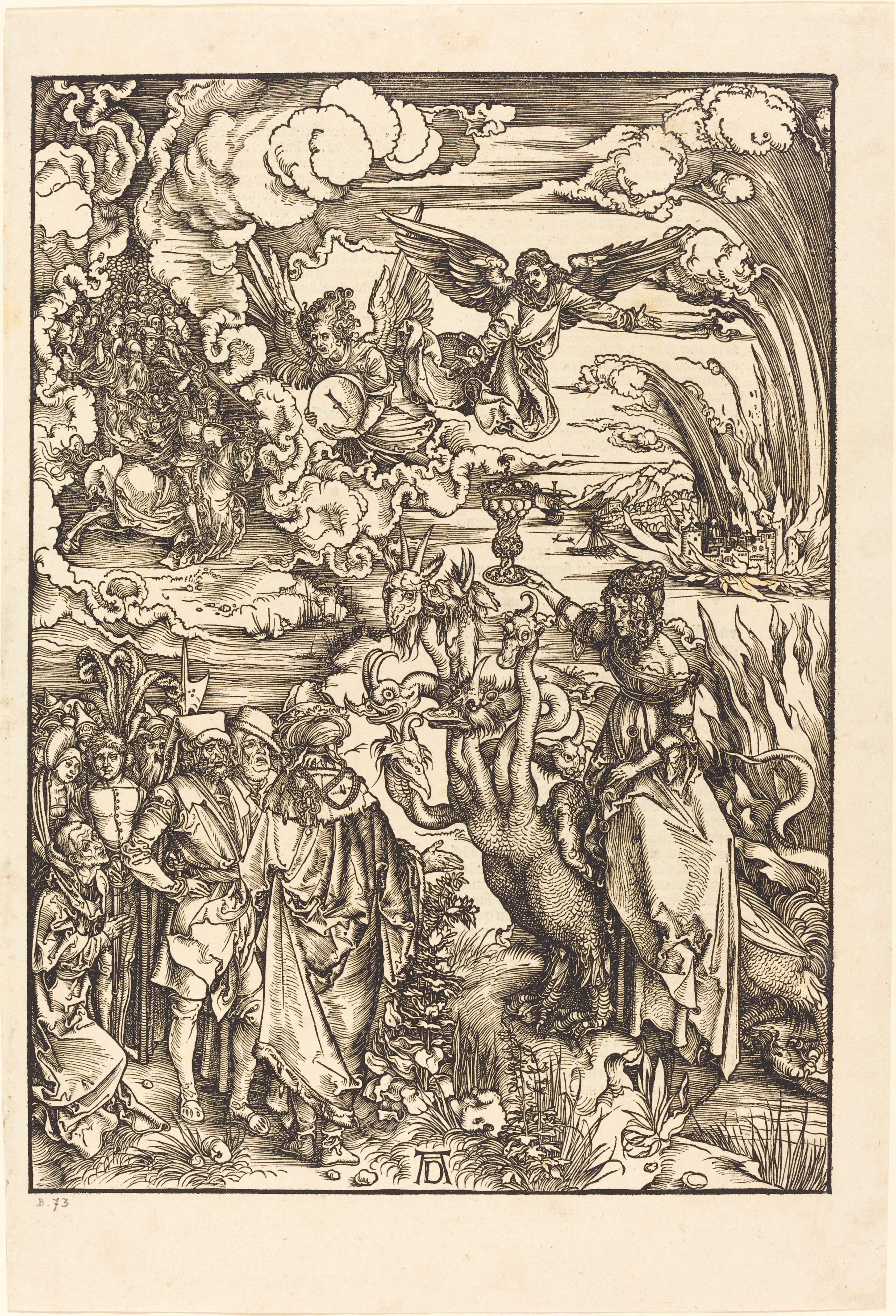
Dürer's 1498 Nuremberg woodcut of the Whore of Babylon on the seven-headed beast gives visual form to the Apocalypse 17 imagery that Funck converts into chronology, where fallen rulers and Roman dominions become the counted evidence of prophecy. Made decades before the Reformation, it shows how familiar such iconography already was in the city-world from which his polemical synchronism emerged. Source ↗.

Books VII to X: papal pretension given a date
From Hormisdas and the Scythian monks to Frederick Barbarossa's stirrup, three further structural units — the end of Book VII, the whole of Books VIII and IX, the first two-thirds of Book X — display with unusual clarity how the annalistic frame and the polemical thesis are made to do one another's work. Book VIII announces its own terminus and method in a formal argumentum, promising to relate in compendium the ecclesiastical history and the civil affairs worth knowing, vsque ad Imperium occidentis sub Carolo Magno instauratum, octauus liber compendio tradit. The declared endpoint is not innocent: fixing the book's boundary at the restoration of the Western empire under Charlemagne makes the coronation of 800 a structural joint of the work as well as an event within it, so that the constitutional question of who transferred what, and by whose right, is built into the architecture of the volume before a single argument about it is made.
Within that frame the compiler is neither uniformly hostile nor credulous. He reports the prodigies of his sources while quietly shifting the burden of belief onto them, and he preserves papal utterances that serve his purpose. Agapetus's rebuke to Justinian is one such: he had wished, the pope says, to come to a most Christian prince, venire optaui, sed Diocletianum inueni. Qua libertate loquenti, & Dei nutu — but found a Diocletian; and at this freedom of speech, and by God's disposing, the emperor yields. That the episode is retained approvingly matters for reading everything else: the polemic is directed at a historically datable accretion of pretension, not at the Roman see as such, and the criterion by which a pope is praised is precisely his willingness to speak plainly to a prince rather than to command one. Against that measure the anti-monastic satire registers as a different order of judgement. Narrating the mission of Maurus, the text says that he was to teach the Franks monastic hypocrisy, qui Francos monasticam hypocrisin (vitam volebam dicere) edoceret — the parenthesis correcting itself to "I meant to say, life." The device — a feigned slip of the pen, immediately amended — is a recurring habit of this commentary, and it is worth pausing on rhetorically. It allows the author to keep the borrowed narrative intact, with its medieval vocabulary of monastic life and mission, while inserting a confessional verdict at the level of a single noun. Dissent is thus lodged inside the transmitted sentence rather than appended to it, which is exactly what a chronicler must do who cannot rewrite his sources but will not endorse them.
The same self-awareness governs his handling of evidence. Introducing the siege of Rome under Totila, he names Procopius as a participant in that war and advertises his own abridgement, qui eidem bello interfuit, scriptis commissa, ego breuiter ipsius autoris scripta in compendium contrahens, summam eius obsidionis indicabo, announcing that, briefly contracting that author's own writings into a compendium, he will set out the substance of the siege. Two claims are made at once: that eyewitness participation confers evidentiary priority, and that epitomizing is a declared operation rather than a concealed one. The resulting narrative is not thereby drained of feeling. The father who leads his children to the bridge and then, with his head covered, leapt at once into the waters of the Tiber, Vbi verò super Tyberis pontem peruenit, capite obuoluto, in Tyberis aquas confestim desiluit, spectantibus filijs Romanisque; cæteris, qui fortè tum aderant, with his sons and the other Romans who happened to be present looking on, supplies the human reckoning of the grain prices and the profiteering of Bessas that the preceding page has tabulated. Chronology here does what it is supposed to do in this work: it holds the figures and the scene in one register, so that the economy of the siege and its moral cost are read together.
The book's controlling argument emerges from the papal series in three consecutive movements, each of which is an etiology rather than a denunciation. First, the humblest of curial styles is derived from a jurisdictional quarrel: moved by the arrogance of the bishop of Constantinople, Gregory, to show himself humble, was the first of all Roman pontiffs to write himself Servant of Servants, Hac elatione Constantinopolitani Episcopi Gregorius motus est, quò humilem se ostenderet, vt primus omnium Rom. Pontificum, Seruum Seruorum se scripserit. The point is not that the title is false but that it has a date and a cause, and that its cause is a contest over primacy — a title of self-abasement generated by a struggle for precedence. Second, the headship itself is relocated from apostolic institution to imperial concession, in the entry already discussed on what Boniface III obtained from the emperor Phocas after great contentions. The formulation there is legally precise — diceretur & haberetur, named and reputed — and it converts a doctrinal status into a grant with a grantor. Third, the grantor's character is made to contaminate the grant: thus was confirmed the authority of the pope, which, built upon a lie and upon trifles, was confirmed and consecrated by a parricide and tyrant emperor, confirmata est autoritas Papæ, quæ super mendacio & nugis superædificata ab Imperatore parricida atque Tyranno confirmata ac consecrata est. The verb consecrata is chosen for its sting: a sacral vocabulary is applied to an act of the secular power performed by a murderer, so that the foundation of spiritual supremacy is shown to be, in its own terms, a consecration by the wrong hands.
Because so much depends on adjudicating between authorities, the commentary states its rule of preference openly when the Sixth Council's patristic florilegium comes into view, declaring, in the sentence noticed elsewhere in this report, that in such a matter he would rather seek the conclusion from the sacred Scriptures than from the writings of the Fathers — a preference whose printed form carries lacris, a long-s misreading of sacris. This is a methodological declaration embedded in a chronological narrative, and it explains the peculiar texture of the work: a hierarchy of proofs is asserted at the very point where a council is doing its own collating, so that the chronicler's procedure and the council's are set in visible competition.
Book IX turns on the coronation of 800, and its entry — already quoted for its formulation of the transfer of empire — states the transfer as accomplished fact while naming its agent, in a line whose misprinted digniras for dignitas betrays the compositor rather than the argument. The instrumental per Papam is the whole of the polemic in two words: the succession of empires is not a silent providential drift but an act with a date and a performer, and therefore reviewable. Immediately adjacent stands one of the rare authorial intrusions about his own labour, the promise that what he commented on nearly the whole Apocalypse six years earlier may be corrected and then published in print, ea quæ in totam ferè Apocalypsim, ante sexennium sum commentatus, correcta prius, quàm primum typis impressa publicentur — a disclosure that the catalogue record alone could not supply. Its significance runs beyond bibliography: it reveals that the apocalyptic scheme by which the successive Roman dynasties are keyed to the beast and the harlot is not improvised in the chronicle but imported from a prior exegetical work, so that the annalistic register is being read through a hermeneutic already fixed elsewhere.
That hermeneutic surfaces most flagrantly in the treatment of the female pontiff, where the author breaks into his own text under his name: I, Funccius, do not doubt that this was divinely permitted, that this woman should become pontiff, and the same a harlot, Ego Funccius non dubito, quin diuinitus hoc ita sit permissum, vt foemina hæc fieret Pontifex, & eadem meretrix. The legend is not defended as history so much as commandeered as sign: the coincidence of Pontifex and meretrix in one person is offered as providence's own gloss on Apocalypse 17. The disorder of the tenth-century series is then pressed into a formal controversial question, closing a catalogue of murdered, mutilated, and deposed popes with an apostrophe to the reader's adversaries — all of whom were called Most Holy and styled Head of the Universal Church, and yet strayed from the truth, qui omnes Sanctissimi sunt dicti, & Caput Vniuersalis Ecclesiæ appellati, à vero aberrauit? Respondete mihi vos defensores Sellæ Pontificiæ Romanæ, "Answer me, you defenders of the Roman Pontifical Chair." The chronological catalogue has become the premise of a disputation against indefectibility: the list itself is the argument, and the reader is invited to test it.
Book X sets its thesis at the head of the Gregorian narrative and lets it govern the selection of episodes: a notable hypocrite, under pretext of the canons and of piety he wrought the most unjust and impious things, Insignis hypocrita, prætextu Canonum ac pietatis, iniustissima & impijssima quæq; effecit. The charge of pretext — canons and piety as cover — is the same structure of argument used against the title of Servant of Servants, transposed from nomenclature to legislation. Within the Investiture narrative the most rhetorically weighted speech is given not to pope or emperor but to the dying antiking, who, having displayed the severed right hand with which he swore fealty, tells the bishops that at their urging he has so often fought so unhappily, Vobis autem vrgentibus toties tam infeliciter prignaui, Videte an recta via me duxeritis. Ite & implete Regi vestro primam fidem, Nam ego ad Patres ibo — see whether you led me by the straight way; go and fulfil to your king your first fealty, for I go to the Fathers (prignaui for pugnaui). The doctrine of the passage is that of Romans 13 delivered as deathbed testimony: the "first fealty," sworn to the magistrate, cannot be dissolved by ecclesiastical absolution, and the perjury is charged to those who counselled it.
The same soteriological measure is applied to a source the commentary has just transcribed at length. After the long catechetical programme of Otto of Bamberg's Pomeranian mission, the verdict is summary: thus the Abbot; such was the religion of that age, in which nothing is said of Christ and his merits, Hæc Abbas, Hæc Religio eius seculi, vbi de CHRISTO & meritis eius nihil dicitur. The method is exemplary of the whole: quote the medieval authority in extenso, preserve it as evidence, then judge it by a criterion the authority did not recognize. The last complete argument in this stretch reduces the imperial-papal contest to a single juridical alternative, in Barbarossa's reply over the stirrup service: you are the first Father for whom we have performed such an office, but I should like to know from you whether this kind of duty is of obligation or of good pleasure, Tu primus es Pater (inquit) cui tali officio deseruimus: Sed scire velim abs te, officij hoc genus ex debito ansit, an ex beneplacito?. The distinction between debitum and beneplacitum is the whole controversy in the language of the schools and the courts, and it is also, characteristically, a historical question: the emperor's opening move is that no predecessor has done this before, so that precedent — which is to say chronology — decides whether a courtesy has hardened into a right.
The last movements: the close of Book X, the Saxon captivity, and the appended matter
The remainder of the tenth book carries the annalistic argument from Frederick Barbarossa to the Sack of Rome, and it does so by a device that makes the register of years itself an instrument of judgement: each pontificate is entered not as an item in a succession-list but as the arrival of a new occupant of a single monstrous office. The death of Adrian IV supplies the pattern in its crudest form. Choked while drinking, the pope dies because a fly flew into his mouth, and when it could not be extracted by the physicians' art it stopped his breath, and so he perished suffocated, Musca namque inuolauit in os: & cum medicorum arte eximi non poterat, præclusit illi spiritum, atq[ue] ita suffocatus perijt. The clinical particularity — the failure of medicorum ars — is not medical curiosity but the evidentiary scaffolding of a providential verdict: the ban laid on Frederick is answered by an agent so contemptible that no natural or political explanation can absorb it. What follows immediately declares the classificatory scheme under which the rest of the book operates, since the commentator announces that there follows now a Beast no less cruel than this one, but that before speaking of her he will briefly set out the conversion of Livonia to Christ, Sequitur nunc Bestia non minus hac crudelis: sed priusquam de ea dicamus, Liuoniæ ad Christum conversionem paucis indicabo. Two things are done at once. The Apocalyptic Bestia is naturalized as an ordinary chronological category, so that the reader passes from pope to pope as from beast to beast without the polemic needing renewal; and the digression on the Baltic mission is licensed by the same annalistic logic, a body of matter otherwise poorly served by the historians being inserted at its proper year. That the Livonian church is made to begin from Bremen merchants driven to the mouth of the Düna, rather than from a crusading vow, is characteristic of a chronicler writing in Prussia for whom the northern conversions belong to the record of German civic and mercantile enterprise as much as to that of Rome.
The Alexandrine schism is where the book's juridical argument surfaces. When the emperor proposes to have the rival elections adjudicated, the refusal is quoted in its canonical form: he replied that the Roman pontiff ought to be judged by no one, and drove the legates from him, respondit Pontificem Rom. à nemine debere iudicari: Legatosque à se repulit. Placing the Gregorian maxim at precisely the moment when a conciliar remedy is on offer converts a principle of immunity into the historical cause of a schism the commentary elsewhere measures in years of damage — the doctrine is dated, and being dated it becomes contingent. The consequence is staged as ceremony at Venice, in the scene already described, where the pope treads with his feet on the neck of the prostrate emperor and pronounces over him the verse about walking upon the asp and the basilisk. That scene is constructed with care. The psalm verse is not glossed but left to indict itself, since its application requires the emperor to occupy the position of the serpent; the parenthetical designation of the emperor as supreme monarch supplies, in two words, the constitutional premise that the humiliation violates. The reported exchange that follows tightens the argument to a point: the prince, bearing this insult ill, replied: Not to thee, but to Peter; but the knave, pressing down the prince's neck again, said: Both to me and to Peter, Princeps indignè ferens hanc contumeliam, respondit: Non tibi, sed Petro, At Vappa rursus deprimens Collum principis ait: Et mihi, & Petro. The emperor's distinction between the apostle and his alleged successor is the whole Lutheran case about the Petrine texts compressed into four words, and the papal reply — refusing the distinction — is made to concede in the pope's own voice what the commentary wishes to prove. The intrusive Vappa, a term of Roman comic abuse for a worthless man, marks the compiler's presence in his sources; he is not merely transmitting an anecdote but editorializing within the reported speech.
Against this the book sets an alternative genealogy of sanctity, lodged in burghers rather than prelates. The origin of the Teutonic Order at Acre is narrated so that the decisive act is the improvised charity of Lübeck and Bremen townsmen, whose sail-cloth shelters for the sick draw from Duke Frederick of Swabia the remark he is said to have declared: These burghers far surpass in benefactions and piety all the princes who are present, dixisse fertur: Ciues hi beneficia & pietate omnes Principes, qui adsunt; longè superant. The cautious dixisse fertur preserves the compiler's habitual marking of hearsay, but the ideological utility is plain: an institution whose Prussian heirs are among the chronicle's parallel registers is given a foundation in lay German piety, with papal confirmation, habit and indulgence arriving afterwards as juridical formalities. The counterpart to this is the account of curial finance, where the satire of the Abbot of Ursperg is quoted at length so that a Catholic religious may testify against Rome — rejoice, our mother Rome, for the floodgates of the treasuries are opened in the earth, that streams and heaps of coin may flow together to thee in great abundance, Gaude mater nostra Roma, quoniam aperiuntur cataractæ Thesaurorum in terra, vt ad te confluant riui & aggeres numorum in magna copia. The Noachic cataractæ invert the deluge into an inundation of coin flowing toward rather than from heaven, and the compiler's own observation that a man saying this shortly before his own age would have been burned turns a medieval joke into an argument about the recent narrowing of permitted speech.
The same procedure produces the book's succession of pre-Lutheran witnesses. Thirteenth-century Swabian preachers are quoted as saying that the indulgence, they say, which we announce, is not feigned by the pope nor composed by prelates, but we announce it to you from God almighty, Indulgentiam, inquiunt, quam annunciamus, non à Papa confictâ non à Prælatis compositâ, sed ex Deo omnipotenti vobis annunciamus. Set at its year like any dynastic notice, the episode performs the testes veritatis topos chronologically rather than doctrinally: the evangelical position is shown to have a datable prehistory, which is a claim only a chronicle can make. The fifteenth-century councils are then judged by the same standard. Of Constance the commentary concludes that nothing was more effected than that the doctrine of Christ, which was then being brought to light by many men illuminated by the Holy Spirit, was condemned by that same council and hidden under a bushel, nihil tamen magis est effectum, quàm quod doctrina CHRISTI, quæ tum per multos, à sancto Spiritu illuminatos viros, in lucem reuocabatur, per idem Concilium sit condemnata, atq[ue] sub modium abscondita. The evangelical metaphor of the lamp under the bushel is made to describe an institutional act with a date, and the notice of Hus and Jerome follows without editorial comment, the breach of safe-conduct left to speak for itself.
The transition out of the commentary proper is marked by a rubric that is also a bibliographical statement: the captivity of the most illustrious duke of Saxony, elector John Frederick, written by Johannes Funck while he was still at Nuremberg, in the summer of the year 1547, SAXONIÆ DUCIS ELECTORIS IOHANNIS FRIDERICI captiuitas, à Iohanne Funcio, cùm adhuc esset Noribergæ, Anno 1547. in æstate conscripta. The self-dating heading identifies an independently composed piece absorbed into the printed volume, and it registers a shift of genre from annalistic commentary to sustained military narrative. That narrative culminates not in the battle but in a play on words at the captive's presentation, where the elector said: Most clement Caesar (whose speech his Imperial Majesty at once cut short, saying: So, so, now I am clement Caesar), ait: Clementissime Cæsar (cuius orationem Cæs. Maiest. mox intercipit, dicens: Sic, sic, iam sum Clemens Cæsar) — the honorific turned back upon the speaker, so that the formula of address becomes the sentence pronounced on him.
The appended matter gathered by other hands prosecutes the volume's argument with documents instead of exempla. Gregory XIII's calendar bull is reproduced with its technical apparatus intact, down to the rule that the years 1700, 1800, 1900 shall not be bissextile, but in the year 2000 the bissextile day shall be intercalated in the accustomed manner, ita vt annus 1700. 1800. 1900. Bissextiles non sint: anno verò 2000. more consueto dies Bissexus intercaletur. A Protestant compilation prints the operative provisions of a papal constitution in full because the quarrel is not over the astronomy: the refusal is stated as a matter of jurisdiction, the Protestant princes having refused to accept this form of the corrected calendar, Hanc verò Calendarij emendati formam Principes protestantes ideo reipere noluerunt, on the ground that a pope legislating for the reckoning of the empire's years without imperial consent diminishes the emperor's superior authority. The whole work's premise — that whoever fixes the numbers has begun to settle the doctrine — is here restated by its opponents' own instrument and by the estates' juridical answer to it. The appendix closes by turning from the Roman adversary to the Ottoman one in a petition that the eternal Father of our Lord Jesus Christ himself go forth with our armies and destroy the kingdom of the accursed Mahomet, Oramus autem æternum Patrem Domini nostri IESV CHRISTI vt ipse egrediatur cum exercitibus nostris & maledici Mahometis regnum destruat, a prayer that leaves the chronology open at its far end, the register of years still running toward an outcome the compilers expect but cannot date.
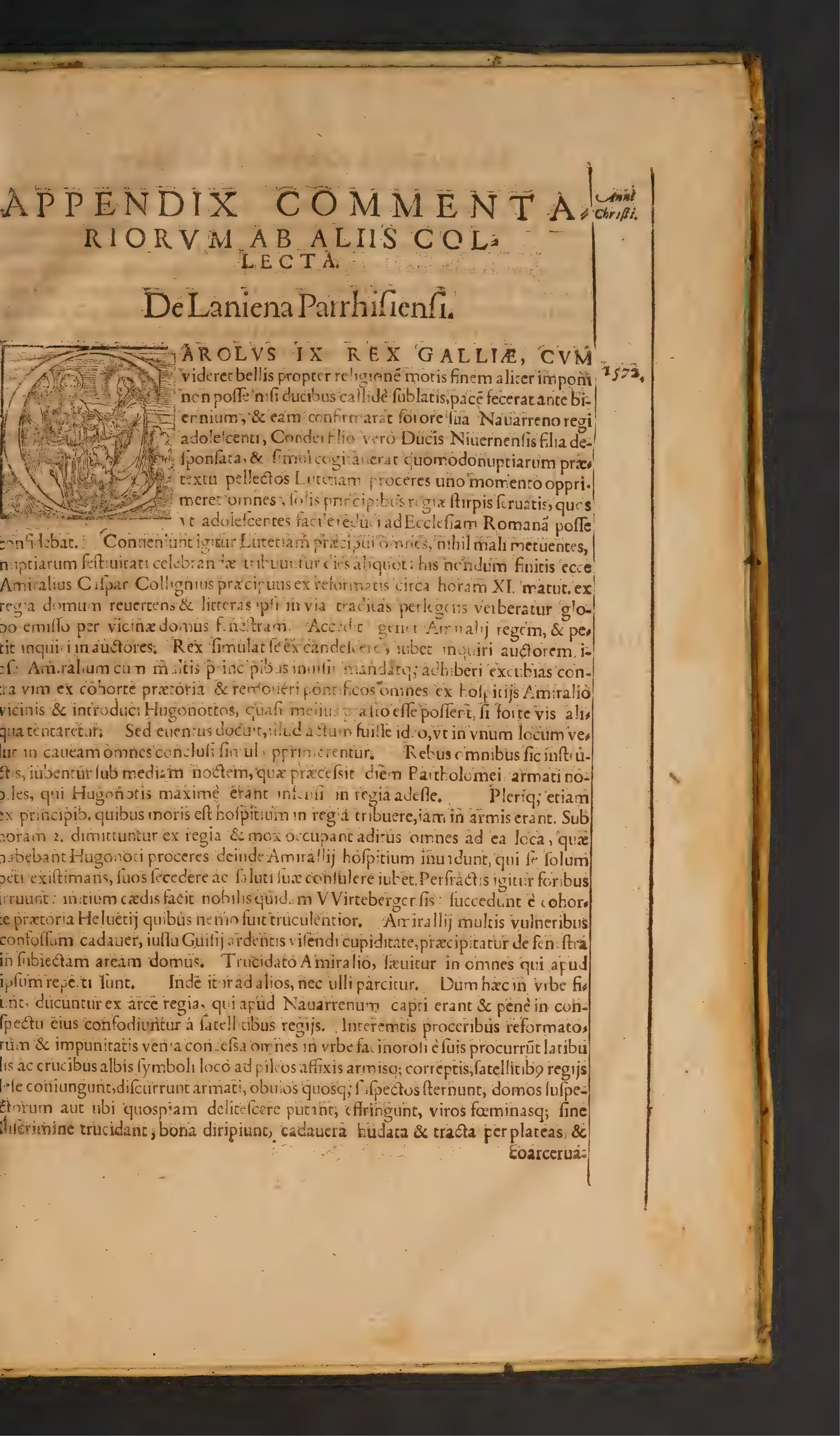
The appendix announces itself in print as "COMMENTARIORVM AB ALIIS COLLECTA," then opens, beneath a large decorated initial, with "De Laniena Parrhisiensi" and the marginal year 1572 — placing the St Bartholomew's Day Massacre inside the same apparatus that elsewhere absorbs papal bulls, juridical protests, and anti-Ottoman prayer. The unnamed continuators carried Funck's register past his death by fitting recent confessional violence into its reckoning of time. Source ↗.
Frequently Asked Questions
What is Johann Funck's Chronologia?
It is a Latin synchronistic universal chronicle, reaching from the beginning of the world and laid out as a ruled register of years in which Romans, the church, Jews, Franks, Goths, Persians, Saracens, Poles, Britons, Scandinavians and the Teutonic Order run in parallel columns. Beside the tables stand ten books of discursive commentary and a large alphabetical index of memorable things and words. Its periodizing choices carry doctrine: the Roman monarchy is dated from Julius Caesar rather than Augustus, and the Donation of Constantine is dismissed outright as a fabrication.
Who was Johann Funck?
Johann Funck, also given as Johannes Funccius or Funcke, was born at Wöhrd near Nuremberg in 1518, studied at Wittenberg, entered the service of Duke Albrecht of Prussia, and became court preacher at Königsberg in the theological orbit of Andreas Osiander. He was executed there on 28 October 1566 amid the collapse of the Prussian political and ecclesiastical crisis. The frequently repeated claim that he was Osiander's son-in-law is not established by the authoritative biographical record, which calls it an unprovable though widespread assertion.
Why does the Chronologia end the 1,260 years of Antichrist in 1521?
Because that year converts an apocalyptic number into a datable event of the recent Lutheran past. The commentary begins the count at 261, the year in which the "treading down" is said to have begun through Paul of Samosata, and closes it at 1521, when Luther stood victorious before the Empire at Worms and undertook to destroy the kingdom of Antichrist. The first person marks the reckoning as the author's own decision. Reports of a separate 666-year scheme and a promised Apocalypse commentary remain unconfirmed against the printed leaves.
What does translatio imperii mean in this chronicle?
Translatio imperii, the transfer of empire, named in the period a providential and historiographical account of how imperia succeed one another, and the title-page synopsis expressly asks how empires were transferred. The register applies it at the coronation of 800, recording that on that very day the dignity of the Roman Empire was transferred by the pope from the emperors of Constantinople to the Franks. The instrumental phrase "by the pope" is the polemic: a transfer with an agent, a date, and a documentary history open to scrutiny rather than a silent inheritance.
Is there an English translation of Funck's Chronologia?
No modern English translation has been identified, and no German or partial vernacular rendering was located in the catalogues and digital records searched; the work is consistently catalogued as Latin, though the absence of a located translation is not proof that none ever circulated. Separately, the Leo edition presents the full transcription together with a complete English translation for the first time. That translation is generated by AI. Leo is an effort to make freely available online, at no cost, English translations of every text printed in Latin in early modern Europe between 1450 and 1750.
This report was generated by an advanced AI assistant that conducted deep research alongside an extensive interpretation of the transcribed original text. Every effort has been made to preserve fidelity to the source and to guard against inaccuracy, but corruption in the text recognition process and model hallucination may nonetheless have entered the text. Treat every claim, quotation, translation, and citation as provisional, and verify each against the original source before relying on or citing it.
Further Reading on Funck, Lutheran Universal History, and Renaissance Chronology
- Robin Bruce Barnes, "Varieties of Apocalyptic Experience in Reformation Europe," The Sixteenth Century Journal: Barnes surveys the range of apocalyptic practice across Reformation Europe, which is the comparative field into which Funck's dating of Antichrist's 1,260 years from 261 to 1521 has to be placed before it can be judged eccentric or ordinary. The article does not treat Funck directly, so it supplies the taxonomy rather than the case study — useful precisely because it shows how many other arithmetics were in circulation.
- Anthony T. Grafton, "Joseph Scaliger and Historical Chronology: The Rise and Fall of a Discipline," History and Theory: Grafton describes how Scaliger brought critical standards and methodological innovation to an already crowded sixteenth-century field, which is the yardstick against which Funck's earlier, still-confessional collation of authorities should be measured. The gap and the overlap are both visible in Funck's own declared rule of evidence, Ego verò in tali negocio mallem è scripturis lacris conclusionem, quàm ex Patrum scriptis petere — critical in form, confessional in motive. Direct treatment of Funck was not established, so read it for the disciplinary horizon, not for the man.
- C. Philipp E. Nothaft, Scandalous Error: Calendar Reform and Calendrical Astronomy in Medieval Europe: Nothaft reconstructs the long medieval effort to diagnose and repair the Julian year, which is the technical prehistory of the Gregorian bull that the 1601 continuation reprints in full. Anyone wanting to know why ten days had to vanish in October 1582, and why Protestant estates could reject the correction without disputing the astronomy, should start here.
- Matthias Pohlig, Zwischen Gelehrsamkeit und konfessioneller Identitätsstiftung: Lutherische Kirchen- und Universalgeschichtsschreibung, 1546–1617: Pohlig positions Lutheran church and universal history between genuine erudition and the manufacture of confessional identity, and he stresses the importance of Apocalypse commentary to that formation — both of which describe Funck's procedure exactly. The chronicle's own foundation-narrative for the Reformation shows the mechanism at work, quæ cum impudentius in Saxonia à Iohanne Detzelio quodam monacho commendarentur, Sancto viro & Domino in Christo reuerendissimo Martino Luthero, Vuitebergensis tunc Ecclesiæ concionatori occasionem præbuerunt, where an annalistic notice acquires honorifics and becomes an origin story.
- Martin Stupperich, Osiander in Preussen 1549–1552: The standard study of the Osiandrist controversy at Königsberg, and therefore the indispensable account of the ducal court, the estates, and the theological quarrel that ended with Funck on the scaffold in 1566. It supplies the political weather in which the 1552 recension was produced; how much it says about Funck himself was not established here, so consult the index before ordering it.