The Five Articles Against a Cardinal: Enrico Noris's Information Concerning the Book of Father Henry Noris
In the winter of 1673 a twenty-four-page memorandum began to circulate that would help drag one of the age's most learned Augustinians into a doctrinal trial lasting decades. Written anonymously by "a theologian of Paris" and titled Informatio de libro r. p. f. Henrici De Noris, Augustiniani, &c. cui titulus est Historia Pelagiana, dissertatio historica de synodo quinta, vindiciæ Augustinianæ. Ad censores libri hujus nuper à summo pontefice delectos. Ab uno theologo Parisiensi, it accused the friar Enrico Noris of smuggling the condemned theology of Cornelius Jansen into scholarship dressed as history — an indictment built article by article to leave its target, the future Cardinal of Sant'Agostino, no place to stand.
ExLatinis
26 July 2026

Contents
In the winter of 1673 a twenty-four-page memorandum began to circulate that would help drag one of the age's most learned Augustinians into a doctrinal trial lasting decades. Written anonymously by "a theologian of Paris" and titled Informatio de libro r. p. f. Henrici De Noris, Augustiniani, &c. cui titulus est Historia Pelagiana, dissertatio historica de synodo quinta, vindiciæ Augustinianæ. Ad censores libri hujus nuper à summo pontefice delectos. Ab uno theologo Parisiensi, it accused the friar Enrico Noris of smuggling the condemned theology of Cornelius Jansen into scholarship dressed as history — an indictment built article by article to leave its target, the future Cardinal of Sant'Agostino, no place to stand.
In the winter of 1673, the presses of Padua produced two learned volumes by Enrico Noris (Henricus de Noris, 1631–1704), an Augustinian friar whose Historia Pelagiana et dissertatio de synodo V oecumenica and Vindiciae Augustinianae set out to defend the theology of St. Augustine on grace and free will as the historical Church had received it. Within a generation, those volumes had drawn Noris into one of the most protracted orthodoxy proceedings of the age. The present text is a weapon forged for that proceeding: an anonymous Neo-Latin informatio — a censorial memorandum — self-attributed to "a theologian of Paris" (ab uno theologo Parisiensi) and addressed to the five censors whom the pope had lately appointed to examine Noris. It survives in a single known printed copy of twenty-four pages, its imprint lost or never present, its true author unresolved. A reader coming to it for the first time meets not a treatise but an indictment, drafted in the forensic idiom of the Roman doctrinal congregations.
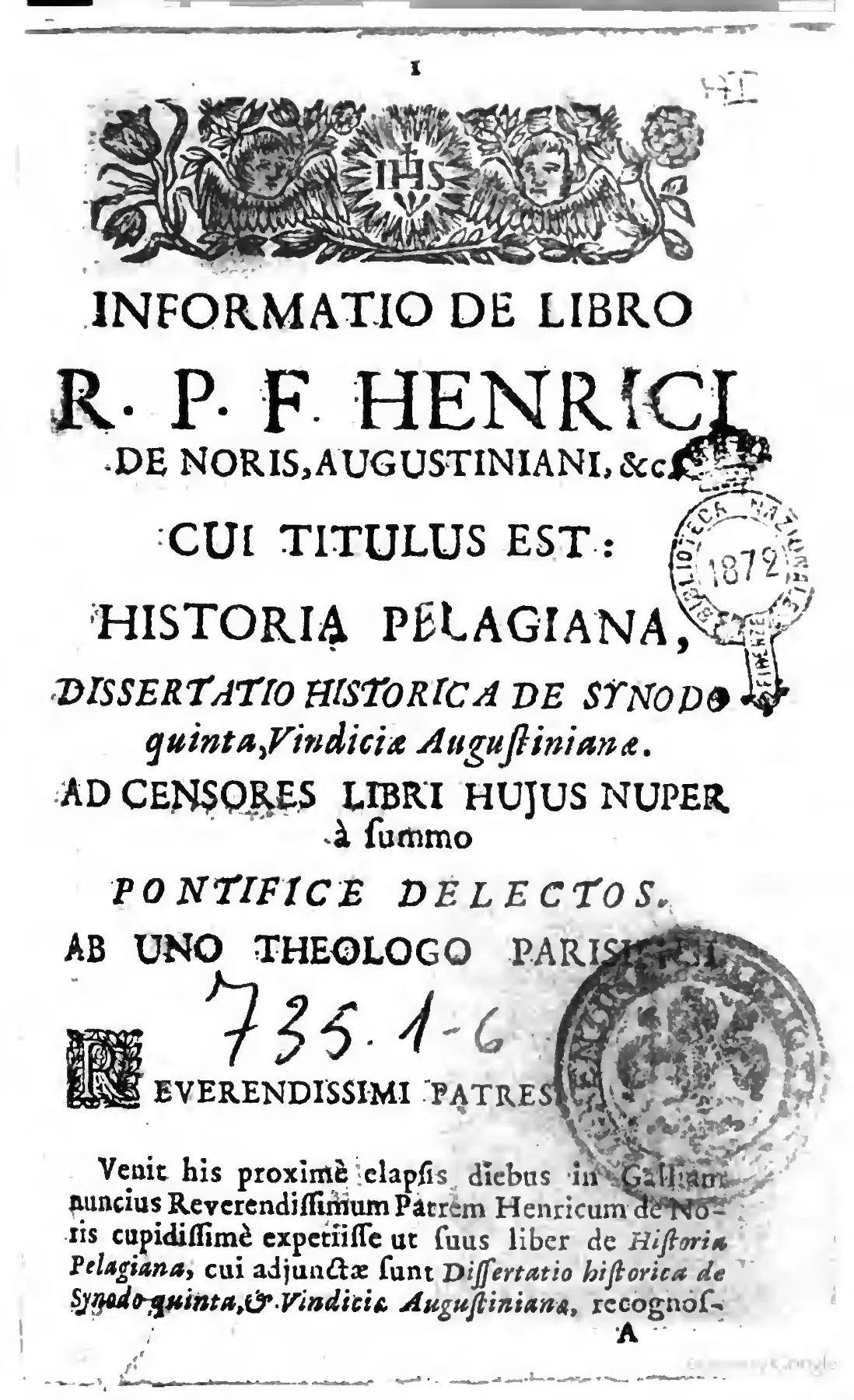
The title-and-incipit page frames the anonymous Informatio as a censorial intervention from "one theologian of Paris" to the papal examiners of Noris, its lack of imprint underscoring the clandestine status of the surviving libellus. Apart from the IHS woodcut headpiece and later library stamps, the page's austerity suits a document conceived less as a published treatise than as a forensic brief in an orthodoxy proceeding. Source ↗.
The single problem the work confronts is whether Noris's Augustinianism can be told apart from the condemned system of Cornelius Jansen, bishop of Ypres. The author's answer is that it cannot, and his recurring move is to press that claim of affinitas — kinship — to the point of identity, then to prosecute the identity article by article. He reduces Noris's teaching to five propositions, documents each through blocks of quotation drawn verbatim from the Padua 1673 edition, and tests the resulting positions against a battery of loaded scholastic terms: the distinction between grace proximè and remotè sufficiens, the privatio potentiæ proximè expeditæ ad perseverandum, the graded possibilitas by which an act may be called possible only "most remotely." He turns Noris's own appeals to the Pelagians and Semi-Pelagians back against him, marshals a phalanx of Thomist authorities from the De Auxiliis controversy, and invokes the disciplinary precedent of Antoine Arnauld's condemnation by the Paris Faculty. The work closes by converting its analysis into a demand — that Noris condemn the Five Propositions of Jansenius in their author's intended sense and swear the formula of Alexander VII.
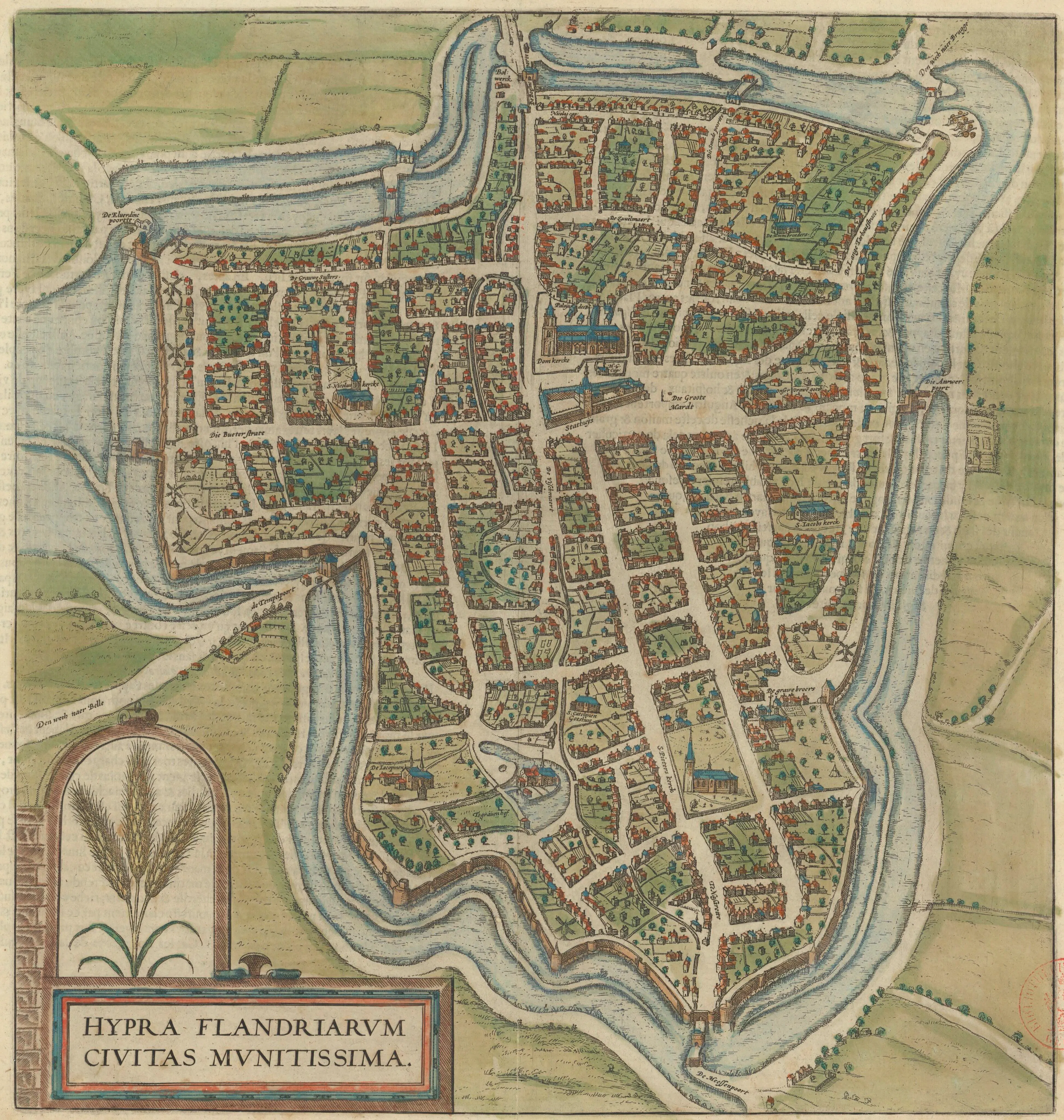
This fortified city plan of Ypres—a dense walled fabric amid Flanders' waterways and fields—evokes the episcopal seat from which Cornelius Jansen's name became inseparable from the condemned Five Propositions. In the polemic against Noris, Ypres functions less as a place than as the doctrinal origin-point against which Augustinian orthodoxy is measured. Source ↗.
.jpg)
The stakes, as the author frames them, are not antiquarian. His declared concern is not historical erudition but the integrity of Catholic truth, and the whole apparatus of grace-terminology he deploys is bent toward a single juridical end: to show that Noris's positions, however Augustinian in dress, reproduce the very propositions the Church had condemned in the bull Cum occasione (1653) and the Alexandrine formulary (1664). This is what gives the text its historical interest. It sits precisely on the fault line between two Catholic Augustinianisms — one licit, one anathematized — and it shows, in unusually concrete form, how the technical vocabulary of the earlier De Auxiliis disputes between Dominican Thomists and Jesuit Molinists could be turned into an instrument of denunciation against a living theologian. The distinction it presses is genuinely difficult to draw, and the difficulty is the point: the author's task is to deny Noris any conceptual room between orthodox and heretical accounts of the impotence of fallen nature.
What is most distinctive about the Informatio is the deliberateness of its forensic construction. It announces that it models itself on the informations that had pleased the censors when Jansenius's own book was examined; it casts its chapters as letters so as not to seem to have written a volume; it brands each cited position with a VERBA NORITII heading before submitting it to analysis. It draws its authorities — Nazarius, Álvarez, Ledesma, Gonet, Báñez, Medina, Soto, Curiel, and others — from the Spanish Thomist commentary tradition, mobilizing a vocabulary otherwise confined to that schola against an Italian Augustinian historian. And it presses toward a striking closing trap: that the "remote power" to which Noris might retreat neither escapes Jansenius nor saves the sinner, so that no formula short of the sworn Alexandrine oath will clear him.
The account that unites the work's conceptual vocabulary, its clandestine material history, and its internal argument runs through that single charge of affinitas. The philology of its loaded terms, the anonymity and lost imprint of its one surviving copy, and the article-by-article structure of its prosecution are all in service of the claim that Noris's grace-doctrine is Jansenism under the cover of scholarship. Much about the object remains uncertain — above all its date, which the surviving catalogue record places in 1673 but which the historical context of the Roman process against Noris in the early 1690s renders contested, and the identity of its author, which the available evidence does not resolve. What is not uncertain is the text's ambition: to close the gap between a condemned system and an unimpeachable one, and to leave its target no place to stand.
Read the full text and English translation on Leo
This text was transcribed and translated as part of the ExLatinis project, an effort by Leo to make free English translations of every text published in Latin in early modern Europe (1450–1750) available online. The complete transcription and English translation of this work can be read free of charge:
→ Read the original Latin text and full English translation on Leo
You can save a copy of this document into your Leo account to run deep text searches, conduct further analysis, or cross-reference it with your own research.
Naming the Text: An Editorial English Title and the Grammar of Grace
Editorial English Title (assigned for convenience, not an established historiographical title): Information Concerning the Book of Father Henry Noris O.S.A. — being the Historia Pelagiana, the Historical Dissertation on the Fifth Synod, and the Vindiciae Augustinianae — Addressed to the Censors Lately Appointed by the Supreme Pontiff, by a Theologian of Paris. (No conventional English title for this anonymous Neo-Latin informatio exists in the scholarly literature; this title is supplied editorially and follows the Latin title-page with a normalised rendering of ab uno theologo Parisiensi and summo pontefice / pontifice.)
Philological framing of loaded Latin terms. The text, as is registered in its surviving title-page and through the lexical fingerprint preserved in the digital exemplar (the Google Books word-cloud confirms the recurring vocabulary), turns principally on three technical Latin locutions whose connotations in the late seventeenth-century Parisian theological register must be carefully distinguished from their modern philosophical sense. That the terminology is a weapon rather than a neutral description is something the author states in his own terms at the outset: his concern, he insists, is not historical erudition but the integrity of Catholic truth, non quæ historicam ad eruditionem pertineat, sed quæ ad integritate Catholicæ veritatis — a declaration that recasts every subsequent lexical distinction as a juridical instrument.
The first is the antithesis between gratia proximè sufficiens and gratia remotè sufficiens — the canonical Thomist distinction between grace that is intrinsically adequate (though in fact never effectual of itself) and grace that is so only remotely, i.e., as a generic divine illumination insufficient for the present act. The pair was first consolidated in the De Auxiliis disputes by Báñez (Dominicus Bannes, 1528–1604) and Alvarez (Didacus Alvarez, d. 1635), and adopted by the Dominican and Thomist camp against the Jesuit–Molinist position that gratia sufficiens is intrinsically sufficient and is rendered efficacious only by the free consent of the will. The Informatio, in keeping with its pro-Molinist thrust against Noris, deploys the locution auxilium proximè sufficiens (the printed word-cloud shows auxilio proximè sufficiente, auxilium proximè sufficiens, gratiam proximè sufficientem) to charge Noris with the Jansenist proposition that grace is intrinsically insufficient for the just and so always requires a second, intrinsic elevation. The author's own definition, drawn from the Thomist witnesses he assembles, holds that by the aid of sufficient grace the will has proximate power and an expedited faculty by which it can be converted, ,, Per auxilium gratiæ sufficien,, tis habet voluntas potentiam proximam & facul,, tatem expeditam qua possit converti. 1. 4. n. 1; the polemical thrust is that Noris denies precisely this proximate power to the justified sinner. In its inherited scholastic use the term is innocent of any Jansenist association: the Informatio weaponises it precisely by reducing Noris's Augustinian theory of the impotentia of fallen nature to a Thomist proposition the Sorbonne has historically rejected. The distinction is turned into a trap at the work's close, where the author warns that Noris must not recur further to a remote power which, as has been shown, neither escapes Jansenius nor saves, non verò amplius recurrat ad potentiam remotam, quæ ut vidimus, nec latet Iansenium, nec salvat:.
The second locution is privatio potentiæ proximè expeditæ ad perseverandum — the privation, in fallen man, of the power proximately fitted for perseverance. The phrase presupposes the Thomist analysis of privatio as a real negation in a subject (as distinct from mere absence), and is here mobilised to convert what for Noris is a positive Augustinian account of the necessity of interior grace into a defective privative ontology. The forensic core of the charge is the quoted proposition that God damns a man eternally for the actual sins into which he falls through an inability to persevere, that is, through the privation of the proximately expedited power, "Asserimus Deum immediatè damnare poenâ æter"nâ honfinem ob peccata attualia in quæ incidit "ob impotentiam perseverandi, seu ob privationem "potentiæ proximè expeditæ ad perseverandum,. The author sharpens the concept through a deliberate analogy: one is said to be deprived of light not by anyone who simply fails to see it, but by one who neither sees nor is able to see, Velut privari luce dicitur, non quicunque eam non videt, sed qui nec videt, nec videre potest — the light-analogy being the instrument by which privatio is made to signify a genuine impotence rather than a mere lack. The text's argument is that Noris must hold that the justified sinner is reduced, per privationem, to a state in which he cannot proximo persevere without an efficacy belonging to grace ab actu; from this premise the author concludes that the Historia Pelagiana lapses into the Jansenist assertion that the commandments of God are impossible to the just in their present state. The semantic divergence from conventional Thomist usage is decisive: in Báñez or Gonet, privatio potentiæ proximè expeditæ is a category describing the status naturae lapsae; in the Informatio it is repurposed as a forensic lemma for the condemnation of a living author.
The third locution is sensus obvius (in contrast with the sensus a Jansenio intentus — the sense intended by Jansenius). The pair is the legal-theological formula by which the formulary of Alexander VII (Regiminis Apostolici, 1664) and the bull Ad sanctam beati Petri sedem (1656) obliged the signatory to hold the Five Propositions of Jansenius as condemned in sensu ab eodem Jansenio intento. The sensus obvius is the proposition's plain or literal sense as the reader finds it; the sensus a Jansenio intentus is the sense its author, Jansenius, intended. The Jansenist distinction of fact and right (Arnauld's distinction, condemned by Alexander VII in 1656) turned on this pair: the Jansenists conceded that the propositions were heretical in sensu obvio but denied that Jansenius held them in sensu a Jansen intento. The Informatio's polemical innovation, preserved in the title-page vocabulary Noritii doctrina, is to charge Noris with reproducing Jansenius's sensus intentus under the cover of historical scholarship — that is, with stating the propositions in such a way that their obvious sense is Jansenist while disclaiming that sense on the surface. The technical resonance of sensus obvius / intentus in the text therefore differs sharply from the modern, merely lexical meaning of 'literal sense': in this milieu it is a juridically charged pair governed by the Roman Congregations and the Sorbonne Faculty of Theology, and the Informatio deploys it in the forensic sense of an imputatio sensus directed against a Catholic theologian whose orthodoxy is otherwise unimpeachable. The whole apparatus converges on the practical demand with which the work concludes: that Noris declare he condemns the Five Propositions in the sense intended by Jansenius, which is declared to be their obvious sense, and swear to the words of the Alexandrine formula taken in that obvious sense, declaret damnari à se quinque Propositiones in sensu à Jansenio intento, qui declaratur esse sensus obvius, juretque in Alexandrinæ formulæ verba obvio sensu accepta,.
What the Informatio Is: An Anonymous Brief Against Noris's Grace-Doctrine
The document is a Neo-Latin informatio — a polemical-censorial theological memorandum addressed to the ecclesiastical censors appointed by the pope to examine Enrico Noris's recently published Historia Pelagiana et dissertatio de synodo V oecumenica and Vindiciae Augustinianae (both Padua, 1673). Its full Latin title is Informatio de libro r. p. f. Henrici De Noris, Augustiniani, &c. cui titulus est Historia Pelagiana, dissertatio historica de synodo quinta, vindiciæ Augustinianæ. Ad censores libri hujus nuper à summo pontefice delectos. Ab uno theologo Parisiensi. It survives in a single known 24-page printed copy, datable to the year registered on the surviving Google Books catalogue record (1673, plausibly coeval with the Padua 1673 Historia Pelagiana); the historical context in which the brief was submitted (Innocent XII's suspension of the Historia Pelagiana, June 1695, and Noris's elevation to cardinalate in December 1695) and the closely cognate Valladolid Scrupuli Doctoris Sorbonici (the 'Scruples of a Sorbonne Doctor' addressed to 'the Roman censors' of the same book and answered by Noris in his January 1694 Responsio ad Scrupulos Doctoris Sorbonici et Responsionis Examen) jointly make a later redating to the early 1690s plausible, though it remains contested in the absence of independent manuscript colophons (the dating question is contested — see the section on textual history below).
The author himself declares his procedural model: he does not shrink from transmitting informations framed on the pattern of those which, in an entirely similar matter, when Jansenius's book was being examined, proved so pleasing and so approved to the most learned censors likewise appointed by the Apostolic See, ut nonnullas Informationes transmittere non pigeat, ad earum normam quæ in simili prorsus negotio, dum Iansenii liber examinaretur, tam gratæ, tam probatæ fuerunt doctissimis illis ab Apostolicâ pariter Sede delectis Censoribus,. The named author is fictitious: the title-page attributes the work only to 'a theologian of Paris' (ab uno theologo Parisiensi); the catalogue attribution to Noris himself is a manifest error, the work being a hostile attack on Noris rather than a work by him. The probable milieu of the anonymous author is an anti-Jansenist controversialist operating within, or drawing his authority from, the Paris theological Faculty (Sorbonne), or an adversary marshalling the precedent of that Faculty; a Jesuit or pro-Molinist authorship has been suggested in the secondary literature (François Annat, S.J., 1590–1670, is a candidate but his death in 1670 weakens the hypothesis unless the date is later than the 1673 catalogue entry suggests). True authorship remains unresolved by the available evidence.
The text's core thesis is that Noris's doctrine of grace, despite its professed Augustinian orthodoxy, is materially indistinguishable from that of Jansenius as condemned in the Five Propositions (1653 Cum occasione) and the formulary of Alexander VII (1664); that, therefore, Noris cannot hold his teaching without detriment to the Catholic faith (cum detrimento fidei teneri non potest). The author states the accusation in its strongest form, that Noris's kinship with Jansenius is so great that the dogma of the one cannot yet be distinguished from the dogma of the other, A Ngit nos primum ac præcipuè Noritii cum Iausenio affinitas tanta, ut dogma unius necdum possimus discernere ab alterius dogmate. The prosecution proceeds by reduction: Noris, the author asserts, teaches these five things, Docet Noritius hæc quinque, each article then being documented from the Padua edition and tested against the technical vocabulary. The language of composition is Latin throughout. No translation of the work is recorded in the sources consulted; it has never been published in English, French, Italian, or Spanish translation to this writer's knowledge.
Why the Informatio Matters: Historiography of the Roman Process Against Noris
The Informatio matters to modern academics for four converging reasons. First, as an artefact of the late-seventeenth-century Roman process against Noris, it materially advances what is known of the dossier submitted to the papal censors and of the anonymous Sorbonne or Jesuit milieu that produced it. The 1722 Bibliothèque Janseniste, ou Catalogue alphabétique des principaux livres jansenistes, ou suspects de Jansenisme records that the Historia Pelagiana 'a été par trois fois déférée au Saint Siège et qu'elle n'a jamais été condamnée'; the Informatio — together with the closely cognate Valladolid Scrupuli Doctoris Sorbonici and Noris's polemical Responsio ad Scrupulos Doctoris Sorbonici — is one of the surviving traces of that deferment process. Its self-conscious modelling on the informations that had earlier pleased the censors of Jansenius's book, noted above, makes it a privileged witness to how such a dossier was assembled and to the continuity of censorial technique across the two proceedings. Second, the text is a privileged witness to the cross-pollination between the Roman De Auxiliis tradition (Báñez, Alvarez, Gonet, the Dominican–Thomist schola) and the Sorbonne's anti-Jansenist formulary practice; it mobilises a vocabulary otherwise confined to the Spanish Thomist commentary tradition against an Italian Augustinian historian, and the weight of that tradition is made to bear directly on the verdict, the author concluding that from the testimonies of so many and so great men it appears that Noris's doctrine cannot be defended with the faith intact, Ex his tot tantorumque virorum testimoniis apparet, Noritii doctrinâ haud posse defendi salvâ fide. Third, the Informatio is the document whose forensic logic Noris's subsequent reply turns against, and is the first stage of the pamphlet exchange that culminated in Noris's appointment as Cardinal-Priest of Sant'Agostino (December 1695) and in the eventual Index condemnation of the Bibliothèque Janseniste in 1750. Fourth, the text's philological vocabulary (gratia proximè sufficiens, privatio potentiæ proximè expeditæ, sensus obvius, affinitas) is the technical grammar of the late seventeenth-century Roman doctrinal process, and a careful study of its lemmata situates the otherwise abstruse distinction between Jansenist and Catholic Augustinianisms — the affinitas charge that furnishes the report's connective throughline.
The text sits at the intersection of four major historical debates: (a) the Jansenist controversy of 1640–1715, with its central pivot the Five Propositions of 1653 and the formulary of Alexander VII of 1664, and the Paris Faculty's condemnation of Antoine Arnauld in 1656; (b) the older De Auxiliis dispute on efficacious and sufficient grace, settled in practice (if not in dogma) by Clement VIII and Paul V at the turn of the seventeenth century but re-opened in Jesuit–Thomist polemic throughout the seventeenth and eighteenth centuries; (c) the Roman scrutiny of Noris's orthodoxy, beginning with the special commission of five theologians appointed motu proprio by the Pope and continuing under Innocent XII, with the Index suspension of June 1695; and (d) the related Roman/Spanish Inquisition disputes over the Historia Pelagiana — a debate in which Cardinal Francesco Albizzi attempted to ban the Vindiciae Augustinianae outright, while Cardinal Colonna and Cardinal Giovanni Bona (one of the Revisores) supported Noris.
Modern scholarship directly bearing on the affair is uneven. The Catholic Encyclopedia (1913) entry on Henry Noris and the parallel Jansenius and Jansenism entry (written by a near-contemporary team) remain foundational tertiary accounts, but they rest on a thin documentary basis and should be flagged as provisional. Louis Cognet's Le jansénisme (1961) and Jean Orcibal's archival Les origines du jansénisme (1967–1984) constitute the modern monographic historiography of the wider controversy but do not treat the Informatio specifically. Brian Van Hove's 2023 monograph on François Annat (cited above) is the most recent book-length treatment of the Jesuit milieu that produced this kind of brief. On the Augustinianism/Jansenism boundary, Henri de Lubac's Augustinisme (1969) supplies the intellectual context. On the Latin technical vocabulary, Katherine H. Tachau's work on the sensus obvius question and on the formulary controversy is standard. On Noris himself, the specialised Italian scholarship (Crescimbeni's Istoria della volgar poesia, 1698, and the Berti brothers' Life in the 18th-century Berti edition) is the principal primary source; modern Italian monograph studies of Noris are sparse, and one finding of this report is that no comprehensive critical edition of the Informatio nor any monograph study of it has been identified in the open bibliographic record consulted. The historiography is therefore best described as thin and divided: consensus exists that the work is anonymous and anti-Noris, but disagreement persists over its date (1673 per the surviving catalogue record vs. 1693–1695 per one modern reading of the Innocent XII context and the cognate Valladolid Scrupuli), its place of printing (no imprint is recorded), and the identity of its author.
The Life of the Object: A Single Copy, a Lost Imprint, and the Valladolid Manuscript
Surviving exemplar(s) and the bub_gb_Jq07oNraCAEC copy. The digital exemplar corresponding to catalogue identifier bub_gb_Jq07oNraCAEC is the Google Books digitisation of a printed copy held by a national library (the Google Books catalogue metadata page records it as 'Original from National…' — the fragment cuts off in the available extract; the holding institution is most plausibly identified as the National Library of Scotland or a comparable national collection whose Google-digitised corpus carries the 24-page imprint, but the precise shelfmark and the explicit holding institution have not been confirmed in the open bibliographic record consulted, and the inference as to which National Library should be flagged). The catalogue entry as published reads in full: Informatio de libro r. p. f. Henrici De Noris, Augustiniani, & c. cui titulus est: Historia Pelagiana, dissertatio historica de synodo quinta, vindiciæ Augustinianæ. Ad censores libri hujus nuper à summo pontefice delectos. Ab uno theologo Parisiensi, '1673, 24 pages'. No edition-statement or variant collation is recorded in the catalogue.
The internal architecture of the libellus is disclosed by its own prefatory device: the author announces that he will comprise each chapter in a single letter, lest he seem to have written a volume, Capita singula singulis Epistolis comprehendam, ne videar volumen scripsisse — an epistolary organisation of the five sections (§§ I–V) that accounts for the compact 24-page count and that connects the work's material brevity to its forensic strategy of reduction to five articles.
A second, manuscript witness of the documentary family is preserved in the Papeles sobre Noris held in the Fondo Antiguo of the Universidad de Valladolid (MS s. XVIII, 22 × 17 cm), digitised through the Biblioteca Virtual Miguel de Cervantes, which contains as item 1 the closely cognate text Scrupuli Doctoris Sorbonici orti ex Libro R. P. Henrici de Noris, qui inscribitur Historia Pelagiana. [etc.] Ad Romanos huius libri Censores. [Pars I et II] — that is, the 'Scruples of a Sorbonne Doctor' (fols. 1–19) — followed (item 2) by Noris's reply Norisii Responsio ad Scrupulos Doctoris Sorbonici et Responsionis Examen (fols. 21–32v), independently confirmed as a surviving Noris text in Google Play Books. The Valladolid manuscript thereby preserves the principal response and polemical exchange between the anonymous Parisian/Sorbonne theologian and Noris. The Cervantesvirtual shelfmark and the University of Valladolid Fondo Antiguo record b1513604; the manuscript is dated 'S. XVIII' and consists in part of three texts printed in Rome (Dabam Romae pridie Idus Martii MDCCL) and Seville (Hispali MDCCLI) plus letters of Carlos II of Spain on the subject of Noris (items 7–9) and commentary on the condemnation of the Bibliotheca Janseniana. No printed edition of the Valladolid manuscript is recorded in the consulted sources, and the manuscript constitutes the principal non-digitised physical witness of the text family.
Materiality and imprint. No printer, place, or date of imprint is recorded on the surviving exemplar of the Informatio itself; the imprint has been lost or was never present. Production appears, by typographical practice and by the absence of privilege, to have been clandestine or semi-clandestine in the manner of many anonymous Jansenist or anti-Jansenist briefs of the late seventeenth century. Format: the only recorded collation is the 24-page count registered by the Google Books catalogue; the format is consistent with a quarto or small quarto (typical for a libellus of this genre). Paper: not recorded. Patrons and dedicatees: none, the text being by its title-page addressed to an institutional addressee (the five papal censors, ad censores libri hujus nuper à summo pontefice delectos), not to a private patron.
Censorship, suppression, loss. The text does not appear to have suffered formal Roman or Spanish condemnation: the Bibliothèque Janseniste (1722) records the Historia Pelagiana itself as never condemned despite three deferments, and the Informatio does not feature on the Spanish Index of 1707 or in the Bibliotheca Janseniana condemnation of 1750. Noris's later appointment as Cardinal-Priest in December 1695 (after the brief had been filed) is a de facto rehabilitation. The textual history of the document is therefore that of a libellus that survived rather than being suppressed. The loss of imprint details and the absence of multiple recorded copies suggest that the surviving copy is exceptional rather than typical, but the absence of any recorded later editions or printings reinforces the impression that the document circulated privately, as was the normal mode for briefs of this type addressed to a Roman congregation.
Reception and chain of replies. The text's addressees are the papal censors appointed by the pope to examine Noris's orthodoxy; its polemical target is Noris himself; its invoked precedents are (a) the Jansenist controversy, in particular the condemnation of Arnauld by the Sorbonne in 1656, and (b) the De Auxiliis Thomist tradition (Alvarez, Báñez, Medina, Soto, Ledesma, Gonet, Martínez de Prado, Mascarenhas, Curiel, and Nazario are all referenced or implied in the printed text). The disciplinary precedent is invoked directly: the author recalls that Arnauld had thought nothing else when his doctrine was declared heretical by the judgment of the Faculty, and, because he would not retract it, was ejected from the sacred Faculty, Non aliud putaverat Antonius Arnaldus quando nostræ Facultatis Iudicio doctrina illius hæretica appellata est, & ipsequod eâ retractare nollet à sacra Facultate ejectus, — the Arnauld precedent functioning as the disciplinary template onto which the affinitas charge against Noris is mapped. The text provoked a direct response by Noris, the Responsio ad Scrupulos Doctoris Sorbonici (January 1694), and was followed in 1693–1695 by a sequence of denunciations culminating in the Congregation of the Index's suspension of the Historia Pelagiana on 19 June 1695. Noris was subsequently named Cardinal-Priest of Sant'Agostino on 12 December 1695, with the result that his Vindiciae Augustinianae and Historia Pelagiana — though listed in the Bibliothèque Janseniste of 1722 as suspect of Jansenism — were never formally condemned. The Spanish Inquisition in December 1695 denounced forty-six propositions drawn from Noris's works; the matter was pursued by Cardinal Francesco Albizzi (who sought to ban the Vindiciae) and opposed by Cardinal Colonna and others; the Roman process against Noris was eventually wound up by Benedict XIV in 1748 with a brief removing Noris's name from the Index.
Relationship to other texts in the controversy. The Informatio belongs to a small typological family of anonymous briefs addressed to papal censors on doctrinal matters and circulating in the wake of Jansenist controversies of the 1660s–1690s. Its closest kin is the Scrupuli Doctoris Sorbonici of the Valladolid manuscript (which exhibits the identical structure: 'ad [Romanos] huius libri censores' and proceeds by articles on the grace-doctrine of Noris). The doctrinal position it presupposes is the same as that of François Annat's anti-Jansenist polemics (Réflexions sur la conduite qu'ont tenue les Jansénistes en l'année 1656 et le Chicanes des Jansénistes), though the medium is Latin and the target specifically Noris rather than Arnauld. The polemical technique of turning an author's own authorities against him — a hallmark of this family — is visible where the Informatio observes that the very argument Noris advances had likewise been brought by the Semi-Pelagians against St. Augustine, Hoc argumentum pariter Semipeiagiani contra sanctum Augustinum adducebant, and where it distinguishes the grace Noris posits as being such as Jansenius's, not such as the orthodox teach, at quale Iansenius, non quale Orthodoxi. The position of Noris himself in the contemporary reception history is documented in the New Advent Catholic Encyclopedia article (1913) and in the standard Italian scholarly literature on Noris (Crescimbeni, Berti), but no specialist critical edition of the Informatio has been identified.
How the Prosecution Is Built: The Five Articles and the Closing Trap
The Opening Gesture: Method as Argument
The Informatio opens not with doctrine but with method, and the opening gesture is itself the first argument. Reporting that news had lately reached France that Noris had sought to have his book reviewed by censors chosen under special mandate of the Apostolic See, the anonymous author immediately positions his own intervention as a set of memoranda modelled on a proven precedent. He submits informations, he writes, framed on the pattern of those which, when Jansenius's book was being examined, proved so pleasing and so approved to the most learned censors likewise appointed by the Apostolic See — the procedural model announced in the executive summary above. The rhetorical work here is subtle and consequential: by declaring the Noris affair a matter in simili prorsus negotio — an entirely similar business — before a single article of Noris's teaching has been examined, the author smuggles his conclusion into his premises. The whole prosecution presupposes what it purports to demonstrate, namely that Noris's case simply is another instance of the Jansenist case, and the informational form is chosen precisely because it succeeded once already. What follows is thus offered not as fresh inquiry but as the reapplication of a settled censorial technique to a target assumed in advance to belong to the same genus.
That the terminological apparatus to come is forensic rather than descriptive the author states plainly, disclaiming any antiquarian interest: his concern, he insists, is not what pertains to historical erudition but what pertains to the integrity of Catholic truth, a distinction already noted at the threshold of the philological framing. The distinction is doing heavy lifting. Noris's works were, by their titles, historical — a Historia Pelagiana, a Dissertatio historica, the Vindiciæ Augustinianæ — and Noris's defence would rest on precisely their character as scholarship reporting what the ancient Church had taught. By announcing at the threshold that erudition is beside the point, the author forecloses that defence: however historical the dress, the only question he will entertain is whether the doctrine, extracted from its scholarly frame, coincides with condemned error.
The Governing Charge and the Reduction to Five Articles
The head of the first section states the governing charge without mitigation. What moves him first and chiefly, the author declares, is Noris's affinity with Jansenius, so great that the dogma of the one cannot yet be distinguished from the dogma of the other — the affinitas tanta set out in the executive summary. The load-bearing term is affinitas — kinship — and the construction tanta, ut pushes kinship toward identity: the affinity is so great that discernment fails. The adverb necdum, "not yet," is calculated; it casts the burden onto Noris to produce the distinction the author claims not yet to be able to make, converting an inability to tell two things apart into a demand that the accused prove them separate. This is the pivot on which the entire tract turns, and everything downstream is the elaboration of a claim of indistinguishability into an article-by-article prosecution.
The method of that prosecution is announced in the terse structural formula that Noris teaches these five things, the Docet Noritius hæc quinque already registered above. The reduction to five is not neutral; it silently mirrors the five condemned propositions of Jansenius, so that the very enumeration prefigures the equation the tract exists to establish. Each article is then buttressed with verbatim extracts flagged VERBA NORITII and keyed to the pagination of the Padua edition, lending the indictment the appearance of documentary inevitability. The most incriminating of these reproduced texts stands under the second article: God, on Noris's alleged teaching, damns a man eternally for the actual sins into which he falls through an inability to persevere, that is, through privation of the proximately expedited power, "Asserimus Deum immediatè damnare poenâ æter"nâ honfinem ob peccata attualia in quæ incidit "ob impotentiam perseverandi, seu ob privationem "potentiæ proximè expeditæ ad perseverandum,. The passage is chosen because it couples divine punishment directly to an impotentia — an incapacity glossed as privatio potentiæ proximè expeditæ — and it is this coupling that the following sections will worry into the shape of the first condemned Jansenist proposition, that the commandments are impossible to the just.
The Semantics of Privatio and the Arnauld Precedent
Everything therefore depends on what privatio is made to signify, and the author supplies the decisive semantic ruling by way of a carefully constructed analogy. One is said to be deprived of light, he writes, not by anyone who simply does not see it, but by one who neither sees nor is able to see — the light-analogy examined in the philological framing above. The maneuver is philologically precise and polemically ruthless: it fixes privatio not as mere absence but as absence conjoined with impotence to obtain, and the Section B lemma confirms the reading, glossing the word not as bare lack but as absence together with the impotence of obtaining it, sed pro absentia cum impotentia obtinendi. Once privation is defined so as to entail a genuine incapacity rather than a contingent lack, Noris's account of the fallen will is made to assert that the justified sinner cannot obtain the grace of perseverance — the very impossibility the formulary anathematized. The light-analogy is thus not illustrative but constitutive: it manufactures the impotence that the charge requires, and does so under cover of a definition that looks merely lexical.
The stakes of that definition are made concrete through the disciplinary precedent of the Paris Faculty. Antoine Arnauld, the author recalls, had thought nothing else when his doctrine was declared heretical by the Faculty's judgment, and, because he would not retract it, was ejected from the sacred Faculty — the passage set out in the account of the work's reception above. The phrase nostræ Facultatis discloses the author's institutional voice — he writes as one for whom the Sorbonne's censure is a personal and corporate memory — and the Arnauld case functions as the template onto which Noris is mapped: an author who held a doctrine, refused retraction, and suffered the consequence. The implication is that Noris stands at the same fork, with the same outcome awaiting the same obstinacy.
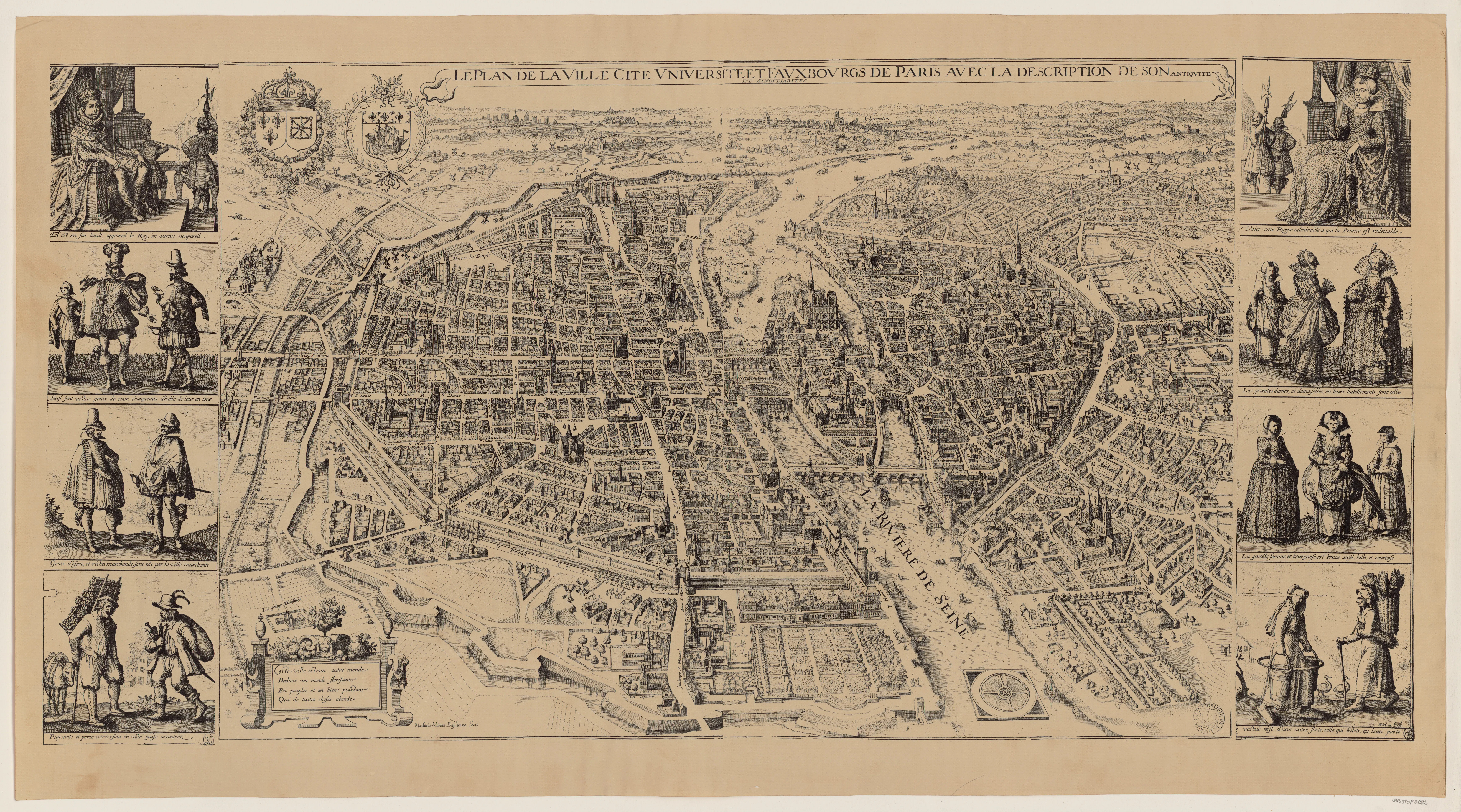
Mathäus Merian's bird's-eye plan renders Paris as a dense early modern city of walls, bridges, church towers, and institutional quarters—the urban world from which the anonymous "theologian of Paris" claims his authority. Shown here as context rather than as an image of the Informatio itself, the view evokes the Sorbonne-centered culture in which Faculty censure, remembered through the Arnauld precedent, could serve as both doctrinal judgment and corporate memory. Source ↗.

The Thomist Witnesses and the Formal Verdict
The third section abandons the register of accusation for that of authority, arraying the Thomist commentators against Noris to show that he departs from every received notion of sufficient grace. The foundational lemma is Álvarez's definition that by the aid of sufficient grace the will has proximate power and an expedited faculty by which it can be converted, a definition already cited in the philological framing above. The rhetorical force lies in the source: this is the vocabulary of the Dominican schola, the party that in the De Auxiliis disputes had opposed the Jesuit account of sufficient grace, and by grounding his indictment in that tradition the author denies Noris even the shelter of Thomism. If sufficient grace confers a potentia proxima and a facultas expedita, then a doctrine that withholds proximate power from the justified sinner cannot be Thomist either. The section closes with its formal verdict, that from the testimonies of so many and such great men it appears that Noris's doctrine cannot be defended with the faith intact, the Ex his tot tantorumque virorum testimoniis set out in the discussion of scholarly significance above — the qualifier salvâ fide converting a scholastic disagreement into a matter touching faith itself.
Closing the Escape: The Remote Power and the Sworn Oath
The fourth section then closes the last avenue of escape by anticipating Noris's likely retreat to a merely remote power to keep the law and showing that Jansenius had already conceded exactly this. Quoting the De Gratia Salvatoris, the author reports that most remotely a man is said to be able to do something by the mere flexible faculty of free choice toward good and evil, this power being constituted in the bare nature of free choice, Remotissimè, inquit) homo dicitur posse aliquid per solam liberi arbitrii flexibilem facultatem ad bonum & & malum, hæc potestas in naturâ nudâ liberi arbitrii constituta est. The tactic is the signature move of the whole family of anti-Jansenist briefs: turn the accused's fallback onto the condemned author's own page. If Jansenius himself admits a remote power lodged in the natura nuda of free choice, then invoking such a power cannot distinguish Noris from Jansenius — it demonstrates their coincidence. This is precisely the conclusion the closing section crystallizes into an instruction: that Noris must not recur further to a remote power which, as has been shown, neither escapes Jansenius nor saves, the nec latet Iansenium, nec salvat trap examined in the philological framing above. The paired verbs form a perfectly closed trap: the remote power is too Jansenian to hide the affinity and too weak to rescue the sinner, so that no conceptual space survives between the licit and the condemned.
Having sealed off the analysis, the fifth section converts it into a demand. Noris must first of all declare that he condemns the five propositions in the sense intended by Jansenius, a sense declared to be the obvious one, and swear to the words of the Alexandrine formula taken in their obvious sense — the practical demand on which the whole apparatus of sensus obvius converges, set out above. The clause qui declaratur esse sensus obvius is the hinge on which the demand becomes inescapable: by asserting that the sense Jansenius intended simply is the plain sense of the words, the author collapses the fact-and-right distinction on which Jansenist subscription had traded, leaving Noris no room to sign the formula while reserving his interpretation. Nothing short of the sworn oath, taken obvio sensu, will clear him.
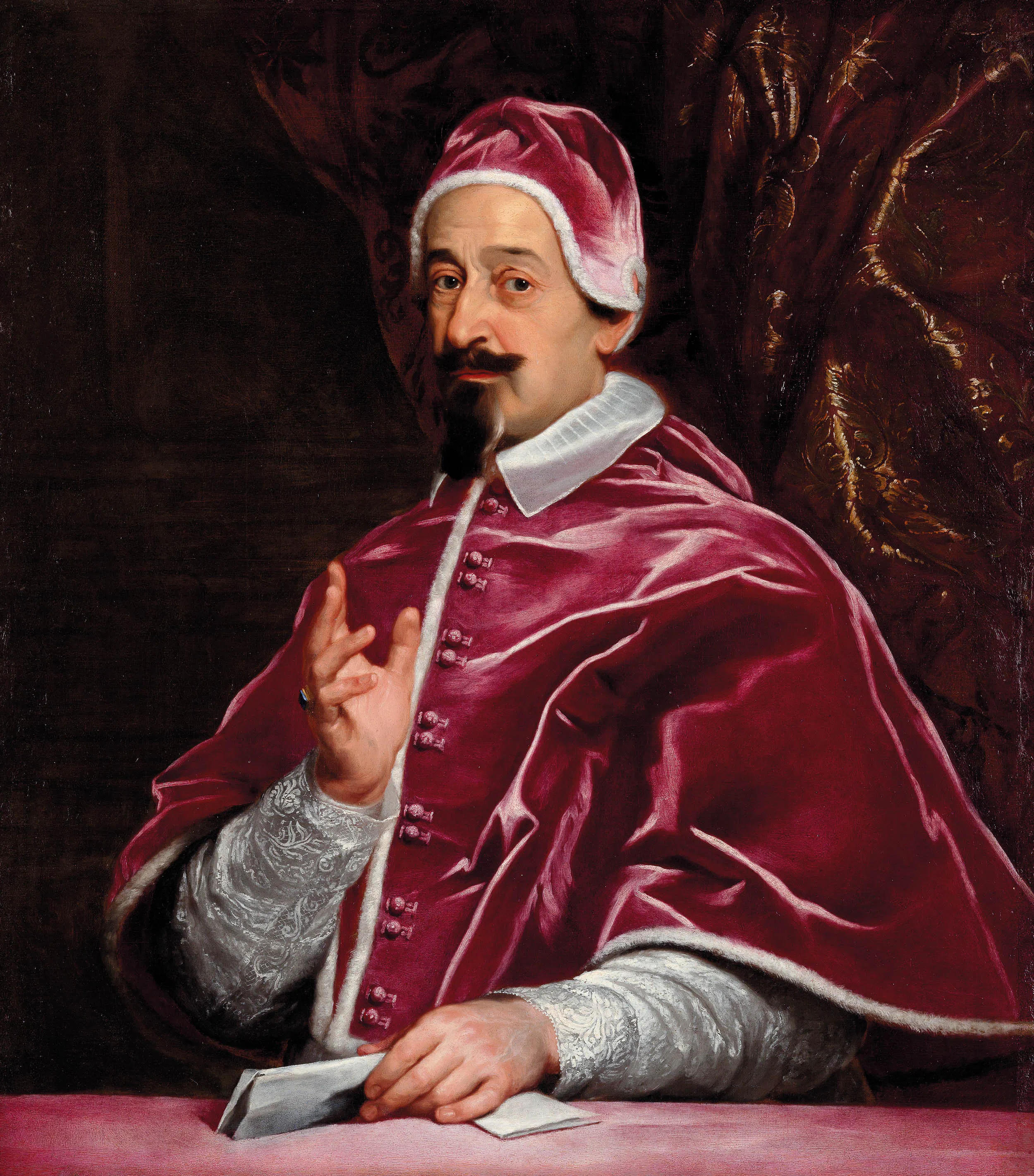
Giovanni Battista Gaulli's portrait presents Alexander VII in the red vesture of papal office, an image of the jurisdictional authority behind the "Alexandrine" formulary invoked here. In the demand placed on Noris, that authority is not ornamental: the oath to condemn Jansenius's Five Propositions in their "obvious sense" becomes the mechanism by which evasion is foreclosed. Source ↗.
.jpg)
The tract grounds this insistence in the authority of Pope Celestine I and the peril of silence, closing on the warning that he fears, says that greatest and most learned Pontiff, lest to keep silent be to connive, lest those who permit such men to speak thus be more truly the ones speaking, Timeo, inquit summus ille & doctissimus Pontifex, ne connivere sit hoc tacere: ne magis ipsi loquantur, qui permittunt illis taliter loqui. The citation performs a final transfer of responsibility: to remain silent before Noris's teaching would itself be a kind of complicity, so that the censors' inaction, not merely Noris's doctrine, is placed under judgment. The whole intervention is thereby framed as a duty rather than an option, and the informational form with which the tract opened — modelled on a censure already approved — is vindicated as the very speaking that silence would betray.
Frequently Asked Questions
What is the Informatio de libro Henrici de Noris?
It is an anonymous Neo-Latin informatio — a censorial theological memorandum — of twenty-four printed pages, written to accuse the Augustinian friar Enrico Noris of concealing the condemned theology of Cornelius Jansen within his historical scholarship. Self-attributed to "a theologian of Paris" (ab uno theologo Parisiensi), it addresses the five censors the pope had appointed to examine Noris's Historia Pelagiana and Vindiciae Augustinianae (Padua, 1673). It reduces Noris's teaching to five propositions, documents each from the Padua edition, and prosecutes the charge that his doctrine cannot be told apart from Jansenism.
Who was Enrico Noris?
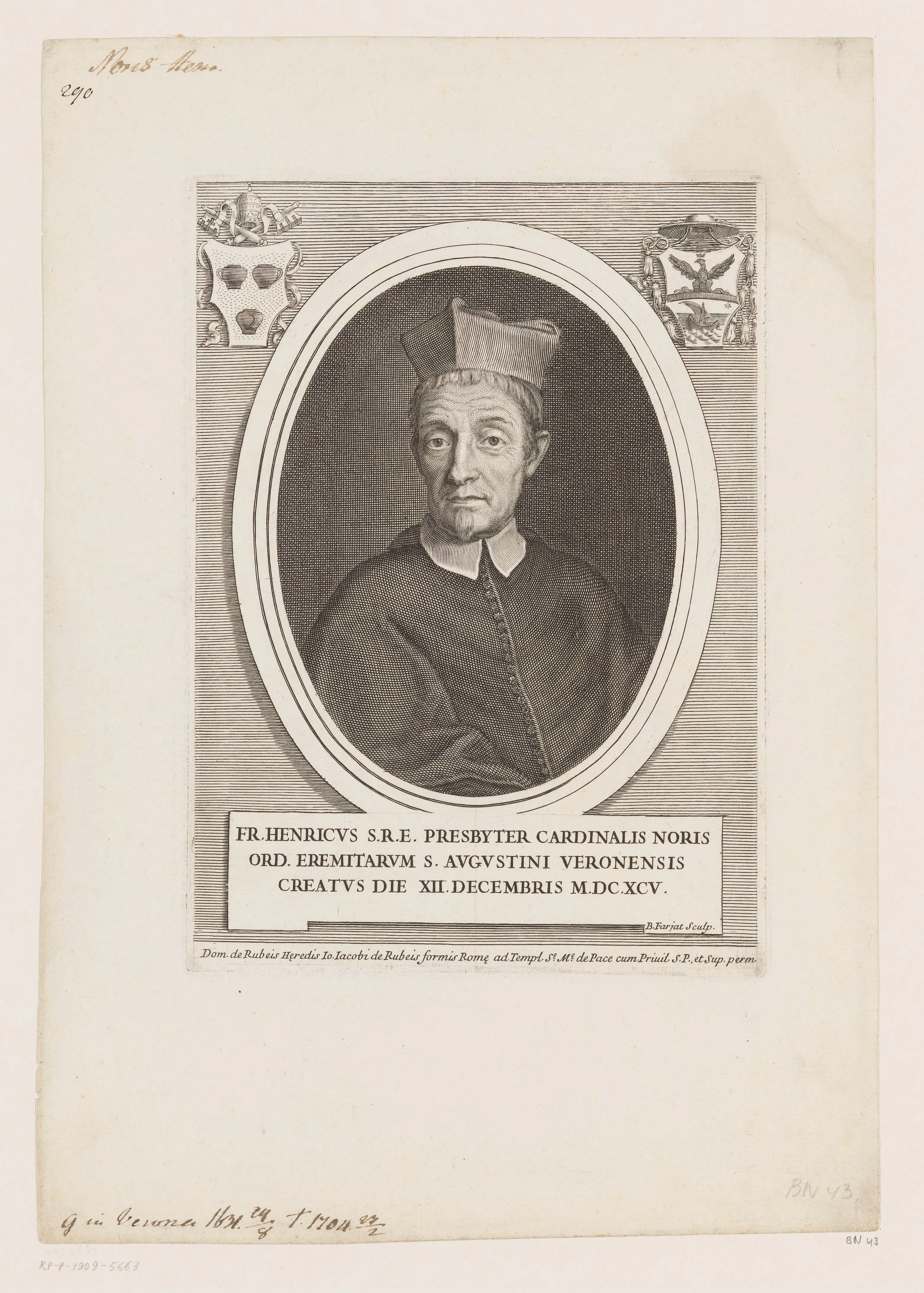
Benoît Farjat's Roman engraving presents Enrico Noris within a cardinal's medallion and heraldic frame, the plate identifying him as an Augustinian from Verona and marking his creation as cardinal on 12 December 1695. That public image of ecclesiastical honor stands in sharp contrast to the prolonged scrutiny of his Historia Pelagiana, making the portrait a visual marker of the rehabilitation that followed the Index proceedings. Source ↗.
_Portretten_van_kardinalen_(serietitel)_Effigies_Car,_RP-P-1909-5663.jpg)
Enrico Noris (Henricus de Noris, 1631–1704) was a learned Augustinian friar whose two Padua volumes of 1673, the Historia Pelagiana et dissertatio de synodo V oecumenica and the Vindiciae Augustinianae, defended St. Augustine's teaching on grace and free will as the historical Church had received it. Those works drew him into a decades-long Roman orthodoxy proceeding. Despite the Historia Pelagiana being suspended by the Congregation of the Index on 19 June 1695, Noris was named Cardinal-Priest of Sant'Agostino that December, and his works were never formally condemned.
What is the "closing trap" the Informatio sets for Noris?
The author anticipates that Noris will retreat to a merely "remote power" (potentia remota) to keep God's law, then shows that Jansenius himself had already conceded exactly such a power, lodged in the bare nature of free choice. This makes the fallback self-defeating: a remote power neither escapes Jansenius nor saves the sinner (nec latet Iansenium, nec salvat). No conceptual space survives between licit and condemned teaching, so only the sworn oath to Alexander VII's formula, taken in its obvious sense, will clear him.
Why does the Informatio rely on Spanish Thomist authorities?
The author arrays commentators from the Spanish Thomist tradition — Báñez, Álvarez, Ledesma, Gonet, Medina, Soto, Curiel, Nazarius, and others — to deny Noris even the shelter of Thomism. This vocabulary came from the De Auxiliis disputes, in which the Dominican–Thomist school opposed the Jesuit–Molinist account of sufficient grace. By grounding the indictment in that school's own definitions — that sufficient grace confers proximate power and an expedited faculty — the author shows Noris departing from every received notion of grace, concluding that his doctrine cannot be defended with the faith intact.
Is there an English translation of the Informatio?
No modern English translation has been identified; the work does not appear to have been published in English, French, Italian, or Spanish. Separately, the Leo edition presents the full transcription together with a complete English translation, generated by artificial intelligence and offered here for the first time. Leo is an effort to make freely available online, at no cost, English translations of every text printed in Latin in early modern Europe between 1450 and 1750. Because no prior scholarly rendering was located, this AI-generated translation makes the twenty-four-page brief accessible in English.
This report was generated by an advanced AI assistant that conducted deep research alongside an extensive interpretation of the transcribed original text. Every effort has been made to preserve fidelity to the source and to guard against inaccuracy, but corruption in the text recognition process and model hallucination may nonetheless have entered the text. Treat every claim, quotation, translation, and citation as provisional, and verify each against the original source before relying on or citing it.
Bibliography
- New Advent, Catholic Encyclopedia: Henry Noris: The 1913 tertiary sketch of Noris — Veronese friar of English ancestry, later cardinal — that still serves as the fastest orientation to the man the Informatio prosecuted. Read it for the outline of his career and the Roman process, but treat its thin documentary base as provisional, exactly as the report warns.
- Cognet, Louis, Le jansénisme: The compact classic synthesis of the movement by a specialist of the Sorbonne school; it places any anonymous Faculty-circulated brief within the wider polemical economy of formulary disputes and the rhetoric of sensus obvius. Consult it to see why "a theologian of Paris" could assume his readers already knew the Arnauld precedent by heart.
- De Lubac, Henri, Augustinisme: La crise augustinienne aux XVIe et XVIIe siècles: Supplies the intellectual terrain on which the whole quarrel turns — the boundary between a licit and an anathematized Augustinianism that the Informatio exists to erase. Indispensable for understanding why the distinction between Noris and Jansenius was genuinely hard to draw, and why the author needed loaded Thomist vocabulary to draw it.
- New Advent, Catholic Encyclopedia: Jansenius and Jansenism: The companion 1913 entry, useful precisely for its comparison of the Five Propositions against the terms of Alexander VII's formulary — the same juridical pairing the Informatio weaponizes. It shows how a near-contemporary Catholic reading understood the fact-and-right distinction the brief collapses.
- Noris, Enrico, Norisii Responsio ad scrupulos doctoris Sorbonici et responsionis examen: Noris's own counter-brief (January 1694), the document whose forensic logic turns the Informatio's technique back on its author. Read it beside the memorandum to watch the accused dismantle the affinitas charge point by point — the other half of a conversation the report can only report from one side.
- Orcibal, Jean, Les origines du jansénisme: The five-volume archival reconstruction of the early quarrel, with vols. 3–4 on the formulary controversy carrying the freight for this text. Essential for tracing the de jure / de facto question that the Informatio inherits and deliberately forecloses against Noris.
- Universidad de Valladolid / Biblioteca Virtual Miguel de Cervantes, Papeles sobre Noris [Manuscrito]: The eighteenth-century dossier preserving the cognate Scrupuli Doctoris Sorbonici and Noris's reply — the closest surviving relative of the Informatio and its structural twin. Anyone testing the report's claims about the text family, or the disputed dating, must start with this manuscript rather than the lone printed copy.
- Tachau, Katherine H., "The sensus obvius Question and the Formulary Controversy," Church History: The standard modern treatment of how both Jansenists and their adversaries exploited the plain-sense clause of Alexander VII's formula. Read it to see precisely what the Informatio's author is doing when he declares that the sense Jansenius intended simply is the obvious sense — the hinge that leaves Noris nowhere to sign.
- Van Hove, Brian, Jesuit Father François Annat and his Role as Minister for Religious Affairs in 17th-Century France: The most recent book-length study of the leading Jesuit anti-Jansenist polemicist and the milieu from which the anonymous "theologian of Paris" is plausibly drawn. It clarifies the genealogy of pro-Molinist attacks on the Sorbonne precedent, though Annat's death in 1670 complicates his candidacy as author — a tension the report flags and this book helps adjudicate.