Mathematical Walls, That Is, Only Paper Ones: Matthias Dögen's Modern Military Architecture, Confirmed by Ancient and Modern Histories and Illustrated with Examples of the Principal Fortifications of Europe
Matthias Dögen was a Brandenburg-born engineer trained in Leiden's school of Dutch mathematics and loyal to the electors of Brandenburg. In 1647, as the Thirty Years' War neared its end, he published at Amsterdam his Architectura militaris moderna. Varijs Historijs, tam veteribus quam novis confirmata, et praecipuis totius Europae munimentis, ad exemplum adductis exornata, a folio that teaches how to fortify and besiege towns in the gunpowder age. It tests every geometrical rule against sieges from Caesar to Breda and judges beauty, cost and the engineer's rank by a single standard, the protection of cities, while also lamenting a devastated Germany and warning that no ruler may lay siege to conscience.
ExLatinis
12 October 2026

Contents
Matthias Dögen was a Brandenburg-born engineer trained in Leiden's school of Dutch mathematics and loyal to the electors of Brandenburg. In 1647, as the Thirty Years' War neared its end, he published at Amsterdam his Architectura militaris moderna. Varijs Historijs, tam veteribus quam novis confirmata, et praecipuis totius Europae munimentis, ad exemplum adductis exornata, a folio that teaches how to fortify and besiege towns in the gunpowder age. It tests every geometrical rule against sieges from Caesar to Breda and judges beauty, cost and the engineer's rank by a single standard, the protection of cities, while also lamenting a devastated Germany and warning that no ruler may lay siege to conscience.
In 1647 the Amsterdam house of Louis Elzevier published a large illustrated Latin folio on fortification, the Architectura militaris moderna of Matthias Dögen. Dögen, also catalogued as Doegen, was a Brandenburg-born engineer and diplomat whose dates are best given cautiously as 1605/06–1672. He had trained in the Duytsche Mathematique at Leiden and served the admiralty of the United Provinces, yet he kept a lifelong allegiance to the electors of Brandenburg. His book is a learned technical treatise. It combines geometrical instruction, computation, engraved plans of fortified places, and historical accounts of sieges from biblical antiquity to the campaigns of the house of Orange-Nassau. It appeared as the Thirty Years' War drew to its close. Within a year the same imprint had issued a French translation by Hélie Poirier and a German version, so the book entered vernacular circulation almost at once.
The problem at the centre of the work is how a new art of fortification should be ordered once gunpowder had made the high medieval wall obsolete. The same problem raises two further questions: who should practise that art, and to what end. Dögen's answer is to subordinate every competing criterion to a single governing end, the protection of cities. He expresses that end in the juridical idiom of a supreme law. Beauty, geometrical regularity, expense and even the professional standing of the engineer are each measured by their service to that end. The safest works become the most beautiful, and mathematical rule yields to tested practice. Outlay is disciplined by what protection requires, and the engineer's rank follows from his usefulness to the commonwealth.
Dögen's characteristic method is to set ancient and modern exempla side by side. He treats the practice of the Dutch Republic under Maurice and Frederick Henry as the school in which the art had been perfected. Classical authority and recent Dutch experience thus confirm one another rather than compete. Historical narrative serves not as ornament but as evidence brought to bear on technical propositions.
The stakes are both historical and disciplinary. The treatise documents the movement of mathematical and military expertise from the United Provinces to Brandenburg during the 1640s. It also documents a period in which the offices of architect and engineer still overlapped, before any sharply differentiated profession of engineering existed. It bears on the long debate over bastioned fortification, siegecraft and military expenditure in early modern Europe. A single technical book cannot, however, establish causal claims about army growth or state centralization.
Dögen extends his governing principle outward into politics and conscience. He presents the devastation of Germany, the role of citadels in the relation between rulers and subjects, and the limits of rule over consciences as matters touching the same art. Whether these statements amount to a fully articulated political or confessional programme has not yet been verified against the full printed text.
The book's particulars are striking. One described Latin copy contains twenty-nine folding engravings lettered A–Z and Aa–Ff, together with forty folding plans of fortifications. The engraved title is attributed to Theodor Dirck Matham, and much of the geometrical imagery derives from Hendrik Hondius's engravings for Samuel Marolois. Dögen's examples range from Dutch towns to Küstrin on the Oder. He commends extensive drawing as an inexpensive form of practice. He also drew freely on the Jesuit Herman Hugo's account of the siege of Breda, an instance of military information crossing confessional and political lines. Library cataloguing has at least once confused his treatise with Hugo's quite different book on cavalry.
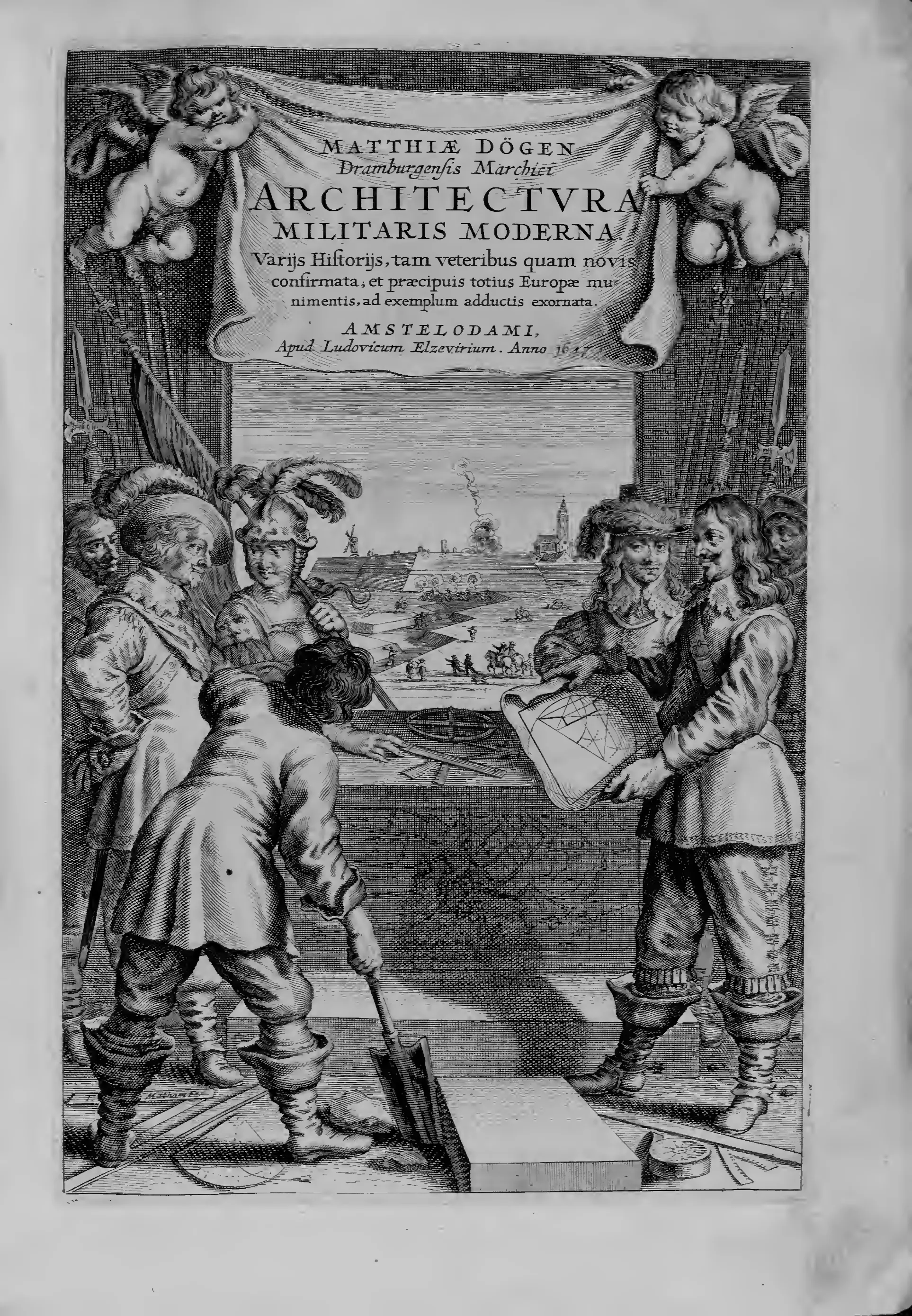
The engraved title page, attributed to Theodor Dirck Matham, sets Dögen's promised method—confirming the art "by various histories, both old and new"—within a cartouche framed by rulers, plans, compasses, soldiers, a spade and a besieged bastion: learned design and operative defence joined on a single page. Source ↗.
A single throughline unites the work's vocabulary, its production and its argument: the reconciliation of learned and operative knowledge in the service of a defensible commonwealth. The conjunction is legible in the title's own terms, an architectura that is military, moderna yet confirmed by ancient histories. It is legible in the book's history, which runs from Dutch printing under the encouragement of Frederick Henry to presentation to Elector Frederick William at The Hague in 1648. It is legible as well in an internal argument that measures every rule by the protection it affords. Some biographical and bibliographical details remain unsettled: Dögen's birth year, the exact day of his death, and the relation of the presented attack-and-defence part to the complete 1647 publication.
Read the full text and English translation on Leo
This text was transcribed and translated as part of the ExLatinis project, an effort by Leo to make free English translations of every text published in Latin in early modern Europe (1450–1750) available online. The complete transcription and English translation of this work can be read free of charge:
→ Read the original Latin text and full English translation on Leo
You can save a copy of this document into your Leo account to run deep text searches, conduct further analysis, or cross-reference it with your own research.
Naming Dögen's Modern Military Architecture: Title, Definition and the Ends of the Art
Modern Military Architecture, Confirmed by Ancient and Modern Histories and Illustrated with Examples of the Principal Fortifications of Europe is an editorial English rendering supplied for convenience, not a documented established English title. The bibliographically attested Latin title is Architectura militaris moderna. Varijs Historijs, tam veteribus quam novis confirmata, et praecipuis totius Europae munimentis, ad exemplum adductis exornata.
The Amsterdam fortification treatise published by Louis Elzevier in 1647 is Matthias Dögen's work, not Herman Hugo's De militia equestri antiqua et nova ad regem Philippum IV libri quinque. An attribution of the 1647 fortification book to Hugo's cavalry treatise confuses distinct authors, subjects and editions. Hugo's work was printed at Antwerp by Balthasar Moretus in 1630 and is independently registered as USTC 1003298. The particular catalogue entry responsible for assigning a Dögen copy to Hugo could not be independently located. The work-level correction is secure, but the history of that erroneous record remains unverified. The bibliographical descriptions and specialist scholarship identify Hugo within Dögen's historical apparatus as an authority on Breda, not as the author of the fortification treatise.
Architectura militaris denotes more than the construction of isolated military buildings. In Dögen's treatment, it encompasses the mathematical ordering of defensive works, their accommodation to the ground, and the knowledge necessary for their attack and preservation. His own definition joins these elements in a single formula, calling military architecture the art of fittingly fortifying and holding any place against hostile force: Architectura igitur militaris est ars locum quemcunque adversus vim hostilem aptè muniendi & tuendi. The paired gerunds muniendi and tuendi bind construction to preservation, so that the art is defined by its capacity to keep a place rather than merely to build it. Dögen then specifies the art's proper ends as threefold, Soli enim atque proprij Architecturæ militaris fines hi sunt tergemini;, a statement of "sole and proper ends" that frames the doctrine teleologically. In the ensuing discussion defence is given priority over attack.
Michèle Virol connects this conception with Dögen's training in Leiden's Duytsche Mathematique and with his use of Vitruvius alongside practical examples. Architecture here belongs to a learned and operative art: geometrical demonstration must issue in works capable of resisting an enemy. Its demands concerning expenditure, proportion and effective construction should therefore be understood within the period's architectural and military learning, not through later managerial or modernist categories. The text itself gathers these demands under one governing end. Since the supreme law of military architecture is the protection of cities, the best eurythmy and symmetry of a fortification's members are those strong enough against all force at least cost: suprema Architecturæ militaris lex est urbium tutela; ita meritò quoque Eurythmia, & Symmetria membrorum Munitionis, optimæ illæ erunt, quæ quàm minimis sumtibus contra vim omnem satis validæ sunt:. The Vitruvian vocabulary of eurythmy and symmetry is retained but redefined. Proportion and economy alike are measured against the juridical standard of urbium tutela, the principle that recurs throughout the work as its controlling criterion.
Moderna qualifies that art historically rather than announcing a repudiation of antiquity. Dögen places recent European fortifications and sieges beside classical authorities. He marks the technical rupture plainly, dating the transformation of warfare from the moment the engine of Mars was brought forth by "our Berthold Schwartz, a German Prometheus," At postquam à Bartholdo nostro Schwartz, (a) Germano Prometheus, a mythological figure that casts gunpowder as a stolen and double-edged gift. The rupture in technique does not, however, entail a rupture in learning. Comparing ancient siege lines with contemporary practice, he insists that no egg is more like an egg than those Julian trenches are like our approaches, nec ovum ovo præterea tam est simile, quam brachia illa Iuliana nostris accessibus.
The title's explicit conjunction of ancient and modern histories makes inherited learning compatible with the requirements of contemporary warfare. Virol's reading likewise emphasizes the combination of mathematical instruction, recent Dutch examples and adaptation to particular circumstances. The contrast is consequently between different conditions and practices of warfare, not between an allegedly irrational past and an exclusively rational present.
The phrase historiis … confirmata assigns historical narratives an evidentiary function. Accounts of sieges are brought into relation with propositions about fortification, rather than serving solely as antiquarian ornament. Virol identifies examples extending from biblical narratives to the Orange-Nassau sieges and Hugo's account of Breda. Interpreting confirmata as a claim that historical experience strengthens technical demonstration is a philological inference supported by this combination of title and contents. It should not be mistaken for a verified quotation of a methodological declaration from Dögen's preliminaries.
The body of the text does supply a general principle consistent with that inference. Dögen holds that nothing new happens under the sun and that the same mind is maker of human actions, quippe nihil sub sole novi accidit, idemque actionum humanarum. The Ecclesiastes echo grounds the comparability of ancient and modern sieges in the constancy of human conduct. It corroborates the evidentiary reading of confirmata without itself constituting the prefatory declaration that remains unverified.
The precise uses of Hercotectonice, Areotectonice and the other specialized Latin formulas still require direct collation of the printed text. The adjectival form is at least attested in the description of Maurice of Orange as founder of the laws of fortification, who had learned from experience: Conditor legum Hercotectonicarum Mauritius, Princeps Auriacus, experientiâ. There the term is tied simultaneously to the Dutch school, to a legislative metaphor and to the authority of practice. A comparable lexical bridge appears where Dögen glosses the "poor wise man" of Ecclesiastes with the vernacular names for the engineer, est in ea vir pauper & sapiens (Ingegnero Itali, Ingenieur, setting the Italian and French terms beside Scripture. These instances indicate the range of the vocabulary but do not substitute for a systematic account of it.
Summarizing Dögen's 1647 Treatise on Fortification
Matthias Dögen's Architectura militaris moderna is an illustrated technical and historical treatise on fortification, published in Latin at Amsterdam by Louis Elzevier in 1647. Its mathematical instruction, examples of fortified places and historical accounts of warfare seek to establish the competence required of an engineer advising military commanders. Regular and irregular fortification are treated within a wider concern for the construction, attack and defence of strongholds. Across these subjects the treatise orders its criteria of beauty, proportion, cost and professional standing by reference to a single end, the protection of cities, which the text states in juridical terms as the supreme law of the art.
Amsterdam is securely established as the place of publication and an important centre of Dögen's professional activity. The text registers his attachment to the city in panegyric terms, calling it rich queen of the cities of Europe and now "our nurturing Parent and truly beneficent second fatherland": Amstelodamum dives Europæ urbium regina, ac nostra nunc alma Parens, Patriaque altera verè benefica. An exact place and interval of composition have not been established.
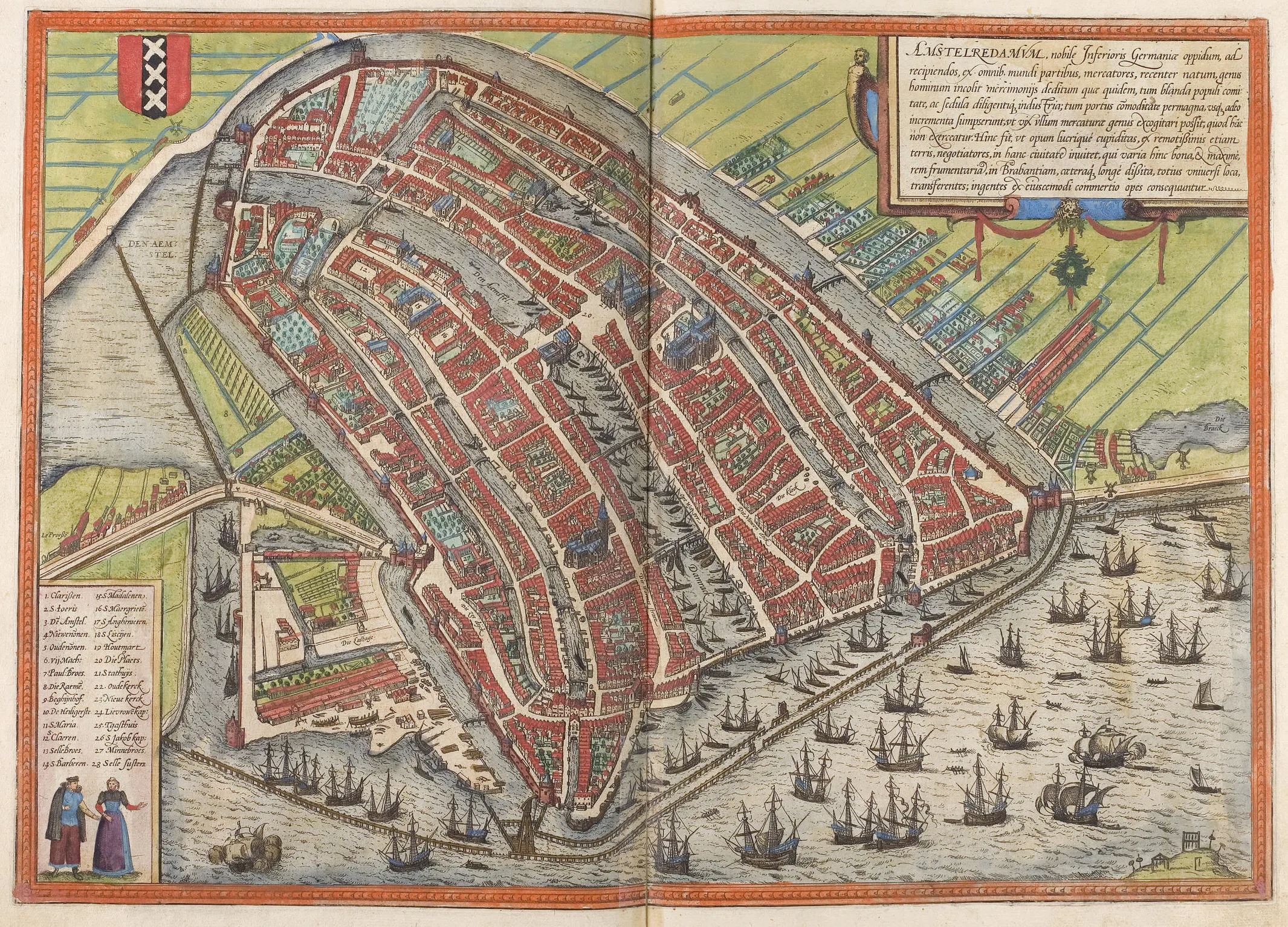
A sixteenth-century Braun and Hogenberg view of Amsterdam, made decades before Dögen wrote, evokes the water-bound mercantile city he praised as his second fatherland, where, he observed, the Hollander defended himself less by arms than by waters. Source ↗.

Dögen, also catalogued as Doegen, was a Brandenburg-born engineer and diplomat whose career connected Dutch mathematical and military institutions with electoral service. His dates are best stated cautiously as 1605/06–1672: the GND authority record gives 1605, whereas the specialist Architectura notice retains 1605/06. Virol identifies his attendance at Leiden's Duytsche Mathematique, subsequent admiralty employment in the United Provinces, and service to the electors of Brandenburg.
The work was translated into French as L'architecture militaire moderne, ou Fortification, by Hélie Poirier, and published at Amsterdam by Louys Elzevier in 1648. A German version, Heutiges tages übliche Kriges Bau-kunst, is also documented under the Elzevier imprint in 1648. An English translation has not been established. Virol separately records the presentation to Frederick William in 1648 of a Latin part concerning attack and defence. Its relationship to the complete 1647 publication requires more exact edition-level investigation.
Why Dögen Matters to the History of Fortification, Siegecraft and Engineering
Dögen's treatise is significant as evidence for the movement of military and mathematical knowledge between the United Provinces and Brandenburg during the final years of the Thirty Years' War. The war is not merely a backdrop: the text addresses its devastation directly, enjoining the reader to look at most afflicted Germany, smoking here with recent fire and still burning elsewhere, Specta Germaniam afflictissimam, fumantem hîc recenti incendio, ardentem alibi adhuc. It also grounds the civic stakes of fortification in the people a besieged town contains. The greatest part, it says, is claimed by women, tender children and the sick or infirm old, whose safety and hope rest almost wholly in strong walls: maximam ejus partem sibi vendicat imbelle foemellarum genus, partem pueri teneri, partem ægri, vel infirmi senes constituunt: quorum omnium salus atque spes in vallis murorum fortium pænè sunt posita. The protection of cities thus acquires a concrete human referent alongside its juridical formulation.
Its historical importance lies not simply in geometrical prescriptions but in the conjunction of instruction, illustrated fortified places, accounts of sieges and the professional claims of the engineer. The publication belongs to Amsterdam's learned printing environment, while its author's electoral allegiance connects that environment with Brandenburg's acquisition of technical expertise.
The strongest directly recovered specialist interpretation is Michèle Virol's 2010 notice for the University of Tours Architectura project. Virol presents the work as an enlargement and updating of Dutch fortification knowledge associated with Samuel Marolois and Adam Freitag. Dögen follows mathematical methods familiar from their works, yet combines detailed calculation with a concern for the circumstances of actual construction and warfare. Virol emphasizes his instruction through diagrams and computation tables and his insistence that the commander benefit from an engineer's command of proportions, terrain and the resistance of fortified works.
The text's own formulations bear out the weight Virol places on practice. Of one technical question Dögen writes that the matter is far more obscure by opining than by testing, since it is subject to no mathematical laws: res hæc opinando multo est obscurior, quàm experiundo: cùm legibus Mathematicis nullis subjaceat. Elsewhere he invokes usage in the place of every reason, using a Roman constitutional figure, Addo nunc, pro omni ratione, usum dictatorem. That figure grants experience an extraordinary authority over the ordinary rule of demonstration, much as Maurice of Orange's laws of fortification are said to have been learned from experience. This interpretation supports a history of practical mathematical expertise rather than a simple opposition between theory and experience.
The place of drawing is particularly important. Virol records Dögen's encouragement of extensive preparatory drawings as a comparatively inexpensive means of practice. Printed plans and geometrical figures are consequently instruments of instruction, not merely embellishments. The same text is nonetheless alert to the danger of drawings that never meet the ground. In an ironic register it proposes, "let us, with mathematical resources, build mathematical walls, that is, only paper ones": mathematicis moenia condamus mathematica, hoc est, tantùm chartacea:. The sarcasm seems directed at designs that substitute for construction rather than prepare for it, though its precise target depends on the surrounding argument.
Pollak's bibliography supplies the material and cartographic framework for comparing this apparatus with other fortification treatises. Schütte's edited exhibition catalogue provides a complementary framework for the historically overlapping offices of architect and engineer. Neither framework warrants identifying Dögen with a later, sharply differentiated professional discipline.
The text's own claims about professional standing fit this overlap rather than a later separation of offices. Dögen would believe the business of war well ordered only when spirited architects command great armies, or commanders of armies practise architecture: tum demum res belli probè, rectéque constituta meritò crediderim, cum animosi architecti magnis exercitibus imperant, aut imperatores exercituum. He urges that all who wage war measure the studies and art of military architects with just estimation and equal them with the highest ranks in war: ut bellum quicunque gerunt, studia, & artem castrensiu architectorum justa æstimatione metiantur, & summis in bello dignitatibus æquiparent,. The ideal is an architect-general, not an engineer set apart as a separate profession, and the engineer's rank is derived from the service his art renders to the protection of the commonwealth.
A second interpretative problem concerns the relationship between general geometrical prescriptions and particular sites. Virol compares Dögen's attention to circumstances with Jean Errard's approach and identifies a broad range of fortified places, from Dutch examples to Küstrin and other European towns. The text treats terrain and nature as resources the art must reckon with. Of the Hollander it observes that he has always, from all past ages, defended himself against enemies not so much by arms as by waters: Hollandus enim non tam armis, quam aquis se semper omni retro ævo defendit ab hostibus.
The tension between mathematically regular designs and adaptation to existing towns, terrain and military requirements is therefore securely grounded. Stronger assertions about particular design rules—musket range as a fixed module, a general rejection of wet ditches, or the exact priority assigned to beauty over security—require passage-level verification. They cannot be treated as established findings merely because they fit this broader interpretation.
The printed text does contain statements that bear directly on each of these questions. It declares in capitals that the immutable measure of all fortifications to be built shall be the shot of the musket, MENSURA itaque OMNIUM MUNITIONUM EXSTRUENDARUM IMMUTABILIS ESTO IACTUS. It holds that more hope lies in the spade than in the cannon, plus in ligone spei, quam in tormentis situm esse. It judges a ditch full of water most inept for discharging military duties, Fossa aquâ plena ineptissima est ad defungenda munia militaria; siccâ, before turning to the dry ditch. And it lays down that the safest fortifications must always be held the most beautiful, TUTISSIMA MUNIMENTA PERPETUO HABENDA ESSE FORMOSISSIMA, which accords with the subordination of eurythmy to the protection of cities.
These formulations show that the propositions are stated in the text in strong terms. The wet-ditch judgement, however, is framed with reference to particular military duties rather than as an unqualified rejection. How far each rule is qualified elsewhere, and how it operates across regular and irregular cases, remains a matter for fuller passage-level collation.
The military-revolution debate supplies a wider comparative setting: bastioned fortifications, siege operations, military expenditure and the relationship of warfare to political organization are all relevant. Dögen's book, however, cannot alone establish that fortification caused army growth or state centralization. Such causal propositions belong to comparative historical argument, not to an inference from a single technical treatise. The verified specialist literature does not disclose a developed Dögen-centred controversy between competing modern schools. The absence of such a controversy must not be represented as scholarly consensus on every aspect of the work.
The use of Hugo's account of Breda is also consequential. A Brandenburg-associated author incorporated material from a Jesuit historian of the Spanish-Netherlandish siege. This supports a limited inference that military historical information could cross confessional and political divisions. It does not demonstrate agreement with Hugo's religious commitments, nor does it establish Dögen's own confession. Similarly, dedications and electoral service document political relationships. An interpretation of the treatise as a fully articulated programme of Protestant concord, anti-Machiavellian political theory or just-war theology awaits direct verification of the relevant printed passages.
The printed text does speak to these themes, and several of its statements can be set out in Dögen's own wording. On the war's justifications, he asks whether the same comedy is not played today, with the characters rather than the plot changed: Annon hodie eadem agitur Comædia non rebus sed personis mutatis?. He laments a war waged without any enemy, gerimus sine ullo hoste. Gessimus quidem bellum nunc (& quem das finem Rex, the apostrophe to a king breaking off in the passage as it survives. On conscience, he holds that whoever would rule over men's consciences invades the citadel of heaven, Quicunque enim conscientiis mortalium imperaturus est, is cæli arcem invadit, turning the vocabulary of fortification into a figure for the limits of coercion.
On citadels, the text holds two positions in tension. It takes issue with one who scorns the building of citadels and counsels demolishing those already built, arcium struendarum contemtor; structarum verò demoliendarum, a figure whom the surrounding discussion associates with Machiavelli. It also affirms that not soldiers, not citadels, but the will of subjects is the firm bulwark of rulers, Non milites, non arces, sed subditorum voluntatem Patribus firmum munimentum:. The art itself is presented as providential. Dögen calls it clearer than the midday sun that God, supreme giver of arts, has bestowed on unwarlike mankind no art more useful or necessary than this martial art by which cities are ingeniously fortified: NOSTRA ITAQVE HAC MARTIA ARTE, qua urbes ad vim perferendam vel faciendam ingeniosè & judiciose permuniuntur, nullam, vel utilitate aut necessitate ampliorem, imbelli mortalium generi elargitum esse supremum artium largitorem Deum, sole clarius est meridiano;. Adapting Virgil's charge to Rome, he assigns the architect the art of imposing the custom of peace, Hæ tibi erunt artes: scilicet pacis imponere morem, moramque.
These passages establish that the text extends its principle of protection into reflection on war, conscience and the relation of rulers to subjects. Whether they cohere into a fully articulated confessional or political programme, and how they bear on Dögen's own confession, has not been established.
The principal historiographical limitation is thus precise. A substantial specialist account of training, method, exempla and professional authority is available, whereas the political-theological and lexical readings that have been advanced remain insufficiently established. The statements quoted above narrow that gap but do not close it. Those subjects are legitimate questions for further research, not settled attributes of the text.
Tracing the Elzevier Editions, Plates and Surviving Copies of Dögen's Treatise
Identification and catalogue controls. The author, title, Amsterdam imprint and year 1647 agree in the University of Tours Architectura notice and the detailed bibliographical description published by Robin Halwas. WorldCat discovery record OCLC 889430798 likewise associates Architectura militaris moderna with Mathias Dogen and the Elzevier publication of 1647, although its complete physical description was not independently recovered. A Dögen-specific STCN identifier and USTC edition number were not recovered. USTC 1003298 belongs instead to Hugo's Antwerp cavalry treatise of 1630 and must not be transferred to Dögen. The surviving catalogue evidence therefore distinguishes the works, but does not authenticate the specific erroneous attribution of a digitized copy.
The exact Latin author formula on the engraved title-page has not been independently transcribed. Dögen and Doegen are securely attested modern catalogue forms; Dogen occurs in international discovery records. No pseudonym or anagram was established. Dramburg, now Drawsko Pomorskie, is the geographical affiliation used in the French title, whereas GND 128847093 specifies Köntopf as Dögen's birthplace. Regional identification with Dramburg must not erase that distinction.
Physical constitution. Halwas describes a Latin copy as folio, measuring 300 × 195 mm, with 278 leaves and the signature formula ² ()² A–G⁴ ⁴ H–M⁴ ² N–Z⁴ Aa–Bb⁴ ⁴ Cc–Zz⁴ Aaa–Vvv⁴. Its pagination is recorded as [8], 1–56, [8], 57–96, [4], 97–200, [8], 201–504, [24]. These measurements belong to the described copy; they are not universal dimensions for every surviving example.
The same description distinguishes twenty-nine inserted folding engravings, lettered A–Z and Aa–Ff, from forty folding engraved plans of fortifications, with an additional engraving printed with the text on p. 28. The assertion that the Latin edition contains more than fifty city plans is therefore not supported by this collation: the larger quantity includes geometrical and construction figures as well as plans. A numerical description of the plates must specify which series is being counted. The distinction between the two series corresponds to the treatise's double reliance on geometrical demonstration and on the particular fortified places through which that demonstration is tested.
The engraved title or frontispiece is attributed to Theodor Dirck Matham. Neither that attribution nor the general association of Matham with the edition establishes that he designed or engraved every inserted plate. Virol identifies substantial debts to Hendrik Hondius's engravings for Marolois, while emphasizing Dögen's enlarged geographical range of examples. A separate portrait, a complete attribution of the plate series, and an independently verified account of disagreement between Dögen and his engraver were not established. Printed placement instructions, technical glossaries and the Bellaria apparatus likewise await direct collation.
Edition and translation history. The Latin edition is identified as the first edition in Halwas's description and referred to Willems, Les Elzévir, no. 1047; Pollak, entry 15; and the British Architectural Library's Early Printed Books, entry 894. Those references provide bibliographical controls, but do not substitute for comparison of complete copies.
The French edition is securely described in HathiTrust record 101750915: L'architecture militaire moderne, ou, Fortification: confirmée par diverses histoires tant anciennes que nouvelles, & enrichie des figures des principales forteresses qui sont en l'Europe, by Matthias Dögen, translated by Hélie Poirier, Amsterdam, Chez Louys Elzevier, 1648. It is a folio in two parts, the second bearing the special title L'architecture militaire moderne, en la partie qui concerne l'attaque & la deffance. That bipartite arrangement makes visible the work's distinction between fortification proper and the attack and defence of places. The record gives [8], 56, [8], 57–104, [4], 105–230, [8], 231–547 [i.e. 543], [1] pages and seventy folded leaves of plates. It also records omitted page numbers 155–158 and the misnumbering of 513–514 as 113–114. These particulars belong to the French edition and must not be silently imposed on the Latin one. Its WorldCat cross-reference is OCLC 5784219.
Google Books documents the German Heutiges tages übliche Kriges Bau-kunst, published bey Ludwich Elzeviern in 1648, from an original identified as belonging to the National Library of the Netherlands and formerly the University of Amsterdam. A complete German collation and the translator's identity were not established. Halwas notes an unpublished Italian translation reported by Mariano d'Ayala; that bibliographical report does not establish an extant printed Italian edition.
Repositories and accessible copies. The securely established Latin shelfmark is Ghent University Library, BIB. MA. 000133, linked by Architectura to the digital object https://lib.ugent.be/europeana/900000070293?pg=PP1. Virol also records a copy at the Staatsbibliothek in Berlin connected with the 1648 presentation, but supplies no shelfmark. The French edition is available through the Getty Research Institute's HathiTrust surrogate, https://babel.hathitrust.org/cgi/pt?id=gri.ark:/13960/t7jq5zc7q. Its physical shelfmark was not recovered. The German Google Books identifier is QEdnAAAAcAAJ. Additional copy-level shelfmarks at the other named repositories were not established.
Patronage and professional networks. According to Virol, Frederick Henry of Orange-Nassau encouraged publication. This is a patronage relationship consonant with the treatise's treatment of the Dutch Republic under Maurice and Frederick Henry as the normative school of fortification. Dögen's enduring allegiance was to the Brandenburg electors: he supplied George William with weekly information from Amsterdam and renewed his fidelity to Frederick William after the succession in 1640. Virol records that Dögen dedicated and delivered the Latin attack-and-defence part to Frederick William during the elector's visit to The Hague in 1648. A separate dedication to Konrad von Burgsdorff has not been independently authenticated. The alleged 1619 Breda contract inclusion and its financial figures were not independently transcribed.
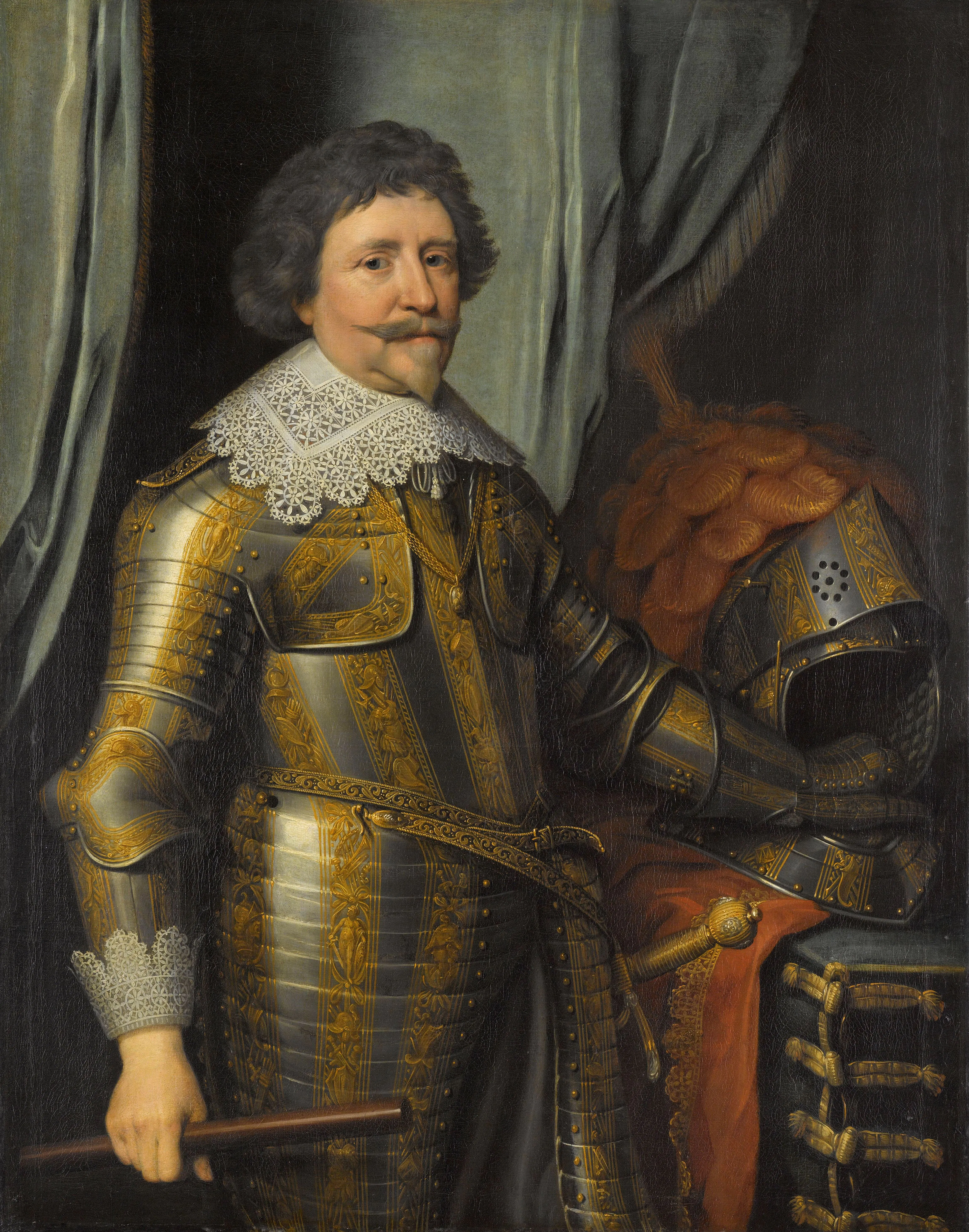
Frederick Henry of Orange-Nassau, portrayed in armour (Rijksmuseum SK-A-254). Virol credits him with encouraging the treatise's publication, and Dögen hails him as the most judicious and fortunate besieger of cities—the soldier-stadholder at the centre of the Dutch school the treatise holds up as normative. Source ↗.

Dögen returned to Brandenburg in the early 1650s as an adviser on fortifications. Virol associates him with Berlin's defensive works of 1658–1659 under Johann Gregor Memhardt and with the creation of the Brandenburg fleet. Küstrin, now Kostrzyn nad Odrą, receives particular attention among the treatise's examples. This establishes its place in his technical discussion, not by itself a documented appointment or building commission there. GND gives his death as 23 February 1672 in Berlin, while Virol gives 24 February. The discrepancy remains unresolved.
Reception and institutional limits. French and German publication in 1648 demonstrates an early multilingual transmission, but does not by itself establish circulation figures, readership or influence on a particular fortress. No contemporary refutation, counter-treatise or official proceeding directed against Dögen's book was identified. A printing privilege, censorship intervention or suppression was not established. That absence of documentation must not be converted into a categorical claim that the book was uncensored. Dögen's personal confession and the theological significance of his closing formulas also require evidence beyond the patronage and professional relationships presently verified.
One such formula reads "to the greater glory of God and the security of the innocent," AD MAJOREM DEI GLORIAM, ET INNOCENTIUM SECURITATEM. It joins a devotional phrase widely associated with the Society of Jesus to an ethical clause that restates, in the protection of the innocent, the treatise's governing end. Its wording alone does not settle the question of Dögen's confession.
Following Dögen's Argument from the Definition of the Art to the Siege
The Prefatory Apparatus and the Definition of the Art
The printed apparatus that opens the volume states the work's method before any argument begins. The title page promises a modern art confirmed by ancient and recent narrative alike, Varijs Historijs, tam veteribus quam novis, "by various histories, both old and new." The binder's instruction that follows lists the folding plans from Ehrenbreitstein and Küstrin to Breda, Palmanova and 's-Hertogenbosch, and so lays out in advance the inventory of places through which the argument will be tested. The surviving leaf of the dedication to Frederick William places the treatise at once within the politics of the war's end. It praises the Elector as the one who alone bought the Christian peace at his own expense, tu solus tuis impendiis redimere, by ceding territory. The compliment matters for what follows. Before fortification is defined, the dedicatee is honoured for a cost borne on behalf of common security, and the vocabulary of expense measured against protection, which governs the later canons, enters through panegyric.
The opening chapter then grounds the whole art in the definition already examined, which couples building with keeping: military architecture is the art of fittingly fortifying and holding any place against hostile force. A learned Greek division follows, into Hercotectonicen (b) sive Munitoriam; & Areotectonicen (c) sive Pugnatoriam, the fortifying and the fighting branches. These coinages give the engineer's craft a classical pedigree suited to a liberal discipline, and the German and French notes that gloss them tie that learned nomenclature to the vernacular of the working engineer. The order of exposition is then justified by a moral maxim rather than a technical one. Since a man's chief care must be to protect himself and his own rather than to attack what belongs to another, Sed cùm homini potior cura se, suaque tuendi esse debeat, quàm aliena incessendi, defence precedes attack. The maxim belongs to natural-law reasoning about self-preservation. It also sets up an ethical axis along which the chapter will later condemn those who lay waste the lands of others.
Nature, Art and the Coming of Gunpowder
The survey of natural fortification moves through mountains and deserts to its main exhibit, Holland, where nature and art are hardest to separate. Here Dögen records the observation, noted above, that the Hollander has always defended himself against enemies less by arms than by waters. The element is two-sided, for Holland wages war against the Ocean at no less expense than against its enemies, Nam contra Oceanum non minoribus impensis belligerat Hollandia quàm contra hostes. The sea is at once an adversary to be held back by dikes and a weapon to be released against an invader. The account of the relief of Leiden in 1574 gives this hydraulic defence a providential sense through Janus Dousa's line, Solæ pro Batavo belligerentur aquæ, "the waters alone shall wage war for the Batavian." The technical treatise thus absorbs the patriotic poetry of the Revolt, together with the narratives of Strada and van Meteren, and the method announced on the title page is put into practice. Histories serve as evidence that a mode of defence has worked. Stralsund's resistance to Wallenstein and Küstrin, a town of the author's Brandenburg homeland, extend the same proof eastward into the Empire.
The second chapter makes art the imitator, and even the rival, of nature. Once natural defences ran short, art took up the work, ea coepit parare ars, ingeniosa naturæ pellex, "that ingenious concubine of nature." The erotic edge of pellex is pointed: art takes nature's place without her legitimacy and borrows rampart and ditch from mountain and river. A teleology is then imposed on this history through the statement, discussed earlier, of the art's sole and proper ends, which are threefold: security against surprise, resistance by few against many, and counter-attack at least cost.
The developmental account of walls is judged against these ends. It runs from the straight wall, whose foot is dead ground, through crenellation and square, pentagonal and round towers. The bastion is its culmination, Prodiisset enim illa ipsa, quâ hodie utimur, propugnaculorum absolutissima forma, "that most perfect form of bastions which we use today would have emerged." The developmental scheme lets Dögen honour Vitruvius and the ancients as stages on the way to the modern trace. Antiquity becomes the infancy of a form that the present has brought to maturity.
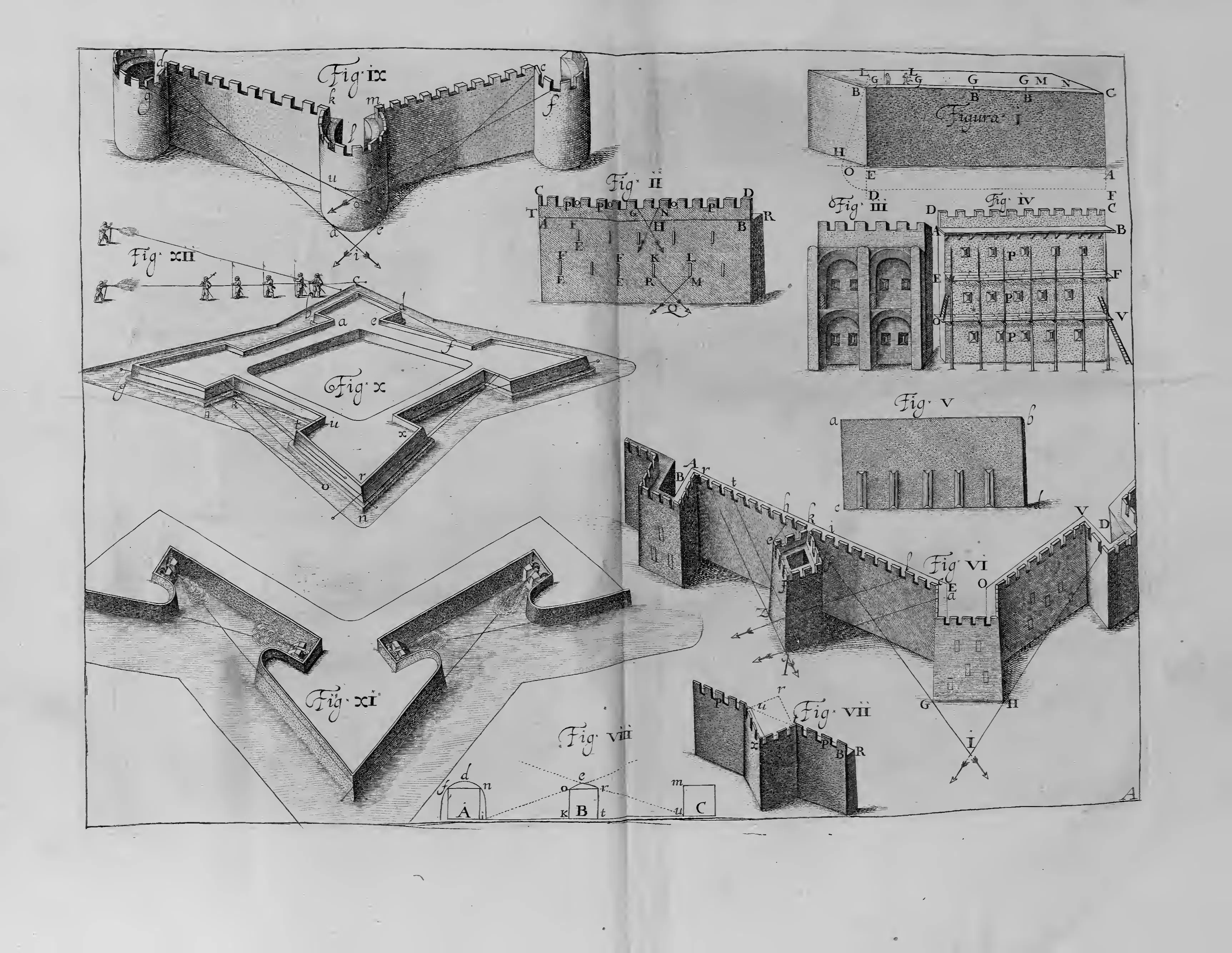
This folding plate sets older crenellated walls and towers beside a bastioned trace, cutaway bastion angles, lines of fire and a musketeer range demonstration, turning the history of fortification into geometry: antiquity as an immature stage of a form that modern bastion design, measured by musket shot, perfected. Source ↗.
Gunpowder marks the break. The weapon was drawn forth, in the phrase already considered, by "our Berthold Schwartz, a German Prometheus." The possessive claims the invention as German, while the Promethean figure recalls a gift of fire that brought punishment as well as power. The consequence follows directly: etiam murorum lateritiorum usus inutilis esse coepit, the use of brick walls began to be useless. The remedy is earthwork, Montes objiciendi fuere, murique terrei, qui disjecti, "mounds had to be opposed, and earthen walls, which when struck..." The phrasing mirrors the opening survey. Art answers the new fire by building artificial mountains, so that the Dutch rampart of earth becomes nature reconstituted.
The chapter closes on a return to nature's desert defence, and it is here that it shifts from antiquarian survey to contemporary testimony. Dögen cites Caesar on the Germans' cleared borderlands, Civitatibus maxima laus est, inquit; quam latissimas circum se, vastatis finibus, solitudines, "it is the greatest praise for states, he says, to have around them the widest wastes, their borders laid desolate." He then turns the reader's eye to the present, to the image already set before us of most afflicted Germany, smoking here with recent fire and burning still elsewhere. The ancient tactic of deliberate desolation is no longer a curiosity. It describes the condition of the author's fatherland. The bitterest point is that the line between friend and enemy has given way, since towns are burned oppida, non plura ab hoste, quam ab amicis, "no more by the enemy than by friends." The land is emptied, he writes, exinanitur à vastatoribus nostris amicis, dicam, an inimicis, "by our ravagers, friends shall I say, or enemies?" The rhetorical question recalls the maxim about guarding one's own rather than attacking another's: the soldiers meant to protect have become a force that lays waste.
Against this Dögen sets the city of his residence, the Amsterdam he hails, in the panegyric already quoted, as rich queen of the cities of Europe and his truly beneficent second fatherland. Amsterdam can make itself an island by flooding, and that defence is preferred to fire on moral grounds, since burning the countryside quare etiam meritò damnatur à Christiana mansuetudine, "is therefore also rightly condemned by Christian gentleness." The contrast is deliberate. Water protects without destroying, whereas fire protects only by making a desert. The treatise's governing end of protection thus acquires a confessional colouring in the language of mansuetudo, although the passage remains a judgement on means rather than a confessional programme.
Definitions, Axioms and the Measure of the Musket
A genre marker then separates the narrative-historical opening from the definitional chapters. Following Vitruvius, Dögen declares Non enim de Architectura sic scribitur, ut Historiæ, aut Poëmata, "for architecture is not written as histories or poems are." The trilingual glossaries and polygon constructions that follow are written in a different register. Yet the technical register immediately admits the limits of demonstration. On the disputed proportions of the trace he concedes, in the sentence already cited, that the matter is far more obscure to opinion than to trial, since it is subject to no mathematical laws. In a book full of trigonometry, the founding proportions are thus declared empirical. Mathematics organises and computes what experience has established. The standard of measure confirms where that experience lies, for the Rhineland rod is adopted because it rules In toto enim Belgio, illustri hujus artis Gymnasio, "throughout the Low Countries, the illustrious school of this art."
The axioms of the fifth chapter carry the juridical idiom of the art into its structure. The supreme law of fortification is stated as lex Hercotectonices est defensio & tutela urbium structarum, the defence and protection of built cities, echoing the Roman maxim on the safety of the people and lifting a technical rule to the rank of a constitutional principle. The canons are then written in the imperative of Roman statute, DEFENDENS LINEA DEFENSA LONGIOR ESTO, "let the defending line be longer than the line defended." Proportion is justified by an appeal to nature, Naturæ lex, non accepta vel inculcata nobis ab ullis magistris, "a law of nature, not received or inculcated in us by any masters," under which defence must be proportioned to exposure. A graded typology follows, in which the most perfect works are those whose flanks exceed the face to be defended, perfectissima esse munimenta, quorum defensionis acies, seu Alæ contiguæ, Faciem superant tuendam.
When reason runs out, practice is given extraordinary authority. Of the sesquialteral ratio of curtain to face Dögen adds, in the formula already encountered, usage as dictator in place of every reason. The Roman figure is exact: the dictator is the magistrate appointed in emergency who suspends ordinary process, and he holds office only for a term. Dögen's open acknowledgement that future weapons may alter the ratio fits that limited tenure.
The refutation of spurious canons shows the evidentiary use of history at its clearest. Against the detached bastion he sets Frederick Henry's siege of Maastricht in 1632, where Istius enim separati Propugnaculi defensores ad unum omnes miserè internecioni dabantur, "the defenders of that detached bastion were all, to a man, wretchedly slaughtered." A recent Dutch siege overturns a theoretical proposal, and the moral reasoning of the earlier chapters returns in the plain fact of men lost because a design failed to protect them.
The argument over the unit of measure brings these lines together. The sole measure, Dögen declares, atque unicus erit jactus tormenti moderni, will be the throw of the modern firearm. He specifies the weapon at once, Præferimus autem nos Musquettas tormentis majoribus, "but we prefer muskets to the greater guns." He supports the choice with van Reyd's account of Steenwijk and its lesson, noted earlier, that more hope lies in the spade than in the cannon. He deflates heavy artillery as spectacle, since no more was placed in it than once positum fuit in immanibus atque visu horrendis elephantis, in huge elephants horrendous to see. The classical comparison works in two directions. It uses ancient learning to belittle a modern prestige weapon. Yet Dögen insists that Infantium terricula verè nobis videntur antiquorum tela vel tormenta, "the weapons and engines of the ancients truly seem to us children's bugbears." The ancients supply analogies and confirmations, but not the standard. That standard is proclaimed in capitals as statute, in the decree already quoted that the shot shall be the immutable measure of all fortifications to be built. The word immutabilis sits uneasily beside the concession that usage holds only a dictator's temporary authority. Dögen's art claims the permanence of law while resting on the changeable evidence of the siege.
The same practical temper governs his view of his own genre. Rebuking treatises swollen with computation, he writes Odi istos πολυφηδυμονες, qui omnia potius alia agere malunt, "I hate those polymaths who would rather do anything other than what they ought." The Greek set within the Latin displays the very learning it censures. The target is not erudition but erudition cut loose from use.
Orthography, the Ditch and the Dignity of the Architect
The orthographic chapters return the art to the human body it protects. Explaining why ramparts must be high and thick, Dögen confesses frankly, Nos enim, ut ingenuè fateamur, scuto magis, quàm nudato sinistro brachio nostro exceptos malumus hostiles ictus, "for we, to confess it frankly, would rather take the enemy's blows on a shield than on our bare left arm." The figure opens his polemic against the Spartan boast that citizens' breasts are walls enough. It turns that ancient virtue around: to expose living men where earth could stand in their place is not courage but a failure of the art. The protection of cities, which the supreme law formulates in juridical terms, appears here in the image of the shielded arm. A rampart exists so that bodies need not be offered to the enemy's fire.
The polemic against unwalled Sparta continues by turning a classical exemplum against the Laconian ideal of citizens who serve as their own walls. Dögen recasts the composition of a besieged city so that the armed men become its smallest part. The rest, in the passage already quoted for its civic stakes, is claimed by the unwarlike sex of women, by tender children, and by the sick or infirm old, whose safety and hope rest almost wholly on strong ramparts. The sentence is built as a distribution, partem … partem … partem, which divides the civic body into dependants before gathering them into the single relative clause quorum omnium. Its rhetorical work is to shift the moral weight of fortification away from martial honour and onto the defenceless. This shift underlies every later charge of folly against those who scorn walls.
The same passage at once turns to method. Defence has already been measured by the musket in the ground plan, and in the profile, Dögen says, in Orthographia unicam curam habebimus jactûs tormenti maximi, "we shall have one sole concern, the shot of the heaviest cannon." The humane premise and the Vitruvian division of plan and elevation thus enter the argument together. Pity for the unwarlike is given immediate effect in a calculus of ranges.
The chapters on the rampart's height develop that calculus through a sequence of Dutch sieges, and Breda furnishes the first and most complex case. Its towering ramparts, nearly a consummate exemplar of the art, proved useless at close quarters because defenders could not depress their guns. Dögen compresses the fault into a simile: a city girt with overly high ramparts is like a boy heavily armed but given the mightiest weapons of a grown and robust man, nam ut lenius loquamur, vallis, nimium altis, septa urbs talis instar pueri est, valde quidem armati, sed cui attributa sunt adulti atque robustissimi viri arma validissima;. The softening formula ut lenius loquamur is itself ironic, since the image indicts monumentality as a kind of immaturity, strength that cannot be wielded. Proportion here is a matter of capacity to act, not of visual magnitude.
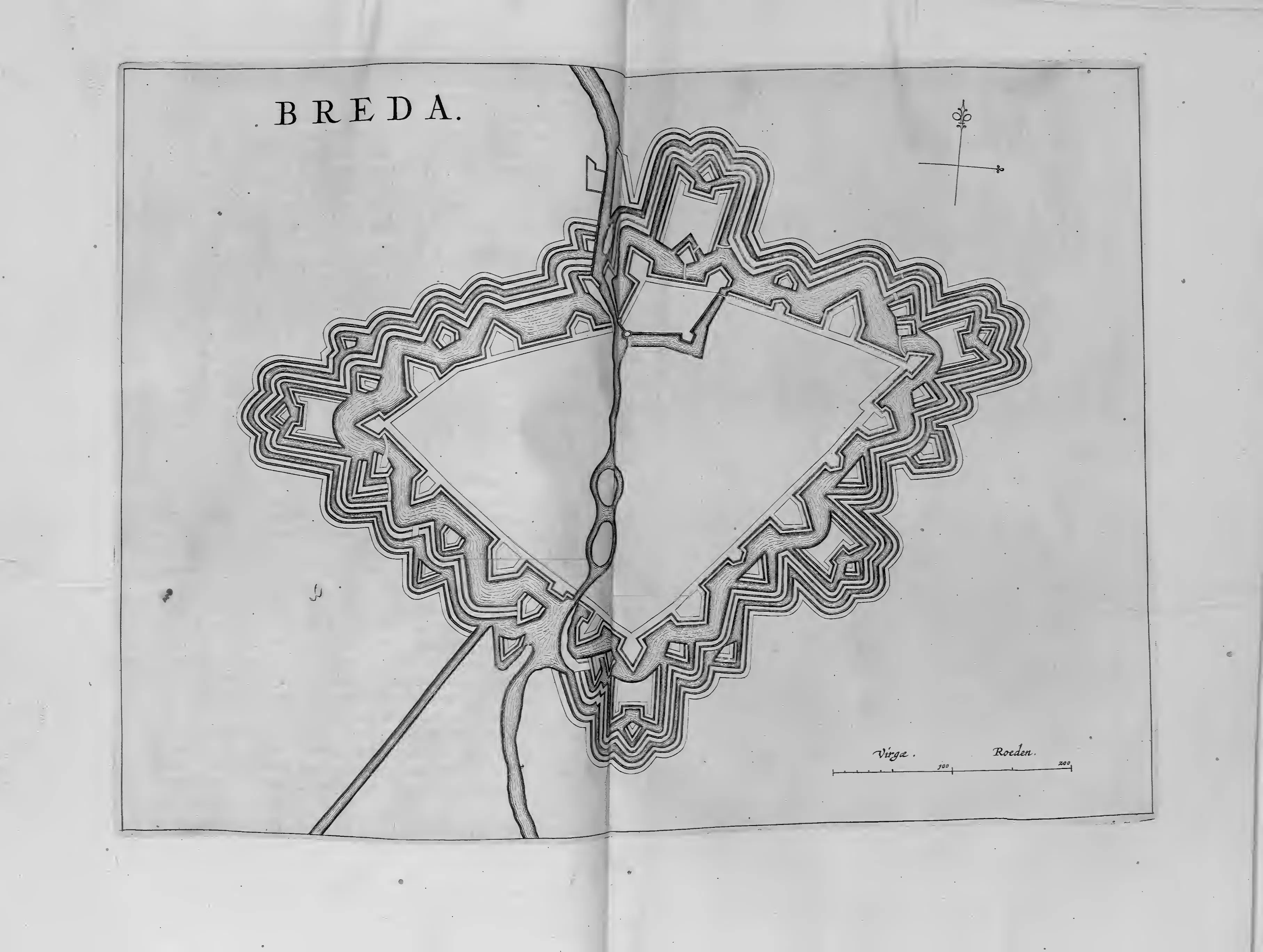
This folding plan of Breda renders Dögen's chief Dutch example as geometry: a bastioned town wrapped in ravelins, hornworks and covered ways, set among converging waterways. Scaled in rods, it presents Breda at once as a model of præmunitiones and a test of the limits of rampart height. Source ↗.
Within the Breda discussion Dögen also inserts a lament for the engineer Knochtius, which converts a casualty into a claim about rank. All the centurions together, each with the rank and file of his century, cannot fill the place of one architect, atque universi Centuriones, cum suarum quisque centuriarum gregariis militibus, ne unius quidem Knochtii Architecti locum. The Roman military vocabulary is deliberate, for the antique officer class is set wholesale beneath a single practitioner of the art. The passage stages the professional self-assertion that recurs throughout these chapters, in which the engineer's worth is reckoned by the irreplaceability of his knowledge.
The opposite fault, excessive lowness, is illustrated from the siege of Ostend. Here the technical argument admits a named civilian. Drawing on Fleming's diary, Dögen presents one Bartholomeus Matthiæ, a citizen of Ostend, as Fortune's plaything and a spectacle of human misery: unus verò Bartholomeus Matthiæ, civis Ostendanus, Fortunæ ludibrium, & humanæ miseræ spectaculum. The diction of ludibrium and spectaculum belongs to the tragic and Stoic idiom of humanist historiography. Its placement inside a demonstration about a besieger's gun-mount commanding a low inner rampart shows how fully the treatise binds ballistic error to human cost.
The orthographic chapter then states the governing principle of the work in its sharpest juridical form. Rejecting the practice of varying rampart thickness by polygon, Dögen issues the formula already examined: since the supreme law of military architecture is the protection of cities, the best eurythmy and symmetry of a fortification's members will be those strong enough against all force at least cost. The formula echoes the Ciceronian salus populi suprema lex. It does not abolish Vitruvian categories; it re-legislates them, so that beauty becomes a function of sufficiency and economy.
The polemical motive for this redefinition emerges in a sardonic aside on the same matter. The wider the rampart, Dögen observes, the fatter the purse the contracting builder carries home, Quò enim latius vallum: eò unctius caput domum refert conductor artifex. The comparative correlatives quò … eò mimic the language of geometrical proportion only to expose a proportion of private gain. Aesthetic justification is unmasked as cover for the economics of fortification let out to contractors.
The ditch chapter carries the central controversy of these chapters. Dögen arbitrates between Speckle, Errard and Lorini, and opens with the verdict, noted earlier, that the water-filled ditch is most inept for discharging military duties, before turning to its dry alternative. Yet when he confronts the wet ditch's one claimed advantage, security against surprise, he makes a striking concession that relativizes his own discipline. The protection and safety of cities, he writes, depend not on dry or wet ditches but on the vigilance, prudence and courage of the garrison: cum non à fossis siccis, aut humidis, sed à præsidiariorum vigilantiâ, prudentiâ & fortitudine urbium tutela, atque salus dependeat;. The phrase urbium tutela recurs, but its guarantor is now moral rather than material.
The surprise of Schenkenschans, the best-moated fort in Europe, yields the corresponding maxim. To virtue nothing is impassable, whereas to weakness and unwarlikeness nothing is firm enough: certissimo documento, nihil virtuti invium esse: imbecillitati verò imbelliæque nihil satis esse firmum. This apparent contradiction, an engineer conceding that works do not save cities, is resolved within the treatise's logic. The wet ditch is condemned precisely because it lulls a garrison into trusting water over vigilance, so that the art serves tutela best by refusing false securities.
After the covered way and glacis, Dögen issues a methodological declaration against school dogma. We should not adhere so strictly or superstitiously to these rules, he says, that a prudent artificer may not depart more or less from received precepts as the nature of the place demands: tam strictè aut superstitiosè adhærendum censeamus; quin, si locorum muniendorum natura alium postulaverit, Artifex prudens, pro re natâ, magis minusve à traditis præceptis recedere queat;. The adverb superstitiosè assimilates rigid adherence to a religious vice. The figure of the Artifex prudens invokes the Aristotelian virtue of practical judgement, which governs particulars where universal precept cannot.
The principle is enacted in his account of a council at The Hague, where he argued against his fellow engineers for lengthening the curtain. His opening figure is that a small curtain of a city is like a dagger, a large one like a sword, Nam parvam urbis Cortinam pugionis, magnam gladii instar esse;. The ensuing debate on musket range takes a notably empirical turn. Drawing on guard target practice and the confusion of a night attack at Maastricht, Dögen reasons that frightened, inexperienced shooters are compensated by multiplying stations. It is more credible, he argues, that more enemies will be struck from many stations, more distant and safer for aiming, than from fewer: Credibilius enim est ex pluribus propugnatorum, iisque ab hoste remotioribus atque ad feriendum tutoribus stationibus plures offensum iri hostes. The fixed rule follows that the line of defence must never exceed sixty decempedae, LX decemped. superare nunquam debere, si quidem cum certitudine ultra hanc. Its immutability rests on a judgement of likelihood drawn from tested experience of fire under stress, not on geometrical deduction.
The moral exempla that follow form the rhetorical centrepiece of the first book, and the Cleomenes polemic rises to a programme for the profession. Dögen would rightly believe the business of war well ordered, in the sentence already quoted, only when spirited architects command great armies, or commanders of armies practise architecture. The chiastic disjunction adapts the Platonic conjunction of wisdom and rule to the military sphere. It confirms that the engineer's dignity is not that of a separate office but of a knowledge that ought to be joined to command.
The case of Octaviano Fregoso, who razed Genoa's citadel to court the people, moves the argument into reason of state. Against such populism Dögen deploys a Tacitean maxim: the love of the people is the worst guardian of lasting rule unless one joins to it powerful fear, pessimus diuturni imperii custos amor plebis, nisi comitem illi adjungas potentem metum. He then turns on Machiavelli in the charge cited earlier, as the contemner of building citadels and counsellor of demolishing those already built. The juxtaposition is ideologically delicate. Dögen attacks the Florentine's scepticism about fortresses with an argument from fear that itself belongs to the idiom of political prudence, so that the defence of citadels draws on the vocabulary of the author it censures.
The exempla culminate in the capitalized thesis, already set out above, that elevates the art to providential status: it is clearer than the midday sun that God, the supreme giver of arts, has bestowed on unwarlike mankind no art more useful or necessary than this martial art by which cities are ingeniously fortified. The phrase imbelli mortalium generi returns to the unwarlike dependants of the Spartan polemic, now generalized to the whole human race as recipient of divine benefaction.
In the lettered apparatus that follows, Livy's Fabius is adapted so that the Cunctator becomes a patron of the engineer: mind and reason, with picks and mattocks, rule in war, mentem rationemque cum dolabris & ligonibus in bello dominari. The pairing of intellect with digging tools is the emblem of operative learning in these chapters. The strategic justification throughout is temporis redemtio, which Dögen ranks even above gold: defensæ: in bello autem auro, contra posito, præferenda est temporis redemtio;.
The chapters on outworks hold technical approval and fiscal anxiety in tension, and Breda again provides the paradox. Asked to dispatch Breda's outworks in three words, Dögen answers that in all the Low Countries nothing is more fortified because of them, and nothing costlier for the States: Tribus vin' absolvam verbis Bredanas Præmunitiones? in toto Belgio Bredâ propter Præmunitiones nihil munitius: Fæderatis propter. Against this ledger of Dutch expense he sets Habsburg prodigality with life. From Reidanus he quotes Archduke Albert's well-known saying that souls are born for God, bodies for the King, Vulgatumque dictum ejus, animas Deo, corpora Regi nata. The saying functions as a negative image of the treatise's own ethic, in which the soldier's body is to be spared by art rather than spent by command.
The hornwork chapter supplies documentary proof of that ethic's economics. The States General's public tender of 1619 for Breda's hornworks is reproduced in full, opening with the style of the Most Illustrious and High-Mighty Lords, Illustrissimi atq; Præ potentes Domini, Dni. Ordines foederati Belgii. The contract closes with its price: on the appointed day the work found a contractor bidding twenty-eight florins per rod, Invenit dictâ die opus Redemtorem, stipulantem in singulas decempedas florenos octo & viginti:. The insertion of contractual Latin into a humanist treatise is the evidentiary counterpart of the earlier jibe at the conductor artifex. Here the costs of earthworks are verified in a public instrument rather than alleged. Dögen draws from it the case for cheap earthen works, so that the supreme utility and dignity of modern fortification may be felt with hands and feet: Hercotectonices summa utilitas atque dignitas manibus palpetur, pedibusque.
This movement ends inside the geometry of tenailles, where the art's first principle is turned against one of its own forms. It must not be concealed, Dögen writes, that the construction of tenailles is not so sound, since it offends against the chief principle of military architecture: Hoc verò dissimulandum non est, structuram Forcipum non usque adeò probam esse, cùm impingat in princeps militaris Architecturæ principium,. That principle, that every station be seen from another, is then tested by a calculation of the dead ground before the re-entrant angle. In this treatise mathematical demonstration serves to expose, not to ratify, an inherited practice, and the measure of any work remains the protection it affords.
Traverses, Drawing and the Close of Book I
The close of Book I begins with a lexical problem. Practice has outrun the Latin language, and Dögen must name works that ingenuity, pressed by necessity, has multiplied faster than words could follow. His solution for the residual category of crosswise works is etymological. They are Transversæ vocantur: quòd transversim angustias aliquas interseptas occupent,, called traverses because they lie athwart narrow passages that have been closed off. The definition locates the work by its position relative to the ground and the enemy's line of advance, not by any fixed geometrical form. That choice prepares the method of the chapters that follow, in which named forms serve as paradigms and judgement covers everything that remains unnamed.
The technical chapter then opens into a moral reflection. Dögen describes the "martial century" as one in which men are tam iniqui æstimatores, ut ingenii nunc ostentatio sit, gloriaque, excogitasse inusitatas, & novas machinas, ad nostram, &, quod pessimum est, nostri ipsius generis accelerandam mortalitatem;. In his words they are such unjust judges that it is now a display and glory of wit to have devised unheard-of machines for hastening the mortality of our own kind. The reproach falls on the inventive faculty itself, ingenium, which ought to dignify the engineer, and it sits uneasily within a treatise that celebrates the ingenious. The tension is resolved through defence. The engineer's wit is redeemed when it answers the killing machine with the protective work, so that the moral complaint becomes the justification for the art. The instance chosen is the newest of these devices: nuper fulminatrix illa machina, mali punici nomine (Granaten, Grenades), that thundering machine lately named after the pomegranate. The classical malum punicum glosses the Dutch and French vernacular, and the phrase records in small compass the treatise's habit of joining humanist Latin to the working vocabulary of the Low Countries.
The answer to the grenade is drawn from recent sieges rather than from rule. Dögen records that Ostendanos imitati, ad Sylvam Ducis, Castelli Isabellæ propugnatores, Loriculas transversas plurimas excitaverant,: in imitation of the defenders of Ostend, the garrison of the Castle of Isabella at 's-Hertogenbosch had raised a great many traverses. The movement of a defensive device from the siege of 1601–04 to that of 1629 is the kind of transmission the treatise sets out to codify. The device spread by imitation among garrisons, without theoretical formulation, and Dögen's text now gathers it into learned exposition. Since the form of traverses is "vague," he states the method openly: atque ex his monstratis cæterarum, sine numero & nomine transversarum munitiuncularum, omnis dependet conjectura,. From the cases shown depends all conjecture concerning the other little traverse-works, which are without number and without name. Conjectura is the vocabulary of prudential reasoning, not demonstration. The exemplum serves as a pattern from which the trained builder extrapolates.
The summary on outworks moves from this flexibility toward a more systematic statement. The four capitalised precepts culminate in a maxim that compresses the whole doctrine: 4. NOS, NOSTRAQUE DEFENDANT, ET HOSTEM SUGGRESSOREM OFFENDANT:, that they defend us and ours and strike the approaching enemy. The paired verbs defendant and offendant restate, at the level of a single class of works, the ends of the art as a whole. Here defence again comes first and offence serves it. The precept is then fixed to a measure taken from the weapon: ita quoque Prætenturæ supra musquettæ potentiam ab operibus, illas defensuris, nullo sunt separandæ modo, so that outworks must in no way stand farther from the works that defend them than musket range. The range of small arms becomes the unit of the system, a module given by the effective reach of a weapon in the field rather than by abstract proportion.
The same confidence in tested practice turns to irony against academic authority. After faulting received teaching on the flanks of hornworks and crownworks, Dögen withholds a verdict: tui erit arbitratûs, lector, utram velis nunc eligere: donec è cathedrâ judicium suum interposuerit summus aliquis Architecturæ Dictator. The choice, reader, will be yours, until some supreme Dictator of architecture interposes his judgement from the chair. The phrase è cathedrâ evokes both the professorial and the pontifical chair. Joined to the Roman extraordinary magistracy, it mocks the expectation that a single pronouncement could settle what only use can decide. The reader is made arbiter in the place of any such dictator.
Chapters XVIII to XX bring the hierarchy of drawing and building into the open. Practice is twofold, and the first kind is explicitly subordinate: Prior chartacea, & ludicra, levique operâ sub tecto parabilis, simulacrum tantummodo est posterioris, & veræ munitionis;. The former, paper and playful, is achieved with light labour under a roof and is only a likeness of the latter, the true fortification. Simulacrum carries the old philosophical weight of the image set against the thing. The plates and geometrical constructions that fill the book belong to this lesser order, preparatory and pedagogical, and they answer to the work in the field.
The printed book's own apparatus comes under this scrutiny. Conceding that one engraved figure has been falsified in cutting, Dögen addresses the reader directly: sed auribus tuis hîc potiùs crede lector, quàm oculis, vel Circino sculptoris falso & fallenti:. Here, he says, trust your ears rather than your eyes, or the engraver's false and deceiving compass. The reversal of the usual hierarchy of the senses, by which sight is held more certain than hearing, is deliberate. The printed text, which the reader "hears" as the author's voice, is given authority over the engraved image. The passage shows a division of labour within the illustrated folio and the author's readiness to disown its faults openly. The surveying chapter extends the same discipline from paper to ground and back again: an existing fortress is mapped to expose the workmen's honesty or fraud and to judge its strength. Book I then ends with the devotional and ethical formula, discussed above, that joins the greater glory of God to the security of the innocent. It places the whole technical progression under the protection of the defenceless.
Irregular Fortification and the War of the Present
Book II raises the stakes at once. Irregular fortification is declared the summit of the art: Hæc verò Fortificationis pars longè nobilissima est;, this part of fortification is by far the most noble. The claim inverts what a geometrical treatise might be expected to prize. Regular figures are the easier case, solved by tables, whereas irregular sites demand the judgement that distinguishes the master from the copyist. The axioms that follow are guided by the commonplace Arte igitur juvandum ubi Natura deficit:, that art must help where nature fails. Nature supplies the ground and its defects, and art supplies an evenness of strength that nature does not give.
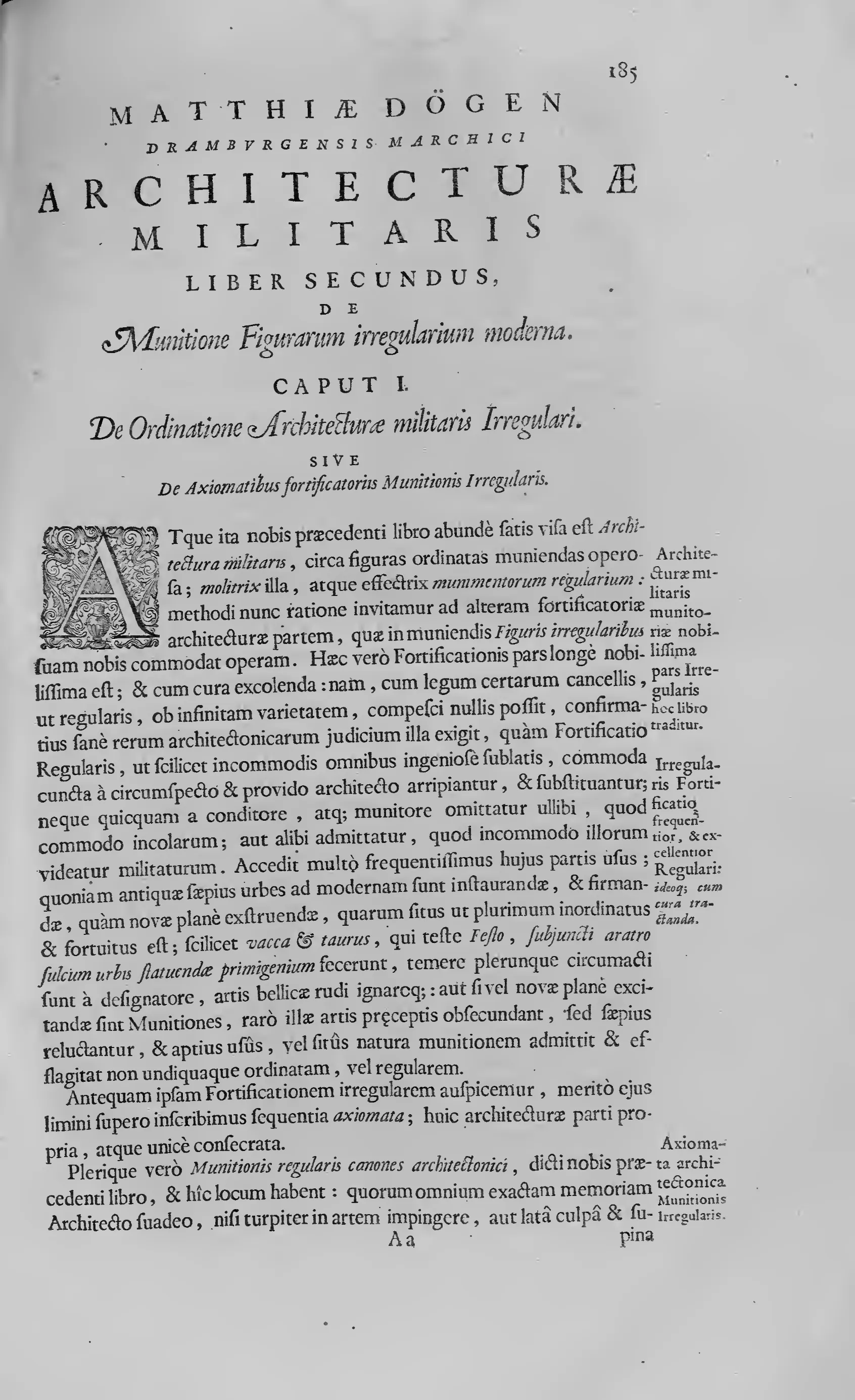
The opening of Liber Secundus marks Dögen's turn from regular schemes to the "munitione figurarum irregularium" with display capitals, marginal apparatus and a decorated initial. Declaring irregular fortification "longè nobilissima," it makes judgement over difficult, inherited sites the art's highest proof rather than an exception to geometric rule. Source ↗.
The polemic attached to Axiom VIII is the sharpest statement of principle in this book. Against those who prize the symmetry of equal faces, Dögen sets the capitalised oracle, already quoted, that the safest fortifications must always be held the most beautiful. Beauty is not abolished but defined by function, and the "painters of cities" who admire regular outlines are corrected by the criterion of protection. The decisive authority is practical and Dutch: & provoco ad Hercotectonices modernæ parentem, & Principem, MAURITIUM, Polictistora Auriacum:. Dögen appeals to the parent and prince of modern fortification, Maurice of Orange, founder of cities. The Graecising self-designation of the art and the epithet Polictistor together make Maurice its originator. His irregular towns are vindicated by their purpose, being works qualia scilicet condi oportuit, ut objicerentur tam vastæ Hispanorum potentiæ, such as had to be founded to be set against so vast a Spanish power. Their success against Spain is the proof of their beauty.
The survey of the five modes of irregular fortification turns this functionalism into a critique of method. The mode that forces equal faces by means of thousands of paper templates is ridiculed as labour qui talis est, ut vel Sisyphum lassaret, vel ipsum fatigaret arenæ mensorem Archimedem, labour that would exhaust Sisyphus or weary Archimedes himself, the measurer of sand. The mythological and mathematical exempla mark computation that never ends and never reaches the ground. Dögen's own fifth mode rests instead on a plain epistemic rule: nihil verò providi cautique unquam habituri sumus firmum & forte, nisi quicquid ab usu & experientiâ tale fuerit comprobatum & demonstratum. The prudent and cautious, he says, will hold nothing firm and strong unless use and experience have proved and demonstrated it so. The verb demonstratum, normally reserved for geometry, is given to experience, so that the language of mathematical certainty passes to tested practice.
From Chapter VII the treatise turns to the war of its own years. The chapter on old towns opens At hoc nostro luctuosissimo bello Europæo,, "but in this our most lamentable European war," naming the conflict as one embracing all Europe. Its examples include the scene of imbelle atque timidum Londinum Angliæ metropolis;, unwarlike and timid London, metropolis of England, hastily fortifying itself against its king while the text was being prepared for the press. Unwalled cities caught unprepared show why towns must be fortified before war comes. The same horizon informs the long note on the manifestos of the warring crowns, which Dögen dismisses with a theatrical verdict: Compendio dicamus; Eadem utrobi que agitur tragædia, mutatis tantum personis:. To put it briefly, the same tragedy is played on either side, with only the masks changed. The figure denies the competing justifications any distinct moral content, and its scepticism keeps the technical argument focused on protection rather than on the claims of princes.
Language and prudence are drawn under the same rule of use. Defending the modern Musquetta against purists, Dögen lays down that decentissimè loquitur, qui aptissimè animi sui sensa exprimit;, he speaks most fittingly who most aptly expresses the sense of his mind. Fitness of speech is measured by communication, just as fitness of a work is measured by safety. The Knodsenburg and Nijmegen case borrows the vocabulary of moral theology: in bello nullum leve, nullum veniale, sed mortalia omnia peccari peccata:, in war no sin is light or venial, but all are mortal. The distinction between venial and mortal sin, taken from the confessional, makes the smallest error of fortification irreparable. From Reyd he draws the corollary on expense, Unde apertum, nequaquam semper, ubi parcimoniæ, ibi & Reip. consuli: it is plain that where there is parsimony, the commonwealth is by no means always served. Economy, elsewhere a virtue of design, yields when protection is at stake.
The chapter on citadels brings the principle of protection to its political limit. Of France, Dögen writes that in Gallia vix ulla nobilis urbs est, quæ arcium compedibus non sit vincta & insignita:, scarcely any noble city in France that is not bound and branded with the shackles of citadels. The image of compedes, fetters, turns the defensive work into an instrument of servitude directed inward against the citizens. Against this he sets the argument of the Groningen deputies reported by Reyd, already quoted, that not soldiers, not citadels, but the will of subjects is the firm bulwark of the Fathers. The word munimentum, the treatise's technical term for a fortification, is transferred to consent. The Republic's demolition of Spanish citadels is thereby presented as a better kind of fortification.
The contradiction is not resolved by repudiating the citadel. Dögen distinguishes tyrannical restraint from innocent refuge and proceeds at once to sound siting. His first monition reads I. Arx fortissimum urbis suum occupet:, let the citadel occupy the strongest part of the city, because it is the citizens' last retreat. Classical precedent confirms the separation of citadel from town as a military operation: Tarento capto, (a) fossa, vallo, muroque urbem ab arce feliciter intersepit bellandi callentissimus Hannibal. When Tarentum was taken, Hannibal, most practised in war, successfully cut off the city from the citadel with ditch, rampart and wall. The same work can therefore fetter a people or shelter it. What decides between the two is the end to which the work is directed, the protection of the innocent, which Dögen offers as the measure of the art.
Elevation, Lexicon and the Economy of Distribution
Further into the second book, whose printed running heads style the work a modern art of fortification, Matthiæ Dögeni Hercotectonices modernæ Lib. II, the treatment of irregular figures passes from plan to elevation. Here the doctrinal exposition is economical because Dögen declares the irregular case to be no new theory at all. The elevation of irregular works, he says, is as like the regular orthography of the preceding book as egg is to egg, Non verò ovum tam simile. The proverb is a methodological claim. Irregularity of site changes the plan but not the principles of height and thickness, so the irregular figure is an adaptation of rule to ground, not an exception to rule. The same proverb, applied elsewhere in the work to the likeness between Caesar's siege lines and modern approaches, here serves a parallel function within the geometry itself: likeness licenses brevity. The principles carried over are explicitly those of the gunpowder age. Ramparts, he writes, tam robusta quoque & lata esse debent, ut modernis muralibus, so strong and wide that modern siege engines cannot pierce them. Thickness is therefore not an inherited proportion but a direct reply to the muralia tormenta of the present.
The demonstration that follows takes the form of a dialectical inventory of commoda and incommoda, each advantage "inverted" to yield its corresponding defect. Its first article sets the pattern: I. Lata valla, quamvis quassata & lacerata muralibus tormentis, ruinam non, wide ramparts, however shaken and torn by siege guns, do not fall into ruin. The paired form subjects every design decision to a reckoning of gain against loss. The evidence for each pair comes from the recent sieges of the Revolt, from Steenwijk to Maastricht, rather than from demonstration. At Steenwijk, Dögen reports, experience showed why the Spaniards called the cannon the terror of cowards, terrorem (Spanta Veillacos) Hispanis ea nuncupari. The soldiers' Castilian byword, set into the Latin period, is a small but telling instance of the treatise's method. The camp idiom of the enemy is admitted as testimony, and the experience it encodes, that broad earthen works rendered bombardment almost ridiculous, confirms the rule for wide ramparts. The governing end of protection is visible here in its most material form: the earthwork is judged by whether it survives the guns.
The short eleventh chapter, a lexicon of the scenographic terms of fortification, shows the learned language bending toward vernacular practice. It opens under its own rubric, Architecturæ militaris termini Scenographici, and proceeds term by term in Latin, German and French. The bastion is entered as PROPUGNACULUM. Germ. Solwerk / Fohrwähre. Gall. Bastion, a classical noun made to answer for a thing that classical antiquity never knew. Dögen mocks the nasutuli who insist on fashionable foreign words, yet his own trilingual apparatus concedes that the art lives in the camp languages, and that Latin must translate them if it is to govern them. One entry carries political weight beyond the lexical. The citadel is defined as works Munimenta urbibus tuendis, aut in officio continendis imposita, imposed upon cities to protect them or to keep them in their duty. The disjunction exposes in a single definition the ambivalence of the arx: the same structure may serve the tutela urbium or the coercion of the citizens it overlooks. The Antwerp citadel built under Alba, invoked earlier in the second book, had already made that ambivalence concrete.
The twelfth chapter, on distributio, is the principal movement of this part of the book, and Dögen opens it by raising cost and execution above design. Distribution is the noblest member of the art, surpassing the preceding members quod in tantum præcedentia antecellit membra, quantum picta & chartacea, by as much as real walls surpass painted and paper ones. The hierarchy inverts what a reader of Marolois might expect. Orthography and ichnography yield precedence to the dispensation of earth, labour and money, because only distribution turns a drawing into a defence. The classical warrant comes from Vitruvius, who reports that at Ephesus Nobili Græcorum atque amplâ civitate, Ephesi, lex vetusta dicitur majoribus, that in the noble and ample Greek city an ancient law was laid down by the ancestors, binding an architect's property against overruns of more than a quarter. The law supplies the juridical frame for the polemic that follows against ignorant aggeratores who sell themselves as fortifiers and the governors who hire them. The satirical figure of the charlatan whose only credential is a coloured picture of Breda belongs to the same economy of the pictum against the real.
From this polemic a vast footnote on German martial character grows into a lament for the war. Its central paradox is stated with deliberate harshness in the passage already quoted: we Germans wage war without any enemy, and have now waged it, with Aeneas's plea to Jupiter for an end of labours pressed into service as complaint. The war is civil because German blood decides every battle on every side. Lützen, Nördlingen and Breitenfeld are set beside Cannae, Trasimene and Trebia. The confessional-political charge is made openly. The emperor, first afflictus and then affligens, is said to have promulgated a bloody edict Germaniæ statuisset, promulgassetque sanguinarium edictum, quo Germanorum LIBERTAS simul atque RELIGIO, by which the liberty and religion of the Germans were assailed. The capitals give typographic emphasis to the paired watchwords of the Protestant estates. The digression also dates itself: these, Dögen writes, are the deeds of a single year not yet complete, moliente belium. Et hæc quidem, ut dixi unius nec dum totius anni 1645 gesta. The lament is therefore composed from within the final campaigns of the war, and the treatise's argument about economy is written amid conditions in which fortification and devastation were simultaneous experiences.
The digression returns to its technical point through the Groningen citadel, where the States' delegates promised 70,000 florins and spent more than 400,000. From this exemplum Dögen draws a general maxim about the order of a warring commonwealth. Affairs are rightly ordered when spirited architects exercitibus imperant, aut Imperatores exercituum seriò architectantur; hoc loco, command armies, or when generals seriously practise architecture. In context the claim extends beyond the field to the councils that hold the purse, so that technical competence becomes a qualification for fiscal government. Only then does the formal definition arrive. Est autem Distributio copiarum locique commoda dispensatio, parcaque in, distribution is the fitting and sparing dispensation of materials and of site, a definition in which the Vitruvian vocabulary is bent toward parsimony. Distribution in turn requires the volume of earth, and Dögen distinguishes three ways of finding it, Sunt autem tres inprimis quærendæ, inveniendæque soliditatis. The first belongs to the mathematicians, Primus Mathematicorum; qui ipsum verum Munitionis corpus perfectissimè, who gather the true body of the work most perfectly. The second belongs to the mechanics and gives a larger figure, and the third to the architects, who mix the two methods. The taxonomy is social as well as computational, because each calculus is assigned to a class of practitioner.
The pages of exact stereometry that follow, worked through tangent and secant tables for a model hexagonal fort, are also a sustained critique of the printed literature. Pitiscus doubles a pyramid, Freitag halves his pyramids, and Marloisius verò in multis hallucinatur, atque nihil minus quàm Geo, Marolois errs in many things and shows himself anything but a geometer. Dögen thus places himself as corrector of the Dutch tradition on which he openly depends. Yet the computation leads to a reversal that tests the authority of exactness itself. He reminds the reader that he prescribes military architecture for architects, enim, non verò Mathematicis, Architecturam præscribimus militarem;, and not for mathematicians. When the methods are compared, he concedes that the mathematical calculus presupposed ramparts nullis interrupta portis, qualia nunquam dantur: ergo mechanicus noster, interrupted by no gates, such as never exist, and that therefore the mechanics' rule comes nearer the truth. The perfection of the first calculus proves to be a perfection of abstraction. After pages of rigorous computation, precision yields to use. This is the treatise's subordination of mathematical rule to tested practice, and here it is enacted inside the calculation rather than asserted against it.
The argument then descends to the contract and the workman. The Dutch earth unit is introduced in Latin dress, (Schafften vocant Batavi) longas latasque decempedam, altas pedem unum:, blocks the Hollanders call Schaften, a rod long and wide and a foot high. With this unit, stereometry becomes a schedule of payment in florins and stuivers. Against fixed rates for earthwork Dögen offers a sentence of considerable moral force: In pace & otio conductor operarius sudorem vendit locatori; in bello, in peace and leisure the contractor sells his sweat to the employer, while in war, the sentence continues, he pours out blood with it. The price of labour must therefore include its danger. Breda supplies the case, through the contrast between Maurice's permanent hornworks and the siege redoubts of 1637 raised by his brother, haut degener ejus Frater, judiciosissimus & felicissimus Poliorcetes, a brother not unworthy of him, the most judicious and fortunate besieger of cities. The Greek epithet Poliorcetes casts Frederick Henry as a Hellenistic taker of cities beside Maurice the builder, so that the two princes divide between them the twin offices of the art.
The chapter's pedagogy of paper models closes with its sharpest irony. Having taught the reader to cut nets of pyramids and of a whole fort, Dögen sets beside the lesson a lament over Christians razing the walls that should hold back the Turk, culminating in the ironic proposal, noted earlier, that with mathematical means we should build mathematical walls, that is, only paper ones. The paper wall that the opening of the chapter ranked beneath real masonry now returns as a reproach to princes who destroy real masonry. When the net is folded, the reader is told, ambitus conjungantur, VALLUM manibus contrectabis PAPYRACEUM, the circuits joined, he will handle a paper rampart in his own hands. The model is at once a teaching device and an irenic gesture, a fortification that threatens no one.
The thirteenth chapter, on the nature of sites, opens with an apologia that defines the scope of the whole book. Artem nunc tracto non purè mathematicam, atque ab omni, Dögen writes, I treat an art not purely mathematical nor abstracted from all matter. Its subject is the earth and its object human action, which licenses the historical and political matter. Its readers are princes: Imperatoribus orbis terrarum artem ordinamus convenientem,, we set out an art fit for the emperors of the world, whom he will not weary with endless numbers. The inventory of sites, rocky, level, marshy, maritime and insular, is again built from exempla.
For level ground the Jesuit historian of Breda becomes a witness. Alliciebant præterea (inquit Hermannus Hugo obsidionis Bredanæ Scriptor), many advantages besides, says Hermannus Hugo, the writer of the siege of Breda, drew the besieger to that city. Hugo's narrative is annotated against Dögen's numbered incommoda of the plain. Hugo is thus an authority used across the confessional divide, his testimony valued for its precision rather than for its allegiance.
Maritime sites call forth a set-piece of Dutch self-praise: Paucis dicam verbis; Liberum Belgium, verum compendium est to, in a few words, the free Netherlands is a true compendium of the universe. It is, the sentence goes on, tius universi; horreum antiqui, & conditorium novi orbis locupletissi, the granary of the old world and the richest storehouse of the new. Navigable water becomes the foundation of a republic's liberty and wealth. Dögen does not let the encomium stand unanswered. He places Censorinus's speech from Appian as a rearguard: tas maritima videtur mihi navis potius esse, quàm terra solida; ita jactatur, a maritime city seems to me a ship rather than solid ground, so is it tossed about. The commoda-incommoda method thus reaches into the political economy of the sea, and the praise of Amsterdam is weighed against a Roman argument for rootedness in land.
The chapter's last movement, on the criteria for choosing a site, returns to Hugo's Breda and to provisioning, and turns them into a gnome dated to the surrender of 1625: Junias M. DC. XXV. Adeò facilè est bellum pro libidine sumere, ponere autem, so easy is it to take up war at will, while laying it down lies in another's power. Placed within a discussion of salubrity, fertility and the ease of digging, the maxim brings the technical inquiry back to the condition that frames the whole chapter: an art of protection practised amid a war whose beginning was easy and whose end was not in the hands of those who suffered it.
Sites, History and the Mirror of the Estates
These criteria for where a fortress should stand, begun with ground, provisioning and cost, sharpen into a precept about sight-lines. The place, Dögen insists, must Nullis subjaceat montibus vel tumulis, quibus nimis possit infestari, lie beneath no hills or mounds from which it can be too greatly harassed. The precept is general, but its force comes from the run of cases that follows. The first is Danzig, a city whose wealth would seem to commend it, introduced in a deliberately double register: Dantisci situs hîc notabilis est; atro tamen carbone, its site notable here, yet marked with black charcoal. The idiom inverts the classical white stone of good fortune. It also turns a commercial emporium into a negative exemplum: the overlooking height bridles the city's claim to sovereign power, so urban topography is made to bear directly on political autonomy.
Zierikzee and Dunkirk show heights, natural or man-made, delivering towns to besiegers. The sequence culminates at Bergen op Zoom, where after Spinola's siege voluerunt Patres Fæderati montem proditorem: ne bis cladem in vicinam, the Federated Fathers resolved upon the traitor hill, lest disaster fall twice upon the neighbouring town. The epithet proditor gives terrain a moral agency, and levelling the hill becomes a punitive act against a betrayer. In the period's political vocabulary the States General appear as Patres, a Roman senate exercising justice over the terrain itself. The same moralised geography governs the treatment of capacity. Cramped forts sinned, peccarunt, through their narrowness until Maurice of Orange, phænice, the phoenix of architects, gave them their due form.
The fourth condition requires that a place remain open to relief, and it produces the longest stretch of narrative evidence in this part of the work: Calais, Stralsund, Bergen op Zoom in 1622, and Ostend. At Ostend Dögen draws on Reyd's figures for the expenditure on both sides. He then disclaims their sufficiency with a Platonic contrast, UMBRAM tantùm obsidii, non CORPUS depictum ipsum opinare;, urging the reader to believe that only a shadow of the siege, not its body, has been depicted. The concession is methodologically revealing. Historical narrative serves as evidence for a technical proposition, yet the author acknowledges that the evidence is always an attenuated image of the event.
The fifth condition then restates the teleology on which the whole art rests: Fines verò sunt; ut alibi diximus, NOSTRA DEFENDERE: & HOSTEM, the ends are, as we said elsewhere, to defend our own and to offend the enemy. The capitals mark the binary as programmatic. Dögen immediately gives the defensive half material shape, Nostra defendimus; si locis, hosti excludendo aptis, Prætenturas, Propugnacula,: we defend our own when we set outworks and bastions in places apt for excluding the enemy. The abstract end is thus translated at once into the elements of the bastioned trace.
From Vitruvius's demand that the architect be learned, Dögen opens a long excursus on history. Its premise is stated without reserve, Historiæ utilitas & necessitas nunquam satis laudari vel inculcari potest;: the utility and necessity of history can never be sufficiently praised or impressed. He grounds that necessity in the Ecclesiastes echo already discussed, that nothing new happens under the sun and that the same mind is maker of human actions. The constancy of human nature is what licenses the exemplary method. Ancient and modern cases become commensurable instances of a single moral and practical order, and a classical illustration such as Hamilcar's mountain camp can be offered ceu in speculo quodam politissimo, as in a most highly polished mirror.
The mirror then multiplies into a speculum for every estate, and the excursus becomes something larger than a defence of learning. Emperors are addressed first, and the lesson set before them is not military at all: MAXIMILIANO II. discant, nullum atrocius esse peccatum (a) quàm imperare velle, let them learn from Maximilian II that no sin is more atrocious than to wish to command consciences. Choosing a Habsburg emperor famed for his moderation makes the norm of rulership a tolerationist one, voiced through a Catholic authority rather than against one. A footnote widens the charge to every confession and every land, in Germania, & ubi terrarum non? pessimè evasit tyrannis: in Germany, and where on earth not, tyranny has turned out most wretchedly.
The governing metaphor of the treatise is then carried into theology, in the sentence already quoted: whoever would rule over men's consciences invades the citadel of heaven. Conscience becomes God's own stronghold, and persecution becomes a siege conducted against the divine arx. The art that protects cities thereby supplies the figure for the one place no ruler may lawfully assault. Here the principle of urbium tutela is extended, by analogy, into the protection of the inner man.
The confessional vocabulary of the passage is pointed. Lamenting division among Protestants, Dögen writes of Augustani, fallaci Romanensium oratione seducti,, adherents of the Augsburg Confession seduced by the deceitful speech of the Romanists. The term Romanenses belongs to Protestant polemical usage. The appeal for Lutheran–Reformed concord accords with the Brandenburg setting of the work, though the passage does not by itself settle the author's own confession. The papacy, too, receives its mirror. Clement VII's words, mediated through Guicciardini, define the pontiff's office as solum atque unicum hoc est; Procurare ac omnibus mediis fovere, this alone and uniquely: to procure and by every means foster peace among Christian princes. A pope's own formula thus becomes the measure against which papal belligerence is found wanting.
The remaining estates are treated through a dense catalogue of recent cases. They run from ensigns dying wrapped in their colours to secretaries instructed by cipher-breakers. In that catalogue the text pays tribute to the Stadholder's secretary: discant à Nobilissimo atque solertissimo Constantino Hugenio, Equiti,, let them learn from the most noble and most skilful Constantijn Huygens, knight. Couriers are addressed with a darker irony, vitæ prodigi TABELLARII huic rei suam addicere volent, letter-bearers prodigal of life who will devote theirs to this business, before the category is extended to pigeons and swallows. Jurists receive the bitterest lesson of all: JURIS CONSULTI, qui castra sequuntur, scient omne jus in armis positum esse, &, the legal counsel who follow the camps will know that all right is placed in arms. The maxim is reported from Pyrrhus and Lysander and shown in practice by Verdugo and Mendoza. It stands as the realist doctrine that the rest of the excursus labours to refute.
The refutation takes the form of a peace sermon. Its hinge is a commonplace sharpened by a single parenthesis, Pax victori (hodie, si unquam) expedit, victo, peace is expedient to the victor (today, if ever), necessary to the vanquished. "Today, if ever" fixes the maxim in the years of negotiation that closed the German war. It introduces Henry II, praised for surrendering conquests at Cateau-Cambrésis, as the model of a glorious Christian prince. The sermon rises to Virgil's collective plea from the eleventh book of the Aeneid: salus bello: Pacem te poscimus (b) omnes!, there is no salvation in war; we all beg you for peace. The accompanying footnote withdraws, with some care, from the theologians' harvest. A writer on fortification may echo the prayer of the multitude, but the doctrinal exposition of peace is left to theologians.
The Dutch Republic enters this sermon as the instance of a peace extorted even from the enemy. dies felicissimos vidit Respubl. Federata; prior (xxvi Julii (b) Anno 1581), the federated Republic saw two most fortunate days, the first on 26 July 1581. The Abjuration is paired with Spinola's arrival at The Hague in 1608 bearing the laurel of peace, so that Dutch liberty appears ratified by its adversary.
Even the closing "parallel examples," which set Belisarius beside Montgommery and Alexander beside the Spaniards on the Garigliano, are qualified by the concession that every comparison limps. The excursus ends by turning to the architect, rewriting Anchises's charge to the Roman: Tu verò, ARCHITECTE, memento imperia fundare, latè dominantia, & regna vel, but you, architect, remember to found empires ruling far and wide, and kingdoms or republics. The imperial clause is redirected at once, in the Virgilian adaptation cited earlier, toward the arts of imposing the custom of peace, and delay. The pun on morem and moram compresses the defensive theory of the whole treatise. Fortification founds peace by retarding violence.
The Interior of the Town and the Labourers' Arts
Chapter XIV returns to the interior of the town, and the technical argument keeps the moral one in view. The pomerium is reclaimed from Roman sacral law as a clear strip for troops and guns, Pomærium quoque a e i o u minimum tantundem latum esto: let the pomerium a e i o u also be at least as broad. The juridical imperative esto gives the measure the force of a statute. Gates generate the chapter's thesis. Drawn from 's-Hertogenbosch, Salapia, Wesel and Rheinberg, it holds that oppugnationum improvisa defendendarum cardo totus versetur circa, the whole hinge of defending against the unforeseen in attacks turns upon the portcullis. The architectural figure of the cardo is literalised in the hanging gate, and the custody rules that follow are justified by it.
At Győr the stakes of a single neglected drawbridge are measured by the Ottoman boast that num talem esse clavem, quâ totius Christiani orbis urbes & munimenta referari, Javarinum was such a key that the cities and fortresses of the whole Christian world could be opened by it. A detail of carpentry is thus placed on the confessional frontier of Christendom. The chapter's inventories end with the treasury, which alone receives a place but no measure, enim, cùm nervus belli pecunia sit, nisi probè jacto & firmato, cætera, since money is the sinew of war, the rest is vain unless it is well laid and secured. Expense, elsewhere disciplined by protection, here becomes protection's precondition.
The final chapter, on the labourers' arts, sets Dutch experience into the form of law. Rampart construction follows the precepts of Maurice, Prince of Orange, styled, in the phrase already examined, founder of the laws of fortification and taught by experience. Foundations are proved by local trial, Experimentum dabo exemplumque soli Amstelodamensis: Anno Salutis 1605, I shall give an experiment and example from the soil of Amsterdam, in the year of salvation 1605.
The book ends in an apology for teaching fortification to an age of Christian fratricide. Its motto pairs a devotional clause, AD MAJOREM DEI GLORIAM, to the greater glory of God, with an ethical one, TUTELAM INNOCUORUM, the protection of the innocent. The second clause answers the dual end of defending and offending by reasserting the primacy of protection.
The Attack and Defence of Places
The newly titled part on attack and defence, issued Apud Ludovicum Elzevirium, at the house of Louis Elzevier, opens with a dedication CUNRADO à BURGDSTORF;, to Konrad von Burgsdorff. The dedication is signed Humillimus cultor & Cliens, most humble devotee and client. Dögen announces his Areotectonice nostra: sed armata, ut eò magis rumpantur ilia Momi, our Ares-architecture, but armed, so that the flanks of Momus may burst the more, and he meets the charge of writing about war amid peace negotiations with a distinction: respondebo artis alicujus theoriam cum praxi toto distare orbe, I shall reply that the theory of an art stands a whole world apart from its practice. To know how places are attacked is not to attack them, and the unprepared Danes show the cost of ignorance.
The synopsis proceeds by scholastic division, Omnis verò oppugnatio, aut occulta est, aut manifesta, every attack is either covert or open. It reaches its most searching problem at Breda. Some places, Dögen grants, soli fami sunt penetrabilia: quæ omni ferro sævior est, are penetrable by hunger alone, which is crueller than all steel. Spinola subdued Breda by want of food, whereas the town was taken by the Orange commander alimoniæ necessitate subjugavit: quam Poliorcetes Auriacus exiguo præsidio, the town Spinola subjugated by necessity of provisions and which the Orange Besieger took with a small force. The moral tempers the Ecclesiastes axiom with circumstantial prudence: duo cum faciunt idem, in bello sæpius non esse idem, when two do the same thing, in war it is often not the same. If human nature is constant, outcomes are not. History instructs by teaching discrimination among cases, not by yielding rules that apply mechanically.
The promised Nassau Codex then closes the circle between learning and command. Johan Maurits sponte gratiosissimè mihi obtulit inæstimabilem totius Artis militaris, of his own accord most graciously offered me the inestimable treasure of the whole art of war. From this Gazophylacio martio Nassoviorum omnes Duces, Militesque, martial treasury of the Nassaus, all commanders and soldiers are to draw. The publication is justified by Vegetius's praise of the art of war as rebus omnibus esse potiorem, per quam libertas retinetur, & dignitas, superior to all things, the art by which liberty is retained and dignity extended. The protection of cities, carried through site, interior, labour and siege, is here named once more as the preservation of liberty.
Within the synopsis of attack, the castrametation material is governed by the figure of the metator, the camp-surveyor whose discretion decides whether an army lives or dies. Dögen works through the surveyor's cautions one at a time. Fire, concealing ground, distance, vigilance, health, water and supply each receive a Livian or Caesarian disaster and a recent Netherlandish counterpart. The long sequence of catastrophes at broken and wooded sites resolves into a first-person verdict: camps placed on more level ground, freer to every view, are the more approved in his judgement, Ut igitur hanc cautionem absolvam dico castra loco planiori, & ad prospectum omnem liberiori sita, etiam probatiora mihi haberi;.
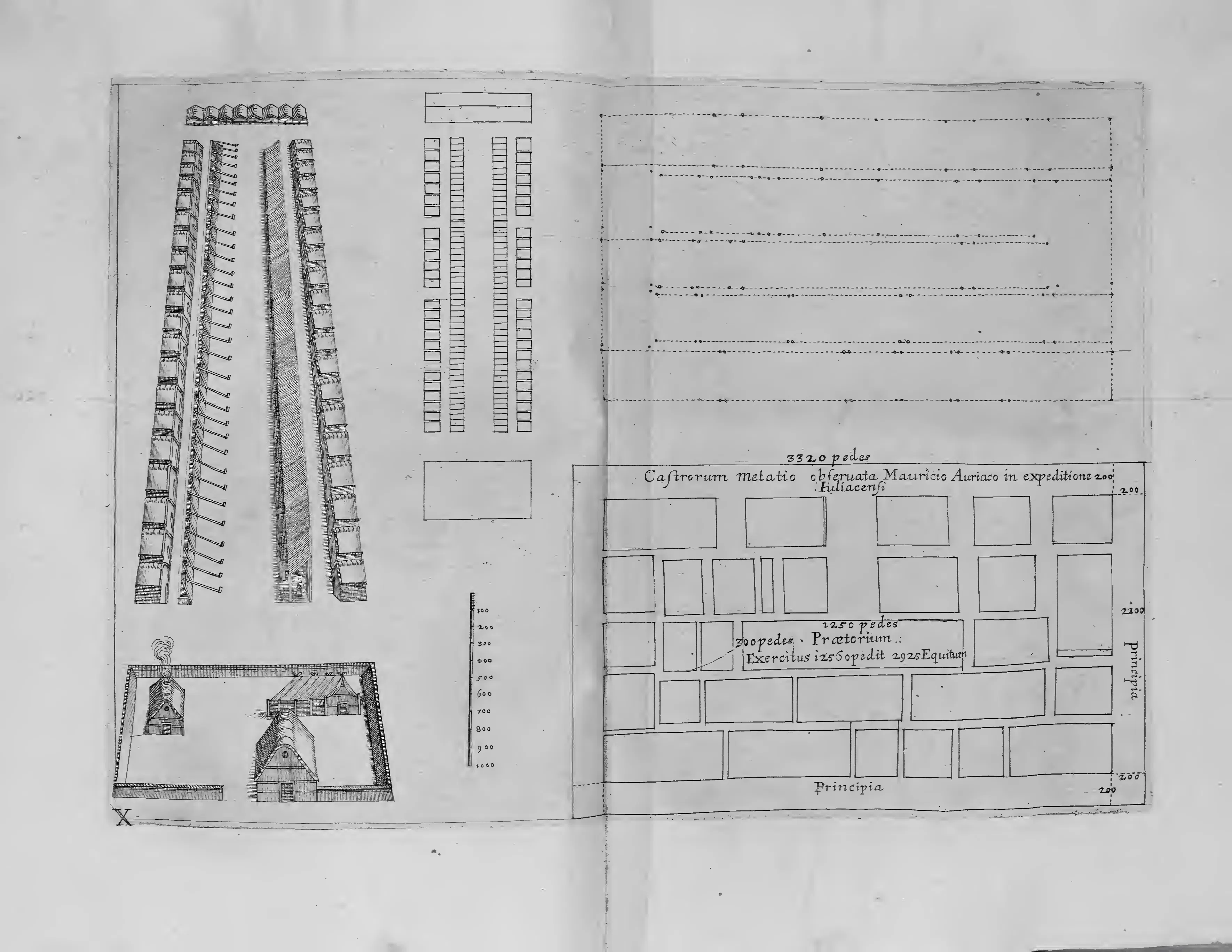
This folding plate gives the metator's discretion the form of measured space: elevations of tented quarters and fortified entrances paired with a ground plan captioned as the castrametation observed under Maurice of Orange in the Jülich expedition. Dimensions and troop totals turn Dutch military authority into calculable order. Source ↗.
Dögen's verdict on level camps joins two orders of reasoning. Sulla's exploitation of Archelaus' cramped position belongs to the older tactical lore of visibility and surprise. The modern rationale Dögen adds at once, the clear field of fire required by artillery, belongs to the post-gunpowder art. Ancient and modern grounds converge on one rule, and this convergence is the method of the attack book in miniature.
Beneath the technical cautions lies a civic analogy that reorients the camp toward the treatise's governing end of protection. A citizen lives secure and safe within his house in the city, and the soldier must likewise live in camp under his hides, far from all danger and even the fear of danger: civis intra urbem in domo sua securus & tutus agit: ita etiam prospiciendum est, ut miles intra castra sub pellibus suis procul omni periculo, & periculi timore, degat:. The analogy is prompted by the Scots regiments sleeping under fire before Maastricht. It transfers the logic of urbium tutela to the moving city of the army. Castrametation becomes a duty of care owed to the soldier, and the camp a provisional commonwealth whose security the architect guarantees.
Dögen does not, however, allow architecture to claim sufficiency. He concedes that all the surveyors' care is empty and void unless the commanders' vigilance is added, tamen omnis cura inanis & nulla est, nisi ducum accedat vigilantia illa, quam. The admission is introduced by Octavius' fivefold camps at Salona, overrun at midday, and it limits the professional claims the book advances elsewhere. The art protects only when joined to the virtues of command.
The same realism governs the medical cautions. The surveyor must not occupy unhealthy places, since no less harm to an army is to be feared from diseases and diseased places than from the enemy himself: Loca morbosa castris non insideat. Nec enim minus detrimentum exercitûs à morbis morbosisque locis, quàm ab hoste ipso timendum est. Vegetius and Vitruvius, and even the haruspical inspection of livers, are marshalled here. Disease is placed on the same footing as the enemy, so that hygiene is drawn into the art of defence.
The water caution yields the sharpest instance in these chapters of critical reading against a source. That place is the most unhealthy of all for a camp, Dögen writes, where all water is either denied by nature or can be snatched by the enemy, and this was a most contemptible lapse of Spinola: Insaluberrimum verò omnium illum castris locum crede, cui omnis aqua vel à natura negata, vel ab hoste eripi possit. Despectissimus hic lapsus est Spinolæ:. The episode of the camp at Gilze is drawn from Hugo's account of Breda. Dögen turns it against Hugo's own hero, and the flattering tribunes who measured others' thirst by their own plenty become an exemplum of commanders who trust their ears over their eyes. A Jesuit narrative of a Spanish siege is thereby made to supply a technical and moral lesson for the engineer.
The cautions on opportunitas, the supply of timber, water, corn and fodder, culminate in a Vegetian maxim that becomes the hinge of the whole attack book: scarcity consumes an army, and hunger is crueller than the sword, consumit exercitum, & ferro sævior est fames. At precisely this point Dögen reflects on his own procedure. He turns to modern instances lest he always prate of Hannibals and Caesars, whose names the ignorant crowd of present-day soldiers has scarcely heard: semper Hannibales & Cæsares crepem, quorum nomina fando vix. The remark states the book's two-track method openly, and it carries a barb against unlettered officers. Pairing ancient with recent sieges serves a demonstrative purpose, and it also serves a pedagogical and polemical one, since learning is offered to a profession that has neglected it.
The modern argument that follows is economic and riverine. One ship, he observes, can bring as much supply as six hundred wagons could not carry by land, una navi tantum commeatûs, rerumque aliarum, quas usus & necessitas exposcunt, advehi possit, quanto terrâ advehendo vel sexcenti carri non essent;. The figure is set against Spinola's four hundred wagons before Breda, and it expresses in arithmetic the logistical advantages of the waterborne Republic.
With the passage to circumvallation the text changes register and genre. Dögen announces that if he pursued the remaining members of the siege at equal length, he would be handing down poliorcetics itself rather than a synopsis of it: Poliorceticam ipsam non synopsin ejus traditurus essem:. The declaration explains the compression that follows and the repeated deferrals to the projected larger Areotectonice. It marks this book as an epitome within a larger planned edifice.
The new subject is introduced antithetically. Castrametation looks first and before all to our own safety, whereas circumvallation now follows as terror and destruction to the shut-in, Post Castrametationem, quâ inprimis & ante omnia nostræ prospicitur saluti, sequitur nunc Circumvallatio, terror clausis & exitium,. The architect who had been guardian of the soldier now becomes the agent of the besieged city's ruin. The tension between these roles is never dissolved within the attack book. It is redeemed only by the moral framing of its close and by the defensive book that answers it.
The treatment of approaches is the most philologically charged stretch of the attack book. Dögen first gives a definition in the scholastic manner: siege-trenches are nothing other than sunken roads, covered against force by earth thrown up to the sides, Sunt autem brachia oppugnatoria nihil aliud quàm depressæ, & contra vim, humo ad latera egestâ, tectæ viæ,. He then traces the vernacular terms, noting that approquer is used by right and, in today's manner, approcher, whence Approches, approquer suo jure, & more hodierno approcher, unde Approches efferunt). This genealogy leads to the identification of the modern work with Caesar's at Uzita, compressed into the proverb already quoted: no egg is more like an egg than those Julian trenches are like our approaches.
The proverbial simile carries the continuity thesis on which the book's choice of sources rests. If the brachia are identical, Caesar's commentaries are practical manuals rather than antiquarian curiosities. The humanist recovery of the classical term over the gallicising one is then itself a technical claim.
The five axioms of approach that follow are framed in a strongly moral vocabulary. After Paolo Vitelli's beheading at Pisa, Dögen draws the lesson that in war no venial but only mortal sins are committed, nobisque monimento adhuc est, in bello nulla venalia sed mortalia committi peccata;. The scholastic distinction between venial and mortal sin is transposed onto the field. Every error in the choice of the point of attack becomes irremediable, as grave sin excludes absolution without penance.
A second aphorism justifies opening the trenches just beyond cannon-shot. The loss of human blood, he writes, is greater than that of sweat: Humani enim sanguinis quàm sudoris major est jactura:. The engineer's ethic is to spend labour in order to spare lives, which is the attacker's counterpart of the protective end that governs fortification. The axiom of the shortest and safest line rests on a rare claim of autopsy, Observavi meis oculis, non semel, duo brachia circa eandem urbem, "I have observed with my own eyes, more than once, two trenches around the same town". Ancient testimony is thus matched by the author's own witness as a practising engineer.
The attack culminates in the mine, which Dögen calls the last work of the besieging architect, the hope and end of all labours: Superest jam tandem ultimum obsessoris Architecti opus, spes finesque laborum omnium Cuniculus;. Its gunpowder form is defined procedurally through chained participles. The galleries are to be filled with martial powder, the filled ones well stopped, and the stopped ones at last kindled by fire thrown in: ut pulvere martio subjecto expleantur, expleti probè obstruantur, ac obstructi tandem igne injecto accendantur:. The syntax enacts the sequence it prescribes. The modern technique is then set against the ancient burning of props, so that discontinuity of means sits within continuity of purpose.
The attack book ends with a motto that legitimises its destructive art politically: to the greater glory of God and the extirpation of TYRANNORUM EXSTIRPATIONEM, that is, of tyrants. The besieger's terror is licensed only against tyranny.
A scriptural interlude of praise intervenes between attack and defence, and it gives the profession its sacred charter. Glossing Ecclesiastes 9, Dögen identifies the poor and wise man found in the besieged city with the figure the Italians call Ingegnero and the French Ingenieur, in the gloss already noted for its vocabulary. The forgotten deliverer of the besieged city becomes the type of the engineer. Placed at the threshold of the defensive synopsis, the gloss inclines the whole art toward the saving of cities.
The Antipoliorcetica opens by drawing boundaries. This book will teach how to defend, but it teaches the architect: Defendere docebit hic liber; sed Architectum:. Treason, stratagem and sudden assault are deferred to the art of command. Yet the earlier concession returns at once and in stronger form, for a hundredfold wall of the architect is of little worth unless the vigilance and industry of the defending commanders be added: Centuplex enim Architecti murus parum fuerit, nisi propugnatorum ducum accedat vigilantia & industria.
Dögen resolves the apparent dependence by fusing the two offices: above all he would want the governor of a city to be most skilled in martial architecture, In primis autem Gubernatorem urbis Architecturæ martiæ peritissimum vellem;. The separation of disciplines declared a page earlier gives way to the ideal of the architect-governor, pressed so far that an architecturally ignorant commander is to be removed.
The governor's providence turns the camp section's maxim on hunger into a doctrine of defence. On the testimony of Niketas Choniates, there is no firmer or keener engine for taking cities than want of provision, enim est, teste Niceta Choniate (b), annonæ inopiâ expugnandis urbibus nullam machinam firmiorem vel acriorem esse. Logistics is reclassified as siege machinery. The fall of 's-Hertogenbosch is then reread through Heinsius: that very shortage of powder, no less than the besieger's work, took the unconquerable city, Hæc ipsa itaque pulveris inopia, non minus, quàm oppugnatoris opera, invictam urbem expugnavit;. The most celebrated triumph of the Dutch school is partly credited to Grobbendonck's failure of provisioning, a striking qualification of Orange-Nassau panegyric.
The defensive book also contains the most open political turn of the whole part on attack and defence. A note on Critognatus' speech becomes commentary on the present war, asking, in the question already quoted, whether the same comedy is not played today with the actors rather than the plot changed. Dögen names the pretexts directly. Religion is put forward as the just cause of execrable wars, and regions are what is obtained, bellorum exsecrabilium justæ causæ prætenduntur Religio; & obtinentur Regiones:. The theatrical metaphor exposes confessional rhetoric as a mask for territorial seizure. It sits uneasily beside the confessionally inflected mottos that frame the books, and the tension is left unresolved.
Technically, the defensive synopsis is at its most independent where it confronts Dutch orthodoxy. In the Netherlands, Dögen reports, the common opinion prevailed that a standing, water-filled moat is infinitely stronger than a dry one: In Belgio communis illa opinio obtinuit fossam stagnantem & aquâ plenam, siccâ infinitis modis esse fortiorem,. Against that opinion he recommends the fossula, a narrow cut sunk in the moat or to be sunk in time of siege, fossæ depressa, aut obsidionis tempore deprimenda. He even suggests that Maurice attacked the wrong part of the moat at Maastricht. The school he venerates is not exempt from correction where tested practice disproves it.
For retrenchment the continuity thesis returns in defensive form. When the old wall gave way, the ancients raised a new wall with a moat drawn before it, and they defended themselves no otherwise than we do today: Muro novô scilicet (cedente veteri) fossâque muro præductâ & illi se tuebantur non aliter quàm nos hodie. The book closes, in deliberate answer to the motto of the attack, with the liberation of the afflicted, AFFLICTORUM LIBERATIONEM. The extirpation of tyrants and the freeing of the oppressed are presented as two faces of a single protective end.
The concluding Bellaria, filler extracts set "lest anything be left empty", turn out to carry the professional manifesto. Through Reidanus on the siege of Steenwijk, Dögen renews the plea, quoted above, that all who wage war measure the studies and art of military architects with just estimation and equal them with the highest ranks in war. The adversary is named as the soldierly prejudice of those who reckon the use of the spade beneath their dignity, dum ligonis usum infra dignitatem suam esse arbitrantur. The humble tool of earthwork, which had spared blood in the approaches and saved cities in the retrenchments, thus becomes the measure of honour. The engineer's claim to rank rests, finally, on the lives and cities his labour preserves.
The Index as a Body of Commonplaces
The work closes with an alphabetical index, and its final run, from the end of the letter B through Z, is not an inert finding list. It is a printed apparatus that recasts the treatise as a field of commonplaces. Each lemma is phrased as a sententia, in the gerundive, interrogative or declarative manner of seventeenth-century Latin subject indices, and is followed by its page reference. The reader consulting the book is therefore offered both a route into the text and a compressed moral and technical doctrine detachable from it. Alphabetical order means that the sequence of entries is not an argument in its own right. The juxtapositions it produces are accidents of the letter. The choice and phrasing of lemmata, however, are deliberate, and they show which propositions the compiler judged worth extracting and how they were meant to be remembered. Read in this way, the index restates the work's governing reconciliation of learned and operative knowledge in the service of the defensible commonwealth. It does so in a genre suited to excerpting and commonplace-book transfer.
The war lemmata under B set a moral frame around the technical matter before any trench or bastion is indexed. The first states a premise of classical and scholastic just-war reasoning: war is to be begun only for cause and after deliberation, Bellum non nisi causè & consultò incipiendum. 420. The paired adverbs make justice and counsel joint conditions, so that rightful cause without prudent deliberation would not suffice. A second entry places that ethic within a view of history as recurrence. The alternation of war and peace, it declares, is perpetual and indissoluble: Belli pacisque perpetua ac indissolubilis vicissitudo est. 418. This axiom does practical work for the fortifier. If peace is only one phase of an unending vicissitudo, the art of fortification cannot be laid aside when hostilities cease, and preparation in peacetime becomes a duty, not a luxury. The third entry introduces the polemical note that runs through the index. It charges that just causes are falsely pretended for the execrable wars of the present: Bellorum exsecrabilium justa bodie causa falso prætenduntur. Here bodie is a compositor's error for hodie, and the grammatical mismatch of singular causa with plural verb also stands as printed. The entry turns the just-war premise against contemporary belligerents. The criterion of causa is upheld precisely so that its counterfeit can be exposed.
That complaint returns, more pointedly, where the index names the pretexts themselves. Impious wars are waged today under the pretext of liberty and religion: Libertatis & religionis prætextu hodie impiabella geruntur, with impiabella printed as one word. The pairing of libertas and religio is the vocabulary in which the parties of the Thirty Years' War justified themselves. To call both a prætextus is to set the author's own art, whose end is the protection of cities, against the slogans under which cities were being destroyed. The same lament takes on classical form under M. Maximinus Thrax, the soldier-emperor of humble Thracian origin and notorious savagery, is invoked as the incarnate devil of the Germans, who might be believed returned from Orcus today: Maximinus Trax, incarnatus Germanorum diabolus, bodie ab Orco redux factus. The misprint bodie recurs here as well. The exemplum fuses a pagan underworld with the Christian language of incarnation and the devil. It thus makes the depredations of contemporary soldiery a monstrous return of the worst ancient precedent, consistent with the treatise's conviction that human actions repeat themselves across ages.
Under C the political commonplaces become openly confessional. One entry records Catherine de' Medici's tyrannous compact with the Spaniard for extirpating heretics in both kingdoms: Catharinæ Mediceæ cum Hispano tyrannicum foedus de exstirpandis in utroq;. The adjective tyrannicum already passes judgement, and the lemma draws on the familiar Protestant narrative of a Franco-Spanish conspiracy against the Reformed. A neighbouring entry gives the principle of conscience imperial authority, recording that Maximilian II pronounced the will to rule over consciences a most atrocious sin: Conscientiis imperare velle, atrocissimum peccatum pronunciat Maximilianus II. The citation is rhetorically shrewd. A Habsburg emperor known for confessional moderation is made to condemn the coercion of conscience in his own voice, so that the principle cannot be dismissed as merely partisan.
Fortification is drawn into the same argument. Citadels appear not as bulwarks but as fetters, "fetters of servitude, citadels of the devastators of the world," Compedes servitutis, arces vastatorum orbis. The image inverts the purpose of the art. The arx built against the subjects rather than for the city becomes a compes, and the engineer's skill becomes an instrument of tyranny. The index thus preserves the tension between the citadel as defence and the citadel as domination without resolving it. In doing so it shows that the principle of urbium tutela has a political edge: a work that does not protect the city's inhabitants fails the supreme law, however well it is built.
The methodological lemmata under I and L return to the relation between geometrical rule and site. The sharpest is a Terentian tag. To wish to force irregular architecture everywhere to the regular norm is, the entry says, to go mad with reason: Irregularem architecturam ubique ad normam regularè velle exigere, cum ratione insanire est. Here regularè stands as printed for regularem. Terence's cum ratione insanire names a madness that proceeds methodically, and the borrowing turns the mathematician's rigour against itself. Regular figures retain their authority as a standard, but applying them indiscriminately to irregular ground becomes a form of unreason. Rule is not, however, abandoned. The index elevates one geometrical element above all others. The fixing line, it says, is the first and foremost of all ichnographic lines: Linea Figens, omnium Ichnographicarum princeps ac præcipua est. The fuller lemma calls it the norm and cynosure of defence. The juxtaposition shows the treatise's balance. Plan drawing is governed by a master line, yet the plan answers to the place, and the place does not answer to the plan. The empirical side of that balance is stated in the language of trust. The experience of craftsmen is more to be relied on than bare assertions, Experientiæ Artificum plus fidendum, quàm assertionibus nudis. 25. The adjective nudis implies that an assertion stripped of tested practice lacks the clothing that would make it credible.
The index also states the treatise's genealogy plainly, placing it within the Nassau tradition of military reform. One entry records that volumes of observations on military matters by Count John of Nassau were communicated to the author: Iohannis, Comitis Nassoviæ, &c. observationum rei militaris volumina Autori nostro communic. The phrase Autori nostro is the compiler's voice, distinct from the author's, and it presents the book as heir to a body of reflection passed down within the house of Nassau. That heritage is then given canonical standing through a learned comparison. The Nassau military treasury will do for men of war what the law books do for jurists: Nassoviorum Gazophylacium Martium viris bellicis idem præstabit, quod Iuris. The lemma goes on to name Justinian's Code for candidates in law and Hippocrates' Aphorisms for physicians. Setting Nassau observations beside the Corpus iuris and the Hippocratic aphorisms claims for military learning the status of a codified faculty, with its own authoritative texts. It parallels the juridical idiom in which the treatise frames its supreme law. A further entry generalizes the Dutch pre-eminence: nowhere on earth is a more learned field of Mars to be found than in Batavia, Martis campum nullibi terrarum eruditorem inveniri quam in Batavia. 111. The phrase Martis campum puns on the Roman Campus Martius, the field of military exercise. Calling it eruditior fuses drill and learning, the operative and the learned, in the Dutch Republic.
The siege doctrine of O and P is distilled into prudential maxims. To begin a siege is always in our power, to end it not always: Obsidionem incipere nostri semper est arbitrii, finire non semper. The maxim echoes Sallust's warning that wars are easily begun and ended only with difficulty. It turns the just-war requirement of deliberation into a tactical counsel, since the moment of greatest freedom is the moment before commitment. Hunger is named the most terrible of the besieger's instruments: Fames omnium tormentorum bellicorum acerrimum. 420. The superlative acerrimum ranks starvation above every engine of war, a stark reminder of what blockade meant for a town's inhabitants. Fear is likewise condemned as a builder in a compact sententia, Metus, pessimus architectus. 484. Works thrown up in panic fail because haste has replaced judgement. The art itself is defined as compound: Poliorcetica constat Architecturâ & Mechanica. That definition joins the architect's ordering of works to the mechanic's handling of force. Its ideal practitioner is the Prince of Orange, named the most skilful and most fortunate of all besiegers, Poliorcetes omnium solertissimus felicissimusque. The pairing solertia and felicitas follows the Roman vocabulary of the successful general, in which skill and fortune together mark divine favour. The paired Breda entries supply the controlled case for this judgement. They set the siege by Spinola beside the capture by Orange, Bredæ obsessæ à Spinola, & expugnata ab Auriaco comparatio. 385. The participles obsessæ and expugnata encode the verdict: one commander besieged the town, the other took it.
A reflexive lemma under P asserts that it is not the bravest centurions but the writers of brave deeds who make besiegers happy and immortal: Poliorcetas, non fortissimi Centuriones, sed fortium. The entry claims for the historian, and implicitly for the author of a treatise that confirms its rules by histories, the power to confer the fame that action alone cannot secure. Historical narrative thus becomes both evidence and memorial. The index is equally self-conscious about the Latin in which it writes. It admits the vernacular term with a phrase of naturalization, Musquetta, Musquettarius, voces Latio donata hodie, words "granted to Latium today," as though by a grant of citizenship. It rejects the humanist rival as an invention, Sclopeta vox ficta pro fistula. The preference for the word current in camps over a classicizing coinage repeats, at the level of diction, the treatise's preference for usage over abstract rule.
The final letters return to economy and ethics. A satirical entry observes that wider ramparts give the contracting craftsman a sleeker head and a fatter purse: Valla latiora Artifici redemtori unctius caput & distentius marsupium præstat. The comparatives unctius and distentius, an anointed head and a distended purse, mock the redemptor who profits from excess bulk. The gibe disciplines expenditure by the measure of what protection actually requires. The ethical frame opened by the just-war lemmata closes with a brief injunction: victors ought not to be cruel, Victores crudeles esse non debent. Two closing axioms gather the treatise's principles. The first is its empirical creed, practice is the best teacher, Vsus optimus Magister. 25. The second is its teleology. The protection and defence of cities and camps is named as the discipline's end, Tutela ac defensio urbium ac Castrorum,, and is then given the force of law: Vrbium tutela, Architectura militaris lex. Placed at the close of the alphabet, the juridical formula serves as the standard by which every preceding lemma is measured. Cost, geometry, language, conscience and the conduct of victory are all judged by whether they serve the safety of the city.
Reading Further on Dögen and Early Modern Fortification Treatises
Pollak, Martha D. Military Architecture, Cartography and the Representation of the Early Modern European City: A Checklist of Treatises on Fortification in the Newberry Library. Chicago: The Newberry Library, 1991. Dögen is treated on pp. 28–29, entry 15. This is the most directly pertinent bibliographical starting point for situating the treatise among illustrated fortification books and distinguishing its textual and cartographic apparatus. It is especially useful for comparing the distinct series of geometrical figures and fortification plans through which Dögen joins demonstration to particular sites.
Schütte, Ulrich, ed. Architekt und Ingenieur: Baumeister in Krieg und Frieden. Wolfenbüttel: Herzog August Bibliothek, 1984. Exhibition catalogue. Its treatment of the architect and engineer provides an appropriate historical framework for Dögen's combination of mathematical learning, construction knowledge and military service. That framework bears in particular on his ideal of the architect who commands and the commander who builds. The bibliographical description of Dögen cites entry 318.
Bierens de Haan, D. Bibliographie néerlandaise historique-scientifique des ouvrages importants dont les auteurs sont nés aux 16e, 17e, et 18e siècles, sur les sciences mathématiques et physiques, avec leurs applications. Nieuwkoop: de Graaf, 1960. The reference to Dögen on p. 76 supplies a further bibliographical control within the history of mathematical and applied scientific publishing in the Netherlands. It is particularly useful for investigating edition relationships rather than treating the Latin, French and German titles as unrelated works.
"Dögen, Matthias." In Allgemeine Deutsche Biographie, vol. 5, 294–295. 1877. This historical biographical entry is a necessary starting point for further investigation of Dögen's Brandenburg career. Its chronological statements should be compared with modern authority records, particularly because the sources presently available disagree over his birth year and the precise day of his death.
These references are independently identifiable in the specialist bibliography accompanying Michèle Virol's 2010 Architectura notice; the original fortification treatise is not included in this secondary reading list.
Frequently Asked Questions
Who was Matthias Dögen?
Matthias Dögen, also catalogued as Doegen, was a Brandenburg-born engineer and diplomat whose dates are best given cautiously as 1605/06–1672. He trained in the Duytsche Mathematique at Leiden and worked for the admiralty of the United Provinces. He nevertheless kept a lifelong allegiance to the electors of Brandenburg and sent George William weekly reports from Amsterdam. He returned to Brandenburg in the early 1650s as an adviser on fortifications. He is associated with Berlin's defensive works of 1658–1659 under Johann Gregor Memhardt and with the creation of the Brandenburg fleet. His death in Berlin is dated to either 23 or 24 February 1672, and the discrepancy remains unresolved.
What is Dögen's Architectura militaris moderna about?
It is a large illustrated Latin folio, published at Amsterdam by Louis Elzevier in 1647, on how to fortify, attack and defend towns in the age of gunpowder. Its governing principle is that the protection of cities, urbium tutela, is the supreme law of military architecture. Beauty, symmetry, expense and the engineer's rank are all measured against that end. The safest fortifications must always be held the most beautiful, and mathematical rule yields to tested practice. Dögen tests his rules against sieges from Caesar's campaigns to Breda, Maastricht and Ostend. He treats the Dutch school of Maurice and Frederick Henry as the place where the art was perfected.
How is the Jesuit Herman Hugo connected to Dögen's fortification treatise?
Herman Hugo appears in Dögen's work as a source, not as its author. Dögen drew freely on Hugo's account of the siege of Breda, citing it on level sites and turning it against Spinola over the waterless camp at Gilze. The borrowing shows military information crossing confessional and political lines, but it neither shows agreement with Hugo's religion nor settles Dögen's own confession. Library cataloguing has at least once confused the 1647 treatise with Hugo's quite different cavalry book, De militia equestri antiqua et nova, printed at Antwerp by Balthasar Moretus in 1630. The specific erroneous catalogue record has not been located.
What does Dögen say about the Thirty Years' War and freedom of conscience?
Writing as the war neared its end, Dögen laments a devastated Germany, smoking with recent fire and still burning elsewhere, where towns were burned no more by enemies than by friends. One passage is dated to the campaigns of 1645. He dismisses the warring powers' justifications as the same play with only the actors changed: religion is the pretext and territory the prize. Invoking Maximilian II, he holds that whoever would rule men's consciences invades the citadel of heaven. Whether these statements amount to a fully articulated political or confessional programme has not been established.
Is there an English translation of Architectura militaris moderna?
No modern English translation of Dögen's Architectura militaris moderna has been identified. The work did reach other vernaculars quickly. A French translation by Hélie Poirier, L'architecture militaire moderne, and a German version, Heutiges tages übliche Kriges Bau-kunst, both appeared under the Elzevier imprint at Amsterdam in 1648. Mariano d'Ayala reported an Italian translation, but no printed edition of it has been established. Separately, the Leo edition presents the full Latin transcription and a complete English translation for the first time, and that translation is generated by AI. Leo is an effort to make freely available online, at no cost, English translations of every text printed in Latin in early modern Europe between 1450 and 1750.
This report was generated by an advanced AI assistant that conducted deep research alongside an extensive interpretation of the transcribed original text. Every effort has been made to preserve fidelity to the source and to guard against inaccuracy, but corruption in the text recognition process and model hallucination may nonetheless have entered the text. Treat every claim, quotation, translation, and citation as provisional, and verify each against the original source before relying on or citing it.
Bibliography
- D. Bierens de Haan, Bibliographie néerlandaise historique-scientifique des ouvrages importants dont les auteurs sont nés aux 16e, 17e, et 18e siècles, sur les sciences mathématiques et physiques, avec leurs applications: This is the classic census of Dutch mathematical and physical publishing, reprinted at Nieuwkoop in 1960. On p. 76 it counts the Brandenburg loyalist among the Netherlands' mathematicians, which suits a man whose trigonometry was learned at Leiden. Consult it to treat the Latin, French and German issues of 1647–48 as one family of editions rather than three unrelated titles.
- Alessandro Biral, Paolo Morachiello and Antonio Manno, Immagini dell'ingegnere tra quattro e settecento: Repertorio bibliografico: This Milanese repertory of 1985 treats Dögen on pp. 65–66 and 176–179 and reproduces three of his engravings. That makes it the quickest place to see the plates the report keeps weighing against the ground. Its framing of the engineer as an image as well as an occupation sharpens the report's reading of Dögen's architect-general, the man who claims rank by drawing and digging at once.
- Deutsche Nationalbibliothek, Gemeinsame Normdatei (GND) Authority Record 128847093: Dögen, Matthias: This is the authority record behind the report's precise disagreements: birth in 1605, the birthplace Köntopf rather than Dramburg, and death in Berlin on 23 February 1672 against Virol's 24th. It answers none of the interesting questions but settles which ones are actually open. Check it before repeating any of Dögen's dates with a straight face.
- Robin Halwas, Doegen (Matthias), 1605–1672: Architectura militaris moderna, Amsterdam 1647: This is the detailed bibliographical description on which the report's account of the physical book rests. It supplies the folio collation, the twenty-nine lettered engravings set apart from the forty folding plans, the Matham attribution and d'Ayala's report of an unpublished Italian version. It is the corrective to anyone tempted to count "more than fifty city plans," and it shows how much a bookseller's catalogue entry can outperform a library record.
- Historische Kommission bei der Bayerischen Akademie der Wissenschaften, "Dögen, Matthias," Allgemeine Deutsche Biographie, vol. 5: This nineteenth-century biographical entry (1877, pp. 294–295) is the oldest standard account of Dögen's Brandenburg career, from the Amsterdam intelligence reports to the Berlin fortifications. Read it for the outline of the life, then test its chronology against the GND record and Virol. The report's unresolved dates show what tends to happen when such entries are trusted on their own.
- Martha D. Pollak, Military Architecture, Cartography and the Representation of the Early Modern European City: A Checklist of Treatises on Fortification in the Newberry Library: Pollak's checklist (Chicago, 1991) places Dögen at entry 15, on pp. 28–29, among the illustrated fortification books whose maps of towns did as much argumentative work as their prose. It is the best comparative frame for the report's distinction between geometrical figures and plans of real places. Use it to see how ordinary, or how unusual, Dögen's paired apparatus was among his rivals.
- Nicholas Savage, Gerald Beasley, Alison Shell and John Meriton Coast, Early Printed Books, 1478–1840: Catalogue of the British Architectural Library Early Imprints Collection, Volume 1: A–D: Entry 894 of this RIBA catalogue (London, 1994) records Dögen under architecture rather than artillery. That placement endorses the report's insistence that the architect and the engineer had not yet parted company. Its copy description is a useful independent control on Halwas's collation, since measurements belong to copies and not to editions.
- Ulrich Schütte (ed.), Architekt und Ingenieur: Baumeister in Krieg und Frieden: This Wolfenbüttel exhibition catalogue (1984) lists Dögen at no. 318 and reproduces his title-page. It is the natural companion to the report's argument that Dögen wanted architects to command armies and commanders to practise architecture. The catalogue's title makes the point the treatise spends some seven hundred pages defending: the builder served in war and peace alike.
- Michèle Virol, "Architectura militaris moderna…," Architectura: Livres d'architecture, Université de Tours: Virol's notice of 2010 is the strongest modern interpretation the report draws on. It covers the Leiden training, the debts to Marolois, Freitag and Hondius, the encouragement of Frederick Henry and the 1648 presentation to Frederick William. Read it for its account of Dögen as an updater of Dutch method rather than its inventor, a modest claim the treatise's own corrections of Marolois quietly contest.
- Alphonse Willems, Les Elzévir: Histoire et annales typographiques: Willems's annals (Brussels, 1880) register the Latin edition as no. 1047. They situate Dögen's folio within Louis Elzevier's Amsterdam output, where the French and German versions followed within a year. Consult it to understand the commercial logic behind that rapid trilingual issue, which a book about protecting cities owed as much to a printer's instincts as to any elector's patronage.