A New Prometheus: Nicolaus Goldmann's Elements of Military Architecture, in Four Books
Nicolaus Goldmann's Elementorum architecturae militaris libri IV (Leiden, 1643) set out to turn fortress-building, unsettled by gunpowder, into a teachable branch of mathematics fit for princes and magistrates as well as engineers. Its four books move from trigonometric ground-plans and earthwork costed in Holland florins to cord-and-stake fieldcraft and siege trenches. Throughout, it insists that the safety of subjects is the art's supreme law and that citadels, too often the home of tyranny, should come down once their cause has passed. For readers of the Dutch Revolt, the history of science or Neo-Latin learning, it shows the lecture room and the siege trench being made to answer to each other.
ExLatinis
11 October 2026

Contents
Nicolaus Goldmann's Elementorum architecturae militaris libri IV (Leiden, 1643) set out to turn fortress-building, unsettled by gunpowder, into a teachable branch of mathematics fit for princes and magistrates as well as engineers. Its four books move from trigonometric ground-plans and earthwork costed in Holland florins to cord-and-stake fieldcraft and siege trenches. Throughout, it insists that the safety of subjects is the art's supreme law and that citadels, too often the home of tyranny, should come down once their cause has passed. For readers of the Dutch Revolt, the history of science or Neo-Latin learning, it shows the lecture room and the siege trench being made to answer to each other.
In 1643 the Elzevier press at Leiden issued a compact Latin treatise, Elementorum architecturae militaris libri IV, by Nicolaus Goldmann (1611–1665). Goldmann was a mathematical and architectural teacher of Silesian birth; the work styles him a native of Breslau. He made his career in Leiden, although the more precise place of composition has not been established. The book is a learned handbook of fortification in four books. It moves from the delineation of fortress plans, through elevation and ground-plan, solid measurement and shaded representation, to rapid field methods and the attack of fortified places. It was dedicated to Frederick, then duke of Schleswig-Holstein and later Frederick III of Denmark-Norway. Two years later the Leiden Elzeviers issued a French version, La Nouvelle Fortification, in folio, with a new dedication to Frederick Henry of Nassau. No complete English translation has been verified, and the English title used here is an editorial convenience rather than an established rendering.
The work confronts a single problem with unusual persistence. Gunpowder had ruined the authority of ancient masonry, and fortification had to be refounded as a certain and teachable science, one fit for a man engaged in public affairs. Yet such a science also had to answer to the endless variety of actual sites, soils and sieges. Goldmann's recurring answer is to pair a rigorous norm with a sanctioned practical counterpart and then to subordinate both to a declared end:
- Method. An exact, tabulated and trigonometric mode of design serves permanent works. A rapid mechanical mode of cord and stakes handles irregular and unforeseeable cases.
- Rules and judgement. Rules are supplemented by judgement trained on examples.
- Computation. Exact computation is defended against its detractors, yet confined where practice suffices.
- Measures. The governing proportions are grounded in natural measures, chiefly the stature of a soldier and the reach of a musket.
- Politics. The same pattern of norm, accommodation and end shapes the treatise's political frame. The art exists for the safety of subjects as the supreme law, and by that standard the citadel is tolerated only provisionally.
The stakes of this programme lie at the meeting of several early modern worlds. The first is the long war in the Low Countries, where earthwork fortresses and sieges decided campaigns and the United Provinces served Goldmann as exemplary practice. The second is the culture of mathematical instruction at Leiden: Jeroen Goudeau has argued that Goldmann presented military engineering methodically, as mathematics, and that designing a fortress could serve him as a means of teaching mathematics itself. The third is the humanist inheritance of Vitruvian architecture, with its categories of firmness and beauty, which Goldmann extends to bastions and gates. Whether the treatise confirms or complicates broader accounts of a military revolution in artillery, fortresses and armies remains open. Its precise debts to individual engineers, its political meanings and the reach of its influence likewise await closer study of the Latin text and its documented reception.
What a first-time reader is likely to remember are the treatise's particulars, which are frequently striking:
- Genealogy. The first walls are traced to Cain and the first empire to Nimrod, so that fortification begins in guilt and conquest.
- Gunpowder. The invention of gunpowder is cast as the work of a "new Prometheus".
- Measures. The height of a six-foot man becomes the module of military architecture, and musket range, reckoned at six hundred or seven hundred and fifty feet, fixes the line of defence.
- Costing. Earthwork volumes are converted into costs in Holland florins, into days of labour and into workforce.
- Politics. The citadel is defined neutrally as a work for defending and coercing a city. It is then denounced, through a pun on its very name, as a seat of tyranny that ought to be pulled down once its cause has ceased.
- Language. French technical terms are admitted into the Latin with an apology for their barbarism.
- Close. The treatise ends with a Virgilian gesture of the victor laying down his gauntlets and his art.
These details are not ornament. Each shows the same balancing of exact rule against practical accommodation under a governing purpose.
That balance also unites the work's vocabulary, its publication history and its argument. Its title words, elementa and architectura militaris, claim for fortification the status of an ordered, demonstrable art within architecture. Its two Elzevier printings carry the same contents and illustrations to different patrons and readerships: a small Latin octavo for learned instruction, and a French folio for a more lavishly presented vernacular audience. The internal argument repeatedly measures geometric certainty against the demands of speed, soil, cost and political legitimacy. Across all three, Goldmann's book presents itself as the place where mathematical rigour and the conduct of war, the lecture room and the field, are made to answer to one another.
Read the full text and English translation on Leo
This text was transcribed and translated as part of the ExLatinis project, an effort by Leo to make free English translations of every text published in Latin in early modern Europe (1450–1750) available online. The complete transcription and English translation of this work can be read free of charge:
→ Read the original Latin text and full English translation on Leo
You can save a copy of this document into your Leo account to run deep text searches, conduct further analysis, or cross-reference it with your own research.
Translating the Title: What Elementa and Architectura Militaris Claim for Fortification
Elements of Military Architecture, in Four Books is an editorial English title supplied for convenience, not a verified established translation title. The attested Latin title is Elementorum architecturae militaris libri IV. In elementorum, "elements" denotes the constituent principles of a teachable art rather than merely elementary advice.
Goldmann's use of architectura militaris brings fortress design under architectura, meaning ordered design and construction, while specifying its martial application. The specialist account of his teaching emphasizes that he presented military engineering methodically as mathematics. The treatise's own definition gives the martial specification a double edge, naming Artem nempè & muniendi, & hostilia munimenta dejiciendi, the art both of fortifying and of casting down hostile fortifications. Offence and defence are thereby held within a single discipline, which is why the last book can turn from building to the attack of places. The mathematical claim is likewise made in Goldmann's own terms. The geometric mode is, as he puts it, Geometrica nempè, erit illa, quæ ex fundamentis Mathematicis scientiam, quantâ per Trigonometriam fieri potest, certitudine, deducit, the one that derives the science from mathematical foundations with as much certainty as trigonometry allows. The phrasing is itself hedged: the certainty claimed is the certainty trigonometry permits, a first instance of the work's habit of pairing rigour with acknowledged limits.
The architectural half of the compound carries its Vitruvian freight explicitly. Goldmann states, finem Architecturæ simplicem ex firmitate & decore copulari animadvertemus, that the end of architecture is simply joined from firmness and beauty. He also affirms, as a governing principle of design, mihi quidem, prudentissimè videtur ars naturam imitari, that it seems most prudent to him for art to imitate nature. The vocabulary of the fortress is thus the vocabulary of building generally, with its classical categories intact.
Within that vocabulary, key terms receive formal definitions in the manner of a mathematical text. Defensio est talis dispositio linearum in Delineatione, ut latera assalientium ad ictus patescant defines defence as such a disposition of lines in the delineation that the flanks of the assailants lie open to shot. The definition turns a tactical aim into a property of a drawn figure. The architectural modulus, the unit from which classical proportions are generated, is transferred to the soldier's body. Goldmann prescribes ut altitudo loricæ interior sit sex pedum, quæ est altitudo viri, & quasi modulus in militari Architecturâ;, so that the interior height of the parapet is six feet, the height of a man and, as it were, the module in military architecture.
Even the practitioner is defined in a phrase that echoes the Roman orator's ideal: Hunc haud inepte describeres, virum bonum muniendi peritum, one might not unfittingly describe him as a good man skilled in fortifying. The engineer is thereby framed in the ethical terms the treatise later applies to the uses of the art.
Sciagraphia, named among the subjects of the work and treated alongside stereometry in its third book, belongs to the learned vocabulary of representing built form through light, shade and perspective. In that setting it signifies a mode of architectural depiction, not another name for a fortress. The text also admits French military terms into its Latin, and apologizes for their barbarism on the ground that they are better known, so its technical lexicon is visibly bilingual. These senses accord with Goldmann's mathematical and representational programme. Finer distinctions in his own Latin usage require collation against the 1643 text.
Summarizing Goldmann's Leiden Treatise of 1643
Nicolaus Goldmann (1611–1665), a Silesian-born mathematical and architectural teacher active in Leiden, published the Latin military-architecture treatise Elementorum architecturae militaris libri IV at Leiden through the Elzevier press in 1643. Its governing purpose, as characterized by Jeroen Goudeau, was to make the design of fortifications a methodically demonstrable branch of mathematical architectural knowledge, while retaining a practical use in wartime.
Goldmann himself holds these two aims together and refuses to let the mathematical one become an end in itself. He declares Ideo enim scientiam trado, ut in Republica versanti ornamento sit; in pace decus, in bello præsidium; non ut ludum Geometricum aperiam: he hands down this science so that it may be an ornament to one engaged in the commonwealth, in peace a distinction and in war a defence, not to open a geometric game. The higher end of the art is stated in juridical language borrowed from the Roman maxim. Finis verò muniendi unicus hic datur, ut subditorum civium & militum salus suprema lex sit names the single end of fortifying as this: that the safety of subjects, citizens and soldiers be the supreme law.
Between rigour and use, Goldmann sets a division of methods. hic semel moneo, modum Geometricum usui esse in illis, quæ quasi æternitatis destinatione conficiuntur, Mechanico vero nonnunquam propter celeritatem uti suadeo advises that the geometric mode serves works built as if destined for eternity, while the mechanical one is sometimes to be used for the sake of speed. This pairing of exact norm and practical counterpart, both subordinated to a declared end, is the work's recurring argumentative move.
The Latin edition was dedicated to Frederick, the future Frederick III of Denmark-Norway. Goldmann's La Nouvelle Fortification, issued by the Leiden Elzeviers in 1645, is a French edition of the theory, not a French title for the 1643 Latin printing; it was dedicated to Frederick Henry of Nassau. No complete English translation has been verified. Goldmann's activity in Leiden is established, but a more precise place of composition has not been established.
Why Goldmann's Military Architecture Matters to Historians of Fortification and Mathematics
Goldmann's treatise is significant not simply as a record of fortification practice but as an attempt to order that practice within mathematical architectural teaching in Leiden. Goudeau distinguishes Goldmann's methodological presentation of military engineering as mathematics from a predominantly professional presentation of the subject. He observes that designing a fortress could serve Goldmann as a means of teaching mathematics. Goudeau's studies of Goldmann's study-room practice and universal architectural theory therefore provide a more specific interpretive framework than a general history of bastioned walls alone.
The text confirms that this mathematical ordering was polemical in its own day. Goldmann complains that plerique enim supputationem exactam, præcipuè Stereometricam, ab arte nostrâ exulare jusserunt,, that most have ordered exact computation, especially stereometric computation, to be banished from the art. He meets practical objections with a distinction between the discipline and its executor: artis tamen est benè collimare, nec ars errat, sed artifex, it belongs to art to aim well, and the art does not err, the artificer does. He is equally conscious of the disorder he means to correct, observing that in his mirè variant plerique, multis tantum exercentibus libidinem ingeniorum: ita ut quot capita tot modi muniendi sint, that in these matters most vary wonderfully, many merely indulging the caprice of their wits, so that there are as many modes of fortifying as there are heads.
Rigour is nonetheless bounded by an acknowledgement that rules cannot exhaust practice. Regulis omnes casus complecti impossibile videtur, ex exemplis verò judicium informatur concedes that to embrace all cases by rules seems impossible, but judgement is formed from examples. This sentence aligns the treatise with humanist pedagogy as much as with mathematical demonstration.
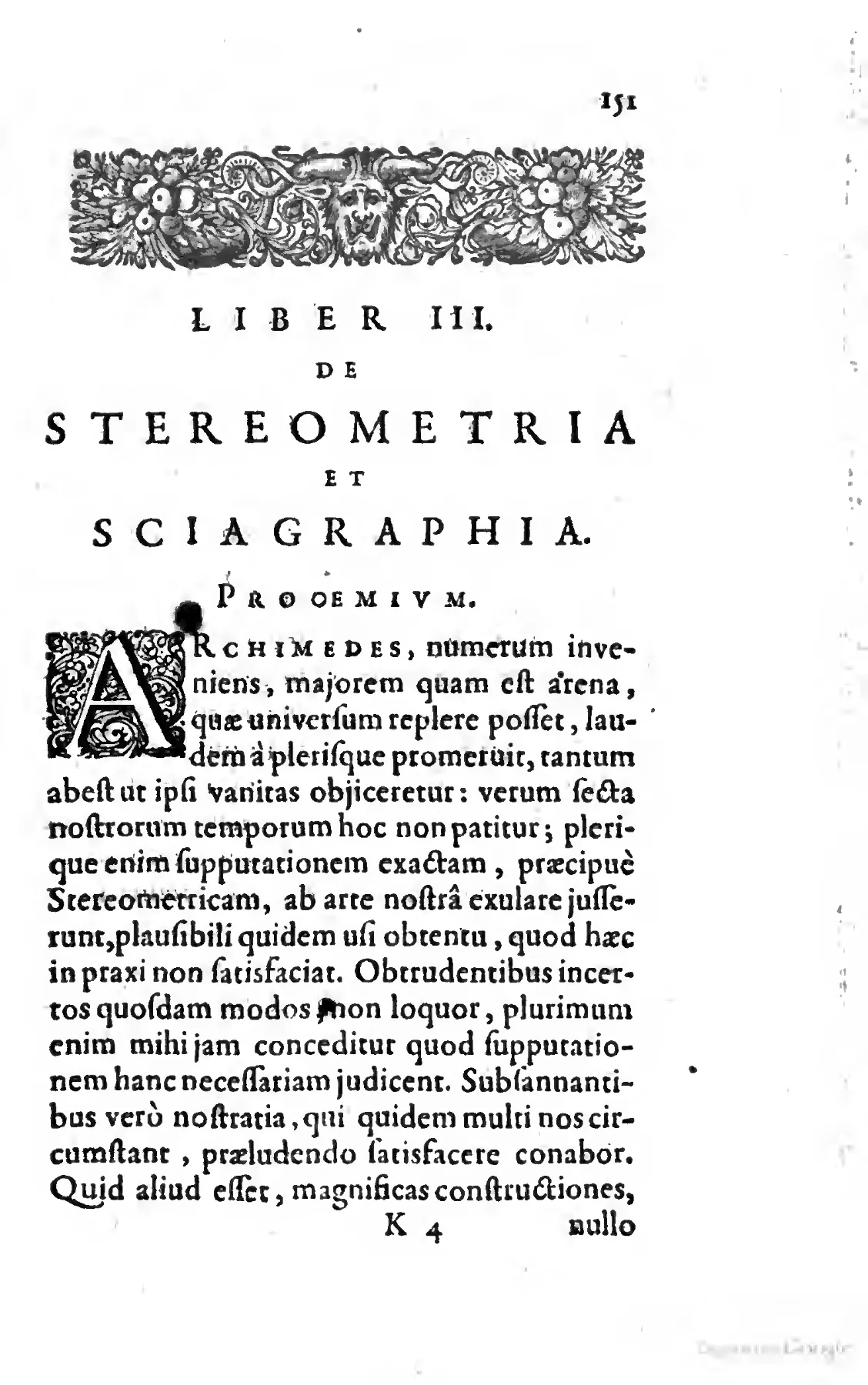
The opening of Book III, De Stereometria et Sciagraphia, frames Goldmann's case for computation in classical terms: an appeal to Archimedes's sand-reckoning makes exactness an inherited scholarly virtue. His complaint that most would banish stereometric calculation from the art then opens a defence of precision as civic obligation, not pedantry. Source ↗.
The French re-edition and its new dedicatee also show the work's movement between Latin learned instruction and a differently presented, illustrated vernacular publication.
The treatise frames its art within a long genealogy that begins in biblical guilt rather than in military technique. Goldmann recalls Cain as the one quem obtruncati fratris piaculum, & inde contractus conscientiæ furor primum moenibus mancipavit, sacra monimenta testantur Cainum, whom, as the sacred records attest, the guilt of his slain brother and the frenzy of conscience that followed first bound within walls. Empire is traced to conquest in the same passage of the dedication, sic imperiâ ab impio vastatore Nimrodo, multo sanguine, coeperunt;, so empires began, with much blood, from the impious devastator Nimrod. The rupture that makes a new science necessary is figured mythologically: gunpowder's inventor is a Prometheus ille novus ignem non modo Iovi furatus esset,, a new Prometheus who had not only stolen fire from Jove. Classical, biblical and Vitruvian authorities in this way supply genealogy and decorum for a discipline that the treatise nonetheless presents as refounded after gunpowder.
The wars of the Low Countries provide the immediate historical setting for assessing fortress design, siegecraft and resources. Geoffrey Parker's account of the Army of Flanders places fortifications within the wider demands of campaigning and logistics. That perspective can be read alongside, rather than substituted for, Goudeau's account of Goldmann's mathematical programme. Neither the presence of a bastioned design nor a Leiden imprint alone establishes that Goldmann endorsed every practice of a single 'Dutch school.'
The text does, however, treat the United Provinces, which it calls Belgium, as an exemplary field of practice. Against critics of specialized craftsmen, Goldmann answers Sed iis hoc reponam, quod in felicissimo Belgio quidem talibus artificibus carere non possint;, that in most happy Belgium they cannot indeed do without such craftsmen. Its examples also range beyond the Republic, to the sieges of La Rochelle and 's-Hertogenbosch, to Valletta and Hungary, and to engineers in Danish and Swedish royal service. The text cites Specklin, d'Aguilon, Freitag, Marolois, Stevin, Clavius, van Ceulen and Serlio. How far these citations amount to genuine debts, rather than learned reference, is part of what remains to be determined.
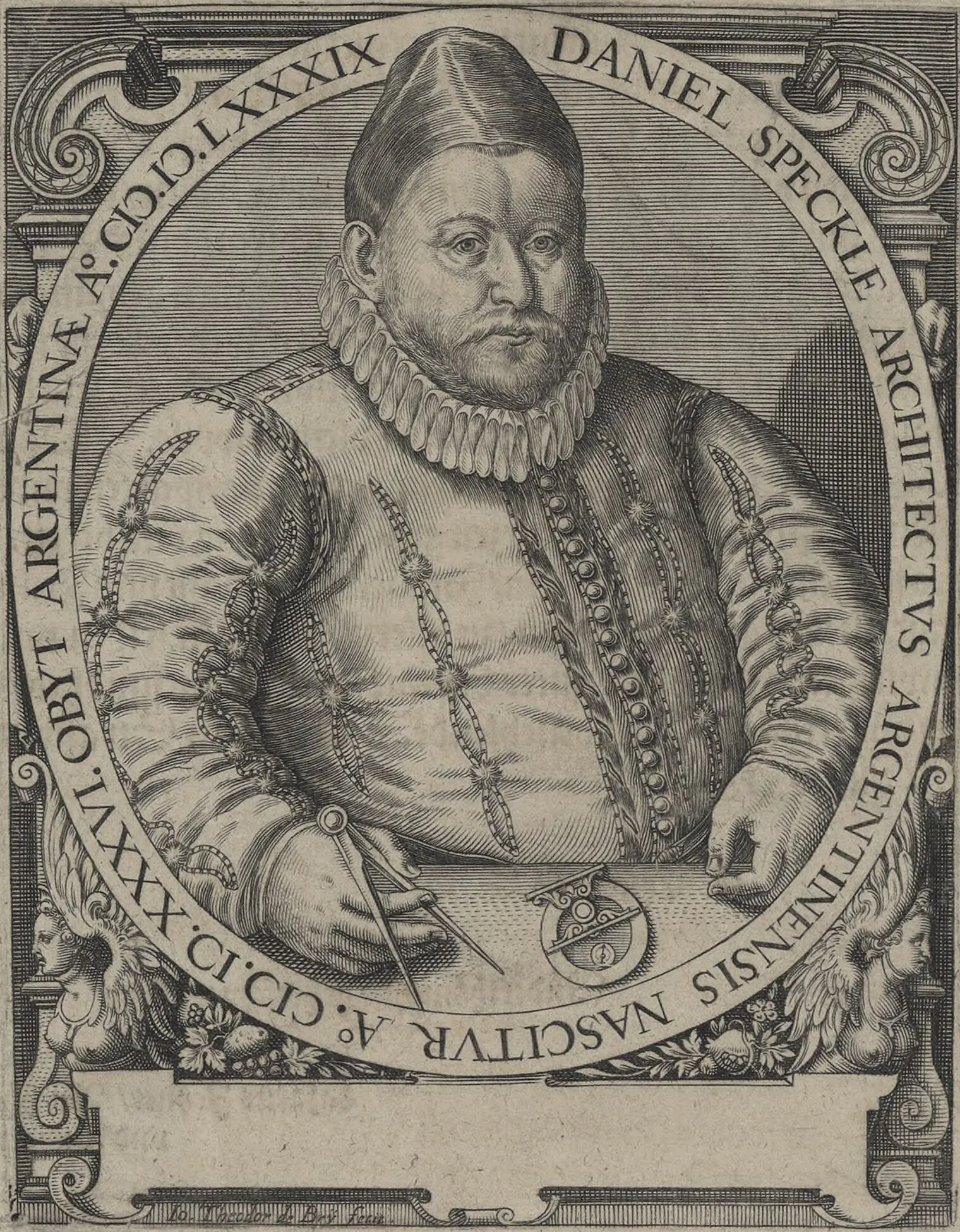
A portrait of Daniel Specklin (1536–1589), the Strasbourg military architect whose name stands among the authorities Goldmann cites. Whether such references mark substantive technical debts or the learned scaffolding of a discipline defining its canon remains an open question. Source ↗.

Broader 'Military Revolution' arguments about artillery, fortresses and larger armies remain relevant comparative historiography. A claim that this treatise confirms or refutes a particular version of that thesis would require close analysis of its Latin text and documented reception.
The treatise's political vocabulary bears directly on the open question of its political meanings, though it does not settle them. Goldmann defines the citadel neutrally: Arces sunt opera fortissima, quæ tam ad defendendum, quam coercendum, urbibus adjiciuntur;, citadels are the strongest works, added to cities as much for defending as for coercing them. He then condemns their misuse in the language of liberty. Rejiciendus verò est nefarius artis abusus, cum subditorum innocentium libertati, arcium Crudelitate, cruenti compedes injiciuntur declares that the wicked abuse of the art is to be rejected, when bloody fetters are cast on the liberty of innocent subjects by the cruelty of citadels. Later he turns the word's etymology against itself: Arces vocant quod hostes arceant; sed nostro tempore sæpè tytannidis & Bellonæ domicilium sunt; ut feré appellatas diceres, quod libertatem civium arceant. They call them citadels because they keep off enemies, but in our time they are often the home of tyranny and Bellona, so that one would say they were named for keeping off the citizens' liberty.
The concession that follows is strictly conditional. Sed utroque casu, tantùm arce opus est, quando saluti civium alterum refugium non patet, cessante vero causa, arces rursus diruendæ sunt allows that in either case a citadel is needed only when no other refuge lies open for the citizens' safety, and that when the cause ceases citadels must be demolished again. These passages tie the citadel to the salus principle stated at the opening of the work. Which contemporary citadels or regimes, if any, the condemnation was meant to touch is not established by the wording alone.
Its precise debts to individual engineers, its political meanings and the extent of its influence remain questions rather than settled conclusions on the evidence established here.
Tracing the Elzevier Editions of 1643 and 1645 and Their Surviving Copies
The Latin Elementorum architecturae militaris libri IV appeared in 1643 with the imprint Ex Officina Elseviriana. The specialist Architectura catalogue describes it as a small octavo dedicated to Frederick, the future king of Denmark and Norway. Its 1645 French counterpart, La Nouvelle Fortification, bears a Leiden imprint naming A. and B. Elzevier. Architectura describes that edition as a folio of 224 pages, dedicated instead to Frederick Henry of Nassau. It records 56 illustrations placed among the French text and describes the editions' contents and illustrations as the same. The difference in format and dedication is consequently material to identifying an individual copy; the French folio's pagination must not be assigned to the Latin octavo.
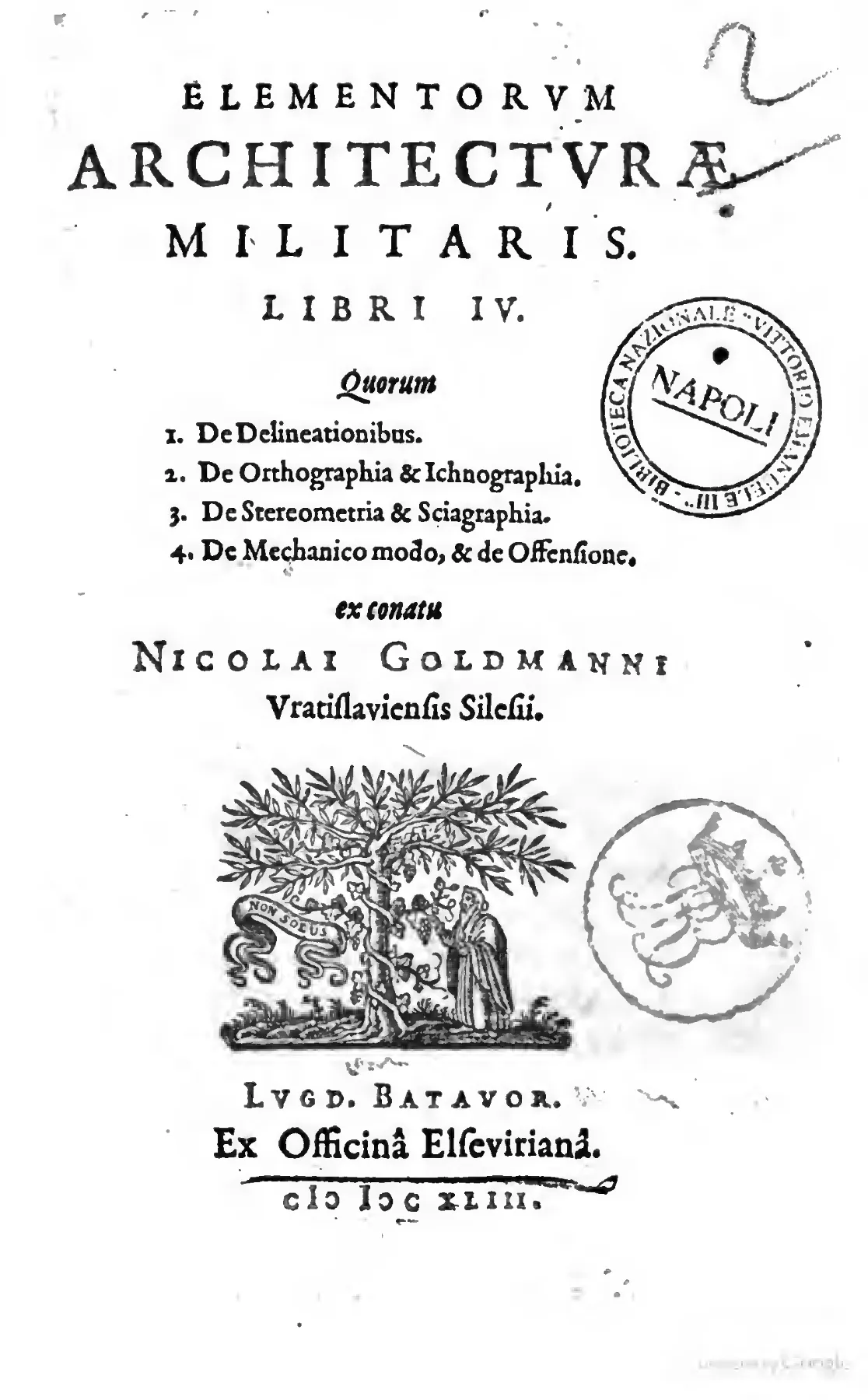
The 1643 Leiden title page presents Goldmann's Elementorum Architecturae Militaris as a Latin Elzevier book, with its four-book programme, the "NON SOLVS" device and the imprint "Ex Officinâ Elsevirianâ." These marks distinguish this small octavo from the 1645 French folio, whose pagination cannot be transferred to it. Source ↗.
The internal design of the work, announced in the four books named on the title page, mirrors the pairing of exact and practical method that governs its argument. Three books develop delineation, orthography and ichnography, and then stereometry and sciagraphy. The fourth turns to the mechanical mode and to offence. Goldmann gives the rationale for that turn in terms of the limits of tabulation: Ac cum infinitos casus neque tabulis neque supputationibus complecti, possibile appateat, & tamen quemvis situm munire requiratur, mechanicæ regulæ necessariæ fuerunt. Since it appears impossible to embrace infinite cases with tables or computations, and yet any site must be fortified, mechanical rules were necessary.
The treatise's computational chapters also treat the production of fortresses as a matter of reckoning cost. Ex soliditate Geometrica sumptus indicantur, si pro quavis mensura numeres florenum Hollandicum states that from the geometric solidity the costs are indicated, if for each measure one counts one Holland florin. Goldmann defers to experience where his rule cannot reach. He writes Cum autem propter maximam terræ diversitatem, necesse sit aliquam esse differentiam, Practicis committo proportionem illam, & præscriptam interim pro regula observabo: since, given the great diversity of soils, some difference must exist, he commits that ratio to the practitioners and meanwhile keeps the prescribed one as a rule. The work closes on a literary rather than technical note, adapting Virgil's boxer Entellus, Me verò quod attinet, vici laborem; atque hic victor cæstus artemque repono: as for himself, he has conquered the labour and here, as victor, lays down the gauntlets and the art. The gesture frames the completed treatise as a humanist achievement as well as a technical manual.
A confirmed institutional holding of the 1643 Latin work is the Luxembourg MNAHA Collections copy, shelfmark 2019-268/0127. A digitized 1643 copy is indexed under Goldmann's Latin title with provenance metadata referring to Leiden University Libraries and the National Library of the Netherlands, but that record does not supply a shelfmark. The Bibliothèque de l'Institut national d'histoire de l'art, Paris, holds the 1645 French edition at 4° Rés 361.
A signature-by-signature collation, confirmed extent of the Latin text and any separately bound tables or figures, and a census of surviving copies have not been established here. Nor has a privilege, censorship proceeding, suppression or documented loss been verified. No reliable identification of a purported Goldmann digitization catalogued as Johannes Meursius's Criticus Arnobianus has been established. That bibliographic conflation should not be repeated as a fact without examination of the particular copy and record.
The dedication change places the two printings before different prospective patrons, but neither dedication alone proves an appointment or payment. In particular, a work printed in 1643 cannot be dated after the death of Prince-Elect Christian in 1647 on the strength of Frederick's titulature. No contemporary refutation or chain of replies to this treatise has been verified.
Goldmann also developed a wider mathematical theory of architecture. Goudeau reports that former students circulated finished manuscripts of his unpublished civil-architecture work after his death and that Leonhard Christoph Sturm edited one for publication in 1696. Sturm's posthumous civil-architecture edition belongs to that related transmission history, not to the edition history of the 1643 fortification treatise. The continuity of the Vitruvian vocabulary of firmness, beauty and module across the military treatise nonetheless indicates why the two bodies of work belong to a single theoretical project.
Following Goldmann's Argument from the Dedication to the Siege Trench
The Dedication and the Prooemium
Goldmann's dedication to Frederick, heir of Norway, justifies the choice of subject before it lists a single technical novelty. Military learning is commended for its fitness to the active life. The appeal Namque in Republicâ versanti ex bellicis rebus non infima gloria quæritur; states that for one engaged in the commonwealth no mean glory is sought from the affairs of war. The phrase in Republica versans places the reader the treatise imagines in the humanist ideal of the vita activa, the prince or magistrate rather than the hired craftsman. The four innovations Goldmann then claims follow from this framing: an extended flank defence, rapid tabular computation of the ground-plan, tabulated earthwork volumes, and a quick mechanical procedure for irregular sites. Each is a means by which a learned patron might command an art otherwise held by practitioners. The dedication therefore anticipates the whole architecture of the book, three books of exact method and a fourth of expedient method, all addressed to a political end.
The prooemium recasts this ambition as genealogy, and its opening move is morally hazardous. The first builder of walls is the first fratricide: Cain, in the passage already noted among the treatise's biblical authorities, is delivered within walls by the guilt of his slain brother and the frenzy of conscience that followed. The verb mancipavit is a juridical term of conveyance and servitude. It makes the walls less a refuge than a confinement into which guilt delivers its owner. Goldmann presses the point into a maxim of moral psychology: metus verò non nisi à culpa proscaturit, fear springs from nowhere but guilt. A parallel in the same passage, likewise cited earlier, extends the charge from fortification to dominion itself, tracing the beginning of empires, with much blood, to the impious devastator Nimrod. In a book offered to a prince, the admission is striking. Goldmann defuses it with the commonplace that good laws arise from bad morals, so that a tainted origin does not vitiate a useful art. The rescue is effective, but it leaves a residue the prooemium will later have to discharge. If walls and empire share a criminal birth, the art requires an explicit end that distinguishes its lawful use from its Cainite and Nimrodian abuse.
The history of the art then runs from Babel and Babylon through Greece and Rome to the moment of rupture, cast in mythological rather than technical terms. Gunpowder's inventor is the new Prometheus already encountered, who not only stole fire from Jove but taught mortals to forge the thunderbolt. The figure is ambivalent in the classical way. Prometheus is the benefactor of mankind who is punished, and his gift brings both civilization and transgression. Here the gift destroys the inventions of the ancients, and the masonry tradition collapses. Italy's earth-backed walls are judged a wasteful half-measure, and completion is credited elsewhere: Vidit nostra ætas, Belgarum auspiciis, summam manum arti additam;, our age has seen, under the auspices of the Belgians, the final hand set to the art. Summa manus is the painter's and sculptor's term for the finishing touch. The Netherlands are thus cast as perfecters rather than inventors, and Goldmann can present his own systematization as the codification of a practice already brought to maturity.
Definition follows history. The double-edged definition of the art as fortifying and demolishing is divided again by method. The geometric mode, as noted earlier, deduces the science from mathematical foundations with as much certainty as trigonometry can yield. Its counterpart, Mechanica, quæ prioribus principiis inhærens, scrupulosas proportiones negligit,, is the mechanical mode, which keeps to the same principles but neglects scrupulous proportions. The mechanical mode is therefore not a rival theory. It is the same doctrine executed with relaxed exactness, a hierarchy rather than a dichotomy.
The practitioner is then defined in Catonian terms, as the good man skilled in fortifying whose formula has already been traced to the orator's ideal. Transferring the orator's formula subordinates technical skill to ethical character. It also explains why the list of the engineer's required studies runs past geometry and drawing to moral philosophy, which arms him against avarice and tyranny.
The genealogical residue is discharged in the statement of the art's end, already cited: the safety of subjects, citizens and soldiers is to be the supreme law. Cicero's maxim from De legibus is narrowed from the magistrate's general duty to the purpose of an art, and the triad of subjects, citizens and soldiers names those the walls protect, not those who command them. The corollary is the anathema, also quoted above, against the nefarius artis abusus, the casting of bloody fetters upon the liberty of innocent subjects by the cruelty of citadels. The compedes answer the mancipavit of the Cain passage. Walls that once bound the guilty within can, misused, bind the innocent. The prooemium's practical counsel on materials closes the circle with Dutch doctrine, in the preference, noted among the further readings, for the best, dense earth over any other material. The ground of the argument is that earth swallows shot harmlessly where stone shatters. After the Promethean rupture, the humblest material becomes the most rational.
Book I: Delineation and the Regular Figure
Book I translates these principles into figures. Its founding definition, already examined, turns tactics into geometry by making defence a disposition of lines that lays the assailants' flanks open to shot. The decisive quantity in that disposition is ballistic, and it is fixed by postulate in the manner of Euclid: ictum sclopeti ad metam recta, sexcentos pedes pertingere,, the musket shot at point-blank reaches six hundred feet, with seven hundred and fifty allowed as effective range. An empirical magnitude is given the logical status of a first principle, and from it the grades of castle descend, from royal to quadrantal.
Goldmann knows that his field is crowded and disordered. His complaint, noted above, that there are as many modes of fortifying as there are heads, frames the rival systems through the phrase libido ingeniorum as undisciplined appetite rather than reasoned difference. Against them he sets his own proportion with unusual confidence, proportio est Dupla continua, quâ quidem meliorem reperiri non posse confido, the proportion is a continued double, than which I trust no better can be found. Chord, face and wing stand in successive halving, a ratio whose very simplicity carries the authority of the Platonic and Vitruvian traditions of number.
The book's treatment of irregular figures complicates this confidence without abandoning it. Goldmann concedes that cities grow along gates, rivers and suburbs, and that a fortress imposed in disregard of commerce would empty its own interior: adeoque illa loca â commercio & frequentiâ hominum exemta habitatores vix unquam reperient, such places, cut off from commerce and the resort of men, would scarcely ever find inhabitants. The geometric norm yields to the city's life, much as the salus principle had subordinated the art to the people it serves. Even the irregular figure, however, is to be disciplined by symmetry, justified by the principle already cited that art should most prudently imitate nature, in this case the bilateral symmetry of the body.
Book II: Orthography and the Human Module
Book II makes that bodily analogy literal. Its prooemium restores the Vitruvian frame of firmness and beauty, discussed above, with firmness named first. The unit of the system is then taken from the soldier: the six-foot interior height of the parapet, the height of a man, becomes, as it were, the module of military architecture. In civil architecture the modulus was the diameter of a column, so the substitution relocates proportion from the order to the body that must stand behind the parapet. The softening quasi marks the transfer as analogy rather than identity. The counterweight to the human measure is the measure of the enemy's iron: Tormentum maximum, quod Canon appellatur, ad distantiam quadringentorum pedum, globo quadraginta octo librarum, loricam viginti pedes crassam perforat:, the largest gun, called the cannon, at a distance of four hundred feet with a ball of forty-eight pounds, pierces a parapet twenty feet thick. Between man and cannon, the profiles of Book II are graded by tables, the parapet's height answering the man and its thickness the gun. When critics object that such detail is excessive, Goldmann turns the praise of the Netherlands into a pedagogical argument, replying, in words already quoted, that in most happy Belgium such craftsmen cannot be done without. Exactness on paper replaces skill in the hand wherever skilled hands are lacking, and the book is offered for use beyond the Republic.

Helmeted Musketeer, Jacques de Gheyn II's 1587 engraving after Hendrik Goltzius, depicts a soldier of the kind whose stature and firearm Goldmann made measures of his art. Six-foot modules and musket-shot lines of defence were rules that could travel on paper wherever skilled hands were lacking. Source ↗.

Book III: Stereometry, Gates and the Citadel
Book III defends this programme where it is most vulnerable, in the reckoning of volumes and costs. Goldmann names the opposition outright in the complaint, cited earlier, that most would banish exact, above all stereometric, computation from the art; the phrase exulare jusserunt casts the critics as magistrates decreeing banishment. His reply raises accuracy to a religious obligation through Jeremiah: maledictos esse, qui opus Domini fraudulenter administrant,, cursed are they who administer the work of the Lord fraudulently. An estimate made carelessly becomes a breach of stewardship over public funds. Two school maxims then meet the objection from failure in practice. The first, already noted, holds that it belongs to art to aim well, and that the art does not err but the artificer does. The second answers the complaint that circumstances vary, quod artis non sit circa singularia versari, that it is not for art to concern itself with particulars. The Aristotelian distinction between universal ars and particular execution protects the norm. It also concedes the territory of the singular case, which the mechanical mode of the fourth book will occupy.
The definitions of Book III contain the treatise's sharpest internal tension. Citadels are defined, in the passage already quoted, as the strongest works, added to cities as much for defending as for coercing them. The register is neutral and technical, with coercion listed without censure. Yet the prooemium had damned exactly that coercion as nefarius artis abusus. The technical definition records what citadels do; the ethical frame governs what they may lawfully be made to do. Goldmann does not reconcile the two here, and the juxtaposition is itself an instance of the norm-and-accommodation structure.
The gates bring decorum into the earthwork. Rustic, Tuscan and Doric are prescribed after Serlio and Vitruvius, because the softer orders would publish the wrong civic character: significabis urbem effoeminatam esse & imbellem,, you would signify the city to be effeminate and unwarlike. The Vitruvian gendering of the orders becomes a matter of civic honour, so that the gate is both a defensive work and a public declaration.
The final architectural propositions descend to drawbridges, a barrier gate observed at Groningen, and the guardhouse vernacularly called the Corps de Gardes. Even this humble structure is reasoned from the political community it shelters, cum verò in Munimentis cives cum militibus vigilias obeant, since in fortresses citizens keep the watches together with soldiers. Citizens and soldiers sharing the watch embody in architecture the triad named in the end of the art. The guardhouse becomes the place where the safety of subjects, citizens and soldiers is kept in practice.

A plate from Braun and Hogenberg's Beschreibung der Städt der Welt, identified as Groningen, whose barrier gate Goldmann cites, depicts a bastioned Low Countries town. Within such works, the guardhouse was where geometric fortification became a daily watch shared by citizens and soldiers. Source ↗.

Alongside these architectural provisions, the closing propositions of the third book carry stereometry from the ideal figure down to the earth that labourers must actually move. Having tabulated the "geometric solidity" of a quadrangular Castellum Dodrantale, Goldmann subtracts the voids of gates, ramps and embrasures, and then announces a procedure under the heading Modus indicandi soliditatem communem, sive terram requisitam, the method of indicating the common solidity, or the required earth. The distinction between soliditas geometrica and soliditas communis is the hinge of the whole passage. The first is the volume of a body bounded by mathematical planes. The second is that same volume as loosened spoil, settling and compacting in the rampart.
The coefficient that converts the one into the other is a received 5:6 ratio. Goldmann adopts it without pretending to derive it, and his reason, already quoted for its deference to experience, exposes the limit of his own method: because of the great diversity of soils some difference must exist, so he commits that ratio to the practitioners and meanwhile keeps the prescribed one as a rule. The sentence is carefully balanced. It does not abandon the rule. It concedes that the rule's authority is conventional and provisional, and it assigns its correction to a distinct class of men, the Practici, whose knowledge is of soils rather than of figures. Geometry supplies the form of the calculation, and experience supplies one of its terms.
The same movement toward the world of contractors governs the unit of reckoning. Volumes are reduced to a local measure, and the text names its origin without embarrassment: IN confæderato Belgio mensura quædam plinthi forma adhibetur, quam Schacht vocant:, in the confederated Netherlands a certain measure in the form of a slab is used, which they call a Schacht. A Dutch vernacular word is admitted into the Latin because payment was made in it, and the slab of 144 cubic feet becomes the bridge between stereometry and the ledger.
The three uses Goldmann derives from the calculation complete this conversion. The first is cost, reckoned, as already seen, at one Holland florin for each measure of geometric solidity. The second and third, time and workforce, rest on a quantified norm of labour, Communiter affirmant duos viros, per diem, si diligentiam adhibeant, quinque mensuras effodere,, that it is commonly affirmed that two men, if they apply diligence, dig five measures a day. The verb affirmant again places the datum in common report rather than demonstration. The conditional clause about diligence, which a further allowance for negligence then qualifies, shows the calculation accommodating the moral unreliability of the workforce as well as the physical variety of the ground. The fortress is now something to be commissioned, paid for and scheduled. In this way the treatise addresses the magistrate who funds a work as well as the engineer who designs it.
The long ditch propositions push the exact mode to its most laborious. They proceed through tangent tables, decompose the slopes into prisms and pyramids, and subtract the result from a "fictitious" ditch. Yet they end in a deliberate refusal of further exactness. After a small supplementary ditch has made good the deficit of earth, Goldmann verifies the result and stops, in the sentence already cited among the further readings, judging that the remaining difference of scarcely one foot could be removed only by a computation that is curiosa, not necessaria. The opposition of curiosa and necessaria belongs to a long moral vocabulary in which curiositas names knowledge pursued beyond its use. Applied here, it sets the boundary of computation at the point where calculation ceases to serve the work.
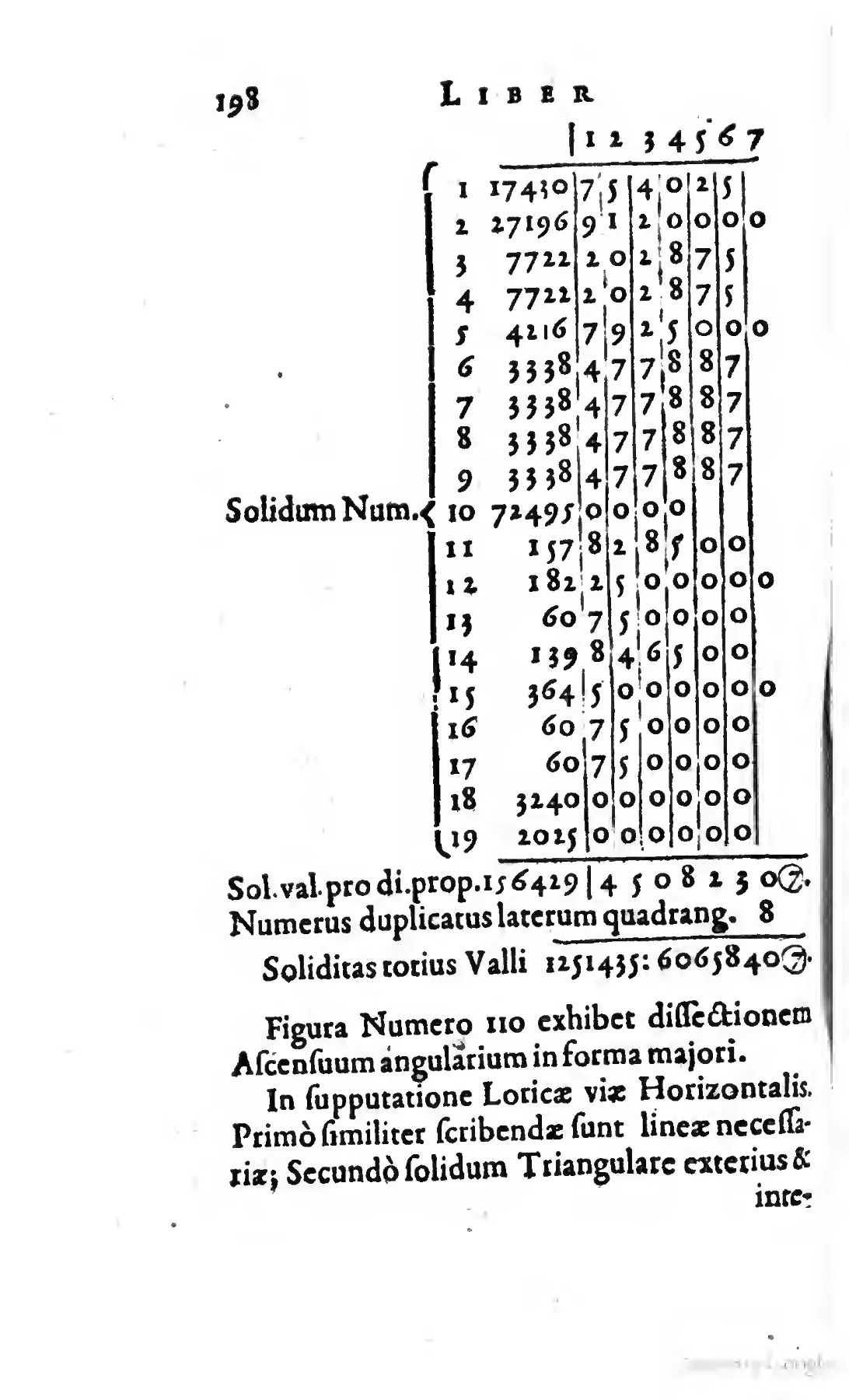
This table divides the rampart, or Vallum, into nineteen solids before totalling the Soliditas totius Valli: the stereometric method Goldmann defended, worked out on the page. The reckoning that follows, for the horizontal road's revetment, applies the same discipline, pursuing exactness where it governs earthmoving and cost. Source ↗.
The third book closes not on earth but on the citadel, and the political register changes abruptly. Within a proposition that ends in the purely technical joining of a pentagonal royal citadel to a decagonal fortress, Goldmann interposes the etymological reversal already discussed, in which citadels, named for keeping off enemies, are said in his own time to have become the dwelling of tyranny and Bellona and to keep off the citizens' liberty instead. The pun works by keeping the verb arcere constant while changing its object. The same structure that excludes the external enemy can exclude the citizen's liberty, and its legitimacy therefore lies in its use, not in its geometry. The concession that follows, also cited above, is framed with the precision of a legal rule: a citadel is needed only when no other refuge lies open for the citizens' safety, and when the cause ceases, it must be demolished again. The "two cases" are a city that changes its lord and a city newly conquered. The maxim cessante causa gives the citadel a merely provisional title, measured against the salus civium. Norm, accommodation and governing end here operate in the political sphere exactly as they had in the reckoning of soils.
Book IV: The Mechanical Mode and Offence
The proem to the fourth book, DE MODO MECHANICO, ET DE OFFENSIONE, justifies the treatise's division of method in the single sentence already quoted, which pleads that infinite cases cannot be embraced by tables or computations while any site whatever must still be fortified. The argument turns on the collision between the infinity of cases and the obligation to fortify quemvis situm. The mechanical mode is presented not as a degraded geometry but as the answer to a necessity the tabulated mode cannot meet.
The same proem defends an aesthetic priority on Vitruvian terms. Goldmann conclusi Eurithmiam retinere, concluded to retain eurythmy, that is, equality of flanks and gorge lines, even at the cost of a symmetry proportioned to the polygon's side. He supports shortened flanks on the weaker parts with a principle of strategic economy, fortiorem non haberi urbem, nisi ubi debilissimam,, that a city is held no stronger than where it is weakest.
The proem's account of competence is equally pointed: neque enim in obsidionibus aptum artificem pronuntiarem, nisi qui absque instrumento, quæcunque proponuntur, conficere norit. He would not pronounce anyone a fit artificer in sieges unless he knew how to execute whatever is proposed without an instrument. The field geometry of the following propositions, with its cord, stakes and 3‑4‑5 perpendiculars, is the content of that competence.
Yet the author who demands this fieldcraft disclaims the soldier's life for himself, neque enim hoc vitæ genus propositum mihi est, sed eminentius quiddam, ad quod me fides patriæ data constringit: this kind of life is not his purpose, but something more eminent, to which the faith he has pledged to his fatherland binds him. The tension is resolved by redefining the audience. The science, in the declaration already cited, is handed on as an ornament for one engaged in the commonwealth, in peace a distinction and in war a defence, not to open a geometric game. The chiastic pairing of decus and praesidium places fortification among the accomplishments of the politicus. The rejection of the ludus Geometricus echoes the earlier dismissal of the merely curious computation. The proem's culminating claim raises this civic function almost to the level of a political theology: nisi consilia ex hâc arte informata sint. Hæc sola beatas urbes efficit,, unless counsels are informed by this art; this alone makes cities blessed. The hyperbole is striking beside the modesty that soon governs the offensive part. It names the end that the whole apparatus of propositions serves.
Within the defensive propositions, the treatment of irregular figures supplies the epistemological counterpart to the proem's argument from infinite cases. After sixteen rules, Goldmann turns to worked examples with the frank admission, quoted earlier, that rules cannot embrace all cases but that judgement is formed from examples. The verb informatur recalls the counsels "informed" by the art in the proem. The humanist pedagogy of exempla, long used to train prudence in moral and political matters, is here transferred to the drawing of bastions on an irregular site.
The offensive part is opened with an even more marked modesty: itaque hic nemo perfectionem in præceptis quærat, sed tantum prima rudimenta proponi cogitet, let no one here seek perfection in precepts, but consider that only first rudiments are proposed. Authority in siegecraft lies in the deeds of commanders, and the text accordingly draws on recent sieges as exempla. Of the disposition of lines it notes ubi illud peculiare, in obsidione Rupellæ, annotandum est,, that this peculiarity of the siege of La Rochelle is to be observed, namely that the ditch may face the city when the rear is secure.
The zig‑zag of the approach trenches is explained by a figure drawn from navigation, simili ratione, qua nautæ cursus in ventum obliquare solent, in the same way that sailors are wont to set their course obliquely into the wind. The image renders the oblique approach intelligible as a technique for advancing against a resistance that cannot be met head on. The model offered is printed siege literature: Exempla vero egregia, ex descriptione Sylvæ Ducis, ab Architecto Regis Sueciæ editâ, colliges,, excellent examples will be gathered from the description of 's‑Hertogenbosch published by the King of Sweden's architect. For the screening of saps, mathematical optics is enlisted across confessional lines: scribent nimirum omnes verissimæ Agvilonii sententiæ, qui Opticam, in Praxi magno usui esse pronunciat, præcipuè in rebus bellicis;, all will subscribe to the most true opinion of Aguilonius, who declares optics of great use in practice, especially in matters of war.
The castrametation chapters strain the Latin itself. Officers' ranks appear in French, and Goldmann asks indulgence for it: Rogo etiam lectores, ut barbarie vocum, quibus hic utor, non offendantur, ipsorum enim commodo hoc feci, quod Gallica, he asks readers not to be offended by the barbarism of the words he uses, since he did it for their convenience, because the French terms are better known. The apology is repeated, as if one excuse could not cover the frequency of the offence. Here the treatise's principle of use reaches its own medium: humanist purity of diction yields, with acknowledged reluctance, to the vocabulary of the camp. The same accommodation appears where classical terms are laid over modern things, as when the gallery carried across the ditch is defined as a vinea, 18. Vinea est ex tabulis & asseribus constructa moles, per ipsam fossam, the vinea being a structure built of boards and planks through the ditch itself.
The peroration returns to ethos. Meum fuit diligentia & fidelitate uti, de eventu verò respondere meum non est, nisi quod apud gratos gratiam sperem; ingratos verò non magnopere extimescam: his part was to use diligence and fidelity, while answering for the outcome is not his, save that he hopes for thanks from the grateful and does not greatly fear the ungrateful. The separation of diligent performance from outcome mirrors the earlier claim that the art does not err though the artificer may. The book then closes on Entellus's words from the fifth book of the Aeneid, recast in the first person and already cited: as for himself, he has conquered the labour, and here, as victor, he lays down the gauntlets and the art. In Virgil the aged boxer renounces combat after a final victory. Transferred to the end of a manual on siegecraft, the line makes the completion of the treatise itself a contest won. It also lets the art of war be laid aside in the same breath that sums it up, an apt final gesture for a work that subordinates its weapons, its tables and its citadels to an end beyond them.
Reading Further on Goldmann, Leiden Mathematics and the Low Countries Wars
- Goudeau, Jeroen. "Nicolaus Goldmann (1611–1665) en de praktijk van de studeerkamer." Bulletin KNOB 94, no. 6 (1995): 185–203. A study of Goldmann's scholarly practice, valuable for placing his fortification writing within his work as a teacher and architectural theorist. It is especially useful alongside the treatise's own reflections on the reach and limits of calculation. One such reflection concedes of an earthwork reckoning, Quæ vix uno pede differt à soliditate communi sive terra requisita; posses autem efficere ut ne uno quidem differret, si mediam latitudinem parvæ fossæ usque ad tertias quæreres; sed hæc tantum curiosa non necessaria supputatio est, that the result differs scarcely by one foot from the earth required, and that it could be made to differ not even by one foot if the mean width of the small ditch were sought to thirds, but that this is merely a curious, not a necessary, computation.
- Goudeau, Jeroen. Nicolaus Goldmann (1611–1665) en de wiskundige architectuurwetenschap. PhD diss., University of Groningen, 2005, especially chap. 4. The most directly relevant book-length investigation of Goldmann's mathematical architectural theory. Its discussion of military architecture warrants consultation alongside surviving copies of the editions.
- Goudeau, Jeroen. "A Northern Scamozzi: Nicolaus Goldmann and the Universal Theory of Architecture." Annali di architettura 18–19 (2006–2007): 235–246. Situates Goldmann's ambition for a general architectural science within the reception of earlier architectural theory, clarifying why his military treatise should not be isolated from his civil-architecture writings.
- Parker, Geoffrey. The Army of Flanders and the Spanish Road, 1567–1659: The Logistics of Spanish Victory and Defeat in the Low Countries' Wars. 2nd ed. Cambridge: Cambridge University Press, 2004. Its treatment of fortifications and the conduct of war in the Low Countries supplies a historical setting for Goldmann's Leiden publication. It does not, by itself, establish Goldmann's sources or political commitments. It offers a useful context for the treatise's preference for earthwork, stated as Nulla certè commodior materia sese offert, quam terra optima & spissa;, that certainly no more suitable material offers itself than the best, dense earth.
Frequently Asked Questions
Who was Nicolaus Goldmann, and what is his Elementorum architecturae militaris libri IV?
Nicolaus Goldmann (1611–1665) was a teacher of mathematics and architecture, born in Silesia and styled a native of Breslau, who built his career in Leiden. The precise place where he composed the treatise has not been established. His Elementorum architecturae militaris libri IV, printed by the Elzevier press at Leiden in 1643 as a small Latin octavo, is a learned handbook of fortification in four books. It moves from drawing fortress plans, through elevation, ground-plan, solid measurement and shaded representation, to rapid field methods and the attack of fortified places. Goldmann dedicated it to Frederick, then duke of Schleswig-Holstein and later Frederick III of Denmark-Norway.
Why did Goldmann treat fortification as a branch of mathematics?
Goldmann held that gunpowder had destroyed the authority of ancient masonry, so fortification had to be refounded as a certain and teachable science. His geometric mode derives designs from mathematical foundations with as much certainty as trigonometry allows, and it serves permanent works. A mechanical mode of cord and stakes keeps the same principles but relaxes exact proportion, and it handles irregular sites and work done in haste. Jeroen Goudeau has argued that Goldmann presented military engineering methodically as mathematics, and that designing a fortress could serve him as a way of teaching mathematics itself. Goldmann insisted that he was equipping men engaged in public affairs, not opening a geometric game.
Why did Goldmann say citadels should be demolished?
Goldmann defined citadels neutrally, as works added to cities for both defending and coercing them, but he judged that in his own time they were often the home of tyranny and Bellona. He turned the word against itself: citadels were named for keeping off enemies but now kept off the citizens' liberty. Because the safety of subjects, citizens and soldiers is the supreme law of his art, a citadel is justified only when the citizens have no other refuge. Once that cause ceases, it must be pulled down again. His wording alone does not establish which contemporary citadels or regimes he had in mind.
How did Goldmann calculate the cost of building a fortress?
Goldmann reckoned costs directly from earthwork volumes, counting one Holland florin for each measure of geometric solidity. The working unit was the Dutch Schacht, a slab of 144 cubic feet. He converted mathematical volume into the loosened earth actually required by a received 5:6 ratio, and he left its correction to practitioners because soils vary so greatly. Labour followed the common report that two diligent men dig five measures a day, with a further allowance for negligence. A fortress thereby became something a magistrate could commission, fund and schedule, as well as something an engineer could design.
Is there an English translation of Goldmann's Elements of Military Architecture?
No complete English translation of Elementorum architecturae militaris libri IV has been verified. The English title Elements of Military Architecture, in Four Books is an editorial convenience rather than an established rendering. The work did appear in French in 1645 as La Nouvelle Fortification, a folio issued by the Leiden Elzeviers and dedicated to Frederick Henry of Nassau. Separately, the Leo edition presents the full Latin transcription and a complete English translation for the first time, and that translation is generated by AI. Leo is an effort to make English translations of every text printed in Latin in early modern Europe between 1450 and 1750 freely available online at no cost.
This report was generated by an advanced AI assistant that conducted deep research alongside an extensive interpretation of the transcribed original text. Every effort has been made to preserve fidelity to the source and to guard against inaccuracy, but corruption in the text recognition process and model hallucination may nonetheless have entered the text. Treat every claim, quotation, translation, and citation as provisional, and verify each against the original source before relying on or citing it.
Bibliography
- Université de Tours, Architectura: La nouvelle fortification: The Tours catalogue notice for the 1645 French folio supplies the format, pagination, illustration count and change of dedicatee on which this report's edition history rests. Its claim that the Latin and French editions share contents and illustrations is the hinge for anyone trying to match a copy to its printing. It also quietly lists the essential Goudeau bibliography, saving the reader a search.
- Jeroen Goudeau, "Nicolaus Goldmann (1611–1665) en de praktijk van de studeerkamer," Bulletin KNOB: Goudeau follows Goldmann into the study rather than onto the ramparts, which suits a treatise that halts a ditch calculation once it turns merely curious. The article explains how a Leiden teacher could build a fortification doctrine at a desk without apologizing for it. Readers without Dutch should still find a way in, since the argument about the study room underpins much of this report's reading of method.
- Jeroen Goudeau, Nicolaus Goldmann (1611–1665) en de wiskundige architectuurwetenschap: The only book-length study of Goldmann, and its fourth chapter on military architecture is where the claim that fortress design served him as a vehicle for teaching mathematics is argued in full. It sets the 1643 treatise beside the civil-architecture manuscripts that Sturm later brought into print. The English summary offers a reluctant Anglophone a narrow but serviceable entrance.
- Jeroen Goudeau, "A Northern Scamozzi: Nicolaus Goldmann and the Universal Theory of Architecture," Annali di architettura: The title makes a large comparison, and the essay earns it by reading Goldmann as an heir of Italian theory with ambitions to a single science of building. It is the best English-language explanation of why the Vitruvian firmness, beauty and module of the fortification treatise are not decorative borrowings. Read it before deciding that the bastion and the column belong to separate disciplines.
- Geoffrey Parker, The Army of Flanders and the Spanish Road, 1567–1659: Parker counts the soldiers, wages and supply routes that Goldmann's florin-per-measure costings assume without discussing. The book supplies the war in the Low Countries that made earthwork sieges a matter of state finance, viewed from the Spanish side of the trench. It will not tell you what Goldmann read, but it shows why a Leiden magistrate might care how many men could dig five measures a day.