Helmeted Hares: Gabriel Naudé's On the Study of Warfare: A Treatise
Gabriel Naudé, the Parisian librarian and controversialist, published the Syntagma de studio militari at Rome in 1637. It is a Latin treatise of more than nine hundred pages that defends a scholar's right to theorise war, then argues that experience, not reading, makes a commander. Along the way it debunks Hannibal's vinegar-split Alps, mocks magnetic armour and the weapon-salve, and places the general beneath both prince and God, which makes it a sharp guide to how early modern Europe separated real knowledge of war from credulous wonder.
ExLatinis
10 October 2026

Contents
Gabriel Naudé, the Parisian librarian and controversialist, published the Syntagma de studio militari at Rome in 1637. It is a Latin treatise of more than nine hundred pages that defends a scholar's right to theorise war, then argues that experience, not reading, makes a commander. Along the way it debunks Hannibal's vinegar-split Alps, mocks magnetic armour and the weapon-salve, and places the general beneath both prince and God, which makes it a sharp guide to how early modern Europe separated real knowledge of war from credulous wonder.
Gabriel Naudé (1600–1653) is remembered chiefly as a librarian, bibliographer and controversialist of the French learned world. In 1637 he published at Rome, through the press of Giacomo Facciotti, a long Latin treatise titled Syntagma de studio militari, which may be rendered as an ordered treatise on the study of warfare. He dedicated it to a young Italian nobleman, Ludovico Guidi di Bagno. Rieti has been named as the place of composition, but that detail has not been independently established from the catalogue descriptions. No published translation into another language has been verified, so the work remains accessible only in its original Latin. The book is not a campaign narrative, a drill manual or a treatise on maritime law. It is a work of learned judgement that sets out what a soldier and a commander ought to be, and what anyone, soldier or scholar, can truly claim to know about war.
At its heart lies a problem of standing and of kind. The first question is whether a civilian scholar may legitimately theorise war at all. The second is what sort of knowledge military knowledge is. Naudé answers by definition through ends. Whatever conduces to victory is proper to military discipline, and that discipline rests on experience, eyewitness inspection and natural causation rather than on encyclopaedic erudition. His recurring move is critical discrimination, applied topic by topic. He separates the useful from the vain and marvellous, history from fable, true worship from superstition, and genuine causal connection from omen and occult remedy. He likewise separates experience from reading, though reading is never discarded and survives as experience's auxiliary. The same sifting governs his portraits of persons. The soldier appears as an instrument of obedience. The general appears as a subordinate agent, bound by the prince's sovereignty over war and by the demands of piety and just war. Both are framed by a Ciceronian scheme of knowledge, virtue, good fortune and authority, which Naudé Christianises and reads in a sober, realist key.
The stakes reach well beyond military science. The treatise enters the old Renaissance contest between arms and letters, and it does so from an unusual position: a man of letters arguing that letters are of limited use to the man of arms. It touches reason of state, the law of nations and the morality of war. It also takes up the critique of credulity that marked Naudé's wider career, including his defence of great men falsely suspected of magic. Modern scholarship has placed Naudé in contexts of Renaissance learning, libertinism and Italian military humanism. How the Syntagma's particular judgements should be classified, whether as libertine, sceptical or conventional, still depends on reading the Latin closely rather than inferring from its author's reputation.
What makes the book memorable is the range and sharpness of its particulars. Naudé debunks the story that Hannibal split Alpine rock with fire and vinegar. He dismisses Archimedes' burning mirrors. He refutes amulets, talismans, magnetic armour and the Paracelsian and Rosicrucian weapon-salve by appeal to practice and to nature as the true healer. He treats the "anointers" blamed for spreading plague at Milan as a case of panic. Along the way he takes the Ottoman levy as a benchmark for selecting soldiers, invokes Don Quixote as a satire of vain daring, and closes a discussion of the general's learning with remarks on chess. One copy offered for sale is described as a thick quarto of more than nine hundred pages. The work also carries an acknowledged tension. It argues against the lettered general and claims priority for practice, yet it is itself an erudite performance addressed to a learned patron, and at one point it calls its own material philological rather than military.
A single concern links the work's vocabulary, its transmission and its argument: the discipline of telling genuine from spurious testimony. Naudé applies that discipline to stories of marvels, to claims of occult causation and to the credentials of the military writer. A version of the same discipline is needed for the book's own later history. A digitized copy of the 1637 Syntagma has been entangled with an attribution to Giulio Ferretti, the author of a separate and earlier work on naval law. The records consulted do not support that attribution for Naudé's text, and they do not establish that Ferretti's work is bound with it. The treatise's keywords (studium, disciplina militaris, auctoritas, religio and superstitio) each mark a boundary of this kind between what can be known and what is merely believed. Its internal movement, from the soldier who executes to the general who judges under the prince and under God, follows the same logic of discrimination and subordination.
Read the full text and English translation on Leo
This text was transcribed and translated as part of the ExLatinis project, an effort by Leo to make free English translations of every text published in Latin in early modern Europe (1450–1750) available online. The complete transcription and English translation of this work can be read free of charge:
→ Read the original Latin text and full English translation on Leo
You can save a copy of this document into your Leo account to run deep text searches, conduct further analysis, or cross-reference it with your own research.
Translating Naudé's Title: Studium, Disciplina Militaris and the Vocabulary of War
On the Study of Warfare: A Treatise is an editorial English title supplied for convenience, not an established translation of Gabriel Naudé's Syntagma de studio militari. Studium denotes sustained application to a subject, while syntagma promises an ordered assemblage rather than a narrative of a particular campaign. The title thus places learned preparation for war at the centre of a work dedicated to a young nobleman.
The pairing of studium with militaris states the work's problem in miniature: can war be an object of study for someone who has not waged it? Naudé settles the definitional side of that problem by fixing the scope of military knowledge through its end. He declares that everything capable of winning victory over the enemy is proper to military discipline: Proprium autem militaris disciplinæ vocamus, id omne quod ad victoriam ex hostibus reportandam conducere potest. This criterion supplies the measure by which he sifts the useful from the merely curious throughout the treatise.
In this setting disciplina militaris joins instruction to the inherited sense of ordered martial practice: the value of books must be considered alongside the conduct expected of soldiers and commanders. On the side of conduct, the soldier's share in this discipline is execution rather than deliberation. It is his office, Naudé writes, not to ask what kind of thing the commander has ordered but to take it up and carry it out: est enim eius officij non quærere quale sit quod Imperator iusserit, sed illud capessere, atque implere;.
Auctoritas carries both the weight of received testimony and the prestige by which a commander secures obedience; it should not automatically be rendered as a legal entitlement to command. Naudé's own usage supports this caution. Authority is the last of four imperatorial qualities that he takes from Cicero in preference to other schemes, namely knowledge, virtue, good fortune and authority: tamen præferuntur quatuor aliæ propositæ a M. Tullio, scilicet scientia, virtus, felicitas, & auctoritas. In its fullest statement, authority works through reputation rather than right. Its virtue and power, he writes, are such that wherever it inclines it draws everything with it, and it persuades peace or war less by reason and judgement than by opinion: nimirum hæc est auctoritatis virtus, & potentia, vt quocunque se inclinarit illuc omnia pertrahat, pacemque vel bellum non tam ratione, & iudicio quàm opinione persuadeat. The third member of the Ciceronian scheme is reshaped in a parallel way. Felicitas is detached from pagan cult when Naudé insists that Fortune herself, or felicity, is no goddess: Neque Fortuna ipsa, siue felicitas dea est.
The distinction between religio and superstitio likewise belongs to early modern disputes over true worship, credulity, and the interpretation of extraordinary events. For this pair, at least, the text itself supplies a compact definition in the patristic manner: religion is the offering of true worship, and superstition the offering of false. religio est veri cultus exhibitio. superstitio autem falsi;. The same discrimination between the genuine and the counterfeit then governs his treatment of amulets, talismans, the weapon-salve and omens. Beyond that definition, the question of whether Naudé gives any of these terms a more exact or polemical inflection in a given passage remains a matter for close reading of the Latin. It is not a settled conclusion that can be drawn from the title or catalogue.
Gabriel Naudé's Syntagma de studio militari in Brief
Gabriel Naudé (1600–1653) wrote the Latin Syntagma de studio militari, a substantial learned treatise on the study of military affairs. It was printed at Rome by Giacomo Facciotti in 1637 and addressed to Ludovico Guidi di Bagno. Its dedication and scale place military learning, rather than a single battle or a maritime-law question, at the centre of the work. Rieti has been identified as its place of composition, but that detail was not independently established from the accessible catalogue descriptions. No published translation into another language was verified.
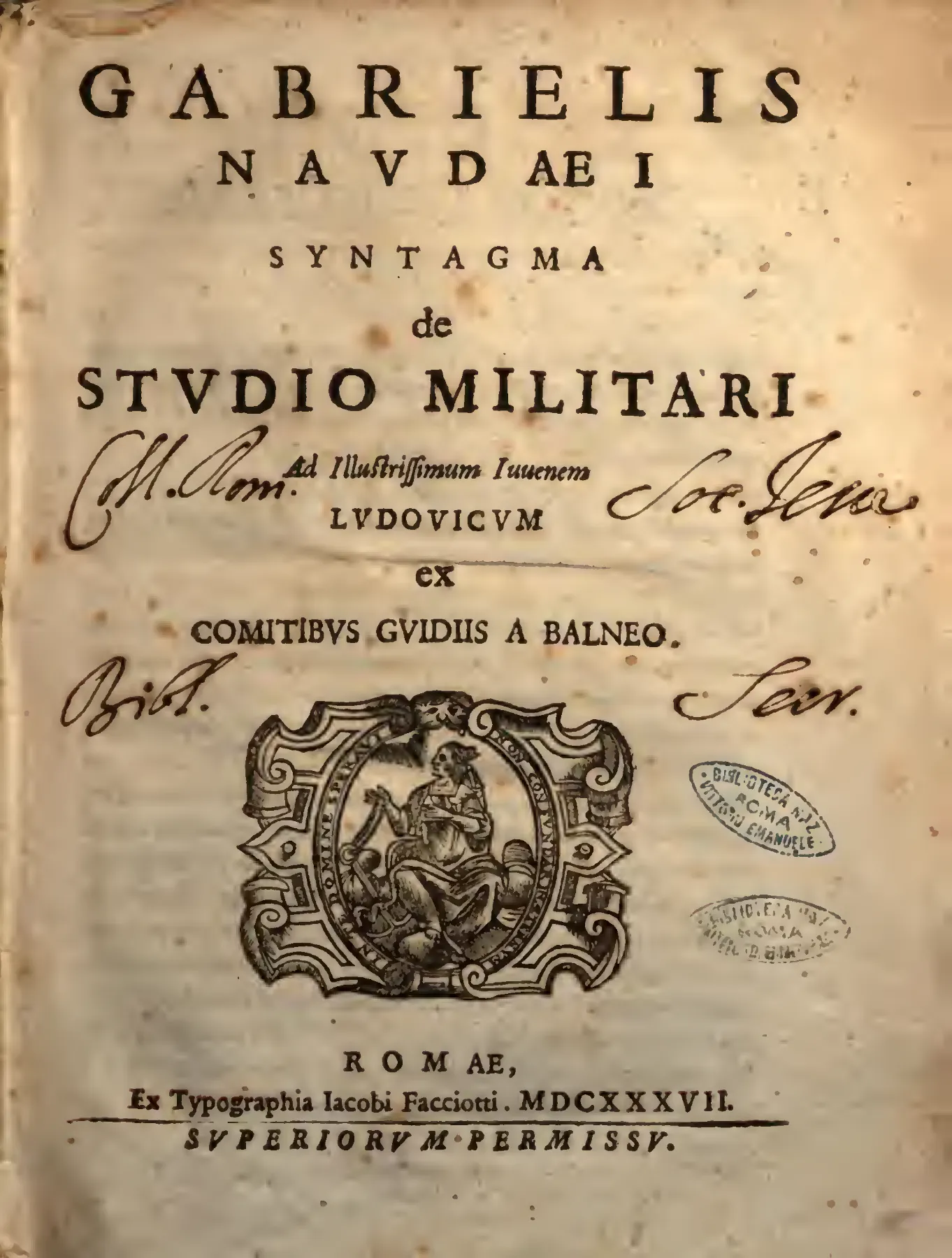
The title page of the 1637 Roman imprint, printed by Giacomo Facciotti and dedicated to Ludovico of the Guidi di Bagno counts, presents military study as learned counsel to a noble patron. Its licensing formula, ownership marks and library stamps place the treatise within Rome's controlled Catholic book world. Source ↗.
Within that frame, the treatise divides its attention between the soldier and the general. It insists on the general's indispensability through a vivid image: without a commander, an army is nothing other than a vast beast without a head, nihil aliud est exercitus, quàm vasta bellua sine capite. Its portrait of command is deliberately unidealised. Naudé sets the commanders of his own day, who live in the dregs of Romulus, against the blessed heroes of Plato's Academy and the Moors who come forth daily from Utopia: Quod non eodem modo illis accidere potest, qui in fæce Romuli vitam degentes, non tot illam possunt illustrare documentis & virtutibus, quemadmodum facere solent beati illi Heroes ex Academia Platonis, aut Mauri Vtopiâ quotidie prodeuntes. This is a realist correction of ideal types, consistent with the work's broader habit of separating attainable practice from fable.
The digitization identified as Cbt7Hos6AkkC is identified by both its Google Books record and its Internet Archive record as Naudé's 1637 Syntagma. Giulio Ferretti's De iure et re navali is a distinct, earlier work. A Ferretti attribution for this identifier was not reproduced in the records checked. Neither those records nor an available binding description establishes that Ferretti's work forms part of the scanned volume. A composite binding therefore remains unproved, and Ferretti must not be assigned authorship of the Syntagma.
Why Naudé's Treatise on Warfare Matters to Historians of Arms and Letters
The Syntagma matters because a seventeenth-century librarian and scholar made warfare the object of sustained Latin study. He did so at a time when classical example, military experience, political prudence, and confessional judgment all claimed authority. Its dedication situates that undertaking in a Roman and Guidi di Bagno patronage setting. Interpreting how Naudé weighed those claims, and whether particular judgments should be called libertine, sceptical, or conventional, requires textual evidence rather than an inference from his reputation.
Some of that evidence concerns the author's own standing. Naudé grants that the precepts and theorems of the disciplines cannot be discovered, established and propagated without use and examples. Yet he holds that, to be grasped, they do not demand action and practice: Disciplinarum igitur præcepta, & theoremata, citra vsum & exempla inueniri, & constitui, propagarique cum minimè possint; vt percipiantur tamen, actionem praximq; non flagitant,. This is the defence of the civilian theorist on which the whole undertaking depends.
The treatise nonetheless ranks action above contemplation. Naudé judges military service far more apt to make men sharers in a shadowed divinity and in true glory: Militiam longè aptiorem esse quæ homines adumbratæ cuiusdam diuinitatis & verę glorię participes reddat,. He presses the point against the lettered general, contending that knowledge of the disciplines is not only useless but harmful to the handling of arms, inutilem modo, sed noxiam quoque esse armorum tractationi. Even so, he leaves reading a subordinate role. It is to be commended only insofar as it aids experience, so that the commander stands on experience and reason as on two legs: Quare eius tantum vsus commendandus est, quatenus opitulari experientiæ solet, & efficere, vt Imperator experientiâ simul & ratione, tanquam vtroque crure innixus. The resulting position neither simply repeats nor simply rejects the Renaissance pairing of arms and letters. Letters are retained, but as experience's auxiliary.

Pedro Berruguete’s portrait of Federico da Montefeltro with his son Guidobaldo stages the Renaissance union of arms and letters: the armoured duke reads, his helmet at his feet. In Naudé’s terms, it casts letters not as a substitute for experience but as an auxiliary to command and dynastic rule. Source ↗.

The same discriminating method shapes Naudé's handling of historical testimony. He sets out to expose those who falsely persuade themselves that Hannibal worked huge rocks and whole mountains with fire and vinegar, and so to show how prone human nature is to trifles: vt ex detecta multorum vanitate, qui sibi falsò persuadent scopulos ingentes, montesque integros, igne & aceto fuisse in ea expeditione ab Annibale pertractos, ostendam consequenter, quàm prona sit in nugas hominum natura. Against such credulity he sets the Polybian standard. The most trustworthy writer is beyond doubt the one who has practical experience of affairs and has surveyed the places where they were done, is sine dubio est, qui & earum vsum habet, & loca in quibus gestæ sunt vndique perlustrauit. He faults historians whose concern is no longer with truth but only with the marvellousness of their stories, illi sit de veritate, sed tantummodo de mirabilitate historiarum. Here autopsy and experience, the same criteria that define military knowledge, become the criteria of historical credibility.
Confessional and juridical judgment run alongside this critical temper. Naudé attacks an impious and profane political writer, identified elsewhere in the text under the name Politicus Florentinus as Machiavelli. That writer, he complains, claimed that the Christian religion blunts warlike virtues and that military virtue and glory cannot be contained within the narrow bounds of Christian law: mentem venerit impiæ cuiusdam, & profanæ politicæ scriptori; vt hæc eade[m], bellicas virtutes in christianis hominibus obtundere, virtutemque, ac gloriam militarem, non posse cum angustijs nostrarum legum cōtineri assereret;. Against that claim Naudé concludes that, without piety, a war can be neither justly undertaken nor happily concluded: Vnde eo tandem negotium reducitur, vt absque pietate bellu[m] nec iustè suscipi, nec feliciter terminari possit.
His account of the general's conscience follows the Augustinian division of responsibility. The wickedness of commanding makes the king guilty, while the order of service shows the soldier innocent: reum faciat Regem inquitas imperandi: innocentem autem militem ostendat ordo seruiendi. He also distinguishes legal impunity from moral licence. Many things done against an enemy go unpunished under the law of war, though they are wholly contrary to piety and humanity: multa enim in illu[m] licent quæ ex iure belli nullis poenis subiacent, licet pietati, ac humanitati penitus aduersa.
In natural philosophy and medicine, the same author rests his arguments on causal connection and the operation of nature. Whether a wound is simple or hollow, he insists, no medicine closes it, and whatever is achieved is the work of nature: siue ea simplex sit, siue cum cavitate, nullum collit medicamentum, sed quicquid in hoc perficitur, naturæ opus est. He rejects divination on the principle that, wherever there is no connection of subject with attribute or of cause with effect, anything may be said of one thing as well as of another: vbicunque enim nulla est connexio subiecti cum attributo, & causæ cum effectu, tam omnia dici de vna quàm de alia re possunt;. Of the supposed anointers at Milan, he says flatly that it was a panic terror and nothing else, Panicus siquidem terror & nihil aliud fuit.
Taken together, these passages show critical naturalism standing beside declared piety and just-war doctrine within a single treatise. The textual evidence documents both strands. It does not by itself settle which interpretive label best fits their combination.
Modern scholarship offers distinct contexts, not a demonstrated consensus on every argument in this book. Jack A. Clarke's biography provides an account of Naudé's career. Lorenzo Bianchi's studies place him in discussions of Renaissance learning and libertinism, a setting directly relevant to the religio/superstitio discrimination noted above. Frédérique Verrier examines the earlier Italian military-humanist tradition against which a treatise joining arms and letters can be read. Their different subjects and periods should not be recast as a documented disagreement about a particular Syntagma passage. A specialist study by Anna Lisa Schino, 'Incontri italiani di Gabriel Naudé,' has been indexed with a reference to the Syntagma and advice concerning its publication, but its full text and bibliographic particulars have not been established. Claims about an intervention by a named member of Naudé's circle, or about the treatise's immediate reception, consequently remain open. The work invites closer study of military bibliography, patronage, and learned judgments about war. The accessible evidence does not yet warrant a definitive account of those debates within its pages.
Tracing the 1637 Rome Printing and Its Digitized Copy
The recorded title of the 1637 printing is Gabrielis Naudaei Syntagma de studio militari ad illustrissimum iuuenem Ludouicum ex comitibus Guidiis a Balneo. Its imprint is Rome, ex typographia Iacobi Facciotti, 1637. The title names Naudé and addresses Ludovico Guidi di Bagno. A description of a separately offered copy calls the book a thick quarto, collates it as [28], 912 pages, and notes errata in the preliminaries. That seller's later leather binding, contemporary marginal marks, and measurements describe that copy only; they cannot be transferred to the digitized exemplar. Signatures and a copy-specific collation of the scan were not established.
The text's own account of its character bears on how its considerable bulk should be understood. Naudé acknowledges at one point that the matters he has been treating are philological rather than military: philologica hæc potius esse quam polemica;. Here polemica carries the Greek sense of what pertains to war. The admission registers, within the text, the tension between the treatise's argument for the priority of practice and its learned, compilatory form, the ordered assemblage that its title promises. Its organisation around the soldier's office and the general's, with the latter framed by the Ciceronian tetrad already noted, gives that erudition a deliberate architecture rather than an encyclopaedic sprawl.
The Internet Archive item bub_gb_Cbt7Hos6AkkC identifies the National Central Library of Rome as the contributing holding library and records 948 digitized page images. Its metadata gives Naudé, Facciotti, 1637, and the Google Books identifier Cbt7Hos6AkkC. The Google Books record for that identifier likewise names Naudé's Syntagma. Neither accessible item description supplies a shelfmark, a binding description for the Rome exemplar, or evidence of a Ferretti component. The difference between 948 images and a separately reported [28], 912-page collation is not, by itself, evidence of another work, because preliminary and unnumbered images require inspection before any such conclusion. A physical check of the Rome library's holding record and of the scan's opening and closing leaves remains necessary to rule definitively on a Sammelband.
Ferretti's De iure et re navali was printed separately at Venice by Francesco de Franceschi in 1579. The Ferretti attribution associated with the identification problem is thus a bibliographic claim about a different imprint, not evidence that Ferretti composed Naudé's text. The separation of a genuine from a spurious attribution here is a matter of the same evidential care that the treatise itself demands of its witnesses. No EDIT16 identifier for that imprint was securely established. A separate digitization of the 1637 Syntagma is also described as coming from the Bavarian State Library; it must not be mistaken for the Rome-library scan. The consulted records do not establish a shelfmark for either copy, a verified later edition, a translation, a specific licensing signatory, or a documented contemporary reply or suppression. The dedication documents an intended connection to the Guidi di Bagno household, but a chain of individual readers or responses cannot be inferred from it.
Following Naudé's Argument from the Soldier's Office to the General's Authority
The Preliminaries and the Preface "De militia"
The printed preliminaries already enact the tension between form and function that runs through the treatise. In a brief note prefacing the analytical Series capitum et articulorum, Naudé claims to have composed the body of the book after the custom and institution of the ancients, that is, without any finer division, more, ac instituto, hoc est absque vlla minutiori partitione. The humanist ideal invoked here is the continuous discourse of Cicero or Seneca, unbroken by the articulated quaestiones and distinctiones of scholastic method. Yet in the same breath Naudé supplies a page-keyed table of heads, a "thread" for the reader, and its numbered articles reappear as printed side-notes in the text. The apparatus that the ancient manner renounces is restored through the resources of the press. The book thus presents itself as an ordered assemblage that is also readily consulted, a syntagma in both senses, and the gap between its avowed form and its actual equipment anticipates the larger gap between its argument for practice and its erudite execution.
The table also fixes the architecture of the second book, and here Naudé makes his structural choice explicit. Against competing schemes of imperatorial virtue, he declares his preference for the Ciceronian tetrad of knowledge, virtue, good fortune and authority discussed earlier. A tetrad drawn from forensic oratory, the praise of Pompey in the Pro lege Manilia, becomes the framework of a pedagogy of command. The same heads, however, already carry a corrective edge. Naudé dismisses as absurd the demand that the general be furnished with universal learning, illum encyclopædià ornari debere, quod oppido perqua[m] absurdum est. The Ciceronian scientia he adopts is therefore not the orator's encyclopaedic culture but a bounded knowledge defined by its usefulness. Even the table of contents participates in the treatise's characteristic act of discrimination.
The preface "De militia" opens with an insinuation proper to a member of the cardinal's household addressing a nobleman who had already seen service at Casale and in the Low Countries. Its first rhetorical problem is the author's own standing. Naudé asks who he is to sustain the role of some Chiron or Xenophon, quis enim ego sum, vt Chironis alicuius, aut Xenophontis personam sustineam?. The two exemplars are carefully chosen. Chiron is the mythic tutor of Achilles, Xenophon the philosopher-commander who both fought and wrote. By disclaiming both personae, Naudé concedes that he can be neither the educator of heroes nor the practitioner-author. The disclaimer belongs to the modesty topos, but it also opens the epistemological question on which the whole enterprise depends.
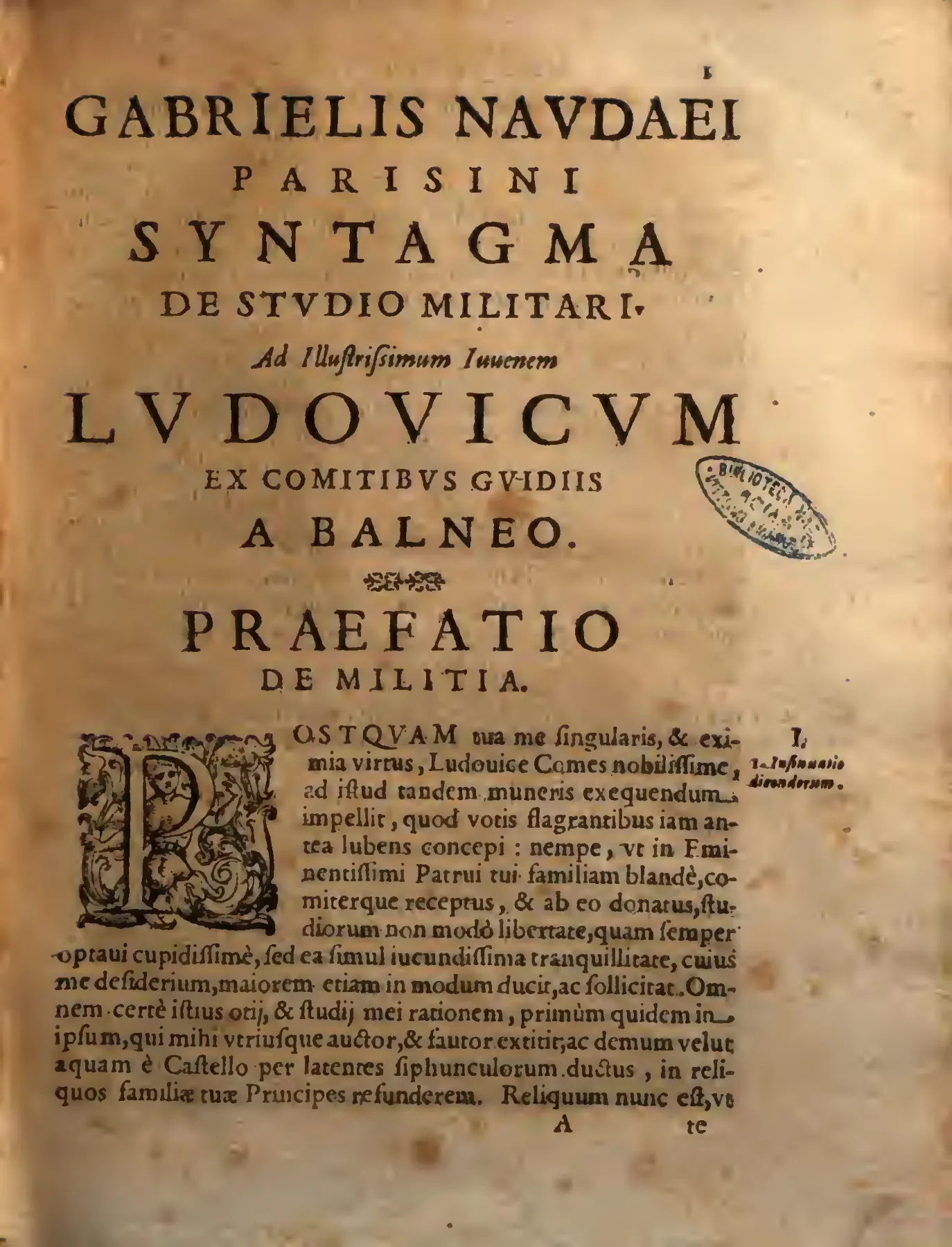
The opening of the preface “De militia” poses the treatise’s problem at once: a Parisian scholar addresses Ludovico Guidi di Bagno in the decorum of Roman learned print. Its ornament and historiated initial frame both a patronage performance and Naudé’s defence of a civilian’s study of war. Source ↗.
He grants the objection in its strongest form: it is plainly one thing to speak about war, and another to rout and put the enemy to flight by fighting, Nimirum aliud planè est, de Bello dicere, & aliud bellando hostes fundere, & fugare;. The concession, echoing the Phormio and Hannibal anecdote that frames the passage, separates dicere from bellare only so that the two can be reconnected on Naudé's terms. The reconnection follows in the carefully poised period, already cited, in which he grants that the precepts and theorems of the disciplines cannot be found, established and propagated without use and examples, yet do not require action and practice in order to be grasped. The sentence divides the life of a discipline into two phases. In discovery and transmission, usus and exempla are indispensable. In reception, perceptio, the learner does not need praxis. Experience generates doctrine, but doctrine, once generated, can be conveyed through reading. This concession secures a place for the civilian theorist without surrendering the priority of practice. It also explains the long roll of non-combatant authorities that follows, from Homer and Vegetius to Valturio, Lipsius and the Jesuit writers, each of whom wrote on an art he did not exercise.
The roll admits one exclusion. Naudé singles out the Florentine from the order of secretaries, whose political books are sprinkled with wicked erudition, ex Scribarum ordine Florætinum hunc, cuius libri politici flagitiosa eruditione respersi,. Machiavelli's Arte della guerra is denied a place among legitimate theorists because it is contaminated by the Principe. The phrase flagitiosa eruditio is pointed: learning itself is not the fault, but learning put to impious ends. The exclusion also refines the argument just made. The civilian writer is admissible, but only if his doctrine is morally sound, so that the boundary between legitimate and illegitimate theory is drawn on confessional as well as epistemic grounds. That the censure appears in a book carrying the approval of Leone Allacci and the Imprimatur of the Master of the Sacred Palace gives it an evident fitness to its Roman setting, whatever its relation to Naudé's own political writing.
Having justified his standing, Naudé limits his scope. He takes upon himself the care only of those admonitions that are general, idcirco harum tantummodo monitionum quæ generales sunt, curam in me recipio;, leaving the particulars of the drill-ground to the campidoctores. The self-limitation complements the epistemology. If reading suffices for perceiving general precepts but not for executing particular manoeuvres, then the scholar's legitimate province is exactly the general. The book defines itself as military culture rather than a tactical manual by the same logic that permits it to exist.
The preface then turns to its polemical core, a defence of arms against the learned. Naudé casts his opponents in siege imagery: these are the battering-rams which the proud nation of the lettered brings against military service, hi sunt Arietes quos superba literatorum natio in Militiam. The literati become a hostile natio and their arguments engines of assault, so that the controversy of arms and letters is fought in martial terms. The irony is pronounced, since the defender of the camp is himself a librarian and among the most bookish men of his generation.
The first of the rams is the claim that contemplation makes men godlike. Naudé inverts it in the passage already cited, holding military service far more apt to make men partakers of a shadowed divinity and of true glory. The qualifier adumbratae is precise. Human participation in the divine is only a foreshadowing, an outline, which keeps the claim within the bounds of Christian piety while reversing the Aristotelian primacy of the bios theoretikos. The rationale is that God is imitated through providential governance rather than idle speculation, so that one must at last confess the whole matter to be one of action, not of vain contemplation, fateatur tandem oportet totum istud esse actionis, non vanæ contemplationis negotium;. The epithet vana recurs across the treatise as its standing term for what fails the test of use, and it already marks contemplation detached from action as belonging with the wondrous and the superstitious.
The second ram, the claim that the sciences teach everything, provokes a sceptical counter-offensive. Naudé assembles a catalogue of disagreement among the learned, observing that Hipparchus dissents from Eudoxus and Copernicus from Ptolemy in astronomical matters, Hipparchus, ab Eudoxo, & Copernicus à Ptolemæo in Astronomicis dissentiunt,. The figure of diaphonia, the discord of the dogmatists, belongs to the Pyrrhonist arsenal revived through Sextus Empiricus and Montaigne. Its force lies in placing Copernicus neutrally beside the ancients as one more party to an unresolved dispute, without endorsing or condemning his system. The sciences are thereby disqualified as sources of certain doctrine, while the useful arts are credited to unlettered inventors. Naudé asks what is more subtle than the chalcographic art of printing books and what more wonderful than the mariner's compass, librorum Chalcographica? quid ipsa Pixide nautica mirabilius?. The Renaissance commonplace of the three modern inventions, which together with artillery had served to vindicate the moderns against the ancients, is turned against the learned. The very technology that multiplies books is shown to owe nothing to bookish learning.
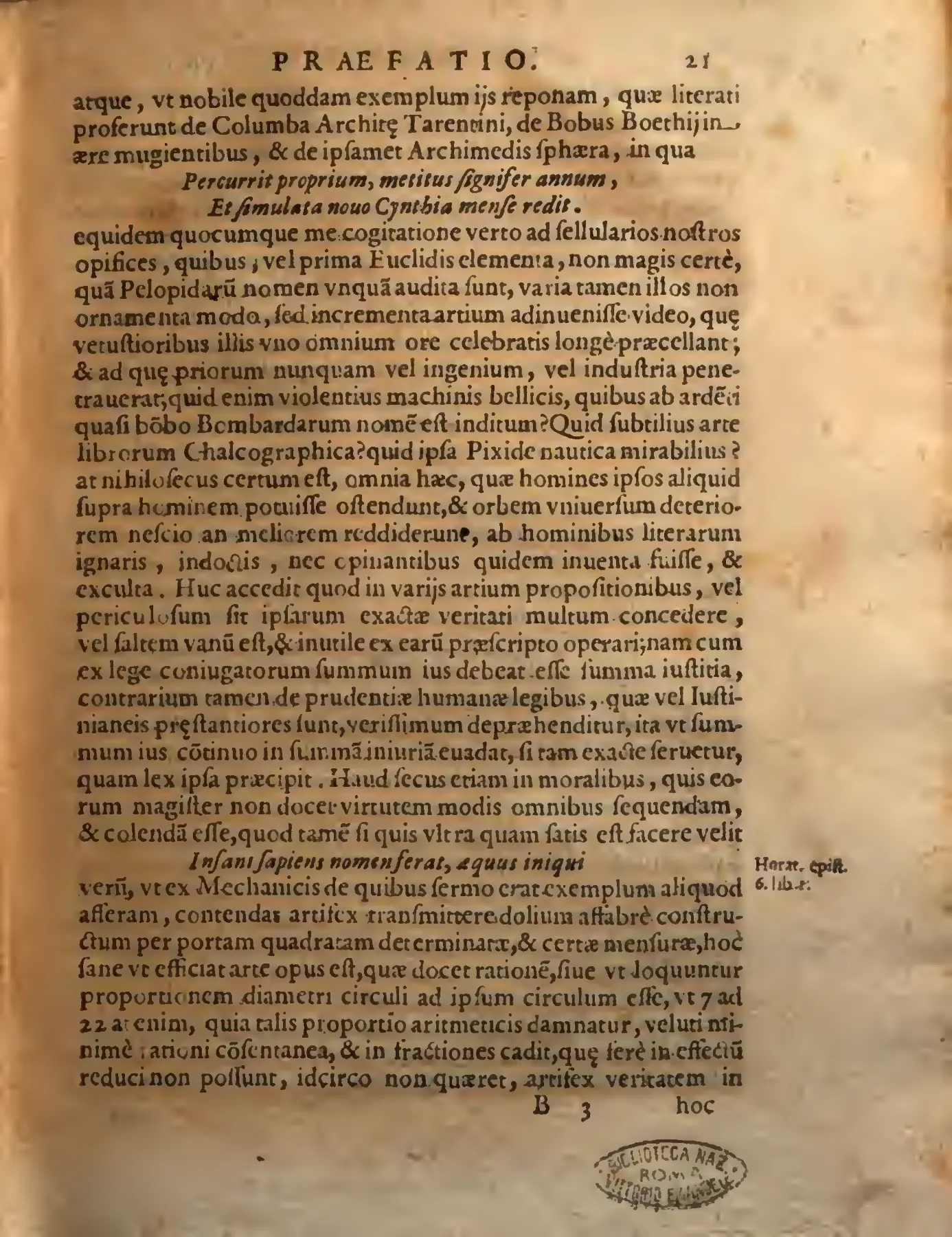
On this page of the preface Naudé turns the modern inventions of artillery, printing and the compass against learned prestige, crediting them to unlettered craftsmen rather than the schools. A comparison of the circle’s diameter and circumference presses the point: in the useful arts, exactitude may yield to practice. Source ↗.
The third ram, eloquence, receives a political answer. Orators breed sedition, and Naudé crowns the case with Chilo's apophthegm that the best form of commonwealth is that in which the laws are most heard and the orators least, eam optimam esse Reipublicæ formam, in qua maximè leges minimè oratores audiuntur. The preference for leges over oratores aligns the military order with the order of law against the volatility of persuasion. The preface ends in exhortation. Naudé tells Ludovico that without arms he may have a good reputation but not a great one, and may live honourably but cannot die gloriously, absque hoc enim bonam famam habere potes, non potes magnam; honestè viuere potes, non potes mori gloriosè. The paired antitheses of bona and magna, honeste vivere and mori gloriose, distinguish civil probity from martial glory and reserve the higher term for the soldier.
Book I: The Soldier's Office
The first book, "De militis officio," opens by grounding its method in the nature of its object. Naudé refuses both utopian idealisation and minute regulation, because the varied and inconstant nature of things to be done permits no law to be laid down about them, rerum enim agendarum varia, & inconstans natura, nullam de ipsis legem ferri permittit,. Here the Aristotelian distinction between the necessary objects of scientia and the contingent objects of prudentia is turned into a principle of composition. Particulars are left to the commander's judgement, and the treatise confines itself to the general precepts it promised.
Prudence, however, is not distributed equally. Phocion's quip, by which he checked the soldiers' boldness with the exclamation "By Hercules, how many generals I see, and how very few soldiers!", audaciam tali exclamatione co[m]primeret, à Hercules quàm multos video Duces, milites verò perpaucos!, introduces the doctrine of the soldier as executor. Naudé states it with unusual starkness: he wants the soldier stripped bare, despoiled not only of his own will, Nudum igitur militem volo, spoliarumque non modo propria. The language of nakedness and spoliation, normally applied to the defeated enemy, is applied to the recruit. Deliberation and the contingency of affairs belong to the general, and the soldier's virtue consists in emptying himself of the will that might rival his commander's.
This division determines the weight Book I places on selection. Naudé attributes modern inferiority to the Romans to contempt for selection and exercise, in co[n]temptum delectus, & exercitationis refero,, and his satirical portrait of drum-beat recruitment makes the point concrete. The urban dregs gathered by such levies are, in a word, truly helmeted hares, verbo absoluam verè galeati Lepores; quibus vt ad populandos. The proverbial image of the timid hare under a helmet exposes the gap between military appearance and martial substance, the same gap between seeming and being that the treatise elsewhere probes in testimony and remedies.
The criteria of selection display the same naturalism. Astrological explanations of national courage are set aside in favour of climate and observation. From Hippocratic premises Naudé draws a conclusion of notable political colour: a greater supply of brave and warlike men tends to arise in free cities than in those held under the rule of a prince, virorum fortium, & bellacium existere solere in ciuitatibus liberis, quàm in ijs, quæ principis cuiusdam dominatu tenentur,. Offered in a book dedicated to a papal nobleman, the claim is presented as a finding of natural history rather than a political programme. Its republican implication nonetheless stands within the text and sits uneasily with the subordination of the general to the prince's sovereignty that the treatise maintains elsewhere. The survey of modern nations is equally inflected. The French and Germans become soldiers almost by nature alone, proficiunt, sed Galli, & Germani sola ferme natura milites eudunt, whereas Spaniards and Italians require discipline. The Parisian author's defence of his compatriots against Livy's slurs finds its culmination here.
The discussion of the body completes the division of labour between soldier and general. Physique and heat of temperament are relevant signs for the recruit, but the general's quality lies elsewhere. Naudé finds this plain beyond doubt from the example of eunuchs, vel Eunuchorum exemplo certissimè patet,, citing Narses and the Ottoman eunuch commanders as proof that command rests on prudence rather than bodily vigour or martial heat. Moderate anger may serve the soldier but harms the general. Through this physiological argument the opposition between the will-less executor and the judging commander is rooted in nature itself.
Selection, Fortitude and Training
The problem of the delectus, the choosing of recruits by age, origin and occupation, then governs the next stretch of the first book. From the outset of that inquiry Naudé measures the decay of Christian practice against an infidel standard. After surveying ancient age limits, he concedes that nowhere today, except among the Turks, does a fixed method of choosing soldiers survive, nullibi certa delectorum militum ratio præterquam apud Turcas. The admission matters because it shows the treatise's critical discrimination working against confessional loyalty. The Ottoman boy-levy for the Janissary corps is not admired for its religion, which Naudé elsewhere condemns. It is admired because it preserves an order that Christendom has let lapse. Frederick's age rules, by contrast, are set aside as obsolete. What counts as authoritative is not the antiquity or orthodoxy of a precedent but whether it is still operative in practice.
The same temper shapes his handling of the old dispute over whether seasoned men or untried youths make better soldiers. Naudé gathers the case for maturity (Nestor, Phoenix, Camillus, Marius) and answers it by distinguishing counsel from combat. He then faces the harder paradox, drawn from Federico da Montefeltro and Commynes, that raw recruits may outdo veterans in the first charge. Here he states his method in miniature, saying that he, who would assert nothing rashly, does not wholly agree with them, lunt, ego vero qui nihil temere proferre vellem, non planè illis. The withholding of assent leads to a synthesis rather than a verdict. Veterans supply steadiness and order, and novices supply a terrifying first shock. This is the sceptical iudicium of the learned critic applied to tactical testimony. Opposed authorities are not ranked by prestige but sorted by the function each correctly describes.
The inquiry into social origin follows Roman legal and moral categories closely, and it reveals the treatise's assumptions about freedom and status. Naudé reconstructs from Cicero the division between honourable callings and sordid gains. In hired trades, he says with Cicero, the wage itself is the bond of servitude, ipsa merces autoramentum seruitutis. The metaphor deserves attention. Auctoramentum is the technical term for the gladiator's contract of hire, so the phrase assimilates the wage-earning artisan to the man who has sold his body for the arena. Service in arms thus appears as a privilege of free status, and that privilege is defined by its opposite. The servile exclusion is then fixed in the Digest, where Marcianus rules that slaves are barred from all military service on pain of capital punishment, omni, inquit, militia serui prohibentur, alioqui capite puniuntur. The oath, the sacramentum, is the juridical threshold, and its sanctity requires that the infamous and the servile be kept outside it.
Against these exclusions stands the positive ideal of the agrarian republic. With Vegetius, Naudé recalls that the Roman citizen was at once warrior and farmer, quem Romanus Ciuis idem bellator fuit, idem Agricola; nec. Cincinnatus and Columella's lament for rural decline give the ideal historical depth. A Vegetian catalogue then gives it bodily form: the rustic folk endure the sun, care nothing for shade, and know nothing of baths or of delights, Solis patiens, vmbræ negligens, Balneorum nescia, deliciarum,. The asyndeton enacts a moral physiology, in which hardness of body follows from the absence of luxury. Yet the argument does not let the myth stand untested. The fable that Muzio Attendolo Sforza was called from the plough by throwing his mattock into an oak is dismantled, since the Attendoli were a respectable family of Cotignola. More significantly, Naudé then turns the ideal against itself. Townsmen are not to be despised, for, as Seneca says, virtue is closed to none, virtutibus dotata onerari debeat. nulli enim præclusa virtus est, inquit. The concession is pragmatic as well as moral. The infantry of his own day is in fact drawn from the urban populace, and a doctrine of selection that ignored this would fail the criterion of use by which the treatise defines military knowledge. The republican myth is honoured as an exemplar and then corrected as a guide to practice.
The treatment of fortitude in chapter XI moves the inquiry from the body to the soul, and it is here that discrimination between the genuine and the counterfeit becomes most explicit. Because courage cannot be read from physiognomy, the recruit must examine himself, and he needs a clear concept of what he is looking for. Naudé therefore sets out the Aristotelian species of spurious fortitude, and he observes, provocatively for a treatise on soldiers, that Aristotle did not class military fortitude under the honourable, fortitudinem militarem, non compræhendi ab Aristotele sub. The soldier's courage of habit and drill is thus not yet virtue. True fortitude is the rational mean between rashness and fear, and its counterfeit in the direction of excess is the vain pursuit of danger. Here the treatise draws on an unexpected witness. Scanderbeg's duel in casks and Suero de Quiñones's bridge serve as examples of reckless display, and no one, Naudé says, mocked such daring and rashness more wittily than the recent author of the fabulous tale, audaciam, temeritatemque derisit, quàm nuperus Scriptor fabulosæ. The appeal to Cervantes is notable within Neo-Latin learned prose. A vernacular fiction is admitted as moral testimony precisely because it is a satire of fiction, a fable exposing the fabulous chivalry that confuses spectacle with valour.
Having excluded the vain, Naudé defines the proper object of courage. The dangers worth undergoing are those taken for religion, for the safety of the fatherland, for the laws, and for a friend, quæ pro religione, pro salute Patriæ, pro legibus, pro amico. Religion comes first in the series, which places the soldier's fortitude within the Christian frame that the treatise elsewhere uses to answer the Florentine politician. Death in battle is the proper matter of courage, whereas death at sea or by disease is not. The operative maxim is Roman in its starkness: the recruit should resolve either to conquer or to die, proponat vel vincendum esse, vel moriendum. The resolution opens a praise of contempt for death as worth more than any weapon. Glory, the second required disposition, is then given an unexpectedly levelling reach. Posterity, Naudé insists, is wont to pronounce on deeds and is equally a friend to the poor man as to the king, suerint pronunciare solet, æque pauperi amica ac Regi; æque. Coeles, Scaevola and Dentatus are remembered as readily as generals. The common soldier, whom the work elsewhere defines as an instrument of obedience, is here granted a share in commemorative honour, which qualifies any purely mechanical reading of his office.
The pivot from dispositions to discipline is the sharpest turn in this part of the book, and it carries the stakes of the whole reform programme. Naudé declares his aim of bringing military discipline within the enclosures of doctrine, since among his contemporaries it no longer exists, doctrinæ septa redigam, vt quoniam ipsa hodie apud nos nulla. The image of septa, the fenced enclosures of a camp or voting ground, fits the theme: doctrine is to enclose a practice that has broken its bounds. The indictment of present troops opens with an antithetical tricolon of inversion, in which soldiers hold for law the sword's edge, for reason their will, and for equity their lust, habent prolege; pro iure, gladij aciem; pro ratione, voluntatem; pro æquitate,. Each member replaces a principle of order with a principle of force or appetite. The diagnosis is then generalised in a rhetorical question: what else will camps be, if one removes discipline, quid aliud erunt castra si quis eam sustulerit, with brigandage as the implied answer. The echo of Augustine's question about kingdoms without justice joins the military argument to the political theology of the treatise. Discipline does for the camp what justice does for the commonwealth. The remedy, however, is located in a Christian monarchy. Naudé credits the French kings with reviving a semblance of ancient order, and he says that most wars, both against the sectaries and against other enemies of the realm, were won by the valour of the royal guards, cum pleraque bella tum aduersus Sectarios, tum alios regni. The Ottoman comparison, conceded at the opening, is answered here: the French guards become the Christian counterpart to the legions, set against the Janissaries' insolence.
The chapters on training apply the same sifting to bodily formation. In the quaestio on whether boys should be hardened from infancy or reared softly, Quintilian clinches the decision for gradual hardening with his lament, would that we did not ourselves ruin our children's morals, rela vtinam liberorum nostrorum mores no[n] ipsi perderemus, infantia[m]. Fencing, likewise, is valued for courage but condemned in its civilian abuse. The art of arms, Naudé writes, too often serves private quarrels, especially in France, where peace is almost more harmful than war, frequenter inseruiat, præsertim in Gallia, vbi pax bello prope. The paradox turns a history of fencing into social criticism of the duel, and it extends the indiscipline of the camp into the peace of the realm.
The most striking demonstration of the treatise's epistemology arises from the arquebus. Against the doctrine, found in the poets, in Aristotle and Seneca, and in the Coimbra commentators, that projectiles melt in flight, Naudé sets physical argument, surgical experience and his own testimony. He describes seizing at once a lead ball that had rebounded by chance into his chamber through the broken window, biculum meum per effracta specularia casu resilientem, cöfestim. The small domestic incident carries the weight of autopsy. A single observed and handled object outweighs a chain of learned assertion. The principle is then given classical form through Cicero, who makes Atticus acknowledge that his brother thinks different laws apply in history and in poetry, intelligo te, frater, alias in historia leges seruandas putare. The distinction is not used to dismiss poetry but to assign it a jurisdiction. Poets may adorn, but they cannot testify to natural fact. The same discrimination that elsewhere separates history from fable here separates natural philosophy from verse, and a ballistic quaestio on maximum range completes the shift from authority to calculation.
Even the chivalric games of the nobility are brought within this ordered scheme. Tournaments are derived from the Virgilian game of Troy: such sham exercises, Naudé writes, we call tournaments, as if by inversion "Troiaments," citationes Torneamenta vocamus, inuersè quasi Troiamenta. The etymology legitimises the joust as shadow exercise continuous with Roman training, and it leads directly to the patron's own lineage, the Medici jousts and the exploits of Ludovico's ancestors. Here the tension that the treatise acknowledges becomes visible within a single passage. The work that ranks practice above reading and debunks fables of the spleen and of melting shot also offers its young patron a learned folk-etymology and a genealogy of family valour. Its erudition remains a means of formation, but it is exercised throughout as the ornament of a noble education and as the instrument of a critique that tests every witness, ancient or modern, against use, nature and observation.
The Laws of the Camp
The long treatment of the recruit's formation then pivots on a concession followed at once by a limit. Having admitted that the drills of the old discipline are now left largely to each soldier's discretion, and having warned against tournaments that cost commanders and even a king their lives, Naudé draws a firm line around a core that admits no indulgence. Certain duties, he writes, are so necessary to the soldier's formation while he is kept within the rampart that, if they too were neglected, everything might seem to collapse and slide backward: Quædam tamen sunt dum ipse in vallo continetur, ita ad eius institutionem necessaria, vt si illa pariter negligantur, ruere omnia in peius videri possint, ac retro sublapsa referri. The image of ruin and backsliding frames everything that follows. Keeping ranks, labouring on the camp works and obedience form the first tier, and a set of moral "laws" follows: frugality, continence, modesty, abstinence, contubernium and piety. This is the treatise's criterion of ends applied to the soldier's office. What is optional may be relaxed, but what holds an army together is fixed.
Order comes first, and Naudé gives it a philological pedigree before a practical one. Following Scaliger, he observes that order so belongs to military service above all that its very name is Greek: ordo in primis ita militiæ conuenit, vt eius nomen græcum esse. The etymology does argumentative work, presenting order as native to war rather than a later refinement imposed on it. His reconstruction of Vegetian drill then translates the principle into spatial terms. The recruits first formed a simple, extended line with no bend or curve, each soldier standing at an equal and lawful interval from the next: faciebâtque primo simplicem, & extensam aciem, nullo sinu, nullâ curuaturâ, distabatque æquali, & legitimo spatio miles à milite,. The adjective legitimus turns distance into a juridical matter, and the gap between two men becomes something prescribed by law. The penal material on desertion of post, running from Greek and Roman law through Livy to Vegetius, supplies the sanction that this language implies.
From the order of the march Naudé turns to the most sustained exercise in historical criticism in this part of the book, and the turn is announced as a method rather than an aside. He takes the opportunity, in the declaration of purpose discussed earlier, to expose the vanity of those who falsely persuade themselves that Hannibal worked huge rocks and whole mountains with fire and vinegar, and thereby to show how prone human nature is to trifles. The real object of the inquiry is less the Alpine crossing than human nature itself, with its appetite for the extraordinary. Against Livy, Plutarch, Appian, Silius and Juvenal he sets Polybius, whose standing rests on autopsy, and with him the standard, already noted, that the most trustworthy writer is the one who both has practical experience of affairs and has surveyed on every side the places where they were done.
The criterion of historical credibility here coincides with the criterion of military competence: usus and inspection of terrain, not eloquence. Naudé's counter-arguments are accordingly practical and natural. Celts had crossed the Alps before Hannibal, and Polybius records local guides. The summits are treeless and so could not have fed pyres. No army could carry the quantities of vinegar required. Vinegar's action on pearls or eggs cannot be extended to mountains. Francis I's passage of 1515 with artillery shows what an army can actually achieve. The conclusion carries a claim of priority. He has dwelt gladly on refuting what is said of Hannibal, because he has heard of no one who exposed its falsehood before: Ego verò in his quæ de Annibale dicuntur exagitandis lubentissimè sum versatus, quia neminem audiui illarum falsitatem antea detexisse,.
The moral he draws is an exhortation to keep the mind pure from all contagion and foulness of popular opinions, ab omni popularium opinionum contagio, & foeditate puras. The vocabulary of contagion and filth is pointed. Credulity is treated as a pollution of judgement, much as idleness will shortly be treated as a disease of armies.
The chapter on labour supplies exactly that diagnosis. Its hinge is a Roman maxim: Appius Claudius, Naudé records, often said that it was better to entrust the Roman people with business than with leisure, Appium Claudium crebro memorare solitum accepimus, negotium Populo Romano melius quàm otium committi. Around this he gathers a dossier from Hippocrates, Tobias, Draco, Xenophon and Vegetius in which leisure breeds hunger, softness and sedition. The argument then becomes a lament over the moderns, who hire pioneers to dig and whose most celebrated siege-works, from Prospero Colonna to Spinola, are dwarfed by Caesar's lines at Alesia. The quarrel of ancients and moderns here serves discipline rather than antiquarian nostalgia. The Roman example is a reproach measured in earthworks.
Obedience, the subject of chapter XXV, receives the most explicit doctrinal formulation in this part of the book. Its core is the definition of the soldier's office already cited, which requires him not to ask what sort of thing the commander has ordered, but to undertake and fulfil it. Martial valour does not stand above this rule. Naudé insists that pugnacity itself, if it lacks obedience, will rather be rashness: ipsamet pugnacitas si obedientià caruerit, temeritas potius erit:. Courage is thus redefined as a function of subordination.
The disputed question that follows does not dissolve this hierarchy. Gellius makes departure from orders depend on the commander's temperament, and Pavia supplies a praised initiative alongside a fatal literalism. Naudé resolves the casuistry by distributing discretion according to rank. Officers may judge, but the private soldier owes fortitude and obedience. The most dangerous men in an army are those who prefer to interpret the orders of commanders rather than execute them, qui iussa ducum interprætari malunt qua[m] exequi. The opposition of interpretari and exequi is notably the opposition of the scholar and the soldier. The man of letters who writes the treatise denies the common soldier precisely the hermeneutic freedom he exercises himself.

A painting of the Battle of Pavia by an unknown artist, dated to the mid-sixteenth century, evokes the battlefield confusion behind Naudé’s examples of obedience and initiative. Amid such disorder, the theorist claims a freedom to interpret that Naudé denies the common soldier. Source ↗.

The laws of temperance open with frugality and then lengthen into a dossier on diet and wine. That dossier is interrupted by a patriotic excursus that shows the critical method turned to national ends. Refuting the tale that the ancient Gauls invaded Italy lured by its wine and fruit, Naudé finds his witness in Livy's own Ambigatus narrative, and he blesses the historian: may it go well with you, Titus Livius, through whom our nation keeps its honour, Benè igitur tibi sit Tite Liui, per quem genti nostræ suus constat honos. The first-person plural is unambiguous. He writes as a Gaul, and he adds that we in our Gaul do not miss Italy, quod nos ipsi in Gallia nostra Italiam non desideramus. A Frenchman composing a Latin treatise for an Italian patron in Rieti here asserts the sufficiency of Gallic soil and Gallic claret. Livy, discredited a few chapters earlier on Hannibal, is rehabilitated when his testimony serves the right cause. The treatise's discrimination between true and false testimony operates passage by passage, not author by author.
On wine itself Naudé chooses moderation over rigorism. He concedes that he is not one who does not know that what these authorities say of wine's harms is partly true, is ego sum qui non sciam, vera in parte esse, quæ ab his de vini incommodis dicuntur. Yet he rejects the Carthaginian prohibition with an argument drawn from the physiology of toil. If soldiers are kept from wine, what else is that but ordering them to be languid in spirit and slack of heart? His words are si ijdem ab vsu vini prohibeantur, quid aliud est quàm eos iubere esse animo languido, corde flaccido,. The contradictions he detects in Plato, Aristotle and Galen are then resolved through humoral and climatic theory, a characteristic move that reconciles authorities by appeal to natural causes.
The same discrimination reaches the poets. Those who claim that heroes ate only roast meat confuse genres. Naudé judges that they are badly mistaken who, as he finds many doing daily, turn into historical truth what the wisest poets said only for the formation of morals: Quamobrem longè falluntur qui, vt multos quotidie facere depræhendo, in historiæ veritatem conuertunt, quod & hic, & sapientissimi alij Poetæ dixerunt tantum ad morum informationem;. Fable is not condemned; it is assigned its proper office, which is moral instruction rather than testimony.
Chapter XXVII on continence ends by subordinating the whole classical gallery of heroic incontinence and reform to a modern Christian exemplar. Francesco Maria della Rovere, known from an unpublished life, protected a noblewoman's household at the sack of Pavia. Naudé judges that the duke's act deserves the name not of mere continence but of Christian piety, wholly divine. The printed text renders pietas with a typographical slip, and the passage stands thus: sed Christiana pictas, ac diuina prorsus. The pagan exempla of Scipio and Alexander are thereby ranked beneath a standard they could not reach. The move anticipates the closing turn of this sequence to piety.
The chapters on modesty and dress reconcile austerity with order and with usefulness. Insults and mockery of commanders, Naudé insists, must be diligently restrained and repressed by the severity of camp laws for the sake of peace, castrensiu[m] legum seueritate diligenter cohereri debent, & reprimi ob pacem. Licit jest, triumphal ribaldry and soldiers' nicknames are tolerated within those bounds. The exhaustive beard controversy is settled pragmatically. He would judge it more fitting that, in a matter that seems of no moment, each man should conform to the custom and practice of his own nation: Censerem ego conuenientius vnum quemque facere, si in re quæ nullius esse videtur momenti, consuetudini se ac instituto suæ gentis accommodet;. Indifferent things are left to custom, in the manner of the adiaphora.
What is not indifferent is the soldier's weapon, and here the criterion of victory returns through Vegetius. Neither splendid dress nor abundance of gold, silver and gems inclines enemies to reverence or favour; they are subdued only by the terror of arms: non enim vestium nitor inquit Vegetius, vel auri argenti, gemmarumque copiæ, hostes aut ad reuerentiam nostram, aut ad gratiam inclinant, sed solo terrore subiguntur armorum. Gilding is vanity, but bright and polished iron is a legitimate ambition, because it serves the end of war.
Abstinence, chapter XXIX, is preached from the Gospel and given legal precision. John the Baptist's precept to the soldiers who came to be taught what was necessary for salvation is quoted in full: rob no one by violence, accuse no one falsely, and be content with your wages. edocerenturque de rebus necessarijs ad salutem, Neminem concutiatis, neque calumniam faciatis, & contenti estote stipendijs vestris. Naudé glosses the precept, through Cujas, as a ban on concussio, extortion by intimidation. With Ambrose he locates the sin in motive rather than in the profession: delictum est, vt inquit D. Ambrosius, sed propter prædam militare delictum est, that is, to soldier for the sake of booty is the offence.
Prudential reasoning then reinforces the moral rule. An army that plunders its allies empties its own markets. Theodosius' law prescribes that soldiers live with the provincials under civil law, lest the spirit that feels itself armed grow insolent: viuant cum provincialibus iure ciuili: nec insolescat animus, qui se sensit armatum. The maxim Naudé distils from the exemplary punishments that follow, Scilicet vbi rigor ibi vigor, "where there is rigour, there is vigour", joins severity to strength in a single chime.
The sequence closes on piety, and the frame shifts from camp to deathbed. War, Naudé recalls, as the common saying has it, belongs to those who are in their death-agony while healthy, sicut vulgo dici solet eorum est, qui sani agonisant. Constant proximity to death makes piety the soldier's most practical virtue rather than an ornament. This in turn sharpens his polemic against the unnamed but recognisable Machiavelli, whose claim, examined earlier, that the Christian religion blunts warlike virtues in Christian men and that military virtue and glory cannot be contained within the narrow bounds of Christian law Naudé greets with open astonishment.
Machiavelli's charge is a fitting adversary for this stretch of the treatise. The disciplines Naudé has assembled, of order, obedience, frugality, continence, modesty and abstinence, have each been shown to be both Christian precept and military advantage. His reply is therefore implicit in the whole sequence before it is stated: what the political writer calls the narrowness of Christian law is, on Naudé's account, the very rigour from which an army draws its vigour.
Piety, Just War and Military Superstition
The explicit reply rests on Naudé's defence of the Christian soldier's right to kill and despoil the enemy, which turns on a single relocation of guilt, from the act of war to the disposition behind it. The authority is Augustine, whose catalogue of what is truly culpable in warfare Naudé reproduces in its canonical form. What deserves blame is the lust to harm, cruelty in revenge, an unappeased and implacable mind, savagery in rebellion, and the lust for domination: nocendi cupiditas, vlciscendi crudelitas, impacatus, atque implacabilis animus, feritas rebellandi, libido dominandi.
The list contains no deed, only passions. Slaughter and plunder are thereby removed from moral scrutiny so long as the soldier's intention is ordered towards peace and justice, while the soldier's interior becomes the new object of moral discipline. The patristic dossier that surrounds the citation does the same work: Ambrose on the Christians in Julian's army and the Theban legion, Clement, and Tertullian's protestation that Christians sail and serve alongside pagans. Each item is chosen to show that the Church never treated arms as incompatible with faith, only injustice in their use.
The same logic explains the sharpness with which Naudé turns on a celebrated saying of the Italian condottieri. He refuses to praise Sforza Attendolo and the Marchese del Vasto, quos dicere solitos accepimus, nihil ijs qui in bello versantur esse difficilius, quàm Martem simul & Christum pari disciplinà coluisse, men reported to have said that nothing is harder for those engaged in war than to have worshipped Mars and Christ with equal discipline.
What might pass for a soldier's rueful candour is read instead as a commanders' alibi, a doctrine of incompatibility that excuses the licence of troops. Naudé is at once rejecting the pacifist objection, which he declines to rehearse at length and leaves to the learned Paris treatise on the law of war and peace, and the cynical soldier's mirror image of it. Both hold that Christ and Mars cannot share a camp. Against both he sets the hinge proposition of this part of the work, the conclusion already cited that without piety a war can be neither justly undertaken nor happily concluded.
The pairing of iustè with feliciter fuses legitimacy and success. Piety becomes a condition of victory as well as of conscience, and so falls within the definition of military discipline by ends that governs the treatise.
The analysis of piety that follows divides it into the knowledge and veneration of God's eminence, goodness and justice, and then divides veneration into interior and exterior worship. The interior form carries the most weight. Where the rites of the camp are wanting, the soldier may rest his whole defence in that inner cult, si miles omne suum præsidium reponat in cultu illo interiori. Naudé then gives this inner devotion an armourer's vocabulary: Christiano militi murus est aheneus; hæc tunica, qua tegitur adamantina, for the Christian soldier this is a brazen wall, this the adamantine tunic in which he is clad.
The Horatian murus aheneus, proverbially the clear conscience, is converted into protective equipment. The conversion is strategic, because it establishes in advance the only legitimate form of invulnerability the treatise will admit. The magical cuirasses and amulets ridiculed in the following chapter are counterfeits of an armour that only piety can forge. Naudé adds a psychological rationale: he who has first placed his soul in safety with God seeks honour more freely at the hazard of his body, & honorem liberius ambit corporis periculo, qui prius anima in tuto posuit apud Deum. Devotion produces courage, and so it serves the end of victory.
Yet the functional argument contains its own limit. Discussing the timing of devotion, Naudé blames T. Quinctius Flamininus for praying when he should have fought. He also endorses a learned man's mockery of helmeted soldiers who would vel sphærulas sacras euoluere, cùm plumbæ glandes in aduersum agmen torquendæ sunt, roll their sacred beads at the moment when leaden shot must be hurled against the enemy line. The image of the rosary set against the musket ball is a striking concession inside an argument for piety. Exterior devotion, however orthodox, is subordinated to the soldier's office in action, and only brief ejaculatory prayer is allowed at the critical moment.
Chapter XXXII turns from true worship to its counterfeit, and it does so through the compact Lactantian definition, already quoted, of religion as the offering of true worship and superstition as the offering of false. On this axis Naudé builds a new category, Hæc autem superstitio polemica, "this military superstition," which he divides into the superstitious prevention of wounds and their superstitious cure. The coinage gives the anti-magical polemic the same internal order as a treatise on the art of war.
Its genealogy runs through poetry. Naudé traces the fantasy of invulnerability to Homeric fiction, sets Homer beside the romancers of Amadis, Boiardo and Ariosto, and follows the talismanic "pledges" of civic safety from the Palladium of Troy to Rome, Constantinople and Paris. The tone is set by a patristic borrowing from Firmicus on the Palladium's seller, who was stultis homiuibus vana promittens, vendebatur Deus vt prodesset emptori: promising vain things to foolish men, a god was put up for sale so that it might profit its buyer.
The talisman is framed from the outset as a commodity of fraud. That frame is carried into the present, which Naudé presents as the sink into which every earlier superstition has drained. Hebrew phylacteries survive among Christians, along with Stoichoea Græcorum, Thalismud Arabum, & Latinorum incantationes atque carmina;, the stoichea of the Greeks, the talismans of the Arabs, and the incantations and charms of the Latins. This comparative taxonomy of magical script makes Christian Europe the residual heir of every pagan error. It also gives the satire a confessional edge, since the same Church whose piety was celebrated a chapter earlier is shown harbouring its contrary. The modern trade is caught in the soldiers' own jargon, seu quemadmodum ipsi loquuntur schediasmata militaria, "or, as they themselves call them, military schedules." The philologist's ear for current usage thus becomes a weapon of exposure.
The satire peaks in Ernst Burggrav's Paracelsian magnetic armour, which Naudé sets among romance fables of Melusine and Arthur. From there he traces the chemists' chimeras back to their fountain-heads, among them Paracelsus himself, Medicus, consuetudine ferme semper ebrius, a physician by profession and almost always drunk by habit. This is the stock caricature of Galenist polemic.
The refutation of amulets that follows, however, rests on probability rather than abuse. Naudé sets amulets found on routed Germans, a Huguenot killed at Poitiers despite his charm, and Turks defeated while wearing Scanderbeg's bones against captains such as Montluc and Pescara who survived unwounded without any charm. He then asks how anyone could persuade him that the preservations they boast of come potius à schediasmate fieri, & periaptis illis suis, quàm casu aut Fortunâ, from the amulet and their periapts rather than from chance or Fortune. The breadth of historical example works as a comparison of like cases: if the charmed die and the uncharmed live, the charm explains nothing. The method extends to historiography itself. Naudé condemns, as noted earlier, writers whose concern is no longer with truth but only with the wonder their stories excite, and he resolves the rumoured Finnish magical darkness at Brandshagen into cannon smoke.
The second branch of superstitio polemica, the cure of wounds by the Paracelsian weapon-salve, receives the most systematically naturalist argument of this part of the book. Its premise is Galenic: the principle, already quoted, that no medicine closes a wound, whether simple or hollow, and that whatever is accomplished in healing is the work of nature.
Once healing is credited to nature, the salve's apparent successes become coincidences, and Naudé draws the formal conclusion that the weapon-salve is not the cause of the healing of wounds, tum armarium curationis vulnerum causa est. He illustrates the point with the pleasantly domestic image of his walks with Antonio della Torre among dantesque huius amoenissimæ vallis Reatinæ colliculos, the little hills of this most delightful valley of Rieti. Walking before rain does not make it rain.
The philosophical refutation then deploys the Aristotelian axiom of contact, impossibile est vt, moueat quod non tangit, it is impossible for anything to move what it does not touch. On that axiom the alleged sympathies of bear's fat, magnet and torpedo are dismantled one by one. Scholastic method is turned to empirical ends as well: the philosopher must ask an res aliqua sit, priusquam quid sit, whether a thing exists before what it is. That order of questions dissolves a debate over mechanisms whose effects had never been established.
The chapter ends by rescuing Galen from his occultist admirers. The incantatory book ascribed to him is declared spurious, and his own observations on the scorpion and the jasper are made to testify that nam substantia est quæ suspenditur; non voces barbaræ: it is the substance that is hung up, not barbarous words. The contrast between thing and sign, between material agency and verbal formula, closes Book I's argument against false worship. In the natural order, as in the spiritual, efficacy belongs only to what is real.
Book II: The Education of the General
Book II, De Ducis Officio, begins by removing the general from any merely conferred dignity. Military command, Naudé holds, does not behave like royal power in resting on authority alone, perinde se habet Imperium militare, ac regium, vt solà auctoritate. It must be earned, and so it requires formation.
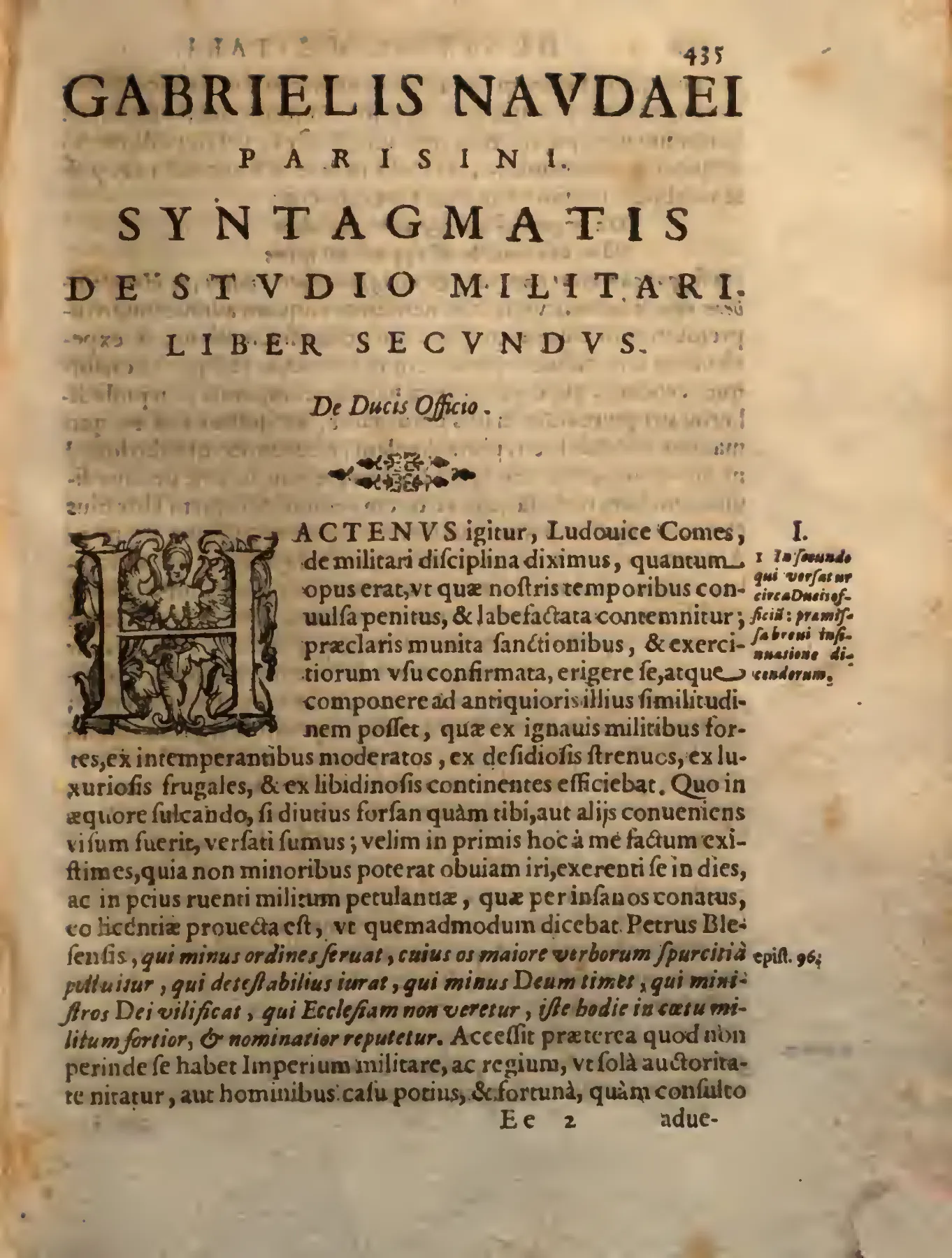
The opening of Book II, “De Ducis Officio,” turns from the soldier’s discipline to the commander’s formation, its decorated initial and marginal article marker making the treatise’s architecture visible. Addressed to “Ludouice Comes,” it insists that military command cannot rest on authority alone. Source ↗.
The stakes are put in the image, already noted, of an army without its commander as nothing other than a vast beast without a head. The body-politic metaphor that defines the soldier as an executing member is completed by its head. Even so, Naudé immediately qualifies the ideal he has raised. On the model of Cicero's orator and the Stoic sage, he confesses that the perfect commander, sic perfectum imperatorem, quem oculis & cogitatione requirimus, the one sought with the eyes and with thought, has never been seen. The concession justifies a composite method, in which Hannibal, Caesar and, among moderns, Spinola each supply part of a model that no single life contains.
After surveying and dismissing Cepolla, Onosander, Xenophon and Patrizi, Naudé fixes the architecture of the book in Cicero's tetrad: quatuor hæ virtutes inesse debent, scientia rei militaris, virtus, auctoritas, fælicitas, four virtues must be present in the supreme commander, namely knowledge of military affairs, virtue, authority and good fortune.
The first of these, knowledge, is at once narrowed to military knowledge alone, and Naudé presses the restriction to a provocative extreme. Learning in the disciplines, he argues in a passage already cited, is not only useless but actually harmful to the handling of arms. The encyclopaedic general is branded an ardelio, Martial's busybody, punished for neglecting his proper office, eas officij neglecti poenas luunt, quod ardelionibus.
The incompatibility is grounded in temperament and in conditions of life: Literæ enim quietis alumnæ, ocyjque comites, for letters are the nurslings of quiet and the companions of leisure. The ethnographic anecdote of the Tartars, who are said to have Tartaros vero libros suos deuorasse, to have devoured their books and so carry their wisdom in their breasts, joins the Spartans and early Romans as witnesses for unlettered martial virtue.
The argument culminates in Sallust's Marius, who challenges his hearers to judge nunc vos existimate, dicta an facta pluris sint, whether words or deeds are worth more. It then passes to a princely maxim that turns Seneca's lament inside out: igitur vitæ no[n] scholæ discendum est, sceptro non serulæ, learning must be for life and not for school, for the sceptre and not the schoolmaster's rod.
The paradox is plain and deliberate. This verdict against books is delivered through Proclus, Huarte, Bodin, Boccalini and a dense apparatus of humanist citation, and it is addressed to a count whose brother receives Naudé's companion treatise on liberal study. Reading is thus not abolished but put back in its place: the scholar's rule that discriminated religion from superstition and nature from charm now discriminates useful knowledge from vain erudition.
The account of the commander's education presses this polemic against the encyclopaedic ideal of generalship further. Naudé first sets out his counter-model in Roman exemplary terms. He would not hesitate, he says, to call Cincinnati from the plough and Hostilii from the rustic hut, Quamobrem non dubitarem ego Cincinnatos ab aratro vocare; & Hostilios ab agresti tugurio. The plural is pointed. Cincinnatus and Tullus Hostilius become types, a class of men whose humble station was ennobled by native prudence and daring. Against them stand the lettered commanders, who by handling noble studies ineptly generally befoul and corrupt them through shameful outcomes, secus profecto quàm in literatis Ducibus euenit, qui præclara studia, ea no[n] aptè tractando, turpi plerumque successu, foedant & corrúpunt.
The charge is double-edged. The literati duces fail as soldiers, but they also dishonour letters themselves. Naudé thus presents his attack as a defence of learning's dignity, not a rejection of it. That rhetorical position allows a man of letters to argue against the lettered general without sawing off the branch on which he sits.
He then reviews the curricula that Renaissance authorities had prescribed for the perfect captain: grammar and languages, rhetoric, ethics and politics, the quadrivial arts, and finally law, theology and medicine. The catalogue mounts towards absurdity, and its comic summit is Agostino Nifo. Nifo, Naudé reports, holds a general worth nothing who cannot paint, Quinimo Niphus Ducem pro nihilo habet qui pingere nesciat. The reductio follows at once: on such terms there will be no art and no science that the commander ought not to know, nulla erit ars, nulla scientia, quam Imperator scire non debeat.
This demolition clears the ground for the definitional move that opens the third division. Here Naudé sets down the definition already noted for its programmatic weight, by which he calls proper to military discipline everything that can conduce to carrying off victory from the enemy. Read against the preceding catalogue, the teleological definition is a principle of exclusion as much as of inclusion. A discipline enters the general's competence only by its demonstrable contribution to the end of war. Nifo's painting fails that test. Eloquence and mathematics pass it only conditionally.
Naudé makes the boundary institutional as well as conceptual. This science, he insists, is not learned from the rhetorician, nor borrowed from Scaevola or Papinian, Hæc aute[m] scientia no[n] ab Rhetore discitur, aut à Sceuola, vel Papiniano mutuatur. The two Roman jurists stand in for the faculty of law, and the rhetor for the humanist schoolroom. Together they represent the two professions that most confidently claimed to train men for public action. Naudé denies both of them jurisdiction over war.
The precepts that remain are reduced to three heads, the undertaking, waging and ending of war. Before those heads, however, Naudé considers the auxiliaries, the adminicula. Their treatment shows that the definition operates as a sieve rather than a wall.
Military eloquence is the first auxiliary admitted, and it is admitted on reformed terms. The Onosandrian maxim is granted its force: our soldiers must be conquered by the tongue before the enemy is conquered by arms, linguà vincendi sunt prius milites nostri, quàm hostes armis. The eloquence approved, though, is not forensic oratory. It is the terse speech of Sparta, and that Laconic eloquence, Naudé observes, needs no great apparatus of studies, vero Laconica facundia, non magno studiorum apparatu indiget. The set-speeches of the historians are accordingly classed as fictions.
The same discussion produces a sharp aside against Justus Lipsius's emendation of Suetonius on Caesar's military eloquence. Such, Naudé says, is the mind of critics that they always make their own errors into the authors', est criticorum mens, vt suos errores, proprios semper anctorum faciat. The jab exposes a tension that runs through this whole part of the book. Naudé wields the tools of humanist textual criticism constantly, yet he distrusts the critic's licence to remake a text. That distrust is of a piece with his distrust of the scholar's licence to remake the art of war from books.
The digressions on camp music, the battle-cry, rutting stags and cock-fighting display this ambivalence at length. They are erudite to excess, yet each is bent towards the physiological and practical question of what actually moves men to fight.
The fourth division turns the question of content into a question of acquisition. Naudé reduces the modes by which military science is gained to two heads, ad hæc duo capita reuocari possint experientiæ, & lectionis, experience and reading. He resolves at once that he will without doubt grant first place to experience, haud dubiè primas experientiæ concedam.
The case for experience gathers its most pungent witness in Gian Giacomo Trivulzio, reported through Guicciardini. On Trivulzio's account, wars are waged with soldiers' arms and the counsel of experienced generals, fighting in the line, not with figures, militum armis, & expertorum Ducu[m] consilio bella geri, in acie pugnando, non figuris. The figurae are the diagrams of the antiquarian tacticians, phalanxes drawn on paper. Trivulzio's scorn therefore strikes directly at the reconstructive military philology of which Lipsius was the great exemplar.
The rebuttal of the case for reading proceeds through comic tableaux: the agronomist at the plough, the theorist of history attempting history, and the physician who has never touched a patient. These belong to a long humanist tradition of satire on the pedant. They do not end in exclusion, however. The resolved position is a hierarchy, set out in the sentence already cited in which reading is commended only insofar as it customarily aids experience, so that the commander stands supported on experience and reason together, as on both legs.
The bodily image deserves attention. Two legs are complementary, yet the sentence's grammar keeps reading in the subordinate clause of usefulness. It is ratio, reason nourished by books, that supplies the second leg, and reading is valued only as its servant.
History alone among literatures survives this subordination intact, because it can be assimilated to experience. The chain of derivation is stated in a compact Tacitist formula: prudence arises from practice, and practice from examples, prudentia vero ex vsu, vsus autem ab exemplis. Examples drawn from histories become vicarious practice. This is why the recommended reading consists of the books that great commanders actually carried, from Alexander's Iliad to Charles V's Commynes, rather than the treatises of the schools.
The long annotated bibliography that follows looks at first like a contradiction of this argument, an enormous display of the very erudition just demoted. Naudé frames it with conspicuous self-awareness. He explains why he did not furnish a full critical military bibliography, Bibliographiam polemicam adornarem, a phrase coined on the model of his own earlier political bibliography, and he pleads the lack of books at Rieti. More importantly, the catalogue is evaluative, and its evaluations enact the thesis of the preceding pages.
Measured by Trivulzio's standard, the works of practitioners such as Mendoza, Savorgnano, Melzi and Basta are praised as not resembling the commentaries of idle men or the meditations of the lettered, hæc enim opera non otiosorum commentis, aut literatorum meditationibus similia. The opposition of otium to negotium is classical, but here it divides the bibliography itself. Books are sorted by whether their authors had made trial of what they teach. The closing advice, that one or two books suffice for an experienced commander, completes the paradox. The most extensive military bibliography of its kind concludes by counselling the general to read very little of it.
The recreation of chess follows, admitted as the only game worthy of a general because it is a likeness of war. It brings the education of the commander to a close.
The Doctrine of War: Causes, Money and Provisions
The doctrine of war proper opens with a decisive limitation of scope. Naudé does not here consider the office of a general who wages war by himself and by his own authority, non hic officium Ducis meditari, qui per se, suaque auctoritate,. The general under discussion acts by the authority and at the expense of a superior. That restriction removes declaration, policy, truce and peace from his purview.
The general's first moral duty is accordingly negative. He must take care not to be the first to sound the trumpet, ne primus classicum intonet. The warmongering commanders, Duces turbulenti, & bellicrepi, turbulent and war-rattling generals, are likened to Nero. They are then buried under a rhetoric of war's horror that runs from Aristophanes' mortar and pestle to Caesar's tally of slain and Statius's palace of Mars. The register here is notably unlike the cool definitional prose of the earlier divisions. Once the end of war is victory, the moral question of who may seek war, and why, presses back in with corresponding urgency.
The answer turns on obedience and conscience. Augustine supplies the classic formula, already cited, by which the wickedness of commanding makes the king guilty while the order of service shows the soldier innocent. Naudé does not rest content with the authority. He asks whether the injustice of the command is ever certain, since princes' reasons lie hidden in their councils. He resolves the doubt by presuming the prince's justice except in manifest offences against God.
The subordinate general's conscience is thus protected, but by a presumption, not a proof. This places the doctrine squarely within the reason-of-state problem of the arcana imperii, which elsewhere Naudé recommends the commander to study in histories. Alongside obedience stands natural law. Of defence of self and fatherland he writes, echoing the Pro Milone, that this is no written but an innate law, estque illa non scripta, sed nata lex.
The catalogue of trivial causes that have kindled great wars follows. It includes women, the Buondelmonti affair, a Swiss cart of furs and a boar's head. It is disarmingly paired with the counsel that the general need not probe causes anxiously. Moral seriousness and political realism sit side by side without full reconciliation.
The discussion of forces descends from conscience to the concrete, and here the realist temper is at its sharpest. Money is defended as the sinews of affairs, agendarum neruos esse dixit, against Patrizi and, through him, against the politician of unspeakable name, ab infandi nominis politico. The epithet conceals Machiavelli while condemning him. Naudé thus rejects Machiavelli's notorious disparagement of money in war even as he adopts a comparably unsentimental analysis of armies.
The Ottoman sultan's war treasury becomes an exemplary reproach to hand-to-mouth Christian princes. It shows admirable administration, Naudé remarks, in a people regarded by us as savage and barbarous, in gête quæ à nobis sera, & Barbara existimatur. The most acute observation, though, comes from the recent experience of the Spanish Army of Flanders. Soldiers rarely complain of the smallness of their pay, but almost always of delay in payment and of fraud, tenuitate, fere semper de solutionis mora, fraude que conqueruntur. The analysis of mutiny is grounded in the soldiers' own sense of what they were owed rather than in classical exempla. It names the malcontents and mutinados in their own vernaculars.
The provisioning section carries the same priority of material necessity. Vegetius's maxim, that want consumes an army more often than battle does, penuria quàm pugna consumit exercitum, opens a sustained argument in which hunger decides Trebia and Spinola's logistics stand as a model.
Even here, the critical sifting of testimony reasserts itself. In the classification of remedies for hunger, the treatment of foul foods leads to cannibalism and to a defence of Hannibal against Livy's charge of having trained his troops in it. Naudé attributes the report to Roman hatred, observing that nothing is so absurd that indignation will not wring it from a man, sed nihil est tam absurdum quod indignatio ab homine non. This is source criticism of a hostile tradition, applied to the enemy of Rome as rigorously as it is applied elsewhere to Hannibal's fabled vinegar. It shows the discrimination between genuine and spurious testimony operating within the most practical part of the treatise, on the question of what armies eat.
The movement of this whole stretch of the argument, from the commander's curriculum through the economy of the war-chest to the granary and the biscuit store, thus enacts the definition from which it began. Whatever conduces to victory is admitted. Whatever merely adorns is sifted, ironised, and in the end subordinated to the practice it was meant to serve.
The Apparatus of War: Victuals, Arsenals, Machines and Guns
The second book then turns more fully from the persons of war to its apparatus, and these pages show how far Naudé's definition of military discipline through its end can stretch. If whatever conduces to victory belongs to the discipline, then salted fish, garum, cheeses and garlic have a claim on the general's attention. The long catalogue of preserved foods is therefore not an antiquarian digression in principle, even when it reads like one in execution. Salt is praised through Plutarch, Plato's Eryximachus and Paracelsus. Garlic is rescued for the soldier by a scholastic distinctio that reconciles Hippocrates and Galen: harmful to the sickly and the occasional eater, nourishing to diggers, sailors and men under arms. The method of discrimination is already at work. Authorities are not discarded but sorted according to the bodies and labours to which their claims apply.
The treatment of water shows that sorting acquiring an explicitly experimental edge. On desalination Naudé defers to the labours of the natural magician, operum artifex Ioannes Baptista Porta desudarit, that is, to Porta, the craftsman of works who sweated over the problem and found that only distillation succeeds. Porta's trial becomes an indictment of the many ancient and modern writers who, as Naudé puts it, detineri solent, qui multa sæpe non satis fideliter, men who often commit to books many things not faithfully enough tested. The phrase compresses the epistemology of this whole section. Reading reports what others claim, and trial decides between them. The authority of Aristotle or Pliny counts for nothing against a failed experiment. It is significant that the corrective comes from Porta, a figure Naudé will later convict of self-contradiction. Even a corrective witness is valued for his trial on a given point, not for his standing as such.
At this point the treatise pauses to hear its own critics. Naudé imagines himself catching the snorts and chatter of certain readers, mihi quorundam runcos & garritus audire, who complain that these matters are philological rather than pertaining to war, the admission already discussed for what it reveals of the book's form. The concession is unusually candid, and its terms matter. Polemica keeps its Greek sense of what belongs to war, so the charge is precisely that the book has drifted from its declared end. Naudé does not deny the charge. He answers it with a dual purpose: the delight of Count Ludovico and the utility of soldiers. That answer exposes the tension the treatise lives with. A work that subordinates letters to experience is also a gift of letters to a learned patron. The apology does not resolve the tension. It assigns the two halves of the book to two different audiences.
The pages that follow tip the balance back towards utility, and they do so through contemporary siege administration rather than ancient example. At Breda, Justinus of Nassau asked Maurice whether bread should be issued by head-count. Maurice advised against it, on the ground that plus vulgo tum edi solere, cùm panis dimenso erogatur, more is commonly eaten when bread is distributed by ration. Naudé glosses this with Ovid's nitimur in vetitum, the observation that men strain towards what is forbidden. Maurice's counsel thus rests on a moral psychology of appetite rather than on arithmetic. It also carries the weight of an eyewitness commander, the Polybian kind of authority the treatise elsewhere prizes. The same realism governs the diagnosis of shortage. Supplies run short, Naudé argues, cum maior sit lixarum, mulierum, institorum in exercitu, because the crowd of sutlers, women and pedlars in the army is greater than its fighting strength. The remedy lies in discipline, by cutting the army's tail, not in further accumulation. Provisioning becomes a question of order, and order leads straight back to the commander's authority.
The arsenal opens a new register of prudence. The Venetian Arsenal, which could assemble a galley in a day for Henri III, serves as the ideal type of the armamentarium. Its moral is the maxim from Theodoric through Cassiodorus, hoc potissimum caput est, Principem semper debere esse, that the chief point is that the prince must always be armed. The maxim places preparedness under the prince rather than the general, consistent with the treatise's subordination of command to sovereignty. A workshop for galleys becomes an emblem of the state's foresight.
The semantic inquiry into arma tests the philological method against the claims of nature. The most consequential move comes in the argument over bronze and iron. Hesiod, Lucretius and Pausanias are cited for an age of bronze weapons, and Naudé demolishes the thesis together with the poetic scheme of ages that sustains it. Anyone who weighs the matter, he writes, fatendum illi necesse erit, parem semper extirisse in rebus, must confess that the same course of nature has always obtained in human affairs. The printed extirisse evidently stands for extitisse. Ecclesiastes' "nothing new under the sun" follows, so that biblical wisdom and naturalist uniformity converge against the poets. The same discrimination of history from fable that undid Hannibal's vinegar here undoes the golden age. The premise has a direct military consequence: if nature is constant, iron weapons in Homer's day are the probable inference, and myth must yield to it.
That premise of constancy is then qualified when the treatise turns to machines, and the qualification is the most subtle turn in this section. Novelty terrifies: gunpowder at Chioggia and in Peru, Caesar's towers before the Gallic tribes. Cicero's counsel of praemeditatio would seem to answer the danger, and Naudé limits it with a sharp antithesis, Sed clades præuideri possunt, non item machinæ, & noua inuenta,, disasters can be foreseen, but not machines and new inventions. Nature does not change, but human contrivance does. Its force lies precisely in its escaping prediction, as Pedro Navarro's mine at Gaeta showed, until time and use supply remedies, as they did against the elephants. Stoic consolation is thereby confined to the moral sphere, and the technical sphere is acknowledged as one of real surprise.
The category of machine is then widened deliberately. Vitruvius defined it mechanically, machina est continens ex materia coniunctio, quæ maximas, a continuous joining of material capable of the greatest effects. Naudé takes it instead omni opere ad bellorum rationes pertinente, for every work pertaining to the conduct of war. The redefinition is another application of definition by ends. What makes a thing a machine is its service to victory, not its construction. That licence admits the moles of Tyre, Farnese's Scheldt bridge and the dike before La Rochelle into the company of the machinae mirabiles. Within that company, the wondrous is sifted as rigorously as the historical. The Archimedean burning mirror is dismantled source by source. Porta, who mocked Cardano's thousand-pace mirror only to boast of one burning at infinite distance, is convicted in a single clause, quàm insigni contradictione cæcus est, how blind he is to so signal a contradiction. The witness whose trial with distillation was accepted is rejected where he contradicts himself. Credit is assigned claim by claim, not author by author.
The fireproofing of siege engines makes the principle formal. Archelaus' alum, the larch reputed incombustible, vinegar and hides are weighed against the testimonies of Giraldi, Mattioli and Porta. The question is closed by appeal to experience, which Naudé sets up, in the formulation noted earlier, as alone the mistress of such things and remedies. The feminine magistra places experience in the office the humanist tradition reserved for history as magistra vitae. In technical matters, however, Naudé reserves that teaching office for trial rather than for the record of the past.
The long treatment of gunpowder weapons brings both strands together, philological care and natural judgement. Naudé coins fulminalia because the inherited names had once designated stone-throwing engines, and he refuses both received origin stories. Those who placed the invention at Chioggia, he says, naufragium veritatis fecere, made shipwreck of the truth, and Petrarch, Walsingham and Spelman are set against them. His own account is gradualist. The gun emerged from incendiary weapons, falaricas primum, & tubos igneos vetustissimis temporibus, fire-darts first and fire-tubes used in the most ancient times, and grew by accretion like music and architecture. He contrasts this explicitly with the datable invention of printing. The historiographical result fits the earlier insistence on constancy. Most arts arise by increments under stable natural conditions, and the singular invention is the exception requiring proof.
Moral and practical judgement then diverge, and the treatise registers the divergence honestly. The aristocratic ethic of hand-to-hand valour holds that missile weapons were devised for the ruin generis humani, corruptelamque veræ militiæ reperta sint, of the human race and the corruption of true soldiery. Its harshest expression is Paolo Vitelli, who of captured arquebusiers erui oculos & præcindi manus iubebat, vulnus enim gladio inferre, ordered their eyes torn out and their hands cut off, holding that to wound with the sword was the mark of the brave. Naudé reports this ethic without adopting its conclusion. Against Lipsius and Patrizi he argues that small arms surpass ancient missiles because, modo sint probè temperatæ, eadem semper vi globulos emittunt,, provided they are well tempered, they always discharge their balls with the same force. The argument is causal: the force belongs to the powder, not to the arm, and so a woman or a child fires as effectively as a veteran. What the noble ethic deplores as the levelling of courage, Naudé records as a fact of mechanism.
The same causal realism produces a surprising concession on heavy guns. Siege and field artillery, he grants with Lipsius and Patrizi, aspectu illo igneo, terrorem potius quàm damnum hostibus afferant, bring the enemy terror rather than harm by their fiery appearance. Terror, which earlier counted as the proper effect of a new machine, is now discounted as appearance without substance once bastions have neutralised it. Contemporary circumvallation is accordingly a contest non de virtute, sed de fame &, not of valour but of hunger. The bitterness of that phrase loops the argument back to the commissariat with which this section began. Augustine's dictum, recte non fieri nisi mutetur, that a thing is not rightly done unless it is changed, sanctions the abandonment of an established instrument, as elephants and scythed chariots were abandoned. The patristic authority makes innovation a form of right reason rather than a breach of custom.
The final movement of the section turns from instruments to men, opening on the Virgilian half-line that war armis constat atque viris,, consists of arms and men. Population, Roman incorporation of the conquered, and the severity of levies are surveyed before the question of size. Naudé's answer is moderate and disciplined: in maximis etiam pugnis pauci sunt, qui prælia prostigant;, even in the greatest battles it is the few who decide the fight. Hence his preference for thirty to forty thousand trained men over unwieldy hosts, and his condemnation of a Leonidas-style rashness that mistakes sacrifice for generalship. From cheeses to cannon to the levy, the argument applies one judgement throughout: the measure of every provision, engine and army is its tested contribution to victory, and neither the prestige of antiquity nor the glamour of terror can stand in for that test.
Forces, Counsel and the Laws of War
The condemnation of rashness leads directly into a polemic against soldierly bravado, which turns at once on the principle of subordination that governs the treatise's portrait of the soldier. Against men whose watchword is to die by rushing into the midst of arms, Naudé addresses the soldier directly: At si nescis miles inconsultè tam in culpa est apud principem mori quàm fugere, si vtrumque absque modo aut ratione facis;. In English, "if you do not know it, soldier, to die rashly is as much a fault before the prince as to flee, if you do either without measure or reason."
The sentence strips heroic death of its autonomy. The soldier's life is not his own to spend, because the prince who hires him buys a death on the prince's terms. The guilt of a senseless slaughter passes upward to whichever commander ordered it. Valour is thus measured by modus and ratio rather than by intensity of spirit. Death and flight, conventionally the poles of honour and disgrace, become morally equivalent when both escape the order of command. This is the soldier as instrument, and the rhetorical vehemence of the apostrophe shows how much the treatise must work against an entrenched ethic of glorious self-sacrifice.
The fifth question, whether an allied army is better raised from one nation or from several, carries the same realist temper into the composition of forces. Naudé concedes the advantage of a single tongue of command. He then argues for mixture from differentiated national aptitude: cùm variæ sint populorum ad varia munera & officia propensiones, ita vt alij quemadmodum Heluetij, & Gallorum cataphracti in pugna stataria meliores sint, alij vero vt Itali, & Hispani felicius in vrbiu[m] obsidione versētur. Since peoples are inclined to different duties, the Swiss and the French cuirassiers prove better in pitched battle, while Italians and Spaniards fare more happily in sieges.
The classical topos of Hannibal's polyglot host, held together for fifteen years without mutiny, is thereby recast as an argument from functional specialisation. The ethnography is drawn from contemporary theatres of war rather than from Livy. The decisive consideration is moral psychology. A single nation, alone and lacking rivals to add a spur to its courage, At vna eademque natio si sola sit, & æmulis, qui suæ virtuti calcar addant, destituatur, slackens. Aemulatio, which Naudé presents as a Roman institution cultivated even among hastati, principes and triarii, becomes the binding force of a heterogeneous army. This sets the argument quietly against the humanist preference for the homogeneous citizen militia.
The weakness of such armies, following Polybius, is that a multinational force in mutiny can hardly be recalled to obedience. Here Naudé lets present experience settle the matter. He names the sole remedy, proven more than once in recent times, as never intercepting or delaying pay: remedium huic malo vnicum est, nec semel istis quoque temp[er]oribus felici euentu probatum, stipendia nec intercipere, nec morari;. He adds the exemplum of the Army of Flanders, in which the bravest hero Ambrogio Spinola most prudently guarded against the danger in the Low Countries by paying wages on time, id prudentissimè cauit in Belgio fortissimus Heros Ambrosius Spinola, vt stipendijs in tempore numeratis,. The classical problem is solved by the logistics of a living commander, a small but telling instance of experience correcting and completing reading.

A plan of Ambrogio Spinola’s 1624 siege of Breda renders military prudence as organised works on the ground. Spinola, whom Naudé praises for paying his troops on time, supplies the living exemplar behind the claim that command experience completes, and sometimes corrects, reading. Source ↗.

Two learned quaestiones follow, and in them the treatise's antiquarian density is most conspicuous. The first concerns whether the Jews served under foreign princes. Naudé answers affirmatively from a catalogue of counter-examples, explains the infrequency of such service chiefly by Sabbath and dietary law, and rehearses hostile commonplaces from Latin poets while formally withholding judgement on them. The second asks whether women are fit for war, and here the dialectic is more carefully staged. An Aristotelian and Galenic case, built from humoral physiology and the topos of calling cowards women, is met by the Platonic counter-tradition. In the Alcibiades, Plato contends that war belongs no more to men than to women and should be called not virile but human, rem bellicam non virorum magis quàm mulierum: nec virilem adeo sed humanam dici debere contendit.
A long roll of martial women, from Zenobia to Joan of Arc and the banner-bearing heroines of Siena, prepares a deliberately moderate verdict. Women, though less pugnacious, ought not to be judged so weak as to be wholly unfit for the duties of war, non tamen adeo infirmæ censeridebent, & ad bellorum munia prorsus ineptæ. The target is Onosander's grouping of women with children and the decrepit. The method is the characteristic one of critical discrimination. Inherited authority is weighed against counter-authority and against historical instance, and the conclusion is pitched no higher than the evidence allows.
With the apparatus of war concluded, a survey of war dogs closing the column, Naudé turns to the second instrument of war: Sequitur alterum consilia videlicet, "there follows the second, namely counsel." He frames it with Cicero's maxim that arms abroad are of little worth unless there is counsel at home, parua esse foris arma, nisi consilium sit domi. Declining to repeat maxims already exhausted by political writers, he offers three monita.
The first, that counsel should be taken from experienced men rather than from the learned, is the most self-implicating passage of this section. Naudé ridicules pedagogues who boast that Alexander was formed by Aristotle and Scipio by Ennius. He then asks why Charles V placed no more trust in Agostino Nifo for the conduct of his wars than in Antonio de Leyva, Cur Carolus Quintus non plus habuit fidei in bellorum suorum administratione Augustino Nipho, quàm Antonio Leuę. The question is rhetorical, and it states the priority of practice in its starkest form. It sets an Aristotelian philosopher against a veteran captain of the Italian wars, and it is posed by a scholar writing a scholar's book.
The ensuing typology of counsels, vast, turbulent, rash, slow and prompt, contains a memorable figure for over-refined prudence. Subtle counsels are plainly like a clock, which the finer the wheels and cords that drive it through its appointed hours, the more easily it is spoiled or goes astray: & planè instar horologij sunt, quod quanto subtilioribus rotis & funiculis agitur in destinatos horarum cursus, tanto facilius aut corrupitur aut aberrat. The mechanical simile, native to the age of the horologist's craft, turns the very ingenuity prized in reason-of-state writing into a liability.
The second monitum, on the three military laws, is the juridical core of this section. Naudé first declares that these laws derive their authority not from one prince or another but from the common consent of mankind, nec auctoritatem suam repetunt ab vno aut altero principe, sed communi hominum consensu firmatam illam obtineat. This places them in the order of the ius gentium rather than of martial discipline enforced by military judges. Necessity comes first, before which exemptions and statutes bend.
The second law, ius belli, is defined with deliberate restriction. Many things are permitted against an enemy, the passage cited earlier explains, which the law of war leaves unpunished though they are wholly contrary to piety and humanity. The verb licere is reduced to impunity, and the reduction allows Naudé to catalogue spoliation, devastation, enslavement and killing without endorsing them.
The catalogue is repeatedly broken by a moral counter-voice. Reading Pietro Cavalli, he cannot refrain from detesting the fury and madness of men who, to keep the laws of war, allow nothing among themselves to be sacred, safe or inviolable: non possum toties non detestari hominum furorem & insaniam, qui vt bello suas leges seruent, nihil inter se sanctum, nihil tutum esse, ac inuiolabile permittunt. Cyprian seals the critique: consensere iura peccatis, & coepit esse licitum quod publicum est, the laws consented to crimes, and what is public began to be lawful.
The structure is therefore not a simple legal positivism. Naudé maps the extent of what custom tolerates and, in the same breath, indicts it. The indictment has practical consequences. Against Federico Bonaventura's defence of assassinating a sworn enemy, he insists that victory is not so desirable that it should not also be shunned whenever it could be won only by crime, neque enim tantopere expetenda victoriâ est, vt no[n] etiam fugienda sit, quoties per scelus aliquod obtineri posset. The definition of military discipline by its end, victory, here meets a limit that the end cannot override.
The third law, humanity, converts the residue of permitted rigour into restraint. Its patristic norm is Augustine's hostem pugnantem necessitas perimat non voluntas, let necessity, not will, destroy the enemy who fights. The rule distinguishes the killing that combat compels from the killing that appetite chooses, and it governs quarter for the surrendered. Contemporary practice again supplies the example. For the protection of farmers, the Low Countries, that single and continuous workshop of Mars, exemplo nobis esse debet Belgium, vnica illa, & continua Martis officina, ought to serve as a model. Naudé finds in the most war-worn theatre of Europe not a lesson in devastation but a regime of reciprocal restraint.
The third monitum forbids trust in omens, dreams and auguries. It names Lipsius and Rantzau as learned authorities who lend credit to superstition, and it states its governing maxim from John of Salisbury: omnia omina tantum possunt, quantum excipientis fides permittit, all omens have only as much force as the belief of the one receiving them allows. The power of the sign is relocated from the cosmos to the credulity of the observer. This is also why the remedy prescribed later is a Christian "extispicy" of one's own heart.
After a vast survey of ancient and modern credulity and a series of counter-examples, the refutation culminates in the logical principle, already quoted, that wherever there is no connection of subject with attribute or of cause with effect, anything may be said of one thing as well as of another. Divination is thus convicted of arbitrariness rather than impiety alone. Naudé enlists recent natural philosophy in support, observing that the whole baseless structure of predictions once drawn from the various appearances of comets has very recently collapsed, cùm nuperrime tota illa prædictionum, quæ ex varia Cometarum apparitione fieri solebant, inanissima substructio corruerit,. The architectural metaphor of a substructio in ruins presents astrological prognostication as an edifice without foundation, overthrown by observation.
The section closes on the aftermath of battle, where the realist key becomes openly provocative. Victory obliges liberality toward the troops. Defeat, if every resource has been tried, brings no disgrace. Against the Roman cult of Aemilius Paulus, who died at Cannae, Naudé declares that he will never fail to rate the other consul Varro far higher, nunquam tamen ego committam quin longe pluris Varronem Consulem alterum faciam, because Varro survived and did not despair of the state. The judgement completes the argument begun against the soldier's rash death. Collective suicides are censured, and "conquer or die" is denied as a maxim for commanders, so that survival in the service of the commonwealth outranks the beautiful death.
The final movement, a defence of concealing defeat against Lipsius, pushes the same logic into reason of state. At times it is necessary not only to simulate or dissimulate but even to make use of fictions, non modo simulare, aut dissimulare, verum etiam fictionibus vti sit necessarium. This concession sits in unresolved tension with the inviolable fides that elsewhere limits stratagem. It shows the general, subordinate to prince, law and piety, still entrusted with the prudential management of what his own army may be allowed to believe.
Virtue, Felicity and Authority
The closing movement of Book II passes from the management of bad news to the endurance of defeat, and it treats endurance as a public act. Drawing on Horace's image of the holm-oak that grows stronger under the axe, Naudé holds that haud aliter nouæ spes ex prioribus damnis co[n]cipiendæ sunt, that in just this way new hopes are to be conceived from earlier losses. His model is the Roman Senate after Cannae. The Senate refused to ransom the captives, declined to recall its generals, and sent a fleet to Spain while Hannibal stood at the walls. Rome's recovery is credited to quàm strenuis illis, & audacibus decretis, quibus, those vigorous and daring decrees by which the invader was brought to despair. This is Livy read as a lesson in political psychology. What breaks an enemy is visible constancy, the opinion of unshaken resolve, more than any tactical result. That emphasis on the management of appearances prepares, from the opening of this movement, the theory of authority in which it culminates.
A refusal comes next, and it is as revealing as anything the book chooses to treat. Naudé notes that peace is better negotiated from strength, but he will not discuss peace-making at length, verum cùm pacis componendæ, non secus ac belli susciendi potestas, sit penes vnum principem, cuius vices copiarum præfectus, in ijs tantummodo, quæ spectant ad bellorum administrationem gerere potest. His reason is that the power of making peace, no less than that of undertaking war, rests with the one prince, and the commander may act in his place only in what concerns the administration of wars. The omission works as a constitutional statement. Naudé confines the general to administratio belli and reserves the decision for war or peace to the sovereign. In doing so he draws the outer limit of the figure the rest of the book will exalt: however great his virtue, fortune and authority, the commander remains a deputy.
With military scientia complete, Naudé turns to the endowments still owed under the Ciceronian scheme of the Pro lege Manilia: virtutem, nempe singularem, summam felicitatem, auctoritatemque clarissimam, namely singular virtue, the highest good fortune, and the most illustrious authority. He first clears the ground methodologically. The writers who load the general with every moral perfection describe beings who exist only as an idaea, and he answers them with the sardonic contrast, discussed earlier, between those who live in the dregs of Romulus and the blessed heroes of Plato's Academy or the Moors who come forth daily from Utopia.
The irony works on two levels. Cicero's faex Romuli, his own complaint against Cato's idealism, is turned against the Ciceronian and Xenophontic tradition of the perfect commander. More's Utopians, ironically presented as an everyday supply, show that the perfect general is a literary artefact. Naudé then names the criterion that replaces philosophical completeness: qui satis noui tutius esse cum vulgo sentire in rebus, quæ ad actionem pertinent, quàm cum philosophis, & vni tantum contemplationi addictis hominibus. He knows well, he says, that in matters pertaining to action it is safer to think with the common people than with philosophers and men given over to contemplation alone.
For a scholar to say this inside a learned syntagma is paradoxical, and the paradox is deliberate. The erudite author uses his erudition to authorise the vulgar opinion. That opinion supplies Cicero's popular list of five imperatorial virtues: toriæ existimantur Labor in negotij, fortitudo in periculis, industria in agendo, celeritas in conficiendo, consilium in prouidendo;. These are labour in affairs, fortitude in dangers, industry in acting, speed in executing, and counsel in providing. The list is reduced to common use, and Naudé presents that reduction as the realist alternative to catalogues of virtue.
Each virtue is then reshaped toward practice. Labour becomes bodily exertion shown by example, though it is soon qualified so that the general does not do the soldier's work or court danger without cause. Fortitude, already assigned to the recruit earlier in the work, is raised for the commander into magnanimitas, its "sublimity". The most consequential reshaping is that of industria. After a fanciful derivation from induere, a habit "put on" through use, Naudé offers that one might define it as eam definire, possit, acumen ingenij dexteritatem rebus applica[n]s,, sharpness of wit applying dexterity to affairs. The definition moves industry from the moral register into the technical and political one. It now names the faculty of stratagem, and it frames the long catalogue of ruses that follows, running from Hannibal and Sertorius to Federico da Montefeltro and Gattamelata. Virtue in the ethical sense is quietly displaced by solertia. This is the commander's prudence as a craft, not a disposition of the soul.
On speed the treatment becomes dialectical. Against Alexander and Caesar Naudé sets Ennius' Fabius and the numismatic emblems of festina lente, and he resolves the opposing authorities by situational judgement: nec semper festinandum esse, sed pro rei cuiusque natura, iam hoc, iam illo vtendum consilio. One must not always hasten, but according to the nature of each matter use now this counsel, now that. The maxim is grounded in a cosmological analogy, that God tempers the world out of contraries, and Fabius as shield and Marcellus as sword serve as its Roman proof. A humoral ethnography follows that gives the principle an unexpected determinism. The French are driven by yellow bile to haste, while Hispanis accidit qui motus animorum habent moderatiores, & propter insitum atræ bilis humorem, ad cunctationem & moras necstendas aptissimos. The Spaniards, he writes, have more moderate motions of mind and, through innate black bile, are most apt for delay and lingering, a temper he credits with winning them another world.
A tension surfaces here. Prudence counsels a free mixing of speed and delay, but Galenic physiology fixes nations at one pole, and Horace's warning that nature cannot be expelled concedes that the mixture is hard to achieve. Naudé's critique of credulity sits easily beside humoral explanation, since in his framework complexion is natural causation, not occult virtue.
Having handled counsel earlier, Naudé adds in its place, as a colophon, the arts dux vti debet, ad militum suorum beneuolentiam, sibi comparandam, quas miror quidem ab alijs fuisse prætermissas: the means a general should use to win his soldiers' goodwill, which he is surprised to find others have passed over. The claim to novelty matters. Honourable forms of address, Scanderbeg's knowledge of his veterans' names, and care for the wounded, down to Velleius on Tiberius' medical provision, all show the bond of command as cultivated affection rather than mere coercion, and this anticipates the treatise's account of authority.
The third condition, felicity, is introduced with full Ciceronian force: Non igitur satis est peritum rei militaris, fortem, strenuum, continentem, ac reliquarum virtutum choro cinctum stiparum que esse ducem, sed etiam vt felix ac fortunatus sit oportet. It is not enough, Naudé argues, that the general be skilled, brave, vigorous, continent, and ringed by the chorus of the other virtues; he must also be lucky and fortunate. An antiquarian excursus on the Roman cult of Fortuna, with her epithets and the golden statue kept in the imperial bedchamber, then threatens to make the concept pagan again. The Christian correction comes directly after Mehmed II is censured as an "atheist" devoted to fortune alone, in the denial, already noted, that Fortune herself or felicity is a goddess. The division of labour is set down in a single chiasmus: fortunam à Deo petendam, à se ipso sumendam esse sapientiam. Fortune is to be sought from God, wisdom taken from oneself.
Naudé does not leave providence unqualified, however. Through Ammianus he subordinates fortune to rational planning: illa est fortuna adiutrix bonorum consiliorum, quibus qui non, meaning that fortune is the helper of good counsels, without which no one can prosper. The two statements stand together without full reconciliation. Felicity is God's gift obtained by piety, and it is also the reward of sound deliberation, so the pious general and the prudent general are asked to coincide. The synthesis that ends the section states the whole scheme explicitly: censeo non aliter geri bellum feliciter posse, quàm si optimus sit belli præfectus, in quo nec scientia rei militaris, nec virtus vlla, nec Fortuna ipsa desideretur. War cannot be waged successfully, he judges, unless the commander is excellent, lacking neither military science, nor any virtue, nor fortune itself.
Authority, the fourth and last condition, is the keystone of the arch, the stone that binds the rest. Naudé first separates it from the coercive power of fathers, princes and magistrates. The authority that Cicero requires in a general, he insists, in duce Tullius requirit, non eadem est cum astricta illa imperij, is not the same as the binding authority of imperium. What remains is reputation born of merit, and its working is described with unusual candour in the passage examined earlier, where authority draws everything with it wherever it inclines and persuades to peace or war less by reason and judgement than by opinion. The comparison with New World shell-money makes the same point: authority circulates as a currency whose value rests on general estimation.
This concession sits uneasily with the treatise's wider campaign against opinion in the form of credulity, fable and prodigy. The same opinio that Naudé exposes in natural philosophy and history is here admitted as the effective force in command. He contains the danger by tying reputation to merit, and a scholastic division into internal and essential, external and accidental causes organises the inquiry. Among the internal causes, retinendæ, magis conducunt facta quàm verba: deeds conduce more than words to keeping authority. Among the external causes, beauty and stature are first allowed and then reduced to a moral sense, nam vera forma putanda est, quam virtus donat, quæ in animo inuenitur, since true beauty is that which virtue bestows and which is found in the soul. A catalogue of deformed and eunuch generals follows to confirm the point.
Nobility receives the most delicate handling, given the noble dedicatee. Sallust's Marius speaks for ille ab aratro dux, qui nulla maioru[m] gloriâ, sed summa tantu[m] virtute, the general from the plough, commended by no glory of ancestors but by supreme virtue alone. The concluding definition, placed with care, generalises the lesson: auctoritas non in potestate, sed in actionibus consistit, non in regno, sed in animo. Authority consists not in power but in actions, not in the kingdom but in the soul. Nobility is welcome but not required, and rising from obscurity may even increase a man's standing. The arch metaphor is then completed: illustrious deeds, a career passed through every rank of the camp, and the fresh memory of merit are fulcra esse & tibicines auctoritatis, quam ille suos inter milites obtinere, the props and pillars of the authority he must hold among his soldiers.
Naudé ends by rejecting the "politic" devices of feigned miracles, from Sertorius' hind to Pharamond's Salic laws, as unworthy of a Christian general. The rejection draws a final line between legitimate reputation and fraudulent prodigy. He then commends the work to Count Ludovico's judgement, thanks the uncle whose liberality gave him leisure, and closes the hexameter envoi with Quod modo FRANCISCi lætus sub murice condo, which I now joyfully lay down under the purple of Francesco. In the cardinalatial murex the treatise's teaching on authority meets its own circumstances. A book that grounds command in merit and opinion rather than inherited power presents itself, in its last line, under the protection of a cardinal patron.
Reading Further on Gabriel Naudé, Libertinism and Military Humanism
Frequently Asked Questions
What is Gabriel Naudé's Syntagma de studio militari?
The Syntagma de studio militari is a Latin treatise on the study of warfare by Gabriel Naudé (1600–1653), the Parisian librarian, bibliographer and controversialist. Giacomo Facciotti printed it at Rome in 1637. Naudé dedicated it to the young nobleman Ludovico Guidi di Bagno, and it fills more than nine hundred quarto pages. It is neither a campaign narrative nor a drill manual. Its first book treats the soldier's office. Its second treats the education of the general, organised around Cicero's four qualities of knowledge, virtue, good fortune and authority. Rieti has been named as the place of composition, though that detail has not been independently established.
Did Naudé think generals should learn war from books?
Only as a support to experience. Naudé argues that practice, not reading, makes a commander. He even calls learning in the disciplines not only useless but harmful to the handling of arms. Reading survives as experience's auxiliary, so that the general stands on experience and reason as on two legs. History alone is fully admitted, because its examples supply a kind of vicarious practice. Naudé also defends a civilian's right to theorise war: precepts arise from use and examples, but they can be grasped without action. He admits the tension himself, conceding at one point that his own material is philological rather than military.
What did Naudé say about Hannibal splitting the Alps with fire and vinegar?
He dismissed the story as a fable that shows how prone human nature is to trifles. He set Livy, Plutarch, Appian, Silius and Juvenal against Polybius. Polybius was more trustworthy, he held, because the best witness has practical experience and has surveyed the places himself. His objections were practical. Celts had crossed the Alps before Hannibal, local guides are recorded, and treeless summits could not feed pyres. No army could carry enough vinegar, and Francis I crossed with artillery in 1515. Naudé claimed he had heard of no one who had exposed the falsehood before him.
Did Giulio Ferretti write the Syntagma de studio militari?
No. A digitized copy contributed by the National Central Library of Rome has become entangled with a Ferretti attribution. It carries the Google Books identifier Cbt7Hos6AkkC and contains 948 page images. Both its Google Books and Internet Archive records nonetheless identify it as Naudé's 1637 Syntagma. Ferretti's De iure et re navali is a separate and earlier work on naval law, printed at Venice by Francesco de Franceschi in 1579. No available record shows that Ferretti's work is bound in the scanned volume. A composite binding therefore remains unproved until the Rome exemplar's opening and closing leaves are physically examined.
Is there an English translation of the Syntagma de studio militari?
No published translation of Naudé's treatise into English or any other language has been verified. For most readers, the work has remained accessible only in its original 1637 Latin. The Leo edition is a separate undertaking. It presents the full transcription and a complete English translation, generated by AI, for the first time. Leo is an effort to make English translations of every text printed in Latin in early modern Europe between 1450 and 1750 freely available online, at no cost. Its rendering offers general readers and students a way into a long and densely learned treatise that has otherwise been closed to those without Latin.
This report was generated by an advanced AI assistant that conducted deep research alongside an extensive interpretation of the transcribed original text. Every effort has been made to preserve fidelity to the source and to guard against inaccuracy, but corruption in the text recognition process and model hallucination may nonetheless have entered the text. Treat every claim, quotation, translation, and citation as provisional, and verify each against the original source before relying on or citing it.
Bibliography
- Lorenzo Bianchi, Rinascimento e libertinismo: studi su Gabriel Naudé: Bianchi (Naples: Bibliopolis, 1996) is the natural court of appeal for anyone tempted to call the Syntagma's sifting of religio from superstitio "libertine" on the strength of Naudé's reputation alone. His studies reconstruct the Renaissance and libertine settings from which that reputation comes, but they do not license a verdict on any particular passage of the treatise, and the Latin has to be brought to the comparison. The obvious test case is the polemic against occult cures such as the weapon-salve, where Naudé names a single criterion that alone must be established as the mistress of such things and remedies, sola rerum, & remediorum eiusmodi magistra statui debet, and that passage has to be read beside the treatise's equally explicit appeals to piety.
- Jack A. Clarke, Gabriel Naudé, 1600–1653: Clarke's biography (Hamden, CT: Archon Books, 1970), freely borrowable through the Internet Archive, is still the most convenient English account of the librarian who, between cataloguing other people's books, wrote nine hundred pages arguing that generals should read very few of them. It places the Roman printing and the Guidi di Bagno dedication within Naudé's career as scholar and librarian. Its treatment of the Italian years should nonetheless be checked against later work, since that is exactly the period in which the Syntagma was composed and printed.
- Frédérique Verrier, Les armes de Minerve: l'humanisme militaire dans l'Italie du XVIe siècle: Verrier (Paris: Presses de l'Université de Paris-Sorbonne, 1997) maps the Italian military humanism of the previous century, Valturio, Patrizi and the reconstructors of Roman drill, which Naudé both mined and mocked. Read against it, his demotion of reading to experience's crutch looks less like eccentricity and more like a late, sardonic verdict on a tradition. The link leads to N. Bergmann-Bingen's 1999 review in the Revue belge de philologie et d'histoire, a useful précis, though Verrier's book concerns the earlier tradition and not the Syntagma itself.