Voracious Ships: Johannes Scheffer's Four Books on the Naval Warfare of the Ancients
Johannes Scheffer, a Strasbourg-trained philologist who made his career at Uppsala, set out in De militia navali veterum libri quatuor (conventionally dated 1654) to rebuild the navies of Greece and Rome from scattered texts, coins, inscriptions, and law. His four Latin books treat seafaring as a disciplined art rather than a wager against the weather. They move from the etymology of the word "ship," through oar-banks, signals, ramming tactics, and naval pay, to the compass that ended the age of steering by the stars. For any reader curious how early modern scholars turned fragments into a working picture of ancient sea-power, arguing, retracting, and correcting one another along the way, the book is a revealing specimen.
ExLatinis
13 October 2026

Contents
Johannes Scheffer, a Strasbourg-trained philologist who made his career at Uppsala, set out in De militia navali veterum libri quatuor (conventionally dated 1654) to rebuild the navies of Greece and Rome from scattered texts, coins, inscriptions, and law. His four Latin books treat seafaring as a disciplined art rather than a wager against the weather. They move from the etymology of the word "ship," through oar-banks, signals, ramming tactics, and naval pay, to the compass that ended the age of steering by the stars. For any reader curious how early modern scholars turned fragments into a working picture of ancient sea-power, arguing, retracting, and correcting one another along the way, the book is a revealing specimen.
Johannes Scheffer (Schefferus), a Strasbourg-trained philologist who made his career at Uppsala, wrote De militia navali veterum libri quatuor, a Latin treatise in four books on the naval warfare and naval institutions of the ancient world. It is conventionally identified as an Uppsala publication of 1654. A bibliographical listing corroborates the title and year, but no original title page or authoritative Swedish edition record has been independently authenticated, and the place and chronology of composition remain unestablished. The treatise belongs to the learned antiquarianism of the mid-seventeenth century, the tradition that reconstructed Greek and Roman res militaris, res navalis, and public life from texts, coins, inscriptions, and law. Its author is reported, on tertiary authority that still awaits confirmation, to have been born at Strasbourg in 1621 and to have died at Uppsala in 1679. He had already published on ships in a youthful work, De varietate navium, dated to 1643.
The problem Scheffer confronts is how to reconstruct ancient sea-warfare as a coherent, rational discipline when the evidence is scattered, technically obscure, and disputed among earlier scholars. His answer treats navigation, and naval war above all, as an ars: a skill governed by method rather than by fortune or the appetite for gain. He presents it as a providential response to human necessity and as the foundation of sea-dominion and thus of empire, a field as systematic as war on land. The same move recurs at every scale of the work. Scheffer first fixes his terms with quasi-juridical precision, defining what a classis properly is and what the ordering of a battle-line properly is. He then divides the subject topically, from origins and apparatus to use, reward, and command. Finally, he tests each claim against converging kinds of evidence: etymology and emendation, coins and inscriptions, Roman and maritime law, Scripture and sacred chronology, and comparison with the Dutch, Italian, and Swedish practice of his own day. He weighs rival authorities in the open, corrects others and himself, and suspends judgement where ancient testimony fails.
The stakes of that method extend beyond the history of oars and rams. In the 1650s the vocabulary of sea-power was also the vocabulary of contemporary juridical controversy. Mari dominari, "to have dominion at sea," and the line between a lawful fleet and a pirate band carried force in the debates associated with Selden's Mare clausum, and in a Baltic world where Swedish maritime ambitions were real. Whether Scheffer's antiquarian definitions were meant to bear on those contemporary questions is not established, and nothing in the accessible evidence licenses reading his ancient naval history as a programme for Swedish naval administration. The bearing of his work on the trireme controversy, on Swedish Gothicism, and on sacred chronology is equally open, and the published historiography on these points is thin. Allan Ellenius's study of Scheffer and Swedish antiquity is the one securely identified specialist contribution.
The treatise is memorable for its range of particulars. It sets Seneca's helmsman, whose art the storm cannot undo, beside a Christian transfer of the ships' protective tutela to the martyrs. It sets the ancient siphon beside the modern gun, Luke's account of Paul's shipwreck beside the history of the compass, and Roman galley-slaves beside the condemned oarsmen of contemporary fleets. It takes sides in the long dispute over how ancient oared ships were rowed, and in doing so it openly abandons earlier opinions, a gesture of self-correction it defends as a duty owed to truth. The book also has a curious afterlife. Material bearing Scheffer's name, the running head DE MILITIA NAVALI, and an Uppsala imprint has been associated with Gabriel Naudé's Syntagma de studio militari, a distinct work printed at Rome in 1637. The two are bibliographically separable even though the particular anomalous record has not been securely identified.
A single concern with proper distinction runs through the work's vocabulary, its transmission, and its argument. Scheffer's ars is skill set against fortune. His classis justa is a fleet properly constituted, set against disorder and predation. His ordines are kept apart from versus, ranks from rows, even where ancient usage blurs the words. The same discipline governs the book's identity as an object: a naval treatise from Uppsala is not a Roman treatise on military study, however a record may conflate them. To read De militia navali well is to watch a seventeenth-century scholar attempt, at every level from the noun navis to the ordering of an empire's fleets, to separate what is lawfully and methodically constituted from what is merely accidental, confused, or asserted.
Read the full text and English translation on Leo
This text was transcribed and translated as part of the ExLatinis project, an effort by Leo to make free English translations of every text published in Latin in early modern Europe (1450–1750) available online. The complete transcription and English translation of this work can be read free of charge:
→ Read the original Latin text and full English translation on Leo
You can save a copy of this document into your Leo account to run deep text searches, conduct further analysis, or cross-reference it with your own research.
Rendering Scheffer's De militia navali in English: Ship, Fleet, Art, and Dominion
Four Books on the Naval Warfare of the Ancients is an editorial English title supplied for convenience, not an established translation title. The Latin title is De militia navali veterum libri quatuor; a bibliographical listing records the additional wording Ad historiam græcam latinamque vtiles. No established English rendering or published English translation was located.
The treatise's own opening announces that philology is its first instrument and that inquiry begins with the noun itself. The text states that the name "ship," with which the author begins his work, prevailed among the Latins by Greek custom: Nauis nomen, vnde mei operis initium capesso, apud Latinos Græca consuetudine. The same etymological reasoning is later turned on the technical vocabulary of the fleet. The very name classis is said to imply a particular kind of construction, with Servius' note on the sixth book of the Aeneid adduced in support: Imo ipsum classis nomen hoc genus innuit, cum, vt notat Seruius ad VI, nauis. In this way the words of the title, navis and classis among them, are themselves objects of the work's inquiry.
Militia navalis admits a broader sense than individual naval battles: it can encompass naval service, military organization, and the institutions sustaining warfare at sea. Accordingly, "naval warfare" is a convenient translation rather than an assertion that the work concerns combat alone. The text supports this broader sense by consistently pairing sea-warfare with its terrestrial counterpart. It observes, for instance, that naval formations were non minus (quod notandum puto) varias, quam in militia terrestri, "no less varied (which I think should be noted) than in land warfare." The phrase treats militia navalis as a discipline parallel to militia terrestris, not as a catalogue of engagements. Veterum identifies the ancient peoples whose practices supply the object of antiquarian inquiry; it does not establish a single homogeneous ancient naval system.
The expression classis justa requires particular caution. In inherited military and juridical vocabulary, iustus can denote a regular, lawfully constituted, or properly constituted force, rather than simply moral righteousness. The text's own definition places justa beside ordinata. It defines a fleet or naval army as a just and orderly multitude of ready ships, Classis seu exercitus naualis justa ordinataque nauium expeditarum, id est,. This pairing lends weight to reading iustus in the sense of regular constitution rather than moral approbation. A distinction between an authorized public fleet and maritime predation is therefore a plausible reading. The work elsewhere describes how pirates came to be pursued as wicked men and public enemies of the human race, vt homines sceleratos publicosque generis humani hostes prosequabantur, a formula that echoes the Ciceronian characterization of the pirate as communis hostis omnium. Even so, whether the definition of the classis justa is itself framed explicitly against such predation, and in what precise terms, remains to be confirmed from the full passage.
Likewise, ars can designate disciplined skill or a systematic body of knowledge. The text invokes the Senecan figure of the helmsman to separate skill from outcome: a storm does not hinder the helmsman's work, but its success, Tempestas non opus gubernatoris impedit, sed successum. In the tactical books the term is narrowed. An ancient authority is reported to call "art" the wheeling-about of ships through frequent turns, Artem vocat, illam nauigiorum per flexus crebros circumactionem. The text itself thus identifies ars in combat with manoeuvre. A specific opposition between tactical manoeuvre and stataria pugna, however, cannot be treated as established without locating the relevant passage and its classical sources.
Finally, mari dominari denotes dominion or command at sea, but does not by itself distinguish effective naval predominance from a juridical claim to maritime sovereignty. The text uses the phrase in a sweeping register, asserting that it is, and always has been, the mark of great power to dominate the sea: est, semperq[ue] fuit, Mari dominari. The generality of the formulation leaves the distinction between predominance and sovereignty unresolved. The work's discussion of thalassocracy engages Casaubon and Selden, but connecting the expression to Selden's legal conclusions or to Swedish Baltic claims requires textual evidence beyond the title and imprint. These are provisional philological distinctions, not authenticated close readings of Scheffer's sentences. The polysemy of ars, justa, and dominari nonetheless already shows the work's characteristic concern: to fix what is properly constituted before arguing about it.
Summarizing Scheffer's Case for Naval War as a Rational Art
Johannes Scheffer's De militia navali veterum libri quatuor is a four-book antiquarian treatise on ancient naval warfare and institutions, conventionally identified as an Uppsala publication of 1654. A bibliographical listing corroborates the title and year, although an original title page and authoritative Swedish edition record were not independently authenticated. The location and chronology of composition remain unestablished.
The treatise's argument rests on a causal and moral account of navigation. Scheffer orders its motives as necessity, utility, and pleasure, insisting on the priority of the first: Necessitats, vtilitas, voluptas. Necessitatem primo loco posui, & merito, "necessity, utility, pleasure; I have put necessity in first place, and rightly." The ranking sets the sea-going art against the moralists' charge that navigation was born of greed. The text concedes that navigation brings very many goods and is harmful only to those who misuse them, navigatio, cum & bona afferat plurima, nec noxia sit, nisi eis, qui bonis ejus. The subject is divided topically, from origins and apparatus through use to reward and command. The reward of naval service, for example, is analysed as twofold, Fructus duplex esse potest, ordinarius & extraordinarius, ordinary and extraordinary. Throughout, the work restrains its own conclusions where the sources give out. In one instance the author declares that, given the lack of ancient testimony, he would affirm nothing, Quanquam in hoc veterum testimoniorum defectu nihil affirmatum velim,.
Attributing a text bearing Scheffer's author-heading, DE MILITIA NAVALI running heads, and an Ubsaliae imprint to Gabriel Naudé's Syntagma de studio militari is bibliographically inconsistent. Those identifiers distinguish Scheffer's naval treatise from Naudé's Roman work. The same discipline of distinction that the treatise applies to its own terms is required to keep its identity apart from Naudé's. The particular anomalous digital object could not be securely identified, however, so a physical Sammelband, a catalogue-level conflation, and a mis-keyed digitization record remain unresolved alternatives. A general claim that multiple copies have been miscatalogued would exceed the evidence.
Latin is the principal language associated with the work. The extent of its Greek quotations and Hebrew or Swedish etymological material was not independently verified. No translation was located; that negative finding does not establish that no translation has ever existed.
Placing Scheffer in the Historiography of Ancient Naval Warfare
The distinction between Scheffer and Naudé matters because it separates two authors, two publishing locations, and two intellectual projects. A Roman work addressed to a member of the Guidi di Bagno family cannot supply the bibliographical identity of a naval text naming Scheffer and Uppsala. Uncorrected attribution would distort the geographic and institutional setting of the work's scholarship. It would also obscure an intellectual project whose own method depends on keeping categories distinct.
Scheffer's life dates, 2 February 1621 at Strasbourg and 26 March 1679 at Uppsala, are reported by a tertiary biographical source and should remain provisional until checked against an authoritative biography. The same source records philological study at Strasbourg under Johan Henrik Boeclerus and the publication of De varietate navium in 1643. Precise dates and titles for the Skyttean professorship, university librarianship, and antiquities appointment were not verified. No pseudonym was established, but that is not proof that none existed.
Allan Ellenius's "Johannes Schefferus and Swedish Antiquity" provides a securely identified specialist contribution to the historiography. Its title and publication details establish its relevance to Scheffer's Swedish antiquarian setting; its substantive interpretation was not accessible and cannot be reconstructed from the title alone.
The trireme controversy, maritime sovereignty and piracy, Swedish Gothicism, sacred chronology, and the ethical significance of public retraction are important potential contexts for De militia navali. Direct claims about Scheffer's position in these debates require authenticated passages. The text itself supplies several.
On the oar-system question, the text insists that ranks were distinct from rows, if not in name, at least in fact: Erant autem distincti ordines a versibus, si non vocabulo, re saltem. It concludes that in all ships each rower worked a single oar, Itaque in cunctis nauibus vnumquemque remigem vnum,. Here Scheffer positions himself among the reconstructions of Baïf, Scaliger, Savile, and Rivius.
On the ethics of retraction, the text sets out a principle of intellectual conduct: studium inesse nobis debet, nec erubescere deteriora, licet priora,. A zeal for truth ought to be in us, and we should not blush to exchange worse opinions, though earlier ones. The passage frames self-correction as a duty of the Republic of Letters rather than an embarrassment.
On sacred chronology and Scripture as nautical evidence, Luke's narrative of Paul's voyage is pressed into service: Hoc est, quod ait Lucas in Actis cap. 27, 70. Neque autem sole, neque syderibus, "this is what Luke says in Acts 27: neither sun nor stars appearing." The text uses the passage to illuminate ancient navigation by the heavens.
On piracy and allied obligation, the text exposes the Athenian practice of exacting ships from allies, which it says aimed, under the specious name of aid, at something else: a sociis exigendarum ratio eo pertinebat, vt sub specioso auxilii nomine. This is a reading of the Delian system as domination, one the work extends to Cicero's Verrines.
In particular, ancient naval antiquarianism should not automatically be equated with a programme for contemporary Swedish naval administration, and discussion of sea-dominion should not automatically be made into an endorsement of Selden's legal conclusions. The text's account of Roman imperial strategy observes that the Romans always kept fleets on the frontiers of the empire, ready for every sudden turn of fortune: semper in limitibus imperii habuere classes, paratas ad omnia fortunæ subita &. The statement is framed as a finding about Roman institutions, among them the Misenum and Ravenna fleets and the frontier fleets of the Notitia Dignitatum, and not as counsel to a modern crown.
The work's significance also lies in the range of its evidence, which joins sacral, legal, and comparative materials. Religion appears as public law. The text reports that sailing was not lawful, the public laws forbidding it, unless the birds had assented: fas erat, prohibentibus ita legibus publicis, nisi addixissent aues. Ancient patronage is traced into Christian practice, for the Christians later entrusted the protection of ships to the martyrs, Christiani postea Martyribus tutelam nauium commiserunt.
Ancient and modern practice are repeatedly set side by side. The text notes that captives, that is slaves, or criminals and malefactors are given to the oar, captiui, hoc est mancipia, ad remum dantur, vel scelerati, & facinorosi. It judges that the ancient siphons seem to have been not unlike our guns, Videntur hi siphones parum absimiles fuisse nostris tormentis, nisi quod. It places the transformation of navigation about three hundred years before the author's time, by a most ingenious device called the compass, donec ante annos circiter CCC ingeniosissimo commento, quod Pyxidem.
The figure of the philosopher-pilot ties this learning back to the conception of navigation as a rational art: omne vnde melius, quam a Philosophis cognosci potuit?, "for whence could all this be better known than from philosophers?" The text likewise defends the dignity of naval service: Nulli loco adstringitur virtus, imo quo plus in mari fortuna potest, hoc. Virtue is bound to no place; indeed, the more fortune can do at sea, the more virtue is tested there. The sentence restates in moral terms the opposition of ars and fortune that governs the whole work.
A verified scholarly disagreement concerning Scheffer's oar-system reconstruction was not established. Nor were specific interpretations of this treatise authenticated in the works of Lindroth, Helander, Momigliano, Miller, Casson, Morrison, Coates, Rankov, Vieira, or Glete. Their possible contextual relevance must be distinguished from demonstrated treatment of Scheffer. The accessible historiography is therefore too thin to support a definitive account of reception, intellectual influence, or scholarly consensus. The primary text shows where Scheffer stood. It does not show how later scholars received him.
Tracing the 1654 Uppsala Edition and Its Confusion with Naudé's Syntagma
Scheffer's editions and antecedents
The title De militia navali veterum libri quatuor. Ad historiam græcam latinamque vtiles is listed under Scheffer with the date 1654. The accessible evidence did not establish the original edition's format, pagination, gathering formula, dedication, privilege, approbation, or illustration count. Ubsaliae denotes Uppsala, but the precise original imprint wording was not authenticated against the title page of a verified first edition; the engraved title page of the copy transcribed for Leo, reproduced below, gives the imprint without settling the edition. The identity of Io. Iansonius cannot responsibly be resolved merely by equating that Latinized name with the Amsterdam publisher Johannes Janssonius; the relationship between an Uppsala establishment and the Amsterdam publishing business remains unverified.

The engraved title page of this copy names De militia navali veterum and carries “UBSALIAE” and “Io. Iansonius,” a name not securely identified. Swedish royal arms, an enthroned martial figure with trident, an ancient vessel, and sea creatures frame its theme of the sea brought under naval order. Source ↗.
A tertiary biographical account dates Scheffer's first work, De varietate navium, to 1643. Its exact title, Strasbourg imprint, printer, and bibliographical identifier were not established. Neither the wording nor the location of a retraction within De militia navali was authenticated. An account of intellectual self-correction therefore remains provisional rather than a documented episode with a quotable passage. The text does articulate a general principle that earlier but worse opinions should be exchanged without shame, as cited in Section 3, and it revises positions in the oar-system debate. Whether that principle is applied specifically to the views of De varietate navium has not been established.
The Huntington collections website has an entry titled De militia navali veterum libri quatuor, identified online as lib-82557. That identifier is a website record identifier, not a verified shelfmark. The accessible entry did not supply enough information to identify its edition or physical collation. Shelfmarks for Scheffer's treatise at Uppsala University Library, Kungliga biblioteket, the Bibliothèque nationale de France, the British Library, and the Bayerische Staatsbibliothek were not established. No USTC or LIBRIS identifier was authenticated.
Naudé's distinct printed work
Naudé's Syntagma is substantially better documented in the accessible records. Its full title is Gabrielis Naudaei Syntagma de studio militari ad illustrissimum iuuenem Ludouicum ex comitibus Guidiis a Balneo. The dedication wording names Ludovicus of the Guidi di Bagno family. The Florence reproduction records Romae: ex typographia Iacobi Facciotti, 1637, and describes a quarto of [28], 912 pages.
The Florence digitization is available as Internet Archive item ita-bnc-mag-00001209-001. Its textual reproduction carries the library designation CFMAGL and the shelfmark 1.6.722. Importantly, its OCR contains DE STVDIO MILITARI and LIBER SECVNDVS: these are headings of Naudé's work, not Scheffer's naval treatise. This supplies positive evidence that the two works must be distinguished rather than treating every digital record bearing Naudé's title as erroneous.
Google Books identifier Cbt7Hos6AkkC describes another Naudé reproduction, originating from the National Central Library of Rome and digitized on 14 January 2014. It records Facciotti, 1637, and 912 pages. Google Books identifier 0UpRAAAAcAAJ also describes Naudé's Syntagma, with the Bavarian State Library as the original source and a digitization date of 22 May 2012. Neither accessible metadata record establishes that Scheffer's treatise is bound with Naudé's book. Catalogue descriptions alone cannot demonstrate the physical sequence of separately printed works within a binding.
Transmission and reception
No verified evidence was obtained for a reprint in Poleni's antiquarian supplements, an independently identifiable translation, or a later critical edition. Scheffer's Addenda, Errata, Latin and Greek indexes, and coin illustrations could not be authenticated or collated. Likewise, no dedication to Christina or another Swedish patron was established. Evidence of censorship, suppression, or an absence of censorship was not located.
A contemporary reply-chain involving Meibom and Isaac Vossius was not demonstrated. Specific passages engaging Dempster, Stypmann, Fuller, Pirckheimer, Beroaldo, Beza, Saumaise, or Bochart were not independently located; their respective roles as opponents, authorities, or correspondents therefore remain unverified. Exact bibliographical relationships with De re vehiculari veterum, Lapponia, Upsalia, and the editions of Arrian and Maurice were also not established.
Naudé's Syntagma remains a distinct contemporary work of military learning. Its relationship to Scheffer's treatise is comparative, not evidence that Naudé authored the naval text or that the two publications necessarily shared a binding. Both books belong to the learned reconstruction of ancient militia, and that shared field helps explain how a record could conflate them. The same shared field is why their identities must be kept apart.
Following Scheffer's Argument from the Noun Navis to the Index
The Apparatus and the Opening of Book I: Name, Art, and Causes
Scheffer's treatise opens with an apparatus that commits the reader to its method before the first chapter begins. The two-page Syllabus Autorum lists those authors Qui in hoc opere laudantur, exponuntur, emendantur, "who in this work are praised, expounded, emended." Each name is keyed to page numbers and sigla for praise, exposition, emendation, annotation, defence, and attempted correction. The roughly three hundred classical, patristic, and recent authorities are thus sorted in advance by the kind of critical treatment each will receive. The index is a printed promise that the reconstruction of ancient sea-warfare will proceed by judging testimony, and the first sentence of Book I keeps that promise. Scheffer begins not with a deed or an inventor but with a noun, in the sentence already considered in the philological framing of this report, which observes that the Latin name "ship," with which he takes up the beginning of his work, prevailed by Greek custom. The phrase initium capesso fuses the opening of the book with the origin of the thing, so that the inquiry into navigation starts as an inquiry into vocabulary. A survey of poetic tropes follows: the ship as chariot, the helmsman as charioteer, the vessel as sea-horse. It ends in a euhemerist principle, Scilicet quæ curruum equorumque, eadem & nauium, "evidently, what belongs to chariots and horses belongs also to ships." By this rule Pegasus and Nessus become memories of boats and ferrymen. Myth is not dismissed. It is translated back into the technical vocabulary it is presumed to encode.
The first conceptual pivot comes when navigation is set among the arts. Scheffer reaches for Seneca's helmsman, whose work the storm hinders only in its success and not in itself, to establish that failure does not refute competence. The Stoic separation of opus from successus lets him claim for seafaring the dignity of a method whose rational integrity survives the sea's caprice. He then turns from the art's definition to its causes with almost scholastic formality: Habes opus artis, habes ejus scopum. Causa sequitur, quæ triplex:, "you have the work of the art, you have its aim; the cause follows, which is threefold." The three causes are listed and ranked at once, in the sentence already cited for its ordering of necessity, utility, and pleasure, where necessity is placed first, and rightly. The words & merito carry the argumentative weight of the whole chapter. Placing necessity first is a polemical choice against a long moralist tradition that treated navigation as the offspring of greed and the first violation of nature's boundaries.
That tradition is met with providential history. After the Flood, God shared in men's cares and strengthened their doubtful and uncertain minds, Deus in curarum partem, dubias & incertas mentes hominum firmauit, vti, so that they might go out and people the earth. The theological claim prepares a direct refutation of Propertius, Pliny, Servius, and Libanius: Falsum enim, quod existimarunt lucri causa primum inuentam nauiga, "for it is false, what they supposed, that navigation was first invented for the sake of gain." Scheffer is not denying that later navigation served commerce, since utility is the second of his causes. He is relocating the art's origin from the vice of avaritia to the command to fill the earth. Seafaring is thereby freed of the moral taint that Roman poetry had fixed upon the first ship.
The same historicizing move governs his treatment of piracy, and here a tension in the chapter becomes visible. Drawing on the scholia to Thucydides, he reports that among the ancients the practice was cere non turpe, sed honestum fuit apud veteres, "not disgraceful but honourable among the ancients." He grounds this in the barrenness of their lands, so that early raiding appears as a necessity of subsistence rather than a crime. The verdict then shifts with time. Once settled communities arose, pirates came to be pursued, in the formula already examined in this report, as wicked men and public enemies of the human race. From that pursuit, he concludes, arose the fourth kind of navigation, the military, quartum nauigationis genus, militare scilicet, exortum. The genealogy is precise and ideologically charged. Naval war is born not of conquest but as a public response to predation, so that the armed fleet is legitimate from its first appearance. The formula generis humani hostes gives that legitimacy a juridical edge. Yet the same pages that criminalize the pirate have just honoured his archaic ancestor. The distinction between lawful and unlawful force at sea is shown to be historically produced rather than natural, even as Scheffer makes it the foundation of his subject.
The section on necessity closes with Casaubon's maxim on Polybius, discussed earlier, that it is and always has been the mark of great power to have dominion at sea. The perfect tense fuit projects the principle across the whole of history. Scheffer's own text connects it to what is being done in his day, though it does not specify a juridical programme. The discussion of utility likewise opens onto the present. Its catalogue of commercial cities, Venetiæ, Genua, in Italia; Massilia in Gallia; Antuerpia, Amstelodamum in, "Venice, Genoa in Italy; Marseille in France; Antwerp, Amsterdam in [Germany]," treats contemporary emporia as continuous with ancient ones. When he comes to pleasure, the most morally exposed of the three causes, Scheffer concedes Plato's charge that the sea is a teacher of vices, but he narrows it. Navigation, he answers in the sentence noted at the outset of this report, brings very many goods and harms no one except those who misuse them. The concession moves the moral danger from the art to its users. This prepares his lengthy recourse to the seventh book of Aristotle's Politics, where a maritime city is reconciled with good laws.
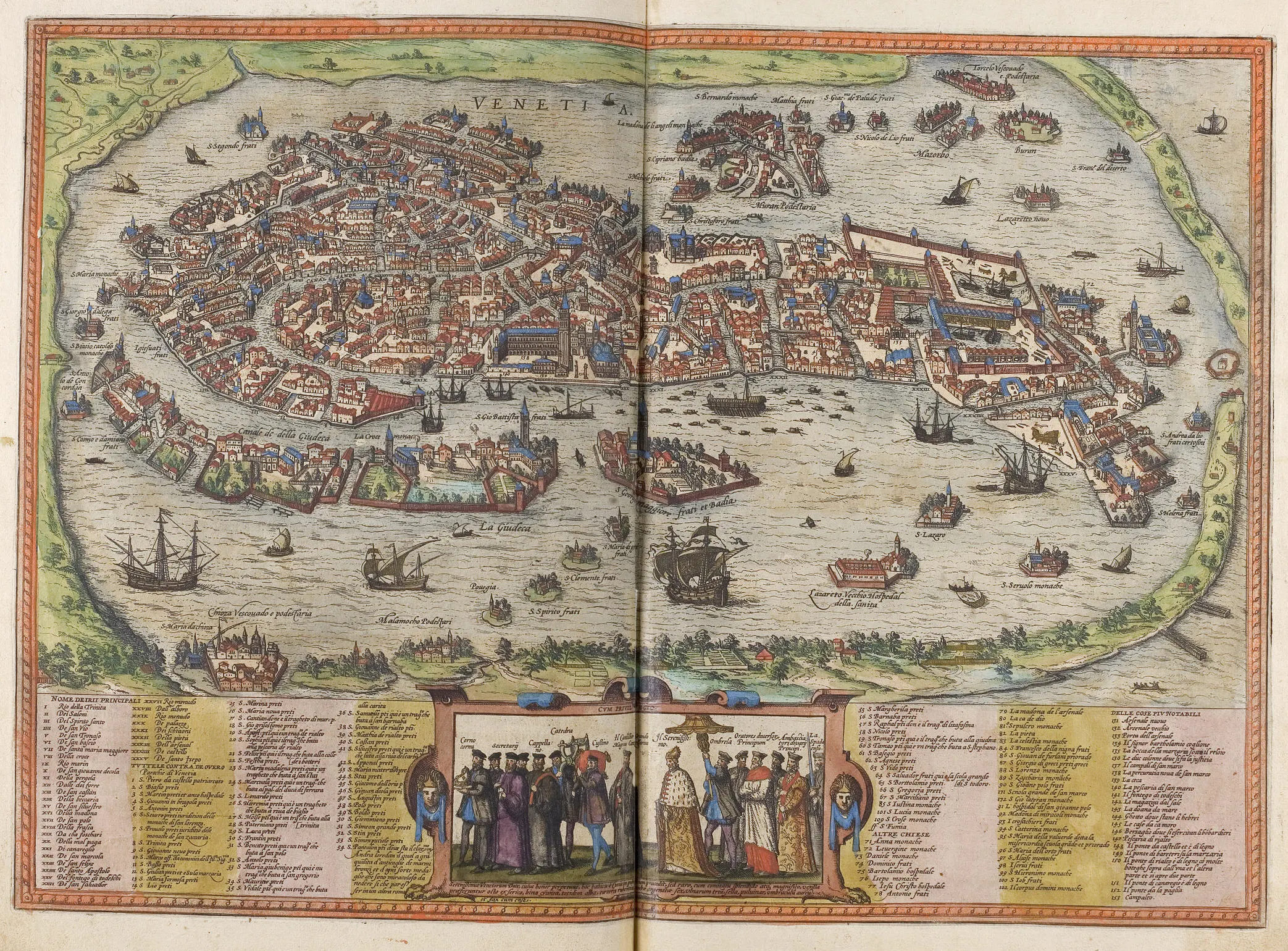
This sixteenth-century Braun and Hogenberg view shows Venice, which Scheffer names among the commercial cities whose power rested on the sea. The galleys and smaller craft on its lagoon offer an early modern counterpart to the contemporary fleets through which he explains ancient naval practice. Source ↗.

Inventors, Vessels, and the Terms of the Oar-System
Chapter II, on the inventors of navigation, turns the same critical discipline on rival claims of origin. Scheffer gives the primacy to the Japhetic line of Genesis 10, with Chittim crossing to Cyprus and Dodanim reaching Rhodes, and he follows Vossius in reading Japhet as Neptune. He is caustic toward Thomas Dempster's attribution of the first ships to the Britons: Sed amor patriæ transuorsum egit hominem, vt a veritate deflecte, "but love of fatherland drove the man aside, so that he swerved from truth." The rebuke states a governing principle of the book: patriotic affection is a source of error that the critic must discount. Even sacred history is held to the technical definition he has established. Noah, in his view, did not invent the art of sailing so much as a better method of building ships, nisse arbitror, quam nauigiorum melius extruendorum rationem. The Ark drifted under providence rather than being steered, and so it cannot count as an act of navigation in the strict sense. Scripture supplies the chronology, but the definition of ars decides what that chronology may be said to contain.
The descriptive chapters that follow, from rafts to the giant polyremes and from timber to the parts of the hull, culminate in two distinctions. They introduce the oar-system question that will dominate Book II, and Scheffer states his terms with care, in the sentence already cited that holds ranks distinct from rows, if not in name, at least in fact. The concessive si non vocabulo openly admits that ancient usage blurs the terms, while re saltem insists that the things they name must be kept apart. The account of the stern then joins the technical to the sacral and juridical. It was enim sacrosancta & inuiolabilis hæc pars nauigii, adeo vt & supplices ad eam, "for this part of the vessel was sacrosanct and inviolable, so much so that suppliants too [fled] to it." The ship is thus not only a machine but a bounded space carrying religious and legal status, a reading Scheffer extends through Fronsperger to Christian galleys.
Book II: The Constitution, Manning, and Equipment of the Fleet
Book II, De apparatu bellico, begins with the definition that underlies the work's whole vocabulary of proper constitution, examined in its first clause in the philological framing of this report: a fleet or naval army is a just and orderly multitude of ready ships. The definition continues by specifying that such a force dares to advance into enemy territory fines hostium non furtim latrocinantium more, sed palam & aperte audet in, "not stealthily in the manner of brigands, but openly and plainly." The earlier genealogy of piracy is here fixed into definition. Iusta takes its meaning from the contrast with latrocinium, and what makes a fleet a fleet is the openness of its hostility. Against Lazius, Scheffer makes even the adequacy of a fleet relational. We judge, he writes, that a just fleet is measured not by our own strength but rather by the enemy's, Arbitramur ergo justam classem non ex nostris viribus, sed hostium potius. The adjective is therefore not a fixed number of hulls but a proportion. This is consistent with his reluctance to let any category stand without reference to its function.
The chapter closes by defending the dignity of naval service against the Roman prejudice that rated it beneath service on land. Scheffer takes up the Senecan opposition again in moral form, in the sentence already cited which holds that virtue is bound to no place, and that the more fortune can do at sea, the more virtue is proved there. The sea's very hazard, which the moralists had used to condemn navigation, becomes the ground on which virtus is most clearly shown.

The opening of Book II: the Argumentum announces the antiquity and dignity of sea service before Caput I defines the classis as a properly ordered, equipped naval force. Scheffer’s defence of maritime virtus rests first on that lawful constitution, not on the sea’s hazards. Source ↗.
The long second chapter turns that argument into a matter of scholarly conduct. After reviewing the systems of Baïf, Scaliger, Savile, and Rivius, Scheffer abandons the hybrid theory of his own earlier dissertation. He frames the abandonment as an obligation, in the principle set out earlier in this report: that a zeal for truth ought to be in us, and that we should not blush to exchange worse opinions, though they be earlier ones. He adds, with evident reference to the learned quarrels in which his own pages are engaged, Quod vtinam simplicius hodie facerent viri ma, "would that great men today did this more simply." The retraction makes a virtue of the willingness to correct oneself, and it does so in a chapter full of correction of others.
His revised solution is offered as the remedy for the physical objection that forty superposed banks could not fit within a hull of plausible height. The rowers sat nec tabulatis a se inuicem distincti, nec tantis in altum spatiis, quantum pro, "neither separated from one another by decks, nor by such great vertical spaces as [some have supposed]." The staggered vertical arrangement keeps Scaliger's insight while removing its apparent impossibility. The appeal to the Vitruvian interscalmium makes the solution answerable to a measurable module.
Chapter III carries the technical argument into social history. The Livian socii navales are glossed through contemporary Dutch usage, those who bus Bootsgesellen nuncupantur, "are called Bootsgesellen." Present practice serves as a lexical aid, not as evidence that ancient arrangements matched modern ones. Scheffer refuses exactly that projection when he concludes, against the multi-man oars of contemporary galleys and in the sentence already cited, that in all ships each rower plied a single oar. He argues the point from Pliny, Silius, and differences in pay.
A quieter contradiction also surfaces here. Having raised navigation to the rank of a noble art, he must record that Cæterum hos omnes prisci pro vilissimis & abjectissimis habuere, "the ancients, moreover, held all these as the vilest and most abject." The dignity of the ars and the low standing of those who practised it are left side by side, without reconciliation.
The opening of Chapter IV returns to Rome's late arrival at the sea, and so to the theme of imitation and acquisition. The captured Carthaginian quinquereme becomes the vessel vnde Romani exemplum fabricandarum nauium petiuerunt, "whence the Romans sought their pattern for building ships." Scheffer then dates the private funding of fleets with annalistic precision as primum factum anno primi belli Punici octauo, "first done in the eighth year of the First Punic War." With this the inquiry moves from what a fleet is to the public and allied means by which a state, having learned the art from its enemy, assembled the forces that made dominion at sea possible.
In pursuing those means, Scheffer turns a question of naval finance into a question of political power. Having compared Roman and Athenian fleet strengths, with the observation that Xiphilinus eundem in bello piratico mille naues habuisse, namely that Xiphilinus credits Pompey with a thousand ships in the pirate war, he traces Athenian naval revenue from Themistocles' diversion of the Laurion silver to the Demosthenic trierarchy. He then interrogates the allied contributions that sustained the Athenian fleet. The verdict, already noted in this report, is pointed: the system of exacting ships from allies aimed, under the specious name of aid, at something other than what it professed. The phrase speciosum nomen belongs to the Tacitean vocabulary of dissimulation so congenial to mid-seventeenth-century political humanism. It also strains the treatise's governing concern with proper constitution. A fleet assembled under the name of alliance may in substance be an instrument of subjection, so the name and the thing must be held apart.
The Roman parallel follows from the Verrines. Cicero is made to say that within the very compact of alliance there lay something like a mark of servitude: In illo ipso, inquit, fædere societatis inerat nescio quomodo quasi, "in that very treaty of alliance, he says, there was somehow a kind of." The hedging nescio quomodo quasi is Cicero's, but Scheffer's choice to cite it is his own. He reads the juridical forms of foedus and societas as capable of masking dependency. The analysis does not abandon the definitional programme; it refines it. Scheffer at once returns to institutional taxonomy in a sentence of almost legal economy, Habemus classes ordinarias. Præter has nonnunquam voluntarias, "we have the ordinary fleets; besides these, sometimes voluntary ones." The distinction separates levied fleets from those offered by allied kings, cities, or private citizens such as Hiero, the Rhodians, or Clinias. It classifies naval force by the legal ground of its obligation, which is exactly the kind of sorting that the classis justa definition elsewhere presupposes.
The treatment of marines shows the developmental shape of Scheffer's institutional history. He begins from the observation that Hos Romani primis temporibus ex legionariis habuere, the Romans in early times drew these fighting men from the legionaries. The narrative then moves toward a permanent establishment: hi quidem postea classiarii, militesq[ue] classici vocati, "these indeed were afterwards called classiarii and naval soldiers." The terminological shift registers an institutional one. Temporary drafts became a standing corps, eventually garrisoned at Misenum and Ravenna under Augustus. Juridical status is tracked with equal care. The maritime colonies enjoyed a vacatio rei navalis, an exemption from naval service, and Scheffer records that in emergency the Senate decreuit vacationem rei naualis his colonis non, decreed that the exemption should not hold for these colonies. Naval manpower here is a matter of public law, of privileges granted and suspended, not merely of numbers.
The strand on rowers closes with one of the book's rare explicit bridges to the author's own century. After tracing the passage from citizen oarsmen to slaves furnished by propertied Romans under census-based decrees of the Second Punic War, Scheffer observes, in the sentence noted earlier in this report, that in the present captives, that is slaves, or else criminals and malefactors, are given to the oar. The sentence presents the galleys of the contemporary Mediterranean as a continuation of ancient practice. The comparison is descriptive rather than hortatory: antiquity and the present illuminate each other without any recommendation being drawn.
Book II, chapter V turns from personnel to equipment, and its programmatic first sentence imposes a binary on a vast and technically obscure field: VT probe nauis sit instructa, alio armorum genere ad nauigationem, alio ad, "that a ship may be properly fitted out, [it requires] one kind of arms for navigation, another for [combat]." The adverb probe echoes the treatise's preoccupation with what is rightly constituted. The division between navigational and combat gear gives order to a chapter that must range over rams, decks, towers, oars, sails, rudders, ground-tackle, and bilge-pumps. Within it Scheffer displays the whole apparatus of his method. Material evidence is declared outright: nummi maxime, quorum ecce hic primos duos e Strada in Octauio Augusto, "coins above all, of which here are the first two, from Strada, on Octavius Augustus." The deictic ecce hic points to the printed coin-images set into the text. The book thus presents itself as an engraved archive in which numismatic images drawn from Strada, Goltzius, Gorlaeus, and Orsini stand beside the texts as testimony.
Textual criticism works alongside this visual evidence. On the delphis, Scheffer defers to the reigning authority of the Republic of Letters, sæculique nostri eruditissimus, Salmasius sic ea restituit, "and Salmasius, the most learned man of our age, restores them thus." On rowing gear he offers a conjecture of his own on Isidore's text. He diagnoses an omission by haplography: a scribe saw that illud tondendis, & decutiendis bis positum esse videbat, itaque alterum, vt, "he saw that 'tondendis et decutiendis' had been set down twice, and so [dropped] one, as [superfluous]." The emendation applies to technical vocabulary the critical procedures that humanist scholarship had refined on classical texts. A corrupt word is a corrupt piece of the ship, and restoring the reading restores the object.
The account of naval arms in chapter VII culminates in a comparative judgement, much remarked and already cited in this report: that the ancient siphons seem to have been not much unlike our guns, except that they discharged only fire. The comparison is hedged by videntur and qualified by nisi quod. Scheffer offers resemblance, not identity, so the analogy serves understanding without collapsing ancient and modern apparatus into one. The same caution governs his use of coins as evidence.

Six coin impressions set into the Latin argument allow Augustan and Punic-War representations of prows and rams to be weighed beside literary testimony. The same cautious comparison lets Scheffer liken ancient siphons to modern guns without making them identical. Source ↗.
Book III: Signals, Training, Departure, and Harbours
Book III announces a new subject, the usus of naval force, and grounds its first chapter on signals in the practical problem of command. Signs must be set out, proponenda sunt, sine quibus quis est, qui voce tantum tam, "without which who is there that by voice alone [could govern] so [great a multitude]?" The rhetorical question assumes that a fleet is a multitude requiring rational ordering, and that signalling is the means by which an ars imposes form on dispersed ships. The classification that follows divides signs into those seen and those heard, and here Scheffer's discipline of distinction is at its most exacting. He defines the parasemon as the painted device identifying a ship, incipiamus. Hoc nil fuit aliud, quam pictura, a Græcis nominata, quæ effigiem, "let us begin. This was nothing other than a picture, so named by the Greeks, which [bore] the likeness." He then separates it firmly from the tutelary image at the stern: quo dixi, signum Tutela est, longe a parasemo diuersum, "the sign of which I spoke is the tutela, far different from the parasemon."
The tutela opens onto sacred history. Scheffer, citing Procopius of Gaza on Isaiah, records the transfer, noted earlier in this report, by which the Christians afterwards entrusted the protection of ships to the martyrs. The sentence posits continuity of function across a change of religion: the stern still carries a protector, but the protector has been christianised. Scheffer neither denounces the continuity as residual paganism nor celebrates it. It is recorded as a fact of usage. Within the same discussion he adjudicates among the moderns, conceding that ergo tantopere errauit Lipsius, vt a non nemine eruditorum traditur, "Lipsius therefore did not err as greatly as is reported by some of the learned." Such measured verdicts recur throughout these chapters: rival scholars are weighed in the open, and censure is proportioned to the evidence.
Modern testimony again enters the account of command signals. For flagships' night-lights Scheffer cites a German military handbook, noting that the lanterns are what farolas nuncupant, cum aliæ singulis sint contentæ, autor est Fronspergius, "[the lanterns] they call farolas, while the other ships are content with one each, as Fronsperger reports." Contemporary practice is not, however, allowed to dictate ancient meaning. Gyraldus's helmet-insignia and the derivation of "galley" built on them meet open scepticism. There are those qui hinc naues militares dictas putent galeas; de quo tamen dubitari potest, "who think that warships were hence called galeae; about which, however, there may be doubt." The chapter's most insistent claim to originality concerns heard signals. Symphonia, Scheffer argues, was musical accompaniment, aliisue instrumentis musicis, longe a celeusmate diuersa, cum quo hactenus, "or with other musical instruments, far different from the celeusma, with which hitherto [it has been confused]." The repeated longe diversus, applied to tutela and parasemon and now to symphonia and celeusma, is the verbal signature of a method that advances by refusing to let neighbouring terms coalesce.
Chapter II, on training, opens with a proverb that converts drill into necessity: quid de militia dicemus? in qua, vt ait ille, bis peccare, "what shall we say of warfare, in which, as that man says, to err twice [is not permitted]?" The maxim restates in martial terms the opposition between skill and fortune. Since the sea leaves no room for a second mistake, art must be acquired beforehand by exercise. The chapter's second half then traces a moral trajectory. Roman ingenuity first extends naval drill: Postea Romani, sicut erat solers genus in excogitandis, "afterwards the Romans, being an ingenious race in devising [what perfects warfare]," dug a basin in the Campus Martius. But the institution degenerates, Postea, vt fit, res in delicias, "afterwards, as happens, the thing [was turned] into luxury." The parenthetical vt fit frames the decline as a general law of human institutions, a familiar humanist topos. The final stage is spectacle performed by the condemned: nomen imponebant; omnes naumacharios appellabant, "they gave them a name; they called them all naumacharii." Exercise that once served the ars of war has become entertainment, and its practitioners are no longer citizens in training but persons destined to die.
The chapter on departure brings Roman religion within the purview of law. Scheffer directs the reader's attention to ancient credulity, appellatur. Et hæc est conscensio: in qua obserua superstitionem veterum, "[it] is called. And this is embarkation, in which observe the superstition of the ancients." Yet he also records, in the passage already cited in this report, that sailing was not fas, the public laws forbidding it, unless the birds had assented. The two registers sit side by side without resolution. Pagan observance is superstitio to a Christian scholar, yet it was also binding public law whose neglect, in the case of Publius Claudius, preceded disaster. The antiquarian's task is to record its juridical force, not to dismiss it.
Chapter IV, on camps and harbours, is marked by candour about the limits of evidence. Confronting the internal arrangement of a naval camp, Scheffer asks, Quis ordo reliquus, quæue integra castrorum nauticorum, "what the remaining order, or what the complete [form] of naval camps was," and concedes that no author makes it clear. Only then does he offer conjecture. Where evidence does allow distinction, he presses it. Drawing on Ulpian and Livy, he concludes ex his verbis, diuersas stationes a portubus tuisse, & qualiacunque commoda, "from these words, that roadsteads were distinct from harbours, and [were] any convenient [moorings]." The technical survey also admits social history, for in portu ædificia lupanaria quoque a Polluce numerentur, "brothels too are counted by Pollux among the buildings in a harbour." Harbours are presented not as engineering alone but as communities, complete with markets, shrines, and vice.
The Battle-Line and the Engagement
Book III then reaches its tactical chapter, which opens with a definition that reprises the formula of the classis itself: Aciei ordinatio est justa vtilisque dis, "the ordering of the battle-line is the just and useful disposition [of ships]." Again justa pairs with a term of function, here utilis, which confirms that iustus in Scheffer's technical lexicon denotes regular and proper constitution. The preconditions of battle follow in deliberate sequence. The first is conflictum. Primo quidem, an tranquillum esset mare. Nam mari turbido, "[before] the engagement. First, whether the sea was calm, for on a rough sea [nothing was done]." The art of naval war thus begins by acknowledging the element it cannot command; the commander chooses his moment so that fortune is minimised rather than defied. Even here philology governs tactics. Scheffer interrupts his account of striking the main sails to censure a Renaissance translator of Xenophon, Pirckeimerus male hic & alibi, majores malos edidit, "Pirckheimer badly here and elsewhere rendered 'larger masts'." A mistranslated noun yields a mistaken manoeuvre, and correcting the word restores the ancient order of battle. In this sentence the conjunction of lexical precision and tactical reconstruction that runs throughout the work is fully explicit.
The account of battle formations that follows rests on a single claim, already noted in this report, which Scheffer marks for the reader's attention with a parenthesis: that the formations of fleets were no less varied than in land warfare. The parenthesis matters. Scheffer is not merely reporting an observation. He is setting the terms on which the sea can be treated as a field of systematic res militaris, capable of the same classification that Lipsius and his successors had applied to the Roman legion. The chapter's procedure follows from this. The crescent, the commonest figure, is confirmed from the Byzantine tactical tradition, Leo. Lunata forma ad hostes circumcludendos potissimum valet, "the crescent form is most effective for enclosing the enemy." The straight-fronted line is then given a name borrowed outright from infantry tactics, Hoc genus aciei phalanx dicebatur, "this kind of battle-line was called a phalanx." The rarer figures follow as a catalogue, Rariores erant forceps, cuneus, oualis, incurua, "rarer were the pincer, the wedge, the oval, and the curved." The vocabulary of the acies thus passes from land to sea without apology. In Scheffer's hands the naval line becomes a species of the same genus as the terrestrial one, and the analogy is a working instrument of definition rather than a figure of speech.
Classification, however, is not the whole method, and the treatment of the circular formation shows where Scheffer moves beyond the lexicographer's catalogue. Of Polyaenus he remarks approvingly, nec formam tantum, sed & vsum ejus ostendit. Prodest scilicet ad pugnandum, that the author shows "not only its form but also its use: it serves, namely, for fighting." Form is to be explained by function. The ancient narrative is read as a store of practical judgement as well as a source of names. Scheffer then extracts from Thucydides a limitation the historian does not state in so many words: eumq[ue] adoriri possent. Obseruandum interim ex eo loco, non durabilem esse, "so that they could attack it. Meanwhile it should be observed from that passage that it was not durable." The circle that protects in calm water dissolves in a swell and under inexperienced rowers. This is inference from narrative, and its confidence is telling. The antiquarian treats the historians as witnesses to a technical art whose rules can be reconstructed from the outcomes they record, even where the witnesses themselves did not formulate those rules.
The same habit of reading order into arrangement governs the placing of men aboard. The disposition is functional, grauis armaturæ milites a lateribus, leuioris vero in prora & puppi, vel in, "heavy-armed soldiers at the sides, light-armed in prow and stern, or in". It is also moral: imum ignauiorum ferme fuisse locum, "the lowest place was, as a rule, that of the cowardly." The hull becomes a vertical scale of virtue, with the decks reserved for courage and the depths for its absence. Scheffer then qualifies the scheme with Lucan, for whom the hold was rather a refuge for the wounded. The qualification is characteristic. A clean hierarchy is proposed and then tested against a contrary witness, so that the reader receives both the rule and its limit.
The chapter on the naval engagement is organized as a ritual and tactical sequence, from omens and vows through harangue, signal and trumpet to the clash itself. Its opening sentence frames the whole as a passage from figure to action: Aciem habemus, pugna superest ac conflictus, quem vt majore animo capesserent,, "we have the battle-line; the fight and the clash remain, which, so that they might undertake it with greater spirit,". Religion here is part of the apparatus of war. The vows were facta a prætore. Item vota, nisi quod in votis nuncupandis præiret celeustes,, "performed by the commander; likewise the vows, except that in pronouncing the vows the celeustes led", so that the boatswain's office, otherwise technical, acquires a liturgical function.
The conceptual centre of the chapter lies in its account of manoeuvre. Scheffer disparages the land-style melee at sea, Stataria pugna minime hic laudabatur, "the standing fight was by no means praised here." He then converts Thucydides' complaint about the clumsy battle off Corcyra into a positive definition, in the passage examined in the philological framing of this report, where the wheeling-about of ships through frequent turns is called "art." The move enacts the treatise's governing opposition between ars and mere force or chance. At sea, the art consists precisely in refusing the logic of the land battle, so the very analogy that organized the formations is suspended at the moment of combat. Naval warfare resembles land warfare in its variety of figures but differs from it in its proper excellence. That tension runs through the whole tactical exposition and is never fully resolved.
The doctrine of ramming makes the art concrete. Scheffer states that the deadliest strike fell on the flank, Damnosissimus autem fuit, qui fiebat in, "but the most destructive was the one made against", and he derives the helmsman's countermeasure of turning to meet blows ram to ram. He also records the technical Latin for shearing an enemy's oars, quæ res detergere Latinis dicta est, "which action was called detergere by the Latins." The rule is then complicated by an exception that turns vulnerability into a weapon: Fuit callidum hoc Illyriorum commentum, "this was a clever device of the Illyrians." Heavy or bound craft deliberately offered their sides so that the rammer, once lodged, could be held and boarded. The exception confirms the principle. Every rule of the art defines a corresponding counter-art, and Scheffer's taxonomy is a map of such moves and replies rather than a static list.
When ships close and grapple, the land analogy returns, now on the model of siege: Ausus est injectare manum. Fuit porro ista pugna similis oppugnationibus, "he dared to throw on the hand; this fight, moreover, was like the storming of cities." Once manoeuvre has given way to iron hands and boarding-bridges, the sea ceases to be the domain of its own art and reverts to the logic of walls. This prepares the turn to blockade and harbour-closure. It also shows how Scheffer's comparative method moves the analogy in and out of force according to the phase of the action.
The book closes with a strategic thesis about Roman naval institutions. Rome, as the passage already cited in this report declares, always kept fleets on the frontiers of the empire, ready for every sudden turn of fortune. The standing fleet stands to empire as manoeuvre stands to combat: preparation set against fortune. Vegetius supplies the ideological rationale, that the Roman people kept its fleet pro decore & vtilitate magnitudinis suæ, non propter necessitatem tumultus, "for the honour and utility of its greatness, not because of the need of some emergency." The phrase is significant in a treatise that elsewhere grounds navigation in necessity. At the scale of empire, necessity yields to decus and utilitas, and the fleet becomes an ornament of greatness as much as a remedy for danger. On the title of the Misene and Ravenna squadrons Scheffer offers alternative explanations, classes hæ Prætoria, vel quod primæ essent seu præcipuæ in mari, vel quod, "these fleets [were called] praetorian, either because they were the first or foremost at sea, or because". The suspended disjunction typifies his caution. When the Notitia catalogue leaves the strength of these fleets undetermined, he declines to guess, affirming nothing, in the sentence noted at the outset of this report, where ancient testimony is lacking.
Book IV: Reward, Penalty, and Command
Book IV turns from use to reward and command and begins with a division that structures everything after it, the twofold reward, ordinary and extraordinary, already cited in this report. The ordinary reward is itself subdivided, est triplex: pecuniæ, frumenti, vestimentorum, "it is threefold: of money, of grain, of clothing." The scholastic cascade of divisions governs the material, but the content is historical. From Livy, Scheffer periodizes the fiscal basis of Roman naval pay, noting that in the crisis of the Second Punic War primum est factum, vt classis Romana sociis naualibus priuata impensa paratis, "for the first time it came about that the Roman fleet [was manned] with naval allies raised at private expense." Discharge is defined with juridical exactness, as quæ nil aliud, quam immunitas plenissima, & perpetua quies a laboribus, "which is nothing other than the fullest immunity and perpetual rest from labours". The definition is then tested against the Misene veterans' inscriptions to fix the length of naval service.
The extraordinary rewards bring the concern with proper constitution to the fore. The right to a naval triumph depended on the commander's own auspices, a rule Scheffer reconstructs from the wager between Lutatius and Valerius: gestisset, is jus triumphandi non habebat, "[whoever had not] conducted it, he did not have the right of triumphing." Here the legitimacy of victory is a matter of public law, not of success alone. The same discipline governs his source criticism. Confronted with Dio's claim that Agrippa's naval crown was unique, he writes non satis admirari possum Dionem Cassium, diligentissimum scriptorem, qui, "I cannot sufficiently wonder at Dio Cassius, a most diligent writer, who". He does not dismiss Dio. He resolves the contradiction by distinguishing types of crown on the evidence of coins, so that the authority's diligence is honoured while his statement is narrowed.
The penalties of naval service are joined to the northern present. Keel-hauling is attested under the Gothicæ, vt testis est Fronsbergius lib. III. & Ioh. Loccenius, Socer, "the Gothic [law], as Fronsberger testifies in book III, and Johannes Loccenius, my father-in-law". The comparison is offered as illustration from living maritime law rather than as prescription.

A Book IV page sets two woodcut coin portraits of Agrippa above a diagram of the rostrata crown, letting numismatic form distinguish one naval honour from another. Visible material proof stands beside the texts, narrowing Dio’s testimony rather than dismissing it. Source ↗.
In the treatment of command, Scheffer's estimate of the pilot's learning returns to the dignity of the ars. Of Onesicritus, the Cynic who steered Alexander's fleet, he asks the question already cited in this report: whence could all this be better known than from philosophers? Navigation by the stars is natural philosophy put to use. Where the evidence for Athenian trierarchic finance grows dark, he marks the conjectural status of his reconstruction: Ego si in re obscura diuinare licet, rem existimo se ita, "if it is permitted to divine in an obscure matter, I judge the matter to have stood thus". The licence to divine is claimed openly and therefore bounded. The helmsman's star-lore is finally placed in historical time against the device that superseded it, the compass, which the text dates, as noted earlier, to about three hundred years before its own day. The ancient art is reconstructed from the vantage of a navigation transformed, and the treatise registers that distance rather than effacing it.
Addenda, Errata, and Indexes
The Addenda that follow are keyed to the printed text, Prior numerus paginam, posterior versum indicat, "the first number indicates the page, the second the line". They show the same method continuing past the formal close of the argument, with corrections and supplements extending to Norse ship-names and to the Christian afterlife of ancient rites. Of the blessing of fleets Scheffer records Apud Christianos Sacerdotum & Episcoporum solenne hoc fuit munus, "among Christians this was the solemn office of priests and bishops". Even in its apparatus of additions, the work traces continuity between ancient institution and Christian practice and keeps its conclusions open to revision.
Taken as a whole, the closing gathering of De militia navali is formally the least discursive part of the book. Beside the Addenda it comprises a list of Errata and Latin and Greek indexes. Yet it reproduces in compressed form the method the treatise applies throughout. The Addenda work as a lemmatized supplement. Each entry is an exact instruction to the reader to insert new matter at a stated point in the printed sheets, as in CCXV, 7. post c.9. adde: Quemadmodum & in nauibus vsurpauit, "after such-and-such a word, add: just as he also used it of ships." The verb adde is the governing gesture of the whole supplement. In print the argument cannot be silently revised, so Scheffer extends it publicly by instruction to the reader. This is a printed form of the self-correction the treatise defends as a duty to truth. The book shows that its distinctions remain open to enlargement, and it lets the reader see exactly where the enlargement falls.
The first coherent run of additions concerns the sacral topography of the harbour. Scheffer supplies a fact about one of the two Roman praetorian stations: in the harbour of the Ravennates there was a temple of Neptune, CCXVI, post Odys. N. adde: In Rauennatium portu templum fuit Neptuni. He cites Girolamo Rossi's history of Ravenna as his authority. He then advances a cautious conjecture: perhaps there was also a temple of Priapus there, for that god too claims to preside over harbours, Forsitan & Priapi illic templum. Nam & hic. The hedging Forsitan matters. Scheffer marks the inference as resting on a single epigram in which the god speaks of his own office, and he does not convert it into fact within the Addenda themselves. The supplement thus keeps the treatise's habitual separation between what is attested and what is only probable. The Ravenna temple is asserted on the basis of a historian; the Priapus temple is only proposed on the basis of a poet. The same unit carries a moralizing aside from Simonides, which warns shipmasters and sailors vt meretrices fugiant, "that they should shun prostitutes." The aside treats the port as a moral as well as a cultic space, a zone of hazard that neighbours the dangers of the open sea.
The additions to the fourth book turn to naval provisioning, and here Scheffer's comparative etymology appears in a characteristically Northern European form. The word maza, barley-cake, is extended to food in general. The extension is supported by the Stephanus glosses, by Athenaeus, and by Casaubon's Hebrew comparison, and the series closes with a vernacular witness: all of which agrees with the fact that the Swedes too use mact for food, Cum quibus omnibus conuenit, quod & Sueci mact. Greek, Hebrew, and Swedish are stacked as converging testimonies. The polyglot etymologizing of the mid-century Republic of Letters is here practised from within Sweden. The Swedish word does not displace the classical evidence; it ratifies it, much as coins or inscriptions confirm texts elsewhere in the treatise. The neighbouring addendum is a pure exercise in lexical discrimination. It separates bilge-water, aqua de sentina, from "water from hides." On the authority of Opilius Aurelius, transmitted through the Festus material, Scheffer insists that the latter must be understood not as the bilge but as the water in which tanners steep hides, non illam intelligi oportere, sed qua imbuuntur coria à coriariis, discimus ex. The concern with proper distinction that governs the definition of the classis operates here at the smallest scale, on a single phrase that later readers might easily have conflated with shipboard filth.
The ration addendum is the most arresting methodological moment in the supplement. Scheffer opens by suggesting that standard allowances may derive something from the Rhodian sea-law, nonnihil ex lege Rhodia videtur. Apud Polybium lib. 5. video, Antiochum. Behind the antiquarian question he thus places the most prestigious body of ancient maritime law. He then works from Polybius' report of Antiochus' grant of twenty thousand artabae to the Rhodians for ten triremes. He converts artabae into Attic medimni, medimni into a daily figure in choenices, and choenices into men fed at the single daily choenix that Suidas gives as the ration. The calculation ends in a conclusion that admits its own limits. Whatever the time-frame, this much is certain: very great expense went on such provisioning, sit, hoc satis constat, in ejusmodi victum plurimum impensum esse. Quæ etiam. The concessive sit signals that Scheffer does not know whether the grant covered a year. What he claims as satis constat, sufficiently established, is the order of magnitude alone. He then caps the reckoning with a literary witness: this is why Lysias called such ships voracious, as Pollux and Hesychius report, causa est, cur Lysias hasce naues, voraces appellaret, vti Pollux, & Hesychius. Arithmetic, law, lexicography, and oratory converge on a single proposition. The rhetorical epithet "voracious" is turned into evidence for an economic fact about the trireme.
The longest technological argument of the supplement concerns the codicariae, vessels built from logs. Scheffer states that they were most rightly so explained and were in very frequent use among the ancients, codicarias rectissime docetur. fuitque creberrimus earum apud veteres vsus. He then makes the fleet's own name testify to the technique, in the passage on Servius' note to the sixth book discussed in the philological framing of this report, where the very name classis is said to imply this kind of construction. The fleet is so called because it is made of poles, dicatur classis, quod fiat de fustibus. Vbi per fustes nil aliud intelligit,. The noun at the centre of the treatise's quasi-juridical definition of a properly constituted fleet is thus traced back to the most primitive carpentry. The classis justa of public law and the classis of interlaced timbers are joined through etymology. Scheffer applies the same literalizing reading to shipwrights' metaphor. The antiquity of the technique, he argues, is evident from the very word "weaving," Antiquissimum autem fuisse hoc genus patet etiam ex texendi voce, qua. What looks like a figure of speech is treated as a fossil of practice.
From words the argument moves to things. Scheffer invokes Vitruvius' Colchian houses and Rusconi's engraving of them. He then turns to living vernacular building: finally, they do this daily among the Swiss and here in Sweden, delineauit. denique quotidie & apud Heluetios, & hic in Suecia faciunt. The deictic hic in Suecia places the author in his country of residence. It also makes contemporary Swedish carpentry an admissible witness to ancient technique, an ethnographic analogy squarely within the antiquarian conventions of the period. The argument closes by absorbing sacred history: indeed, Noah's vessel itself was built in no other way, Imo ipsum Noachi nauigium non alia ratione fuit structum. Scheffer glosses the claim through the Septuagint's term. The ark thereby becomes the first instance of a building method that runs unbroken from the antediluvian world, through Colchis and Rome, to the Alpine and Baltic carpenters of his own day. Sacred chronology and technological history are fused into one continuous genealogy.
The additions on rigging reopen a controversy from the body of the treatise, and Scheffer settles it lexically. Hesychius and Nicander allow acatium to gloss the merchant holcas. That would have been impossible, he argues, had merchant ships not carried oars, quod non potuisset, si, de quo disputatum est in præcedentibus, onerariæ non, since about oars on the acatia there is no doubt at all, habuissent remos, cum de remis in acatiis sit nullum dubium. The reasoning is a syllogism built on a gloss. A lexicographer's equation becomes proof of the equipment of a whole class of ships. The open reference back to the earlier dispute shows the Addenda acting as a continuation of argument and not merely a repository of afterthoughts.
The votive unit gives the supplement its fullest material texture. Scheffer moves upward in scale. He begins with personal offerings in the temples of Isis, patron of navigation, whose marine epithet is attested by an inscription, nauigationi, vti Lucianus docet. Hinc PELAGIA in inscriptione veteri, apud. For the novelty of the matter he reproduces an epigram in which Dionysius set up an image of his hernia-truss as the sole survivor of forty sailors, Imaginem herniæ Dionysius hic posuit, seruatus ex nautis quadraginta solus. The incongruity of the offering is preserved and not explained away. It shows ex-voto practice as intimately bodily, the deliverance of one man commemorated by the object bound most closely to his flesh. He then rises to the dedication of entire vessels: indeed, men freed from such danger dedicated whole ships to the gods, felicitas. Quin & naues integras dedicabant diis, liberati ex tali periculo,. A poetic exemplum follows, just as Catullus dedicated his phaselus to Castor and Pollux, secundam, quomodo Catullus Phaselum suum Castori & Polluci dedicauit lib. I. Catullus is read as documentary evidence for a cultic act. Further testimonies extend the series to tablets for the saviour Zeus, sacratas ex Inscriptione veteri Tomasinus docet. Addo, & Ioui Servatori, cui. They also explain Venus Pelagia's auspicious place in dreams by her birth from the sea, since she was believed to hold power over the element, Artemidorus lib. II. cap. 42. Nempe Pelagia orta è mari, credebatur elementi. In treating religion at sea, the treatise sets fortune, which only the gods could master, beside the art of seamanship.
The final additions turn to institutions and to navigation itself. An inscription from Gruter records public provision for sick and dying soldiers of the Misene fleet, who were not to be cared for and buried from a private collection of money, TVR. NE. ÆRE. CONLATO. CVRENTVR. SEPELIANTVRQ. Another inscription recovers a fleet rank, pag. 103 1. legitur PRINCEPS. CL. RAVENNATIVM. qui non videtur, which Scheffer identifies with the prefect. The navigation addendum states its thesis compactly. Day courses were set by the sun, which distinguished east from west and south from north, so when the sun did not shine sailors wandered uncertain, ortum ab occasu, meridiem à septentrione. Igitur cum Sol non luceret, erra. Virgil and Scripture are then made joint witnesses, Luke's report of Paul's voyage in Acts 27, already cited in this report, that neither sun nor stars appeared, being enlisted for the purpose. Paul's shipwreck becomes a datum in the history of celestial pilotage. On another point Scheffer defers openly to a living authority, noting that Bochart refutes the error most brilliantly in his usual way, rissime refutat Samuel Bochartus Partis Secundæ Geogr. Sac. lib. I. cap. 38. Because the Geographia Sacra appeared in 1646, the citation independently sets the text after that date. Deference to Bochart is balanced by correction of another scholar. Checking the Latin version of Leo's Tactica against the Greek, Scheffer notes two helmsmen at the helms of each dromon, where the translator wrongly rendered the term as "neck," gubernatores ad gubernacula (collum perperam interpres reddidit) dromonis cu.
The Errata apply the same discipline to the printed text itself. They correct a geographical slip, Siciliam, sc: Hispaniam. 150, 16, "for Siciliam write Hispaniam," alongside many Greek accentuations. The indexes then turn the treatise into a navigable structure. Their headings preserve its governing questions. One asks whether the desire for gain was the first cause of navigation, Lucri cupido, an prima causa nauigandi, 6, recalling the opening contest between necessity and avarice. Another names the origin of naval warfare, Militiæ naualis origo, 8, and the same heading declares that naval warfare was the cause of great empires, caussa magnorum impe. The index also takes in the Addenda, so the supplement's harbour cults, log-built vessels, and fleet ranks enter the book's alphabetical order. The thesis that sea-power founds empire therefore stands, in the index as in the treatise, beside the most minute distinctions between bilge-water and tanners' water, between conjecture and attestation, and between a translator's "neck" and a helmsman's rudder.
Reading Further on Johannes Scheffer and Swedish Antiquity
A three-to-five-item bibliography with verified publication details and substantiated annotations could not be established. Additional contextual literature should not be represented as a demonstrated interpretation of Scheffer's naval treatise without checking its actual engagement with the work.
Frequently Asked Questions
Who was Johannes Scheffer?
Johannes Scheffer, also known as Schefferus, was a Strasbourg-trained philologist who made his career at Uppsala. A tertiary biographical source, not yet checked against an authoritative biography, gives his birth at Strasbourg on 2 February 1621 and his death at Uppsala on 26 March 1679. The same source records his philological training under Johan Henrik Boeclerus. He had already written on ships in a youthful work, De varietate navium, dated to 1643. His treatise on ancient fleets names Johannes Loccenius as his father-in-law. Allan Ellenius's 1957 study places him within Uppsala's world of royal antiquaries and Scandinavian collecting.
What is De militia navali veterum libri quatuor, and when was it published?
It is a Latin treatise in four books that reconstructs the navies of ancient Greece and Rome. It is conventionally identified as an Uppsala publication of 1654. A bibliographical listing confirms the title and year, but no original title page has been authenticated, and the place and date of composition remain unestablished. A citation of Bochart's Geographia Sacra, which appeared in 1646, sets the text after that year. The books move from the origins of navigation through ships, crews, and equipment to signals, battle formations, and ramming, and end with naval pay, triumphs, penalties, and command. Scheffer draws on texts, coins, inscriptions, Roman law, and Scripture.
How did Scheffer think ancient oared warships were rowed?
Scheffer concluded that in every ancient ship each rower worked a single oar, and he refused to project the multi-man oars of contemporary galleys onto antiquity. He insisted that ranks and rows were distinct in fact, even where ancient usage blurred the words. He placed the rowers in staggered tiers, without separating decks or great vertical gaps, and tested the scheme against a measurable module drawn from Vitruvius. After reviewing the reconstructions of Baïf, Scaliger, Savile, and Rivius, he openly abandoned the hybrid theory of his own earlier dissertation, defending such retraction as a duty owed to truth. No verified scholarly dispute over his solution has been established.
Why did Scheffer reject the idea that navigation was invented for profit?
Scheffer ranked the causes of navigation as necessity, utility, and pleasure. He put necessity first in deliberate opposition to Propertius, Pliny, Servius, and Libanius, who traced the first ship to greed. In his account, God strengthened the doubtful minds of men after the Flood so that they might sail out and people the earth, and commerce followed only as a secondary benefit. Naval war itself, he argued, arose as a public response to piracy, once raiders came to be pursued as enemies of the human race. A properly constituted fleet therefore advances openly into enemy territory, not stealthily in the manner of brigands.
Is there an English translation of De militia navali veterum libri quatuor?
No published English translation of the treatise has been identified, and no established English rendering of its title has been located, though this negative finding does not prove that none has ever existed. "Four Books on the Naval Warfare of the Ancients" is an editorial convenience, not a recognised translation title. The Leo edition is a separate undertaking that presents the full Latin transcription and a complete English translation for the first time. Its translation is generated by AI. Leo is an effort to make English translations of every text printed in Latin in early modern Europe between 1450 and 1750 freely available online, at no cost.
This report was generated by an advanced AI assistant that conducted deep research alongside an extensive interpretation of the transcribed original text. Every effort has been made to preserve fidelity to the source and to guard against inaccuracy, but corruption in the text recognition process and model hallucination may nonetheless have entered the text. Treat every claim, quotation, translation, and citation as provisional, and verify each against the original source before relying on or citing it.
Bibliography
- Allan Ellenius, "Johannes Schefferus and Swedish Antiquity," Journal of the Warburg and Courtauld Institutes: Published in volume 20, nos. 1–2 (1957), pp. 59–74 (DOI 10.2307/750151), this is the one specialist study that places Scheffer within the Uppsala world of royal antiquaries, Gothicist enthusiasm, and Scandinavian collecting, rather than leaving him a disembodied editor of Greek tacticians. Readers who noticed hic in Suecia turning up in a treatise on Roman fleets, or Swedish mact filed beside Greek maza, will find here the institutional setting that explains why a Strasbourg philologist was comparing triremes with Baltic carpentry. The article predates most modern trireme scholarship, so it will not settle the oar-banks quarrel, but it remains the obvious first stop before anyone credits Scheffer with a Swedish naval programme he never wrote down.