Mute Masters: Dominicus Baudius's Funeral Oration for Joseph Justus Scaliger
On the morning after Joseph Justus Scaliger's burial in January 1609, the Leiden jurist Dominicus Baudius delivered the Oratio funebris dicta honori & memoriae maximi virorum Iosephi Iusti Scaligeri, a Latin funeral speech that crowns the most formidable scholar of his age as perpetual Dictator of the republic of letters. It is part eulogy and part counter-pamphlet against the libel that branded Scaliger a changeling, and it shows how early modern scholars turned learning, lineage, and a good death into public authority. Its closing claim, that a scholar's books are a truer portrait than any painter's, still shapes how Scaliger is remembered.
ExLatinis
14 October 2026

Contents
On the morning after Joseph Justus Scaliger's burial in January 1609, the Leiden jurist Dominicus Baudius delivered the Oratio funebris dicta honori & memoriae maximi virorum Iosephi Iusti Scaligeri, a Latin funeral speech that crowns the most formidable scholar of his age as perpetual Dictator of the republic of letters. It is part eulogy and part counter-pamphlet against the libel that branded Scaliger a changeling, and it shows how early modern scholars turned learning, lineage, and a good death into public authority. Its closing claim, that a scholar's books are a truer portrait than any painter's, still shapes how Scaliger is remembered.
Dominicus Baudius (Dominique Baudier, 1561–1613), a jurist and Leiden professor, delivered a Latin funeral oration for Joseph Justus Scaliger (1540–1609) in the theological auditorium of the University of Leiden at ten in the morning on 26 January 1609, the day after Scaliger's burial. The printed version appeared at Leiden the same year as a pamphlet of some twenty-three pages, offered for sale by Louis Elzevier and Andries Clouck. Around the speech it carries a prefatory Latin epigram by Janus Dousa the Younger on the likeness of Scaliger's father, Julius Caesar Scaliger, a printed notice recording the delivery, and a French acrostic sonnet signed R. I. de Nerée. It belongs to the genre of the academic oratio funebris, a ceremonial Latin speech in which a university honoured one of its own. It was also one of a pair. Daniel Heinsius had spoken immediately after the funeral the previous day, and at least one surviving copy of Baudius's pamphlet was bound with Heinsius's memorial. Before George W. Robinson's English version of 1927, Robinson himself reported finding no translation of either oration into any language.
The oration confronts a double problem. Baudius presents Scaliger's excellence as beyond the reach of adequate speech, yet the duty of pietas forbids silence. He must also praise a man whose reputation, and above all whose claim to descent from the della Scala lords of Verona, stood under public attack. His recurring response is to translate Scaliger's attributes into the language of the Roman commonwealth, so that panegyric becomes vindication.
- Scholarship as public office. Learning is cast as an office within a respublica literaria, a republic of letters, in which Scaliger holds the dictatorship, leads its senate, and receives the lowered fasces of its magistrates.
- Erudition as a public good. Even his leisure must render account to the commonwealth.
- Nobility reasserted. His ancestry is defended in the face of lost patrimony and printed slander.
- Death as Roman constancy. His end is presented as Roman fortitude joined to Reformed Christian hope.
Under this repertoire, praise, polemic, and confessional witness serve a single aim: to make Scaliger's authority appear legitimate, public, and lasting.
The stakes reach beyond one ceremony in a Dutch university town. The oration shows how Leiden humanism represented critical learning as a form of public dignity, ranking discrimination of evidence and the reconstruction of ancient time above the merely recreational pleasures of philology. Modern scholarship, especially the work of Anthony Grafton and Henk Jan de Jonge, has redirected attention towards exactly those chronological and critical achievements. The orator's hierarchy can therefore be read against reconstructed scholarly practice without its encomiastic claims being taken at face value. The speech also enters the contest over Scaliger's lineage. It names and execrates the libel Scaliger hypobolimaeus, although the identity of the libel's author, conventionally associated with Caspar Scioppius, is not given in the text and has not been secured from a verified apparatus. Its deathbed theology, delivered at Leiden in 1609, invites confessional readings. The precise relation of that theology to the controversies then gathering in the university awaits passage-level contextualization.
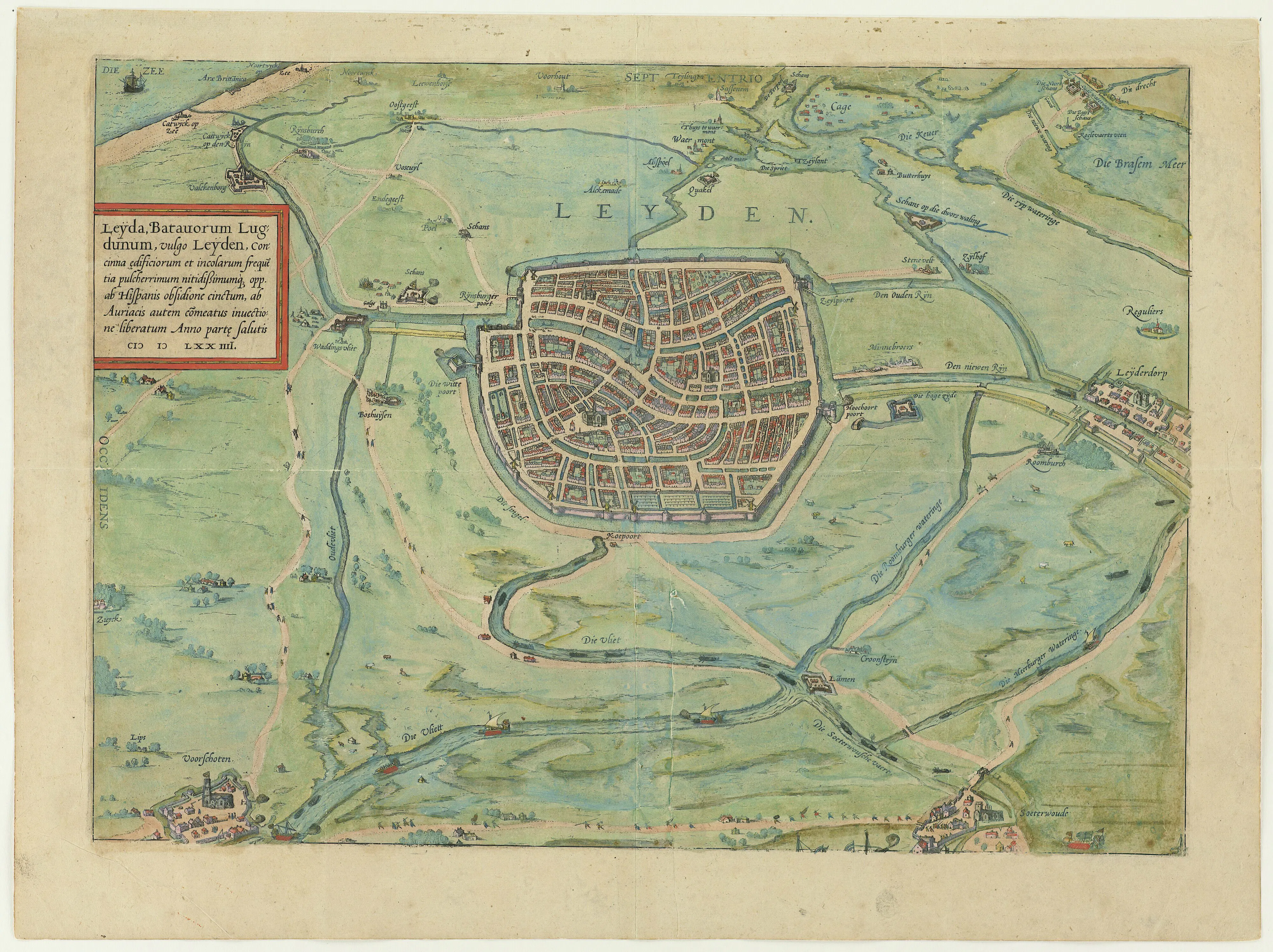
A coloured map of Leiden and its surroundings, dated 1574, records the city some three decades before Baudius delivered his oration there. It grounds the oration's claim for critical learning as public dignity in the city—the Lugdunum Batavorum of the pamphlet's imprint—whose university made Leiden humanism a public institution. Source ↗.

Several features make the text vivid even to a reader new to it. Baudius's invective against Scaliger's detractor is extraordinary in its ferocity, while he praises Scaliger's own disdainful silence as the nobler response. Scaliger appears as a self-taught polyglot who learned from books, the "mute masters" a fifteenth-century king called his truest counsellors. Yet he treats languages only as provisions for the journey towards knowledge of things. His death fuses a Roman emperor's resolve to die standing with the apostle Paul's longing to depart and be with Christ. The oration ends by moving Scaliger's immortality into his printed writings, a likeness, Baudius claims, truer than any painter's or sculptor's.
The same concern with legitimacy, publicity, and durability runs through the work's vocabulary, its material life, and its argument. The terms on which the oration turns are respublica literaria, Critica, Philologia, and pietas. Each converts private learning or private grief into public standing. The pamphlet did the same work as an object. It was printed and sold at Leiden, set beside Heinsius's companion piece, and later transmitted alongside the editorial labours of Scaliger's friends, Baudius among them, who helped shape the surviving correspondence. In this way a single morning's speech became part of the durable record of Scaliger's reputation. The argument itself closes on the same note: the man is gone, but his works remain as his monument, a loss to Leiden and to the entire commonwealth of learning.
Read the full text and English translation on Leo
This text was transcribed and translated as part of the ExLatinis project, an effort by Leo to make free English translations of every text published in Latin in early modern Europe (1450–1750) available online. The complete transcription and English translation of this work can be read free of charge:
→ Read the original Latin text and full English translation on Leo
You can save a copy of this document into your Leo account to run deep text searches, conduct further analysis, or cross-reference it with your own research.
Naming Baudius's Funeral Oration and Its Roman Vocabulary of Learning
Funeral Oration for Joseph Justus Scaliger is an editorial English title supplied for convenience, not an established historical title. The fuller Latin title is Oratio funebris dicta honori & memoriae maximi virorum Iosephi Iusti Scaligeri, approximately "Funeral oration delivered in honour and memory of Joseph Justus Scaliger, greatest of men." George W. Robinson's English edition uses the simpler heading "Funeral Oration by Dominicus Baudius." The title's superlative, displayed on the printed title page itself, already announces an encomiastic judgement, not a disinterested biographical designation. It is the first instance of the elevation that the oration then carries into the language of Roman public office.
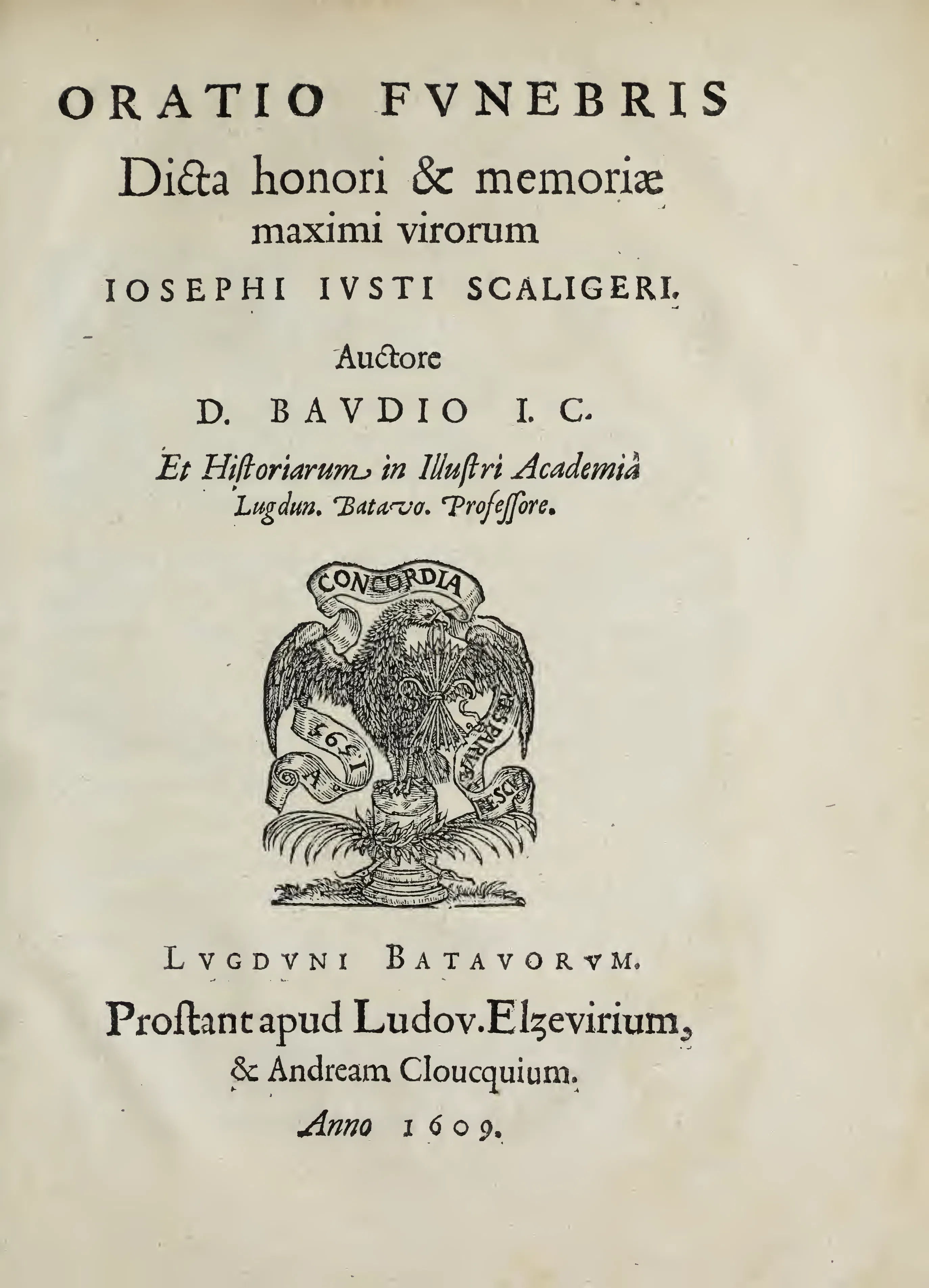
The 1609 Leiden title page announces the encomium at a glance, honouring “Iosephi Iusti Scaligeri” as “maximi virorum” and naming Dominicus Baudius with his Leiden academic office. Its woodcut device and Elzevier–Clouck imprint place the pamphlet in Leiden's book trade as well as its academy. Source ↗.
Baudius's respublica literaria denotes a community constituted through learning, judgement, reputation, and reciprocal recognition. Its Roman political vocabulary confers symbolic precedence upon scholars without describing an actual governmental jurisdiction. The reference to the other members of its triumvirate belongs to this rhetoric of distinction. Baudius recalls how often two of its leading figures spoke of Scaliger, Quoties ejus meminerunt duo de trium viris reipubl, "as often as two of the triumvirs of the republic [of letters] mentioned him." Scholarly authority is thus represented through inherited languages of public dignity. The same register makes Scaliger the magistrate before whom the fasces are lowered, & cujus dignitati fasces submittere co[n]venit, tanquam perpetuo scientiarum omnium Dictator, "to whose dignity it is fitting to lower the fasces, as to the perpetual Dictator of all sciences." Elsewhere Baudius styles him the man of his age and president of the learned senate, culi fuisse virum, & Principem Senatus literatoru[m]. The titulature is consistent: dictatorship, triumvirate, and the princeps senatus are offices of the Roman commonwealth, transferred to a community of letters.
The passage does not name those colleagues, and their identification must therefore rest on evidence outside that sentence rather than on an expanded translation. Scott Mandelbrote's discussion of Scaliger's correspondence provides an important qualification. The learned community survives in records selected and transmitted by particular correspondents and editors, not as an institution with a complete archive. The oration itself treats the republic as a body capable of suffering injury. Near its close Baudius declares that non solùm hæc Academia, verumetiam universa resp. literaria gravi damno ac vulnere afflicta est, that not this Academy alone but the whole republic of letters has been struck by grave loss and wound. The phrase extends Leiden's bereavement to the entire imagined polity.
The distinction between Critica and Philologia is unusually hierarchical. Baudius presents Scaliger as unrivalled in critical judgement: In Criticis omnium rectè æstimantium judicio princeps sine controversia, sine æmulo ac rivali dominatur. In criticism, by the judgement of all who estimate rightly, he reigns as prince without dispute, rival, or competitor, and the verb dominatur once more casts critical eminence as sovereignty. Philological pursuits, by contrast, are something cultivated during intervals of more demanding business: Philologiam ille quidem adamavit, sed quum intervalla negotioru[m], "he did indeed love philology, but [only] when the intervals of business [allowed]." Philologia consequently carries a narrower and more recreational colouring here than the comprehensive disciplinary sense often assigned to "philology." Critica foregrounds the capacity to discriminate, correct, and judge ancient textual evidence. This distinction is best understood as a local strategy of praise, not as proof that every contemporary accepted a uniform division between two disciplines.
The opposition of otium and negotium helps construct that hierarchy. Baudius invokes Cato's dictum that scripsit, viris claris & eminentibus non minus otij, quàm negotij reddendam esse rationem, that famous and eminent men must render account of their leisure no less than of their business. Learned recreation remains honourable, but Scaliger's highest authority lies in judgement rather than miscellaneous accomplishment. Even his leisure is accountable to the commonwealth, which is the civic logic that governs the oration's whole treatment of learning.
Pietas likewise exceeds either private affection or a merely formal duty to the dead. Baudius makes it the ground of the speech itself. Silence would breach it: salva pietate fieri non potest, ut hodierno die vox, "it cannot be done with piety unimpaired that on this day [my] voice [should be silent]." The account of Scaliger's final illness joins testamentary provision, Christian devotion, and the obligation to preserve his memory. The dying scholar's conversation is reported as turning on the central articles of Reformed soteriology, generis humani, de justificatione per side[m] in Christum, de resurrectione corporum & animarum, that is, on the human race, on justification by faith in Christ, and on the resurrection of bodies and the [immortality] of souls.
Baudius's reference to the apostolic desire to be with Christ places the dying scholar within a Christian understanding of release from bodily suffering. He sets it beside a Roman imperial exemplum, the resolve that mor originis cogitabat Imperatorem stantem mori oportere, "mindful of his origin, he thought that an Emperor ought to die standing." The Suetonian saying of Vespasian thus joins Pauline hope in a single portrait of constancy. Pietas therefore links the deceased's religious disposition with the survivors' commemorative responsibilities. The textual interpretation is secure. A more precise assignment of every theological statement to a particular Leiden controversy requires additional doctrinal and institutional evidence.
Baudius Mourns Scaliger at Leiden, January 1609
Dominicus Baudius, also known as Dominique Baudier (1561–1613), composed a Latin university funeral oration honouring Joseph Justus Scaliger (1540–1609). The surviving Leiden pamphlet appeared in 1609 with the imprint "Prostant apud Ludov. Elzevirium & Andream Cloucquium." Its printed delivery notice establishes that Baudius spoke in Leiden's theological auditorium on 26 January 1609 at ten in the morning, the day after Scaliger's burial. The precise place and date of composition, as distinct from delivery, are not established.
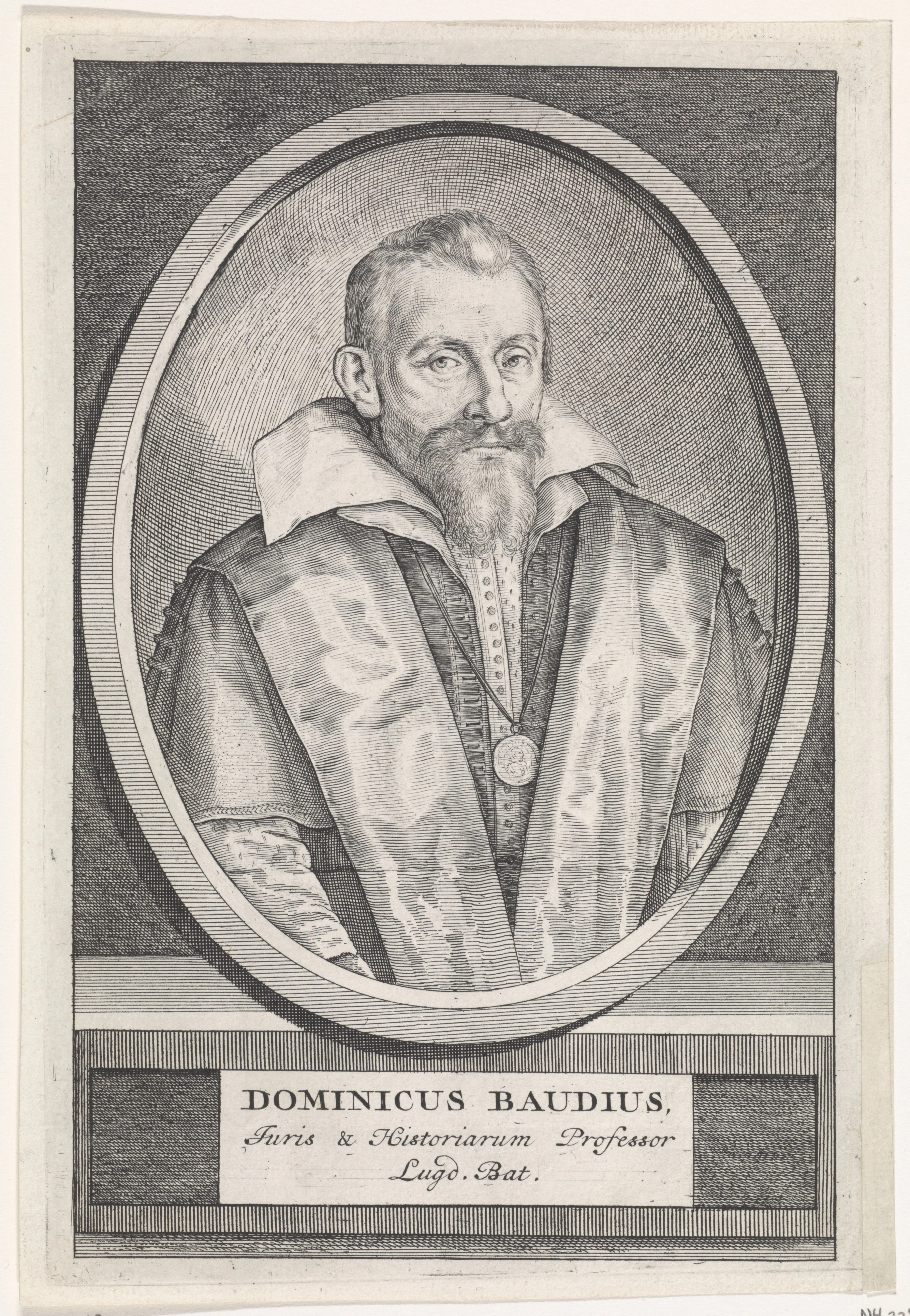
Engraved portrait of Dominicus Baudius, whose cartouche names him “Iuris & Historiarum Professor Lugd. Bat.”, professor of law and history at Leiden. Like the 1609 title page, the likeness presents the orator through the university office from which he spoke for Scaliger. Source ↗.

The work combines commemoration, intellectual evaluation, and exemplary Christian biography. It opens on the classical topos of inexpressibility, VERBA desunt rebus immensis,, "words fail before boundless things," and then turns to the duty of pietas that compels the orator to speak regardless. Its governing purpose is to vindicate Scaliger's standing among learned men and to make his scholarship, conduct, and death worthy of continued collective remembrance. Baudius consistently frames that scholarship as a public good. Scaliger acquired learning not for private enjoyment sed ut eam in commune conferret, & publicis usibus impartiretur, "but that he might bring it into the common stock and share it for public uses." In this formulation the civic vocabulary of the republic of letters becomes the measure of individual merit.
A prefatory Latin epigram concerns Julius Caesar Scaliger, Joseph's father. The pamphlet also contains a French acrostic sonnet attributed to R. I. de Nerée.
The Internet Archive object oratiofunebrisdi00baud is currently described correctly as Baudius's 1609 oration, contributed by the Getty Research Institute. Its catalogue notes document a bound-with relationship to a 1609 memorial work by Daniel Heinsius, not to Nicolaus Goldmann's military-architecture treatise. The origin of the alleged Goldmann association could not be established. Metadata conflation is therefore the most plausible provisional explanation, while a composite binding containing Goldmann and a scanning substitution remain unproved.
An English translation is established. George W. Robinson included the oration in Autobiography of Joseph Scaliger, with autobiographical selections from his letters, his testament and the funeral orations by Daniel Heinsius and Dominicus Baudius (Cambridge, Massachusetts: Harvard University Press, 1927). Robinson reported that he had found no previous translation of either funeral oration into any language. That statement documents his investigation in 1927; it does not establish the absence of all other translations before or since.
Reading the Oration Against Modern Scaliger Scholarship
Baudius's oration is evidence for the construction of scholarly authority within Leiden humanism. Its judgements reveal how a university community could represent critical learning as a form of public dignity and turn a colleague's death into an occasion for asserting shared intellectual values. The superlative language of the title and the Roman titulature of the learned community require the same caution as other epideictic writing: praise is historically informative without being a neutral measurement of achievement.
The oration elevates Scaliger to a civic stature by Roman example. Baudius recalls the injunction Ite filij, celebrat exsequias, nunquam majoris civis funus videbitis, "Go, my sons, attend the funeral; you will never see the funeral of a greater citizen." The scholar's burial thereby becomes the obsequies of a citizen of the first rank.
The memorial's biographical value was strongly affirmed by George W. Robinson, who described the funeral orations of Heinsius and Baudius as brilliant contemporary biographies written by learned men who had known Scaliger closely. Baudius himself grounds his authority in that closeness. He congratulates his own good fortune in his access to Scaliger, hic labor est. Ego plurimu[m] genio meo gratulor, quod ex maximi viri consuetudine, & intima admissione: "this is the toil; I greatly congratulate my genius that, from the great man's familiarity and intimate admission [to his company]." Such proximity gives their testimony importance, but it also gives them a stake in his posthumous standing. Claims about intellectual supremacy, personal nobility, and religious constancy should therefore be distinguished from independently recoverable events.
Modern historiography has altered the evaluation of Scaliger's achievement. Scott Mandelbrote's review of the critical correspondence edition contrasts earlier philological judgements with the historical approaches associated particularly with Henk Jan de Jonge and Anthony Grafton. A. E. Housman could condemn the boasting of Scaliger's table talk while admiring his work on Manilius. Wilamowitz-Moellendorff criticized extravagant conjectures while acknowledging major achievements in Latin scholarship, chronology, and inscriptions. These are differences of emphasis and assessment, not a single organized controversy over Baudius's pamphlet.
Grafton and de Jonge helped redirect attention towards Scaliger's reconstruction of ancient history and religion through chronological, linguistic, and textual evidence. That approach makes Baudius's distinction between critical judgement and learned recreation especially significant. The oration itself places chronology at the summit of Scaliger's achievement. It praises emendatio temporum, & accuratissima omnium, "the correction of times, and the most accurate of all," and invites the reader to stupore accedat in lucos Eusebij nunc luce meridiana, to approach with awe the groves of Eusebius, now standing in midday light. The metaphor presents Scaliger's work on the Eusebian chronicle as an illumination of what had been obscure.
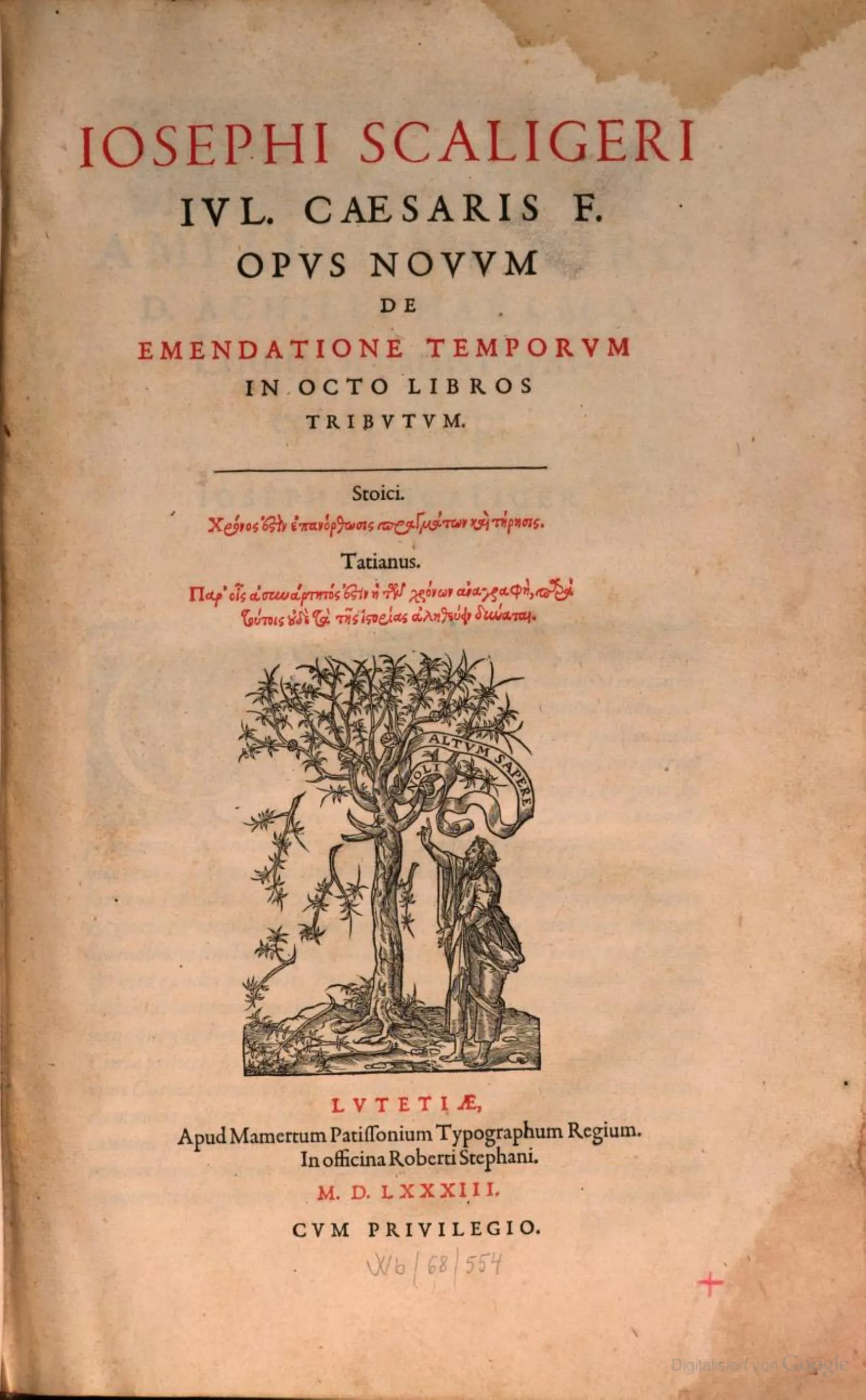
Title page of De emendatione temporum (1583), Scaliger's treatise on the correction of historical time. Baudius places that labour, emendatio temporum, at the summit of Scaliger's achievement, and his closing claim that the books themselves form Scaliger's truest likeness gives this printed page the force of a portrait. Source ↗.

Linguistic mastery is treated in the same instrumental spirit. Baudius portrays Scaliger as an autodidact: non vivæ vocis præsidio, non ope interpretis subnixus hasce molestias exantlavit, sed suis auspicijs re[m] gessit, usus tantùm mutis illis magistris, quos fidelissimos consiliarios appellabat eximius regum Alphonsus. Relying neither on a living voice nor on an interpreter's aid, he endured these labours, conducting the campaign under his own auspices and using only those mute masters, books, whom the excellent King Alfonso called his most faithful counsellors. Even here the military-civic idiom of suis auspicijs recurs. Baudius nonetheless subordinates languages to things: sanè varietas loquelarum non instruit nos scientia reru[m], sed viatico, "truly, the variety of tongues does not furnish us with knowledge of things, but with provisions for the journey."
The orator's praise concerns a capacity to assess evidence and command extensive learning, not simply an accumulation of reading. The oration's valuation of scholarship can consequently be compared with reconstructed scholarly practice without accepting every encomiastic claim.
Paul Botley and Dirk van Miert's eight-volume correspondence edition provides a further methodological correction. More than 1,600 surviving letters are presented in a critically established sequence, yet the corpus is substantially smaller than the correspondence Scaliger must have produced. Mandelbrote emphasizes the role of recipients, collectors, seventeenth-century editors, and copyists in shaping its survival. Baudius belongs to that commemorative and editorial history, not merely to the category of eyewitness biographer.
The tension between inherited nobilitas and intellectual merit is another important feature. Claims of noble descent and claims of learned excellence could support one another, but they required different kinds of proof. Baudius makes both claims through the relation of father and son. Julius Caesar Scaliger is vir sine exēplo maximi, "a man of the greatest [name], without precedent." Yet the son surpasses him by uniting excellences that others held only singly: ea junctim universa solus possedit, "he alone possessed all these things together." The lineage itself is asserted against its loss of fortune: Scaligera nobilitas, quamvis exuta sit patrimonio majorum, & exterminata sedibus avitis per injuriu[m] potentiorum magno cum sæculi pudore. Scaliger's nobility survives, the orator argues, even though stripped of ancestral patrimony and driven from ancestral seats by the injury of the more powerful, to the great shame of the age.
The oration's hostile language towards an unnamed detractor invites comparison with the controversy over Scaliger's ancestry. Nevertheless, identification of that detractor as Caspar Scioppius, and a precise connection to Scaliger hypobolimaeus or the pseudonymous Confutatio stultissimae Burdonum fabulae, were not established from a verified annotation or critical apparatus. Their chronology, attribution, and pseudonym should not be supplied as settled particulars without that evidence.
The text itself does name the book it attacks. It asks whether erupit in auras immanior & horribilior liber quam est SCALIGER hypobolimæus?, whether any more monstrous and horrible book ever burst into the air than the "Scaliger Hypobolimaeus." The oration's target is therefore explicit at the level of title. Its author remains unnamed in the text, and the identification of that author, together with the Confutatio connection, remains unestablished.
The invective is unrestrained. It brands the author & abominandum pareret vespillonis atque exoleti scorti progenies, plagiarius, fur, delator, crucis candidatus,, the offspring of a corpse-bearer and a worn-out harlot, a plagiarist, thief, informer, and candidate for the cross who brought forth an abomination. Baudius contrasts this with Scaliger's own restraint: heros fastidioso contemptu, & constanti silentio vindicabat se ab hujusmodi nebulone, ne luto manum. Our hero vindicated himself from such a scoundrel by disdainful contempt and constant silence, lest he soil his hand with mud. In that contrast panegyric and counter-polemic serve the same vindication.
The portrayal of Scaliger's final illness also makes the work relevant to histories of religious identity and exemplary death. Christian devotion and the duty of commemoration reinforce the praise of learning. Baudius records that Scaliger cursed none more than unbelievers, atq[ue] exsecrationibus devovebat, quam atheos: nec, "and he cursed with execrations [none more] than atheists." The oration also laments a contemporary state of affairs in which dubium vocaretur meritum & satisfactio Servatoris, the merit and satisfaction of the Saviour were being called into doubt. The phrase belongs to the vocabulary of contemporary soteriological dispute.
Its theological language must not, however, be converted automatically into a documented intervention in the Arminian controversy simply because the speech was delivered at Leiden in 1609. A precise account of anti-Socinian argument, Christ's merit and satisfaction, or local confessional alignments requires passage-level contextualization beyond the evidence presently established.
The strongest scholarly foundation concerns Scaliger's learning, correspondence, and posthumous reputation. A comprehensive modern commentary devoted specifically to Baudius's pamphlet was not established. Its historical significance is substantial, but the bibliography of its individual paratexts, copy history, and immediate polemical reception remains incomplete.
Tracing the 1609 Leiden Pamphlet and the Getty Copy
Identification and the Goldmann association. The accessible Internet Archive record identifies the object as Oratio funebris dicta honori & memoriae maximi virorum Iosephi Iusti Scaligeri, by Dominique Baudier, published in 1609. The digitized text independently supplies the Baudius attribution and Leiden imprint. These witnesses establish the work's identity independently of any association with military architecture. The public record does not, however, identify an erroneous catalogue entry whose history would conclusively explain the mismatch.
A separate Google Books record describes Nicolaus Goldmann's Elementorum architecturae militaris: libri IV as an Elzevier publication of 1643. It originates from the National Library of the Netherlands, names Leiden University Libraries as the original source, and records digitization on 23 March 2017. That record has a different institutional and digitization history from the Getty pamphlet uploaded in 2015. Shared references to Leiden and Elzevier cannot establish that the two works belonged to one physical volume.
The evidentiary distinction is consequential. A metadata conflation remains the best-supported provisional diagnosis of the Goldmann association, but its originating record was not located. A Sammelband is positively documented for the Getty copy, although its recorded companion is Heinsius rather than Goldmann. A scanning error is not demonstrated by the accessible records. No verified copy-level evidence places Goldmann's 1643 treatise in the Getty memorial volume.
Imprint and physical description. The title is transmitted as Oratio funebris dicta honori & memoriae maximi virorum Iosephi Iusti Scaligeri. The author appears in the abbreviated form D. BAVDIO I. C.; I. C. identifies the author as a iurisconsultus, or jurist. The title-page OCR also preserves a professorial designation referring to history at Leiden. The chronology of Baudius's several chairs and his appointment as historiographer was not established from an authoritative appointment record. A later date assigned to his history chair should not be repeated without reconciling it with the 1609 title page.
The imprint reads "Lugduni Batauorum: Prostant apud Ludov. Elzevirium & Andream Cloucquium," 1609. Lugdunum Batavorum is Leiden; the named booksellers are Louis Elzevier and Andries Clouck. Because prostant apud specifies where copies were offered for sale, it is not, by itself, proof that both men personally performed the presswork. Their commercial participation is established more securely than the precise division of printing labour.
Robinson describes the original as a booklet of twenty-three pages. The Internet Archive catalogue places the delivery notice and French sonnet on page 23 and records a woodcut device on the title page and a historiated initial on page 3. An independently checked signature collation, format, leaf dimensions, and account of terminal blanks were not obtained. Quarto format should consequently remain unconfirmed rather than be supplied from probability.
Paratexts and performance. The prefatory epigram is attributed to IANI DOVSÆ F., Janus Dousa filius, or Jan van der Does the Younger, and concerns the likeness of Julius Caesar Scaliger. Its presence brings the father's reputation into the son's commemoration. The epigram hails the elder Scaliger as Æmule Naturæ, meta & spes Ultima rerum;, "rival of Nature, goal and last hope of things." It anticipates the oration's opening topos by declaring that only the subject himself is equal to his praise: Dicere; te nisi tu dicere nemo potest, "no one can speak of you unless you yourself." The paratext thus announces, on behalf of the father, the problem of inexpressibility that the speech confronts for the son.
The epigram's earlier publication history, the circumstances of its reuse, and the exact chronological implications of its attribution remain unresolved. No original locus or verified posthumous reprint history was established.
The delivery notice reads: "Habita est in auditorio Theologico Lugduni Batavorum XXVI. Ianuarij M DC IX. hora decima matutina, postridie ejus diei quo defuncti corpus sepultura mandatum fuit." It fixes the event on 26 January 1609 and places burial on the preceding day. The surviving institutional description is thus more precise than a general identification as an oration delivered somewhere within the university.
The French "Sonnet acrostique," on page 23, is signed R. I. de Nerée. The initials were not securely expanded, and an identification with "Richard Jean de Nérée" or a particular Leiden student or Huguenot cannot be adopted as established fact. A separate dedicatee was not verified.
The Getty copy and its companion. The catalogue's bound-with note names Daniel Heinsius's In obitum v. illustr. Iosephi Scaligeri and gives the reference SPECIAL 94-B20442. That note supplies a concrete institutional locator and establishes a memorial compilation involving the two Leiden scholars. It describes the companion imprint as "Antwerp: Ex officina Plantiniana Raphelengii, 1609." This is a catalogue statement, not an independently checked transcription of that companion's title page.
The Internet Archive additionally labels 9929587580001551 as a "Call number." Its status as a conventional physical retrieval shelfmark was not independently established, so it should be preserved as an identifier rather than silently substituted for SPECIAL 94-B20442. The digital object was added on 5 January 2015. Its identifier is https://archive.org/details/oratiofunebrisdi00baud.
No verified STCN or USTC number was obtained for the Baudius pamphlet or the Goldmann edition. Physical shelfmarks for additional copies at Leiden, the KB, the British Library, the BnF, or the Bayerische Staatsbibliothek were not established. Their inclusion as confirmed holdings would exceed the available evidence.
Transmission and reception. Heinsius and Baudius produced complementary commemorations of the same scholar. Robinson identifies Heinsius's printed delivery statement as placing his oration immediately after the funeral on 25 January; Baudius's statement places his own speech on the following morning. The Getty binding therefore joins texts with distinct performance occasions, rather than two interchangeable versions of one speech.
The relationship also extended beyond commemoration. Mandelbrote identifies Baudius among Scaliger's friends who published, assisted with, or contemplated editions of his correspondence. Their editorial activity helped determine the later shape of Scaliger's reputation. This continued in practice the oration's own closing claim that Scaliger's enduring presence lay in his written legacy. Nevertheless, a verified chain of replies directed specifically against Baudius's pamphlet, or proceedings arising from it, was not located. Its denunciation of an unnamed detractor cannot alone establish a particular adversary's identity.
Robinson's 1927 volume supplies an established English transmission. Its contents place Baudius's oration at page 89, while the index cites the translated text at pages 91–116. The precise reprint history in Baudius's collected Orationes, in Illustrium virorum orationes, or in other memorial compilations was not verified. No censorship, suppression, or confiscation affecting this pamphlet was documented; that absence is not proof that no restrictions ever existed.
Following Baudius's Argument from Exordium to Written Likeness
The Prefatory Epigram and the Exordium
The printed pamphlet opens not with Baudius's voice but with a Latin elegiac epigram by Janus Dousa the Younger, headed IANI DOVSÆ F, "of Janus Dousa the son," and addressed in effigiem to the likeness of Julius Caesar Scaliger. The placement is deliberate. Before the son is mourned, the father is set before the reader as nature's competitor rather than her pupil, in the apostrophe to the rival of Nature, goal and last hope of things, already considered among the pamphlet's paratexts. The poem's governing claim, that no one can speak of him unless he speaks himself, carries the topos of inexpressibility into the paratext before the oration has begun. Two strands that the speech will braid together are thus already present in the opening leaf: a dynasty of matchless men, and the inadequacy of any portrait, verbal or pictorial, to render them. The epigram's concern with an effigies also prepares the oration's final substitution of written works for painted likeness.
Baudius's exordium takes up the paradox at once, opening on the confession that words fail before boundless things. He would prefer a sacred silence, and he recalls, without naming him, the painter Timanthes, who veiled the grief he could not paint. The modesty is conventional, but its resolution is not merely formal. What breaks the silence is duty: in the sentence on which the oration's whole conception of pietas rests, Baudius declares that it cannot be done with piety unimpaired that his voice should be silent on this day. Pietas here is the obligation the living owe the dead and the community owes its great men. Later in the oration the same word will name Scaliger's own Reformed devotion. That double use lets the orator's office and the deceased's virtue mirror one another.
The first exemplum then sets the civic register that governs the whole speech. Baudius borrows the words Metellus Macedonicus spoke at the death of his political adversary Scipio Aemilianus, bidding his sons attend the funeral, since they would never see the funeral of a greater citizen. Two effects follow. Scaliger becomes a civis, a citizen whose burial is a public event of the commonwealth. The exemplum also models magnanimity towards an enemy, an ideal the oration will conspicuously fail to practise when it reaches Scaliger's detractor.
Lineage and the Self-Taught Polyglot
Having announced that Scaliger surpassed every age in lineage, character, and learning, Baudius sets external fortune aside as superfluous to a man rich in his own goods. Only the father is singled out among the ancestors, as a man of the greatest name, without precedent.
The dynastic argument turns on a commonplace about degenerate heirs: eagles do not breed doves, yet glorious ancestors often breed sloth. Against this Baudius presents Joseph as the crowning increment to his father's fame, the one who alone possessed together all the excellences admired singly in other great minds. Those excellences converge in one person. The hinge matters for the oration's larger strategy. Inherited nobility and personal merit are made to confirm each other, so that the son's learning becomes evidence for the lineage, and the lineage frames the learning as something more than private accomplishment.
From lineage the oration passes to languages, and here Scaliger becomes a polyglot who conquered his learning alone. He mastered nearly every tongue that possessed written monuments, and he did so, in the passage already examined for its portrait of the autodidact, without the aid of a living voice or an interpreter, conducting the campaign under his own auspices and using only those mute masters whom King Alfonso called his most faithful counsellors. The idiom is military and magisterial: suis auspicijs rem gerere is the language of a Roman commander acting on his own authority. The royal anecdote ennobles book-learning, since books become counsellors to a king. Baudius then rehearses the humanist complaint about the burden of language-study, that the variety of tongues furnishes not knowledge of things but only provisions for the journey. He grants the complaint only to exempt "diviner minds" from it. Such minds learn so readily that Plato's doctrine of learning as recollection seems plausible, and they move like the stellar orbits, without fatigue. The concession thereby becomes a means of elevation. The movement culminates in the most explicit transfer of Roman constitutional dignity in the oration, the formula by which Scaliger is the man before whose dignity the fasces are lowered, the perpetual Dictator of all sciences.
Public Utility and the Hierarchy of Learning
Sovereignty demands a justification, and Baudius supplies it through public utility. Scaliger was the oracle and sanctuary of sacred and profane history. He gathered learning not for private delight or display but, as the oration puts it in a phrase noted earlier, to bring it into the common stock and share it for public uses. The phrase converts erudition into a contribution to the commonwealth, the fiscal and civic sense of in commune conferre making knowledge a kind of public revenue.
On this footing the oration ranks Scaliger's achievements. Chronology stands highest, as sacred precincts closed to the profane: the correction of times, the most accurate of all his labours. Before the reader, too, the Eusebian chronicle opens as a grove to be entered with awe, now lit by midday light. The image of a once-dark sacred wood flooded with noon presents chronological reconstruction as illumination. Criticism receives the language of rule, in the declaration that by the judgement of all who estimate rightly Scaliger reigns as prince in criticism without dispute, rival, or competitor. The verb dominatur and the title princeps keep critical judgement within the vocabulary of sovereignty. The appeal to those who judge "rightly" quietly excludes dissent from the community of competent judges. The republic of letters itself acquires magistrates in the same movement, through the remark on how often two of its triumvirs mentioned him. Baudius leaves the two colleagues unnamed, so the reader must supply them.
Philology, by contrast, is pointedly placed below these labours, loved only when the intervals of business allowed. Even such recreation must be defensible before the commonwealth. Baudius therefore invokes Cato's dictum that famous and eminent men must render account of their leisure no less than of their business. The maxim protects Scaliger's lighter studies by making them accountable. The same hierarchy explains Baudius's contempt for antiquarians who seek a cheap laurel by reviving obsolete words.
The orator then inserts himself into the picture. Echoing Virgil's hoc opus, hic labor, he congratulates his own genius on the familiarity and intimate admission he enjoyed with the great man. His critical judgement of Scaliger's verse is authorized by closeness to Scaliger, and his own standing is bound up with the reputation he is constructing.
The Polemical Digression
The longest movement is a polemical digression, and it disturbs the oration's composure. Envy, the inseparable shadow of virtue, is said to reveal Scaliger's greatness as shade reveals light, and Cato, Horace's Virtus repulsae nescia, and Hercules are summoned as witnesses. The target is then named through his book, in the indignant question whether any more monstrous and horrible book ever burst into the air than the Scaliger hypobolimaeus. The title-word means a supposititious child, a changeling. It fuses legitimacy of birth with legitimacy of authority, and the funeral oration becomes, for these leaves, a counter-pamphlet. Its author, unnamed, receives a genealogy of infamy in return for the one he denied Scaliger: he is made the offspring of a corpse-bearer and a worn-out harlot, plagiarist, thief, informer, and candidate for the cross. The slander on lineage is turned back on its source.

Pieter van der Heyden's engraving of Envy after Pieter Bruegel the Elder, published in 1558, gives Invidia monstrous form. It offers a visual counterpart to Baudius's digression, in which Envy is virtue's inseparable shadow and Scaliger's unnamed detractor is answered in the language of vice and infamy. Source ↗.

Yet Baudius immediately praises the opposite conduct in his hero, who vindicated himself from such a scoundrel by disdainful contempt and constant silence, lest he soil his hand with mud. The eagle does not hunt flies. The tension is unresolved: the orator speaks at full volume where his subject chose silence, and the Metellan magnanimity of the exordium has no place here. The resolution, so far as there is one, lies in the division of labour between hero and panegyrist. Scaliger's dignity forbids reply, so his friend must make it for him.
The movement ends by reasserting both offices and blood. Scaliger is once more styled the man of his age and leader of the senate of the learned. His lineage stands firm in the sentence that defends Scaligeran nobility as enduring, though stripped of ancestral patrimony and driven from ancestral seats by the injury of the more powerful, to the great shame of the age. The lost Veronese lordship becomes evidence of fortune's injustice rather than of a false claim. With Bias, Scaliger carries all his goods with him.
Pietas and the Deathbed
The final movement crowns the portrait with pietas in its confessional sense, a virtue the oration calls rarer among the learned, whom knowledge often puffs up into contempt of God. Scaliger, Baudius records, cursed none more than atheists. After glosses on conscience as a domestic torturer and on Achilles' hatred of duplicity, Solon's rule that no one is blessed before death opens the deathbed narrative. Scaliger foresaw his end, made his will, and spoke on the articles of the faith already rehearsed: the human race, justification by faith in Christ, and the resurrection of bodies and the immortality of souls. These are the credentials of orthodoxy before a Reformed university.
Roman constancy is joined to them in the resolve, mindful of his origin, that an emperor ought to die standing. Vespasian's saying is set beside the Pauline desire to be dissolved and be with Christ. The word originis once more lets lineage colour the manner of dying. Scaliger's grief at the times enters a note of contemporary anxiety, for he lamented an age in which the merit and satisfaction of the Saviour were called into doubt. The vocabulary belongs to current soteriological dispute, though the text names no party.
Consolation and the Written Likeness
Consolation follows. The body buried the previous day awaits resurrection while the soul enjoys its reward. The bereavement extends beyond Leiden, since not this Academy alone but the whole republic of letters has been struck by grave loss and wound. Mourning, however, is to yield to congratulation, and the dead man's presence is relocated in his writings, where one may contemplate a likeness better expressed than by the brush of Apelles or the chisel of Lysippus. The figure answers the epigram on the father's effigies and the veiled painting of the exordium. Words, which failed before boundless things, prove in the end the only adequate portrait, provided they are the subject's own.
Baudius congratulates the city on having possessed such a man, dum est sæculo nostro, quod Leida primario, &, a broken phrase that speaks of "our age" and of Leiden as "foremost," then pledges his service to the students and gives thanks to the assembly. The printed note fixes the occasion as one of public record, Habita est in auditorio Theologico Lugduni Batavorum, "it was delivered in the theological auditorium at Leiden." A French acrostic sonnet spelling Scaliger's name and signed R. I. de Nerée closes the pamphlet by setting the plainness of the tomb against the worth it encloses.
Further Reading on Scaliger, Baudius, and Leiden Humanism
Grafton, Anthony. Joseph Scaliger: A Study in the History of Classical Scholarship. Vol. 1, Textual Criticism and Exegesis; vol. 2, Historical Chronology. Oxford: Clarendon Press, 1983–1993.
Grafton's reconstruction of Scaliger's textual and chronological scholarship supplies the principal corrective to funeral panegyric. It permits Baudius's assertions of intellectual supremacy to be distinguished from the demonstrable methods, achievements, and limitations of Scaliger's scholarship. The comparison is invited by the oration itself. Baudius ends by offering Scaliger's writings as his truest portrait, effigiem melius expressam quàm penicillo Apellis, aut coelo Lysippi, "a likeness better expressed than by the brush of Apelles or the chisel of Lysippus." Grafton's study examines that written likeness on its own evidentiary terms.
Grootens, P. L. M. Dominicus Baudius: Een levensschets uit het Leidse humanistenmilieu, 1561–1613. Nijmegen and Utrecht: Dekker & Van de Vegt, 1942.
This specialist biography provides the appropriate starting point for Baudius's position within Leiden humanism and for investigating his professional appointments. Its bibliographical identity is established; detailed claims about its interpretation of this particular oration require consultation of the relevant passages.
Botley, Paul, and Dirk van Miert, eds. The Correspondence of Joseph Justus Scaliger. 8 vols. Travaux d'humanisme et Renaissance 507/1–8. Geneva: Droz, 2012.
The edition's historical introductions, identification of correspondents, and reconstruction of textual transmission illuminate the relationships behind the memorial orations. Its critical apparatus also guards against treating the surviving correspondence as an unmediated or complete record: early recipients, collectors, and editors substantially shaped what survives. The edition thereby documents the editorial labour through which Scaliger's friends, Baudius among them, sustained the public and lasting authority that the oration claimed for him.
Frequently Asked Questions
What is Dominicus Baudius's funeral oration for Joseph Justus Scaliger?
It is a Latin academic funeral speech, the Oratio funebris dicta honori & memoriae maximi virorum Iosephi Iusti Scaligeri. Its author was Dominicus Baudius (Dominique Baudier, 1561–1613), a jurist and Leiden professor. He delivered it in the theological auditorium of the University of Leiden at ten in the morning on 26 January 1609, the day after Scaliger's burial.
The printed pamphlet, of some twenty-three pages, appeared at Leiden that year and was offered for sale by Louis Elzevier and Andries Clouck. It carries a Latin epigram by Janus Dousa the Younger on the likeness of Julius Caesar Scaliger and a French acrostic sonnet signed R. I. de Nerée. Daniel Heinsius had delivered a companion oration the previous day.
Is there an English translation of Baudius's Oratio funebris for Scaliger?
Yes. George W. Robinson translated it in Autobiography of Joseph Scaliger (Cambridge, Massachusetts: Harvard University Press, 1927), alongside Heinsius's companion oration. The translated text runs at pages 91–116.
Robinson reported finding no earlier translation of either oration into any language. That statement records his own search in 1927 and does not prove that no other version ever existed.
Separately, the Leo edition presents a full transcription of the Latin with a complete English translation generated by AI, available at no cost. Leo is an effort to make freely available online English translations of every text printed in Latin in early modern Europe between 1450 and 1750.
Why does Baudius rank Scaliger's criticism above his philology?
Baudius treats critical judgement as Scaliger's sovereign achievement and philology as a recreation pursued only in the intervals of business. In criticism, he declares, Scaliger reigns as prince without dispute or rival. Chronology, the correction of times that brought the groves of Eusebius into midday light, stands highest of all.
Philology here carries a narrower, leisure-time sense than the comprehensive discipline the word usually names. Baudius defends even that leisure with Cato's dictum that eminent men must account for their leisure as for their business.
The hierarchy is best read as a local strategy of praise, not proof of a division every contemporary accepted. The work of Anthony Grafton and Henk Jan de Jonge on Scaliger's chronology gives it particular weight.
What was Scaliger hypobolimaeus, and who wrote it?
It was a libel attacking Scaliger's claimed descent from the della Scala lords of Verona. Its title brands him a supposititious child, a changeling.
Baudius names the book and asks whether any more monstrous and horrible book ever burst into the air. He calls its unnamed author the offspring of a corpse-bearer and a worn-out harlot, a plagiarist, thief, informer, and candidate for the cross.
The libel is conventionally associated with Caspar Scioppius. However, the oration never names him, and the attribution has not been secured from a verified critical apparatus. Baudius sets his own fury against Scaliger's disdainful silence, kept so that he would not soil his hand with mud.
How does Baudius portray Scaliger's death?
He presents it as Roman constancy joined to Reformed Christian hope. Scaliger foresaw his end, made his will, and spoke of justification by faith in Christ and the resurrection of bodies. Mindful of his origin, he held with Vespasian that an emperor ought to die standing, while sharing the apostle Paul's desire to depart and be with Christ.
He is said to have lamented an age in which the merit and satisfaction of the Saviour were called into doubt. That is the language of contemporary soteriological dispute, though its exact relation to Leiden controversies in 1609 remains unestablished.
The oration ends by placing his immortality in his writings. These, Baudius claims, are a likeness truer than Apelles' brush or Lysippus' chisel.
This report was generated by an advanced AI assistant that conducted deep research alongside an extensive interpretation of the transcribed original text. Every effort has been made to preserve fidelity to the source and to guard against inaccuracy, but corruption in the text recognition process and model hallucination may nonetheless have entered the text. Treat every claim, quotation, translation, and citation as provisional, and verify each against the original source before relying on or citing it.
Bibliography
- Paul Botley and Dirk van Miert, eds., The Correspondence of Joseph Justus Scaliger: Eight volumes and more than 1,600 letters, edited with a rigour Scaliger himself might have grudgingly approved. Read it for the circle of friends Baudius belonged to, and for proof that the "republic of letters" the oration mourns survives only in what correspondents and editors chose to keep. Its apparatus is the best available check on the orator's flattering memory.
- Anthony Grafton, Joseph Scaliger: A Study in the History of Classical Scholarship: Baudius promised that Scaliger's books were his truest likeness, and Grafton took him at his word, examining the textual criticism of volume one and the chronology of volume two with forensic care. Readers who want to know whether the "perpetual Dictator of all sciences" earned his fasces should start here. The second volume in particular explains why the oration placed the "correction of times" and the groves of Eusebius above mere philology.
- P. L. M. Grootens, Dominicus Baudius: Een levensschets uit het Leidse humanistenmilieu, 1561–1613: The orator, for once, becomes the subject, which is only fair to a man who spent so much eloquence on other people. This Dutch biography is the place to sort out Baudius's tangled chairs, his Leiden standing, and the career that made him the right voice for the morning after the burial. Readers puzzled by the "history" professorship on the 1609 title page should consult it before trusting later dates.
- Scott Mandelbrote, "Review of The Correspondence of Joseph Justus Scaliger," Bryn Mawr Classical Review: A short, shrewd review that sets Housman's sneers and Wilamowitz's reservations against the more generous reassessment led by Grafton and Henk Jan de Jonge. It also reminds readers that the surviving letters are "very much less than the sum total" Scaliger wrote, filtered through seventeenth-century editors, Baudius among the friends involved. It is the quickest route from this funeral oration to the modern argument over Scaliger's reputation.