Sacred, Constant, Unmoved: Marcus Zuerius van Boxhorn's Various Political Treatises: Institutes, Political Cases, and Dissertations on Government
Marcus Zuerius van Boxhorn, the Leiden professor who taught politics to the young Dutch Republic in the 1640s, left behind a body of lectures, disputations and case studies that a publisher gathered after his death as V. Cl. Marci Zuerii Boxhornii Varii tractatus politici, quorum seriem index tractatuum, operi praefixus, indigitat (Amsterdam, 1663). Its central claim is that a government's majesty rests finally on the settled judgment of the governed, and that every law, privilege and grievance must be weighed against the survival of the commonwealth. Written in a state that had just won independence by revolt, it remains one of the clearest windows onto how the Dutch reasoned about power, consent and the right to resist.
ExLatinis
16 October 2026

Contents
Marcus Zuerius van Boxhorn, the Leiden professor who taught politics to the young Dutch Republic in the 1640s, left behind a body of lectures, disputations and case studies that a publisher gathered after his death as V. Cl. Marci Zuerii Boxhornii Varii tractatus politici, quorum seriem index tractatuum, operi praefixus, indigitat (Amsterdam, 1663). Its central claim is that a government's majesty rests finally on the settled judgment of the governed, and that every law, privilege and grievance must be weighed against the survival of the commonwealth. Written in a state that had just won independence by revolt, it remains one of the clearest windows onto how the Dutch reasoned about power, consent and the right to resist.
Marcus Zuerius van Boxhorn (1612–1653) taught history and politics at Leiden during the last decade of the Eighty Years' War and the first years of the peace. The Varii tractatus politici, published at Amsterdam by Caspar Commelin in 1663, ten years after his death, gathers his Latin academic political writings into a single volume. It contains a systematic textbook, the Institutiones politicae; a sequence of historical cases distilled into political maxims, the Disquisitiones politicae; dissertations on the Roman regal and imperial constitution; a group of shorter dissertations on succession, election, punishment, public wealth, amnesty and law; and a concluding description of the Batavian Republic. Much of this material originated in teaching during the early 1640s and circulated in lecture notes and anonymous editions before Commelin collected it. The book is therefore the posthumous record of a university political science rather than a fresh intervention in the politics of the 1660s. It has sometimes travelled under a wrong attribution to Johannes Scheffer, whose genuine treatise on ancient naval warfare has nothing to do with these contents.
The problem that unites these varied writings is how a commonwealth can hold power strong enough to preserve itself while that power rests on, and is bounded by, the consent of those it governs. Boxhorn's recurring answer is to make the safety of the commonwealth, salus Reipublicae, the measure of every subordinate claim. Laws, privileges, private grievances, religious policy and constitutional forms are each judged by whether they serve the preservation of the political body. He then hedges the prerogative this produces with several limits:
- the mutual consent of rulers and subjects;
- fundamental laws;
- divine and natural law;
- a deliberately high threshold for resistance, which may be exercised only by public authority.
Supreme authority, majestas, is located less in the ruler's person than in the settled judgment of the subjects that their governors rightly govern. The same logic yields a striking constitutional relativism: the best form of commonwealth is whichever is fitted to a people's character, and the idea of a mixed constitution is declined.
The stakes were considerable in the Dutch Republic of Boxhorn's lifetime. The authority of the provincial States, the place of the Stadholder, the justification of the Revolt against Philip II, and the relation between confessional allegiance and constitutional loyalty were all live and contested. Modern historiography has struggled to classify him. Labels such as Aristotelian, Bodinian, Tacitist and republican each capture something and fail to capture the whole. Jaap Nieuwstraten has placed him between late humanism and the early Enlightenment, with affinities to problems later associated with Hobbes and Pufendorf. The evidence for direct transmission to later Dutch theorists such as the De la Court brothers remains a suggestion rather than a demonstration.
Several features make the work memorable to a first-time reader:
- Clapmar. Boxhorn takes Arnold Clapmar's vocabulary of the jus dominationis and pointedly refuses its phrase "legitimate tyranny."
- The States and taxation. He describes the Dutch States as bodies that once begged rather than commanded taxes.
- Persuasion, not command. He presents the provincial assembly as a place of persuasion rather than compulsion of the towns.
- Unreconciled positions. He leaves certain positions standing side by side without forcing them together: Stoic severity toward the guilty beside an almost unlimited case for amnesty, and arguments for election beside arguments for hereditary succession, debated on both sides in the manner of the academic disputation.
- Reception in English. The Disquisitiones reached English readers in 1701 as Arcana Imperii Detecta. Other vernacular versions, notably a possible German translation of 1653, await bibliographical confirmation.
The collection's history and its argument run along the same line. Its key terms, respublica, majestas and jus dominationis, describe authority that exists to preserve a community and depends on that community's recognition. The volume itself is a work of preservation: teaching that had circulated in fragments, anonymous editions and other men's hands was gathered under Boxhorn's name by a publisher who addressed it to three dedicatees. Its internal movement runs from abstract definition, through historical cases and the Roman constitution, to the institutions of the Dutch provinces. That movement enacts Boxhorn's conviction that political science must test its general propositions against the particular histories and characters of peoples.
Read the full text and English translation on Leo
This text was transcribed and translated as part of the ExLatinis project, an effort by Leo to make free English translations of every text published in Latin in early modern Europe (1450–1750) available online. The complete transcription and English translation of this work can be read free of charge:
→ Read the original Latin text and full English translation on Leo
You can save a copy of this document into your Leo account to run deep text searches, conduct further analysis, or cross-reference it with your own research.
Translating Boxhorn's Respublica: The Title, the Commonwealth and Majestas
Marcus Zuerius van Boxhorn, Various Political Treatises: Institutes, Political Cases, and Dissertations on Government (Amsterdam, 1663).
This is an editorial English title supplied for convenience, not an established historical translation-title. The printed collective title is V. Cl. Marci Zuerii Boxhornii Varii tractatus politici, quorum seriem index tractatuum, operi praefixus, indigitat: approximately, "Various Political Treatises of the Distinguished Marcus Zuerius Boxhorn, whose sequence is indicated by the index of treatises prefixed to the work."
The breadth of the collection depends upon a meaning of respublica that cannot be restricted to government without a king. Boxhorn's political community encompasses different arrangements of government. His definitions associate it with a plurality of bodies brought under common laws for the utility of all and each.
The Institutiones open by defining politics as the science that hands down the care and method of constituting, preserving and enlarging the commonwealth, POLITICA, Scientia est, quæ constituendæ, conservandæ, augendæque Reipublicæ curam ac rationem tradit. That triad already gives preservation the central place it holds throughout the collection. The definition of the commonwealth follows: a rule over many bodies, imbued with the same laws for all and each for the sake of utility, and directed toward acknowledging the majesty of that same rule, Respublica est Imperium corporum multorum ad agnoscendam ejusdem Imperii Majestatem, iisdem legibus omnium & singulorum, utilitatis causa, imbutum. The definition builds acknowledgment into the very concept of the commonwealth, and the theme of recognized authority recurs across the work.
Consequently, "commonwealth" is often a more discriminating translation than "republic": a discussion of the Roman kings belongs within the same science of political association as a description of the United Provinces. The language joins the constitution of a political body to the recognition of its governing authority, rather than identifying respublica with one constitutional form. Boxhorn draws the relativist consequence himself. He declares it mostly vain to dispute which form of commonwealth is better, since any form is best, and far to be preferred to the rest, that is attuned to the character of its own people, Ex quo apertum est, quæ Reipub. forma melior sit, frustrà plerumque disputari. Quævis enim optima & longè cæteris præferenda, quæ suorum ingeniis est attemperata.
Within that association, majestas denotes supreme authority, but its operation cannot be understood solely as a possession inherent in the ruler's person. Boxhorn locates its effective foundation in the subjects' settled judicium that those governing possess a rightful claim to govern. The text states this with emphatic adjectives: majesty is nothing other than the sacred, constant and unmoved judgment of the subjects, habet, est nihil aliud, quàm sanctum, constans, & immotum judicium subditorum,. Earlier in the Institutiones, the bond of rule is likewise presented as consensual. That bond, the supreme force and soul of all rule, is said to consist in the mutual and unconquered consent of rulers and subjects, Nexus ille, & suprema Imperii omnis vis & anima, in imperantium ac subditorum mutuo, invictoque consensu, consistit.
Nieuwstraten emphasizes the resulting dependence of authority upon acknowledgment and obedience. This is not, without further argument, a doctrine of unrestricted popular government: recognition by subjects and participation in office are different questions. The consent described is a mutual bond between rulers and subjects, not a transfer of government to the subjects. Nevertheless, it qualifies a straightforward assimilation of Boxhorn to Bodinian sovereignty; Nieuwstraten expressly distinguishes Boxhorn's position from the requirement that sovereignty be indivisible.
The limits of authority emerge particularly clearly in jus dominationis. This denotes an extraordinary right exercised for the preservation of the commonwealth, rather than a general authorization of arbitrary rule. Boxhorn accepts the importance of political necessity while rejecting Arnold Clapmar's expression "legitimate tyranny." In his own words, he does not therefore think that, with Clapmarius, it should be called legitimate tyranny, for tyranny cannot be called legitimate, Non tamen idcirco, cum Clapmario, legitimam Tyrannidem appellandam censeo, neque enim Tyrannis legitima dici potest,. An authority directed toward preserving the political community cannot simply be equated with tyranny directed toward its destruction.
The safety of the people and preservation of the commonwealth therefore function as justificatory conditions, not merely as ornamental appeals accompanying an unlimited prerogative. The same subordination governs positive law: the commonwealth does not exist for the sake of the laws, but laws were instituted for the sake of the commonwealth, enim Respublica est propter Leges, sed propter Rempublicam sunt Leges institutæ. It governs inherited privilege too, for the commonwealth is not subject to privileges, but privileges to the commonwealth, quippe Rempubl. non subesse Privilegiis, sed Reipubl. privilegia,. Law and privilege are thus measured by the same standard of preservation that justifies, and limits, the jus dominationis. These distinctions are documented in Nieuwstraten's discussion of the Institutiones, especially I.4.4 and I.6.11.
Identifying Boxhorn's Varii tractatus politici and Its Core Principles
The identifiable political compilation is Marcus Zuerius van Boxhorn's Varii tractatus politici, published at Amsterdam by Caspar Commelin in 1663. It is a posthumous collection of Latin academic political writings, not Johannes Scheffer's antiquarian treatise on ancient naval warfare. Its components include the Institutiones politicae, the Disquisitiones politicae, dissertations concerning Roman government, shorter political dissertations, and a description of the Batavian Republic. Boxhorn lived from 1612 to 1653; the Amsterdam publication date must therefore be distinguished from the earlier composition and teaching of its constituent texts.
A Scheffer attribution to these political contents is a misidentification. The particular discrepant catalogue record could not, however, be independently located. The distinction between the two works is secure; the location and cause of the catalogue–content mismatch are not. No verified evidence establishes that the physical copy is a Sammelband containing both authors.
The collection combines general political propositions with historically grounded inquiry into government, obedience, necessity, and the preservation of political society. Preservation is stated in the text as an overriding tacit mandate. In a passage concerned with the Inquisition being forced on subjects, the work holds that the safety of the commonwealth and of the prince is always the supreme mandate, above all others, subditis, Inquisitio obtrudatur. Salutem Reipubl. & Principis supremum semper esse & supra cætera mandatum. The work's practical counsel also prefers what can be carried out to what is best argued. It is better, Boxhorn holds, to choose what you approve less and can execute than what you approve more and cannot execute, Melius est quod minus probes & exequi possis, quam quod magis probes & exequi non possis. These two principles, preservation as the supreme measure and prudence as its method, connect the textbook definitions to the historical cases.
Its intellectual setting is Boxhorn's teaching at Leiden, although no single place or date of composition can be assigned to every constituent work. Commelin's signed dedication establishes his active involvement in presenting the collected writings; it does not by itself identify every editorial intervention.
Translation occurred at the level of individual works rather than demonstrably of the complete 1663 collection. An English version of the Disquisitiones appeared in 1701 as Arcana Imperii Detecta; or, Divers Select Cases in Government. A possible German version associated with Europae auffgedekkte Wunden (1653) requires further bibliographical confirmation. A Dutch translation of the complete compilation has not been established.
Classifying Boxhorn: Aristotelian, Bodinian, Tacitist or Republican?
Boxhorn's political writings are important because they connect university instruction, historical learning, and reflection on the contested authority of the Dutch provincial States. Their publication history also complicates any interpretation based solely on imprint dates. Nieuwstraten argues that material subsequently published in the Disquisitiones and Commentariolus originated in teaching during the early 1640s. The Commentariolus consequently carried arguments formed during war into publication after the peace settlement. The 1663 compilation cannot simply be read as a newly composed intervention in the First Stadholderless Period.
The Batavian account belongs to the constitutional justification of the Dutch Revolt. Nieuwstraten describes its opening defense of resistance to Philip II through the claim that the Dutch had acted to preserve their liberties and restore supreme authority to the provincial States. Such language must be understood through historically constituted bodies and privileges. It does not establish an undifferentiated sovereignty of all inhabitants.
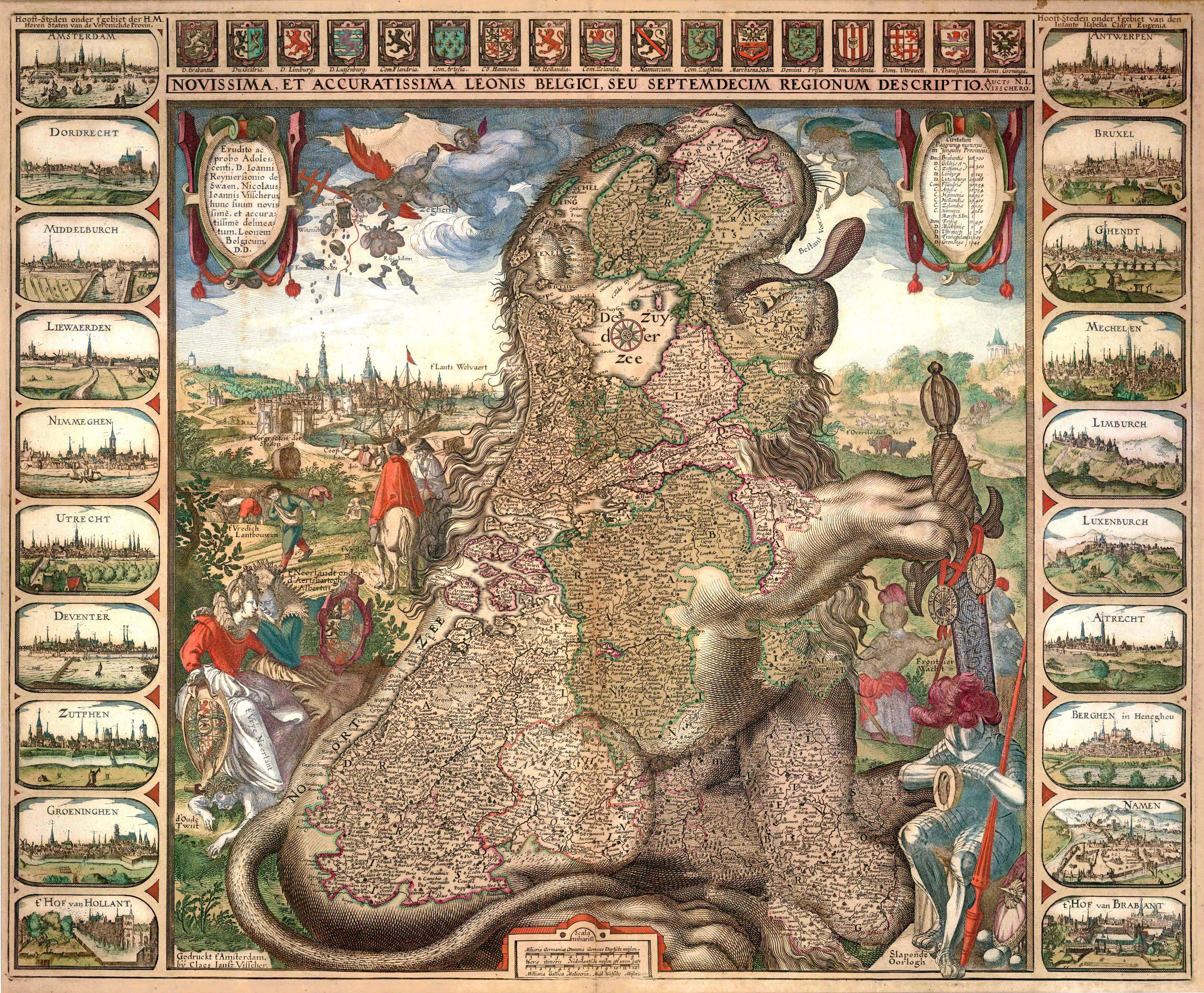
Visscher’s Leo Belgicus casts the seventeen provinces of the Low Countries as a single lion, an emblem of unity that still evokes a composite political geography. The same tension runs through the Batavian defence of the Revolt, which grounded liberty in the provincial States and their privileges. Source ↗.

The Batavian description grounds this corporate reading in fiscal and deliberative practice:
- Taxation by request. Discussing the petitions for revenue, the beden or preces, it records that those seeking revenue were said to beg rather than impose taxes, unde precari magis, quam imponere tributa dicebantur,.
- Persuasion of the towns. Of the States' assembly, it observes that there is not so much an authority to compel individual towns as a way of obtaining each one's consent by legitimate reasons, & in comitiis Ordinum non tam cogendi singulos esse authoritatem, quam modum per legitimas rationes obtinendi singulorum.
- Private credit for public need. Its account of military finance turns on the interdependence of public and private means: thus the private individual supplies for the present what the public lacks for the present, namely soldiers' pay, Sic privatus publico impræsens præstat, quod impræsens publicum non habet, stipendium dico militare.
In these passages, consent is solicited from towns and provincial bodies rather than from an undifferentiated people. The consensual vocabulary of the Institutiones thus reappears here in the language of corporate representation. The distinction between acknowledgment of authority, representation by corporate bodies, and participation in government is central to interpreting Boxhorn's political vocabulary.
Religious and institutional conflicts likewise resist simple party classifications. Leiden University stood within an arrangement involving the States of Holland, university curators, and the town's magistrates. Its political teaching was not detached from those relationships. Nieuwstraten also cautions against automatically equating Remonstrants with the States party and Counter-Remonstrants with Orangism. Oldenbarnevelt's position illustrates why confessional belief and constitutional allegiance cannot be treated as identical categories.
Boxhorn's own treatment of religion separates confessional truth from political allowance in a comparable way. Only one religion, he writes, can be true and please God, but meanwhile several can please the magistrate, Equidem una tantum religio vera esse potest, & una Deo placere, sed interim Magistratui placere plures possunt. Elsewhere he judges badly mistaken those who extend the argument so far as to hold that a Christian prince may impose Christianity on an infidel people and make war for its refusal, Quod qui eo usque extendunt, ut à Christiano principe infideli populo Christianam religionem imperari, & ob non admissam, bellum inferri posse statuant, maxime falluntur. These statements are textual starting points for the question of toleration; they do not by themselves constitute a detailed account of it.
E. H. Kossmann's studies supplied an influential framework for the history of political theory in the Dutch Republic. Jaap Nieuwstraten's 2012 dissertation offers the most directly relevant extended reconsideration of Boxhorn. Its central argument places him between late humanism and the early Enlightenment, identifying both inherited Aristotelian-humanist assumptions and affinities with problems subsequently associated with Hobbes and Pufendorf. Affinity is not equivalent to direct borrowing, and the chronology of teaching materials makes that distinction especially important. Boxhorn's contractual language shows why the distinction matters. His remark that contracts are not entered into except between equals, contractus enim non ineuntur, nisi inter æquales, invites comparison with later contract theory, but such resemblance cannot by itself establish a line of influence in either direction.
Nieuwstraten explicitly resists fitting Boxhorn's account of human beings and political society wholly into an Aristotelian mould. His treatment of majestas also complicates a simple Bodinian classification: supreme authority depends upon recognition and obedience, and Boxhorn does not straightforwardly reproduce indivisible sovereignty.
The text bears on this question from more than one direction. On one side, it holds that the supreme power of princes is not released from all the laws it has itself passed, and that it may diminish and confine itself and so increase the people's liberty, Ergo summa principum potestas non est soluta omnibus legibus, quas ipsa tulit; & eidem licet se ipsam imminuere ac coarctare, & sic libertatem populi augere;. On the other, it declares that neither here nor elsewhere is it necessary to acknowledge a mixed form of commonwealth, Mixtam enim Reipubl. formam neque hîc, neque alibi, necesse est agnoscere. The denial of a mixed constitution stands alongside the qualification of indivisible sovereignty. The passages alone do not settle how the two positions are to be related.
These findings do not warrant replacing "Aristotelian" or "Bodinian" with an equally comprehensive label of "republican." Different constitutional arrangements can be considered within his political science.
Tacitism presents a similar interpretative problem. Modern scholarship has differentiated several forms of Tacitism, including the use of Tacitus to defend princely power, criticize it, or support limited monarchy. Boxhorn has been associated with the last of these tendencies. Jan Waszink's methodological work is pertinent because historical use of Tacitus does not by itself identify one political programme. Boxhorn's acceptance of necessity and extraordinary measures must be weighed alongside his refusal to identify legitimate prerogative with legitimate tyranny.
The bounding of necessity is matched in the text by a high threshold for resistance:
- When tyranny may be cast off. The tyrant's rule is to be cast off only when, under him, the extremes of liberty have been reached, exuendum Tyranni imperium, deveniendum est, ubi sub eo deventum est ad extrema libertatis,.
- When a prince loses his rule. A prince does not lose his rule except by that crime through which the rule is believed about to perish, Imperium non amittit princeps nisi eo scelere, quo id creditur periturum.
Against private claims, conversely, the text sets the commonwealth's safety:
- Private grievance. The most equitable cause of any private person or subject becomes unjust, and so deserves punishment, when pursued with present harm to the commonwealth, Æquissima cujusvis privati & subditorum causa iniqua est, ac idcirco meretur poenam, ubi quis eam persequitur cum præsente damno Reipubl.
- The terms of civil society. Each person enters civil society on the condition that it is juster for an innocent private man to perish than for the commonwealth not to be safe for his sake, hac tamen lege quisque convenit in societatem civilem, ut justius sit perire innocentem privatum, quam ejus salutis causa Rempub. salvam non esse.
Prerogative, resistance and private right are thus all placed under the same justificatory measure of preservation that governs the correction of Clapmar.
The debates surrounding the De la Courts provide a related but distinct historiographical setting. As Nieuwstraten summarizes them, Haitsma Mulier has emphasized Hobbesian influence, while Hans Blom has emphasized Machiavelli and reason- or interest-of-state thinking given a naturalistic development. Those arguments concern the formation of later Dutch political thought; they cannot establish that every corresponding argument originated with Boxhorn. Haitsma Mulier's proposed role for Boxhorn as an intermediary remains a suggestion requiring particular textual evidence.
The strongest scholarly conclusion is therefore a qualified one: Boxhorn's political thought combined historical inquiry, inherited academic forms, attention to obedience, and arguments about political preservation. Its significance lies partly in the tensions among those commitments. Some of these tensions are left standing within the collection itself. De poenis sets out the position that it is not permitted to the wise man ever to grant pardon or forgive the guilty, Non licere sapienti interdum veniam dare aut ignoscere nocentibus. De amnestia, by contrast, holds that no offence ought to seem so great that, in a disordered and embattled commonwealth, it should be judged unworthy of amnesty, Nullum proinde tantum delictum videri debet, ut in turbata ac commissa Rep. indignum Amnestia censeatur.
On the law of nations, the text states that faith given in a public treaty must be kept even with a heretic, an infidel, an enemy and a rebel, Fides enim data publico foedere, servari etiam debet Heretico, infideli, hosti, & rebelli;. Such statements mark where fuller inquiry would begin. A detailed account of his religious toleration, international-law arguments, rejection of particular forms of tyrannicide, or influence on Spinoza requires further directly verified evidence rather than extension from general intellectual resemblance.
Tracing the 1663 Amsterdam Volume from Leiden Lectures to Print
Identification and the catalogue discrepancy
The collective title Varii tractatus politici is independently attested by the Amsterdam 1663 digital witnesses. The title-page transcription names Boxhorn and gives the imprint Amstelodami, apud Casparum Commelinum. The dedication also identifies the Institutiones, historical Disquisitiones, and dissertations concerning Roman regal government. These mutually supporting features establish the political compilation's identity independently of any Scheffer attribution.

The 1663 Amsterdam title page fixes the compilation’s identity in print: Boxhorn’s name, the collective title Varii tractatus politici and the imprint of Casparus Commelinus frame the central printer’s device. The attribution rests on the book itself, not on any later association with Scheffer. Source ↗.
The Google Books witness LRUIdxJMjtEC identifies its source as the National Library of the Netherlands and records an extent of 631 pages. Its contents links locate the following:
- Institutiones at p. 1;
- Disquisitiones at p. 129;
- Roman political dissertations at p. 409;
- succession and primogeniture at p. 533;
- election and succession at p. 548;
- De poenis at p. 557;
- De primis opibus rerumpublicarum at p. 565;
- De amnestia at p. 577;
- De legibus at p. 594;
- De republica Batavica at p. 607.
These are useful bibliographical navigation points, not a substitute for a signature-by-signature collation. The abbreviated contents do not establish whether De Achaeorum republica has an independent heading or is incorporated elsewhere.
A second accessible witness is Internet Archive identifier bub_gb_woEluKpBUT0C, derived from Google Books identifier woEluKpBUT0C. Its metadata identifies the same collective title, publisher, and year, but lists 668 pages. That total must not be silently equated with the printed pagination or reconciled by conjecture with the other witness's 631 pages. A verified format, complete collation, record of separate title-pages, and account of any pagination irregularities remain unavailable. No securely verified STCN identifier or physical shelfmark for the Boxhorn witnesses was established.
The material distinction from Scheffer is clear. The University of Seville's Scheffer copy, shelfmark A 035(312)/153, is catalogued with the imprint Ubsiliae: Excudebat Johannes Janssonius, 1654, and the physical description, 348 pages, illustrated, quarto. Its record describes an engraved frontispiece and engraved illustrations. Heidelberg's digitization likewise presents Scheffer's naval treatise as four books, followed by addenda and an index. Neither accessible record identifies accompanying Boxhorn political writings. These independent copies establish the existence and character of Scheffer's genuine work; they do not establish the binding composition of the unidentified discrepant copy. A Sammelband, a wrongly attached digital object, and an erroneous catalogue attribution remain distinguishable possibilities, not interchangeable findings.
Publisher, dedication, and editorial responsibility
The 1663 dedication is signed Casparus Commelinus. It addresses three recipients in the forms Henrico Heidano, Carolo Heidano, and Gerardo Mastrichtio. Their complete vernacular identities and institutional positions have not been securely established. The plural dedication corrects any assumption that the volume necessarily had a single dedicatee.
The imprint establishes Commelin's publishing responsibility; the signed dedication establishes his participation in presenting the collection. Neither proves that he personally printed the sheets or prepared every text. A separate printer, a co-imprint involving Ravesteyn or Janssonius van Waesberge, and a complete editorial attribution have not been verified. Georg Horn is associated with a catalogue description of the 1668 Institutiones, but that association cannot be transferred automatically to the 1663 compilation.
The accessible transcription is too corrupt to authenticate the dedication's exact date-line. It also does not securely establish a separate address to the reader, the authorship of commendatory verse, the presence and engraver of a portrait, or a printing privilege. No documented censorship, suppression, or chain of contemporary proceedings against the 1663 volume was located; this is an evidentiary limit, not proof that none occurred.
Earlier transmission and later editions
The Disquisitiones first appeared in 1650. Nieuwstraten records that the 1650 and 1651 editions issued by Johannes Verhoeve omitted Boxhorn's name and lacked an authorial preface. Their anonymity is not evidence that Boxhorn used a pseudonym. His authorization of the publication cannot be assumed merely because the first edition appeared during his lifetime.
The Institutiones followed a different route. Its earliest edition appeared in the Holy Roman Empire in 1656, after Boxhorn's death. Nieuwstraten identifies substantial variation among editions: the Leiden edition of 1657 contains short theses, whereas Leipzig 1659, Amsterdam 1668, and Utrecht 1702 include explanations. The 1668 and 1702 editions also contain additional material in the first book. The 1663 collection should therefore not be treated as textually interchangeable with every edition carrying the Institutiones title.
Christian Friedrich Franckenstein's preface to the Leipzig edition of 1659 reports that he had received explanatory material approximately seventeen years earlier. Nieuwstraten discusses Johannes Fridericus Hanwaker as a possible intermediary. This evidence places an important part of transmission in the circulation of teaching materials before publication; it does not establish an authorially supervised collected edition. The dispersed and partly anonymous transmission of these writings gives the 1663 gathering the character of an act of preservation in its own right, though not of authorial completion.
The 1663 Roman and shorter dissertations belong to the same collected publishing project, but their complete independent publication histories remain unsettled. The relationship between the concluding Batavian description and the Commentariolus de statu Confoederatarum Provinciarum Belgii requires textual collation. Common subject matter and a shared pedagogical origin do not by themselves prove textual identity.
Teaching and reception
Boxhorn's connection with Leiden political instruction is well documented. In 1643 he obtained permission to conduct political disputations publicly. In 1648 he was permitted to give public historical lectures in place of Daniel Heinsius, whose dispensation from teaching was initially understood as temporary. Heinsius did not resume those duties. This is more precise than an unqualified claim that Boxhorn simply inherited a newly defined chair of history and politics.
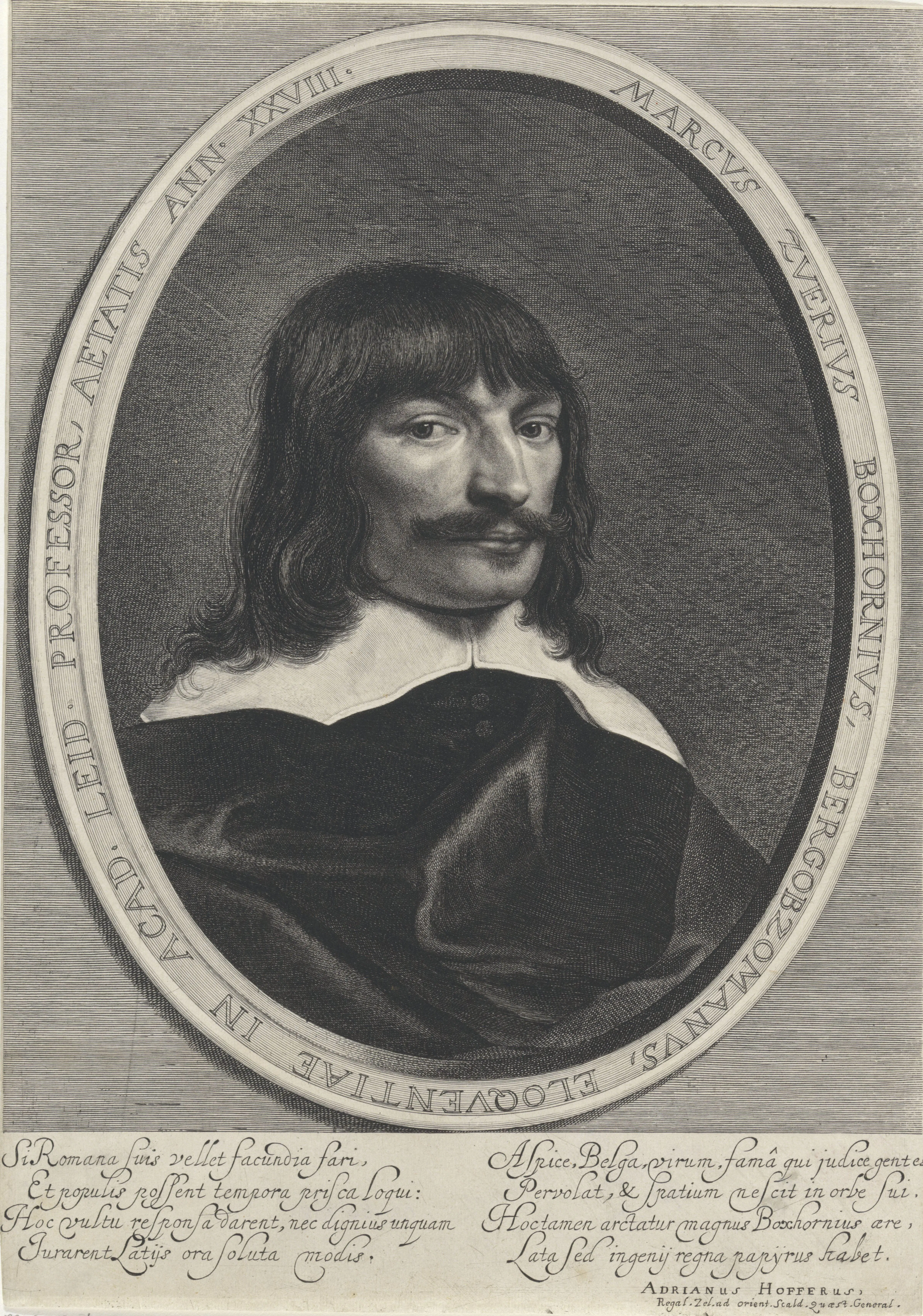
An engraved portrait of Marcus Zuerius Boxhorn, whose oval inscription names him as professor of eloquence at Leiden at the age of twenty-eight. His later political disputations and historical lectures grew from this learned culture of rhetoric, philology and history rather than from a newly created chair. Source ↗.

The collection's handling of election and succession shows the disputational habit of argument that such teaching cultivated, arguing the question on both sides. One formulation balances the two: a prince is well elected who, had he not been elected, ought to have been born one, and well born who, had he not been born one, ought to have been elected, Bene verò electus est Princeps, qui, nisi electus, nasci debuisset: Bene natus est, qui, nisi natus esset, eligi debuisset. Another presses the case against inheritance: in succession, not the ruler one wishes for but whoever is offered, good, bad, fit or unfit, is raised to royal dignity, In successione contra non qualis optatur, sed qualis offertur, bonus, malus, aptus, ineptus ad regiam dignitatem admovetur:. The manner is consistent with the academic disputation practice for which Boxhorn received public permission in 1643. No particular dissertation in the volume is thereby dated to that practice.
Baselius's account connects the Disquisitiones and Commentariolus with Boxhorn's teaching of historically grounded practical politics. The textbook's definition of politics as a science of constituting, preserving and enlarging the commonwealth reflects the same pedagogical conception of politics as a discipline that can be handed down. Repeated publication in the Dutch Republic and the Holy Roman Empire demonstrates circulation; it does not establish prescribed classroom use at every place of publication. A named German university curriculum requiring these particular works was not verified.
The English Disquisitiones of 1701 provides concrete evidence of later reception. By contrast, the possible German translation of 1653 remains a bibliographical lead. Nieuwstraten records Haitsma Mulier's suggestion that the De la Court brothers encountered Tacitus and Clapmar through Boxhorn. Boxhorn's explicit correction of Clapmar's "legitimate tyranny" shows that any such mediation would have carried a critical engagement with Clapmar, not a simple relay of his terms. That proposed mediation should not be elevated into demonstrated dependence. Direct citations or refutations by Ulrik Huber, Hermann Conring, and Spinoza, and a complete sequence of contemporary replies to the 1663 collection, have not been established.
Following Boxhorn's Argument from the Institutiones to the Batavian Republic
The Front Matter: Arcana Made Public
The volume's front matter tells the reader how to use what follows. The publisher's address presents the collection as a progressive course: the Institutiones are joined to the historical Disquisitiones, to dissertations described as laying wholly open the arcana of civil science, Civilis scientiæ arcanæ penitus recludentes,, and to a description of the Batavian commonwealth. Together these form a doctrine that embraces, besides general politics, the government of the Romans and the Batavians, ac Romanorum Batavorumque Imperii Doctrinam contineat. The phrase arcana penitus recludentes matters. It borrows the Tacitist vocabulary of hidden counsels of rule, but it promises their disclosure within a learned and teachable science. The address thus presents the book as the reverse of a manual for secret princely craft: it is an academic exposition that makes arcana into public knowledge. Much of what follows moves between those two poles, the arcanum and the openly taught ratio.
Institutiones politicae, Book I: Definition, Consent and the Prerogative
Book I of the Institutiones establishes that ratio in short numbered paragraphs, a textbook form. The definition of the commonwealth at its threshold, already discussed as a rule over many bodies imbued with common laws for the sake of utility and directed toward acknowledging the majesty of that same rule, contains from the outset the tension the whole treatise must manage. Three elements are joined in it that later chapters will pull apart and recombine:
- imperium, a vocabulary of command;
- utilitas, an Aristotelian end;
- agnoscere, an act of recognition.
The plural corpora multa is also significant. The commonwealth is a union of bodies rather than a single undifferentiated body, which is how the Dutch provinces and towns appear in the historical cases.
The third chapter describes the cohesion of these bodies in an animating metaphor: the bond, cited earlier, which is the supreme force and soul of all rule and consists in the mutual and unconquered consent of rulers and subjects. The language of anima turns consent into the vital principle of the political body rather than an external constraint on it. The adjective invictus turns a voluntary act into something unbreakable. The fourth chapter carries this further when it locates majesty on the subjects' side, defining it in this aspect as nothing other than the sacred, constant and unmoved judgment of the subjects. The run of adjectives (sanctum, constans, immotum) gives the subjects' opinion the fixity and inviolability that Bodin's tradition reserved for the sovereign's own power. Boxhorn does not abolish the majesty of rulers, which the chapter treats as a distinct quality. He doubles it, so that the stability of rule depends on a judgment its holder cannot command. The chapter then gives the commonwealth itself a majesty secured by laws devised for that purpose and commonly called fundamental, quæ pro eâ repertæ sunt, & vulgò fundamentales appellantur. The adverb vulgò shows that Boxhorn is taking over a term already in circulation rather than coining one.
The chapter on liberty draws the boldest juridical consequences. Liberties, it reports, were sometimes bought from needy princes under the formula of the Roman innominate contract, formula, in quibus est: Do, ut facias, "I give so that you may do." The sworn pact is then subjected to the rule of private law, already noted, that contracts are not entered into except between equals. The tension here is real. Applying the categories of the Digest to princely oaths makes the prince, within the scope of his pact, a party standing level with his people. The textbook does not resolve this against the commanding vocabulary of imperium with which it began. Instead it moves directly to the threat that such equality might be simulated. The Tacitean umbra libertatis, the shadow of liberty, receives emblematic form: it is a matron most beautiful at first sight who nonetheless hides a serpent in her bosom, libertatis est illa, primo aspectu pulcherrima matrona, quæ tamen in sinu serpentem tegit,. The image belongs to the emblem books and their moral allegory. The danger it names is political deception, a liberty kept in its outward forms while its substance is withdrawn. The same science that discloses arcana must also warn its readers against arcana turned on them.
Chapter 6 accordingly turns to the prerogative itself. The jus dominationis is taken from Clapmar, but its reach is restricted at once. The claim that all rights yield to it is qualified: only civil and common rights yield, not divine ones, juri dominationis omnia cedere jura; cedunt enim civilia & communia tantum, non divina,. The correction of the source follows in the refusal, examined above, to call the prerogative legitimate tyranny with Clapmar, since tyranny cannot be called legitimate. The objection is philological as well as moral. For a Latinist trained on Cicero and Aristotle, tyrannis names a rule perverted toward the ruler's own advantage, so the adjective legitima contradicts the noun. The prerogative stays standing, but the Ciceronian maxim directs it toward its end: Salus enim populi suprema lex esto, let the safety of the people be the supreme law. The same principle that elsewhere makes salus populi the tacit condition of subjects' liberty here becomes the ground of the ruler's extraordinary power. One maxim therefore authorizes the prerogative and measures it.
Religion is the domain where this measure is tested most sharply. Boxhorn separates truth from civil allowance in the sentence already cited, which grants that only one religion can be true and please God while several can meanwhile please the magistrate. The temporal adverb interim carries the weight of the sentence. It assigns plural religions to the time of civil life and leaves unity of truth to God's judgment, without conceding any confessional relativism. Toleration so grounded has limits, and the chapter excludes Anabaptists and atheists. Conscience, however, marks the one boundary at which prerogative gives way entirely: where God has kept dominion for himself, the jus dominationis must yield, sibi Deus imperium servavit, cedere oportet jus dominationis. The verb cedere, used earlier for the yielding of civil rights to prerogative, now runs the other way. That reversal shows the structure of the whole edifice: authority yields to necessity in civil matters, and necessity yields to God in matters of conscience.
The chapter on laws completes the instrumental logic with the principle, discussed above, that the commonwealth does not exist for the sake of the laws but the laws for the sake of the commonwealth. Civil laws may therefore change with the times, while the fundamental laws that secure the commonwealth's own majesty are exempt from that mutability. The chapters on treaties and war apply the same reasoning to relations between commonwealths, holding, as already observed, that faith given in a public treaty must be kept even with a heretic, an infidel, an enemy and a rebel. Read against the confessional polemics of the age, the rejection of any exemption for heretics has a clear Protestant edge. Boxhorn grounds it as much in the utility of a reputation for good faith as in conscience.
Institutiones politicae, Book II: Forms of Rule and the Threshold of Resistance
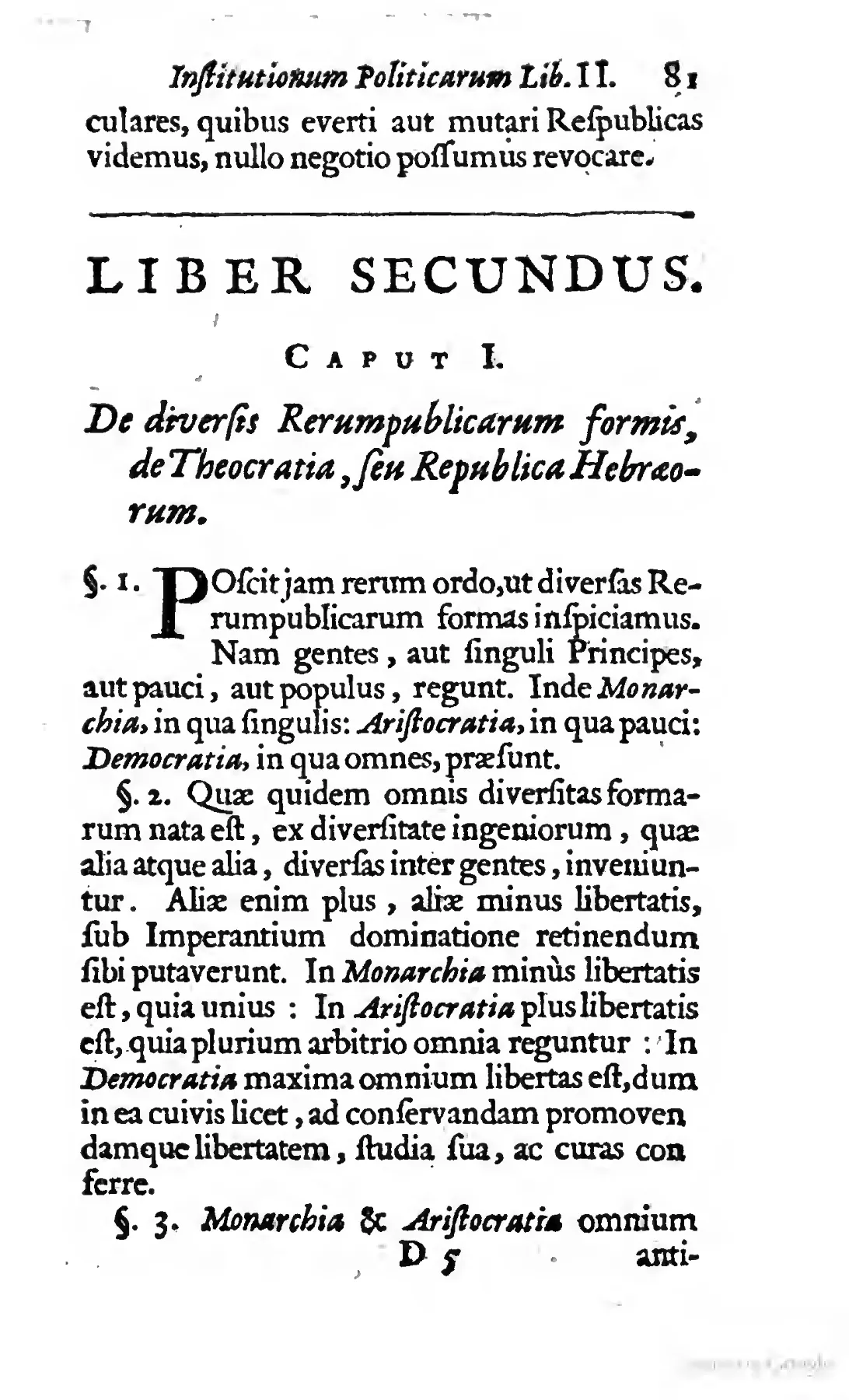
The opening of Book II, headed “LIBER SECUNDUS. CAPUT I.”, turns to the forms of rule. Monarchy, aristocracy and democracy are judged not as rivals for supremacy but by their fit with different peoples; the page’s comparison of liberty under each frames Book II’s relativism. Source ↗.
Book II moves from the general science to the particular forms. It opens by declining the classical search for the best regime: that form is to be judged best which is most fitted to the characters and interests of its own people, ea optima censenda, quæ ad ingenia suorum, & commoda, maximè est comparata. Monarchy itself is then divided along a distinction from Roman law. Lawful princes possess all the goods of their subjects by right of rule, not of ownership, Principes enim omnia subditorum Imperio possident, non Dominio. Dominatus in its strict sense is left to the Turks and Muscovites. The lists of arcana that follow, presented as a supplement to Clapmar, adopt a frankly realist register. One maxim recognizes that an armed plebs shares rule with the prince, Plebs enim armata cum Principe imperium partitur,. Force in the hands of subjects is described as power already divided, whatever the constitution formally says.
The doctrine of resistance is the most carefully balanced passage of the book. The tyrant's rule, in the formulation already cited, is to be cast off when the extremes of liberty have been reached under him. The deliberate inversion of the expected phrase extrema servitutis carries the argument. The decisive moment comes at the last point at which liberty still exists to be defended, not after servitude is complete, since by then the people would lack the means of recovery. This timing is joined to a demand for public authority, and private tyrannicide and papal deposition are both condemned. Prudence about timing and a strict rule about agency thus restrain each other. The book ends on the bleakest form of the preservation principle: it is in the interest of good men that the bad rather than no one should govern, bonorum intersit, malos potius, quam nullos,. Placed after the theory of resistance, the sentence sets its outer limit. Removing a tyrant can be justified only as a passage to another rule, never to the dissolution of rule.
Disquisitiones politicae: History as the Trial of Counsel
The Disquisitiones recast this science as judgment on cases. Each case follows the fixed sequence of Casus, Sententiae, Decretum, Eventus and Judicium, the procedure of the academic disputation transferred to recent and ancient history. The first case sets the tone: in royal marriages princes consider not the affection of blood and the duties of kinship but the commonwealth, sanguinis affectum & officia pietatis, sed Rempubl. à Principib. cogitari. Pietas, the most Roman of familial virtues, is set beneath the commonwealth.
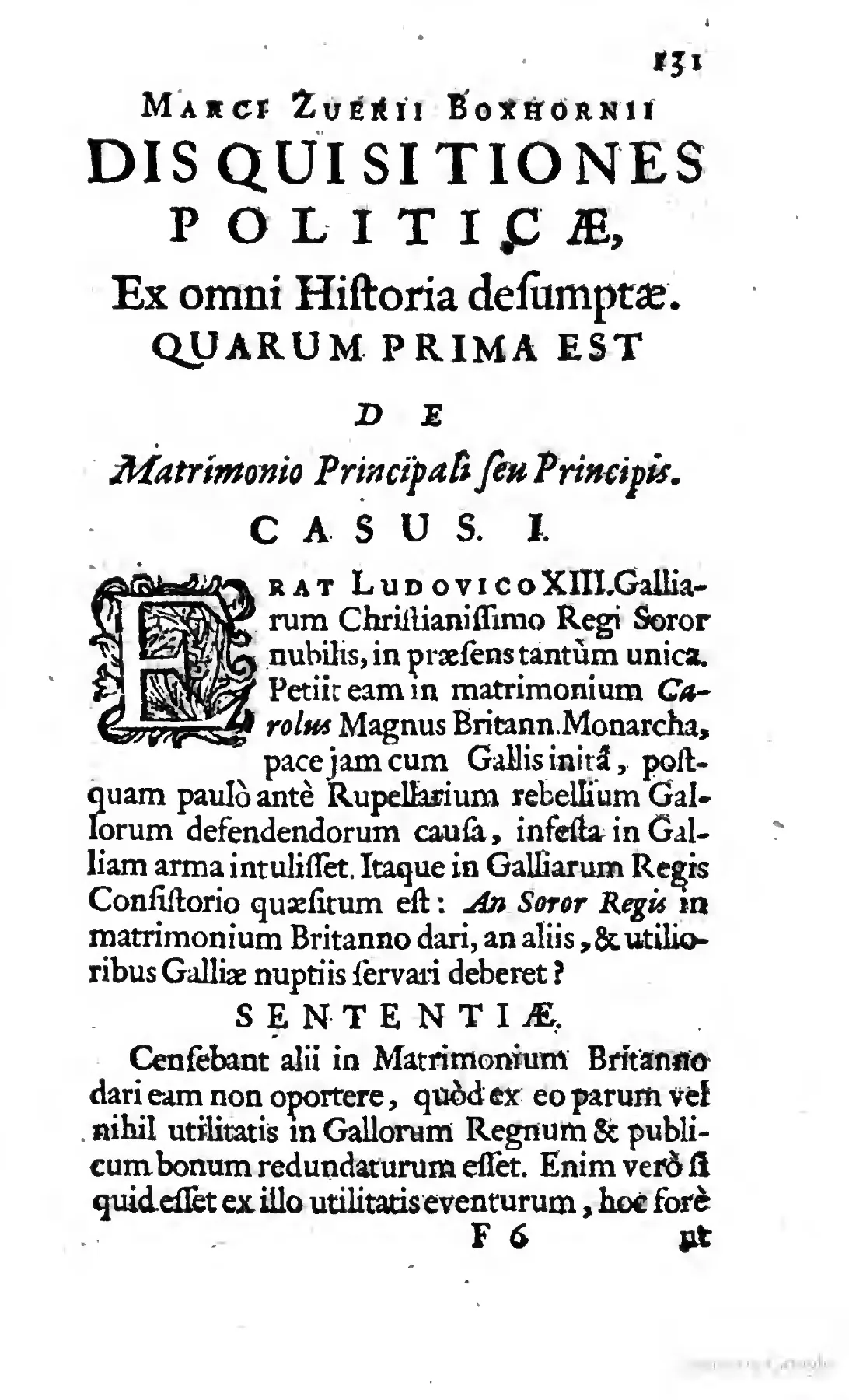
The display heading of the Disquisitiones politicae leads straight into Casus I: whether Louis XIII’s sister should be given in marriage to Charles I or reserved for more useful French alliances. From its first case, the method tests kinship and pietas against the claims of the commonwealth. Source ↗.
The Portuguese revolt of 1640 receives a Tacitean verdict on timing. Those who deliberate about defection have already defected, and in such counsels it is more dangerous to deliberate than to dare: desciverunt; & in ejusmodi consiliis periculosius est deliberare quàm audere. Here the logic of extrema libertatis reappears in the historical register. It is complicated by the fact that the agents are a nobility and a pretender, and the case leaves the question of public authority implicit.
The Twelve Years' Truce receives a verdict of open partisanship: experience proved that counsel and decree harmful, Noxium id consilium & decretum fuisse experiundo comprobatum est. The verb experiundo shows the work's method. Eventus tests decretum, and history is the trial of counsel.
The case of Julian's minister at Berytus, which the text expressly points toward contemporary Britain, limits command from the opposite side: no mandate of a crime averts or absolves its penalty, Nullum mandatum sceleris avertit aut absolvit poenam. Princes, the case maintains, are given to the commonwealth rather than to themselves.
Yet with the case of Oldenbarnevelt's handling of the English envoy, the first half of the Disquisitiones closes on the vocabulary the publisher's address had promised to lay open. Of that case and its comparanda from Tiberius and Dutch practice, Boxhorn writes that these counsels are to be referred to the arcana of domination, Hæc consilia ad arcana Dominationis referenda. The term that the Institutiones had disciplined in the abstract is here used for a Dutch statesman's deliberate management of a foreign ally. The arcanum is not confined to princes. In Boxhorn's political science it belongs equally to the provincial States and their officers, and so to the commonwealth that his definitions placed under the measure of its own preservation.
The Later Cases: Grievance, Mandate and Privilege
The second half of the Disquisitiones politicae keeps the same fixed printed scheme. Each historical case (CASUS), drawn from a named history, is followed by opposing opinions (SENTENTIÆ) set out in numbered arguments, then by a decree, an outcome, and finally Boxhorn's own verdict (JUDICIUM). The form stages the deliberation of a council and then subordinates whatever was actually decided to a maxim that can be carried beyond the case. This sequence is the method by which the collection tests its general propositions against particular histories. It also gives salus Reipublicae its operational form: the verdicts repeatedly turn on whether a given course preserves or endangers the political body, rather than on whether the claimants were in the right.
The close of the case of the mutiny over unpaid wages states this principle with notable severity. The officers are bound to satisfy the soldiers' claims. Yet the verdict holds that this very act of tumult deserves punishment, however just the cause of the disturbance may be thought, Hoc ipsum mereri poenam, ut ut causa turbæ justa possit existimari,. Boxhorn then lifts it into the general rule already discussed: the most equitable cause of any private person or subject becomes unjust, and therefore merits punishment, when someone pursues it to the present harm of the commonwealth.
The maxim separates the justice of a claim from the legitimacy of the means used to pursue it. The adjectives carry the paradox. The superlative æquissima collapses into iniqua through no change in the claim itself, only through the manner of its pursuit. For a teacher in a republic whose founding act was the armed assertion of grievance against a lawful prince, the rule carries an evident tension. The safety of the commonwealth is made the measure even of righteous complaint. The solution depends on who acts and when: what is forbidden is the private, tumultuous assertion of right, not right as such.
The Neapolitan case under Charles V turns the same measure against the prince's own command. The viceroy is ordered to introduce the Inquisition among a people who, mindful of their former liberty, declared secretly and openly, with great commotions, that they would never suffer the Inquisition to be brought into their dominion, Neapolitani memores pristinæ Libertatis, clam, palàm, magnis motibus asseverabant, haud unquam se passuros, ut inquisitio in Ditionem suam inveheretur. The verdict reads every mandate as tacitly conditioned: if the Inquisition is to be forced on subjects, the safety of the commonwealth and of the prince must always remain, in the formula noted earlier, the supreme mandate above all others.
The Ciceronian maxim of the people's safety as supreme law here becomes a rule for interpreting commands. A minister obeys the end of a command rather than its letter, and so may decline to execute part of it while remaining obedient. Boxhorn is careful not to let this become a licence for simple refusal. Where it is not permitted to execute the whole and entire mandate, he writes, the whole is not on that account to be abandoned, Ubi totum ac integrum Mandatum exequi non licet, non ideò totum intermittendum est. The viceroy executes what can be done without force and awaits fresh instructions before using violence. A juristic vocabulary of agency, mandatum and mandatarius, thus places a structured discretion between the prince's will and the subject's resistance, and both are answerable to the commonwealth's preservation.
The case of the garrison guilty of rapine shows the reverse side of this discretion. Here Boxhorn condemns not excessive rigour but timidity. Those who defer punishment out of fear of disturbance, he argues, overturn and corrupt the order of the commonwealth: they fear their subjects and are not feared by them, Qui enim metu motus differunt supplicia, inverso & corrupto Reipubl. ordine, metuunt subditos & non metuuntur. The Tacitean antithesis presents political order as a hierarchy of fear that may be inverted. It underpins a carefully staged five-step technique for punishing a chosen few as an example: select the most guilty and most hated, remove complicit troops on a pretext, introduce untainted forces, and then pardon the rest. The prudence Boxhorn teaches is less a choice between severity and leniency than the calculated management of both.
Several cases move from force to its signs. In the dispute over imperial letters of credence, which styled the Dutch States as fideles dilecti in the formula used for vassals, the letters are returned unopened. The justifying principle is that each person is, and becomes among others, such as he allows himself to be called, æstimantur. Talis enim quisque est & apud alios fit, qualem se patitur appellari. The sentence concentrates the collection's view of majestas as recognition. If supreme authority consists in the settled judgment of others, then a title tolerated in silence becomes a status conceded. In public formulae, words stand in place of things, and the refusal of a single vassal's formula defends the independence of the confederated States at the level where that independence is enacted.
The same attention to circumstance shapes Boxhorn's treatment of law. He reproduces Philip II's edict for debtors ruined by war in its quasi-statutory imperatives and approves it as equity over strict right. Its rhetorical core is a triple correction. By the law of humanity, the creditor must consider that he is not always a creditor but sometimes a man; the court must consider that it is not always a tribunal but sometimes the times; and the magistrate must consider that he is not always a judge of the case but sometimes an arbiter of necessity, creditorem non semper esse creditorem sed subinde hominem: non tribunal semper, sed aliquando tempora: denique Magistratum non judicem se semper causæ sed aliquando arbitrum necessitatis, cogitare debere. The anaphoric non semper … sed aliquando moves each office from its fixed juridical role into the flux of tempora. That a Dutch author draws this lesson from the edict of the king against whom the provinces revolted shows how far the casuistic method sets aside partisan origin in favour of the maxim.
Necessity, however, also licenses harder conclusions. In the occupation of neutral territory in Cleves and the lands of the Elector of Cologne, the argument attributed to the States rests on a stark premise. Each is believed to hold in the commonwealth only as much as he can defend; the rest belongs to the adversary, if not by right then at least by arms, Nam tantum quisque in Republ. habere creditur, quantum potest defendere, cætera adversantis sunt, si non jure saltem armis. The concessive si non jure saltem armis does not abolish the distinction between right and force, but it allows possession to lapse in practice where defence fails. Neutrality, a term the text marks as current usage, thus becomes contingent on the neutral's capacity to protect itself.
The Roman case of Crassus and the aqueduct submits private property to a parallel reasoning. Supreme magistrates are said to possess private goods by imperium but not by dominium. Boxhorn then goes beyond the Senate's decision in his own voice. When we fail to offer what we owe the commonwealth in its need, a compelled sale is not a taking but a condictio, a recovery from an ingrate, non offerimus ubi opus, venditio coacta non ademptio est, sed condictio repetitioque ab ingrato. The Roman-law action for recovering what is owed recasts expropriation as restitution, which places the citizen in the position of a debtor to the commonwealth.
The pointedness of these positions within the Dutch tradition is clearest in the treatment of corporate privilege. The fall of Antwerp to Farnese is blamed on consultation through the guilds during an emergency. A perpetual and unmoved adherence to privilege is condemned as obstinacy rather than prudence, since all things must be accommodated to circumstances and times, dentia est, quam contumacia. Omnia rebus ac temporibus accommodanda sunt. In the case of Bolsward in Frisia, where the restoration of popular election is refused, the principle receives the compact formulation already encountered: the commonwealth is not subject to privileges, but privileges to the commonwealth.
In a polity that had justified its revolt by appeal to violated privileges, this subordination demotes privilege from inviolable title to revocable instrument. The demotion does not, however, empower magistrates without limit. In the plague case concerning tax farmers, the debt may be deferred but never remitted, because the commonwealth is regarded as a ward, in prejudice of whose rights magistrates have no power to decree anything, cum velut Pupilla censeatur Respubl. in cujus proinde præjudicium aliquid decernendi Magistratus non habent. The tutelary figure turns the magistrates into guardians answerable for an estate they do not own. The same measure that dissolves privilege therefore also binds those who govern.
The method's preference for the executable over the well argued is stated outright in the verdict on Alba's mission. His arguments for severity are conceded to be very strong, yet the council should have adopted another course, since, in the maxim already cited, it is better to choose what one approves less and is able to execute than what one approves more and cannot execute. Prudence here sits above dialectical victory, and deliberation is judged by its capacity to issue in action.
The case of the Cologne negotiations of 1579 joins this practical criterion to Boxhorn's philological training. Having reproduced the Estates' sixteen articles in full, he dissects the Spanish counter-drafts for their rewording, reordering, amplification and restrictive clauses. Of one article that appears at first sight to answer the Estates' demand, he warns, with the Virgilian proverb, that a snake meanwhile lies hidden in the grass, respondere videbitur. Latet interim anguis in herba; & Ordinum Legati summum fucum. Close reading becomes a defence against diplomatic deceit. The case then ends with a maxim that retrospectively vindicates the continuation of the war: one must wholly abstain from entering those pacifications in which the parties seek more by peace than by war, IV. Deneque omnino abstinendum est ab ineundis illis pacificationibus, in quibus partes plus pace quam bello petunt. Peace is not treated as a good in itself. It is measured, like everything else in the collection, by what it secures for the commonwealth.
The Roman Dissertations: From Romulus to Tarquinius Priscus
After the index, a separate title-page and an inaugural preface introduce the Dissertationes politicae de regio Romanorum imperio. The preface presents them as public lectures on civil wisdom delivered under academic and civic authority. The commentary on Romulus opens with the programmatic thesis, discussed above, that sets aside the classical question of the best regime: it is mostly vain to dispute which form of commonwealth is better, since any form is best, and far to be preferred to the rest, that is attuned to the character of its own people. He then reverses a famous Tacitean antithesis, the res olim dissociabiles of the Agricola, in the claim already noted that the most absolute rule of princes and the liberty of the people are not by nature incompatible, nor do they conflict. Taken together, the two theses free the analysis of Roman kingship from any presumption that monarchy and liberty are opposed. A writer from a confederated republic can thereby approve Romulan monarchy without inconsistency.
The commentary on Numa carries this functional reasoning into religion. Although the Roman rites are elsewhere called vain and pitiable, religion is declared so necessary a bond of the commonwealth that it is better for a false one to exist and be practised than none, Unde liquet claretque, vinculum Reipub. adeo necessarium esse religionem, ut præstet falsam in eâ esse & coli, quam nullam. The commentary on Ancus Martius sets a firm limit on any extension of this political use of religion. Moving from the fetial formulae and the inviolability of envoys to the law of nations, Boxhorn judges gravely mistaken, in the passage already cited, those who stretch jurisdiction so far as to hold that a Christian prince may command Christianity upon an infidel people and make war upon them for refusing it.
Religion may thus bind a commonwealth from within but may not be carried abroad by arms. The commonwealth's preservation justifies the cult while denying it the status of a cause of war. The discussion of Tarquinius Priscus then reads the Roman kingship as elective and prefers election to succession. The Roman commentary thereby continues the work of the cases: general propositions about form, liberty, religion and right are drawn from, and tested against, the particular history of a people.
Servius Tullius and Tarquinius Superbus: Self-Limitation, Tyranny and Deposition

Boxhorn’s ruled table of Servian classes, census levels and centuries, including the division between seniores and iuniores, renders the reform of Servius Tullius as a scheme of property and age. Boxhorn reads this distribution of voting weight as royal self-limitation within an undivided imperium, not a mixed constitution. Source ↗.
The commentary on the Roman kings then reaches Servius Tullius, at the point where Boxhorn must decide what the king's reforms did to the form of the state. Servius had shared power with the people through his laws, and a Polybian reader might take this for the birth of a mixed constitution. Boxhorn refuses that conclusion: royal rule nonetheless remained, and this is not to be called a mixed form of commonwealth, Mansit nihilominus regium imperium; neque mixta hæc Reipub. forma dicenda est. The refusal depends on a distinct doctrine of sovereignty. What looks like mixture is in fact a sovereign limiting itself: supreme power, in the sentence considered earlier, is not released from all the laws it has itself passed, and it may diminish and confine itself and so increase the people's liberty. The move is economical. The jurists' maxim of the prince legibus solutus is qualified, yet the unity of majestas is kept intact. Popular liberty can grow without any partition of supreme authority, because the growth is the sovereign's own act of self-restraint. This one passage sets the terms for much of what follows: constitutional change is read as the redistribution of a single, undivided imperium, not as the joining together of separate powers.
The chapter on Tarquinius Superbus turns that analysis of form into an analysis of abuse. Boxhorn defines tyranny less by title than by procedure. Capital punishments, though rightly claimed, make even good princes suspected of tyranny if they alone decide them, inflict them secretly, and do not reveal their lawful grounds to the people, Et sane capitalia supplicia, licet merito arrogata, bonos etiam principes tyrannidis reddunt suspectos, si ea soli ipsi indicant; si clam sumant; si denique populo non aperiant legitimas eorum rationes. The weight falls on the concessive licet merito arrogata. Even a legitimate power over life and death takes on the character of tyranny when it is exercised in secret. Tyranny is thus a matter of the people's perception and judgment. This fits the volume's definition of majestas as resting on the settled judgment of subjects: a prince who conceals the grounds of his justice is withdrawing them from that judgment.
Against this, Boxhorn sets a Tacitean caution against ostentatious defiance. Those err, he says, and harm others as much as themselves, who under the most unjust rule of princes forever clamour and talk of liberty, as Tacitus rightly reproves throughout, Peccant, & aliis tantum nocent ac sibi, qui sub iniquissimo principum imperio crepant semper & loquuntur libertatem, quales merito passim arguit Tacitus. The contemptuous crepant makes the point by its very sound: the man who rattles on about liberty under a bad prince has confused display with prudence.
These two thoughts prepare the formal quaestio on whether the deposition of Tarquin was lawful. Boxhorn's answer is built from a duty, a threshold and an authorized agent. The duty is patience, but patience defined by its purpose: Et subditis patientia commendata est, non quâ evertitur Respub. sed qua conservatur. Patience is commended to subjects as the kind by which the commonwealth is preserved, not the kind by which it is overthrown. The threshold follows from this: a prince, as noted earlier, does not lose his rule except by that crime through which the rule itself is believed about to perish. The agent is collective. It is lawful, Boxhorn judges, for the nobles and people to strip such a ruler of his rule and drive him out by force, licere proceribus populoque eum imperio exuere & vi expellere judicamus. The construction is careful at every point. Preservation, which justifies obedience, also marks the point at which obedience ends, and the right to act belongs to proceres and populus, never to the private man. Boxhorn gives the conclusion medieval authority by citing John of Salisbury, for whom the prince, as image of the Deity, is to be loved, revered and honoured, while the tyrant, as image of depravity, is generally even to be killed if he cannot otherwise be restrained, Imago Deitatis princeps amandus, venerandus est & colendus; tyrannus pravitatis imago plerumque etiam occidendus, si tamen aliter coarceri non potuerit. The force of the borrowing lies in its final condition. Tyrannicide is admitted only as a last remedy, after every other means of restraint has failed.
The Republic: Consulate, Tribunate and the Denial of Mixture
With the consulship, Boxhorn carries the language of monarchy into the Republic itself. The consulate, he writes, is royal power, conferred on two men and bounded by a year's term of command, Consulatus est Regia potestas, eadem in duos collata & annuo imperii spatio definita. Expelling the kings, on this reading, changed the tenure of royal power, not its nature. To this reclassification Boxhorn attaches a conservative rule of political change: not every change for the better, but only necessary changes, are to be admitted in a commonwealth, Neque enim in Repub. omnes ejusmodi in melius, sed necessariæ tantum mutationes admittendæ sunt. Necessity, not improvement, is the measure of legitimate innovation, and that standard will govern his judgments on Caesar and Augustus.
The secession of the plebs puts the principle of preservation under strain. Boxhorn justifies the Senate's humiliating embassy to the Mons Sacer with a reworking of Cicero: Neque enim gloria, sed salus, suprema semper Reipublicæ lex est, for not glory but safety is always the supreme law of the commonwealth. Yet the concession that saved Rome also transformed it. Boxhorn finds that, once the tribunes were created, the state of the Roman empire became plainly democratic, Itaque creatis Tribunis Democraticum planè Imperii Romani statum factum esse statuimus. He then generalizes the denial he had made under Servius into the claim, already noted, that neither here nor anywhere else is it necessary to acknowledge a mixed form of commonwealth. Roman history therefore appears as a succession of pure forms rather than a balanced constitution, and the new democratic form is judged pernicious.
Boxhorn does not, however, let that hostility override prudence. The same reasoning that condemns the tribunate also counsels yielding to the crowd that demanded it. The unjust demands of such a multitude, he advises, are not to be refused, lest, once rebuffed, it demand and obtain still more unjust things, Et iniqua petenti ejusmodi multitudini haud neganda sunt, ne repulsam passa flagitet atque obtineat iniquiora. Two judgments stand here side by side. The institution is condemned on the level of constitutional form, while the concession is endorsed on the level of present safety. Boxhorn leaves the two in tension rather than resolving it.
The decemviral and censorial chapters extend this practical art of government. On the ban on intermarriage between patricians and plebeians, Boxhorn approves the policy but faults its publication: Plurima enim in Rep. egregia, aut noxia sese offerunt, quæ consilio potius arcano, quam scriptæ editæque legi sunt permittenda. Many matters in a state, whether excellent or harmful, are better entrusted to secret counsel than to written and published law. The approval of arcana sits uneasily beside his earlier treatment of secret capital justice as a mark of tyranny. The difference seems to be that he refuses concealment where life and death are at stake, while permitting it in social policy. The military tribunes with consular power give him a further maxim, Nomen quippe ad vim adjicit honorem & dignitatem, non autem delata sine nomine potestas: a name adds honour and dignity to power, which power conferred without the name does not possess. Titles, in this view, are instruments of rule that a prudent statesman may grant or withhold apart from the substance of power.
Caesar and Augustus: Necessity and the Slow Remedy
The chapter on Julius Caesar is the most revisionist of the Roman dissertations, and it rests on a contractual argument against civil war. Each man, Boxhorn argues in a passage already cited, enters civil society on the condition that it is juster for an innocent private man to perish than for the commonwealth to be unsafe for his sake. The argument cuts against Caesar, since even a wronged innocent may not defend himself by civil war. Yet Boxhorn also frees Caesar from the charge of tyranny. Caesar did not attack his country, overthrow the commonwealth, or aim at liberty's throat, Non oppugnavit patriam, non evertit Rempub. aut jugulum libertatis Cæsar petiit,. The verdict is sealed with Tacitus: Non aliud discordantis patriæ remedium fuit, quam ut ab uno regeretur, there was no other remedy for a country at discord than to be ruled by one man. Caesar's real fault is imprudence, and Augustus is praised for correcting it. Boxhorn uses the physician's language here: Quemadmodum enim natura infirmitatis humanæ, ita etiam in emendanda corrupta Rep. tardiora esse debent remedia, quam mala, as with the nature of human infirmity, so in amending a corrupt commonwealth the remedies ought to be slower than the evils. The maxim that only necessary changes should be admitted thus becomes a method of treatment. Monarchy is justified because it was necessary, and it is installed well because it is installed gradually.
The Shorter Dissertations: Succession, Punishment and Amnesty
The appended dissertations continue the disputational manner. On lineal succession, Boxhorn denies that the prince owns his principality. He holds it, sed jure quasi quodam usufructuario, vel potius tanquam Administratorem possidere,, by a kind of usufructuary right, or rather as an administrator. The prince is a trustee of a public thing, which is consistent with the subordination of every holder of power to the commonwealth. The following dissertation, however, reverses the emphasis and turns to election, pressing against inheritance the objection, quoted earlier, that succession raises to royal dignity not the ruler one would wish for but whoever is offered, good or bad, fit or unfit. The two dissertations read as a question argued in utramque partem.
The same unresolved pairing returns, more sharply, in the treatment of punishment and pardon. De poenis closes with the Stoic saying, discussed above, that it calls most sacred: that the wise man is never permitted to grant pardon or forgive the guilty. De amnestia answers this not by denying memory but by reframing it: Est tamen in potestate nostra, eorum, quorum oblivisci haud possumus, non meminisse in vindictam aut ultionem, it is in our power not to remember, for vengeance or retribution, the things we cannot forget. The law of oblivion asks for a renunciation of redress, not an impossible erasure of memory, and so the argument moves from psychology to policy. The essay concludes, in the sentence already quoted, that no offence ought to seem so great that, in a disordered and embattled commonwealth, it should be judged unworthy of amnesty. The qualifying phrase in turbata ac commissa Rep. suggests how the two positions might be reconciled, though Boxhorn himself does not make the reconciliation. Retribution is the norm for a settled commonwealth, and oblivion is the cure for a sick one. Both are measured by the same standard of preservation.
De republica Batavica: Consent in a Living Constitution
The Descriptio of the Batavian Republic applies the volume's vocabulary of consent to a living constitution. Of the comital petitions for revenue, it records, as noted earlier, that those seeking it were said to beg rather than impose taxes. Taxation by request becomes the historical evidence for a continuous liberty, and against that liberty the deposition of Philip II appears as restoration rather than innovation. The States of Holland are described in the same spirit. Because each town is in its own right, the assembly of the States possesses, in the phrase already cited, not so much an authority to compel individual towns as a way of obtaining each one's consent by legitimate reasons. Here the judgment of subjects, on which the Institutiones and the Roman commentary rested majestas, takes institutional form as a practice of persuasion among corporate bodies, each of which must be won over by reasons.
Reading Further on Boxhorn and Dutch Political Thought
Frequently Asked Questions
What is Marcus Zuerius van Boxhorn's Varii tractatus politici?
It is a posthumous collection of Boxhorn's Latin academic writings on politics. Caspar Commelin published it at Amsterdam in 1663, ten years after the Leiden professor's death in 1653. The volume contains:
- his textbook, the Institutiones politicae;
- the Disquisitiones politicae, historical cases distilled into political maxims;
- dissertations on Roman regal and republican government;
- shorter dissertations on succession, election, punishment, public wealth, amnesty and law;
- a description of the Batavian Republic.
Much of this material began as teaching at Leiden in the early 1640s. The collection has sometimes been wrongly attributed to Johannes Scheffer, whose genuine treatise on ancient naval warfare is unrelated to it.
How did Boxhorn define majestas, or supreme authority?
Boxhorn located majesty less in the ruler's person than in the subjects' settled judgment that their governors rightly govern. In the Institutiones he calls majesty, in this aspect, nothing other than the sacred, constant and unmoved judgment of the subjects. He describes the bond of all rule as the mutual and unconquered consent of rulers and subjects.
This is not a doctrine of popular government, because the consent is a mutual bond rather than a transfer of rule to the governed. Jaap Nieuwstraten distinguishes the position from Bodin's demand that sovereignty be indivisible. Boxhorn nonetheless declines to recognise any mixed form of commonwealth.
Why did Boxhorn reject Arnold Clapmar's phrase "legitimate tyranny"?
Boxhorn adopted Clapmar's jus dominationis, an extraordinary right exercised to preserve the commonwealth. He refused to call it legitimate tyranny, because tyranny cannot be legitimate. For a Latinist trained on Cicero and Aristotle, tyranny names rule bent to the ruler's own advantage, so the adjective contradicts the noun.
Boxhorn also narrowed the prerogative. Only civil and common rights yield to it, not divine ones, and in matters of conscience it must itself give way to God. The Ciceronian maxim that the safety of the people is the supreme law both authorises and limits it.
When did Boxhorn think subjects could rightfully resist a tyrant?
Boxhorn allowed resistance only at a late moment and only through public authority. He held that a tyrant's rule should be cast off when, under him, matters have come ad extrema libertatis, "to the last extremities of liberty." This is the final point at which liberty still survives to be defended, before servitude is complete.
A prince, he argued, loses his rule only by the crime through which rule itself is believed about to perish. Judging the case of Tarquinius Superbus, he allowed the nobles and people to strip the king of rule and expel him by force. He condemned private tyrannicide and papal deposition, and he accepted John of Salisbury's case for killing a tyrant only as a last remedy.
Is there an English translation of Boxhorn's Varii tractatus politici?
No English translation of the complete 1663 collection has been identified. One part did reach English readers: the Disquisitiones politicae appeared in 1701 as Arcana Imperii Detecta; or, Divers Select Cases in Government. A possible German version associated with Europae auffgedekkte Wunden (1653) still awaits bibliographical confirmation. No Dutch translation of the whole compilation has been established.
Separately, the Leo edition presents the full transcription and a complete English translation of the collection for the first time, and that translation is generated by AI. Leo is an effort to make freely available online, at no cost, English translations of every text printed in Latin in early modern Europe between 1450 and 1750.
This report was generated by an advanced AI assistant that conducted deep research alongside an extensive interpretation of the transcribed original text. Every effort has been made to preserve fidelity to the source and to guard against inaccuracy, but corruption in the text recognition process and model hallucination may nonetheless have entered the text. Treat every claim, quotation, translation, and citation as provisional, and verify each against the original source before relying on or citing it.
Bibliography
- E. H. Kossmann, Political Thought in the Dutch Republic: Three Studies: Published by the Royal Netherlands Academy of Arts and Sciences in 2000, Kossmann's three studies built the framework within which Dutch seventeenth-century political theory, and the academic writers of politica in particular, have usually been placed. Read it alongside Nieuwstraten to see which of the inherited classifications applied to Boxhorn survive contact with his actual texts and their transmission. The Batavian description's insistence that the States persuade the towns by legitimate reasons rather than compel them makes a good test of how far Kossmann's categories still hold.
- Jaap Nieuwstraten, Historical and Political Thought in the Seventeenth-Century Dutch Republic: The Case of Marcus Zuerius Boxhorn (1612–1653): This 2012 Erasmus University Rotterdam dissertation is the one book-length study this report leans on throughout, and it argues that Boxhorn stands as a transitional figure between late humanism and the early Enlightenment. Its separation of teaching dates, manuscript circulation and posthumous publication is what stops the 1663 volume from being misread as a commentary on the Stadholderless Period, and its reading of majestas as dependent on the subjects' recognition can be checked line by line against the Institutiones. The repository page leads to Nieuwstraten's full dissertation PDF, which also contains the Verhoeve and Franckenstein publication details summarized above.
- Jan Waszink, "Your Tacitism or Mine? Modern and Early-Modern Conceptions of Tacitus and Tacitism," History of European Ideas: Waszink's 2010 article, in volume 36 of the journal, warns against treating Tacitism as one coherent political allegiance, which is a useful brake on any classification that moves straight from Boxhorn's sources to a verdict on monarchy, republicanism or reason of state. Boxhorn's claim that the most absolute rule of princes and the liberty of the people are not by nature incompatible or at war, Neque res sunt natura sua dissociabiles, aut pugnant, absolutissimum Principum imperium, & populi libertas, is exactly the kind of sentence whose politics Waszink's distinctions help to sort out. The page range has not been established here, so a reader should confirm it before citing the article.