Iron Bellona Lies Buried: Jacobus Perizonius's Two Orations on Peace: A Thanksgiving for the Peace of Rijswijk and an Exhortation to Make Peace
Jacobus Perizonius, Leiden's professor of eloquence and history, met the Peace of Rijswijk with the Orationes duae de pace, a pair of Latin speeches that first urge Europe's princes to settle and then give thanks once they have. His method is to strip war of its honoured names: conquest becomes robbery, Alexander becomes the greatest robber of all ages, and the olive outranks the laurel. The result shows how a scholar of a trading republic argued against hegemony at the moment when the domination of Europe by a single power was the central political question of the day.
ExLatinis
18 October 2026

Contents
Jacobus Perizonius, Leiden's professor of eloquence and history, met the Peace of Rijswijk with the Orationes duae de pace, a pair of Latin speeches that first urge Europe's princes to settle and then give thanks once they have. His method is to strip war of its honoured names: conquest becomes robbery, Alexander becomes the greatest robber of all ages, and the olive outranks the laurel. The result shows how a scholar of a trading republic argued against hegemony at the moment when the domination of Europe by a single power was the central political question of the day.
Jacobus Perizonius (1651–1715), born Jacob Voorbroek and holder of Leiden's chair of eloquence and history from 1693, is remembered chiefly as a historical critic, the author of the Animadversiones historicae whom Barthold Georg Niebuhr would later salute as a predecessor. The Orationes duae de pace show him in another role, that of a university orator speaking on a public occasion. They are two Latin academic speeches tied to the Peace of Rijswijk of 1697, which ended the long war between Louis XIV's France and the coalition led by William III of Orange. One speech is a thanksgiving for the concluded peace. The other, a Cohortatio ad faciendam pacem, was composed while the representatives of princes and peoples were gathered at The Hague and Delft to seek terms. The pair appeared at Leiden in a quarto of about sixty-two pages. The surviving catalogue records disagree on whether the date is 1697 or 1698, and on whether that disagreement reflects separate impressions or only inconsistent description.

Blaeu’s 1652 plan of ’s-Gravenhage: The Hague, one of the two cities where envoys gathered in 1697 to seek terms for the Peace of Rijswijk, and the city behind the catalogue title’s “Hagam et Delphos.” The orations themselves were printed at Leiden. Source ↗.

The problem the orations confront is easily stated and hard to answer. How can a Europe of Christian princes, raised in a culture that honours conquest and derives nobility from arms, be brought to prefer peace to the pursuit of hegemony? Perizonius answers with a single, repeated strategy of unmasking redefinition. He takes the honoured vocabulary of war and strips it to what he presents as its moral substance. Bellum becomes the rage of a beast, born of avarice. Conquest becomes latrocinium, robbery on a grand scale, and Alexander becomes the greatest robber of all ages. Martial glory turns out to be successful crime wearing the title of Virtue. Against these debased honours he sets glory, kingship and divine favour grounded in the arts of peace. The olive is preferred to the laurel. The king is cast as shepherd and father of his people. God is called the God of Peace, and peace stands next to holiness.
The stakes reached beyond the lecture hall. In the 1690s the question of whether one power might gain an overriding dominion over Europe was the central political question of the day, and Perizonius frames it in terms of libertas Europaea against universalis dominatio. His argument draws on several kinds of material:
- classical exempla and antiquarian iconography;
- the testimony of a humanist eyewitness;
- the fiscal and commercial interest of the Dutch Republic;
- an account of how coalitions form against any prince who rises too high.
The pacific case therefore reaches into political theory, the law of war, theology and the political economy of a trading republic. Whether this amounts to a fully articulated doctrine of the balance of power, rather than a rhetorical use of familiar diplomatic commonplaces, remains an open interpretive question. Equally unsettled are the precise office in which Perizonius spoke and whether any classical or humanist predecessor (Augustine on the pirate and Alexander, or Erasmus on peace) shaped his formulations directly rather than by analogy.
The orations are full of memorable particulars:
- The orator declares that he bears the public person of the Leiden Academic Senate.
- He calls Willibald Pirckheimer, soldier and scholar, as an eyewitness to the cruelties of war two centuries before.
- He invokes Cephisodotus's statue of Peace nursing the infant Plutus.
- He casts France as seated at the "navel" of Christian Europe.
- He dismisses French victories as Cadmean.
- He closes with a deliberate limit: peace among Christians is joined to perpetual war against the Turks.
The work's later history adds a twist of its own. In at least one digital setting the peace orations became confused with Dominicus Baudius's funeral oration for Joseph Justus Scaliger of 1609. The two works are clearly distinct, but the mechanism of the error has not been traced.
What unites these strands is a single concern with the proper naming of public things. The orations' key terms (war, robbery, glory, liberty, kingship) are each redefined so as to transfer honour from conquest to peace. The circumstances of their making are bound to that same act of public naming: they were the corporate speech of a university that claimed the Muses' sanctuary as a stake in the settlement, printed at Leiden at the moment of diplomatic resolution. Their internal movement, from exhortation during uncertain negotiations to thanksgiving for a peace achieved, enacts the passage from war's false titles to peace's true ones. Much still awaits confirmation against a complete text, but the coherence of this design is already visible in the orator's own words.
Read the full text and English translation on Leo
This text was transcribed and translated as part of the ExLatinis project, an effort by Leo to make free English translations of every text published in Latin in early modern Europe (1450–1750) available online. The complete transcription and English translation of this work can be read free of charge:
→ Read the original Latin text and full English translation on Leo
You can save a copy of this document into your Leo account to run deep text searches, conduct further analysis, or cross-reference it with your own research.
Naming Perizonius's Two Orations on Peace: Title, Author and the Vocabulary of War
Two Orations on Peace: A Thanksgiving for the Peace of Rijswijk and an Exhortation to Make Peace. This English title is supplied editorially for convenience. It is neither an established historical title nor the title of a published translation.
The Latin title. The bibliographically attested Latin designation is Orationes duae de pace. A British Library-derived Google Books record preserves an expanded but explicitly abbreviated title: J. Perizonii ... Orationes duæ de Pace, quarum altera factam laudans, ... altera ad suadendam composita, quum legati principum et populorum undique Hagam et Delphos convenissent ad tentandas pacis faciendae rationes. Its ellipses preclude treating it as a diplomatic transcription of the title page. Nevertheless, it distinguishes between praising peace already concluded and persuading the parties to conclude it, and that distinction independently establishes the pairing's commemorative and deliberative purposes. Within the text, the second speech carries the heading Cohortatio ad faciendam pacem. Hagam et Delphos denotes The Hague and Delft in this diplomatic setting; it is not a reference to the Greek sanctuary of Delphi. [Google Books, KhRlAAAAcAAJ.] The orations' own Latin toponymy is consistent with this reading: Haga stands for The Hague, Delphi for Delft, and Risovicum for Rijswijk.
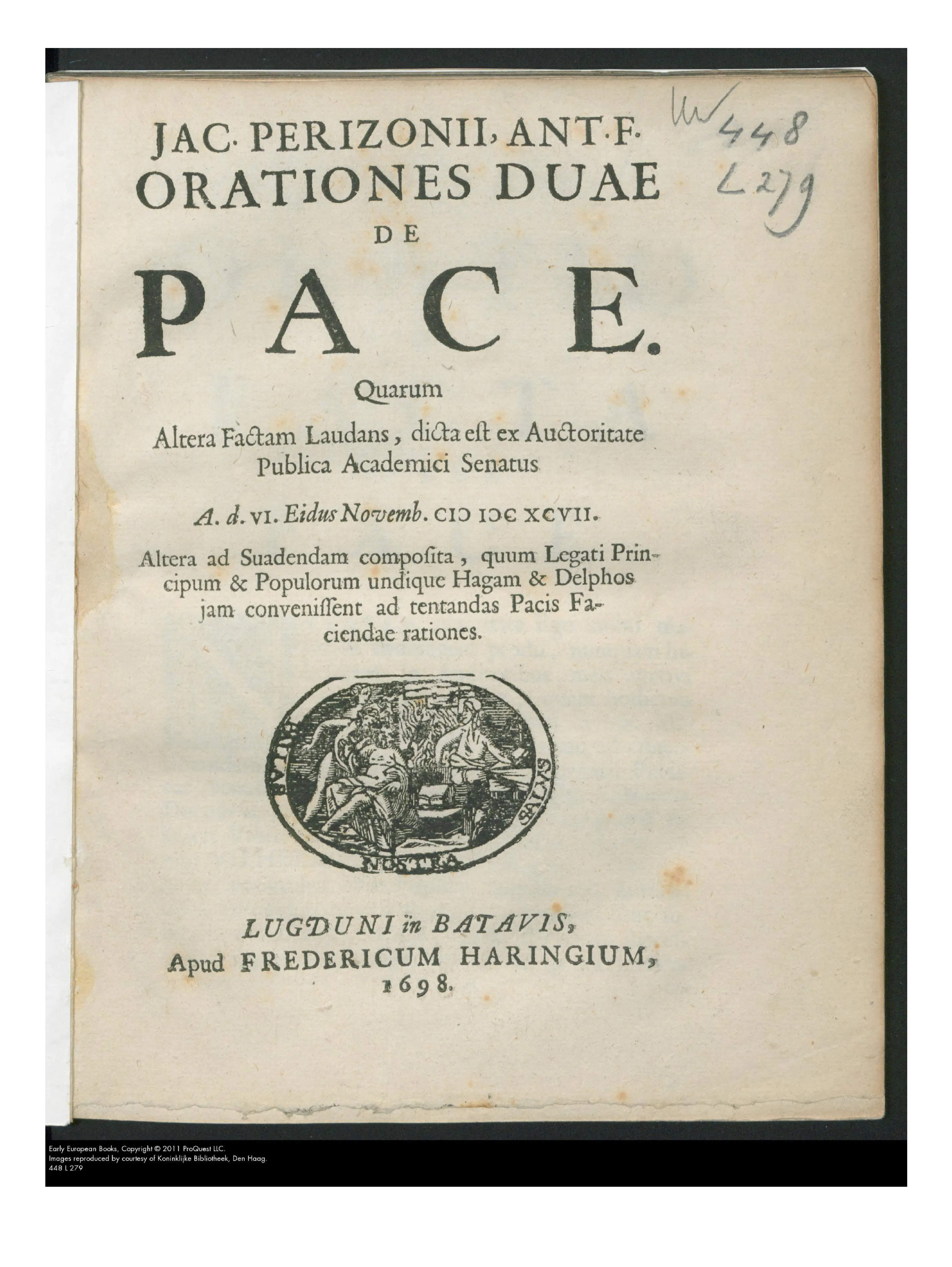
The work’s title page gives the fuller subtitle behind the abbreviated catalogue title, separating praise of peace made from persuasion to make it while envoys met at The Hague and Delft. Its imprint, “apud Fredericum Haringium, 1698,” and a device with the motto “NOSTRA SALUS” bear on the dating question. Source ↗.
The author's name. Jacobus Perizonius is the conventional scholarly name of Jacob or Jakob Voorbroek. Richard Hoche's biographical account identifies Voorbroek as the family's original name and states that it had already been Graecized. Perizonius is therefore an inherited learned family name, not an occasional disguise adopted for these speeches. The running-head form Jac. Perizonii is genitive: "of Jacobus Perizonius." The precise linguistic derivation beyond the documented Graecization should not be reconstructed from resemblance alone.
The keyword bellum. The orations' governing keyword is itself the first object of redefinition. Perizonius rests the moral case of the work on a sound-play between bellum and belluinus, "bestial." He tells his audience that war, weighed rightly, is nothing but the rage of a bestial kind, born of avarice, by which men not content with their own fly upon the possessions of others without just title: Bellum, Auditores, si recta rem ratione reputaveritis, nihil reperietis esse aliud, quam belluini generis rabiem, ex avaritia ortam, qua homines non contenti rebus suis, in aliorum involant justi prorsus tituli possessiones. The definition is also a legal one. Its closing phrase locates war's defect in the absence of justus titulus, so the etymological jest carries a juridical charge.
This reclassification belongs to an Ovidian scheme of ages in which war is absent from the Golden Age and invented by the Iron. The thanksgiving accordingly proclaims that an age is under way in which iron Bellona lies buried, agitur seculum, ubi ferrea jacet Bellona sepulta,, turning a poetic commonplace into a description of the settlement. The same transfer of honour governs the work's emblematic vocabulary of olive and laurel. The orator asks who would not far prefer, at that price, to see the Fatherland crowned with olive rather than laden with laurels: quis non multo malit ista mercede Patriam videre redimitam oleaginis, quam laureis onustam?.
The keywords libertas Europaea and universalis dominatio. A provisional contextual interpretation of libertas Europaea, opposed to universalis dominatio, concerns the preservation of a plurality of political communities against an overriding princely power. The text frames this liberty as a rhetorical question. It asks what would remain free in Europe, what in its own right, what not wholly subject and enslaved, if the power and judgment of all things came to a single people: Nam quid tandem liberum in Europa, quid sui mansurum esset juris, quid immo non obnoxium foret & servum plane, si ad unum deveniret populum omnium rerum potestas & arbitrium,. The phrasing sui juris belongs to the language of legal status. Liberty here is the condition of a body that is its own master, set against the servile condition of one held obnoxius.
The antagonist is named. The French, placed as it were by nature at the navel of Christian Europe for encroaching on the borders of others, have long pursued the imaginary glory of universal dominion: Prae reliquis vero Galli, ferme dixerim, in umbilico Christianae Europae quasi de industria attractandis aliorum finibus ab ipsa rerum natura collocati, imaginarium illud universae dominationis decus improbo conatu dudum affectaverre,. In this passage the concept appears as universae dominationis decus. The adjective imaginarium performs the work's characteristic unmasking, reducing the glory of hegemony to a phantasm.

Louis XIV in a portrait after Lefebvre, from the collections of the Château de Versailles. The orations treat royal grandeur as the problem itself: the French pursuit of the “imaginary glory of universal dominion” becomes a phantasm threatening the liberty of Europe. Source ↗.

The liberty at stake need not imply a particular republican constitution: a king could be praised as the defender of the liberties of other rulers and commonwealths. Nor does opposition to universal domination, by itself, establish a fully articulated doctrine of the balance of power. That stronger classification requires attention to the orator's actual formulations and their relationship to contemporary diplomatic argument.
The keywords latro and latrocinium. This vocabulary raises a different question: whether conquest retains the moral character of public warfare when exercised without justice. The orations apply it to the paradigmatic conqueror. Alexander, master of the world, is called the greatest Robber of all ages, Orbis, maximus fuit omnium Seculorum Latro,.
The text also traces the moral corruption to the honour culture that rewards such conduct. Inhuman crime, especially if successful, is handed down to posterity as an achievement under the fair title of Virtue, and wins its authors a Nobility "which among us is wholly from war": Quin immo inhumanum saepe scelus, inprimis si etiam sit felix, tanquam res bene gesta, specioso Virtutis titulo ad posteros quoque propagatur, & Nobilitatem, quae sane apud nos omnis ex bello est, auctoribus suis conciliat. The root of the evil is located in the desire for domination within princes themselves. Remove this lust from the minds of princes, the orator promises, and you will soon drag Mars from heaven itself and nearly restore the whole world to the Golden Age: Hanc mihi aufer ex animis Principum; & coelo mox ipso detrahes Martem, inque aureum ferme restitues universa seculum,. This closes the circle with the Ovidian scheme of ages.
The Augustinian analogue. Augustine's account of Alexander and the pirate in De civitate Dei IV.4 offers a pertinent inherited analogue, placing predatory kingship and robbery in disturbing proximity. The orations do apply this vocabulary to a conquering prince, and that application attacks the justice of conduct rather than merely military success. A direct quotation from Augustine, or a specific chain of humanist borrowing, cannot be asserted without textual collation.
These conceptual readings remain provisional, and no complete, page-verified transcription of the orations was established. The passages of the text itself settle the presence of this vocabulary; they do not by themselves settle its full argumentative weight across both speeches.
What Perizonius's Peace Orations Argue: Publication, Movement and Open Questions
The work and its publication. Jacobus Perizonius's Orationes duae de pace comprises two Latin academic speeches associated with the Peace of Rijswijk. One is an epideictic celebration of concluded peace; the other is a deliberative exhortation composed while negotiations were underway. The catalogue title explicitly places the negotiating representatives at The Hague and Delft. The thanksgiving names the place of settlement in its own panegyrical terms. It declares that restored peace will ennoble Rijswijk far more splendidly, with all wars on land and sea extinguished and pleasant quiet, secure liberty, plenty and ease of life returned to so many nations: nunc speciosius nobilitabit Risovicum revocata in tot gentes, bellis omnibus terra marique extinctis, jucunda quies, secura libertas, affluentia annonae, vitae facilitas?.
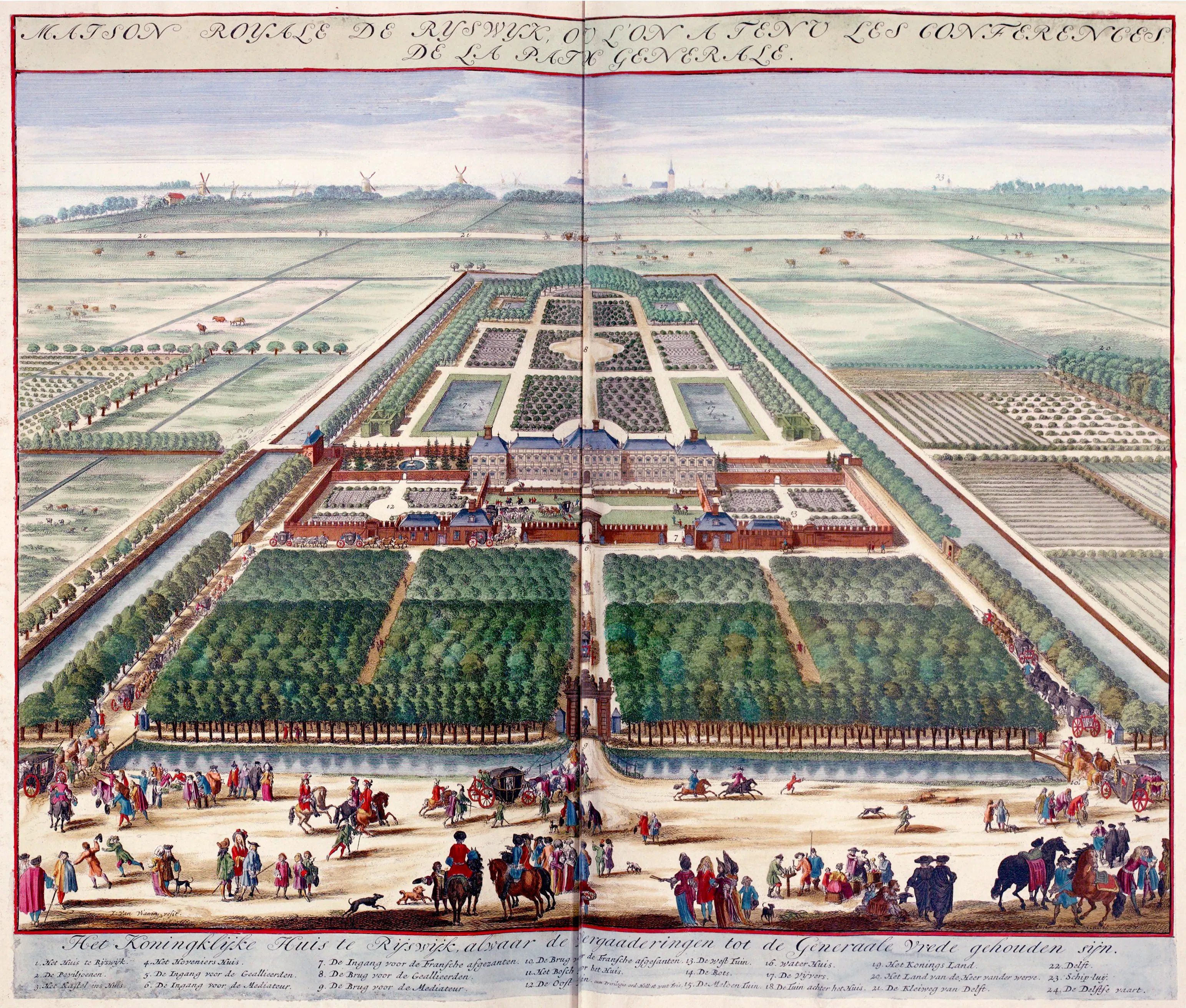
Huis ter Nieuwburg at Rijswijk, where the peace of 1697 was negotiated, in an engraving by P. Schenck. This is the place the thanksgiving promises to ennoble, its name made a byword for restored quiet, liberty and plenty after war on land and sea. Source ↗.

Leiden is the recorded publication place. The historical occasion belongs to 1697, but the accessible bibliographic records disagree about publication. The British Library-derived Google Books record gives 1697, whereas a Koninklijke Bibliotheek-derived reproduction record gives Leiden, 1698. Another digital record associates the 1698 text with the imprint apud Fredericum Haringium. Whether these descriptions represent separate impressions or inconsistent cataloguing remains unresolved.
The work's movement. The work's central movement is from advocating a negotiated settlement to praising its achievement. The text itself, however, sets the thanksgiving first and the Cohortatio ad faciendam pacem second. The printed sequence therefore runs counter to the chronological movement from negotiation to celebration, and whether it reflects the order of delivery remains open.
Unmasking as throughline. Across both speeches the recurring move is the unmasking of war's honoured names, so that the transfer of glory from conquest to peace serves as the work's throughline.
What still requires a complete witness. More specific claims about the work's treatment of William III, Louis XIV, commerce, taxation, or the Ottoman enemy require a complete textual witness rather than reconstruction from the historical occasion alone. The text itself does address Louis XIV, Leopold I and William III in turn. It also names commerce the chief sinew of the Republic and reserves perpetual war for the Turks. How these elements are weighted across the whole still requires a complete text.
The Baudius conflation. Attributing these peace orations to Dominicus Baudius under his 1609 funeral oration for Joseph Justus Scaliger is a catalogue error at the level of work identification. Baudius's Oratio funebris is a distinct work, printed at Leiden in 1609 and delivered on 26 January of that year. The particular digital record responsible for the erroneous association could not be identified conclusively. Consequently, an aggregation error cannot yet be distinguished from an item-level description applied to an unidentified composite volume.
Language and the orator's office. The language of the peace orations is Latin. No Dutch translation, contemporary vernacular rendering, or later published translation was securely identified; this is not evidence that none ever existed.
Perizonius's precise official capacity on the occasions of delivery remains unconfirmed: he may have spoken as rector, as designated university orator, or as another representative of the Academic Senate. The text itself contains the orator's own description of his role in the exordium of the thanksgiving. He summons his hearers to attend upon Peace and, "with me, who here bear the public person of the Academic Senate," to recall the memory of the former time: Agite ergo, Auditores, adeste Paci, & mecum, qui publicam Academici Senatus hic sustineo personam, recolite memoriam superioris temporis. The declaration establishes that the speech is delegated corporate speech. It does not identify the office by which that delegation was held.
Why the Rijswijk Orations Matter: European Liberty, Williamite Praise and Perizonius's Reputation
Persuasion and praise. The pairing's most securely established significance lies in its conjunction of two rhetorical functions: persuasion before a settlement and praise after it. Its catalogue title preserves this distinction explicitly. The collection consequently offers a potentially valuable witness to how a university scholar converted the uncertain work of negotiation into a publicly celebrated political achievement. One maxim in the Cohortatio states the bridge between the two functions in a single antithesis: peace is necessary for the vanquished and honourable for the victors, Pax enimvero victis est necessaria, victoribus pulchra:. The maxim offers each party a ground for agreement that preserves its honour. Establishing whether the printed order reverses the order of delivery, and how extensively the speeches were revised for publication, requires a complete copy.
European liberty and princely power. Opposition to universal monarchy and the preservation of European liberty provide an appropriate interpretive setting. They should not, however, be collapsed into a single, already completed balance-of-power doctrine. The important questions are:
- which political bodies possess liberty;
- what obligations bind allied rulers;
- whether negotiated peace or continued resistance best preserves their independence.
The Cohortatio supplies the orator's own account of how a plurality of states responds to a would-be hegemon. Its states repeatedly conspire and rush together at once, as if to put out a common fire, whenever any One rises higher above the rest and, breathing excess, seeks dominion over others: conspirant identidem & concurrunt extemplo veluti ad extinguendum commune aliquod incendium, si quis Vnus supra caeteros emergat altius, ac immodica spirans dominationem in alios affectet. The text joins to this a military observation that makes conquest futile in practice. Now the dispute is not over Africa or Asia, nor all of Spain, but always over single towns, for nearly a whole year's campaigning season: At nunc, non de Africa, aut Asia, nec de Hispania omni, sed de singulis semper oppidis disceptatur totis ferme unius anni aestivis,. Together these passages show that the orator reasons structurally about coalition and siege. Whether such reasoning constitutes a doctrine, rather than an argument from contemporary experience, remains the interpretive question.
Praise of a king and the limits of monarchy. Williamite panegyric can coexist with this plural political order: praise of one monarch need not entail approval of monarchy without limits. The orations' mirror of princes points in this direction. Their ideal ruler is the true and faithful Shepherd of Peoples, Ille denique Populorum etiam verus & fidus est Pastor,. Kingship is defined by its service: this truly is to play the king, this to spend and devote oneself to the public safety, Hoc enimvero est Regem agere: Hoc, impendere se & devovere saluti publicae:.
The same standard is turned upon the French king. In the royal address of the Cohortatio, Louis XIV is urged above all to erase from his mind those splendid robberies of Alexander of Macedon: Dele inprimis ex animo splendidia illa Alexandri Macedonis latrocinia,. The admonition brings the latro vocabulary to bear on a living sovereign. A precise account of Perizonius's position remains dependent on textual verification rather than on the diplomatic outcome alone.
Williamite propaganda and religious interpretation. Tony Claydon's William III and the Godly Revolution supplies a firmly identifiable historiographical intervention. Against predominantly secular readings of late Stuart political language, Claydon emphasizes the king's representation as a providential ruler protecting and renewing Protestant religion. His argument illuminates the possibility that praise of William combines confessional obligation with the defence of political liberty.
The orations do give peace a theological standing. The orator asks what else he should say of it than that Peace is most worthy of the majesty of God, most pleasing to his rites, next to holiness: Quid immo aliud de eo dicam, Auditors, quam Pacem ergo majestate Dei esse dignissimam, gratissimam ejus sacris, sanctimoniae proximam?.
The panegyrical register likewise subordinates martial greatness to pacific achievement. In one royal apostrophe the addressee, "though Greatest in war," is declared by the peace won for so many peoples "far Greater even than yourself": Te, Bello licet Maximum, conciliata tamen tot populis Pace, longe jam Te etiam ipso dicam Majorem. Military success on the opposing side is correspondingly deflated. The French, the orator concedes, usually left battles as victors, but theirs was mostly a Cadmean victory and, if they would admit the truth, merely a more showy defeat: superiores quidem variis ex proeliis discessisse Gallos, sed plerumque Cadmeam illis contigisse victoriam, &, si vera velint, speciosiorem tantum cladem.
Claydon's immediate evidentiary field is English royal propaganda, however. It cannot establish what a Leiden Latin orator said, nor prove that a particular English campaign shaped the speeches. No direct scholarly controversy specifically concerning Perizonius's peace pairing was located.
Humanist peace and its limits. The juxtaposition of an exhortation to peace with a celebration of its conclusion makes the humanist moral criticism of warfare a pertinent context. The orations draw on humanist testimony explicitly. Willibald Pirckheimer is introduced as a most trustworthy witness, famed chiefly in the gown but also in the cloak, who affirmed that he had seen, in the Swiss wars of Maximilian I nearly two hundred years before, a thing that surpasses all belief: Verum omnem superat fidem, quod Vir tamen fide dignissimus, Bilibaldus Pirkheimerus, toga potissimum, sed & sago clarus, ante hos ducentos ferme annos, se in Helveticis Maximiliani I. bellis vidisse affirmat,. The pairing of toga and sagum makes the witness doubly credible, as scholar and as soldier. It also places a humanist eyewitness alongside ancient exempla as evidence. Dependence on Erasmus's Querela pacis or Dulce bellum inexpertis remains unproved.
The pacific programme is framed as a restoration of Christendom. The princes are urged that by a sure peace they may at last restore all things and found anew the commonwealth of Christians: ut certa denique pace excitetis omnia, & Christianorum denuo constituatis rempublicam. Its outer boundary is stated without qualification. With these alone, the Turks, let there be eternal and inexpiable war for you: Cum his solis aeternum Tibi sit bellum & inexpiable:. Peace among Christian rulers is therefore accompanied by approval of war against the Ottoman Empire. That distinction qualifies the geographical and confessional reach of the pacific argument, which should not be represented as an unrestricted rejection of warfare. Conversely, a conventional anti-Ottoman appeal does not, without further evidence, establish a practical proposal for a new military coalition.
War finance and commerce. Dutch public borrowing, taxation, commercial disruption and privateering belong to the historical circumstances against which an appeal for peace must be tested. An argument that commerce sustains the commonwealth would connect civic prosperity to the termination of war. The text makes that connection in a pointed rhetorical question: did not Commerce lie utterly prostrate, which is nonetheless the chief sinew of our Republic? Annon jacuit penitus Mercatura, quae nostrae tamen Reip. nervus est potissimus?. The orator also honours the fiscal endurance of his fellow citizens, promising that late posterity will not ignore their praise of the same kind: Neque vero vestram ejusdem generis laudem, Batavi Cives, ignorabit sera posteritas,. The link between peace and wealth is given antiquarian authority as well. Cephisodotus of Athens once fashioned a statue of Peace holding Plutus, god of wealth, in her lap like a child: Cephisodotus Atheniensis finxit olim Pacis effigiem, quae Plutum, divitiarum Deum, quasi puerum, sinu fovebat. The precise relation of the nervus formula to its classical antecedents, however, cannot be assumed.
Lawful warfare and the Palatinate. Condemnation of the devastation of the Palatinate would need to be situated within contemporary distinctions between legitimate hostilities, punishment, devastation and princely predation. The text frames its complaint as a corruption of law itself. The fierce nature of Mars has now given a kind of right even among Christians, and these are the outrages of arms in which soldiers are trained today: Martis indoles etiam inter Christianos quoddam quasi jus jam dedit. Haec sunt armorum flagitia, quibus hodie militum imbuuntur tirocinia. The qualifier quoddam quasi jus marks this "right" as a counterfeit, another of war's false titles. Such condemnation does not automatically amount to a systematic account of the ius belli. These are interpretive questions, not established conclusions about particular passages.
The university and the historian-orator. The image of the academy as Palladis sacrarium would make the preservation of learned institutions a public argument for peace rather than a merely private scholarly preference. The orations cast scholars as natural partisans of peace: they wholly abhor bloody Mars, being the servants and priests of the Muses, à cruento penitus Marte abhorreat, Musarum hi sunt Famuli & Sacerdotes,.
The institutional claim is especially significant because the orator declares that he bears the public person of the Academic Senate. Even so, the formal authorization and the office behind that declaration remain undocumented.
Perizonius's reputation. Perizonius's broader reputation has often been organized around historical criticism rather than occasional political oratory. Richard Hoche's 1887 biography reproduces Barthold Georg Niebuhr's exceptionally favourable judgement of the Animadversiones historicae, thereby documenting a nineteenth-century tradition that valued Perizonius as an important predecessor. Hoche also records much less favourable assessments of his grammatical scholarship. This uneven reception cautions against treating his standing as uniformly secure across all his activities. Neither the precursor narrative nor the criticism of his grammar establishes how the peace speeches were received in 1697–1698. A modern, work-specific historiography and a documented contemporary reception history were not securely located.
Tracing the Leiden Quarto: Editions, Digital Witnesses and the Baudius Conflation
Bibliographic identity and publication date. The secure identification is Jacobus Perizonius, Orationes duae de pace. The expanded title preserved in the British Library-derived record describes one speech praising peace already made and another advocating its conclusion during the gathering of diplomatic representatives at The Hague and Delft. That record gives 1697 and 62 pages. A second digital description gives 1698 and the publisher's formula apud Fredericum Haringium, again with 62 pages. The Wellcome Collection's independently accessible description gives "Leiden : [s.n.], 1698" and describes the reproduced original as quarto. These records support a late-1690s Leiden publication, not a 1609 imprint. They do not establish two distinct editions: differences of date and imprint description may reflect differing catalogue practices.
Imprint and physical make-up. The name in apud Fredericum Haringium belongs to the publication or bookselling statement. Without a verified title page or colophon, it should not automatically be converted into a claim about who physically printed the sheets. No dedicatee, complete signature sequence, press figure, ornament inventory, or copy-specific binding description was established. The catalogue extent of 62 pages does not settle the number of preliminary leaves, blanks, or digital images. Image numbering must not be treated as an additional printed pagination sequence without inspection.
Located witnesses and reproduction records.
- British Library-derived digitization: Google Books identifier KhRlAAAAcAAJ, catalogued as J. Perizonii ... Orationes duæ de Pace…, 1697, 62 pages; digitized 3 November 2015. The original library is expressly identified as the British Library. A physical shelfmark was not recovered. Stable discovery record: https://books.google.com/books?id=KhRlAAAAcAAJ.
- 1698 digital witness: Google Books/Google Play identifier SubHbT2H_nkC, titled Orationes duae de Pace, with the publication metadata apud Fredericum Haringium, 1698, 62 pages. Its relationship to the British Library-derived witness was not established. Discovery record: https://play.google.com/store/books/details?id=SubHbT2H_nkC.
- Koninklijke Bibliotheek-derived reproduction: Wellcome Collection record gh49cd4v, Orationes duae de pace Jacobus Perizonius, Leiden, 1698. It is described as quarto and explicitly identified as a reproduction of an original in the Koninklijke Bibliotheek, Nationale bibliotheek van Nederland. The electronic reproduction was issued by ProQuest, Cambridge, UK, in 2014 within Early European Books, and its linked ProQuest record is 2090331257. The Wellcome entry describes access to a reproduction, not a separate physical copy held by Wellcome. Neither a KB shelfmark nor a complete digitization identifier appears in the accessible description. Record: https://works.www.wellcomecollection.org/works/gh49cd4v.
The Baudius conflation and the composite-volume hypothesis. A separately identifiable Getty Research Institute copy of Baudius's Oratio funebris dicta honori & memoriae maximi virorum Iosephi Iusti Scaligeri is available through Internet Archive as oratiofunebrisdi00baud. Its imprint is Leiden, Prostant apud Ludov. Elzevirium & Andream Cloucquium, 1609. Its catalogue records:
- delivery in Leiden's theological auditorium on 26 January 1609;
- a French acrostic sonnet by R. I. de Nerée on page 23;
- a title-page woodcut device;
- a historiated initial on page 3.
That copy has a genuine bound-with description: Daniel Heinsius, In obitum v. illustr. Iosephi Scaligeri, Antwerp, Ex officina Plantiniana Raphelengii, 1609, with the catalogue reference SPECIAL 94-B20442. Crucially, the listed companion is Heinsius, not Perizonius. This proves the existence of a composite Scaliger memorial volume, but it neither proves nor disproves the existence of another volume containing the peace orations. The Getty description cannot be transferred to an unidentified KB object. Record: https://archive.org/details/oratiofunebrisdi00baud.
The identification error is therefore demonstrable at the level of the two works, while its material or digital mechanism remains unresolved. The two works differ in kind as well as date. One is a funeral tribute to a single scholar; the other is a pair of civic orations on a European settlement, whose argument turns throughout on the redefinition of war and peace. The digitization identifier ned-kbn-all-00005611 could not be linked to a complete, inspectable bibliographic record. The independently documented KB reproduction of Perizonius provides a genuine repository connection, but does not establish that the disputed identifier describes that same copy. No verified STCN number, Knuttel or Muller entry, or catalogue correction notice was recovered.
Institutional circumstances and reception. Perizonius had occupied Leiden's chair of eloquence and history since July 1693; his earlier Franeker appointment dated from January 1682. These appointments establish an appropriate institutional setting for university oratory, but do not prove that he delivered the peace speeches as rector magnificus. The orator's own declaration that he bears the public person of the Academic Senate establishes delegated corporate speech, not necessarily possession of the rectorship.
The relevant Senate decision, rectoral register, and governmental thanksgiving decree were not established. Attribution of the occasion specifically to the States of Holland or the States General would therefore be premature.
No independently documented censorship action, suppression order, French counter-orations, prosecution, or chain of replies was identified. Absence of an identified proceeding is not proof of unrestricted circulation. Likewise, no dedicatee or patron should be inferred from the princes praised or addressed. The orations' apostrophes to Louis XIV, Leopold I and William III are rhetorical addresses, and a rhetorical apostrophe to a sovereign is not a printed dedication.
Collected editions and the author's other writings. A catalogue record identifies Jacobi Perizonii ... Orationes XII. varii et praestantioris argumenti ... collectae, published by Johannes Arnoldus Langerak in 1740, with 592 pages. Its contents were not verified, so inclusion of the two peace speeches, their position within the collection, and any textual revision remain unestablished. An early-eighteenth-century collected edition could not be securely documented.
The peace speeches belong alongside, but should not be confused with, Perizonius's historical-critical scholarship. His Animadversiones historicae appeared in 1685, and his Origines Babylonicae et Aegyptiacae in 1711. Their existence establishes the breadth of his intellectual activity; it does not demonstrate that the occasional speeches reproduce their methods or arguments. The translation lineage, contemporary circulation, and copy-specific provenance of the peace pairing remain substantial bibliographical gaps.
Following the Argument from the Thanksgiving to the Cohortatio ad faciendam pacem
The Thanksgiving: Corporate Voice and the Definition of War
The thanksgiving opens by establishing the standing from which it speaks. Its exordium, in which the orator urges his hearers to attend upon Peace and, together with him who here bears the public person of the Academic Senate, to recall the memory of the former time, has already been cited for what it reveals of his office; its interest for the structure of the oration lies in the two choices it makes at once. The voice is corporate: the term persona, drawn from the language of office and representation, makes the speech a public act of the university rather than the private sentiment of a professor. The method is also commemorative. Peace is to be praised through deliberately recalled war. The orator disclaims any wish to darken a festive hour with grief, yet his structure depends on it, since peace can shine only against the darkness he summons. The panegyric is therefore built from its own opposite, and the catalogue of war's evils is the necessary ground of the thanksgiving.
The first substantive move is definitional. The sound-play already examined, by which war, weighed by right reason, proves to be nothing other than the rage of a bestial kind, born of avarice, through which men not content with their own fly upon the possessions of others without any just title, is a grammarian's jest. Its weight, however, falls on the closing juridical clause. By locating war's defect in the absence of justus titulus, Perizonius borrows the vocabulary of possession and lawful claim, and he implicitly withholds from aggressive conquest the standing that the just-war tradition might grant it. Through the Ovidian genealogy that follows, war becomes the invention of the Iron Age, and that age is said to have furnished war with a "right" of its own.
Honour, Hegemony and the Ledger of the War
From this genealogy the oration turns to a sharp social diagnosis, in the passage already noticed among the work's keywords: inhuman crime, especially when fortunate, is handed down to posterity as an achievement under the fair title of Virtue, and it wins for its authors a Nobility which, among us, comes wholly from war. The governing word is titulus once more, now qualified as speciosus, a showy title, so that the critique of war becomes a critique of false naming. The phrase apud nos is pointed. It does not exempt the orator's own society, and it brings the martial foundation of aristocratic honour into an academic oration delivered in a burgher republic. The conditional si etiam sit felix exposes the hinge of the whole honour culture. Success converts crime into res bene gesta, and posterity ratifies the conversion.
Abstract diagnosis then acquires a target in the French, whom the orator places, as he would almost say, at the navel of Christian Europe, set there as if by nature herself on purpose to encroach on the borders of others, and whom he charges with long pursuing, by wicked effort, the imaginary glory of universal dominion. The hedges ferme dixerim and quasi de industria are telling. They attribute purpose to rerum natura while withdrawing the attribution in the same breath, so that geography appears to explain French ambition without excusing it. The adjective imaginarium repeats the unmasking already performed on Virtutis titulus: the decus of hegemony is a phantasm. The stakes of that phantasm are stated in the language of legal status, through the rhetorical question already discussed, which asks what in Europe would remain free, what in its own right, what not wholly subject and enslaved, if the power and judgment of all things came to a single people. The antithesis of sui juris and obnoxius transfers the Roman law of persons to the society of states. Europe's liberty is the plurality of bodies that are their own masters.
The balance-sheet of the war that followed the Revolution makes a revealing concession. In the admission noted earlier, the orator grants that the French generally left the various battles as victors, but insists that theirs was mostly a Cadmean victory and, if they would own the truth, only a more splendid defeat. The adjective speciosior echoes specioso Virtutis titulo, and once again appearance is set against substance. The honest acknowledgement of French success in the field is neutralised by an argument from cost rather than denied. William's victories in Ireland, at Namur and at sea are enumerated against this ledger. The ensuing catalogue of devastation along the Rhine, Neckar, Meuse and Sambre reaches its moral judgment in a phrase, already considered in connection with the law of war, that again turns on counterfeit law: the fierce nature of Mars has now given a kind of right even among Christians, and the outrages of arms have become the matter with which the apprenticeship of soldiers is imbued. The double qualifier quoddam quasi marks this "right" as a simulacrum. The word tirocinia adds an anxiety about formation, since atrocity has become a discipline that is taught.
The Republic, Theology and the Royal Apostrophe
The oration then brings the argument home to the Republic, asking whether Commerce, the chief sinew of the commonwealth, did not lie utterly prostrate. The figure of the nervus belongs to the language of the body politic. Here it is redirected from money as the sinew of war to commerce as the sinew of the state, so that war is shown to sever the very tissue that sustains the commonwealth. Fiscal grievance is converted into civic praise, as the Batavian citizens' sacrifices are set above Roman precedent. The argument then rises to theology. After the exemplum of David, barred from building the Temple because of his bloodied life, and of Solomon, the peaceful king who built it, the orator concludes, in the formula already quoted, that Peace is most worthy of God's majesty, most pleasing to his rites, and next to holiness. The triple superlative brings peace close to sacral standing. The subsequent division of peace's benefits into goods of the soul, of the body and of fortune follows the classical tripartition of goods, so that the theological climax is underwritten by philosophical method.
The peroration's apostrophe to William III resolves a tension that a Williamite panegyric on peace must face, namely how to honour a warrior king without honouring war. The answer is the paradox of self-surpassing noted earlier, by which the king, though Greatest in war, is declared through the peace won for so many peoples now far Greater even than himself. The concessive licet grants the martial superlative only in order to subordinate it. William's restraint is ranked above his victories, and the transfer of honour from conquest to peace is enacted in the person of the victor himself.
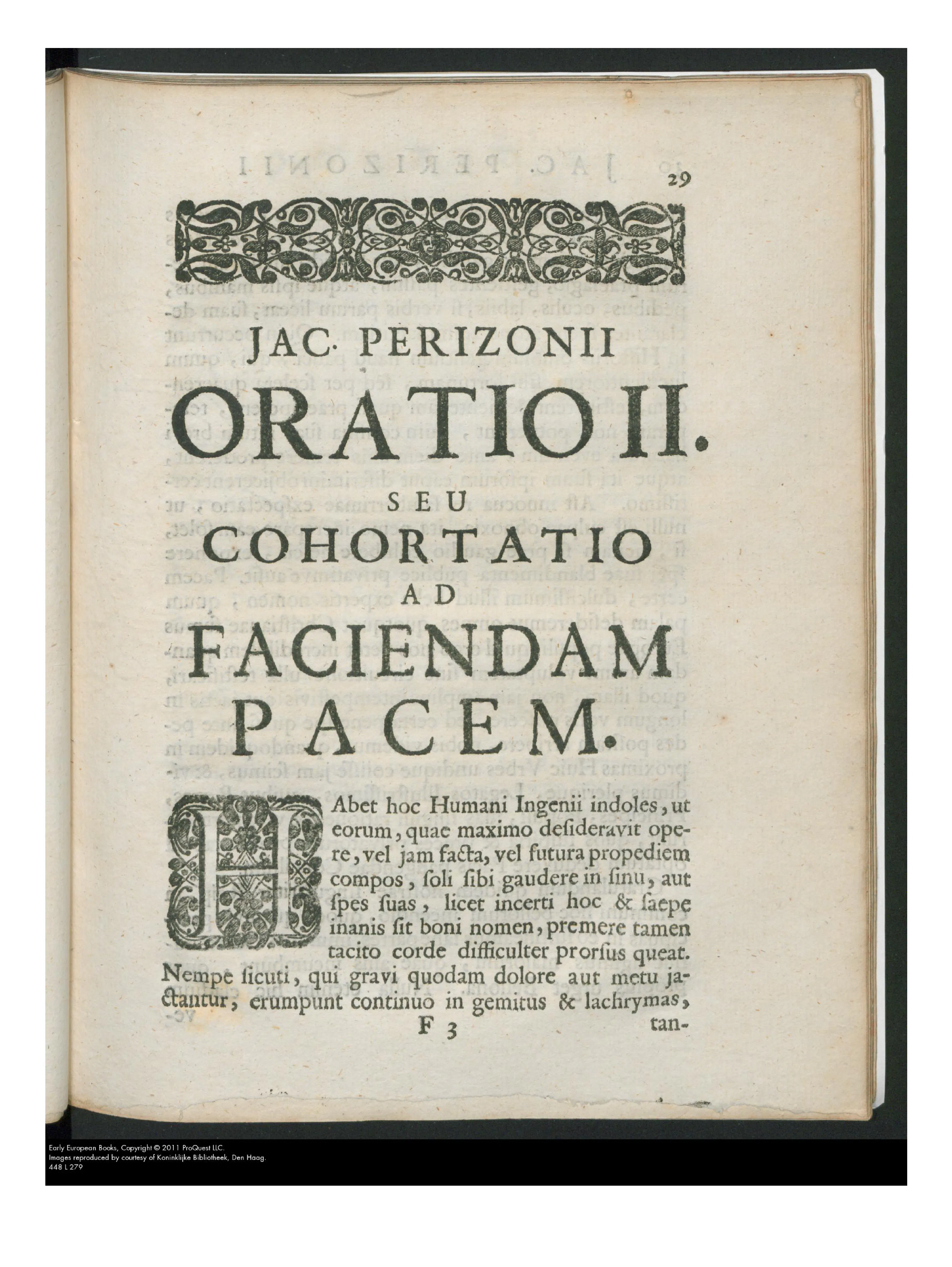
The decorated opening of the second oration, headed “COHORTATIO AD FACIENDAM PACEM,” with its ornamental headpiece and historiated initial. Here the work turns from thanksgiving to exhortation, treating peace not as the aftermath of victory but as a cause requiring learned persuasion. Source ↗.
The Cohortatio: The Root of War and the Arts of Peace
The Cohortatio reframes the same material for deliberation. It justifies academic intervention by the scholar's natural aversion to bloodshed, in the description already cited of men of letters as the servants and priests of the Muses, who wholly abhor cruel Mars. It then names war's single root, the lust for domination in princes, in the promise discussed among the work's keywords: take this from the minds of princes, and you will soon drag Mars from heaven itself and all but restore the whole world to the Golden Age. The Ovidian cycle that the first oration used for genealogy here becomes a programme, and its fulfilment lies in the reformation of princely souls. The invective that follows makes the paradigmatic conqueror its exhibit, branding Alexander, master of the world, the greatest Robber of all ages. The charge extends to the tutors who set him before royal children as a model. Against him stand Numa and the Antonines and the arts of peace, which the orator calls the arts in which alone a solid and entire glory is found: Hae enim sunt Artes, in quibus solis solida demum & integra. The adjectives solida and integra define true glory as undivided. Martial glory is always shared with generals and with Fortune, and so it is never wholly the prince's own.
Coalition, Siege and the Mirror of Princes
The most analytically ambitious stretch concerns the condition of contemporary Europe. Peoples joined by commerce and continual embassies, the orator observes in the passage already examined, repeatedly conspire and rush together at once, as if to put out some common fire, whenever any One rises higher above the rest and, breathing excess, seeks dominion over others. The urban image of neighbours running to a shared conflagration casts coalition as a civic duty of mutual preservation. Yet the orator does not idealise the allies. Fear has joined them, he says, and will join them so long as France persists: eos junxit Metus, & junget, quamdiu Gallia,. The conditional quamdiu concedes that the alliance is contingent. Its bond is metus, not amor, and the argument for peace thus quietly acknowledges that the mechanism resisting hegemony is itself a product of threat. A military observation, likewise already noted, completes the case for futility: men now dispute not over Africa or Asia, nor over all Spain, but always over single towns, for almost a whole year's campaigning season. The ancient scale of conquest is set against modern siege warfare, which consumes a season for a single town. From these premises comes the gnomic hinge of the exhortation, the maxim already cited that peace is necessary to the vanquished and honourable to the victors. The antithesis gives each camp a ground for agreement that preserves its honour, and it allows France to withdraw without the shame that might prolong the war.
The addresses to individual sovereigns turn the mirror of princes on living rulers. Louis XIV is urged, in the admonition already discussed, above all to erase from his mind those splendid robberies of Alexander of Macedon. The oxymoron of splendid robbery compresses the whole method of the orations into a single phrase. In place of Alexander, Louis is offered the domestic exemplars of Louis the Pious, Saint Louis and Louis XII. Leopold I is reminded that Habsburg greatness grew from marriages and peace. He is then given the boundary of the pacific ideal, the eternal and inexpiable war with the Turks alone that has already been seen to mark the outer limit of the argument. The word solis is precise. It confines war to a single enemy outside Christendom and thereby reveals that the redefinition of war as robbery operates within the Christian commonwealth, not universally. William, finally, is praised in the closing emblem already cited, for having added to those magnificent laurels an olive no less illustrious. The emblem resolves the tension between victory and peace by accumulation rather than renunciation, with the olive crowning the laurel instead of replacing it. A closing prayer then asks God to quench ambition and untie the knots of the negotiation.
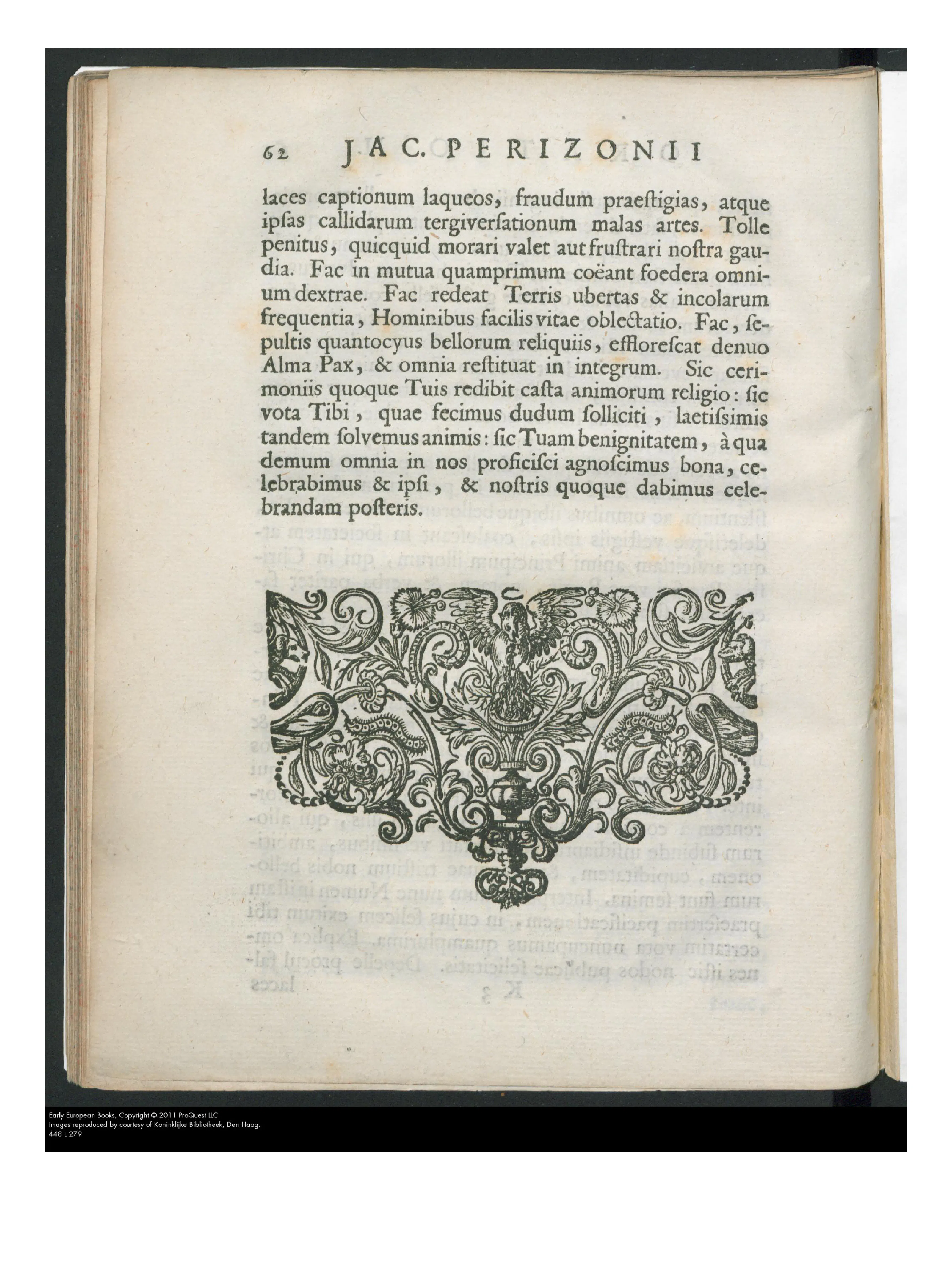
The final printed page of the Cohortatio, where the closing prayer asks that Peace flourish anew (“efflorescat denuo”) and restore all things “in integrum,” borrowing the language of legal restitution. A woodcut tailpiece of scrollwork, birds, masks and a central urn seals the quarto. Source ↗.
Reading Perizonius Alongside Claydon, Duchhardt and Hoche
Claydon, Tony. William III and the Godly Revolution. Cambridge: Cambridge University Press, 1996.
Claydon interprets William's English royal propaganda through providence, Protestant protection, and religious renewal rather than predominantly secular constitutional argument. His approach supplies an important comparative framework for Perizonius's Williamite praise, although influence or correspondence between the English material and these Latin orations requires separate demonstration. The comparison is especially pertinent where the orations praise a victorious monarch by subordinating his martial honours to peace. One royal addressee is told that to those magnificent laurels he will have added besides an olive no less illustrious, & magnificis illis laureis non minus illustrem addideris insuper olivam,. The passage gives the olive-and-laurel emblem a closing, crowning function.
Duchhardt, Heinz, Matthias Schnettger, and Martin Vogt, eds. Der Friede von Rijswijk 1697. Veröffentlichungen des Instituts für Europäische Geschichte Mainz, Beihefte 47. Mainz: Philipp von Zabern, 1998.
This specialist collection provides the diplomatic and political setting necessary to distinguish the circumstances of the negotiations from the subsequent celebration of peace, the same distinction that separates the orations' deliberative and epideictic halves. Its bibliographic record also corrects the occasionally abbreviated attribution of the volume to Duchhardt alone: Schnettger and Vogt are co-editors.
Hoche, Richard. "Perizonius, Jakob." In Allgemeine Deutsche Biographie, 25:378–379. Leipzig: Duncker & Humblot, 1887.
This older scholarly biographical essay documents Perizonius's appointments, principal writings, and nineteenth-century reputation, including Niebuhr's praise of his historical investigations. Its age requires caution. It is evidence for an influential reception tradition, not a substitute for a modern specialist biography or a work-specific study of the peace orations.
Frequently Asked Questions
What is Jacobus Perizonius's Orationes duae de pace?
Orationes duae de pace is a pair of Latin academic speeches by Jacobus Perizonius, Leiden's professor of eloquence and history. The speeches are tied to the Peace of Rijswijk of 1697, which ended the war between Louis XIV's France and the coalition led by William III. One speech gives thanks for the concluded peace. The other, the Cohortatio ad faciendam pacem, was composed while envoys gathered at The Hague and Delft to seek terms. The orator says he bears the public person of the Leiden Academic Senate, though his exact office is unconfirmed. The pair appeared at Leiden in a quarto of about sixty-two pages, and catalogue records disagree on whether it was printed in 1697 or 1698.
Why does Perizonius call Alexander the Great the greatest robber of all ages?
Perizonius calls Alexander the greatest robber of all ages because his whole method is to strip war of its honoured names. Conquest without just title becomes latrocinium, robbery on a grand scale. He defines war itself, through a play on bellum and belluinus, as bestial rage born of avarice. Success, he argues, merely dresses crime in the title of Virtue and earns a nobility drawn wholly from war. In the Cohortatio he urges Louis XIV to erase Alexander's splendid robberies from his mind, and he offers Numa and the Antonines instead. Augustine's story of Alexander and the pirate is a pertinent parallel, but direct borrowing has not been shown.
Did Perizonius's call for peace include war against the Turks?
No. Perizonius confines his case for peace to Christian princes, and he closes with a deliberate limit: with the Turks alone there is to be eternal and inexpiable war. The phrase comes in his address to Leopold I, whom he reminds that Habsburg greatness grew from marriages and peace. He frames peace among Christians as a refounding of the commonwealth of Christendom. His redefinition of war as robbery therefore applies within that commonwealth rather than universally. The orations should not be read as a rejection of all warfare. Nor does this conventional anti-Ottoman appeal by itself amount to a practical proposal for a new military coalition.
Why are Perizonius's peace orations confused with Baudius's funeral oration for Scaliger?
At least one digital record wrongly attributes the peace orations to Dominicus Baudius, filing them under his funeral oration for Joseph Justus Scaliger. This is a catalogue error at the level of work identification. The two works are plainly distinct. Baudius's Oratio funebris was delivered on 26 January 1609 and printed at Leiden that year, whereas Perizonius's orations belong to the late 1690s. A Getty Research Institute copy of Baudius is bound with Daniel Heinsius's elegy on Scaliger. That copy proves composite memorial volumes existed, but not that one contained the peace orations. The responsible record has not been identified, so the mechanism of the error remains unresolved.
Is there an English translation of Perizonius's Orationes duae de pace?
No modern English translation has been identified. No Dutch translation, contemporary vernacular rendering, or later published translation of the two Latin orations was securely identified either, though this does not prove that none ever existed. Separately, the Leo edition presents the full transcription and a complete, AI-generated English translation for the first time. Leo is an effort to make freely available online, at no cost, English translations of every text printed in Latin in early modern Europe between 1450 and 1750.
This report was generated by an advanced AI assistant that conducted deep research alongside an extensive interpretation of the transcribed original text. Every effort has been made to preserve fidelity to the source and to guard against inaccuracy, but corruption in the text recognition process and model hallucination may nonetheless have entered the text. Treat every claim, quotation, translation, and citation as provisional, and verify each against the original source before relying on or citing it.
Bibliography
- Tony Claydon, William III and the Godly Revolution: Claydon shows William's English image-makers dressing the king as God's chosen restorer of true religion, not merely as a constitutional convenience with a Dutch accent. Read it to test how far Perizonius's Peace that stands "next to holiness" and his self-surpassing warrior-king belong to a shared providential idiom, and how far a Leiden professor was simply making his own Latin weather. The book covers England, not Leiden, so any line drawn between the two remains the reader's own work.
- Heinz Duchhardt, Matthias Schnettger, and Martin Vogt (eds.), Der Friede von Rijswijk 1697: This Mainz volume reconstructs the actual business of Rijswijk, the haggling, the delegations, and the long wait between The Hague and Delft, which the Cohortatio could only address from the lectern. It is the necessary corrective to an orator who speaks of knots untied by God, since here one learns who held the string. Note the three editors; crediting Duchhardt alone is a habit the volume's own record quietly declines.
- Richard Hoche, "Perizonius, Jakob," Allgemeine Deutsche Biographie: Hoche supplies the dates, the chairs at Franeker and Leiden, the Voorbroek surname, and Niebuhr's warm verdict on the Animadversiones historicae, with a few colder remarks about the grammar set alongside it. It is the quickest way to see why Perizonius is remembered as a critic rather than an orator, and therefore why the peace speeches have gone largely unread. Treat it as a nineteenth-century witness to a reputation, not as the final word on the man.