Obscure Sand: Pieter Burman the Elder's Funeral Oration for Johann Georg Graevius, with an Elegy and Memorial Poems by Friends
In the winter of 1703 Pieter Burman the Elder mourned Johann Georg Graevius, the most celebrated classical scholar of the Dutch Republic, in a Latin speech printed at Utrecht as Petri Burmanni Oratio funebris in obitum viri clarissimi Joannis Georgii Graevii. The oration treats the death as the burial of Learning itself. It is at once a biography, a manifesto for Ciceronian Latin and civic liberty, and a petition to the city's magistrates on behalf of the dead man's orphaned daughters, and it shows an early modern university presenting its grief, with considerable eloquence, as an invoice to its patrons.
ExLatinis
19 October 2026

Contents
In the winter of 1703 Pieter Burman the Elder mourned Johann Georg Graevius, the most celebrated classical scholar of the Dutch Republic, in a Latin speech printed at Utrecht as Petri Burmanni Oratio funebris in obitum viri clarissimi Joannis Georgii Graevii. The oration treats the death as the burial of Learning itself. It is at once a biography, a manifesto for Ciceronian Latin and civic liberty, and a petition to the city's magistrates on behalf of the dead man's orphaned daughters, and it shows an early modern university presenting its grief, with considerable eloquence, as an invoice to its patrons.
When Johann Georg Graevius died at Utrecht on 11 January 1703, the city lost its most celebrated classical scholar. Graevius was a German-born philologist trained in the Dutch schools who had held the chair of eloquence at Utrecht since 1661 and that of history and politics since 1667. A few weeks later, on the date the title page gives as XI Kal. Martias 1703 (19 February by inclusive Roman reckoning), Pieter Burman the Elder commemorated him in a Latin funeral oration. The academy's printer, Willem van de Water, issued it at Utrecht with an elegy and a gathering of memorial poems by friends, the Amicorum carmina. The work belongs to a recognizable genre, the academic oratio funebris: a public act of praise delivered within a university, at once an eulogy, a biography and a rhetorical performance. Its value as a record of Graevius's life is real but conditional. The narrative is shaped throughout by the demands of encomium. Its principal witness, the scholarly reference tradition, itself depends partly on Burman's account.
The oration confronts a problem that is larger than one man's death. Burman presents the passing of Graevius as the burial of Learning and Letters themselves, and he asks what a learned community owes to such a loss. His answer proceeds by a consistent manoeuvre. He sets aside the funeral commonplaces of birth, ancestry and fortune and praises a man who "owes everything to himself." He then reads each stage of the life as the emergence of a norm. Confessional purity is set against the Spanish tribunal and the monks. Severe schooling is preferred to parental softness, and Ciceronian Latinity to the archaizing imitators of Justus Lipsius. Philology is grounded in the collation of manuscripts, and political prudence is drawn from historical example rather than scholastic dialectic. A free civic life is set against splendid servitude at court, and urbanity is joined to learning. Each norm, once established, is then turned outward into a claim upon Utrecht and its academy. Those claims include patronage for learning, support for the orphaned daughters, a fitting monument, and continuity through a successor.
The stakes are those of several overlapping histories. The oration is evidence for the formation of a scholar who moved from Schulpforta and Leipzig to Deventer and Amsterdam, and who passed from Lutheranism to the Reformed Church. It records the contest over Latin style in the generations after Lipsius. It shows how civic freedom could be invoked as a commendation of learned life during the Second Stadtholderless Period, although that invocation does not by itself fix the speaker's party allegiance. It also reveals a university embedded in urban government, whose printer bore an academic title and whose publications addressed the city's magistrates.
What makes the text memorable is the vividness of its particulars. Gronovius tests the young Graevius and pronounces that he knows Latin "grammatically, not Latinly." The Lipsian imitators are branded "apes," who gather their vocabulary from the dunghill of archaic Roman tragedy. Graevius is remembered as the most urbane among the learned and the most learned among the urbane. He is said to have likened an academy to a shop that attracts no buyers unless it is stocked with goods of every kind. The oration itself asserts that his learned correspondence consumed almost a fifth of his yearly salary, although no salary record has yet corroborated the figure. In the memorial verses, a reproach that the body lies in obscure sand without a monument stands beside the image of Utrecht as a "new Rome," and a poem promises that its addressee will be "another Graevius."
A single conviction binds these elements together: learning is a civic good, and its loss creates obligations. That conviction governs the oration's conceptual vocabulary, including libera civitas, civilis prudentia, Latine and officina. It also governs the circumstances of the work's production, since the academy's printer issued it and its addresses went to the city's authorities. Finally, it governs the argument, which moves from the exemplary life to a petition. The material history of the printed object is less settled. Its collation, its full contents and the attribution of its individual poems await confirmation against the surviving text. The Florence copy now accessible in digital form has also carried a conflicting catalogue association with a seventeenth-century geography, an association that remains undocumented.
Read the full text and English translation on Leo
This text was transcribed and translated as part of the ExLatinis project, an effort by Leo to make free English translations of every text published in Latin in early modern Europe (1450–1750) available online. The complete transcription and English translation of this work can be read free of charge:
→ Read the original Latin text and full English translation on Leo
You can save a copy of this document into your Leo account to run deep text searches, conduct further analysis, or cross-reference it with your own research.
Titling Burman's Funeral Oration for Graevius and Reading Its Civic Latin
Funeral Oration for Johann Georg Graevius, with an Elegy and Memorial Poems by Friends — an editorial English title supplied for convenience, not an established historical translation.
The securely recoverable principal Latin title is Petri Burmanni Oratio funebris in obitum viri clarissimi Joannis Georgii Graevii. The author is Pieter Burman the Elder, Latin Petrus Burmannus; Petri Burmanni is the genitive appearing on the title page. The commemorated scholar is Johann Georg Graevius, whose name appears there as Joannes Georgius Graevius in the corresponding genitive form. These are Latinized names, not evidence of pseudonymous authorship. A complete diplomatic transcription of the additional titulature has not been established.
Burman's libera civitas belongs to a contrast between the insecurity of courtly dependence and the honorable tranquility available to a learned man within a free civic community. Freedom here is not an assertion of universal political participation. The passage associates the scholar's security with obedience to equitable laws and freedom from personal subordination. The oration draws the contrast in its own vocabulary. The courtly alternative is a life lived dignitatis specie, magnificus & splendidus, magnificent and splendid under the appearance of dignity. Against it Burman sets existence in libera civitate, ubi nemo, si modo legibus aequissimis obtemperat, alteri se in turpe servitium addicit, ubi ipsis Magistratibus, qui sola dignitate reliquis superiores, jure vero omnibus civibus aequales sunt, nihil praeter reverentiam debetur;. In English: in a free city, where no one who obeys the most equitable laws binds himself to another in base servitude, and where to the magistrates themselves, superior to the rest only in dignity but equal by right to all citizens, nothing but reverence is owed. The clause on magistrates who are equal in right and distinguished only in dignity sharpens the opposition to personal subordination. It does not extend the claim into a doctrine of participation. Its immediate concern is the conditions of learned otium: the leisure necessary for study, compatible with teaching and civic service. An interpretation within Dutch republican political language is persuasive, but a declaration of allegiance to a particular political faction does not follow automatically from this vocabulary. Here, as elsewhere in the oration, a political term serves the larger claim that learning flourishes under particular civic conditions and is owed their protection.
Civilis prudentia similarly names a cultivated capacity rather than merely a body of abstract propositions. In the account of Graevius's teaching, political learning acquires value through its relation to the conduct of public affairs and the formation of future governors. The oration characterizes the discipline as horridam Civilis prudentiae scientiam, Graevio,, "the rough science of civil prudence," in a sentence that binds its fortunes to Graevius. Burman's disparagement of scholastic terminology makes the opposition between verbal subtlety and useful judgment especially important. The scholastic alternative is figured through those handled quos Chrysippeis nodis, & ineptis sophismatis, with Chrysippean knots and inept sophisms. The Stoic logician's name serves here as a classical byword for captious dialectic. The historical interpretation is that eloquence, historical learning, and political discernment reinforce one another; the passage does not establish that Graevius rejected political theory altogether.
The distinction between knowing Latin grammatice and knowing it Latine sharpens the same educational argument. In Burman's account, Gronovius discovers the inadequacy of Graevius's earlier preparation: grammatical explanation or substitution of German equivalents does not yet amount to command of idiomatic, elegant Latin. The discovery is staged as a dialogue. After Graevius respondit. Ergone, inquit Gronovius, Ciceronis, "he replied. 'Then,' said Gronovius, 'Cicero's…'," the exchange presses toward Ciceronian usage. Its verdict follows: Graeviumque Grammatice, non Latine scire animadvertat Gronovius, Gronovius perceives that Graevius knows Latin grammatically, not Latinly. Latine therefore carries an evaluative force beyond linguistic correctness. It denotes participation in an inherited literary culture whose standards Burman associates with Ciceronian purity. His attack on Lipsian imitators belongs to this contest over literary formation, not to a neutral classification of acceptable Latin. The adverb thus works in the same way as libera civitas and civilis prudentia. Each term names a norm that the life is shown to embody and that the commemorating community is implicitly asked to sustain.
How Burman Turns the Death of Graevius into a Claim on Utrecht
Pieter Burman the Elder's commemoration of Johann Georg Graevius is an academic Latin funeral oration, accompanied by memorial poetry, including an elegy and the collective Amicorum carmina. Its principal purpose is encomiastic: Graevius's learning, teaching, character, and public usefulness become grounds for preserving his memory and affirming the value of the learned institution he served.
The scale of the loss is fixed at the outset. Graevius is mourned not as one non ingenii laude prae reliquis excellens, sed Eruditorum Princeps, imo ipsa Eruditio & Litterae cum Graevio efferuntur: not a man excelling others merely in praise of talent, but the prince of the learned, with whom Learning and Letters themselves are carried out to burial. The exordium then turns grief into duty. It dwells on a mind torpenti & frigore quodam contracto aperiri? Cum tamen summum foret scelus,, laid open while numbed and contracted by a kind of chill, and on the greatest crime that silence would constitute. Burman then declares his method. He sets aside the material with which funeral praise laudatione frequentari solet, in locos communes, is commonly crowded, sorted into commonplaces. Instead he speaks sed de Viro, qui omnia sibi debet, & nuda virtute, & mente omnium scientiarum capacissima enituit, of a man who owes everything to himself and shone forth by naked virtue and a mind most capable of all sciences. This preference for intrinsic merit over birth and fortune organizes the whole oration. Each stage of the life becomes evidence of a scholarly or civic norm, and the peroration and verses finally present those norms as claims on Utrecht.
The title dates its delivery to XI Kal. Martias 1703, corresponding, by inclusive Roman reckoning, to 19 February 1703. The imprint identifies Utrecht, Trajecti ad Rhenum, and Willem van de Water, Guilielmus vande Water, printer to the academy. The precise delivery venue and place of composition have not been independently established. No published translation was located; this is not proof that no translation has ever existed.
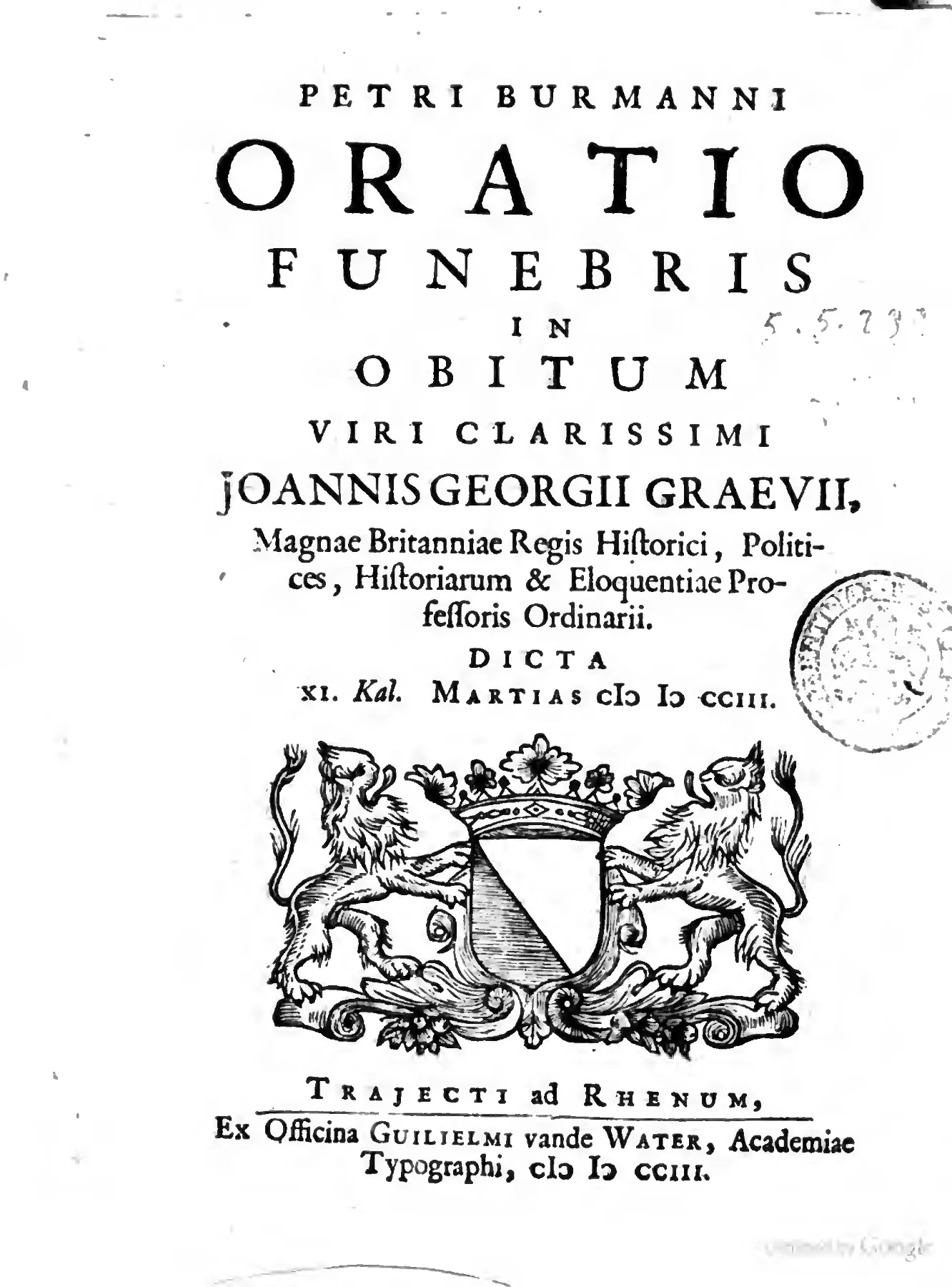
The title page announces genre and institutions together: an Utrecht academic funeral oration for Johann Georg Graevius, dated in Roman style and issued by Guilielmus vande Water as the academy’s printer. Its heraldic device, Florence library stamp, and pencilled shelf mark trace the commemoration’s afterlife in a surviving copy. Source ↗.
The digital identifier bub_gb_Xn0-Vn5731sC, from which the title page above is reproduced, belongs to a Google-derived copy of Burman's oration originating in the National Central Library of Florence. A crucial qualification affects its catalogue history: the current Internet Archive and Google Books records inspected identify Burman and the 1703 oration, not Clüver and Heinsius or a 1641 geography. The alleged Clüver attribution could therefore not be reproduced as a current description of this identifier.
The available evidence establishes the identity of the Burman text but does not establish a Sammelband containing a 1641 Clüver edition. A mistaken catalogue association remains a possible explanation for the conflicting attribution; neither its historical occurrence nor its mechanism has been demonstrated. The existence and exact imprint particulars of a 1641 Clüver edition also remain incompletely resolved.
Placing the Graevius Oration in the History of Dutch Classical Scholarship
Dutch classical scholarship and the authority of commemoration
Graevius's career connects German schooling, Dutch philological training, and the institutional consolidation of classical scholarship at Utrecht. Ward Briggs's scholarly reference entry records education at Schulpforta and Leipzig, subsequent study at Deventer and Amsterdam, and successive chairs of eloquence at Duisburg, 1656–1658, Deventer, 1658–1661, and Utrecht, 1661–1703. Utrecht's chair of history and politics followed in 1667. Briggs identifies Gronovius as decisive in Graevius's turn toward classical philology and David Blondel as influential in his movement from Lutheranism to the Reformed Church. Graevius died at Utrecht on 11 January 1703.
Burman sets this geography of formation inside a confessional prehistory. Graevius's forebears are said to have fled persecution: cum purioribus sacris essent initiati, ab horrendo illo & sanguinario Hispanorum tribunali bonis exuti, in Bohemiam concesserant. Having been initiated into the purer rites and stripped of their goods by that horrible and bloody tribunal of the Spaniards, they had withdrawn into Bohemia. Schulpforta is remembered in the same polemical key, as a monastic foundation redeemed by reformers who, discussis falsorum errorum tenebris, ex libidinis latebris ignavissimos ventres, & sola ignorantia turgentes Monachos extraxerant, & coenobia, regiis vectigalibus dotata, in bonae mentis palaestras converterant. Having dispelled the darkness of false errors, they had dragged from the lairs of lust the most slothful bellies and monks swollen with ignorance alone, and had converted monasteries endowed with royal revenues into training-grounds of sound minds. Burman generalizes from the severity of that schooling. He declares that there is non aliam hujus saeculi infelicitatis, & bonorum virorum penuriae caussam esse, quam perversam illam lenitatem & educationis mollitiem, qua, dum puerorum tergis & corporibus metuimus, secure mentem corrumpi permittimus;: no other cause of this age's misfortune and dearth of good men than that perverse leniency and softness of education by which, while we fear for boys' backs and bodies, we carelessly let their minds be corrupted. The industry this discipline produced appears in the report that Graevius partem Homeri & Hesiodi lectioni se impendisse, tantamque inde Graecae, devoted part of the night to reading Homer and Hesiod, and thence so great a command of Greek. Briggs attributes the later confessional move to Blondel. The oration's counterpart describes Graevius as gravitate & auctoritate adductus, puriori, led by a mentor's weight and authority to the purer faith. That phrasing extends the vocabulary of "purer" religion from the family's flight to the scholar's own conversion.
These connections make the oration valuable for the history of scholarly formation, but its narrative cannot be treated as disinterested biography. Burman's exemplary contrasts establish the deceased's authority and the legitimacy of the culture he represented. Briggs's entry is a useful scholarly reference rather than a specialist monograph, and its bibliography itself includes Burman's oration: agreement between the two is not automatically independent corroboration.
Briggs characterizes Graevius as especially important for gathering and presenting earlier scholarship, with editions valued for annotation rather than wholly new textual methods. That emphasis differs from the unrestricted praise expected in funeral encomium. Burman's own image of Graevius's method is more heroic. He describes a scholar who, sed Herculeo labore veterum codicum & editionum comparatione instituta, pulcherrimis auctoribus insidentes labes eluebat, by Herculean labour, instituting a comparison of old codices and editions, washed away the blemishes clinging to the finest authors. The distance between the encomiastic portrait of the collating critic and the reference tradition's more measured estimate is itself evidence of how commemoration constructs scholarly authority. Collation figures in the oration as one more norm the life exemplifies. Lucian Müller's Geschichte der klassischen Philologie in den Niederlanden represents an earlier, nineteenth-century evaluative historiography. No sustained modern controversy specifically about this funeral oration was established.
Latin style after Lipsius
The description of Lipsian imitators as Lipsianae simiae belongs to a polemical account of Graevius's intellectual correction under Gronovius. Burman casts the stylistic fashion of the preceding generation as a contagion: flaverat enim pestilens quoddam sidus omnes fere, for a certain pestilential star had blasted almost all. In his abusive figure, the archaizing vocabulary it fostered is drawn sterquilinio, ex Pacuvii sordibus antiqua &, from the dunghill, from the filth of Pacuvius, old words. In the narrative of Graevius's early style, his name is set against the imitators in the phrase Graevium Lipsianae simiae, qui, antequam, "Graevius, the Lipsian apes, who, before." Its evidentiary value lies partly in the boundaries it draws around legitimate eloquence. Burman associates literary excellence with purity, continuity, and idiomatic mastery while representing rival imitation as distortion. The rhetoric of contagion and correction parallels the confessional narrative of error dispelled, so that stylistic and religious purity are presented as kindred achievements of the same formation.
Tom Deneire's "The Philology of Justus Lipsius's Prose Style" offers a contrasting scholarly method: formal and functional analysis of Lipsius's actual prose. Burman's denunciation and Deneire's analysis concern different objects and cannot be represented as a direct scholarly dispute. Their juxtaposition nevertheless exposes a necessary distinction between Lipsius's stylistic practice and an opponent's representation of Lipsian followers.
Republican liberty and civic usefulness
The praise of life in a libera civitas makes Dutch republican political language relevant, especially in the setting of the Second Stadtholderless Period. The memorial verses, which also register the death of William III, belong to the same political moment. Wyger R. E. Velema's work on eighteenth-century Dutch republicanism emphasizes the importance of a shared identity as freeborn republicans. That framework helps explain why civic freedom could function as a widely intelligible commendation without fixing every speaker's party allegiance.
The oration's opposition between civic security and courtly dependence, between splendour worn as a mere appearance of dignity and reverence freely owed to magistrates equal in right, should therefore not be translated directly into an anti-Orange manifesto. Graevius's associations with rulers and aristocratic pupils complicate any simple opposition between republican learning and princely patronage. The demonstrable claim is narrower: Burman presents lawful civic independence as favorable to learned work.
Correspondence and the Republic of Letters
Graevius's extensive correspondence and his exchange with Richard Bentley situate his scholarship within collaborative learned communication. Hans Bots and Françoise Waquet's La République des Lettres provides a contextual framework for its obligations, reputations, and exchanges. Letters transmitted scholarly assistance but also required material resources and sustained personal effort. Burman joins this sociability to learning in a chiastic formula: Graevius inter eruditos urbanissimus, inter urbanos eruditissimus habebatur, among the learned he was held the most urbane, among the urbane the most learned.
The particular assertion that postage consumed almost one fifth of Graevius's salary has not been independently confirmed. The text itself, however, carries it. Burman raises the question quanti ipsi hoc commercium litterarium steterit,, how much this literary commerce cost him, and gives the measure ut quintam fere stipendii partem quotannis, so that almost a fifth part of his salary each year. The figure is therefore attested as Burman's own encomiastic claim. It should not be repeated as an established financial fact without a supporting account. Correspondence collections and university or municipal salary records would be necessary to establish the amount and period involved. Within the oration, the cost of correspondence serves the larger argument: the scholar's private expenditure on the common good of letters becomes a ground for the community's reciprocal obligation.
Utrecht and academic commemoration
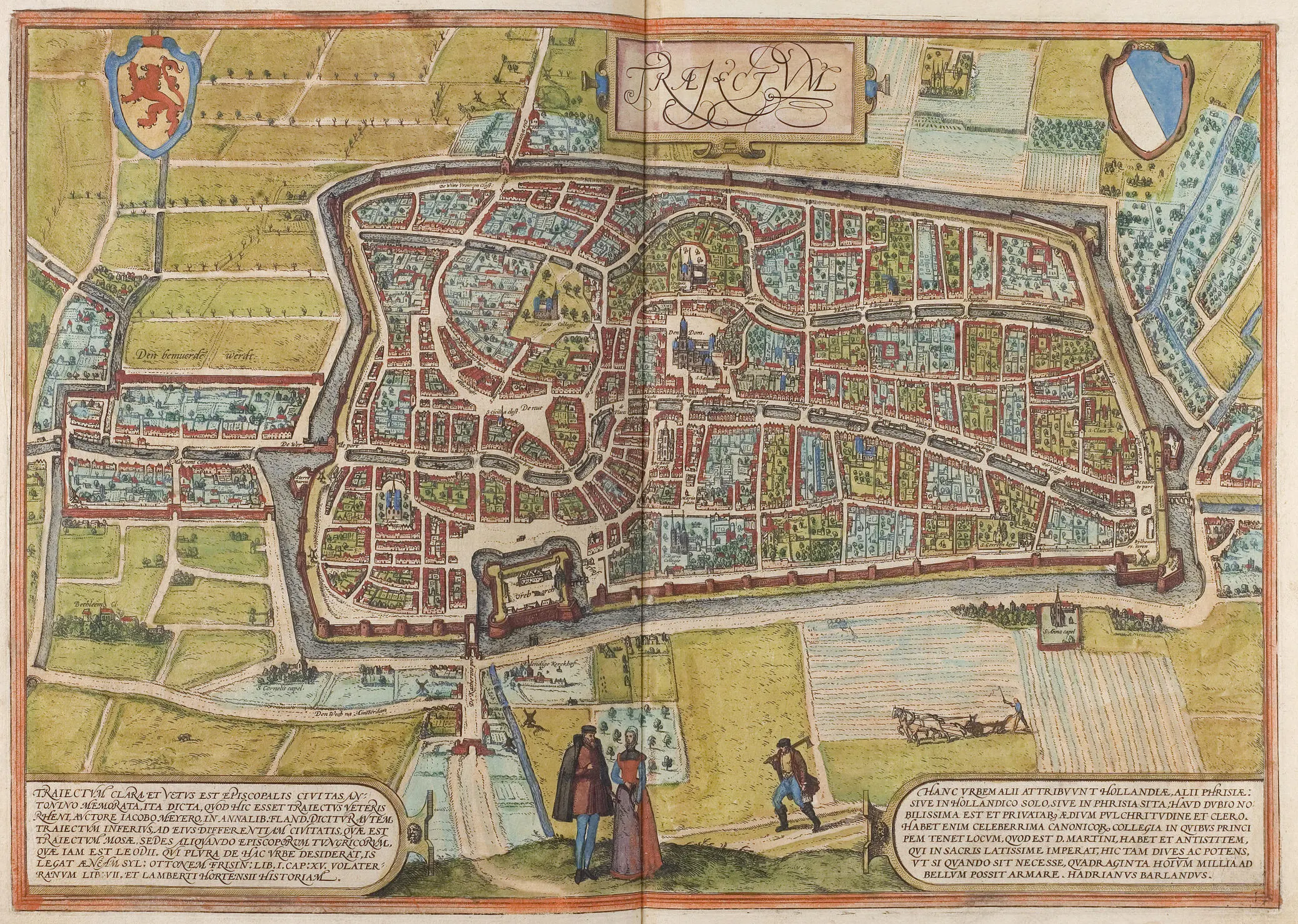
An early modern bird’s-eye view of Utrecht renders the city named in the oration’s imprint, “Trajecti ad Rhenum,” as a dense civic landscape. This is the free city whose dignity, in the speech and its memorial verses, frames academic mourning and earns the title of a new Rome. Source ↗.

The conjunction of civic address, academic printing, eloquence, and political instruction reveals a university embedded in urban government. Burman attributes to Graevius a mercantile image of that institution: Officinam esse, ajebat, Academiam, quae nullos emtores allicit, nisi omnis generis mercibus & copia sit instructa. He used to say that an academy is a shop, which attracts no buyers unless it is furnished with goods of every kind and in abundance. The figure grounds the case for patronage in the city's own interest. The institutional history edited by G. W. Kernkamp, De Utrechtsche Universiteit, 1636–1936, is a relevant point of departure, but no specific archival finding about the financing or civic reception of this publication was established.
The appended memorial poems extend commemoration beyond a single speaker. They present themselves as Carmina non artis, sed pietatis opus, songs the work not of art but of piety. They make the dead scholar's reputation a collective undertaking, while the funeral oration converts learning into an exemplary life. The verses also enlarge the civic claim. One celebrates the moment when Trajectumque vetus potuit nova Roma vocari,, old Utrecht could be called a new Rome. Another looks to continuity, turning to its addressee, apparently Burman himself, with the promise In Te: Tu nobis GRAEVIUS alter eris, into you: you will be another Graevius for us. The oration's account of the death closes on the merits of Christ, Christi Servatoris nostri meritis, & apud, "the merits of Christ our Saviour, and before," which gives the confessional memory of the early narrative its devotional conclusion. Such texts are evidence for academic values, succession, confessional memory, and claims on patronage. They are not transparent records of unanimous opinion. No securely documented controversy over Burman's succession or the anti-Lipsian passages was located, and the precise consequences of the commemoration for Graevius's family remain unknown.
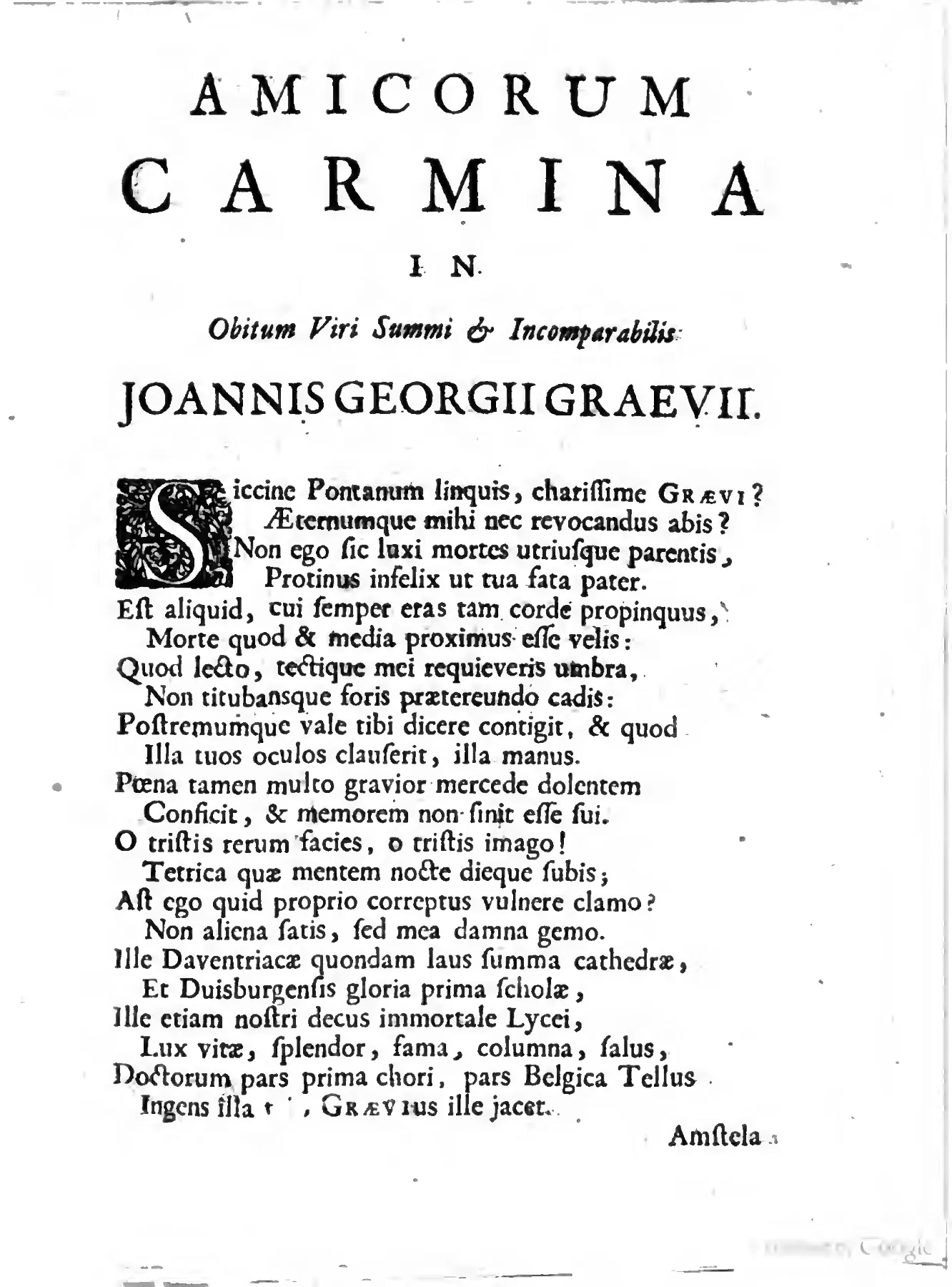
The opening of the Amicorum carmina announces poems “in obitum”—on the death—of Joannes Georgius Graevius, marking the turn from Burman’s single voice to communal mourning. The first poem’s recollection of Graevius’s chairs at Deventer and Duisburg turns a scholarly career into collective reputation for the wider Republic of Letters. Source ↗.
Tracing the 1703 Utrecht Printing and the Florence Copy
The 1703 Utrecht printing
The principal title reads Petri Burmanni Oratio funebris in obitum viri clarissimi Joannis Georgii Graevii. The title-page date is XI Kal. Martias 1703. The imprint identifies Trajecti ad Rhenum and the press of Guilielmus vande Water, Academiae Typographus. The institutional designation establishes the printer's relationship to the academy; it does not, by itself, establish who commissioned or paid for this particular publication.
The accessible text includes an Amicorum heading and memorial poems. A signature H3 is recoverable in the transcription, but an isolated signature cannot establish a complete gathering formula. The exact format, collation, full pagination, and presence or absence of an engraved portrait remain unverified. Google Books describes the work as 57 pages, whereas Internet Archive records 96 pages. These discrepant metadata counts must not be silently converted into an analytical bibliographical description.
A specific STCN record for this edition was not securely identified. Consequently, no STCN number, fingerprint, gathering formula, or Dutch holding shelfmark can responsibly be assigned. The absence of a located record is not evidence that the edition is absent from STCN or from Dutch collections.
The Florence copy and its digital transmission
Google Books identifies the original institution as the National Central Library of Florence and records digitization on 24 September 2013. Internet Archive identifies the same source institution, gives Google identifier Xn0-Vn5731sC, and records addition on 16 September 2014. Its persistent identifier is ark:/13960/t8pc5t076. The physical Florence shelfmark, acquisition history, binding date, and earlier ownership were not established.
The current records are accessible at https://books.google.com/books?id=Xn0-Vn5731sC and https://archive.org/details/bub_gb_Xn0-Vn5731sC. Both name Burman's funeral oration. No Clüver or Heinsius text was identified in the accessible textual evidence. Nevertheless, neither catalogue metadata nor a searchable transcription can substitute for a complete examination of binding and constituent-title evidence.
The three possible explanations for the conflicting attribution therefore have unequal evidentiary standing. A catalogue error or mistaken digital linkage is possible, but no erroneous historical record was recovered. A physical Sammelband remains unproved: no constituent-title list, common shelfmark, binding description, or documented sequence joining the two works was established. Another conflation is likewise possible, but its mechanism cannot be reconstructed. The defensible conclusion is that the present digital identifier represents Burman's 1703 oration, while the alleged association with Clüver remains undocumented.
Clüver, Heinsius, and the unresolved 1641 imprint
A separate John Carter Brown Library digitization, philippicluverii00clve_2, explicitly describes a Clüver geography accompanied by Daniel Heinsius's funeral oration for Clüver. This confirms the bibliographical conjunction of geography and funeral oratory in at least one Clüver edition. It does not demonstrate that the Burman copy was confused with that edition, or that the separate digitization represents the year 1641.
The New York Public Library catalogue provides a relevant lead, record b14284438, indexed for Clüver's Introductio and carrying the call-number element \KB 1641 (Clüver, P.). The complete imprint was not securely established from that lead. A definitive statement of the 1641 edition's printer, city, format, and USTC or VD17 identifier is therefore unavailable. No identification of a Leiden Elzevir printing of that year should be treated as verified solely on this evidence. Catalogue lead: https://www.nypl.org/research/research-catalog/bib/b14284438/marc.
Institutional address, contributors, and reception
The printed preliminaries address Utrecht's civic authorities, and the printer identifies himself through his academic office. These features place the publication within civic-academic patronage. The peroration renews the address in the form of a petition. It declares that familiae spes in vestra, Patres Patriae & Academiae,, the family's hope lies in your benevolence, Fathers of the Fatherland and of the Academy. The oration thus turns the norms its biography has established into an explicit claim on the city's governors. These features do not demonstrate a municipal payment, a formal commission, or a decision concerning support for Graevius's surviving family.
A definitive poem-by-poem register remains unestablished. In particular, the individual contributions attributed to Adriaan Reland, Jan van Broekhuizen, Pieter Francius, and David van Hoogstraten, together with the distribution of Latin, Greek, and Dutch pieces, require verification against their printed headings and subscriptions. The accessible transcription does preserve the name M. Leydecker in the memorial material.
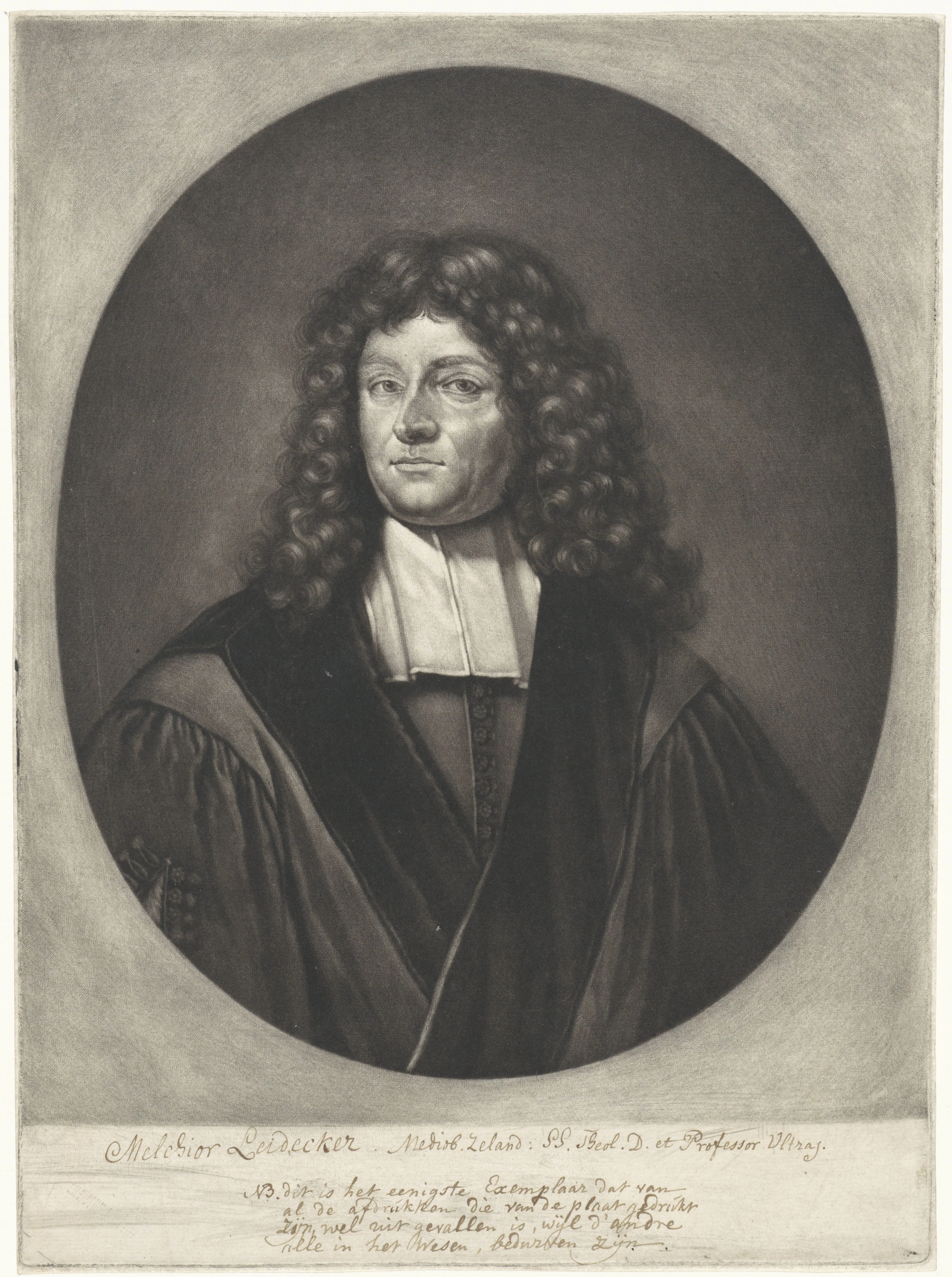
Portrait of the Reformed theologian Melchior Leydekker, professor at Utrecht, whose name appears to correspond to the “M. Leydecker” preserved in the memorial material. If so, Graevius’s commemoration reached beyond classicists and poets into Utrecht’s confessional and academic networks. Source ↗.

No documented administrative outcome was located for a request concerning Graevius's daughters or a funerary monument. The memorial verses state the grievance over the monument directly: Sed pudor! Obscura requiescit corpus arena,, but for shame! the body rests in obscure sand. Whatever followed from that reproach is not recorded in any document so far located. No particular censorship decision, approbation, suppression, or contemporary counter-publication responding to this oration was established. These are limits of documentation, not findings that no such acts occurred.
Later transmission and related works
Ward Briggs's bibliography points to Burman's account of Graevius in Eloquentium virorum narrationes de vitis hominum doctrina et virtute excellentium, Leipzig: Hartmann, 1826, pages 134–196, with bibliography on pages 196–204. This is a useful transmission lead, but textual identity with the complete 1703 publication, including its poetic appendices, has not been demonstrated by collation.
Inclusion in Burman's collected Orationes or prefatory placement in a posthumous Graevius publication was not verified. Graevius's own collected official speeches, reported as published in 1717, must not be confused with Burman's speech about him. Burman's continuation of Graevius's Italian antiquarian enterprise supplies a genuine connection between commemoration and the preservation of scholarly work, without establishing that the oration accompanied every subsequent edition. That continuation corresponds, outside the text, to the succession the memorial verses imagine.

A 1704 title page of Graevius’s Thesaurus antiquitatum et historiarum Italiae, issued the year after his death and bearing his name in the same Latin genitive as the funeral oration. The Italian antiquarian enterprise Burman continued made succession a matter of publication, not only of oratory and verse. Source ↗.

Several biographical particulars also remain unresolved: the precise Janusz Radziwiłł intended; the identity of the Saxe-Lauenburg duke bearing the territorial style Angariae et Westphaliae Dux; the exact connection with Frederick I of Prussia; and the circumstances of particular refused appointments. The ducal style alone does not establish Julius Heinrich's identity. The oration's account of the final illness includes clinical matter, but details of apoplexy and therapeutic bloodletting likewise were not independently established.
Following Burman's Argument from Exordium to Memorial Verses
The exordium: Learning carried to burial
Burman fixes the scale of his subject before he has said anything about Graevius's life. Adapting the cry of Metellus Macedonicus, he summons not the citizens of Utrecht but the peoples of the world. The deceased, he declares in the opening lament already quoted above, was not a man merely more distinguished than others in talent but the prince of the learned, and with him Learning and Letters themselves are carried out to burial.
The verb efferre, the technical term for carrying a corpse out to its funeral, does structural work. It turns the oration from the commemoration of a colleague into the obsequies of the respublica litteraria as a whole. Everything the speech later asks of the city depends on this opening enlargement, since a city cannot be petitioned for the support of Learning itself unless Learning has first been shown to be what lies on the bier.
The exordium then performs the expected recusatio of the grief-stricken speaker and converts it into obligation. Burman evokes a mind that must be opened while numbed and drawn in upon itself by a kind of chill, and, in the rhetorical question cited earlier, insists in the same breath that silence would nonetheless be the greatest crime. The question concedes incapacity only so that the following clause can override it.
The logic is that of humanist exemplarity. A life born to serve as a pattern for others cannot rightly be buried unpraised, so praise becomes a moral debt rather than an ornament. This is the first of the oration's many conversions of sentiment into duty, and its later appeals to the magistrates are built on the same pattern.
The method follows directly from that sense of debt. In the two declarations of method already examined, Burman renounces the material with which funeral praise is ordinarily crowded, sorted out into commonplaces, and promises in its place to speak of a man who owes everything to himself and who shone forth by naked virtue and a mind most capable of every science.
The disavowal is itself a commonplace, the praise of the homo novus, but it carries a programme. If merit is self-generated, the community's obligation cannot be discharged by honouring a lineage. It must be discharged by sustaining the conditions under which such merit arises.
Lineage, conversion, and the discipline of Schulpforta
The genealogy that follows sits in some tension with the declared contempt for ancestry, and Burman resolves that tension by making ancestry confessional rather than aristocratic. The mother's forebears, as the passage on the Spanish tribunal recalled above records, were initiated into the purer rites, stripped of their goods by that horrible and bloody tribunal of the Spaniards, and withdrew into Bohemia. What is praised here is the nobility of suffering for true religion rather than blood. The Inquisition, the stock antagonist of Netherlandish Protestant memory, supplies the family's only title of distinction.

Francisco Rizi’s auto de fe, painted c. 1683, stages the Spanish Inquisition as public ceremony. It depicts no episode from Graevius’s family history, but evokes the “horrible and bloody tribunal” against which Burman defines a Protestant nobility of confiscation, exile, and suffering. Source ↗.

The comparative purioribus deserves attention. It recurs at the moment of Graevius's own passage from Lutheranism to the Reformed Church, where, in a phrase already noted, he is described as led by a mentor's weight and authority to the purer faith. The vocabulary thus binds the ancestors' flight and the scholar's conversion into a single movement toward purity. It also quietly places Lutheranism, praised elsewhere for its first assault on Roman tyranny, on a lower rung of the same ascent.
The schooling at Schulpforta prompts the first digression in which the funeral oration turns into civic admonition. From the severity of the regimen, which ran from five in the morning until sunset, Burman draws the general diagnosis cited earlier: there is no other cause of this age's misfortune and dearth of good men than that perverse leniency and softness of education by which, while we fear for boys' backs and bodies, we carelessly allow their minds to be corrupted.
The antithesis of body and mind, tergis & corporibus against mentem, is classically Quintilianic in its concern with mollities. Its target, however, is the parental indulgence of Burman's own audience, the patrician households of Utrecht. The exemplary boyhood becomes a reproach to the present, and the present is implicitly asked to restore the discipline that produced the man it now mourns.
Corruption and correction of style
From the discipline of the school the oration passes to the intellectual centre of the vita, the narrative of stylistic corruption and correction. Burman casts the anti-Ciceronian fashion of the preceding generation as an astral contagion, the pestilential star already encountered, which had blasted almost all the universities of Germany. The figure is drawn from the language of plague and malign influence, and it relieves the young Graevius of personal blame while making his recovery all the more remarkable. The imitators of Lipsius are then pursued with deliberately coarse abuse, in the image discussed above of old words gathered from the dunghill and from the filth of Pacuvius.
The violence of the image is itself a statement of norms. Archaic Roman tragedy, which the Lipsian taste had mined for recondite vocabulary, is relocated from the treasury of antiquity to its refuse heap. The juxtaposition of Graevius's name with the Lipsian apes, noted earlier, places the future Ciceronian, in the period before his correction, among those apes. The term evokes the simia of imitation-theory, which copies without understanding.
The correction is staged dramatically, as a Socratic exchange at Deventer. Gronovius sets Graevius to construe a letter of Cicero, and after the young man's answer the dialogue, already quoted above, presses home with the question whether Cicero's familiar letters are already plain to him. Its verdict, likewise cited earlier, is that Gronovius perceives that Graevius knows Latin grammatically, not Latinly.
The distinction between the two adverbs is the programmatic core of the oration's pedagogy. To know Latin grammatice is to master rules and substitute vernacular equivalents. To know it Latine is to inhabit Roman usage historically and idiomatically. The scene also marks the turn of the career, since Graevius confesses his ignorance, abandons law and remains at Deventer. Philological formation is thereby presented as a vocation discovered through humiliation, and the true teacher's office is shown to be the exposure of false knowledge.
The free city and the reform of civil prudence
The account of the Deventer chair occasions the oration's most politically charged passage. Against the courtly life, Burman sets existence in a free city, in the sentence already examined at length: there no one who obeys the most equitable laws binds himself in base servitude to another, and to the magistrates themselves, superior to the rest only in dignity but equal by right to all citizens, nothing but reverence is owed.
The sentence turns on the distinction between dignitas and ius. Magistrates may claim precedence of honour but not personal dominion, so that obedience is owed to law and only reverence to persons. Delivered weeks after the death of William III, the passage could hardly be heard without political resonance.
Yet its argumentative function remains the conditions of learned otium. The scholar's freedom from servitium is what allows study to flourish. The same praise that exalts civic liberty also flatters the very magistrates whom the peroration will petition, since it defines them as the guardians of a lawful equality and not as patrons commanding service. The elaborate roster of princely pupils that follows, culminating in Johan Willem Friso entrusted by William III, coexists with this encomium without being reconciled to it. Graevius taught princes while preferring not to serve them.
The reform of the chair of politics extends the same opposition into method. Burman speaks, in the phrase already cited, of the rough science of civil prudence, which Graevius took over and dressed more elegantly. He taught it from history and examples rather than from scholastic definitions.
The adjective horrida, unkempt or bristling, belongs to the same aesthetic register as the Lipsian dunghill. Political wisdom, like Latin style, is to be purified of crabbed technicality and restored to a humane form. Eloquence and prudence thus emerge as two faces of a single cultivation, and both are made answerable to their usefulness for those who will govern.
The species of virtue: collation, correspondence, urbanity
The catalogue of virtues, presented as a sequence of "species", translates the norms established by the vita into a portrait of mature achievement. Graevius's critical method is given heroic proportions in the image of Herculean collation already discussed, by which, having instituted a comparison of old codices and editions, he washed away the blemishes clinging to the finest authors.
The metaphor of cleansing (labes eluere) continues the lexicon of purity that runs from the confessional genealogy through the stylistic narrative. Collation is cast as an ethical as well as a technical act, the restoration of ancient texts to their original integrity. The contrast implied with editors who patch from lexica marks the boundary of legitimate criticism.
The correspondence receives the oration's most concrete figure. Burman raises the question how much this literary commerce cost him and answers, in the reckoning noted earlier, with a measure of almost a fifth part of his salary each year. Within the encomium the number functions as proof of liberality. The scholar's private outlay sustains a common good, and the implied reciprocity prepares the claim the peroration will make on behalf of his heirs.
The social complement of this learning is fixed in the chiastic formula already quoted, by which Graevius was held the most urbane among the learned and the most learned among the urbane. The symmetrical inversion enacts the reconciliation it describes. Learning is protected from pedantry by politeness, and politeness from frivolity by learning.
Patronage, death, and petition
With the section on patronage the argument draws closest to its petitionary goal. Burman attributes to Graevius the saying, discussed above, that an academy is a shop which attracts no buyers unless it is furnished with goods of every kind and in abundance.
The mercantile figure was well suited to a commercial republic. It justifies the employment of masters of riding, fencing and dancing alongside professors, and it is joined to the argument that the spending of foreign students returns to the city's treasury. Learning is commended to the magistrates on grounds of their own fiscal interest. The image of the officina also echoes, perhaps unintentionally, the printer's officina on the title page, so that academy and press appear as kindred enterprises of the same city.
The death narrative compresses the expected ars moriendi into the suddenness of apoplexy. Bloodletting is applied as the sole remedy in a severe apoplexy, in Apoplexia vehementiori unica medela est, in the oration's clinical phrasing. Before speech fails, Graevius professes the trust in the merits of Christ our Saviour already recalled above. Clinical precision and Reformed confession sit side by side, and the profession of faith secures the good death that the brevity of the illness might otherwise have denied.
The peroration then makes explicit what the whole oration has prepared. The one remaining hope of the family, in the address already quoted, lies in the benevolence of the Fathers of the Fatherland and of the Academy. The double title fuses civic and academic paternity, and it makes the support of the orphaned daughters at once an act of gratitude and a public honour paid to letters.
The elegy and the Amicorum carmina
Burman's elegy reworks the oration in a different register. He offers songs that are, in the self-description noted earlier, the work not of art but of piety. The sincerity topos is placed, with evident self-awareness of convention, immediately after a long display of artful eloquence. Its pietas is double, filial toward a master and dutiful toward a city.
The poem closes by sharpening the petition into reproach, in the outburst already cited: but for shame, the body rests in obscure sand. The demand for a monument completes the sequence of claims that the life has generated.
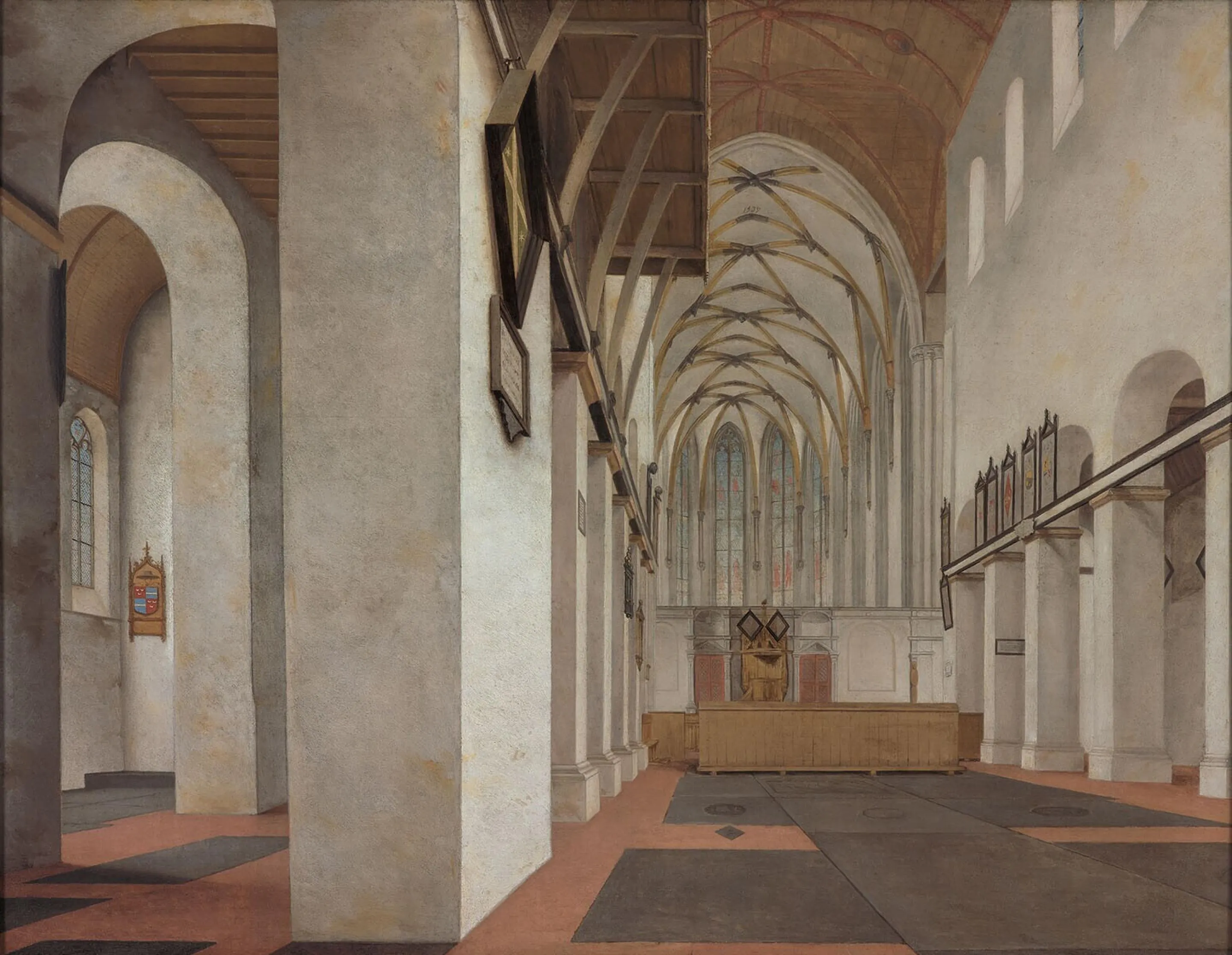
In this Reformed church interior by Pieter Jansz. Saenredam, floor grave slabs and wall tablets make commemoration part of the building itself. Against such settings, the complaint that Graevius’s body lay in “obscure sand” marks burial without a visible monument as a failure of public memory. Source ↗.

The Amicorum carmina carry the civic theme into collective voice. In van de Poll's poem, the presence of a new Cicero transfigures the city, so that, in the line recalled above, old Utrecht could be called a new Rome. The translatio of Roman eloquence becomes a title of civic dignity, and that title is now endangered by the loss.
The anthology resolves this danger by succession. Its final address, already quoted, assures Burman that Graevius's learned genius has migrated into him, and that he will be another Graevius for his hearers. The burial of Learning proclaimed at the opening is answered by its reincarnation in the orator himself. Through that answer the publication sets out a claim of continuity that the commemorated life has been made to authorize.
Reading Burman's Graevius Against Later Scholarship
- Müller, Lucian. Geschichte der klassischen Philologie in den Niederlanden. Leipzig: Teubner, 1869: A substantial nineteenth-century account of Dutch classical scholarship, explicitly cited in Ward Briggs's bibliography for Graevius. Its evaluations provide a historiographical comparison with Burman's encomiastic presentation, although its judgments require treatment as nineteenth-century scholarship rather than current consensus. The comparison bears directly on Burman's portrait of the scholar who washed away the blemishes of the finest authors by Herculean collation, an image whose relation to later estimates of Graevius's editorial achievement is itself a historiographical question.
- Deneire, Tom. "The Philology of Justus Lipsius's Prose Style." Wiener Studien 125 (2012): 189–262: Deneire approaches Lipsius's prose through formal and functional analysis. This supplies an important methodological counterweight to Burman's hostile representation of Lipsian imitation: the characteristics of Lipsius's writing must be distinguished from the faults attributed to his followers. The distinction is especially pertinent to the oration's imagery of a pestilential star and of archaic diction gathered from the dunghill of Pacuvius, which describes imitators rather than analyzing Lipsius's practice. Publisher text: https://verlag.oeaw.ac.at/api/download/content/9783700173113_kapitel_189_262.pdf.
- Bots, Hans, and Françoise Waquet. La République des Lettres. Paris: Belin, 1997: A foundational contextual synthesis for interpreting scholarly correspondence, learned reputation, and obligations among geographically dispersed scholars. Its relevance to Graevius's commemoration does not independently substantiate particular claims about his expenditure on postage or the financing of his publications. It does, however, supply the framework within which Burman's praise of the costly commercium litterarium and of an urbanity inseparable from learning becomes historically intelligible.
Frequently Asked Questions
What is Pieter Burman the Elder's funeral oration for Johann Georg Graevius?
It is a Latin academic funeral oration, Petri Burmanni Oratio funebris in obitum viri clarissimi Joannis Georgii Graevii, which honours Graevius after his death. Its title page dates it XI Kal. Martias 1703, which is 19 February 1703 by inclusive Roman reckoning. Willem van de Water, printer to the academy, issued it at Utrecht with Burman's elegy and the Amicorum carmina, a set of memorial poems by friends. The speech treats Graevius's death as the burial of Learning and Letters themselves and reads his life as a series of scholarly and civic norms. It closes by petitioning the "Fathers of the Fatherland and of the Academy" on behalf of his orphaned daughters.
Who was Johann Georg Graevius?
Graevius was a German-born classical philologist and the most celebrated scholar of the Dutch Republic in his day. He died at Utrecht on 11 January 1703. He was educated at Schulpforta and Leipzig and studied further at Deventer and Amsterdam. Gronovius turned him toward classical philology, and David Blondel's influence drew him from Lutheranism to the Reformed Church. He held chairs of eloquence at Duisburg, then Deventer, and from 1661 at Utrecht, where he added the chair of history and politics in 1667. Burman praises him as a heroic collator of manuscripts. Later reference works value him more cautiously, chiefly for gathering and annotating earlier scholarship.
What did Gronovius mean by saying Graevius knew Latin "grammatically, not Latinly"?
The verdict separates mastery of rules from command of idiomatic, Ciceronian usage. In Burman's telling, Gronovius set the young Graevius to construe a letter of Cicero at Deventer. He then judged that Graevius knew Latin by grammar and vernacular equivalents rather than as Roman usage demanded. Humbled, Graevius abandoned law and stayed to study. The scene belongs to Burman's attack on the archaizing imitators of Justus Lipsius. He brands them "apes" who gather old words from the dunghill of Pacuvius, the archaic Roman tragedian. That abuse targets Lipsius's followers and offers no analysis of Lipsius's own prose.
Did Graevius really spend a fifth of his salary on letters?
The figure is Burman's own claim and has not been corroborated. The oration asks how much Graevius's learned correspondence cost him and answers that it consumed almost a fifth of his salary each year. No salary record or correspondence account has yet confirmed the amount, so it remains an encomiastic assertion rather than an established financial fact. Within the speech it serves an argument. Graevius's private outlay on the common good of letters, including exchanges with scholars such as Richard Bentley, becomes grounds for Utrecht's reciprocal obligation toward his family.
Is there an English translation of Burman's funeral oration for Graevius?
No published English translation has been located, though that finding does not prove none has ever existed. The Leo edition, a separate undertaking, presents the full transcription of the 1703 Utrecht oration and a complete English translation for the first time. That translation is generated by AI. Leo is an effort to make English translations of every text printed in Latin in early modern Europe between 1450 and 1750 freely available online, at no cost. Readers can therefore consult Burman's Latin speech, with its elegy and memorial poems, alongside a full English rendering without charge.
This report was generated by an advanced AI assistant that conducted deep research alongside an extensive interpretation of the transcribed original text. Every effort has been made to preserve fidelity to the source and to guard against inaccuracy, but corruption in the text recognition process and model hallucination may nonetheless have entered the text. Treat every claim, quotation, translation, and citation as provisional, and verify each against the original source before relying on or citing it.
Bibliography
- Hans Bots and Françoise Waquet, La République des Lettres: The standard short account of how early modern scholars wrote to, flattered, borrowed from and occasionally ruined one another across borders. Read it to understand why Burman could present a fifth of a professor's salary spent on postage as a civic virtue rather than an accounting scandal. It explains the system Graevius paid into, though not the size of his bill.
- Ward Briggs, "GRAEVIUS, Johann Georg," Database of Classical Scholars: The most convenient modern summary of Graevius's career, chairs and confessional turn, with a source list that points to Müller, Halm, Sandys and Leonhardt. Its cooler verdict, an editor prized for gathering and annotating rather than for new method, is the necessary corrective to Burman's Herculean collator. Note that it lists Burman's oration among its sources, so agreement between the two is partly an echo.
- Tom Deneire, "The Philology of Justus Lipsius's Prose Style," Wiener Studien: A careful formal and functional analysis of what Lipsius actually wrote, as opposed to what his enemies said his imitators wrote. Anyone tempted to take Burman's dunghill of Pacuvius as a description of Lipsian prose should read this first. It restores the defendant's own testimony to a trial the oration conducts entirely in absentia.
- Karl von Halm, "Graevius, Johann Georg," Allgemeine Deutsche Biographie: The nineteenth-century German national biography's entry, one of the reference works Briggs names as a source. It shows how Graevius's German origins were reclaimed by a German scholarly tradition that had little use for his Utrecht civic setting. Useful for checking dates and for observing how much of Burman's narrative survived into the standard reference account.
- G. W. Kernkamp, ed., De Utrechtsche Universiteit, 1636–1936: The tercentenary institutional history of the university whose magistrates Burman petitioned. It supplies the administrative and civic context for the academy's printer, its professorial chairs and its dependence on the city. Consult it for the institution behind the officina; do not expect it to reveal whether the orphaned daughters were ever paid.
- Lucian Müller, Geschichte der klassischen Philologie in den Niederlanden: A pugnacious nineteenth-century survey of Dutch classical scholarship that judges its subjects with Teubner-era severity. Set beside Burman's encomium, it shows how quickly a "prince of the learned" could be demoted to a capable compiler once the funeral was over. Read it as historiography with opinions, not as a neutral verdict.
- John Edwin Sandys, A History of Classical Scholarship, vol. 2: The English-language survey that places Graevius among the Dutch editors of the later seventeenth century, cited by Briggs at 2:327–328. Its brief entry is valuable precisely for its brevity, since it records what remained of Graevius's reputation after two centuries of reassessment. Pair it with Müller to see two national traditions taking the measure of the same scholar.
- Wyger R. E. Velema, Republicans: Essays on Eighteenth-Century Dutch Political Thought: Velema's essays explain how the identity of freeborn republicans served as common political currency in the Dutch Republic. They are the best guard against reading Burman's libera civitas as a party manifesto delivered weeks after William III's death. The vocabulary was shared ground, and Velema shows why a professor could praise civic liberty while his late colleague tutored princes.