Sisyphus Sweating at His Sphere: Claude Guillermet de Bérigard's The Pisan Circle
Claude Guillermet de Bérigard, a Frenchman from Moulins who held chairs of natural philosophy at Pisa and then Padua until his death in 1663, spent a career teaching Aristotle in order to argue that Aristotle's most basic explanatory device — substantial form — was a fiction that had generated centuries of error. His Circulus Pisanus, issued at Udine in the 1640s and reissued much enlarged at Padua in 1661, replaces form with the arrangement and motion of corpuscles, calls the sun a chemist, the stars fiery fountains, and the tides a fermentation, while reserving universal nature and every effect's principal causality to God alone. It is one of the most revealing documents of the moment when a Peripatetic curriculum began to argue itself out of existence from within.
ExLatinis
August 31, 2026

Contents
Claude Guillermet de Bérigard, a Frenchman from Moulins who held chairs of natural philosophy at Pisa and then Padua until his death in 1663, spent a career teaching Aristotle in order to argue that Aristotle's most basic explanatory device — substantial form — was a fiction that had generated centuries of error. His Circulus Pisanus, issued at Udine in the 1640s and reissued much enlarged at Padua in 1661, replaces form with the arrangement and motion of corpuscles, calls the sun a chemist, the stars fiery fountains, and the tides a fermentation, while reserving universal nature and every effect's principal causality to God alone. It is one of the most revealing documents of the moment when a Peripatetic curriculum began to argue itself out of existence from within.
Sometime between 1643 and 1661, a French philosopher from Moulins, teaching in Italy under Medici patronage and then in the Paduan Studio, published a vast Neo-Latin course through Aristotle's natural philosophy whose purpose was to dismantle the central explanatory device of the very tradition it expounded. Claude Guillermet de Bérigard — Claudio Berigardo to his Italian colleagues, Claudius Berigardus Molinensis on his own title-pages — held the chair of natural philosophy at Pisa from 1627, transferred to Padua in 1639, rose to the first chair there in January 1661, and died at Padua on 23 April 1663; his birth is placed probably in 1590 by the strongest biographical account, though Niceron gives 15 August 1578. His Circulus Pisanus is a large composite work in Latin, first issued at Udine by Nicolò Schiratti in six separately titled and separately paginated parts dated 1643 and 1647, then reissued in greatly enlarged and revised form at Padua by Paolo Frambotto in 1661, with some catalogue and bookseller records dating the physical issue or certain parts to 1660. Its parts march through the Physics, De caelo, De ortu et interitu, the Meteorologica, and the three books De anima, and it is cast as a disputation between the interlocutors Charilaus and Aristaeus — a dialogic staging whose supposed function as an authorial mask is an interpretive proposition rather than a documented pseudonym. The title itself preserves the memory of that setting: circulus here names the completed cycle or round of academic disputation begun at the Studio of Pisa, not a geometrical figure and still less a modern-style coterie.
The intellectual problem the work confronts can be stated in one question: what actually accounts for change, generation, and quality in nature once Aristotle's substantial form has been denied? Bérigard's answer is pursued by a single move repeated book after book, with a consistency that gives this sprawling text its unity. He isolates a Peripatetic explanatory entity — substantial form, singular intelligent formative natures, the Intelligences of the celestial spheres, real qualities, spiritual species and rays, the reaction of contraries — argues that it is a figmentum, a fiction that multiplies difficulties instead of resolving them, and puts in its place an arrangement of pre-existing corporeal principles set in local motion. Form accordingly becomes symmetry, harmony, or concentus, a concord of parts in continual flux, with the rational soul expressly excepted from the reduction; heat and cold, light, magnetism, colour, the tides, and the origin of sea salt are all referred to the motion, compression, and privation of particles. What keeps this from collapsing into a self-sufficient mechanism is a theological reservation held throughout: the universal nature is God alone, and nature is only divinae artis instrumentum, the instrument of the divine art, so that divine concurrence remains the principal cause of every natural effect.
The historical stakes of that programme are considerable, and they are also genuinely ambiguous — a point the surviving evidence enforces rather than softens. Bérigard was the first published opponent of Galileo's Dialogo, in the Dubitationes of 1632/1633, a work criticized even in its own century for treating Galileo superficially; yet the Circulus is described by the principal biographical literature as welcoming elements of the new physics and as permitting a carefully qualified discussion of terrestrial motion, admitting a slow motion of the earth while rejecting diurnal rotation. Nor does the corpuscularism resolve into a familiar shape. Modern interpreters divide over how to classify it: Giorgio Stabile made the monographic case for a place in the history of seventeenth-century atomism, while an influential interpretive line insists that Bérigard's corpuscles are not true atoms and that, even after reading Gassendi, he remained committed to a qualitative physics of porous, configurational bodies. Maria Bellucci's specialist study of his natural philosophy and letters, and Maria Laura Soppelsa's placement of him within the decline of Aristotelianism and the formation of Galilean method at Padua, both point toward a transitional figure whose warrants are as heterogeneous as his conclusions: unconquered reason set above authority, the rehabilitated ancients — Democritus, Empedocles, Plato — anatomy read as natural theology, chemical operations, and the new evidence of oblong glasses and burning mirrors.
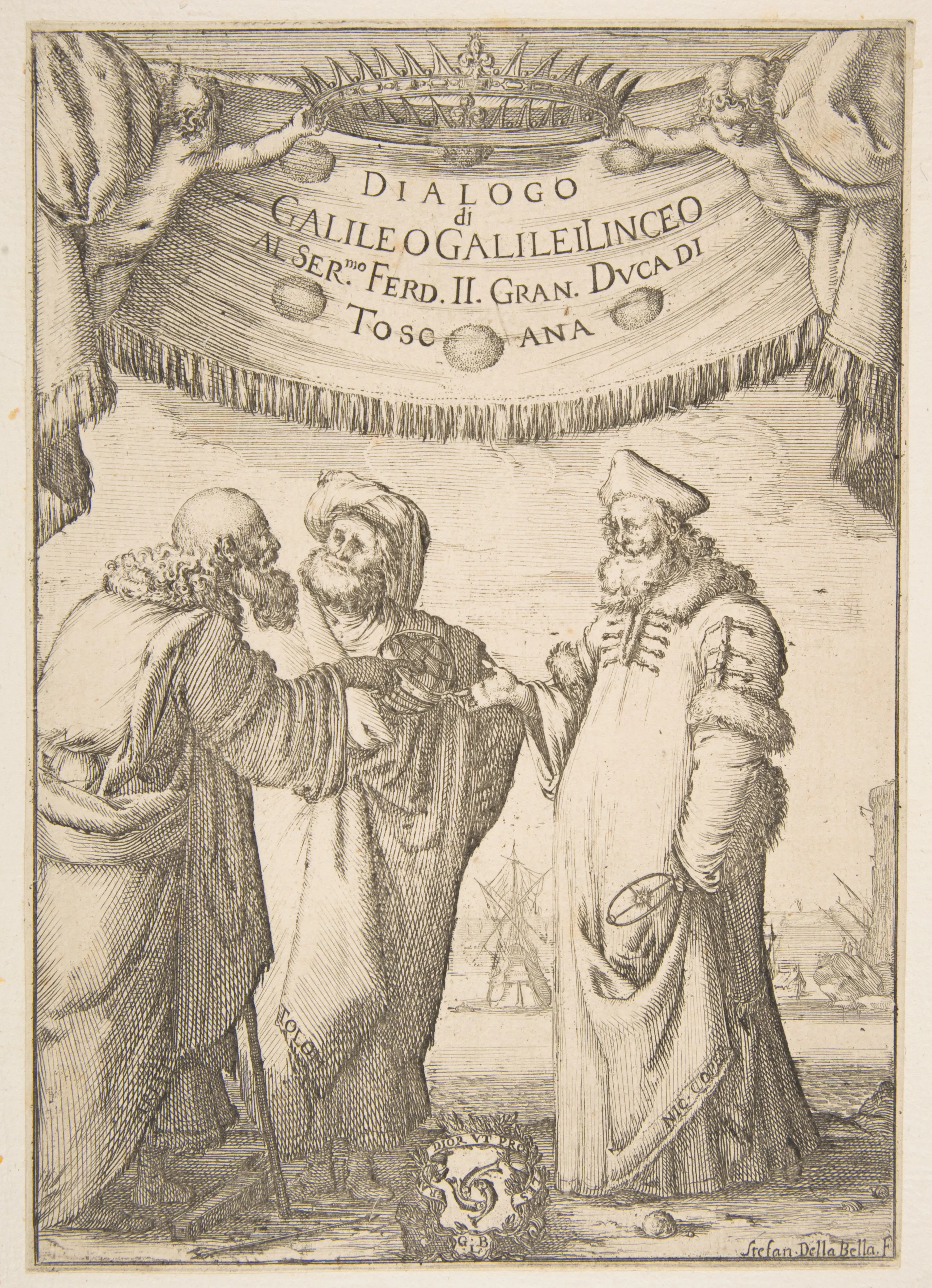
The frontispiece to Galileo's Dialogo stages the cosmological quarrel as a meeting of Ptolemaic, Aristotelian, and Copernican authorities — the same three-way dispute Bérigard entered with his Dubitationes. Its dedication to Ferdinando II places the contested book within the Medici patronage world that also framed the Circulus Pisanus. Source ↗.
What a first-time reader will remember, though, are the particulars. Generation is likened to a printer setting the same letters now one way and now another to produce different speeches. The sun is called a chemist, drawing salt out of the scorched earth as from its ashes. The stars are fiery fountains vomiting purified fire; the earth's poles have fauces, throats; tides are fermentation; the soul of a nourished and continually renewed body is compared to a ship whose timbers have all been replaced. Ocular rays are declared corporeal and real rather than spiritual and fictitious; the inflammation produced by cold through antiperistasis is announced as a mechanism unknown to the Peripatetics. Alongside these come Galen's confession of defeat taken up as a programme, a discors concordia of the elements, Stoic spiritus as the world's vehicle, poisons and their alexipharmaca, a balsamum naturale, indivisibles distinguished as straight and oblique points, and natal astrology treated as a corpuscular influxus. The same reach appears in the volume's own making: successive parts bear separate dedications to a series of Medici patrons — Ferdinando II, Cardinal Giovanni Carlo, Mattias, Leopoldo, Lorenzo, and Cardinal Carlo — carrying the author's Pisan connection forward into the Paduan reissue, and the whole closes with an Index rerum et verborum totius operis. The reception was correspondingly turbulent: accusations of Pyrrhonism, libertinism, and even association with the legendary De tribus impostoribus attached themselves to his name, though these are best understood as contemporary and later polemical constructions rather than demonstrated authorship, and the biographical record's statement that ecclesiastical authorities approved two editions still awaits confirmation from the underlying approval documents. It is a text whose conceptual vocabulary, patronage, and internal argument all point the same way: a Peripatetic curriculum turned, from inside, against the apparatus of form.
Read the full text and English translation on Leo
This text was transcribed and translated as part of the ExLatinis project, an effort by Leo to make free English translations of every text published in Latin in early modern Europe (1450–1750) available online. The complete transcription and English translation of this work can be read free of charge:
→ Read the original Latin text and full English translation on Leo
You can save a copy of this document into your Leo account to run deep text searches, conduct further analysis, or cross-reference it with your own research.
Translating the Title: The Pisan Circle, Circulus, and Bérigard's Vocabulary of Fiction
The Pisan Circle: Claude Guillermet de Bérigard's Ancient and Peripatetic Natural Philosophy (editorial English title supplied for convenience; no established English title was located). The printed title is conventionally rendered as The Pisan Circle of Claude Bérigard of Moulins, formerly at Pisa and now first philosopher in the Paduan Lyceum: On Ancient and Peripatetic Philosophy in Aristotle's eight books of Physics, four on the Heavens, two on Coming-to-be and Passing-away, four on Meteorology, and three on the Soul. In Circulus Pisanus, circulus is not primarily a geometrical figure or the name of a modern-style intellectual coterie. It recalls a completed course or cycle of disputation and teaching begun at the Studio of Pisa, a sense supported by Bérigard's own retrospective association of the title with a philosophical contest begun there. Forma substantialis, in the Aristotelian and scholastic vocabulary, denotes an intrinsic principle making a thing the kind of substance it is; Bérigard's polemical use of figmentum casts that explanatory principle as a fictive construction rather than an observed cause. The force of that word in his hands is unmistakable where he draws the conclusion of the argument against form, proposing to infer that no such form is given, and that it is a mere figment of Aristotle's, and the fertile principle of all the errors committed in natural philosophy, inferre, non dari talem formam, esseque merum Aristotelis figmentum; omniumque errorum qui in naturali philosophia committuntur, fertile principium; figmentum is thus not a passing insult but the pivot of a diagnosis, and the same charge of fictiveness recurs against each Peripatetic entity in turn. His alternative language of corpuscles, configuration, harmony, and concord therefore shifts explanation toward the arrangement and interaction of material parts, while the rational soul remains a limit case rather than simply another corporeal configuration. Cognate to this vocabulary is the pairing of corporeus against spiritalis, which in the optical books does the same work as figmentum does against form: he asks why we should not rather acknowledge such rays as corporeal and real, than as spiritual and fictitious, Quidni potius radios ejusmodi corporeos & veros, quam spiritales, fictitiosque fateamur? — the adjective fictitius marking the species and actio spiritualis of the schools as belonging to the same class of invented causes. A third term worth unpacking is antiperistasis, in Peripatetic usage the mutual encircling and consequent intensification of a contrary quality; Bérigard retains the word while claiming its true mechanism for himself, announcing that this is the true nature of that inflammation which comes about from cold by antiperistasis, unknown to the Peripatetics, Hæc est vera inflammationis, quæ à frigore fit per antiperistasim, natura, Peripateticis incognita, a characteristic manoeuvre in which inherited terminology is preserved and its explanation replaced. Finally, atomi and related corpuscula should not be treated as exact equivalents of later mechanical atomism: the historical interpretation of Bérigard emphasizes qualitative, porous, and configurational bodies, and the surviving text's interlocutor headings CHARILAUS and ARISTAEUS belong to a dialogic presentation whose authorial masking is an interpretation, not evidence for an established pseudonym.
Bérigard's Circulus Pisanus in Brief: A Peripatetic Course Turned Against Substantial Form
The Circulus Pisanus is a large Neo-Latin philosophical course-book and polemical synthesis organized as a sequence of treatments of Aristotle's Physics, De caelo, De ortu et interitu, Meteorologica, and De anima. Claude Guillermet de Bérigard (also Claudio Berigardo, Claude Beauregard, and Latin Claudius Berigardus Molinensis) was a French philosopher from Moulins who taught at Pisa and Padua. The strongest biographical account places his birth probably in 1590, while Niceron gives 15 August 1578; it records his Pisan appointment in 1627, transfer to Padua in 1639, promotion to the first chair in January 1661, and death at Padua on 23 April 1663. The first known composite printing was issued at Udine by Nicolò Schiratti in 1643, with parts dated 1643 and 1647. The enlarged and revised Paduan issue was printed by Paolo Frambotto in 1661, although some catalogue and bookseller records date the physical issue or parts to 1660. Its driving purpose is to rework Peripatetic natural philosophy through ancient authorities, corpuscular explanations, and selective engagement with Galileo-era problems, without simply becoming Gassendist mechanism. Positively stated, the reworking substitutes for substantial form the rearrangement of pre-existing corporeal principles, a substitution the text illustrates from the printing house, just as we see a Typographer, from the same characters set now one way now another, fashion now one speech, now another, haud secus atque videmus Typographum ex iisdem characteribus aliter atque aliter positis, alias, atque alias orationes effingere — generation and corruption thus becoming matters of disposition rather than of the induction and expulsion of forms. The reduction is bounded, however, by a theological reservation carried through every book: singular formative natures acting by their own intelligence are denied, and causality is referred upward, on the argument that no singular Natures are given which fabricate such things by their own intelligence, and that they therefore come to be from a certain universal Nature, which can be nothing else than God himself, At non dantur Naturæ singulares quæ intelligentia propria res ejusmodi fabricentur, ergo fiunt à Natura quadam universali, quæ sanè alia quàm Deus ipse esse nequit, with nature itself retained only as divinae artis instrumentum, the instrument of the divine art. The work is in Latin. No complete modern translation, or reliable record of a translation into another modern language, was located.
Placing Bérigard Between Galileo and the Peripatetics: The Historiographical Debate
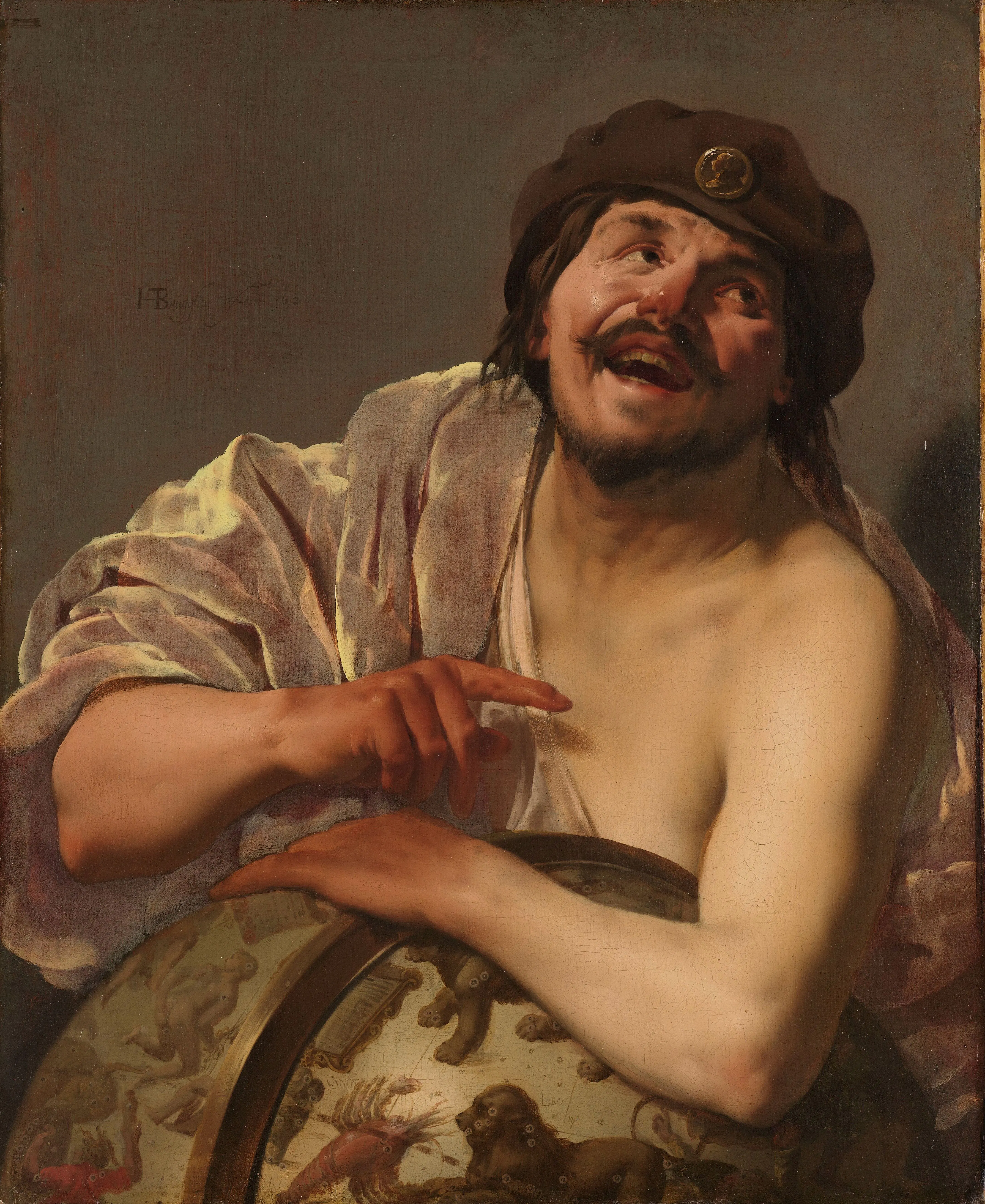
Laughing as he leans on a celestial globe, this seventeenth-century Democritus catches two strands of Bérigard's anti-Peripatetic project: the rehabilitation of atomist authorities and the satirical pressure he brings to inherited accounts of the heavens — antiquity reread against Aristotelian orthodoxy, not simply weighed between Galileo and the schools. Source ↗.
The work matters because it preserves an unusually broad seventeenth-century negotiation between Aristotelian teaching, pre-Socratic and Stoic authorities, medical natural philosophy, and the mathematical and experimental controversies associated with Galileo and Torricelli. Bérigard's 1632/1633 Dubitationes opposed Galileo's Dialogo on terrestrial motion, yet the Circulus is described by the principal biographical literature as welcoming elements of the new physics and allowing a carefully qualified discussion of terrestrial motion. That qualified discussion is audible in the text's own idiom, where the concession is routed through ancient authority rather than through Copernicus: behold, then, the motion of the earth which that divine Plato and other most wise men intended, Ecce igitur quem divinus ille Plato, quemque alit vir sapientissimi terræ motum volebant, the transmitted wording here being imperfect, though the sense of the concession is not in doubt. The tension is historically important: the text is neither straightforwardly Aristotelian nor an uncomplicated Copernican or mechanical manifesto. Consistent with that in-between position, the warrant repeatedly invoked is neither school authority nor novelty for its own sake but demonstrative necessity, as when the discussion of the world-spiritus pauses to record its own method — see by what road we have come to the knowledge of this spirit: not moved by the authority of the Stoics or of other Philosophers, but under the pressure and compulsion of unconquered reason, Eccé qua via ad hujus spiritus notitiam pervenimus; non sanè movente nos Stoicorum, aliorumve Philosophorum authoritate; Sed ratione invicta urgente ac cogente; — a formula that recurs, with the prisci recruited as witnesses rather than as masters. The same appeal to instruments belongs to this configuration of warrants: oblong glasses have not long since been invented, by whose operation the keenness of sight is extended for several thousand paces, Specularia non dudum inventa sunt oblonga, quorum opera visus acies ad plura millia passuum protenditur, the telescope and the burning mirror being treated as evidence for the corporeality of light and of rays rather than as merely convenient devices.
The principal modern disagreement concerns how to classify its natural philosophy. Giorgio Stabile's work presents Bérigard as a contributor to the history of seventeenth-century atomism, while Maria Bellucci's study of his natural philosophy and letters supplies a more detailed basis for assessing his conceptual vocabulary. The text's own handling of Democritus bears directly on that disagreement, since the ancient atomist is rehabilitated by way of a hermeneutic rescue rather than adopted wholesale: Democritus understood this excellently, who, speaking in this sense, was twisted to a bad one, when he said that individual things come to be by a fortuitous concourse of the elements, Quod optimè intelligebat Democritus, qui hunc in sensum locutus, in pravum detorsus est. Cum dixit con cursu elementorum fortuito singula fieri:, the "fortuitous concourse" being reinterpreted so as to remain compatible with divine governance. The same Democritean sympathy governs the doctrine of action, where the Peripatetic requirement that agent and patient be contraries is set aside in favour of the ancient principle that like acts on like: this opinion of Democritus, which Aristotle attacks, many things demonstrate to be most true, H Anc Democriti sententiam, quam impugnat H Aristoteles, verissimam demonstrant multa, the running-head letters having intruded into the line as transmitted. A modern interpretive summary stresses that his corpuscles are not true atoms and that, even after reading Gassendi, he remained committed to qualitative physics; that judgment cautions against assimilating him to later universal mechanism, and it is supported by the way the reductions are argued — from the failure of form to explain, and from the ancients' testimony, rather than from a prior commitment to matter and motion alone. Maria Laura Soppelsa places him within the decline of Aristotelianism and the formation of the Galilean method at Padua. The Treccani biography adds a further historiographical layer: it reports accusations of Pyrrhonism, libertinism, and even association with the legendary De tribus impostoribus, but treats these as contemporary or later polemical constructions rather than demonstrated authorship. Such accusations meet, in the work itself, a voice conscious of exposure, which records a long hesitation before publishing — I was long uncertain; at last not so much boldness as necessity conquered fear, diutius incertus fui. Tandem vicit timorem non tam audacia, quàm necessitas — a self-presentation that documents the author's sense of risk without settling what he was risking. The alleged authorial masks of Aristeus and Charilaus likewise remain an interpretive proposition. The most secure historiographical conclusion is that Bérigard is best studied as a transitional and internally qualified natural philosopher whose "atomism" is corpuscular and qualitative rather than a simple anticipation of later mechanistic doctrine — a judgment reinforced by the text's habit of presenting its most radical reductions as the reluctant outcome of argument, as where the doctrine of interrupted motion is embraced under compulsion: behold to what necessity has compelled us even unwilling, namely that, fleeing those manifold and inexplicable wrappings of errors, we should fall into the doctrine of Empedocles, Ecce quò vel invitos necessitas compulit, scilicet ut multiplicia illa, atque inexplicabilia errorum involucra fugientes, in Empedoclis doctrinam incidemus.
Printing the Circulus Pisanus at Udine and Padua: Editions, Medici Patronage, and Surviving Copies
The 1661 title begins Circulus Pisanus Claudii Berigardi Molinensis olim in Pisano, jam in Lyceo Patauino philosophi prim. and enumerates the Aristotelian books treated. Google Books metadata gives the imprint typis Pauli Frambotti bibliopolae, 1661, and records a copy originating at the Biblioteca Nazionale Centrale di Firenze. The Museo Galileo catalogue identifies the Florence provenance and shows a composite volume whose separate title-pages and dedications address successive Medici patrons: Ferdinando II, Giovanni Carlo Cardinal Medici, Mattias, Leopoldo, Lorenzo, and Carlo Cardinal Medici. Its contents proceed through the Physics, De caelo, De ortu et interitu, the Meteorologica, and De anima, ending with an Index rerum et verborum totius operis.
The distribution of subject matter across those parts is uneven in texture as well as in length. The books on form, standing at the head of the sequence, work through the scholastic literature on the origin of the substantial form — the Coimbra commentators' virtus animae relicta in semine, Scaliger against Cardano, the Thomist appeal to accidents producing form — by way of dense disputational reductio, as in the objection that the soul cannot be extended through the semen because what follows more monstrous than this, namely that all dogs sprung from one are one dog with it?, Quid autem sequitur monstrosius, quam quod ex illa sequitur, omnes scilicet canes, qui ab uno prodierunt, unum esse cum illo canem? The Meteorologica part, by contrast, is dominated by chemical and hydrological explanation, in which the formation of sea salt is derived from solar action on the earth: the Sun is the chemist, who by scorching the earth draws out this matter of salt as from its ashes, Chymicus est Sol qui terram adurens ex ejus veluti cineribus hanc salis elicit materiam — the same reductive programme that governs the books on form, here transposed into ars Chymica and applied to salt-districts, springs, tides, and subterranean heat.
The earlier Udine transmission is materially clearer than its exact textual relation to the later issue. Metadata for the digitized composite identifies Vtini: Ex typographia Nicolai Schiratti, Latin, 1643, in six parts in one volume. The part sequence is: prior books of the Physics (1643), the eighth book of the Physics (1643), De caelo (1647), De ortu et interitu (1643), Meteorologica (1647), and the three books of De anima (1643). Each part has a separate title-page and separate pagination. A BSB record for an Udine 1647 issue gives Munich, Bayerische Staatsbibliothek, call number 4 A.gr.b., and 160 scans; an Internet Archive record identifies a digitized copy at the Thomas Fisher Rare Book Library, University of Toronto, call number gal 00026. These are copy records, not proof that every part or state is identical.
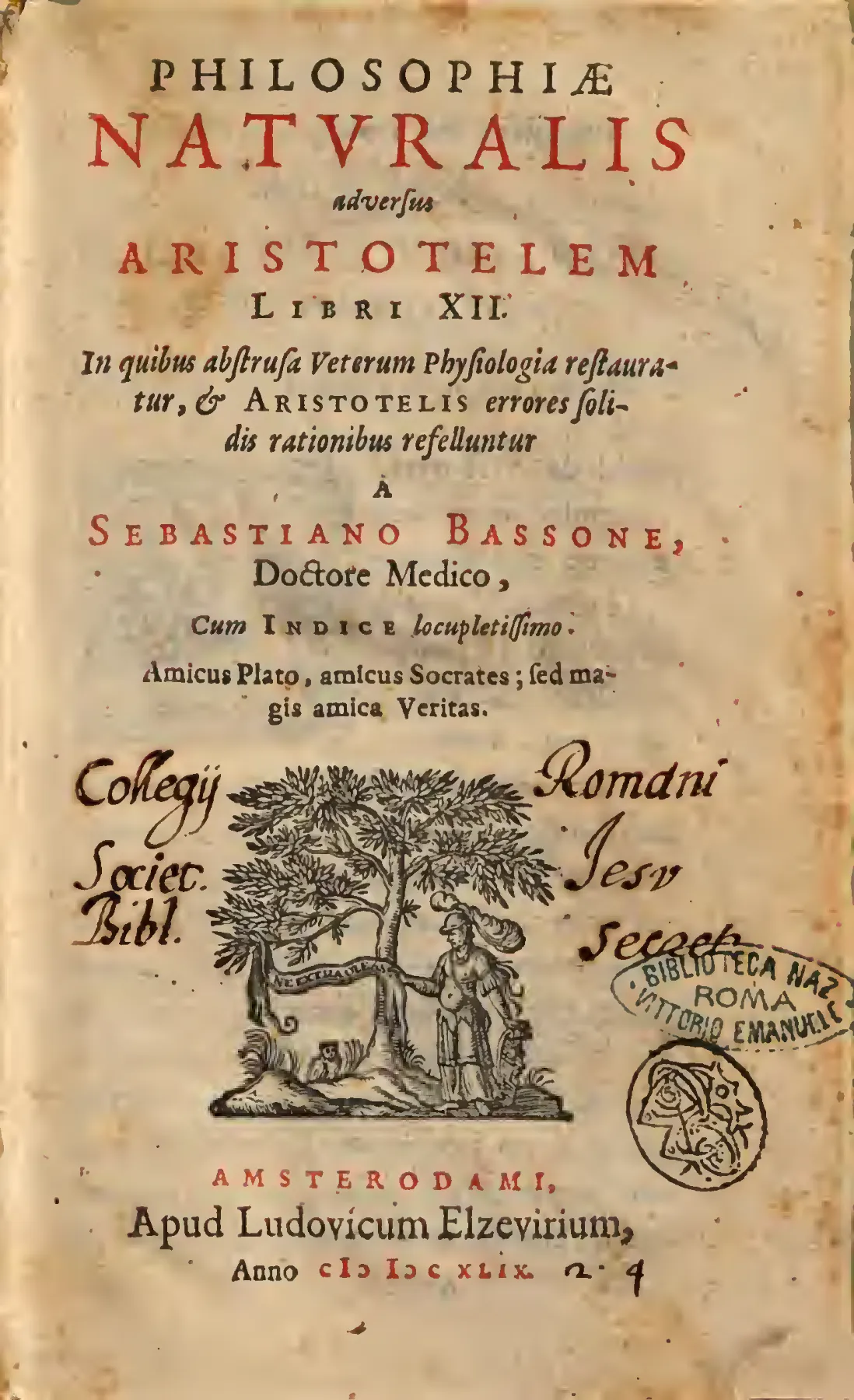
Sebastian Basso's Philosophiae Naturalis adversus Aristotelem (Amsterdam: Elzevir, 1649) announces a cognate anti-Aristotelian programme: restoring ancient natural philosophy while refuting Aristotle by reasoned argument. The manuscript marks and library stamp on this copy are a reminder that provenance records cannot prove that every part or state was identical. Source ↗.
A bookseller's detailed description, which must be treated as provisional until checked against a library copy, calls the Padua production a final, greatly augmented edition and reports six parts in one quarto, measuring 218 × 159 mm, with pagination [20], 64, [8], 65–203, [9], 205–353, [9], 357–538, [6], 541–583, [7], 585–729, [25], separate title-pages bearing the printer's device, decorated initials, head- and end-pieces, a portrait engraved by Giovanni Giorgi, and numerous diagrams. The same description dates parts 2–4 to 1660 and parts 1, 5–6 to 1661; this explains why records alternate between 1660 and 1661, but a complete issue/state collation has not been established. The Google record's 722-page count and the Museo Galileo viewer's 814 image pages should not be conflated with the bookseller's bibliographical pagination. Chain-lines, catchwords, running heads, the repeated Intentio VI, and a formal signature formula remain unverified from a fully inspected bibliographical description.
The work's dedications demonstrate sustained Medici patronage, extending the author's Pisan connection into the composite volume; a dedication to the Paduan reformers or a Venetian patrician was not confirmed. The accessible OCR did not expose an imprimatur, superiorum permissu, privilege, or other censorial formula. The biographical record states that ecclesiastical authorities approved two editions, but the underlying approval documents and a direct Roman Index or Holy Office file were not located. No suppression proceeding, complete contemporary refutation of the Circulus, or modern-language translation record was confirmed. Bérigard's related Dubitationes was criticized for its superficial treatment of Galileo, while later accusations of impiety and concealed heterodoxy belong to a contested reception history — a history against which the work's own reservation of universal nature and principal causality to God, and its retention of nature as the instrument of the divine art, deserve to be weighed. A complete census for the BnF, British Library, Marciana, Biblioteca Universitaria di Padova, BNCF shelfmarks, Wellcome, Bodleian, Herzog August, and North American libraries remains unavailable; only the BSB and Toronto shelfmarks above were directly located.
Following Bérigard's Argument Book by Book: Form, Motion, the Heavens, and the Tides
The first book De forma: the school's accounts of the soul's origin
The closing articles of the first book De forma proceed by a method that is worth naming before its content is described: Bérigard cedes the floor to his opponents at length, quotes them in extended blocks marked off by the formula Hæc ille, and only then interrogates what they have said. Julius Caesar Scaliger is allowed to build his whole case — that the semen cannot be an excrement, since excrements press to leave the body at once whereas semen departs only when concocted and only for another's welfare rather than its own; that the semen is therefore animatum; that its temperatura constructs the great work; that in it there remains a soul inchoata & pendula, begun and suspended; that the process resembles wine altering in its cask or water freezing in a river. The refutation, when it comes, consists in a single question about what has been left unsaid: Scaliger asserts an ensouled seed but never declares which soul this is, and certainly not the soul of the future foetus, which is precisely what stands in question. The same pressure is applied to Aristotle himself, who lodges the principle of the soul in the semen's motion, its spiritus, and its temperatura, and whose text is turned against his followers rather than repudiated.
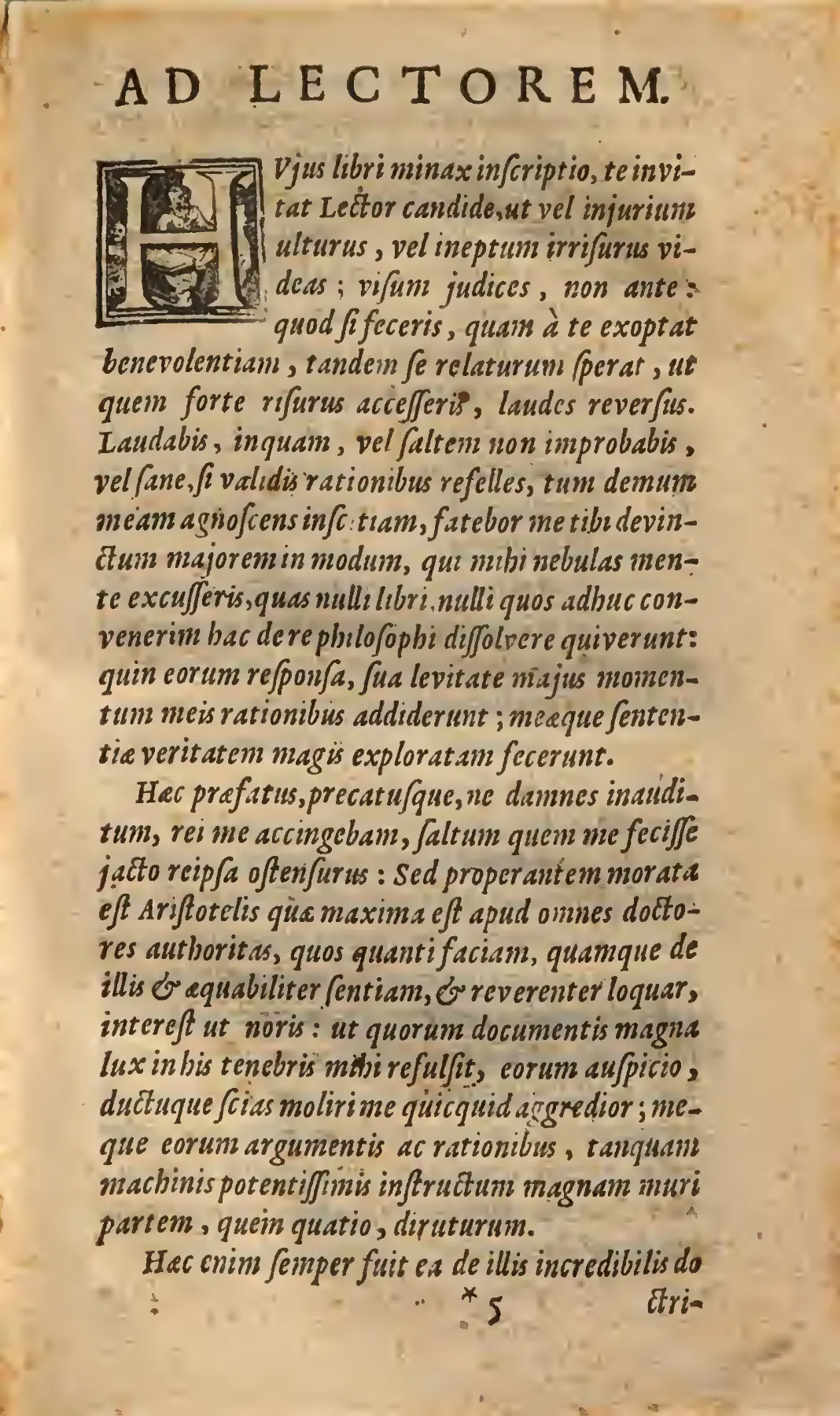
The opening of Bérigard's Ad Lectorem, set beneath a historiated initial, makes the address to the reader a manifesto for the method: Peripatetic doctrine is to be met with its own arguments, "as with the most powerful siege engines." Its cautious provocation anticipates the handling of Scaliger and Aristotle. Source ↗.
Out of this negative work the positive doctrine surfaces almost parenthetically, and it is the conceptual hinge of the whole argument. Bérigard concedes that the soul is in the semen potentially, but insists on construing potency his own way: but it is understood in our fashion, in which we say that the soul is a certain symmetry of parts, so that for it to be in the semen is for the thing in the semen to be capable of being ordered and adapted, so that from the disposition of the parts that motion results, Sed intelligitur nostro modo, quo animam esse dicimus certam partium symmetriam; ut proinde eam esse in semine, sit rem in semine posse ordinari, atque adaptari, ut cum ratione partium dispositarum ille motus resultet. The reduction is thus effected not by denying the Aristotelian vocabulary of potency but by redefining what potency requires: parts capable of arrangement. The counter-case follows immediately and is stated as a dilemma internal to the school — since on the Peripatetic view the form is a certain substance, and since that substance is indivisible and therefore has no parts that could be in the semen potentially, they are compelled to ask by whom such a substance is produced. Indivisibility, the very attribute that secures the form's unity and dignity, is what forbids its presence in the seed and generates the insoluble question of its origin; and the less the Peripatetics can answer, Bérigard adds, the more the truth of the ancient principles appears. The argumentative economy is characteristic: an opponent's metaphysical strength is converted into an explanatory liability.
The survey of authorities that follows is framed by a diagnosis of the whole condition, and here the register rises to the metaphorical: for hitherto we have seen how great is the empire of substantival form in the Peripatetic world; yet what the thing is, whence it comes, by what and out of what it is made, they do not agree; we have seen in the examination of it what portents lie hidden in a deep abyss, Enimverò hactenus vidimus in mundo Peripatetico quantum sit imperium formæ substantivæ: Quæ tamen res sit; unde veniat; à quo & ex quo fiat, non consentiunt. Vidimus in ipsius examine quanta profundi barathri portenta latitent. Two figures govern the passage. The first, imperium, casts form as a sovereignty exercised over an entire intellectual world, so that the dispute becomes one of jurisdiction rather than of detail; the second, the barathrum with its lurking portenta, converts scholastic disagreement into a monstrous depth, a place where inquiry is swallowed rather than satisfied. The evidentiary force of the sentence lies in the asymmetry it isolates: universal consent about the existence of the entity, no consent whatever about what it is or how it arises. The six opinions catalogued from the Coimbra commentators — the foetus's own soul, certain accidents, natura itself, the male seed, Avicenna's angel, the virtus cæli of Albertus and others — are marshalled as proof of that asymmetry, and the Coimbrans' own dialectic is allowed to consume its options: if natura is intrinsic it is either the form (whereupon the first opinion returns) or an accident (whereupon the third returns), and if extrinsic it is the sun's heat, the heaven's power, or the seed, each collapsing into an opinion already rejected. The disjunctive machinery designed to eliminate rivals is thus shown to leave no surviving member.
Sharper still is Bérigard's use of the Coimbrans' candour about the standing of their own thesis, that the semen discharges its whole office by the power of the male soul left in it: this conclusion cannot be proved by reason, but is made persuasive, and will be established from those conjectures which we shall adduce, Hæc conclusio ratione probari non potest, sed suadetur, & ex his conjecturis, quas afferemus, constabilitur. In a work whose declared warrant is demonstrative necessity, the admission that a central doctrine rests on conjecturæ rather than on ratio is quoted as a self-inflicted wound; and the conjectures themselves are then displayed. Cow's urine flowing of itself is sterile, but the urine of a milk-sucking animal, stored in a vessel near dung, brings forth worms and even serpents, the sole cause being the power of the milk left behind in it; and, by analogy, the sacraments possess the power of producing grace without possessing productive forms, having only a power left in them by God. Bérigard's rejoinder presses on the identity that the analogy is meant to conceal: what real distinction separates the forma propria they deny to the semen from the virtus animæ left in it by the parent, which they affirm? He notes too that the spontaneous worms and snakes already possess forms of their own on Peripatetic principles, so that the illustration proves less than it claims, and that to make the virtus rather than the soul the agent is to say that man is generated not by man but by a power of the soul. The sacramental parallel, tacitly, imports an institution of supernatural efficacy into a question of natural causality — an argumentative import Bérigard does not need to denounce, since simply quoting it beside the ratio non potest is enough.
The dismantling then reaches its rhetorical form, a litany of negations: which power, forsooth, both acts and does not act, for it is both an instrument and not an instrument, but the whole semen itself is the instrument; which power is not the soul, but the soul's power, neither heat nor spirit, not temperament, not symmetry — for of these they do not speak; which power is assuredly nothing else than mere trifling, Quæ scilicet virtus & agit & non agit; nam & est instrumentum; & non est instrumentum, sed ipsum semen totum est instrumentum. Quæ scilicet virtus non est anima; sed animæ virtus, neque calor, neque spiritus, non temperatura, non symmetria; neque enim de his loquuntur. Quæ virtus utique nihil aliud est, quàm mera nugatio. The verdict is arrived at by exhaustion of predicates: an explanatory term for which every available positive determination has been refused is not an obscure cause but an empty word. The list of refusals is telling in one further respect — temperatura and symmetria are the two candidates Bérigard himself would accept, so the nugatio is defined precisely by its refusal of the corpuscular alternative.
What that alternative would look like is stated in the same movement, and it carries the theological reservation with it: rightly indeed could the Ancients have said that the semen is formed, and that there is in it a certain symmetry of parts, and a certain power, and as it were an impetus received from the principal agent (concerning which in the following book), whereby it may exert its power upon the female matter, until, that matter being thus disposed, that principal agent then pours into the foetus what it has received according to its own nature, and accomplishes wondrous works in it, Rectè quidem Antiqui potuissent dicere semen esse formatum: certamque in eo esse partium symmetriam, & virtutem quandam, ac veluti impetum ab agente principali (de quo libro sequenti) receptum: quo virtutem suam in materiam foemineam exserat, donec ea sic disposita jam tum principale illud agens acceptum foetui pro sua natura infundat, atque in eo mirabilia opera exsequatur. The parenthesis is the load-bearing element: the agens principale is named and its treatment deferred, so that the embryology is corpuscular in its mechanism while its efficient cause is referred upward and outward. The deferral recurs verbatim in the closing articles — whence that motion, what its cause, and by whom this most wondrous work is fabricated, we shall say in the following book — and it is what prevents the account from resolving into a self-moving disposition of matter.
Within those limits the mechanism is described with confidence. The semen is concocted in its appropriate vessels as in a workshop, an officina, and compounded out of parts of its own kinds, no more wonderful than the making of animal spirit in the brain, vital in the heart, natural in the liver, or chyle in the stomach — Galenic physiology enlisted as the ordinary case that renders the extraordinary one credible; and since the ejected semen visibly retains its particles outside the body, it must retain them within the womb. From this the foetal fabric follows: since from those parts the foetus itself is fabricated, there will be no doubt that the animal's frame is constructed out of the parts of the semen itself, by that wondrous motion which Aristotle acknowledges in it; for since it has particles of its own kinds, those particles, aided by the suitable parts of the nourishment, must gradually grow — as bones, as nerves, as arteries, and the like, Cum autem ex illis fabricetur ipse foetus, non erit dubium, ex ipsius seminis partibus, motu illo mirabili, quem in eo Aristoteles agnoscit, animalis sabricam construi. Cum enim habeat sui generis particulas: est utique ut illæ à convenientibus alimenti partibus adjutæ paulatim crescant; ut ossæ, ut nervi, ut arteriæ, & similia. — the transmitted sabricam and ossæ standing for fabricam and ossa. Growth is here like nourishing like, and the developmental sequence terminates not in the induction of a form but in the succession of parts into order and their proper symmetry. The obstacle to this account is identified as a doctrinal prohibition rather than an observation: the Peripatetics, out of obstinacy, can admit no diversity of parts in a thing at all, whereas the whole preceding argument has been that in any thing however small the parts are diverse.
From the overthrow of form to the search for the formative cause
The second book opens with a proem whose ornamental initial has dropped out of the transmitted text, leaving the truncated Vamvis for Quamvis: although far more has been said in the overthrow of that imaginary substantival form than we had hoped — things which, however, not so much our own arguments as those of the Peripatetics themselves supplied — nothing of all is more effective than what we shall now, with God as our guide, pursue, Vamvis longè plura quàm speraveramus, in eversionem imaginariæ illius formæ substantivæ dicta sint; quæ tamen non tam nostra, quàm Peripateticorum ipsorum argumenta suppeditarunt; nihil profectò omnium efficacius est, quàm ea, quæ nunc, Deo duce, prosecuturi sumus. Three claims are compressed here. The form is imaginaria, an object of imagination rather than of demonstration, which is the same charge the work elsewhere presses with figmentum. The demolition is credited to the school's own materials, a genealogical point that lets Bérigard present himself as an expositor of Peripatetic texts even while overturning their central device. And the enterprise is placed under divine guidance, the phrase Deo duce doing openly what the parenthetical agens principale does structurally. The programme announced for the book is correspondingly conditional: to seek what that cause is which in any thing performs its motions and actions, and to show that there is no other form than the one which coalesces out of the diversity of parts — for if there is no other form than this, then there is no substantival form. Symmetry must now be made to do positively what the first book showed form could not do; and the book accordingly begins not with corpuscles but with an Intentio on the wondrous works of nature and an article on the fabric of animals, where the anatomical catalogue of bones, cartilages, ligaments, muscles, nerves, veins, arteries, membranes, and glands is amplified into an argument that nothing in it lacks a determinate end and use. That amplification is not a concession to teleology at odds with the reduction. The earlier articles had already conceded that the artful plexus of nerves, veins, arteries, membranes, cartilages, bones, and muscles is drawn into so wondrous a symmetry that one may wonder it is not the work of a single Angel — a formulation that echoes both Scaliger's demand for angelic wisdom and Avicenna's angel while granting neither. The wonder is retained in full and its recipient changed: what the Peripatetics assign to singular formative natures is reserved for the principal agent, and the fabrica animalium is thereby made the strongest evidence not for form but against it.
The technique that produced that verdict deserves a second look, for the demolitions of the first book display it in its purest form. There Scaliger's doctrine, mounted against Cardano, that a parent's soul begets by extending itself into the seed, so that soul is propagated as flame is taken from a lamp or a shoot from an olive, is not merely denied; Bérigard lets it run to its own terminus in the reductio already noticed above, which asks what more monstrous consequence could follow than that all dogs sprung from one are one dog with it. The force of that reductio lies in its target: if the offspring's soul is numerically the parent's, merely extended and afterwards divided, then individuation — the very thing substantial form was introduced to secure — dissolves into a single canine individual dispersed across generations. The refutation of the Thomists that follows works by the same technique of internal collapse. Against the claim that accidents produce substantial form not by their own power but by the substance's, Bérigard applies the school's own axiom that actions belong to subsisting subjects, and then asks which subject is acting; the answer Aristotle himself supplies undoes the position, since the semen, whatever power it may have, is nothing other than an excrement, semen, quamcunque habeat virtutem, nihil aliud est quam excrementum, ut ex Aristotele retulimus. The Peripatetic classification of seed as residue is not contested but exploited: a doctrine that must locate the efficient production of a substantial form in a residue has, on its own premises, no agent at all.
This is the argumentative rhythm of the whole first movement, and it culminates in the statement of the negative programme already quoted in the framing of the work's vocabulary — the inference that no such form is given, that it is a mere figment of Aristotle's, and that it is the fertile principle of all the errors committed in natural philosophy. Two claims are compressed there that are logically distinct. The first is ontological: there is no such entity. The second is etiological, and it is the more consequential for the shape of the book, since fertile principium is a deliberately perverse borrowing from the language of generation — the form that was supposed to be the fecund principle of natural things turns out to be fecund only of error. The failure is diagnosed as structural rather than personal: the adversaries err not through incapacity but because the principles they hold force absurdity upon them whichever way they turn, and the survey of Fernel's solar generation of forms — refuted by chicks hatched in winter warmth, by the products of ars chymica such as the aqua Chrysalca, by metals bred in recesses that the Sun never reaches, by gardeners forcing plants out of season — is designed to show that even the most ingenious escape from the difficulty simply relocates it.
The second book converts this destructive result into a positive question, and it does so by adopting an ancient confession of ignorance as a research programme. Galen is quoted at length to the effect that he sought whether he might find some sound account of the nature of animals, and then, finding none — which in this book he frankly confesses — he urges on those philosophers who have more talent or capacity for the matter, an aliquam de natura animalium validam rationem possem invenire, ac nullam deinde inveniens (id quod in hoc libro fateor ingenuè) Philosophos, quibus ad hanc rem plus est vel ingenii vel facultatis hortor,. The rhetorical economy of the citation is worth noting: an admission of defeat by the greatest medical authority licenses the claim that the question of the formative principle is genuinely open, and that the disputes convulsing natural science all descend from this single unresolved point. Three questions are then posed — whether nature acts with cognition, whether God's immediate presence is required, whether things nonetheless act as principal causes — and the theologians' apparatus is assembled with unusual generosity before it is dismantled: the Coimbra formula of nature as divinae artis instrumentum, Hippocrates' unlearned yet learned nature, Toletus' archer who imprints upon the arrow the impetus by which it reaches a mark it does not itself foresee. Bérigard's objection is not to the theology of concurrence but to the intermediate entity it is made to sustain. Aristotle's diffused, cognitionless nature, propped up by an absent God, yields only the dilemma that he calls in God's help — an absent God, and one who by the ministry of this blind guide is to teach this blind Nature: yet teach it so that it remains no less ignorant, idcirco advocat Deiauxilium, absentis tamen, & qui cæci hujus ducis ministerio cæcam hancce Naturam doceat: ita tamen doceat, ut hæc natura nihilo minus ignara maneat. The image of the blind guide leading the blind is chosen for its scriptural resonance, but the argument is strictly economical: an explanatory intermediary that neither knows nor senses adds a second obscurity to the first without diminishing it. Scaliger's alternative — a single supremely intelligent formative nature that builds the human body — is rejected for the opposite reason, that such natures would rival the rational soul and populate the world with quasi-deities, so that felling a tree would be sacrilege. What remains, once both the blind nature and the intelligent one are removed, is a universal nature that can be nothing but God, with singular natures excised as superfluous.
That conclusion carries a professional risk which the text names outright, announcing the aim of overturning that opinion commonly spread abroad about physicians, as though by the force of natural science they were led into atheism, si eam quæ vulgo percrebuit de medicis, opinionem convellero, quasi naturalis scientiæ vi in atheismum ducantur:. The anatomical set-piece that follows — the nerve conjugations, the communication of liver, heart and brain, the tunics of the eye, the rete mirabile, the villi of the intestines — is thus doubly employed: as proof that the formative cause must be present and knowing, and as a public demonstration that the medical study of the body's contrivance terminates in God rather than away from him. The removal of substantial form is presented, in other words, as a strengthening of providence, not a weakening of it, since every effect is referred directly to the divine artificer instead of being farmed out to a fictive intermediary.
Flux, harmony, and the world-spiritus
In the third book the flux-thesis replaces form altogether, and the method of convicting the strongest defender is applied to Zabarella, whose evasions on the soul's passage from part to part are met with sarcasm sharpened into an epistemic point: what is so insane that it cannot be covered by the shield of ignorance? He does not know how the soul passes from part to part without motion; nevertheless it passes. Believe it, philosophers: Zabarella says so, Quid tam insanum, quod tegi non possit ignorantiæ clypeo? Nescit quomodo anima de parte in partem transeat sine motu, attamen transit. Credite Philosophi, Zabarella dicit. The clypeus ignorantiae names a recognisable disputational manoeuvre — the appeal to an inscrutable mode of operation — and by attaching it to the most rigorous of the Paduan Aristotelians the argument secures its a fortiori: if the doctrine cannot be defended here, it cannot be defended at all. Willow cuttings, the divided serpent, reunited limbs and the grafted cock's spur then supply the empirical counterweight, and the positive definition is recovered from antiquity by way of Aristotle's own report, that they say the soul is a certain harmony, for they say that harmony is a tempering and a composition of contraries, Animam enim harmoniam quandam inquiunt esse. Harmoniam namque temperationem esse, compositionemque contrariorum dicunt. Form becomes concentus: a due proportion of parts sustained by the influx of brain, heart and liver, and therefore continually renewed rather than statically possessed — with the sentient soul left as a harder case and the rational soul expressly exempted.
The book on nature and the world-soul secures this physics theologically before extending it. That elements may pursue only their own proximate ends while the divine purpose is nevertheless accomplished is argued from the Passion: Judas in his betrayal, the Jews in their accusation, Pilate in his condemnation of Christ, each looked to a different end; yet God most good and great, by his most wise dispensation, through their actions fulfilled the work of our salvation which he had purposed, Iudas in proditione, Iudæi in accusatione, Pilatus in condemnatione Christi, diversum quique finem intuebantur. Deus tamen Opt. Max, sapientissima sua dispensatione, per illorum actiones, quod proposuerat, nostræ salutis opus adimplevit. The analogy does precise work: it makes Democritus' fortuitous concourse fortuitous only with respect to the elements, never with respect to the first cause, and so buys corpuscular explanation at no cost to providence. The pivot from form-theory to matter-theory then follows from the treatment of rarefaction, which yields a strict disjunction — unless we concede a vacuum between the parts, which nature abhors, we must admit some corporeal substance, and that a most tenuous one, ni concedamus vacuum inter partes à quo natura abhorret, admittendam esse substantiam aliquam corpoream, tenuissimam quidem,. The Stoic spiritus is thus reached by exclusion rather than by adoption, and its relation to nature is fixed by a definition of exemplary economy: the difference between Nature and the World-Soul is the same as that between an instrument and the hand that moves it, Respondeo idem esse discrimen inter Naturam, & Animam mundi, quod est inter instrumentum & manum quæ illud movet. Nature retains aptitude and disposition; the moving power belongs elsewhere.
The book De motu: weight, fall, and the hydrostatic test
The book on motion carries the same instruments into questions of weight and fall. Aristotle's proof from the inflated bladder is met not with a distinction but with a consequence about the whole atmosphere — the wonder why so great a mass of air, resting on our heads, does not crush us with its weight, Miror, cur tanta moles aëris nostris capitibus incumbens nos pondere suo non obterat — after which acceleration is referred to the thrust of the air above and the diminishing resistance of the air below, whose severed parts rush upward to fill the space. The argument closes on quantitative ground, quoting the verses on Hiero's crown: if anyone mixes silver with tawny gold, how much it is, and by what means you may detect it, the deep mind of the Syracusan master first disclosed, Argentum fulvo si quis permisceat auro, Quantum id sit, quove id possis deprendere pacto, Prima Syracusii mens prodidit alta magistri. Hydrostatic comparison of gold and silver replaces the doctrine of elemental degrees of gravity, and the polemic against form arrives, by its own momentum, at measurement.
The closing articles of that same book are occupied with hydrostatic puzzles that a conventional Peripatetic commentary would relegate to the status of quaestiones curiosae, yet Bérigard opens them by declaring that they carry the evidential weight of his entire doctrine, since the solution of this question, he writes, will add no small light and no small strength to the truth of our teaching, H Vjus quæstionis solutio non parum cùm luminis tum roboris addet nostri dogmatis veritati, the stray initials at the head of the line being the decorated drop-capital caught by the compositor. The inversion of priorities is deliberate and methodologically consequential: the truth of a general physics is to be tested at the point where a particular, observable, and slightly grotesque fact — the drowned animal that sinks alive and floats dead — resists the received explanation. He dismisses the appeal to air-filled lungs outright and substitutes the contest of moist and hot within the living body, which draws water inward while life lasts. What the reader is being trained to accept is not merely a new answer but a new criterion of adequacy, in which the particular case is probative and the general definition is answerable to it.
The same procedure governs the wine-cask article, where the doctrine of nature's abhorrence of a vacuum is reported in the collective voice of the schools, they all say the cause is that unless air entered, a vacuum would be given, from which nature most greatly shrinks, Dicunt omnes causam esse, quia ni aër ingrederetur, daretur vacuum à quo natura maximè abhorret, and then set aside for brevity's sake in favour of two corporeal causes: the difficulty with which like is torn from the company of like, and the positive expulsion effected by the entering air. The refusal is instructive precisely because it is not a Torricellian argument about the weight of the atmosphere. Bérigard removes horror vacui from the list of explanatory principles not by measuring anything but by replacing an appetite of nature with dispositions and affinities among parts — a move that keeps the physics qualitative in idiom while making it corpuscular in structure, and that accordingly resists assimilation to later mechanical accounts of pressure. The book De loco proceeds identically: the Aristotelian definition of place as the surface of the immediately containing body is rejected on the ground that a flowing medium would carry the place away while the thing stood still, and a determinate distance from the pole is offered instead, illustrated by the Moselle that ceases to be the Moselle once it has entered the Rhine.
When the projectile problem is reached, the universal spiritus is introduced as the single obedient agent of all impulse, informing fire in fiery matter and water in aqueous, and it is here that the reduction meets its declared limit. Asked why this one instrument should carry flame upward and water downward, Bérigard answers that if you seek the cause of it, there is none other than the ordination of Nature by the Best and Wisest Founder, Cujus causam, si quæras, non alia est quàm Naturæ ab Optimo Sapientissimoque Conditore ordinatio, the article closing with the scriptural commonplace of number, measure and weight. The passage is the hinge on which the whole programme turns: the elimination of intrinsic principles of motion does not yield a self-moving world but concentrates causal responsibility upward, so that the directional regularities the Peripatetics assigned to the forms of the elements become brute institutions of the divine ordinance, executed by a corporeal instrument. Directionality is thus explained away as an explanandum within physics and re-founded outside it.
The mathematical Intentiones: indivisibles and interrupted motion
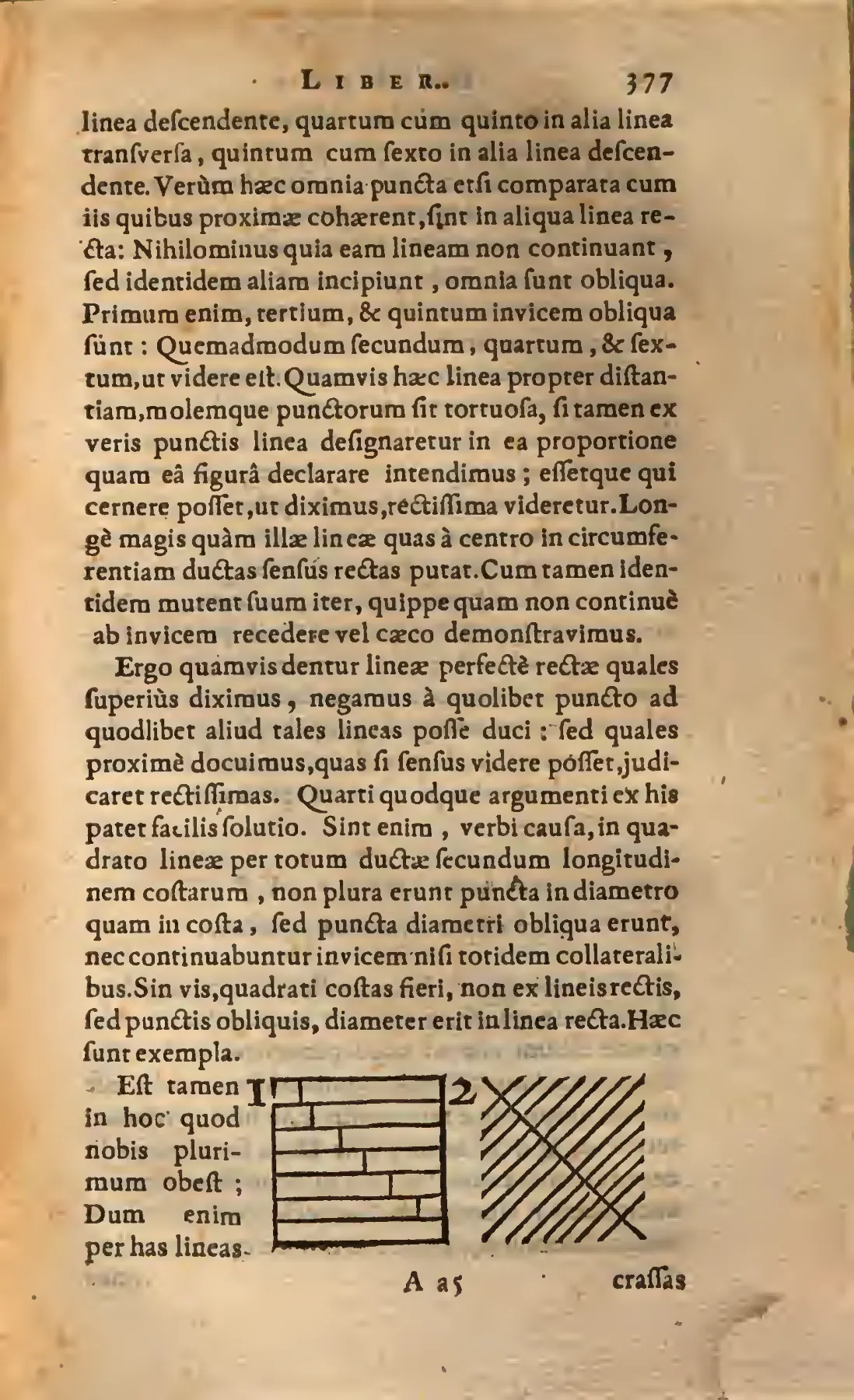
Two small typographic grids give visual form to Bérigard's distinction between puncta recta and puncta obliqua, horizontal ordering set against diagonal crossing as the prose argues that a transverse series does not continuously extend the same line. The coarse printed rules become part of the lesson. Source ↗.
The mathematical Intentiones mark the most exposed moment in the course. Bérigard begins by conceding the universality of the axiom he means to destroy — there is no one who does not suppose, as evident, that straight lines drawn from the centre to the circumference on either side recede continuously from one another; who would call this into doubt? behold, we undertake to demonstrate the contrary, Nemo enim est qui non, ut evidens, supponat, lineas rectas à centro in circumferentiam hinc inde ductas continuè ab invicem recedere. Quis hoc in dubium revocet? Ecce contrarium demonstrare aggredimur — a rhetorical construction that stages consensus in order to identify it as the prima errorum indissolubilium textura, the first weaving of insoluble errors. The claim is that radii preserve equal distance across small quantities and separate only stepwise; otherwise the space traversed by the parts nearest the axis of a turning wheel would equal the immense length of the radius. That such stepwise separation escapes observation is not treated as an objection but as an occasion for a declaration of method: what difficulty is there here? that this tiny distraction of parts escapes the senses? what of it? sense does not see it, but the mind assuredly sees it with the eyes of reason, Quid hic difficultatis? Quia sensum fugit hæc tantilla partium distractio? Quid tum? Sensus non videt? at sanè mens oculis rationis eam videt. The oculi rationis license the imperceptible particle as a legitimate object of natural philosophy, and the argument closes by embracing, as forced upon its unwilling author, the Empedoclean doctrine of motion interrupted by rests — a rehabilitation of a position the schools had made ridiculous, presented not as antiquarian preference but as the residue left when every other construal has been shown to generate monstrosities. Between the lever theory and this polemic stands a warning to the reader that the subtlety of these matters has its difficulty, but such as frequent reading may conquer, for a rose does not grow without thorns, Horum subtilitas habet difficultatem, sed quæ frequenti lectione vincatur. Non crescit rosa sine spinis, a schoolroom aphorism doing considerable ideological work: the difficulty is relocated from the doctrine to the pupil.
The companion Intentio on indivisible parts — the numbering repeated by the press — works almost entirely through the concessions of Toletus, whose admissions that indivisibles are real, that parts subsist in act within the whole, and that Zeno's argument is non facilè solutu are turned against their author. Bérigard's most elegant stroke is to explain the tenacity of the opposing intuition by means of the Peripatetics' own epistemology: since there is nothing in the intellect which was not previously in sense, how could the intellect form for itself such points, of which sense has offered it no image? Cum autem nihil sit in tellectu quod prius non fuerit in sensu, quomodo intellectus talia puncta sibi formare possit, quorum nullam sensus sibi obtulit imaginem?. The axiom of sensory origination is thus made to account for a systematic error rather than to guarantee knowledge: because no image of a true point can be given, imagination silently substitutes a small round or square body, and the geometrical objections of Scotus and Gregory follow from that substitution. His answer, the distinction of puncta recta from puncta obliqua, is set out with typographic diagrams, accompanied by the apology that the coarseness of printed lines misrepresents what is meant — a rare acknowledgement that the printed page is itself an imperfect instrument of demonstration. The Epilogus to these books records a long hesitation about publishing these subtleties at all, resolved by necessity rather than daring.
De actione: parsimony, likeness, and the dissolution of cold
The book De actione states the reductionist thesis without hedging: in the preceding book we treated of that motion which no one denies to be local, whereas in the present we have resolved to show how true is what we affirmed above out of the discipline of the Ancients, Præcedenti libro egimus de illo motu quem localem esse nemo negat, præsenti statuimus ostendere quàm sit verum quod superiùs affirmavimus ex Veterum disciplina. The warrant is then supplied by Aristotle himself: let that maxim so celebrated by Aristotle flourish, that nature does nothing in vain, and that it is in vain to do through many what can be done through fewer, Vigeat illud Aristoteli tam celebratum, naturam nihil agere frustra, & frustra fieri per plura quod per pauciora fieri potest. The tactic is characteristic and recurs in the celestial books against multiplied orbs: parsimony is not imported from a rival school but extracted from the Peripatetic canon and made to consume real qualities, faculties, and forms. Within this frame the Democritean principle that like acts on like organizes a long pharmacological excursus on poisons, alexipharmaca, viper powder and the balsamum naturale, and the doctrine of reactio is expelled on the ground that what is weakened in action is not the agent but the subject deserted by its spirits. The sequence culminates in a formula that dissolves a first quality entirely, so that we may see clearly that cold is not a quality, as it were a new nature adjoined to the element, but partly its action, partly the thing's passion, partly the privation of the element's action, Vt clare videamus frigus non esse qualitatem quasi novam naturam elemento adjunctam, sed partim ejus actionem, partim rei passionem, partim actionis elementi privationem — a tripartition in which quality is redistributed across motion, resistance and absence, with the winnowing-fan and the sieve replacing Aristotle's definition of the hot as that which gathers what is of the same kind.
De coelo: Sisyphean movers and the fiery heaven
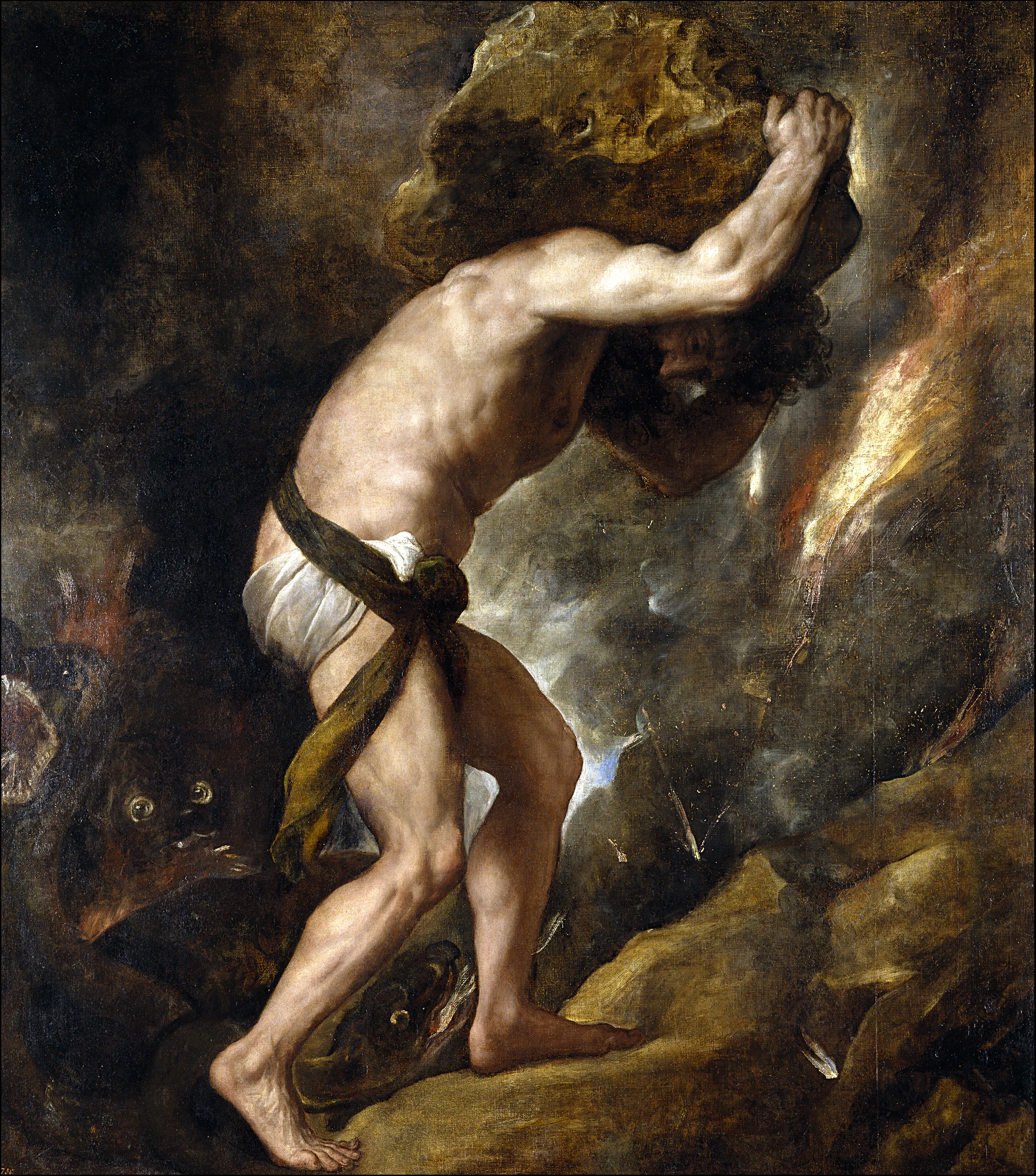
Titian's sixteenth-century Sisyphus, straining beneath his rock, supplies period form to the myth Bérigard weaponized in De coelo. Likening the Peripatetic celestial Intelligences to a sweating Sisyphus made to hold up his own sphere, he turned heroic punishment into satire on the labour of immaterial movers. Source ↗.
In De coelo the polemic changes register from demonstration to derision. The Intelligences of the spheres are staged as labouring bodies: I seem to see this Intelligence — or if you prefer, this Sisyphus, this Motor, I say — with foot braced, head and hands turned about, sweating and panting in the face, holding up his own sphere against the rapidity of the higher Globe, Videre mihi videor hanc Intelligentiam ni mavis hunc Sisyphum, hunc inquam Motorem, pede presso, capite manibusque obversis, sudante vultu anhelantem, adversus Globi superioris rapiditatem, suam sphæram sustinere, the mockery justified shortly after by the maxim that nothing forbids speaking truth by laughing. The satire is precisely calibrated: by giving the immaterial mover a body that sweats, Bérigard exposes what he takes to be the covert corporeality already smuggled into the Peripatetic machinery, and the ensuing exploitation of the astronomers' own quarrel — Fracastoro's seventy-seven or seventy-nine spheres against the eccentrists' thirty-three, reported from Clavius on Sacrobosco — leaves the planets moving themselves. Positively, the heavens are reassigned to the elements, and the author's own hypothesis is hydraulic and physiological at once: a single solid firmament with a fiery sea beneath, fire admitted through immense polar fauces, concocted as food is concocted in the stomach, and then expelled through the stars, which serve as so many fountains or fiery rivers pouring out fire now made purer — the image already noticed in connection with the corpuscular reading of the heavens. Planetary diversity then follows from successive concoctiones, on the analogy of stomach, liver, heart, spleen and brain, with the Chymists' metal-planet correspondences recruited as corroboration. The consequences are pressed to the point where astrology itself becomes a doctrine of particles: once the child has been brought forth into the light, the spirits sent down from the star, wandering most frequently in every direction, suddenly entering all the passages of the tender body, Edito verò in lucem puero, spiritus qui ab astro demissi quoquo spatiantur frequentissimi, subito cunctos tenelli corporis meatus, are the seeds of a new conformation, the first arrivals occupying the citadel and repelling all later comers save their kin. Natal influence is thereby retained as a physical fact while its Peripatetic and Neoplatonic supports are withdrawn: what reaches the newborn is not an incorporeal virtue but an army of igniculi, transmitted along the standing river of fire that stretches from star to earth, and the astrological tradition survives only as a corollary of the corpuscular hypothesis that has replaced its metaphysics.
These celestial books close on a problem that the Peripatetic apparatus had habitually resolved by appeal to the influence of the orbs: why the Sun's power to warm and to produce weather is not constant. Having already denied that the Sun possesses fire of its own beyond what the fixed stars pour into it, Bérigard is obliged to locate the variation in the stars themselves, and he does so by describing a second mode of consensus in wholly percussive terms — the stars of the firmament help and increase the Sun's powers when they so correspond with one another that, by the joining of their fires, they compress the solar fire and press it straight down against the earth, or into our regions, Iuvant, augentque vires Solis stellæ firmamenti, cum ita invicem correspondent, ut ignium suorum commissione ignem Solarem cogant, ac rectà contra terram, vel in nostras oras deprimant. The verbs are those of hydraulic and ballistic compulsion — cogant, deprimant — and the astrological lexicon survives intact while its causality is entirely reconstituted: consensus no longer names a sympathy between natures but the geometry of intersecting fiery streams. The corollary is that influxus, that most occult of technical terms, becomes a quantity subject to interception and deflection, fitque sæpius ut quem stellæ cujuspiam influxum planeta nobis ademit, eundem in alios deflectat, so that a planet frequently diverts to others the influx of some star which it has taken from us. Natal astrology is thereby neither refuted nor left as it was: it is made a branch of the physics of corpuscular traffic.
Magnetism and the economy of likeness
The short book on the magnet that follows shows how little machinery Bérigard thinks he needs. The turning of iron to the north and the attraction of iron by the Heraclean stone are both referred to the polar stars' saturation of one terrestrial region with their spirits, and then to a single axiom of likeness which the text states as already established doctrine: it has been said that each thing shrinks from being divided from its like, and therefore strives to expel whatever differs from itself, and universal nature has attested this, Dictum est unumquodque abhorrere divisionem à simili, ac propterea quicquid à se diversum, conari expellere; Idque universa natura testata est. The economy is the point: one principle is made to carry the compass, the coalescence of magnetic and ferrous effluvia, the running of dispersed mercury to a gold ring held in the mouth, the drawing of chaff by amber, the action of gems and herbs at a distance, and finally nutrition itself, where the nourished substance yields to its congenial part. Where the schools multiplied specific forms and occult qualities, Bérigard multiplies nothing but arrangements of like and unlike bodies in a resisting medium. Yet the warrant he invokes — the testimonium of universal nature — and the frankly qualitative content of simile and diversum mark the limit of the reduction: this is a physics of homogeneity and heterogeneity among corpuscles, not of size, shape and impact alone, which is precisely why his corpuscularism resists assimilation to a later mechanical atomism.
The book De visu: corporeal rays against spiritual species
The interpolated book De visu is where the diagnostic vocabulary of fiction receives its most sustained application, and it opens not with a counter-demonstration but with a demand for intelligibility. The two controversies are stated as a clean disjunction — emission from the eye or reception into it, and a spiritual or a corporeal medium — and the Peripatetic branch is dismissed in the first person: the opinion of Aristotle and the Peripatetics is that vision comes about by reception, but what that is which they suppose to be admitted from the visible thing into the eye, Bérigard confesses he has never been able to understand, Aristotelis quidem ac Peripateticorum sententia est, visionem fieri per receptionem. Quid verò sit illud quod è re visibili in oculum admitti putant, fateor me nunquam intelligere potuisse. The confession is a methodological instrument. It converts the burden of proof into a burden of conceivability, and it is the same test that convicts substantial form elsewhere: an entity that cannot be conceived acting is not a cause but a figmentum.
The refutation proper then proceeds by turning the adversary's own principle against him. Bérigard states it in its most uncompromising Aristotelian form, that a natural agent does not act on the extreme unless it acts on the medium, and that every natural action comes about by touching — this, he insists, is the Aristotelian axiom, Est enim Aristoteli universale; agens naturale non agere in extremum, nisi agat in medium; omnemque actionem naturalem fieri per tactionem. Hoc, inquam, est axioma Aristotelicum. The emphatic inquam stages the manoeuvre as a citation rather than a construction: if action requires contact, and contact requires body, then the species and the actio spiritualis invoked to save reception are excluded by Peripatetic doctrine itself. In their place he installs an ancient mechanical model, praising Pythagoras above all others as having expressed the nature of vision when he said that it comes about by repercussion, just as we see a ball rebound from the wall against which it has been dashed, maximè videtur Pythagoras visionem naturam expressisse, cum dixit visionem fieri per repercussionem, haud secus ac videmus pilam ex muro in quem allisa est, resilire. The simile is not decorative: rebound admits of degree, and degrees of rebound will later be made to do the whole work of colour, so that the dove's neck, the peacock's tail, the rainbow and the blue of the sky are differences of reflection rather than real qualities inhering in surfaces.
The polemic against the species is conducted in a register of studied self-deprecation, which is itself an argumentative resource. Confronted with the claim that innumerable species may occupy one point of air without confusion, Bérigard remarks that how this happens, in order to be understood, requires subtle intellects, such as those of the Peripatetics, and that his own, he confesses, is too coarse to conceive it, quomodo fiat, ut intelligatur, requirit subtilia ingenia, qualia sunt Peripateticorum: meum fateor crassius quam ut hæc concipiat. The irony redistributes intellectual virtue: subtilitas, the schools' highest praise, is recoded as vacuity, while crassitudo is aligned with the coarse-grained corporeal physics of the prisci. The rhetoric of the book is thus of a piece with its doctrine — a preference for the palpable over the refined at both the conceptual and the physical level.
To this ancient thesis the new instruments are then recruited, with a boldness that complicates any simple opposition between Peripatetic and post-Galilean optics: the recently invented oblong glasses, already noticed above as extending the keenness of sight over several thousand paces, are read as a device for gathering the ocular rays and preventing their dispersion, and so as an argument for extramission, with the experientia nostri sæculi enlisted on the side of Pythagoras and Plato. The same evidential logic governs the first-person trials with the burning mirror at varying distances from a book, and it culminates in the thesis for which the whole book has been arranged, put as the rhetorical question already quoted in the framing of the work's vocabulary, which names the alternative as fiction and asks why such rays should not rather be acknowledged as corporeal and real than as spiritual and fictitious. The inference rests on a parity argument — what issues from a body, acts upon bodies, and heats and burns, is a body — and the decisive experimental sign is that vision is disturbed in agitated water but not in moved air, since only a corporeal ray could be so carried away.
That this optical treatise stands where the sequence of Aristotelian books did not require it is acknowledged by the text itself, in an apology that documents its own compositional history: the treatise on the heavens, had not the doctrine of sight, seizing its occasion, crept in, was to be followed by the Meteorological matters, Ractatum de coelo, ni doctrina de visu occasionem uacta obrepsisset, Meteorologica sequebantur, the transmitted wording being defective at the opening word. The verb obrepsisset concedes the irregularity with some elegance, and the Meteorologica that follow are announced with the conceit of a plunge from the heavens into the sea.
The Meteorologica and the close of the course
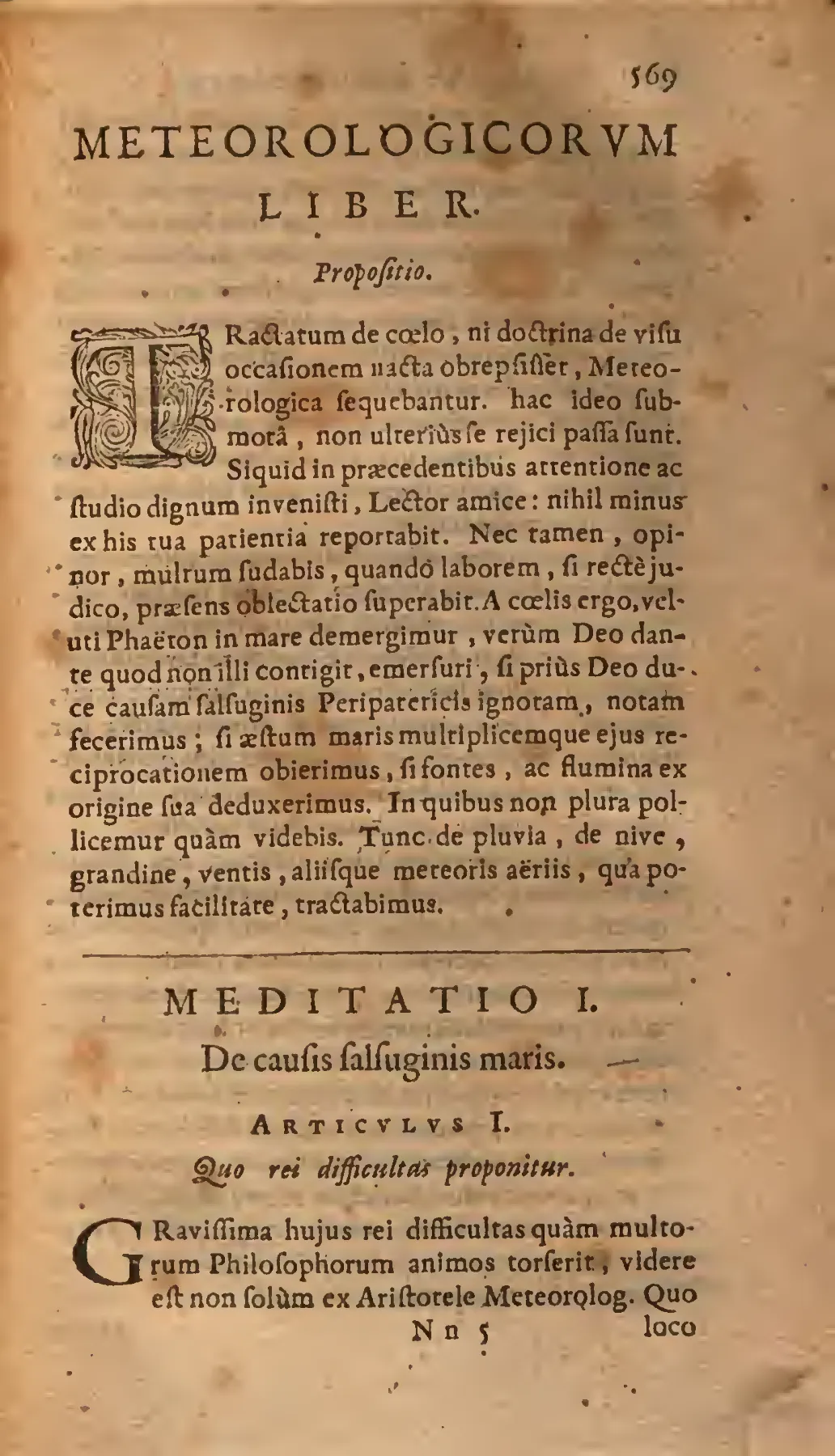
The opening of the Meteorologicorum liber makes the course's structural hinge explicit: after the inserted doctrine of sight, the printed Propositio resumes the sequence from De caelo. Meditatio I turns at once to the salinity of the sea, the Aristotelian problem anchoring the solar-chemical account and Scaliger's defence. Source ↗.
The meteorological books make the salinity of the sea their first and hardest case, and Bérigard stages it as an internal collapse of the Aristotelian party rather than an assault from outside: Scaliger alone, expounding Aristotle favourably on this matter, has cut his throat with the very knife he sharpened against the ancients, ut unus Scaliger Aristotelem hac de re favorabiliter exponens ipsum suo cultro quem in Antiquos acuit, jugularit. The image of self-slaughter by one's own blade identifies the fatal concession precisely: to explain sea salt on Aristotelian premises, the defender must admit heterogeneous parts persisting within a mixture — which is to concede the corpuscular point and to surrender the doctrine of mixture that substantial form was invoked to secure. The positive account is then supplied by chemistry, with the Sun leaching salt from the scorched earth as the chemist leaches it from ashes, and by quantitative bookkeeping over the annual extraction of salt reckoned against post-diluvian chronology.
The treatment of tides applies the same discipline of exclusion to the two dominant explanations, animation and lunar sympathy. Against Scaliger's premise that the sea can have no internal principle of its own motion unless it be an animal, Bérigard replies that its falsity is taught by very many things, and chiefly by grapes fermenting of themselves in the vat and wine boiling in the cask, non posse mare habere principium sui motus internum, ni sit animal, docent cum alia quamplurima, tum in primis uvæ in cupa sponte ferventes, vinumque in dolio bulliens. Fermentation is thus made the model of an internal, periodic, entirely corporeal motion — spontaneous without being ensouled — and its periodicity is domesticated by comparison with intermittent fevers and the arterial pulse, which permits fixed tidal returns without a governing intelligence. The three meteorological intentiones are finally tied together by a single circulatory hypothesis, that these are the spirits which the sea-water carries down with it beneath the Earth through those hidden channels, spiritus scilicet illos esse quos aqua maris per cæcos illos ductus sub Terram secum vehit: the astral fire lodged in the sea, drawn inward, accounts at once for springs, for mineral concoction, for the perpetual fire of Etna and for the winter warmth of wells — one stream of corpuscles carrying the explanatory load formerly distributed among distinct exhalations and qualities.
The book closes with the conventional gesture of authorial reluctance, which doubles as notice of a sequel: if this first part, which the entreaties of friends extorted from him, shall please the Reader, Si hæc prima pars, quam à me preces amicorum extorserunt, Lectori placuerit. The topos of preces amicorum deflects responsibility for publication onto solicitation, a posture consistent with the hesitation recorded elsewhere in the volume, and the alphabetical index of things contained in the work that follows converts the whole course into a consultable digest, its entries on prime matter, the continuous flux of substantial form, the world-soul, the void, Democritus' atoms and the Copernican opinion on celestial motion registering, in the flattest possible register, exactly which doctrines the Circulus had put in circulation.
Frequently Asked Questions
Who was Claude Guillermet de Bérigard?
Bérigard — Claudio Berigardo to his Italian colleagues, Claude Beauregard in French, Claudius Berigardus Molinensis on his title-pages — was a French philosopher from Moulins who taught natural philosophy in Italy. He held the Pisan chair from 1627 under Medici patronage, transferred to Padua in 1639, rose to the first chair there in January 1661, and died at Padua on 23 April 1663. The strongest biographical account places his birth probably in 1590, though Niceron gives 15 August 1578. He was also the first published opponent of Galileo's Dialogo, in the Dubitationes of 1632/1633.
What is the Circulus Pisanus, and what does "circulus" mean in the title?
It is a large Neo-Latin course-book and polemical synthesis running through Aristotle's Physics, De caelo, De ortu et interitu, Meteorologica, and the three books De anima, cast as a disputation between the interlocutors Charilaus and Aristaeus — whose supposed function as authorial masks is an interpretive proposition, not a documented pseudonym. Circulus here names a completed cycle or round of academic disputation begun at the Studio of Pisa, not a geometrical figure and still less a modern-style coterie. It first appeared at Udine from Nicolò Schiratti, in parts dated 1643 and 1647, then much enlarged at Padua from Paolo Frambotto in 1661.
Why did Bérigard call Aristotle's substantial form a fiction?
Because, on his argument, it explained nothing and multiplied difficulties: he infers that no such form is given, that it is a mere figmentum of Aristotle's — a fictive construction — and the fertile principle of all errors committed in natural philosophy. In its place he sets the arrangement and local motion of pre-existing corpuscles, comparing generation to a printer setting the same letters now one way, now another. Form becomes symmetry, harmony, concord; the sun is a chemist drawing salt from scorched earth, the stars fiery fountains, the tides a fermentation. The rational soul is expressly excepted, and universal nature reserved to God alone.
Why do scholars disagree about whether Bérigard was an atomist?
Because his corpuscles behave unlike later mechanical atoms. Giorgio Stabile made the monographic case for a place in the history of seventeenth-century atomism, while an influential interpretive line holds that the corpuscles are not true atoms and that, even after reading Gassendi, Bérigard remained committed to a qualitative physics of porous, configurational bodies. Maria Bellucci's study of his natural philosophy and letters, and Maria Laura Soppelsa's placement of him amid the decline of Aristotelianism at Padua, both suggest a transitional figure. His Democritus supports this: the "fortuitous concourse" is rescued by reinterpretation so as to remain compatible with divine governance.
Is there an English translation of the Circulus Pisanus?
No complete modern English translation, and no reliable record of a translation into another modern language, has been identified for Bérigard's Circulus Pisanus; the work has been read in Latin. Separately, the Leo edition now presents the full transcription together with a complete English translation for the first time, and that translation is generated by AI. Leo is an effort to make freely available online, at no cost, English translations of every text printed in Latin in early modern Europe between 1450 and 1750.
This report was generated by an advanced AI assistant that conducted deep research alongside an extensive interpretation of the transcribed original text. Every effort has been made to preserve fidelity to the source and to guard against inaccuracy, but corruption in the text recognition process and model hallucination may nonetheless have entered the text. Treat every claim, quotation, translation, and citation as provisional, and verify each against the original source before relying on or citing it.
Critical Further Reading on Bérigard, Padua, and Seventeenth-Century Corpuscularism
- Anon., "Beauregard, Claudio Guillermet signore di," Dizionario Biografico degli Italiani, vol. 7: The foundational biographical entry, and the source of nearly every date, chair, dedication, and rumour repeated about Bérigard since 1970; its claims about appointments and ecclesiastical approval deserve archival checking rather than citation on trust. Read its catalogue of accusations — Pyrrhonism, libertinism, the De tribus impostoribus — beside the Circulus's own admission that necessity rather than boldness overcame fear, which records the author's sense of exposure without disclosing its cause.
- Bellucci, Maria, "La filosofia naturale di Claudio Berigardo," Rivista Critica di Storia della Filosofia: The one specialist reconstruction of Bérigard's physics, and indispensable for anyone tracing the vocabulary that holds this sprawling course together — figmentum, concentus, divinae artis instrumentum, igniculi. Its reported appendix of unpublished letters makes it the natural starting point for questions of correspondence and Paduan institutional context.
- Soppelsa, Maria Laura, Genesi del metodo galileiano e tramonto dell'Aristotelismo nella Scuola di Padova: Situates Bérigard inside the Paduan reworking of Aristotelian teaching, which is the only setting in which the Circulus reads as a school text rather than a freakish atomist tract. Its interest in the continuum and the mathematics of motion speaks directly to the Intentiones on indivisibles, where the conclusion is staged as a defeat — Ecce quò vel invitos necessitas compulit, scilicet ut multiplicia illa, atque inexplicabilia errorum involucra fugientes, in Empedoclis doctrinam incidemus — a reluctant fall, in flight from inexplicable errors, into the doctrine of Empedocles.
- Springer Nature Link, "Guillermet, Claudio," Encyclopedia of Renaissance Philosophy: A compact reference entry that assembles the standard bibliography on Bérigard in one place and states the interpretive line against which Stabile's atomism thesis must be tested — that the corpuscles are not atoms and the physics stays qualitative even after Gassendi. Useful less for its narrative than for showing which five items the field has agreed to keep citing.
- Stabile, Giorgio, Claude Berigard 1592–1663. Contributo alla storia dell'atomismo Seicentesco: The principal monographic case for enrolling Bérigard in the history of seventeenth-century atomism, and the claim every later reader has had to argue with. Test it on the celestial books, where the heavens are filled with fiery streams rather than orbs — the sun, through the stars, as through so many fountains or fiery rivers, vomiting forth fire now made purer, per stellas, veluti totidem fontes, vel fluvios igneos, evomat ignem jam puriorem effectum — imagery unmistakably corpuscular and just as unmistakably qualitative.
- Stabile, Giorgio, "Il primo oppositore del 'Dialogo': Claude Bérigard," Novità celesti e crisi del sapere. Atti del convegno internazionale di studi galileiani: Fixes Bérigard's place in the first reception of Galileo's Dialogo and helps keep the 1632/1633 Dubitationes distinct from the later, warier accommodations of the Circulus. The distinction matters, because the Circulus concedes a motion of the earth by way of Plato and the ancients while still rejecting diurnal rotation — an accommodation to antiquity, not to Copernicus.