Not Yet Dug from the Earth's Veins: Wilhelmus Lindanus's The Gospel Panoply: Five Books on the Evangelical Word of God
Writing as Wilhelmus Lindanus, the Dordrecht theologian Willem Damasus van der Lindt published Panoplia evangelica, sive de verbo Dei evangelico libri quinque at Cologne in 1559–60 as a five-book Catholic reply to the Reformation principle of Scripture alone. His claim is that the Bible cannot be identified, much less interpreted, without the apostolic teaching the Church hands down unwritten. He presses it with Greek philology, canon law, Frisian church plate and a sharp eye for his opponents' contradictions, which makes the book an early and sustained answer to how Catholics defended tradition in the years of the Council of Trent.
ExLatinis
October 2, 2026
Contents
Writing as Wilhelmus Lindanus, the Dordrecht theologian Willem Damasus van der Lindt published Panoplia evangelica, sive de verbo Dei evangelico libri quinque at Cologne in 1559–60 as a five-book Catholic reply to the Reformation principle of Scripture alone. His claim is that the Bible cannot be identified, much less interpreted, without the apostolic teaching the Church hands down unwritten. He presses it with Greek philology, canon law, Frisian church plate and a sharp eye for his opponents' contradictions, which makes the book an early and sustained answer to how Catholics defended tradition in the years of the Council of Trent.
Willem Damasus van der Lindt, who wrote in Latin as Wilhelmus Lindanus, put his name to a five-book Catholic controversial treatise that Maternus Cholinus printed at Cologne in 1559–60. Its dedication to Philip II is reportedly dated at Leeuwarden, 1 July 1559. The title is Panoplia evangelica, sive de verbo Dei evangelico libri quinque, which might be rendered "the complete armour of the evangelical Word of God." It belongs to the learned polemic produced in the Habsburg Netherlands and the Rhineland in the years between the early sessions of the Council of Trent and its final period. It is a work of controversial theology, but it draws freely on patristic scholarship, canon law, conciliar history, liturgics, chronology, Greek philology and antiquarian observation. Its author styles himself Dordracenus, of Dordrecht, and he argues as a Netherlander. His pages turn repeatedly to local testimony from Friesland, Holland and Utrecht.
The work confronts one problem. If Scripture alone is the Word of God and the sole rule of faith, how can the Church know which books belong to Scripture, what they mean, and on what authority its received doctrines and rites rest? Lindanus answers by dividing the Word of God into two parts, one written and one unwritten. He then makes the apostolic teaching "once delivered" to the churches the prior rule by which both doctrines and books are tested. He calls that teaching a touchstone, the Lydius lapis on which an assayer tries gold.
His method recurs throughout the five books in three moves:
- He turns his opponents' principle against itself. He argues that the reformers' principle of Scripture alone undoes itself, because Protestant creeds, the canon, the Nicene homoousion and the baptism of infants already depend on tradition.
- He limits and ranks his witnesses. He admits the consensus of the Fathers only within fixed chronological bounds, and he grades traditions by their authority.
- He applies this method doctrine by doctrine. He works through grace and merit, the saints, the sacraments, Roman primacy, the sacrifice of the Mass and communion under one kind. He often presents present-day adversaries as ancient heresies revived.
The question mattered greatly to Catholics and Protestants alike. Trent's decree on Scripture and traditions of 8 April 1546 had dropped its draft's partim–partim language, under which revelation was contained "partly" in writing and "partly" in unwritten tradition. Theologians nevertheless went on arguing about whether the council had taught two partial sources of revelation. Lindanus's treatise is an early and sustained statement of a two-part view. It must, however, be read as his own position and not simply attributed to the council. It also stands near the Louvain tradition of reflection on canon and tradition associated with Johannes Driedo. The work has even been catalogued under Driedo's name, but that attribution is a misattribution, not a competing authorship. Driedo's influence on Lindanus is a plausible research hypothesis, but no study has yet demonstrated it passage by passage.
What makes the Panoplia distinctive is the texture of its argument as much as its thesis. It contrasts the "true" Gospel contained in letters with the "full" Gospel that includes what the apostles delivered by voice. It compares unwritten doctrine to gold still lying unmined in the earth's veins, which already bears the name and value of gold. It refuses to call any ecclesiastical writer as a witness to Catholic dogma unless he flourished more than a thousand years earlier. It also reports concrete observances, such as Frisian infant communion and the chalice tubes used at Bolsward and Dokkum, as evidence for the antiquity of practice.
The argument is candid about its own strains. Lindanus concedes that the Church's grasp of truth clears only gradually. He admits that rites and clerical morals need a healing hand, though he defers the cure until the time is ripe. He treats some apostolic practices as matters of indifference.
Three aspects of the work point to the same claim. The armour metaphor of its title, the dedication to Philip II together with a closing submission to Paul IV, and the argument's movement from the definition of the Word to the defence of particular sacraments all hold that the Word can be recognised only within a Church that hands it down. The work's printing history shares in this uncertainty about transmission. That history includes a Eucharistic continuation issued separately in 1560 and a later Cholinus imprint of 1563 whose relation to the earlier setting is unsettled. Further printings at Antwerp and Paris have been reported but not confirmed.
Read the full text and English translation on Leo
This text was transcribed and translated as part of the ExLatinis project, an effort by Leo to make free English translations of every text published in Latin in early modern Europe (1450–1750) available online. The complete transcription and English translation of this work can be read free of charge:
→ Read the original Latin text and full English translation on Leo
You can save a copy of this document into your Leo account to run deep text searches, conduct further analysis, or cross-reference it with your own research.
How Lindanus Titled the Gospel Panoply and Defined the Word of God
The Gospel Panoply: Five Books on the Evangelical Word of God is an editorial English title supplied for convenience, not an established translation. The attested Latin short title is Panoplia evangelica, sive de verbo Dei evangelico libri quinque. The complete title-page wording beyond that opening has not been independently transcribed.
Panoplia denotes a full equipment of arms. Applied to the evangelical word, it evokes the armour of God in Ephesians 6:11–13. In this Catholic controversial treatise, however, the armour is turned against competing claims to interpret that word, so evangelica should not be read as a straightforward declaration of Protestant allegiance. The text itself makes the polemical point of the conceit explicit. Lindanus presents his adversary as an impostor who leaves the written Word untouched in its letters while emptying it from within: dum videlicet scriptum Dei verbum, si literas numeres, sartum tectum sese simulat callidus impostor relinquere: sed si poenitiorem eius intueâre naturam, re vera illud totum conatur sublegere, atque funditùs perdere. In this image the cunning deceiver pretends to keep the written Word intact "if you count its letters," yet tries to steal and destroy it entirely. The armoury is therefore defensive equipment for the Word, not an assault on it. The adjective evangelicus is likewise claimed for the Catholic side rather than conceded to the reformers who called themselves "Evangelicals."
The work's governing question is lexical before it is doctrinal. Lindanus asks whether Christians should understand the name "Word of God" to mean Holy Scripture alone: An verbi Dei nomine sola Scriptura sacra sit Christianis accipie[n]da?. The definitional, or "horistic," method of Book I follows from this framing. The dispute is conducted as a question of what verbum Dei denotes.
Traditio means a handing down of teaching and practice, not merely an addition to a written text. The contested expression verbum Dei non scriptum concerns whether apostolic teaching transmitted without being written down keeps its doctrinal authority. Lindanus states the Catholic counter-thesis in exactly these terms, that many unwritten things are to be believed and many things not contained in Scripture are to be acknowledged as the Word of God: contrà, docemus Catholici multa esse Christianis credenda non scripta: multa esse pro verbo Dei agnoscenda Scripturis non cõprehensa:.
He then claims that the written Word itself cannot be known with certainty except through the unwritten Word: Illius verò hîc est admonendus pius lector, verbum Dei scriptum nisi per verbum Dei nô scriptum certò atq[ue] indubiè cognosci non posse,. This claim governs his treatment of the canon. The canon, on his account, is known only through tradition.
He draws the same contrast in philological terms between a "true" Gospel and a "full" one. The full Gospel is not merely what is contained in letters; what is written is true too, but not full: Istud est verum ac plenum Euangelium, non quòd literis tantùm est comprehensum: quanquam & hoc verum, sed non plenum.
Regula fidei, the rule of faith, names a criterion by which received teaching and the interpretation of Scripture may be judged within the Church. Lindanus places it alongside the vocabulary of Canon and the assayer's touchstone. He argues that another canon and rule of the Christian faith besides Scripture alone is necessary, by which, as by a Lydian stone, the genuine truth of both dogmas and books is tested: Alium idcirco Christianæ Fidei, præter Scripturam solam, esse Canonem atque regulam, est necessarium, qua ceu Lydio lapillo & dogmatum & librorum Catholica Ecclesiæ germana veritas sit exploranda:.
He also defines the rule positively. The most certain norm of the evangelical Word is whatever the apostles, taught by Christ and by the Holy Spirit, proclaimed to the churches to be believed and handed on to posterity: indubitatem crededi regulam siue certissimâ Dei verbi Euangelici normam esse, quicquid Apostoli tam à Christo Domino, quàm à Spiritu sancto veritatis magistro docti Ecclesiis Christi credendum annunciarunt, atque posteris prodendum tradiderunt. In this formulation tradere carries both its senses, "to deliver" and "to hand on." The regula is thus defined by the act of transmission itself, which is the same claim the title's evangelicus makes about whose Word this is.
Lindanus defends the value of what has not yet been minted into writing with a metallurgical image. Gold, whether stamped as coin, melted in the mass, or still hidden unmined in the earth's veins, bears the name and holds the value of gold: Cù em auru, vt signatu, ita & in massa conflatu, adeoq; in terræ venis delitescés nondu effossum, auri & nome habeat, & valore teneat:.
Whether Lindanus expressly borrows Driedo's formulation of the rule, rather than drawing on a wider Louvain theological vocabulary, has not been established. The passages cited here do not name Driedo as their source.
What Lindanus's Gospel Panoply Argues Against Scripture Alone
Panoplia evangelica is a Latin Catholic controversial treatise in five books by Willem Damasus van der Lindt, writing as Wilhelmus Lindanus. Its Cologne printing by Maternus Cholinus is associated with 1559–60, and the reported dedication to Philip II is dated at Leeuwarden, 1 July 1559.
Its central controversy concerns the authority of the evangelical word, including Scripture, ecclesiastical interpretation, and transmitted teaching. Lindanus states the thesis of his first book in so many words. The Word of God is not Scripture alone, nor is it wholly contained in the sacred writings, and Scripture alone is not its rule; the rule is the apostolic doctrine delivered once to the churches from their beginning: videbitur verbum Dei non esse Scripturam solam, aut totum literis sacris inclusum, nec verbi Dei Euangelici regulam esse vnam Scripturam: sed doctrinam Apostolicam Ecclesiis abs sui exordio semel traditam.
His chief polemical method is to turn his opponents' principle back on itself. He argues that the "Evangelicals" weaken their dogma by confirming it and destroy it by building it up: ita prorsus & istis euenire videas Euangelicis, vt videlicet in istius dogmatis sui confirmatione sese primùm ipsi confirmando infirment, astruendo destruant,. After setting out these principles, the treatise applies them doctrine by doctrine to grace and merit, the saints, the sacraments, primacy, and the Eucharist.
Attributing this work to Johannes Driedo, author of the distinct four-book De ecclesiasticis scripturis et dogmatibus, is a cataloguing misattribution, not an alternative authorship. No published translation of the Panoplia into another language was located. The absence of a located translation does not establish that none exists.
Why Lindanus Matters to the Scripture and Tradition Debate around Trent
The Panoplia matters as a Catholic intervention in disputes over who could recognize, transmit, and interpret the word of God in the decades surrounding the Council of Trent.
Patristic method. Lindanus places his method within patristic precedent from the outset. He adopts Cyprian's counsel that where truth has wavered and faltered, the priests of God must return to the dominical, evangelical, and apostolic tradition as to its origin, so that the reason of the Church's action rises from the source whence order and origin arose: Quod & nunc facere oportet Dei Sacerdotes præcepta diuina seruantes, vt in aliquo si nutauerit, & vacillauerit veritas, ad originem Dominicam ac Euangelicam & Apostolicam Traditionem reuertamur, & inde surgat actus nostri ratio, vnde & ordo & origo surrexit.
He invokes Basil in the same spirit. If unwritten customs are rejected as having little force, the Gospel itself will unwittingly be mutilated in its principal parts: Si enim consuetudines Scriptura non comprehensas quasi exiguam vim habentes, reiicere aggrediamur, imprudentes Euangelium ipsum suis potissimis mutilabimus partibus.
The patristic authorities are not admitted without restriction. Lindanus binds himself to call no ancient writer as witness to Catholic dogma who had not flourished before the whole Christian world, with published books, more than a thousand years earlier: Quare ita nos instruximus, vt veterum Scriptorum neminem ad fidei Catholicæ dogmata constituenda aduocauerimus testem, qui no[n] ante annos iam mille suis in publicum editis libris, toti Christiano orbi effloruerit. This self-imposed limit treats the consensus of the Fathers as an auxiliary witness. It also frames Lindanus's dispute with Melanchthon over the Fathers' authority.
He voices the Protestant objection that the vote of the ancient writers does not shake the certainty of Scripture: Atqui, inquiat, Scripturæ certitudine[m] nô quatefaciat Scriptorum veteru[m] calculus. He also quotes Melanchthon directly, to the effect that there is great dissimilarity among the Fathers, who were men and could slip and be deceived: magna dissimilitudo est, homines enim erant, & labi ac decipi.
Wider contexts. The Panoplia belongs beside Louvain reflection on the biblical canon and unwritten traditions, the confessional disputes of the Habsburg Netherlands, and arguments over sacramental practice.
The tu quoque argument. The "you too" argument links these contexts by claiming that Protestant orthodoxy itself depends on tradition. Lindanus claims that whoever reads the Nicene acts will recognise that the homoousion came more from the tradition of the ancients: agnoscet illud homousion magis ex Traditione veterum. The point presses on opponents who professed the Nicene faith. If the creed's key term rests on tradition, the principle of Scripture alone cannot account for the orthodoxy its adherents confessed.
Grace, merit and the saints. In the doctrinal sections the same method governs grace and merit. Lindanus rejects the assurance of salvation that comes from special faith, holding that such certainty befalls no true believer, not even the apostles in this life: indubitatem salutis æternæ certitudinem, quæ ex fide est, non modò Christianis omnibus verè credentibus non contingere, sed ne ipsis quidem Apostolis hac in vita vnquam co[n]tigisse.
He bounds the cult of the saints with a distinction. The saints mediate by helping and commending, not, as Christ does, by meriting and effecting: sed iuuando & commendo, non vt Christus promerendo atque efficiendo.
Sacraments and the Roman see. His sacramental theology begins from a definition. For Catholics, the sacraments are efficacious signs of divine grace: refert animaduertere, Sacramenta Catholicis esse efficacia diuinæ.
His ecclesiology culminates in a mark of the Church. According to Lindanus, the Fathers judged that the true Church of Christ is recognised in this world by the mark of the Roman chair, as the sky is recognised by the sun: nota, tanquam cælum Sole, césuerunt veram Christi Ecclesiam in hoc.
Tensions Lindanus acknowledges. The treatise's historiographical interest lies partly in strains it admits openly. It concedes development: the Spirit governs the Church so as to lead her gradually out of an ambiguous mist of truth toward clearer truth, Ecclesiam, vt paulatim eam ex ambigua veritatis caligine ad manifestiorem.
It treats some apostolic practice as indifferent. Whether the apostles anointed with oil or not, Lindanus says, matters little: Vnixerint ergo Apostoli oleo, non vnixerint, nostra haud ita multùm refert.
It also admits the need for reform while deferring it: Sunt quæda, ingenuè agnosco, dolenterq[ue]; ingemisco, sunt quæ medicam iam pridem desiderant manum, tam in Ecclesiæ ritibus, quàm populi totius, imò in primis Cleri moribus: Sed secandi vlceris maturitas expectanda, non præcipiti temeritate. Here he concedes, with open lament, that some things in the rites, in the morals of the whole people, and above all in the morals of the clergy have long needed a healing hand. He insists, however, that the ulcer's ripeness must be awaited rather than cut with headlong rashness.
The partim–partim formulation. The report of a partim–partim account of written and unwritten teaching in the Panoplia can now be checked against the text. The text itself reads that one part of the truth is contained in the apostolic writings and the other consigned to all the churches by the apostles' living voice: cuius partem quidem vnam dicimus scriptis Apostolicis comprehensam: partem verò alteram viua ipsorum voce Ecclesiis omnibus consignatam. The passage confirms a two-part division in Lindanus's own words. How this formulation relates to the draft wording at Trent, and to the other ways in which the treatise grades and bounds tradition, still awaits close assessment.
Trent and its interpreters. Trent's fourth session issued its decree on Scripture and traditions on 8 April 1546. Its draft's partim–partim wording was not retained. George H. Tavard argues that later theologians nevertheless invoked Trent for a doctrine of two partial sources, although the decree neither canonized that doctrine nor excluded a Catholic account of the primacy of Scripture. The Geiselmann–Lennerz disagreement concerns what can legitimately be inferred from the altered conciliar wording. Lindanus's position therefore must not simply be assigned to the council itself, and his explicit two-part formulation is no evidence of what the decree taught.
Louvain and the Soto–Brenz exchange. Wim François's study of Driedo identifies a pertinent earlier controversy over the sources of truth, and John L. Murphy treats Driedo's notion of tradition at length. Shared concerns make direct influence on Lindanus a research hypothesis, not an established scholarly finding.
Within the text, Lindanus's account of the foundation of faith follows Soto's thesis against Brenz, and his fifth book is directed against Brenz, Calvin, and the Württemberg Confession. Even so, no specialist account showing how the Panoplia was received, or documenting its precise intervention in the Soto–Brenz exchange, was located.
Tracing the Cologne Printings and the Driedo Misattribution
Identification and the digital surrogate. The identifiable work is Lindanus's Panoplia evangelica, sive de verbo Dei evangelico libri quinque, not the first tome of Johannes Driedo's collected works. A digital surrogate identifies Lindanus as author and gives 1559–60 as its publication date. Its placement in an aggregator collection labelled "Early English Books, 1641–1700" cannot establish either the language or the date of this Latin Cologne imprint. The surrogate's displayed metadata does not identify the physical holding institution or shelfmark.
Neither an original-copy record tying the alleged Driedo description to that surrogate nor a binding examination was located. A composite volume, a misapplied digitization record, and a simple metadata error therefore cannot yet be distinguished. The confusion with Driedo nonetheless echoes the Louvain lineage of the questions the work addresses, even though it remains an error of attribution.
Printing history. Maternus Cholinus printed the Cologne Panoplia. A Cholinus imprint dated 1563 is also catalogued, though its relationship to the earlier setting was not established by copy comparison.
A separately issued 1560 Eucharistic continuation, Pars altera, is reported, as are a printer's explanation for its delay and a submission to Pope Paul IV. In substance, the Eucharistic argument treats the Mass as sacrifice and as propitiation. It derives all the efficacy attributed to the sacrifice of the Mass, as rivulets from a fountain, from the one sacrifice: vi vniversa, quæ Missæ sacrificio tribuitur, efficacia ceu ex fonte riuuli.
The argument defends communion under one kind as a matter left to the governors of the Church. Lindanus argues that although Christ distributed both species to the apostles at the supper, he did not give them to the laity or command in any words that they be given to them: Tametsi enim Christus vtramque speciem in coena distribuit Apostolis, non tamen dedit laicis, aut vllis verbis dandam eis præcepit,.
He reads the Council of Constance defensively. He does not think, as is commonly said, that Constance forbade communion under both kinds to the laity, but that it defended the communion under one kind long customary among them: haud equidem existimo, vti vulgò dictitatur, vtriusque speciei communionem laicis prohibitam, sed defensam vnius speciei communionem tunc laicis antiquissimo ex more vfratissimam.
The papal submission. The submission names its addressee in ecclesiological terms that match the treatise's argument about the Roman see. The Church's head in Christ's place is Peter's successor, the bishop of the Roman Church, Paul IV: cuius cæput Christi loco est Petri successor Romanæ Ecclesiæ Episcopus Paulus quartus,.
Points requiring examination of the printed leaves. The precise wording, sequence, and signatures of the continuation, the printer's explanation, and the submission, and their relationship to the 1559–60 copies, require examination of the printed leaves. No dependable full collation, verified privilege or approbation, ownership history, Index entry, or shelfmark for the surrogate was established. Reported Antwerp and Paris printings likewise remain unconfirmed. The evidence does not warrant inferring a Frankfurt-fair issue or a press variant from the reported running-head discrepancy alone.
Driedo's treatise. Driedo's distinct De ecclesiasticis scripturis et dogmatibus libri IV was printed at Leuven in 1533 by Rutger Rescius with Bartholomaeus Gravius; the catalogue describes a folio of 634 pages. Driedo is an important Louvain antecedent in the history of Scripture and tradition, but no documented passage-to-passage dependence of Lindanus on his treatise was established.
Habsburg and papal setting. The reported dedication to Philip II and submission to Paul IV place Lindanus's appeal within the Habsburg and papal world of 1559. Joined to the treatise's claim that the Word is known only within a Church that hands it down, they show the work presented to the two authorities whose guardianship that claim presupposes.
Specific contemporary replies to the Panoplia, as distinct from related exchanges among Catholic and Protestant controversialists, were not securely identified. Lindanus's De optimo scripturas interpretandi genere and his later defence of the Council of Trent provide related works for comparison, not evidence of a verified chain of replies.
Following Lindanus's Argument Book by Book, from the Definition of the Word to the Eucharist
The Title Page, the Dedication and the Preface
The printed title page already announces the bipartition on which the whole Panoplia turns. It promises a defence of verbum Dei non scriptum, sed traditum, aduersus infesta Catholicæ, that is, of the Word of God "not written, but handed down," against forces hostile to the Catholic Church. The participle traditum does the decisive work. The unwritten Word is not presented as a gap in revelation or as a supplement to it. It is presented as a mode of transmission, and the five-book plan moves from the nature of the evangelical Word, through its division, to the defence of the unwritten part. The title thereby makes the definitional question and the polemical one the same question.
The dedicatory epistle to Philip II opens, unexpectedly, by disarming its own title. Drawing on the natural-philosophical commonplace that nature equips the elephant, the eagle and the lion with weapons but not man, Lindanus observes, OMINEM à natura ita comparatum videre est, Serenissime Rex, non vt bello, that one may see, most serene King, how man has been so fashioned by nature as not to be made for war. Man is instead, in Lindanus's words, the pacis (vt ita dixerim) mancipium & concordiæ custodem: the bondsman of peace, so to speak, and the guardian of concord. The paradox is deliberate. A "panoply" written by a creature born for peace needs justification, and Lindanus supplies it from Cicero's rule, transmitted through Augustine, that war is licit only for faith or for safety. Armour thus becomes a duty imposed by the defence of the faith rather than a natural disposition. The autobiographical sequel frames the treatise as a private store of weapons that grew public. He had first meant quoddâ quasi armamentariu[m] instruere ac co[m]parare,, to build and furnish for himself a kind of armoury. The move from personal arsenal to royal dedication carries the treatise's ecclesiology in miniature. Weapons forged by one theologian acquire their public warrant from a patron whose hereditary title, Regius enim ille Titulus CATHOLICVS, auito ex stemmate fluës,, is a royal style "Catholic" that flows from an ancestral lineage. The very name of Philip's office is thus figured as an inheritance handed down, which is the logic the treatise will apply to doctrine.
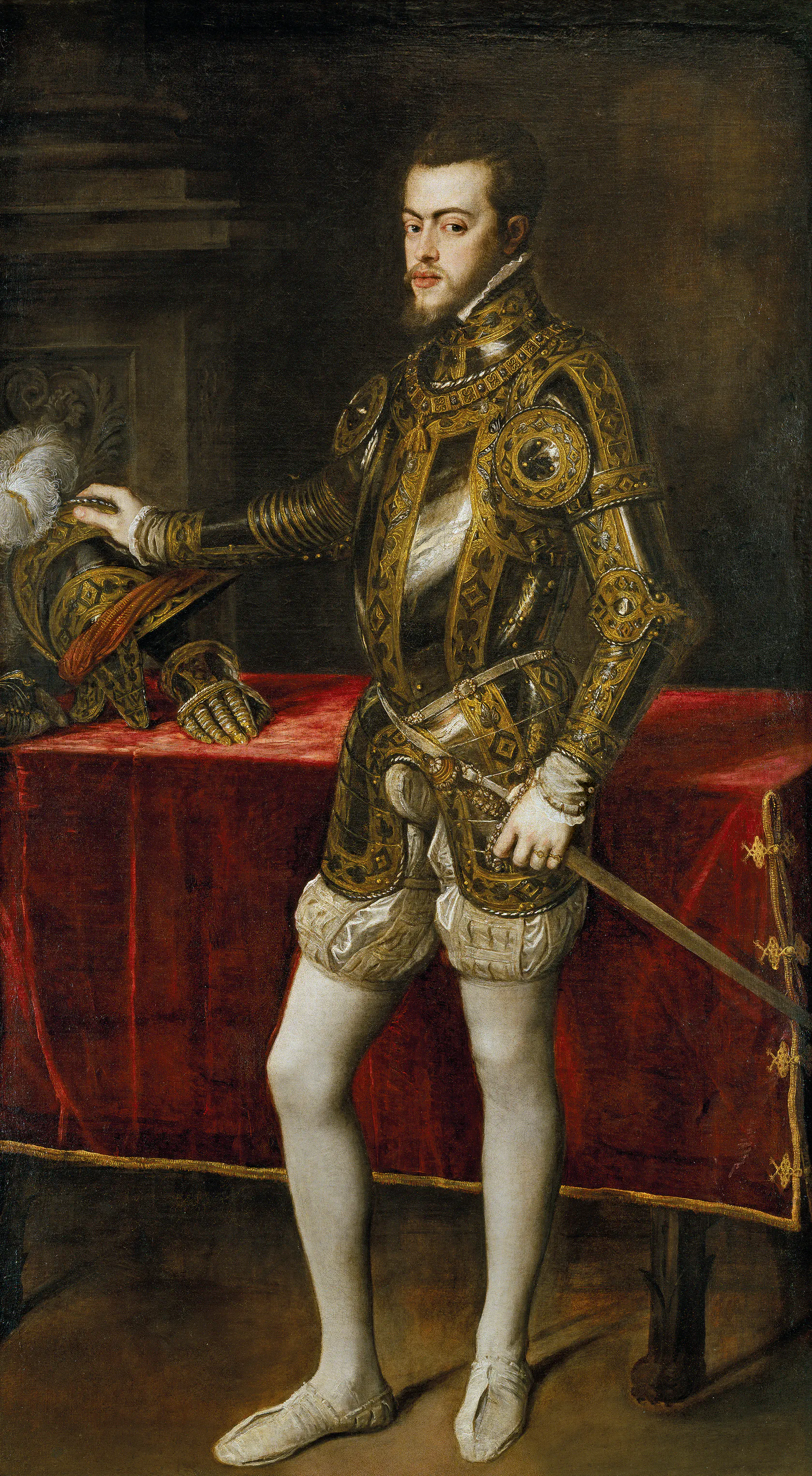
A portrait of Philip II in armour, the king to whom Lindanus dedicated the Panoplia evangelica in 1559. His royal style "Catholic," flowing from ancestral lineage, mirrors the treatise's claim that true doctrine is received through legitimate transmission. Source ↗.
The Praefatio in quinque libros explains why Scripture cannot arbitrate the controversy on its own. Opponents discard books they dislike, and even the books they accept can be bent. Scripture, Lindanus writes, flexum rectè naso fuit assimilata cereo, has rightly been likened to a pliable nose of wax. The proverb was a commonplace of Catholic controversy, but Lindanus sharpens it with a humanist parallel. He compares heretical proof-texts to the Virgilian cento of Hosidius Geta's Medea and to Proba's Gospel stitched from Homer and Virgil. Every word is authentic, yet the assemblage says what its compiler wills. The objection is therefore not that Scripture is unreliable. It is that verbal fidelity alone cannot secure sense, a point to which the preface's demonology will return.
The remedy is a return to the source, and Lindanus states it in the words of Cyprian already met in the discussion of his patristic method: wherever truth has wavered and faltered, God's priests, keeping the divine precepts, are to return to the dominical, evangelical and apostolic tradition as to its origin, so that the reason of their action may rise from the place whence order and origin arose. The choice of authority carries a latent strain. In the letter to Pompeius, Cyprian invoked this return to the source against Pope Stephen's appeal to custom in the rebaptism controversy. Lindanus turns an argument once aimed at Roman custom into a defence of Roman tradition. His index shows that he knew Cyprian had erred on that question, so the redeployment is knowing rather than naïve. The aqueduct image of the letter suits his purpose well: a channel fails along its course, not at its head.
The preface then introduces a second support for apostolic testimony, the consensus of the Fathers, and it is careful to rank that support beneath the first. Lindanus has joined to apostolic doctrine the Catholic teaching of the most ancient writers, Sed illi Catholicam vetustissimorum Christianæ religionis Scriptorum doctrinam, Apostolicæ illi quasi succenturiatam, adiunximus sociam, as an ally drawn up in reserve behind the apostolic line. Succenturiatus is the vocabulary of Roman tactics for troops stationed in support. It sustains the conceit of the panoply and fixes a hierarchy: the Fathers reinforce the apostles but do not command them. The need for reserves is grounded historically, in the senescence of the world, the "itching ears" of 2 Timothy 4, and the recurrent fears of the millennium's end. Patristic consensus is thus not a principle of development but a defensive measure suited to a decaying age.
From this diagnosis the preface distils the single question on which the work turns, the lexical question noted at the outset: whether by the name "Word of God" Christians are to understand Holy Scripture alone. The Reformation dispute is cast as a problem of denotation, and the "horistic," or definitional, method of Book I follows directly from that framing.
The apocalyptic history that precedes the question gives it its urgency. Satan, loosed after the thousand years, has abandoned open persecution and piecemeal excision of books for the subtler stratagem already observed in connection with the title's armour conceit: the cunning impostor pretends to leave the written Word intact and in good repair, if one counts its letters, but if one looks at its inner nature, he in truth tries to steal the whole of it and destroy it utterly. The passage completes the logic of the wax nose and the cento. Scripture cut off from its apostolic sense is Scripture lost, however scrupulously its letters are preserved. The reformers are cast as the climax of a diabolical history of mutilation running back through Marcion and the Alogi.
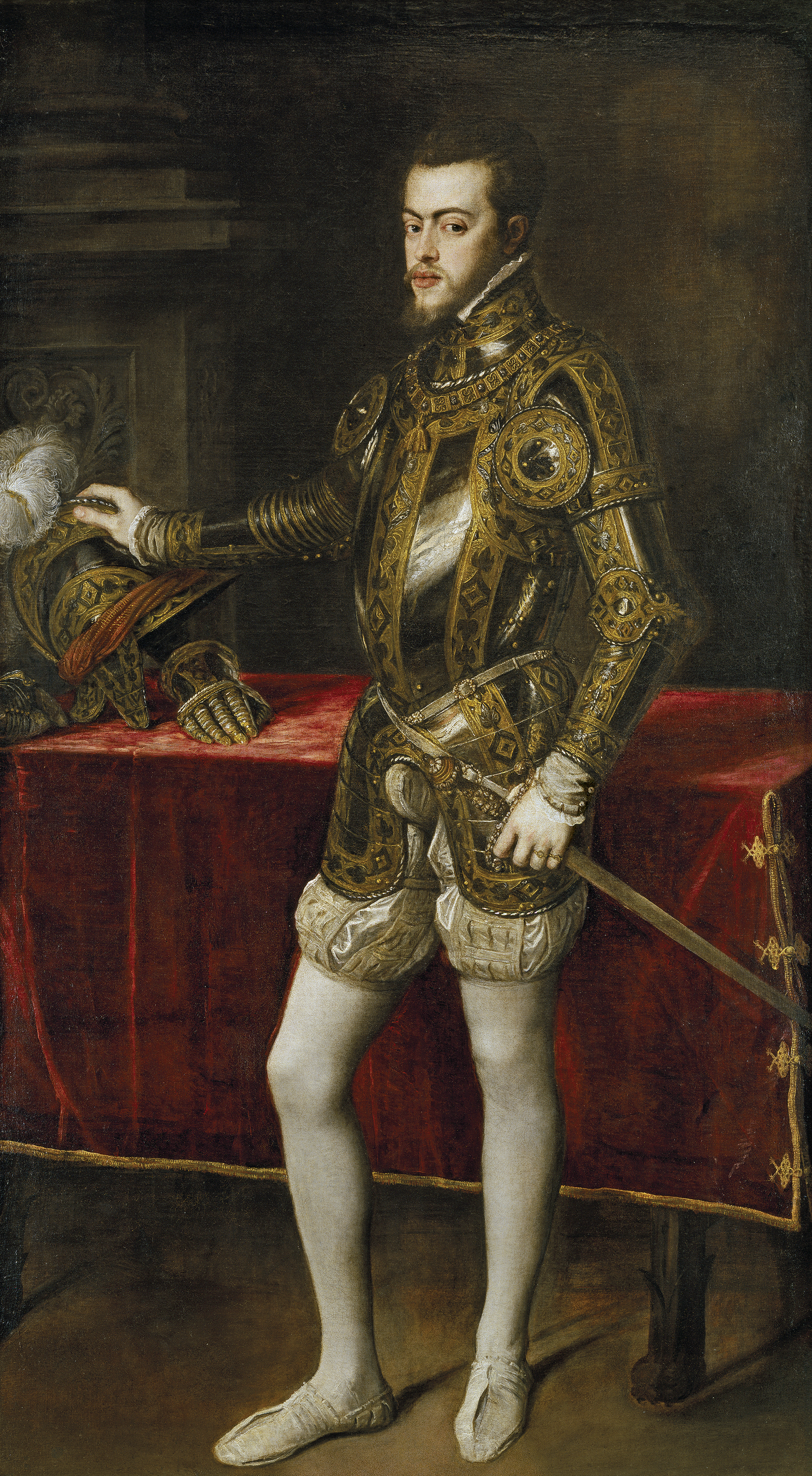
The opening of Lindanus's Praefatio, with its display heading, address to the Christian reader and decorated initial, marks the threshold of the argument. Here the "Word of God" controversy becomes not a neutral dispute over texts but a long history of mutilated apostolic meaning culminating in the reformers. Source ↗.
Against such an enemy the preface sets self-denying rules of evidence. The most striking is the chronological rule already noted, by which Lindanus has equipped himself so as to call no ancient writer as witness for establishing Catholic dogma who had not flourished before the whole Christian world, with his books published, more than a thousand years earlier. The verb instruximus, by which he describes that self-equipment, keeps the military register. The rule accepts the opponents' own suspicion of medieval accretion and turns it into a weapon, since everything Lindanus cites must predate the corruptions his adversaries allege.
Book I: The Definition of the Evangelical Word
Book I opens by stating the target proposition as the axiom shared by otherwise quarrelling adversaries: docent Catholicæ Christi Ecclesiæ aduersarii, Verbum Dei solis sacræ Scripturæ limitibus esse comprehensum, finibusque inclusum: nec quicquâ prætereà pro verbo Dei Christianis agnoscendum, quod non sacris in literis contineatur. On this account, the adversaries of Christ's Catholic Church teach that the Word of God is comprehended within the limits of Holy Scripture alone and enclosed by its boundaries, and that nothing beyond is to be acknowledged as God's Word that is not contained in sacred letters. The spatial vocabulary of limites and fines prepares the refutation. Lindanus traces the axiom back through Waldo to an obscure Western heresy of some four centuries earlier, branding it as recycled error. His first blow is a peritrope: the axiom is itself nowhere written. This is the self-refutation already quoted, in which it befalls these "Evangelicals" that in confirming their dogma they weaken it by confirming it and destroy it by building it up. The antitheses confirmando infirment, astruendo destruant give the self-refutation the rhetorical shape of a chiasmus. The parallel Lindanus draws with Pyrrhonist suspension of judgement places the Protestant principle among the ancient self-consuming doctrines. The ironic Euangelicis, the name the reformers gave themselves, withholds from them the adjective the title claims for the Catholic side.
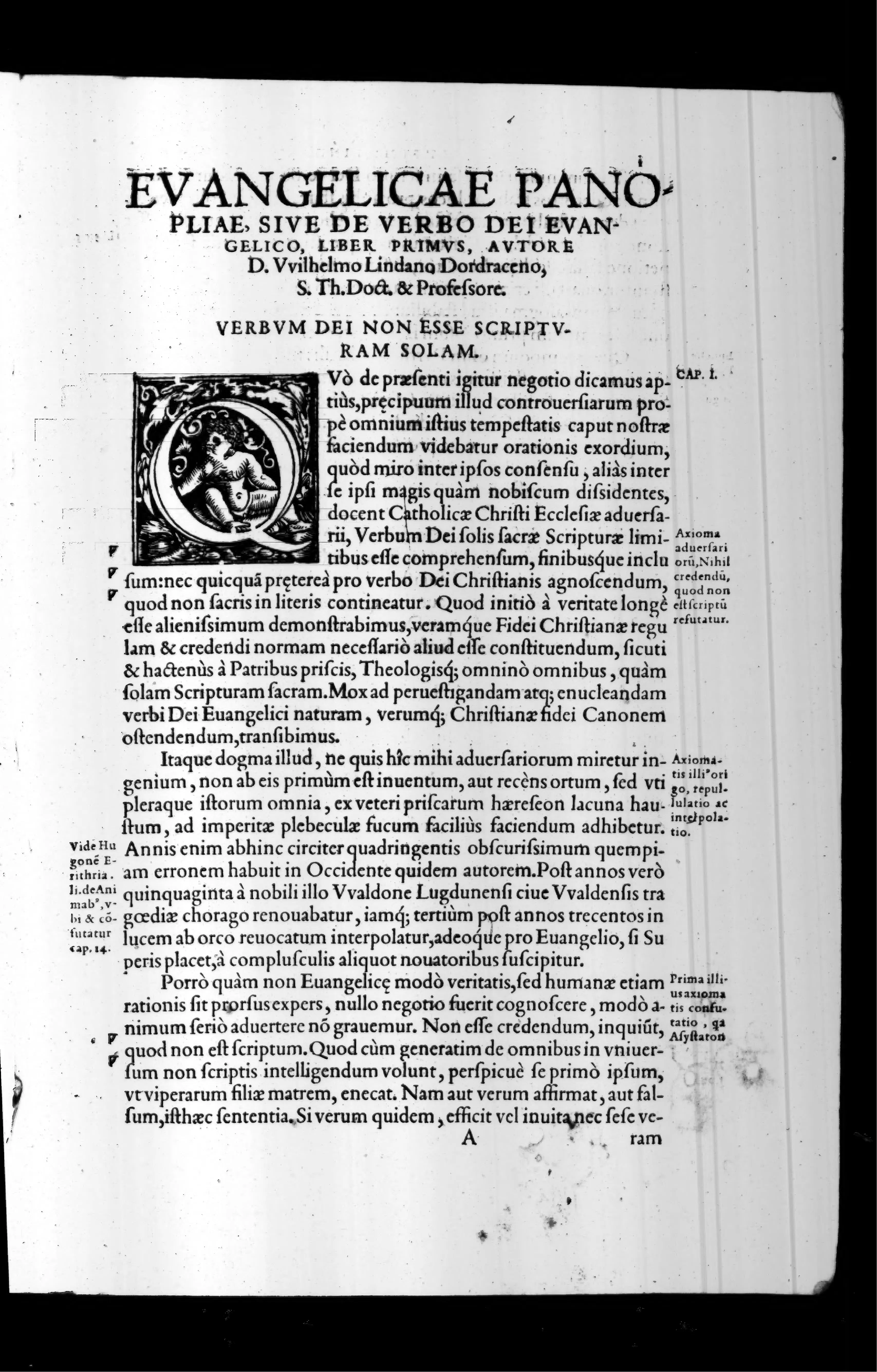
At the opening of Book I, the heading "Evangelicae Panopliae … de Verbo Dei Evangelico" claims evangelical ground, and a decorated initial Q launches the denial that God's Word is bounded by Scripture alone. Marginal notes flagging the adversaries' "axiom" make the Evangelici the object, not the owners, of evangelical truth. Source ↗.
The counter-thesis follows in its most compact form, the declaration already cited that many unwritten things are to be believed by Christians and many things not comprehended in the Scriptures are to be acknowledged as the Word of God. The repeated multa answers the opponents' solis, and non cõprehensa answers their comprehensum.
The pivot of the argument against Brenz comes in the same movement. Lindanus makes the canon itself the paradigm of unwritten tradition. Those who deny that the tradition may be questioned which hands down the Scriptures to us without writing, the fount of almost all traditions and as clear as the sun, rely on an exception more crafty than solid: Sic sanè ii, qui hanc Traditionem, quæ citra scriptum nobis tradit Scripturas, vniuersarum penè Traditionum fontem, ac Solis instar clarissima inficiantur in dubium vocadam, callidiori certè quàm solidiori obnituntur exceptione. The figure of the fons answers Cyprian's source, and the paronomasia of tradit Scripturas compresses the thesis into three words: the Scriptures are themselves something handed down.
A transitive syllogism then vindicates Pedro de Soto's thesis that traditions are the most certain foundation of faith. Lindanus asks Si Scriptura sacra certissimum est fidei fundamentu, vti est haud dubiè, an non quod earum est fundamentum certissimum, sit fidei quoque certissimum fundamentum?: if Holy Scripture is the most certain foundation of faith, as it undoubtedly is, is not that which is the most certain foundation of the Scriptures also the most certain foundation of faith? The concession vti est haud dubiè is not mere courtesy. Lindanus does not demote Scripture. He subordinates its certainty to the act that delivers it, so that scriptural authority shows its dependence on the Church that transmits it.
The same structure recurs with infant baptism, where the magisterial reformers' defence against the Anabaptists forces them onto Catholic ground. Apostrophising Melanchthon, Lindanus presses a dilemma: Si irrita est ex Traditionis non scriptæ autoritate dogmatum Fidei confirmatio, quid tibi eam Philippe in tanti momenti dogmate astruendo callidè magis quàm validè vsurpabas?. If confirming dogmas of faith from the authority of unwritten tradition is void, why did Melanchthon use it, more cunningly than validly, in establishing a dogma of such moment? The pairing callidè magis quàm validè echoes the callidiori quàm solidiori of the argument against Brenz. Both opponents are convicted of the same fault, a cleverness without foundation.
The first movement of Book I closes on the formal conclusion already quoted: another canon and rule of the Christian faith besides Scripture alone is necessary, by which, as by a Lydian touchstone, the genuine truth of both the dogmas and the books of the Catholic Church is to be tried. The assayer's stone extends the rule's jurisdiction to the books themselves, not only to doctrines drawn from them. That extension is the boldest consequence of the canon argument.
Having refuted, Lindanus defines, and he begins from prophecy. Jeremiah's new covenant becomes a statement about the medium of the Gospel, which is to be written non in tabula lapidea, Mosaicæ legismodo, non in arido Bethulæ libello, non in vili papyro, sed in viuis hominum cordibus descriptum iri. It is to be inscribed not on a tablet of stone after the manner of the Mosaic law, not in a dry little book of birch bark, not on cheap papyrus, but in the living hearts of men. The descending catalogue of writing materials, from stone to bark to papyrus, sets dead surfaces against living hearts. On this reading orality is not a deficiency of the new law but its distinguishing mark.
The definition promised by the horistic method then arrives in the formula already examined: the indubitable rule of belief, the most certain norm of the evangelical Word of God, is whatever the apostles, taught both by Christ the Lord and by the Holy Spirit as master of truth, proclaimed to Christ's churches to be believed and handed on to be transmitted to posterity. The inclusion of the Spirit's teaching after the Ascension widens the rule beyond the dominical sayings. The doubled verbs prodendum tradiderunt write transmission into the definition itself.
The chronology of oral preaching before any Gospel was written, and the occasional character of the Epistles, prepare the claim that withholding was apostolic policy. Lindanus states that Postolos itaq[ue] præcipua quædam Fidei capita noluisse papyro & atramento peritura credere, sed fidelibus Christianorum cordi: the apostles were unwilling to entrust certain chief articles of faith to perishable papyrus and ink, preferring the faithful hearts of Christians. The echo of 2 and 3 John returns to the heart of Jeremiah. It also inverts the opponents' assumption that the written is the durable, since here ink perishes and memory endures.
Lindanus seals the equal authority of the two parts of the Word with the metallurgical analogy already noted: gold, whether stamped, melted in the mass, or still lying hidden and unmined in the veins of the earth, bears the name of gold and keeps its value. The image belongs with the patrimonial vocabulary of the preface, but it sits in quiet tension with the Lydian stone. If unwritten doctrine is gold in the ore, it is the metal awaiting the assay. Yet Lindanus has made that same doctrine the touchstone by which even the apostolic books are tried, as his closing appeal to Paul's autograph signature and to Tertullian against Marcion insists. Unwritten doctrine is thus at once the treasure and the instrument that proves it. In that doubling the argument of the first book rests its whole weight on the Church that both holds the gold and keeps the stone.
The closing pages of Book I gather the argument into the programmatic sentence already cited as the thesis of the first book, which Book II then undertakes to prove from history: it will appear, Lindanus writes, that the word of God is not Scripture alone, nor wholly enclosed in sacred letters, nor Scripture alone the rule of the evangelical word, but the apostolic doctrine delivered once to the churches from their beginning.
The sentence is built as a cascade of three negations followed by a single affirmation, and each negation removes a distinct Protestant position:
- Scripture as the whole of the word;
- Scripture as its container;
- Scripture as its rule.
The affirmation then turns on semel traditam, which echoes Jude 3. The phrase limits what might otherwise seem an open-ended appeal to custom: the deposit is apostolic, delivered once, and dated abs sui exordio. Tradition in this formulation is not a living accretion but a closed inheritance whose boundaries are fixed at the Church's origin. This tension will press on Lindanus later, when he must account for the gradual definition of the canon.
The same pages announce the method of proof. At Nicaea, Gangra and elsewhere, the Catholic Fathers overthrew heretical novelties Concilio Nicæno, Gangrensi, et aliàs, non tam Scripturis, quàm, that is, "not so much by the Scriptures as" by unwritten tradition. The non tam … quàm comparative recurs throughout the following book and is carefully calibrated. It never declares Scripture irrelevant, which would expose Lindanus to the charge of subordinating the inspired text to human custom. Instead it ranks two kinds of evidence, and the burden of proof falls on the adversary, who must show that the councils argued from Scripture alone.
Book II: The Catalogue of Witnesses
Book II takes the form of a century-by-century Catalogus of witnesses, and its organising conceit is diachronic. If the apostles' disciples and successors did not treat Scripture as the sole rule, the reformers' principle is a novelty. Before assembling the catalogue, Lindanus pauses to defend the Dionysian corpus against what he calls the rash calumny of certain critics. He argues from style, from Pauline allegorism, and from a chain of later reception reaching to Bessarion and Nicaea II. The digression matters to his strategy because Dionysius, if genuine, offers a witness from the apostolic generation itself to the hierarchical and liturgical order the reformers rejected.
The catalogue proper opens with Papias, who reports, through Eusebius, that he thought himself helped less by books than by the living and present voice: me libris adiuvari, quantum viua & præsenti voce arbitratus sum. Lindanus makes this the first post-apostolic preference of speech over writing, so the viva vox acquires priority by chronology as well as by authority.
Irenaeus then supplies the decisive logical form, a counterfactual. If the apostles had left us no Scriptures, would it not have been necessary to follow the order of the tradition they delivered to those to whom they entrusted the churches? Apostoli quidem Scripturas reliquissent nobis, nonne oportebat ordine[m] sequi Traditionis, quæ tradiderunt iis, quibus comittebas Ecclesias?. The force of the question lies in what it makes conceivable: a Church without Scripture is still a Church, whereas a Church without tradition is not. Tradition is thereby made logically prior, not merely supplementary. Lindanus strengthens the point with Irenaeus's barbarians, who hold the faith sine charactere vel atramento.
Tertullian is enlisted for the procedural consequence. Appeal is not to be made to the Scriptures, nor the contest staged in them, where victory is either null, uncertain, or scarcely certain: Non ergo ad Scripturas prouocandu[m], nec in his constituendum certamen, in quibus aut nulla, aut incerta est victoria, aut paru[m] certa. In Lindanus's hands the praescriptio becomes a rejection of the disputation format the reformers demanded, the colloquy conducted on scriptural texts alone. The question of who holds the discipline, and from whom it descended, must be settled before any text is opened.
The third-century witnesses show that attestation, not sanctity, governs admission to the catalogue. Origen, whose orthodoxy Lindanus knew to be contested, is cited from the preface to De principiis for a criterion of truth: luculentis expressit: Illa sola, inquiens, credenda est veritas, quæ in nullo. Here Origen "expressed in clear words" that "that truth alone is to be believed which in nothing" departs from ecclesiastical tradition. The negative form of the rule is significant: tradition functions less as a source of new propositions than as a boundary that any belief must not cross.
A text Lindanus reads as Cyprian's, the De ablutione pedum now assigned to Arnold of Bonneval, carries the argument further. What the apostles handed down at the dictation of the Holy Spirit is no less ratified than what Christ himself delivered: nec minùs ratum est, quod dictante Spiritu sancto Apostoli tradiderunt, quàm quod ipse tradidit. The doubled tradiderunt … tradidit places apostolic institution on a level with dominical institution. This equivalence is required by the later defence of sacraments and rites that lack explicit gospel warrant. Lindanus's acceptance of the attribution reflects the critical horizon of mid-sixteenth-century patristic scholarship, and it gives the claim the authority of a martyr-bishop whom the reformers also esteemed.
Chapter VI forms the polemical centre of Book II, and here the catalogue gives way to a trap. Whoever reads the Nicene acts, Lindanus declares in the sentence already noted, will recognise that the homoousion came more from the tradition of the ancients than from the written word. The target is the Württemberg Confession, which claimed that the Fathers expounded the term from scriptural testimonies. Since the Protestant confessions profess the Nicene faith, the most central term of their own Trinitarian orthodoxy becomes a hostage to the principle they deny.
Lindanus narrates the Arian crisis at length in order to show how fragile a purely textual defence would have been. He mocks the opponents of Nicaea, who tried to pervert the term into homoiousion by adding a little letter: in homæusion, adiecta literula peruertere conabantur. The diminutive literula carries the argument in miniature. A faith that rests on letters can be overturned by a single letter, whereas a faith guarded by transmission survives the alteration.
He frames the episode in explicitly dramaturgical terms, turning next ad hæc atrocem Tragædiæ istius Arrhianæ Epithasin, "to the dreadful epitasis of this Arian tragedy." The term is borrowed from the humanist analysis of Terentian comedy, where epitasis denotes the thickening of the plot. Its use casts ecclesiastical history as a drama with providence as its author, and the reduction of orthodoxy to three bishops serves as the turn before the resolution.
Lindanus then addresses the Confession's authors directly, in apostrophe. You assert these things boldly, he tells them, but they ought to have been confirmed by clear testimonies: Isthæc quidem asseueratis fortiter, sed liquidis oportebat testimoniis. The demand for explicit texts establishing "persons," "consubstantial," and the Filioque turns the reformers' own evidentiary standard against them. Chapter VII then argues that accepting the creeds commits one to the other conciliar decrees, including the veneration of images. It treats the reformers' misassignment of decrees to the wrong councils as dolus malus, using the legal term for deliberate fraud.
The fourth-century chapters turn on Basil, and here Lindanus defends a text as well as citing it. The passage is Basil's warning, already encountered, that if we undertake to reject customs not contained in Scripture as having little force, we shall unwittingly mutilate the Gospel itself in its principal parts. The metaphor of mutilation recasts the reformers' purification of worship as amputation from a body.
Lindanus pairs the passage with Brenz's verdict, which he quotes. Brenz had placed Basil's dictum among the sayings eorum dictorum, quæ Patribus ignosci potiùs, quàm probari debeant, that is, among those sayings for which the Fathers should be pardoned rather than approved. The quotation exposes the Lutheran hermeneutic Lindanus opposes, in which the Fathers are honoured but sifted, and their departures from Scripture are indulged as human weakness. Lindanus's reply, that Basil's chapter is deliberate method and not a slip, converts a disagreement about one text into a dispute over who has authority to judge the Fathers.
Chrysostom supplies the starkest formula. To stop the mouths of those who belittle authority, he says, "It is tradition; seek nothing further": autoritatem eleuantibus os obturaturus, Traditio est, inquit, nil requiras. Lindanus anticipates that the nasutuli will call such a formula tyrannical. He thereby shows his awareness of the charge most likely to be brought against his position.
The epilogue restates the thesis with a pointed diminutive: the word of God is not to be measured nempe verbu[m] Dei non esse ex vno Biblioru[m] libello, eoq[ue] exiguo,, "by one little book of the Bible, and that a slender one." The book then closes on the conversion of Polemon by Xenocrates, applied hopefully to a "darkened" Germany.
Book III: Canon, Grace, Merit and the Saints
Book III moves from historical proof to systematic definition, and its epistemological core is the unqualified warning already quoted: the pious reader must be told that the written word of God cannot be certainly and indubitably known except through the unwritten word of God. The canon itself thus becomes the clearest instance of tradition at work.
Lindanus's history of the canon nevertheless forces him to concede something that sits uneasily with semel traditam. He treats the 85th Apostolic Canon as spurious, Nicaea's reception of Judith as doubtful, and Laodicea's list as shorter than Carthage's. He resolves the difficulty pneumatologically, through the admission of development already noted: the Spirit governs the Church so as to lead her gradually out of the ambiguous mist of truth toward a clearer grasp of it. The adverb paulatim admits historical process, and the image of mist distinguishes a deposit already complete from the Church's recognition of it, which grows clearer over time. This is the means by which a closed tradition and an unfolding canon are made compatible.
The chapters on the obscurity of Scripture press the same point from another side. Jerome's complaint to Paulinus, that the art of the Scriptures alone is the one everyone claims for himself, Sola Scripturarum, inquit, ars est, quam sibi, is redirected against lay and vernacular reading of the Bible. The Sola Jerome wrote in satire takes on, in this new setting, an unmistakable resonance with the reformers' watchword.
The doctrinal chapters on Sunday, the Creed, Lent, the Ember Days, and Friday abstinence draw on regional observance, including that of Lindanus's own dioceses of Utrecht and Liège. They then lead into grace and free will, where the tone briefly softens. Having traced the denial of free will from Mani through Wyclif to Calvin, Lindanus declares that he cannot but greatly praise Melanchthon's candour in this respect: ingenuitatem hac in parte non possum non summoperè laudare,. The praise refers to Melanchthon's revision of the Loci, and it fits the epilogue's hope of reclaiming moderate adversaries.
On justification Lindanus deploys James as the apostolic commentary on Paul: ex operibus iustificatur homo, & nô ex Fide tantùm, "a man is justified by works, and not by faith alone." On merit, against Calvin's charge that merit is asserted against grace, he answers with Augustine: Merita nostra sunt Dei dona: quæ cu[m] Deus coronat, nihil, "our merits are God's gifts, and when God crowns them" he crowns nothing but his own gifts. The formula keeps the language of reward (reddet, iustus iudex) while placing its ground wholly in grace. It thereby completes, at the level of soteriology, the pattern of the whole argument: Lindanus answers each Protestant dichotomy by reading the opposed terms as joined within a single economy received through the Church.
The defence of merit proceeds by moving its source. Lindanus does not concede to the Confessio Saxonica that talk of merit diminishes grace. He relocates merit inside grace, so that the dispute becomes a question of who honours Christ more. Catholics, he says, measure the force of good works non humanis ex viribus, sed vna ex Christi gratia nobis per eius, not from human strength but from the grace of Christ alone, given to us through his Spirit. The adversary's sharpest charge is quoted verbatim so that it can be turned around: illa Confessionis Saxonicæ doctrina: Et contumelia est filii Dei, inquit capite de Iustificatione, fingere vlla nostra opera. In this doctrine of the Saxon Confession, its chapter on justification declares it an insult to the Son of God to imagine that any of our works merit.
The inversion depends on the word contumelia. If works merit only because they are wrought by Christ's Spirit, then denying their merit insults not human nature but the grace that operates within it. Lindanus does not let the matter rest even with the Scholastic fallback that God rewards works only ex gratuita dignatione, out of gratuitous condescension. He demands a "true reason of merit." The method set out in the treatise's framing is visible here in small. The opponents' own principle, the sole glory of Christ, is made to testify against their conclusion.
The doctrine of merit is not an isolated soteriological excursus. It is the hinge on which the latter half of Book III turns toward the cult of the saints. Lindanus extends merit beyond the individual to the community of the living and the dead. God, he argues, grants benefits to the living for the sake of the saints, quòd propter Sanctos, eorumque merita nobis superstitibus varia largitur, exhibetque beneficia, quæ alioqui non erat largiturus: on account of the saints and their merits he bestows on us survivors various benefits that he would not otherwise have bestowed. The phrase nobis superstitibus quietly reconfigures the Church as a single body spanning death. Merit, once established as Christ's work in the regenerate, becomes a common treasury from which the Church militant draws. The saints' patronage is thereby made continuous with the soteriology already defended, and does not appear as a separate devotional accretion.
Between merit and the saints stands the chapter De fiducia bonorum operum. There Lindanus confronts the Reformation doctrine of "special faith," the believer's infallible certitude of his own salvation. His thesis is sweeping, and it is the one already noted: the undoubted certainty of eternal salvation said to come from faith falls to no true believer, and never fell even to the Apostles in this life. The proof is exegetical rather than speculative. Paul's fear of becoming reprobus (1 Cor. 9; Phil. 3), glossed through a chain of Greek and Latin commentators, becomes the evidence that the Apostle of grace himself lacked the assurance his modern readers claim.
What gives the chapter its rhetorical edge is Lindanus's diagnosis of why the doctrine persuades. Quid enim arridet blandiùs, quàm suæ salutis viuere securum, à qua non excidas, nisi contra conscientiam,: what smiles more sweetly than to live secure of one's salvation, from which one cannot fall unless one acts against conscience? The verb arridet casts assurance as a seduction of the affections. The polemicist addresses not only the intellect but the reader's appetite for securitas, a word that Augustinian usage had long associated with spiritual complacency. The exempla that close the chapter answer this blandishment with a counter-image of holy fear: Augustine dying with the penitential psalms posted beside his bed, Jerome weeping over the sins of his youth. Lindanus does not set humility against confidence. He sets it against a confidence that has not been earned through works.
The Pauline objection that eternal life is gratia (Rom. 6:23) is met with an Augustinian formula. Lindanus treats it as the untying of the knot. Eternal life gratia nuncupatur, non ob aliud, nisi quia gratis datur, nec ideo quia meritis non datur, sed quia data sunt & ipsa merita, quibus datur: it is called grace for no other reason than that it is given freely, not because it is not given to merits, but because the very merits to which it is given are themselves given. Alongside this he sets the military register of wage and pay, merces. Quod est autem merces operanti, hoc militanti stipendium: eternal life is a wage, and what a wage is to the labourer, a soldier's pay is to the one who serves under arms. The image sits naturally within a work that calls itself a panoplia. The Christian who has put on the full armour of the evangelical Word receives his stipendium as one enrolled in Christ's service. The reward is both earned and bestowed, because the arms, the service, and the pay alike come from the commander.
With images, feasts, and invocation of saints, the argument moves fully into the unwritten Word, the traditions whose apostolicity must be shown from antiquity rather than read from Scripture. The argument for invocation reaches its formal climax in a syllogism that Lindanus himself labels an epicheirema: Sanctorum festa fuêre Apostolorum ætate celebrata, quare & Sanctorum. Feasts of the saints were celebrated in the age of the Apostles, and therefore invocation of the saints, too, was handed down by them. The construction is characteristic of his method. The major premise rests on a practice his opponents themselves retain, since they keep the Apostles' days. The minor premise, that invocation accompanied such feasts, he proves from Augustine and Prudentius on Lawrence, from Basil on the Forty Martyrs, and from Theodoret. The structure of the argument shows its ambition. It is the boldest attempt in this part of the work to push a contested rite back to the apostolic generation, beyond the chronological limits that even sympathetic authorities had allowed.
The descending catalogue of witnesses that precedes this syllogism, running from Augustine c. 400 to the legend of Justina c. 160, answers a chronological challenge. The Apologia of the Augsburg Confession claimed that no writer before Gregory the Great mentions invocation. Lindanus meets a date with a series of dates. The conciliar evidence he adduces is chosen for its explicit vocabulary of tradition. The synod of Gangra, condemning Eustathius' contempt for martyrs' shrines, declares in its synodal letter, summa dicamus, quæ nobis siue per Scripturas diuinas, siue per Traditiones Apostolicas sunt tradita, in Ecclesiis fieri optamus, that, in sum, the fathers desire to be done in the churches whatever has been handed down to us either through the divine Scriptures or through the Apostolic Traditions. For Lindanus this disjunction, siue per Scripturas... siue per Traditiones, is a fourth-century statement of the two-part Word itself, now carrying conciliar authority. The canon protecting martyrs' shrines is thereby read as protecting invocation.
He even recruits the enemy of the faith as a witness. Julian the Apostate's sneer at Christians who pray at tombs, preserved in Cyril of Alexandria, Si igitur immunditiâ Iesus esse dicit plena, runs: if Jesus says that tombs are full of uncleanness, how do you call upon God at them? The hostile witness proves the practice by mocking it. The polemical yield is double. Fourth-century invocation is attested, and the modern "Evangelicals" who share Julian's scorn are placed in the Apostate's company. This is the work's recurring figure of present adversaries as ancient enemies revived.
The long campaign against Melanchthon is at once philological and ad hominem. It contains a moment that locates the controversy geographically. Mocking the "procurations" of patron saints, Melanchthon had cited the hope of riches through Saint Anne. Lindanus answers that people may promise themselves such things through her prayers precibus polliceantur in Saxonia, certè in nostro Belgio, quod equidè, that is, in Saxony, but certainly not, so far as he knows, in our Belgium. The concession is real, for he admits old women's deliria. But it is displaced onto Lutheran territory, while the Low Countries are presented as a land of sound devotion. The Dordrecht theologian speaks here as a Netherlander, defending the piety of his own provinces against a critique formed elsewhere.
His theoretical defence of specialised patronage rests on an instrumental analogy. One rightly seeks heat from fire and light from the sun, sed vt veri Dei, qui eas functiones dedit, ministro: not as from God, but as from a minister of the true God, who gave them those functions. The same act, directed to a creature as minister rather than as deity, separates lawful honour from idolatry. This is how he answers the charge that patronage was borrowed from Juno, Mars, and Castor. External resemblance to pagan cult proves nothing, because the intention and order of the act determine its character. The analogy also prepares the latria/dulia distinction that governs the remaining chapters.
The epistemological objection, that the dead cannot hear, is answered by revelation rather than natural philosophy. Following Augustine's De cura pro mortuis, Lindanus holds that the saints preces atque vota Spiritu Dei reuelante cognoscere, know our prayers and vows through the Spirit of God revealing them. He declines to explain the manner. A revealed mystery need not be understood in its mode, any more than the Trinity, the virgin birth, or the Eucharist. The charge that Catholics pray "in the name of the saints" is answered from the Church's own liturgy. The Church prays to the Father everywhere, suas concludens preces omnes, Per Christum Dominum nostrum?, concluding all its prayers "Through Christ our Lord." The rhetorical question turns the lex orandi into evidence. The Church's practice of prayer itself witnesses to the sole mediation it is accused of denying.
The distinction that holds this edifice together is set out with Scholastic economy in the formula already noted: the saints mediate by helping and commending, not, as Christ does, by meriting and effecting. Here the treatment of merit and the treatment of invocation meet. Merit in the strict, causal sense belongs to Christ. The saints' "merits," by which God benefits the living, are themselves gifts of his grace, and their mediation is intercessory, never meritorious in the redemptive sense. The distinction lets Lindanus affirm both the saints' efficacy and Christ's uniqueness without contradiction, at least on his own terms.
Book IV: The Sacraments of Initiation
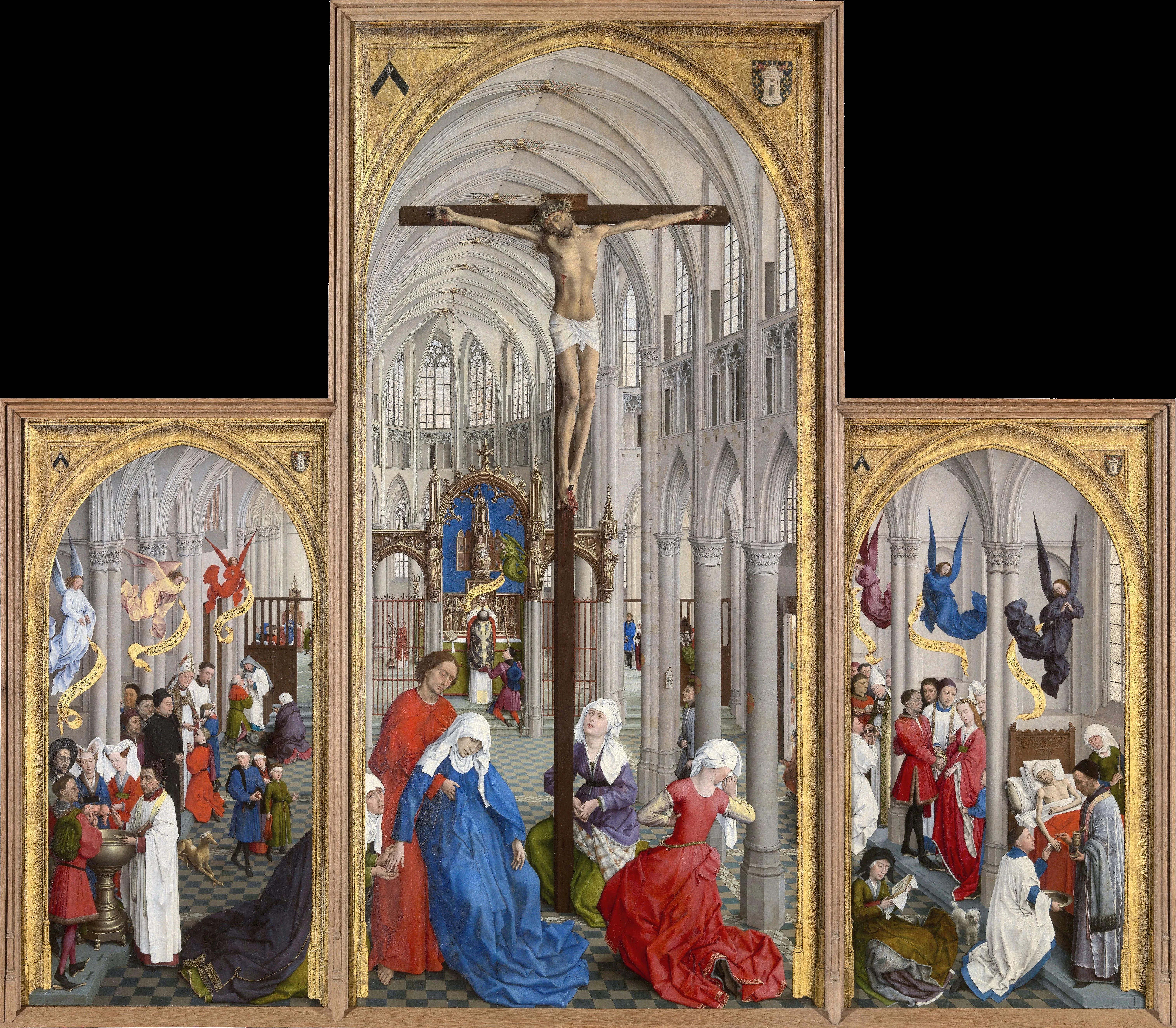
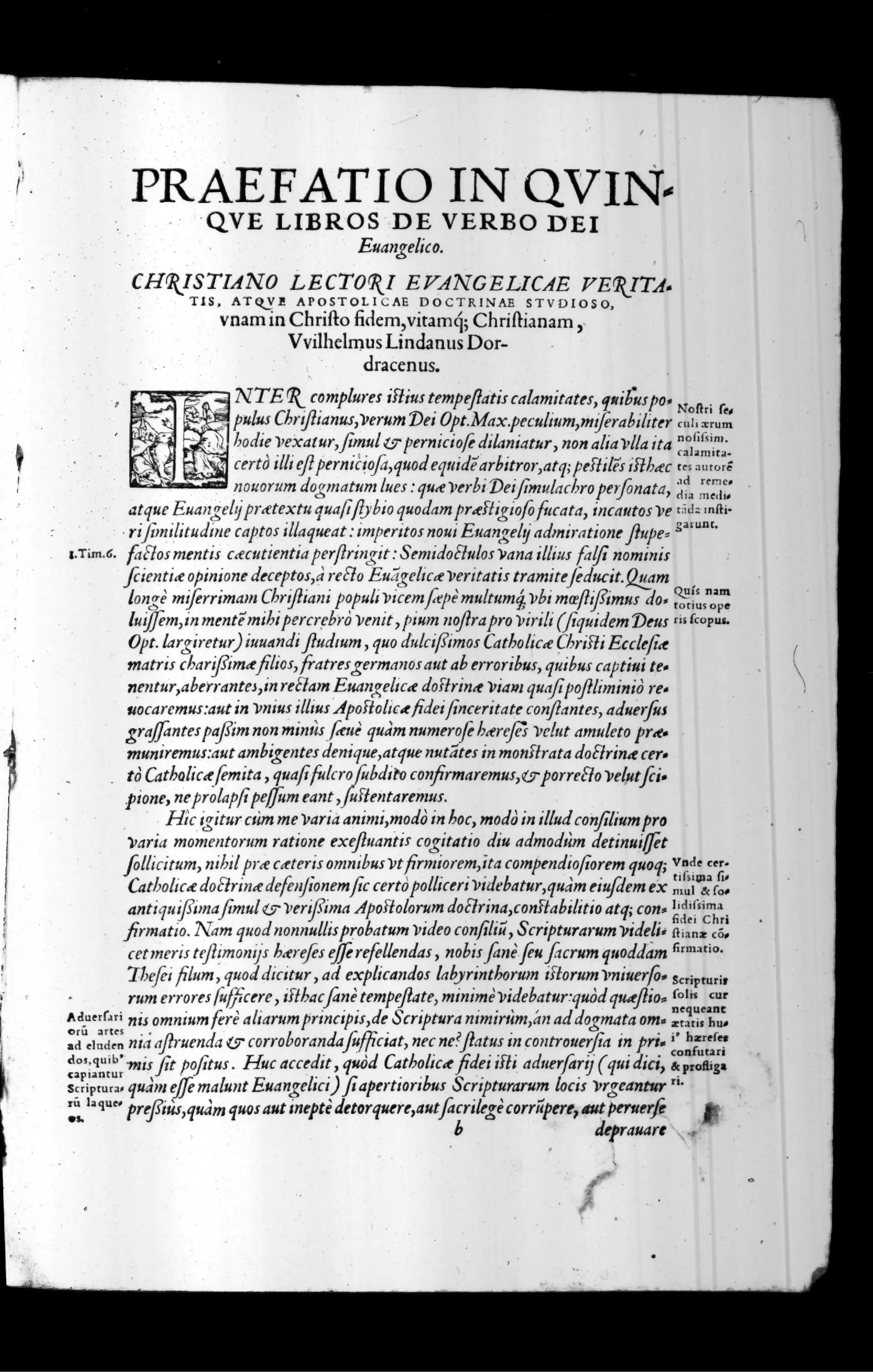
The Seven Sacraments altarpiece attributed to Rogier van der Weyden, a mid-fifteenth-century Netherlandish panel, sets all seven rites within the visible Church. Its vision of grace administered through ecclesial sacraments, from the Low Countries milieu Lindanus shared, is the order he defends against reduction to Scripture alone. Source ↗.

Book IV moves from the "historical" to the "mystical or ritual" part of the unwritten Word. Its opening definition reverses the Reformed account of sacramental signs. It is a matter of note, Lindanus writes in the definition already cited, that for Catholics the sacraments are efficacious signs of divine grace. He sets this against his adversaries' sacraments, ita vt nihil ipsa quidem operentur, sed ignaua sint & mera signa, signs that effect nothing themselves but are idle and mere signs. The adjective ignaua, sluggish, cowardly, idle, carries a faint military reproach. In a treatise conceived as an armoury it is apt that empty signs should be called idle.
The decisive Augustinian text is the dictum on Psalm 73 that the sacraments of the new covenant Testamenti dant salutem, Sacramenta veteris legis promiserunt Saluatorem, give salvation, while those of the old law promised the Saviour. Calvin had read "give salvation" as hyperbole. Lindanus reads it as a causal claim, and the contrast between promise and gift becomes the hinge between figure and efficacy.
The question of number shows how far his textual armoury depends on the received patristic corpus of his day. The pseudo-Cyprianic De ablutione pedum supplies, obiter quatuor hæc ex septem, Baptismum, Eucharistiam, Ordinem, an incidental mention of four of the seven: baptism, the Eucharist, Orders, and one more. Lindanus treats it as a third-century witness to a septenary that his opponents reduced to one, two, or a shifting three and four.
The baptismal chapters reach exorcism, a rite derided in Lutheran territories but defended here as apostolic. Optatus of Milevis provides the operative claim, Hoc Exorcismus operatur, per quem Spiritus immundus: this the exorcism works, by which the unclean spirit is driven out. The verb operatur echoes the efficacy that opened the book. The sacramental rites, like the sacraments themselves, are not idle signs but acts that accomplish what they signify.
The exorcism of the candidate is the most exposed threshold of the baptismal rites, and Lindanus frames it from the outset as a matter of controversy. The adversaries of his age, he writes, reproach Catholics for applying the ceremony of exorcism to the baptized among all nations: isthoc seculo aduersarii Catholicis exprobrant, quòd hanc Exorcismi cæremoniam vbique gentium Baptizandis admouemus.
He sets this reproach beside Ulpian's pagan sneer that "exorcizing" was a word for impostors. The parallel lets Protestant mockery take its place in a long line of ridicule from outside the Church. He then quotes a satirical Latin couplet directed at the rite. With mock incredulity it asks whether anyone really believes that infants are inhabited by a demon, infants whom the people of Christ and holy parents begot: Scilicet, infantes habitari à Dæmone credit, Quos populus Christi & Sancti genuêre parentes.
Lindanus quotes the verse not to answer its wit but to expose its premise. To deny the devil's possession of the newborn child of Christian parents is, on his reading, to deny original sin. The ridicule of a ceremony thus becomes evidence of a doctrinal error. His larger strategic claim follows. Satan's surest way to destroy baptism was to attack exorcism first. Those who discarded the rite went on to strip the sacrament itself of its power, teaching that sins are covered rather than washed away. On this view the liturgical periphery guards the dogmatic centre, so that defending a minor rite is the first line of defence for the whole doctrine of baptism.
The positive theology of the chapter is juridical in texture. Through Adam humanity fell into the devil's servitude, and exorcism enacts a forensic expulsion of the usurping lord. The devil is compelled to acknowledge and surrender a dominion that is owed to God, while the baptized are rescued, snatched away and freed from his power: Deo Opt. Max. deberi agnoscendu[m] reddendumq[ue]; co[m]pellitur. Nos verò eisdem ab eius potestate eruimur, eripimur atq[ue] liberamur. The accumulation of verbs (eruimur, eripimur, liberamur) gives the language of a lawsuit over possession the sound of a liturgical cry.
Against this realist model Lindanus sets his paraphrase of the Reformed position. According to his opponents, souls are not truly justified through baptism nor restored to their former integrity, but remain caught in perpetual chains of sin and stained with an indelible injustice: non verè animas per Baptismum iustificari, aut pristinæ suæ integritati restitui, sed perpetuis peccatorum vinculis irretitas, atq[ue] iniustitia indelebili contaminatas. He brands this "more than Pelagian." The paraphrase is hostile, but its polemical economy is precise. It casts justification as a contest between true restoration and perpetual bondage, and the chapters that follow elaborate that opposition.
The move from exorcism to original sin reveals the historiographical premise on which the whole book rests. Lindanus invokes the Fathers' maxim that no heretical error is so absurd as to lack followers and even defenders: Verùm illam veterum Patrum sententiâ nullos esse hæreseon errores adeò absurdos, qui non sectatores, imò defentes inueniât. Novelty, on this view, is never really new. It is the recurrence of an error already condemned, and the controversialist's task is to recognise it.
Origen supplies the apostolic warrant on the other side. The Church, he testifies, received from the apostles the tradition of baptizing even infants for the removal of original sin: Origines: Pro peccato, inquiens, Originali tollendo Ecclesiam ab Apostolis Traditionem accepisse, vt paruulos etiam baptizet. Doctrine and practice here prove one another. The practice of infant baptism attests the dogma of original sin, and the dogma explains the practice.
When the opponents argue from 1 Corinthians 7:14 that children of believers are born holy, Lindanus labels the claim Julian's old sophism. He answers it with Augustine's pun, which warns that parents must not err by thinking the child already born faithful, since they can call it "born" but not "reborn": Non sic errent parentes, vt putent eum iam fidelem natum. Natum enim possunt dicere, non renatum. The play on natus and renatus separates nature from grace with an economy that no covenantal argument from parentage can overcome.
The consecration of the font allows Lindanus to name the category that governs every rite lacking explicit scriptural warrant. Following Basil's De Spiritu Sancto, he refers such practices to the silent and mystical tradition of the apostles, as Basil himself calls it: ad tacitam atque mysticam, vt ipse loquitur, Apostolorum referat Traditionem. Here the work's two-part account of the Word operates at the level of liturgy. The blessing of water, like the renunciation of Satan's pompa and the use of consecrated salt, is legitimated by unwritten tradition rather than by the letter of Scripture.
The anti-Anabaptist section that follows relies on the same principle. It insists that the ancient writers mention Pædobaptismus in very many places, cùm prisci Scriptores plurimis in locis Pædobaptismi. The Greek technical term itself lends the practice an air of antiquity.
Calvin becomes the principal target at the necessity of baptismal water. Lindanus quotes the Institutio's exegesis of John 3:5, in which Calvin takes "water and Spirit" simply for "the Spirit, which is water": Aquam & Spiritum, inquit, simpliciter accipio pro Spiritu, qui est aqua. To Lindanus the reading is an act of exegetical self-assertion against the unanimous Fathers. It also allows Calvin a leniency towards unbaptized infants that Lindanus calls worse than Pelagian.
In reply he reasserts Augustine's sacramental definition. According to Catholic doctrine, no one is to be held reborn in Christ unless baptized with the sacrament of baptism, which consists of word and element: No enim quisqua in Christo secundu doctrina Catholica habendus est renatus, nisi Baptismatis Sacrameto, quod verbo costat & elemeto, sit baptizatus. The word-and-element formula becomes contested ground shared by both sides, and it returns in the debate over Confirmation.
The long dispute over whether John's baptism differed from Christ's brings the hermeneutical crux of the Reformation to the surface. Lindanus stages the opponent's objection, already noted, that the vote of the ancient writers does not shake the certainty of Scripture. He concedes the principle. What he disputes is that Calvin's reading possesses the certainty it claims.
The Fathers, on his argument, do not compete with Scripture. They expose an interpretation that is merely uncertain and presents itself as Scripture's own certainty. He then presses Calvin with Calvin's own esteem for Augustine, asking where now is the praise once given to Augustine as the best and most faithful witness of all antiquity: Vbi nunc tua illa Augustino dudum tributa laus, eum ex tota Scriptorum antiquitate optimum & fidelissimum esse testem?.
The tactic exploits a real tension in Reformed patristic practice, which honoured Augustine and dismissed him selectively. In the same section the book's title-word turns up, apparently by design, when John the Baptist's preaching and baptism are called his whole Panoplia, his spiritual equipment: Siquidem totus Iohannes vniuersa illa sua Panoplia atque spirituali apparatu. The forerunner's armament serves as a figure for the controversialist's own.
The chapters on the effects of baptism form the doctrinal core of the baptismal treatise, and their rhetoric is borrowed. Lindanus transfers to Calvin Augustine's tricolon against Julian, that the things they say are strange, new and false, and that the strange astonishes, the new is to be guarded against, and the false refuted: Mira sunt quæ dicitis, noua sunt quæ dicitis, falsa sunt quæ dicitis: mira stupemus, noua cauemus, falsa conuincimus. The appropriation enacts the premise that heresy recurs. An ancient answer fits a modern error because the error is the same.
The patristic florilegium then sets out the realist reading of baptismal effects in its fullest form. Clement of Alexandria provides a ladder of effects: washed, we are enlightened; enlightened, adopted; adopted, perfected; perfected, made immortal: Tincti, illuminamur: Illuminati, in filios adoptamur: Adoptati, perficimur: Perfecti, immortales reddimur. Basil, in Latin translation, calls baptism ransom to captives, remission of debts and guilt, the death of sin, the rebirth of the soul, a garment of light: Baptisma captiuis est redemptio, debitorum atq[ue] reatuum venia, peccati mors, animæ regeneratio, indumentum lucidum. The two catalogues work cumulatively, and each of their terms denies that baptism merely covers.
From this consensus Lindanus reverses the opponents' central claim to honour Christ. He compresses forensic justification into a triad of derogatory adjectives, a righteousness imputatiua tantùm, accommodatitia tantùm, tectoria tantùm, that is, "only imputed, only accommodated, only a covering." He then asks whether Catholics do not proclaim the Saviour's glory far more brilliantly than these new men, who would rather call themselves "Evangelicals" than be such: multò illustriùs Christi Saluatoris gloriam prædicare Catholicos, quàm nouos istos, quos se ipsi dicere malût, quàm esse, Evanglicos?.
The quarrel over the name evangelicus, which the title of the treatise already claims for the Catholic side, here becomes a quarrel over Christ's gift. A righteousness that only covers diminishes the giver. The logical engine is the Adam–Christ antithesis of Romans 5. As Christ truly restores life to the just, so he truly restores righteousness, the cause of life: & sicuti vitam iustis verè reddit, ita iustitiam quoque vitæ causam verè reddit. The twofold verè carries the argument. If Adam's damage was real, its remedy cannot be fictive.
The question of concupiscence after baptism shows where this realism has to admit a limit. Lindanus grants that concupiscence remains in the baptized as an infirmity to be fought. He insists, however, that concupiscence itself is no longer sin: nam ipsa quidem concupiscentia iam non est peccatum in. The decisive proof-text is Augustine's, that guilt is not left remaining and unimputed but is taken away so that it does not remain: Non quòd reatus manens non imputetur, sed auferitur, ita vt non maneat.
He then reduces the Protestant position to an epigram, forgiven, not cleansed; covered, not removed: condonatur, non mundatur: tegitur, nô tollitur. Against it he sets the principle that God judges according to truth. The distinction between remaining infirmity and abolished reatus is what holds the realist account together. It explains why the baptized still struggle without conceding that they remain sinners in the strict sense.
The post-baptismal rites move the argument from dogma to observation. Lindanus sorts them by how far they have survived, and he draws on his own region. Wine, he notes, is still given in his native church of Dordrecht: aut vini, vt nostris temporibus in Ecclesia patria Dodracensi:. Infant communion has otherwise lapsed, except that Frisia still brings the Eucharist for baptized children to be placed on the altar, a clear trace of ancient custom: nisi quòd Frisia vel pueris Baptizatis sacram profert Eucharistiam altari imponendam, quod luculentum est priscimoris vestigium.
The word vestigium is telling. Local usage serves as a residue of apostolic practice, and the Netherlandish parish becomes an archive of antiquity. Lindanus also defers the symbolic exposition of such rites to a projected Diarium Christianum, which is to explain the reason of the whole Christian year's feasts, fasts and sacred rites: in Diario nostro Christiano: quod totius anni Christiani festorum, ieiuniorum, rituumq[ue] sacrorum explicabit rationem. The announcement confines the Panoplia to proving that the rites are legitimate, not explaining what they mean.
The treatise on Confirmation applies the whole apparatus once more. It also shows its pressure points most plainly. Tertullian supplies the pattern of visible sign and invisible effect: the flesh is washed that the soul may be cleansed, anointed that it may be consecrated, signed that it may be fortified: Caro abluitur, inquit li. de Resurrectione carnis, vt anima emaculetur: Caro vngitur, vt anima consecretur: Caro signatur, vt & anima muniatur:.
The defence of chrism, however, produces a striking retreat. After gathering pseudo-Isidorian decretals and Honorius Augustodunensis on chrism's apostolic origin, Lindanus concedes, in the words already quoted, that whether the apostles anointed with oil or not matters little to his case. Apostolic institution is enough, even if apostolic practice is uncertain. The concession shows how far the authority of tradition can be detached from a historically demonstrable use.
The reason the detachment is possible appears shortly afterwards, in the most explicit statement of the two-part Word in the sacramental chapters. The apostles joined the gift to this visible sign of the laying-on of hands from the word of God, whether written in Luke or not written: Proinde ex verbo Dei, siue apud D. Lucâ scripto, siue non scripto, Apostoli huic visibili manuum impositionis signo. The disjunction siue scripto, siue non scripto makes the question of a written source secondary to the fact of transmission.
Against this Calvin's minimalism appears in his own words. He thinks no deeper mystery underlay the laying-on of hands: Huic autem impositioni manuum non altius subesse mysterium cogito:. He also claims prophetic authority, pronouncing boldly "not from myself but from the Lord": Hoc non à me, inquiens, sed à Domino audacter pronuncio,. To Lindanus this is pseudo-apostleship, a usurpation in the manner of Korah. The anti-Calvin dossier ends with Calvin's verdict that Confirmation is a false promise of the devil that draws us away from God's truth, falsam esse Diaboli pollicitationem, quæ nos à veritate Dei abstrahet:.
The dispute with Calvin thus ends on the inversion with which the baptismal chapters began. Exorcism was defended as the expulsion of the devil, and the reformer now assigns Catholic rite itself to diabolical fraud. Each side charges the other with the devil's work, and Lindanus's case rests on the claim that only the Church which hands down these rites can tell which charge is true.
The treatment of Confirmation closes, however, on the question of its minister, and Lindanus settles it by appeal to an apostolic precedent that no written law prescribes. Acts 8 supplies the scriptural occasion, since Philip the deacon baptized at Samaria but could not confer the Spirit. The decisive warrant, however, is Jerome's claim that the episcopal reservation of the rite derives from the event of Pentecost itself. Lindanus puts the point in Jerome's words, disce hanc obseruationem ex ea autoritate descédere, quòd post ascensum Domini Spiritus sanctus ad Apostolos descendit: learn that this observance descends from that authority, that after the Lord's ascension the Holy Spirit descended upon the Apostles. The play of descendere binds the observance to the descent of the Spirit, so that a liturgical custom acquires the authority of the founding apostolic moment. That is the treatise's general doctrine of the unwritten Word in miniature.
Lindanus is equally careful to mark the limits of what this authority settles. Jerome's own qualification, that the reservation serves the honour of the priesthood rather than the necessity of law, leaves room for theologians who allow a priest to confirm by papal concession. Lindanus classes that dispute as one quæ ad illud genus pertinet, quod non cu[m] hæreticis Ecclesiâ oppugnantibus, sed cum fratribus, a question of the kind debated not with heretics attacking the Church but with brothers. The distinction between open scholastic questions and matters of faith is no mere courtesy. It is the working counterpart of the graded hierarchy of traditions, and it allows Lindanus to concede latitude within the Church while refusing it to her adversaries.
The same precision governs his answer to Calvin's charge that Catholics are Donatists for valuing Confirmation by its minister. He replies with a distinction between two kinds of dignity, Non à ministri dignitate Caluine, quæ secundum virtutem est, atq[ue] sanctimoniam, vt Donatistæ Sacramenti vim æstimant Catholici: sed eâ, quæ secundum donationem est Spiritus sancti in consecrationibus Ecclesiasticis collata. Catholics, he says, do not reckon the force of the sacrament by the minister's virtue and holiness, as the Donatists did, but by the dignity conferred through the gift of the Spirit in ecclesiastical consecration. Dignity of order is thus severed from dignity of merit. Lindanus then turns the charge back through Optatus' narrative of Donatist bishops casting the Eucharist to dogs and the chrism out of a window, and in this way recasts the reformer's accusation as a revival of the very heresy it names.
The Printer's Interruption, Penance and the Orders
At this point the printed book itself interrupts the argument. Maternus Cholinus addresses the reader to explain why the twenty chapters on the Eucharist do not follow. Verùm quu[m] eius Eucharistiæ partis exemplar diutiùs ab ijs, quibus ab autore ad me transmittendi negotium demandatam est,: the copy for that part was held back too long by those whom the author had charged with sending it. Rather than halt the edition, the printer moves forward to Penance and promises the missing chapters either at the end of the volume or as a separate issue. He dates the notice Vale, ex nostra tabernæ libraria, Calendis Iulij, 1559, from his bookshop on 1 July 1559. The notice exposes the conditions of the work's making: an author at a distance, copy sent in instalments through intermediaries, and a printer who reorders the sequence of the sacramental books on his own decision. The transmission of a treatise on transmission was itself broken, and the printed order of the book records the break.
The Penance treatise proper opens by justifying further sacraments at all. An Edenic analogy carries the opening: the three trees of paradise sufficed for unfallen Adam, but fallen humanity needs further remedies, just as Baptism, Confirmation and the Eucharist do not suffice for Christians who fall after baptism. Lindanus then defends the sevenfold number by exposing the instability of his opponents. Non enim tribus Sacramentis cum Lutheranismo veteri, nedum duobus cum Caluino, aliisque ab Augustana Confessione desciscentibus: nec cum Philippo quatuor iam cudente, veteremque, animisensum subinde recudente contenti esse possumus:. In this passage he refuses to be content with the three sacraments of the old Lutheranism, or with the two of Calvin and those who have deserted the Augsburg Confession, or with Melanchthon, who now coins four and keeps recasting his earlier opinion. The minting verbs cudere and recudere are pointed. Doctrine struck afresh at each edition is set against a fixed coinage of faith, and the metallurgical language recalls the treatise's wider imagery of gold that keeps its value whether or not it has been stamped. Against this variance Lindanus sets the Council of Florence, quod antecannos 125. vniuersa Christi Ecclesia in Concilio Florentino, tam Oriente quàm Occidente congregata, the universal Church gathered from East and West 125 years before. Reckoned from Florence, the count points to a date of writing well after the printer's notice of 1559. Whether this reflects revision of the text or a garbled numeral cannot be settled from the passage alone.
The reformed position that the whole treatise sets out to dismantle is quoted directly from the Institutio: Itaque quoties lapsi fuerimus (inquit cap. 17. institut. de Bapt.) repetenda erit Baptismi memoria, & hac armandus animus. For Calvin, whenever believers fall, the memory of Baptism is to be recalled and the mind armed with it. Lindanus's rebuttal is compressed into a single tense, In præterita itaq[ue] peccata Baptismus valebat susceptus, non item in futura. Baptism once received availed for past sins, not likewise for future ones. The imperfect valebat confines baptismal efficacy to what lay behind the moment of reception, and it opens the space that Tertullian's "second plank" will fill.
The historical survey of excommunication that follows shows Lindanus at his most independent. Arguing that the communio laica imposed on clerics meant reduction to the laity's place rather than communion under one kind, he openly departs from established scholars. He asks the reader Non nos illis magnis componat, qui nos sua vel vmbra possunt obscurare, sed argumenta iudicio expendat, non verba numeret: not to measure him against those great men who could eclipse him with their mere shadow, but to weigh arguments by judgment rather than count words. The plea has a humanist character, and it sits in some tension with a work that elsewhere ranks witnesses by antiquity and consensus. Lindanus claims critical freedom in the reading of canons while denying the reformers that freedom in the reading of Scripture. His distinction between solemn public penance, granted once only, and non-solemn public penance, which could be repeated, is likewise turned against Melanchthon's historical reconstruction. Melanchthon, he says, cuperet Philippus Melanchthon hac vna specie vniuersum Pænitentiæ publicæ genus strangulare atque enecare, would like to strangle and kill the whole genus of public penance by means of this one species. The dialectical terms genus and species become weapons, and the charge is that Melanchthon has drawn a general conclusion from a single species.
On contrition Lindanus reorders the Lutheran pairing of terrors and faith. Fides ergo fundamentum est, quo sine Poenitentia vt non suscipitur, ita nec agitur:. Faith, then, is the foundation without which penance is neither undertaken nor carried out. On the analogy he draws, light is the precondition of seeing and not a part of sight. Faith is honoured, but it is moved out of the structure of the sacrament into its foundation, and the parts of penance proper are left to contrition, confession and satisfaction.
The long argument on confession gathers patristic witnesses into a demonstration of apostolic continuity. Leo supplies the warrant for auricular practice, cùm reatus conscientiaru[m] sufficiat solis Sacerdotibus indicari cõfessione secreta, since it suffices that the guilt of consciences be made known to priests alone in secret confession. Calvin's Antidote to the Paris articles is then made to yield a damaging admission: Confitendi quidem morem, inquit in Antidoto articulorum Parisiensium, non nego vetustissimum esse, sed dico fuisse liberum. Calvin, he reports, does not deny that the custom of confessing is most ancient, but says it was free. Once antiquity is granted, the dispute narrows to obligation. Against Calvin's twelve centuries of supposed ignorance before Innocent III, Lindanus answers with a map of the world. Confession was a doctrine Origene in Oriente, Cypriano & Augustino in Meridie, Basilio in Septentrione, Hieronymo & Leone in Occidente prædicata, proclaimed by Origen in the East, Cyprian and Augustine in the South, Basil in the North, and Jerome and Leo in the West. The four quarters set out the Vincentian criterion of what has been believed everywhere as a spatial figure. The Nectarius episode, the reformers' strongest historical case, is reread to the same end. Nectarius igitur circa confessionis Sacramentalis substantiam nihil quicquam immutauit:. Nectarius, on this reading, changed nothing in the substance of sacramental confession, since he abolished only the office of the penitentiary priest. The scholastic distinction between substance and accident becomes a principle of historical interpretation: an institution may change while the sacrament it served remains.
Satisfaction, defined as the discharge of the temporal penalty that remains after guilt is remitted, leads Lindanus to indulgences. Here the treatise's habitual candour about abuses returns. He traces indulgences to the martyrs' grant of peace and to the treasury implied by Colossians 1:24, yet he concedes that the institution is one atque nepharia nundinatio & in extremum adduxit contemptum, brought into utter contempt by nefarious trafficking. The doctrine is defended and the market in it condemned, and the concession places the blame for the crisis on the practice rather than on the doctrine.
Absolution completes the sacrament, and Lindanus defines it as a judicial act, qualis est prætoris, qui Imperatoris loco litigatoribus ius dicit, like that of a praetor who pronounces judgment for litigants in the emperor's place. The Roman-law image answers Melanchthon's account of absolution as the mere execution of another's benefice: the priest is a delegated judge who exercises real jurisdiction. The treatise then ends on an unexpected personal note, as Lindanus describes himself qui vt o[mn]im notarum reus, ita nulli rei nisi Poenitétiæ natus, guilty of every mark and therefore born for nothing but Penance. The controversialist steps into the penitent's place, and the closing prayer accepts for its author the discipline the treatise has defended.
The opening chapters on Holy Orders shift from sacramental doctrine toward ecclesiastical discipline and reform. The boundary between laity and clergy is drawn with Ambrose's rebuke to Theodosius, Purpura, inquiens, Imperatorem facit, non Sacerdotem, "the purple makes an emperor, not a priest." In a work dedicated to Philip II, the remark carries a pointed warning about lay intrusion into the sanctuary. The survey of the minor orders opens into reform proper. Lindanus complains of courtiers, soldiers and boys raised to prelacies, and from the office of lector he passes to a critique of elaborate polyphony: Quo in genere Gregorianu[m], quem dicut, equidem excellere arbitror:. Of the kinds of church song, he judges the so-called Gregorian to excel. He commends churches that had excluded polyphony, vti Traieten. & quod audio Lugdunæsis, Utrecht and, by report, Lyon, and he urges the renewal of John XXII's decretal on chant. Liturgical renewal is thus framed as a return to ancient law rather than as innovation. Against Calvin's denial that the later diaconate has any apostolic basis, Lindanus gives the office a threefold definition: the apostolic deacons' ministry lay partim in pauperum cura, partim in Euangelii præconio, partim in Episcopi ministerio fuisse versatum, partly in the care of the poor, partly in proclaiming the Gospel and partly in serving the bishop. The survey of the orders ends on the synonyms of the priesthood, where the etymology of Presbyter is traced into the vernacular, planiùs apud Hispanos Seniore, more plainly rendered among the Spaniards as Seniore. In this etymology the name of the office has itself passed into common speech, and Lindanus finds in it the same continuous handing down that he claims for the sacraments.
Ministry, Primacy and the Remaining Sacraments
The treatment of Holy Orders then turns the treatise's principle of transmitted authority onto the ministry itself. Lindanus does not simply assert the Catholic hierarchy. He first historicizes its vocabulary, and only then shows that the hierarchy outlasts the historical concessions he makes. His treatment of Episcopus opens as philology rather than dogma. He derives the term from the work of oversight, Ab hac ergo Episcopes functione dictus est Episcopus, quæ vox, "from this function of inspection, then, the bishop is named, a word which…". He supports the derivation with Greek prefixes, Athenian magistracies, Cicero, the Pandects and a Netherlandish cognate. The method is humanist, but the yield is polemical. Once the word is shown to have had a secular and then a shared scriptural life, Lindanus can grant, with Jerome and Bede, that presbyters too were once called bishops. He can grant this without conceding that the two orders are the same.
The same move governs Papa. He admits that the name, Sup[er]est Papæ nomen, quod tametsi hodie apud Latinos vni, "there remains the name of Pope, which although today among the Latins [belongs] to one alone," was once common to all bishops and even to priests. He presents it as a child's affectionate word for a father. Its narrowing to Rome thus appears as a development within the Church's own usage, not a usurpation. That reading lets him turn the domestic sense of the word against the reformers. Those who hate the name cane peius oderint & angue, q[uæ] verè suum illum Cham Papæ illudendo, "hate worse than dog and snake, truly [showing] their Ham by mocking the Pope." The figure of Ham uncovering Noah casts Protestant derision as filial impiety. Read this way, the affectionate etymology already carries an ecclesiology, because one cannot mock a father without confessing oneself a son.
The structural hinge of the anti-Lutheran argument is the distinction between two priesthoods. Lindanus accepts the spiritual priesthood of all the baptised, which Jerome had called the "lay" priesthood. He then sets out to prove that a second priesthood exists, est, demonstremus aliud hoc esse Sacerdotium externum ab illo spirituali, quod, "let us show that this external priesthood is something other than that spiritual one." The concession disarms the reformers' appeal to 1 Peter 2. It allows the universal priesthood to stand as true but insufficient, much as the treatise elsewhere treats the written Gospel as true but not full.
He then defines the external priesthood by its functions. Those functions are corpus Domini conficere, Consecratum offerre, Sacramenta administrare,, "to confect the body of the Lord, to offer it once consecrated, to administer the sacraments," with the government of the Church as the fourth. Oblation receives the most extended defence, because there Protestant resistance was sharpest. Lindanus argues by covenantal logic drawn from Hebrews 7. Priesthood and covenant stand or fall together, so the new covenant cannot remain intact nouum Testamentum persistere in colume, si suum illi eripitur Sacrificium à, "if its own sacrifice, [instituted] by [Christ], is snatched from it." The effect is to make the Mass a constitutive element of the Gospel covenant rather than an adjunct to it. To abolish the sacrifice, on this reasoning, is to abolish the very covenant that the reformers claimed to restore.
Cyprian's letter to Caecilius supplies the patristic keystone. The priest Christiverè fungitur, q[uæ] id, quod Christus fecit, imitatur. Et sacrificium: he "truly acts in the place of Christ, who imitates what Christ did. And [offers] a sacrifice." The vocabulary of acting vice Christi carries weight well beyond this passage. Lindanus guards it carefully against the charge, built on 1 Timothy 2:5, that priestly mediation rivals Christ's. Priests are called mediators, cùs, appellantur mediatores? Haud quaquàm sanè primarii, sed vicarii, "are they called mediators? By no means primary ones, but vicarious." The distinction between primary and vicarious mediation is the same one he uses for the saints, who help and commend but do not merit. Here it prepares the ground for the papal vicariate that the book will reach. Each grade of the hierarchy is legitimate precisely because it stands in for another.
Within this defence lies one of the more candid moments in the work. On the fourth office, church government, Lindanus admits that it once belonged to the college of presbyters. Bishops claimed it for themselves when disciplina, & crescente secularis dominationis arrogantia Episcopi solis sibi, "[as] discipline [declined] and the arrogance of secular domination grew, the bishops [took] to themselves alone." The language is one of decline and worldly encroachment. It belongs to the same vein of reform-minded lament that the treatise elsewhere voices about rites and clerical morals.
The concession creates an evident strain. Lindanus must deplore episcopal monopoly while maintaining against Aerius, and against Aerius's late medieval heirs Wyclif and Marsilius, that bishops exceed presbyters by divine institution. He resolves it through careful reading of Chrysostom's dictum that the bishop is greater Episcopum sola ordinatione Presbytero esse maiorem. Quæ verba ne, "that the bishop is greater than the presbyter by ordination alone. Lest these words…". He at once restricts the phrase to the chief mark of the episcopate rather than its whole content. In doing so he takes back from Protestant readers a text that might have narrowed the distinction to a single rite.
The polemic then widens into confessional geography. Lindanus asks whether this is not the persuasion by which labefactabatur pridem Anglia, qua vastatur nunc, & funditùs euertitur Germania?, "England was long ago shaken, by which Germany is now laid waste and utterly overthrown." The shift from pridem to nunc registers England's upheaval as past, which fits the years of the Marian restoration. Germany's ruin he treats as present.
Against this background the evangelical "Superintendents" become witnesses against themselves. Their reluctance to take the episcopal name is read as a tacit admission. Because they legitimè non mittuntur, rectè atque iure optimo sibi à legitimo vocatorum &, "are not lawfully sent, rightly and with the best of right [they abstain] from [the name] of the lawfully called and [sent]." This is Lindanus's characteristic inversion. The adversary's own choice of words is made to concede the Catholic case, much as he elsewhere finds the reformers undermining their dogma by the very act of confirming it.
The chapters on Petrine primacy carry the argument from orders to the visible unity of the Church. Lindanus explains the keys of Matthew 16:19 by a civic custom his readers would have recognized. He compares them to the keys of a city or castle handed to a consul or castellan, bolo Consuli vel Castellano claues traditæ vel ciuitatis, vel castri gu. On this reading the keys signify the full administration of government rather than an honorific precedence, and the gloss is pointed against Calvin's "honour only." The defence of Peter's Roman episcopate is built from a dense catalogue of witnesses. It is equally a lesson in method. Calvin's appeal to the silence of Luke and Paul is dismissed as the work of petty rhetoricians who, against omnem artis dialecticæ rationem cudere argumenta rethorculi. Silentium,, "every principle of the dialectical art, forge arguments, these little rhetoricians. Silence…". This rejection is consistent with the treatise's whole position. A doctrine of unwritten tradition cannot allow that the silence of the written text is evidence against what the Church received.
The culmination is ecclesiological, in the solar image already cited: the Fathers, Lindanus writes, judged that by the mark of the Roman chair, as the sky by the sun, the true Church of Christ is recognised in this world. The solar image makes the Roman see the source of visibility by which the Church is identified. It thus answers the question the treatise has posed since its first book: how can the Word be recognized except within a Church that can itself be recognized?
Lindanus nonetheless bounds the claim precisely. Taken merely as a diocesan, the Roman bishop has no more power over his own flock potestatis, quàm aut Traiectensis noster, aut Augustanus: tamen pote, "than either our bishop of Utrecht or the bishop of Augsburg; yet [he has] power…". The distinction between diocesan and primatial jurisdiction lets him admit parity among bishops in one respect and deny it in another. The possessive noster places the argument in the diocese of Utrecht.
The providential reading of history that closes the primacy chapters gives this jurisdiction a political edge. Defection from Rome is followed by loss of dominion, so that the tyranny of the Turks florentissimis Asiæ, Syriæ & Arabiæ Ecclesiis Turcaru nunc premit ty, "now presses on the most flourishing churches of Asia, Syria and Arabia." The warning to Germany is plain.
Lindanus defends the papal titles with the philological care he gave to Episcopus and Papa. Gregory the Great had condemned the title of universal bishop when John the Faster claimed it at Constantinople. Lindanus separates that title from the legitimate sense, and insists against the common suspicion that venabatur, atque studiosorum vulgus suspicatur. Non enim idem est Episcopus: "[what John] was hunting after, and as the common run of students suspects. For a 'universal bishop' is not the same as" a bishop of the universal Church.
The sacramental chapters that follow apply the same framework to the laity's daily life. Marriage is a sacrament chiefly by what it signifies, luculétissimum Christi sua cum sponsa Ecclesia copulati symbolum,, "a most brilliant symbol of Christ joined with his bride the Church." In confirmation of the doctrine Lindanus appeals to liquidissima Conciliorum Florentini, Tridentini, atque Constantiensis, "the most clear [definition] of the Councils of Florence, Trent and Constance." The appeal to Trent is notable, because the council had not yet issued its decree on matrimony. Indissolubility is then stated in the strongest terms. The bond survives whatever a spouse becomes, leprosus, aut aleator, siue hæreticus, Zodomita, cinedus, aut ganea, "leper or gambler, heretic, sodomite, catamite or glutton." The accumulating list is rhetorical. It closes off one by one the Lutheran grounds for the remarriage of an innocent party. On Extreme Unction Lindanus quotes Calvin's mockery so that he can answer it, rehearsing the charge that the rite is sitione suprà demonstrauimus: nempè histronica hypocrisis, qua, "as we showed above: namely, a histrionic hypocrisy, by which…". He then refutes it point by point from James 5 and Innocent I.
The sacramentals reveal the texture of Lindanus's traditionalism most fully. Here antiquity is shown to persist in ordinary custom. Tertullian testifies that Christians mark their foreheads with the cross ad mensas, ad lumina, ad cubilia, sedilia, quacunq[ue] nos conuersatio ex, "at table, at the lamps, at beds and seats, wherever our way of life [engages] us." Lindanus then sets this testimony beside his own upbringing, a prayer that nos quidem mea mater puellos balbutire docuit, cui de hac & alia fidei, "my mother taught us as small boys to stammer out, to whom for this and other [instruction] in the faith…". The juxtaposition is effective. Apostolic tradition arrives as a mother's teaching at home as well as through councils, and the household becomes one channel of the traditio that the treatise defends.
His antiquarian discussion of the Tau-shaped cross extends the same conviction to material remains. He appeals to ancient tablets bearing the title inscription, aliaque arguebat, vti nostrum Musæum isti, "and other things argued it, as our museum [furnished with] such [emblems shows]." His own collection is thereby admitted as controversial proof.
The final chapters of this sequence complete the projection of present practice back into the apostolic age. A synod under Alexander I is made to speak for the blessing of holy water, Aquam sale conspersam populis benedicimus (inquiunt, non Alexander solus, sed, "We bless water sprinkled with salt for the people (they say, not Alexander alone, but…)." The text in fact derives from the pseudo-Isidorian decretals, but Lindanus dates it precisely as expedire crediderim, ista Synodi Romanæ ante 1440. annos celebratæ, "I would believe it expedient [to cite] these [words] of the Roman synod celebrated 1,440 years ago." The reckoning shows how directly Lindanus measures tradition in years. The fixed chronological distance that the treatise elsewhere demands of its witnesses is here supplied by a text he reads as genuinely ancient, so that a rite of his own time is made to stand on a decree of the second century.
The Gradation of Traditions and the Close of Book IV
Lindanus closes his fourth book with a methodological brake rather than a triumphal flourish. Having assembled a "medley" of ecclesiastical traditions that runs from the apocryphal midwife Anastasia and the palm bending to the Virgin, through the Magi's thirteen-day journey, to the authorship of the Gospels and Peter's Roman episcopate, he stops to warn that these kinds of tradition, touched on only in passing, cannot all be weighed on one scale. Anyone who thought otherwise would err gravely: Hæc atq[ue] similia Traditionum Ecclesiasticarum genera hîc obiter delibata, si quis vniuersa eodem prorsus autoritatis pondere putarit stimanda, vt non grauiter modò hallucinetur. The verb hallucinari, to wander in mind or dream, is pointed. The fabulous traditions he has just dismissed derive from apocryphal "dreams," and the controversialist who fails to discriminate between them and the rest shares their delirium.
The concession has polemical risk. A Protestant reader could take it as an admission that "tradition" is an indiscriminate heap. Lindanus forestalls that reading by turning the heap into a hierarchy. Within the same apparatus he can mock Cologne's painters for depicting the Ethiopian Magus as white, quod Coloniensis Ecclesia candidos pingat, while ranking among historical traditions of indubitable faith the claim that Peter was at Rome and died there in his episcopate, Petrum fuisse Romæ, ibique Episcopatu defunctum. The juxtaposition is deliberate. The critical humanist and the defender of the Roman see are the same author, and the first credential is meant to warrant the second.
The doctrinal core of the gradation is a threefold order: traditions meriting faith equal to Scripture, traditions meriting none, and a middle class. Lindanus defines that middle class with care. It lies between the other two, cannot be rejected as false, yet does not merit the faith by which the authority of Scripture is commended to us: Tertium verò, quod inter hæc sit medioprimum, quod reprobari quidem non potest, ceu falsum: tamen illam non meretur fidem, quâ Scripturæ autoritas nobis est commendata. This intermediate tier licenses pious historical assent without binding conscience. It is also unstable, for Lindanus immediately adds the claim already noted in connection with the post-Tridentine debate: such traditions, among them Peter at Rome and Antichrist not yet come, could nevertheless be raised into articles of faith by the Church's definition. The verb redigere, to bring or reduce into a determinate form, makes ecclesiastical definition the instrument by which a middling tradition changes its rank.
Here the work's throughline, that the Word is recognisable only within a Church that hands it down, acquires a dynamic dimension. The Church does not merely transmit a fixed deposit. It also adjudicates the status of what it transmits. The satirical excursus that follows, against those who "dream" of the world's end in a fixed year, somniat aut 1589. aut 1643. aut alium quempiâ certò definitum, dreaming of 1589 or 1643 or some other definitely fixed year, shows the obverse of this power. Private definition of what the Church has left undefined is the mark of the enthusiast.
The second genus, traditions shaping Christian life, carries the argument from belief to observance. It is here that Lindanus's Netherlandish horizon is most visible. He catalogues how Episcopatus Traiectensis, aliter Leodiensis, aliter Cameracensis,, the dioceses of Utrecht, Liège and Cambrai, each keep the apostles' vigils differently. He also records an English liturgical calendar that reached the Low Countries inter illas Ecclesię Anglicanę ruinas, quas huius tempestatis procella paucis antè annis in Belgicum eiecerat, among the ruins of the English Church that the storm of the age had cast onto the Belgic shore a few years before. The shipwreck image casts the fragment as flotsam. It is a remnant of a dismantled national Church, salvaged as evidence of a common observance.
Against the charge that such diversity betrays disunity, Lindanus is categorical: this variety of feasts and fasts does no harm to the unity of faith, Verùm hæc atq[ue] istiusmodi varietas festoru atq[ue] ieiuniorum fidei vnitatem nihil offendit. Diversity in custom is not, however, licence. Local usage binds residents and visitors alike. Lindanus seals the point with Jerome's counsel to Lucinius that ecclesiastical traditions, especially those not harming the faith, are to be observed as the elders delivered them: Ego te breuiter, ait ad Lucinium de Sabbathi ieiunio, admonendum puto, Traditiones Ecclesiasticas, præsertim quæ fidei non officiunt, ita obseruandas, vt à Maioribus traditæ sunt. Jerome's rule becomes the hinge on which the later refutation of the Württemberg Confession turns.
The peroration of Book IV contains the work's most unguarded admission, the confession already quoted in full: Lindanus acknowledges, candidly and with grief, that some things have long desired a healing hand, in the rites of the Church, in the morals of the whole people and above all of the clergy, while insisting that the ripeness of the ulcer must be awaited before lancing, not forced with headlong rashness. The surgical metaphor draws on the Galenic and Hippocratic commonplace that an abscess must come to a head before incision. Reform is therefore a matter of medical kairos, and timing belongs to the physician, which is to say to the Church's lawful governors. The Platonic dictum invoked nearby, that an ageing republic's mores should be borne rather than rashly changed, gives the same counsel in political dress. The book then closes on its declared scopus, which is vnitatem Spiritus, doctrinæq[ue]; Catholicè concordiam in vinculo, the unity of the Spirit and Catholic concord of doctrine in the bond of peace. The panoply is armour for concord, not for conquest.
Book V: Refutation and Submission
Book V turns from exposition to refutation, and its idiom sharpens accordingly. Its frame is the one Word divided into its parts, partesq[ue] eius, scriptum & agraphon, the written and the unwritten. Its antagonist is chiefly Brenz, who had sought to make Catholics into Kabbalists because they receive unwritten traditions, Catholicos conatur efficere Cabalisticos, quòd Traditiones non scriptas recipiunt. The charge assimilates Catholic tradition to rabbinic secret lore and thus to "Jewish servitude." Brenz had also punned on Traditionarii as Traditores, traitors. Lindanus answers in kind, repeating the jibe, si breuiori vocabulo delectaris, Traditores, quorum turbam antecedit nunc Asotus, "if you delight in a shorter word, Traitors, whose troop is now led by Asotus," with Pedro de Soto mocked as "Asotus," the profligate. He then caps it: Non ab Asoticis, o bone, sed Apostolicis, "not from the profligate, my good man, but from the apostolic."
The substantive rebuttal is a syllogism built on Brenz's own concession that the tradition delivering the canon is certain. The question of how one would know there are four Gospels, Vnde cognoscas enim quatuor esse Euangelia?, leads to the conclusion that tradition is the most certain foundation of faith, Vnde efficitur, Traditionem certissimu[m] esse fidei fundamentu[m]. De Soto's contested phrase is thereby vindicated, and the pun reverses: Brenz, conceding the premise while denying the conclusion, is the true Traditor.
Against the scriptural "rams" of Deuteronomy 12 and Galatians 1, Lindanus deploys the distinction between a true and a full Gospel already encountered: the Gospel the apostles taught is true and full, whereas what is comprehended in letters alone is true, but not full. The formula concedes the truth of Scripture in order to deny its sufficiency. It also allows him to dissolve the prohibition against adding to the Word, because embracing unwritten traditions of faith adds nothing to God's Word: igitur Dei verbo addimus nihil, Traditiones fidei non scriptas amplexantes:. Tradition is not a supplement to the Word but a part of it, so the Deuteronomic warning cannot touch it.
The same logic then widens the circle of inspired utterance. Faith in Christ discloses the Spirit speaking not only in the Prophets and Apostles, sed & in Còciliis, sed & in Petri successorib[us] Christiq[ue] vicariis, but also in Councils and in Peter's successors, the vicars of Christ. The theology of tradition here passes explicitly into a theology of living magisterium.
The long chapter against Calvin turns that magisterium into a safeguard for the canon itself. Lindanus sets out Calvin's "firm axiom," Esto hoc firmum axioma, Non aliud habendum Dei verbum, that nothing is to be held as God's Word beyond the Law, the Prophets and the apostolic writings. He punctures Calvin's etymological restriction of apostolus with humanist ridicule: if things are to be judged by etymology, let the Emperor confine himself to commanding camps, Si ab Etymo res veniunt æstimandæ, Imperator sese in castris tantùm contineat moderandis.
The gravest charge is that a Church confined to Scripture cannot defend Scripture. By what impudence, he asks, does Calvin dare to strip away Ecclesiasticus, Luther the Epistle of James, and Pomeranus Hebrews, while tomorrow some fanatic will remove the Apocalypse, the day after the Acts of the Apostles, and afterwards even the four Gospels with the Anabaptists in Moravia: Qua enim impudentia Caluinus ei audet Ecclesiasticum sublegere, Lutherus Iacobi epistolam, & ad Hebræos Pomeranus, cras Phanaticus quispiam Apocalypsim, perendie acta Apostolorum, posteà etiam quatuor Euangelia cum Anabaptistis illis in Morauia. The temporal cadence of cras, perendie and posteà dramatises the anxiety that drives the whole treatise, the progressive dissolution of the canon once its ecclesial guarantor is removed.
Two concessions qualify the polemic. The apostles, Lindanus allows, left some things unwritten, not through ignorance but through prudence and care to conceal the mysteries, dicimus Apostolos quædam omisisse, ne in literas proferrent non ignorantiæ vitio, vti commiseris, sed prudentiæ studio, sed occultandorum mysteriorum cautela,. On this reasoning the incompleteness of Scripture is a deliberate economy of the disciplina arcani, not a defect. From it follows the bipartite formula already quoted, which assigns one part of the truth to the apostolic writings and the other to all the churches, consigned to them by the apostles' living voice. Consignare, to seal or commit under seal, lends the oral part the documentary solemnity of a deposited instrument.
The treatment of the Confession's patristic fragments then closes the loop opened in Book IV. Jerome's scorn for the Zacharias story does not contradict his rule to Lucinius, because that tradition was not ecclesial sed scriptis nitebatur apocryphis, but rested on apocryphal writings. The gradation of traditions thus proves to be the operative criterion of the refutation, not a digression from it.
The epilogue gathers the argument into an act of submission. Lindanus yields to the Church whose head in Christ's place, in the words of the submission already cited, is Peter's successor, Paul IV, bishop of the Roman Church. He condenses his creed into one line: Eius enim fides, mea fides est, quia fides Catholica est, "his faith is my faith, because it is the Catholic faith." The order of the causal clause matters. The pope's faith is Lindanus's faith not because it is the pope's but because it is Catholic, so the submission rests on the same ecclesial criterion that tested books and doctrines.
The final words then reopen the surgical theme. He longs for a reformation of nearly every kind of life and for the chastisement of abuses that truly can no longer be tolerated, exoptamus vitæ omnis propè generis reformationem, abusuumque non diutiùs sanè tolerabilium castigationem. Between the Book IV concession and this close the language has hardened. The ulcer that was to be left to ripen is now "no longer tolerable," and the treatise ends with deferral visibly straining against urgency.
The Eucharistic Continuation: The Sacrifice of the Mass
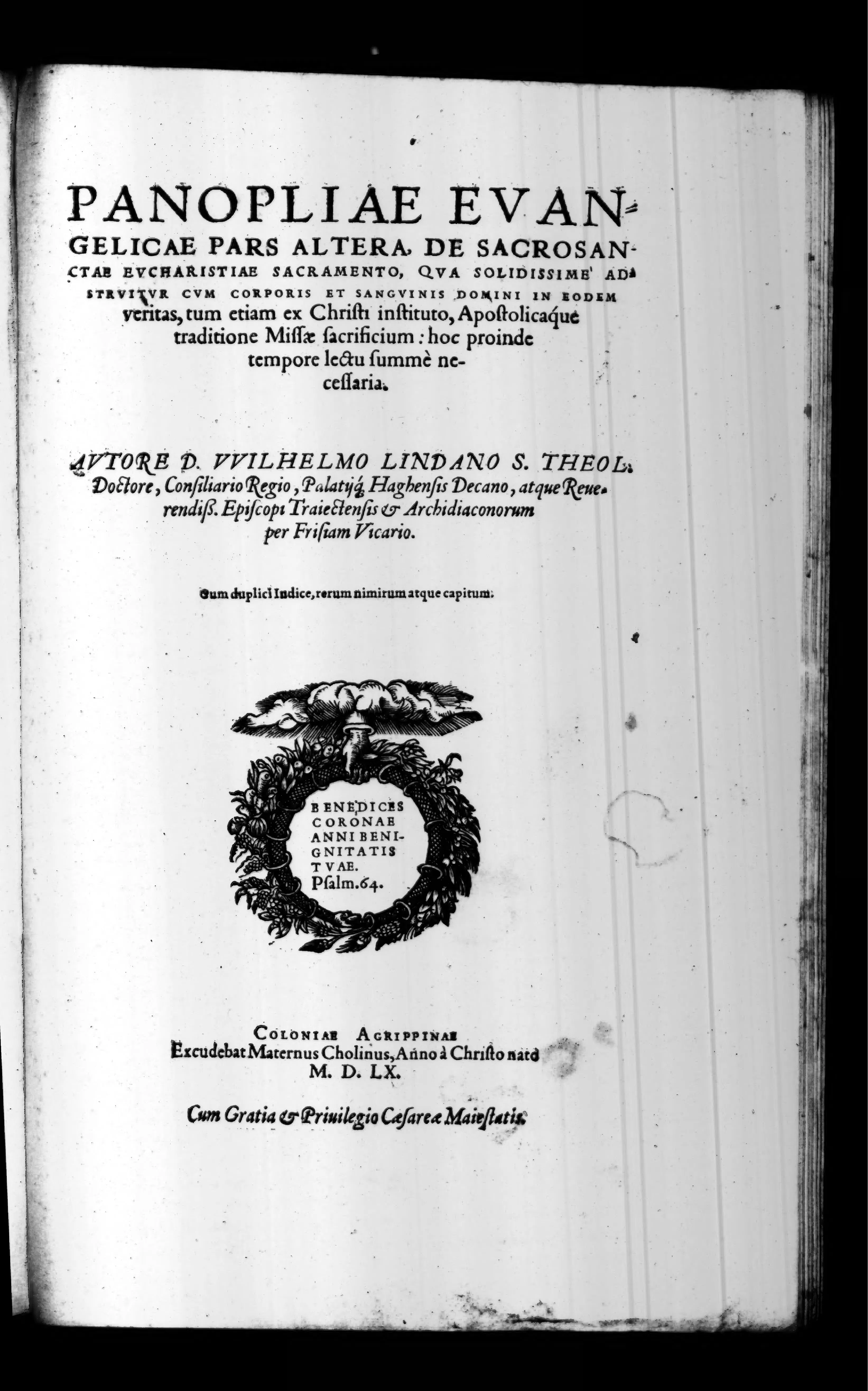
The separately issued 1560 title page of the Panopliae Evangelicae Pars Altera frames the defence of the Real Presence and the sacrifice of the Mass around Christ's institution and apostolic tradition. Its Cholinus imprint and imperial privilege place the continuation within authorised Catholic publishing. Source ↗.
The separately issued Eucharistic part, under its own title page and a new imprint, Excudebat Maternus Cholinus, Anno à Christo nato M. D. LX, "Maternus Cholinus printed it in the year from the birth of Christ 1560," applies the same method to sacramental practice. Cholinus's preface explains the separate issue by the pressure of the market calendar, Et quu[m] instaret nudinæ Frackfordi, when the Frankfurt fair was imminent and the author's copy of the Eucharistic treatise was wanting.
In the chapters that follow, Lindanus reads Paul's account of the Supper as narrative rather than rubric: in these words Paul recalls the history of what Christ did at the last Paschal supper and does not prescribe a form for consecrating the Eucharist, Istis enim verbis Diuus Paulus historiam rerum à Christo in nouissima Paschalis agni coena gestarum rememorat, non autem consecrandæ Eucharistiæ formam præscribit. If the written text does not deliver the form of consecration, the form must come from the Church's received liturgy. The argument from the canon thus returns in sacramental guise.
Against the charge of sacramental sorcery, he declares that Catholics ascribe to these words a power not magical but heavenly, Quare hisce verbis virtutem non tribuimus Catholici magicam, vti hodie passim blasphemant impii, sed coelestem,. Against the mockery of "transubstantiation" as a neologism, quod de transubstantiatione nugaris vocabulum esse nouum, inauditum, & monstrosum, the trifling objection that the word is new, unheard of and monstrous, he invokes the precedent of homoousion, a non-scriptural term that the Church's tradition had made the guardian of scriptural faith. The defence of a single word thereby restates the work's whole thesis, that the written Word stands secure only where the unwritten Word and the defining Church stand with it.
The Eucharistic argument reaches its controversial crux once Lindanus has shown that Arians and Catholics alike took the altar-sacrifice for granted, and that even Hus at Constance affirmed that priests must offer the Lord's body. Having established that the oblation itself was common ground among ancient heretics and the precursor of the reformers, he turns to the harder issue. He asks whether the Mass is also a propitiatory sacrifice, proficiscamur, Sitne Missa propitiatorium etiam sacrificium? Nam de Eu. The particle etiam carries the strategy of the whole stretch. Lindanus treats the sacrificial character of the Mass as already conceded by the consensus of the ages, so the dispute narrows to whether that sacrifice is expiatory. When he later states the matter in the formal scholastic idiom, the narrowing becomes a method. The state of the controversy, he writes, is whether our sacrifice of the altar is propitiatory, Cōtrouersiæ enim status est, an sacrificium nostrû altaris sit pro. By fixing the status controversiae this tightly, he sets aside the more dangerous question of how far the Mass's efficacy might equal that of Calvary, and he obliges his opponents to fight on ground he has chosen.
The first engagement is exegetical. Georg Major had attacked the patristic proofs of the Augsburg Interim and glossed Irenaeus's "new oblation" as spiritual worship, alms and first-fruits. Lindanus does not deny Major's categories. He concedes them and then adds to them. As we acknowledge these two kinds of sacrifice, he replies, so also that third kind, likewise handed to the Church by the Apostles, of the Lord's body and blood: & illud tertium Ecclesiæ ab Apostolis quoque traditum corporis sanguinisque.
The decisive word is traditum. The third genus of sacrifice is legitimated not as a deduction from the written text alone but as something delivered, which ties the Eucharistic controversy back to the treatise's governing claim about the unwritten Word. Lindanus parses Irenaeus into two "arguments", one from Christ's teaching and one from apostolic delivery. The pairing reproduces in miniature the two-part account of revelation that the Panoplia builds elsewhere. The exegesis ends in a firm inference: the Lord's body, according to Irenaeus's opinion, is offered to God the Father, Domini iuxta Irenæi sententiam offerri Deo Patri. The same text is then turned on a second front. Irenaeus's Eucharist "consisting of two things" is read as a defence against those who would leave bread beside the body. Lindanus says Irenaeus fortifies the faithful munit contra istos impanatores ab orco resurgentes: Panis, inquiens,, that is, against "these impanators rising again from Orcus." This underworld image is the recurring schema of the work, in which modern dissent is ancient heresy revived. It also allows a single patristic witness to serve against Lutherans on both transubstantiation and sacrifice.
The defence of Cyprian against Major yields the stretch's sharpest rhetorical reversal. Major had mocked "private Masses," and Lindanus redefines the adjective so that the charge loses its force. Among Catholics, he insists, there is absolutely no one who celebrates a private Mass, but always a public one: licos enim nullus est prorsus, qui priuatam celebrat Missam, sed om. A Mass is public, on this account, because it is offered in the name of the whole Church, whatever the number of communicants. The redefinition makes ecclesial representation the measure of a Mass, not the presence of a congregation. It then allows him to retort that Lutheran communions at the sick-bed are the truly private rites.
Beneath the retort lies a theory of priestly agency that Lindanus draws from Cyprian's sixty-third letter. Because Christ commanded the rite to be done in his commemoration, that priest truly acts in Christ's stead who imitates what Christ did, comemorationem præcepit, vtique ille sacerdos vice Christi verè fungitur, qui. The formula vice Christi becomes the warrant he deploys against Major, against Valentinus Vannius, and against the Württemberg Confession in turn.
Against Vannius the polemic takes theatrical form. Vannius's treatise is staged as a "tragedy of the Mass," with its scena, its epitasis, its histrio, and its self-contradictions over the elevation and the Agnus Dei. Amid the mockery, however, Lindanus formulates the doctrinal answer to the charge that the Mass repeats the sacrifice. We do not acknowledge sacrifices, he writes, but the single sacrifice of Christ, the very same that Christ offered: Nos quidem non agnoscimus sacrificia, sed vnicum Christi sacrificium, quod idem. The many oblations remain one victim.
The Vannius chapter then widens into eschatology. The Saxon Confession, presented with fanfare at Trent, had redefined Daniel's perpetual sacrifice as preaching, prayer and right use of the sacraments. Lindanus reports its formula: Ecclesiæ Apostolicæ:& iuge sacrificium est, sonare doctrinam incorruptam, making the perpetual sacrifice "the sounding of incorrupt doctrine." His reply joins apocalyptic typology to the history of transmission. Like Antiochus, the type of Antichrist, the Saxons abolish the very sacrifice that Boniface and Ludger had delivered to Saxony some seven hundred years before. Tradition is here localized as a mission history, and to reject it is cast as a betrayal of the Saxons' own conversion.
The refutation of the Augsburg Confession meets the objection from Hebrews' semel through a distinction of mode. The Church, Lindanus explains, offers the same victim with the Lord Christ, but not in the same manner as he did, cum Christo Domino hostiam offert, sed non eodem, vt ille, modo. The Mass would rival the cross only if it were offered in the cross's bloody mode. He then gives the image, already noted, that governs the whole account: all the efficacy attributed to the sacrifice of the Mass flows from the one sacrifice as rivulets from a fountain. The hydraulic metaphor is designed to subordinate the altar entirely to Calvary. It also echoes, in a sacramental register, the treatise's broader picture of truth flowing from an apostolic source.
The reinterpretation of opus operatum follows from this picture. Lindanus exclaims, in a liturgical-patristic register, at the wondrous thing that the same Christ here both sacrifices and is sacrificed: rem miram, idem Christus hîc & sacrificat & sacrificatur: Agnus. The scholastic formula is thereby moved from the minister's action to Christ's person. Lindanus also guards against the Lutheran caricature that the rite works mechanically without faith. He reports the opposing claim that it does not merit remission of guilt or punishment by the work performed, non meretur remissionem culpæ, aut poenæ ex opere operato. He answers it by distinguishing culpa from poena and denying that Catholics hold the rite efficacious in adults without faith.
The long chapter on offerings for the dead depends on a graded scheme from Augustine's Enchiridion. Offerings for the very good, Augustine wrote, are thanksgivings, and for the not very bad they are propitiations: gratiarum actiones sunt, pro non valdè malis propitiationes sunt: pro. This scheme lets Lindanus disarm Melanchthon's appeal to the Greek canon's commemoration of saints. He invokes the Augustinian maxim that whoever prays for a martyr wrongs him, and that one offers instead in thanksgiving: cùm iniuriâ faciat martyri, qui pro martyre orat: sed gratiarum actionis.
Here, too, the argument concedes something revealing. Addressing his opponent by name, Lindanus declares that Catholics do not teach that the Mass is a satisfaction, Philip, but that in the Mass the unbloody sacrifice is offered: esse satisfactionem Philippe Catholici non, docemus: sed in Missa. Giving up the vocabulary of satisfaction while retaining the Mass's propitiatory effect on the punishments of the dead is a careful terminological retreat. It shows Lindanus adjusting Catholic language under polemical pressure even as he claims to hold unchanged ground.
The deepest methodological pressure in this part of the argument comes from Melanchthon's dictum, already noted, which Lindanus quotes in order to refute it: that there is great dissimilarity among the Fathers, for they were men and could slip and be deceived. The sentence threatens the epistemic warrant on which the entire treatise rests, the concors sententia Patrum. Lindanus answers with a comparison to Epicurus and then a reductio aimed at Lutheran orthodoxy itself. What dogma of your faith, he demands, will you put forward that some Servetus or Schwenckfeld will not overthrow by this argument? The challenge runs: habes) dabis dogma, quod non Seruetus aliquis, aut Svuenefeldius, aut. The argument is the treatise's characteristic "you too" turned toward the Trinity. If patristic consensus can be discounted, Wittenberg has no defence against the anti-Trinitarians whom it also condemns.
Lindanus then exploits division within the Protestant camp. Against Melanchthon's claim that prayers for the dead crept in late, he sets Bucer, who by the very evidence of the matter, defeated, frankly admits the practice: tamen ipsa rei euidentia Bucerus victus ingenuè fatetur lib. 2. de vera. The following chapter, misnumbered in the printed sequence as a second fifty-third, charges that Bucer elsewhere falsified Epiphanius by way of Cornarius's Latin version. In a prosopopoeia, Epiphanius himself is made to rebuke Bucer. Bucer's local reading of Monica's funeral at Ostia is also dismantled.
The final chapters of this sequence return from the dead to the living and from controversy to the Church's liturgical practice. Defending votive Masses against the charge of abuse, Lindanus allows that the titles vary, for peace, for the king, for the sick, for a pregnant woman: abusi. Etsi enim titulus pro pace, pro rege, pro infirmis, pro pregnante,. The sacrifice, he insists, remains invariant under the unchanging canon that Pope Vigilius attested, while the intentions change. The list, which extends to Masses contra Turcas, records a votive repertory shaped by the Ottoman danger. Its witnesses range from the Ambrosian canon to Ethiopian and Muscovite rites, making universality of observance a further proof of apostolic delivery.
The sacrificial chapters close at the threshold of communion under one kind, and there Lindanus frames the utraquist demand with a proverb. He laments that learned men should again stir up this Camarina, stirred long ago by that John Anserinus, or Hus: ratò nobis mouere camerinam ab illo Iohan. Anserino, siue Hussio. Camarina was the Sicilian marsh best left undisturbed. The figure of Hus, who at the opening of these chapters was summoned as an unwilling witness to the sacrifice, returns as the author of a controversy that the universal council of Constance had laid to rest. The movement of the sacrificial chapters is thus complete in its own terms: a question once settled by the Church's transmission is not to be reopened, and to reopen it is to revive an error already judged.
The Eucharistic Continuation: Communion under One Kind and the Repair of the Order
The final stretch of Lindanus's defence of communion under one kind is built as an argument from the Church's lived practice rather than from the text of Scripture. That choice puts into practice the treatise's governing claim that the Word is known only within a Church that hands it down. Lindanus begins at the deathbed, with the viaticum. Through Theodoret's account of Simeon Stylites he recalls how a pious priest, fearing that the saint was about to be snatched away by death, fortified him with the sacred viaticum, Hunc ille cùm existimasset morte hinc abripiendum, sacro pius præmunit viatico.
The edifying anecdote turns into a demonstration through a single material detail. The priest moistened the sick man's mouth with a sponge, an act that would have been pointless had the chalice been offered. The proof does not rest on any patristic statement about the species. It rests on what a narrative incidentally discloses about how a rite was physically performed. The same procedure governs Lindanus's handling of Ambrose's funeral oration for his brother Satyrus. Shipwrecked, Satyrus had the sacrament bound in an orarium, wrapped the orarium around his neck, and cast himself into the sea: Etenim ligari fecit in Orario, inquit, & Orarium inuoluit in collo, atque se deiecit in mare.
The argument is deliberately simple. A liquid cannot be tied in cloth, so what Satyrus carried must have been bread alone. Here Lindanus's antiquarian method takes its characteristic form: hagiography and consolatory oratory are read as unintended records of liturgical fact. The very lack of polemical purpose in the source is what makes it credible as a witness to custom.
What he draws from this evidence is notably restrained. He concludes that one-kind communion was then customary in some churches, even churches of great name, though not in all, nor solemnly throughout the world: Quare videre est, tunc vnius speciei communioné fuisse non nullis, etiam magni nominis Ecclesiis, etsi no[m] omnibus, nec toto orbe soleniter, visitam. Lindanus does not claim universality, and he immediately adds a counter-case: the sick and delirious were sometimes communicated under wine alone. The concession is strategic, because diversity of practice is exactly what he needs to show.
When he turns to the apostolic age, the same restraint shapes a striking admission. Throughout East and West, he says, one-kind communion crept in gradually, from the caution of some, or perhaps from religious piety, or from other cause: per Orientem & Occidentem in primis paulatim vnius speciei communio quorundam aut cautela , aut pietate fortè religiosa, aut. The Catholic practice is thus conceded to be an accretion. It is legitimated by piety and custom, not traced back to dominical institution as a universal form.
This is where the argument depends most on the treatise's wider theory of tradition. Lindanus does not need one-kind communion to be original. He needs only to show that the rite was free. His stated purpose is that the reader should recognise the liberty of this rite in the ancient apostolic Church of Christ, and see that no belief in the necessity of communion under both kinds was then held: vt huius ritus libertatem agnoscas in priscæ illa Apostolica Christi Ecclesia, non illam verò de vtriusque speciei communionis necessitate creditam fuisse opinio.
The decisive opposition is between libertas and necessitas. The burden of proof moves to the opponent, who must show a divine precept. The Catholic need only show variety, and variety is precisely what the patristic sources supply in abundance.
The most original historiographical move in these chapters deals with the strongest counter-evidence: the decrees of Leo I and Gelasius I commanding reception of the chalice. Lindanus historicises them. Certain pseudo-Christians, he argues, abused one-kind communion to conceal their heresy, because, following Mani, they believed, quidam pseudochristiani ad suam obtegendam abuterentur hæresin, quia Manichæum. What they believed concerned wine itself. These heretics shunned the cup worse than dog or snake, the wretches holding wine to be the creature of an evil principle, cane peius & angue, quòd opinarentur miselli, vinum esse mali.
The Horatian tag gives the heresiological portrait a humanist polish. The substantive claim, however, is canonistic. A papal mandate issued against a particular abuse binds only as a remedy for that abuse, and it does not declare a perpetual precept. Lindanus limits the decrees further by insisting that the celebrant's communion under both kinds was never in question. The mandate concerned the laity.
The logic of the remedy is then given proverbial point. Those who thereafter abstained from the chalice exposed themselves as Manichees, and the shrew perished by its own sign: se prodebant ipsi Manichæos, atque suo perit indicio forex. The Terentian sorex appears here as forex.
The witticism exposes the inquisitorial reasoning in the argument. A liturgical form becomes a public test of orthodoxy, and conformity of rite becomes a way of discerning belief. That reasoning is not left in late antiquity. Lindanus observes that the same plague of the Manichees is now gaining ground through Frisia and elsewhere, Quod inualescente iam per Frisiam, & alibi, eadem peste Mani. He leaves it to the rulers of the Church whether the same remedy should be applied.
Two features of the treatise meet here. One is its habit of presenting present-day adversaries as ancient heresies revived. The other is the Netherlandish vantage from which it argues. The historical hypothesis that explains away Leo and Gelasius also gives a possible precedent for restoring the chalice locally as a pastoral and disciplinary measure, should the governors of the Church judge it fitting.
The medieval history that follows rests on a canonistic principle drawn from Constance. A custom reasonably introduced and very long observed is to be held as law: rationabiliter introducta, & diutissimè obseruata sit, habenda est. This is the juridical counterpart of the unwritten Word. Custom does not merely record tradition; under the right conditions it acquires normative force.
Lindanus nonetheless takes care to show that the older practice really existed. Some of his evidence comes from objects he has seen. Into certain chalices, he reports, a tube was soldered and skilfully inserted, by which one might suck the blood of Christ rather than drink it: calicibus canna est ferruminata, affabreque inserta, vnde Christi sanguinem liceret sugere, non bibere. Tales duos vidimus Bolzvuardiæ Frisiorum. He adds that he saw two such vessels at Bolsward among the Frisians.
The first-person vidimus matters. It joins the controversialist's argument to the antiquary's autopsy and treats surviving altar plate as a monument of tradition. The vessels show that the people once received the chalice. They also show the fear of spillage that later helped to make one-kind communion prevail. A single object thus testifies both to the old custom and to the pious reasons for its decline.
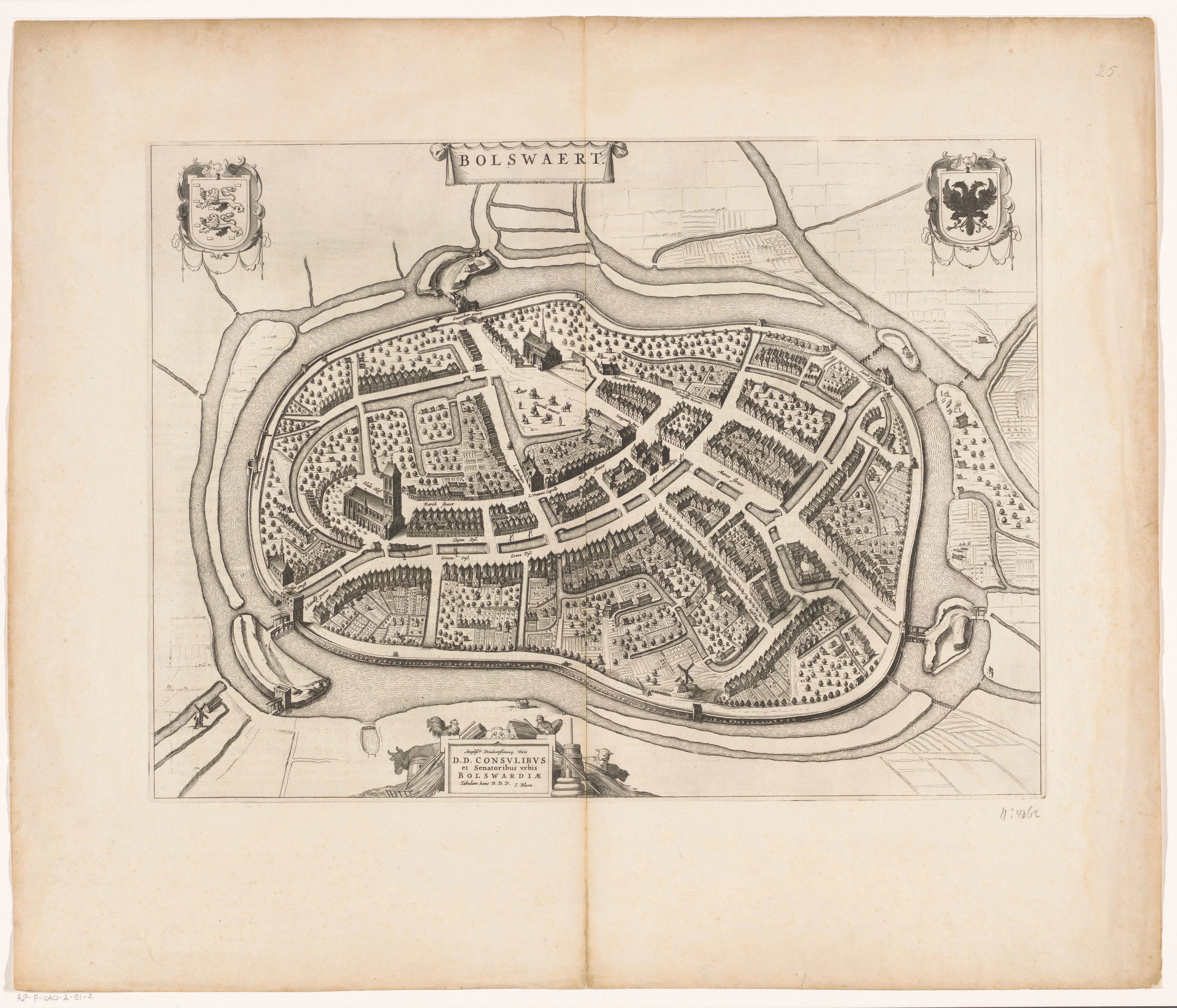
A plan of Bolsward (Bolswaert) in Friesland, where Lindanus says he saw two chalices fitted with soldered tubes for receiving Christ's blood. It sets that observation in the Frisian world that gave his case for the antiquity, and decline, of lay communion from the chalice its force. Source ↗.
,_RP-P-AO-2-51-2.jpg)
From this history Lindanus derives the strikingly limited reading of Constance already cited: he does not think, as is commonly said, that the council forbade communion under both kinds to the laity, but that it defended the communion under one kind then, by most ancient usage, most customary among them.
On this reading the council answered a charge of sacrilege. It did not legislate a universal prohibition, and Eastern, Dalmatian, Northern and even Roman survivals of the chalice were left untouched. The consequence is an even-handed principle applied to very different results. The Greeks are vindicated, for the pious observance of an enduring custom not only excuses them but justifies them: Illos enim non tantùm excusat, sed iustificat pia perdurantis consvetudinis obseruatio.
The Saxon and Bohemian innovators are condemned, and the reason is not their practice but the opinion that drives it. They hold it necessary, and a matter of divine precept, to receive both kinds: Volunt enim esse necessarium, atque diui præcepti, vtramq[ue] accipere speciem. Heresy lies precisely here. The chalice in lay hands is not heretical. The claim that Scripture commands it is, because that claim denies the Church's authority over what Scripture leaves undetermined.
The tu quoque method then turns this principle against the reformers' own writings. Lindanus cites Luther's work to the Bohemians. Since it would indeed be fine to use both kinds, and Christ commanded nothing in this matter as necessary, it would be better to pursue peace and unity, which Christ did command, than to contend about the species of the sacrament: Quoniam pulchrum quidem esset, inquit libr. ad Bohemos scripto, vtraque specie vti, & Christus hac in re nihil tanquam necessarium præceperit, præstaret pacem & vnitatem (quæ vtique Christus præcepit) sectari, quàm de speciebus Sacramenti contendere.
Luther's earlier concession is made to agree with the Catholic libertas. Lindanus adds the sarcastic wish that the Lutherans would deign to hear their own Luther, whom they boast as a third Elijah, Lutherani suum ipsi audire dignarentur Lutherum, quem tertium iactant Eliam?. The jibe aims at the prophetic veneration of the reformer, and it sets the authority of an individual against the authority of a council.
The positive doctrine follows, modelled on Augustine's reply to Januarius on fasting communion: as already noted, although Christ distributed both species to the apostles at the supper, he did not give it to the laity, nor command by any words that it be given them. What Scripture leaves unregulated falls to the governors of the Church, and this is the treatise's ecclesiology applied to a single rite.
Because the whole Christ is received under either species, Lindanus redirects the dispute toward pastoral reform. It would be better to dispute about the use of holy communion than to contend about its mode: satiùs esset de S. communionis vsu disputare, quàm de modo contendere. The emphasis on frequency matches the work's candid admission elsewhere that practice needs a healing hand.
The controversy then closes on a forked alternative. Either, as a Catholic, believe the Catholic Church in all things, or, as a Lutheran, believe at least on this point the Lutheran synagogue: Aut ergo Catholicus Ecclesiæ in omnibus crede Catholicæ: aut Lutheranus hac saltem in parte synagogæ crede Lutheranæ. The pejorative synagoga denies the opposing party the name of church. The dilemma shuts out the Utraquist necessity from both sides, since both Constance and Luther's own words deny it.
A short bridge then moves the work from controversy to sacramental theology. Lindanus defines the body of Christ in the Eucharist as a sacrament to us, a sacred sign of a sacred thing, by which what is visibly done is invisibly effected in us: Illud admonuisse suffecerit, corpus Christi in Eucharistia nobis esse Sacramentum, id est, sacrum sacræ rei signum, quo id nobis præstatur inuisibiliter, quod visibiliter geritur:. The pastoral call to frequent communion finds its authority in Ambrose: Accipe quotidie, quod quotidie tibi profit, "receive daily what profits you daily."
Questions left open, about preaching and about unworthy celebrants, are set aside for a projected work. Lindanus announces the next movement in the patristic image of the second plank after shipwreck. Reserving these and other matters for the books of the Origines sacrae, he says, let us pass to the other plank of salvation, the sacrament of Penance: Verùm hæc aliaque in Originum sacrarum libros reposituri, ad alteram salutis tabulam Poenitentiæ Sacramentum transeamus. The figure answers Satyrus's shipwreck at the opening of these chapters.
The printed book then accounts for its own disordered transmission. A notice to the candid reader explains that these Eucharistic chapters, now joined, repair the interrupted order and supply what was lacking in the series of the treatise: nun iuncta, interruptum ordinem resarciunt, & ea suppeditant, quæ in institutæ. The notice adds that they had been left out of the earlier part for want of a copy from which to set them. A treatise about the Word handed on intact through the Church thus closes by acknowledging, and making good, a gap in its own handing on through the press.
Reading Further on Driedo, Tavard and the Louvain Debate over Tradition
Wim François, "John Driedo's De ecclesiasticis scripturis et dogmatibus (1533): A Controversy on the Sources of the Truth," in Orthodoxy, Process and Product: On the Meta-Question, ed. Lieven Boeve, Mathijs Lamberigts, and Terrence Merrigan (2009), 85–118. François supplies the closest identified scholarly treatment of Driedo's account of doctrinal authority. A direct textual debt from Lindanus to Driedo remains to be demonstrated.
John L. Murphy, The Notion of Tradition in John Driedo (Pontificia Universitas Gregoriana, 1959). This study offers a sustained account of the Louvain antecedent to the questions about Scripture and tradition that Lindanus raises. It should not be mistaken for a study of Lindanus himself.
George H. Tavard, "Tradition in Early Post-Tridentine Theology," Theological Studies 23. Tavard examines Catholic arguments about tradition after Trent and cautions against treating the council's decree as an unequivocal endorsement of two partial sources of revelation. A complete publication date and page span were not independently established. Tavard's questions bear directly on Lindanus's claim that certain traditions could nevertheless be raised into articles of faith by the Church's definition: posse tamen eas Ecclesiæ definitione in fidei articulos redigi. That claim is the point at which his graded hierarchy of traditions meets the post-Tridentine debate over how tradition becomes binding doctrine.
Frequently Asked Questions
What is the Panoplia evangelica by Wilhelmus Lindanus?
The Panoplia evangelica, sive de verbo Dei evangelico libri quinque is a five-book Latin Catholic treatise by Willem Damasus van der Lindt of Dordrecht, who wrote as Wilhelmus Lindanus. Maternus Cholinus printed it at Cologne in 1559–60, and its dedication to Philip II is reportedly dated at Leeuwarden, 1 July 1559. The work answers the Reformation principle of Scripture alone by dividing the Word of God into a written part and an unwritten part handed down from the apostles. It then defends grace and merit, the saints, the sacraments, Roman primacy and the sacrifice of the Mass doctrine by doctrine. It closes with a submission to Pope Paul IV.
Did Lindanus's two-part view of Scripture and tradition simply restate the Council of Trent?
No. Lindanus's two-part view is his own position and cannot be credited to the council. Trent's decree on Scripture and traditions of 8 April 1546 dropped its draft's partim–partim wording, under which revelation lay "partly" in writing and "partly" in unwritten tradition. Lindanus, however, states plainly that one part of the truth is contained in the apostolic writings and the other was consigned to all the churches by the apostles' living voice. George H. Tavard argues that later theologians invoked Trent for two partial sources, even though the decree neither canonized that doctrine nor excluded the primacy of Scripture. Lindanus's explicit formulation is therefore no evidence of what the decree taught.
Why is the Panoplia evangelica sometimes catalogued under Johannes Driedo?
The attribution to Driedo is a cataloguing error, not a rival claim of authorship. Driedo wrote a distinct treatise, De ecclesiasticis scripturis et dogmatibus libri IV, printed at Leuven in 1533 by Rutger Rescius with Bartholomaeus Gravius. A digital copy of the Panoplia correctly names Lindanus and gives 1559–60 as its date. It cannot yet be determined whether the confusion arose from a composite volume, a misapplied digitization record or a simple metadata error. The mistake echoes a real Louvain background to Lindanus's questions. Even so, Driedo's influence on him remains a plausible hypothesis that no study has demonstrated passage by passage.
What were the chalice tubes Lindanus saw at Bolsward in Frisia?
They were chalices with a tube soldered and skilfully inserted into them, through which communicants could suck the blood of Christ rather than drink it. Lindanus reports seeing two such vessels at Bolsward among the Frisians. He treats them as evidence that the laity once received the chalice. They also show the fear of spillage that later helped communion under one kind prevail. The tubes belong with his other local evidence, including wine still given at Dordrecht and the Frisian custom of placing the Eucharist on the altar for newly baptized children. He reads the Council of Constance as defending communion under one kind, not as forbidding communion under both.
Is there an English translation of Lindanus's Panoplia evangelica?
No published translation of the Panoplia evangelica into English or any other language has been identified. That negative finding does not prove that no translation exists. A separate resource is the Leo edition, which presents the full Latin transcription and a complete English translation for the first time. Its translation is generated by AI. Leo is an effort to make English translations of every text printed in Latin in early modern Europe between 1450 and 1750 freely available online at no cost.
This report was generated by an advanced AI assistant that conducted deep research alongside an extensive interpretation of the transcribed original text. Every effort has been made to preserve fidelity to the source and to guard against inaccuracy, but corruption in the text recognition process and model hallucination may nonetheless have entered the text. Treat every claim, quotation, translation, and citation as provisional, and verify each against the original source before relying on or citing it.
Bibliography
- Wim François, "John Driedo's De ecclesiasticis scripturis et dogmatibus (1533): A Controversy on the Sources of the Truth," Orthodoxy, Process and Product: On the Meta-Question: François reconstructs the Louvain argument over where doctrinal truth comes from a generation before Lindanus set up his armoury, which makes this the place to test whether the Panoplia's two-part Word is borrowed equipment or fresh forging. Read it alongside Lindanus's Lydian touchstone and the passages on the canon as tradition; the overlaps are suggestive, and the absence of any cited debt in Lindanus's own pages is equally instructive. It also clarifies why a cataloguer might have filed the Panoplia under Driedo's name, an error with a respectable pedigree.
- John L. Murphy, The Notion of Tradition in John Driedo: Murphy's Gregorian dissertation remains the fullest account of how Driedo handled canon, unwritten tradition and the authority of the Church, and it gives the reader a baseline against which Lindanus's bolder formulations, above all his partem unam … partem alteram, can be measured. Its subject is Driedo alone, so anyone hoping to find Lindanus in the index will leave disappointed but better armed. Consult it to judge how much of the Panoplia is Louvain inheritance and how much is Dordrecht temper.
- George H. Tavard, "Tradition in Early Post-Tridentine Theology," Theological Studies: Tavard's article in volume 23 of Theological Studies tracks how Catholic theologians read Trent's decree of 8 April 1546 in the decades after it, and it warns, usefully for this report, against assuming the council endorsed two partial sources simply because its interpreters did. It is the essential corrective to any temptation to treat Lindanus's two-part Word as Trent speaking through a Netherlandish mouthpiece. Its questions also sharpen the reading of Lindanus's graded traditions, especially his claim that the Church can promote a middling tradition into an article of faith.