Great Cities Reduced to Points: Philippe Briet's Annals of the World
Philippe Briet, a Jesuit geographer from Abbeville, spent the early 1660s trying to hold the whole of time in a single numbered column: his Annales mundi, printed at Paris across 1662 and 1663, dates everything from the creation of Adam to the ministers of Louis XIV within one synchronized grid of eras. What makes the folio worth opening is the combination it sustains without apology — a forged appeal-canon conceded, the legend of Pope Joan demolished, Proteus's transformations reduced to devices painted on Egyptian diadems, and, in the same annual cell, empires read as divine preparation or as chastisement. Briet is also candid about his own limits, admitting a French bias and then defending it on evidential grounds, recording the bookseller waiting on his last sheets, and refusing at the close to predict how the war then in progress would end.
ExLatinis
August 26, 2026

Contents
Philippe Briet, a Jesuit geographer from Abbeville, spent the early 1660s trying to hold the whole of time in a single numbered column: his Annales mundi, printed at Paris across 1662 and 1663, dates everything from the creation of Adam to the ministers of Louis XIV within one synchronized grid of eras. What makes the folio worth opening is the combination it sustains without apology — a forged appeal-canon conceded, the legend of Pope Joan demolished, Proteus's transformations reduced to devices painted on Egyptian diadems, and, in the same annual cell, empires read as divine preparation or as chastisement. Briet is also candid about his own limits, admitting a French bias and then defending it on evidential grounds, recording the bookseller waiting on his last sheets, and refusing at the close to predict how the war then in progress would end.
Philippe Briet (1601–1668) was a French Jesuit — a native of Abbeville, as the title-pages style him — who taught geography at Rouen and at the Collège de Clermont in Paris, and whose Annales mundi, 'Annals of the World', was printed at Paris by F. Muguet across 1662 and 1663 as a multi-part folio set. It belongs to a genre that was already old and still contested in the seventeenth century: the universal annalistic chronicle, a year-by-year register of events that begins at the Creation and runs, without changing gear, to the author's own present. What such a book undertakes is not a narrative in the modern sense but a single ordered sequence of time into which everything must be fitted — patriarchs and Olympiads, Assyrian dynasts and Roman consuls, popes, councils, sultans, and the first printers of Mainz. Later issues carry the sequence further than Briet himself did: a Venetian issue is recorded for 1692, and a 1696 Augsburg/Dillingen issue is catalogued with a supplement continuing the chronicle from 1663 to 1692, the continuation ascribed in a catalogue record to Casimir Freschot — an attribution that is a cataloguer's ascription rather than demonstrated authorship.
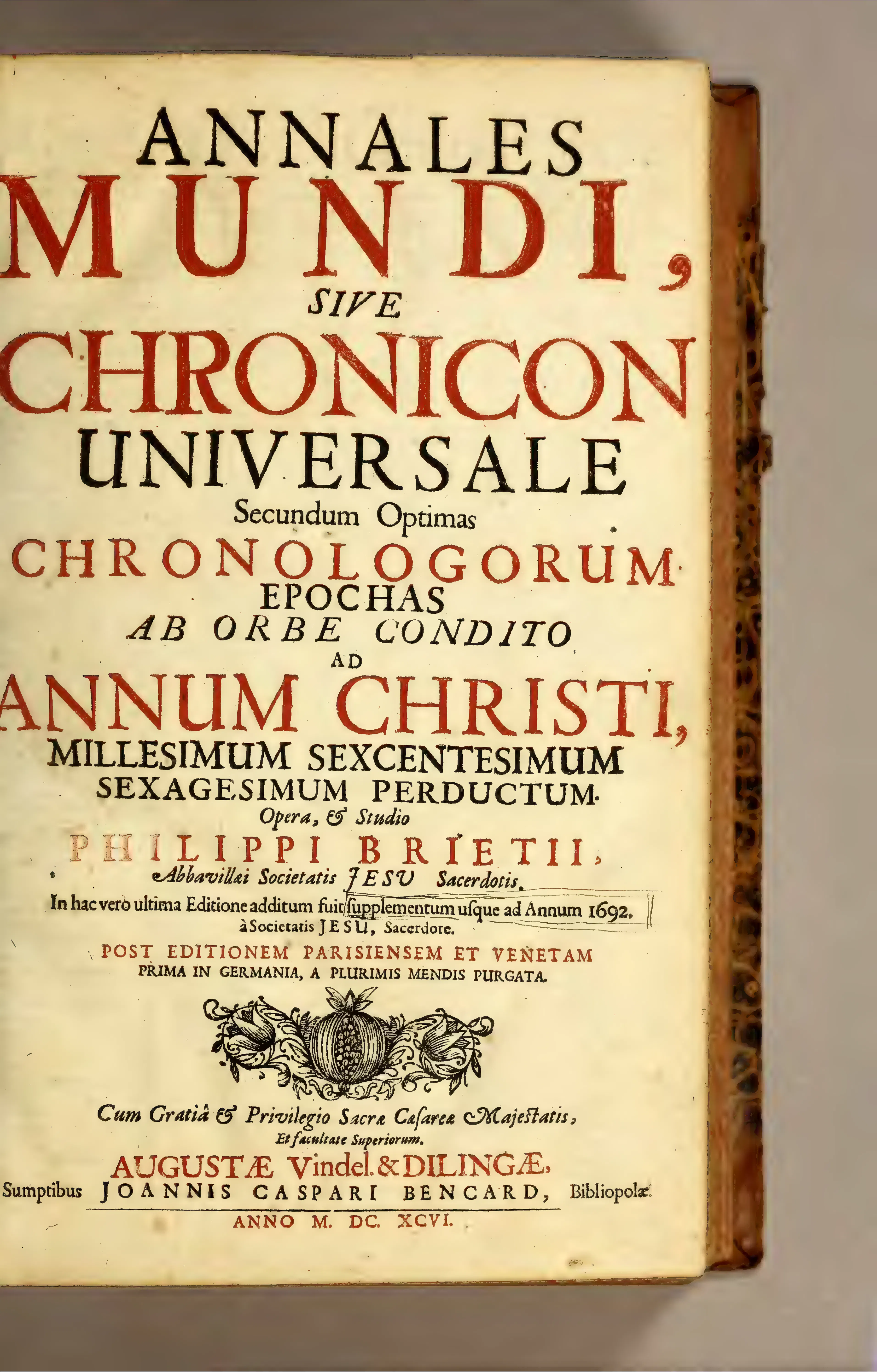
The Augsburg/Dillingen title page places the 1696 issue within the work's afterlife: it announces Briet's universal chronicle and adds a supplement "usque ad Annum 1692" by a Jesuit priest. Its claim to be the first German edition after Paris and Venice, "a plurimis mendis purgata," names both the transmission chain and the editorial problem of correction. Source ↗.
The intellectual problem the work confronts is the one that made chronology a battleground rather than a convenience. All of time is to be held in one verifiable and morally legible order, yet the sources disagree with each other, the eras in which they reckon are mutually incommensurable, and — decisively for a Catholic annalist — the inspired testimony of the Old Testament stops, after which the historian must proceed on human credit alone. Briet's response is a single move repeated at every scale of the work. Each notice is fixed to a year within a synchronized grid of eras, so that scriptural, Greek, Near Eastern, Roman, papal, and Ottoman events can be read in one column of time; rival datings, forged or misattributed canons, marvels susceptible of rational explanation, and confessional fables are then weighed philologically, with scribal negligence, misattribution, and invention named as such and genuinely doubtful cases left open; and the unit closes with a compressed providential or moral verdict, empires figuring as preparation or as chastisement, schism and heresy as self-inflicted ruin. Compression is itself avowed as method: the annalist declares that he will do what geographers do, reducing great cities to points and long rivers to thin lines.
The stakes of this are both disciplinary and confessional. Chronology in the generations after Joseph Scaliger had become a critical discipline, dependent on the comparison of calendars, eras, and authorities rather than on tabular convenience, and disputes over the age of the world, over Paschal reckoning, and over the reliability of regnal lists were understood to bear directly on the authority of Scripture and of ecclesiastical tradition. A Catholic annalist writing after Trent inherited both that critical apparatus and a polemical vocabulary — Novatores, Heterodoxi, Pseudosynodus — in which doctrinal deviation is classified rather than described. That Briet was by training and publication a geographer, author of the Parallela geographiae veteris et novae, situates the work within a wider Jesuit effort to coordinate spatial and temporal knowledge, and helps explain why a creation-to-contemporary chronicle could be offered as an argument about the ordering and reliability of historical knowledge itself rather than as a mere aid to memory.
Several features make the text memorable in ways a first-time reader will want to know in advance. Its critical edge is real and directed inward as much as outward: the legend of Pope Joan is dismissed as a fiction in which everything wavers, the appeal-canon invoked by Zosimus is conceded to be Sardican rather than Nicene, and marvels are unmade by rational explanation — Proteus's transformations traced to devices painted on Egyptian royal diadems. Its providentialism is equally unembarrassed: Rome is a preparation for the Church, the destruction of Jerusalem a judgment no age will keep silent about, the Frankish monarchy the bulwark of the Church, the Reformation a scourging whose welts have not yet subsided. And its authorial voice is unusually candid about its own limits — the difficulty of the work is said to grow the nearer it approaches the present; a French bias is admitted and then defended on the epistemic ground that French affairs are the better explored and the more certain; the whole is submitted to the judgment of the Church and the Pontiff with an offer to retract; the annals themselves report a bookseller waiting on the last sheets; and the closing pages decline to predict how the war then in progress will end. Alongside the Ottoman advance, which forms the spine of the later parts from Nicaea through 1453 to Vienna and Belgrade, the work registers the invention of printing, the naming of America, and the mission to Peking, all of them entered in the same annual column as councils and heresies.
What unites the work's conceptual vocabulary, its production history, and its internal argument is the ambition of the single sequence: the polysemy of annus mundi and saeculum mundi as coordinating devices, the division of the whole into tomes, parts, books, and decades each opened by its own prooemium, and the closing gesture of submission all serve one project of making the totality of time citable, adjudicable, and morally readable. That project has attracted far less modern scholarship than the work of Scaliger, Pétau, Ussher, Baronius, or the Bollandists, and much about the book remains to be settled: the collation of the Paris set, the censorship and privilege history, the identity of the continuator, and the origin of the bibliographic confusion by which Briet's annals have on occasion been conflated with Seth Calvisius's Opus chronologicum — a conflation that the surviving records permit one to disentangle without yet explaining. The interest of the Annales mundi lies precisely there, in a text where rigorous source-criticism and providential Catholic universal history are not rival options but simultaneous commitments, and where the evidence for many of the book's own particulars still awaits confirmation against the surviving pages.
Read the full text and English translation on Leo
This text was transcribed and translated as part of the ExLatinis project, an effort by Leo to make free English translations of every text published in Latin in early modern Europe (1450–1750) available online. The complete transcription and English translation of this work can be read free of charge:
→ Read the original Latin text and full English translation on Leo
You can save a copy of this document into your Leo account to run deep text searches, conduct further analysis, or cross-reference it with your own research.
Translating Annales mundi and Reading Briet's Chronological Vocabulary
Editorial title supplied for convenience: Philippe Briet's Annales mundi: Jesuit Universal History between Sacred Chronology and Historical Erudition. The Latin title Annales mundi is best rendered 'Annals of the World': annales denotes year-ordered historical record, while mundi places the sequence within a universal, creation-centered chronology rather than a merely national history. The catalogue evidence identifies the work as Latin and as a chronicle; it does not by itself establish every internal rubric or the exact wording of Briet's prolegomena. Annus mundi should therefore be understood as a chronological convention that coordinates human history with the age of the created world, not simply as an alternative date-label. The related expression saeculum mundi gives the work a larger periodizing architecture: the universal past is segmented into world-ages while remaining readable through annual notices. That coordinating function is visible in the text's own manner of tying profane regnal years to scriptural episodes, as when the annalist observes that into the fourth year of Seleucus Philopator fall the blows of Heliodorus mentioned by the sacred text in the third chapter of the second book of Maccabees, [In hunc annum quartum Seleuci Philopatoris
cadunt Heliodori plagæ quarum meminit
sacer textus cap. 3. libri secundi Machabæorum](https://tryleo.ai/share/5448eb7f-c056-426b-8d0e-ef24e29b54b0/?imageId=21f70887-07c0-4a28-9fb6-5b7122ccc593) — a formula in which a Hellenistic dynastic year and an inspired book are made to occupy the same cell of the universal grid, which is the elementary operation on which the whole work rests.
In post-Tridentine Catholic polemical usage, Novatores and Heterodoxi are confessional classifications rather than neutral descriptions; they mark perceived doctrinal innovation and deviation from ecclesial norm. Their use belongs to the polemical register of confessional universal history, although the precise occurrences and distribution in Briet's text require inspection of a reliable scan or critical transcription. The polemical deployment of Heterodoxi is directly attested where the annals dismiss the legend of the female pope, reporting that Marianus Scotus, a great trifler, records under that year that Leo IV died and Joan the Popess succeeded him, that the heterodox seized on the fiction and triumphed in it as on a torture-horse, but that in the fable everything wavers — time, name, homeland, Marianus's manuscript, the papal portraits at Siena — so that to believe it now is to be mad, Marianus Scotus, magnus nugator, hoc anno tradit Leonem IV. obiisse, eique Joannam Papissam succedisse; quod commentum inde Heterodoxi rapuerunt, & in eo tanquam in equuleo triumpharunt; in qua fabulâ omnia labant, tempus, nomen, patria, Mariani codex, imagines Pontificum in Ecclesia Senensi; adeò ut jam id putare, delirare sit. Here the confessional label and the philological argument operate together: Heterodoxi names the adversary while the refutation proceeds by enumerating the points at which the tradition fails to cohere. The corresponding distribution of Novatores across the volumes remains to be surveyed on the pages themselves.
Philological framing extends, in this work, beyond the title and the confessional lexicon to the etymological explanation of names, which functions as historical argument in its own right. The name of the pagans is derived from an imperial measure, the annals reporting that at that time the appellation of Pagani is thought to have arisen because Constantius wished all soldiers to be Christians, and since idolaters could not serve they were called pagani in that the emperor had reduced them to civilian status, Hoc tempore creditur nata appellatio Paganorum, quòd Constantius milites omnes Christianos fieri voluisset; cùm enim qui Idola colerent militare non possent, ideo Pagani dicti, quòd ad Paganitatem eos Imperator redegisset:. The same procedure is turned on the confessional names of the author's own era, where the label is explained as the residue of a political act rather than of a doctrine: they were called Protestants, a name that thereafter passed over to the Lutherans and the sectaries, so that what belonged only to politics became a matter of religion, appellati sunt Protestantes, quod nomen deinceps ad Lutheranos & Sectarios transiit, & quod politiæ tantùm erat, factum est religionis. The philological interest of the work therefore lies not only in the semantic weight of annus mundi and saeculum mundi as coordinating conventions, but in a sustained practice of onomastic derivation by which names are made to disclose the circumstances that produced them.
Summing Up the Annals of the World: Bibliographic Facts and Their Limits
Philippe Briet (1601–1668), a French Jesuit associated with geography and chronology, authored a Latin universal annalistic chronicle printed in Paris by F. Muguet across 1662–1663. The bibliographic record supports a multi-part folio set: an Eton record describes separate pars with separate title-pages, pagination, and registers. A later Venetian issue is recorded as Venetiis: apud Io. Iacobum Hertz, 1692, while a 1696 Augsburg/Dillingen Bencard issue is catalogued with a supplement extending the chronicle from 1663 to 1692. The work belongs to the genre of year-ordered universal history, but the available catalogue evidence does not independently verify every internal feature that has been ascribed to it—paired anno mundi and anno Christi columns, divisions into saecula mundi and decades, or the exact terminal index. The language is Latin; catalogue records do not establish a translation or vernacular-abridgement history, and no secure vernacular epitome has been located.
The character of the enterprise is stated by the text itself at the point where its documentary situation changes, the annalist noting that here the history of the sacred codices of the Old Testament ends, and that thereafter its most certain light will be lacking, to the great damage also of human credit, [Hic porrò sacrorum Codicum veteris
instrumenti desinit historia, cujus certissimiluce
deinceps, magno etiam humanæ fidei damno,
carebimus](https://tryleo.ai/share/5448eb7f-c056-426b-8d0e-ef24e29b54b0/?imageId=a2240a3b-4e3b-4d39-b150-e3cadcff9de4). The remark identifies the governing difficulty of a creation-to-contemporary chronicle: the single sequence must be carried forward across a threshold at which the quality of the available testimony alters, and the philological adjudication of profane sources becomes the annalist's only recourse.
The 1685 Calvisian volume is a separate work: Seth Calvisius's Opus chronologicum ... ad annum 1685 continuatum, printed at Frankfurt am Main and Leipzig by Christian Gensch, in folio, with a substantial appendix attributed to manuscript materials. The evidence presently supports disentanglement, not a demonstrated case of a single volume being correctly attributable to both authors.
Situating Briet between Scaliger's Chronology and Jesuit Providential History
The chronicle matters because it stands at the intersection of three early-modern practices: sacred chronology, confessional ecclesiastical history, and Jesuit geographical erudition. Anthony Grafton's studies of Joseph Scaliger show chronology becoming a critical discipline grounded in the comparison of calendars, eras, and historical authorities rather than a merely tabular aid; that framework clarifies why a creation-to-contemporary chronicle could function as an argument about the ordering and reliability of historical knowledge. C. Philipp E. Nothaft's work on computus and chronological scholarship supplies the longer medieval and early-modern genealogy of disputes over eras, Paschal calculation, and biblical time. Johannes Zachhuber's study of Denis Pétau is especially relevant for the Catholic synthesis of chronology, philosophy, historical criticism, and theology. Briet's geographical publications, including Parallela geographiae veteris et novae, place him within the Jesuit effort to coordinate spatial and temporal knowledge; a modern cartographic reference identifies Philippe Briet (1601–1668) as teaching geography at Rouen and the Collège de Clermont in Paris.

An engraved portrait of Joseph Scaliger, the scholar who made chronology a critical discipline rather than a tabular aid. For a Jesuit chronicle such as Briet's, Scaliger's legacy defined the terrain on which sacred history, calendars, eras, and historical authorities had to be compared and ordered. Source ↗.
The critical practices that Grafton and Nothaft describe are exercised on the page in several distinguishable registers. The annalist reports rather than resolves where the authorities are irreconcilable, inviting the reader to take the varied opinions of the authors who have fixed the founding of a most celebrated city relative to the Roman Parilia and who hold it established so many years before the founding of the city, Tu varias habeto sententias authorum, qui celeberrimæ urbis hujus conditum Romanis Palilibus ita præfixerunt, & ante urbem conditam his annis statutam volunt — a quaestio left open rather than closed, which is precisely the posture that distinguishes chronology as a critical discipline from chronology as a table. Marvels are handled by rational reduction, the cause of Proteus's transformations being referred by Diodorus the Librarian back to the custom of the Egyptian kings, who bore fire, water, wild beasts and the like depicted on their diadem for terror and display, cujus causam Siculus Bibliothecarius refundit in consuetudinem Regum Ægyptiorum, qui in diademate suo, ignem, aquam, feras, aliaque ejusdem modi ad terrorem, & pompam depicta ferebant. Rabbinic exegesis is refused on internal grounds, the annalist holding that the Hebrews are not to be heard here who will have it that Jephthah's daughter was not killed but consecrated to God, and asking why in that case the virgin would have obtained two months for mourning, Neque enim hic audiendi Hebræi, qui hanc non interfectam, sed Deo consecratam volunt. Cur enim virgo duos obtinuisset ad luctum menses?. Elsewhere the reporting of tradition is marked off from assertion by an explicit disclaimer, the annalist conceding that he is perhaps compelled to set out not what was done in a given place but what many have written, Verùm exponere cogimur fortè, non quod hîc gestum est, sed quod multi scripsere. Canon-law history receives the same treatment, with a misattribution conceded against a papal use of it: and then it was discovered that the canon cited by Zosimus was not of the Nicene but of the Sardican council, Tumque deprehensum est citarum canonem à Zosimo non fuisse Nicæni, sed Sardicensis Concilii;. Read together with the declared loss of the Old Testament's certain light quoted above, these passages indicate that the work's critical apparatus is not confined to profane antiquity but is applied to the ecclesiastical record as well.
The geographer's habit of mind is likewise declared as method rather than merely inherited as biography. Faced with an expanse of material too great for the annual form, the text announces that it will nevertheless do here what geographers are wont to do, who describe great cities by points, large rivers by little lines, and long stretches of mountains and plains by small intervals, Faciemus hic tamen quod Geographi solent, qui magnas urbes punctis, grandes fluvios lineolis, lorgos montium æquorumque tractus parvis intervallis describunt. The analogy makes compression a principle of representation, in which the annalist's scale-reduction of time answers to the cartographer's scale-reduction of space, and it supplies a precise sense in which the coordination of spatial and temporal knowledge attributed to Jesuit erudition is operative inside this text. The same interest surfaces in the notice of the western discoveries, where the naming of a continent is recorded as an act of philological history: in that year the New World was first truly discovered, perhaps unknown to the ancients, afterwards called America from Amerigo Vespucci the Florentine, who surveyed it more diligently, Hoc anno verè primùm detectus est Novus Christophorus Novu[m] Orbem primus detegit. Orbis, antiquis forsan incognitus, postea dictus America, ab America Vesputio Florentino, qui eum lustravit diligentiùs.
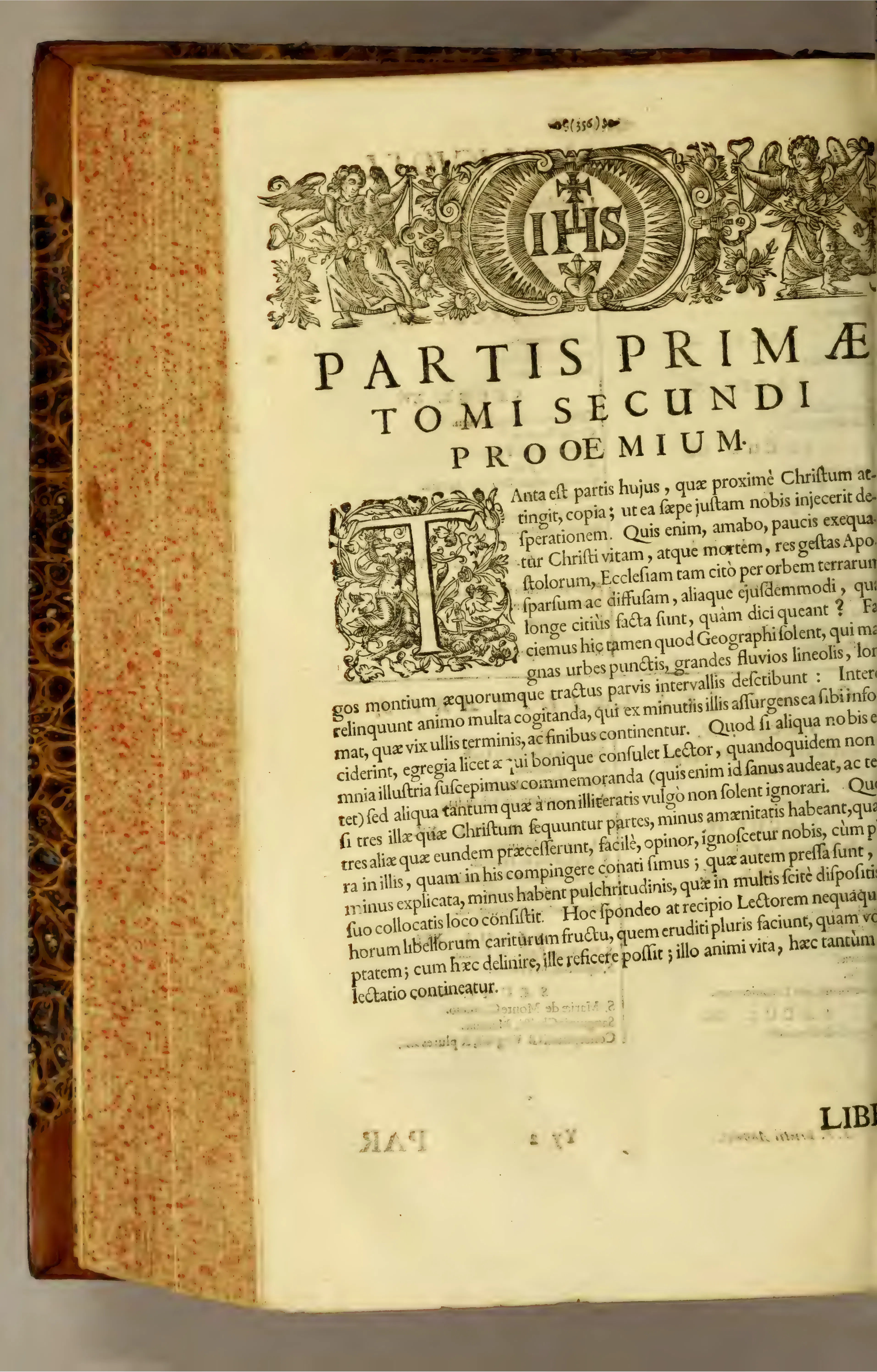
Beneath a Jesuit IHS headpiece, the prooemium to the second tome's first part turns a typographic threshold into a methodological declaration: the annals will reduce Christian-era history as geographers reduce cities to points and rivers to lines. Compression is the scale of the work, not a defect of abbreviation. Source ↗.
Set beside this critical apparatus is a providential and moral register that the annals do not treat as an alternative to it. Divine justice is read off the manner of a tyrant's death, thus Antiochus Epiphanes, an exile gnawed by worms and a stinking living corpse, vomiting out a soul fouler than his stinking body, a great monument of divine wrath and justice against blasphemous, cruel and sacrilegious princes, [Sic extorris Antiochus
Epiphanes vermibus arrosus, & foetens vivum
cadaver, animum de foetenti corpore foetentiorem
evomuit, magnum in blasphemos,
crudeles, ac sacrilegos Principes divini furoris
atque justitiæ monimentum](https://tryleo.ai/share/5448eb7f-c056-426b-8d0e-ef24e29b54b0/?imageId=d1145a8a-9350-45ff-a8c0-24d28b0815f9). The destruction of Jerusalem is given a supersessionist construction of the same kind: thus fell the holy city, which God had held in his eyes and had honoured with his temple, which, when it had stretched out its hands against its God and fastened him to the wood, was so chastised that no age will be silent about its destruction and the whole world shudder at the hearing of it, Ita concidit Sancta civitas, quam Deus in oculis tulerat, temploque suo dignatus erat, quæ cum in Deum suum extendisset manus, eumq[ue] affixisset ligno, sic castigata est, ut de ejus excidio nulla tacitura sit ætas, & ad ejus auditionem orbis universus perhorrescat. The Reformation is fitted into the same explanatory scheme in two complementary ways. Its occasion is traced to an inter-order quarrel over the preaching of indulgences, the annals recording that in that year the Lutheran heresy took its beginning from the indulgences committed to the Dominican Fathers by the Archbishop of Mainz, whereas previously the Hermits of St Augustine had been their promulgators, Hoc anuo hæresi Lutheranæ datum est initium ex Indulgentiis, Patribus Dominicanis ab Archep. Moguntino commissis, cùm antea Eremitæ S. Augustini earum promulgatores essent; and its ultimate cause is located in ecclesiastical corruption met by divine chastisement, a document being said to have portrayed the utterly corrupt state of the Church of that time, for whose amendment God afterwards applied a more powerful remedy, and stripes whose wounds and welts have not yet closed nor subsided, quâ corruptissimum Ecclesiæ hujus temporis statum repræsentavit; cui emendandæ postea Deus remedium potentius adhibuit, & verbera quorum plagæ ac vibices nondum coaluerunt, ac detumuerunt. The moral verdicts extend to individuals in the form of the obituary balance-sheet, a king being summed up as a bad son, a bad father, a bad husband, a bad brother, but a good king, and one who made the kings of France masters of their own right, malus filius, malus pater, malus maritus, malus frater, sed Rex bonus, & qui Reges Francicos sui juris fecit, and to the age itself, where the frequency of betrayals is turned by everyone into a vast disgrace of the century, a thing which, though execrable by every curse, would seem long since to have shed all shame, Ingenti sæculi nostri probro nemo est qui non vertat hanc proditionum frequentiam, cujus licet rei diris omnibus execrandæ pudorem jam dudum omnem exuisse videretur.
The historiographical significance is consequently prospective rather than settled: Briet-specific scholarship is much thinner than scholarship on Scaliger, Pétau, Ussher, Baronius, or the Bollandists. Claims about Briet's treatment of Pope Joan, Gallicanism, Ottoman history, hagiographic criticism, and providential explanations should be tested against the primary pages before being presented as established interpretations. On several of these heads the surviving text does speak directly. The refutation of the Pope Joan legend quoted above is explicit and turns on the incoherence of the tradition rather than on ecclesiastical authority alone. On the Ottoman advance, the fall of Constantinople is construed as the outcome of Greek invidia, the hatred of New Rome for the old having proceeded so far that she preferred to pass over to the Ottomans than to return to her mother, and to bear Mahomet's harsh yoke rather than the sweet yoke of Christ and the Church, Novæ Romæ in veterem eò usque processit odium, ut illa ad Ottomannos transire maluerit, quàm ad matrem redire, & Mahumeti ferre potiùs immite jugum, quàm suave Christi atque Ecclesiæ, and is reinforced by a fiscal counterfactual, that had they spent those monies on the pay of Western soldiers they would have preserved a great part of them together with their liberty, quas pecunias si impendissent in stipendia Occidentalium militum, magnam earum partem cum libertate suâ conservassent. Conciliarism receives a compressed judgment of the same epigrammatic kind, the manifold Council of Basel being said to have ended, at its beginning advantageous to the Church and at its end destructive, Sic terminatum est Basileense Concilium multiforme, initio Ecclesiæ commodum, tandem perniciosum — a verdict that bears on the constitutional questions later gathered under the heading of Gallicanism without by itself settling how the work treats the Pragmatic Sanction, the Concordat of Bologna, or the articles of 1682. Hagiographic criticism, and the fuller Gallican material, still require examination on the pages themselves before conclusions are drawn.
The work's self-description is unusually forthcoming about the epistemic asymmetries of universal history, and it belongs to the assessment of the work's method. The annalist observes that the nearer we approach our own times, the greater grows the difficulty of the work, whether one considers the abundance of matter or the manner of narration, Vo magis accedimus ad nostra tempora, crescit hujus operis difficultas: si ve ubertas materiæ, sive dicendiratio consideretur. A national preference is admitted and then justified on grounds of evidential access rather than patriotism alone, the other nations being expected to judge it fair and right if more is said of French affairs than of theirs, since those matters are better explored and more certain, being set before the author's very eyes, Aequi verò bonique consulent reliquæ nationes, si de Francicis plura, quàm de suis dicamus: Cùm enim illa magis explorata sint & certa nobis, utpote ob oculos nostros posita. The work is best approached as evidence for the continuing coexistence of critical source evaluation and providential Catholic universal history, not as proof that one had displaced the other; the passages above show the two operating within a single annual entry rather than in separate compartments.
Tracing the Printed Issues of the Annals of the World from Paris to Vienna
The secure bibliographic sequence is as follows. The first Parisian set was issued Parisiis apud F. Muguet over 1662–1663; the Eton record explicitly describes separate parts, separate title-pages, separate pagination, and separate registers. A distinct Venetian record gives Venetiis: apud Io. Iacobum Hertz, 1692, with a BSB record describing one volume of [12] leaves and 359 pages. A 1696 Bencard issue from the Augsburg/Dillingen trade is catalogued with Supplementum ad annales et chronicon Philippi Brietii ab anno 1663 usque ad annum 1692; an Internet Archive/Open Library record assigns the supplement, pp. [935]–983, to Casimir Freschot. That attribution is a catalogue attribution, not proof that Freschot wrote the continuation. A later Vienna Monath issue of 1727 is recorded in eight tomes. The evidence does not securely establish a complete collation or sheet count for the Paris set, nor the printer's fount inventory, a mangled Greek heading, named approbators or censors, a royal privilege, or an appearance in Roman or Iberian indices. No reliable shelfmark for a physical Briet copy has been confirmed here; the Eton catalogue record is the strongest located institutional description, while the BSB, HathiTrust, and Internet Archive records establish digitized or catalogue manifestations rather than a verified shelfmark in the present evidence.
The division of the work into parts, which the Eton description registers externally, is also announced internally by the text, and the announcement is argumentative rather than merely navigational. One such opening declares that this second part of the Second Tome begins with the monarchy of the Franks, asking whence the second part of the years from Christ would better arise than from that kingdom which Christ established as the bulwark of his Church, and under whose auspices he willed his religion to flourish everywhere on earth, ALTERAM hanc Tomi Secundi partem cum Monarchia Francorum exordimur, Vnde enim annorum à Christo pars altera melius orietur, quàm ab eo Regno, quod Christus Ecclesiæ suæ propugnaculum statuit, & sub cujus auspiciis ubique terrarum suam flovere voluit religionem?. The seams of the set thus carry the periodizing thesis of the sections they introduce, so that the architecture of parts and the providential reading of the single sequence of time are not separable questions.
Two further statements in the text bear on the work's close, and neither alters the bibliographic findings above. The annalist reports that as he was preparing to add something further to these matters, the bookseller holds him back, for some days and sheets now awaiting the end of the work, Parantem his aliquid addere retinet Bibliopola, jam ab aliquot diebus, & foliis, hujus operis opperiens finem; this is the work's own account of why it stops where it does, and the external documentary corroboration for a termination imposed by the trade, like the identity of the anonymous continuator, remains unlocated in the sources consulted. Likewise, the ecclesiastical submission that the text pronounces on its own contents — the annalist finally submitting this part and all the preceding ones to the judgment of the Church and of the Pontiff, so that if anything has escaped him rashly said, or false, or not well digested, he is ready to retract and expunge it, Denique & hanc partem, & superiores omnes ita sub jicimus Ecclesiæ judicio, atque Pontificis, ut si quid exciderit nobis, quod aut temerè dictum sit, aut falsum, aut non bene concoctum, id relinere, atque expungere parati simus — is a rhetorical stance of the kind conventional in Jesuit publication and does not supply the missing evidence for named approbators, censors, or a privilege. At its terminus the chronicle declines prediction, answering the question whether an elector will long enjoy what he has gained by observing that the almost exterminating war waged in those provinces answers but poorly, a war which scarcely anyone would dare promise himself will soon be brought to an end, An autem Elector ea gavisurus sit diu, id ægrespondet bellum prope internecinum, quod in his provinciis geritur, quodque brevi terminandum iri vix sibi quis audeat promittere — the single sequence of time being carried to the present and there broken off rather than extended by prophecy.
The Calvisius item is bibliographically distinct: Sethi Calvisii Opus chronologicum, ad annum 1685 continuatum, with Isagoge chronologica and an appendix of letters, judgments, and chronological controversies, was printed Francofurti ad Moenum et Lipsiae: apud Christianum Gensch, 1685. Its catalogue collation is folio, [16], 1050 [i.e. 1052], 84; 74, [2] pages, and the record names Balthasar Christoph Wust, Wolfgang Philipp Kilian, and Christian Gensch. The title itself describes the appendix as collected from the author's manuscript materials and records ducal Saxon patronage. The two works therefore have different authors, imprints, dates, and textual apparatus. Searches located adjacent records and digitizations but no explicit catalogue record proving that a Briet Annales mundi volume was deliberately catalogued as Calvisius's Opus chronologicum. The safer finding is that bibliographic confusion is possible in undifferentiated digitization and second-hand citation, but its precise origin and transmission chain remain unproven. The termination of the author's annals at 1663 under pressure from the trade, the identity of the anonymous continuator, the archive of Calvisius's papers, direct replies or refutations, translation history, and censorship history remain unresolved in the sources located.
How Briet Builds the Annal: Year, Decade, and World-Age from Creation to 1692
The Recapitulation of the Dynasties and the Index of Things
The final stretch of the Egyptian material presents the annalistic method stripped to its arithmetical skeleton. Narrative has disappeared altogether; what remains are columns of royal names and, beneath each block, a sum. The eighteenth dynasty, reckoned as the sixteenth of the Thebans, closes with the notice that these reigned three hundred and forty-eight years and five months, [Regnarunt hi
annis 348. men. 5.](https://tryleo.ai/share/5448eb7f-c056-426b-8d0e-ef24e29b54b0/?imageId=8fabd2d4-4de7-4e28-bb31-df28b745fcb3). The residual months are the significant feature. In a table whose kings are otherwise bare names — Amosis, Chebron, Mephres, Mephramuthosis — a precision to the month can serve no biographical or moral purpose; it is retained because the block totals must remain commensurable with the running series of years from the Creation, and because a discarded remainder would silently falsify every subsequent sum. The table is thus not an ornament appended to the annals but the audit of the annals: the place where the reader may verify that the dynastic durations excerpted from a profane source can be added up and made to meet the sacred reckoning. Precisely the same priority governs the treatment of a lacuna, where twelve kings of the twentieth dynasty are entered as unknown with a duration of one hundred and seventy-eight years, Reges XII. incogniti anni 178.. The interval survives although the names do not, and the admission of ignorance is exact rather than embarrassed: what chronology requires from a dynasty is duration, not identity, and a stretch of time whose occupants are lost is still a stretch of time that must be measured if the column is to close. The candour and the arithmetic are one gesture.
Within the same tabular economy a prodigy is transmitted without comment. The twenty-fourth dynasty consists of a single reign, entered as Bocchoris the Saite for forty-four years, at which time the lamb spoke, [Bocchoris Saites annis 44. quo tempore agnus
locutus est.](https://tryleo.ai/share/5448eb7f-c056-426b-8d0e-ef24e29b54b0/?imageId=8fabd2d4-4de7-4e28-bb31-df28b745fcb3). The oracular lamb of Bocchoris belongs to the Egyptian prophetic tradition as it reached Latin readers through the Manethonian excerpts, and it functions in that tradition as a dating device: the reign is identified by the marvel that occurred in it. Here the marvel is carried over with the datum it serves to fix, in an impersonal perfect that neither affirms nor derides, and the adjudicative voice that elsewhere unmakes wonders by rational reduction is suspended by the form of the table itself. The tension is instructive rather than accidental. A recapitulation ordered by dynasty and total has no syntactic room for a quaestio; the critical operation requires a sentence, and the table offers none. What the reader receives is therefore the source's own synchronizing apparatus, reproduced as such, with the consequence that a portent stands in the register of verifiable durations without ever being asserted as fact.
The list's most revealing entry for the coordinating ambition of the work is the twenty-seventh dynasty, which is Persian: Cambyses, Darius son of Hystaspes, Xerxes the Great, Artabanus and Artaxerxes are enrolled among the dynasts of Egypt and assigned a joint total of one hundred and twenty-four years and four months, Anni 124. men. 4.. The Achaemenids appear here not under their own monarchy but as the twenty-seventh house of a foreign kingdom, so that the same reigns are counted twice within the work under two distinct frames of reckoning. This is the elementary synchronizing operation of universal chronology exhibited in its purest and most hazardous form: the double entry is what allows Persian regnal years and Egyptian dynastic sums to be converted into one another, and it is also what would corrupt the total if the thirty dynasties were read as a simple additive series rather than as a set of partly overlapping frames. The table presupposes a reader who knows which of its sums may be added and which may not — a competence the volume's prefatory apparatus is designed to supply.
The recapitulation ends by naming its warrant. After the thirtieth dynasty the sequence closes with the words from Manetho and Josephus, Ex Manethone, & Iosepho.. The doubling of the citation is philologically precise and quietly consequential. Manetho is the authority; Josephus is the vehicle, since the Egyptian priest's dynastic lists survived only in excerpt, and chiefly through the apologetic argument against Apion in which a Jewish author deployed them for his own polemical ends. To cite both is to concede that the whole tabulated conspectus of Egyptian antiquity rests on fragments transmitted by an interested intermediary — which accounts for the unnamed twelve kings, for the unassimilated months, and for the survival of the speaking lamb, all of them marks of a text received rather than reconstructed. The running title above the closing dynasties describes the operation performed, a recapitulation of the thirty dynasties, Recapitulatio Dynastiarum XXX: the material has already been dispersed through the annual notices, and is here gathered into a single conspectus so that the reader may see at once what the year-by-year form necessarily fragments. Compression and recapitulation are complementary techniques of the same project, the table supplying the synoptic view that the annual column withholds.
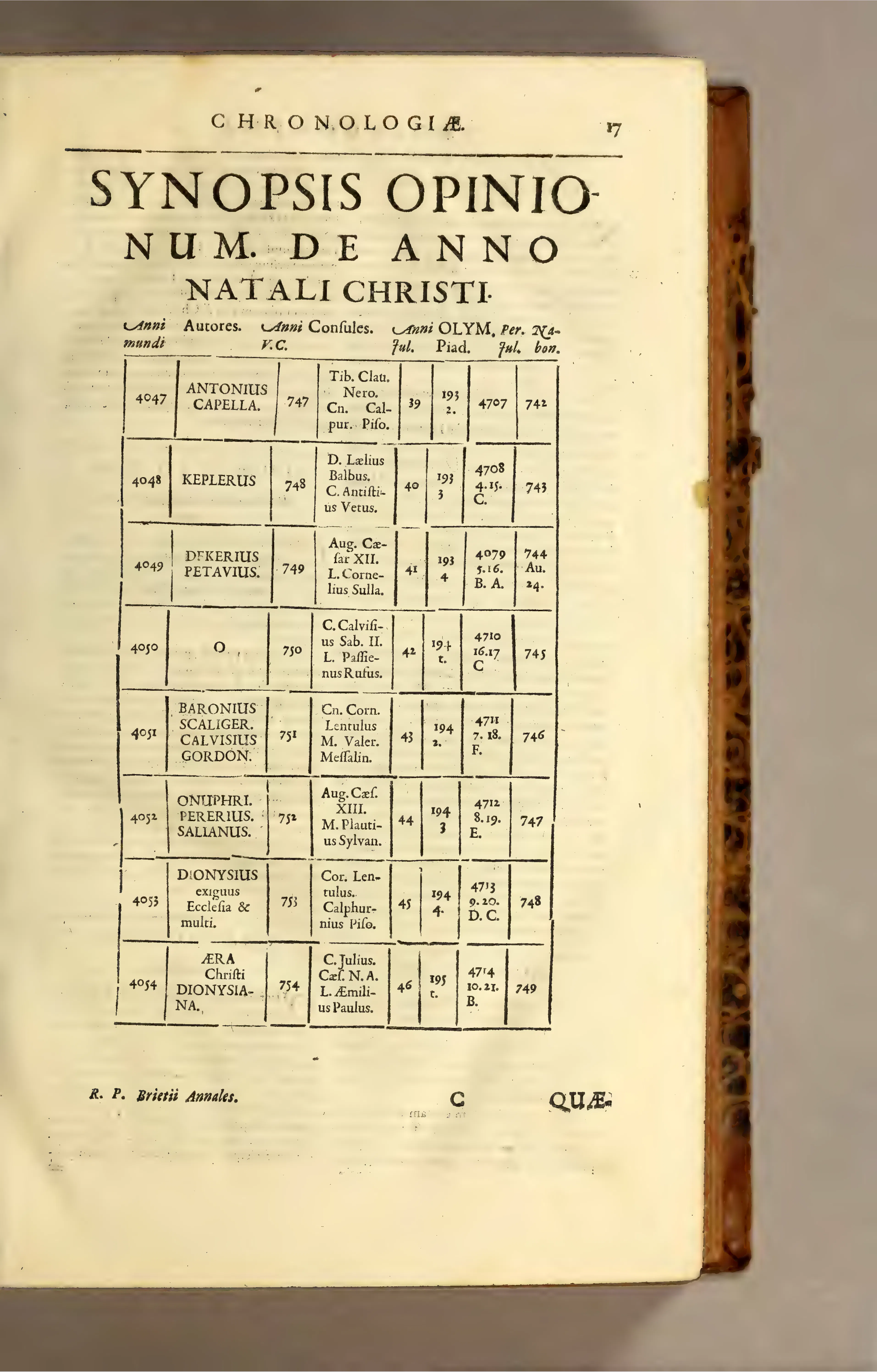
The preliminary "Synopsis opinionum. De anno natali Christi" makes even the Nativity year a comparative problem, ranging authorities such as Baronius, Scaliger, Petavius, and Dionysius Exiguus against Roman consuls, Olympiads, and Julian-period years. Like the recapitulation of the Egyptian dynasties, the grid holds incompatible traditions together rather than smoothing them into narrative. Source ↗.
The volume then turns from tabulated time to indexed time. The alphabetical index of things and words contained in the work is not a neutral finding-aid but a second exhibition of the book's structure, and it discloses two distinct strata of the volume. The first is a technical apparatus, gathered under numerals below twenty: a definitional entry asking what chronology is, then the lunar and solar cycles, the lunar month, the Julian period, epochs, the ages of the world, Olympiads, the founding of the City, Nabonassar, the Callippic period, the weeks of Daniel, and a run of eras — Seleucid, Antiochene, Spanish, the Julian, Actian and Herodian years, Dionysius Exiguus, the indiction, the era of the Martyrs. The index thus reveals, without narrating anything, that the work opens with a systematic treatise on reckoning before a single event is dated, and that the definition of the discipline precedes its exercise. Two of the entries in this stratum are especially telling: the Hegira and the capture of Constantinople stand here not as episodes of narrative but among the era-points, epoch-defining ruptures admitted into the repertoire of chronological instruments. A Catholic annalist's technical apparatus accommodates the Muslim era as a reckoning device even as his narrative construes the Ottoman advance as chastisement; the polemical and the computational registers make different demands, and the index shows both being met.
From the numeral twenty-three onwards the index turns to events, and its lemmata reproduce the grammar of the annal in miniature. Adam is created, Abel killed, Aaron consecrated and then dies, Abraham is born, goes into Egypt, dies, Abimelech reigns and is killed, Moses is born. The headword consists of a proper name and a passive or intransitive verb, which is to say that the index constitutes an event as something that befalls a named subject at a specifiable moment — the minimal datable unit out of which the entire sequence is built. Equally consequential is what the alphabet places side by side without hierarchy: Chaos and Paradise, the Babylonian tower and Prometheus, the giving of the Law, the manna and the golden calf alongside the Minotaur, the Labyrinth, Phaethon, Medea and the Argonauts. No typographic distinction marks sacred from fabulous matter, and each item alike carries a numeral. The alphabet is indifferent to the standing of what it files, but the numerals are not: by assigning every mythographic figure a place in the same paginated series, the index makes pagan fable as datable, and therefore as disputable, as scriptural history. The index also registers the instability of names it must accommodate, entering Enoch and Henoch at the same reference, and Joshua twice, under the Vulgate style and under the Greek-derived form, at a single place — a reader's courtesy that concedes how far the identification of persons in universal history depends on the collation of variant onomastic traditions. Taken together with the dynastic recapitulation, the two devices define the volume's ambition from opposite ends: the table makes the totality of time addable, the index makes it citable.
From the Heroic Age to the Founding of Rome
The stretch of annals running from the heroic age of Theseus and Hercules to the religious institutions of Numa Pompilius shows the work's characteristic unit of composition at its most legible: a notice assembled from collated authorities, occasionally adjudicated, and then closed by a compressed verdict. The moralized cadence that terminates the Theban expedition of the Seven is exemplary — thus the expedition, cruelly begun, was atrociously continued, and piously and religiously concluded, Sic crudeliter inchoata expeditio, atrociter continuata, piè ac religiosè terminata est. The tricolon is not ornament but the structural terminus of the annal: where a narrative historian would supply causal connectives, the annalist supplies a graded moral assessment of the three phases of an action, so that the year's entry closes on judgment rather than on citation. This is the same operation, at the smallest scale, that the work performs on empires and pontificates, and it explains why the annual form can carry an argument at all — each cell of the grid is not merely filled but appraised.
Immediately adjacent stands the opposite gesture, the deliberate refusal to appraise where the authorities cannot be reconciled. The foundation of Carthage generates a compact chronological quaestio in which Eusebius and Philistus, Appian, Menander as cited by Josephus, Josephus himself, Solinus, Trogus, Servius and Velleius are set out in series, and the reader is then directed, in the imperative already discussed above, to hold for himself the varied opinions of the authors who had fixed the founding of that most celebrated city relative to the Roman Parilia. Two things deserve notice. First, the second-person imperative habeto transfers the burden: the reader is made the holder of a spread of datings rather than the recipient of a single figure, which is precisely the posture of chronology conceived as a critical discipline rather than as a table to be consulted. Second, the interval is reckoned ante urbem conditam and pinned to the Parilia, so that even an unresolved dispute is expressed in the coordinates of the universal grid; the disagreement is registered inside the system, not outside it, and the resolution is deferred to a later year of the world where the harmonizing proposals of Petavius and Salianus — successive stages of building and enlargement — can be weighed.
The same page offers an unusually reflexive moment in a work written in the language it discusses. Recording the accession of Latinus in Latium, the annalist remarks that nothing is more illustrious than that from him the language which the Romans spoke, and by which they ruled the world, was called not Roman but Latin, Verùm nihil illustriùs quam quod ab eo lingua quà Romani loquuti sunt, & rexerunt Orbem non Romana, sed Latina nominata est. The observation belongs to the onomastic practice that runs through the whole chronicle, in which a name is made to disclose the circumstance that produced it; here the disclosure is that imperial speech carries the name of a pre-Roman kinglet, and that the instrument of world rule — rexerunt Orbem binds language and dominion in a single verb — is an inheritance rather than a conquest. For a seventeenth-century Jesuit composing a universal chronicle in Latin, the note quietly dignifies the medium of his own undertaking.
Source-criticism in this stretch is directed as sharply at exegetical tradition as at profane chronographers. On Jephthah's daughter the annalist refuses the reading that would spare her, and the refusal has already been set out above: the Hebrews who will have her consecrated rather than killed are not to be heard, and the question is put why in that case the virgin should have obtained two months for mourning. The argument is internal and philological: the two months of lamentation and the annual four-day commemoration are treated as textual data that the consecration reading cannot accommodate, and the rhetorical question does the work of a demonstration. The confessional frame is nonetheless explicit, the tradition being swept aside with the dismissal, away then from here with the ravings of the Rabbis, Apage enim hinc deliria Rabbinorum. The juxtaposition marks the boundary condition of the work's criticism: rabbinic interpretation is classified as deliria before it is examined, yet the examination that follows still proceeds by argument from the letter of the text rather than by appeal to authority alone.
Where the tradition is profane and irreducible, the annalist states his obligation with disarming precision. Having floated the rationalist suggestion that the Trojan Horse was in fact the siege-engine later called the ram, he concedes, in the formula quoted earlier, that what he is compelled to set out is not what was done there but what many have written. The distinction between quod gestum est and quod multi scripsere is the theoretical hinge of the whole enterprise: the annalist's warrant is the transmitted report, not the event, and the hedging fortè of that sentence concedes that even the compulsion is uncertain. The admission licenses the extensive use of Dictys Cretensis and Dares Phrygius for the Trojan set-piece without committing the chronicler to their veracity, and it prepares the moral use to which the whole is put, since the casualty totals are followed at once by the verdict that both victors and vanquished were plainly mad, who for the sake of an unchaste woman and a lustful ravisher destroyed so many thousands of men, Insanis planè victoribus, & victis, qui propter mulierem impudicam, & libidinosum raptorem tot hominum millia perdiderunt. The epic tradition is thereby transposed into an anti-heroic register: numbers gathered as antiquarian data are converted into an indictment, and the fabulous status of the sources is no obstacle to the moral, because the moral attaches to what has been written and believed.
That the moral order is meant to run continuously across sacred and profane matter is shown by the sententiae that recur in both. The treachery of Aeneas and Antenor yields the maxim that both, who had betrayed their fatherland in order to remain in it, were both compelled to depart from it, and that treachery never profited those who practised it, but only those who used it, Sic qui prodiderant ambo patriam ut in ea consisterent, ab ea discedere compulsi sunt ambo. Neque unquam proditio molestibus, sed tantùm utentibus profuit; the chiastic ambo … ambo and the antithesis of agent and beneficiary compress a general law of politics into a single period. The theological counterpart appears in the loss of the Ark, where judgment falls not on Israel but on its clergy: thus the Ark came into the hands of the Allophyli, since the crimes of the priests so required, and God preferred to be ignored and despised by idolaters than to be acknowledged and adored by impious priests, Sic Arca venit in Allophylorum manus, quoniam sic crimina Sacerdotum exigebant; & Deus ignorari, contemnique ab idololatris, quàm agnolci, & adorari ab impiis Sacerdotibus maluit. The Septuagintal Allophyli supplies the note of ritual alterity, and the comparative construction turns a military disaster into a statement about clerical unworthiness — a providentialism whose edge is directed inward at the priesthood.
The geographer's competence surfaces where sacred and modern knowledge collide over the location of Solomon's gold. The annalist reports that where this region Ophir was situated, from which gold and ivory were exported, is not yet clear, some wrongly foisting on us the Peruvian in America, others Taprobana, that is Ceylon, or Sumatra in Asia, others more plausibly offering Sofala in Africa, Ubi autem sita esset hæc Ophira regio, unde aurum, & ebur exportabatur, nondum liquet, aliis malè Peruanam in Americâ obtrudentibus; aliis Taprobanam id est Ceylanum, vel Sumatram in Asiâ; aliis Sophalam in Africâ meliùs offerentibus. The graded adverbs malè and meliùs rank the candidates without closing the question, and nondum liquet keeps the crux open in the same manner as the Carthaginian datings; the reported Portuguese finds of Solomonic remains at Sofala are then admitted not to escape suspicion of imposture. Biblical toponymy is thus made to absorb the results of oceanic navigation while remaining subject to the same tests of probability as any other transmitted claim.
The division of the volume is itself argumentative. The preface to the second part of the first tome, which opens at the founding of Rome, states the providential thesis in a clause caught mid-sentence in the printed line: for God willed that men should in a manner become Romans before, Prius enim homines quodammodo Romanos Deus fieri voluit, quàm — the sequel being that they should become Christians, and should learn to obey Augustus in order to submit themselves to Peter. Roman universal dominion is construed as the divinely arranged precondition of ecclesial obedience, and the qualifier quodammodo keeps the claim analogical rather than literal. Alongside it stands a principle of historical growth: as men grow gradually, so also do empires, and that people, the tamer of the world, struggled for nearly five hundred years to subdue Italy alone, Vt sensim homines, sic etiam imperia crescunt. Ille domitor orbis populus Romanus annis prope quingentis luctatus est, ut unam subjugaret Italiam. The organic simile justifies the partition of the part into two segmenta, the first exhibiting laborious increase to the First Punic War, the second magnificent triumph to the birth of Christ; periodization is derived from a theory of imperial maturation rather than imposed for convenience.
Rome's beginnings are then read as omen. Of the fratricide the annalist writes that however the matter stood, the first mortar of the Roman walls was diluted with royal blood, so that it might be intimated how much gore that city would pour out, which when it was being fortified had not spared even a brother's blood, Utut se res habuerit prima Romanorum murorum intrita regio sanguine diluta fuit; ut innueretur quantùm cruoris illa civitas esset profusura, quæ cum muniretur, neque fraterno sanguini pepercisset. The concessive Utut se res habuerit suspends the factual question — early Roman historians are noted to have tried to clear Romulus — while the omen holds regardless of which version is true, an economy that lets moral legibility survive source-critical doubt. The founding maxim recurs when Tarpeia betrays the citadel, and Rome first experienced that treachery is more useful to the one who receives it than to the one who commits it, ac primùm experta est Roma proditionem accipienti, quam facienti utiliorem esse, the repetition binding Trojan and Roman treasons into a single order of consequence. Yet the same years are also secured by strictly technical means, the annalist noting that this year is most famous for the Era of Nabonassar, than which there is none more celebrated in astronomical matters, Clarescit hic annus maximè Ærâ Nabonassaris, qua nulla est in Astronomicis rebus celebratior — an epoch whose value lies in eclipse computation, entered in the same column as auguries and asylum, so that the grid is fixed by astronomy at the very point where the narrative is governed by portent.
The Decade as a Unit of Composition
Further into the fourth century before Christ the same procedures are visible in a stretch whose two halves are held together by a single moral proposition about concord. The annalist first records a swift grant of peace to a city whose population, once the greater part of the enemy had been expelled by arms, contained nothing but citizens and men wholly of one mind, Sed pacem eis extemplo dedit ea urbe majorem hostium partem armis ejecti, in qua nihil præter cives, & concordissimos deprehendisset. [reading uncertain] — the syntax of the ablative phrase is disturbed in the printed line, but the sense of the superlative concordissimos is not in doubt, and it is the hinge of the entry. The reward of unanimity is immediately set against its opposite: the Latins and Volsci are crushed, their towns Satricum and Antium stormed, and out of the plunder taken from both there arose a grave quarrel between the Roman soldiers and the allies, with the result that the Romans laboured more under their own and mutual tumults than under the arms of the enemy, Tum Latini & Volsci oppressi, & horum urbes Satricum, & Antium expugnata, unde direptis ex utraque prædis exorta gravis inter milices Romanos, & socios contentio, ut suis mutuisque tumultibus, quàm hostium armis magis Romani laborarent. The construction is the annalist's characteristic one: a chain of participles compressing a campaign into a clause, followed by a consecutive ut which converts the narrative into a maxim. That maxim — that a polity is undone from within rather than from without — is the profane counterpart of the verdicts the work pronounces on ecclesiastical division, where the loss of a see or a communion is likewise traced to invidia and self-will rather than to the strength of the adversary. The same explanatory grammar serves republican Rome and the Greek church, which is one measure of how thoroughly the single sequence of time is also a single moral idiom.
What follows exposes the mechanism by which such notices are made citable at all. A new chapter is opened, headed CAP. VIII. and immediately subdivided as a decade of years, Decas Octava. Ab anno 3670. ad 3680., so that the chapter is not a topic but a span: ten years of the world, into which whatever the sources report must be distributed. Beneath the rubric stands the columnar apparatus, OLYMP. C. Mundi Urb. Cond. ann. 1. 3674. 374., which aligns the first year of the hundredth Olympiad with the year of the world 3674 and the year 374 from the founding of the city. Three mutually independent reckonings — a Greek quadrennial cycle counted from a games festival, a computation descending from the Creation, and a Roman civic epoch — are here made commensurable by simple juxtaposition in a single printed row, and every notice that follows is fixed by that row rather than by any narrative connection to what precedes it. Two consequences deserve remark. First, the third column in this stretch is not the year of Christ but the year of the city: in the pre-Christian reaches of the work the Roman epoch performs the office that the Incarnation performs later, which shows the grid to be adaptive rather than fixed in its constituent eras. Second, the alignment silently commits the work to a chronology of the world's age, since the equation of Mundi 3674 with Urb. Cond. 374 places the Creation something over four millennia before Christ — a computation of the shorter, Hebrew-text type rather than the expansive Septuagint reckoning, and one that is asserted here by tabular position alone, without argument. The learned controversy that stood behind such a figure is not rehearsed at the point where the figure does its work; it is presupposed, and the reader who wishes to contest it must contest a column heading.
Within that frame the annual entries are miniature causal arguments, each supplied with its own printed shoulder-note in the margin so that the year can be searched by matter as well as by date. Egyptian affairs are reduced to a proposition about the balance of powers: Ammonius, king of Egypt, proved superior to the kings of the Persians, since the Athenians too had an interest in Persian power being broken, which they were finding, thus enlarged, to their own hurt, Ammonius Ægypti Rex Regibus Persarum superior fuit; cùm Athenienses etiam pro eo staret, ut Persica potentia frangeretur, quam sic auctam suo malo experiebantur. The notice is not a report of events but an explanation of an outcome, and the operative phrase is suo malo experiebantur: Athens suffers from a greatness it had itself helped to procure. This is the moralized causality that the work applies with equal readiness to Hellenistic dynasts and to Christian princes — a harm is intelligible when it can be shown to issue from the sufferer's own earlier policy — and it explains why the annals can dispense with narrative transition. Each year yields a judgement, and judgements do not require continuity.
The entry on Dionysius of Syracuse compresses the topos of the tyrant interrupted. He too attempts great things, reaching for Rhodes, Crete and Delphi and preparing arms against the Carthaginians and Etruria, but death broke off all these attempts, cutting him off in mid-course of the victories that were being promised him, Dionysius quoque grandia molitur, dum Rhodum, Cretam, Delphosque appetit, Præterea in Carthaginienses & Hetruriam arma parat; sed hos omnes ejus conatus mors abrupit, in medio cursu victoriarum interceptum, quæ ei promittebantur. The historic present molitur set against the aorist finality of mors abrupit is the whole rhetorical burden of the sentence: ambition is granted its verb of continuous striving only to be cancelled. To this the annalist appends the literary humiliation, that he even carried off a prize for his poems in the Olympic contest, and that death imposed an end upon his published disgrace, Etiam Poëmatis suis in Olympico certamine præmium tulit, quæ mors ei publicati pudoris finem imposuit. The line is grammatically strained — the relative quæ has no clean antecedent, and the prize and the pudor publicatus sit in unresolved tension, since a victory is made the occasion of shame. The strain is instructive rather than merely careless: the annalist has telescoped a tradition in which the tyrant's verses were both crowned and derided into a single clause, and the seam shows. Compression on this scale, avowed elsewhere in the work as a deliberate principle of representation by which great things are rendered as points and lines, is purchased at the cost of exactly such syntactic knots, and the reader of the annals must often reconstruct the collated sources from the residue their abridgement has left.
The Roman notice of the same decade turns from moral causation to sacred practice. The people of Praeneste pay the penalty of their obstinacy, conquered by T. Quintius Cincinnatus, who detached eight peoples from their alliance, received Praeneste itself in surrender, and dedicated an image of the place to Jupiter Imperator with an inscription of his victories among the Volsci, Contumaciæ suæ poenas ferunt Prænestini, quos vicit T. Quintius Cincinnatus octo populis, ab eorum societate abductis. Ipsum Præneste in deditionem recepit, atque ejus loci simulacrum Iovi Imperatori dicavit, cum inscriptione suarum in Volscis victoriarum. Defeat is glossed at once as poena contumaciae, punishment for contumacy, a term that in ecclesiastical usage denotes obstinate refusal of a legitimate summons, so that the Latin town's resistance is classified in the vocabulary of jurisdiction rather than of war. The annalist then draws out the religious moral in a sentence whose transmission is imperfect, observing that thus the holiest things, both spoils and victories, were rendered to God, while by inscriptions display was made to mortals along with command and victory, Sic sanctissima Deo, & manubiæ, & victoriæ tributæ, & inscriptionibus in cadaveribus, cum imperio, & victoriâ mortalibus ostentata. [reading uncertain] The antithesis is between what is offered upward and what is exhibited to men, and the epithet sanctissima concedes to pagan Rome a genuine instinct of referring victory to the divine — the kind of concession that allows the work to read the Roman order as a preparation rather than merely as an idolatry to be denounced.
The decade's Greek entry then supplies the counter-example to the concord with which the sequence began, and the printed side-note announcing Concordia inter Græcos, concord among the Greeks, stands over a notice that records concord's dissolution. A treaty was entered into among all the Greeks that none should rule over others but each be contained within his own boundaries, by which measures Greece was hoped to stand in tranquillity; and at first the Thebans obtained their own right and command, but all were so desirous of new things that with a change in their will the tranquillity of Greece was soon over, Foedus omnibus Græcis inter se est initum, ut nulli aliis dominarentur, sed suis quisque terminis contineretur; quibus rebus Græcia in tranquillitate sperabatur consistere. Ac primùm Thebani suum obtinuerunt jus & imperium, sed ita omnes rerum novarum cupidi erant, ut brevi mutata cum illorum voluntate, Græciæ tranquillitas fuerit. Two features of the diction repay attention. The peace is described in juridical terms — jus, imperium, suis terminis contineretur — as though the common peace of the fourth century were a settlement of boundaries and titles of the kind an early modern publicist would recognize; and its failure is ascribed to men rerum novarum cupidi, greedy for revolution, the classical idiom for sedition. That phrase belongs to the same lexical family as the Novatores by whom the work classifies doctrinal innovators in its confessional stretches, and the continuity is not accidental: in both registers the fault named is a restless appetite for the new set against a settled order of right, and in both the consequence is the loss of tranquillitas. The peace is undone not by an invader but by the will of its own signatories, which returns the decade to the proposition established at its outset, that men suffer more from their own tumults than from the arms of their enemies.
The Triple Rubric and the Wars of the Middle Republic
The mechanism by which the whole work holds incommensurable reckonings in a single column of time is exposed most plainly not in a prooemium but in the year-headings that punctuate the narrative of the Second Punic War, where a Greek athletic era, the age of the created world, and the Roman civic era are set out as three figures on one ruled line, the third year of the hundred and forty-second Olympiad, the year of the world 3844, the year from the founding of the city 544, [OLYMP. CXLII. Mundi Urb. Cond.
ann. 3. 3844. 544.](https://tryleo.ai/share/5448eb7f-c056-426b-8d0e-ef24e29b54b0/?imageId=b2965dfe-d920-4c8a-b62a-a57d44b12851). The heading is set in two registers, the era-names above and their numbers beneath, so that the reader takes in a small table rather than a sentence; and because the same table recurs at every annual division, the reader is trained to perform the conversion without prompting. What is being asserted typographically is that these three ways of counting are three notations for one and the same instant: the Olympiad supplies the Greek historians' datum, annus mundi supplies the sacred datum by which any notice can be referred back to the Creation, and ab urbe condita supplies the Roman datum in which the annalist's chief sources for these years reckon. The middle figure does the coordinating work, since it alone is common to every notice in the book, and it is on this pivot that the claim of a single verifiable sequence rests. Nothing in the heading argues for the equivalence; the equivalence is enacted by the mere fact of horizontal alignment, and the reader who accepts the page accepts the synchronism.
Above the annual grid stands a larger periodization, declared in the running head that identifies the page as belonging to the thirty-ninth century of the world and to the sixth Roman division, 252 SÆC. MUNDI XXXIX. ROM. VI.. Two distinct scales are thus printed on the same line as the folio number: the saeculum mundi, a hundred-year band measured from the Creation and therefore indifferent to any political history, and a Roman sequence numbered independently of it. The first divides time arithmetically, the second divides it by imperium; the annalist keeps both in view at once and lets the reader locate a page either by the age of the world or by the phase of Roman power. This is the same reduction of scale that the work elsewhere avows as its method, and here it operates on the head-line itself: a century of world-time is compressed to a numeral, exactly as a great city is reduced to a point.
Within each annual cell the notices rotate among theatres — Italy, Spain, Macedonia and Achaea, the Seleucid east, Egypt, and the consular fasti at Rome — so that a year is presented as a set of simultaneous states of affairs rather than as a story. Simultaneity is the annalist's substitute for narrative connection, and the price he pays for it is that causal explanation must be delivered in a compressed final clause appended to each notice. Those clauses are where the annals stop registering and begin judging. So the Roman recovery of ground in Italy closes on an antithesis that is at once a summary of a decade and a verdict on Hannibal's whole Italian enterprise, Q. Fulvius Flaccus having recovered several towns among the Lucanians and by these operations driven Hannibal back into Bruttium, [Q. Fulvius Flaccus mox aliquot in Lucanis
oppida recepit, quibus rebus gestis in Bruttios
Annibalem repulit: quo pacto nulla ferè in
Italia relicta est provincia, in quâ non vicisset,
& à quâ non fuisset excussus](https://tryleo.ai/share/5448eb7f-c056-426b-8d0e-ef24e29b54b0/?imageId=b2965dfe-d920-4c8a-b62a-a57d44b12851), so that scarcely a province was left in Italy in which he had not conquered and from which he had not been shaken out. The chiasmus of vicisset and excussus converts a series of annual entries into a single sententious paradox, and the paradox does the explanatory work that a continuous narrative would otherwise have to supply: victory that leaves no possession is the form Carthaginian success takes, and the reader is given the moral of the war without departure from the annalistic form.
The same compressed judgment is turned against the pagan explanatory category most available in the sources. Philip V's campaign is reported as militarily successful and then immediately reframed, since he entrusted himself too far to fortune, [Fuit ergo bellum,
in quo Philippus feliciter admodum pugnavit;
sed nimium se fortunæ commisit, quæ jam eum
sui pertæsum spoliaverat, si à Deo & Rege
constitutus non fuisset [reading uncertain]](https://tryleo.ai/share/5448eb7f-c056-426b-8d0e-ef24e29b54b0/?imageId=b2965dfe-d920-4c8a-b62a-a57d44b12851), a fortune already weary of him which would have stripped him had he not been established by God and as king. The clause is textually insecure and its syntax will not bear heavy weight, but the theological operation is legible: fortuna, the term in which the Greek and Roman historians explain reversal, is admitted into the notice and then subordinated to a divine constitution of royal power that limits what fortune can take away. The annalist does not expel the pagan category, which would cost him his sources; he demotes it to a secondary cause operating under a providence that the sources themselves did not know. This is the characteristic maneuver of the work at the level of the single sentence, and it explains how a stretch of years containing no scriptural matter whatever can still be read providentially.
Moral reading extends from causes to consequences, and the notice on Marcellus's return from Sicily supplies the annals' version of a topos inherited from the Roman historians themselves, that the spoils of Syracuse first taught Rome to look at Greek art. Marcellus sought a triumph and obtained only the lesser honour on the Alban Mount, and there were displayed the royal riches and the most magnificent ornaments seized from the cities of Sicily, [Marcellus tunc Syracusis reversus triumphum
petiit, quem tantum in monte Albano obtinuit;
tumque ostentatæ sunt divitiæ regiæ, atque etiam
ornamenta magnificentissima urbium
Siciliæ ereptâ, quæ Romæ conquiverunt oculos, quos
posteà tot bella non oblectavere](https://tryleo.ai/share/5448eb7f-c056-426b-8d0e-ef24e29b54b0/?imageId=b2965dfe-d920-4c8a-b62a-a57d44b12851), objects which at Rome drew the eyes that so many later wars did not delight. The final relative clause carries the moral charge: military triumph is set against aesthetic captivation, and the reader is invited to see the beginning of a corruption in the very moment of victory. The transmitted wording of the clause is imperfect, which is a reminder that at this density of compression the annalist's judgments depend on single verbs that the press could damage; but the structure of the sentiment — spoils that seduce more than wars gratify — is intact and is offered as the significance of the entry.
Egyptian affairs at the death of Ptolemy Philopator introduce a different order of scrutiny, one directed at documents rather than at motives. The concealment of the king's death by Agathoclia and Agathocles is followed by the accession of the five-year-old Ptolemy Epiphanes, whose guardianship was made over to the nobles of the kingdom by a forged letter, [Cujus tutela pro
ceribus Regni per epistolam supposititiam à
Sosibio, atque Agathocle demandata est](https://tryleo.ai/share/5448eb7f-c056-426b-8d0e-ef24e29b54b0/?imageId=9d545b00-812f-4821-a73d-32bec36796b0), the instrument being ascribed to Sosibius and Agathocles. The technical term epistola supposititia belongs to the vocabulary of documentary criticism that the work applies elsewhere to canons and decretals, and its appearance inside a narrative notice is instructive: forgery is presented here not as a hazard of transmission afflicting the historian but as a political technique practised by the actors, a means by which a regency is stolen. The annalist's alertness to spurious instruments is thus not merely a scholar's caution about his sources; it is offered as a historical fact about how power has been seized, and the two senses reinforce one another.
Against that usurpation the Spanish material sets an exemplum of the opposite kind, in which restraint is at once a virtue and an instrument of policy. Among the captives at New Carthage was a most beautiful girl betrothed to Allucius, a chieftain of the Celtiberians, [Fuit inter captivos formosissima puella
sponsa Regulo Celtiberorum Allucio; hanc
Scipio non modò intactam suo sponso reddi
dit, sed & Auro quo à parentibus redimebatur;
quo facto tam Allucii, quàm Celtiberorum ani
mos sibi conciliavit](https://tryleo.ai/share/5448eb7f-c056-426b-8d0e-ef24e29b54b0/?imageId=9d545b00-812f-4821-a73d-32bec36796b0), whom Scipio returned to her betrothed not only untouched but with the gold by which her parents were ransoming her, and by that act won over the minds of Allucius and of the Celtiberians alike. The notice is constructed so that the moral and the political consequence are inseparable: non modò … sed & escalates the continence into liberality, and the closing ablative absolute converts both into the conciliation of a people. Placed in the same annual cell as the forged letter of Sosibius, the two entries form a silent comparison between two ways of acquiring authority over others, and the annalist leaves the comparison to the grid rather than drawing it out. That reticence is itself a feature of the method: within a year-by-year register whose notices are reduced almost to points, the juxtaposition of theatres does the argumentative work that a continuous history would assign to explicit commentary.
That same triple heading, whose numerals follow on the line beneath the era-names, continues to govern the year-entries as the annals move out of the Hannibalic war into the Macedonian and Syrian wars. It is the operative instrument by which a Campanian capitulation, a Roman censorship, Antiochus III's pursuit of Arsaces into Hyrcania and Philip V's Illyrian campaigns can be entered as coordinate data in a single column of time, so that the reader may pass from Italian to Seleucid to Macedonian matter without ever leaving the same cell of the grid. Above that annual apparatus stand two larger units, the decade and the world-age. Chapters are decadal, headed as the sixth decade running from the year 3850 to 3860, CAP. VI. / Decas Sexta. / Ab anno 3850. ad 3860, and books are secular, a new one opening as the fortieth age of the world, from the year of the world 3900 to 4000, LIBER VII. / SÆCULUM MUNDI / QUADRAGESIMUM. / Ab anno mundi 3900. ad 4000. The architecture is thus strictly arithmetical and strictly nested: century, decade, year. It carries no thematic caesura of its own, which is precisely its polemical utility, since the annalist can allow the Hasmonean revolt, the Macedonian wars and the Spanish sieges to fall where the numbers put them rather than where a narrative of nations would place them.
Within that frame the evaluative work is done by compressed sententiae attached to particular notices. The Marcellus notice already considered supplies the pattern at once, for where the general is denied a triumph and granted the lesser honour of an ovatio, the annalist turns the two ceremonies' insignia into a judgment, myrtle being seen to prevail over laurel and pipes over trumpets, [tumque Myrthus Lauro,
& tibiæ tubis visæ sunt prævalere](https://tryleo.ai/share/5448eb7f-c056-426b-8d0e-ef24e29b54b0/?imageId=b2965dfe-d920-4c8a-b62a-a57d44b12851). The Roman honorific gradation, in which the ovatio is by definition the diminished form, is inverted: the humbler wreath and the softer instrument are declared superior, and a technical point of public law is converted into a maxim about modesty. The same inversion structures the Metaurus set-piece, where Claudius Nero, having marched secretly to his colleague and destroyed Hasdrubal, follows the triumphing Livius on horseback, more noble by his own modesty than by his victory, [ipse eques triumphantem
in curru Livium secutus est, nobilior modestiâ
suâ quàm victoriâ](https://tryleo.ai/share/5448eb7f-c056-426b-8d0e-ef24e29b54b0/?imageId=9d545b00-812f-4821-a73d-32bec36796b0). Renunciation of honour is thereby made the highest form of honour, and the comparative nobilior performs the transaction in a single word. What gives these verdicts their force in an annalistic register is their brevity: they are not developed arguments but ratings appended to a dated fact, and their repetition across many entries builds a consistent scale of value without ever interrupting the sequence.
That scale is applied to Rome's own institutions as readily as to individuals, and not always to Rome's advantage. When the Campanians, having accused the consul Fulvius before the Senate, receive from that body a sentence harsher than the general's, the annalist reaches for a Homeric commonplace, so that while fleeing the Scylla of Q. Fulvius the unhappy Campanians fell into the Charybdis of the Roman Senate, [Ita dum Scyllam Q. Fulvium fugiunt in Carybdim
Senatum Romanum infelices inciderunt](https://tryleo.ai/share/5448eb7f-c056-426b-8d0e-ef24e29b54b0/?imageId=b2965dfe-d920-4c8a-b62a-a57d44b12851). The wit is mythological, but the judgment is juridical: the epithet infelices places the sympathy with the condemned provincials, and the figure makes appeal to the sovereign body worse than submission to the magistrate. Elsewhere the elective heroism of the exemplum is staged with equal economy, when, all murmuring and no one offering himself, the young Scipio demands the Spanish province from a higher place, [mussantibus
omnibus, & offerente se nemine, ex superiori
loco P. Cornelius Scipio Publii cæsi in Hispania
ilius, hanc sibi provinciam depoposcit](https://tryleo.ai/share/5448eb7f-c056-426b-8d0e-ef24e29b54b0/?imageId=b2965dfe-d920-4c8a-b62a-a57d44b12851) — the printed ilius standing for filius, one of several places in these sheets where a dropped initial letter betrays the compositor rather than the copy.
As the annals move eastward the moral vocabulary shifts into a constitutional one, and the recurrent theme becomes the conversion of Hellenistic multipolarity into a single arbitral authority. After treaty terms are referred to Rome for ratification the annalist draws the conclusion in one clause, thus the Senate and People of Rome were the arbiter of kings, Sic erat arbiter Regum Senatus Populusque Romanus. The formula is deliberately juristic: arbiter is the private-law term for a chosen judge, and its transfer to relations between crowned heads describes hegemony as a jurisdiction rather than as conquest. The counterpart to Roman arbitration is Greek servility, and the annalist finds his emblem for it in the Isthmian proclamation of liberty, where the acclamation was such that crows flying over the assembly fell down, and Quinctius was no longer held a barbarian but worshipped as almost a god by Greeks most skilled in flattery, [ut corvi supervolantes concioni,
deciderent, Quintius non jam ut Barbarus haberetur, sed ut propè Deus, à
Cræcis adulandi peritissimis, coleretur](https://tryleo.ai/share/5448eb7f-c056-426b-8d0e-ef24e29b54b0/?imageId=9730e512-9565-4f22-8943-8405c0d4be57) (the printed Cræcis for Græcis is another compositorial slip). The marvel of the falling birds, which in the Livian tradition attests the volume of the shout, is here bent into a moral: the same voices that acclaim liberty manufacture a god, and the superlative adulandi peritissimis turns a political scene into a national character-judgment that will be reused when the annals reach the later fortunes of the Greek East.
The most severe of these juridical escalations concerns Perseus. After the poison plot the Roman People thereafter thought it must deal with him not as with a king, but as with a public enemy of the human race, [Itaque Populus
Romanus deinceps non putavit agendum cum
Perseo, ut cum Rege, sed cum publico humani
generis inimico](https://tryleo.ai/share/5448eb7f-c056-426b-8d0e-ef24e29b54b0/?imageId=bc59bbb3-c2c4-4ec3-a532-fe2e247d4ca6). The phrase does real work: royal standing is what makes negotiation obligatory, and its forfeiture converts a war between states into a prosecution. The category of the hostis humani generis is one the annalist can deploy because his moral scale is not confined to civil law, and the parallel theological category is sacrilegium, under which temple-robbers are seen to be overtaken by punishment in kind — a penalty plainly worthy of the sacrilege, dignâ planè poenâ sacrilegio. Providence, in this idiom, is not a supplementary commentary but a rule of proportion visible in the outcomes themselves.
The Jewish material is threaded into the same annual columns, and its entry is marked by an explicit statement of chronological method: the formula examined earlier, by which the blows of Heliodorus are said to fall into the fourth year of Seleucus Philopator, with chapter and book of Maccabees cited, belongs to this stretch of the annals. The verb cadunt is the technical language of the chronologer — an event "falls into" a year — and the citation of chapter and book shows that the sacer textus is being handled as a datable document, its narrative sequence used to secure a Seleucid regnal year. The corollary is stated when the Hasmonean sequence reaches John Hyrcanus and the canonical books give out, in the declaration already discussed above that here the history of the sacred codices of the Old Testament ends, and that thereafter its most certain light will be wanting, to the great damage also of human credit — the compound certissimiluce being set solid in the print. The remark is the epistemological hinge of this stretch. What is lost is not edification but evidential quality: with the inspired codices the annalist forfeits his one incorrigible witness, and humanæ fidei damno concedes that even profane history was steadied by having a fixed point against which human testimony could be checked.
That concern with the credit of witnesses is not reserved for the scriptural threshold. Reporting a treasury figure, the annalist suspends judgment because here the credit of the Plinian codices wavers, quia hic Plinianorum codicum vacillat fides — fides here meaning the trustworthiness of the transmitted text rather than of its author, so that a numerical discrepancy is diagnosed as a defect of copying. The same critical reflex governs the death-notice of Plautus, entered on an authority rather than as a fact, Jerome writing that M. Accius Plautus died in that year, [Obiisse hoc anno M. Accium Plautum scribit
Hieronymus](https://tryleo.ai/share/5448eb7f-c056-426b-8d0e-ef24e29b54b0/?imageId=ee1e2aa0-5a42-411f-85a1-e827f71cfcd7), where the construction leaves the attribution with its source.
The closing movement of this stretch reads the Republic's decline as a sequence of structural faults rather than of misfortunes. Roman venality is stated in Sallustian terms as an established fact known even to a Numidian, Jugurtha having long since learned that all things at Rome were for sale, [nisi jam prid
didicisset omnia Romæ esse vænalia](https://tryleo.ai/share/5448eb7f-c056-426b-8d0e-ef24e29b54b0/?imageId=24bb10ed-d9d4-43dd-be3e-a16ce7fcf6c8), and made the explanatory principle for the failure of Roman diplomacy in Africa. The verdict on the extraordinary commands is sharper still, the lex Manilia being described as what was indeed to subject the whole Roman empire dangerously to one man, [quod profectò fuit totum imperium Romanu
uni viro periculosè subjicere](https://tryleo.ai/share/5448eb7f-c056-426b-8d0e-ef24e29b54b0/?imageId=f3d28123-cc73-4d42-8182-29dd1720a782), the truncated Romanu marking another dropped letter at the line-end. The adverb periculosè diagnoses rather than laments: concentration of imperium is identified as the constitutional mechanism whose consequences the following years will register, and the annalist has thereby supplied, within the confines of a dated notice, a causal proposition that the succeeding entries of the sequence are left to verify.
From the Late Republic to the Destruction of Jerusalem
The late-Republican decades are handled with a compression that leaves the classical moral vocabulary wholly intact. Resuming the Catilinarian conspiracy under the consuls of 64 B.C., the entry reports that Catiline bound his associates to himself by an unspeakable sacrifice, with human blood even drunk, and urged them to change the state of the commonwealth and bring in new account-books, Eos autem nefando sacrificio, haustoque etiam humano sanguine, inter se devinxit, & invitavit ad mutandum Reip. statum, novasque tabulas inducendas. Two things are worth noting about the handling. The Sallustian topos of the blood-oath is carried over without the hedging that the annalist elsewhere applies to marvels and legends, because the sacral perjury is not a prodigy but a moral datum; and the technical phrase novae tabulae, the cancellation of debts, is retained as the economic substance of the sedition, so that the conspiracy is registered simultaneously as a religious abomination and as a fiscal programme. The annual form here does not thin the classical source; it selects the two clauses that make the entry legible as both crime and policy.
The Pompeian settlement of the East receives the kind of epigrammatic closure that recurs throughout these decades: peace was given by Pompey to the whole East, the Armenian and Parthian disputes being also settled, and the Roman Empire was advanced as far as the Euphrates, so that Asia, where Pompey had begun the war, became the navel of the Roman Empire, which before had been its boundary and limit, Ita pax à Pompejo toti Orienti data, compositis etiam Armenorum, Parthorumque controversiis; Romanum Imperium ad Euphratem usque promotum, ut Asia, unde bellum inchoarat Pompejus, fieret Romani Imperii umbilicus, qui antea limes, & terminus fuerat. The antithesis of umbilicus against limes and terminus is a spatial figure doing chronological work: the same territory changes its meaning by changing its position within a whole, which is precisely the operation an annalistic grid performs on events. It is the geographer's cast of mind expressed as a sententia, and it converts a campaign narrative into a statement about the reconfiguration of an empire's centre.
Caesar's first consulship is entered under a juridical rather than a psychological heading, the annals recording that at that time Caesar laid the foundations of his tyranny, pore Cæsar suæ Tyrannidis fundamenta jecit, and the substantiation is drawn out in a catalogue of sacrilege and venality: and first, being in need of money, he stole three thousand pounds of gold in the Capitol and replaced as much in gilded bronze; he sold at a price everything that had formerly been given free, the more powerful the more criminal he was, and religious only so far as his ambition allowed, Ac primùm cum indigeret pecuniâ tria millia pondo auri furatus in Capitolio, tantundem inaurati æris reposuit: omnia addixit pretio, quæ ante donari consueverant, eò potentior quò sceleratior, & tantùm religiosus quantum fua sineret ambitio. The two comparative clauses are the verdict, and they are delivered in the manner of Tacitus rather than argued: power grows as a function of criminality, piety shrinks to whatever ambition can spare. The choice of tyrannis over mere dominatio or ambitio matters, since it classes the fall of the Republic as a constitutional offence with a name, in the same lexical register in which the work elsewhere classifies doctrinal deviation. Moral judgement and juridical categorization are one act.
The same vocabulary is then turned against Rome itself in the Judaean material, where provincialization and tributary status mark the extinction of a polity — Jerusalem made tributary to the Romans, Hierosolyma facta Romanis stipendiaria — and where the end of the Hasmonean house draws an unusually direct expression of sympathy: in this prince the family of the Hasmoneans failed, and he was cruelly slain for no other cause than that he had tried to preserve his ancestral inheritance against the tyranny of the Romans and of Herod, In hoc principe defecit Assamonaeorum familia, & crudeliter cæsus est non aliud ob causam, quàm quodavitam hæreditatem servare adversus Romanorum & Herodis Tyrannidem conatus esset. The pairing of Roman and Herodian tyrannis in a single genitive is pointed: the providential reading of Rome as preparation for the Church, which governs the work at large, does not here suspend the juridical assessment of Roman conduct, and legitimate hereditary right is allowed to stand against imperial expansion even where the expansion is part of the divine economy. The verdict on the Idumaean is correspondingly cool, Herod being the callidus princeps who marries his betrothed Mariamne understanding that she would bring him the kingdom as her dowry once Antigonus was dead, ubi Mariannem desponsatam sibi ducit uxorem, quàm ad se deferre dotale regnum, mortuo Antigono, callidus princeps intelligebat. Dotale regnum reduces the Hasmonean claim to a marriage portion, a juridical metaphor that says more about the character of Herodian legitimacy than a page of narrative would.
At the Julian reform the annalist steps briefly out of the annalistic voice to speak as a technician of his own discipline, noting that from this year also the Julian years proceed, and the one that immediately follows is the first Julian year, which consisting of 365 days and about six hours inserts every fourth year one extra day made up of those six hours multiplied four times, which they call the bissextile, to the great advantage of chronology and of the reckoning of time — the printed line being defective in several places: Ex quoque anno procedunt anni Juliani, & qui simè sequitur, primus annus Julianus est, qui stans ex diebus 365. & sex circiter horis, tro quoque anno diem unum interserit ex lliscirciter horis quater in unum ductis conm, quem Bissextilem vocant, magno Chrogiæ, ac rei temporariæ commodo. The praise is instrumental rather than antiquarian: a calendar is commended for the service it renders to chronologia, that is, for making the single sequence computable. Caesar's political act is condemned under the heading of tyranny; his calendrical act is welcomed as an aid to the very grid within which the condemnation is recorded, and the annals show no discomfort in holding both.
The Augustan settlement is analysed with comparable sharpness. Of the provincial division the entry observes that by which act, full of the greatest prudence, he disarmed the Senate and reserved all the forces of the empire to himself, Quo facto prudentiæ plenissimo, Sena exarmavit, sibi vires omnes Imperii reserv. The commendation of prudentia sits in evident tension with what the act accomplishes, and the tension is the point: the annalist grants the statesman's calculation its technical name while describing the disarming of the res publica, and leaves the reader to register that the prudent measure and the constitutional extinction are the same measure. The new titulature is treated in the double register that the work reserves for names, at once onomastic commentary and era-reckoning, the annals holding that the utterance sounds holy and venerable, and above the condition of men, and that from this year therefore the Augustan years run, Ea vox sa& venerandum sonat, & hominum tione superiorem; ex hoc igitur anni Aug rum decurrunt. A quasi-sacral honorific becomes an epoch: the semantic analysis of the word and its chronological function are inseparable, and the reader is shown the mechanism by which a political name enters the apparatus of dating.
The first volume closes not with an annal but with dogma. The Nativity entry states that in that place the Queen of heaven and earth bore without pain her son and her God, as she had conceived without pleasure, and wrapped in swaddling-clothes she laid him in a wooden manger plastered over, with straw spread beneath, In eo loco coeli terræque Regina, sine dolore filium suum atque Deum peperit, uti sine voluptate conceperat, & pannis involutum, substrato foeno in præsepio ligneo, lutatoque repoluit. Two Marian privileges are asserted in a single antithesis, and the sentence then descends abruptly to the material particulars of the manger — wood, plaster, straw — so that theological exemption and physical poverty are yoked in one clause. The same procedure is visible at the Annunciation, where the annal becomes scholastic exposition: in her most chaste womb, by the working of the Holy Spirit, from her most pure blood, God-man was formed, possessed of reason, adorned with all the gifts of nature and of grace, head and ruler of angels and of men, in ejus castissimis visceribus, opera Spiritus sancti ex purissimo ejus sanguine Deus homo formatus est, rationis compos, omnibus naturæ, ac gratiæ donis exornatus, Angelorum hominumque caput & rector. Rationis compos at the instant of conception is a technical determination, not a narrative datum: the annual cell is here occupied by a proposition of speculative theology, dated as precisely as a consulship.
The prefatory matter of the second volume states the method that governs what follows, in the geographers' analogy already set out above, by which great cities are described by points, large rivers by little lines, and long tracts of mountain and plain by small intervals. The analogy is an admission and a defence at once: the notice is a sign of a magnitude, not the magnitude itself, and the reader is expected to supply scale — an epistemology of abbreviation that justifies the serial catalogues of pontiffs, emperors, councils, heresiarchs, persecutions, schisms, and orders that precede the first book, in which whole institutional histories are reduced to enumerated points.
Within the Christian era the confessional programme becomes explicit at the doctrinally load-bearing dates. The Holy Thursday entry imports the language of Trent, stating that he wonderfully concealed his body and blood under the species of bread and wine, so that the Body and Blood of Christ filled up the lost nature of bread and wine, to which adhere only the accidents of bread and wine, pus enim suum & sanguinem sub speciebus nis atque vini mitabiliter occultavit, adeò ut perditam panis & vini naturam Christi Cor & Sanguis explerent, quibus adhærent taxat accidentia panis & vini. The precision of accidentia subsisting without their proper substance is not narrative but scholastic definition, placed inside a dated annal so that the doctrine acquires a position in the sequence of time. The Roman see is dated with the same deliberateness, Antioch being left behind, Peter established the episcopal see at Rome on the fifteenth of the Kalends of February, where he also sat about 24 years, relictâ Antiochiâ Petrus sedem Episcopalem constituit Romæ xv. xal. Febr. ubi & sedit annos circiter 24 — a day-precise notice because the chronology is itself the argument, and it leads directly into the rebuttal of the confessional adversaries over the Petrine Babylon, Quam vocem dum Novatores in Romam, where the polemical classification and the philological reading of a scriptural place-name again operate as one procedure.
Persecution enters the sequence under the enumerative scheme that the volume's front matter had already tabulated, the Neronian entry carrying the rubric PRIMA PERSECUTIO and reporting that he diverted these fires onto the Christians, of whom there was then at Rome no small multitude, some of whom he had covered with the skins of beasts to be torn by wild animals, others smeared with pitch and sulphur he ordered to burn as torches, and to furnish a cruel light for nocturnal spectacles, Nam in Christianos, quorum erat tum Romæ non exigua multitudo, hæc incendia derivavit, quorum aliquos ferarum pellibus tectos à bestiis lacerandos curavit, alios pice ac sulphure illitos pro facibus ardere jussit, & crudelem nocturnis spectaculis exhibere lucem. The Latin follows Tacitus closely, and the borrowing is instructive: a pagan historian's account is taken over as the evidentiary basis of the first term in an ecclesiastical series, so that hostile testimony underwrites the martyrological scheme. The Jewish War is treated with the same combination of source-fidelity and exegetical adjudication, the Danielic abominatio desolationis being weighed as a chronological crux, Sic enim abominatio desolationis à Daniele, and the horrors of the siege retained from Josephus without abridgement, among the rest Mary, a very rich and noble woman, all her food having been seized by the soldiers, ate her own son, and this was discovered from the smell of the roasting flesh, Inter cæteras Mariæ prædives ac nobilis foemina omnibus edulibus per milites raptis, filium comedit suum, idque agnitum ex nidore assatæ carnis. The chapter then abandons the annalistic register altogether for the peroration already set out above, in which the holy city, having stretched out its hands against its God, is so chastised that no age will be silent about its destruction and the whole world shudders at the hearing of it. The rhetorical economy is exact: the physical detail supplied from a Jewish eyewitness furnishes the evidence, and the providential clause supplies the verdict, the two lodged in the same annual entry and neither softening the other.
Persecution, Prodigy, and the Criticism of Documents
Across the stretch of years from the last phase of Domitian's reign to the aftermath of Sardica, the annals hold to a single, unvarying scaffold: every year is headed by a three-part rubric giving the year of the world, the year from the founding of the City, and the year of Christ; ten years are gathered into a decas under its own chapter number; ten decades make a book, and each book carries one century. The uniformity is not merely typographic convenience. It is the operative claim of the work — that a persecution edict, a praetorian jurist's codification, an Alexandrian episcopal succession, and a Dacian campaign can be lodged in the same cell of a universal grid and read off against one another. What the material of this stretch supplies is the test case, since here the annalist has left the inspired testimony behind and must proceed on the credit of Suetonius, Dio, the Historia Augusta, Eusebius, and the conciliar record, weighed one against another.
The Domitianic close of the first century establishes the tonal signature of the whole. A notice of the emperor's severity against Vestal unchastity is capped by a moral inversion, the annalist observing that thus the emperor punished incestuous unions while he himself, fouler and more shameful, defiled his own brother's daughter, and harried doves with his censorship while sparing the raven, Sic puniebat incestos concubitus Imperator,. The closing clause is a Juvenalian tag, and its redeployment shows how the annual form absorbs satire as evidence: the epigram is not ornament appended to the notice but the notice's verdict, the compressed judicial sentence that the annalistic unit exists to deliver. The same year yields the classic instance of imperial blasphemy, where Domitian, dictating a formal letter in the name of his procurators, began it thus, "Our Lord and God orders this to be done," Cùm Domitianus tum procuratorum suorum. What follows is more interesting than the indictment: the annalist turns immediately to Martial, whose use of the titulature is excused as adulationis non est, sed necessitatis, flattery being reclassified as compulsion. Within a portrait built entirely of accusation, a literary judgment is entered on the other side, and the criterion is the poet's situation under a tyrant rather than the words on the page — a small but telling instance of the work's willingness to distinguish the responsibility of an author from the language he was constrained to use.
The technical apparatus is never far from the moral one. Where the origin of the fifteen-year fiscal cycle is at stake, the annalist records that Scaliger thinks the origin of the Indictions arose thence, Scaliger ortam originem Indictionum putat;, and then declines the derivation. Naming the greatest of the chronologers as the holder of a rejected opinion is a deliberate posture: it locates the annals inside the critical discipline rather than beside it, and it establishes that the year-columns are the product of adjudication among moderns as well as ancients. The same instinct governs the treatment of corrupt readings, where a false name or a misplaced document is referred back to its material cause, so that, as the annalist puts it, an error therefore arose from the carelessness of the copyists, Igitur ex Librariorum incuriâ natus er. Scribal negligence functions here as a diagnostic category of the first order: it permits a tradition to be discarded without impugning the authority whose name it bears, and it is applied indifferently to profane geography and to ecclesiastical documents.
The persecution notices give the stretch its ecclesiastical spine, and they are handled with an eye to legal texture rather than to atrocity alone. The Plinian correspondence is compressed into a single annalistic ruling, that Trajan replies they are not to be sought out but, if brought forward, to be punished — absurdly, for if they are evil, why not seek them; if good, why punish them, says Tertullian, respondet Trajanus quærendos non. The polemical stroke is ceded to Tertullian by explicit attribution, which is characteristic: the annalist reports the Apologeticum's dilemma as an authority's argument rather than assuming it in his own voice, thereby keeping the annalistic notice within the register of documentary summary while allowing the ancient apologist to carry the indictment. Against this juridical dryness the martyr entries are pitched at a wholly different intensity. Ignatius, led to Rome and exposed in the amphitheatre, is described as thus broken and ground down, which he had most vehemently desired, offered to God as the sweetest bread, fearing this one thing only, lest the beasts should prove gentler and fawning, S. Ignatius deductus Romam, in Amphithea. The eucharistic metaphor is not the annalist's invention but the martyr's own, lifted from the letter to the Romans, so that the notice becomes a citation of the victim's theology rather than a description of his death; the fear of a gentle beast, retained from the same source, converts the expected pathos into the paradox that the sufferer's only anxiety is that the sentence might fail.
Where marvels enter the record, they are subjected to comparison of witnesses. On the rain miracle under Marcus Aurelius, the annalist reports that then most of the Christian soldiers from Melitene in Armenia, kneeling and adoring their God, obtained rain for their own side and fire, hail and lightning for the enemy, Tum Christiani milites plerique ex Melitinâ, and then sets against this the pagan accounts — the Egyptian magician Arnuphis in Dio, the emperor's own supplication — before returning to the letter transmitted with Justin's Apology. The procedure is the same source-critical weighing exercised on secular chronology, applied to a prodigy: the competing explanations are named, their bearers identified, and the decision rested on documentary attachment rather than on edification. The corresponding rigour on hagiographic titles is stated as a rule of terminology, the annalist observing that since the name of Martyr, like that of Confessor, was granted to those who had suffered something for the Faith and had not breathed their last amid the torments, from this name alone one concludes only that the man was enrolled among the saints not without labour and hardship, Sed cum Martyris nomen,. This is critical hagiography in miniature: a title in an ancient list is treated as evidence of limited probative force, and an uncertain case is resolved by determining what the word could and could not have meant when it was applied.
The Decian and Diocletianic material shows the same taxonomic temper turned on the Church's internal discipline. The fallen are sorted into named classes, among them the libellatici who purchased certificates of compliance, the annalist noting that another class was that of the Libellatici, Altera classis erat Libellaticorum. To distinguish sacrificati, thurificati, idololatrae and libellatici is to make degrees of apostasy into a juridical scale on which penance can be measured, and the annals reproduce the distinction because the Cyprianic controversy is unintelligible without it. The adjacent rubric supplies the dynamic principle behind the classification, since schism is separated from heresy juridically only to be linked causally, the annalist remarking that the slide from schism into heresy is an easy one, est enim proclivis à schismate in Hære — a formula that permits Novatian's rupture to be treated first as a disciplinary offence and then as a doctrinal one without the record having to choose between the two.
Chronology itself becomes a site of confessional appropriation in this book. Of the Diocletianic era the annals record that it runs on, afterwards called from hatred of him the Era of the Martyrs, decurrit, postea ex ejus odio dicta Æra Martyrum. Here the work's own instrument — the era, the reckoning-base by which years are counted — is shown being renamed by the community that suffered under it, so that the persecutor's calendar is turned into a monument of his victims. For a chronicle whose method depends on the commensurability of eras, the notice is doubly pointed: the same numbering serves two irreconcilable memories, and the annalist registers the substitution as an act of hatred rather than as a neutral change of label. The Constantinian turn follows in the same critical key. On the vision before the Milvian Bridge the annals report that as Constantine was moving against him, the sun declining past midday, as he himself testified to Eusebius, he saw with his whole army a cross formed of light in the sky bearing the words "conquer in this," Cùm igitur Constantinus in eum moveret,. The attribution is exact — the emperor's testimony to a named historian — and it is followed by a technical description of the standard, a spear with a small transverse piece of wood and the letters X and P interlaced, so that the prodigy is fixed in a describable artefact and in a chain of witness rather than left as a report.
The conciliar material of the fourth century brings the computistical and the critical strands together. The Nicene decision is stated in its operative form, the annalist recording that the Council turned to the causes of the Church and decreed that Easter be celebrated by all on the same day, that is, on the Lord's Day which most nearly follows the fourteenth of the moon of the first month, Ergo ad causas Ecclesiæ. Stated with its equinoctial limit at 21 March, this is the rule on which the whole apparatus of the surrounding years depends, and its appearance inside an annual entry rather than in a preliminary table is itself an argument: the norm that governs the reckoning is presented as an event within the sequence it governs. The most sustained piece of source-criticism in the stretch concerns the two synods of 343, where the annalist explains that when the Arian bishops saw that in this Council neither force nor fraud could prevail against the most holy bishops deciding in equity, they slipped away from the Synod and gathered another at Philippi in Thrace out of bishops of their own faction, which they maliciously also called the Sardican, posse, sanctissimis Episcopis ex æquitate statuen. The disentangling of the genuine Sardican canons from the decrees of the rival assembly is what allows the annals to explain why Fathers of unimpeachable standing appear in the record as hostile to "Sardica": the name, not the council, is the forgery. Applied to a body of canons that bore directly on Roman appellate jurisdiction, the demonstration shows the philological instrument being used where its results were least comfortable, and it belongs to the same operation as the reference of a corrupt place-name to a copyist's inattention — one method, exercised without regard to whether the document under scrutiny is profane or ecclesiastical.
Arians, Franks, and the Limits of Apology
The stretch running from the last years of Constantius II to Belisarius's Vandal triumph is printed under the same triple year-rubric — the world-year, the year from the founding of the City, and the year of Christ — and subdivided into books, chapters, and ten-year Decades, with signature marks, catchwords, and the running foot R.P. Brietii Annales carrying the reader through columns framed by printed marginal rubrics. Within this apparatus the compositional unit is remarkably stable: a compressed annalistic notice, then a sententia that assigns the notice its moral or juridical value. The Arian crisis furnishes the pattern immediately. The Roman plebs' shout on behalf of the exiled Liberius is recorded and then instantly deprived of its consolation, the people having publicly acclaimed "One God, one Christ, one bishop," whereupon the emperor promised that Liberius would be restored, but gave him back only corrupted, publicè acclamatum, Deus, unus Christus, unus Episcopus; quare restituendum Liberium pollicitus est, sed nonnisi corruptum reddidit. The acclamation is the plebs' rejection of the anti-pope Felix, and a confessional annalist might have been content to leave it as the vindication of legitimate succession; instead the entry is made to anticipate, in a single participle, the later subscription that would embarrass the see. The technique is worth naming precisely: the sententia does not soften the annal but pre-judges the sequel, so that the year-cell holds both the event and its consequence.
The same year-cells carry a sustained argument about the competence of secular power in ecclesiastical matters, and the argument is conducted by contrast rather than by treatise. Where Valens is shown conceding a council to the Macedonians, the western emperor is credited with the sounder answer, the more prudent Valentinian having replied to the bishops' envoys that these councils lay not in the power of a lay emperor but of the bishops, sapientior Valentinianus Episcoporum legatis respondit, hæc Concilia non in potestate Imperatoris laici, sed Episcoporum esse. The whole force of the notice rests on one adjective: to call an Augustus laicus is to place him inside the ecclesiological taxonomy of clergy and laity rather than above it, and thereby to resolve a question of imperial jurisdiction into a question of ecclesiastical order. That this is a genuine principle, and not merely partisanship for the western court, appears from the annalist's willingness to record the costs of ecclesiastical grandeur without suppression. The pagan prefect's gibe to Damasus is set down in direct speech — make me bishop of Rome, and I will become a Christian at once, Facite me Romanum Pontificem, e[ss]e statim fiam Christianus: — and immediately turned into a double-edged maxim on the wealth of the first see, which brings good popes double glory and bad ones double disgrace. The concession is calculated: by admitting the scandal and moralising it, the annalist keeps the polemical initiative that outright denial would have surrendered.
Elsewhere the axiom does the work that evidence might have been expected to do. Rejecting the claim that the Arian Ulfila first brought the Goths to Christianity, and preferring the Nicene Theophilus, the annalist argues from principle rather than from testimony, for it is certain that heretics were never fit to enlarge the Church, but only to divide and shake it, certum est enim hæreticos nunquam idoneos fuisse ad amplificandam Ecclesiam, sed ad eam dividendam, & labefactandam. Here the critical apparatus and the confessional commitment are not merely simultaneous but fused, since a proposition about the nature of heresy is deployed to settle a disputed question of missionary chronology. A comparable move governs the conciliar canons that touched Roman precedence, where the annalist combines procedural irregularity with non-reception, reporting that some hold something was conceded to the bishop of Constantinople by the departing bishops, namely that he should be second after the Roman pontiff, but that this was disapproved and so little received that not even the Eastern bishops themselves admitted it, Multis Episcopis ex Synodo digressis aliquid concessum Episcopo Constantinopolitanio volunt, videlicet ut à Romano Pontifice secundus esset; sed hoc improbatum, & tam parum receptum, ut neque ab ipsis Orientalibus Episcopis admitteretur — the same reasoning that will be turned, later in the same book, against Chalcedon's twenty-eighth canon.
Precisely because that apologetic machinery is so visible, the Apiarius dossier is the most instructive sequence in this portion. The African bishops' denial that the canon on appeals to Rome was Nicene, the embassy to the East for authentic copies, and the synods of two hundred and seventeen bishops are all reported, and the outcome is conceded flatly against the papal use of the text, in the admission already discussed above that the canon cited by Zosimus belonged not to Nicaea but to Sardica. The critical method applied to Gothic missions and imperial etymologies is here turned inward upon the documentary basis of Roman appellate jurisdiction, and the annalist accepts the philological finding without attempting to rescue the citation. The reader is thus given, within a few dozen pages, both the apologetic reflex and its self-correction.
The doctrine of religious coercion is built up across widely separated annals into a position that is consistent without being lenient. The execution of the Priscillianists at Trier is condemned and its authors excommunicated while the principle of princely correction is retained, for that reason both he and his associates were separated from Catholic communion, since the Church seeks that the wicked be corrected by princes, but short of blood, quare tam hic quàm ejus socii à communionem Catholicâ separati sunt; quoniam Ecclesia petit improbos à Principibus emendari, verùm citra sanguinem. Two decades of annals later the same doctrine is given its positive form in the Donatist dossier, where Augustine begged the count Marcellinus to spare those convicted of murder, and that their blood be spared who had shed Catholic blood so freely and so cruelly, since the Church profits not by striking but by suffering, S. Augustinus Marcellinum Comitem oravit, ut iis de cæde convictis parceret, & ab eorum sanguine parceretur, qui Catholicorum sanguinem tam laxe, tam atrociter profudissent; quoniam Ecclesia non cædendo, sed patiendo proficit. The formula citra sanguinem is the hinge between the two entries; the annalist has distributed a single theory of ecclesiastical clemency across the annual grid, so that the moral coherence of the work must be assembled by a reader moving forward through years rather than read off any one notice.
That same grid disciplines the treatment of pious tradition. The martyrdom of the eleven thousand virgins at Cologne is neither affirmed nor refuted but assigned to a category, the annalist declaring of the story that we so believe it as to judge that many fables have been attached to this history, and that to sift the truth out of them is not the business of this work, which hastens on to more certain matters, An autem militibus ejus missæ sint undecim millia Virginum, quæ ad Coloniam Agrippinam trucidatæ sunt cum S. Ursula ab Hunnis, ita credimus ut huic historiæ multas fabulas alligatas esse judicemus; ex quibus veritatem excernere, non est hujus operis ad alia certiora festinantis. The genre of the compendium is invoked as a licence for suspended judgment, and the same device recurs when the authenticity objections to the Dionysian corpus are set out at length and then left unadjudicated, since it is not the business of this work, nor his own, to compose such great quarrels, hujus operis non est, neque nostri zantas compone re lites — where the garbled zantas compone re for tantas componere is a slip of the press rather than of the author. Restraint is thus not a failure of nerve but a declared property of the form.
The structural caesura of this portion is likewise argued rather than merely executed. The decade rubric, so rigorously imposed elsewhere, is openly subordinated to epochal significance, the annalist observing that the following year belongs to this decade too, but that since an illustrious epoch begins in it, he judged that the other part of this tome should be drawn from it, Qui sequitur annus, ad hanc quoque Decadem spectat; sed cum in eo illustris incipiat Epocche; unde alteram hujus Tomi partem ducendam existimavimus. What follows is a fresh internal title-page naming the author, PHILIPPO BRIETIO ABBAVILLÆO Societatis IESU Sacerdote, a proem that grounds the division in the Frankish monarchy as the bulwark God chose for his Church, and a silent typographic consequence: the year-rubric drops the Urb. Cond. column and prints only world-year and Christ-year thereafter. The abandonment of Roman foundation-reckoning at exactly the point where the Frankish kingdom begins is the periodizing thesis made visible in the setting of the page, and it is the clearest instance in this portion of the printed apparatus carrying an argument.
The consequences of that thesis are drawn without embarrassment when Clovis appears, chosen by God to be the safeguard of his Church, pagan though he was, while the whole East and West groaned under heretical princes, because a heathen usually displeases God less than a heterodox, Clodovæus, hoc est, Ludovicus primus, annos ferè quindecim natus, Francis, mortuo Childerico patre, præficitur, feligitui que à Deo ut esset præsidium Ecclesiæ suæ, paganus licet, dum universus Oriens & Occidens sub Principibus Hæreticis gemeret, quia Deo plerumque minùs Ethnicus, quàm Heterodoxus displicet. The comparative ranking of Ethnicus below Heterodoxus is the sharpest confessional axiom in this stretch, and it converts the accident of Frankish paganism into a providential qualification. Yet the panegyric has a philological limit, for immediately after Tolbiac and the baptism at Reims the annalist withholds assent from the regalia-legends, determining nothing here concerning the holy Ampulla let down from heaven, the emblems of the lilies in place of the diadems or the toads, and the Oriflamme, because the controversy is matter for a larger work, De sacra Ampullâ cœlitus delapsâ, insignibus Liliorum pro Diadematis vel Bufonibus, & Auriflammâ, nihil hîc statuimus, quia majoris est operis controversia,. The kingdom is providentially elected; its sacral insignia are left in suspense.
Doctrinal conflict, meanwhile, is repeatedly resolved into a point of language, as when Nestorius is convicted by an accent, saying of the Virgin that she was not Deipara but born of God, and by the change of a single mark becoming a bad grammarian and a fouler heretic, quam non esse Deiparam, sed à Deo genitam dixit: unius apicis mutatione malus Grammaticus, & turpior hæreticus effectus — the grammatical and the dogmatic offence graded on one scale. At the far end of this portion the annalist locates his own labour against the reigning technical standard, noting that down to this year of Christ 533 that most learned master of the art, Dionysius Petavius, wove his Chronicon, in which nothing can be desired except that it stopped too soon, Ad hunc annum Christi 533. Chronicon suum texuit vir artis hujus scientissimus Dionysius Petavius, in quo nihil desiderari potest, nisi quòd citiùs desierit. The compliment doubles as a statement of the annalist's own warrant: beyond the year at which the Petavian scaffolding gives way, the single sequence must be carried on by the compiler's own adjudication of witnesses.
The Ninth Century: Conversion, Succession, and the Greek Schism
The ninth-century annals, gathered under the running head of the forty-ninth age of the world and the ninth century of Christ, and carried across the openings by the running head of the first part of the second tome, run from the conversion of the Bulgars in the year of the world 4898, the year of Christ 845, to the creation of Nicholas I in 4909; and their movement is fourfold. The conversion narrative opens the stretch as a providential demonstration, the Bulgar king yielding at last as one overcome by Christian affairs rather than by Bulgars, the notice building its causal chain out of a captured brother instructed in the faith, of Christian captives prevailing in Bulgaria, and of the monk Theodorus Cuphara ransomed by Theodora at the request of the Bulgar king's sister, and closing on an inversion of martial hierarchy by which the king is conquered by his own children, by women, and by captives. The spine of the stretch is then supplied by the chain of pontifical obits and successions — Sergius II to Leo IV, Leo IV to Benedict III, and at length Nicholas I — each entry giving regnal arithmetic to the day and paternal filiation, natione Romanus, patre Radoaldo, and each headed by its era-pair, MUNDI CHRISTI. 4899. 846., so that the synchronized grid is visible in the smallest unit of ecclesiastical record. Into that chain is set the attempt of the cardinal presbyter Anastasius upon the see, twice reported, first by attachment to the imperial legates and then, in the annalist's phrase, vi & armis sedem invasit, by force and arms; and it is resolved by a compressed moral verdict on the successor who bore himself so as to show himself worthy of the seat another had invaded. The argumentative climax is the deposition of Ignatius and the intrusion of Photius, from which the schism of the Greeks is said to have arisen and to endure to the present hour, and Nicholas I's rejection of the Photian election closes the sequence in a great contention between East and West. A secondary thread runs beneath these: the Saracen incursions, read first as chastisement in the spoliation of St Peter's, then as providential deliverance in the victories at Corduba and in Spain and in the repulse from the Roman Port, with papal initiative and divine aid alike named as the causes of secular victory.
The rhetorical habits of the stretch are consistent, and several deserve separate notice. The sharpest formulation in these years is a paradox of self-defeating persecution, since the punishment of the Manichaeans is judged more destructive to the Church than the heresy itself had been, because the persecuted fled to the Saracens and betrayed Christian provinces — a case in which providential reading yields a criticism of imperial anti-heretical policy on prudential grounds. Nearly every decade-notice terminates in a compressed antithesis or moral balance of that kind, and character is dispatched in two adjectives, Photius being learned indeed but ambitious and destructive to the Church, Benedict III illustrious for sanctity and learning, Nicholas I a great man and a defender of the Church. The claim that the Greek schism endures to the present hour is one of the devices by which the single sequence of time is made to bear on the author's own confessional situation. And the printed marginalia function throughout as an apparatus of retrieval — Bulgari convertuntur, Michael impietas, Ignatius exulat, Nicolaus I. Papa — a feature of the folio's material design as consequential for use as the year-columns themselves. The transmission, finally, is not everywhere sound: the Anastasius notice is garbled in the printed line, and the decade heading omits the anno Christi figures for the years 4904 to 4909. The passages on which this reading rests are these:
- [conversion / inversion of hierarchy] And so the impious King was conquered by his own children, in the warfare of Christ, and by women and by captives — sicque impius Rex à liberis suis, in militiâ Christi victus, atque à foeminis, & captivis
- [persecution paradox] And thus the punishment of the Manichaeans was more destructive to the Church than the heresy itself had been — sicque perniciosior Ecclesiæ Manichæorum poena, quàm ipsa fuit hæresis
- [papal succession formula] Leo IV, when he had sat eight years, three months, six days, died on the fifteenth of the Kalends of August; to whom succeeded Benedict III, a Roman by nation, his father Peter — Leo IV. cùm sedisset annos 8. menses 3. dies 6. obiit 15. Kal. Aug. cui successit Benedictus III. natione Romanus, patre Petro
- [moral verdict / antipope] But Benedict so bore himself that he showed himself worthy of that see which he had invaded under Anastasius — Ita autem se gessit Benedictus, ut se dignum eâ sede ostenderet, quam sub Anastasio invaserat
- [schism / continuity to the present] Whence arose the schism of the Greeks, which endures even to this present time — unde ortum est schisma Græcorum, quod ad hoc usque tempus perdurat
- [character sketch] a man learned indeed, but ambitious, and destructive to the Church — hominem doctum quidem, sed ambitiosum, & Ecclesiæ perniciosum
- [east–west contention] Whence a great contention arose between East and West — unde magna contentio inter Orientem & Occidentem exorta est
- [providential agency in secular victory] by the aid of Pope Leo — ope Leonis Papæ
- [textual state] The Anastasius notice is transmitted in a defective state, the printed line running: because against those, on whose account he was not at Rome, the sentence of Louis the Pious, from the clergy, or where he had wished — quia in eos, quorum causâ Romæ non erat, sententiam Ludovici Pii, à Cleri, aut quà voluerat...
From the Leaden Age to the First Crusade
The same run of ninth-century annals, governed by century-books, decade-chapters and per-year rubrics coupling an anno mundi figure to an anno Christi figure, displays at once the coordinating ambition of the grid and the moral vocabulary in which its notices are cast. The conversion of the Bulgars is registered not as a diplomatic or doctrinal event but as an effect of fear induced by a painted image, the prince being judicii extremi picturâ territo, terrified by a depiction of the last judgment; the notice is characteristic in compressing cause, instrument, and moral into a single ablative phrase. The same economy governs the classification of doctrinal deviance. Gottschalk of Orbais does not enter as a theologian with a position but as a labelled agent, disseminator hæresis Prædestinatianorum, a disseminator of the heresy of the Predestinarians — a designation that in the middle of the seventeenth century could not be neutral, since the controversies over grace and predestination then dividing French theologians gave the ninth-century condemnation an immediate polemical afterlife. The annalist neither explains the doctrine nor argues against it; he assigns it a name already carrying its verdict, and the year-entry moves on.
Where the record cannot be settled by classification, however, the critical apparatus visibly engages. The Constantinopolitan council of 861 is refused the dignity of the term synodus and reduced to a Conciliabulum 318. Episcoporum, a conventicle of three hundred and eighteen bishops — the numeral itself a silent polemic, since it echoes the traditional count of the Nicene fathers and so exposes the assembly's pretension. But the harder problem is the presence of Roman signatures on an assembly Rome rejected, and here the annalist argues rather than labels: Balsamon called this synod ecumenical, Pope Nicholas a robber-council; the papal legates did indeed subscribe to it, but compelled by a fear that would seem to fall even upon brave and constant men, being threatened with longer exiles and dreadful starvation, and with Ignatius held up before them as an example, Hanc Synodum Balsamon dixit Oecumenicam, Nicolaus Papa Latrocinalem; huic quidem subscripsere Legati Pontificii, sed metu compulsi, qui in viros fortes & constantes cadere videretur, intentatis eis longioribus exiliis, atrocique fame, & exemplo Ignatii ostentato. The structure of the argument deserves notice: the documentary fact is conceded in full, and the inference from signature to consent is then severed by a reconstruction of duress, with an explicit concession that the coercion was of a kind to overcome even resolute men. This is not the suppression of an inconvenient datum but its reinterpretation, and it is the same operation — separating an act's material occurrence from its juridical value — that recurs whenever ecclesiastical scandal is admitted.
The willingness to place the adversary's case on the page in its own form is more striking still where the Greek indictment of Latin usage is reproduced as an enumerated dossier: for they raised ten heads against the Roman Church, by which they also reproached it with ten errors — first the Sabbath fast, second the procession of the Holy Spirit from the Father and the Son, third that they forbade priests to take wives, Enimvero capita decem objecere Ecclesiæ Romanæ, quibus & decem errores exprobrabant. 1. Jejunium Sabbati. 2. Processionem Spiritus sancti ex Patre, & Filio. 3. quòd prohiberent Presbyteros uxores ducere. The numbered form belongs to the polemical genre of the capitula, and its reproduction serves the annalist's purposes precisely because he can then name Hincmar of Reims and Odo of Beauvais as the respondents: the grievances are archived rather than answered in the annal itself, the refutation delegated to authorities cited by name. That the second head is the Filioque is significant for the arc of this run, since the annals elsewhere treat the insertion as the publication of what the churches had long since held, FILIOQUE; quod jampridem fecerant Ecclesiæ — a formula that converts an innovation in the text of the creed into the making explicit of an existing belief, and so removes the chronological difficulty by relocating it from doctrine to promulgation.
The tenth-century book opens by supplying a periodizing judgment that is simultaneously an apology for the state of the evidence. The century is characterized by metallic epithets, its men having flourished hoc sæculo planè plumbeo, vel ferreo, extitere, in this age plainly leaden, or rather iron; the descent below the Hesiodic and Ovidian iron age to lead makes the point that the defect is not only moral but documentary, the ignorance and carelessness of the century's writers explaining the poverty and confusion of its records and thereby licensing the annalist's own corrections. The judgment is then made good by a concession of remarkable bluntness for a Jesuit ecclesiastical historian: this Sergius III begot a son from Marozia, a noble whore, who afterwards under the name of John XI disgraced the seat of Peter, Hic porrò Sergius III. ex Marozia nobili scorto filium genuit, qui postea sub Joannis XI. nomine, Petri deturpavit sedem. The scandal of the Roman aristocratic domination is not minimized; the verb deturpavit concedes the disgrace as fact. What follows the concession is the compensating argument — that from this period no schism or heresy arose — and its complement, the formal distinction between the man and the office, stated of John X, who although of most foul morals nonetheless administered the pontificate not badly, having been approved by the clergy, and who taught that bad prelates and rulers are sometimes good and useful to others, qui licet moribus foedissimis, nihilo tamen minùs non malè Pontificatum administravit, jam probatus à Clero; docuitque sibi malos præsules & rectores nonnunquam aliis bonos & utiles esse. The clause jam probatus à Clero carries the juridical weight: canonical approbation, not virtue, constitutes the title, and the moral verdict is thus permitted its full severity because it has been rendered irrelevant to validity.
That defensive architecture is turned outward at the imperial concessions of 962, where the annalist rebuts a specific confessional use of the record: wherefore the heterodox here insult in vain the Roman see of St Peter and the pontiffs, and wish to subject them to emperors, whom at that time the Roman pontiffs felt and acknowledged rather as their defenders than their assailants, Quamobrem hic frustra Heterodoxi insultant S. Petri Romainæ sedi, ac Pontificibus, eosque subdere volunt Imperatoribus; quos tunc temporis potiùs propugnatoras suas, quàm oppugnatores Romani Pontifices senserunt, & agnoverunt. The argument is historicist in form: the conditions imposed on papal elections are read as emergency remedies against local tyrant-intruders, valid for their moment and not as constitutional principle. Yet the very next movement of the entry limits the imperial role by an independent criterion, reporting that soon a plague raging in Otto's army showed that all these things had displeased God, and that princes who involve themselves in ecclesiastical affairs, however good they may be, have always found God an avenger, Sed mox pestis in exercitu Othonis grassata, ostendit hæc omnia displicuisse Deo, Principes qui se rebus Ecclesiasticis immiscent, quantumvis bonos, semper Deum ultorem expertos esse. The two sentences stand in productive tension: the emperor is a defender when the polemical need is to deny structural subjection, and an intruder punished by pestilence when the need is to deny that his concessions established a right. Providential reading here does not supplement the juridical argument but adjudicates it, the epidemic functioning as evidence in a constitutional dispute.
The eleventh-century book opens by disposing of the year-1000 terror in the same double motion of refusal and concession: it was reckoned by very many that the world would end when the thousandth year from Christ's birth had run out, and the utterly depraved morals of Christians demanded it; but that fear was empty, nor was the world amended, but made worse, Actatum à plerisque desiturum Mundum, cùm à nato Christo annus millesimus effet evolurus: & id perditissimi Christianorum mores exigebant; verùm metus is vanus fuit; nec emendatus est Orbis terrarum, sed pejor est effectus. The eschatological computation is dismissed as vanus, which is what a discipline of eras must do with a prophetic reckoning; the moral diagnosis that generated it is nonetheless retained and even sharpened, since the expected chastisement failed to reform. Against this refusal of anachronistic prophecy stands an anachronism of a different order in the same year-neighbourhood, where the eucharistic controversy is introduced under a sixteenth-century confessional rubric, the heresy of the Sacramentarians having emerged, its author Leutheric archbishop of Sens, emersisse Sacramentariorum hæresis, authore Leutherico Senonensi Archiepiscopo. The retrospective label makes the eleventh century legible within the classificatory grid of the annalist's own confessional era, and the procedure is the obverse of his philological caution: where dates and documents are tested, heresies are genealogically continuous and may be named by their latest form.
The reform narrative culminates in two entries whose evidentiary logic is that of the ordeal rather than the archive. At Canossa the pontiff, amid the solemnities of the Mass, having taken one part of the mysteries and asking God that if he were guilty he might perish by sudden death, offered the other part to Henry, but he did not dare receive it, Pontifex inter solemnia Missarum, parte mysteriorum acceptâ, rogans Deum ut si reus esset subitâ periret morte, aliam partem Henrico obtulit, sed hanc ille recipere non est ausus; the king's refusal is made to function as a confession, and the sacrament as a juridical instrument of proof. The death of Gregory VII then supplies the run's most celebrated utterance, the pope dying at Salerno, having sat eleven years, one month, and three days, and pronouncing these words: I have loved justice and hated iniquity, therefore I die in exile, obiit tum quoque Salerni Gregorius VII. cùm sedisset annis 11. mense uno, diebus tribus, hæc verba pronuncians, Dilexi Iustitiam, & odi Iniquitatem, propterea morior in exilio. The exact regnal computation to the day is the annalist's own contribution, fixing the sentence in the grid; the claim appended to it, that the body was found wholly incorrupt after nearly five hundred years, converts hagiographic report into corroboration of the dictum's justice.
The turn to the crusade is announced as a structural pivot of the work itself, the annalist declaring that now the holy war against the Saracens of Palestine calls us to itself and to the third part of this work, Sed jam bellum Sacrum in Saracenos Palæstinæ nos ad se, atq[ue] ad tertiam hujusce operis partem vocat — the division of the printed set thus coinciding with a thematic caesura rather than a mere reckoning of sheets. In the Clermont entry that follows, the force of ecclesiastical censure is demonstrated by a diplomatic argument of exactly the kind a philologist would value: there came together at Clermont on the appointed day thirteen archbishops and one hundred and five bishops, who firmly excommunicated Philip king of the Franks on account of his marriage with Bertrada, and that anathema was so scrupulously observed that at this time in most charters it was written not "in the reign of Philip" but "in the reign of Jesus", Convenerunt ergo Claromontem ad condicam diem 13. Archiepiscopi, & 105. Episcopi, qui Philippum Francorum Regem, propter nuptias cum Bertradâ, fortiter excommunicarunt: quod anathema tam accuratè servatum, ut hoc tempore in plerisque diplomatis, non regnante Philippo sed regnante Iesu scriberetur. The proof is drawn from dating formulae in charters, that is, from the very apparatus by which a chronologer establishes years — the annalist's professional instrument redeployed as evidence of a spiritual sanction's practical bite, and applied, notably, to a French king. The crusade narrative then closes on a portrait in which royal ceremonial is refused for christological reasons, since never would that king consent to be crowned with gold, or to sit upon a throne, where his God had been wreathed with thorns and had lain in hay, but he always sat upon straw, neque enim unquam Rex auro coronari voluit, aut in throno sedere, ubi Deus suus spinis redimitus, atque in foeno jacuisset, sed semper sedit in stramine. Gold against thorns, throne against hay, the seat of majesty against straw: the antitheses are arranged so that the Latin kingship of Jerusalem is defined by what it declines, and the notice, capped by the ascending tricolon that Godfrey was great in winning the kingdom, greater in governing it, and greatest in leaving it, shows the annal at its most compressed, delivering a moral judgment in the same space it allots to a dynastic succession.
A Decade of the Fourteenth Century
Two centuries further on the apparatus is at work with no change of principle, and for the fourth decade of the fourteenth century the evidence is best presented as it stands, since the interest of the stretch lies in the capitular structure taken whole and in the juxtaposition, within single years, of French, Imperial, Byzantine and Ottoman notices.
- [Ottoman advance through Greek discord] Meanwhile the Byzantines were so pinched by famine that most crossed over into Turkey; and the Turks besides were occupying the towns of Bithynia, and chiefly Prusa and Nicomedia: thus through the foolish and inhuman Greeks the empire of the Turks took its increase — Interea sic angebantur Byzantini fame, ut plerique in Turciam sese transferrent: qui præterea occupabant Bithyniæ oppida, & præcipuè Prusam, & Nicomediam: sic per fatuos, & inhumanos Græcos incrementa sumpsit Turcarum imperium.
- [Ottoman advance / loss of Nicaea] Andronicus the Younger fought unsuccessfully with the Turks and lost Nicaea, a city which was the capital of Bithynia and most celebrated for two councils — Andronicus Junior cum Turcis pugnavit infeliciter, & Nicæam amisit; quæ urbs Bithyniæ caput fuit, & Conciliis duobus celeberrima.
- [moral verdict on a deposed king] He was unfit for the kingdom, but not so unfit that a son and a wife should rise against him thus; on whose account no one is approved, however deservedly he was deprived of the kingdom — Erat ille ineptus regno, sed non tam ineptus, cui in eum sic à filio & uxore insurgeretur; quorum causâ nemo probatus, quantumvis etiam ille regno privatus sit merito.
- [anti-Jewish violence and its adjudication] In this year there occurred the coming of the Pastoureaux into France, very many men, as before, vagrant and idle, most hostile to Jews and to churchmen, who, when they heard that the Templars were subverting Christians by means of the Jews and destroying them by poison, rushed upon them inhumanly and slaughtered them — Contigit hoc anno adventus Pastorellorum in Francia, hominum plurimorum, sicut antea, vagorum, & desidiosorum, Iudæis, & Ecclesiasticis maximè infensorum, qui cum audirent Templarios, Christianos Iudæis subvertere, & veneno interimere, in eos irruerunt inhumanè, ac trucidarunt.
- [schism as self-inflicted ruin] Louis the Bavarian was not only struck with anathema by John XXII but also stripped of the Empire; whence great schisms arose against the Church, as damaging to the German nation as they were destructive — Ludovicus Bavarus, à Joanne XXII. non tantùm anathemate perculsus est, sed & Imperio spoliatus; unde exorta magna schismata in Ecclesiam, & Germanæ Nationi tam damnosa, quàm perniciosa.
- [providential and moral reading of dynastic succession] Charles the Fair died this year on the third day before the Nones of February in the castle of Bois de Vincennes, when he had reigned six years, one month and twenty-seven days, of disease; no male being left, whence arose the controversy over the French kingdom, which the Salic law and the Estates of the realm decided, adjudging it to Philip of Valois, Charles's paternal uncle, against Edward the Englishman, son of Charles's sister: whence nevertheless great wars afterwards blazed up, by which Gaul was long harassed — Carolus Pulcher hoc anno obiit 3. Non. Febr. in castro Bosco de Vincennes, cùm regnasset annis 6. mensibus 1. diebus 27. ex morbo; nullo relicto masculo, unde exorta est controversia de Francico regno, quam Salica lex, & Ordines Regni deciderunt, adjudicantes Philippo Valesio, patruo Caroli, contra Eduardum Anglum, sororis Caroli filium: unde tamen postea magna bella exarsere, quibus Gallia diu vexata est.
- [compressed literary judgement] In this year died Dante Alighieri, the Florentine poet, in the fifty-sixth year of his age, at Ravenna, more praised in his poem than in his writings; for otherwise he was ill-willed and evil-speaking against pontiffs and prelates, and thought badly of the pontificate and the privileges of the Roman Church — Obiit hoc anno Dantes Aligerius Poëta Florentinus, ætatis anno 56. Ravennæ, laudatior in Poëmate suo, quàm in scriptis. Nam alioqui malevolus, & maledicus in Pontifices atque Præsules, & de Ecclesiæ Romanæ pontificatu, & privilegiis malè sentiens.
- [chronological grid: paired era columns and decade structure] Chapter III. The Third Decade. From the year of Christ 1320 to 1330 — CAP. III. Decas Tertia. Ab anno Christi 1320. ad 1330.
- [astrological criticism] There flourished at this time in France Vasco de Tinemuc, otherwise called de Tinemer, moderately learned but signally fabulous, of the herd of astrologers — Florebat hoc tempore in Franciâ Vasco de Tinemuc, aliter dictus de Tinemer, mediocriter doctus, sed insigniter fabulosus, Astrologorum grex.
The 1440s: Printing, Council, and the Turkish Advance
The decade of the 1440s opens under its own rubric as the fifth decas of the fifteenth century, and the first matter admitted to the annual column is neither dynastic nor conciliar but technical: the annalist records that the art was first invented at Strasbourg, whence it was carried over to Mainz by four artificers in 1442, among whom Johannes Gutenberg, or Cuteberg, soon made use of copper matrices, though they report that in 1444 Gerson's book On the Imitation of Christ was printed at Strasbourg, a great instrument for bringing both goods and evils into the world, [primùm inventam Argentinæ, unde
translata Moguntiam à quatuor artificibus 1442.
inter quos Joan. Gutenbergensis, seu Cutebergus
mox usus est æncis matricibus; verùm anno 1444.
excusum ferunt Argentinæ Gersonis librum de
imitatione Christi, magno bonorum & malorum
in Orbem invehendorum instrumento.](https://tryleo.ai/share/5448eb7f-c056-426b-8d0e-ef24e29b54b0/?imageId=3f4e9d0c-13da-4255-9d4b-5237d8f498ac) Three habits of the work are compressed into this one notice. The competing claims of Strasbourg and Mainz are not adjudicated but distributed, invention assigned to the one city and transfer to the other, with the hedge ferunt marking the 1444 imprint as reported rather than asserted; the inventor's name is given in two forms, Gutenbergensis, seu Cutebergus, the onomastic variant registered as a datum rather than silently normalized; and the Imitatio is entered under Gerson's name, a position within an authorship question already contested when the annals were printed. The closing ablative is the characteristic move by which a notice acquires its verdict: the press is appraised not as a good but as an instrumentum of double efficacy, capable of conveying bona and mala alike into the world. A providential estimate is thereby attached to a mechanical art without any narrative being told about it, and the reader is left with an evaluation that will not resolve into praise.
The conciliar material of the same years is handled by a figure drawn from the theatre. After the forty-fourth session, the final session of 1 May, the ratified rejection of Ferrara and the subscriptions of Felix V, the assembly persists in Lausanne and in the legations of the nations; when Frederick IV is invited to Basel, the annals conclude that all was in vain, since their drama was inclining toward its catastrophe, [sed omnia frustra fuere, cùm eorum
Fabula vergeret ad Catastrophen.](https://tryleo.ai/share/5448eb7f-c056-426b-8d0e-ef24e29b54b0/?imageId=5580f992-3d08-403a-b6a2-d9f6efc30f5a) Fabula and catastrophe are technical terms of dramatic composition, the second denoting the final turn by which a plot is resolved; applied to a general council they convert a juridical contest over the seat of authority into a spectacle whose ending is already determined by its own construction. The metaphor performs a piece of periodization: the residual Basel of the 1440s is not refuted but assigned a genre, and its later acts require no argument because the plot admits only one dénouement.
That the annals' censure is not reserved for schismatics appears in the notice of Alfonso's entry into Naples, where the pontiff is measured on the same scale as the prince: Alfonso having entered Naples in the manner of one triumphing, Eugenius hurled thunderbolts against him otherwise than was fair, yet since Alfonso strove to reconcile him it is doubtful which of the two was the more useful to himself, or indeed to the Church, except that the king had the more obstinacy, as the pontiff the more violence, [Alphonsus autem Neapolin ingressus, more
triumphantis, in eum secus quàm æquum erat
distrinxit fulmina Eugenius; verùm cùm hunc
sibi conciliare studeret Alphonsus, dubium est
uter fuerit sibi utilior, immo & Ecclesiæ; nisi quòd
Rex plus habuerit pertinaciæ, sicut Pontifex vio-
lentiæ.](https://tryleo.ai/share/5448eb7f-c056-426b-8d0e-ef24e29b54b0/?imageId=3f4e9d0c-13da-4255-9d4b-5237d8f498ac) The censures are named fulmina, the conventional metaphor for excommunication, and are then judged inequitable; dubium est leaves the comparative utility of king and pope formally unresolved; and the closing antithesis distributes a vice to each party in strict parallel, pertinacia to the king and violentia to the pontiff. The lexicon is consistent across the decade — the Basel fathers press their claims non pertinaciâ minori, and an English duke detains his people in a foreign war pertinaciter — so that obstinacy operates as a moral category applied indifferently to councils, crowns, and the Roman court.
The eastern entries state the causal thesis that governs the rest of the decade. Of John Palaeologus the annals record that while he cultivated the Latin Church he was ill used by the Greeks, and that his brother Demetrius, despot of the Peloponnese, joining Turkish forces to himself, attempted Byzantium, but was repulsed by John and soon reconciled, and thus the Turks were made more powerful by the discords of the Greeks, so that they might soon rage against them and against the West, [Ioannes Palæologus Imperator Constantino-
politanus dum Ecclesiam Latinam colit, à Græ-
cis male habitus est, ejusque frater Demetrius
Peloponnesi Despota, adjunctis sibi Turcarum
copiis, tentavit Byzantium; verùm à Joanne re-
pulsus, & mox reconciliatus, sicque Turcæ Græ-
corum discordiis facti sunt potentiores, ut mox
in eos, atque Occidentem sævirent.](https://tryleo.ai/share/5448eb7f-c056-426b-8d0e-ef24e29b54b0/?imageId=3f4e9d0c-13da-4255-9d4b-5237d8f498ac) The syntax makes the political point: the ecclesiastical union and the fraternal war are placed in a single period whose sicque converts Greek division into Ottoman strength, and the final clause extends the consequence westward, so that a dynastic quarrel in the Morea is entered as the proximate cause of a threat to Latin Christendom.
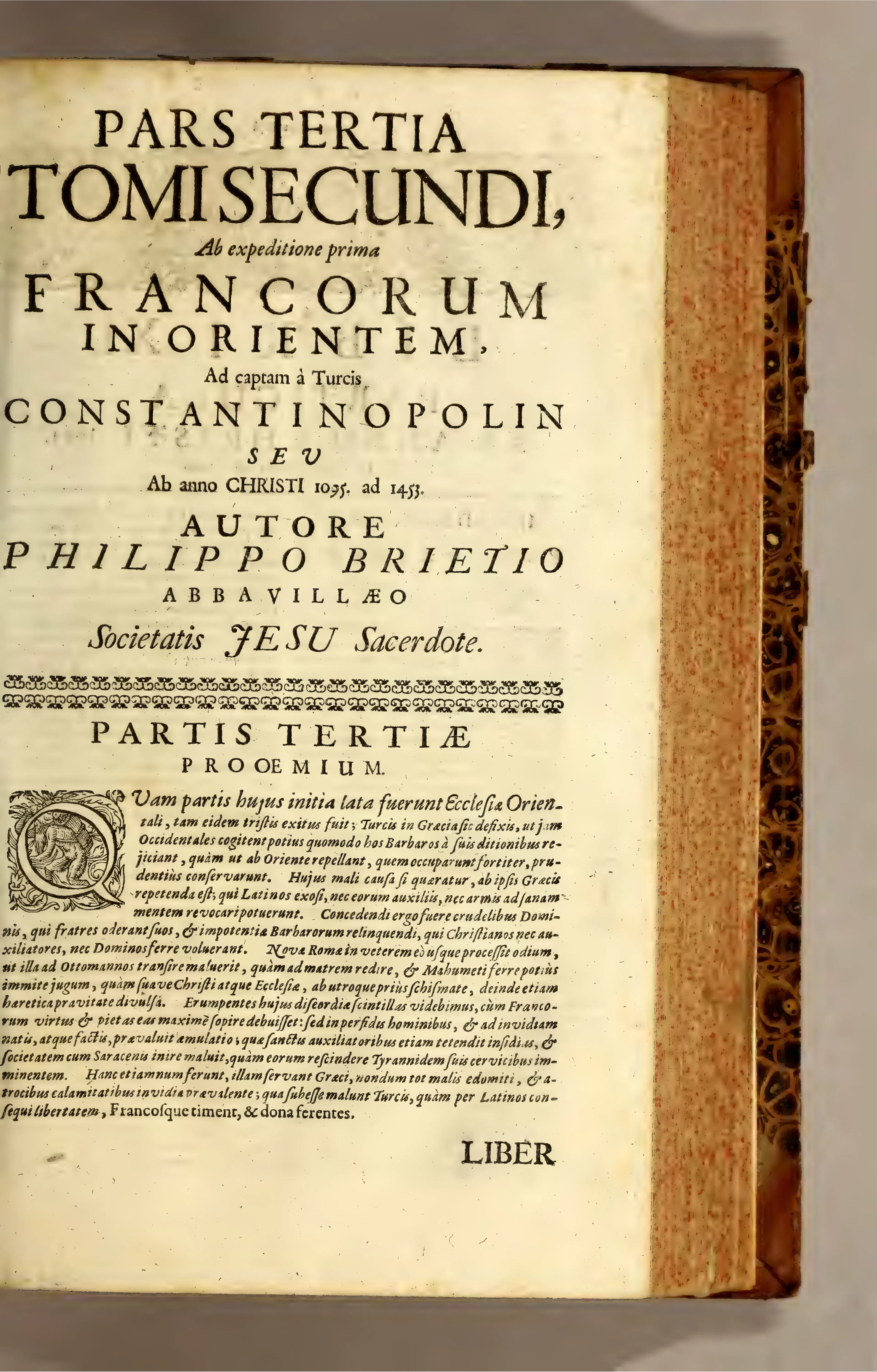
At the opening of Part III, the divisional title fixes the span from the First Crusade to the fall of Constantinople, while the proem beneath turns that chronology into a providential verdict on Greek schism and hostility to Rome. Display title and decorated-initial proem make periodization and moral causation one argument. Source ↗.
The Varna campaign of 1444 forces the annalist to explain a Christian defeat that followed upon a broken truce, and he does so by relocating causality altogether. Where Cesarini had contended that it was expedient for Christendom that Turkish power be extinguished, the entry concludes that his counsel, though the best, lacked success, but that this must be imputed to God angered by our sins, [Verùm ejus consilium
optimum successu caruit, sed Deo per
peccata nostra irato imputandus est.](https://tryleo.ai/share/5448eb7f-c056-426b-8d0e-ef24e29b54b0/?imageId=5580f992-3d08-403a-b6a2-d9f6efc30f5a) The judgment preserves the legate's prudential standing intact — the counsel remains optimum — while assigning the outcome to divine anger, and the first-person plural per peccata nostra draws annalist and reader into the guilt rather than confining it to the combatants. It also forecloses, without naming it, the rival explanation that the disaster punished the perjury of a ruptured oath. Human agency reappears immediately at the level of treachery for hire: the sultan prevailed by the guile of the Genoese, by whom his forces were ferried into Europe, to the huge damage of the Christian name and to the infamy of the Genoese, whom the Turks at once held in contumely and forever afterwards despised, [prævaluit
Sultanus dolo Genuensium, à quibus in Europam
copiæ ejus transvectæ sunt, cum ingenti Christiani
nominis damno, & Genuensium infamiâ,
quos statim etiam Turcæ contumeliosè jam habuere,
& perpetuò postea contempsere.](https://tryleo.ai/share/5448eb7f-c056-426b-8d0e-ef24e29b54b0/?imageId=5580f992-3d08-403a-b6a2-d9f6efc30f5a) The moral is drawn from the ingratitude of the beneficiary: the transaction that saves an empire earns its agents nothing but the permanent contempt of those they served, and infamia is presented as the settled historical wage of profitable perfidy.
The fate of Władysław is then given not as a fact but as a divergence of testimonies. Some, the annals report, say that he was cut down by the Turks in the marsh into which he had fallen from his horse while fleeing; others that he was preserved, carried to the Portuguese island of Madeira, and lived long unknown, whence they also transmit his penitence and confession, and his detestation of the calumnies of the Basel fathers and of Julian, who had incited him to break the truce, and that when his body had been brought thither his hand, as they say, remained still entire in the cathedral church of Madeira, [Quidam Wladislaum
mox à Turcis obtruncatum aunt in palude,
in quam dum fugeret ex equo deciderat; quidam
verò servatum, ac Madeiram Insulam Lusitanicam
delatum, ac diu ignotum vixisse; quare
etiam poenitentiam ejus tradunt, & confesionem,
Basileensiumque Patrum ac Iuliani calumnias
detestationem; qui eum incitarant ad rumpendas
inducias; & cùm ejus corpus eô delatum
esset, ejus manus (uti ferunt) restitit adhuc integra
in æde Cathedrali Madeirensi.](https://tryleo.ai/share/5448eb7f-c056-426b-8d0e-ef24e29b54b0/?imageId=5580f992-3d08-403a-b6a2-d9f6efc30f5a) The paired quidam … quidam verò, the verb printed aunt for aiunt, the transmissive tradunt, and the parenthetical uti ferunt attached precisely to the incorrupt relic mark every element of the second tradition as reported rather than affirmed. The consequence is a genuine tension inside the same annual entry: the account the annalist reports blames the legate's incitement for the rupture of the truce, whereas his own verdict a few lines earlier had called that counsel the best and referred the defeat to divine anger. He does not reconcile the two, and the reporting register is what permits an accusation he has effectively rejected to stand within his own pages.
The subjugation of Greece is then compressed into a sentence of judicial form: the Turks invaded the Peloponnese, and when they had taken most of its cities and stripped the inhabitants of their arms, they led sixty thousand persons into slavery, and thus Greece, estranged from the Latins, was gradually brought under the Turkish yoke by the just judgment of God, avenging the contumacy and contumely against his Church, [Turcæ Peloponnesum invasere, ubi cùm plerasque
urbes cepissent, atque incolas armis abstulissent,
sexaginta hominum millia in servitutem
abduxerunt: sicque Græcia à Latinis alienata,
sub Turcicum jugum sensim rediget est, ex justo
Dei judicio, qui vindicem Ecclesiæ suæ contumaciam,
atque contumeliam [reading uncertain]](https://tryleo.ai/share/5448eb7f-c056-426b-8d0e-ef24e29b54b0/?imageId=5580f992-3d08-403a-b6a2-d9f6efc30f5a). Estrangement from the Latins is named as the offence, enslavement as the sentence, and the adverb sensim gives the punishment the temporal shape of the annals themselves, a judgment executed by instalments across successive years rather than in a single catastrophe. Under the same year the column also registers the death of Emmanuel Chrysoloras, who had been present at Basel and had first taught Greek letters in Italy with great success — Greek learning migrating westward in the very entry that records sixty thousand Greeks led into servitude. The annalist draws no lesson from the conjunction, and does not need to: the year-form places the two notices in one cell of the grid, and the reader is left to see what the sequence has made visible.
From Basel to the Sack of Rome
The same years are then closed by the disposal of the council itself, and the manner of the disposal establishes the register in which everything that follows is judged. Basel is not refuted doctrine by doctrine but assessed as a career, and the assessment is delivered as the compressed verdict already quoted above on a body that changed its character over time, at first advantageous to the Church and at last destructive. The adjective multiforme does the polemical work: a council that changes shape cannot be a stable organ of the Church's mind, and the temporal split between initio and tandem converts an ecclesiological objection into a chronological one, which is the only kind of objection the annalistic form is built to register. That the verdict is then capped with the Horatian figure of the beautiful woman ending in a foul fish shows how readily the schoolroom canon of poetic decorum is enlisted for ecclesiology: a council, like a poem, is condemned for incoherence of composition rather than for any single false line.
The same juridical-temporal habit governs the treatment of the German suspension of obedience between Eugenius IV and Felix V, which is reported not as a doctrinal position but as an anomalous condition of the polity that diplomacy at last removed, and so with the matter having been negotiated, that notorious Neutrality of Germany was abolished, re itaque tractatâ Neutralitas illa famosa Germaniæ sublata est. Neutralitas, marked as famosa, names a scandal of jurisdiction — obedience held in suspense is treated as a state that had to be lifted rather than argued down — and the passive construction quietly assigns the outcome to negotiation rather than to victory in dispute. The liquidation of the schism itself is then recorded with a notary's precision, in an inventory of the honours reserved to the abdicating antipope: that he should be perpetual legate in Savoy, that the Pontiff should rise at his coming, that he should return only the kiss of the mouth, and that he should retain the papal ornaments, magnis ei reservatis honoribus, videlicet ut perpetuus esset Legatus in Sabaudiâ, ei venienti Pontifex assurgeret, ille tantùm osculum oris redderet, reservaret ornamenta Papalia. Here the annalist's method is at its most characteristic: the ending of the last Western schism is made citable through the ceremonial particulars of precedence — who rises, which kiss is exchanged, which insignia are kept — because those particulars are what a later reader can verify and adjudicate. Ceremonial detail is evidence, not ornament, and the derided verse on Felix yielding to Nicholas that follows the inventory allows the settlement to be remembered simultaneously as legal instrument and as epigram.
At the volume's structural seam, where Part III closes and a fresh divisional title-page opens Part IV on the taking of Constantinople by the Turks, the work interrupts its annual column to speak about itself, and the prolegomenon is unusually exposed about the epistemic gradient the genre conceals. That the difficulty of the work grows the nearer it approaches the author's own times has already been noticed; what deserves emphasis here is that the difficulty is doubled deliberately, since ubertas materiæ is a problem of selection, recent centuries depositing more documents than the annual cell can hold, while dicendi ratio is a problem of decorum, the nearer events touch living interests the more constrained the telling. Against that constraint the author admits a national preference and defends it, as we have seen, on evidential rather than patriotic grounds, expecting the other nations to judge it fair that more be said of French affairs because those matters are the better explored and the more certain, being set before his own eyes. The plea rests on explorata and certa, the vocabulary of investigated and secured testimony, so that proximity is converted from a source of partiality into a warrant of reliability; the argument nonetheless concedes what it means to neutralize, since a chronicle claiming to hold all of time in one order here acknowledges that its resolution varies with the observer's position. The prolegomenon then closes with the formal act by which a Jesuit author places the whole under review, the submission of this part and of all the preceding ones to the judgment of the Church and of the Pontiff, with the offer to retract and expunge. The triad temerè dictum, falsum, non bene concoctum distinguishes three distinct failures — imprudence of speech, error of fact, and insufficient digestion of matter — and only the second belongs to source-criticism proper; the offer to expungere therefore extends the corrective authority of the Church over judgment and tact as well as accuracy, in the same breath in which the author has claimed for himself the philologist's criteria of the explored and the certain.
The taking of Constantinople, which gives the new part its title, is built out of quantities and antitheses rather than lament. The disproportion of forces is stated as an arithmetical fact: only six thousand Greeks, and three thousand Venetians and Genoese, defended the city against two hundred fifty-eight thousand Turks and three hundred twenty ships, Urbem porrò defendebant tantùm sex Græcorum millia, tria Venetorum, ac Genuensium, adversùs Turcorum ducenta quinquaginta octo millia, & naves trecentas viginti. The figures function chronologically as well as militarily, since they are followed by the conceit that eleven hundred and twenty years separate the Constantine who founded the city from the Constantine who lost it — the fall entered not as catastrophe but as the closing of an interval measurable in the same grid that carries Olympiads and consular years. Within that frame individual conduct is assessed by the obituary antithesis: he who had begun the city's defence so nobly ended it so basely, at the start braver than a man, at the end more cowardly and abject than a woman, cùm Urbis propugnationem tam generosè inchoasset, quàm turpiter absolvit; initio supra hominem fortis, in fine inframulierem ignavus & abjectus. The structure is precisely that of the verdict on Basel — initio against in fine, an honourable beginning voided by its end — so that the same figure of judgment governs a council and a commander, and moral assessment is made a function of the sequence of time rather than of essence. The indictment is completed by a fiscal counterfactual that spares neither party, the observation already quoted above that monies spent on the pay of Western soldiers would have preserved a great part of them together with their liberty. Treasure hoarded rather than converted into stipendia is made the material equivalent of obedience withheld; the loss is explained by a failure of expenditure, which is to say by a decision that could have been taken otherwise, and providential reading and prudential accounting are held in the same clause.
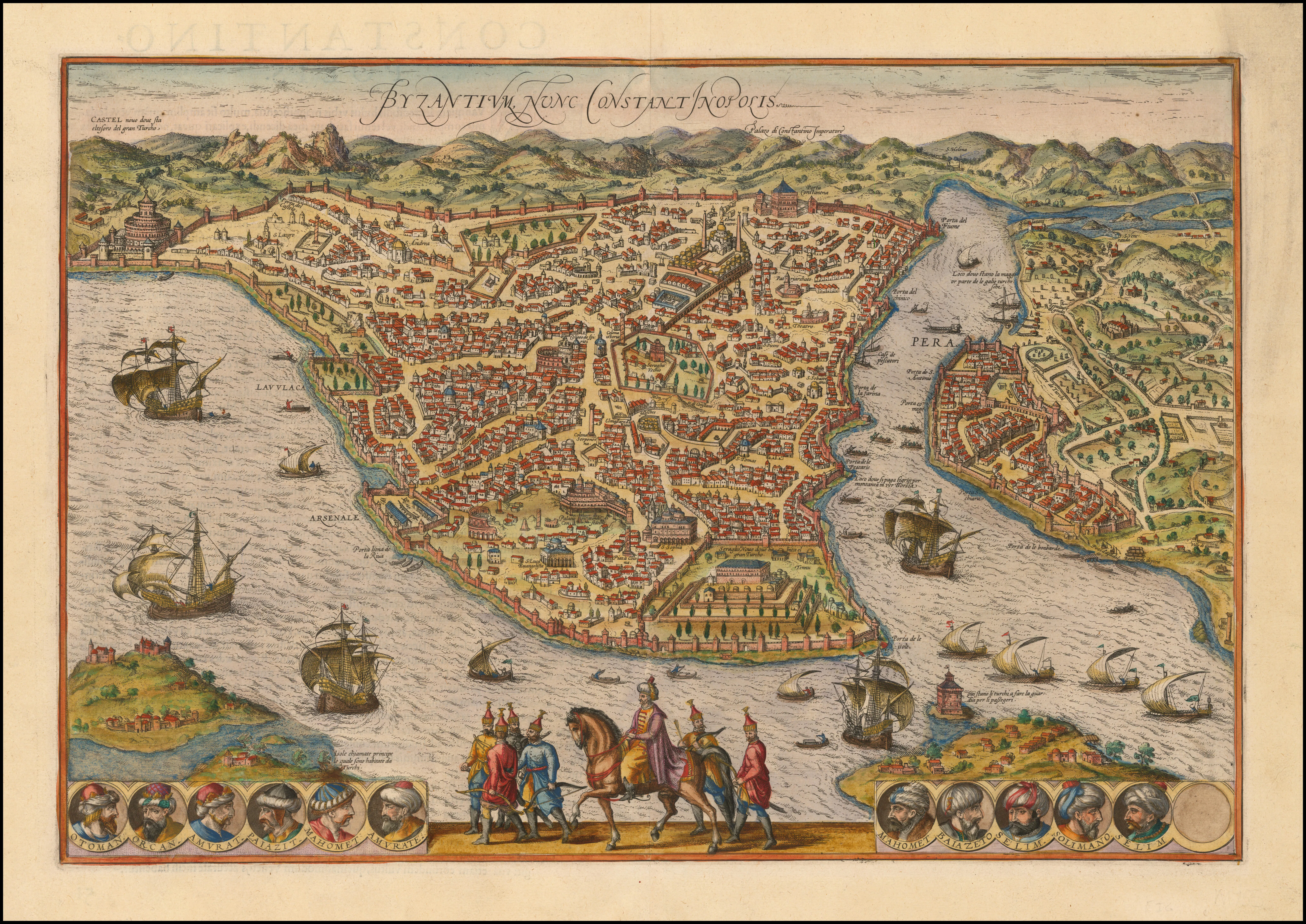
Braun and Hogenberg's sixteenth-century view renders Constantinople as the kind of legible node annalistic history can measure, walls and waters set out on a plane, Ottoman dynastic medallions ranged along the border. Beside Briet's arithmetic of 1453, the fall reads as a calculable interval and a transfer of power. Source ↗.
The Gallican material in these decades is handled through the same instruments of instrument-history. The abrogation of the charter of 1438 is recorded as an act of royal command procured by petition, the Pragmatic Sanction being at once abrogated by Louis's order at the request of Pius II, Abrogata est statim, Ludovici jussu, Pragmatica Sanctio, rogante Pio II; and when the settlement of 1516 replaces it, the replacement is judged worse than what it displaced, and this was where the so-called Concordat was made, the Pragmatic Sanction having been abolished, offspring worse than its bad mother, hicque factum Concordatum, ut vocant, abolitâ Pragmaticâ Sanctione, malæ matris soboles pejor. The genealogical metaphor — malæ matris soboles pejor — converts a sequence of legal texts into a lineage in which corruption is inherited and compounded, and the distancing ut vocant refuses the Concordat the dignity of its own name. The position is notable for cutting against confessional convenience: neither the conciliarist charter nor the papal-royal bargain that annulled it is defended, and the criticism of the second falls upon a pope trading spiritual right for revenue quite as much as upon the French crown.
The turn to the Lutheran affair is made with the same preference for proximate institutional causes over doctrinal narrative. The beginning of the Lutheran heresy is referred, in the notice already discussed above, to the indulgences committed by the Archbishop of Mainz to the Dominican Fathers, where previously the Hermits of St Augustine had been their promulgators. The rupture is thus given a documentary and jurisdictional occasion — a commission transferred from one order to another — and the annalist's closing image of a fire that a drop of water applied by a prudent hand might have quenched frames the schism as a failure of administration rather than an eruption of doctrine. Yet in the same year the register shifts, and the annals let a Catholic reformer's oration stand as an indictment of the Church itself: the most powerful oration of Gianfrancesco Pico, Count of Mirandola, portrayed the utterly corrupt state of the Church of that time, and to it the annalist appends, as we have seen, the more powerful remedy God afterwards applied and the stripes whose wounds and welts have not yet closed or subsided. The medical-penal metaphor of remedium and verbera makes the Reformation an instrument in the hand that it wounds, and the perfect tenses of that clause bring the wound forward into the annalist's own present, so that a notice fixed to 1517 is left deliberately unclosed within the sequence.
Two notices near the close of these decades show how far the moral schema is allowed to run against expectation. Rhodes falls, but its capitulation is credited with terms honourably observed, on the most honourable conditions, and such as, contrary to custom, were kept by the Turks, namely that those who wished might depart, and those who remained should live free as they had under the Knights, honestissimis tamen conditionibus, & quæ contra conluetudinem à Turcis servatæ sunt: videlicet, ut qui vellent abirent, qui remanerent liberi quemadmodum sub Equitibus viverent — a concession of good faith to the adversary whose advance otherwise supplies the spine of these decades, saved from inconsistency only by the qualifier contra conluetudinem, which preserves the general rule while conceding the particular fact. Against that, the Christian commander who brought his army to the walls of Rome is dismissed with the harshest of these verdicts: thus perished like a common soldier a very great commander, whom weakness of spirit made a traitor to his country, despair a despiser of divine and human law, and an impious and sacrilegious death a victim of hell and the devil, Ita perit uti miles gregarius Dux maximus, quem animi impotentia patriæ proditorem effecit, desperatio divini humanique juris contemptorem, mors impia, atque sacrilega, inferorum ac Dæmonis victimam. The tricolon assigns each stage of ruin its own interior cause — animi impotentia, desperatio, and finally an impious death — descending from a defect of temperament through contempt of divinum humanumque jus to damnation, and the contrast of miles gregarius with Dux maximus delivers the same reversal of beginning and end that condemned Basel and the defender of Constantinople. That the account of the sack which follows records the burning of the Vatican Library places the loss of books in the same annual cell as the loss of a soul, which is exactly the coordination the annalistic grid exists to enforce.
The Confessional Century
The sixteenth-century decades are laid out in the same apparatus that governs the rest of the sequence: chapter-rubrics gathering the years by tens, from Decas Quarta through Decas Ultima, each annual entry headed by the paired designation of the year of the world beside the year of Christ, with running heads that fix the reader simultaneously in the fifty-sixth century of the world and the sixteenth of the Christian era. The effect of this double heading in the most densely documented stretch of the whole work is worth registering: the notices grow crowded — diets, colloquies, sieges, obituaries of scholars, etymologies of party-names — yet the coordinating device does not change. A Turkish campaign, a Genevan execution, a Parisian arrêt, and the death of a printer are entered in the same cell of the universal grid, and the marginal side-notes that supply topical headings function as the only concession to the reader's need for orientation within a year that may run to a page and more.
The interpretive key is set down before any secular causation is offered. Treating the sack of Rome and the captivity of Clement VII, the annalist grants that the calamities had nevertheless been announced beforehand by good men, so that no one could doubt they were sent from God, nunciatis tamen antea per viros bonos his calamitatibus, ut à Deo immissâ esse nemo dubitaret. The construction is careful. It is not the imperial army but the prophecy that establishes the divine agency, and the evidentiary weight rests on the testimony of viri boni — a category that is at once moral and forensic, since the credibility of witnesses is precisely the currency in which a chronicler after the close of inspired testimony must trade. Providence here is not asserted against the sources; it is read out of a documented antecedent, which is the annalist's habitual way of keeping the moral verdict and the philological procedure in the same operation rather than in separate registers.
Immediately adjacent to that judgment stands a notice of curial method that is remarkable for its coolness. Of the dilatory instructions given in the Henrician cause, the text explains that the Pontiff hoped the business could be extinguished by time and patience, which by violence and haste would be rendered incurable, Sperabat enim Pontifex negotium tempore, & patientiâ, extingui posse, quod impetu & celeritate insanabile redderetur. Delay is presented not as pusillanimity but as a considered therapeutics — the medical metaphor of the insanabile wound governs the whole clause — and the annalist offers it in the vocabulary of prudential statecraft rather than of pastoral duty. The reader who knows the outcome supplies the irony; the text does not, and its refusal to convert hindsight into censure of a pope is a small but telling instance of the restraint that coexists with its readiness to moralize catastrophe.
Where the polemical energy of these decades is concentrated is in onomastics. The origin of the Reformed ministerial title is traced to a nickname and a lecture-hall: that Good Man, having professed in the Ministraria of Poitiers — for so the law auditorium at Poitiers is called — was named Minister, and left his name, as he did his heresy, to the chiefs and preachers of the Calvinists, Vir autem ille Bonus professus in Ministraria Pictaviensi (sic dicitur Pictavii Auditorium Juris) Minister appellatus, nomen suum, sicut hæresin, Calvinianorum proceribus & prædicantibus reliquit. The derivation is a piece of argument, not of curiosity. By locating minister in a juridical institution of provincial France and in the sobriquet le Bon Homme, the annalist denies the title any apostolic or scriptural derivation and reassigns it to the accidents of local usage; the parenthetical gloss on Ministraria, offered in the manner of a lexicographer, lends the deflation the appearance of neutral erudition. The same procedure governs the Netherlandish party-name, where a shout of contempt becomes a confessional designation: Charles, count of Berlaymont, exclaimed in French, Que veulent ce Guex? that is, beggars, whence the omen clung to them, so that those who in France were Huguenots should in Belgium be called Geusi, exclamavit Gallice; Que veulent ce Guex? hoc est, Mendici; unde iis adnatum omen, ut qui in Franciâ Hugonoti, in Belgio Geusi dicerentur. Two features deserve notice. The vernacular is quoted and then translated into Latin, so that the moment of speech is preserved as evidence and simultaneously made citable within the learned language of the annals; and the word omen converts an accident of insult into something that adhered by more than chance, a providential residue left inside an otherwise strictly documentary etymology. The comparative gesture that yokes Hugonoti and Geusi under one pattern is the annalist's way of making the confessional geography of France and the Low Countries a single phenomenon in the single sequence — and it is of a piece with his willingness elsewhere to declare an etymology unsettled, as with the name of the Huguenots themselves, where nothing is affirmed as certain before the Tours spectre is adduced.
Within this same stretch the annalist writes the origin-narrative of his own order, and the tone shifts from derivation to charter: in the same year at Paris, in the sacred chapel of the Mount of Martyrs, the foundations of the Society of Jesus were laid by Ignatius Loyola, a Cantabrian noble, converted to Christ by his Pamplona wound, Eodem anno Parisiis in æde sacra montis Martyrum jacta sunt fundamenta Societatis IESU per Ignatium Loyolam nobilem Cantabrum, vulnere Pampelonensi ad Christum conversum. The architectural verb jacta sunt fundamenta and the naming of the nine companions one by one give the entry the form of a foundation instrument rather than a notice, and the wound at Pamplona is made the efficient cause of a religious institute — a providential reading of a military accident exactly parallel in structure to the reading of the sack of Rome, though inverted in valence. The apologetic is completed a few years on, at the papal approbation, by the analysis of the order's government as a mixture of the three good constitutions in the manner the Philosopher would approve; that the political vocabulary of monarchy, aristocracy, and timocracy should be applied to a religious congregation shows how far the juridical lexicon of civil history has become the annalist's default idiom for ecclesiastical institutions as well.
The hagiographic register is likewise unembarrassed where relics are concerned. Of the body of Xavier the annals report that, though buried in quicklime, after fifteen months it was found whole and lifelike, and, illustrious with many miracles, was carried back to Goa, Hujus corpus, calce vivâ licet obrutum, post menses 15. integrum vividumque repertum est, multisque miraculis illustre Goam reportatum est. The concessive licet obrutum is doing evidentiary work: the corrosive agent is named precisely so that the preservation cannot be attributed to burial conditions, and the interval of fifteen months is given as a measured quantity. The passage is thus assembled as a dossier — agent, interval, condition of the body, subsequent miracles, translation of the relic — in the manner of a canonization file, and it stands in instructive tension with the source-critical severity the work exercises upon legends it declines to receive. The criterion of discrimination is not credulity or scepticism as such but the coherence and documentary character of the tradition; the annalist trusts an attested exhumation as he does not trust a wavering fable.
The most consequential set-piece of these decades is narrated with the same insistence on technical exactitude, and to formidable ideological effect. On the Lord's day, the feast of St Bartholomew, by prior agreement, at the sound of Saint-Germain-l'Auxerrois, the slaughter of the Huguenots was begun everywhere, called the Parisian Matins because it had begun at earliest morning, Nam Dominico die festo S. Bartholomæi ex condicto, adsonum S. Germani Antissiodorensis inchoata est ubique Hugonotorum cædes dicta Matutinæ Parisienses, quia summo manè cæpta fuerat. Nothing is softened: ex condicto concedes premeditation, ubique concedes generality, and the coining of Matutinæ Parisienses — a name derived, in the etymological manner the annalist applies to parties and nicknames alike, from the canonical hour — fixes the event in the liturgical day on which it fell. What follows is the crown's own construction, reproduced without demurral: Charles IX excused the deed by his edict and denied that they had been punished as heretics but as rebels and disturbers of the kingdom, impunity being promised to the rest who kept quiet, Excusavit & hoc factum Edicto suo Carolus IX. negavitq[ue]; mulctatos esse ut hæreticos, sed uti rebelles, regni perturbatores: ac cæteris quiescentibus impunitas promissa. The transposition from heresy to lèse-majesté removes the killing from the jurisdiction of the Church to that of the prince, and the annalist, whose habit elsewhere is to weigh a claim against its incoherences, here lets the royal edict stand as the account of record. The juridical framing thus performs the same function that providential reading performs in other entries: it renders the event legible within an order, and the cost of that legibility is the suspension of the critical instinct.
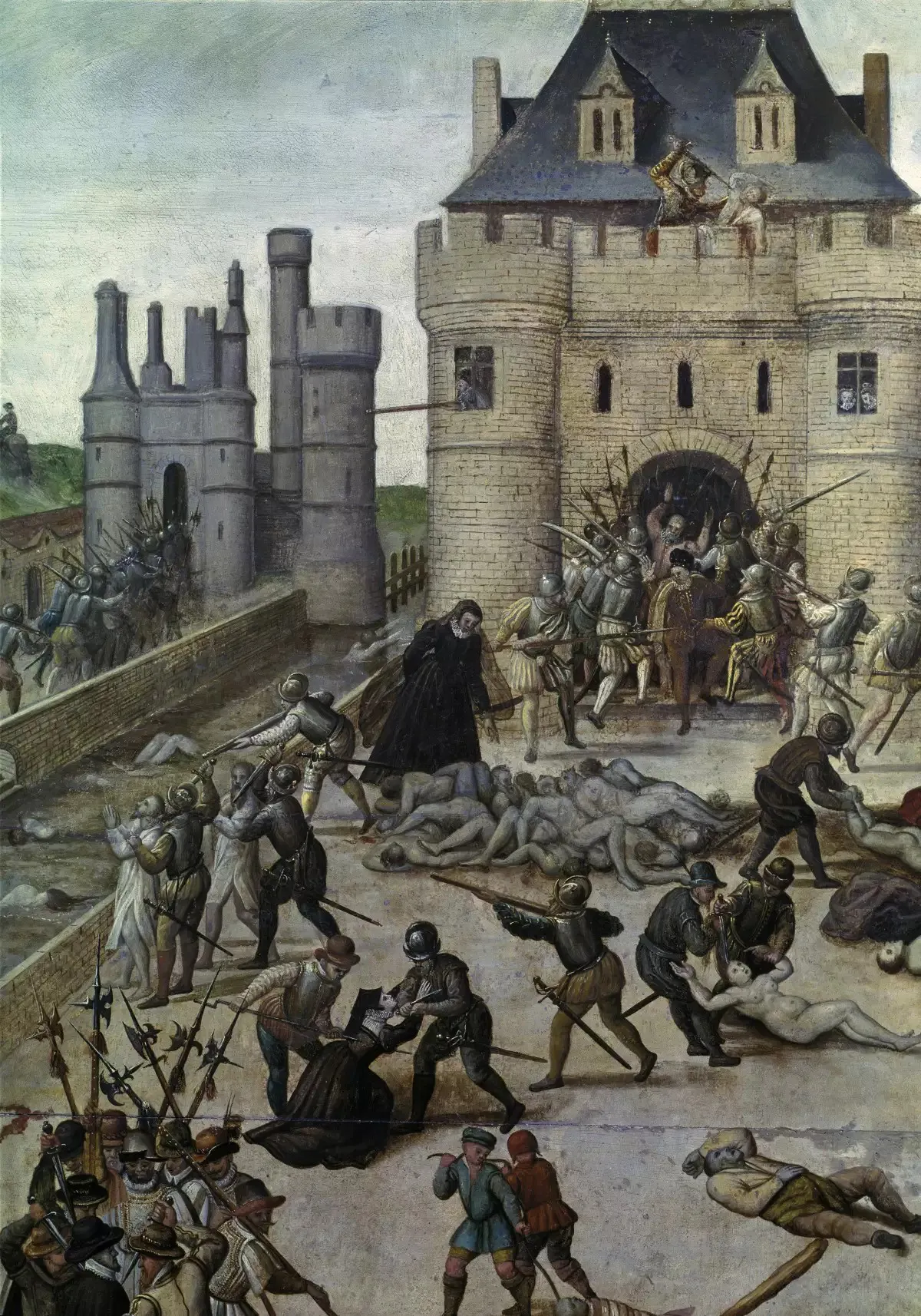
François Dubois's near-contemporary depiction, by a Huguenot painter, gives the annals' compressed "Parisian Matins" an urban scale of bodies, armed men, and public violence. Its crowded civic setting sharpens the strain in Charles IX's edict, where confessional killing is made legible as the punishment of rebels. Source ↗.
That suspension is not uniform, and the later decades expose its limits. The defeat of the Spanish fleet is disposed of in a single balanced clause — to this preparation, so great and so much to be feared, nothing was lacking but fortune, Huic apparatuitanto, tamq[ue] metuendo; nihil præter fortunam defuit — where fortuna, not divine judgment, absorbs a Catholic disaster, precisely the explanatory move refused to the sack of Rome. The asymmetry is the clearest structural contradiction in this stretch of the annals: providence interprets defeats suffered by the guilty, contingency those suffered by the friends of the cause. Yet the annalist is willing to turn severity inward. Of the regicide he writes that Jacques Clément, a Dominican of twenty-four, unlettered and rude, roused by the fanatical voices of preachers and perhaps by the private ones of certain persons, admitted to the King as though he were bringing letters from Harlay, fixed a poisoned knife in his belly and left it there, Iacobus Clemens Dominicanus 24. annorum, illiteratus, & rudis, excitatus fanaticis concionatorum vocibus, & fortè privatis quorumdam, quasi ab Harlæo litteras afferret, ad Regem admissus, venenatum ei cultrum in alvo defixit, ac reliquit. Every epithet strips the act of dignity — youth, illiteracy, rusticity, fanaticis vocibus — and the causal chain runs back to Leaguer preaching, with the guarded fortè left over the suggestion of private instigation. Coming from a writer generally in sympathy with the Catholic party, the notice shows the annalist's moral verdicts operating against his own side when the object is tyrannicide.
The sequence of these decades resolves in the act that reconciles crown and Church: Henry publicly abjured heresy and, professing himself an obedient son of the Church, having made confession of his sins, was absolved by the Archbishop of Bourges, Hæresin publicè ejuravit Henricus, seque filium Ecclesiæ obsequentem professus, factâ peccatorum exomologesi absolutus est ab Archiepiscopo Bituricensi. The vocabulary is sacramental and canonical rather than political — ejuravit, exomologesi, absolutus — so that a dynastic settlement is entered as an act of penitential jurisdiction, and the annalist's aside that the day was that of St James, the better that the Spaniards might drink their grief the deeper, allows a national satisfaction to surface in the same breath. Confessional reconciliation, Gallican triumph, and the etymological pleasure of a saint's day made to bear a political meaning are held together in a single annual notice, which is the characteristic achievement of this part of the chronicle.
The Annalist's Own Present
The seventeenth-century decades carry the same apparatus into the annalist's own lifetime. The final entries fall in the closing chapter of the annals proper, headed as the seventh chapter and the seventh decade, from the year 1660 to 1670, beneath running heads that place the reader in the fifty-eighth age of the world and the seventeenth century of Christ, and, on the last page, in the span from the year of Christ 1600 to 1663. The entries for 1661 and 1662 are subdivided by marginal rubrics — Turba Polonica., Regis Angliæ inauguratio., Nascitur Delphinus., Pax Anglicana cum Batavis. — a shift in the printed apparatus toward dense marginal indexing in the contemporary portion; and the decade rubric promises coverage to 1670 while the text in fact stops in 1662 and closes with its terminal word and the signature matter following. The substance of these last notices may be set out as they stand:
- [Ottoman succession and the logic of dynastic favour] In this year at Constantinople a thousand houses are believed consumed by a horrendous fire; and there too was the greatest sense of an earthquake, and thence a huge loss sustained. The Vizier Cupriuli having died, his son Achmet Bassa succeeded him, twenty-five years old, with which office no one so young had ever been distinguished, because no one had grown up with so powerful a father — Mortuo Vizire Cupriuli, ei successit filius Achmeses Bassa, 25. annos natus, quo primaria dignitate, nemo tam adolescens fuerat unquam insignitus, quia nemo tam potenti patre creverat
- [Turkish severity as political maxim] Yet that Turkish severity is of little use; for it is feared, not loved; and because of that no fidelity or obedience of their own men can be certain to those who rule thus — quæ tamen Turcica severitas parum est utilis; timeturenim,non amatur; quiaque nulla certa esse potest, sic imperantibus suorum fides atque obedientia
- [the disproportion of Christian and Ottoman forces] But he returned with the business unfinished; for against these barbarians Christian forces have never sufficed, being always far inferior in number to theirs — Verùm re infectâ rediit; his enim Barbaris nunquam suffecerunt Christianæ copiæ, semper illorum numero longè inferiores
- [the posthumous punishment of the regicides] On the ninth day before the Kalends of November, on behalf of King Charles, the corpses of Cromwell, Bradshaw and Ireton were dragged to Tyburn, and there hung upon a beam, in mockery, at the setting of the sun, then placed beneath the gibbet — Nono Kal. Novembris pro Rege Carolo Cromvvelli, Bradschavii, & Iretoni, cadavera in Tyburnum sunt tracta, ibique in trabe pendente, ex ludibrio, sole occidente, mox sub jugo posita
- [the composition of the Ottoman house enumerated] About that time the Ottoman house was contained in these: the two sons of Mahomet IV, Mustapha and Achmet; Sultan Solimann, his only brother; Cazana his sister, wife of Achmet Bassa; the mother of Sultan Mahomet; Mahomet IV himself. For Turkish wives are not counted, being born of concubines; and for so great an empire the House and Family is little numerous — Sub id tempus domus Ottomanica his continebatur, filiis Mahometi IV,duobus,Mustaphâ, & Achmete; Sultano Solimanno unico fratre; Cazana ejus sorore, Achmetæ Bassæ conjuge; matre Sultani Mahometis; ipso Mahomete IV. Uxores enim Turcicæ non computantur, ex Concubinis natæ; & est tanto Imperio Domus, & Familia parum numerosa
- [English Catholics disappointed by the Restoration] Nevertheless in the preceding year, and in this, nothing was done not only concerning the liberty of the Catholic Church, but not even concerning the safety of Catholics, so much did many fear that when the authority of the true and ancient Lord was restored, the worship of the true and ancient Religion would also be restored — Nihilominùs anno superiori, & isto, non modò de Ecclesiæ Catholicæ libertate, sed nec de Catholicorum incolumitate quidquam actum est, adeò multi metuebant, ne cùm veri, & antiqui Domini restitueretur authoritas, veræ etiam, & antiquæ Religionis restitueretur cultus
- [Mazarin's obituary and the paradox of the unwarlike war-maker] On the ninth day before the Kalends of April Cardinal Mazarin died, to the great grief and longing of the King and of all good men; who was never present at a war, and yet carried wars through more successfully than others who had been reared and trained in camps — Nono Kalend. Aprilis obiit Cardinalis Mazarinus, magnâ Regis, & bonorum omnium mœrore, atque desiderio; qui bello nunquam interfuit, & tamen bella feliciùs peragebat, quàm alii qui in castris educati fuerant, atque exercitati
- [Louis XIV assumes personal rule] He being dead, King Louis resolved to administer everything by himself; so that now the affairs of France should be conducted in his name and by his genius alone — Hoc mortuo Rex Ludovicus, cuncta administrare per se decrevit; ut jam suo tantùm nomine, & ingenio res Franciæ gererentur
- [the suspended verdict on Fouquet] which was sifted with such diligence, and so often interrupted, that it is not yet known whether he is guilty or innocent; but he is now liable to punishment by reason of his imprisonment, not of himself — quæ tantâ diligentiâ excussa est, & tam sæpe interpolata, ut necdum sciatur an sit sons, an insons; sed jam est ratione carceris, non sui, poenæ obnoxius
- [the counsel drawn from Christina of Sweden's failure] and so, when she had lost both kingdom and monies, to such a degree that she despised herself, and lived even on the benefits of others: how much it matters, therefore, that kings, who ought always to live, should never seek back what they have laid down — sicque cùm & regnum & pecunias perdidisset, adeò ut se ipsa despexerit, & alienis, etiam vixerit beneficiis: quantum est ergo, ut Reges qui semper vivere debent, quæ deposuerint ne repetant unquam
- [the Gallican clergy and the Jansenist formula] An assembly of the Gallican Clergy was held at Paris, in which many things were established concerning ecclesiastical affairs, and concerning the Jansenists also, whose error was again condemned, and a formula proposed for subscription — Comitia Cleri Gallicani habita sunt Parisiis, in quibus multa de rebus Ecclesiasticis constituta sunt, & de Iansenianis quoque, quorum error iterum damnatus est, & formula subscribenda proposita
- [the works of Louis XIV and the judgement of posterity] King Louis XIV in this year began many magnificent works at Paris, by which he might render that city and his kingdom more illustrious; all of which posterity will admire, and perhaps not imitate — Rex Ludovicus XIV. hoc anno multa & magnifica opera Parisiis inchoavit, quibus urbem illam, & regnum suum illustriorem redderet; quæ omnia posteritas admirabitur, & fortasse non imitabitur
- [the terminal rubric] The end — FINIS.
Within that terminal chapter the annalist's evaluative habit appears at its most compressed, and the year-by-year form is carried into a present in which he is himself a witness. Where a diplomatic instrument is on the table, the notice does not merely register it but measures its juridical form against its political substance: a treaty was concluded on 29 March between the Bishop and the citizens of Münster, but one which stripped them of everything and granted him everything, the city being wholly despoiled of its liberty, so that the treaty ought to be called a victory rather than a peace, Fædus initum est 4. Kal. April. inter Episcopum & cives Monasterienses, sed quod his eriperet omnia, illi omnia concederet civitate penitus spoliatâ libertate: sicque fædus istud, victoria potiùs, quàm pax appellandum fuit. The verdict is delivered as a matter of correct nomenclature — appellandum fuit, what the thing ought to be called — and thus belongs to the same practice of onomastic adjudication by which the annals elsewhere derive names from the circumstances that produced them. Here the operation runs in reverse: a name conventionally applied is refused because the substance does not answer to it.
The same year supplies the constitutional judgment that will become the chronicle's most portable analytic formula. In that year, the annals report, the King of Denmark obtained supreme authority in his kingdom, whereas before he depended on the nobles in the administration of his dominion and seemed almost to reign on sufferance; and those noble guardians of the Danish princes then forfeited their privileges and acknowledged at last that the monarchical state prevails over the aristocratic, Hoc anno Daniæ Rex summam in regno suo consequutus est authoritatem, cùm antea in administratione ditionis suæ pendêret à nobilibus, ac ferè precariò regnare videretur. Tum autem excidêre privilegiis suis nobiles illi Danicorum Principum tutores, & agnoverunt tandem Monarchicum Aristocratico statui prævalere. The vocabulary is that of the schools — the status monarchicus and status aristocraticus of the mixed-constitution tradition — and the decisive phrase is juridical rather than political: precariò regnare, to hold by precarium, at another's revocable pleasure, is the language of tenure applied to sovereignty itself. Constitutional change is thereby not narrated but classified, an event in the annual column being resolved into a shift between named forms of rule.
Alongside these juridical determinations stands a rarer sort of remark, in which the annalist generalizes about motive. The London East India Company quarrelled with the likewise East India Company of the Dutch, commonly called "East Inde"; the matter, however, went no further than papers, because arms were ruinous to both, and merchants resort to them only with reluctance, Societas Indiæ Orientalis Londinensis rixata est cum Societate item Indicâ Orientali Batavicâ, vulgò Est Inde; res tamen ultra scripta non processit; quia utrique perniciosa erant arma, ad quæ non nisi ægrè mercatores confugiunt. The vernacular company name is retained under the standard signal vulgò, as untranslatable institutional nomenclature; the explanatory clause, however, is not annalistic at all but maxim-like, positing a class of actors whose interest inclines them against war. It is a small breach in the providential and dynastic causality that otherwise governs the entries, and it shows the annalist willing to attribute historical outcomes to calculated interest as readily as to divine chastisement.
The author's own annals then end not at a natural terminus but at an imposed one, and the imposition is reported as an event: the bookseller, in the closing notice already cited above, holds back the author who was preparing to add something further, having waited some days and sheets now for the end of the work. The passage is exceptional for its candour about the material conditions of a folio in production: the pressure is counted in dies and folia, days and sheets, the latter the unit in which a printing house measures both cost and time, and the annalist submits to it with the additional justification that the last part must not swell and deform the history. A universal chronicle that undertakes to hold all of time in one sequence thus terminates at the point where the trade's reckoning of quires overrides the author's reckoning of years.
The Continuation to 1692 and the Closing Index
What follows in the same volume is a continuation announced on its own title-page as the CHRONICON PHILIPPI BRIETII AB ANNO 1663 and carried to 1692, and the seam is audible in more than the typography. The continuator writes longer periods, loads his sentences with participles, and — most consequentially — supplies explicit causal analysis where Briet had preferred the terse verdict. Yet the critical postures are continuous. Confronted with the comet of December 1664, the text delivers an epistemological ruling rather than a portent: the gossiping astrologers had foretold many things from it, which — that no credit may ever be given them — have been found exactly false, Dicturientes Astrologi multa inde portenderant, quæ (ne iis umquam fides adhibeatur) adamussim comperta sunt falsa. The parenthesis is the interesting part: the falsification is recorded not for its own sake but as a standing instruction about credit, fides, the same term the annals use for the reliability of human testimony after the inspired books cease. Prognostication is thus excluded on the same evidential ground on which forged canons and incoherent legends are excluded, and the adverb adamussim, 'to the plumb-line', claims exactness for the refutation.
The continuator's confessional commitments are, however, sharper than Briet's, and nowhere more so than in his handling of the Sorbonne's censure of a book on papal infallibility. With greater danger to the Catholic faith, he writes, the Sorbonne College thundered against a certain book which discussed the infallible authority of the Pontiff, but the censure was repressed by the Clergy assembled not long after, lest they should seem with fickle wit to approve what they had lately condemned by solemn if tacit consent — namely when they wished the heresy of the Jansenists to have been rightly struck down by the sole and infallible judgment of the Pontiff, Majori Fidei Catholicæ periculo Sorbonicum Collegium intonuit in Librum quemdam, qui de Pontificis auctoritate infallibili differebat. Sed à Clero non diu poët congregato repressa Censura est, ne desultorio ingenio probare viderentur quod nuper solemni, etsi tacito consensu damnarant; cum scilicet Jansenianorum Hæresim solo, & infallibili Pontificis judicio ritè percussam voluere. The argument is a charge of inconsistency: the Gallican clergy are held to have conceded in practice, by accepting a papal condemnation of Jansenism, the very authority they deny in principle. The reasoning is not narrative but forensic, and it establishes the interpretive line along which the whole later ecclesiastical arc of the continuation will be plotted.
Constitutional vocabulary remains the continuation's chief instrument for describing power that is held indirectly. The Dutch office is admitted in its vernacular form with a Latin gloss, Auriacus novo Reip. decreto Statholder factus (fic status arbitrum, & summum Moderatorem vocant), where William III's elevation of 1672 is registered as the creation of an arbiter of the state and supreme moderator — a formula that names the office without resolving whether it is magistracy or principate. The Habsburg position in Hungary receives the same treatment through the very term used of the Danish nobility: the kingdom of Hungary being subdued and placed under German garrisons, which before Leopold had administered as if on sufferance, domito & præsidiis Germanis supposito Regno Hungariæ, quod antea quasi precario Leopoldus administrabat. The recurrence of precario across a Baltic monarchy and a Danubian kingdom is not accidental but diagnostic: it marks the category of rule dependent on the consent of estates, and its supersession by garrison and forfeiture is presented in both cases as the resolution of an anomaly.
The military spine of the continuation culminates in the relief of Vienna, reported with an emphasis on the collapse of the besiegers' order: with John arriving with his Poles, on 12 September the besieging barbarians were routed and put to flight by the allied armies, driven by such terror and confusion that they seemed not soldiers giving battle but dull beasts submitting to the slaughter, adveniente cum Polonis suis Joanne Casimiro pridie Idus Septembris à foederatis exercitibus funduntur, & fugantur obsidentes Barbari, eo terrore, & confusione acti ut non milites certamen, sed stolida animalia laniem sustinere viderentur. The simile denies the Ottoman army the status of a belligerent altogether, converting battle into slaughter and combatants into stolida animalia; and the naming of the relieving king as Joannes Casimirus, rather than Joannes Sobieski, is a slip of exactly the kind the annalistic method exists to prevent, a reminder that the closer the chronicle approaches its own present, the more its accuracy depends on the reliability of recent report.
The confessional and ecclesiastical arc closes on two acts of sovereign proscription and papal annulment. Of the first, the text records that by a solemn edict published in the Parlement of Paris on 22 October King Louis proscribed from the whole of France the heresy of Calvin which had long flourished there, and ordered all his subjects to live as Catholics and to take part in the Roman rites, Proscripsit solenni Edicto in curia Parisiensi vulgato xi. Kal. Nov. Rex Ludovicus ex universa Gallia Calvini quæ diu viguerat hæresin, omnesque sibi subditos Catholicos vivere, & Sacris Romanis operari jussit — the object of the verb being not persons but a haeresis, an abstraction proscribed from a territory, even as the entry goes on to concede that the conversions were matched by an equal tally of emigrants abandoning their homes. Of the second, the bull Inter multiplices is reported in its full formal solemnity as rescinding the four propositions asserted by the Gallican Clergy in the assembly of 1682 concerning the authority whether of the Pontiff or of the universal Church, together with the acts done concerning the extension of the Regale and by anyone against the immunities and privileges of ecclesiastical places and persons, and declaring them to have been, and to be for ever, of no value or force, quo assertas à Clero Gallicano in Comitiis Anni 1682. quatuor propositiones de Auctoritate ceu Pontificia, ceu Ecclesiæ universæ, actaque ab eo circa Regaliæ extensionem, & à quocumque contra Locorum ac personarum Ecclesiasticarum immunitates & privilegia rescidit, ac nullius valoris aut roboris fuisse, aut fore umquam declaravit. The retroactive and perpetual formula — fuisse, aut fore umquam — attempts what the annalistic form cannot, the removal of an event from the sequence of time altogether; and it stands only a few entries before the point at which the year 1691 breaks off mid-sentence over a marriage negotiation, the continuation ending, as the author's own annals had ended, not at a conclusion but at the edge of the sheet.
Those terminal pages carry the single sequence of time to the very edge of its own manufacture. The running head over the last annalistic page states the span the continuation claims, AB ANNO CHRISTI 1663. AD 1692. 983, and the annual entries beneath it proceed in exactly the form the earlier reaches of the work had used for Assyrian dynasts and Roman consuls: a Roman-calendar date, a place, an agent, an outcome, and, where the compiler judges it warranted, a compressed verdict. The register in which the year opens is that of frontier plunder-warfare, the Tatar commander invading Poland and, having laid waste the provinces far and wide and carried off many thousands of captives, withdrawing laden with booty before avenging arms could be prepared, Poloniam invadit, Provinciisque longe, lateque vastatis, adductisque multis millibus captivorum, antequam ultricia arma pararentur, præda onustus abscedit. Nothing here is a battle or a siege; the entire political judgment is carried by the temporal clause antequam ultricia arma pararentur, which converts a raid into a statement about the slowness of the Polish state — the annalistic form doing analytical work through subordination rather than through comment.
The most sustained conceptual movement on the page concerns betrayal, and it shows the compiler's evidentiary caution and his moralism operating in successive sentences. The Netherlandish arrests are reported with the sources of knowledge carefully distinguished: on the day before the Ides of July, in the principal cities of the Spanish Netherlands — Brussels, Bruges, Louvain, Mechelen and Antwerp — a hundred and more were thrown into prison, whom rumour published as having plotted, by a sworn crime, fires in each of those cities, so that access might be given to the enemy to seize them once the citizens and garrisons had been drawn elsewhere, Pridie Id. Iulii In præcipuis Belgii Hispanici Urbibus Bruxellis, Brugis, Lovanio, Mechlinia, & Antverpia centum & amplius in carceres detrusi, quos conjurato facinore fama vulgavit in singulis eorum incendia molitos, ut aditus hostibus daretur eas abstractis alio civibus, & præsidiariis invadendi. The imprisonments are asserted flatly in the indicative; the conspiracy itself is reported only as what fama vulgavit, so that the juridical category conjuratum facinus is attributed to public report rather than to proof — the same discrimination between what is done and what is said that governs the work's handling of ancient marvels, here applied to an event of the compiler's own year. What follows is the sharpest evaluative statement in the whole stretch, and it abandons that reticence entirely, turning the frequency of these betrayals, in the sentence already quoted above, into a vast disgrace of the century — a thing which, though execrable by every curse, would seem long since to have shed all shame. The rhetorical construction is worth noting: the judgment is not claimed as the compiler's own but attributed to universal consensus, nemo est qui non vertat, and the concessive clause concedes that treachery has ceased to attract shame even while insisting that it deserves every curse. A run of local police actions is thereby elevated into a diagnosis of the saeculum, and the ancient annalistic device of moral epitome is turned upon the age in which the sheets were being printed.
The ecclesiastical notice of the year is calibrated with the precision the genre reserves for its own institutional spine: after a long deliberation of five months the cardinals at length proclaimed as Supreme Pontiff, on the sixteenth day before the Kalends of August, Antonio Pignatelli, a Neapolitan, who chose to be distinguished by the name of Innocent XII, Longa quinque mensium consultatione tandem Cardinales Summum Pontif. renunciarunt xvi. Kal. Aug. Antonium Pignatellum Neapolitanum qui Innocentii XII. nomine insigniri voluit. The technical verb renunciarunt names the publication of the election rather than the election itself, and the chosen regnal name is registered as a deliberate act of self-definition, which the next sentence reads programmatically: emulating the zeal of his namesake predecessor, he showed himself from his first days a most vigorous champion of ecclesiastical discipline, with the same constancy holding himself back from the company and the affection of his kinsmen; moreover, most acceptable through his piety and kindness toward the poor, for whom he fixed a set day each week on which he would publicly hear the complaints and petitions of all, Cognominis Antecessoris zelum æmulatus se Ecclesiasticæ disciplinæ acerrimum Assertorem à primis diebus exhibuit, eadem constantia ab affinium contubernio & affectu temperans, insuper pietate, & benignitate in Pauperes acceptissimus, quibus certum singulis Hebdomadibus diem staruit, in quo omnium querelas, & preces publice exaudiret — the printed staruit a press form of statuit. The panegyric is built on precisely the two axes by which post-Tridentine reform measured a pontificate. Assertor casts the pope as champion rather than custodian of discipline, an agonistic term; and affinium contubernium is a euphemism of considerable delicacy, naming nepotism by describing what the pope abstains from — the company and the affection of relatives — so that the reform is registered as a personal continence rather than as legislation. That the entry follows the moral indictment of the century's treacheries gives the sequence a logic: corruption diagnosed, and a remedy located in ecclesiastical self-discipline.
Ottoman affairs are constructed on a contrary principle, sovereignty being described as something conferred by ministers: on the eleventh day before the Kalends of August, Suleiman, tyrant of the Turks, having been carried off at Adrianople by apoplexy in the fiftieth year of his age, there was substituted in his place his brother Ahmed, certainly by the help and counsel of those ministers who had earlier procured the abrogation of Mehmed's reign, XI. Kal. Augusti. Elato Adrianopoli Apoplexia Solimano Turcarum Tyranno anno ætat. 50. in ejus locum suffectus est Achmetes ejusdem frater, eorum certe Ministrorum ope, & consilio, qui pridem Mahumeti Regnum abrogari curaverant. Two lexical choices carry the argument. Tyrannus withholds from the sultan the vocabulary of legitimate kingship that the same page grants without hesitation to Rex Hispaniarum Carolus; and suffectus est, the term proper to filling a vacated magistracy by substitution, presents a dynastic succession as a co-optation engineered by the same faction that had deposed a previous ruler. Ottoman power is thus given a constitutional character — ministerial rather than hereditary — which serves the larger reading of the Porte as internally unstable during the Holy League war.
Confessional division inside a Catholic coalition army produces the most delicately suspended entry of the year. The baggage which the garrison was carrying off under the terms of surrender was plundered by the heterodox (Barbets), led by this reason or pretext, that in the preceding year, while the same city was being occupied by the French, those men had likewise stolen the furniture and baggage of the soldiers of the same sect who were leaving with the rest of the garrison, Direpta ab Heterodoxis (Barbetti) impedimenta quæ Præsidiarii deditionis pactis secum auferbant, ea seu ratione, seu prætextu ducti quod anno præterito dum Ubs eadem à Gallis occuparetur ipsi ejusdem Sectæ militibus qui cum cæteris præsidiariis exibant suppellectiles & impedimenta pariter surripuissent. The Waldensian militias are given both the confessional classification Heterodoxi and their contemporary nickname, glossed parenthetically, and their conduct is at once condemned in substance — a breach of capitulation terms — and left juridically open by the alternative seu ratione, seu prætextu, which declines to decide whether the alleged prior injury constituted a ground or merely a pretence. The same refusal to over-determine appears in the Irish notices, where the printed marginal rubric concedes the outcome in dynastic rather than regal terms, & Tota Hybernia Auriaco cedit, while the entry itself keeps the Stuart claim juridically alive at the moment of its military extinction: on the day before the Nones of October, Limerick, which alone was fighting for James, king of England, worn out at last by a long siege, surrendered itself to Duke Ginkel; and those who were still serving that same King James were transported with the garrisons into France, Prid. Non. Oct. Limericum, quod unicum Jacobo Regi Angliæ militabat, longa obsidione farigatum se tandem Guinkelio Duci dedidit, & cum præsidiariis in Galliam sunt traducti, qui adhuc eidem Jacobo Regi merebant concessit. William is Auriacus, styled from his principality; James remains Rex Angliæ in the very clause that reduces his obedience to one city. Titulature here is not ornament but the chronicle's instrument for registering a contested legitimacy without arbitrating it.
The year closes on a grant whose constitutional wording the compiler evidently thought remarkable: on the third day before the Nones of December, Maximilian Emanuel, Elector of Bavaria, was proclaimed by Charles, King of the Spains, perpetual Governor of the Catholic Netherlands, with all that authority in the conduct of affairs which an absolute lord of the region might use, III. Non. Dec. Renuciatus est à Rege Hispaniarum Carolo Belgii Catholici Gubernator perpetuus Maximilianus Emmanuel Bavariæ Elector cum ea omni in rebus gerendis auctoritate, qua absolutus Regionis Dominus uti possit. A delegated office is described in the vocabulary of absolute lordship, and the following sentence draws the dynastic inference: since the governorship conferred is said to be destined to pass even to his heirs, the Elector is believed to have received it in the name of a dowry, especially because a rumour of this same grant, spread abroad already from the time when he married, impelled King Louis to send an envoy to Madrid to complain of it as prejudicial to his son's claims, Cum collata gubernatio etiam ad hæredes transitura dicatur, eam doris nomine accepisse creditur Elector, maxime quod jam ab eo, quo nupit, tempore sparsus ejusdem collationis rumor Regem Ludovicum impulerit ut Madritum Oratorem destinaret de ea questurum quasi filii rationibus injuria. The reasoning is inferential and marked as such by dicatur and creditur: heritability implies a marriage settlement, and the French protest is adduced as evidence of how contemporaries construed the transaction. Then the annals stop, not on a triumph but on a declared incapacity to foresee, in the closing notice already discussed above: whether the Elector will long enjoy the grant is answered but poorly by the almost exterminating war then being waged in those provinces, which scarcely anyone would dare promise himself will soon be brought to an end. The single ordered sequence is carried up to the present and there broken off; prophecy, which a providential chronicle might have been expected to supply, is explicitly refused, and the refusal is grounded in the state of the evidence rather than in modesty.
The back matter immediately makes the whole of that sequence retrievable. The catchword resolves into the finding-aid, headed in the standard formula as an index of the memorable matters, RERUM MEMORABILIUM, and the letter A demonstrates the reach the design requires: its earliest entry stands at the third page of the work, Abelis Cædes 3, while the sultan whose co-optation has just been narrated appears with references into the 800s, Achmetes Turca. Adam's fall and the Ottoman succession are alphabetized on one leaf and cited by the same page-numbering, which is the clearest formal demonstration available that the universal chronicle treats sacred beginnings and contemporary dynastic politics as items of one order. The index also registers the technical apparatus that makes such coordination possible, entering rival computational systems as things in themselves, Æra Hispanica beside Æra Antiochena — the incommensurable eras that the annalist's grid exists to reconcile becoming, in the alphabet, mere headwords. Its internal ordering betrays the accretive manner of its own compilation, a first strictly scriptural run being followed by a supplementary run of profane, patristic, medieval and near-contemporary names and then by a further alphabetical restart, so that the finding-aid preserves the seams of its assembly even as it presents the work as a single searchable whole.
Frequently Asked Questions
What is Philippe Briet's Annales mundi?
Annales mundi, 'Annals of the World', is a Latin universal annalistic chronicle printed at Paris by F. Muguet across 1662 and 1663 as a multi-part folio set, with separate parts, title-pages, pagination and registers. It dates everything from the creation of Adam to the ministers of Louis XIV within one synchronized grid of eras, so that patriarchs, Olympiads, Assyrian dynasts, Roman consuls, popes, councils and sultans occupy a single numbered sequence. Later issues carry it further: a Venetian issue of 1692, and a 1696 Augsburg/Dillingen issue catalogued with a supplement continuing the chronicle from 1663 to 1692.
Who was Philippe Briet?
Philippe Briet (1601–1668) was a French Jesuit, a native of Abbeville as his title-pages style him, who taught geography at Rouen and at the Collège de Clermont in Paris. Besides the annals he wrote the Parallela geographiae veteris et novae, and the geographer's training shapes the chronicle, which avows compression as method: it will do what geographers do, describing great cities by points and long rivers by little lines. He admits a preference for French matter and defends it on evidential grounds, French affairs being the better explored and the more certain, set before his own eyes.
How does Briet handle legends and forged documents?
He unmakes them by philology, and not only when the target is convenient. The legend of Pope Joan is dismissed as a fiction in which everything wavers — time, name, homeland, the manuscript of Marianus Scotus, the papal portraits at Siena — so that to believe it now is madness. The appeal-canon invoked by Pope Zosimus is conceded, against Roman use of it, to be Sardican rather than Nicene. Proteus's transformations are referred back to the fire, water and beasts that Egyptian kings bore painted on their diadems, and corrupt readings are traced to the carelessness of copyists.
How is time organized in the Annales mundi?
Each notice is fixed to a year within a grid of coordinated eras. Annual rubrics pair the year of the world with the year from the founding of the City and, in the Christian reaches, with the year of Christ; chapters gather years by tens as decades; books each carry a hundred-year band counted from the Creation. The annus mundi, 'year of the world', is the one reckoning common to every notice, which is what allows Olympiads, consular years, papal reigns and Ottoman successions to be read in a single column. Where the Frankish monarchy begins, the Roman foundation column is simply dropped.
Is there an English translation of Annales mundi?
No modern English translation has been identified; the catalogue record establishes the work as Latin but does not establish any translation or vernacular-abridgement history, and no secure vernacular epitome has been located. Separately, the Leo edition presents the complete transcription together with a full English translation for the first time, and that translation is generated by AI. Leo is an effort to make English translations of every text printed in Latin in early modern Europe between 1450 and 1750 freely available online, at no cost.
This report was generated by an advanced AI assistant that conducted deep research alongside an extensive interpretation of the transcribed original text. Every effort has been made to preserve fidelity to the source and to guard against inaccuracy, but corruption in the text recognition process and model hallucination may nonetheless have entered the text. Treat every claim, quotation, translation, and citation as provisional, and verify each against the original source before relying on or citing it.
Further Reading on Early Modern Chronology and Jesuit Universal History
- Simon Ditchfield, "What Was Sacred History? Early Modern Catholicism and Historical Scholarship," Sacred History: Uses of the Christian Past in the Renaissance World: Ditchfield's line of work on post-Tridentine historical culture explains why Catholic erudition invested so heavily in archives, martyrologies, and institutional record-keeping, which is the practical world in which Briet's folio was assembled. Read it alongside specialist studies of Baronius and the Bollandists, since Briet's interest lies less in doctrinal novelty than in the routine machinery of Jesuit universal history — a machinery on which the annals themselves comment when they describe how the government of the Society was tempered by Ignatius, a man of admirable genius, out of the three good states, as the Philosopher would wish, monarchic in the General, aristocratic in the Assistants, timocratic in the Procurators to be sent to Rome every third year, Cæterùm regimen hujus Ordinis Ignatius admirabili vir ingenio, ex tribus statibus bonis (quod Philosophus optabit) temperavit, Monarchico in Generali, Aristocratico in Assistentibus, Timocratico in Procuratoribus tertio quoque anno mittendis Romam. The exact bibliographic venue for this recommendation should be checked before formal citation; it is offered as a research direction rather than a fully verified record.
- Anthony Grafton, "Joseph Scaliger and Historical Chronology: The Rise and Fall of a Discipline," History and Theory: The foundational account of how chronology became a critical discipline built on collating calendars, eras, and authorities rather than on the convenience of a table. Grafton's model is exactly the posture Briet adopts whenever he sets out rival datings for a city's foundation and then leaves the question standing, and it explains why such reticence counts as method rather than as failure.
- Anthony Grafton, "Dating History: The Renaissance and the Reformation of Chronology," Daedalus: A short, unusually lucid statement of what was confessionally at stake in dating the past, from the age of the world to the reliability of regnal lists. It supplies the quickest route to understanding why annus mundi reckoning was an argument and not merely a label, and why a Jesuit could treat a column heading as a doctrinal position.
- C. Philipp E. Nothaft, Scandalous Error: Calendar Reform and Calendrical Calculation in Medieval Europe: The technical history behind Paschal reckoning, computus, and calendar reform, without which Briet's Nicene rule and his warm praise of the Julian bissextile look like antiquarian filler rather than professional commitments. Nothaft also shows how long the disputes had been running before the seventeenth century inherited them, which usefully deflates any impression of novelty.
- Johannes Zachhuber, Time and History in Denis Pétau: Philosophy, Science, and Religion in Early Modern France: The nearest available contextual parallel: a Catholic chronologer joining theology, philosophy, and historical criticism in the generation immediately before Briet. It is the sharpest instrument for testing whether Briet's method is derivative or independent, the more so because the annals openly defer to Petavius up to the year 533 and then admit that they must carry on alone.





.jpg)