Ten Days Removed from October: Johann Clüver's Epitome of the Histories of the Whole World, from the First Origin of Things to the Seventeenth Century
Johann Clüver died at forty, but his Historiarum totius mundi epitome — a Latin history of the world carried from Creation to 1630, first printed at Leiden in 1631 — went on being reprinted, supplemented and extended for four decades after him, until its printers had pushed it to the Anglo-Dutch peace of 1667. Clüver's method was to give every institution a birth date: the Roman primacy, the popes' temporal lordship, the veneration of images, the death penalty for heresy, even the party-name Protestantes are each assigned a first moment, a named agent, and a marginal authority. The result is a universal chronology in which computing a year is itself the act of judgement.
ExLatinis
September 13, 2026

Contents
Johann Clüver died at forty, but his Historiarum totius mundi epitome — a Latin history of the world carried from Creation to 1630, first printed at Leiden in 1631 — went on being reprinted, supplemented and extended for four decades after him, until its printers had pushed it to the Anglo-Dutch peace of 1667. Clüver's method was to give every institution a birth date: the Roman primacy, the popes' temporal lordship, the veneration of images, the death penalty for heresy, even the party-name Protestantes are each assigned a first moment, a named agent, and a marginal authority. The result is a universal chronology in which computing a year is itself the act of judgement.
Johann Clüver — Lutheran theologian, born at Krempe in Holstein in 1593 and dead at Meldorf in 1633, a man of barely forty at his death — left behind a Latin history of the world that outlived him by decades and grew as it travelled. First printed at Leiden in 1631 as Historiarum totius mundi epitome, the work carries the history of the world from the first origin of things to 1630, with a continuation by Clüver himself to 1633 and later enlargement, in the printed title matter of 1668, through the conclusion of peace between England and the Dutch in 1667. It is an epitome in the full early modern sense: not a thin digest but a compressed and navigable ordering of sacred and profane history, laid out in fourteen books with appendices, set in double columns, hung about with printed marginal citations drawn from a stated pool of more than six hundred authorities, and closed by alphabetical indexes. A reader opening it meets Creation, the Flood, the patriarchs, the ancient monarchies, the successive ages of the Church, the Empire and the Ottoman sultans, and — in the later matter — the Bohemian revolt, Tilly and Wallenstein, Westphalia, the Fronde, and the campaigns of Dunbar and Worcester, all threaded on a double marginal chronology that runs Anno Mundi beside Anno Christi.
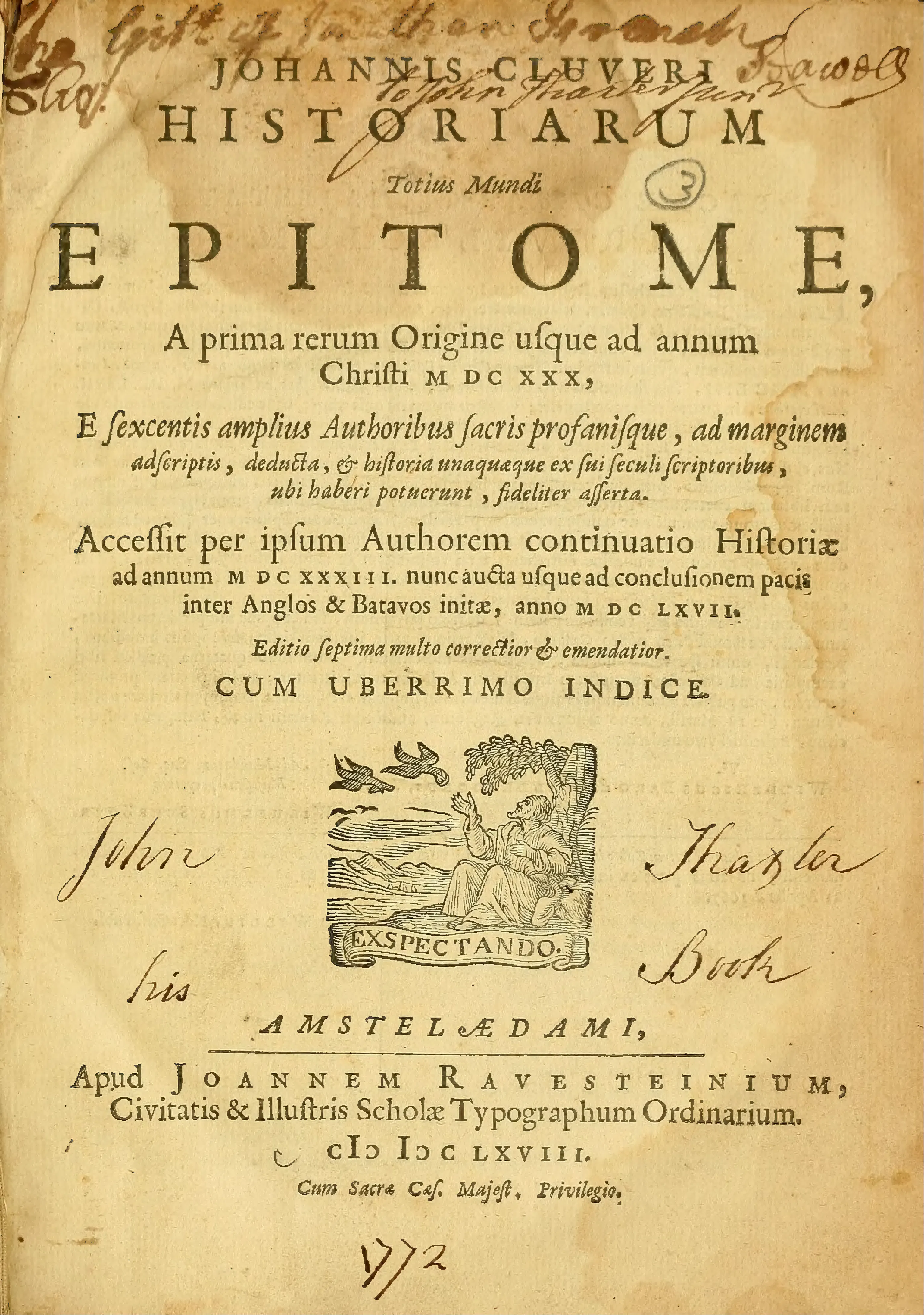
This title page of the 1668 Amsterdam seventh edition concentrates the work's printed self-presentation: a world history to 1630, enlarged to the Anglo-Dutch peace of 1667, advertised as corrected, indexed, and drawn from more than six hundred sacred and profane authorities. Later ink ownership marks register its onward readership. Source ↗.
The intellectual problem the work sets itself is how the whole of human time can be held in a single verifiable frame and still read for intelligible cause. Clüver's answer is a recurring double operation. First, he dates origins: powers and practices that present themselves as immemorial — the Roman bishop's primacy, the popes' temporal lordship, the veneration of images and relics, the oecumenical title, the death penalty for heresy, even the party-name Protestantes — are assigned a first moment, a named agent, and a marginal authority, so that antiquity becomes a matter of record rather than of prescription. Second, he adjudicates: defeats, plagues and sacks are weighed as the requital of sacrilege, heresy and vice; divided sovereignty, usurped title and faction are shown consuming the states that admit them. The chronological apparatus is thus not neutral scaffolding but the instrument of judgement, and terms that look like loose religious or political vocabulary — tyrannis, providentia divini numinis, exercitium religionis, annus normalis, pax postliminio reducta, ius publicum Imperii — operate as technical measures within it.
The stakes of that procedure are considerable. Chronology in this period was an autonomous learned discipline, and dating decisions settled how biblical time, imperial succession, ecclesiastical development and confessional legitimacy stood to one another; an epitome that pins each institution to a year is therefore making constitutional and doctrinal claims in the act of computation. The work also belongs to the learned management of abundance: marginal source columns, appendices and indexes are the techniques by which a compiler kept several thousand years of authority retrievable. And in its later reaches the epitome becomes something closer to a current history of war and diplomacy, embedding princely declarations, an arbitral award over Trier, an electoral capitulation, embassy articles with the Emperor's reply, and the terms of the Treaty of Cleves, with the Peace of Münster set above imperial constitutions and territorial statutes as the measure against which elections, normative years, confessional exercise and princely self-help are tested. Documents published in print are preferred to what circulates in men's talk, hearsay is marked as hearsay, and the author accounts in his own voice for what his authorities will bear.
What is most striking about the object as it survives is how mobile and how unfinished it proved to be. A catalogue overview records at least twelve further editions by 1678, at Leiden, Amsterdam, Hildesheim and Breslau, with a Leipzig-published continuation of 1668 covering 1653 to 1667; the seventh, "much more corrected and emended" edition came from Johann Ravesteijn at Amsterdam in 1668 at some nine hundred pages. Supplements accrete, appendices attach themselves to Books X through XIV, and a continuation begins where the appendices leave off — a supposedly complete world history that kept having to be completed. Several attractive propositions about that history remain unsupported by the accessible records: the claim that a named Catholic-Imperial continuator carried the Lutheran epitome forward to a terminus of 1651 is not borne out, the title matter continuing to assign the later history to Clüver; a reported comparison with Hobbes on the chronology of religious history cannot yet be traced to full bibliographic details; and the work must be kept distinct both from Johannes Temporarius's Chronologicarum demonstrationum libri tres and from the geographer Philippus Cluverius, with whom surname-only records invite confusion. One copy carries the epitome into a very different world: a Boston Public Library exemplar from the John Adams Library, inscribed by John Thaxter in 1772, imperfect at the end and so unable by itself to witness the final continuation.
Held together, the work's conceptual vocabulary, its print history and its internal architecture make a single argument. A book that converts narrative into dated, sourced norm must keep adding years; a book that measures institutions by their origins must keep auditing the newest institutions, including the peace of 1648 and the papal diploma that condemned it; and a book that treats providence as an operative cause of historical reversal must follow that cause into the author's own decade and, in the hands of its printers, past his death.
Read the full text and English translation on Leo
This text was transcribed and translated as part of the ExLatinis project, an effort by Leo to make free English translations of every text published in Latin in early modern Europe (1450–1750) available online. The complete transcription and English translation of this work can be read free of charge:
→ Read the original Latin text and full English translation on Leo
You can save a copy of this document into your Leo account to run deep text searches, conduct further analysis, or cross-reference it with your own research.
Titling Clüver's Epitome and Reading Its Chronological Vocabulary
An Epitome of the Histories of the Whole World, from the First Origin of Things to the Seventeenth Century: Johann Clüver's Latin Universal History. This is an editorial English title supplied for convenience; no established English title was located. The principal Latin title is Historiarum totius mundi epitome, expanded in the 1668 title matter as a history extending from the first origin of things to 1630, with an authorial continuation to 1633 and later enlargement to 1667. The title's epitome is not simply a claim to brevity. In early modern learned usage it signalled a deliberate act of reduction, ordering, and retrieval: a large body of sacred and profane history was compressed into a navigable chronological structure while preserving authorities through marginal citation. The work's division into fourteen books and appendices, together with its indexes and printed marginalia, shows that brevity coexisted with documentary density. The text states that economy as a working rule in its own voice, explaining that because an affair arose suddenly and was soon afterwards composed, and was celebrated in men's various reports, it seemed right to recount it somewhat more fully from the ground up out of those things that have been publicly issued in print, so far as the brevity of the design allows, Quod quia subito extitit ac deinde mox compositum, variis hominum sermonibus celebratum fuit, paulo altius, ex iis quæ palam literis edita sunt, pro instituti mei brevitate repetendum duxi. Brevity here is a measured constraint set against two competing pressures — the pull of rumour and the pull of documentary fullness — and the preference for what has appeared in print is part of the same discipline.
The chronological vocabulary is equally important. The epitome organizes universal history through epochs, regnal blocks, biblical periods, ecclesiastical ages, and synchronisms. In that setting, chronology was an interpretive discipline rather than a neutral numerical framework. The work belongs to the scholarly culture in which, as Anthony Grafton has shown, chronology could function as an autonomous learned discipline cultivated by mature scholars. Dating therefore helped determine not only when events occurred but also how sacred history, imperial history, ecclesiastical development, and confessional legitimacy were related. The practical form this takes in the epitome is a dual marginal reckoning, Anno Mundi beside Anno Christi, supplemented by Olympiads, years from the founding of the city, the epoch of the Greek empire, and indictions, with the later books pairing Western emperor and Ottoman sultan in annalistic synchronism; the apparatus is what allows an institution's first moment to be fixed and then assessed, as the work's opening leaf already shows.
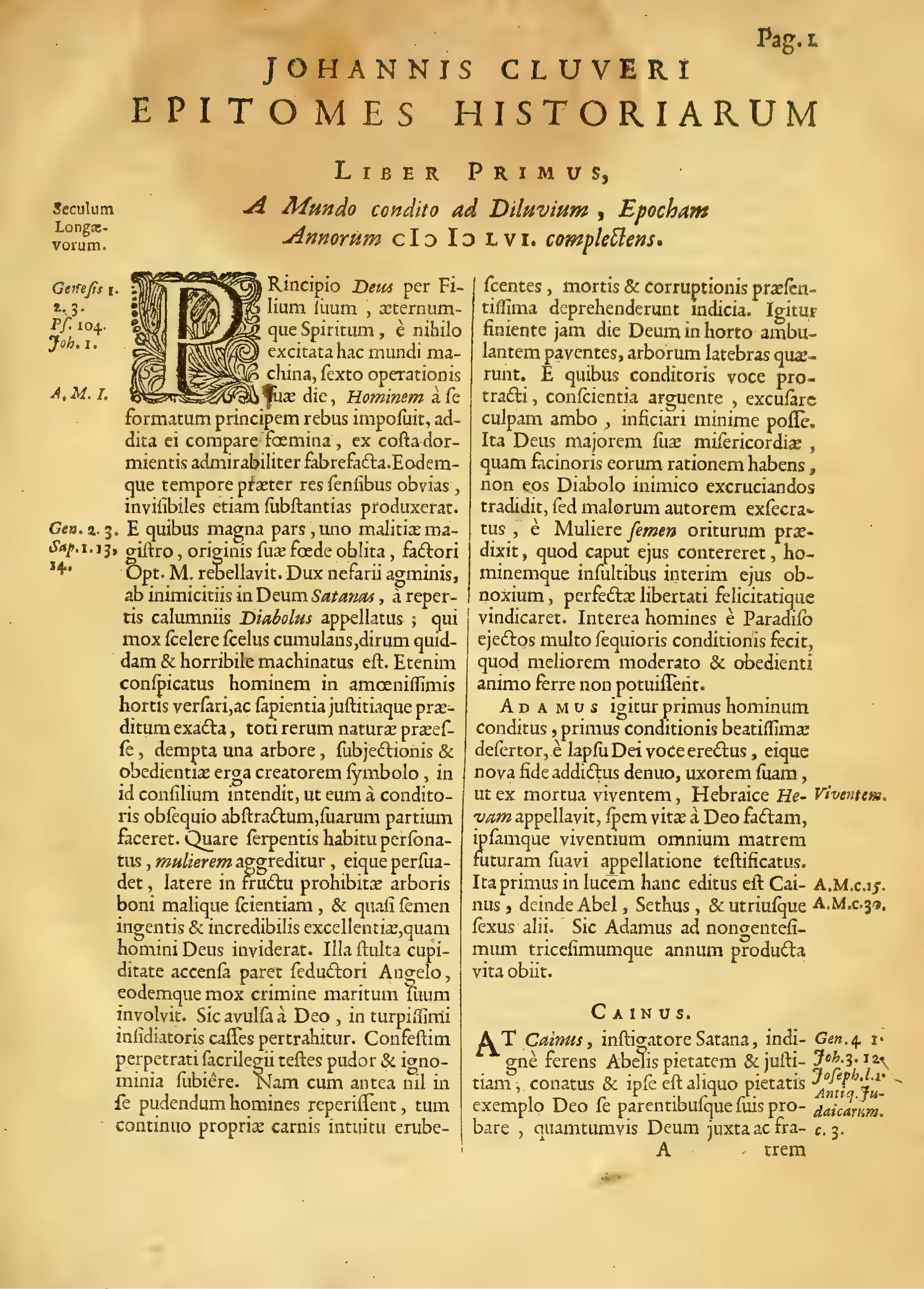
The opening page of Book I makes the method visible: a double-column account beginning with Creation runs beside printed epoch and Anno Mundi labels and cited authorities. An ornamental initial marks the first major division, and the compressed apparatus shows chronology working as judgement, not mere numbering. Source ↗.
Terms such as tyrannis, providentia divini numinis, exercitium religionis, and ius publicum Imperii should consequently be read within early modern political theology and imperial constitutional language. Tyrannis could designate defective or usurped title, not merely personal cruelty; the correlative vice in the epitome's political vocabulary is division, as when provinces are parcelled out among the chief men, which gave to each of them the material of great aggrandizement and of civil discord, the empire collapsing under many heads and raging against its own vitals when under a single head it might have flourished, Inde provincias inter principes dividit, quæ magnorum singulis incrementorum, civilisque discordiæ materiam dedere, ruente sub pluribus imperio, & in sua viscera sæviente, quod sub uno vigere capite potuisset. Providentia could operate as a causal explanation of historical reversal, punishment, and preservation, and the epitome uses the phrase in exactly that explanatory position, reflecting that it seemed to the author to have happened not without the providence of the divine power that Bohemia and its metropolis Prague, which once by its own revolt gave the beginning to this most grievous war of thirty years, should now, its error recognised and its purpose changed, by its own fidelity and constancy impose an end upon that same war, and so by this penitence, as it were, amend the earlier offence, Cæterum mihi hoc non sine providentia divini numinis evenisse videretur, ut Bohemia ejusque metropolis Praga, quæ olim sua defectione gravissimo huic triginta annorum bello initium dedit, eadem nunc cognito errore ac mutato proposito, sua fide & constantia eidem bello finem imponat, atque ita prius delictum hac velut poenitentia emendet. And exercitium religionis referred to legally protected public religious practice rather than to private belief alone: in the embedded Swedish undertaking that when the prince shall have come to the administration of the realm he will govern it by the counsel of the royal senate, according to Swedish law and the constitutions of the realm, and will protect all and singular the Estates and subjects of the realm in the exercise and use of the Augsburg Confession as it was received and confirmed in the Council of Uppsala, Cum ad Regni administrationem pervenerimus, illud ex Regii senatus Consilio, juxta Ius Suedicum, & Regni constitutiones gubernabimus. Omnes & singulos Regni Ordines & subditos in exercitio & usu Augustanæ confessionis tuebimur, prout illa in Upsaliensi Concilio recepta & confirmata est, religious exercise and the public law of a realm are stated in one breath, as two clauses of a single obligation. The available catalogue and OCR evidence does not, however, establish the exact distribution or argumentative force of each of these expressions in every relevant book. Their interpretive value is therefore secure as contextual framing but should not be mistaken for a completed philological concordance.
Clüver's Universal History in Brief: Scope, Authorship, and Contested Attribution
Historiarum totius mundi epitome is a Latin universal-history epitome by Johannes—or Johann—Clüver, a Lutheran theologian and historian born at Krempe in 1593 and deceased at Meldorf in 1633. The first publication is recorded at Leiden in 1631. Its stated historical method draws on more than six hundred sacred and profane authorities, cited in the margins, and arranges the history of the world from Creation through biblical, classical, ecclesiastical, imperial, and early modern periods. Consistently with that method, the narrative repeatedly pins doctrines, offices and party-names to a first moment and a named agent; the name of the evangelical party is given just such an etiology, the princes at the diet having protested, whence the name of Protestants spread afterwards to all who embraced the correction of what had been wrongly introduced into religion, protestati sunt: unde Protestantium nomen ad omnes postea, qui eorum, quæ perperam in religionem invecta sunt, emendationem amplectebantur.
The strongest bibliographical evidence does not confirm the proposition that the surviving object is a Lutheran epitome carried by a named Catholic-Imperial continuator to 1651. The 1668 title and contents instead state that Clüver himself continued the history to 1633 and that the work was later enlarged through the conclusion of the peace between England and the Dutch in 1667. A separately catalogued Continuatio Johann. Cluveri Epitomes Historiarum Mundi covers 1653–1667, is attributed to Johannes Clüver, and was published by Fellgiebel at Leipzig in 1668. The available 1673 catalogue record confirms appendices to Books X–XIV and a continuation section, but does not name a posthumous continuator or establish a confessional change of authorial voice. The alleged terminal date of 1651, Catholic-Imperial seam, and contract with a publishing house therefore remain unconfirmed. The later historical matter does carry the narrative to the settlement of 1648 and closes that phase with an authorial benediction — so at length, after a most grievous war of thirty years, peace was brought back by right of return, and that it may be happy and lasting for the German nation may He from whom all good proceeds, God best and greatest, grant it, Ita tandem aliquando post triginta annorum gravissimum bellum pax postliminio reducta est, quæ ut nationi Germaniæ felix & diuturna sit, faxit is à quo omne bonum procedit Deus optimus Maximus — and it continues into year-by-year narration of the early 1650s; but neither the terminus nor any change of authorial hand can be settled from the accessible records.
The work is distinct from Johannes Temporarius's Chronologicarum demonstrationum libri tres. The latter is a separate Latin chronology, published at Frankfurt (Francofurti) by the Wechel heirs in 1596, in a folio format, with [4] leaves, 304 pages, and [1] final leaf. No reliable evidence establishes that Temporarius's work was the title or author of Clüver's epitome; nor has a verified binding or sale-catalogue explanation for the conflation been located.
The language is Latin, with sacred and profane documentary material and Latinized or vernacular-derived proper names. That onomastic practice is pervasive and sometimes demanding: rulers and authors appear as Ulphila, Dithmarus, Luitprandus, Hildebrandus, Joannes Trosnovius, qui & Zisca, Joannes Basilides, Dux Fridlandus, Torstensonius and Julius Mazarinus; parties as Euangelici, Pontificii, Geusii and Hugonoti; and places under classicizing or coined names such as Gebel Tarich, Sylva Ducis, Tychopolis, Brisacum, Vigornium and Portus Longus, so that identification is itself part of reading the epitome. No confirmed German or Dutch translation, abridgement, or vernacular continuation was located. The documented transmission is instead overwhelmingly Latin and typographical: multiple Leiden, Amsterdam, and later Central European editions, expanding supplements, appendices, and continuations.
Placing Clüver among Chronologers, Confessional Historians, and the Jurists of Westphalia
The epitome matters because it makes visible how universal history was constructed as a confessional, chronological, and bibliographical practice. Its organization from Creation through ecclesiastical and imperial history does not merely accumulate events. It orders sacred and profane time, places political authority beside ecclesiastical development, and uses marginal citation to expose the learned basis of historical claims. The ordering is also evaluative: ancient statecraft is assessed in moral terms that double as juridical ones, as in the character of a king manifestly cultivating treaties not by good faith but by advantage, an artificer in earnest and in jest, most negligent of his oath if perjury were profitable, taught by gold to storm the very breasts of mortals along with the best-fortified strongholds, Primum Deorum vindex habitus, mox contemptor maximus, foedera non fide, sed utilitate colere manifestus; in seria & jocos artifex, blandus pariter & insidiosus alloquio, promissis dives, gratiam singere suetus in odio, jurisjurandi negligentissimus, si quæstui foret dejerare, auro doctus expugnare cum castellis munitissimis ipsa pectora mortalium; and hegemony dressed as liberty is exposed by the conqueror's own mot, that Philip himself called the garrisoned cities, not more insultingly than truly, the fetters of Greece, ipsum Philippum non contumeliosius, quam verius compedes eas Græciæ appellare. Providence performs the same adjudicating work on a longer scale: swelling with success, Himilco, as he held nothing sacred or profane, as he despoiled the tombs of the dead and the temples of the supposed gods, was at once assailed from the opposite side by the eternal Godhead of heaven, Ea felicitate intumescens Himilco, ut nihil sacri profanique habuit, ut mortuorum sepulcra, ut Deorum, qui putabantur, templa expilavit, statim ex adverso ab æterno coeli Numine est oppugnatus, and the hermeneutic is stated in aphoristic form as the principle that God avenges the vices of Christians so much more gravely than the ignorance and savagery of infidels, Adeo Deus Christianorum vitia gravius, quam infidelium inscitiam immanitatemque ulciscitur. A catalogue overview notes that Clüver's treatment extends beyond political and religious history to learned history, while the work's appendices and continuations show how a supposedly comprehensive world history remained open to supplementation.
The work belongs to the wider historiography of early modern chronology. Anthony Grafton's study of Joseph Scaliger presents chronology as an independent discipline carried on by and for mature scholars. That framework is especially useful for interpreting Clüver's epochal organization and the relationship between biblical chronology, imperial succession, ecclesiastical periodization, and the practical needs of readers consulting a large historical compilation. The epitome's form also belongs to the information-management culture analyzed by Ann Blair, whose work examines the proliferation of printed reference books and the techniques by which scholars organized abundant authorities. Clüver's marginal citations, appendices, and index are best understood within that culture of learned retrieval — the more so because the citation columns carry evaluative weight as well as documentary weight, sources being classified by confessional interest, hostile witnesses enlisted as corroboration, patently fabulous authorities discarded, and some disputed matters left explicitly undecided.
The work is also important for the history of confessional historiography. Heinz Schilling's account of confessionalization provides a framework for studying the interaction of religious identity, institutional formation, and political order in early modern Europe. Clüver's universal history can be read as a Lutheran intervention in that field, especially where ecclesiastical chronology and imperial history intersect. The intervention takes the characteristic form of origin-dating. The Roman primacy is given a first claimant and a date, Leo receiving the Roman presidency as the first who began to arrogate to himself some dominion over the bishops of the whole Christian world, as if from a privilege given to Peter, a great venerator of images and relics and the author of the words of the canon, Romanum tunc præsulatum accepit Leo, qui primus in omnes totius orbis Christiani Episcopos dominatum sibi aliquem, velut ex privilegio Petro dato, coepit arrogare, venerator imaginum & reliquiarum magnus, autorque verborum canonis. The popes' temporal lordship is traced to a documented grant, Aripert, having thus gained the kingdom, giving the Cottian Alps, once made a province of the empire by Nero, to the Roman pontiff and sending the instrument of donation written in golden letters to John VII at Rome, this being the beginning of the temporal lordship of the popes, Aripertus ita potitus regno, Alpes Cottias, factam olim à Nerone Imperii provinciam, Pontifici Romano donavit, ac donationis instrumentum aureis perscriptum literis ad Iohannem VII Romam misit. Id initium temporalis Paparum dominii exstitit. Even the coercive apparatus against heterodoxy is dated to a first precedent and censured in the same clause, Maximus, turning from gentler counsels, putting to death the heretics convicted of sorcery and of nocturnal assemblies, men unworthy of the light indeed, yet an example intolerable to wiser men, At Maximus à mitioribus deflexus consiliis, convictos malesicii, nocturnorumque congressuum hæreticos, supplicio affecit, luce quidem indignos, sed exemplo cordatioribus haud tolerando. The verdicts can be blunt, the condition of the city of Rome being reported as worse, torn apart by pontiffs more depraved than the women who controlled them, Pejor erat Romanæ urbis conditio, quam deteriores foeminis Pontifices lacerabant. The surviving catalogue evidence, however, does not establish the proposed transition to a Catholic-Imperial narrator; that interpretation must remain a hypothesis rather than a historiographical conclusion.
The confessional logic extends backwards and forwards from those datings. Doctrinal error is made a historical cause with measurable military consequences, it being agreed that scarcely a third of the army escaped and that nowhere since Cannae was Roman fortune worse handled, this being the thanks the Gothic nations owed Valens, who had infected them with the Arian heresy at Eudoxius's prompting, their bishop Ulfila having been won over with money, Constat vix tertiam evasisse exercitus partem, nec post Cannensem pugnam, usquam deterius rem Romanorum gestam. Hanc gratiam debuerunt Valenti nationes Gothicæ, quas autore Eudoxio, Arianâ hæresi infecerat, Episcopo eorum Ulphila pecuniis delinito. Medieval dissent is reported in a doxography whose articles are given without refutation — that what has no authority from the sacred writings is to be reckoned a fable, that sacred things are to be performed in the vernacular tongue which all understand, and that no saint is to be invoked but God alone, Quod è sacris literis autoritatem non habeat, pro fabula censendum; Sacra vulgari lingua; quam omnes capiunt, peragenda. Neminem sanctum, nisi solum Deum invocandum. And the representativeness of the Council of Trent is audited by a count of nations, Germans, English, Scots, Danes, Swedes, Norwegians, Hungarians, Poles and Bohemians being either few or wholly absent, and the greatest part of the canons framed by Italians and Spaniards, Germani, Angli, Scoti, Dani, Sueci, Norvegi, Hungari, Poloni, Bohemi, aut rari, aut nulli interfuere. Ab Italis Hispanisque maxima Canonum pars confecta est. These are the moves of a confessional historiography that prefers dating and enumeration to disputation, and they belong to the same operation that fixes the origin of the name Protestantes.
The later historical matter engages the problems of the Thirty Years' War and the Peace of Westphalia. Peter H. Wilson's synthesis emphasizes the war's extraordinary political and military complexity, which cautions against reducing it to a single confessional cause. Derek Croxton's study of Westphalia is particularly relevant because it treats the 1648 settlement as both imperial constitutional law and international peace. That duality illuminates why terms such as exercitium religionis, annus normalis, pax postliminio reducta, and ius publicum Imperii carry constitutional force rather than functioning as loose religious vocabulary. The point is visible where the epitome embeds the machinery of a normative-year dispute, commissioners who, having taken counsel among themselves and heard the arguments of both parties, shall inquire whether the state of religion in these dominions is to be reduced to the observance of the year 1624 according to the Peace of Münster, or rather to the year 1609 according to the provisional pacts and agreements of the princes, Qui communicato inter se consilio, auditis utriusque partis rationibus disquirent an status Religionis in his ditionibus ad observantiam anni 1624, juxta Pacem Monasteriensem, an vero ad annum 1609. juxta pacta & conventa Principum provisionalia, reducendus sit; here a date is a legal measure, exactly as origin-dating is elsewhere a doctrinal one. Religious exercise appears in turn as an attribute of princely standing, it being unseemly and alien to the dignity of a prince that no exercise of his own religion should be lawful to him in his own provinces, cum indecorum sit, & à dignitate Principis alienum, nullum ei in suis provinciis, suæ Religionis exercitium licere. That the settlement was contested as law and not merely as policy is registered by the inclusion of the Roman condemnation, a papal diploma having been published in the same year condemning the German pacification chiefly on the ground that in that peace many churches and their goods are perpetually conceded away by Catholics, Publicatum est eodem anno diploma Pontificis, quo damnat pacificationem Germanicam has ob causas præcipue, quod in ea pace multæ Ecclesiæ, earumque bona perpetuo concedantur à Catholicis,. The available evidence does not yet permit a verified reconstruction of Clüver's treatment of each normative-year dispute or of every Westphalian legal formula.
The work also belongs to the history of print-mediated historical knowledge. Andrew Pettegree's reconstruction of the early modern book world places printing within intertwined religious, economic, and cultural pressures, a useful context for the epitome's repeated editions, changing supplements, and transregional movement among Leiden, Amsterdam, Hildesheim, Breslau, and Leipzig. J. Müller's study of early German newspapers and the Thirty Years' War provides a complementary framework for examining how current events and overseas reports entered historical writing, and it bears directly on the epitome's stated preference for matter publicly issued in print over what circulates in men's various reports, as well as on its citation of London news relations. The epitome's expansion from a 1631 universal history to later appendices and continuations thus records a shift from inherited world chronology toward an increasingly current history of war, diplomacy, and confessional settlement.
Finally, the work's relation to Hobbes is potentially significant: one scholarly record states that Clüver's Historia totius mundi epitome offers a more structured chronology of religious history than Hobbes. Because the accessible record does not provide the article's author or full bibliographic details, that comparison should be treated as a promising lead rather than a settled historiographical claim. The same caution applies to the alleged Protestant conciliarist genealogy, the reception of Sarpi and de Thou, the dating of ecclesiastical accretions, and the interpretation of prodigies, eclipses, and calendar disputes: these are important research directions, but the present catalogue evidence does not by itself establish them as Clüver's fully documented arguments. On the conciliarist question the text does speak in its own first person, declaring that it has authorities that the opinion of the Council of Basel, by which the pope was subjected to a council, was defended throughout that whole century by the greatest and most constant supporters, Autores habeo, sententiam Basiliensis concilii, qua concilio subjiciebatur Papa, toto eo seculo maximis suffragatoribus & constantissimis esse defensam; the claim of a sustained conciliarist genealogy thus has direct textual support at this point, though the fuller reconstruction of that genealogy across the ecclesiastical books, like the treatment of Sarpi and de Thou, awaits systematic collation.
Tracing the Editions: From Leiden 1631 to the John Adams Library Copy
The recoverable publication history begins with the Leiden edition of 1631. A later catalogue overview states that at least twelve further editions appeared by 1678, in Leiden, Amsterdam, Hildesheim, and Breslau. Documented witnesses include a 1639 edition from the Bavarian State Library; a 1645 edition of 850 pages; a 1649 Leiden imprint issued by David Lopes de Haro, recorded at 650 pages; a sixth edition from Leiden, Ex officina F. Moyardi, 1657; and the seventh, "much more corrected and emended" edition, printed at Amsterdam by Johann Ravesteijn in 1668. The 1668 copy is described as [4] leaves, 900 pages, and [16] leaves, in quarto. The catalogue overview also states that the earliest supplement, nearly forty pages covering 1630–1633, was written by Clüver himself.
The 1668 title and contents are decisive for the chronology of transmission. They announce the original history to 1630, Clüver's continuation to 1633, and later enlargement through the Anglo-Dutch peace of 1667. The separately catalogued Continuatio Johann. Cluveri Epitomes Historiarum Mundi Ab Anno MDCLIII usque ad Annum MDCLXVII covers 1653–1667 and is attributed to Johannes Clüver, with Fellgiebel at Leipzig as publisher in 1668. This record complicates rather than confirms a posthumous Catholic continuator: the catalogue continues to assign the later matter to Clüver, and the evidence does not identify another author. The later historical matter itself sustains a first-person narrator who moves from theatre to theatre with an explicit transition — a most flourishing kingdom, divided into factions, destroying itself by its own strength, from which point, the outcome being left to the fates, the narrator sails across to neighbouring Britain, Ita divisum in factiones florentissimum Regnum suis se ipsum viribus conficit. Ego hinc, eventu fatis permissio, in proximam Britanniam enavigo — and this continuity of authorial address, together with the theatre-by-theatre arrangement of the matter for 1650 and 1651, does not by itself settle the attribution question the catalogue records leave open.
The most informative table of contents divides the volume into Books I–X, followed by appendices to Books X, XI, XII, XIII, and XIV, and then a continuation. The sequence moves from Creation and the Flood, through the patriarchs, Israelite history, the ancient world, the Church's successive ages, and the final ecclesiastical age associated with Gog and Magog. The appendices occupy the later historical matter, while the continuation begins after the appendix to Book XIV. The later matter is also documentary in texture rather than purely narrative: princely declarations, arbitral awards, electoral mandates, embassy articles with the Imperial reply, and treaty clauses are quoted or closely paraphrased, as with the stipulation that the norm and rule of the Elector's obligation be the archiepiscopal capitulation, by force of which the Elector shall be bound in grave affairs bound up with danger to the country to communicate with the metropolitan chapter and to determine or attempt nothing in such matters without its counsel, Ut norma & Regula Electoralis obligationis, sit Capitulatio Archiepiscopalis, cujus vigore Elector teneatur, in gravibus negociis quæ cum patriæ periculo conjuncta sunt, cum Capitulo Metropolitano communicare, & fine ejus consilio in hujusmodi rebus nihil statuere aut attentare; the practice extends into the epitome's later pages the same conversion of events into dated, citable norm that governs its treatment of antiquity. A Staatsbibliothek zu Berlin record for a 1673 witness identifies the title and year, records 988 scanned pages, places the preface and Praefatio Ad Lectorem near the front, and lists the appendix to Book XIII and the appendix to Book XIV. Its catalogue record does not supply a shelfmark or publisher. An e-rara record identifies another 1673 witness as Vratislaviae, held by the Zentralbibliothek Zürich, but the accessible record does not name the printer or provide a shelfmark.
The Internet Archive exemplar with identifier johannescluverih00cl is not an anonymous or institutionally indeterminate scan. It is a Boston Public Library copy from the John Adams Library, with call number 39999052969126. Its provenance includes the John Adams Library bookplate, an inscription by John Thaxter dated 1772, and transfer from the supervisors of the Temple and School Fund at Quincy in 1894. The copy is in Latin, printed in double columns with printed marginalia. It lacks the added engraved title page and approximately 132 pages at the end, so it cannot by itself serve as a complete witness to the final continuation or terminal apparatus.
The marginal apparatus is therefore materially significant: it required the simultaneous setting of a dense historical narrative, double columns, and printed citations. Its function is inseparable from the work's method, since it is the marginal column that carries the classified authorities on which each dating and each verdict rests. The available 1673 OCR displays running heads such as "Historiarum Lib. X" and "Appendix," together with irregular signature-like strings and broken typographical readings. These observations support attention to compositorial practice, but they do not establish a stable bibliographical state for the alleged impietatis/pietatis substitution, the specified signatures Gggg 2 and Hhhh 2, or particular mispaginations. Those claims remain to be checked against page images and multiple copies.
The accessible catalogue records do not recover a dedicatee, patron, privilege-granting authority, approbation, or named posthumous continuator. The existence of a preface in the 1673 record is secure, but its contents were not available in the catalogue excerpt. No reliable evidence was located for Roman or Spanish Index condemnation, expurgation, suppression, or a chain of contemporary refutations. Likewise, a complete bibliography of Clüver's theological and historical works beyond the epitome was not established from authoritative bibliographical evidence. Clüver must nevertheless be distinguished from Philippus Cluverius, the earlier geographer and historical-geography writer, and from other surname-only Cluverus entries; the epitome's author is the Lutheran Johannes Clüver of 1593–1633.
Following the Argument through Fourteen Books, the Appendices, and the Continuatio
The books of the epitome can be followed in the order in which they were set, and that order itself carries the argument: each movement fixes a first moment for the institutions, parties and practices it reports, and then weighs them against the reckoning of years that runs beside the columns. What follows traces the procedure through the ancient monarchies, the apostolic and patristic Church, the imperial synchronisms of the medieval books, the conciliar and Reformation matter, and finally the appendices and continuation in which the method is turned upon the compiler's own decade and carried past it.
Faction, usurped title, and sacrilege in the ancient monarchies
The Greek and Hellenistic matter is entered in the middle of a reign rather than at a fresh beginning, and its architecture is immediately visible: regnal headings set in capitals — the Persian Great Kings, then an imperial rubric for the Greeks, then the Ptolemaic series — govern blocks within which Aegean, Sicilian, Persian, Jewish and Roman events are interleaved year by year, while the margins carry the double reckoning of Anno Mundi beside Olympiad, years ab urbe condita, and the epoch of the Greek empire, the last explicitly tied to Jewish chronographic usage. The marginal column beside this narrative names Livy, Diodorus, Justin, Xenophon, Plutarch, Polybius, Curtius, Josephus, Eusebius and the books of Maccabees, so that the alternation of theatres is at every point underwritten by a classified authority. Within that apparatus the narrative voice is anything but neutral. The Athenian refusal of Spartan overtures after Cyzicus is reported with an explicit verdict on the mechanism of demagogy, that broken by these disasters the Lacedaemonians sought peace, and that they should not obtain it was brought about by Cleophon and others, for whom disorder afforded profit — by the most foolish error of the Athenians, who preferred an uncertain war to an honourable peace, Quibus malis fracti Lacedæmonii, pacem petiêre: quam ne acciperent, Cleophonis aliorumque opera effectum est, quibus turbatæ res præbebant quæstum, stultissimo errore Atheniensium, honestam pacem incerto bello posthabentium. Two things are done at once here. The quæstum clause supplies a motive — faction as a trade, disorder as a source of gain — and the ablative of quality stultissimo errore converts a political decision into a moral fault of the assembly itself, with honestam and incerto set against each other so that honour and calculation fall on the same side. The formula is an early statement of the vocabulary in which the epitome will later weigh divided sovereignty and faction: what destroys a state is not primarily the enemy's strength but its own preference for the uncertain.
That preference has a counterpart in the vice of the victor. Sparta's fall at Leuctra is narrated with the causal work assigned entirely to character rather than to tactics: the victory fell to the Thebans, and the most ancient commonwealth of the Lacedaemonians, which for five hundred years had claimed the primacy of Greece, was cast down by its own pride from the honour it had long usurped, victoria Thebanis cedit, antiquissima Lacedæmoniorum Respublica, quæ annos quingentos principatum sibi vendicarat Græciæ, suapte superbia, usurpato pridem honore dejicitur. The juridical charge is carried by two words. Vendicarat makes the Spartan hegemony a claim asserted rather than a right possessed, and usurpato completes the verdict: the principatum was held by usurpation, and five hundred years of tenure confer no title. This is precisely the reasoning the epitome applies elsewhere to institutions whose antiquity is offered as their warrant, and it is applied here to a pagan commonwealth: duration is not prescription, and an origin in self-assertion remains legible in the fall.
The same logic governs the treatment of sacrilege, where the historian's interest in record and his interest in retribution coincide. Philomelus' seizure of Delphi is registered not merely as plunder but as an assault on documentary authority, for he erased the decrees of the Amphictyons cut there upon the columns, & Amphictyonom sententias columnis ibi incisas erasit. The detail matters to a compiler whose own method rests on inscribed and printed evidence: to efface a public sententia on stone is to attack the very medium in which lawful decision survives, and the crime is thus doubled, against the shrine and against the archive. The theological verdict that follows is carefully hedged and all the more emphatic for it, since, as the author insists of the Phocians, because to them at least these were gods, God avenged their extreme impiety with punishments, tamen quia ipsis Dii erant, impietatem extremam suppliciis vindicavit Deus. The concessive quia ipsis Dii erant preserves the confessional distance of a Lutheran writer who will not concede the reality of the pagan pantheon, while the argument runs that the sacrilege is real in the perpetrators' own terms and therefore punishable by the one God who is the subject of vindicavit. Providence, in other words, judges by the offender's own profession, a principle that stands very close to the aphorism elsewhere in the work that the vices of Christians are punished more gravely than the ignorance of infidels. The distance from pagan cult is registered lexically as well, in the gloss that names Apollo truly Apollyon, that is, the destroyer, as he is called by John, vere Apollyon, id est, perditor dictus Johanni; the etymological identification of the Delphic god with the angel of the abyss folds a scriptural apocalyptic lexicon into classical narrative without interrupting it, and it supplies the ground on which oracles will subsequently be treated as fraud rather than as prophecy.
In the Alexander books the moral analysis shifts from sacrilege to the constitution of monarchy. Darius' overtures elicit the formula of universal empire in its sharpest form, the Macedonian answering that he would have peace if he were willing to hold his empire at the victor's discretion, for heaven does not suffer two suns, nor earth two supreme empires, Responsum à Macedone, habiturum pacem, si de arbitrio victoris imperium vellet. Nam nec duos cælum soles, nec duo summa imperia terram pati. The cosmological analogy grounds sole rule in the order of nature, and it prepares the argument that the true danger to such an empire is internal. The corruption is diagnosed as a conquest in reverse: here Alexander openly loosed his appetites, and he whom the arms of the Persians had not broken, his vices conquered — untimely banquets, and the insane sweetness of hard drinking and of staying awake, and games and herds of concubines, all lapsed into foreign custom, Hic vero palam cupiditates suas solvit Alexander, & quem Persarum arma non fregerant, vitia vicerunt, intempestiva convivia, & præpotandi pervigilandique insana dulcedo, ludique & greges pellicum, omnia in externum lapsa sunt morem. The antithesis arma non fregerant / vitia vicerunt is the characteristic epigrammatic closure of a narrative unit in these books, and the concluding in externum lapsa sunt morem names the mechanism: degeneration is the adoption of another people's usage. Its constitutional expression follows at once, in the report that he ordered that he should no longer be greeted as king but adored with the body prostrate on the ground, nec amplius salutari se ut regem, sed prostrato humi corpore adorari præcipit. The contrast between salutari ut regem and adorari is a distinction between lawful kingship and a cult of the ruler, and the verb adorari belongs to the same vocabulary of illegitimate veneration that the epitome elsewhere applies to images and relics.
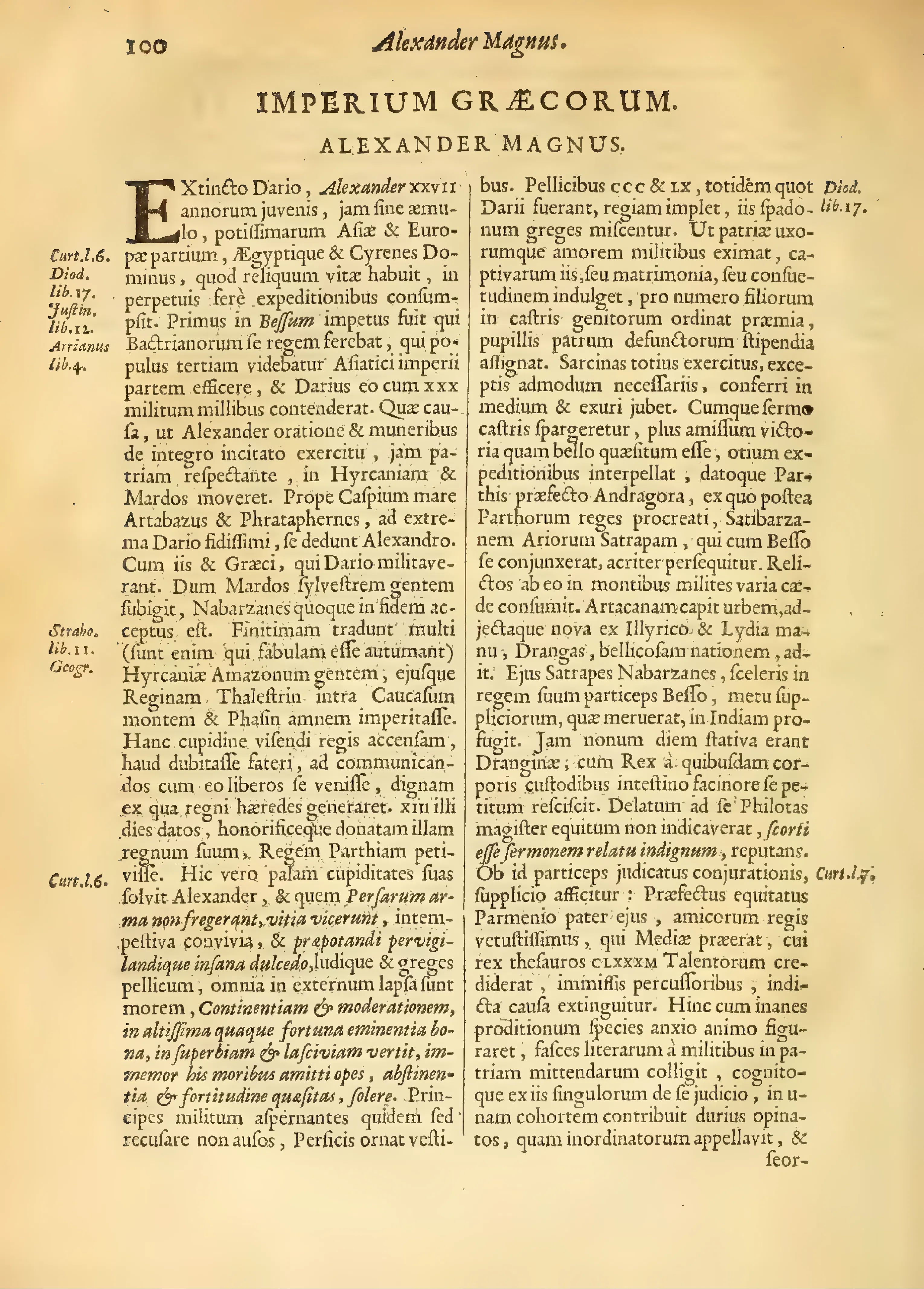
Opening the Alexander Magnus section under the imperial rubric for the Greeks, this double-column page hangs its narrative with marginal authorities—Curtius, Diodorus, Justin, Arrian, Strabo. The same leaf that voices scepticism about the Amazons stages degeneration, faction, and the Philotas–Parmenio killings as symptoms of monarchy corrupted from within. Source ↗.
The succession crisis is then made to turn on a single judgement of principle. Alexander's disposition is reported as a deliberate rejection of dynastic right, forgetful of his little son Hercules, of his brother Aridaeus, and of the pregnant Roxane, he judged that a successor was to be estimated by virtue and not by blood, blitusque filioli Herculis fratris Aridæi, & prægnantis Roxanes, virtute non sanguine æstimandum judicavit successorem. Stated as a maxim, virtute non sanguine is the hinge on which the whole Hellenistic disorder is hung, since it leaves the title to empire indeterminate and therefore contestable by every commander. The outcome is given in a formula of arithmetical bleakness, that when these things were heard Seleucus, Cassander and Lysimachus likewise claimed royal majesty for themselves, and in place of one many kings suddenly emerge, Quibus auditis, Seleucus, Cassander & Lysimachus, & ipsi regiam sibi vendicant majestatem, ac pro uno multi subito emergunt reges. Here vendicant recurs in its earlier technical force of claim without title, and pro uno multi supplies the numerical figure of defective sovereignty; the assumption of the diadem is at once available for synchronism with the prophetic scheme of a Greek empire divided, so that the profane narrative delivers a datable fulfilment rather than an illustration.
Oracular authority receives the treatment the earlier Apollyon gloss prepared. Pyrrhus' Italian expedition is introduced as scarcely more fortunate than what preceded it, he having been deluded by an ambiguous oracle of Apollo, the reply having been, I say that you, son of Aeacus, can conquer the Romans, Nec multo felicio Pyrrhi, Epirotarum regis, in Italiam expeditio fuit, ambiguo Apollinis delusi oraculo. Responderat, Aio te Æacida Romanos vincere posse. The Latin is left in its undecidable accusative-and-infinitive construction, in which either party may be subject of vincere, and the syntactic ambiguity is itself the evidence: delusi attributes the failure not to misreading but to the deceit of the responding god.
The closing movement of this matter sets that fraudulent ambiguity against a demonstrated computation. Before Pydna the lunar eclipse is handled as a case in which prediction and portent diverge: when the moon had been eclipsed at the appointed hour, the wisdom of Gallus seemed almost divine to the Roman soldiers, while it moved the Macedonians as a sad portent, foretelling the setting of the kingdom and the destruction of the nation, Edita hora luna cum defecisset, Romanis militibus Galli sapientia propè divina videri. Macedonas, ut triste prodigium, occasum regni perniciemque gentis portendens, movit. For a writer whose whole enterprise rests on computed years, the contrast between edita hora — the hour announced in advance and then met — and triste prodigium is a defence of chronological science itself: the same celestial event is knowledge to those who can reckon it and terror to those who cannot, and only the second reading is superstition. The victory is then closed not with triumph but with a caution against the confidence victory breeds, Aemilius Paulus admonishing his own sons and all the young men who were present that in prosperity nothing should be resolved proudly or violently against anyone, and that present fortune should not be trusted, since it is uncertain what late evening may bring, liberosque admonuit suos, & quotquot erant juvenes, in secundis rebus nihil in quemquam superbè ac violenter consulendum, nec præsenti credendum fortunæ, cum quid serus vesper vehat, incertum sit. The clause quid serus vesper vehat carries an unmistakable Virgilian cadence, and its placement is deliberate: the admonition against superbia answers the diagnosis of Sparta's fall, so that the conqueror of Macedonia is made to articulate the very principle by which the epitome had judged the hegemony he has just destroyed.
The apostolic age under Nero
A single dense page of the book devoted to the earliest Church shows the same apparatus compressed to its limit. It runs continuously from Paul's arrest in the Temple through his Roman captivity and execution to the Neronian persecution and the fire of Rome, and it functions as a hinge between the Judaean political history of the procurators and the beginning of the persecutions that will structure the ecclesiastical books; the running head sets the whole under a theological indictment of the nation, Iudæa suum Regem cœlestem persequitur, Judaea persecutes her own heavenly King. The sequence opens with the tumult at Ephesus, explained by the quæstus of superstition — the revenue interest attached to the great altar — the governor acting for the favour of the Ephesians, among whom the greatest altar of Diana was worshipped, and there was the revenue of much superstition, in gratiam Ephesiorum, apud quos ara maxima Dianæ colebatur, & multæ superstitionis quæstus erat.
The arrest that follows is narrated as Roman legal process, with citizenship operating as a procedural protection: the Roman tribune of soldiers Lysias, reckoning him the author of the disturbed peace, kept him bound; then, his Roman citizenship being known, he nevertheless retained him, but more honourably, and sent him to the governor Felix at Caesarea, having been informed of the ambushes of the Jews, who, a conspiracy having been made, had resolved to fast until they had killed that most holy man, Tribunus militum Lysias Romanus, perturbatæ pacis autorem ratus, vinctum eum habuit: cognita deinde civitate Romana, retinuit tamen, sed honestius, & ad Felicem præsidem misit Cæsaream, edoctus Iudæorum insidias, qui conjuratione facta jejunare statuerant, donec sanctissimum virum occidissent.. Felix, Portius Festus, the appeal to Caesar and the hearing before the younger Agrippa and Berenice follow in turn, and between the appeal and the Roman captivity stand the voyage, the shipwreck, the viper and the healing of Publius's father, reported without comment. Chronology in this page is carried by procuratorial succession — Felix, Festus, Albinus — and by high-priestly succession — Ismael, Josephus Cabi, Ananus — rather than by the Anno Mundi and Anno Christi marginalia alone, and provincial disorder is registered in the same breath as the governor's arrival: the Iudæi, stirring up their accustomed tumults, provoke Albinus the governor of Judaea sent by Nero, and were laying waste Jerusalem, Iudæi consuetos tumultus agitantes, iritant Albinum Iudææ præsidem à Nerone missum, Ierosolymamque vastabant.
Within that sacerdotal sequence falls the death of James, narrated with the full apparatus of place and motive: Ananus, on the death of the procurator Festus, led James, the brother of the Lord Christ, held in the highest admiration among the Jews, up to the pinnacle of the Temple, and, having thrust him down from it, overwhelmed him with stones, because he most constantly preached Jesus Christ the Son of God, Ananus mortuo Festo Procuratore, Jacobum, Domini Christi fratrem, apud Iudæos in admiratione summa positum, in templi fastigium subducit, & in id impulsum lapidibus obruit, quia constantissimè Iesum Christum Dei filium prædicabat.. The providential requital is then registered not on the compiler's own authority but on that of the Jewish historian himself: since an incredible calamity of the Jews followed the murder of the holy man, not a few, among whom Josephus, judged that on account of that crime the divine anger had been kindled, Sancti viri cædem, cum sequuta esset incredibilis Iudæorum calamitas, non pauci, inter quos Iosephus, ob istud facinus divinam iram inflammatam senserunt.. The contest de imperio between Judaeans and Syrians at Berytus, and Nero's decision expelling the Jews from the city, follow in the same annalistic manner.
The Roman martyrdoms are handled with attention to mode of execution — the inverted crucifixion and the sword — and with a patristic witness adduced for the growth of the Church out of them: this indeed Clement of Rome writes, that with Peter especially and Paul having been shamefully treated the number of martyrs grew, and that the ground of edification arose for him from them, Hoc quidem scribit Clemens Romanus, Petro præsertim & Paulo indignè tractatis martyrum numerum crevisse, causamque sibi ædificationis ex iis nasci.. The prison epistles are then made evidence of conversions at the very centre of the persecuting power, and the report closes on a note of remarkable charity: it is also agreed that Paul, when he was first at Rome, procured from Nero's household believers for Christ, of which matter there are traces in his epistles, when from custody at Rome he wrote to the Philippians, the Colossians, Timothy and Philemon, and did not despair even of Nero's salvation, if he were willing to hear the preaching, Constat etiam Paulum quum Romæ primum esset, ex familia Neronis fideles Christo comparasse, cujus rei in epistolis ejus vestigia sunt, cum ex custodia Romæ Philippenses, Colossenses, Timotheum & Philemonem scriberet, ac de Neronis quoque salute non desperaret, si prædicationem audire vellet..
The turn to persecution is then given its political mechanism. The tortures and the human torches are followed by the fire and by the transfer of odium: the suspicion was among all that the fire was made by Nero's own design, that he might be the founder of a new city and impose a new name upon it; in order to remove the odium of that matter from himself, he turned it upon the Christians, whom he punished as though they were incendiaries, Suspicio fuit apud omnes, ipsius Neronis consilio factum incendium, ut novæ urbis conditor esset, & novum illi nomen imponeret. Ejus rei invidiam ut à se amoveret, in Christianos convertit, quos velut incendiarios supplicio affecit.. The page then closes by giving the persecutions their first moment and their providential construction at once: these were the beginnings of the Christian persecution, which was then continued through Domitian, Trajan, and the rest of the princes, while God tried his own as though in a furnace, Hæc initia persecutionis Christianæ, quæ deinde per Domitianum, Trajanum, aliosque principes continuata est, dum DEUS suos velut in fornace probaret.. The furnace figure is drawn from Malachi and Isaiah, and it closes an interlocking of Roman administrative history, Jewish sacerdotal history and the beginnings of ecclesiastical martyrology with a providential reading of martyrdom itself.
Persecution, learning, and the multiplication of errors in the fourth century
The fourth-century annals set the ecclesiastical and imperial matter in the double marginal reckoning of Anno Christi and Anno Mundi, with the reigning emperors named as rubric, and five movements can be distinguished within a single dense forme: Valens as persecutor, with a catalogue of his cruelties; the Donatist disturbance and Valentinian's armed recovery of the churches; a roster of learned bishops and monks, balanced at once by an enumeration of multiplying heresies; the accession of Gratian and Valentinian II with the death of Valens; and a retrospective block on Constantius, Julian the Apostate and Jovian.
The persecution material is documented from the ecclesiastical historians, the margin naming Sozomen by book and chapter, Zozom. l. 6. c. 6. 21., the Historia tripartita at the corresponding place, Tripart. Hist. l. 6. c. 21., and Sozomen again for the sequel, Zozom. l. 6. c. 21.. Valens, having learned of a very great disturbance, afflicted the men of Antioch, some with death, most with the deprivation of their goods and dignities; among whom, after Theodorus, especially a certain aged Salustius, of the most ancient Aristotelians, a philosopher of outstanding name, was against the expectation of all torn apart with terrible torture, Comperto Valens turbatione plurima Antiochenos afflixit, morte quosdam, plerosque bonorum ac dignitatum privatione. Ex quibus secundum Theodorum præcipuè Salustius quidam senex, ex vetustissimis Aristotelicis, egregii nominis Philosophus, contra spem cunctorum cruciatu terribili laniatus est.. The same Valens consumed by the burning of a ship, sunk in the sea, eighty presidents of churches, when they had sent men to the court to demand an account of the oppression of the Catholics, Idem Valens octoginta Ecclesiarum præsides, cum in aulam misissent, qui rationes oppressionis Catholicorum expostularent, in mare demersos incendio navis absumsit.. Censure of the Western emperor is measured rather than withheld: Valentinian had less appetite for deeds of this deadly kind, although in the matter of torturers and other like things he is held to be fierce more than justly, Valentiniano ejusmodi feralium rerum minor cupido erat, licet in tortoribus, aliisque similibus rebus, plusquam justè, atrox habeatur..
The African schism is then narrated as a discrete juridical-military episode. Straightway the Donatists stirred up great dissensions for him in Africa, while by their own dogmas they refused to have their right feet bared and washed, by which they were insultingly derided, Magnas statim illi dissensiones Donatistæ in Africa concitavere, dum adversus dexteros pedes suos nudandos & abluendos, a quibus ipsi contumeliose insultati, propriis dogmatibus negarentur.; and Valentinian did not endure such obstinacy, as one about to break out into tumults and civil wars, and recovered by armed forces his churches which had been claimed by them and interdicted to the Catholics, and drove the Donatists themselves into exile, Non sustinuit Valentinianus tanta pervicacia, ut in tumultus & bella civilia prorupturam, ecclesias suas ab illis assertas, & Catholicis interdictas, armatis viribus recuperavit, atque Donatistas ipsos in exilium egit.. Against the Western recovery of order stands the Eastern provocation of wrath, stated with an explicit appeal to the historians: meanwhile, when Valens, who was still surviving, was stirring up disturbed churches and various heresies, as the history has it, determining nothing concerning those things which are pleasing to God, but presuming only his own, or yielding to the counsels of others, he aroused a grave wrath against the Church, Interim cum Valens, qui adhuc superstes erat, turbatas Ecclesias, & varias haereses, ut historia est, conflaret, nihil de illis, quae Deo grata sunt, statuens, sed sua tantum praesumens, aut alienis consiliis cedens, gravem Ecclesiae iram excitavit.. The corresponding gift is credited to God rather than to arms, the emperor being rendered terrible to the enemies whom Sozomen records, because God had then subjected them to Christian princes, hostibus reddidit terribilem, quos Zozomenus commemorat, quia Deus eos principibus Christianis tunc subjecerat..
The learned roster is entered with a clause that states the criterion of inclusion — surviving writings. At these times there were held famous in the Church Basil of Caesarea in Cappadocia, Gregory Nazianzen, Gregory of Nyssa, Eusebius of Samosata, Didymus of Alexandria, Ambrose of Milan, Hilary of Poitiers, Optatus the African, Epiphanius of Cyprus, Cyril of Jerusalem, Athanasius of Alexandria, Damasus the Roman, bishops, whose monuments the Church still enjoys, Hisce temporibus celebres in Ecclesia habebantur Basilius Caesareae Cappadociae, Gregorius Nazianzenus, Gregorius Nyssenus, Eusebius Samosatenus, Didymus Alexandrinus, Ambrosius Mediolanensis, Hilarius Pictaviensis, Optatus Afer, Epiphanius Cyprius, Cyrillus Hierosolymitanus, Athanasius Alexandrinus, Damasus Romanus Episcopi, quorum monumentis Ecclesia fruitur adhuc.. The monastic roster that follows is qualified in a way that privileges action over contemplation: Ephraem the Syrian, Antony, Hilarion, Macarius, Paul, and very many other monks were moreover distinguished by holiness of manners and splendour of doctrine, whom then, as Sozomen says, they mingled not so much with contemplation as with work and the harshness of life, and also with the conduct of affairs, Illustrabant praeterea sanctitate morum, doctrinaeque splendore, Ephraem Syrus, Antonius, Hilarion, Macarius, Paulus, aliique Monachi plurimi, quos tunc, ut ait Zozomenus, non tam contemplationi, quam operi et vitae asperitati, quam etiam rebus gerendis admiscuere.. The balance is then immediately restored on the debit side, and with its own heresiological authorities: but under these times also errors were multiplied in the Church, Photinians, Arians, Eunomians, Macedonians, Apollinarists, Novatians, Donatists, and innumerable others, whom Augustine, Jerome, Epiphanius and others diligently reviewed, Sed sub hisce quoque temporibus multiplicati sunt in Ecclesia errores, Photiniani, Arriani, Eunomiani, Macedoniani, Apollinaristae, Novatiani, Donatistae, aliique innumeri, quos Augustinus, Hieronymus, Epiphanius, aliique diligenter recensuere..
The accession that follows is reported with the constitutional form of collegial rule and with doctrinal policy in the same sentence: Valentinian being dead, Gratian his son, already before an Augustus, obtained the empire, with his brother Valentinian, a boy, whom after their father's death the soldiers had called Augustus; they therefore with their uncle Valens administered the commonwealth, and strove to restore peace and sound doctrine in the Church of God, while Valens still favoured the Arians and harassed the Catholics, Mortuo Valentiniano, Gratianus filius ejus, jam ante Augustus, imperium adeptus est, cum fratre Valentiniano puero, quem post mortem patris milites Augustum dixerant. Illi ergo cum Valente patruo rempublicam administrabant, et in Ecclesia Dei pacem, sanamque doctrinam restituere studebant, cum Valens adhuc Arianis faveret, et catholicos vexaret.. The Goths, driven by the Huns from the Maeotic marshes, burst into Thrace and struck a treaty with Valens that they should dwell on Roman soil; but on account of the avarice of the Roman commanders, by whom the grain allowance was denied them, they turned to arms and inflicted a great slaughter on the Romans, and killed Valens himself at Adrianople in the fifteenth year of his reign, when he had fled into a certain cottage, which was set on fire by the enemy, and thus he perished by the punishment of fire, with which he had afflicted the churches of God and the saints, in the fiftieth year of his age, Sed ob avaritiam ducum Romanorum, quibus annona negabatur, in arma versi, magnam cladem Romanis intulerunt, ipsumque Valentem apud Hadrianopolim anno imperii quinto decimo interfecerunt, cum in casam quandam confugisset, quae ab hostibus incensa est, atque ita ignis supplicio, quo Ecclesias Dei et sanctos affecerat, ipse periit, anno aetatis quinquagesimo.. The punishment is made to answer the crime in kind, and the regnal and biological years are computed in the same clause that pronounces the requital.
The retrospective block that closes the sequence works by conditional praise and by hostile testimony. Constantius died in the year of his reign, and a prince to be reckoned of great works, if he had been more moderate and more peaceable, Obiit anno regni sui Constantius, & magnorum operum, si moderatior fuisset, et pacatior, princeps habendus. — the epitaph granting the achievement only on a counterfactual. The apostasy is then narrated as a coordinated programme with an educational core: Julian the Apostate, Constantius's cousin, seized the empire, and at once put off the Christian name, and fell away to the superstitions of the heathen, and endeavoured to restore them; he opened the temples, renewed the sacrifices, deprived the Christians of honours, offices, schools and other things, and interdicted them from the liberal disciplines, that no Christian should teach or learn grammar, rhetoric or philosophy, whereby he hoped to bring the Christians back to ignorance and so to heathenism, Julianus Apostata, Constantii patruelis, imperium occupavit, & statim Christianum nomen exuit, & ad Ethnicorum superstitiones defecit, easque restituere conatus est. Templa aperuit, sacrificia instauravit, Christianos honoribus, muneribus, scholis, aliisque rebus privavit, & doctrinis liberalibus interdixit, ne quis Christianus grammaticam, rhetoricam, aut philosophiam doceret aut disceret, quo Christianos ad ignorantiam, & sic ad ethnicismum reducere sperabat.. The prophecy is then vindicated on a pagan's word: he endeavoured to restore the Temple of Jerusalem to the Jews, that he might show Christ's prophecy false, but globes of fire bursting out from the foundations hindered the work and consumed the workmen, as Ammianus Marcellinus, a heathen writer, testifies, Templum Hierosolymitanum Judaeis restituere conatus est, ut Christi prophetiam falsam ostenderet, sed globi ignis e fundamentis erumpentes opus impedivere, & operarios absumsere, ut Ammianus Marcellinus, ethnicus scriptor, testatur.. The qualification ethnicus scriptor does the evidentiary work: the witness has no interest in the conclusion he supplies. The block closes with the apostate's death and the brief restoration under his successor: Julian being transfixed in Persia by a certain Persian or by a Christian soldier or by divine agency, and dying with that word, Thou hast conquered, Galilean, Jovian, a Christian and orthodox man, was named Emperor by the army, who made a peace with the Persians, ignominious indeed but necessary, in order to save an army perishing of hunger, and ceded the city of Nisibis to the Persians; he restored the Christian religion, closed the temples of the heathen, and recalled Athanasius from exile, but in the eighth month of his reign, suffocated by the vapour of coals in his bedchamber, he died, Juliana in Perside a Persa quodam vel a milite Christiano, vel divinitus transfixo, & moriente cum illa voce, Vicisti Galilaee, Jovianus, vir Christianus & orthodoxus, ab exercitu Imperator dictus est, qui pacem cum Persis ignominiosam quidem, sed necessariam fecit, ut exercitum fame pereuntem servaret, & Nisibin urbem Persis cessit. Christianam religionem restituit, templa ethnicorum clausit, & Athanasium ex exilio revocavit, sed octavo mense regni sui, vapore carbonum in cubiculo suffocatus, obiit.. The triple alternative for the fatal wound — Persian, Christian soldier, or divine agency — is the same studied reticence the epitome uses wherever its authorities do not agree.
From the Huns to the Roman primacy
The same reign-by-reign sequence, read from its opening, begins on a displacement that the epitome treats as the mechanical cause of everything following: the Huns, a people unknown, dwelling beyond the Maeotic marshes next to the frozen Ocean, without hearth, without law or fixed rite, ever wandering, living in wagons, with no care for turning the ploughshare, had poured with an immense cavalry into the lands beyond the Danube, driving the Scythians and Goths to implore Valens's protection, Hunni gens ignota, ultra paludes Mæoticas glacialem Oceanum accolens, absque lare, absque lege & ritu stabili, semper palabunda, in carpentis habitans, nulla versandi vomeris cura, cum immenso equitatu in Transistrianas terras se effuderat, Scythas Gothosque cogens Valentis imploare fidem. The Ammianean excursus is compressed into four privations — lar, lex, ritus, vomer — and each negates a category by which the epitome elsewhere measures a polity: settled habitation, public law, fixed cult, agriculture. Ethnography is not ornament here but the first link in a chain of secondary causation, since the Huns press the Goths, the Goths are admitted to Roman soil, and the empire is undone from within by the very peoples it received.
The narrative refuses, however, to let secondary causes stand alone. The catastrophe that follows is measured first by classical standards and then re-explained theologically, in the verdict discussed earlier in this report, where it is agreed that scarcely a third of the army escaped and that Roman fortune had nowhere been worse handled since Cannae, and where the Gothic nations are said to have owed Valens just this thanks for infecting them with the Arian heresy at Eudoxius's prompting, their bishop having been won over with money. Two idioms are welded in as many sentences. Constat and the Livian comparison belong to the humanist historian's calibration of disaster; hanc gratiam debuerunt is the sardonic accounting of requital, in which the emperor receives back precisely what he disbursed. Heresy is figured as contagion (infecerat) and its transmission as a purchase (pecuniis delinito), so that venality and doctrinal corruption are introduced together as a single explanatory couple — a couple that will reappear when a Roman primacy is bought from a usurper.
The same reign-sequence supplies the epitome's first case of blood shed for doctrine, and with it the double judgement that is the method's signature: the execution of the heretics convicted of sorcery and of nocturnal assemblies, already quoted in this report, where Maximus turns from gentler counsels and the condemned are granted unworthy of the light while the precedent is nonetheless refused. The concession and the censure are held in one sentence by the quidem … sed articulation: the condemned are granted to be vicious, while the precedent is refused. The comparative cordatioribus — "to men of sounder heart" — locates the judgement not in a party but in a standard of prudence, and the protest of Martin of Tours, narrated immediately before, functions as contemporary testimony against the practice rather than as hagiographical decoration. Capital coercion for heterodoxy is thus given a first agent and a first date, exactly as offices and titles are elsewhere.
That habit of dating is inseparable from a declared economy of witnesses, in which hostile authorities carry the greatest weight. Moved by that victory the poet Claudian, obstinate pagan though he was, bore witness to God and to the man, when he sang, Illa victoria motus Poëta Claudianus, Paganus licet pervicax, DEO hominique testimonium tulit, cum cecinit, and the verse produced is the line about the winds that come as sworn confederates to the trumpets, Et conjurati veniunt ad classica venti!. The concessive Paganus licet pervicax is doing evidentiary work: a witness with no interest in the conclusion, indeed with every interest against it, is the strongest possible corroboration of a providential reading of the Frigidus. The same manoeuvre governs the use of Zosimus's pagan lament over the ruined shrines and, later, of Zosimus's complaint at the swarming of monks, where a classical detractor of Christianity is enlisted against an institution the epitome also opposes. Adversarial testimony is, in this procedure, not a concession to impartiality but a polemical instrument.
The ecclesiological pivot of these books fixes several accretions to a single pontificate, in the sentence already cited on Leo's reception of the Roman presidency: four contested things — universal jurisdiction, the cult of images, the cult of relics, and the sacrificial formulae of the canon of the mass — are bound to one name and one year, and the whole claim is suspended by a single particle, since velut ex privilegio Petro dato reports the Petrine warrant as alleged rather than granting it. The verb arrogare classifies the act juridically as appropriation, and coepit makes it an inception, which is the decisive point, since what has a beginning within recorded time cannot rest on prescription.
The counter-precedent follows on the same reckoning of years. The African refusal of transmarine appeals is narrated as a constitutional victory and stated in the fathers' own reasoning: thus the lordship of the bishops Zosimus, Boniface and Celestine was crushed, and it was decreed that each case should receive its determination in the places where it arises, nor should it be supposed that God inspires the justice of examination in one man and denies it to countless priests gathered in council, Ita Zosimi, Bonifacii, Cælestinique Episcoporum elisa dominatio, statutumque, ut unaquæque negotia in suis locis, ubi oriuntur, accipiant definitionem; nec putetur, Deum uni inspirare examinis justitiam, & innumerabilibus congregatis in concilium sacerdotibus eam denegare. Dominatio echoes the dominatum attributed to Leo, so that the two passages read as thesis and rebuttal within a few pages; and the argument from the inequitable distribution of divine illumination is left in the mouth of the African synod, its letter cited in the margin, which allows a conciliarist proposition to enter the narrative as documented fact rather than as the epitomist's opinion.
Chalcedon is then treated as doctrinally decisive and institutionally fatal at once. Having credited the council with settling the two natures, the text records that the synod had granted the bishop of Constantinople a power in the East equal to that which Leo of Rome claimed for himself in the western provinces, Synodus Constantinopolitano Episcopo potestatem in Oriente tribuerat, parem illi, quam Leo Romanus in occiduis sibi asserebat provinciis. The asymmetry of the verbs is the argument: the council tribuerat, conferring by conciliar act, whereas Leo sibi asserebat, claiming on his own behalf. The schism of East and West therefore receives an institutional birth-date, and its cause is assigned to rivalry over jurisdiction rather than to dogma — a diagnosis that makes the preceding definition of faith and the following struggle over precedence belong to two different orders of history.
Learning is audited on the same ledger as hierarchy. Of Justinian the epitome records that, since he needed limitless money, he despoiled many of their fortunes and abolished in all cities the stipends once established for the masters of the liberal disciplines, which cities, their schools of letters standing empty, rusticity and barbarism thereupon filled, cum infinitis egeret pecuniis, multos facultatibus spoliavit, stipendia liberalium disciplinarum magistris olim constituta, in omnibus urbibus sustulit, quas proinde vacantibus literarum ludis, rusticitas barbariesque implevit. Cultural decline is given a fiscal mechanism — a withdrawn public salary, not a barbarian invasion — and the personification of rusticitas barbariesque occupying emptied cities converts an administrative measure into a description of an age. The theme is kept consistent across these books by the burning of the Byzantine library, the exile of a grammarian, Bardas's refoundation of the schools under Leo the philosopher, and Charlemagne's patronage: instruction is treated throughout as an institution with named founders, revenues and dates.
Two datable beginnings then close the account of Roman claims. Gregory the Great is made the chief witness against his own successors, for when John the Faster, and then Cyriacus, patriarchs of Byzantium, wished to be called Oecumenical, Gregory judged this to be the ambition of Antichrist, Cum Joannes Jejunator, ac Cyriacus deinde, Patriarchæ Byzantini, Oecumenici vellent appellari, Gregorius eam esse Antichristi ambitionem judicavit; and of Boniface III it is reported that he pressed Phocas to constitute the Roman see head of all the Churches, Hic contendit à Phoca, ut sedem Romanam caput omnium Ecclesiarum constitueret. The juxtaposition is engineered rather than incidental: the title Gregory called Antichristian is obtained a few pages later from the ruler whom the epitome brands a usurper in the strict juridical sense, and the transaction is explained by the emperor's need of Italian support. Temporal lordship receives the same documentary treatment in the report, discussed above, of Aripert's gift of the Cottian Alps to the Roman pontiff and of the instrument of donation written in golden letters sent to John VII: a charter with a date, a donor and a material description displaces immemorial right, and the golden letters are cited as the very evidence of contingency.
Iconoclasm is handled as a proposition with its warrant rather than as an imperial policy, the text reporting that Leo further added that idolatry is committed when anyone worships images and statues with religious veneration, and that in that opinion he was also confirmed by the authority of the Jews, Leo autem addidit, idololatriam committi, cum quis imagines & statuas religiosâ veneratione colit, atque in ea sententia Iudæorum quoque autoritate est confirmatus. The doctrinal argument is thereby separated from the emperor's conduct, which the narrative condemns elsewhere without retracting the premise — a partition that matches the epitome's earlier willingness to grant the Priscillianists vicious and still refuse their execution.
Against so much confident dating stands a conspicuous suspension. The narrative of the woman pope, in appearance a pope, in reality a woman and a harlot, who had once consorted with an English priest at Mainz, specie Papam, re foeminam scortum, cum sacerdote olim Anglicano versatam Moguntiæ, is furnished with an unusually long file of vouching authorities and then explicitly left open with the remark that this history is contradicted by the friends of the Roman see, Contradicitur historiæ huic ab Romanæ sedis amicis, the author declining to weigh their grounds on the stated ground that an epitome which follows compendia with authorities assigned is not the place for adjudication. The generic constraint is thus made to carry an epistemic one: where sources conflict and no instrument can be produced, the compiler reports, classifies and abstains. The account of the Roman pontiffs ends instead in a scene needing no adjudication, where Formosus's successor dragged him into judgement as though alive, cursed him, stripped the body brought out of the tomb of its papal ornaments, and, the three fingers of the right hand having been cut off, ordered it thrown headlong into the Tiber, traxit in judicium, devovit diris, corpus è sepulcro productum Papalibus nudavit ornamentis, abscissisque tribus dextræ digitis, præcipitari in Tiberim jussit. The sequence of finite verbs proceeds through the whole apparatus of legal process and sacramental sign — arraignment, anathema, divestiture, the severing of the fingers of blessing, and disposal — so that a juridical form is shown being used to undo a juridical act, and the honours whose origins these books have patiently dated are seen being stripped off a corpse by the office that conferred them.
The imperial synchronisms: Rome's tenth-century nadir to the medieval dissenters
The stretch of the epitome that carries the narrative from the early tenth century to the eve of Frederick II's reign is articulated by paired reign-headings that set a Western emperor beside his Eastern contemporaries, with the double reckoning of Anno Mundi and Anno Christi running as apparatus beside the columns. That synchronistic frame does more than align two lines of rulers: it establishes a single measured time in which Byzantine minority government, Saxon kingship, and the affairs of the Roman see can be compared year against year, and it is on that comparative grid that the governing judgement is laid down. Having begun with the childhood of Constantine VII and the recall of the empress Zoe, the narrative turns abruptly westward with the programmatic verdict already quoted in this report, that Rome's condition was worse, torn apart by pontiffs more depraved than the women who controlled them. The sentence is constructed to be quotable: a comparative in the main clause (worse than Constantinople's own disorder) nested inside a second comparative (worse than the women reputed to govern them), so that the moral scale descends twice in twelve words before the catalogue of Romanus, Theodorus, Leo V, Christophorus and Sergius III has even begun. The rhetorical economy is characteristic of the epitome's method: a compressed sententia performs the evaluative work that a disputation would otherwise carry, leaving the following pages free for names, years, and marginal authorities.
The same place supplies the explanatory mechanism behind that decay, in a classicizing theory of declension applied simultaneously to the Carolingian line in Italy and to the papal dignity: as things that have risen are wont to fall, and those most enlarged to age fastest, especially where, the exercise of virtue being relaxed, men are summoned to pleasures and to baths that effeminate rather than strengthen the mind, ut solent occidere quæ orta sunt & aucta maximè senescere, præsertim ubi remissa exercitatione virtutis, voluptatibus thermisque ad effœminandas potius, quam roborandas mentes vocatur. The metaphorical schema is organic and medical — rising, ageing, slackening — and its vocabulary is drawn from Roman moralising historiography rather than from theology; the thermæ function as a synecdoche for institutionalised luxury. What makes the passage load-bearing is that it converts the epitome's habit of origin-dating into a theory of duration: an institution which can be given a birth can also be given a senescence, and the greater its aggrandisement the faster that senescence arrives. That the point is conceded by Platina, a curial authority, is registered in the citation column, an instance of the technique by which hostile or interested witnesses are enlisted precisely because their testimony tells against their own party.
Byzantine dynastic politics yield a maxim of comparable generality. Narrating the elevation of Romanos Lekapenos, who bound himself by oath, married his daughter to the legitimate heir, crowned his own son, and reduced the Porphyrogenitus to earning money by painting images, the text draws the moral that in time it appeared that the son-in-law was not safe from his father-in-law, and that there is nothing sacred which is not violated for the sake of ruling, Interjecto tempore apparuit, nec generum à socero tutum, nihilque non sacrum regnandi causa violari. The cadence is Tacitean, and the substance belongs to the epitome's technical sense of defective title: the offence is not cruelty but the displacement of a lawful heir, which is why the narrative troubles to gloss the legitimist title etymologically, as denoting birth in the purple chamber set apart for the empire's lawful successors. Usurpation is thus classified as sacrilege — nihil sacrum — and the political vocabulary of the work is shown to be continuous with its religious one.
Against this dense moralisation stands an equally explicit critical procedure. Reporting the tradition of the chaste marriage of Henry II and Kunigunde, the author suspends the story on the silence of a contemporary: of which, if it be true, he wonders that no mention is made by Dithmar, Henry's contemporary and a curious enough annotator even of monastic dreams, cujus rei, si vera, miror nullam injici mentionem à Dithmaro Henrici coætaneo, curioso satis etiam somniorum annotatore monasticorum. The argument from silence is deployed with a precise premise — a witness who records even monastic dreams would not have omitted a royal continence — and the dry qualification of that witness as curiosus satis simultaneously grounds the inference and marks the credulity of the genre from which the tradition comes. The first-person miror is the same authorial voice that elsewhere accounts for what its authorities will bear; here it leaves a pious tradition standing as unverified rather than refuting it.
The structural thesis about the papacy in these books is formulated not in the author's own voice but through a borrowed contemporary judgement on Leo IX's defeat by the Normans: by God's hidden judgement, says Hermann, a writer of that time, because a spiritual rather than a carnal battle for perishable things befitted so great a priest, and because he led to war with him wicked men who flocked to him for impunity for their crimes or for greedy gain, occulto DEI judicio, ait Hermannus ejus temporis scriptor, quia tantum sacerdotem spiritualis potius, quam pro caducis rebus, carnalis pugna decebat, & nefarios homines ob impunitatem scelerum, vel quæstum avarum ad se confluentes, militatum ducebat secum. Providence is here not an edifying afterthought but an operative cause with a stated ratio: the defeat follows from a mismatch between office and instrument, and the double motive imputed to the pontifical levies — impunity and gain — anticipates the epitome's later accounting of crusading and schismatic warfare. Attributing the verdict to a writer of that time performs two functions at once, insulating the judgement as testimony and dating the critique itself to the eleventh century rather than to the sixteenth.
That strategy governs the Investiture material, which is the polemical core of this stretch. Within the clergy's protest against the celibacy decree, the scriptural rebuttal is inserted as if it were part of their remonstrance, that not all grasp this saying, let him who can grasp it, and the Apostle's, that he who does not contain himself should marry, for it is better to marry than to burn, Non omnes capiunt hoc verbum, qui potest capere, capiat. Et Apostoli: Qui se non continet, nubat; melius est enim nubere quam uri. The surrounding argument — that a compelled angelic life slackens the reins to fornication — is reported without refutation, so that the reader encounters a sixteenth-century position already voiced by eleventh-century clergy. Canossa is then narrated with an accumulation of privatives designed to strip imperial majesty item by item: received, wretched, within the second circuit of the fortress walls, without companion, without royal dress, barefoot and fasting, he stood from morning until evening awaiting the pontiff's sentence, and did so a second and a third day, Receptus miser intra secundum murorum arcis ambitum, sine comite, sine cultu regio, nudis pedibus, jejunus, à manè usque ad vesperam perstabat, sententiam præstolans Pontificis. Hoc secundo, hoc tertio die fecit. The spatial detail of the secundus ambitus measures the distance still withheld, and the tricolon of repeated days converts an act of penance into serial exposure. The juridical claim implicit in the scene is then documented, not argued, by the hexameter said to have been inscribed on the crown sent to the anti-king, that the rock gave to Peter, and Peter the diadem to Rudolf, Petra dedit Petro, Petrus diadema Rodolfo: six words in which the Petrine succession is made the conduit of an elective right over the Empire, and which the narrative treats as material evidence of an arrogated power rather than as rhetoric.
The counterweight is a maxim of obedience drawn from the death of that same anti-king, where a great lesson was given to the world — the author flagging that he speaks in the words of a contemporary author — that no one should rise up against his lord, magnumque mundo documentum datum est (verbis loquar autoris coætanei) ut nemo contra dominum suum consurgat. The two judgements sit in productive tension: the humiliation of an emperor is censured, yet the rebellion mounted against him is censured too, and the resolution lies not in partisanship for either party but in the epitome's insistence that both papal elevation of rivals and subjects' insurrection are breaches of a settled order. The abuse of jurisdiction is then named as such, in Sigebert's words, while each party abuses the authority of excommunication against the other more according to his own pleasure than out of regard for justice, dum alter in alterum excommunicandi autoritate magis ex suo libitu, quam ex justitiæ respectu, abutitur. The contrast of libitum with justitiæ respectus is a technical distinction between arbitrary will and lawful cause, and it is the clearest sign that the ecclesiastical polemic of these books is framed as a question of jurisdiction rather than of sentiment.
The crusading arc receives the same treatment in miniature. Its whole trajectory is compressed into an antithesis exploiting the coincidence of pontifical names, that under Urban II the holy city was recovered, and under Urban III it fell back into servitude, Urbano I I Pontifice sancta urbs recepta. Urbano I I I recidit in servitutem, so that a century of Latin rule is bracketed as a closed episode legible from its termini alone. The verdict pronounced upon that loss turns providence inward, in the aphorism already quoted in this report that God avenges the vices of Christians so much more gravely than the ignorance and savagery of infidels. The comparative structure that opened the tenth-century section returns, now with confessional insiders occupying the worse term, and the asymmetry of the pairing — vitia against inscitia — makes culpable knowledge, not unbelief, the aggravating circumstance.
The same irony is turned on the curia during the contested double election, in words taken from the Abbot of Ursperg: rejoice, our mother Rome, since the floodgates of treasures are opened in the earth, that streams and heaps of coin may flow together to you in great abundance, Gaude mater nostra Roma, quo[n]niam aperiuntur cataractæ thesaurorum in terra, ut ad te confluant rivi & aggeres nummorum in magna copia. The apostrophe parodies liturgical exhortation, and the diluvial imagery of opened floodgates recalls the Flood narrative of the epitome's opening books while inverting its moral direction; the continuation of the charge, that Rome conquered the world by men's wickedness rather than by its religion, states plainly what the irony implies. Finally, the long report of Waldensian teaching is set out in indirect discourse and left unanswered, its articles — noticed earlier in this report — holding that whatever has no authority from the sacred writings is to be reckoned a fable, that sacred things are to be performed in the vernacular tongue which all understand, and that no saint is to be invoked but God alone. Reported without condemnation at the close of a book otherwise devoted to councils and crusades, the doxography completes the operation these books have been performing throughout: where accretions of doctrine and jurisdiction are given a datable first author, dissent is given a documented medieval ancestry, and the chronological apparatus that pairs emperors and sultans is made to carry a confessional argument about which usages are original and which are late.
Book X: Bohemia, Basel, and the extinction of the Greek empire
Book X continues in the ecclesiastical-imperial annalistic manner, running from the Neapolitan campaigns of Alfonso through the Hussite wars, the Council of Basel, the reigns of Sigismund, Albert II and Frederick III, and the Ottoman conquests under Murad II and Mehmed II, and closing with an explicit book-transition formula. Its first move is a declaration of narrative control, the compiler interrupting his Italian matter with a signal of digression and return, but we must return to the Bohemians, from whom we digressed into Italy and France, Sed ad Bohemos revertendum, unde digressi in Italiam & Franciam sumus; the first-person plural marks the compiler's management of a multi-theatre narrative, and the epitome's brevity is achieved by explicit excursus-and-return signals rather than by the suppression of theatres. The aetiology of the Bohemian troubles under Wenceslas follows, his concession of churches motivated by fear and measured against the epitome's standard confessional test: the Emperor Wenceslas had conceded several churches to the Hussites, fearing lest they should contrive something against himself, since what they opposed depended on the caprice of ecclesiastical men, not on a divine oracle, Venceslaus Cæsar Ecclesias aliquot Hussitis concesserat, veritus, ne quid molirentur in seipsum, quod ex libidine Ecclesiasticorum hominum, non è divino oraculo penderet. The relative clause inserts into the causal explanation of a political concession the alternative on which the whole work turns: an institution rests either on the libido of churchmen or on the divinum oraculum of Scripture.
The Hussite party is then shown both as a body constituted by a judicial grievance — they had judged Sigismund an enemy on account of the killing of Hus and Jerome — and as a body that harmed itself, the specific provocation of the smaller Prague faction being registered as image-removal, because that greater faction not only spurned the pontifical rites but also cast the images out of the churches, quod illi non tantum pontificios ritus sperneret, sed & imagines è templis ejicerent, and the political maxim that governs empires elsewhere being applied here to a confessional party: yet not long afterwards they harmed themselves by civil contentions, Non ita multo tamen post civilibus nocuerunt sibi ipsi certaminibus. The fourfold division of Bohemian strength is enumerated with the point of disagreement specified as ceremonial rather than doctrinal: there, although they agreed in the matter of the Sacrament and in certain other things, they disagreed in this, that the Aegidians and most of the Praguers retained the pontifical Masses with the vestments and the ceremonies of the altars, whereas the Taborites wished them abrogated, Ibi, cum in re Sacramentaria & aliis rebus nonnullis congruerent, in eo dissidebant, quod Ægidiani, Pragensesque plurimi, Missas pontificias cum vestibus, altaribusque ceremoniis retinebant, at Thaborini eas abrogatas volebant. Žižka appears as the military instrument of the Taborite party, avenging Albert's cruelty upon captives and dividing the Praguers by his own harshness, and his death is reported with a distancing ascription of superstition to his cult: Žižka, already blind in one eye, lost the other by an arrow at the siege of a certain fort, and at length was finished by a mortal wound, being venerated after his death by the strange superstition of certain persons, Zasca oculo ante captus, alterum sagitta perdidit, ab obsidione castelli cujusdam, plagaque tandem lethali confectus, mira quorundam superstitione post fata cultus. Sympathy for the Hussite cause does not extend to the cult of its captain, which is filed under superstitio in the same vocabulary applied to relic-veneration elsewhere.
The apparatus supporting this stretch is dominated by a small number of named authorities cited with book-and-chapter granularity, above all the Bohemian history of Aeneas Sylvius Piccolomini, the future Pius II, entered by chapter blocks as Æneas Sylv. Hist. Bohem. cap. 38. 39. 40. 41. &c. and again as Æneas Sylv. Hist. Bohem. cap. 42. 43. 44. and Æneas Sylv. Hist. Bohem. cap. 47. 48.. The reliance on Aeneas Sylvius for the internal history of the Hussite parties is significant for the epitome's citation method, since the authority is a hostile Catholic witness enlisted for the narration of a movement the work treats with qualified sympathy. Earlier the apparatus combines a Belgian chronicle drawn from Jean de Dinter, Aeneas Sylvius by chapter, and Cuspinian for a single year, Anno 1417. Chron. Belg. ex Ioan. Dintero. Æneas Sylv. Hist. Boh. cap. 36. 37. Ioan. Cuspin., and a note pairs a decade-citation with Antoninus at part three, title twenty-two, chapter thirteen, dec. 3. Anton. p. 3. tit. 22. cap. 13.. The chronological marginalia are sparse but load-bearing, the year-tag for 1434 standing beside the council's sitting, Anno 1434., and the tag for 1453 beside the sentence on Sigismund's Roman journey, An. 1453., where the marginal year and the year given in the text — the thirty-third of that century — are in apparent conflict, a discrepancy attributable either to compositorial error or to OCR corruption and one that should be verified against further copies [reading uncertain]. The running heads in this stretch identify the reigning emperor rather than the book, the Emperor Sigismund, Sigismundus Imperator., and the Emperor Frederick III, Fridericus III. Imperator., with a signature-like string standing at the foot of the Basel discussion, Z z z. The same forme exhibits a conspicuous eye-skip in the sentence on the Bohemian priests ordered to teach, where a clause concerning amendments of Hussite doctrine and morals, and the obtaining that the matter be handled by common counsel and the council's authority, is set twice, non aliquot doctrinæ, morumque emendationes Hussiticæ, jussus docere, cum obtinuisset, ut in ea re communi consilio, autoritate concilii; this is a compositorial or OCR doubling and not an authorial repetition [reading uncertain].
The conciliar material is judged in a four-membered conditional period that indicts preference for advantage over amendment: indeed, if they had preferred the amendment of the Christian commonwealth and of religion to their own advantage, if they had not dealt so basely concerning their own vices, if they had not, by attacking the truth as at Constance, done more harm by vices than by diseases, the pontiffs would not have borne the council so ill, nor for so many years sweated over labours empty and ridiculous, Sane si intransigebant, Christianæ Reipubl. religionisque emendationem quam sui ipsorum commodum maluissent, si non tam sordide de suis vitiis egissent, si non oppugnata etiam, ut in Constantia veritate, plus vitiis quam morbis nocuissent, non tam ægre è concilio tulissent Pontifices, non tot annis vacuum ludibriosumque desudassent laboribus. The Hussites administer sacraments in their own manner at the synod, and the Bohemian position on the cup is reported at the level of modality rather than flattened into a slogan: both species in the Eucharist were approved by the Bohemians; it did not, however, seem necessary, Placuit Boëmis utraque species in Eucharistia: necessaria tamen non videbatur. Textual integrity is then treated as a historical cause in its own right, since the Basel constitutions reached Bohemia mutilated: but those were carried to the Bohemians by no means entire; whence new tumults, and the defection of very many of the Bohemians to the pontifical party, Verum illæ, haudquaquam integræ, ad Bohemos perlatæ sunt; unde novæ turbæ, & plurimorum ex Bohemis ad pontificias partes defectio. The conciliarist question is recorded as a documented act of rescission with named agency: there Eugenius rescinded what had been decreed at Constance and Basel concerning the superiority set above the pope, certain men from the Council of Basel pressing some matters upon him, Ibi quæ concilii in Constantiensi & Basileensi habiti de superioritate Papis prælata, decreta fuerant, rescidit Eugenius, quibusdam ex Basileensi concilio aliqua ad eum urgentibus.
Sigismund's obituary fuses regnal computation with a constitutional verdict on the subordination of auctoritas Cæsarea: Sigismund, now an old man, and having submitted the imperial authority too much to the zeal of Italy and of the pontiff, died in the thirty-seventh year of that century, the twenty-seventh of his reign, Sigismundus jam senex, & auctoritatem Cæsaream Italiæ Pontificisque studio nimium submissam, defunctus est anno ejus seculi trigesimo septimo, imperii vicesimo septimo. The dynastic succession is then given an unusually prospective sentence reaching from 1438 to the compiler's own present: the empire passed to the Austrians, from which time Albert and his posterity have propagated throughout all Europe to this day the glory and majesty of the empire and the amplitude of kingdoms, Imperium ad Austriacos, ex quo Albertus, ejusque posteri, per omnem hactenus Europam, imperiique gloriam & majestatem, & regnorum amplitudinem propagarunt. The paired-ruler heading then introduces the annalistic synchronism of Western emperor and Ottoman sultan; Murad's conquests are listed, Hunyadi emerges as the Christian bulwark, and the Florentine union of the Greek and Latin churches is recorded and adjudicated by its durability in a single ablative absolute: but that concord was empty, the Greeks soon withdrawing again from the Romans, Sed inanis ea concordia fuit, Græcis mox à Romanis iterum recedentibus.
Frederick III's long reign is measured by the same criterion of utility to the German nation that will later govern the benediction on the peace of 1648: he held the empire long, but was little fortunate, or useful to Germany, Is imperium diu tenuit, sed parum felix, aut Germaniæ utile. Murad's perjured victory at Varna and Mehmed II's capture of Constantinople are then dated, and the extinction of the Greek empire is computed from a named foundation and weighed ecclesiastically rather than merely politically: then the Greek empire, after one thousand one hundred and fifty years from the founding of the city by Constantine the Great, was utterly extinguished, to the greatest detriment of the Eastern Church, Tum Græcum imperium, post annos mille centum quinquaginta, ab urbe condita à Constantino Magno, penitus exstinctum est, Ecclesiæ Orientalis maximo detrimento. Against that loss the priorities of the contemporary pontiffs are set in a tricolon of malpractices ranged against reformation: Nicholas V, Calixtus III, Pius II, Paul II, Sixtus IV, Innocent VIII, Alexander VI were the pontiffs, most of whom applied themselves to Italian wars, to the aggrandizement of their nephews, and to the selling of indulgences, rather than to the reformation of the Church, Nicolaus V, Calixtus III, Pius II, Paulus II, Sixtus IV, Innocentius VIII, Alexander VI, Pontifices fuerunt, quorum plerique bellis Italicis, nepotibus augendis, indulgentiisque vendendis, magis quam Ecclesiæ reformationi studuerunt. The enumeration of names followed by a collective verdict is the epitome's compressed alternative to case-by-case polemic, and the book then closes on its navigational device: thus far concerning the affairs of that time; what follows we shall pursue in the eleventh book, Hactenus de rebus ejus temporis. Sequentia in libro undecimo persequemur.

Braun and Hogenberg's city-atlas view of Byzantium, now Constantinople, sets the Ottoman capital beside a sequence of named sultans—the same conjunction of city, conquest and rulership that structures Clüver's synchronisms. Here it accompanies the passage dating Mehmed II's capture of 1453 as the extinction of the Greek empire. Source ↗.
Councils, print, and the dating of the Reformation
The same stretch of reign-blocks, carried forward from the Bohemian tumults to the minority of Christian IV, works throughout by the double operation that governs the epitome's treatment of antiquity: it fixes a first moment for each practice, party and instrument, and then weighs it. The Hussite opening shows the procedure at its most delicate, because the doctrine at issue is one the narrator largely shares. The programme of demolition is reported in indirect speech, the churches in question being those which had been dedicated to men, for they said it was not lawful for temples to be consecrated to any other than God alone, quæ hominibus essent dedicatæ. Neque enim fas dicebant, alteri, quam soli Deo, templa sacrari. The construction fas dicebant holds the iconoclastic principle at the distance of attributed opinion while still stating it in full juridical-sacral vocabulary — fas, not merely licet — so that the Bohemians are credited with a theological warrant rather than with mere violence, and the narrator incurs no obligation to underwrite the demolitions themselves. Against that, the papal response is dated and censured in a single clause, remission of sins being offered to those who should fight against the Taborites and Orebites, peccatorum venia iis, qui adversus Theaboritas & Orebitas militarent; the sentence continues by charging that the indulgence dispatched multitudes to be cut down by Hussite swords, which converts a spiritual grant into a demographic fact. Indulgence appears here, a century before Tetzel, already as an instrument with countable consequences — the same evaluative frame that will be reapplied in the reign-block of Leo X.
The conciliar material is where the chronicle's arithmetic and its constitutional argument coincide. The council's inception is written out in full words rather than numerals, meanwhile, as the time of the Council of Basel drew on, Cardinal Julian beginning it at Martin's order in the year of Christ one thousand four hundred and thirty-one, Interea appetente tempore concilii Basiliensis, Julianus illud Cardinalis Martini jussu inchoavit, anno Christi millesimo quadringentesimo tricesimo primo. Spelling the year in words inside a rapid narrative is not ornament: in a page carrying marginal year-tags and double reckoning, the verbal date marks the event as one of the fixed points against which surrounding matter is measured, and it commits the compiler to a precise institutional birth-date for an assembly whose authority is then asserted against the papacy. That assertion is registered in strictly legal terms when the fathers gave Eugenius notice that unless he betook himself to Basel they would decree against him what it is fitting to decree against deserters of the sacred cause, Denunciabant Eugenio, nisi Basileam se conferret, constituturos se in illum, quod in desertores sacrae causæ decerni conveniat. The force lies in desertores sacræ causæ being treated as a settled category of delict, with decerni conveniat supplying the impersonal propriety of law rather than the language of protest: the council is made to speak as a court possessing jurisdiction over the person of the pope.
The legislative yield of that jurisdiction is then shown passing directly into the law of a kingdom, the assembly having issued the Pragmatic Sanction, so it was called, on the strength of which King Charles VII of France soon ordered it to be publicly declared law, Pragmaticam sanctionem (ita vocabatur) edidit, è qua rex Francus Carolus VII publice mox jus dici imperavit. The naming parenthesis is the epitome's habitual gesture toward a reader who must be taught the technical word before he can use it, and the clause that follows models the pattern by which ecclesiastical reform becomes royal statute — the pattern reproduced later in the Danish and English chapters. The fiscal side is glossed with the same pedagogical care, annates by right, that is, the first year's revenue from each province, being forbidden, Jure equidem Annatæ (id est, primi anni è quaque provincia reditus) interdictæ, with the surrounding clause classing fees for pallia, investitures and consecrations as inventa Romanensium. The word inventa is precisely the instrument of origin-dating: what is an invention has an inventor and a date, and therefore cannot plead immemorial right.
The same place, however, preserves a seam that the chronicle does not smooth. Reporting the union of Florence, it states that the Greeks came over to our opinion, that the Holy Spirit proceeds from the Father and the Son, and that the Armenians too acknowledged the Roman see as chief, being persuaded also that a purgatory exists after this life, Descenderunt Græci in sententiam nostram, Spiritum sanctum à Patre Filioque procedere: quin & sedem Romanam Armenii principem agnovere, persuasi & purgatorium dari post hanc vitam. The possessive sententiam nostram is confessionally double-edged: on the Filioque a Lutheran compiler can indeed say "ours," but the clause then runs on, without a change of register, into Roman primacy and purgatory — doctrines the epitome elsewhere dates and impugns. The phrase betrays a source-voice imperfectly assimilated, and the tension is left standing rather than resolved; immediately afterward the bishop of Ephesus's refusal to be stormed is recorded as steadfastness, so that the union is at once reported as achieved and quietly qualified by the dissent it did not absorb.
Political vocabulary receives the same treatment. Against the crowning of the infant Ladislaus stands the maxim that kings are given to a kingdom, not kingdoms to kings, and that whoever needs to be ruled is unworthy of the title of king, reges regno dari, non regna regibus: qui regendus sit, eum regis titulo indignum. The chiasmus states an office-based and elective conception of rule in which titulus is earned by capacity to govern, and the printed remark that this opinion prevailed converts a debating speech into a recorded constitutional outcome. This is the positive counterpart of the epitome's tyrannis: defective title is not cruelty but the divorce of name from function.
Two technical developments are made causal agents of the century. Printing enters as compensation within a sequence of calamities, the unhappiness of those times being in some part repaired by the new invention of the typographic art, John Gutenberg of Strasbourg, noble in family and in talent, producing the first specimen, Infelicitatem eorum temporum novum Typographicæ artis inventum parte aliqua resarfit. Joannes Gutenbergius Argentinensis, genere ingenioque nobilis, primum specimen edidit. The verb resarcit, of mending torn cloth, assigns the art a providential function in the economy of the age, and primum specimen gives the craft the same kind of datable first moment the chronicle gives to doctrines and offices. Artillery is handled with the same concreteness but the opposite valuation: in the inventory of the 1453 siege stand huge bronze guns, among which one was drawn by seventy yoke of oxen and two thousand men, tormenta ænea prægrandia, inter quæ unum à lxx boum jugis, viris bis mille trahebatur. The measurement is by draught animals and manpower rather than by calibre, which is how a compiler makes a machine's scale legible to readers who have seen teams and levies; and the enumeration, with its bombardment reckoned in days, installs the guns as the proximate cause of the Greek empire's end.
Censure in these blocks is often delegated or made antithetical. Of Sixtus IV, after the Vatican Library has been allowed as the one act worthy of a pontiff, it is added that he also built a noble brothel, heaping up some profit for his treasury from the trade of prostitution, Sed & nobile ædificavit lupanar, nonnihil emolumenti ex meretricio quæstu ærario suo accumulans. The sardonic transfer of nobile from library to brothel, and the bland fiscal participle accumulans, carry the indictment without a sentence of invective: the compiler's method is to set credit and censure in adjacent clauses and let the reader draw the balance.
That accumulated grievance frames the etiology of 1517, in which above all Martin Luther, a theologian of keen intellect at Wittenberg and a zealot of sincere piety, was galled by the shameless blasphemy of John Tetzel and his associates, who preached that there was no crime that could not be blotted out by papal indulgences, Imprimis Martinum Lutherum, apud Wittebergenses acri ingenio Theologum, ac sinceræ impietatis zeloten, urebat imprudens Joannis Tetzelii & sociorum ejus blasphemia, qui nihil non scelerum papalibus deleri indulgentiis prædicarent. Two readings here are compositorial rather than authorial: the sense plainly requires pietatis where the forme reads impietatis, and impudens where it reads imprudens, a reminder that this dense double-column setting with marginal citation was liable to just such substitutions, and that the epitome's verdicts reach the reader through the accidents of the press. Substantively, the cause assigned is preaching, not doctrine — a reaction to an abuse publicly proclaimed, which keeps the Reformation within the chronicle's programme of correcting what was wrongly introduced.
Reform is thereafter presented as an act of public authority: soon the reformation of doctrine and worship was prescribed to the Danes and Norwegians on the advice of Martin Luther and Johann Bugenhagen of Pomerania, Mox reformatio doctrinæ ac cultus, de M. Lutheri & Ioh. Bugenhagii Pomerani consilio, Danis Norvegisque præscripta. The verb præscripta makes the change an ordinance handed down, the theologians supplying consilium only, and the ensuing appointment of named superintendents diocese by diocese supplies the institutional receipt — origin-dating applied to a new ecclesiastical office. Where confessional violence is at issue, the chronicle prefers the perpetrator's own record: the king himself, boasting in letters written to the pope about the number of the slain, declared that he had killed more than seventy thousand in a few days, Rex ipse perscriptis ad Papam literis de numero cæsorum gloriabundus, ultra LXX millia paucis diebus se occidisse prædicavit. The evidentiary weight rests on perscriptis literis and on the self-incriminating prædicavit, and the prodigy and sudden death that follow supply the providential requital without the narrator needing to pronounce it.
The most exact demonstration in these books that computation is itself contested authority comes with the Gregorian reform, by which, ten days being removed from the month of October, the fourteenth moon of the Hebrews' first month, at which Easter is kept, was brought back to the twenty-first day of March, where it had stood in the time of the Synod of Nicaea, Eo ablatis è mense Octobri decem diebus, decima quarta Luna primi Hebræorum mensis, quo Pascha agitur, ad xxi Martii diem, ubi tempore Synodi Nicenæ fuisset. The account is technically scrupulous and, tellingly, justifies the reform by restoration to a dated conciliar norm — the very logic the epitome uses against later accretions. The refusal is then given a strictly jurisdictional ground, most Protestants, lest they should seem to concede any authority or dominion to the Roman pontiff over other nations, retaining the old calendar, Protestantes plerique, ne quid Pontifici Romano autoritatis aut imperii in alias gentes concedere viderentur, veteres retinuere. Autoritas and imperium in alias gentes name the stake exactly: what is disputed is not the astronomy but the competence to legislate time for peoples outside the pontiff's obedience. For a work whose whole method is the dating of institutions, this is the sharpest possible statement of what a calendar is — and it places the epitome's own double reckoning of years within a controversy about who may fix the reckoning at all.
The late annals: the Armada, the French crisis, and the close of the first hand
The late annals are governed throughout by a single hermeneutic, stated at their opening with a confidence that is at once scriptural and forensic: so God arose and judged his own cause — words which, by a remarkable omen, the stern-ornaments of the Spaniards bore inscribed, Ita surrexit Deus, & judicavit causam suam, quas aplustria Hispanorum voces miro omine præferebant. The construction repays attention, because it does not simply assert that the wreck of the Armada was providential. The verdict is read off an inscription: the mottoes painted on the Spanish sterns are entered as documentary evidence against the fleet that carried them, so that divine judgement arrives in the form of a text that can be cited. This is the same procedure that governs the epitome's treatment of antiquity — the fixing of a claim to a moment and a witness — transposed into recent memory, and it establishes the register in which everything that follows will be weighed. Omen here carries no divinatory freight; it names the coincidence between a party's self-description and the outcome that convicts it.
The audit falls with equal method upon persons and institutions. The extended hostile portrait of Sixtus V is constructed as a ledger, closing on the juxtaposition of hoard and monument: they report that he left five millions, though the insane mortal had spent up to thirty-eight thousand crowns on the translation of a single obelisk, Quinque milliones cum reliquisse tradunt, cum insanus mortalis in obelisci unius translatione ad xxxviii millia coronatorum impendisset. Two accounting figures are made to do the work of a character-sketch, and the cautious tradunt — they report — marks the larger sum as received testimony while the obelisk's precise cost is stated flat. The invective insanus mortalis is unusually bare for an annalist otherwise practised in compression, and it is placed where the fiscal evidence has already done the argumentative work: extravagance in stone set against treasure extracted from subjects convicts the pontificate of acquisition rather than of pastoral office. The sequence from obscure birth through Franciscan quarrels to the tiara is, in the epitome's idiom, an origin-dating of a reign, and it measures the papacy by its accumulation rather than by its claim.
The French crisis draws out the same technique applied to a conversion. The abjuration at Saint-Denis is staged with ceremonial particulars and then given in near-direct speech: asked by the archbishop of Bourges what he wished, he replied that he wished to be received into the bosom of the Catholic Apostolic Roman Church, and to live and die in that religion, à Bituricensi interrogatus, quid velit; respondet, velle se in Ecclesiæ Catholicæ Apostolicæ Romanæ gremium recipi, inque ea religione vivere ac mori. The formula is reproduced rather than glossed, which lets the reader hear the juridical completeness of the act — and makes the withholding of assent that follows, first by the legate and the religious, then by the curia, an objection to something already perfectly performed. The epitome's own verdict is reserved for the obituary, where it is inserted as a parenthesis inside an encomium: a king — if you except the dissimulation of that religion which most affirm was not in him — the greatest of his age, regem, si simulationem ejus religionis, quam plerique in eo non fuisse confirmant, excipias, suæ ætatis maximum. The concessive clause is doing two incompatible things at once, canonising the king politically while voiding his profession, and it does so on the authority of consensus (plerique) rather than of the narrator, which is how the chronicle habitually registers a judgement it will not itself underwrite. Conversion becomes an act of state, and the confessional question is displaced onto the testimony about the man rather than the words he spoke.
Against the League and its clerical auxiliaries the indictment is sharper, and it takes the form of tracing a deed to a doctrine and a doctrine to its teachers: Jean Chastel, driven by a mad spirit, so that he might somewhat lessen the weight of eternal punishment which, sunk in vices, he shuddered at, forms the plan of killing the king, having been taught by the Jesuits that it was a most beautiful deed to kill a heretical king, nes Castellus, vesano spiritu incitatus, ut poenæ æternæ gravitatem, quam obrutus vitiis exhorrescebat, aliquatenus imminueret, interficiendi regis consilium capit, edoctus à Jesuitis, perpulcrum esse facinus, hæreticum regem necare. The causal chain is carefully assembled: a conscience deformed by vice seeks remission, and instruction supplies the means by which murder can be reckoned satisfaction. Edoctus is the load-bearing word, converting the assassin's act into evidence of a taught proposition, so that the expulsion of the Society from the kingdom which the narrative next records reads as a penalty measured against a demonstrated cause rather than as confessional reprisal. The epitome thereby does to the Jesuits what it elsewhere does to the Roman primacy: it assigns a practice an author.
That the providential calculus is symmetrical, and not merely a weapon turned outward, is clear where the narrative of the Hungarian war censures the victors: those Christians who had stormed Hatvan, by raging with every kind of cruelty against both sexes, declared themselves no whit milder than the Turks, Hatuanam qui expugnaverant Christiani, omni crudelitatis genere in utrumque sexum sæviendo, nihilo se Turcis mitiores declararunt. The reflexive se declararunt is precise: the cruelty is a declaration, a public self-classification, exactly as the Spanish mottoes were. The massacre of the garrison of Eger after terms, which the chronicle then reports as requital, follows from this as consequence rather than as misfortune, and the lesson drawn — that barbarian savagery ought not to be provoked by like examples — subordinates confessional identity to conduct within the same scheme of divine assize.
The epitome's documentary protocol is visible again where a condemned party is allowed its own words. The Remonstrant position is set out as a numbered creed before any verdict is pronounced: that election to eternal life is made by God in view of faith in Jesus Christ and of perseverance, and reprobation according to the foreknowledge of obstinate unbelief, Electionem ad vitam æternam à Deo, adspectu fidei in Iesum Christum & perseverantia fieri; reprobationem, secundum præscientiam infidelitatis obstinata. Reproducing the articles in their own technical vocabulary — adspectu fidei, præscientia — before recording the synod's sentence and Oldenbarnevelt's execution is the narrative equivalent of the marginal citation column: the reader is given the instrument on which the judgement was passed.
Where the narrative turns to the war in Germany the narrator becomes visible in the text, named among the first professors appointed by the king as Johann Clüver, theologian, who wrote these things, Professores dicti à Rege inclytissimo primi, Joannes Cluverus Theologus, qui hæc scripsit — a self-designation in the third person that ties the compiling voice to a datable institutional appointment. That voice takes its most exposed stand over Magdeburg, first invoking a convention and then breaking it: concerning the number of the slain most hesitate, and most writers of histories have laid it down that such numbers be passed over in silence, De numero cæsorum hæsitant plerique: ac de reticendo talium numero, actores plerique historiarum sanxêre. The verb sanxêre dignifies the reticence as a rule of the craft, which makes the ensuing citation of refugee testimony for the bodies thrown into the Elbe a deliberate breach, justified by naming the class of witness on whose credit the figure rests. Having admitted a number, the chronicle then abandons annalistic diction altogether for direct address: repent, sisters, after her example — unless you are converted, you shall all likewise perish, Resipiscite ad exemplum forores: Nisi convertimini, omnes similiter peribitis. The Lucan sentence is turned upon the German cities as a collective addressee, and the sacked city becomes an exemplum in the strict rhetorical sense: a datable event admitted into evidence and then preached from.

A near-contemporary engraving of the 1631 siege, showing Magdeburg's fortifications and outworks and Tilly's encircling forces as the city burns. Its news-print treatment of siege and catastrophe answers the episode Clüver refuses to leave in annalistic silence, turning Magdeburg into both evidence and admonition for Germany's cities. Source ↗.
The death of the Swedish king receives the corresponding verdictive form, a formal character in the Suetonian manner: he was of tall stature, fair hair, venerable countenance, of royal disposition, prompt in action, born for war, moderate in prosperity, great-souled in adversity, Erat statura procera, capillo flavo, facie venerabili, indolis regiæ, in rebus agendis promptus, ad bellandum natus, in prosperis moderatus, in adversis animo magnus. The catalogue of qualities moves from body to temperament to conduct under fortune's two faces, and the appraisal that closes it — that he was no less great in constancy than in felicity — matters for the whole providential scheme of the appendix, since it refuses to let success alone constitute the measure of a prince. The enrolment of his death among the martyrs of the Gospel is offered in the same breath as the reckoning of his years and reign, so that hagiographical and computational registers are made to coincide.
The concluding matter then registers a marked change of texture. Under the heading of Johann Clüver's second part of the epitome of the histories of the whole world, JOANNIS CLUVERI HISTORIARUM TOTIUS MUNDI EPITOMES PARS ALTERA, the years 1633 to 1645 are compressed into one- or two-sentence entries gathered and fitted together, as the title-page states, from diverse authors: Wallenstein's killing at Eger under suspicion of aiming at the Bohemian crown, the Peace of Prague and the accession of the estates to it, Wittstock, Breisach, Torstensson in Silesia and Moravia, the opening of the negotiations at Osnabrück and Münster. Narration, marginal authority and providential comment all fall away, leaving the bare chronological frame that had elsewhere carried them; the nearer the matter comes to the compiler's own present, the more it is reduced to dated notice. After FINIS the alphabetical index performs the complementary operation, converting the whole into retrievable heads with page references, gathering Wallenstein under his ducal style of Fridlandus by cross-reference, and entering Clüver himself among the memorable things of the book as its author — the compiler taking his place in the apparatus he built.
The terminal apparatus: the appendices to Books XI–XIV and the Continuatio
The final appendices, to Books XI through XIV, and the Continuatio run from the mid-1630s campaigns to the early 1650s, and their dominant structural pattern is annalistic: each year receives a marginal Anno Christi heading, and within each year the narrative moves theatre by theatre — Germany, the Low Countries, Italy, Spain, France, Poland, Muscovy, the Ottoman frontier, Britain — the marginal headings pairing year with theatre, though not all of those headings are securely recoverable from the surviving impression [reading uncertain]. The centre of gravity is the negotiation and conclusion of the Peace of Westphalia, after which the texture changes markedly, from narrative of campaigns to the embedding of legal and diplomatic instruments quoted or closely paraphrased at length. Three movements can be distinguished: first, the war's later campaigns, with heavy attention to the deaths of commanders, sieges, and the moralised reckoning of sacrilege and plunder; second, the peace process — the congresses at Münster and Osnabrück, the Swedish and French demands, the settlement of the gravamina ecclesiastica, the normative year, the satisfaction of the soldiery, and the formal conclusion of 1648, closed by the authorial benediction on a peace brought back by right of return and followed at once by the Roman condemnation of it; and third, the post-Westphalian order under strain — the Jülich-Berg dispute between the Elector of Brandenburg and the Duke of Neuburg, the Trier arbitration, the electoral capitulation that becomes the norm and rule of an Elector's obligations, the embassy articles with the Emperor's reply that refers the parties to the imperial constitutions and the recent pacification, the Treaty of Cleves, and the turn to Britain at Dunbar and Worcester, marked by the first-person transition already noticed in this report in which the narrator leaves the outcome to the fates and sails across to neighbouring Britain.
In this matter the apparatus works at full stretch. Printed marginal source citations name news relations and printed instruments, and the distinction between what is publicly issued in print and what circulates in men's various reports is repeatedly drawn, as in the first-person methodological remark quoted earlier in this report, by which an affair much celebrated in talk is taken up afresh out of what has appeared in print, and pursued only so far as the brevity of the design allows. After 1648 documentary embedding largely displaces marginal citation: the instruments are given in extenso or near-extenso, with numbered articles. Hearsay is explicitly flagged as such, the author declining to adjudicate; the papal diploma against the German pacification is quoted for its grounds of condemnation; the Swedish royal undertaking on religion and the laws of the realm, and the commission charged with deciding between two normative years, are set down as instruments rather than paraphrased; and English affairs are drawn from London relations.
That break at 1633 deserves closer attention, for the pages immediately preceding it show the first hand at work on matter only weeks old. The annalistic matter begins in the immediate wake of Lützen, with the casualty rolls and the loss of the Swedish king, and its first interpretive act is to prevent that loss from being read as the collapse of a cause. The consolation is put in typological rather than political terms — the safety of the Church does not depend upon one mortal head, for when a Maccabee has been slain, He has Jonathans, Simons and Hyrcanuses ready to hand, as champions of a tottering commonwealth, Ille enim cæso Macchabæo, Ionathas, Simones, Hyrcanos, in promptu habet, labantis Reipub. vindices. The choice of exemplum is exact: 1 Maccabees supplies a sequence of successive deliverers rather than a single indispensable one, so that a battlefield disaster is converted into evidence for providential continuity. This is the same adjudicating move the epitome makes upon ancient sacrilege and medieval defeat, now applied to an event only weeks old, and it shows how little the apparatus of judgement is relaxed when the narrative reaches the author's own decade.
The confessional stakes of the same campaign season are stated in juridical, not devotional, language. Colmar's surrender to Gustav Horn is narrated as the undoing of a legal deprivation, a city which the imperial party had five years before despoiled of the exercise of purer religion, and which, weary of unaccustomed servitude and at the same time fearing the overwhelming sword of the Evangelical army, surrendered itself to Horn of its own accord, quam quinquennio ante Cæsariani purioris exercitio religionis spoliaverant, pertæsa insuetæ servitutis, simulque verita præpotentem Euangelici exercitus gladium, se ultro permilit Horn — where permilit is a long-s misreading of permisit. Two things are conceded at once. Exercitium religionis is treated as a property that can be stripped and restored, so that the subsequent reinstatement of public evangelical worship by the Strasbourg theologian Johann Schmidt is described as done publica autoritate, by act of public authority rather than by conversion; and the city's motive is doubled, resentment of servitude standing beside fear of a preponderant army. The formula se ultro permisit asserts voluntary submission in the very sentence that names the sword which made it prudent, a tension the text does not resolve.
That documentary sobriety coexists with a register in which portents carry evidential weight. The year's necrology is followed by a catalogue of prodigies — blood-rain, two-headed births in the Holstein villages, blood found in bread and on leaves — glossed by the Pauline figure of a groaning creation, and then by the Muscovite exemplum of an extortionate tax-farmer whose blasphemy against God is answered by his transformation into a black dog. Portents here are not ornament appended to the annals but a species of argument about divine judgement, and the metamorphosis tale is deployed to prove from a contemporary instance that men have degenerated into beasts: the moral anatomy of the age requires a case, and a reported prodigy is admitted as one.
It is at this point that the epitomator speaks in his own person about the cost of his undertaking, recording that the labour drained much time, health, strength and expense, and that his office, age, station and study demand that he do something else, labor: Officium nostrum, ætas, status, studium, aliud agere postulant. The sentence is a formal resignation of the provincia of epitomator, and it exposes the economics of universal-history abridgement with unusual candour: the four nouns move from the physical (ætas) through the institutional (officium, status) to the vocational (studium), so that the abandonment of the work is justified not by exhaustion of the subject but by the competing claims of a clerical career. What follows is accordingly offered as a surplus rather than a completed instalment, the year 1633 handed to the reader as what has merely come to the compiler's knowledge, Accipe saltem, Lector amice, quæ de hujus anni initiis nobis comperta sunt. The concessive saltem and the restriction to anni initiis are a precise statement of a structural condition: an epitome that dates and audits everything must break off at a year it cannot yet audit, and the fragment thereby licenses the continuators whose appendices follow.
Before that break, the closing pages deliver the most unsparing diagnosis in this stretch of the work. Surveying the belligerents, the text observes — in the remark quoted earlier in this report — that some go about to destroy the very religion which with their own mouths they profess to be the sole road to heaven, while others ally their arms with those whom they hold for heretics and abominable men. The antithesis is casuistical in form: each clause names a contradiction between professed soteriology and practical alliance, and the two together indict both camps without assigning the fault to doctrine as such. The passage sits awkwardly beside the party vocabulary of Euangelici and Pontificii that governs the surrounding narrative, and it is followed not by a resolution but by an eschatological displacement, the expectation of the greatest earthquake of all that ever were, the division and overthrow of the city of Rome, the ruin of nations, cities, islands, mountains, and finally the subversion of the whole world, Nimirum ut fiat maximus omnium, qui unquam fuere, terræ motus, divisio, eversioque urbis Romæ, ruina gentium, civitatum, insularum, montium, denique totius mundi subversio, with Revelation 16–20 supplied in the margin. Universal pacification is thus removed from the horizon of political possibility and reassigned to the last things; and the appendix closes not in prose narration at all but in a hymnic ode in classical lyric metre, a generic shift that marks the exhaustion of one hand.
The voice that resumes in the appendix to Book XI stands on the other side of the confession. It narrates the Wallenstein conspiracy as the Emperor's deliverance from his gravest peril, and it subsumes the general's destruction under a law of history rather than a verdict of party: he fell into that precipice, most notorious in the annals of all nations, which suddenly hurls down from on high into the depths almost all the sons of a loftier Fortune, incidit in illud præcipitium omnium gentium annalibus notissimum, quod plerosque omnes altioris Fortunæ filios, repente ex alto in imum proturbat. The appeal to omnium gentium annales is what permits a political assassination to be narrated as moral exemplum: the fall belongs to a pattern attested by universal history, and the killers' deed need not be justified because Fortune's precipice has already accounted for it. The same restraint governs the report of the death itself, where the alternatives are left standing — by that wound he at once fell dead, without uttering a word, whether sudden terror had blocked it, or ingrained obstinacy kept it back even in death as no longer of any use, Eo vulnere statim exanimis procubuit, nulla edita voce, sive eam intercluserat repentinus terror, seu insita contumacia, nihil amplius profuturam, etiam in morte continuit. The sive … seu construction is studied historiographical reticence of the kind the epitome elsewhere uses to leave disputed matters undecided, and it is the more conspicuous for coming after a Tacitean portrait in which the general's own maxim about lowly spirits is turned into the evidence of his ruin.
Where the continuation is strongest is in its conversion of the war's settlements into citable norm. The Peace of Prague is reproduced clause by clause, the central compromise fixing possession to a date and withdrawing it from litigation for a generation: those ecclesiastical goods occupied by the Protestants immediately before and after the Passau Transaction, as many of them as they possessed on 12 November 1627, they shall possess quietly and securely for forty years, Immediato vero ante & post Transactionem Passaviensem à Protestantibus occupata, quotquot eorum anno 1627, 12 Novembris possederunt, eadem ad annos quadraginta quiete ac secure possideant. A year here functions exactly as the origin-dates function in the ecclesiastical books: it is a measure by which claims are adjudicated rather than a mere point on a scale. The limits of that instrument are registered with equal precision, since in the Kingdom of Bohemia and the other Austrian provinces, although the Elector of Saxony pressed the point most urgently, the Emperor was by no means willing to permit free exercise of the Augsburg Confession, In Regno Bohemiæ, & cæteris Austriacis Provinciis, etsi Elector Saxoniæ summopere urgeret, Cæsar liberum confessionis Augustanæ exercitium nequaquam permittere voluit. The clause simultaneously records the Habsburg confessional programme in the hereditary lands and supplies, without saying so, a cause for the war's continuation after 1635.
The distance travelled from the earlier voice is measurable in a single epithet. Ferdinand II's obituary, credited in the margin to Lamormaini's account of his virtues, styles him a prince most richly adorned with all royal virtues, but in piety and religion second to none of the Caesars before him, Princeps omnibus Regiis virtutibus ornatissimus, sed pietate ac Religione nulli ante se Cæsarum secundus. Pietas is the term on which the whole panegyric turns, and it is precisely the term the evangelical narrator of the earlier books had reserved for the opposite party. Yet the underlying explanatory habit is unchanged: confession remains the engine of political events, as the long retrospective on Tudor and Stuart religious policy asserts in a general thesis about the age, that the beginning of the British troubles arose in Scotland from a dispute over sacred things, religion being, as in nearly all the wars of our time, the trumpet-call, Earum initium, ut omnium pene nostri temporis bellorum classicum Religio esset, è Scotia exortum est, dissidio sacrorum. The military metaphor of the classicum makes religion the signal that opens hostilities rather than their substance, which is a subtler claim than confessional causation simply stated.

A period engraving of Ferdinand II, from a series of portraits of the Ferdinands, whose Latin verse inscription puts religion at the centre of the ruler's image. That idiom matches the obituary's turn from dynastic virtue to pietas and religio as the measures of imperial rule. Source ↗.
The providential reading returns in full force at the settlement, where the defence of Prague against Königsmarck is made the symmetrical closing bracket of the conflict whose opening Bohemia had furnished; the reflection quoted earlier in this report — that it seems not to have happened without the providence of the divine power that Bohemia and its metropolis, which once by their revolt gave the war its beginning, should now, their error recognised, impose an end upon it — performs the periodisation it describes, naming a bellum triginta annorum and closing it with the language of penance, delictum, poenitentia, emendet, rather than of arms. Against that theological symmetry the peace is then recorded with notarial exactness, down to the reservation entered on behalf of Rome: on the Pope's part there was present Fabio Chigi, Bishop of Nardò and legate of the Apostolic See, who nevertheless, because many things were of necessity admitted to the prejudice of the Catholic religion, always strongly contradicted the peace, Ex parte summi Pontificis adsuit Fabius Chisius Episcopus Neritonensis, & sedis Apostolicæ Legatus, qui tamen quoniam multa in præjudicium Religionis Catholicæ necessario admissa sunt, semper pacifortiter contradixit — the adverb necessario conceding that the concessions were unavoidable in the same breath that the protest against them is registered.
The following year supplies the counter-case to the Bohemian symmetry. The execution of Charles I is introduced by a balance that refuses to say which term holds, since the King of Great Britain either ended or began the internal discords of the civil commotions with his own blood, Inter hæc magnæ Britanniæ Rex Carolus civilium motuum intestina dissidia suo sanguine aut finivit, aut incepit. The disjunction is the analytical thesis of the English matter: a death that might be a terminus and might be an origin cannot be dated as either, and the epitome's characteristic operation — assigning a first moment to an institution or a conflict — is here suspended in the presence of an event too recent to be fixed. That suspension, set beside the confident bracketing of the German war, marks the point at which the method registers its own limit.
The post-Westphalian order, 1650–1651
The annalistic matter for 1650 and 1651 opens with the liquidation of the Bordeaux war, and it opens in the idiom of accounts rather than of arms. The terms mediated by the Parlement of Paris are enumerated as a schedule — amnesty, the governorship of Guyenne transferred to the king's only brother rather than to Épernon, 1,200,000 livres to Bouillon for his claim on Sedan, no obligation on the Bordelais to rebuild the demolished royal citadel — and the schedule closes with a fiscal remission, the province of Gascony and the city of Bordeaux to be freed from every royal tribute for a full six years in compensation for the damage inflicted by this war, Provincia Gasconia & civitas Burdegala toto sexennio ab omni tributo Regio in compensationem damni hoc bello illati liberabitur. The clause is worth pausing over because of the procedural admission it carries. A crown that compensates a rebel province for its own campaign has purchased rather than pronounced its pacification, and the annalist records the price without comment, leaving the arithmetic to indict what the royal entry that follows in October would otherwise conceal. The same place closes the Nuremberg executive congress with the one openly homiletic sentence in the German material, where the settlement is said to have been brought back postliminio — restored to its former standing at law, as an exile returns to his rights — a juridical figure that treats the peace not as a novelty made in 1648 but as a status recovered after thirty years' dispossession.
The Swedish unit that follows exhibits the compiler's preference for documents over narration. Christina's refusal of marriage is reported not as temperament but as a public act performed before the Estates in solemn attestation, after which the hereditary principate and the succession pass to Charles Gustavus by the common suffrages of the magnates and are entered in a decree; the succession is thus at once hereditary in name and elective in form. The declaration of consent is then reproduced in extenso, and its clauses are those of a capitulation: obedience to the reigning queen in the vassalic triad of faith, observance and obedience; no war, peace or treaty without her consent and the Senate's counsel; and a confessional test governing both marriage and the nursery, since he undertakes to take no wife save one of the unaltered Augsburg Confession and to educate his children in that same confession, Conjugem vero non ducemus quam quæ immutatæ Confessionis Augustanæ sit, atque in ea liberos quoque nostros educabimus. The adjective immutata is not decorative: it excludes the Variata and so writes a precise post-1555 juridical distinction into the law of a royal house, making a doctrinal subscription a condition of dynastic capacity. Beside it stands a renunciation of partition, by which neither he nor his children shall demand anything out of the kingdom, so that the instrument binds confession and territorial indivisibility together as the two guarantees of the realm's continuity — precisely the pairing that the later Jülich retrospect will show breaking down.
The Trier composition is the most exacting piece of documentary work in the terminal matter, and its arbitral award of 23 August discloses a hierarchy of norms that had consolidated with remarkable speed. Voiding the coadjutorial election procured by the Elector, the arbitrators declare that the election of Philipp Ludwig, Baron of Reiffenberg, as coadjutor, as contrary to the Peace of Münster, the constitutions of the Empire and the provincial statutes, together with the collation of the metropolitan provostship and everything depending on it, is void and of no effect, ut electio Philippi Ludovici Baronis de Reiffenberg in Coadjutorem, ut pote Paci Monasteriensi, Constitutionibus Imperii, & statutis provincialibus contraria; item Collatio Præposituræ Metropolitanæ, omniaque inde dependentia, vana atque irrita sint. The sequence of the three grounds is the whole point: a treaty concluded two years earlier is cited first, ahead of the Empire's own constitutions and of territorial statute, as though the pax had become the outermost measure against which a prince-archbishop's ecclesiastical acts are tested. The award's remaining articles then run the same test across the principality's internal order, restoring the chapter's ancient right of election, abolishing the new commissions and assemblies that had confused jurisdictions, recovering named prelacies, tithes and lordships alienated to the Sötern family trust, and making the archiepiscopal capitulation the norm and rule of the Elector's obligations, with an express duty to consult the chapter in grave affairs; what the document describes is a prince constitutionally bridled by his own cathedral corporation.
Immediately upon the divisional title that opens the appendix to Book XIV, the narrative turns to Rome for the Jubilee of 1650, and here the epitome performs one of its most characteristic operations upon an institution that presents itself as timeless: it dates the interval. The holy door is said to be opened with venerable rite in a great throng of cardinals, princes and ambassadors, formerly in each century, afterwards in the fiftieth year, but now, because of the brevity of human life, in the twenty-fifth, Et olim quidem singulis sæculis, postea anno quinquagesimo, nunc vero propter brevitatem vitæ humanæ anno quinto & vigesimo, venerabili ritu in magno Cardinalium, Principum atque Oratorum numero aperitur. The genealogy of the practice is supplied together with its pastoral rationale, and — what is more striking in a work whose earlier books date the veneration of images and the popes' temporal lordship in order to strip them of prescription — the rationale is reported without polemical turn, as is the plenary remission for those who undertake the journey and visit the stational churches on the appointed days. The voice here is not that of a controversialist auditing an accretion but of a chronicler reporting the economy of a Catholic devotional year, and the impression is confirmed a few lines later when the papal diploma condemning the German pacification is set down in the same even register. That juxtaposition frames the deepest tension of the post-1648 Catholic world: the instrument the Trier arbitrators treat as supreme law is, at Rome, pronounced void so far as it perpetually concedes churches and their goods and erects an eighth electorate without papal consent.
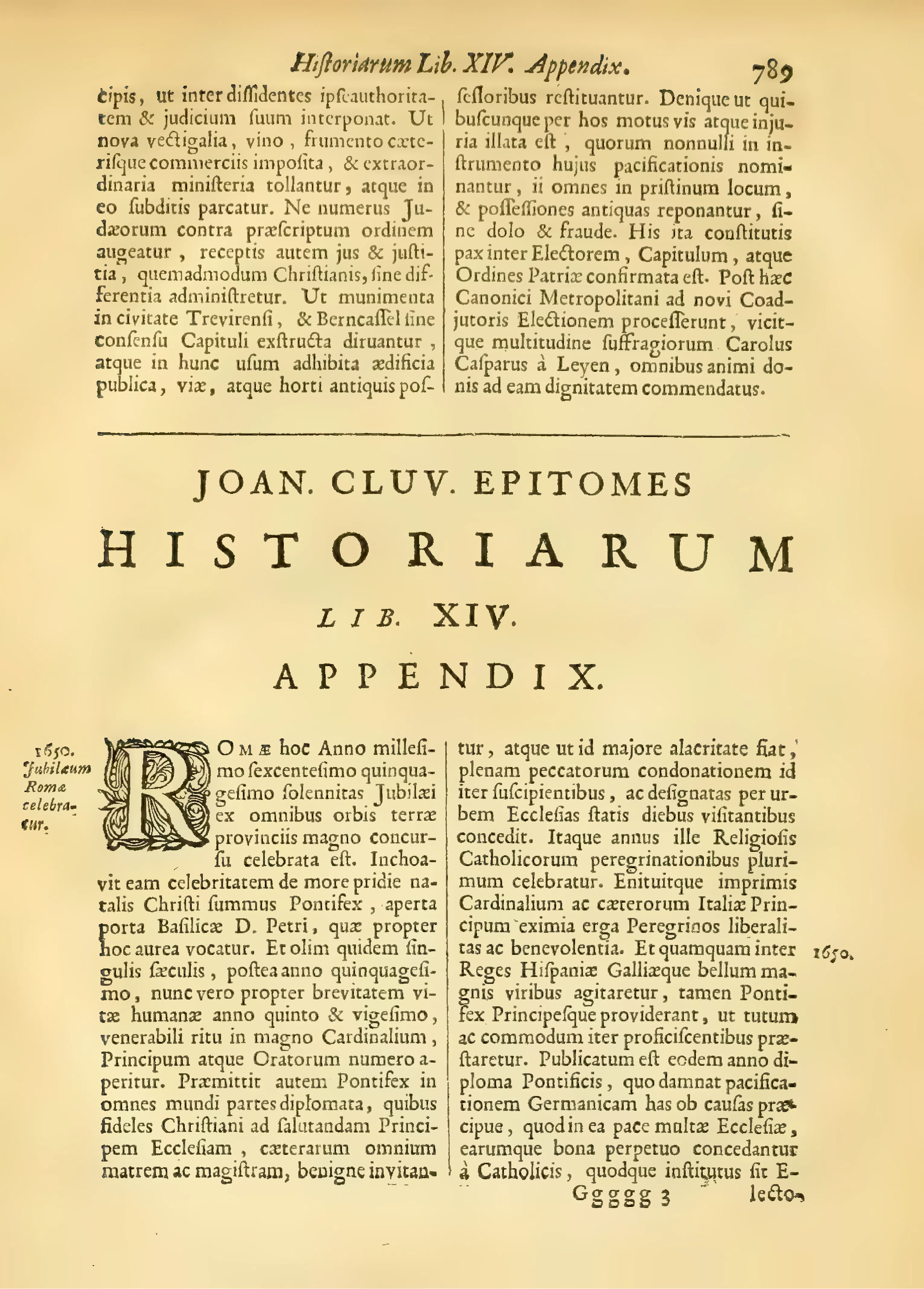
With its full-width APPENDIX heading and ornate initial, this page turns the annalistic apparatus from the Trier settlement to the Jubilee of 1650, moving from local constitutional settlement to Rome. Its compressed entries set the Jubilee's shifting interval beside the papal condemnation of the German pacification. Source ↗.
The Jülich-Berg war of 1651 is introduced by an explicit methodological pause — the affair arose suddenly, was soon composed, and had been much celebrated in men's talk, so the narrator will go back further out of what has been publicly issued in print — and the retrospect that follows is built from instruments rather than from report. Its juridical premise is a privilege of Charles V, secondly that all the said dominions should remain undivided under one single universal lord and successor, according to the custom hitherto observed among the princes of Germany and most foreign princes for the strengthening of the sinews of power, Deinde ut dictæ ditiones omnes, apud unum tantum universalem Dominum ac successorem indivisæ permanerent, more apud Principes Germaniæ, & plerosque externos ad firmandum potentiæ robur hactenus observato. Indivisibility is justified in nakedly political terms, ad firmandum potentiæ robur, and the irony of the ensuing dossier is that this very privilege, designed to keep a patrimony whole, generated a condominium parcelled between two houses. The confessional guarantee is quoted in its operative words, the Reversales provided by two letters of 14 and 21 July 1609 that the Roman Catholic and other Christian religions, as everywhere throughout the Roman Empire so also in these provinces, just as they are in fact in public use and exercise, should thenceforth be continued, permitted and defended, Eodem tempore de Religione, ejusque exercitio Ordinibus Patriæ binis litteris; die 14 Iulii Duisburgi, & 21 Iulii Dusseldorpii, ita cautum & provisum fuit, ut Romana Catholica, & aliæ Christianæ Religiones, sicut passim per Imperium Romanum, ita & in his provinciis, prout de facto in publico usu, & exercitio sunt, sic deinceps continuentur, permittantur, & defendantur. The fatal clause is prout de facto: a guarantee pegged to the factual state of worship at a moment necessarily leaves the identification of that moment to later contest, and the marginal rubric on the controversy over the sense of the Reversales marks the resulting litigation as such. Neuburg's escape from that local pegging is to invoke a higher and later date, having taken up the year 1624 generally prescribed in the instrument of that pacification, assumpsit Annum 1624. in ejus pacificationis instrumento generaliter præscriptum, so that a quarrel over confessional possession becomes a dispute between two normative years, one imperial and general, the other provincial and provisional.
Within that legal machinery the narrator registers the human reckoning, and he does so in terms that measure confessional conflict by the cure of souls: many infants meanwhile departed this life without baptism, and adults without the sacraments of confession and the Eucharist, with peril even of eternal salvation, multique interea infantes sine baptismo, adulti sine confessionis & Eucharistiæ Sacramentis, cum æternæ etiam salutis periculo ex hac vita discederent. The clause follows the Dutch seizure of priests and religious out of Berg and Jülich, and it costs the sequestration not in territory or contribution but in sacraments withheld — a calculus that sits uneasily beside the Lutheran authorship the printed title matter asserts, and that should be weighed as evidence in any reconstruction of the later matter's voice rather than assimilated to it. The same sympathy shapes the juridical verdict on the war itself, for when Neuburg answers the Brandenburg embassy point by point he is allowed the full apparatus of just-war doctrine, that these things could rather be said against the Elector, who with no plausible and plainly undeclared cause makes war upon him, innocent and fearing nothing of the kind, against all human and divine laws, against the public constitutions of the Empire and the recent pacification, and plunders and lays waste his dominions in hostile fashion, Magisque hæc in Electorem dici posse, qui nulla probabili, ac plane indicta causa, sibi innocenti ac nihil minus metuenti contra omnia humana ac divina Jura, contra publicas Imperii constitutiones, ac nuperam Pacificationem, bellum inferat, suasque ditiones hostilem in modum populetur ac devastet. Just cause, formal declaration and the innocence of the attacked are here ranged with the Peace of Münster subsumed under divine and human law, and the Treaty of Cleves duly resolves the whole campaign into a single commission charged to determine which of the two years shall govern.
The French matter of 1651 returns to the organ that had brokered Bordeaux, now acting in its own right: at the beginning of the year it was decreed by the Parlement of Paris that the captive princes, held meanwhile at Le Havre-de-Grâce, a most strongly fortified citadel at the mouth of the Seine, be freed from custody, and that Cardinal Mazarin depart the kingdom within fifteen days with all the foreigners attending him, In Gallia initio hujus anni decretum sit à Parlamento Parisiensi ut Principes captivi, qui interim apud portum Gratiæ, quæ est arx ad hostium Sequanæ munitissima, detinebantur, è custodia liberarentur. Utque Cardinalis Mazarinus intra spacium quindecim dierum, cum omnibus qui ipsi adessent externis, è Regno excederet. A judicial college releases princes of the blood and banishes the first minister, and the clause against his externi reproduces the Frondeur charge against foreign counsel with no editorial distance; the king's emergence from his mother's tutelage in September, narrated in Roman-law vocabulary, and Condé's subsequent condemnation for crimen Majestatis complete a sequence in which sovereignty is described as contested between court, Parlement and princely faction. The British campaign that closes the year is handled with the same discrimination between kinds of evidence that governed the Jülich dossier: casualty figures at Worcester are attributed to the London relations, while the king's flight is expressly flagged as report, there being a rumour that when he turned aside from his horsemen he climbed into a shady tree and lay hidden there three whole days, then went with that magnate into the enemy's camp in changed clothes, and afterwards to London in the dress of a chamber-servant, Fama est, cum ab equitibus divertit, ascendisse in arborem opacam, atque ibi delituisse toto triduo, inde cum magnate illo in iisse in castra hostium, mutatis vestibus, ac dein Londinum habitu famuli cubicularii. The legend is admitted into a chronicle otherwise built from awards, mandates and treaty articles, but only under the label of fama — the discipline that distinguishes what men say from what has been published in print holding even where the story is most attractive.
Frequently Asked Questions
What is Johann Clüver's Historiarum totius mundi epitome?
It is a Latin universal history, first printed at Leiden in 1631, carrying the world's history from the first origin of things to 1630, with a continuation by Clüver himself to 1633 and later enlargement, announced in the 1668 title matter, through the peace concluded between England and the Dutch in 1667. Laid out in fourteen books with appendices, set in double columns, it hangs printed marginal citations drawn from a stated pool of more than six hundred sacred and profane authorities beside the narrative, closes with alphabetical indexes, and runs a double marginal reckoning of Anno Mundi beside Anno Christi.
Who was Johann Clüver?
A Lutheran theologian and historian, born at Krempe in Holstein in 1593 and dead at Meldorf in 1633, barely forty years old. He appears inside his own narrative in the third person, named among the first professors appointed by the king as Johann Clüver, theologian, who wrote these things. Breaking off at 1633, he explains that the labour drained time, health, strength and expense, and that his office, age, station and study demanded something else. He must be kept distinct from the geographer Philippus Cluverius, with whom surname-only catalogue records invite confusion.
How does Clüver's epitome date the origin of institutions, and why does that matter?
Powers and practices presented as immemorial are each given a first moment, a named agent, and a marginal authority, so antiquity becomes a matter of record rather than of prescription. Leo receives the Roman presidency as the first to begin arrogating dominion over the bishops of the whole Christian world, as if from a privilege given to Peter. The popes' temporal lordship is traced to Aripert's gift of the Cottian Alps, its instrument written in golden letters and sent to John VII. Capital punishment for heresy is dated to Maximus and censured as a precedent intolerable to wiser men.
Why does the epitome treat the Gregorian calendar reform as a question of authority rather than astronomy?
Because computing time was itself contested jurisdiction. The reform is described with technical care: ten days removed from the month of October brought the fourteenth moon of the Hebrews' first month, at which Easter is kept, back to 21 March, where it had stood in the time of the Synod of Nicaea — a restoration to a dated conciliar norm. The refusal is then given a strictly jurisdictional ground: most Protestants retained the old calendar lest they seem to concede any authority or dominion to the Roman pontiff over other nations. What was disputed was the competence to legislate time for peoples outside his obedience.
Is there an English translation of Historiarum totius mundi epitome?
No modern English translation has been identified, and no established English title was located; the documented transmission is overwhelmingly Latin and typographical, with multiple Leiden, Amsterdam, Hildesheim, Breslau and Leipzig printings, and no confirmed German or Dutch translation, abridgement or vernacular continuation traced. Separately, the Leo edition presents the full transcription together with a complete English translation for the first time. That translation is generated by AI. Leo is an effort to make freely available online, at no cost, English translations of every text printed in Latin in early modern Europe between 1450 and 1750.
This report was generated by an advanced AI assistant that conducted deep research alongside an extensive interpretation of the transcribed original text. Every effort has been made to preserve fidelity to the source and to guard against inaccuracy, but corruption in the text recognition process and model hallucination may nonetheless have entered the text. Treat every claim, quotation, translation, and citation as provisional, and verify each against the original source before relying on or citing it.
Critical Further Reading and Contextual Resources
- Ann M. Blair, Too Much to Know: Managing Scholarly Information before the Modern Age: Blair's account of printed reference works, excerpting, compilation, and information-management techniques clarifies the function of Clüver's dense marginalia, source columns, indexes, and epitomizing method, and it ranges across medieval Europe, the Islamic world and China before settling on the printed compilations of Clüver's own century. It also clarifies why the epitome's first-person accounting for its authorities, and its classification of witnesses by confessional interest, belong to the working equipment of the compiler rather than to polemical ornament. Read it and the epitome's citation column stops looking like decoration and starts looking like a filing system.
- Derek Croxton, "The Peace of Westphalia of 1648 and the Origins of Sovereignty," International History Review: Croxton provides a necessary corrective to treating Westphalia as a simple diplomatic endpoint: the settlement operated simultaneously as imperial constitutional law and as an international peace, precisely the dual legal horizon required for reading Clüver's later historical matter. The epitome exhibits that horizon when it records the Emperor's reply to a prince's complaints six days later, that they did not seem of such weight that on their account the Elector should invade Neuburg in hostile fashion, to the greater ruin and devastation of the provinces, and thereby give occasion for a new war throughout the Roman Empire, sufficient provision having been made by the constitutions of the Empire and the recent pacification as to how controversies and difficulties of this kind ought to be met, whether by law or by amicable composition, Ad has querelas Cæsar sexto post die respondit non videri ejus momenti, ut propterea ad majorem Provinciarum ruinam & vastitatem Elector Neoburgicum hostiliter invadat, atque exin novo per Imperium Romanum bello occasionem injiciat. Satis provisum esse constitutionibus Imperii ac nupera pacificatione, quomodo hujusmodi controversiis ac difficultatibus vel jure vel amica compositione obviam iri debeat, where the peace of 1648 and the imperial constitutions stand together as the measure of lawful princely self-help.
- Anthony T. Grafton, "Joseph Scaliger and Historical Chronology: The Rise and Fall of a Discipline," History and Theory: Grafton's 1975 essay is fundamental for interpreting the epitome's chronological architecture, its dependence on learned dating practices, and the intellectual status of chronology as an autonomous discipline carried on by and for mature scholars. It is the indispensable frame for the epitome's central operation, in which fixing the year of an institution's first appearance is simultaneously a judgement on its authority. Cited hundreds of times since, and still the shortest route to understanding why a date could be a weapon.
- Müller, J., study of early German newspapers and the Thirty Years' War: The full bibliographic details of this study were not established from the accessible records, and the reference should be pursued before it is cited. Its value lies in the framework it supplies for the passage of current events and overseas reports into historical writing, which bears on the epitome's stated preference for matter publicly issued in print, its explicit marking of hearsay, and its citation of London news relations in the later appendices.
- Andrew Pettegree, The Book in the Renaissance: Pettegree reconstructs the first century and a half of print as a web of religious, economic, and cultural pressures, which helps situate the epitome's repeated editions, expanding supplements, double-column format, and transregional circulation within the book trade rather than treating them as merely textual phenomena. Anyone puzzled by why a dead Holstein pastor's world history kept being reset at Leiden, Amsterdam, Hildesheim and Breslau will find the commercial logic here.
- Schilling, Heinz, studies on confessionalization in early modern Europe: Full bibliographic details for the particular study underlying the account of confessionalization used here were not established from the accessible records, and the reference should be pursued in Schilling's published corpus. The framework itself — religious identity, institutional formation, and political order developing together — is the one within which the epitome's dating of ecclesiastical accretions, its doxography of medieval dissent, its audit of Trent's representativeness, and its etiology of the name Protestantes are best read.
- Peter H. Wilson, The Thirty Years War: Europe's Tragedy: Wilson's large-scale synthesis supplies the political, military, and confessional framework for evaluating the epitome's treatment of the Bohemian crisis, Tilly, Wallenstein, Sweden, France, and the war's difficult relation to confessional explanation. The epitome registers that difficulty in its own terms when it observes that some go about to destroy the very religion which with their own mouths they profess to be the sole road to heaven, while others ally their arms with those whom they hold for heretics and abominable men, Nam alii excisum eunt religionem, quam ore suo solam ad coelos ducere profitentur: alii illorum sibi arma sociant, quos pro hæreticis & nefandis habent, a remark that sits awkwardly beside any single-cause confessional reading of the war and deserves weighing against Wilson's account.





.jpg)
,_RP-P-1891-A-16232.jpg)