Nothing, Decorated with Measures: Johann Christoph Sturm's Selective, or Hypothetical Natural Philosophy, Volume II
Johann Christoph Sturm, professor of mathematics and physics at the little Lutheran university of Altdorf, spent his last years assembling a whole natural philosophy on a judicial method he called electiva: collect the phenomena, lay out every rival hypothesis, then appraise. The second volume of his Physica electiva, sive hypothetica — printed at Nuremberg in 1722, nineteen years after his death, with a preface by the young Christian Wolff — runs to some 1,368 pages of barometers, burning mirrors, pendulum counts and measured speeds of sound, all in service of one severe claim: that nature is explicable in figures, sizes and motions of particles, and that nothing in it moves except by God's good pleasure. It is the fullest surviving monument of German Lutheran eclecticism, the Altdorf voice in the quarrel over the idea of nature that drew Leibniz into print, and one of the doors through which Newton's Principia entered the German lecture hall.
ExLatinis
July 29, 2026
Contents
Johann Christoph Sturm, professor of mathematics and physics at the little Lutheran university of Altdorf, spent his last years assembling a whole natural philosophy on a judicial method he called electiva: collect the phenomena, lay out every rival hypothesis, then appraise. The second volume of his Physica electiva, sive hypothetica — printed at Nuremberg in 1722, nineteen years after his death, with a preface by the young Christian Wolff — runs to some 1,368 pages of barometers, burning mirrors, pendulum counts and measured speeds of sound, all in service of one severe claim: that nature is explicable in figures, sizes and motions of particles, and that nothing in it moves except by God's good pleasure. It is the fullest surviving monument of German Lutheran eclecticism, the Altdorf voice in the quarrel over the idea of nature that drew Leibniz into print, and one of the doors through which Newton's Principia entered the German lecture hall.
Johann Christoph Sturm (1635–1703), professor of mathematics and physics at the small Lutheran university of Altdorf in the territory of Nuremberg, spent the last decade of his life building a complete system of natural philosophy in Latin under the title Physica electiva sive hypothetica. The first volume, devoted to physica generalis, appeared at Nuremberg in 1697 from the press of Wolfgang Moritz Endter. The second — the volume treated here — came out from the same house in 1722, nineteen years after its author's death, carrying a Latin preface by the young Christian Wolff, who had learned his natural philosophy from Sturm's textbooks at Jena. It is a very large book: roughly 1,368 pages of text, seventy-two further leaves of indexes and addenda, fifteen engraved plates, and, after the closing FINIS / SOLI DEO GLORIA, two appended treatises — Sturm's own metaphysical, theosophical and moral application of general physics, and a Theosophiae Specimen by Wolf, Baron von Metternich, furnished with definitions and axioms methodo Mathematica. Its genre is systematic-didactic natural philosophy in the late-scholastic manner, but its contents are relentlessly experimental: barometric and Torricellian tubes, air-pump receivers, thermoscopes and hygroscopes, Sturm's own Aërometrum, burning mirrors and lenses, pendulum counts, specific gravities, measured speeds of sound.
The intellectual problem that organises all of this is single and severe: how the visible operations of nature can be explained mechanically — in figures, sizes, situations, connexions and agitations of particles — while remaining, at every instant, wholly dependent upon God. Sturm's recurring move is a two-step reduction. First, whatever earlier philosophy had reified is dissolved into privation or mode: evil, cold, darkness, rest and above all spatium are treated as carentia, space itself becoming the very notion of nothing decorated with measures; heat, elasticity, savour, odour, sound, light and colour are resolved into modal determinations of matter; substantial forms are dismissed as shadowy entities and form is redefined as the configuration that fits a body to its office. Second, what survives as genuinely causal is referred beyond matter altogether: particular natures are second causes only, local motion adds no more than a mode of successive existence, and movere — to move — belongs to the divine Will alone, its commanding or exigitive cause being DEI Beneplacitum, God's good pleasure, exercised through general law rather than a train of particular volitions. The reduction is disciplined, however, by a standing methodological rule that a natural, material proximate cause is always to be preferred to an immediate divine impression, which is why the work reads as physics and not as devotional metaphysics.
The method by which these results are reached is what gives the book its title. Electiva names a judicial procedure, not a taste: phenomena are first collected faithfully, then rival hypotheses old and new are laid out, and finally an epicrisis eclectica appraises them, selecting what is true pro more, rejecting what is false modestè, and where possible attuning conflicting hypotheses to one another by syncretismus so that a single common hypothesis emerges. Sturm had given this programme its canonical Latin formulation in De philosophia sectaria et electiva (Altdorf, 1679); here it becomes the load-bearing architecture of an entire physics. The stakes are correspondingly wide. The work is the fullest systematic monument of the German Lutheran philosophia eclectica, the principal Latin witness on the Altdorf side of the exchange with Günther Christoph Schelhammer that drew Leibniz into print with De ipsa natura in 1698, and one of the main channels through which the Newton of the Principia entered the German academic syllabus. Whether Sturm's occasionalism is best read as a theology of divine governance or as a theory of scientific explanation remains open in the recent literature, as does the question whether his eclecticism is a transitional expedient or a stable philosophical position.
What is most striking about the book, for a reader coming to it fresh, is the range of matter drawn into that single argumentative frame. Cartesian plenism is admitted in the main but corrected: interspersed empty spacelets of incomprehensible tenuity are conceded against Descartes, and the reluctance of philosophers to concede them is diagnosed as a vacui metus, a fear of the void. Epicurean chance, the world-soul of the Spinozists, Henry More's hylarchic principle, the plastic nature of Cudworth and Ray, and Sperling's particular natures are each taken up and refuted. The insistence that physical qualities are modal rather than absolute is traced, in du Hamel, Honoré Fabri and Francesco Lana Terzi, to a confessional prejudice concerning eucharistic transubstantiation — an unusually explicit avowal that natural-philosophical disputes in the empire ran along confessional seams. Newton's vis centripeta, vis centrifuga and vis inertiae are accepted as convenient abbreviations while their status as causes is denied, and Halley's letter announcing the Principia as then in the press is reported. And in the appended moral and theological articles the same doctrine of dependence is carried into duty, war and toleration: dynastic warfare is denounced as publica latrocinia, public brigandage; only arguments and demonstrations are allowed to convince the intellect; a magistrate may at most order the dissenter to emigrate with his property; and coerced abjuration extracted by non-lethal torture is judged worse than pagan persecution. The neologism propricidium is coined along the way.
The unity of the work lies in the fact that its philological vocabulary, its production history and its internal argument all point the same direction. The keywords — electiva, hypothesis, epicrisis, causa exigitiva, carentia, qualitas modalis — are the technical instruments of the two-step reduction; the Nuremberg printing house that issued Sturm's Collegium Experimentale sive Curiosum also carried this posthumous continuation into print, and the young Wolff's preface marks the point at which an eclectic Lutheran physics was handed over to the systematisers who would supersede it; and the movement of the text itself, from matter and space through the tactile, acoustic, optical and chromatic qualities to local motion, percussion and pendulums, and thence to metaphysics and ethics, is the same reduction repeated at ascending scales. No complete translation into any modern language is recorded, and the standard modern access is the 2006 Olms facsimile.
Read the full text and English translation on Leo
This text was transcribed and translated as part of the ExLatinis project, an effort by Leo to make free English translations of every text published in Latin in early modern Europe (1450–1750) available online. The complete transcription and English translation of this work can be read free of charge:
→ Read the original Latin text and full English translation on Leo
You can save a copy of this document into your Leo account to run deep text searches, conduct further analysis, or cross-reference it with your own research.
Translating Sturm's Title: Electiva, Hypothesis, and the Vocabulary of Privation
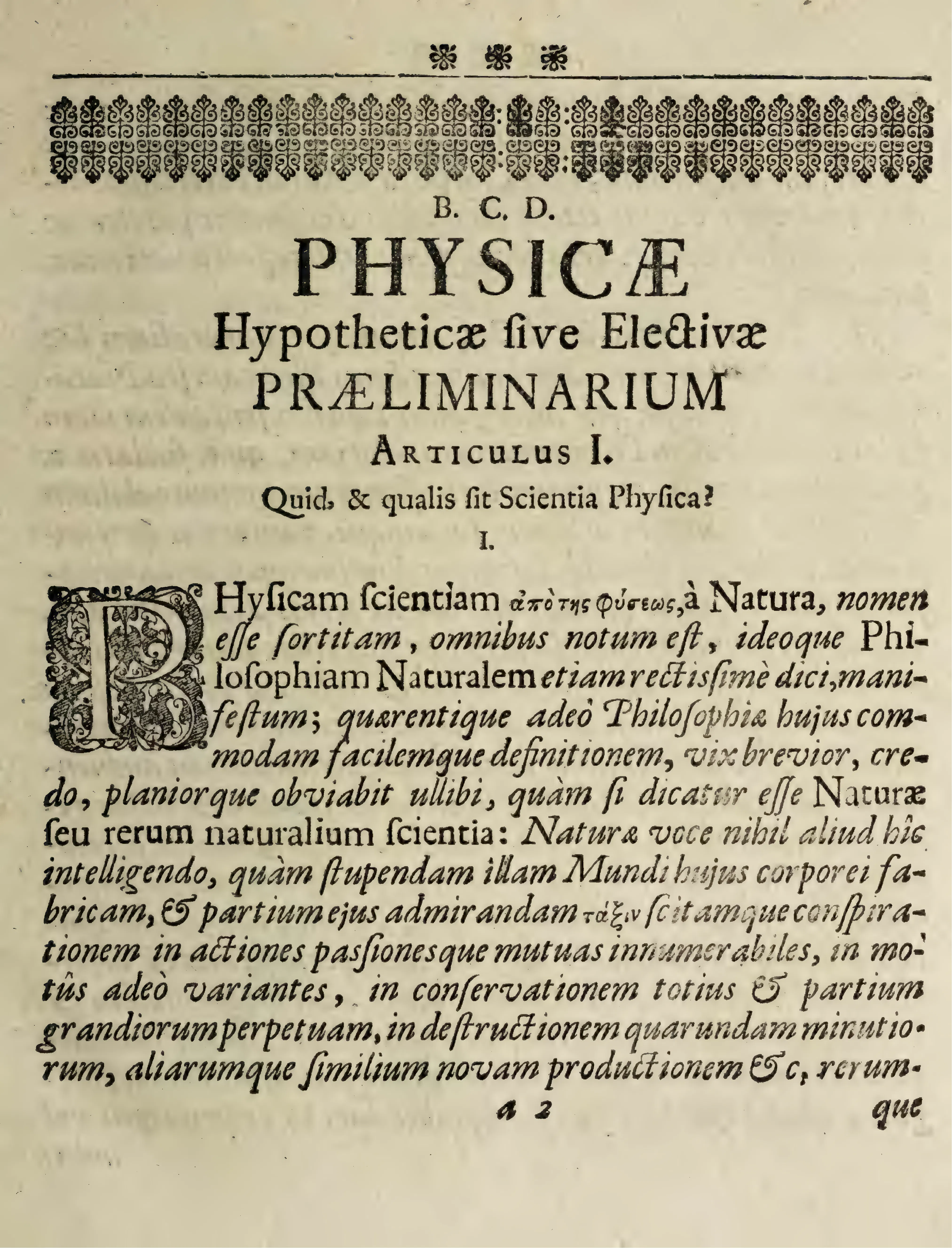
The Præliminarium opens under the printed question “Quid, & qualis sit Scientia Physica?”, turning Sturm’s title words — hypothetica and electiva — from labels into a method for defining natural science. As the threshold to the numbered articuli, it frames electio not as eclectic preference but as the disciplined adjudication of hypotheses. Source ↗.
Editorial title supplied for convenience: Physica electiva, sive hypothetica, Tomus Secundus: Selective, or Hypothetical Natural Philosophy, vol. II — the posthumous continuation (1722) of Johann Christoph Sturm's master-work, published by Wolfgang Moritz Endter at Nuremberg with a Latin preface by the young Christian Wolff. No conventional English title is established in current historiography; the Latin incipit Physica electiva sive hypothetica (often abbreviated PE) is uniformly retained by Sangiacomo (2020), the Stanford Encyclopedia of Philosophy (Sangiacomo, 2020; rev. 2024), and the Olms reprint series (Hildesheim, 2006). The philological heart of the work is the programmatic title itself: electiva. The Stanford Encyclopedia marks Sturm as the figure who gave the German Protestant programme of philosophising by selection among sects its canonical Latin formulation in De philosophia sectaria et electiva (Altdorf, 1679) and who later embedded it in the Physica electiva as a three-step procedure: the faithful collection of phaenomena; the exposition of old and new hypotheses to explain them; and an epicrisis eclectica (or analytica) that selects from every school what is true, rejects what is false, and, where compatible, syncritises rival hypotheses into a single explanatory structure. That third operation is announced in the text in strikingly irenic terms: the author undertakes wholly to remove the disagreement between two authorities and, on the very point where their hypotheses seem chiefly to conflict though elsewhere admirably in accord, so to attune them to one another that one common hypothesis, displeasing to neither and so much the fitter for declaring the truth, may arise from them, imò periculum faciemus tollendæ prorsus illius dissensionis, & ex ea quoque parte, quâ repugnare sibi præcipuè videntur eorum hypotheses (in cæteris apprimè consonæ) sic invicem attemperandi, ut una communis, neutri, uti credo, displicitura, & veritati declarandæ tantò futura aptior, inde exoriatur. Electiva is not the modern English "eclectic" — that suggests unsystematic personal taste — but the technical Latinate label for a judicial operation of appraisal, in which the philosopher acts as arbiter among competing sententiae and binds only what survives examination. The very name therefore distances the programme from the philosophia sectaria that it claims to supersede: eclecticism here is methodical, not dilettantish.
A second term whose period sense differs sharply from its modern cognate is hypothesis. Within the Physica electiva a hypothesis is not a tentative conjecture in the modern Popperian sense but a mechanismum — a sufficient causal account imaginatively constructible from the phenomena and held pro more, modestly, as adequate to the appearances without commitment to its ontological truth. The corollary is a persistent suspicion of names offered in place of mechanisms: a received term may be conceded, the text allows, but only on condition that the thing it designates be explained — the terms are absolute, it is impetus, but these are only names for that thing which is being sought, easily to be admitted provided the thing itself designated by these words be explained, absoluta; Impetus est: Sed hæc non nisi nomina sunt illius rei, quam quærimus, facilè quidem à nobis admittenda, modo res ipsa vocabulis his insignita explicetur. The concluding epicrisis is the judicial appraisal of such mechanisms: the Greek root ἐπίκρισις retains its forensic sense of expert adjudication, and Sturm's preface treats the natural philosopher as iudex of rival systemata, not as advocate of any one of them. The modeste rejection of what is false and the syncritical fusion of what is true in rival hypotheses are the two operations of this appraisal.
A third loaded term, central to the Sturm-Schelhammer-Leibniz controversy, is the causa exigitiva — an "exigitive," commanding cause set against the causa efficiens of the schools. In the framework of the Physica electiva, finite substances possess only passive, sine qua non forms; the efficient cause of every local motion is the divine will operating not as a series of particular volitions but through a general law: DEI Beneplacitum, God's good pleasure as the exigitive cause of motion in nature. The definition is given in the text in precisely these words, namely that local motion acknowledges no physical efficient cause and therefore none acting of necessity, but only an exigitive one, that is, one commanding and ordering, which can be nothing else than the mere good pleasure of the willing God, quòd motus localis non agnoscat causam efficientem physicam adeoque ex necessitate agentem, sed exigitivam tantùm h[oc] e[st] jubentem, imperantem, quæ alia esse non possit quàm merum volentis DEI Beneplacitum. This usage, codified in the Sturm-Schelhammer exchange of 1692–1698 and ratified in Leibniz's De ipsa natura (Acta Eruditorum, September 1698), is intelligible only against the background of Sturm's earlier claim in De philosophia sectaria et electiva that genuine philosophy begins from phenomena and ascends to causes by the legitimate use of hypothesis.
A fourth register of vocabulary, less often noticed but pervasive, is that of privation. Carentia, privatio and absentia do the ontological work that positive entities do elsewhere, and the usage is not confined to natural philosophy: vice in the physical order is defined as the privation and lack of a due perfection, in the moral order as a defect of the rectitude due to our actions, Vitium in ordine physico est privatio & carentia perfectionis debitæ, in ordine morali defectus rectitudinis actionibus nostris debitæ. The same analysis is applied, with considerably greater consequence for physics, to spatium, which is not admitted as a subsistent interval at all but resolved into a measured privation: the conclusion is that space is nothing else than the very notion of nothing, adorned nevertheless with determinate or indeterminate measures which the measures of real bodies supply, Concludimus itaque, spatium nihil aliud esse, quàm ipsam nihili notionem, mensuris tamen determinatis vel indeterminatis, quas realium corporum mensuræ nobis suppeditant, decoratam. The privative reading of space and the exigitive reading of motion are the two halves of one strategy: what is dissolved into carentia on the side of extension is exactly what need no longer be furnished with a causal power on the side of agency.
What the 1722 Second Volume Contains and What It Argues
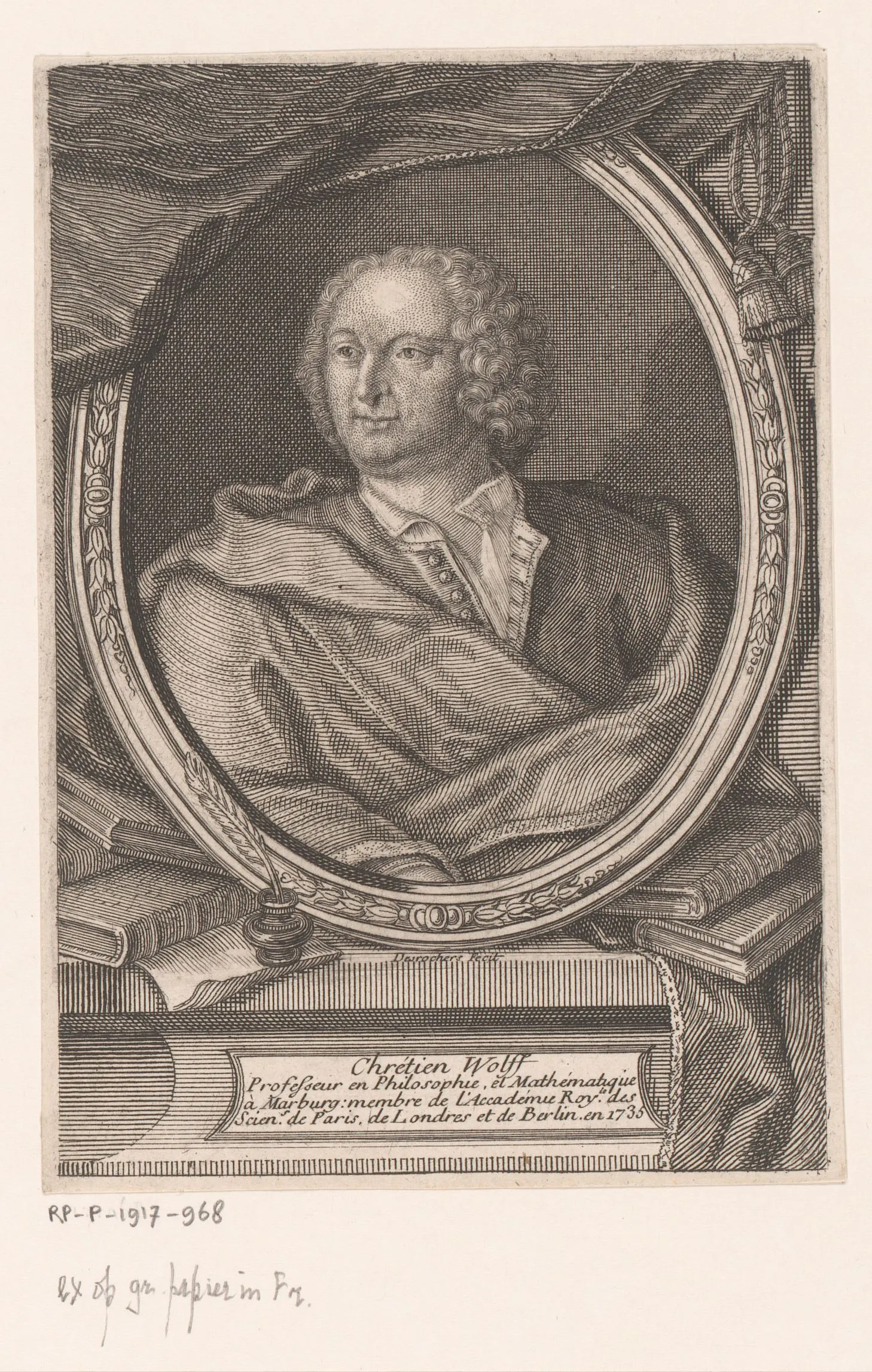
A period engraving of Christian Wolff, dated 1735, presents the philosopher in the formal visual idiom of early eighteenth-century learned authority. His preface to Sturm’s posthumous 1722 volume made him both a transmitter of the eclectic Lutheran physics and a sign of the systematic philosophy that would supersede it. Source ↗.
Johann Christoph Sturm (3 November 1635, Hilpoltstein – 25/26 December 1703, Altdorf bei Nürnberg), professor primarius of mathematics and physics at the Academia Norica (University of Altdorf) from 1669 until his death and fellow of the Leopoldina, is the author of the Physica electiva sive hypothetica, the two-volume Latin treatise of which the volume under study is the posthumous continuation. The work is a learned treatise in Neo-Latin, printed at Nuremberg in two volumes: Tomus Primus (1697) and the posthumous Tomus Secundus (1722), both by Wolfgang Moritz Endter; the second volume is prefaced by the then young Christian Wolff, who had learned natural philosophy from textbooks of Sturm at Jena. Tomus Primus treats the physica generalis; Tomus Secundus the physica specialis, comprising the elementary or sublunary world and the sidereal or macrocosm, together with special treatments of the first and second parts. The 1722 sheets run to roughly 1,368 pages of text plus 72 leaves of indexes and 15 engraved plates and close with FINIS / SOLI DEO GLORIA; the appended metaphysical-moral treatise and the Metternich Theosophiae Specimen follow. The genre is systematic-didactic natural philosophy in the late-scholastic mode, with extensive apparatus of instruments, hypotheses, and experiments. Composition and production occurred at Altdorf and Nuremberg between the mid-1690s and 1722; the 1722 printing was completed nineteen years after the author's death.
The driving thesis is that a complete natural philosophy must be constructed by the eclectic method: phenomena are gathered, rival hypotheses are exhibited, and an epicrisis selects, rejects, or syncretises them under the regulative authority of occasionalist metaphysics. That regulative authority is stated in the text without reserve, in the thesis that to move is something divine, proper to the divine Will alone, and consequently, first, that no truly and properly motive virtue, or one productive of any motion in any body, is found in the whole world apart from the aforesaid virtue of the divine will freely willing and by willing moving all things, Movere esse Divinum quiddam uni Voluntati Divinæ proprium, & consequenter 1. Nullam in universo Mundo reperiri virtutem verè proprieq[ue] motricem, aut motûs ullius in ullo corpore efficientem productricem, præter memoratam Divinæ voluntatis virtutem liberè volendo moventem omnia: Occasionalism at this level of generality does not, however, licence recourse to divine action in the explanation of particular effects, and the treatise repeatedly enforces a rule of preference for material intermediaries: of the gravity of the subtle air, for instance, the author declares that he would rather ascribe it to an ether circulated by divine power, as its proximate cause, still natural and material, than acknowledge it as already impressed immediately by God, ipsius tamen aëris subtilis gravitatem malimus ætheri divinâ virtute circulanti, tanquam causæ proximæ, adhuc naturali & materiali adscribere, quam ipsam jam à DEO immediatè impressam agnoscere: The two commitments together define the work's characteristic movement: everything is referred to the divine will at the level of first causes, and nothing is so referred at the level of physical explanation while a mechanism remains constructible. The work has never been translated into a modern language; the Olms Verlag reprint of 2006, edited under the Wolff Gesammelte Werke series as Bände 3 and 4 of Abteilung III, is the standard modern facsimile.
Why the Physica electiva Matters: Occasionalism, Eclecticism, and the Sturm–Schelhammer–Leibniz Debate
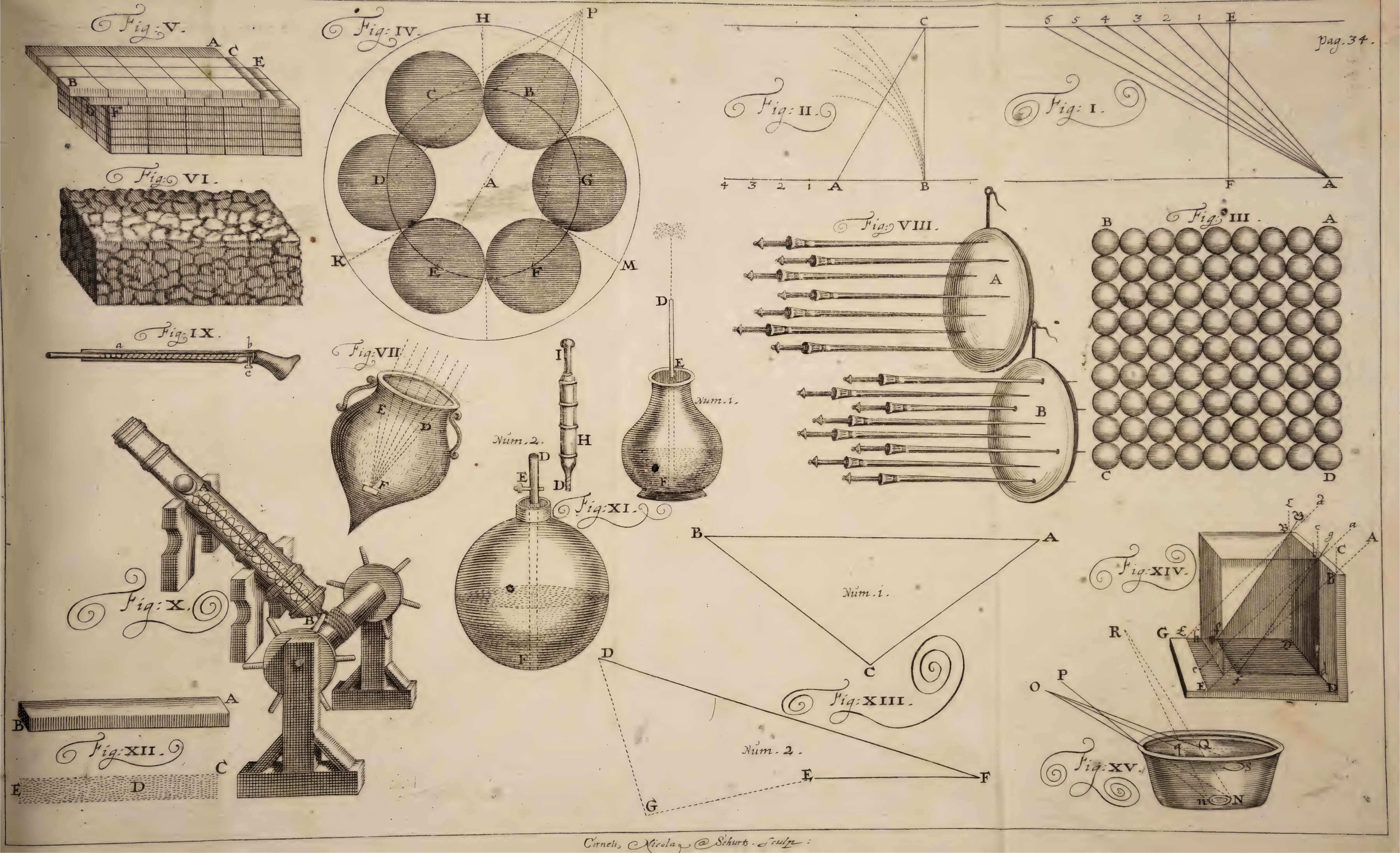
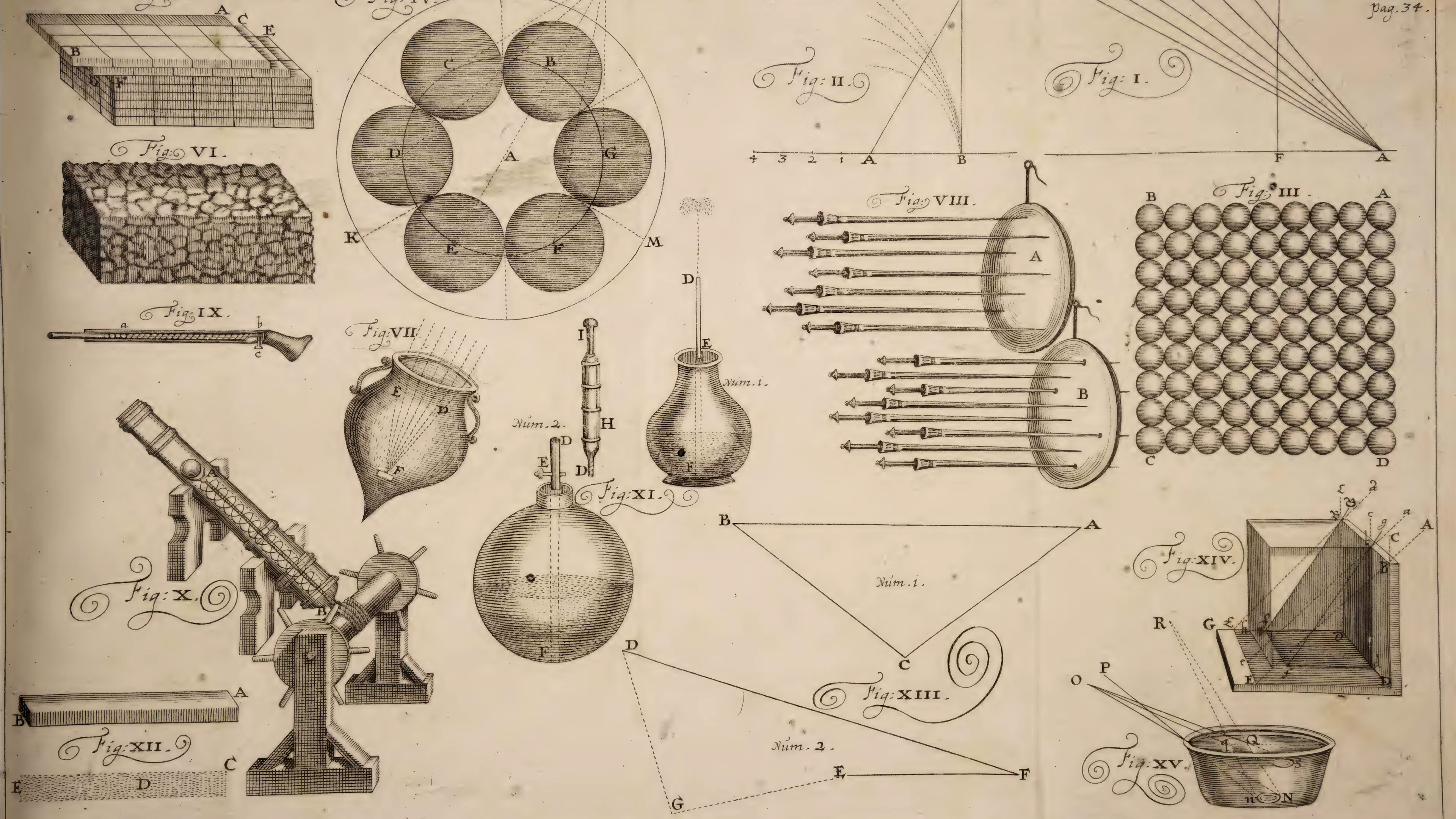
Engraved by Cornelis Nicolaas Schurts, this plate carries the visual machinery of the physica specialis: packed globules, ray diagrams, pressure arrows, vessels and optical instruments turn arguments about indivisibles, void interstices and aetherial pressure into inspectable form — the eclectic experimentalism at stake in the Sturm–Schelhammer–Leibniz debate. Source ↗.
The Physica electiva sive hypothetica matters to modern academics because it is the systematic textbook in which the German Lutheran philosophia eclectica programme of the late seventeenth century reaches its full architectural form, and because it is the principal Latin witness on the Altdorf side of the Sturm–Schelhammer–Leibniz exchange on occasionalism and the laws of nature. Sangiacomo's 2020 article in the Journal of the History of Philosophy re-positions Sturm as a serious occasionalist who, following Boyle's Free Enquiry into the Vulgarly Received Notion of Nature (1686) and the Cartesian occasionalist current represented by Malebranche, Cordemoy, and La Forge, treats finite natures as lacking true efficient causality and treats God as the sole true cause operating through a general law. The disagreement turns on whether Sturm's occasionalism is principally a theology of divine governance or a theory of scientific explanation. Both readings find purchase in the text's treatment of chance, where the identification of nature with fortune is denied on the ground that whatever is said to happen by chance is undoubtedly carried out by the ordination of the most powerful Deity, though frequently unobserved by us — that this Nature and fortune or chance are one and the same thing can be conceded so much the less, the more clearly this appears, Naturam autem hanc & fortunam sive casum eandem esse rem, tantò minus posse concedi, quantò clarius jam patet, quicquid casu fieri dicitur, id ordinatione Numinis potentissimi indubiè, licet à nobis frequenter inobservatâ, peragi. — a formulation at once theological in its warrant and explanatory in its function, since it is deployed to exclude a rival cosmology rather than merely to edify.
The companion literature on the German reception of Cartesianism (Detel, Geist und Erfahrung, 1995) frames Sturm's eclectic method as a Lutheran compromise between the Wittenberg-Aristotelian mainstream and the Wolffian-Cartesian reform. The texture of that compromise is visible in the doctrine of modal qualities, where the reduction of sensible qualities to modes of matter is affirmed against Jesuit authorities: heat too, the text holds, will have to be called only a modal quality, that is, one consisting in nothing but certain modes of material particles — figure, agitation and so on — not absolute or real, as Fabri and his follower Lana would have it, Erit autem hoc pacto Calor etiam qualitas aliqua modalis tantùm à nobis dicenda, h[oc] e[st] non nisi in quibusdam materialium particularum modis, figura, agitatione &c. consistens, non absoluta aut realis, uti volunt P. Fabri ejusque hîc sectator P. Lana; The confessional dimension of the disagreement is then named outright: no necessity is yet seen of admitting physical qualities other than modal ones, whatever may seem to the contrary to du Hamel, Fabri and Lana, whom a religious prejudice, chiefly concerning eucharistic transubstantiation, seems to hold in this opinion, nondum videmus ullam necessitatem admittendi qualitates physicas alias quàm modales, quicquid etiam contrà videatur Hamelio & P. Fabri, & P. Lanæ, quos præjudicium religiosum, de transsubstantiatione eucharistica præcipuè, in hac sententia detinere videtur The diagnosis is worth weighing against Detel's reading: the eclectic epicrisis is here not a neutral arbitration above the confessions but a procedure that identifies confessional interest as a source of philosophical error in others.
The eclectic procedure is equally visible where the text parts company with Cartesian orthodoxy on the plenum. Assent is given to one set of authorities in preference to others as regards the chief point of the matter, while their auxiliary suppositions are set aside — there being no need to suppose either a precisely globular figure in the aetherial particles or, in the filings of the subtlest matter, an aptitude for assuming any figures whatever at any moment, an aptitude which the fear of the void seems to have extorted, VI. His igitur nos etiam, præ cogitatis aliorum, quoad rei caput assentimur, tametsi non habeamus opus vel in æthereis particulis globosam præcisè figuram, vel in subtilissimæ materiæ ramentis figuras quasvis quovis momento induendi aptitudinem (quam vacui metus extorsisse videtur) supponere. The positive consequence follows immediately: the interstices of air are confessed to be filled with a certain ether, and the far smaller little spaces interposed among the aetherial minutiae to be perfused with another subtler matter, yet the author does not so shudder at interposing among these little dusts of the subtlest matter empty spaces at last, of incomprehensible tenuity, Siquidem aëris interstitia æthere quodam repleri, æthereis minutiis interjecta spatiola multò minora subtiliore aliâ materiâ perfundi fatemur; his verò subtilissimæ materiæ pulvisculis spatiola tandem inania incomprehensibilis exilitatis interjicere non adeò horrescimus, Since space itself has already been resolved into a measured privation, the concession of interspersed spatiola inania costs the system nothing ontologically, which is precisely why the vacui metus can be treated as a psychological rather than a metaphysical obstacle.
The recent Altdorf scholarship (Baumann, Die Universität Altdorf, 2018) locates the Physica electiva within the experimental culture of the Collegium Curiosum sive Experimentale founded by Sturm at Altdorf in 1672. On the reception of Newton, the Physica electiva is now recognised as one of the principal German vehicles by which the Newton of the Principia entered the German academic syllabus, alongside Pfautz's review in the Acta Eruditorum (1688). The mode of that reception is instructive, and it follows directly from the treatment of names and mechanisms set out above: Newton's vocabulary of force is admitted as abbreviation while its causal pretensions are refused — other words like these, which the most celebrated Newton uses everywhere in that most ingenious work he entitled Philosophiæ Naturalis Principia Mathematica, would long since have displeased us, the text confesses, Et, fateor, alia quoque his similia vocabula, quibus Celeberrimus Newton in opere ingeniosissimo, quod Philosophiæ Naturalis Principia Mathematica inscripsit, passum utitur, dudum nobis displicuissent, Brill's chapter on the Leibnizian reception of Newton's concepts of force places Sturm alongside Keill, Hermann, and the Acta reviewers. Where scholars disagree most openly is on the periodisation of the philosophia eclectica: Wundt (1939) and Schmidt-Biggemann (Historia philosophiae, 2011) treat Sturm's eclectic method as a transitional phenomenon, whereas Sangiacomo and the recent Italian scholarship (RENAT, Milan, 2026–2028) read it as a structurally stable position in its own right.
Printing, Plates, and Provenance: The Nuremberg Volume and Its Surviving Copies
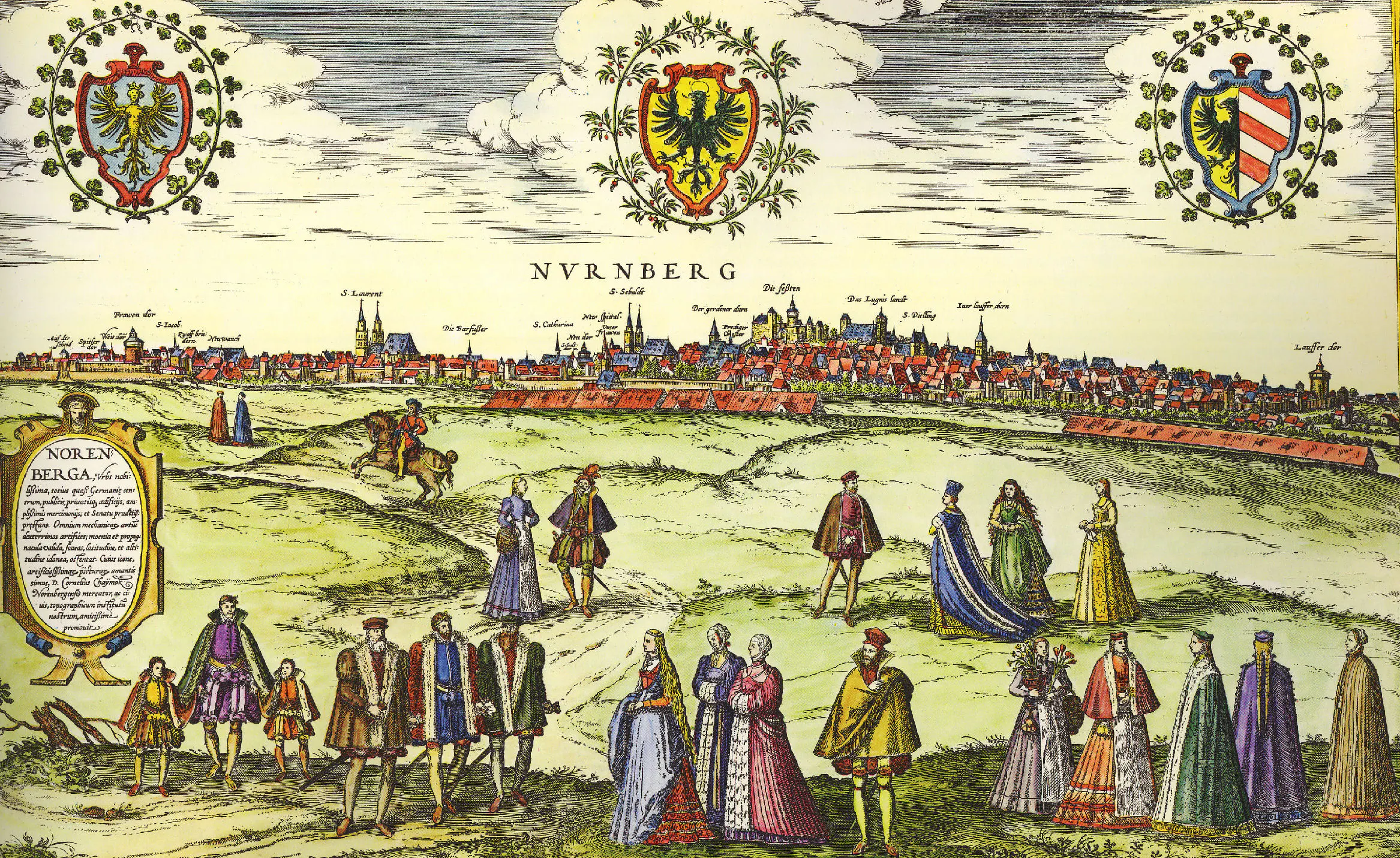
Braun and Hogenberg’s city view presents Nuremberg as a fortified, densely built urban centre long before Wolfgang Moritz Endter issued Sturm’s Physica electiva there in 1722: a major printing city whose authority also extended to Altdorf, where Sturm held his chair. Source ↗.
Tomus I of the Physica electiva sive hypothetica was printed at Nuremberg by Wolfgang Moritz Endter in 1697. Tomus Secundus was printed by the same house in 1722, nineteen years after the author's death, with a Latin preface by Christian Wolff. The bibliographic record is unusually clean: WorldCat (OCLC 164803028) and the Bayerische Staatsbibliothek digital catalogue both list a single imprint, Norimbergae, impensis W. M. Endteri, 1722; the Munich Digitisation Centre (MDZ) holds the canonical digital copy under shelfmark bsb11763866 (VD18 80168213), in which the title page reads IOH. CHRISTOPHORI STURMII ... PHYSICA ELECTIVA SIVE HYPOTHETICA. TOMUS SECUNDUS ... PHYSICAM SPECIALEM ... COMPLECTENS, with the printer attribution Norimbergae, impensis Wolfgangi Mauritii Endteri. MDCCXXII. The volume is in quarto and collates [13] preliminary leaves (title, dedication, preface, indexes), 1,368 pages of text, [72] leaves of index and addenda, and [15] engraved plates (Tafeln), chiefly folding. The 1722 sheets are a continuatio of the 1697 first volume, not a reissue and not a re-edition; the imprint, the Wolff preface, and the dedication apparatus are the new preliminaries; the body of the work is Sturm's posthumous physica specialis, treating first the elementary or sublunary world (de geocosmo seu mundo elementari), then the sidereal world (de mundo sidereo sive macrocosmo), with special sections on the planets (de planetis specialissima).
The body is punctuated by disputational digressions and by an internal finding apparatus, the Tabula Capitum sive Index Materiarum, that allows the reader to move between the chapters on tactile qualities, elater, odours and savours, sound, and light and colour, and the long series of chapters on compression, rarefaction and condensation, calefaction and frigefaction, conglaciation, exsiccation, coagulation, the mutations of sound, light, colour and taste, occult qualities, quantity, local motion, percussion, reflection, compound motion, pendulums, and essential change. One digression treats the sufficiently obscure nature of matter and space; another takes as its theme the obscure simplicity of the most familiar things in nature, opening with the observation that as most things in nature are the simplest, so they are not only more obscure than even the most composite, other things being equal, but — what is most to be wondered at in them — often the more obscure the simpler and the more familiar and better known they are, UT sunt in Natura pleraque simplicissima, ita non solùm ipsis vel maximè compositis, ceteris paribus, obscuriora, sed & (quod maximè in his mirandum) tantò obscuriora sunt sæpiùs, quantò simpliciora sunt & familiariora, notiora. The remark supplies the methodological warrant for the whole eclectic architecture: if rest, density, gravity, fluidity, matter, motion and place are the hardest cases, then the exhibition of rival hypotheses followed by epicrisis is not a concession to learned disagreement but the only procedure adequate to the subject matter.
The title closes with a FINIS / SOLI DEO GLORIA and is followed by Sturm's Physicae Generalis usus Metaphysicus, Theosophicus et Moralis (Articles I–VIII), an applied metaphysics and natural theology, and by the Theosophiae Specimen of Wolf (Guelph/Welf), Baron von Metternich, written at the Academia Norica in 1689 and dedicated under the letter of 6 April 1689, with the eleven Definitiones and Axiomata methodo Mathematica that Sturm added to it. The appended articles extend the doctrine of dependence from nature to conduct, deriving reason and revelation alike from one Pater luminum, ordering the duties owed to God, neighbour and self, denouncing dynastic warfare as publica latrocinia, and treating the coercion of conscience under the same rule that governs the coercion of assent generally, since arguments and demonstrations are the one and only means by which the intellect is convinced, moderation, charity and compassion being what is owed toward those who err, Argumenta igitur & demonstrationes sunt unicum illud medium, quo intellectus convinci; moderatio, charitas, commiseratio erga errantes, The printer is Wolfgang Moritz Endter of Nuremberg, heir of the Endter dynasty that had published Sturm's Collegium Experimentale sive Curiosum (1676, 1685) and the Physica conciliatrix (1684). The volume survives in at least the following institutional copies: Bayerische Staatsbibliothek München (signature Phys.sp. 19 m, digitized bsb11763866); Niedersächsische Staats- und Universitätsbibliothek Göttingen (8 PHYS 1230); Herzog August Bibliothek Wolfenbüttel (collection record in the GBV); Universitätsbibliothek Erlangen-Nürnberg (holding from the dissolved Altdorf university library). The Altdorf university library was dissolved on 24 September 1809 by King Maximilian I Joseph of Bavaria and incorporated into the University of Erlangen in 1818. The 1722 sheets are also reproduced in the Georg Olms Verlag (Hildesheim) reprint series, edited under the Christian Wolff, Gesammelte Werke, III. Abt., Materialien und Dokumente, Bände 3 and 4 (Hildesheim: Olms, 2006), where Band 3 is the Tomus Secundus, Physica specialis I (818 pp., ISBN 978-3-487-13013-2) and Band 4 is the Tomus Secundus, Physica specialis II (629 pp., ISBN 978-3-487-13014-9). No complete English or German translation is recorded. Reception is documented in the Nova Litteraria Germaniae, in the Wolffian textbooks of the 1720s and 1730s, and in the specialised occasionalist literature (Schelhammer 1697; Leibniz, De ipsa natura, 1698). The chain of replies to the idolum naturae position runs: Boyle, A Free Enquiry into the Vulgarly Received Notion of Nature (1686); Sturm's Idolum naturae (Altdorf, 1692); Günther Christoph Schelhammer, Natura sibi et medicis vindicata (Schaffhausen, 1697); Sturm's De natura sibi incassum vindicata (Altdorf, April 1698); G. W. Leibniz, De ipsa natura (Acta Eruditorum, September 1698).
Tracing the Argument from Privative Space to the Appended Moral Tracts
Privative entities and the resolution of space
The sequence of numbered articles that closes the treatment of privative entities — articles III to VIII of a chapter given over throughout to a single manoeuvre — proceeds by accumulation rather than by demonstration: one alleged quality after another is dissolved, and the ontological economy that results is what makes the rest of the physics affordable. The pattern is set by the definition of vice already noticed above, which spans two orders at once, being in the physical order the privation and lack of a due perfection and in the moral order a defect of the rectitude owed to our actions. The doubling is not decorative. It imports into natural philosophy the whole Augustinian apparatus of privatio boni, together with its principal advantage: a privation, precisely as such, requires no cause to be sought for it elsewhere, so that the theodicy which refuses to make God the author of moral perversity and the physics which refuses to make cold a positive agent are one and the same manoeuvre performed on two levels. The load-bearing word is debitus, "due": privation is always privation of what is owed to a subject by the norm of its kind, and the normative structure carried over from moral theology is what keeps the physical carentia from collapsing into sheer indeterminacy.
That structure is on display in the analysis of cold, where the argument moves from the definition to a phenomenon that embarrasses the reifying account. Cold, to one considering a little more attentively, is nothing else than the absence of due heat — and that not always a true absence, but often merely a relative one, in so far as a body which is still lukewarm touches another hotter than itself; by which, if it be our hand, we reckon that body cold, although to another colder hand it will pass for hot: cùm tamen paulò attentiùs consideranti frigus nihil aliud sit, quàm caloris debiti absentia, nec ea semper vera absentia, sed sæpe relativa duntaxat, quatenus corpus, quod adhuc tepet, aliud calidius ipso attingat, quo, si nostra manus fuerit, illud pro frigido æstimamus, licet alteri manui frigidiori pro calido futurum sit. The distinction between vera and relativa absentia does real work: it concedes that the tactile report is systematically comparative, and it thereby converts a familiar schoolroom topos about the two hands into evidence against an entire class of qualities. The procedure is the eclectic one in miniature — the phenomenon is collected first, and the rival ontology is dismissed only because it cannot accommodate it. The same reduction is then extended without argument, on the principle that the like judgement should hold concerning darkness, which we everywhere consider as a real quality, and not as the absence of light, which is what it really is, Idem judicium esto de tenebris, quas ubique tanquam realem qualitatem consideramus, nec ut absentiam luminis, quæ reverà sunt. What follows this in the article is the sharpest consequence of the whole analysis: some who are by no means unversed in physiology, when the air darkens through the thickening and interposition of clouds, ascribe the darkness to the intervening clouds as to an efficient cause, when a mere interception of light and the absence consequent upon it would have sufficed. The reification of a privation, in other words, does not merely misdescribe an item; it manufactures a spurious efficient cause. This is the same fault the work pursues elsewhere in the natura of the schools, in plastic natures and hylarchic principles, and it is diagnosed here in its simplest and most domestic instance.
The transition to space is made explicitly as an application of this diagnosis rather than as a new topic. It happens not otherwise, the article observes, in that real existence of space which certain men have believed in, which, if we abstract from all bodies — as can easily be done in thought — is really nothing, Non aliter accidit in reali illa quam quibusdam credidere spatii existentia, quod, si abstrahamus ab omnibus corporibus (quod animo facile fieri potest) reverà nihil est. The most original stretch of the argument is then genetic: the treatise explains how the illusion is generated, and locates its origin in the practice of measurement. We have grown accustomed, it continues, to estimate and define the distance of the Sun, Moon and other stars from us by certain measures of terrestrial spaces which have been measured, and therefore we conceive, even outside the bulk of the world, spaces — if not certain and determinate ones, then at least indefinite ones — stretching out into the immense, and everywhere double, triple, hundredfold the bulk of the world, to which we then straightway attribute reality, immensity and eternity: Consuevimus Solis, Lunæ, & aliorum astrorum distantiam à nobis certis terrenorum spatiorum, quæ mensurata sunt, mensuris æstimare & definire, & propterea etiam extra Mundi molem, si non definita quædam & determinata, indefinita saltem spatia in immensum sese porrigentia concipimus, & ubique dupla, tripla, centupla &c. mundi molis: quibus adeò illico Realitatem, immensitatem, æternitatem &c. attribuimus. The sting lies in the triad Realitatem, immensitatem, æternitatem: these are the attributes of God, and the astronomer's habit of extrapolating measured terrestrial intervals beyond the world's bulk is charged with transferring them, unnoticed, to a nothing. The polemical target is not named, but the theologising of absolute extension that runs from Henry More through the English mathematicians is unmistakably in view, and the reductio is achieved without any appeal to Scripture: the fault is a fault of cognitive habit, not of doctrine.
Having emptied space, the argument must nevertheless rescue the discourse in which we speak of it, and the instrument is a distinction between two senses of res. In a wider sense, the treatise allows, whatever the human mind can conceive and signify in speech is also worthy of the appellation of thing, so that in this way privations and lacks too, no less than any positive items, are things: Ampliori enim sensu Rei quoque appellatione dignum est, quicquid mens humana concipere ac loquendo significare potest, hoc modo etiam privationes carentiæque, non minus quàm positiva quævis, res sunt. The concession is semantic and deliberately so: non-ens differs from ens as legitimately as death from life, disease from health, darkness from light, silence from sonority — a series that quietly names several of the very qualities the volume goes on to treat. The illustration chosen is deliberately homely, that when the wine has run out from some vessel which it formerly filled, we say that that vessel is now empty, Ita v. g. Deficiente ex Vase quodam vino, quo pridem replebatur, dicimus vas illud jam esse vacuum, vacuity being nothing else than the absence of the contents. For a natural philosopher who had spent two decades exhausting receivers before the Collegium Curiosum at Altdorf, this is a consequential piece of grammar: it licenses the entire experimental vocabulary of the vacuum as an idioma, a settled manner of speaking, without any ontological commitment to a subsistent void — which is exactly why interspersed empty spacelets can later be conceded to the plenists at no metaphysical cost.
The appraisal of authorities that follows shows the eclectic procedure operating across confessional and sectarian lines: Gassendi's mind is found to be not other, Cordemoy's hypothesis is recalled, and two arguments are borrowed from the Jesuit Lana. The second of these carries the doctrine of place: space is not on that account necessarily to be presupposed, so that a place may be assigned to the body, for it is not proper to the motion of a body that it be in some place, but only this, that it move itself with respect to other bodies, and move itself among the remaining mundane bodies, and so that some change of its place be observed in it, non est præsupponendum spatium ideò necessariò, ut ipsi in eo locus assignetur; nec enim proprium est corporis motus, ut in aliquo loco sit, sed hoc solùm ut se moveat respectu aliorum corporum, ac inter cætera corpora mundana sese moveat, & sic in eo aliqua loci sui mutatio spectetur. Motion is thus made wholly relational before it is made occasional: if local motion is a change of situation among bodies rather than a passage through a receptacle, then nothing in the description of motion demands a real term to which a moving power must be applied, and the later claim that local motion adds no more than a mode of successive existence has already been prepared at the level of place.
The chapter closes with the conclusion already set out above — that space is nothing else than the very notion of nothing, decorated with the measures which real bodies supply — and then with a formal elimination that runs through the categories of the schools one by one: space is nothing real, nothing corporeal, nothing incorporeal, nothing positive, nothing negative, nothing substantial, nothing accidental, but it is nothing, marked nevertheless with its own determinate or indeterminate measures, and therefore a certain relative and connotative nothing, as our Weigel has excellently observed — Nihil ergo est reale spatium, nihil corporeum, nihil incorporeum, nihil positivum, nihil negativum, nihil substantiale, nihil accidentale; sed est nihil, mensuris tamen suis determinatis vel indeterminatis insignitum, & propterea nihil quoddam relativum & connotativum: prout Weigelius noster egregiè monuit. The anaphora of nihil is doing logical as well as rhetorical work: each pair of disjuncts is a standard division of being, and space is refused a seat in every one of them, so that the residue is not a category but a mode of signification — a nihil relativum & connotativum, a nothing that connotes the measures borrowed from real bodies. The attribution to Weigelius noster, Erhard Weigel of Jena, under whom Sturm had studied mathematics, is characteristic of the epicrisis: the conclusion is reached by concurring with a Gassendist, a Cartesian occasionalist and a Jesuit, and then credited to a domestic Lutheran mathematician, the several sects converging on one common hypothesis without any of them being adopted as a school. The sheets that carry this material are worth a bibliographical remark of their own: they run out under the signature marks of gathering H, the catchword gna- / gnari carrying the reader across the turn of the leaf, and they bear a printed pagination distinct from the volume's continuous sequence.
The formally distinct Digressio Prima, announced by its own head-title — DIGRESSIO PRIMA / De / Materiæ & Spatii natura satis obscura, / ejusque obscuritatis causa — and by a fresh series of numbered articles beginning again at I, then supplies the epistemology that the preceding reduction presupposed, and it does so as a piece of providential economy. It ought surely to seem strange to no one, it opens, that so many and so various things have hitherto been contrived and disputed concerning the nature of space and matter, since God himself, disposing all things most wisely above what we can conceive, has so ordered the nature of things that we, drawing all the matter of our knowledge from the senses, are able to know distinctly above all those things which are obvious to our senses: NEmini profectò mirum videri debet, tam multa & tam varia de spatii ac materiæ natura fuisse hactenus commenta ac disputata, cùm ipsam DEUS omnia suprà quam cogitare possumus sapientissimè disponens, ita comparaverit rerum naturam, ut nos, ex sensibus omnem cognitionis nostræ materiam haurientes, ea inprimis distinctè cognoscere valeamus, quæ sensibus nostris obvia sunt. What escapes the senses is held to be, as the article continues, less necessary to us, and therefore apprehensible only under an obscurer and confused notion. The disagreement of philosophers is thus neither scandal nor accident but the predictable consequence of a divinely apportioned cognitive constitution — and it is precisely this that licenses the hypothetical method, since where distinct knowledge is providentially withheld, a mechanism held pro more is the only honest instrument. The point is pressed to the limit of the discipline's own object: matter in its simplest state is far removed from our senses — not only that which is commonly called prime, which has never existed nor ever will exist, but also our physical matter, which must consist of insensible minutiae, whether inorganic or organic, Materia, uti hactenus expositum est, in statu suo simplicissimo à sensibus nostris procul remota est, nedum illa quæ vulgò dicitur prima, quæque nunquam extitit nec unquam extitura est, sed etiam illa nostra physica, quæ ex minutiis insensibilibus, sive inorganicis sive organicis, constare debet. The parenthetical dismissal of materia prima as a thing that never was and never will be is a considerable stroke against the Aristotelian inheritance, and it leaves the corpuscular alternative in an instructive predicament: the minutiae on which every mechanical explanation in the volume rests are themselves, by definition, below the threshold of sense. The illustrations that follow are drawn from the animal body, for the minutest vessels, and the particles of the humours, and their most subtle motions, and the most hidden artifice in them, far surpass our senses, Nam & vasa minutissima, & humorum particulæ, & motûs illorum subtilissimi, & artificium in ipsis abditissimum, sensus nostros longè superant. — and from the ascent and distribution of nutritive sap in plants. These hidden structures are described as an artificium abditissimum, a most hidden contrivance, so that the failure of the senses is measured not against confusion but against a craft, and the obscurity of the simplest things becomes itself a mark of the wisdom that apportioned it.
The appraisal of efficient causes and the digression on the simplest things
The eclectic appraisal to which that digression is appended — the closing articles of the chapter on the external principles of natural things and, specifically, on efficient causes — dispatches in numbered order the rival doctrines catalogued earlier under the hypotheses secundae: tertiò the Epicureans, quartò the Spinozists and the partisans of a world-soul, quintò the nature that abhors a vacuum together with More's hylarchic principle, sextò the particular natures of the physicians and anatomists. The refutations all turn on a single distinction stated at the outset, that insofar as all things act only as moved and acted upon — the universal Nature — and insofar as individual things and the whole possess nothing but a passive aptitude for such or such motions impressed upon them by an infinitely powerful and wise mover, each particular Nature may truly and properly be called a second cause of natural effects, ut quatenus omnia mota & acta agunt, universa Natura, & quatenus non nisi passivâ singula & universa aptitudine ad tales vel tales motûs, ipsis à motore infinitè-potente ac Sapiente impressos, se habent, particularis quæque Natura verè & propriè dici possint effectuum Naturalium causæ secundæ. The concessive form of the sentence is its whole point: the scholastic term causa secunda is not withdrawn but hollowed and refilled, so that what the schools took to be a derivative power becomes a mere receptivity. The adverbs verè & propriè carry the polemical weight, insisting that this thin sense is the strict and literal one rather than a diminished usage — precisely the manoeuvre that made the term contestable in the exchange over the idolum naturae.
Against Epicurus the argument is not empirical but grammatical, and it draws directly on the privative reading of space. If the bodies constituting nature are atoms of matter driven by some motion or other through the void, that is, through nothing, and so never moved through this very nothing, then certainly they cannot have been moved by that nothing, Iam si corpora, quæ ipsam constituunt, sunt atomi materiæ, motu quodam quocunque per inane, id est nihil, incitatæ, atque adeò, per hoc ipsum nihil, nunquam motæ; certè per illud nihil moveri ipsæ non potuerunt. The gloss id est nihil does all the work: once inane has been resolved into privation, it cannot be recruited as either medium or source of agitation, and the atomist is left needing motion and existence to come from elsewhere. The parenthetical sweep against those who devised bodily impatiences and levities as essential and necessary tendencies extends the same refusal to the peripatetic alternative, so that no positive appetency survives on either side. What follows is the characteristic operation of the epicrisis, which divides a sect's physics from its metaphysics rather than condemning it entire: however many bodies there are do indeed consist of an aggregation of atoms, yet not without a measure of motion communicated by the supreme mover, nor without his most wise direction, atomorum quidem congerie constare quotcunque corpora, non tamen absque motûs à supremo motore communicati mensurâ, aut absque directione ejus sapientissima. Corpuscularian composition is annexed; the self-sufficiency of the corpuscles is refused. The word mensura is the hinge, since a quantity of motion communicated and conserved is exactly what a mechanical physics requires and exactly what an atom cannot supply itself.
The refutation of the world-soul proceeds by an argument from divine sufficiency whose logic is worth pressing, since it is certain that what an infinitely powerful and wise mover could have done through some subordinate, that very thing he could have done immediately by himself without any trouble — namely by a single nod of what he had once most freely and most efficaciously willed — and that this willing to do it was his one and entire business, cùm certum sit, quod facere per subordinatum quempiam potuisset motor infinitè-potens & sapiens, id ipsum sine ullo negotio (unico nempe nutu semel voliti liberrimè & efficacissimè) per se ipsum immediatè facere potuisse, ipsumque hoc velle facere unicum ac totum illius negotium fuisse. Three terms are load-bearing. Semel voliti names the single antecedent volition rather than a train of particular ones, which is what allows divine agency to be exercised as general law; sine ullo negotio denies that mediation could relieve any labour, there being none to relieve; and unicum ac totum negotium reduces the whole of providence to one act of will. The argument is potent enough to be dangerous, for an unrestricted principle of sufficiency would dissolve the intermediate mechanisms the physics itself constructs. What confines it is that it is aimed only at a proposed intelligent intermediary, a substance endowed with prudence and counsel — and the preceding step has already shown such wisdom to be finite wherever it is mundane, and impossible in anything corporeal. Material intermediaries carry no wisdom and so are not touched: they may still be preferred, and are, as proximate causes.
The treatment of the nature that sweats to avoid a vacuum, and of More's hylarchic principle, shifts register from refutation to diagnosis, offering a genealogy of the error: men wondered at effects always alike among themselves and constantly directed as if to the same goal, and could discover or fabricate no other cause for them than a wise adviser who by this counsel alone directed everything to that end, ideò homines ejusmodi effectûs semper inter se similes, atque in eundem quasi scopum jugiter directos, mirati sint, nec aliam illorum causam invenire aut consingere valuerint, quàm consultricem sapientem, quæ hoc solo consilio ad hunc scopum omnia dirigeret. The verb consingere, to fabricate, marks the teleological reading as an invention rather than an inference, and the cause of the invention is located in an epistemic deficit: gravity and fluidity, the ordinary conditions inseparable from every particle of every fluid and incapable of subsisting without perpetual striving, had not yet been rightly perceived. The remedy is correspondingly procedural — once such effects are fully explained from the ordinary conditions of matter according to the most general laws of motion, the hypothesis falls of itself — and the concession then offered to a partisan afflicted with an incurable itch to defend the hylarchic principle is calculated to be humiliating: he may retain one or two effects whose cause has not yet been discovered, everything else being wrested from his hands by modern physics. A hypothesis is thereby recast as a receipt for present ignorance, contracting as explanation advances.
The particular natures sought by physicians and anatomists are, by contrast, gladly acknowledged, but under a redescription: they are substances capable of manifold motion, possessing an aptitude proper to them for this or that motion that is receptive and not active, variously agitated by the supreme and sole Mover, acting so wonderfully by his power, prudence and providence and not their own, that one would rightly call them the most exquisite part of universal nature rather than peculiar and absolute Natures, sed tanquam Substantias multiplicis motûs capaces, aptitudine ad hunc vel illum motum receptivo, non verò activo, ipsi propriâ, à Summo & unico Motore diversimodè agitatas, ipsius adeò virtute, prudentia & providentia, non sua, tam mirabiliter agentes, ut naturæ potiùs universalis exquisitissimam partem, quàm Naturas peculiares & absolutas, meritò dixeris. The distinction between an aptitude receptivum and one activum is the technical formula of the whole system, and absolutas is its antonym in the same sense in which qualities were denied to be absolute rather than modal. Verification is deferred to the comparison of the wonderful and most artful fabric of animal and inanimate bodies with their effects, a matter promised to the special part of the physics — the architecture of the work thus absorbing the burden of proof.
The disputation reprinted as the chapter's digression, held publicly on 29 January 1681 under Sturm's presidency with Johann Christoph Kammerer of Uffenheim as respondent and described on its own head-title as a second specimen of the Electiva physics, applies the same instruments to the most elementary terms: rest, density and rarity, gravity and levity, fluidity and firmness. Rest is defined privatively, in such a way that the word permansio denotes something not so much positive as rather privative, and so bears this sense, that rest is the simple negation of change of place, or no motion at all, sic tamen, ut illa vox permansio non tam positivum, quàm potiùs privativum quiddam denotet, adeoque sensum hunc habeat: Quies est simplex mutationis loci negatio, sive nullus omnino motus. The definition is at once put under pressure by the observation that bodies appear to strive to remain in place, a force resisting change which is positivum quid and therefore recoils from the privative account; and by the further admission that only respective rest is found in nature, so that what we call rest is itself a kind of motion. Resistance is then resolved into the resistance of parts, distinguished by quantity of matter and by figure, until the analysis reaches the cohesion of contiguous particles and halts: nothing satisfactory can be answered, but recourse must rather be had to the Divine Will, so that this straining and reluctance is its effect, Nihil quod satisfaciat, respondere quis poterit: sed potiùs ad Divinam Voluntatem esse recurrendum, ut hujus effectum sit illa nixio & renitentia. This is the point of greatest strain with the standing preference for a natural and material proximate cause, and the strain is not concealed: no configuration of figure and agitation is on offer for cohesion, and the divine will functions here as the avowed terminus of analysis rather than as an explanation, a candour the disputation genre permits because its declared theme is obscurity itself.
The remaining aporiae are exhibited in the same key — the paradox that a rare body should offer greater resistance than a dense one when only body resists, the difficulty that resistance should be ascribed to quantity of matter when a body divided in two loses none of it, the doubt whether the Cartesian vortex accounts at all for the descent of heavy and the rise of light bodies, and the finding that only respective gravity and levity are given in nature. The digression closes on the corresponding admission, that since all these things can be conceived only with difficulty, nothing else remains than that we have recourse to the first cause, and so illuminate the obscurity of the simplest things so far as lies in us, Quæ omnia quia difficulter concipi possunt, non aliud restat, quàm ut ad primam causam recurramus, & ita simplicissimarum rerum obscuritatem, quantum quidem in nobis situm est, illustremus. The qualifying clause quantum quidem in nobis situm est measures the claim precisely: recourse to the prima causa is a bounded human expedient at the limit of analysis, not a substitute for the mechanisms the general part has been constructing. The chapter's own finding-list registers the digression as the last item of the general physics, following the Epicrisis Eclectica on efficient causes, so that the passage to the third object of general physics, the End of Nature, is made only after the treatise has entered on its record that rest, density, gravity and fluidity remain unmastered.
Tactile qualities: the collection of hypotheses
The chapter on the tactile qualities opens not with a definition but with a survey, and the order of that survey is itself the method at work: the Cartesian account of heat as the rapid motion of insensible particles is set out first, together with its corollary treatment of cold. The report of that corollary is carefully phrased — cold is said in the first place to be a slackening of such motion in the particles, or the privation of the same, but since cold too sometimes appears to exert a certain action, as the effects of freezing show, it still requires some further conditions, Frigus verò dicit primò esse remissionem talis motûs in particulis, aut ejusdem privationem: Sed cùm frigus etiam actionem quandam exerere aliquando videatur, ex effectibus congelationis, aliquas adhuc conditiones desiderat. The privative reading of cold is exactly the move one expects from a physics that resolves so much of the received furniture of nature into carentia; what is notable is that it is here reported rather than adopted, and immediately qualified by an appeal to phenomena that resist it. Freezing is an effect, and effects require something to produce them: the congealing of water is precisely the sort of positive result that a pure privation cannot easily be made to yield. The concessive adhuc conditiones desiderat marks the boundary between the first and second stages of the eclectic procedure — the phenomena have been faithfully collected, the hypothesis has been exhibited, and the deficiency noted is a debt to be discharged later rather than a refutation delivered now. The Cartesian corollaries reported alongside it are equally characteristic of the collecting stage: that even in bodies vulgarly called cold the insensible particles move continually, a claim supported by the observation of fine powder stirred into water and watched with armed eyes; that two bodies in contact will equalise their local motions over time; and, at the humblest end of the evidential scale, that bookbinders flatten their sheets by striking them with a heated iron hammer, the heat departing with the moisture and cooling the tool.
The treatment of Honoré Fabri that follows is the sharpest methodological moment in the sequence, because it turns on the difference between what a philosopher calls himself and what he actually maintains. Fabri Honoratus professes himself an Aristotelian, yet agrees with Descartes in placing heat in the swift motion of parts, which he names fiery filaments, not simply or nakedly, but because those small particles, like so many little darts, are driven into the pores of other bodies that are to be divided, Fabri Honoratus Aristotelicum se dicit, sed Cartesio consentit, quatenus calorem in celeri motu partium (quas Filamina ignea nominat) constituit, non simpliciter tamen aut nudè, sed quia parvæ istæ particulæ, tanquam totidem spicula, in poros aliorum corporum dividendorum impinguntur. Sectarian self-designation is here treated as a label detachable from doctrine, which is precisely the diagnosis on which a philosophia electiva depends: if the schools were coherent wholes, selection among them would be impossible, but since a professed Aristotelian can hold a Cartesian thesis under an Aristotelian vocabulary, the appraisal must be conducted proposition by proposition. The verdict passed on Fabri's distinction between impetus and calor follows from the same principle — the distinction is judged to have been drawn after the ceremonies of certain smatterers rather than by the laws of physics, and so no real dissent from Descartes can be recognised in it. What is deferred, significantly, is the one point of substance: that Fabri makes impetus not a mode but an absolute quality. That is the doctrine of modal qualities, and its adjudication is postponed to the place where such matters are to be sifted more exactly. On cold, by contrast, Fabri is reported as siding with Descartes in denying it any positive entity, so that the same author supplies both an error to be corrected and an opinion to be joined.
Boyle then enters on the opposite side, holding cold to be something positive and absolute rather than a mere privation, on the ground that cold, like heat, rarefies bodies and so exhibits positive effects; and Thomas Willis is brought in from a third discipline entirely, the accension of the blood being offered as the explanation of animal heat by analogy with the burning of coals and wood, requiring sulphureous, saline and spirituous particles and a continual renewal of purer air. The collection thus draws on physici, Jesuit peripatetics, chymical experimentalists and anatomists indifferently. Only after this does the exposition turn to its own account, and it does so through a preamble on sensation in general which grounds the entire mechanism in divine contrivance: it pleased the most wise Artificer, in fabricating the animal body after its organic manner, to draw out certain most slender filaments from the brain, as from a kind of source, through all its parts, and especially the external and superficial ones, Sapientissimo Opifici placuit filamenta quædam tenuissima ex cerebro, tanquam ex fonte quodam, per omnes ejus partes, easque prasertim externas ac superficiales, deducere. The theological reference is placed at the level of the arrangement, not of the operation: God disposes the filaments so that agitations at their outer extremities propagate to the brain and there present notice of the impression to the mind, but the propagation itself is thereafter described in wholly material terms of contact, order and impulse. This is the standing rule of the treatise applied to physiology — the proximate cause remains natural and material, while the fitness of the whole contrivance is referred to the Artificer's wisdom. The preamble also fixes the epistemic register of everything that follows: because the corpuscles and the fibres vary infinitely in magnitude, figure, situation, connexion and motion, the resulting sensations exceed both our nomenclature and our knowledge, the intermediate agitations lying hidden in nature's innermost recess; of most sensations we can only conjecture the manner of production probably. The eclectic epicrisis is therefore constitutionally probabilistic, and the modest holding of hypotheses is not diffidence but the doctrine of the case.
The own hypothesis, when it comes, is a refinement of the Cartesian one rather than a rival to it: minute, somewhat rigid corpuscles terminating in a fine point, agitated by a subtler matter and driven repeatedly into the fibres of the skin. What forces the refinement is a set of discriminations that a single variable cannot register, and the instrument is what makes them public: one hot body not only pricks the hand but burns it, while another lacks that burning effect and works only by its pricking motion; fire kindled from spirit of wine pricks far more sharply than fire from oil, the flame of oil more sharply than that of wood, and this more sharply than what proceeds from coals, and yet all produce the same effect in the thermometer, so that all these things are by no means sufficiently explained by the Cartesian hypothesis in one single manner, prout etiam calidum unum corpus manum nostram non pungit modò, sed & urit; alterum hunc non habet urendi effectum, unicè nempe punctivo suo motu operans; & multò acutiùs pungit ignis ex spiritu vini accensus, quàm ex oleo, ex olei flamma acutiùs quàm ex ligno, hoc autem acutiùs quàm à carbonibus procedens &c. tametsi eundem in Thermometro effectum edant: quæ omnia, cum unico modo, per Cartesianam hypothesin sanè haut satis explicantur. The argument turns on a controlled discrepancy: where the thermoscope registers identity and the sense registers difference, the difference must be lodged in variables the thermoscope does not measure — the figure, rigidity and point of the corpuscles rather than the bare velocity of their agitation. The critique of Descartes is thus not doctrinal but quantitative, and it is delivered in the idiom of the Altdorf experimental college.
The positive definition that follows is correspondingly modal and psychological in its formulation: these things being supposed, we say and assert that heat in us is nothing else than the pressure of insensible corpuscles, somewhat rigid, sharpened, and agitated by a certain subtle matter, exerted upon the outermost extremities of the nerve fibres and, according to the measure of the agitation, continued as far as the brain, but acted in various ways, a pressure which, according to the varying velocity of motion and the figure and connexion of the particles, can produce innumerable sensations that we can distinguish by no nomenclature, His igitur suppositis, calorem in nobis nihil aliud esse, quàm particularum insensibilium rigidiuscularum, acuminatarum, & à subtili quadam materia agitatarum, in extremas fibrarum nervearum extremitates, & pro modo agitationis in cerebrum usque continuatam, sed variis modis actam, pressuram, dicimus & asserimus, quæ pro varia motûs velocitate, particularum figura & connexione &c. sensationes innumeras, à nobis nulla nomenclatura satis distinguendas, producere possit. Three things are accomplished at once. The qualification in nobis restricts the definition to the sensation, leaving what corresponds to it in the object to be stated in terms of figure and motion alone. The reduction of heat to a pressura — a mode of action, not an inhering quality — enacts the modal thesis in the very case where the peripatetic tradition had insisted most firmly on a real quality. And the admission that no nomenclature suffices to distinguish the sensations reverses the ordinary relation of word to thing: the poverty of names is a fact about our sensory access, not a licence to multiply qualities to match our vocabulary. The illustration offered is deliberately coarse — a quantity of slender and somewhat blunted needles pressed variously against the skin, yielding not distinct impressions but a confused scraping sensation quite unlike the effect of any single needle applied alone.
Economy of principles is then pressed further by identifying the corpuscles of heat with those of light: the corpuscles of our heat are themselves of the same nature and the same figure as the corpuscles that constitute light, which however, in order to produce this or another effect in us and excite its sensation, must be admitted through the pupil into the bottom of the eye, Corpuscula caloris nostri, & ipsa sunt ejusdem naturæ, ejusdemque figuræ, cum corpusculis lucem constituentibus; quæ tamen, ut istum aut alium effectum in nobis producant, & ejus sensationem excitent, per pupillam nostram in oculi fundum admitti necessum est. Sensory difference is thereby relocated from the agent to the organ and the route of admission, the same particles yielding vision through the pupil and the tactile sensation we call heat when they penetrate the fibres of the skin. The concessive close of the argument is characteristic of the epicrisis in its modest form: should anyone insist that quite other corpuscles must produce heat, it is better to concede the point than to quarrel over it — provided the objector explain how corpuscles of two kinds can proceed from one and the same body, such as fire. Cold is then given a parallel treatment in which its efficacy lies in the velocity, figure and consistency of its particles, which must be pointed on one side yet blunt and plane on the other, as the analogy of salts suggests, so that they may constrict the flow of blood in cold weather and, in water, produce something solid and hard; and the chapter turns finally to the moist and the dry in the vulgar acceptation, defining them by ease of admitting and adhering to alien boundaries and deferring their corpuscular explanation to its proper place. Throughout, the reason of these qualities is sought nowhere but in the figures and motions of bodies, so that the whole tactile order is carried over from the register of real qualities into that of configuration and agitation.
The modal reduction of heat and cold, and the Epilogus
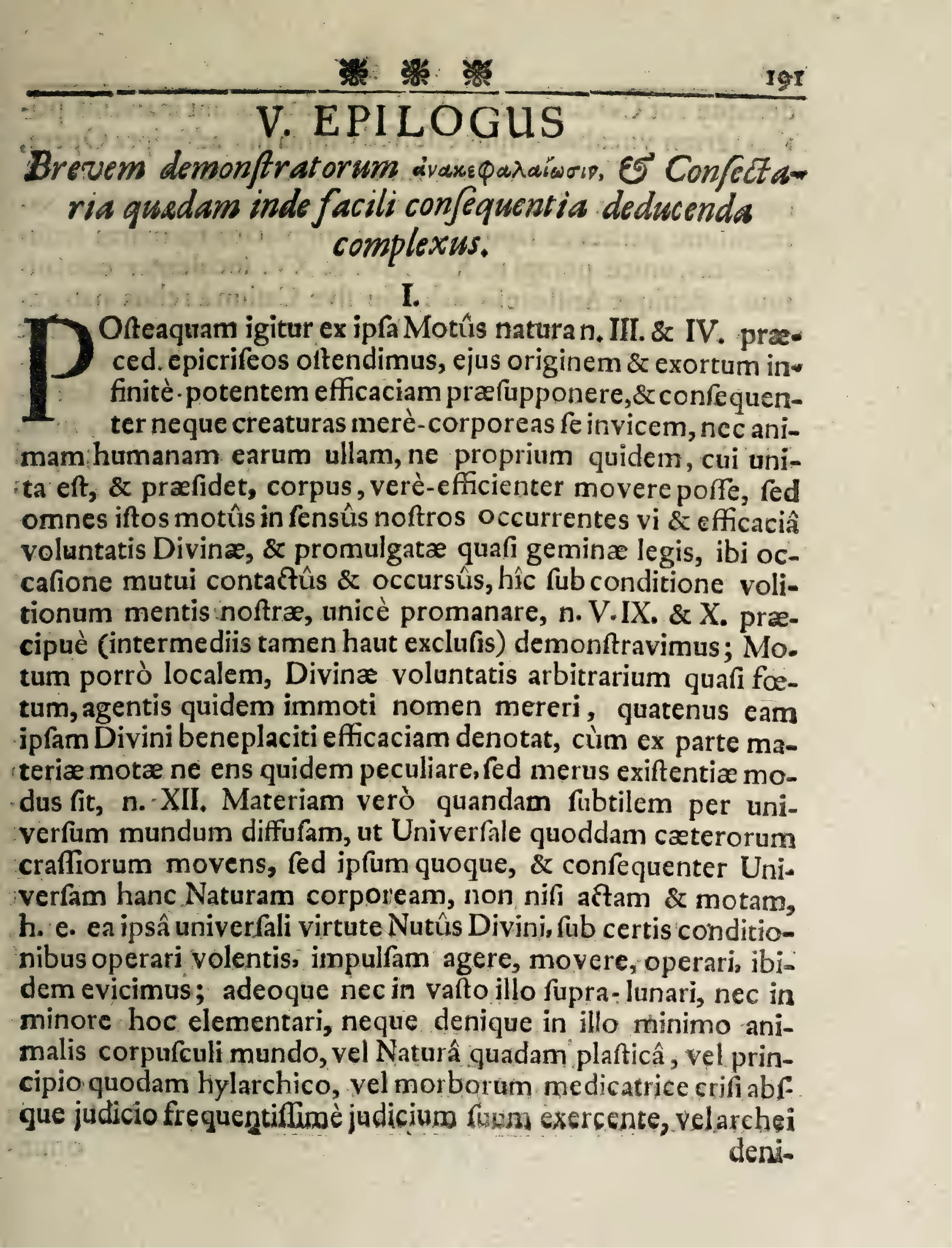
The italic heading “V. EPILOGUS” and its Greek subtitle ἀνακεφαλαίωσιν give typographic prominence to the chapter’s culminating recapitulation: tactile motions are referred from passive bodies to the efficacy of the Divine Will. The printed rejection of plastic nature and hylarchic principles marks the decisive turn to occasionalism proper. Source ↗.
That doxographic survey repays returning to at the point where the whole ontological question of the section is joined, in the appraisal of cold. Sturm fixes the baseline with Descartes by way of an internal cross-reference of his own: that Descartes located the nature of cold in the rest of parts, or in the privation or diminution of calorific agitation, is already clear, he says, from that one passage adduced earlier, V. Frigoris naturam Cartesium in partium quiete sive privatione aut imminutione agitationis calorificæ posuisse, vel ex uno illo loco, quem n. III. adduximus patecit:. The formulation is deliberately reportorial: Descartes enters not as magister but as one sententia laid on the table beside Cardano's mere privation, Scaliger's censure of it, and the Fabrian compromise by which cold is privative in the thing chilled but positive in the chilling agent. That compromise is the hinge, because it saves the observable violence of freezing — burst vessels, swollen ice — for a genuine agency, and it is precisely what the most radical hypothesis in the survey abolishes. There is yet another hypothesis, Sturm reports, which tries to evade even this distinction, namely Perrault's, who holds that active cold in chilling bodies, no less than passive cold in chilled ones, is a mere privation of heat and motion, while those positive effects that attend intense cold he contends are in themselves and immediately effects not so much of cold as of gravity in the subtle air, Sed est tamen adhuc alia hypothesis, quæ hanc etiam distinctionem conatur eludere, Pervaltii nempe, qui frigus activum in frigefacientibus æquè ac passivum in frigefactis, meram esse caloris motûsque privationem existimat, effecta verò illa positiva, quæ frigus intensum consequuntur, per se & immediatè non tam effecta frigoris, quàm gravitatis in aëre subtili esse contendit. The manoeuvre is exemplary of the work's reductive economy: a carentia is permitted to remain a pure lack precisely because the positive work formerly demanded of it has been reassigned to a material agent, the weight of the subtler air. Nothing is left unexplained, and nothing spurious is left in being. Sturm's admission that he had long preferred Fabri's distinction and now nearly defects — retaining only the burning north-easterly winter winds as a residual difficulty — shows the epicrisis operating as a judicial revision of the philosopher's own earlier verdict, with the unresolved case honestly entered rather than suppressed.
Against this privative treatment of cold stands the one thesis of the chapter that Sturm declares settled. That heat consists in the swift and variously omnidirectional agitation of subtle particles or corpuscles seems to him beyond doubt, II. Calorem in particularum sive corpusculorum subtilium celeri, variaque in omnes partes agitatione consistere, indubium nobis videtur — the flat indubium nobis videtur is rare in a book whose habitual register is videtur, malimus, forsan, and it is earned by evidence of penetration through glass, crucibles, stone and metal, and by the visible motion of flame. The ontological consequence follows at once, in the declaration already discussed above that heat too must in this way be called a modal quality only, consisting in nothing but certain modes of material particles — figure, agitation and the rest — and not absolute or real, as Fabri and his follower Lana would have it. The criterion by which absolute qualities are refused is explanatory transparency rather than metaphysical animus: Fabri's qualitas rarefactiva, promoted in a further step to qualitas resolutiva sive causa resolutionis, renames the explanandum instead of exhibiting a mechanism, and a quality declared inexplicabilis is for that reason disqualified as a term of physics. Where the doctrine of modes is generalised, however, the polemic changes key and becomes denominational, the opposing opinion being traced, as noted above, to a prejudice concerning eucharistic transubstantiation. The eclectic arbiter here abandons the posture of a judge above the parties and diagnoses the interest of one party: real accidents are wanted by du Hamel, Fabri and Lana, on this reading, because a doctrine of the altar requires accidents capable of subsisting without their subject. The remark is worth pausing over, since it concedes by implication that a reader might apply the same diagnostic to Sturm — that his own reduction of qualities to modes sits comfortably with a Lutheran sacramental theology — a symmetry the text does not acknowledge.
The parsimony that governs these reductions is voiced in the scholastic idiom itself: it is not permitted otherwise, the text says, to multiply entities beyond necessity, nec aliàs permissum, entia præter necessitatem multiplicare,, a maxim inherited from the schools and turned against the schools' own furniture of absolute levity and real qualities. When gravity, hardness, ductility and elater are severally referred to the fluor of the highest subtle air, the reduction stops not at God but at a circulating ether — the same rule of explanatory order that keeps the book within the bounds of physics.
That restraint makes the Epilogus to the chapter on tactile qualities all the more striking, for there the ascent to the first cause is at last permitted, and made the whole point. Since all tactile sensation reduces to motive impressions, it follows indubitably, Sturm writes, that motion is nothing else than the virtue and efficacy of the divine will exerting itself through parts of matter that are merely passive, Ex quo porrò indubiè consequitur, cùm motus nihil aliud sit, quàm Virtus & efficacia divinæ voluntatis, per materiæ partes merèpassivè habentes, sese exerens, juxta num. 1. Epilogi Cap. IV. Sect. I. The cross-reference matters: the premise is not argued here but applied, imported from the general physics as an already demonstrated result. What is new is the exegetical conclusion drawn from it, that God too is palpable and handleable, not indeed in the crude and vulgar sense, but in a truly philosophical sense which perhaps no one, or few, have hitherto noticed, patescit, ipsum quoque, non crasso quidem & plebejo, sed hoc verèphilosophico sensu (quem nemo forsan, aut pauci, hactenus animadverterunt) palpabilem esse manibusque contrectabilem. The parenthetical claim to novelty is unusual in a book so scrupulous about attribution, and it converts a physical analysis of touch into a reading of Acts 17:27 in which Paul's ψηλαφήσειαν need not be taken tropically. The devotional pay-off is thus produced by the reduction rather than in spite of it: because matter is wholly passive, whatever resists the hand is divine efficacy, and the mechanist analysis of hardness terminates in a doctrine of immediate contact with God.
Elater, sound, and light
The chapter on elasticity begins with lexicography and ends with the same terminus. Sturm records four synonyms for a still-unsettled concept, noting that this force of bodies restoring themselves as it were spontaneously out of a stretched or compressed state is that remarkable quality which philosophers call the elater, elaterium, elasticity or elastic force, est insignis illa qualitas, quam Elaterem, Elaterium, Elasticitatem vel Vim Elasticam Philosophi appellant,; the guarded ultrò quasi of the definition already forecasts the verdict, since the restitution will prove only apparently spontaneous, being produced by the pressure of the double atmosphere. The doxography here reaches the very edge of the author's present: in these very days, he writes, letters given to him from England from Mr Edmond Halley, Doctor of Medicine and Secretary of the Royal Society, VI. His ipsis diebus ex Anglia datæ ad nos literæ Dn. Edmundi Halley Med. D. & Soc. Reg. Secret, announce Newton's books on gravitation then groaning under the press and report that the particles of air and vapours seem endowed with a mutually repelling force by which dilatation and condensation might be explained. Sturm reports the suggestion faithfully and then declines it, and the ground of the refusal defines his reception of Newton generally: as the confession already quoted in the historiographical survey makes plain, words of this kind, which Newton uses throughout that most ingenious work entitled Philosophiæ Naturalis Principia Mathematica, would long since have displeased him. Vis centripeta, vis centrifuga and vis inertiæ are tolerated as abbreviations that permit the mathematics to advance, on exactly the terms by which the Peripatetic answer to the elater was rejected as the substitution of one obscure name for another. The consistency is impressive and its cost is plain: the same rule that disqualifies a qualitas rarefactiva disqualifies an attractive force, and Sturm pays for it by constructing a graduated pneumatic account from sponge to steel.
The licence under which such constructions are offered is stated in the epicrisis on odours and savours, where Descartes' two clocks are appropriated to the purpose announced in the book's title: Sturm confesses that, just as two clocks may be made by the same craftsman which, though they indicate the hours equally well and are outwardly wholly alike, are yet inwardly composed of a very dissimilar arrangement of wheels, confessus utique, quemadmodum ab eodem artifice duo horologia fieri possunt, quæ quamvis horas æquè bene indicent, & extrinsecus omnia similia sint, intus tamen ex valdè dissimili rotularum compage consent. Hypothetical adequacy, not demonstrated truth, is what a hypothesis physica claims; the demand is only that the supposition answer the phenomena as accurately as may be, a demand reinforced by Aristotle's own licence of demonstration ad possibile.
The chapter on sound shows what that demand looks like when the phenomena are quantified. Sturm reports that two observers, each equipped with his pendulum, one at 1200 and the other at 2400 fathoms, watching together the flash of a discharged cannon, counted from that moment to the perception of the following sound seven and fourteen seconds respectively, cùm duo v. g. observatores, suis pendulis utrique instructi, alter ex distantia 1200. alter ex distantia 2400. sexpedarum, ignem explosi tormenti simul spectantes, ab eo momento usque ad perceptum subsequentem sonum numerarunt, prior 7. posterior 14. secunda unius horæ, teste Perraltio in Tract. de Sono Part. I cap. IV. p. 34. The doubled distance and doubled count are made to yield the uniformity of sound's propagation, and the figure is immediately collated with the Florentine Academicians and with Gassendi and Mersenne. Upon this base the eclectic verdict opens with its own procedural formula: about to make his selection now, as is his custom, of those things which seem most consonant with reason and observation, and modestly to reject the rest, he rightly refuses Epicurus' effluvia and corporeal sound, Electum igitur nunc pro more facturi eorum, quæ ex hactenus dictis rationi & observatis videntur esse maximè consentanea, cæteraque modestè rejecturi, Epicuri quidem effluvia sonumque corporeum meritò recusamus;. Pro more declares a repeatable institution rather than an occasional judgement, and modestè keeps the irenic register even in refusal — a register that reaches its constructive extreme when Perrault's aerial and Lana's solid propagation are fused, whether by marriage or by syncretism, sive connubio sive syncretismo,, into one alternating hypothesis from which the twenty-four phenomena are then re-derived seriatim. Rejection is thus the lesser half of the method; the greater is the marriage of hypotheses that had been posed as contradictories.
The optical chapter applies the same double negation to light. It is not to be judged to be without body — which alone du Hamel's arguments conclude — but to be a pulsion, pressure, or some effort of the celestial body, that is, of the most fluid ether, Neque tamen secundò lucem & lumen esse sine corpore censendum est, (quod solum Hamelii rationes num. VI. allatæ concludunt) sed esse corporis cœlestis sive ætheris fluidissimi. Gassendi's substantial effluvium and the scholastic incorporeal quality with its species intentionales are excluded at a single stroke, and what remains is a pressure in a material medium, from which luminosity, opacity, reflection, transparency, the burning mirrors, the phosphenes of ocular pressure and the trials in the exhausted receiver are severally derived. The ether that carried gravity, hardness and elater carries light as well, so that the whole series of chapters is one supposition tested against successively different phenomena — which is precisely what the eclectic procedure was designed to produce.
Compression, rarefaction, conglaciation, and echo
The chapters on compression and dilatation bring that same ether to bear on a further set of phenomena, and the review of Francesco Lana Terzi's propositions on tension with which they open is already an exercise in the procedure that names the book. Having distinguished tension, which gains in length what it surrenders in breadth, from dilatation, which expands the whole body, and having observed that Lana's account coincides in substance with the Cartesian hypotheses save that the Cartesians break the continuity of the aether, Sturm registers his own adhesion in the formula already quoted in the historiographical survey: he assents to these authors in preference to the thoughts of others as regards the chief point of the matter, while declining to suppose either a precisely globular figure in the aetherial particles or, in the filings of the subtlest matter, an aptitude for assuming any figures whatever at any moment — an aptitude which, he says, the fear of the void seems to have extorted. Three operations are compressed into that single sentence: the hypothesis is accepted quoad rei caput, at the level of its explanatory core; the auxiliary machinery its authors required is detached and left unassented to; and that machinery is then given a diagnosis rather than a refutation. Vacui metus is not a physical objection but an aetiology of error — the supposition is said to have been extorted, wrung out of its proponents under a compulsion that is affective rather than evidential. To call a doctrine a metus is to remove it from the field of argument altogether, and it is worth noticing how economical this is: Sturm need not disprove the perfectly globular corpuscle, only explain why anyone wanted it.
The concession that follows is the boldest ontological step in this portion of the work, and it too has been quoted already: the interstices of air are confessed to be filled with a certain aether, the far smaller spacelets among the aetherial minutiae to be perfused with another subtler matter, and among those little dusts of the subtlest matter there are interposed, at last, empty spacelets of incomprehensible tenuity which the author does not so shudder to admit. The litotes non adeò horrescimus is exactly calculated: the traditional horror vacui is not denied but downgraded to a squeamishness that the philosopher may decline to share. The regress of ever subtler media terminates not in a further fluid but in a privation, and the terminal spatiola inania are cheap precisely because space has already been resolved into a measured nothing; nothing is added to the inventory of beings by admitting them.
What licenses the admission is not experiment but the liberty of the Creator. The warrant offered is that if it pleased the Divine Majesty to fill that vast void with matter already actually divided into minutiae and actually distributed under the forms of those bodies which now constitute this world, rather than with continuous matter thereafter to be divided into such, it was surely not obliged to so exact a repletion that it could not leave innumerable little points of that nothing empty, as they had been before, si placuerit Divino Numini vastum illud inane materiâ in minutias actu jam divisâ potiùs & sub illorum corporum formas, quæ nunc Mundum hunc constituunt actu distributâ, quàm continuâ, deinceps in tales demum dividendâ, replere, non fuisse sanè illud ad repletionem adeò exactam obligatum, ut non potuerit innumera illius nihil punctula sic, uti prius fuerant, inania relinquere. The argument turns on a negative theology of obligation — non fuisse obligatum — and the void is characterized twice over as nihil, whose punctula were simply not filled. Divine freedom here does physical work without being invoked as a physical cause: God is not made the agent of any particular compression or rarefaction, only the free author of a distribution that leaves room for the mechanism. The methodological rule that a natural, material proximate cause is always to be preferred is thus not breached; what the appeal to the Divinum Numen secures is a permission, not an explanation.
Upon that result the chapter's own epicrisis is built, and it proceeds by joining one ancient opinion and dismissing another as redundant: with what has been said so far, Sturm writes, there plainly comes to be joined Aristotle's opinion, cited above, that those things are compressible which have their pores void of body of the same kind, whence he immediately adds that water is little liable to compression because it has no such pores, while on the other side the Democritean opinion is to be rejected as superfluous, hactenus dictis apertè conjungenda venit Aristotelis sententia allegata num. I. compressibilia esse ea, quæ suos habeant poros ejusdem generis corpore vacuos; unde quoque immediatè subjungit, aquam parùm compressioni obnoxiam esse, quia poros ejusmodi non habeat; & ex adverso Democritica sententia rejicienda ceu superflua. The quarrel between the moderns and the schools is then dissolved as merely verbal, since it is plainly the same thing that the Cartesians blame in the Aristotelians, when they everywhere speak of the inflexion of parts, whether of bodies or vapours or air, as though it were the cause of condensations and rarefactions, whereas every condensation arises only from the expulsion, and rarefaction from the addition, of insensible matter, Idem verò illud plane est, quod in Aristotelicis vituperant Cartesiani, dum ubique de partium sive corporum sive vaporum sive aëris inflexione loquuntur, quasi condensationum & rarefactionum causa esset; ubi tamen omnis condensatio, non nisi ex expulsione, & rarefactio ex additione materiæ insensibilis nascitur — so that here too there is no place for their mutual invectives, if the mind be directed to the thing rather than to the words, adeò ut hîc etiam mutuis illorum invectivis nullus sit locus, si mens ad rem magis quàm ad verba dirigatur. The eclectic tribunal thus disposes of a school controversy not by adjudicating it but by showing that both parties describe one and the same corpuscular process under rival vocabularies.
The substantive test is then experimental. That soft bodies are truly condensed by the inflexion of their parts and brought into a smaller space is declared evidently false, ut in cera aliisve mollibus corporibus, quæ, ubi premuntur, per partium inflexionem verè condensari & in minus spatium coire, evidenter falsum est, inasmuch as such bodies change their figure rather than their bulk or magnitude, utpote quæ potiùs figuram, quàm molem seu magnitudinem, mutent. The proof is hydrostatic, and it is offered as decisive: as is established in particular by all the experiments of hydrostatics, by which it is proved beyond doubt that wax under water, however greatly it be pressed, never departs from its own specific gravity — which could not happen if it were truly compressed and, contracted into a smaller space, made denser, prout speciatim per omnia hydrostaticæ experimenta constat, quibus indubiè comprobatur, ceram sub aquis, licet quam maxime prematur, nunquam à propria specifica gravitate discedere, quod, si verè comprimeretur & in minus spatium contracta magis densaretur, evenire non posset. Specific gravity, measurable and invariant, is thus made the criterion of a change that inspection of shape cannot settle, and the definition follows from it: true compression must take place according to all its dimensions, vera compressio secundum omnes suas dimensiones fieri debet. Coarctation in one dimension with extension in another is not compression at all.
The same audit is applied to the analogy by which compressible physical points had been defended. That the extension of an angel in any place whatever is only virtual is manifest from the very essence of a spiritual substance, extensionem Angeli in loco quocunq[ue] non nisi virtualem esse, ex ipsa essentia spiritualis substantiæ manifestum est; but if by a physical point one understands something substantial and already actually extended, or naturally enjoying extension, this would be truly and really extended, not merely virtually, and so there is no comparison between the two, punctum verò physicum si substantiale quid & jam actu extensum sive extensione naturaliter gaudens intelligat, hoc verè & realiter, non virtualiter tantùm extensum sit; nec ergo istorum ulla est comparatio. Taken the other way, as an indivisible atom, this very supposition already involves a certain contradiction, hac ipsa suppositio jam contradictionem quandam involvit; and taken as a mere mathematical abstraction the point is incapable of compression altogether. The equivocation between virtual and real extension is thus dismantled by exhausting the senses of the term, which is the standing method of the work whenever a name is offered where a mechanism is wanted.
Fabri, by contrast, is defended rather than refuted, and the defence supplies the occasionalist substitute for an intrinsic restoring power: for Fabri could and ought easily to answer here that, by a law of Nature laid down by the Divine will and unceasingly observed, it is so ordered among the minutiae of matter that, once contracted by a greater force, they expand again when that contracting and violent force ceases, and return to their first expansion, Nam Fabri hîc facilè respondere posset & deberet, per legem Naturæ à Divina voluntate latam & indesinenter observatam ita comparatum esse in materiæ minutiis, ut, vi majore semel contractæ, cessante hac vi contrahente ac violenta iterum se expandant, & ad primam suam expansionem redeant. What would have been an inherent tendency in the schools becomes a standing law continuously observed, which is exactly the form the general-law occasionalism takes when it descends to the level of particles. Lana's objection is met on its own premise, since there is no action at a distance, cùm actio in distans nulla sit — a premise that both parties grant, and that a mechanism of contact and expulsion must therefore satisfy. The printed summary at the chapter's end sets out the mitigations in order: either there are no vacuities in nature, or such vacuities as there are are filled by compression, or what occurs is a coarctation in one dimension with extension in another, arising not from any intrinsic effort but through the subtler matter admitted. The next chapter, De Rarefactionibus & Condensationibus, then opens its own collection of phenomena by dividing bodies that cannot be brought into a smaller space — water, oil, wax, lead — from those in which the contrary plainly happens, air, sponge and wool.
In that chapter the eclectic appraisal turns outward, against the Jesuit physics of quantity. Fabri's definitions are reported with punctilious fidelity — that Rarefaction is a motion toward rarity, that is, toward the state in which a body has little of matter or of corporeal entity and has or requires much external extension, Condensation on the contrary a motion toward density, toward the state in which it has much of matter or of corporeal entity, which latter little words he adds in both places on account of his eucharistic mystery, but little extension, quòd Rarefactio sit motus ad raritatem h. e. eum statum, in quo habeat parum materiæ vel entitatis corporeæ, & multum extensionis externæ vel habeat vel exigat; Condensatio contrà motus ad densitatem, h. e. ad eum statum, in quo habeat multum materiæ vel entitatis corporeæ (quas posterioris voculas propter eucharisticum suum mysterium utrobiique addit) at parum extensionis. The diminutive voculas is doing polemical labour: the disputed clause is reduced to a pair of tiny words, slipped in twice over, whose function is doctrinal rather than physical. As with the vacui metus, the opponent's position is explained by its motive; here, however, the motive is confessional, and the accusation is that a definition in natural philosophy has been shaped to leave room for transubstantiation. That a Lutheran professor at Altdorf should identify eucharistic interest as a distorting force in a Jesuit's account of quantity shows how little the epicrisis eclectica is a neutral tribunal standing above the confessions; it is rather a procedure that can name confessional prejudice as one of the recognized sources of philosophical error.
The positive resolution is reached by a strictly analytic route. Having eliminated the swelling of individual particles as merely displacing the question, Sturm falls back on the oldest of scholastic axioms to reach a corpuscularian conclusion: but since nothing is moved by itself, but whatever is moved is moved by another, it is absolutely necessary that into the body to be rarefied, whose innermost parts too are drawn apart, another subtler and more agitated body insinuate itself intimately and by its impetus dissociate those parts, Verùm enimvero, cùm nihil à seipso, sed quicquid movetur ab alio moveatur, oppidò necessum est, in corpus rarefaciendum, cujus intimæ quoque partes destrahuntur, aliud corpus subtilius & agitatius intimè se insinuare suoque impetu partes illas dissociare. The Peripatetic maxim is retained intact and turned against Peripatetic physics: because no body has motion of its own, every internal dilation demands an intruding agitated medium, and the only imaginable mode is the one the Cartesians, Lana and du Hamel had proposed. The same denial of self-motion that elsewhere refers all movere beyond matter functions here as the engine of a purely mechanical inference.
The consequence for cold is a demotion that the whole system requires. Cold ceases to be an agent: rather, in my judgement, cold, or the departure of heat from the pores of a compressible body, is said not so much itself to condense, as to furnish to the air lying above or surrounding, ponderous and elastic, an occasion of condensing or compressing it, Rectiùs, meo judicio, frigus aut caloris è corporis compressibilis poris discessio, non tam ipsa condensare, quàm incumbenti desuper aut ambienti aëri ponderoso & elastico. The first-person meo judicio marks the intervention as Sturm's own against Peripatetics and Cartesians alike, and the vocabulary of occasio is the same vocabulary that governs his account of causation at large: what is privative supplies an opportunity, and the real work is done by the weight and elasticity of the atmosphere. From this follows a clean logical subordination that abolishes a traditional pair: so that in this way every condensation is really a compression, yet not conversely every compression a condensation, since this latter presupposes some cold, or a diminution of heat, removing as it were an obstacle to the compressing force, Ut ita omnis condensatio compressio quædam revera sit, non tamen vicissim omnis compressio condensatio; cùm hæc posterior frigus aliquod supponat, sive caloris imminutionem, virtuti compressuræ obstaculum quasi removentem. One species is folded into another and the difference between them is located in the mere removal of an impediment — the privative reduction operating not on space now but on a pair of processes.
The chapter on conglaciation reverses the direction of the argument, beginning not from analysis but from astonishment, and doing so through the eyes of those for whom ice is not commonplace: so wonderful a thing in itself is Conglaciation, the annual conversion in these more northerly climates of water, by its own nature flowing, soft and mobile, into an unmoved, hard and solid substance, that not so very many years ago it was reckoned a miracle by the Spaniards, on the testimony of the newsletters, when the river Manzanares that washes Madrid was seen joined as if by a bridge of ice, a rare spectacle indeed in those regions, A Deò miranda res est in se Conglaciatio, h. e. aquæ suâ naturâ fluxæ mollis & mobilis in immotam, duram solidamque substantiam anniversaria in his septentrionalioribus climatibus commutatio, ut non solùm ante annos haut adeò multos Hispanis pro miraculo fuerit, Novellis testibus, cùm alluens Madritum fluvius Manzanares glaciali quasi ponte junctus cerneretur, raro quippe in istis oris spectaculo. Printed newsletters are here admitted to the evidentiary record beside travel narratives and laboratory trials, and the rhetorical strategy is one of deliberate defamiliarization: a northern commonplace is made strange by being viewed from Madrid and from the Indies, so that the philosopher's own habituation, which would otherwise suppress the phenomenon entirely, is broken open. Within the same chapter Sturm makes an unusually explicit claim of originality. Noting that freezing does not proceed with snow or crushed ice alone unless salt has been mixed with them, he remarks that the necessity of this certainly presupposes some special reason, which I do not remember to have been distinctly enough set forth by anyone hitherto, Quandoquidem verò solâ nive aut contusâ glacie præsente congelatio tamen non procedit, nisi salis etiam aliqua quantitas istis admixta fuerit, hujus necessitas utique specialem quandam rationem supponit, quam à nemine hactenus distinctè satis expositam memini. The solution he then supplies — the liquefying salt sealing the passages between the grains into one continuous icy crust and so cutting off the ingress of warmth from the neighbouring air — is thermal and structural rather than corpuscular, and it dispenses with the frigorific atoms that Gassendi, du Hamel, Fabri and Stair had each been obliged to posit. The compiler's gesture and the discoverer's gesture are here made to coincide: the gap in the literature is identified, and the identification is itself the ground of the claim.
In the chapter on the mutations of sound the criterion for a physical distinction is drawn from the physiology of the sense organ. Echo is not constituted by reflection alone: it does not suffice that any repercussion whatever of a sound or voice should form an echo distinctly, but such a one is required as shall carry back to the organ of hearing a tremor or vibration of the air similar to the direct one, at that time precisely when the impulse of the direct sound in the trembling fibrils of the auditory nerve has for the most part ceased, Non sufficit igitur quæcunque soni vocisque repercussio ad echum distinctè formandam, sed talis 2. requiritur, quæ directo similem aëris tremorem aut vibrationem ad organum auditorium iteratò deferat eo demum tempore, quo directi soni impulsus in fibrillis auditorii nervi contremefactis maximam partem cessavit. The definition is thus jointly geometrical and organic, and it converts what had been a taxonomic curiosity — monosyllabic and polysyllabic, monophonic and polyphonic echoes — into a quantity: the refractory interval of the trembling fibrils, combined with the measured speed of sound calibrated against the arterial pulse, yields minimum distances that can then be checked against the echoes Sturm himself paced out around Altdorf.
That habit of testing what tradition merely repeats governs the turn to light with which this stretch closes. The equality of the angles of incidence and reflection, endlessly asserted, is submitted to apparatus: we ascertained the truth of the assertion by this experiment, setting upon a table or board well flattened a plane mirror ABCD, bare of supports so that it touched the table immediately with its extremity AB, for the sake of easier observation, Nos hoc experimento asserti veritatem deprehendimus; Statuimus supra mensam aut tabulam probè complanatam Speculum planum A B C D (Fig. XLII.) subscudibus nudum ut tabulam immediatè contingeret extremitate suâ AB, commodioris Observationis ergo. The description is deliberately reproducible, keyed to an engraved figure, and its point is not novelty of result but the conversion of a received formula into something a reader may verify — the same discipline that refuses a name in place of a mechanism, applied now to a law so familiar that no one had thought to measure it.
Reflection, colour, savour, and the causes of motion
The optical epicrisis that closes the treatment of reflection and refraction shows at once what kind of operation Sturm's judicial method is. His first move against Gaspar Schott is not to deny the equality of the angles of incidence and reflection — he holds that law himself — but to void the proof offered for it: that demonstration seems to him mere illusion and a begging of the question, for it supposes the object placed at C and the incident ray CE to be reflected to the eye placed at D, Mihi verò demonstratio illa mera illusio & principii petitio esse videtur: Supponit enim objectum in C positum, radiumque incidentem CE (Fig. XLIII.) reflecti ad oculum in D collocatum. The reversibility of the optical path, which the argument helps itself to, is only intelligible if the angles are already equal; an adversary denying the equality would refuse the premiss in the same breath. The charge matters structurally because it marks off the second and third moments of the eclectic procedure from each other. A hypothesis may be retained while the reasoning advanced for it is discarded, and conversely a conclusion faithfully drawn from the phaenomena owes nothing to the demonstrations that have been mustered on its behalf. The epicrisis is thus an audit of inferences, not a poll of authorities, and the sharpness of principii petitio is reserved for formal failure rather than for substantive error.
Descartes fares no better under the same audit, and here the criterion of appraisal becomes explicit. That water, coarser than air and violently pressing all channels and passages with its weight, and hard solid glass besides, should impede the action of light less than air, seems to Sturm greatly repugnant both to imagination and to the nature of things itself, quòd crassiorem aëre aquam suoque pondere vias omnes ac meatûs validè urgentem, ac durum insuper solidumque vitrum, actionem luminis minus impedire quàm aërem toties subtiliorem accedere promptiorem, credere, imaginationi ac ipsi rerum naturæ valdè repugnans videatur. The coupling of imaginatio with ipsa rerum natura is not a rhetorical flourish but a statement of what a hypothesis is required to deliver in this physics: a mechanismus that can be pictured in figures, sizes and situations of particles. What cannot be imagined corporeally is not a mechanism at all, and so fails the test before any question of its truth arises. The standard is deliberately weaker than demonstration and correspondingly harder to evade by verbal adjustment.
Having refused both proofs, Sturm does not choose between the parties but recombines them, and the passage is syncretismus caught in the act: as regards reflection, Descartes's demonstration has less difficulty, especially if the underlying plane be understood as supremely hard, and it will come out more evident still if it be combined with the Barrovian hypothesis, Quod reflexionem attinet, Cartesii demonstratio minus habet difficultatis, maximè si planum subjectum summè durum intelligatur. < Ratio V. Phæn.> Evadet autem evidentior adhuc, si cum Barroviana hypothesi combinetur. Barrow's objection had been that a ray conceived as a breadthless line cannot reflect intelligibly, and his remedy was to give the ray body — parallelepiped, prismatic or cylindrical — so that rotation about its mid-point generates the law. Sturm keeps the Cartesian series of aethereal globules and installs Barrow's rotating solid within it; the marginal Ratio tag embedded in the line shows the printed apparatus binding each explanatory paragraph back to its numbered phenomenon. The eclectic result is thus not a mean between two doctrines but a third mechanism assembled from the serviceable parts of each, which is precisely what the programme promises when it speaks of attuning rival hypotheses so that one common hypothesis arises from them.
In the chapter on changes of colour, opacity and transparency, the same machinery is turned against the schools' ontology of quality. Sturm reports that Boyle, the discoverer of the two crucial experiments, judged nothing more apt to make plain that we need not suppose all colours must necessarily be inherent qualities flowing from the substantial forms of bodies, Id quod ampliùs ex VIII. vi & IXni Phæn. experimentis ita elucet, ut eorum Inventor Boylius non aliud aptum magis judicaverit ad palam faciendum, non opus esse ut supponamus, colores omnes esse necessariò oportere inhærentes qualitates, à substantialibus corporum formis manantes. The experiments in question are the generation of a saturated orange from two colourless liquids and its abolition by a third, and the force Boyle claims for them is carefully economical: not that inherent qualities are impossible, but that there is no need to suppose them. That modesty is exactly the epistemic register the method prescribes, and it explains why the reduction of colour to surface texture, pore-disposition and figure can be pressed without any commitment to the ontological truth of the corpuscular picture. Where the schools require an emanation from a form, the eclectic physicist requires only a constructible alteration of texture.
The chapter on savours and odours states the reduction in its most compressed form, holding that tastes and odours, so far as they are received and perceived in the sensorium, are nothing other than the various agitations, prickings, scrapings, tensions and constrictions of the nervous fibrils spread through each organ, Sapores & odores, quatenus in sensorio recipiuntur & percipiuntur, nihil aliud esse, quàm fibrillarum nervearum per utrumque organum expansarum varias agitationes, puncturas, rasuras, tensiones, perstrictiones &c. The qualifying clause quatenus in sensorio recipiuntur does all the metaphysical work: it partitions the quality into what happens in the organ and what belongs to the body, so that nothing absolute survives on either side of the division. The lexicon of puncturæ and rasuræ is that of the Gassendist corpuscularians, and its choice is consequential, since figure, rigidity and motion of particles are quantities a mechanism can specify, whereas a sapid form is not. The chapter's most telling phenomena — new odours generated from odourless quicklime and water, musk sweetened by rose spirit — are selected because they exhibit qualities arising where none was, which is unintelligible on an emanative account and trivial on a modal one.
The motion chapters bring the same demand to bear on a doctrine held not by Peripatetics but by moderns. Against Lana and Fabri, who make impetus an absolute rather than a modal quality, Sturm concedes the word and withholds the explanation, in the formula on names and mechanisms already set out in the philological framing above: such terms are only names for the thing being sought, and are easily admitted provided the thing itself designated by them be explained. The generosity of the concession is the trap: since the same test had already dissolved substantial forms and the qualitates occultæ vulgò dictæ, its extension to impetus demonstrates that the eclectic tribunal is not a Cartesian party in Peripatetic dress. Pressing his opponents to say whether an impetus exacts motion morally or physically, by commanding and ordering, Sturm claims to extract from their own concessions the conclusion likewise quoted above — that local motion acknowledges no physical efficient cause, and therefore none acting of necessity, but only an exigitive one, commanding and ordering, which can be nothing other than the mere good pleasure of the willing God. Presented in this way, the causa exigitiva is the residue of an appraisal rather than a premiss imported from theology — a rhetorical placement that leaves the doctrine looking like the last hypothesis standing after the others have been examined.
That the resulting occasionalism does not license appeals to divine action within physics is secured immediately by a rule of method. No other cause can alter or destroy this efficacy of the divine will and law than either this same general law and will, or some special one contrary to it; but to suppose such a special will in individual cases of this sort would be superfluous and unworthy of a philosopher, Quam voluntatis ac legis divinæ efficaciam nulla causa alia immutare vel destruêre potest, quàm aut hæc eadem generalis lex & voluntas, vel specialis aliqua isti contraria; sed specialem ejusmodi voluntatem in singulis ejusmodi casibus supponere superfluum esset & indignum Philosopho. The disqualification is professional as much as logical: the philosopher who reaches for a particular volition where a general law suffices has abandoned his office. This is what permits the chapters that follow to proceed as mechanics, estimating force from bulk and speed, tabulating rebound heights, and counting vibrations, without any recurrence to the metaphysical result just established.
Its immediate application is the graduated account of reflection, carried by a simile drawn from civic life: just as, for example, a well-moneyed man, if he fell among a huge crowd of beggars, could be drained and stripped of all his coins, quemadmodum e.g. homo bene nummatus, si in gregem mendicantium ingentem incideret, omnibus exhauriri & emungi nummis posset. Motion striking a wholly soft body is not annihilated but parcelled out among innumerable yielding parts; among those who refuse the coins or return them at once, the traveller keeps his whole store, which is perfect hardness and elasticity; and the mixed crowd yields the intermediate case. The image satisfies the criterion invoked earlier against Descartes, since it renders the distribution of motion imaginable in bulk and number, while the pointed avoidance of any language of destruction is precisely what the general-law doctrine requires: quantity of motion is redistributed, never extinguished by the body it meets.
The evidentiary base on which such adjudications rest is displayed most vividly in the pendulum chapter, where Riccioli's three nights of observation between the meridian transits of Spica and Arcturus are reported with their totals — counted, he says, were the simple vibrations, twice 3212, once 3214, numeratæ sunt, inquam, vibrationes simplices, bis 3212 semel 3214. The near-identity of three independent counts, with Grimaldi and Zeno as witnesses and tokens dropped into a vessel at every thirtieth double vibration to keep the tally, is offered as the argument for isochronism; the phenomena stage of the chapter thus supplies numbers whose stability, not any theoretical construction, obliges the hypotheses that follow.
The final chapter turns the whole apparatus on generation and corruption, and here the confessional edge of the enterprise surfaces. The telescopic discovery of sunspots and faculae is said to furnish a most just cause to Christian minds for gradually putting off that pagan superstition, justissimam inde causam animis Christianis, gentilem illam superstitionem paulatim exuendi — the superstition being celestial incorruptibility, diagnosed as heathen veneration of the heavens carried into Christendom by excessive deference to gentilis philosophia. Against the Aristotelian form, which can neither be created from nothing nor resolved into matter and whose coming-to-be is therefore unintelligible, Sturm sets a definition framed entirely in accidents: then the form and essence of the changed body is reckoned to have perished, when so great a change occurs in the figure, or the disposition, or the connexion, or the motion and rest of the parts, that it wholly ceases to perform its former office, to which it had been destined by the Artificer of Nature, Nimirum tum periisse forma & essentia corporis mutata censetur, cum tanta vel in figura, vel in dispositione, vel in connexione, vel in motu aut quiete partium, accidit mutatio, ut id pristinum obire munus, cui à Naturæ opifice destinatum fuerat, penitus cesset. The mechanical vocabulary is complete, yet the criterion of identity remains teleological: what fixes the boundary of a form is the munus, the office assigned by the Naturæ opifex, so that the reduction of form to configuration is at the same time a referral of function to the divine appointment that instituted it — the same double gesture that made local motion mechanically describable and causally dependent.
The close of the physica specialis and the appended tracts
The stark half-title — PHYSICÆ GENERALIS usus METAPHYSICUS aut THEOSOPHICUS ET MORALIS — announces the appended tract as a deliberate turn from general physics to its metaphysical, theosophical and moral use, making visible the hinge at which Sturm’s account of dependence in nature is redirected toward duty, providence, war and conscience. Source ↗.
The numbered rationes that bring the book to its close complete a test case for the whole doctrine of form: what constitutes the essence of a natural composite, and what happens when that essence lapses. Against the Latin Schools, for whom the rational soul is itself the form of man, the text makes the union of soul and body the form, so that when their mutual commerce ceases a man ceases to be a man and, the death of the animal body ordinarily preceding in this case, is transmuted into a lifeless corpse, cessatque adeò homo esse homo, & (cùm in hoc casu corporis animalis mors & interitus ordinariè præcedat) in cadaver inanime transmutatur. The move is characteristic of the eclectic procedure at its most economical: the scholastic vocabulary of materia and forma is retained intact, since bodies are still said to be composed ex duobus principiis essentialibus, but the referent of forma is silently shifted from an inhering substantial principle to a relation — here a commercium — whose subsistence is not the soul's subsistence. A surviving separated soul would, on the Schools' analysis, leave a surviving formatum, which the criterion of death forbids. The same chapter's account of why the great globes never lose their essences is built on an equally deflationary reading of what looks like an intrinsic power, gravity being resolved into a compulsion toward the common centre that depends on the surrounding celestial gyre, a formulation which makes the perpetuity of the solar and planetary forms a function of the ambient vortex rather than of any virtue lodged in the bodies themselves. The treatise's last sentence then raises the stakes by naming a class of forms that mechanism cannot reconstitute, those set in organic fabric, which acknowledge not counsel-less Nature but God's own effecting hand, Impossibilis denique Naturæ viribus in earum formarum casu, quæ in fabrica organica positæ sunt, non Naturam consilii expertem, sed ipsam DEI manum effectricem agnoscente. The concessive structure is worth pressing: mechanism is total in its scope, yet the fabrica organica is precisely the mechanism whose assembly is immediately divine. Nothing is exempted from figure, size and motion; what is exempted is the claim that unguided nature could ever have put such figures together. The printed FINIS and SOLI DEO GLORIA that follow are therefore not a pious flourish appended to a mechanical physics but the epigraph of the argument just concluded.
What follows in the volume is the appended usus metaphysicus, theosophicus et moralis, introduced by its own half-title (one leaf at the opening of the tract is so degraded that no text can be recovered from it), and presented as gathering filo continuo what the main work had established sparsim. Articulus I sets out the passivity of matter, and does so by an argument from composition whose first premise is stated in an unusually personal epistemic register, since it is evident and beyond doubt to the author that all secondary matter, as we call it, of the natural as well as the artificial bodies that exist, is something composite and imbued with some antecedent physical form, Primum igitur illud evidens ac indubium mihi est, cùm omnis materia secunda, quam vocamus, naturalium æquè ac artificialium, quæ extant, corporum, sit compositum quiddam & formâ quadam Physicâ antecedanea imbutum. The mihi est is not modesty but method: within a physica electiva the philosopher who appraises hypotheses speaks as iudex declaring what has survived examination, and the regress that follows is displayed rather than merely asserted, by the analysis of a book or an oration into chapters, periods, cola, commata, words, syllables and finally letters. The rival accounts of prime matter — Greek body-as-body, the Cartesian identification with extension, Democritean and Epicurean atoms, the indivisible monads revived by Wyss and Stair, the scholastic potentia passiva — are then canvassed not to be adjudicated between but to be shown to converge: each, however construed, yields a subject capable only of being divided, figured and moved. This is the eclectic epicrisis used for a negative result, and its polemical dividend is that the Aristotelian definition of matter as the first or proximate subject out of which something comes to be can be claimed for the passivity thesis while the forma substantialis of Aristotle's Latin interpreters is refused.
Articulus II supplies the inference that the passivity of matter demands, and it turns on a deliberate impoverishment of what motion is. Motion superadds nothing real to the thing moved but only this mode of existing, that so long as it is moved it exists successively in one place after another, quòd motus rei motæ nihil reale superaddat, sed hunc solùm existentiæ modum, ut, quamdiu movetur, in aliis aliisque successivè locis existat;. Once motion has been reduced to a mode of existing, the question of its cause is no longer a question about the transfer of some entity from one body to another but about who can confer existence-in-succession; and existence is not in the gift of creatures. Hence the thesis, quoted already in the summary above, that to move is something divine, proper to the divine Will alone, and that no truly and properly motive virtue is found anywhere in the world beside the virtue of that will freely willing and by willing moving all things. The objection from impact is met not by denying the phenomenon but by parsing what the eye actually reports: we see the second body likewise displaced after the impact of the first, but that the first effects this we do not, properly and truly speaking, see, nor can we see, Videmus, inquam, hoc alterum loco suo similiter emoveri post impactionem illius prioris; illud autem hoc efficere, propriè vereq[ue] loquendo, non videmus, nec videre possumus; The rhetorical intensity here lies in the nec videre possumus: sense delivers succession, and efficacy is an addition made by the iudicium rather than a datum of observation — the same discipline that elsewhere refuses to let a name stand in place of a mechanism is turned against the most intuitive of all supposed mechanisms.
The cost of the thesis in confessional currency becomes visible in Articulus III, where the received Lutheran-scholastic doctrine of divine cooperation is pressed until the term itself gives way, since concursus presupposes something acting together or simultaneously, and finds no place where one sole agent does all that is done, concursus præsupponit aliquod unà sive simul agens, ibi autem locum non invenit, ubi unum solum agens agit, quæ aguntur omnia. To declare a central term of the academic theology incongruus is a striking liberty in a textbook, and the tract insures itself in advance by locating reason and revelation in one source, the Pater luminum, so that a quarrel between them is impossible and confessional conflict must be a quarrel over human exegesis instead. Articulus IV then completes the demolition of forms: taken strictly, they are nothing other than certain modifications of matter, shadowy entities, or rather something of entities, nihil aliud sunt, quàm certæ quædam materiæ modificationes, umbratilia quædam entia, aut entium potiùs aliquid, — the trailing aut entium potiùs aliquid registering an ontological embarrassment that the sentence cannot quite resolve. What secures the point is not metaphysical but mechanical: the lever, with its fulcrum, is the paradigm of the potentiæ mechanicæ, and the demonstration is that in all these effects the form of the lever contributes nothing actively or by acting, in his omnibus effectibus formam Vectis nihil activè aut agendo propriè conferre. The corroborating apparatus is characteristic of the Altdorf experimental culture — the collision trials of Huygens and Mariotte, the balance, the mills and clocks and automata that stand idle without water, spring, wind, draught beast or human hand — and the animal body is then read in the same key, gullet, lungs, lacteals, chyle duct and vessels enumerated as conduits and the heart as a torcular, bones and joints as levers homodromi, with Borelli's De motu animalium cited for the geometry.
The moral articles extend the doctrine of dependence to conduct, and their tone shifts abruptly from demonstration to testimony. Discussing premature death and the theodicy it forces, the author records having twice lost a wife in the flower of her age, and advances as his own heresy that the whole of human life, at least from earliest adolescence, seems to be nothing other than a kind of continued self-killing, Totam hominis vitam saltem à prima adolescentia, videri nihil aliud esse quàm continuatum quoddam propricidium,. The coinage propricidium does theological work: if intemperance and the abuse of the body are the proximate causes of shortened life, then God withdraws nothing prematurely, and the ordinary laws of nature are vindicated at the price of laying the whole burden on the creature's own agency — the one agency the physics had allowed it, namely willing. The indictment of war follows the same logic outward, man being everywhere and daily wolf and devil to man, though the target is those public brigandages by which one man, or a few sacrificing to one man's ambition or wickedly abusing his authority, devastate whole provinces and cut down whole nations, homine adeò homini lupo ac diabolo passim & quotidie existente; sed de publicis istis latrociniis, quibus unus aliquis homo, aut pauci unius ambitioni litantes, aut ejus authoritate nefariè abusi, integras provincias devastant, totas gentes exscindunt, The juridical word latrocinia denies dynastic war the dignity of a legal category altogether. The plea for toleration is built on the same denial of coercible faculties, and its sharpest formulation concerns the newer method of conversion, in which the unceasing continuation of non-lethal tortures and a duration intolerable to human weakness compels even the most steadfast to a hypocritical abjuration and so to manifest perjury, sed cruciatuum nonmortiferorum indesinens continuatio & humanæ imbecillitati intolerabilis diuturnitas vel constantissimum quemque ad abjurationem hypocriticam, manifestum adeò perjurium, The charge is not merely cruelty but incoherence: a procedure calibrated to fall short of killing aims precisely at the soul it professes to save, and is therefore judged worse than the ancient persecutions under pagan tyrants, with the magistrate left no remedy beyond ordered emigration with property preserved.
The volume then annexes, mantissæ loco, the Theosophiæ Specimen defended at the Academia Norica in 1689 under the author's presidency by Guelph, Baron von Metternich, with a dedicatory letter dated from the Museum on 6 April of that year. Its architecture is that of a demonstrative natural theology methodo Mathematica, and its definitions reproduce the reductions of the main tract in axiomatic form: Natura is the mere coordination of the world's totalities, operating without any counsel or providence of its own, indeed wholly ignorant of its own operations, sine ullo suo consilio, aut providentia, imò, suarum operationum planè nescia, and conservation is defined as the continuous positing anew of a thing that would otherwise lapse instantly into nothing. The axioms open with a criterion imported from Descartes, that what we clearly and distinctly understand to pertain to a thing's nature, idea or concept can, indeed must, be most truly affirmed of that thing, Quod clarè & distinctè intelligimus pertinere ad alicujus rei naturam, ideam aut conceptum, id potest, imò debet, de illa re verissimè affirmari, immediately legitimated by an appeal to Euclid's practice — a syncretismus of Cartesian evidence and Greek axiomatics that shows the eclectic method operating on the very instruments of proof.
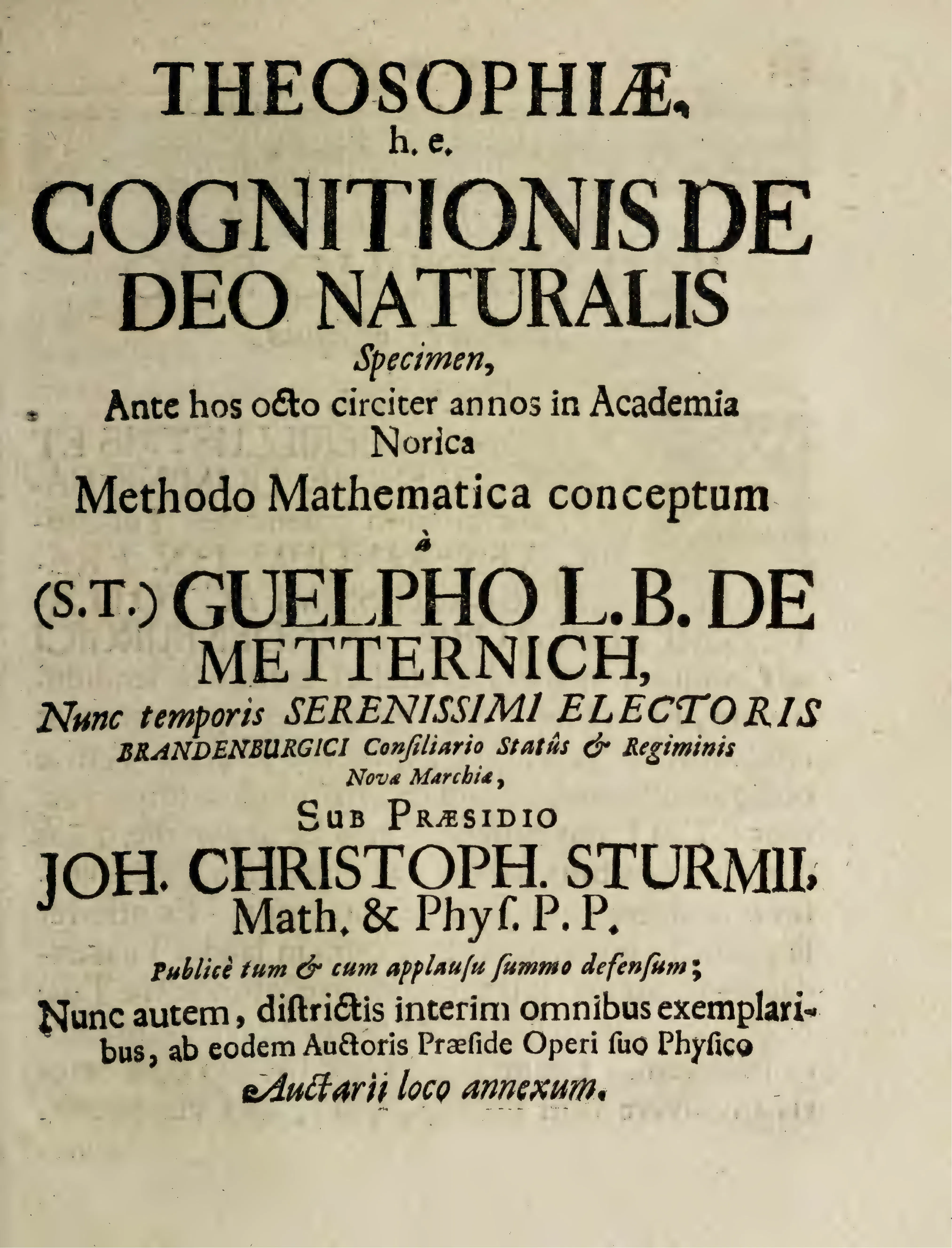
The appended title leaf announces Metternich’s Theosophiae Specimen as natural theology “Methodo Mathematica conceptum,” defended at the Academia Norica under Sturm’s presidency and reissued here “Auctarii loco.” Its printed notice that intervening copies had been suppressed — “districtis interim omnibus exemplaribus” — makes the annex evidence of the specimen’s fragile earlier circulation. Source ↗.
Frequently Asked Questions
Who was Johann Christoph Sturm, and what is the Physica electiva sive hypothetica?
Johann Christoph Sturm (born Hilpoltstein, 3 November 1635; died Altdorf bei Nürnberg, 25/26 December 1703) was professor primarius of mathematics and physics at the Academia Norica, the small Lutheran university of Altdorf in the territory of Nuremberg, from 1669 until his death, a fellow of the Leopoldina, and founder in 1672 of the Collegium Curiosum sive Experimentale. His Physica electiva sive hypothetica is a two-volume Latin natural philosophy printed at Nuremberg by Wolfgang Moritz Endter: the first volume on general physics in 1697, the second, on special physics, posthumously in 1722 with a preface by the young Christian Wolff, who had learned natural philosophy from Sturm's textbooks at Jena.
What does electiva mean in Sturm's title, and how does his eclectic method work?
Electiva names a judicial procedure of appraisal, not a matter of personal taste. Phenomena are first collected faithfully; then old and new hypotheses are exhibited; then an epicrisis eclectica — an eclectic adjudication — selects what is true, rejects what is false modestly, and where rival hypotheses are compatible attunes them by syncretismus so that one common hypothesis arises. Sturm had given the programme its canonical formulation in De philosophia sectaria et electiva (Altdorf, 1679). In practice the arbiter audits arguments rather than counting authorities: Gaspar Schott's proof of the equality of angles of incidence and reflection is dismissed as begging the question while the law itself is retained.
Why does the work call space "nothing, decorated with measures"?
Because space is resolved into a privation rather than admitted as a subsisting interval. Abstracted from all bodies, space is really nothing; the conclusion drawn is that it is nothing real, corporeal, incorporeal, positive, negative, substantial or accidental, but a nothing marked with determinate or indeterminate measures borrowed from real bodies — a relative and connotative nothing, credited to Erhard Weigel of Jena, under whom Sturm had studied. The illusion of real extension is traced to the habit of extrapolating measured terrestrial distances beyond the world's bulk and then attributing reality, immensity and eternity to the result. Emptied of being, space costs nothing when empty spacelets are later conceded against Descartes.
How does the 1722 volume treat Newton's Principia and the forces it names?
Newton's terms are admitted as useful abbreviations while their standing as causes is refused. Sturm confesses that words of that kind, used throughout the Philosophiæ Naturalis Principia Mathematica, would long since have displeased him, and centripetal force, centrifugal force and force of inertia are tolerated only on the standing rule that a name may be conceded provided the thing it designates is explained by a mechanism. In the chapter on elasticity he reports letters newly received from England from Edmond Halley, Doctor of Medicine and Secretary of the Royal Society, announcing Newton's books on gravitation then in the press and proposing a mutually repelling force among air particles — a suggestion faithfully reported and then declined.
Is there an English translation of Sturm's Physica electiva sive hypothetica?
No complete translation of the work into English or any other modern language has been identified; the standard modern access has been the Georg Olms facsimile of 2006, issued within Christian Wolff's Gesammelte Werke. Separately, the Leo edition now presents the full transcription of the 1722 second volume together with a complete English translation for the first time, and that translation is generated by artificial intelligence. Leo is an effort to make freely available online, at no cost, English translations of every text printed in Latin in early modern Europe between 1450 and 1750.
This report was generated by an advanced AI assistant that conducted deep research alongside an extensive interpretation of the transcribed original text. Every effort has been made to preserve fidelity to the source and to guard against inaccuracy, but corruption in the text recognition process and model hallucination may nonetheless have entered the text. Treat every claim, quotation, translation, and citation as provisional, and verify each against the original source before relying on or citing it.
Critical Further Reading on Sturm, Eclecticism, and German Occasionalism
- Brancato, Mattia, "Christoph Pfautz as a Reviewer for the Acta Eruditorum: the Invention of a German Tradition in the Sciences," Philosophical Reviews in German Territories (1668–1799): Shows how the Altdorf–Leipzig review network, and Pfautz's notice of the Principia in particular, decided what German readers would take Newton to have proved. Read it beside Sturm's willingness to borrow Newton's vocabulary of force while refusing its causal claims, and the eclectic filter on that reception becomes legible as institutional practice rather than personal caprice.
- Gaab, Hans, Johann Christoph Sturm (1635–1703): Eine Bio-Bibliographie: The reference work behind every reliable date, imprint and disputation title in the Sturm literature, assembled with the patience such volumes demand and rarely receive. Anyone checking the 1697/1722 sequence, the Collegium Curiosum disputations, or the Endter house's role will want it at the elbow.
- Sangiacomo, Andrea, "Johann Christoph Sturm's Natural Philosophy: Passive Forms, Occasionalism, and Scientific Explanations," Journal of the History of Philosophy: The article that made Sturm a philosopher again rather than a footnote to De ipsa natura, arguing that his passive-form doctrine is a working theory of explanation and not merely piety in Latin. Its central tension — general dependence on the divine will versus the standing preference for material proximate causes — is exactly the tension the 1722 volume enacts chapter by chapter.
- Sangiacomo, Andrea, "Sine Qua Non Causation: The Legacy of Malebranche's Occasionalism in the German Enlightenment," Malebranche's Occasionalism: Freedom and Causation in Early Modern Philosophy: Traces how a French Oratorian's doctrine was rebuilt in Lutheran Germany with different tools and different aims, Sturm's causa exigitiva being the decisive modification. Useful for seeing that "occasionalism" names a family of positions rather than a single thesis, and that Sturm's version is the one Leibniz thought worth attacking.
- Wundt, Max, Die deutsche Schulmetaphysik des 17. Jahrhunderts: Old, opinionated, and still the map most later scholars are quietly redrawing; it fixed the periodisation in which eclecticism is a way-station between Protestant scholasticism and Wolff. Worth consulting precisely because the present report's dispute about whether Sturm's method is transitional or stable is a dispute with this book.